
What does your dermatologist have in common with a car detailer?....they both have to deal with your indifference
My Car Guru Podcast
What does your dermatologist have in common with a car detailer?....they both have to deal with your indifference
My Car Guru Podcast · Aug 19, 2025
Annotations will appear as you listen
0:00
24:05


LIVE
Hey folks, Lenny Lawson here, the CarGuru, I'm sorry, I'll just apologize up front because
I am in the process of creating more things for you to do, but that's a regular occurrence
in my household.
I get things created for me to do all the time, and they need to be done, but I've got
this built-in, this girl that lives in my house and she just reminds me of stuff that
I just don't even think about.
I went to the dermatologist the other day, he had some reminding to do.
He said, Lenny, do you ever use sunscreen or anything like that, use lotions or anything?
I said, well, sometimes I do.
Usually I forget.
He said, yeah, yeah, makes sense then.
I was complaining about these white spots on my arm.
They don't tan anymore.
They just, I don't know.
It's just the Scotch Irish skin is what he keeps saying, but yeah, you're supposed to
use sunscreen, things like that, protect your skin.
It's better when you do it when you're young and then you don't have problems and you're
not going to the dermatologist every six months to check you for whatever.
Your car is the same thing.
Just think about it.
Swap places.
You're your car.
It's 95 degrees outside, but the temperature on the hood is about 140.
Maybe more than that.
You could fry an egg on it and it's got bird poop on it.
It's got sap that's been there for months and months.
You haven't washed it in a long time.
You've never waxed it.
And then a couple of months down the road, you say, honey, let's trade.
Let's go get a new car.
You drive it into the dealership and they look at it and they're not real excited about it
because it's obviously not been taken care of like my skin.
And so you don't understand why they won't give you what, you know, you've done some
research and you don't understand why they not giving you what the book says your vehicle
is worth.
It's because the paint is bad.
I mean, it's going to require a lot of work.
I had a gentleman drive down from Johnson City and he wanted me to do a detail on his vehicle
where we only had about three hours and more or less about all you can do is really wash
it good and clean the interior and clean the windows and stuff like that.
And when he came out, he looked at it and he wasn't real pleased with it.
And I said, well, you know, to really, it's a black car and to really get rid
of all that stuff, those years and years of no suntan lotion, you know, just an analogy
there.
Yeah, it's going to take some work.
We're going to have to grind on it a little bit.
So we'll have to use compound.
Compound is kind of like it does what wax does except it takes off more of the surface
of the paint.
Yes, you're actually removing some of the clear coat to get down to where it's
nice and shiny because the top surface of it has become pitted and full of junk, microscopic
junk and sap and sludge and dirt.
And all of that has to be taken off.
It's why your paint isn't shiny anymore.
You know how you might have a dark colored vehicle and when you clean it, it just looks
like you look at it from a distance with the sun on it and it has swirly looking
marks all over it.
It's just microscopic when you get up close to it.
You can't see it, but when you get away from it and the sun's reflecting on it,
you can see it.
And those aren't really supposed to be there.
That's probably because the way you've washed your car, either by hand, not using a really
clean mitt, or you go to car washes all the time and you've got those rotating, almost
like a torture chamber for a car, beaten on your car and it's got the car in front
of its dirt ground into those fibers and it's beaten your car with that.
Now, some of your car washes will say, well, it doesn't work like that at all.
Well, I think it does because I've seen too many cars that come out of regular car
washings and they've got micro scratches all over them.
So what's your responsibility?
Well, I think when you're coming out of winter, it's spring.
That's time to get your car detailed.
Get the paint really, really clean.
Let them use chemicals on it to get some of that grime off and then let them put
a real good, high quality wax coat on the vehicle.
Some type of a paint treatment that will, again, take off that surface layer, make it
shiny and then protect it as well.
It's even got UV protection, some of them do.
So you can do that and then when you're going into winter, maybe put an extra
little coat.
You know, they make that little spray type, you can just like Windex or something.
It's what it's like.
You just spray bottle and you just spray and wipe it, spray and wipe it.
It doesn't last very long, but it will last for a couple months and it will keep your
paint looking good.
Well, I don't have time to do that.
Well, then pay somebody else to do it.
I mean, that's all you got to do or do it, you know, get your car washed.
Wash it yourself in your driveway.
Don't take it to the car wash.
You know, buy some of that car wash, that specialized car soap that you can
buy at O'Reilly's or AutoZone or someplace.
They have McGuire's.
I like McGuire's stuff and you can buy their waxes and their car soaps and get a
nice mitt that you can put on your hand to actually wash the car with and get a
nice chamois.
You know, a chamois is, you know, back when I was first started working
in the cleanup shop at Lawson Chevrolet in 1971, I was 14, and they would use
these, it was deerskin and you use it to dry the cars off and the guy
threw me one of them and it was as hard as a brick.
I said, I'm not going to dry the car off with this.
He said, you got to get wet first.
Wait a minute, I thought you wanted me to dry off the car.
Why don't I get it wet first?
You'll see.
You get it wet and then you wring it out and then you dry off the car.
Then you wring it out, dry off the car.
But anyway, you can't buy real deerskin.
Well, maybe you can.
Deerskin chamois anymore.
But they sell a synthetic version of it and that's what you need
to dry your car off.
You know, the worst thing you can do is wash your car and leave it out
in the sun and not dry it off.
It develops water spots, which can actually somehow, I don't know how,
but it will etch your paint.
And there's so many environmental factors, not as bad as it used to be.
I remember back in the 70s and 80s, we would get cars in from the factory
and we would wash them and they would have looked like little amoeba
marks all over the paint.
And that's where the environmental fallout had settled on the on the
surface of the paint and just eaten right through the clear coat,
or at least into the clear coat.
In many cases, we couldn't buff it out.
And so I don't know if you notice or not, but most cars today come
with white plastic on the hood and on the top and on the door handles,
any of the flat surfaces.
Guess why they did that?
Environmental fallout.
OK, I'll take my first break.
I'll be back in just a second.
OK, we are back.
We are I am back.
So the gentleman who brought his car down is not satisfied with his paint.
Told him we have to make other arrangements and it's going to cost more.
How much more?
I told him it's about $400 to do a really extensive job on his paint.
You know, one of the worst things about his paint is the color.
It's black.
It's also metallic and it's going to be a challenge.
It's going to we're going to grind on it.
Not literally, but we're going to have to use different grades.
You know how you use how you have different grades of sandpaper, you know,
the higher the number, the less the grit.
Well, compounds are that way as well.
So we're going to have to hit it with some pretty strong compound first.
And then we're going to use a lighter level of compound and then wax
and then final polishing and it'll be done.
So it's it's all day is what it's going to take to do this.
And somebody's going to get real sweaty if it's hot outside.
You don't do this out in the sun, by the way.
You don't wax cars out in the sun.
You don't wax a hot car.
You don't wash a hot car.
You know, well, it's outside.
What do I do?
Well, I don't know.
Wait till the sun goes down.
But all of this, you know, causes the soap dries on the paint,
the water dries on the paint before you have a chance to wipe it off
with your deer skin.
OK, it's not really deer skin.
You know, what is a shami and how do you spell it?
It's C-H-A-M-O-I-S.
Some people would say chimoise.
But it is a true leather.
It originally did come from a small European mountain
dwelling antelope or goat.
So it's related to a deer.
Well, maybe the goat isn't, but the antelope is.
But over time, though, the term shami or chimoise
became generic.
So a traditional shami, that's what I'm going to call it,
because that's what I've called it my entire adult life,
is a soft, porous leather made from the skin of the shami animal.
Modern shami cloths are usually made from sheepskin,
especially the split skin oiled tanned,
to get that buttery, soft feel.
And then, but it's really not deer skin,
although some people confuse the two,
because deer skin can be soft like that
if it's tanned properly.
So that's the truth about shami, chimoise,
or you could just get a beech towel out of the closet.
But you know, the problem with them
is that they scratch the paint.
It's kind of like using a,
I made a mistake many years ago,
I used paper towels to clean my glasses.
My wife saw me doing it.
She said, you know you're not supposed to do that,
right?
I said, why?
It gets it clean, well, you'll see.
And she was right.
It made scratches all over the glass,
so you're supposed to use some type of special microfiber.
And this is true for your car in certain areas.
You know, a lot of people,
I guess they're cleaning the inside of their car.
And they're doing their dash panel.
And you know, the things that cover your gauges,
that's all plastic, it's not glass.
The thing that covers your,
or the surface of your infotainment system
and the screen there, that's all plastic.
And if you wipe that off with a paper towel
or with the wrong type of cloth,
you're scratching it.
And then over time, it's gonna look like crap.
So what do you do?
Well, most manufacturers provide a microfiber cloth
to clean that, just like when you get a new pair of glasses.
They'll give you one of those little cloths
to clean your glasses.
There's a reason for that, because you're gonna scratch them.
And you're gonna scratch that infotainment screen.
So don't be careless with what you use
to clean the interior of your car.
And be careful of chemicals.
Don't spray Windex on your plastic panel.
You're supposed to use just light soap and water
with a microfiber towel.
And then you will be able to see how fast you're going
and read all your gauges and it will look decent.
You know, many years from now,
I was looking at another vehicle,
I was appraising a vehicle the other day
that had a customer wanting to trade cars.
And it wasn't that old, it was like a six year old car.
And the instrumentation looked awful.
The car was very clean,
but the instrumentation was all yellow.
You know, the screen over top of it
and all scratchy looking.
I mean, that's, they're trying to keep the car clean.
They're just using the wrong stuff.
Okay, enough of that.
I'm a little tick,
because I have to go to Las Vegas twice
in the next, what, six months?
Or no, less than that.
I've got to go in September,
October, November, December, January,
and again in February, so five months.
And so why am I going,
well, the first meeting is for Ford
and they just pretty much require it.
And it's going to be interesting this year
to see what their strategy is.
So we go to the Wynn Hotel or Casino in Las Vegas,
been there many times.
Nice place, I mean, it's just amazing.
I just don't like Las Vegas.
So we go to a bunch of meetings and they tell,
I mean, it's really two really big meetings
and they have all these fancy screens set up.
I mean, it's an impressive thing
and they drive cars up onto the stage
and you get to see what the new models are going to be
and what their new direction is
and what their plans are.
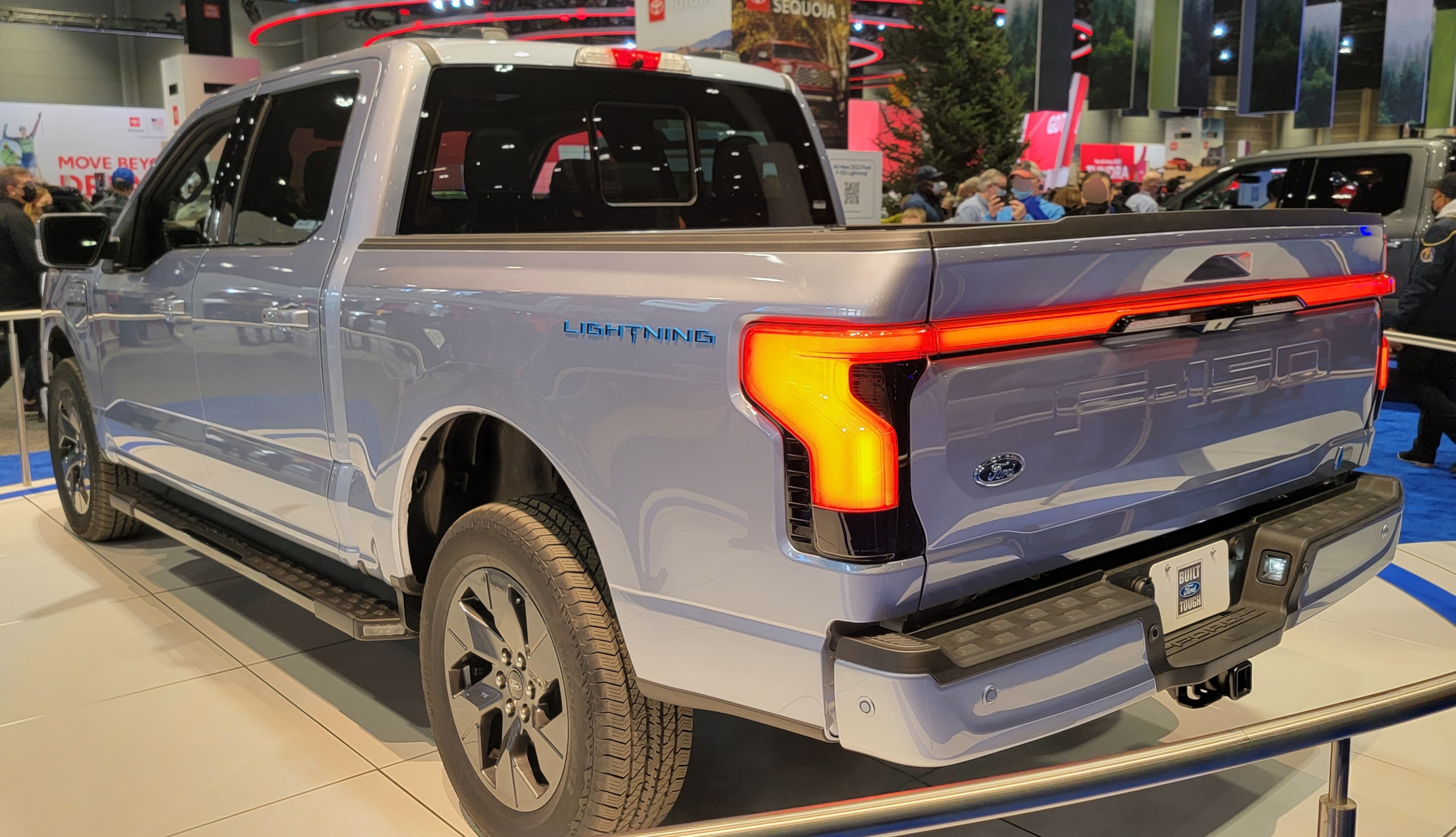
I'd say that we'll probably see the new EV
that's going to be built.
Where is that thing going to be built?
As if we cared about EVs,
but this one's supposed to be a real game changer
because it's only going to cost,
I don't believe this,
but they say it's going to be $30,000.
It's going to be,
I'm guessing about a mid-sized truck,
it's going to have a frunk.
You know what that is, right?
That's where the engine normally goes in a car
or a truck, it's just a trunk.
So a storage area, they call it a frunk
because it's in the front.
And then it's going to be a much lesser expensive,
much lesser, a lesser expensive battery
that is faster to charge and has longer range.
And so why are they putting it in a truck?
You know, a lot of people will be asking that question,
but you know, Ford sells more trucks
than anybody else does and they know how to build them.
And it's a very good niche for them to be in,
but there's just too much competition in the SUVs
and passenger cars and stuff like that.
So they decided to do another truck.
So now we'll have the Maverick,
whatever this thing's called,
the Lightning, which is the F-150 electric truck,
the Ranger,
and then the F-150, 250, 350 and on up.
So we're gonna be completely trucked up,
ready for this surging demand in electric vehicles.
I mean, Ford is convinced.
I mean, the CEO of Ford, not Chris Farley, Jim Farley.
Remember Chris Farley from Saturday Night Live,
real crazy guy, just loved him.
Yeah, his cousin is the CEO of Ford.
And he is completely sold on the EV Future.
Are you?
I'm not, but they say it's coming
and I'm gonna be a Ford dealer
and then when they send me these things,
I'm gonna have to find homes for them.
So, and I can, if it makes sense,
you know, if it's a good size vehicle,
you know, I just worry about all this technology stuff,
but you know, it's just where we are.
If it has really good range and it's cheap enough
where people can afford to buy it
and not have to pay for it for 84 months,
and if the resell it will hold up, you know,
that's the big problem I have with EVs right now
is you buy an EV and you lose half your value
when you drive it off the lot.
And that's why I recommend that you never buy one,
you lease it, you know, let somebody else take that risk.
And the manufacturers, all of them,
are subsidizing the leases.
You know, how you had that $7,500 tax credit
if you bought an EV, well, that's gone away.
So, in order for these automakers
to be able to sell vehicles in the most populous states,
which would include California and New York,
and then the surrounding, you know,
almost all of New England is this way,
and then the whole West Coast,
you know, Washington State and Oregon,
they all have very similar laws in guidelines
as far as EV mandates.
And that's where the market is.
And so, General Motors and Ford and Chrysler
and everybody else has to build EVs for those markets.
They don't care about Tennessee.
They're not worried about Oklahoma.
They know those people don't like EVs,
but there's enough people to do to make it important.
And you've got the uncertainty
from the political standpoint.
I mean, don't you know that if the Democrats
get back in power, that they're just gonna
change everything.
They're gonna slap back on the EV mandates.
They're gonna start incentivizing people to buy EVs.
They're more worried about climate change
and us pumping oil out of the ground
that, you know, they just gotta stop all that nonsense.
Get us back on the other track.
I'm kidding.
That's not how I feel.
But it won't be a problem, I guess,
if Trump wins the third and fourth
and maybe the fifth term.
I'm just kidding.
This is not a politically based show.
This is a show about cars.
And I'll get back on that here in just a minute.
Okay, folks, I am back.
Let's talk just a second about what I am seeing happen
to folks, especially the elderly,
when they go to some of these,
let's call them questionable car dealers
who really play a lot of games, had one yesterday.
They had been to one of my competitors,
I'm not gonna say whom, who it was,
but he was wanting me to meet,
or at least, or maybe beat,
which probably I would want him to beat him.
Wanted me to beat this deal that he had been presenting.
I said, well, send it to me.
Do you mind sending me a copy of the buyer's order?
And he said, sure.
So he took a picture of it and sent it to me.
And I looked it over and the first thing I saw was
that I knew what the MSRP was of the vehicle
he was trying to buy from me
and it was really the same as the MSRP from them.
But their starting price was $2,500 more than mine.
And I just wanted to make sure he understood that
because if he didn't read that contract closely,
he was just looking at the trade difference.
Now, I talk until I'm blue in the face
about the four targets that you have to hit
when you're buying a car.
You have to nail down each one of them separately.
If you do them simultaneously together,
then you're gonna get taken advantage of
because they're gonna switch you over to monthly payment
and you won't know what you're paying for the car.
I've talked about that a lot.
I hope that point has gotten through,
but you gotta negotiate the price,
you gotta negotiate the trade separately.
Then you look at the financing,
what the terms are of the loan,
the interest rate, the term and the amount financed.
Just all of that stuff,
you have to make sure it's the same
as what it is on your contract.
And then the aftermarket products, warranties,
paint sealant, fabric guard,
all those other little add-ons,
gap insurance.
But in this case, he was a cash buyer
and he is only looking at the bottom line.
He was paying, I can't remember,
$20,000 down, I believe,
and then he had the trade difference.
And that's what he was looking at.
He didn't look at the starting number,
didn't negotiate it,
didn't notice that it was $2,500 more than MSRP.
But guess what?
I noticed.
And so I told him that.
And he's a MyCard guru listener
and is just a regular customer of mine,
not car buyer,
but yeah, I mean he has bought vehicles from us,
but he's no, he is a regular customer of MyCard guru,
which that doesn't cost anything,
except time.
And in many cases, it's time well spent
because there are plenty of tips in here
that will save you a lot of money.
And as I say, I mean, when you make a,
I don't know, you spend too much on something
at Walmart, $5 too much, $10 too much, whatever,
you compare that to an automotive purchase mistake
that could cost you thousands of dollars.
I mean, I have seen people pay
or be charged $5,000 for an extended warranty product
that cost $1,500.
I mean, this is the kind of craziness that goes on
because people stop paying attention.
Once they've agreed to buy the car,
they've settled on a monthly payment,
which they have no clue what they're paying for the car.
They get into the finance office
and they absolutely go to sleep.
Not everybody, but some people do.
And the finance manager, he's just sitting there
rubbing his hands together saying,
oh boy, got me a payment buyer here.
Because he knows he can stick a lot
of these extra products in there
and it just, one might jack up your payment,
$12 a month, another $20 a month.
And then his trick is he'll break that down
to what it's actually costing you per day.
And it's just pennies a day, folks.
I mean, for what you would pay for a whopper
at Burger King, you can protect your family.
You mean it's the same price as a whopper?
Yes.
No, it's less than a whopper.
Okay, we'll take it.
Oh, it's a whopper, all right.
And you just gotta guard yourself.
If you got somebody that's vulnerable, an older person,
don't let them go in and buy a car by themselves.
Go with your mom, your dad, your uncle,
your next door neighbor, extra set of eyes,
extra set of ears, read the paperwork.
You know what we call those people in the car business
that come along with the car buyer?
They actually have a name.
They're called the quarterback
because most car dealers know that that quarterback
has a lot of influence over the buyer, the actual buyer.
And they're sometimes calling the shots.
So when we see somebody who's a quarterback,
you know, we talk as much to the quarterback
as we do to the customer
because they're the ones that are gonna say,
yeah, go ahead and do it.
And we wanna make sure that the quarterback
feels comfortable with us.
And that, you know, with what they're seeing.
But quarterback, you know, when you take somebody with you
and you introduce them
as the person that's gonna help you make your decision,
I would just go ahead and say,
and Mr. Salesman, he's my quarterback.
I would just go ahead and tell him that
because that salesperson knows what that means.
That means his profit is gonna go down.
So folks, if you want more tips,
best thing to do is just send me your email address,
text it to me at 423-552-2020
and say send me the Guru guidebook
because it's got so much stuff.
I'm getting ready to do an addendum to it,
an update here in a few days
because I left out a couple chapters
that really need to be in there.
And but you can get it now,
send it to you in a PDF form
and then I'll send you the updated or the addendum.
It's not like a window sticker,
extra window sticker on a car though.
I hate to even use the word addendum.
Let's call it a supplement.
I like that better.
So I'll send you the supplement,
but you gotta send me your information,
you gotta request it.
So 423-552-2020,
I wanna see a bunch of them in my text box this afternoon.
Okay, so I can send out a bunch of these
because they're hot off the presses
in the PDF electronic form.
You can also send an email to Lenny Lawson 2020
at gmail.com.
Let me know if you want it texted to you.
It'd be kind of hard to read on the phone,
but it's better to have an email address, okay?
Well, thanks for listening
and I'll see you next time.
About this episode
Lenny Lawson draws an intriguing parallel between car care and skincare, emphasizing the importance of regular maintenance for both. He shares personal anecdotes about neglecting his skin and how that mirrors the consequences of ignoring a vehicle's upkeep. The discussion covers detailing techniques, the impact of environmental factors on car paint, and the significance of using the right products for cleaning. Lenny also touches on the upcoming trends in electric vehicles and the importance of being cautious when buying cars, especially for vulnerable individuals. His practical advice aims to help listeners protect their investments.
Original notes
Email Lennie at [email protected]
My Car Guru Podcast
My Car Guru...Lennie Lawson
0:00
24:05