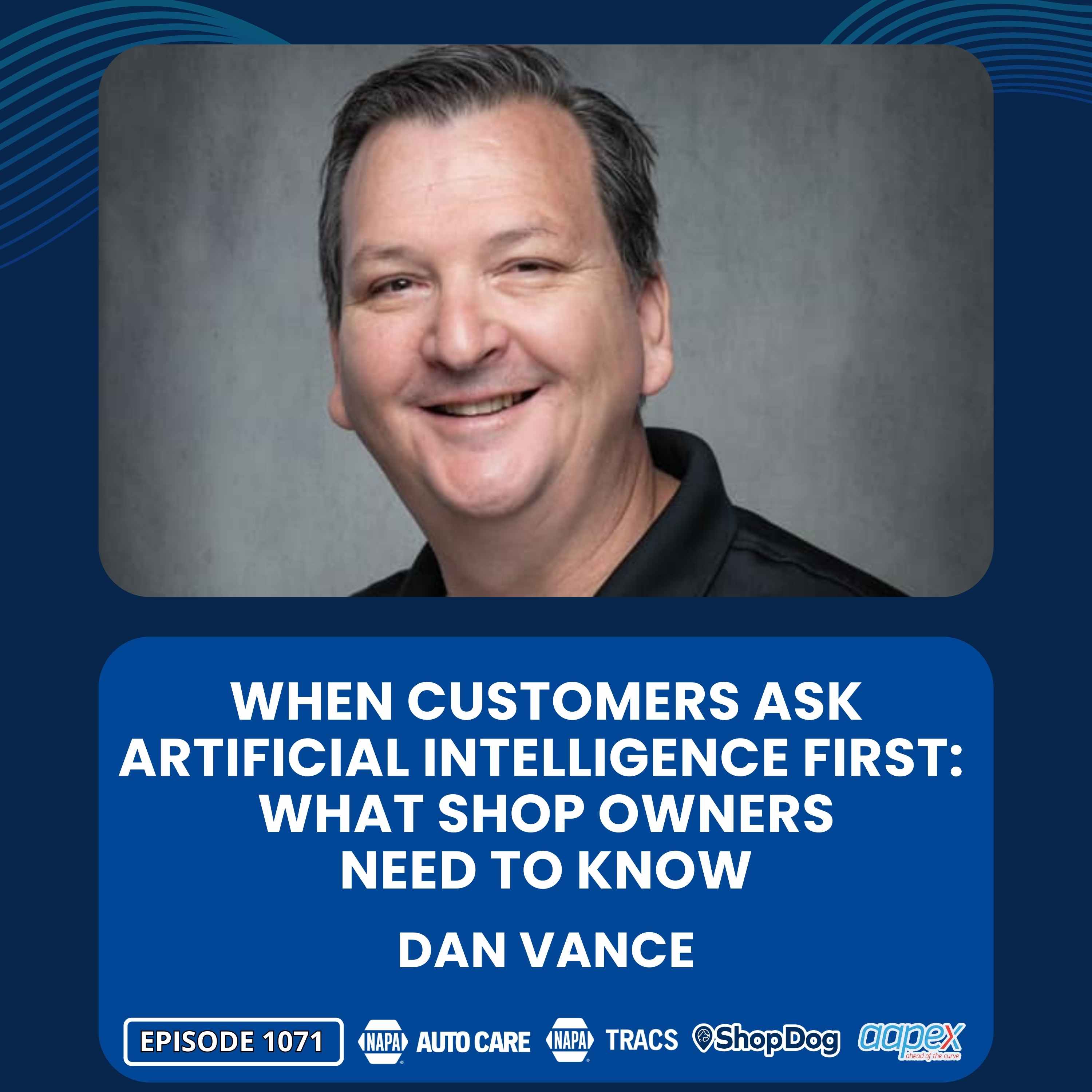
Dan Vance from Shop Dog Marketing discusses the transformative role of AI in the automotive repair industry. He emphasizes that while AI can enhance business operations, it’s crucial to remain skeptical of its outputs due to potential inaccuracies. The conversation covers how AI influences customer decision-making, the importance of trust in online interactions, and the evolving landscape of digital marketing. Vance also highlights the need for shop owners to adapt to these changes, leveraging AI as a tool for improved customer engagement and operational efficiency.
Thanks to our Partners, Shop Dog Marketing, NAPA Auto Care, and NAPA TRACSWatch Full Video Episode
Recorded live at AAPEX 2025, this episode features Dan Vance, CEO of Shop Dog Marketing, sharing how Artificial Intelligence is reshaping marketing, business strategy, and the auto repair industry. The conversation explores how AI is changing consumer behavior—from lightning fast website visits focused on trust signals to customers using AI for vehicle self-diagnosis and shop recommendations, with AI often presenting only a few options, strong branding and clear communication matter more than ever.
In the marketing sphere, Vance explains that attention spans are incredibly short. Website visitors typically spend just 20 seconds looking for clear trust indicators such as professionalism, strong reviews, warranties, online scheduling, and financing options. Visual cues communicate faster than text, while warm colors and photos of the team help build familiarity and trust. Online scheduling continues to grow in importance as many consumers prefer it over making a phone call.
Vance encourages shop owners to embrace AI as a “digital butler”—a tool that anticipates needs, explains marketing metrics in plain language, and helps owners show up more confident, shifting from reacting to problems to intentionally driving growth.
"Thank you to Dan Vance for being my guest here today from Shop Dog Marketing for sponsoring us to be here"
Shop Dog Marketing helps car repair shops advertise online so they can get more customers.
Shop Dog Marketing is a marketing firm that specializes in helping automotive repair shops increase their online visibility and attract more customers.
"Hey, did you know that Napa Tracks has on-site training plus six days a week support?"
It’s a program that teaches car repair workers how to do their jobs better, with help every week.
Napa Tracks is a training program offered by Napa AutoCare that provides on-site instruction and weekly support to help technicians improve their skills.
"The automotive industry is facing a technician shortage. But Napa AutoCare is stepped up with a powerful solution."
There aren't enough skilled mechanics to fix cars, so people have to wait longer or pay more for repairs.
A technician shortage refers to the lack of qualified automotive repair professionals available to service vehicles, leading to longer wait times and higher costs.
"But Napa AutoCare is stepped up with a powerful solution. The Napa AutoCare apprentice program. And the best part? It's completely free for members."
It's a training program where people learn how to fix cars over time, usually with a mentor and classroom lessons.
An apprentice program trains individuals in automotive repair skills through structured coursework and hands‑on experience, often leading to full technician roles.
"[1051.6s] We provide an extensive set of tools to increase and track profitability in real time.
[1057.6s] Napa Tracks offers the industry's best post sale support, hands down, and we train your people on site."
Post sale support means the help you get after buying a car or parts, like fixing problems and getting warranty service.
Post sale support refers to the services and assistance provided to customers after they have purchased a vehicle or parts, such as maintenance guidance, warranty claims, and technical support.
Select text to request an explanation
This is the Automotive Repair Podcast Network.
Thank you to Dan Vance for being my guest here today from Shop Dog Marketing for sponsoring us to be here, you know, as Dan says,
in our account are like ice cream, sweeten your revenue with Shop Dog Marketing, grab our free guide to learn how AI who we should talk about that Dan can drive more repair orders every day.
Don't miss out on the chance to boost your business download now at shopdogmarketing.com.
You know the technician shortage is real, but Napa AutoCare has a solution at no cost to members.
The Napa AutoCare apprentice program builds tomorrow's technicians through a two-year, nine-stage curriculum, learn more at member.napaautocare.com or talk to your Napa representative today.
Hey, did you know that Napa Tracks has on-site training plus six days a week support?
It all starts when a local representative meets with you to learn about your business and how you run it.
After all, it's your shop, so it's your choice.
Let us prove to you that Tracks is the single best shop management system in the business.
Find Napa Tracks on the web at NAPATRACS.com.
Let's meet Dan Vance, CEO Shop Dog Marketing. Hi, Dan.
Hello, hello.
Thanks for being such just a great partner with us and all the podcasts that shows that we do.
Thank you so much AI.
So he walks in the studio and I show him this book I'm reading called the AI Driven Leader from Jeff Woods.
And I told him I can't put it down.
And of course he is all about wanting to be sure that AI is integrated into your world and your life and the stuff that you do.
Yes. And I said, can we talk about that? He jumped up and down.
I did. I'm loving it. I think it's okay.
It's funny to me. There was a time when people thought indoor toilets was a bad idea. I'm glad they didn't prevail.
People are resistant to change. They've always been that way.
This is a change that I think is going to be just unbelievably great and we're just starting.
People that the internet was going to be creepy and take away all of our opportunities to do things.
And that's not been the case at all.
So AI is just going to be 10 times that I'm sure it's awesome.
And people thought that the indoor toilets wouldn't work in this book down.
It's talking an awful lot about using AI as a thought partner, not as a thought leader.
And I guess if we, like anything, you can ask anywhere on the internet you could talk to people you know.
They're going to give you their opinion or they're going to research information.
It doesn't mean that the information is right.
And that's been the biggest warning that anybody has told me or that I've read about AI is you can't trust it 100%.
There's no glitch in it. They technically call it hallucinations.
But essentially they're saying there's aspects of it where a little intentionally lied to you to give you a response in a timely manner.
So the famous one is the people that were doing a study and they asked for references in AI gave them references, which was books with authors and it gave them the chapter.
And the page number where the references were.
And when before they published, they actually went back and verified those books and they found out the books didn't exist.
But AI had given them all of that information to make it appear as though it was real.
So that's a known thing. It's getting better. You know that most people are saying with these version improvements, that's going away.
But nobody's saying it's gone. It's still a real thing.
That's a pitfall like you need to be aware that not everything that you're coming as sourced or sourced in a way that's accurate.
And so you have to kind of balance it right now. It's an experimental state.
Trust but verify me. Yeah, 100%.
I'm blown away by that. But the author goes on and this isn't about this book that says, listen, AI won't replace you.
AI will enhance you.
Yes.
I get this. There are certain jobs, certain thinking jobs that we have in our world, that AI might replace maybe three people into one.
And no, listen, even technology, the way these machines will make more items in less time.
Those are replacing, you know, factory floor workers. Yes.
You know, they always said, I always say, if you're really good at what you do, and you're smart, and you're a contributor,
and you're a loving kind of a person, if you're a team player, where the hell you gone?
You're not. You're on the team.
Anyway, I don't want to say the word. We bitch a lot about stuff that we don't know anything about, but maybe it's true.
There's been some culture changes like my uncle returned from World War II.
He got a job at the paper mill in Oregon, and they took pride in making the best paper they could possibly make.
And that was a kind of a motivation for everybody. Like, how do we make this paper better?
How do we make our company that we work for more money?
You know, let's make a difference in an impact where we find ourselves.
Let's bloom where we're planted.
And I love that.
And so, I think some of that's been lost, but people are going to have to find a way, I think,
and get back to this, like, the best value I can do is to get the best of myself, like you were saying.
And we definitely need to do that. And technology will never replace what comes out of us.
Our desire to make an impact, and to actually do it by giving the best of our sense.
Okay. So, you're heavily into helping shop owners create great, you know, website.
Yes. In marketing.
Yes.
Is AI going to become a component player and all of that?
Well, yes and no. Like, I mean, there's two sides of a website.
And I'm going to share some things that I'm working on that are not necessarily published just yet.
But we've been looking at studies that show that a user that comes to your website is probably going to be on your website for 20 seconds.
They're looking for something very specific. Like, can I trust this? Do they look like a professional place?
Do they have great reviews and warranty and a schedule online button?
And can I connect with them easily? And what if I need financing?
That's the kind of stuff they're looking for. They assume that you know how to change breaks.
They're not going to reach a break page.
They might look here about us.
Like, are you a family owned business or you're local or use some franchise shop and whatever.
So whatever they want to line up for, but they're not on there very long search engines on the other hand.
They spend a lot of time on your website and they read every single word on your website.
And we can see this in a platform that Google provides called Google search console.
And in there, it'll show you basically Google is saying, I'm going to reference Google because they're the primary search.
They'll say, Oh, we looked at your website and we scanned these pages, but that's all we're going to do.
These pages we scanned and we stored them in our server, which means they're planning on making those available in a search result because they're on their server there.
And I've looked at those pages and I've wondered what's the big factor for them? Why are they not like they're reading the page, but they're just saying it doesn't meet a criteria.
And this kind of all points back to AI. The criteria is high.
For example, if I have a doctor and he's writing things, it's really important that it's technically correct.
And then he's probably providing information that's not going to mislead people related to their health.
That's a high standard automotive repair probably doesn't think of themselves that way, but they're in the same standard like fix my breaks because that moment I have to hit them.
I want to stop.
Yeah.
So the thing is is that I think that it's really important that we put really good critical information on our websites.
It's going to help the search and understand that it's really great content.
20 seconds to figure out trust, professionalism, financing, reviews.
Yeah, I'm blown away that someone can collect all of that in an average of 20 seconds.
Yeah.
And so your job with the thumb because most of them are on their cell phone.
So it's just this little movement with my thumb and they're interpreting it really quickly.
And we visually take things in like images we can translate much, much faster than we can text.
Like if I have a badge of a warranty that communicates much faster.
So there's tricks to like how I can give them more information and in that smaller space of time.
Dan, how do I get trust in a quick view?
Well, for a lot of these guys, it's alignment like colors.
Is it alignment like how does it emotionally make me feel?
That's a trust factor.
We rely heavily on social proof, which is reviews.
What color is trust?
Warm.
Warm color.
Yeah.
Is I'm colored blind?
Will it matter to me?
Well, yeah, it would make a difference for you.
All right.
Yeah.
But websites that have good color blend.
They look professional.
I got a picture of their shop.
They have a picture of them.
They're not doing the fig lift thing.
They're all smiling.
Those all build trust.
They're layers of trust.
A trust trust.
What if on the first page or they call it above the fold?
And I don't know what above the fold is on mobile.
I don't.
But if there was a picture of the team in front of the shop, professionally done.
Yes.
Is that important?
A 100%.
Yeah.
We want to connect and I bet you many people will look at those picture.
And they want to know like, do I know any of these people?
Ah.
Blow it up.
Curious.
Yeah.
They want it dinner the other night.
Yeah.
There's a more viewing time.
Yes.
Now, 26 is the average.
20 seconds is the average.
But people will spend more time.
And they'll get more engaged.
And we want to spend enough time that they'll hit the call button or schedule.
Right.
That's why they came to your website.
So how much of that is being done today?
Call and schedule.
Online scheduling is growing.
Like, we're seeing trends that are showing that it's actually increasing year-over-year.
So people are becoming more and more comfortable with that.
Any idea that percentage of people at this time?
They don't know the numbers.
Okay.
But I do know that that's a growing area.
Like, when we see websites without, that's our first question.
It was why?
You know, if you have the old contact fill out in form.
You're missing opportunities because people don't want to.
They'd rather do that than call you.
Like, oh, okay.
I think I'm going to do business.
So do people really rely on what they see on a Google search?
More important today than they do on a good website?
So this is an interesting thing.
This is a trend that we're seeing shift with AI because I want to insert this as much as I can.
Users are going to the AI model first.
And they're saying, well, I'm driving my car around and I have this funny smell like I'm not sure what it is.
And AI will say, well, it's probably this, this or this.
And their next response is, who in my area does this?
Who fixes this?
And AI will give them options.
Sometimes it's one or two.
And think about the like the impact that has like if I do a Google search on Google Maps,
there's going to be at least 20 businesses there with reviews and locations.
But now the AI has given me two versions.
And a lot of people will just call one of those two versions.
The trust factor with the AI is growing so much.
They feel more confident because now there's a trust bridge that's been resolved like they.
I know what the problem is.
But damn, they're trusting AI and no one knows why.
I'm sorry, but if how is AI?
The God of God's determining what two shops are going to see.
Yeah, it's ease of use.
That's a big one.
It's helping them know what the problem is because that's a huge stress factor like they're not sure if the shop is being honest with them about what the problem is.
And those two factors are driving that.
That's a segment of the AI users.
There's another bigger segment of those people that will do basically one of two things.
So ask our friends and neighbors, but most of them will do a Google search.
And instead of letting Google sort the listings, they're sorting the listings based on review stars and how many reviews they have.
Because consumers are associating those as the best possible shops to call.
This is so fascinating to me because the reality of the way we used to be doing things even a year ago are changing those dynamics of changing.
We understand that now.
And AI is influencing people.
It's having an impact in their decision making it's having an impact because they're using it for other things.
And the more they use it, they like it and trust it.
That's the old thing, right?
We want people to know us to like us and to trust us.
Yes.
That's happening with an AI.
So instead of them going to Google, they're going to chat and asking the same questions they would do with Google.
And is chat and Google getting the information from the same places?
Is chat doing the kind of research or scanning that Google is doing to websites?
So when these language models got started, they used open source, which was basically everything they could grab on the internet.
And there's a lot of places that didn't like that idea like newspapers.
They felt like their content was copyrighted and you shouldn't be able to use that.
But there's a segment of the population of those large tech companies that just feel like,
hey, open source means open source, all of this information is in that public domain.
And it's available for anybody to utilize.
So if New York Times had articles published, they don't want anybody to touch and see it, grab it, get it.
Right. They want to pay portal related to that, but they also want copyright type to it.
But there's a segment of the population says, no, the internet's open source, like all that information is available.
And that's where AI really came from was grabbing as much of that existing content that's in the internet space.
About five years ago, I attended a seminar where they talked about how many blogs there are on the internet at the time.
And the question was, like, how many blogs do you think there are?
And like a billion, you know, worldwide globally, everybody writing blogs to rank an SEO,
and the writing them every single week and every single month.
And some places write 60 blogs a week.
How many blogs are there?
How much of their content is unique and different?
And you start thinking, well, what is that number?
Well, maybe it's a trillion blogs.
I mean, there is a massive amount of content that's been written.
And you take the power of AI, which is like thousands of computers in the room and it smashes all that information up.
And it starts to kind of filter it out.
Or if I could say, like, purify it into more streamlined ends.
That's a powerful word purify.
Yeah. Wow.
So they've been all of this raw material comes in and it comes out.
And that's what we're experiencing.
So now the language model is like, yeah, I can source this out.
No problem.
And it gives you the links where it sources it.
But it also can personalize it to me because it's getting to know me better.
Hey, you know, it's no secret.
The automotive industry is facing a technician shortage.
But Napa AutoCare is stepped up with a powerful solution.
The Napa AutoCare apprentice program.
And the best part?
It's completely free for members.
This program was pioneered by shop owners Pete McNeil and master technician Jake Sorenson at McNeil's AutoCare in Sandy, Utah.
They recognize that waiting for skilled technicians to appear wasn't an option.
So they built a program to grow their own.
By recruiting motivated individuals with the right passion and attitude and providing them with structured training,
they approved that apprentices could become the next generation of skilled certified technicians.
The program features a comprehensive nine-stage curriculum with in-depth classroom videos, instructor led Napa AutoTech classes,
web-based courses, and hands-on training with a mentor.
Apprentices move at their own pace, typically completing the program within two years.
Graduates earn four ASC certifications, the G1, A4, A5, and air conditioning.
And are officially registered with the Department of Labor as Journey Workers Automotive Technicians.
And here's the business benefit.
As apprentices gain skills, they generate billable hours.
Often boosting shop profits is early as stage five.
Plus Napa now offers a new apprentice toolkit, developed with Carlisle tools at an exclusive price,
helping break down one of the biggest barriers for new technicians, the cost of tools.
Together, Napa AutoCare and your shop can tackle the technician shortage head-on.
Start now, grow your own talent and build your bench for the future.
Visit member.napaautocare.com or contact your Napa representative today and get started with your apprentice program.
Let's face it, your shop management system is the single most important tool in your shop, period.
Napa Tracks was built from the ground up to make your business more profitable and efficient.
We provide an extensive set of tools to increase and track profitability in real time.
Napa Tracks offers the industry's best post sale support, hands down, and we train your people on site.
Yep, on site, and we offer remote refresher training ten times a week.
And customer support is open, six days a week.
Give us a call, visit the website, or join our Facebook community today to learn more.
We'll prove to you that Tracks is the single best shop management system in the business.
Napa Tracks is always customized and tailored for you, whether you're a one-man shop or a large multi-bay or multi-location company.
After all, it's your shop.
So, it's your choice.
Visit us on the web at napatracks.napa.com
I'm fascinated, by the way, and I hope my listener is too.
It's my swish-cheezing brain here.
Yeah.
If I went to Google and said automotive repair and you're me, and I really don't care, I know I've got a problem.
I just got to see somebody.
Would I go to AI and say the same thing?
Or am I going to get granular like my car smells like this?
Can you just go to AI and say auto repair and you're me?
Yeah. What are you going to get?
Still, too.
Most likely, you'll get two to four, but that's it.
And there's no reviews.
AI won't provide you reviews.
At least the last time I did it, I didn't see any reviews.
And it didn't have any other qualifying things.
AI just served up something that it felt like was personalized for me based on what it knows.
What it knows about you.
Yes.
So, it's learning all about you.
Yes.
Is Google doing the same thing?
Does 100%.
I think that when they talk about these AI tools like chat or Gemini or some of these others,
they're language model.
They're in a research and understanding mode.
And the objective is personalization.
LLMs are called right, large language models.
Yes.
What else could it be?
Like we know the search engines that have been using personalization as much as they can.
Like I've had people in a group like even eight years ago.
From all over the country, we sat down, we pulled out our phones, we all did a search for auto-repairing near me.
And maybe three out of ten had the same identical search results.
But everybody else got different search results.
Well, why?
The search results should be the same.
The keyword search in a local area.
It was by you.
And it was personalized.
Maybe I have an app on my Ford truck.
And the search engine knows.
And so I get search results that are probably more Ford focused in their content distribution of the search engine.
That's been a real long time.
There's only one word I can say scary.
Yeah.
So AI is just magnified 10 times.
10 times.
So we have to learn.
You have to learn at shop dog marketing.
How to integrate or help the shop owner deal with these two different.
I don't want to call Google a large language model, but it almost is.
Right?
And the check comes out and it says, we're really not, but we are.
Yeah.
They all are.
And chance part of the, you know, the being in the Yahoo side of the search engine world.
And then, you know, Gemini is the Google version.
They have the same objective, which is to right now.
I don't know if you saw this, but Google reported their stock is up 4%.
And it's all tied directly to not Google ads, but AI.
So AI is profitable and it's making them money.
So they're going to double down on that.
And it's only a bit bigger from their perspective, like more and more of that.
For us as users, I think there's just this two things.
One is that you have to know like how it's working so that you can't be manipulated
because you didn't know.
Like it's an awareness thing.
Okay.
There's things about this that I have to understand.
And there's things you should know that are pretty well known like the hallucinations.
Like it doesn't always tell the truth.
If you know those two factors and you use it in a way that helps you do discovery or brainstorm or mashup data.
It's amazing.
It's unbelievably amazing.
We took a full year of phone calls.
We attract 65,000 phone calls with recordings.
And we downloaded all of that.
It took like a day and a half just to download it.
It was just this massive amount of data.
And we put it in these files so that we could upload it into chat to you.
And we use chat.
That's the one we love to use.
I put it in there into chat and I said, okay, here's 65,000 phone calls.
I need them sorted by answered, unanswered, hung up, you know, all these different categories.
You know how long it took?
Two seconds.
No.
Yeah.
64,000 phone calls.
Yeah.
So I asked it.
I said, are you sure this is right because this only took you two seconds.
And it basically said, that's easy.
It only took me two seconds.
So it says, okay, well, I'm going to try to make this harder then.
And I started diving deeper with my prompts, you know, to try to create a scenario where it would go slower.
I failed if that objective.
Oh, my God.
Really?
I love the fact that you were there challenging.
I was, I was just like, this is weird.
Like, you know, I got 65,000 phone calls and you just spit this information out.
It's so powerful.
It's run by, you know, a room of 20,000 computers.
It's just the chips on these things are amazing.
And nothing's quantum yet.
Yeah.
And it's just.
Wait till we get quantum.
It'll take quarter of a second.
I can't wait.
You know, it's going to provide so many things for us that, you know, are kind of a pain.
Like, wouldn't it be great?
And we had enhanced driving capacities because it's computer power that's working even faster for us.
So we just got to get out of its way almost.
I think so.
Like, we have to.
We got to respect it.
We have to learn it.
We don't want to be in the group of the toilet haters.
Like, we don't want to do that.
Listen, we want to embrace it, but we also want to be careful, smart.
Yeah.
We can't jump at every answer and say, see, I told you.
Yes.
Do we need to be always be skeptical of what we get back?
I love what I'm getting from it.
Yeah.
It's really good stuff.
Yes.
But sometimes it makes me look or feel smarter than what I wrote.
And I don't want that to be.
Now that isn't that interesting.
Yeah.
That's a built-in programming feature.
It has a cadence.
Like, you probably have notices.
Like, it'll respond to you.
Like, that's a really great insight.
Super, like, you really came up with an angle that most people don't see.
And it like validates us.
Like, you're asking really great questions.
And that's so perceptive.
And then it will like, essentially, it'll repeat back to you what you asked it.
Right.
And then it'll give you a response.
So it has a cadence.
It's a programming cadence.
And now that I've said that people are going to recognize that that's happening to them.
That's okay.
I've never asked it to dumb it down yet.
No, but you could say, hey, get rid of the emojis.
I don't need those in the extra moment points.
And I don't need you to, you know, give me the super validation when you respond.
Like, let's just stay on to it.
Like, you could ask it to do that.
But nobody does.
Because we kind of love that.
Oh, yeah.
I've never thought of that.
I said too.
Oh, look at that big time.
Yeah.
Yeah.
So it's really cool.
It's cool stuff.
It's emerging.
And it's moving along very fast.
And I think for our auto shop industry, like, not to be afraid of it.
And to use it and to not be afraid to put data in there.
One of the things we run across often is the metrics that the internet's always used.
That shop owners are just kind of like, what does this mean really?
Like, all I have, somebody thinking about doing business with this,
asked me to look at their reporting and tell them what it says.
And often I'm just like, you should know what your reporting is telling you.
You shouldn't ask me.
I'm a stranger.
And I have my own motives.
You know, who knows what I say to you about that reporting?
Report your showing.
I think AI is a place for them to kind of do some self discovery where they could say to AI.
What does an impression really mean?
And what does that metric mean to my business?
How does it equate to my business?
What's a baseline?
So I'm off.
I'm improving or not.
Yes.
Again, reading this book.
What's coming back to me?
The AI driven leader by Jeff Woods, GE OFF Woods.
He's trying to teach me his reader how to understand what you can ask AI.
And give some great examples of working some strategic plans with financial numbers.
And you just said this, put data in there.
You just said those words.
And it made me think about some of his examples and how mind blowing when he restricted AI.
Don't do this, but do this.
Yes.
And you know what?
As the average individual, I would have never known that you could be in total control of AI based on what you ask.
How you ask it and what you ask for back.
Yes.
Yes.
Yes.
Okay.
So as an industry, we have to temper this love that we have for AI.
It's not necessarily going to make our jobs easier and may make it.
I don't want to say smarter.
But one of the things you talk about in here, it's a time saver if you get it right.
Yeah.
I also see it as empowering because in my lifetime, there's been things where I'm just like,
I don't know what that means and I don't know where to go to find the answer about what that really means.
But AI is empowering to me now because I can ask AI and something like,
what does an impression mean as a digital metric?
The answer is going to be pretty much 100% truthful every single time because it's such a standard thing.
I can trust that answer and then I can expand on it.
Well, help me understand how that applies to my business and the marketing I'm doing currently.
And then you can just go from there and keep asking questions like,
am I performing better than standards?
What can I do that might improve performance?
And then when you have meetings with your marketing partner, you have conversations not about
my sales are off or we didn't get enough car counts.
It's more about how do we create more visibility digital and visibility in such a way that creates more interest and engagement in us that drives that traffic down.
And the shop owner can come better prepared and feeling more confident about, I have this.
I've got control.
I can really drive this thing, drive these results.
Well, I'm with Dan Vance CEO of shop dog marketing.
You just mentioned this.
It just hit me so hard here.
I have Dan is my marketing partner.
And yet I'm going over here to AI and we're talking about this kind of stuff.
So if you're a marketing partner for me in this marketing web based world,
but I'm still going to chat.
You take all of this, you take the Dan stuff, you take the AI stuff,
and you as the CEO discuss it probably.
I mean, who knows you can't go back and discuss it with AI.
I know you can.
I'm learning how you can.
You discuss it with the human being Dan who's doing the same thing over here.
It's almost like there's this incredible partnership going on,
even though this isn't a human being,
but it seems to be acting like one.
Yes.
A more and more so that's where it's going like,
that great.
We're going to have our own digital butler that knows us and everything about it
anticipates everything that we want to do.
It's going to make life so more delicious
because we have that experience moving forward.
Your way with words is incredible.
Well, thank you.
Honestly, God, digital butler.
Yes.
Delicious.
Yes.
It's going to be, I'm telling you.
Now, the other thing is like if you're having a meeting with your marketing partner
and you say, I did some research on AI and this is what I'm learning
and I want to discuss how do we create more visible visibility
in the search engines?
And your marketing partner gets a little tight-lipped or they're offended
or they tell you not to do that.
Man, what an insight.
You just found for yourself because they should be wrapping their arms around that
and asking you questions like, tell me how you did that.
What kind of prompts did you use?
Tell me more about what you did to get that discovery.
They should be wanting to be part of that process
because there should be learning from that experience too.
I have shop owners and say, I did this and I'm just like,
oh, tell me how you did that.
I want to know, I want to be able to do that.
I'm learning too.
I want to create those experiences.
So AI is, I think it's a tool that we've never really had before.
Like I could do a search like, what does this really mean?
And I would get 30 websites and then I got to dig into the websites
and I got to read it and then I got to figure out I got to put all this stuff.
I got to really put a lot of thinking power in there.
That was then today.
I put it into AI in two seconds.
I have understand and a capacity to be able to drive my marketing performance
based on the reality of what it takes.
Car count is way down here at the bottom.
What do I do right now to increase my visibility?
Okay, you see me.
Why are you not clicking on that?
Oh, if I change these words, now you'd love to click on.
And all of that is driven by the auto shop owner and says,
I'm going to use AI.
I understand what these metrics are, how they work
and how I can manipulate them for better performance.
And then all of a sudden they have 10 times or 20 times more cars
than they had before because they're involved now in that earlier process.
They made some smart decisions along the way.
And AI helped guide them if they were thinking right or wrong.
Carmen, you know these guys are problem solvers.
These auto shop repair people are problem solvers.
And it's such a natural fit to them.
They want to solve the problem.
They want to feel good like that.
You four are like, yes, I did this.
And it's all there with AI.
It'll help you along the way to do.
So embrace AI, learn from AI, being control of AI.
Yes.
That's what I'm learning from the book.
Yes.
You have to tell it what you want.
And again, can't put that book down.
It's so cool.
I read it more on the plane when I go home.
But you and I need to almost do an AI series together.
Oh, yeah, because it's moving so fast.
Things are changing so much.
And I'm having a hard time keeping up with all the things
that are happening truthfully.
They just rolled out a big story about the behavioral,
which I spoke to a little bit earlier,
where they did a legitimate study.
They had the eyeglasses and they watched how people interacted with search
and things that they were doing that would be really odd to us.
Like people really are doing it that way.
But so there's interesting things.
But for people listening to this podcast,
the one thing AI is doing that is interesting to me is that it's going back
and it's forcing users to go back to relying more on traditional marketing
that they had long forgotten like phone books,
newspapers and mass media as a more of a personalized way of me reaching
into the marketplace upstream, like building my brand.
And anybody that has questions about whether that's a legitimate thing
or not just ask Cracker Bill, right?
Build your brand.
If I can build my brand in my local community,
if I can go upstream even more as people use AI
and they're using AI in the way that we're talking about,
they're going to remember you.
I've known this shop.
And that association is part of our biology right,
self-preservation.
I feel good about these guys for some reason I'm going with them
because I worked on my branding upstream.
So there's layers of marketing that we're also like going back to
and revisiting because it's having a bigger application
to how we're being chosen in the marketplace today.
All this is AI.
This change of that's,
we didn't know that a year ago that that's what's happening.
So if you're living your life doing your thing,
working your butt off and you didn't know that there was a survey
about what people do with their eyes and how they search
and you didn't use AI to help you determine what improvements
you could make in your world because of what they know
that you don't shame on you.
Yeah.
And we got to be using it more.
That's a really interesting dynamic.
Wow.
I love it.
Yeah.
All right.
Because he loves it.
We have to have him back.
Yeah.
Yeah, wait to hear Dan talk the next series on.
Anyway, Dan Vance, CEO, shop dog marketing.
This was mind blowing episode.
I probably couldn't keep up with you all the way through,
but it was brilliant.
Oh, thank you so much.
Thank you, sir.
Thank you.
Thanks for being on board to listen and learn
from the premier automotive repair business podcast,
Remarkable Results Radio.
Get your episodic education on the ARPN listening app
at automotiverepairpodcastnetwork.com.
Also, enjoy the podcast on our Carm Capriotto YouTube channel.
Carm is all for advancing the professional automotive service industry.
Until next time.
Request an explanation for:
Request an Explanation
Heard something you'd like explained? We'll add it to this episode.
Sign in to request explanations for terms you heard.
Want to learn more?
Browse our glossary for plain-English explanations of automotive terms, jargon, and concepts.
See something that's not quite right? Our annotations are AI-generated and can sometimes miss the mark.
Click the flag icon on any annotation to suggest a correction.