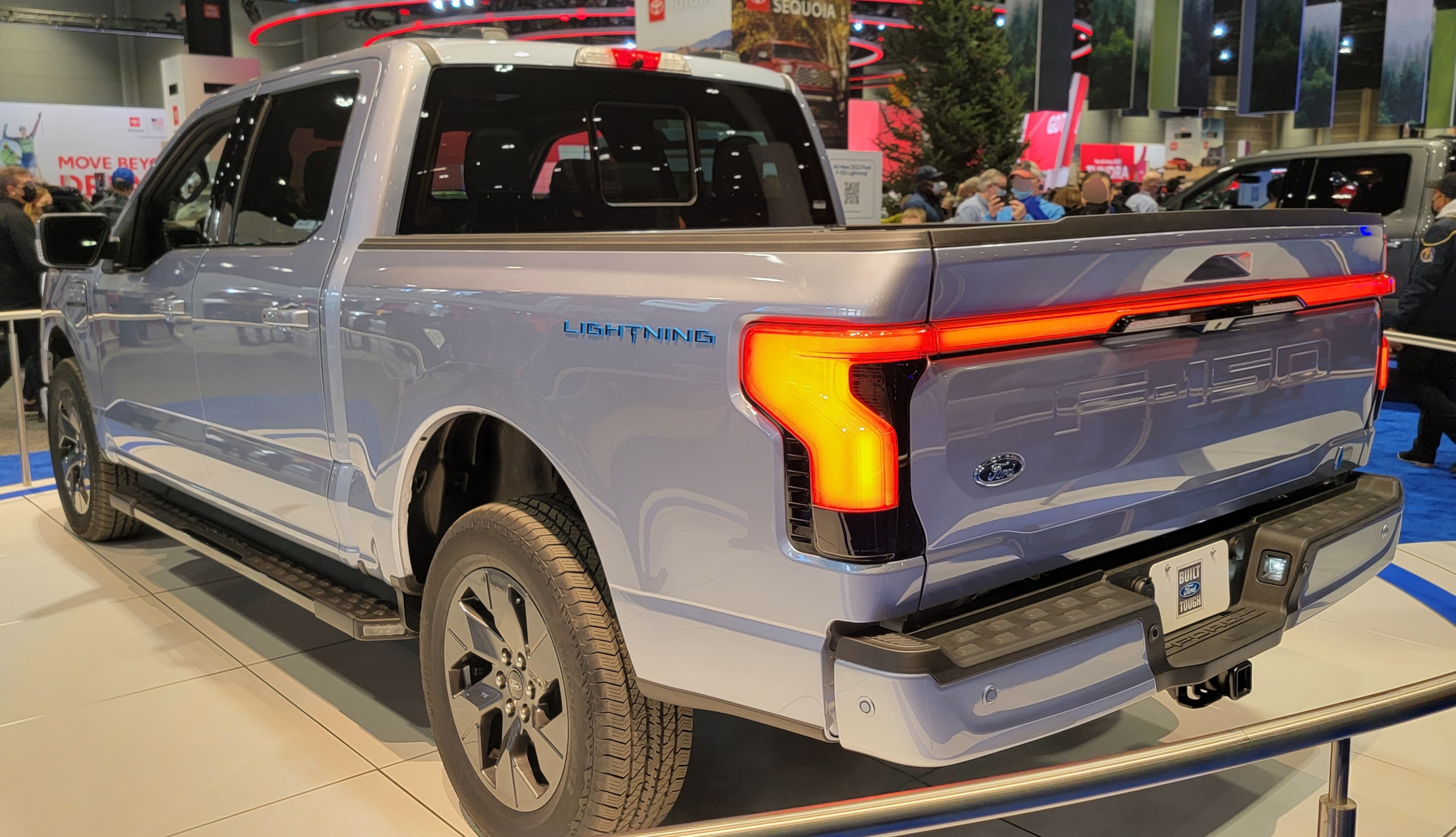
The Ford F-150 is a large pickup truck made for hauling, towing, and daily use. People talk about it a lot because Ford also makes high-performance versions for off-road driving. The podcast mentions it when discussing possible future competitors to that kind of truck.
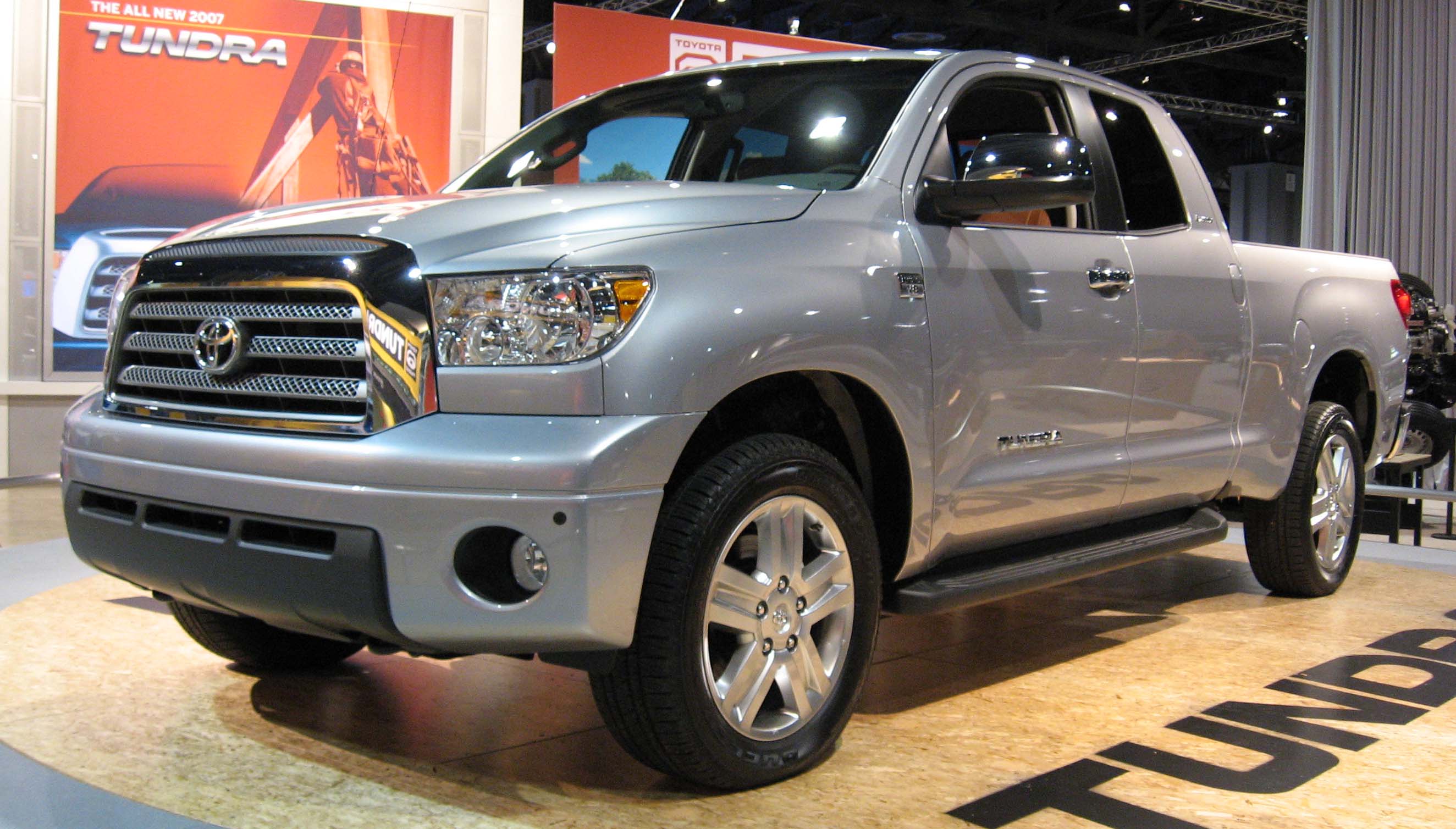
The Toyota Tundra is a large pickup truck made for tasks like towing and carrying things. It’s a direct competitor to other big trucks in the same category. The episode mentions it while talking about how Toyota is competing in that space.
R&D is how companies figure out what works and what doesn’t. They test ideas—sometimes using race or prototype vehicles—so they can improve the final product you can buy.
The Mint 400 is a tough off-road race in the Nevada desert. It’s known for rough ground and it really tests whether a vehicle can survive and keep going.
The race is in the Nevada desert near Las Vegas. That area has sand, rocks, and rough trails, so the truck has to handle a lot of different kinds of bumps.
A pre-production vehicle is an early version of a car or truck made before it goes on sale. Engineers use it to test things and make sure everything works reliably.
“Side-by-side” (SxS) refers to off-road vehicles with two seats and a roll cage, commonly used in desert racing and off-road series. The transcript uses it to distinguish different vehicle types and their ability to run the full required laps.
When you slow down, regenerative braking helps turn some of that motion into electricity. That electricity goes back into the battery so you can use it again later.
Ground clearance is how much space your truck has between the bottom and the road. If you have more of it, you’re less likely to hit rocks or ruts underneath.
A flat tire is when your tire goes low on air. It’s a big problem because it slows you down and you have to stop to fix or replace the tire.
Term
shooting head forms at hoods
In crash testing, they use special dummy heads to see what happens when someone’s head hits the front of a car. Testing hoods helps engineers design the front to reduce injury in pedestrian-type impacts.
Driving in the dark is harder because you can’t see the terrain as clearly. It usually means you have to drive more carefully and depend more on guidance.
Pre-running is when you drive the course before the race to learn where the bumps and hazards are. It helps you go faster later because you’re not guessing.
General Motors is the company that makes brands like Chevrolet. In this discussion, they’re being called out for needing more factory-built off-road/wide-body truck options.
“Chevy” means Chevrolet. The speaker is pointing out that Chevrolet shows up in off-road racing, which helps prove their trucks and sell the idea to buyers.
Rock crawling is off-roading where you go very slowly over rocks and obstacles. The goal is to keep traction and control so you can climb and maneuver without spinning out.
TRD stands for Toyota Racing Development. It’s Toyota’s performance and racing brand, and it usually means the truck has off-road or durability-focused upgrades.
The Ford Mustang is Ford’s famous sports car. The conversation is joking/speculating about whether Ford could make a Mustang that’s built for off-road adventures too.
“37s” means very large tires—about 37 inches tall. Bigger tires help with ground clearance for off-roading, but they often require suspension and fitment changes.
The hosts are pointing out that Hyundai is willing to try new, bold ideas. They’re saying Hyundai (and related brands) will test concepts to see what catches on.
It means trying new ideas and seeing what people actually respond to. In car terms, that often starts with concepts or prototypes before committing to production.
Volvo makes big trucks that are used for hauling goods. The hosts are saying they went to a Volvo semi-truck event where they got to learn or experience how those trucks work.
A semi truck is a large truck that pulls a trailer, usually for long trips. It’s the kind of vehicle you see hauling freight across states.
LIVE
If you felt stuck trying to lose weight, you're not alone.
Enter Weight Loss by Hers.
It's designed to support you in reaching your goals.
And Hers now offers access to an affordable range of FDA-approved GLP-1 medications, including
the WeGovi pill and the WeGovi pen.
With WeGovi at Hers, lose up to 20% or more of your body weight when combined with diet
and exercise.
It helps you regulate your appetite, eat less, and keep weight off.
Plus, WeGovi is the first GLP-1 available in a pill, so there are no needles needed.
Everything is 100% online through Hers.
You'll connect with a licensed provider who will determine if treatment is right for you.
If prescribed, your medication is delivered right to your door.
No insurance necessary.
And it doesn't stop there.
Weight Loss by Hers goes beyond medication by offering access to 24-7 messaging with
your care team and tons of in-app lifestyle and nutrition tips, like recipes, meal plans,
fitness videos, sleep content, and more.
Even better, with a range of affordable GLP-1 options, Hers makes it simple to find an approach
that fits your needs and your budget if eligible.
You'll get a treatment plan personalized to you and unlimited dosage changes as needed.
It's Weight Loss designed to work with your life.
Ready to reach your goals?
Visit forhurs.com slash women to get personalized, affordable care that gets you.
That's F-O-R-H-E-R-S dot com slash women.
Forhurs.com slash women.
Weight Loss by Hers is not available in all 50 states.
WeGovi is the registered trademark of Novo Nordisk AS.
To get started and learn more, including important safety information, WeGovi clinical
study information and restrictions, visit forhurs.com.
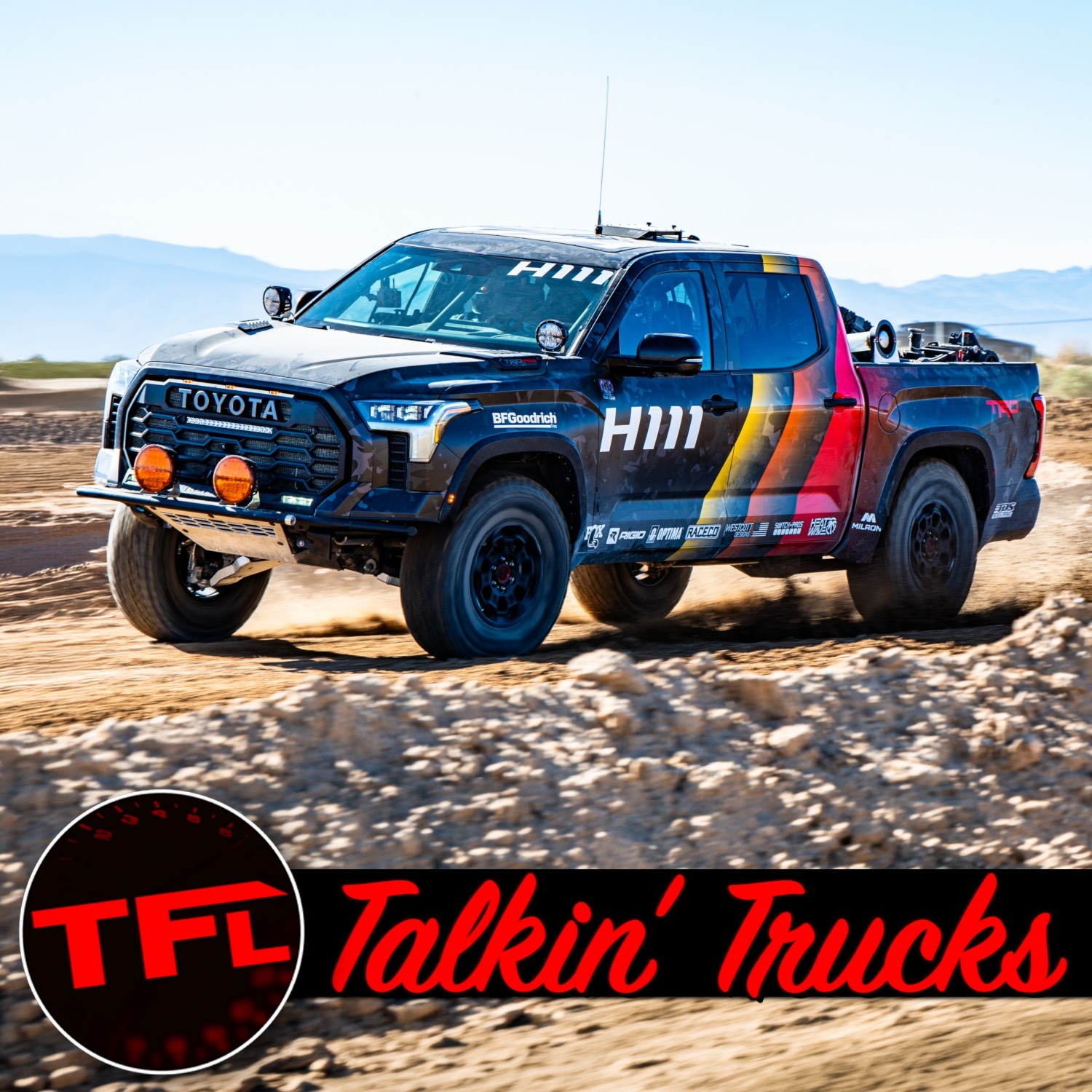
Some say that Toyota is working on a true Ford F-150 Raptor competitor, maybe even a
Remt-RX competitor, with the next TRD Hammer because they trademarked that name.
Yeah, that's right.
Some people are saying that.
We are some of those people.
Well, we are hoping for that.
We are hoping for it.
And it's not just talk.
There is some evidence for it, especially recently having had the Mint 400 just a couple
weeks ago where Toyota was competing with the Tundra.
Yeah, but Toyota was actually nice enough to allow me to speak to one of the people
who are really involved in their project with Tundra Racing because this is a factory
effort.
You know, sometimes manufacturers take a vehicle, they kind of hand it off to a racing team,
which is kind of a separate unit, right?
And then those racing teams are actually racing that vehicle.
But what Toyota did this time is actually some of the engineers that are actually designing
and building these vehicles as we speak were actually involved in this project.
And I got to talk to one of them, Skyler Watson.
And what's cool is that guys like Skyler aren't involved in it in the sense that they're maybe
standing there on the sidelines, taking photos and posting them.
And looking at data.
As their race truck goes by, he's actually in the truck as it's racing, so he's directly
involved in this program and the actual running of the truck, which is great news because
hands-on activity like that in racing with these vehicles from the people that are actually
engineering and designing them and directly involved in bringing these vehicles to market,
that's a good combination.
That's the kind of thing that helps us get toward more and more extreme and rugged versions
of these trucks from the factory, which is what we want.
Exactly, because it's all about enthusiasm, right?
Yeah.
And yes, there will be those work trucks and everything like that.
But we also care about enthusiasts and we are enthusiasts.
One as much as we would like to believe that we've got some sway to talk to some of these
guys, the engineers and marketing teams and everybody to say, hey, wouldn't it be cool
if you guys make an even more extreme version of your pickup truck that's 100% off-road
focused?
The people that are actually designing the trucks, they've got actually a lot of sway
with the company, so they're the ones that can make it happen.
Yeah, so I have an interview, a very detailed interview with Scott Watson where I ask him
a bunch of questions because I wanted to know why do this in the first place.
Yeah.
Is this just a weak connectivity for these guys?
Or is it some development, some research and development toward actually making something
that a regular customer could go out and buy?
Yeah, and actually, what was inside of this truck?
Did they soup it up?
Did they change it?
Did they, you know, what did they do with this Tundra?
Because they started with the TRD Pro and also, I mean, there's many topics.
I asked them about the side-by-side, the scion, the concept they showed, because they're
apparently they want to go into the side-by-side business also.
Which kind of makes sense.
Obviously, that's a big side step from what they're typically doing, but obviously, off-road
space is a huge space.
And it's especially interesting to talk to them about some of the things that they had
to do to this Tundra to compete in the Mint 400, because if you're not aware, the Mint
400 is a pretty rugged race.
It is not an easy competition to just take a factory vehicle off of the assembly line
and immediately hurl it into a competition like that.
Yeah.
People always talk about Baja, 1000, Baja 500, many other, those signature races.
Mint 400 is also no picnic.
Yeah.
I mean, it's in the Nevada desert, near Las Vegas, Nevada.
And so, there's everything out there.
There's sandy washes, there's big boulders and rocks, everything.
Well, then on the subject of Deseracing and Toyotas, you've met more than once, Ivan, Iron
Man Stewart.
I was fortunate to meet him twice.
Who is an icon, not just in racing Toyotas, but in off-road racing and racing period.
And one of the big things about this type of racing is that it's not all about absolutely
how fast can you go.
It's how fast can you go while also sustaining your vehicle.
Surviving.
Yeah, because you got to consider the punishment that the machine itself is taking.
So it takes a great deal of awareness, not only for the racing and for the environment
that you're in, but also for the status and the longevity of your vehicle.
All right.
Well, how about this?
How about we go to the interview right now?
All right, Skyler, thanks for joining me on this episode of the podcast.
First, before we get going, can you please introduce yourself?
Yeah, thanks.
My name is Skyler Watson.
I'm a senior engineer at Toyota.
I work in our product development office in Michigan.
I'm on the chief engineers team where we develop some badass trucks.
Yeah, well, it appears you do because just very recently, you have entered a new
Tundra TRD Pro, right?
I could say that because that's kind of how the truck started, right?
Yeah, yeah, it's a passion project for us and a passion of mine personally,
but it started its life as a non-sellable, off-the-line pre-production vehicle
that is a hybrid TRD Pro.
Yeah, so when you entered it into a Mint 400 race, which is a major off-road race
in the country, and I think it's really well known.
I was there not this year, unfortunately, but the year prior.
So you took this kind of, like you said, pre-production Tundra TRD Pro,
and I want to learn everything about it because people were asking questions.
What is Toyota doing?
Why are they there, et cetera, et cetera?
And you were a co-pilot, a driver, an engineer.
I mean, you were wearing many hats.
Yeah, yeah, a couple of hats.
And I think that's kind of a testament to our team as a whole to get there, right?
But yeah, what did we do to the truck?
Really, within the rules of the stock class, you can't modify much.
So it's stock powertrain, stock system, stock suspension points.
We were able to go up to a 37 inch tire, which was really critical for the terrain.
But we built the truck in about three weeks.
It started its life as a development truck, and we played within the rules
that we could and improved anything that was there, right?
Really, it's just a different tire package and pretty cool for us.
First hybrid ever to enter the grueling Mint 400 and then first ever finish.
And kind of our feather in the cap for us, too, was because we were part
of the hybrid electric class, we were an official finisher after one lap.
As an engineering team, we decided to run a total of three,
which was the most of any production class vehicle this last year at the Mint.
It's pretty cool.
So that may be a little bit confusing.
So sorry, my mind is going to like a hundred different directions
because the Mint 400, I mean, it's near Las Vegas, Nevada, right?
So it's in the desert and it's a combination of different terrain.
It's a sanctioned race, but it's also not like a point to point race, right?
So that's kind of established what it is.
And you can run several different laps around.
But is it is it approximately 400 miles?
I mean, the name suggests it could be upwards of 400 miles.
But it may not be the case.
Like you were saying, it depends on how many laps you're running.
Yeah, it's all determined by the sanctioning body.
In this case, the Unlimited Race Series or American Off-Road Racing Championship.
And for class by class, there's official finisher laps.
So the Mint 400 name comes from four laps of around 100 miles per lap.
This year's course, all vehicles ran that were non moto or ATV ran the same.
Course, and that lap was 95 miles.
So on limited day, there was over 300 race vehicles that started.
So we were one of those.
And we we actually started pretty far back in the pack beyond 200 positions back
and survived one lap, survived a second and survived a third,
which was again, the most of any production class.
There were other vehicles out there, like professionally side by side drivers
that ran a full four laps that were dictated by the sanctioning body.
We we were following the rules and then broke the rules by doing too many laps,
I guess you could say.
Well, now I kind of want to hear more like, well, first of all,
let's get to like, why do this, right?
Can you kind of explain kind of the driving force?
I know you're not just an engineer, you're an enthusiast, right?
Of pickup trucks and off-roading.
But but, you know, why?
Why put kind of so much of Toyota's, I guess, effort into this, right?
Yeah, that's a great question.
I think we we are a passionate group here at Toyota.
I think it reflects in our brand and for me personally,
love in the off-road space, love trucks and just want to go faster,
want to go have some fun and prove our product is capable.
So it really started a long time ago, many years
through parts that we've developed and I'm passionate about making authentic things.
And part of those parts and part of it is to prove it.
And so the Mint 400 idea, which is really unique for us,
it's one of the first times Toyota has had an engineering led activity race.
We got to learn a bunch of stuff.
I think we had confidence in the vehicle and the platform in its durability.
There was no question of us finishing.
It was just us taking care of the vehicle to get through that.
And so kind of for us to go do, we're really thankful to have management
here at the technical center and our chief technology officer, Maritsu,
support from chief engineer Sheldon Brown and Don Federico.
We've we've got a management that believes in doing
and we were able to go do and prove that our trucks really bad ass
and it can finish the harshest environments out there.
And you're basically kind of learning at the same time, right?
Because because it's not just about what you're doing like right now, right?
It's kind of is that true?
Like you're trying to learn more and maybe maybe even improve.
Yeah, of course.
I mean, the spirit of Toyota is Kaizen constant improvement.
And we really believe that.
And another Toyota word is Genshigin Butsu, right?
Go to the Gemba, go to the activity.
And so honestly, me and many other members have gone to multiple off
order races just as passion people.
We've helped in pits with spec and trophy truck friends that we have.
And so for us to be out there, Genchi in Butsu and taking action on doing,
it's really just a part of us doing and we learned, right?
I think that's the best part.
We started started an activity.
We've been developing the truck for years, right?
We the team that was on our race team, our core members that developed
the new Tundra, so we knew the platform, their performance well.
And I think that's a bit of why we were able to quickly build the truck.
We knew where to go, how to do it.
And then as we develop, of course, it's a place for us to learn.
And we can we can go back to our desk.
The chassis design engineer, Trey Bailey, he's the one going back
and doing frame development and design, our shock and ride and handling teams,
even our noise and vibration guys, performance leaders were out there
learning and everything's applicable when we come back to our desk
and how we apply it for our customers and for us.
Yeah, that's really cool.
But but it's also kind of rooted in, I mean, if you look at Toyota
for racing, I mean, this goes back to the 80s, right?
And I was I was very fortunate to meet Ivan Ironman Stewart, who is legendary.
And and so obviously, I haven't is retired.
Yeah, yeah, he's been retired for maybe what, 26 years.
So I those are big shoes to fill, I guess, for sure, for sure.
Yeah, and we would be completely remiss if we didn't say that we were
totally inspired by them, right?
I think I think I like to say Teardee 2.0, right?
I don't know where that goes or anything more than my belief
that is a cultural change, right?
And so when we look back at what Ivan Ironman Stewart did,
Cal Wells, Tom Morris with PPI, it was putting a Toyota product
out there and showing it could do it.
And really, you look at the truck that Ivan raced, it was underpowered,
but it was an optimized suspension and he won everything.
And and that was how you go fast in the desert is a high performance suspension
and and kind of taking that inspiration and then making it the next thing.
A small example, our number H111 is inspired by Ivan.
He often raced number one or 11, but it's kind of the H in front of it is hybrid.
Wow, this is a new generation of Toyota and even our livery that we chose.
We could have gone white with the triple stripes, but we we wanted to make it
kind of edgy, cool, our new generation, our new story and be inspired, right?
Because if we don't look back and learn from our history,
we don't know how to go forward best.
So those guys have helped us a ton and it's been super cool
to be inspired by them and and sort of apply what they showed.
Yeah, when I was interviewing Ivan Ironman Stewart,
I remember him saying before you win a race, you have to finish first.
That's right. So and that stuck with me from for many, many years,
just kind of in everyday life, too, right?
Because, you know, if you go too hard at the very beginning,
then something could go wrong, something could break.
So so really, yeah, that's really important.
So I want to talk more about the truck, right?
Because this is like we said, the Teardee Pro, which is a hybrid.
So it's a twin turbo V6, right?
You've got your hybrid system, which is basically electric motor
kind of sandwiched between the engine and the transmission.
You've got your transmission.
You've got your, I would say,
smallish because this is not a plug in hybrid, right?
You've got a smallish capacity, high voltage battery.
That's what's in production right now, correct?
Yeah, yep, this is a production class.
It was production, drivetrain hybrid system.
And and being the first hybrid entry into the race was again, really cool for us.
No one else gets to be first now.
And and where we saw the benefit of this hybrid system in the desert
and in those scenes was the acceleration.
And that's really how everyday customers see it.
But it's also very, very applicable to a high performance race scene.
That's what that's what we found.
And that's what we were able to really use.
A small example is when we were door to door at the start line
with a buggy class vehicle, there was a lot of jockeying.
And you could really see where our acceleration
through that hybrid system helped us kind of pull away through corners and turns,
of course, limited by suspension.
Well, once we get out into the wild further, but every every turn,
every corner in that desert, in that environment,
we were able to use the hybrid system and then a lot of regenerative breaking
and adding energy back into that system.
You said we're not a PHV. That's correct.
So we had to collect energy as we went through the race.
And there's a lot of scenarios in offroading where that happens, right?
D cells where you just have natural engine breaking
and that power comes right back into that battery
and it's waiting for you at the next turn.
I got you. So this wasn't like an experimental or soup top system.
This was a production level powertrain.
Yeah, 100 percent.
And I think that it's a testament to our team to say, let's go out there and do it.
It was the same thing that's in your standard
TRT Pro vehicle in your capstone in any other hybrid vehicle that Toyota produces.
We drove that in the Mint and we did more laps than we needed to
because we believed we could and we're going to go to the next race
at Silver State and keep going with that same powertrain, that same engine.
Gotcha. But so here's so digging a little bit more into the truck.
Now, the truck has to have a roll cage.
I mean, it has to have a lot of safety equipment, obviously,
because safety is number one in any racing.
So then the truck is now heavier.
I imagine, right?
Because then the production vehicle, can you tell me a little bit more about it?
Because, you know, I have some pictures and a little bit of video that your team sent me.
So there's a roll cage inside.
There is also kind of a chase rack in the bed.
You've got you carrying two spare tires.
A lot of it is regulation based, right?
But but now your truck is also heavier.
Can you talk about that a little bit?
Yeah, of course. So where did we start?
We started with a base truck and then the rules say add the safety equipment
and a very high level that's a safety roll cage, which encompasses the entire cabin.
And then that roll cage is also tied into our bed rack, where we have different
recovery equipment, spare tires, tools to survive out in that wild environment.
And then part of the rules also state you need to have a fuel cell.
So we have an off the shelf fuel cell, but we chose for simplicity of the system
to actually make what we call a surge tank.
So we actually ran the OE fuel pump.
So we have a secondary smaller tank next to the fuel cell with the OE
sending unit and all OE fuel rail all the way up to the box.
So it's all stock. Everything's normal.
And then really beyond that, it was tires.
We ran the BBS Teardee Pro wheels because we wanted to keep steering effort
the same and geometry the same and we changed tires.
And beyond that, it was a stock truck.
And I think it's just a really cool actual representation of the capability
of the Tundra, of the hybrid system and how we with confidence were able
to not change anything.
And it went out and drove that environment.
The conditions were insane.
You've been there, Andre.
I think you know from seeing it a little bit how harsh it can get.
By lap three, the ground was alive and the truck was constantly, constantly moving.
It was amazing.
Well, yeah. And yeah, I want to talk about tires and also wanted to talk
about a rumor that was online.
But so tires, you said you went to 37s, right?
Because so the stock vehicle is on 33 approximately diameter tire, correct?
Correct.
I'm talking about Teardee Pro.
So now, but you also have racing vehicles.
You mentioned side by sides.
There is also some other modified vehicles, right?
I don't know, are trophy trucks running the same courses as well?
Or not, not on Friday.
That's a that's the next day that they are qualifying, but it's a different course.
Yeah, the trophy trucks are usually on the 40s, right?
And they tear up the some of those tracks as well.
So you have to part of surviving is having the clearance, right?
So so you're stepping up your tire size.
And you were able to kind of package that together.
That's pretty impressive.
Yeah, I mean, the rules allow us to go up to a 37.
And so we wanted to take advantage and improve our ground clearance.
That was going to be a known challenge for all the reasons that you just stated,
with over 300 different vehicles and wheelbases ranging from the buggy class
that race like the VW bugs all the way up to professional 35 inch, 37 inch,
side by side tires, right?
And the frequencies that are developed in the sand in the dirt from those
different tread patterns create quite what we call kind of the mound in the
middle from the ruts of the tires.
And so for durability, the vehicle, it was really critical to raise that
ride height a little bit with some additional ground clearance rules also
allow us to add some skid plates underneath.
So again, within rules we followed, but the vehicle, you know, the tires were
critical for performance and ground clearance.
Yeah.
And we were super happy.
I mean, we ran BFG 37s.
We had no flats, which is a testament to the Toyota Driving Academy schools
that we have here to, you know, this isn't the first time we've driven these
vehicles in this kind of pace and speed.
It's maybe the first time with mixed traffic, but no flat tires.
It's really cool for us.
And that was an ability to keep moving the whole time.
Right.
I'm clapping because, well, a flat tire and not only slows you down, right?
You have to change it.
That's right.
But also, that's kind of a moment of pride, I think, right?
Because that means, you know, you're not maybe pushing too hard.
You're following kind of the Ironman spirit, right?
You're kind of, you're trying to use most of your vehicle, but maybe not pushing
it beyond, you know, all limits and actually not finishing, which is not good.
But the rumor I'm talking about is there was some news that a
Toyota SUV hammer name was trademarked by Toyota and everybody said,
Whoa, Toyota is at the mid 400 and this is the new hammer.
Can you comment at all on any of this rumor?
Yeah, we can't talk about future product.
But what we can say is that we're learning all the time.
Like we said before, Kaizen is the spirit of Toyota and we're trying
to constantly improve our products, future product we can't talk about.
But I think we're learning a ton, which is awesome.
Well, I had to ask that.
I'm sorry.
Well, because the audience, you know, the guys and gals are listening and watching.
I think they kind of wanted to hear a little bit more about it.
Yeah, I'm very impressed.
I was going to ask you about flat tires.
So that's, that's, I mean, very impressive.
Tell me a little bit more about your co-pilot.
So are you doing some navigation as well?
And also you were the pilot.
Can you talk a little bit about that?
Yeah, yeah, we've got a cool collection of members
across our development team.
And so our driver team is made up of myself, Tim Wachowski, who's super passionate.
His day job is actually a safety crash technician.
So he's shooting head forms at hoods.
And then our other two drivers, Bob Dittner and Derek Gibbs are part
of our advanced driver team, and they do a ton of drivers training
for all of our Toyota members.
So start of the race, Tim Wachowski led us off the line and I was
an navigator for the first lap and we brought it all the way back to main pit.
From there, Derek Gibbs and Bob Dittner got in, they did the second lap.
And then finally, Derek Gibbs and myself finished the lap.
I drove the last 70, which it was kind of cool to go from the start to the finish
and just see honestly the carnage and the degradation of the course.
At the start, we passed probably seven to 10 vehicles within the first six miles
that had already encountered, we'll say a challenge or something had failed.
And they were just pulled off and kind of we say tortoise in the hair.
We just kept moving.
And it's funny you mentioned Ivan's statement.
It was said many times in our team, you know, to finish first, first you must finish.
And that was really our mindset.
Just keep moving, keep eating an elephant one bite at a time.
And then that start all the way to doing that third lap.
The terrain was just honestly destroyed.
There was car parts everywhere, full tires, fire extinguishers, quarter panels.
And so not only are you driving the terrain, but you're trying to avoid vehicles
broken down on the side of the road or in the racetrack.
It was it was a really, really cool experience.
And honestly, first for me, first for a lot of our team to be in mixed traffic,
actually racing, having vehicles pass and us passing cars and things like that.
Well, it's a very demanding, right?
I mean, and also, were you in the driving in the dark, racing in the dark at this point?
Yes, yep.
So funny story, second lap is where basically was the last lap for production vehicles.
So Derek and I had gotten in and the start of the third lap from main pit
is maybe one mile after is the finish line.
And so him and I come up over the mound that has the fire shooting up.
And there's a flag guy saying, this way, he's sending us into finish line.
And Derek and I both from the hood are pointing out, no, you've got to go in.
No, we're going out.
And then he turns his mind says he flags us out and we go out for a third lap.
And it was about dusk at that time and probably 20 miles into that 95 miles.
It was full pitch black.
So then you've got just this adverse terrain.
And it's kind of nice, actually, at night, because you can actually see
you can get color changes in the whoops and the terrain.
And sometimes it's a little bit more recognizable.
And by that time, you know, we're one of the few vehicles still out
because a lot of people have either broken down or called the day.
Yeah, I did.
I mean, the closest I've come to driving in a grueling environment like this
is I kind of pre ran, so to speak, Vegas, Torino course before it was ever run, right?
So so it was like a groomed course.
Yeah, I mean, groomed in quotes because there's still some challenges
because it is in the middle of nowhere.
But just maintaining your focus for that amount of time, because you're moving fast.
And these obstacles are coming at you quite quickly, right?
So yeah, it sounds fun, but it's also, I mean, it is demanding on the person
and the machine, of course.
Yeah.
And, you know, Andre, in that scenario, you guys all knew each other
and you were probably having fun and friends.
Imagine that those vehicles around you want to get past you.
And they're not going to wait.
And that was that was one of the biggest things for me personally to, wow, first pass.
There's a little transponder that has a little P question mark.
You've got to select that.
Yes. Well, that guy is already halfway trying to get around you.
And we're on what is a two track, literally a two track.
And so part of the challenge in the day is, you know, we're slower vehicle
just from our suspension and where do you turn over safely, pull off to the side
and let them by in a track that's 0.7 and your vehicle's one.
And now you've got to get a two through there.
That it's really tough, right?
And so being careful and cautious.
There's a rock behind every bush is the assumption.
So don't go through a bush, right?
Exactly. And there could be a boulder hiding behind it.
Yeah, that could be day ending right there, for sure.
Oh, I forgot to mention this before, but I was looking at some pictures
and I was seeing your your team name, right?
It was it was also DRT, dirt racing team, right?
That's right. Yeah.
We've got you quick plug, subscribe and follow Toyota underscore DRT.
That's your Instagram.
OK. Yeah.
And that's a little bit of us kind of telling our story, direct, a little bit.
You know, we're not marketing guys.
You're not going to get a cool story, but it's raw.
It's it's us giving our ourselves some cool kudos.
And the name, the name, you know, we like it's shorthand for dirt.
It desert race team.
I think it's pretty cool.
And it kind of embodies us, right?
Like, let's go do it.
Let's get in the dirt.
And I read it backwards.
DRT is TRD.
That's right.
And then my mind exploded when I read it backwards.
OK, anyway, don't turn it upside down, right?
Oh, gosh, I don't know what will happen.
I don't know what will happen.
Well, that's very interesting.
I also wanted to ask you a little bit about I was looking at the interior of the vehicle.
Obviously, you have radios there, racing radios.
You have a roll cage, obviously.
You have kind of a battery disconnect switch or something like that.
Yep. Also, in the back, I saw some there's some cooling ducts or something.
Can you can you describe anything more about it?
Yeah, that was all kind of us just confirming what we can within the rules, right?
And so we wanted to make sure that fresh air was getting to those those intakes, right?
And so in this harsh environment with all the dust,
I'm still probably blowing dust out my nose from three weeks ago.
It was to dump fresh air right into that intake, but we didn't modify any of the fans.
We didn't modify that battery.
That's actually the OE surround that goes around the battery.
We kept that kind of our decision logic was our parts first.
And then if we need a different solution, solve that.
And so we kept all of that structure all the same.
And then where we needed to, you know, improve our odds of giving it fresh air.
Let's can't let's do that where we can. Gotcha.
And then finally, so the axles, the suspension components,
were those stock mostly or in the shocks as well?
Yeah, everything is stock.
Everything's stock within the rules that we can play with.
So we can't change geometry and we can't change the mounting points.
So everything's stock.
OK, that's very interesting because I mean, you're putting,
I'm imagining more stress through all those components, right?
Including the drive shafts and the axles
because you're increasing the weight of the truck and you're also increasing the tire size, right?
So so so I'm imagining I even remember, you know,
when this generation of the time it first came out, I was speaking with Mike Sweers, right?
And, you know, he was kind of one of the things he showed
was kind of the chain and the transfer case, right?
That it was kind of a little bit overbuilt for for what a half ton truck
or a light duty truck might need.
So and I think that's kind of in the spirit of that.
Yeah, 100 percent.
And I mean, that platform, the Toyota Bakedon, QDR,
quality, dependability, reliability that we have going to the Mint
shows an example of where we naturally have excessive durability and we showed it.
There's no Mint 400 TS that exists.
But by meeting all the other standards and internal requirements,
we have the extra capacity in that platform in those parts to go do that.
And it's parts all across, right?
Like we use lift kit parts, we use stock base parts,
like all across our vehicle that we developed for that platform in that truck.
Pulling from our parts bin first was the goal.
Nice. And also, as we finish up here, Toyota also unveiled a concept,
scion side by side.
Is your team involved in that or are you involved in that effort at all?
Yeah, I'm near some of that stuff, some of those concepts.
And I think it's it's really, you know, I know you were at Arizona
when we showed it, I was there as well.
It's again, a testament to our passion, right?
These are passion projects really getting back to our roots of authentic capability,
authentic performance.
And that's the truck fits right in with this.
You know, we're at the Mint or making the truck do the real truck stuff
that we love where those customers to.
Gotcha. Yeah, yeah.
That's cool because in the scion side by side is using a Tacoma drive train, power train.
But but but everything else is different because, you know,
suspension components and the whole chassis.
I mean, that side by side is kind of unique to it.
But but that's another kind of I can see your thinking kind of right.
So using what you have already and then expanding on that for that concept.
Yeah, yeah, we've got a great global parts bin, right?
We're the largest global manufacturer.
We make stuff all over the world.
That's really, really durable for really challenging environments.
And we're here in North America, part of that global ecosystem.
So let's look at the parts that we have across the world
and understand the applicability of those and the baked in QDR that exists for Toyota.
Right. So so what's next?
The Silver State, that's the next one.
Yeah, we're we're headed there the end of this month.
That's our plan. That's a different track.
So you mentioned Vegas, Torino.
It's a little bit more of that flowy space.
The mint is super harsh.
So we're excited to see the truck and that hybrid system out in that environment.
Again, our mindset is to finish first, you must first finish.
So not going too far.
But yeah, that's next for us.
You know, we got the truck back, nothing major.
Small, small rebuild of some some parts and shocks and some consumable things.
But flu change and keep it running. That's our goal.
Awesome.
Well, Skyler, thank you for your time.
I really appreciate it.
I want to get out there with you, actually.
Yeah. Well, you can come.
You can do a couple of things, right?
So we share a bunch on our Instagram.
And then we actually have on board cameras, which allow you to watch us
while we're going. We use it for safety, but it's also to give people a chance
to ride along with us.
So we'll typically try to share those links on our Instagram.
And we want to see you out there too, Andre.
Let us know when you're out in the desert to go have some fun, man.
All right, I appreciate it, Skyler.
Hopefully we'll meet soon in person and we'll go from there.
Yeah, thanks for the time. Thank you.
Well, as you could see there, I tried.
I asked as many questions as I could.
So much they're going to reveal.
And I learned a lot, actually, because I was impressed.
Well, first of all, T.R.D. Hammer, they can't talk about future products, right?
Exactly. And this is not just Toyota.
This is every manufacturer that does this.
Yeah, that's industry standard.
So they're never going to reveal exactly what they're doing,
depending on the project and the manufacturer.
Maybe they'll hint a little bit at what they're doing,
but there is still really good indication that they're working on something
because like we've talked about in the past, current Tundra owners
got a letter in the mail asking them to vote on what they thought was a good name
for a more aggressive off-road truck.
Exactly. And then they trademarked that name.
Yeah, so T.R.D. Hammer.
T.R.D. Hammer.
So there's something there.
There is something. There's something happening.
And even in that letter, although they didn't say,
hey, this is a truck that's coming out and it's going to have these features,
they said, what would you think of one of these names?
T.R.D. Hammer included for a truck that had
and they listed some specific off-road features.
And bigger tires, too.
Yeah. What did they say? 37s?
Yeah. Yeah.
And this truck happens to be on 37s.
Yeah. What are the chances?
Again.
What are the, what are the chances?
None of this is coincidence.
No. And I don't want to get Skyler in trouble or anything like that,
you know, with his bosses.
But we're allowed to speculate.
Because, you know, Sheldon might, you know, come down on him.
And I don't want, I don't want that.
No. No, but, um, but the point is, is that he's excited.
It's really great to see where, you know, a person in the team like this,
you know, the Skyler and the team, the extended team that did this.
They're excited by this.
They love doing what they're doing.
And when that happens, you know, they're making cool things.
Yeah. Absolutely.
And that's what it looks like they're doing.
Because again, they're, they're trademarking this name.
They're querying customers about a truck that's got some more
capability, some more rubber underneath it.
And they're testing out some, some features that are along those lines.
And especially to over time, if they want to get more and more into racing
like this, which I think is a good thing because it proves a lot.
And it says a lot about the brand.
If you're successful in racing, then that does a really good job
of marketing your vehicles.
And that's massively important in itself.
But if they want to continue in this category, then over time, we could
certainly see some development of more and more aggressive trucks.
And maybe again, fingers crossed, maybe someday a wide body truck.
A wide body ton from the factory.
Cause you and I, we want more wide body trucks from the factory on the market.
Well, those hips don't lie.
You know what they say.
So I have heard that.
Well, no, because a wide body truck like the TRX or the Raptor, RHO, Raptor R,
all that stuff, it's, it's more stability, right?
You can get a more suspension travel.
It's not just for looks, right?
I mean, it's actually a function.
And what General Motors has been doing, our producer, Colin, I know this really well.
Colin, I went Vegas, Torino, we pre ran that in Colorado, ZR2.
We, we were there watching the Mint 400 where Chevy was participating.
Ford does a lot of this too.
Yeah, they have their Raptor trucks and Bronco vehicles racing.
And you mentioning the ZR2 is another good point.
GM really needs to get on the wide body truck bandwagon as well, because even though
there's not tons of people that are necessarily buying trucks from the factory
and going out there in desert racing them, these kinds of trucks are still great
in a lot of different situations.
And we take a lot of these wide body trucks and we rock crawl them because
rock crawling is the majority of what we have here in Colorado.
And they still do a great job of that.
But even if you just drive it around regular roads every day, especially some
of the really bad road surfaces we have here around us, they're very pleasant to drive.
We like squishy trucks.
It's, it's nice.
It's not the best thing for utility, but it is comfy.
Well, Colin, we're just in New York City.
And what we learned in New York City is you should have a wide body truck.
Yes, because some of the potholes in New York City are sizes of like swimming pools.
Yeah.
So, so, or hot tubs.
So you need, so it's really difficult if you have like, I don't know, uh, something
on 20 foes, um, rolling there because there's huge potholes.
So that is, that is some direct consumer advice from Andre.
If you live in downtown New York, buy a Raptor or a TRX.
Yeah.
Good plan.
It's really difficult to park.
You're really a lot of space to open it up too.
Well, yeah, because you're moving at four miles per hour.
Um, no, but seriously speaking, like, uh, we've been to Detroit, you know, a lot
of the snowy cities in the, you know, in the rust belt and the bad climate, um, you
know, winter climate cities, the roads get shown as tough roads.
Yeah.
It's really tough on the roads.
We see this in the mountains.
So it's not just for desert racing.
It's also just comfort, you know, just some jumping train tracks.
No, we don't, we don't condone that.
Um, it's also really cool that Skyler and his team, uh, they have their own kind
of Instagram page, uh, that's official Toyota underscore DRT, uh, where people can
follow, um, they also have cameras inside these trucks, uh, where they can share
some live streams, uh, from future races, which is cool.
Yeah.
So they publish a lot about what they're doing and the name DRT is kind of cool
because it's dirt racing team and, and DRT minus one vowel is dirt, dirt, but
it's also TRD backwards.
Yes.
I, I, I did see that.
I asked Skyler about it and yeah, we were already got the letters.
We were laughing about it.
So they just got to switch the letters around.
Oh, you don't, maybe you don't switch them around.
Maybe you just read it backwards, use both of them.
Yeah.
Yeah.
Yeah.
If you're a dyslexic, so that's, that's awesome.
No anyways, so, so, um, I want to thank, you know, Skyler and his team and of course
for their time, um, in this, and I think, well, looking at the sales, right?
We did recently did a sales story.
Um, GM, uh, you know, it's pretty successful using some of the racing, um, that
they participate in sell trucks, uh, Ford lost some sales in the first quarter for
the series material shortages.
Yeah.
There are different, um, aspects, but also they said in their, in the Ford
press release is that their tremor FX four and Raptor trucks were still selling
really strongly.
Yeah.
It's just overall, there weren't, you know, the volume overall wasn't quite there.
So the off-road vehicles and Ford is leaning into Raptor really heavily.
Raptor and potentially some other projects that they're not necessarily letting
slip yet, what exactly.
Well, the Ranger tremor is coming back.
Yeah.
You know, so, so they're really leaning into a lot of those, um, off-road brands.
Yeah.
And their, their off-road team and, and the leadership behind that has, has, has
made a couple statements that makes it sound like they could be working on some
entirely new off-road models.
Well, like almost like based on their Dakar racing vehicle, right?
Because they have a T one plus Dakar Raptor, which is really not a truck.
It's more of a tube chassis SUV looking thing, right?
Yeah.
So, um, and they've hinted, I mean, Jim Farley hinted that, like, Will
a Mustang be a Raptor?
Yeah.
Or some kind of off-road supercar.
Yeah.
Like a supercar thing.
Interesting.
Like maybe some precedent for that because the Huracan, Storato and the 9-11
Dakar, both big sellers, very popular.
So those manufacturers are considering creating follow-ups, some of those vehicles.
Also, back on the Toyota front, there's also that Celica race car.
Oh, yeah.
The rally car that they were teasing.
That people have been sharing photos of a lot and speculating about.
Again, no, no real details on that either, but there's some interesting things in the
work.
You know, it is fun.
It is fun.
It is fun to see actual corporations having some fun.
Yeah.
And also translating that fun, not, not just because they have the money to do
it, but actually translating the fun they're having with motor sports fun.
And, you know, I know it's a lot of work, but translating that, translating that
into stuff we can buy.
Exactly.
Because that's, that's how it works.
If they have a racing program and they're developing vehicles for racing, some of
that inevitably trickles down to the actual vehicles that you walk into a
dealership and buy yourself, which is really important.
There's, there's a lot of manufacturers out there that have had maybe in the last 10
or 20 years, a bit of an issue with not creating a lot of very interesting cars.
Just regular everyday passenger vehicles are important, but it's also important to
have your flagship vehicles that prove, Hey, we can do this with our engineering.
This is what brings you into a dealership because you want to look at that raptor or
that top model off-road vehicle.
And, you know, maybe they end up selling you on something different, but it's
still an available thing that you could potentially work up to, aspire to get
excited about.
So that's really, really awesome.
And one way or another, because you and I do this job, we get to drive it.
Well, yeah, that's good for us too.
And, and I don't know, I'm not super psyched.
You know, if Ford made a $300,000 off-road race car, that, that's cool, but
I can't afford one.
You know what I'm saying?
So I'm more excited about the Ranger trimmer than I'll ever be about a 9-11
Dakar competitor.
You know what I'm saying?
Yeah.
But still knowing that that exists.
But you never know, they could do, Ford could do something along those
lines, but price it very differently.
Yeah.
Well, because like how the Corvette is versus a lot of super cars.
I wish Ford would do more of that.
Yeah.
Just cause you're competing with somebody doesn't mean you have to be priced similar.
And now, once again, speaking about New York City, Hyundai unveiled a concept on
37s too.
This was their boulder named after Boulder, Colorado.
Yeah.
Uh, that's not a joke.
It actually named after their head designer actually said those words.
I'm not making this up.
So if Hyundai is looking into that, there's my mind exploding again.
So which, and it's very cool because credit where credits do Hyundai, Kia, Genesis, these
brands are willing to throw something against the wall and see if it sticks.
They're willing to put themselves out there a little bit and try something different,
which I appreciate a lot of the Japanese manufacturers and a lot of manufacturers in
general from all different countries of origin can be pretty conservative.
You know, they, they've got a little bit of a formula.
They don't want to stray too far all at once because if it's a big failure, it's
going to cost a lot of money, but this is a huge departure.
And yet it's gotten a massively positive reaction from the people that we're
looking at this very boxy, very tall, bolder concept with what?
Thirty fives, a lot of ground clearance.
Thirty sevens.
Thirty sevens, really.
No way.
And they also talked about, I talked to the chief engineer.
Do you see that pull sign on the rear hatch?
Yeah.
So it can open from either direction.
Yeah.
But he talked about bouldering and actually grabbing a rock.
Oh yeah.
That's what inspired that door handle.
Nice.
Bit of a crimp.
And you appreciate that because you do bouldering.
I used to.
Yeah, not so much anymore.
So, so there you have it.
Yeah.
So this would be really cool as well.
Hyundai is bringing out a body on frame, more traditional pickup truck, which is
also going to be interesting.
And they promised that already.
Yeah.
They said it's coming before the end of this decade, which is what, within four years?
Yeah.
So who knows?
What do you think?
Is there potential for this to be on a similar platform?
Yes.
So they were really kind of, there's not a lot of specs about the Hyundai boulder.
But the fact that it's on the frame, frame based SUV, body on frame, the fact
that it has big tires and it's wide, I think points to the fact that's where
they're moving to.
Yeah.
Even though Boulder, as it's, as you could see it right now may not come to
production, something like it will.
So, especially with the midsize truck.
And even on the Honda end of the spectrum, the passport trail sport has been
selling really well and it has had a really positive reception.
So Honda is getting good feedback on so far their most aggressive off road
vehicle in that lineup.
I was just reading their press release about their sales in the first quarter.
I couldn't believe my eyes.
So the passport was refreshed.
Right.
They came out with it.
I can't believe this happened.
So, you know, they have multiple trims, of course, of the passport.
Yeah.
Their top of the line trail sport is accounting for 81%.
What trail sport elite?
No, no, just, just the entire trail sport.
Like, I know they have a couple of different versions of trail sport.
Anyways, the trail sport group of vehicles that they're selling is 81% of their
sales.
Again, and that kind of positive feedback reception and also the sales to back it
up might even make a slightly more conservative manufacturer like Honda in
the future lean more into rugged off road capable vehicles.
Yeah.
Super exciting.
And of course, that's puts more pressure on Toyota.
Yeah.
It puts more pressure on Ford.
What if Honda made a proper forerunner competitor?
Hey, be awesome.
They could do it.
They make side by side.
Yeah, I know.
Already.
They make side by side.
Anyways, so yeah, so that's a lot of excitement.
Thanks for joining this episode once again.
And next week we might be talking about a bigger vehicles still.
Yeah, absolutely.
Some more massive, pretty interesting things that I got to do in Virginia with
some Volvo semi trucks.
So we're looking forward to talking a little bit more about that.
Yeah.
Because I was a bit jealous that you went to that Volvo semi program because.
Fair enough.
Yeah, you had to walk 10 miles around a convention center.
I was pulling big trailers or big semis.
So that's cool.
Okay.
All right.
Stay tuned for that.
That's coming very soon.
About this episode
Toyota’s engineers and drivers explain why a hybrid Tundra TRD Pro showed up on 37-inch tires for the Mint 400—then actually finished. Senior engineer Skyler Watson details the factory-built, rules-limited build: stock powertrain and suspension points, safety cage, surge/fuel setup, recovery gear, and durability-focused tire choice (no flats). The hybrid system’s acceleration and regenerative braking are credited for surviving mixed traffic and punishing desert terrain. The hosts also debate the TRD Hammer trademark and broader factory off-road trends from Ford, Hyundai, and Honda.
( https://www.alltfl.com/ ) Check out our new spot to find ALL our content, from news to videos and our podcasts! Is Toyota finally building a true Raptor and TRX killer? In this episode, Andre sits down with Skylar Watson, a Senior Engineer at Toyota, to go behind the scenes of their factory-backed Mint 400 effort. They didn't just bring a show truck to the desert; they brought a pre-production Hybrid Tundra TRD Pro and put it through one of the most grueling off-road races in America. From the decision to run 37-inch tires to the surprising performance of the stock i-FORCE MAX hybrid powertrain, we break down how this "passion project" is serving as a real-world rolling laboratory for future Toyota trucks.
The guys also dive deep into the rumors surrounding the "TRD Hammer" trademark and what it means for the enthusiast market. Skylar shares what it’s like to navigate the "carnage" of the desert at night and how the engineering team is using "Genchi Genbutsu" (going to the source) to improve the trucks you can actually buy at the dealership. Whether you're interested in the instant torque of hybrid racing or hoping for a factory wide-body Tundra, this deep dive covers the future of Toyota’s off-road DNA.
( http://www.patreon.com/tflcar ) Visit our Patreon page to support the TFL team!