Tom Walkinshaw Racing was a racing team that worked with Jaguar cars. They helped make Jaguar cars faster and more competitive in races during the 1980s and 1990s.
The Jaguar XJ-S is a stylish car made by Jaguar that has a powerful engine and is meant for long drives in comfort. It was popular because it looked good and was fast, making it a favorite among car lovers.
A V12 engine is a type of engine that has twelve cylinders arranged in a V shape. This design helps the engine run smoothly and produce a lot of power.
Rotary engines are a different kind of engine that uses a spinning shape instead of regular pistons. They are smaller and can be very powerful for their size.
Group A is a type of racing that allows cars that are similar to regular cars you can buy. To race, car companies had to make a certain number of those cars for the public.
Independent rear suspension means that the back wheels of a car can move up and down separately. This helps the car handle better and makes the ride smoother.
The brake pedal is what you press with your foot to make the car slow down or stop. If the brakes get too hot or if the car is too heavy, it can make it harder to stop quickly.
The transmission is what helps the car change gears and move. It connects the engine to the wheels and can be either automatic (shifts for you) or manual (you shift it yourself).
Homologation means getting official approval for a car or its parts to make sure they follow the rules for racing. It's like a stamp of approval that says the car can compete.
A wet sump is a way to keep the engine lubricated by storing oil in a pan at the bottom. A pump moves the oil around to keep everything running smoothly.
A forged steel crank is a strong part of the engine that helps it run smoothly. It's made from steel that is shaped under high pressure, making it tougher than other types.
A cast iron crank is a part of the engine made from cast iron, which isn't as strong as some other materials. It can break more easily when the engine is under a lot of stress.
The roll center is a point in the car's suspension that helps determine how the car leans when turning. Changing this point can affect how the car handles corners.
The BMW 5 Series is a luxury car that has been around for a long time and is known for being fast and comfortable. It's popular because it combines nice features with good performance, making it a top choice for many drivers.
The Lucid Air is a fancy electric car that can go really far on a single charge. It's designed to compete with other luxury cars but runs on electricity instead of gas, making it a modern choice for drivers.
A camshaft is a part of the engine that helps open and close the valves, allowing air and fuel to enter and exhaust gases to exit. It affects how well the engine runs.
Soft tyres are special tires used in racing that help cars grip the road better. They can make cars go faster but wear out quickly, so teams have to manage them carefully.
A drive belt helps run parts of the engine. If it breaks, important parts like the water pump can stop working, which can cause the engine to overheat.
The Ford Flex is a large SUV that has a unique boxy shape and lots of room inside for people and stuff. It's a good choice for families because it can fit everyone comfortably.
Valve gear is the part of an engine that helps open and close the valves, which let air and fuel in and exhaust out. It's important for how well the engine runs, especially when going fast.
Endurance racing is a type of motorsport where cars race for long periods of time, often several hours. The goal is to see which team can cover the most distance in that time, testing both the car's and driver's endurance.
The Jaguar E-Type is a classic sports car from the 1960s that many people think is really beautiful. It was popular in America because it was fast and stylish, helping Jaguar become a well-known car brand.
Le Mans is a famous car race that lasts for 24 hours. It's a big deal in the car world because it shows how well cars can perform over a long time.
LIVE
Jaguar Enthusiast magazine has teamed up with our Heritage partners, the Jaguar Daimler Heritage Trust, to track the human stories behind one of Jaguar's best-selling model ranges. Over a period of nearly a quarter of a century in production, it evolved through V12's, straight 6's, convertibles and special editions, carving out its own legacy.
As one of Jaguar's longest-running models, to celebrate its 50th anniversary, we're going to explore the highs, lows and lasting impact of Jaguar's misunderstood masterpiece, the XJS.
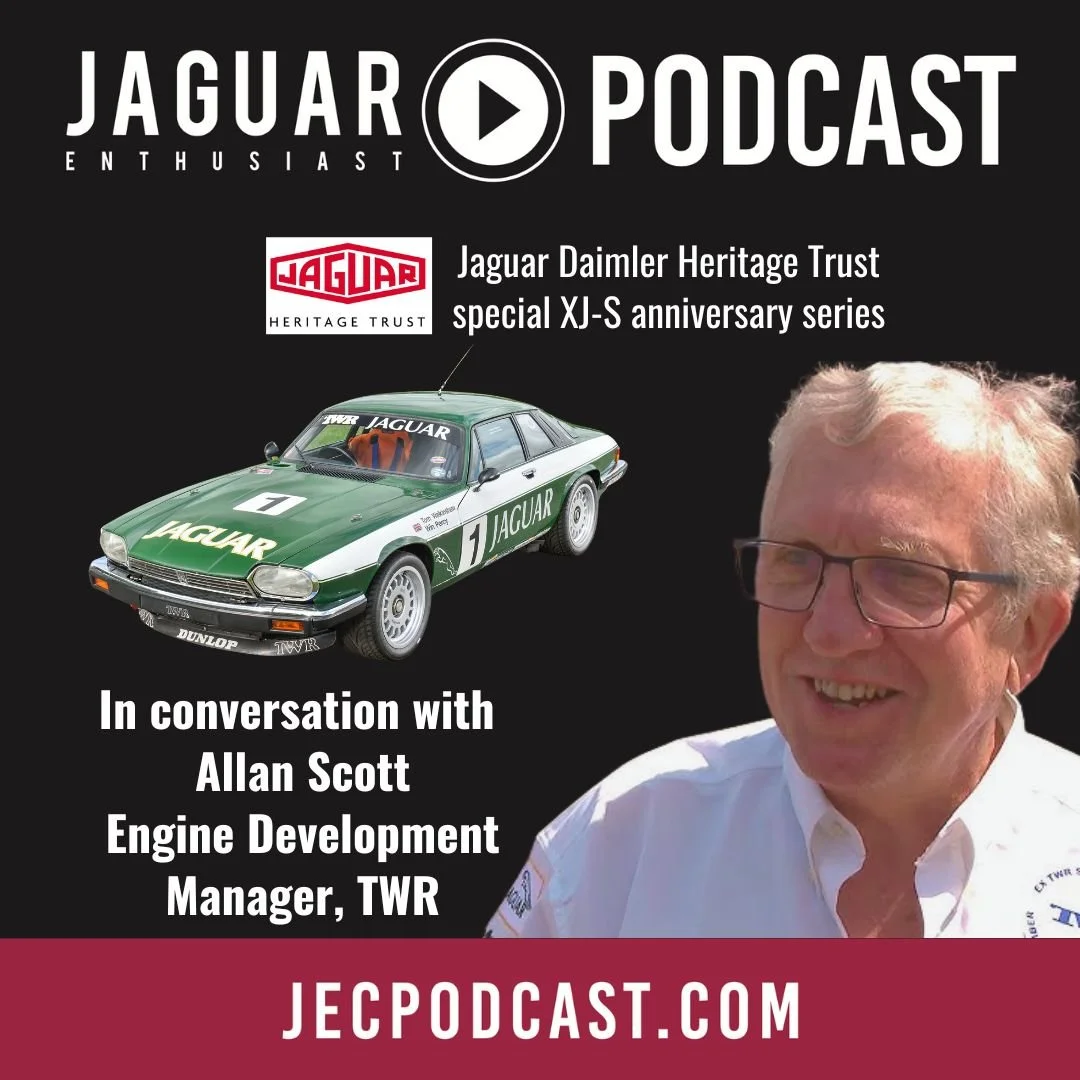
On this episode, we're joined by someone who played a pivotal role behind the scenes of some of Jaguar's most exciting motorsport chapters with the XJS.
Alan Scott is best known as the manager of the engine division at Tom Wildkenture Racing, TWR, during a golden year of the 1980s and early 1990s.
Originally hailing from New Zealand Island Trainers and Engineer before moving to the UK and joining TWR, at TWR, Alan led the team responsible for turning Jaguar's V12, XJS, into a world-beating power plant and racing car.
It's an honour to have Alan with us to reflect on his experiences from the workshop floor to the winners podium and, here first hand, what it took to transform the XJS into a racing icon.
Alan, welcome to the UK, welcome to the Jaguar Day, my heritage trust once again.
It's a great facility. I really enjoy it being here. I had some friends from New Zealand and we came here actually yesterday
and because I hadn't done a full walk around myself and just looking at the evolution of the way cars have evolved and the safety along with aluminium arriving for a Jaguar and things like that.
It's a great engineering evolution to look at. Yeah, I enjoy that.
And great to see all of these exhibits, especially with the Jaguar brand, preserved for future generations, isn't it, unprotected in the way that they are?
Yeah, I think this is an incredible thing to keep the history. History teaches us how engineers think the limiting they had at the time, they can then move on and they have a solution which is governed by what facilities they had at the time or the circumstances.
And you can just see things growing and it's just a learning process for engineers, brilliant.
Well, talking of history, this is part of a mini series from the Jaguar Day and the Heritage Trust and Jaguar Enthusiasm Magazine celebrating half a century of the XJS, of course, the vehicle that arrived from Jaguar in 1975 to replace the E type.
And Alan is one of the few on this series that we're interviewing that is well kind of actually unique in the sense that he didn't work for Jaguar instead.
He worked for TWR on a program that history probably records correctly, certainly changed the fortunes of the XJS and captured people's imaginations around that model once again.
It was 10 years after it's launched that won the European Touring Car Championship and it was a car that suddenly saw a resurgence in interest as a result of that.
So we'll get into some of those stories, but Alan, how was it that you came to work for the legendary Tom Wolkenshire? How did that relationship start?
I think it was probably the biggest incredible fluke of all times.
My new wife and I arrived at Heathrow where my business plan finished.
She wasn't that impressed with me. But I was interested in rallying. I thought I would do some professional rallying here.
I was just at a time of life at age 29, where I was open to anything.
And I ended up seeing a job that was offered in the magazine at race engine services.
They wanted to dyno operator. I'd done a little bit of rolling road, but I was probably the honest Kiwi and said I wasn't suited, so they told me to go away.
But Dick Bennett said it was well known to the motor racing scene over here. Dick had been through the night-schooling and apprenticeships that I had done he was one or two years ahead.
And he had worked at race engine services and done very well, so that was an introduction for a New Zealander to work there, and they phoned me.
A few days later and said, do you want to start? So at that stage, Tom Wolkenshaw was a complete unknown to me.
But I had mentioned that I had done a lot of work on rotary engines, which I'd done in my rally cars.
And I started at race engine services in Twickenham, and this Mr. Wolkenshaw was dropping off a rotary engine.
And I did some work. I had an idea on the carburetor that I thought they'd overlooked, so I made the mistake of doing that and getting a little bit of an improvement.
And there's Spike saying, you can't do this, Ellen, because we've got to charge money for these things, and you can't be free.
So that wasn't you. But my introduction to Tom, we had a new ignition system for the Mazda, and I went to these hallowed grounds of Brands hatch to meet the man.
And I couldn't find him because I was looking for a Granada with a trailer and an RX-7 on it.
There was a great big truck down at one end, so I thought I'd go down and ask where Mr. Wolkenshaw was, and that's where he was.
So I just, my wife and I started going out supporting the races and doing things like that. And after a few months, I worked at race engine services for nearly six months.
He offered me a job, and we was quite crucial because we had decided the UK was a bit too hard for us.
And we'd actually decided, both my wife and I had lived in Sydney for a few years.
We basically were going to pack up and go and live in Australia, as opposed to living in New Zealand.
So it was quite a crucial situation where he offered me a job, and we went to Kiddlington.
What were your first impressions of him back then?
I knew he was different. He was decisive.
I'd asked for more money from race engine services, and they said we'll have to talk to our accountant.
When Tom asked me how much money I wanted, I said a figure, he said, oh, that's quite a bit of money, but okay.
And basically, the interview was over. And as I went out, he said, talk to my secretary. She's got the keys for a house that she's feeling for you down the road.
And you go, you know, well, this guy's different.
I got the sense from others that I've talked to that work for Tom over the years, that if he felt your loyalty, he repaid that and was actually a very kind man for all of the kind of bravado of the racing driver that most people saw in the media.
Would you agree with that?
Yes, certainly early on, I think it's a small group. We were looked after very well.
Then of course, it becomes basically an empire, so his mindset is split between half a dozen different situations.
But the one thing that he did from day one and continued was the mechanics didn't sleep in the truck.
The mechanics slept in a hotel. Mechanics were fed.
It was interesting briefly talking with Denny Holm, who drove for us in the mid 80s.
He's been away from McLaren for 10 years. And he said to me, 10 years ago, this makes McLaren look.
And one of the things that he couldn't get over was stopping for lunch and feeding the boys 10 years ago.
The McLaren mechanics worked and when they found some time they went and bought something for themselves.
So it was just something that was different and obviously that is more expensive.
But what Tom was doing was he was setting himself a little bit apart.
So that mentally you weren't like everybody else, you know, the difference was their mechanics are sleeping in the truck.
We're sleeping in a hotel.
And ahead of his time because we take that kind of treatment of teams and mechanics and all of the others that are around the operation for granted now, don't we?
But it kind of started there, really.
He would take quite a few of us out to restaurants in Europe.
One of the things he had was trying to re-educate the British Palace.
And that cost money. You know, you would be having different types of pastors in Italy and things like that.
Which he had quite a European connection in his life.
So that was just one of those things he did. We dined well.
So initially working then on Mazda's as Tom was racing at the time, how did you first get wind of the potential of a Jaguar and Group A project for the European Touring Car Championship then?
So firstly, Mazda was probably going to go nowhere because the European car business was frightened of the Japanese and from memory there was a limitation of 10,000 vehicles in Europe that the EU would put on.
Mazda. Mazda would be developing its markets in America and Australia where it was happy to spend money.
It could sell the allocation in Europe. So Mazda really wasn't going to be going anywhere.
You then had your Ford Capri that all the locals were using.
And then you had the Rover coming along and you had Jaguar.
And Tom decided that his future would be with British, British marks, British names.
And so there was Rover and Jaguar that were, Rover were already in motor racing. Jaguar was a possibility.
So that's, he liked the idea. I suppose fundamentally the XJ has had an independent rear suspension.
We were always driving, you know, beam type rear axles where you couldn't change cambers and when you start to move into radial plight tires and things.
You know, so you could do a tow change and a camber change on the back of a car.
The only cars that could do that were BMWs. So that's where, that probably would be the biggest influence of Tom looking at the XJS.
A wishbone front suspension adjustable geometry.
You started, I believe, being brought in by Johnny Egan-Boss at Jaguar at the time to have a look at the broad speed XJ coupé that had gone before had phenomenal performance.
And it's still here in the collection of the Jaguar Day Marities Trust had been enjoyed by the likes of Derek Bell.
But it never reached its potential was flawed in many ways and had never really delivered the results for Jaguar or British Leyla motorsport as it was then.
Was that where it all began for you? Basically being consultants to try and figure out what had gone wrong with that car, first of all?
Yeah, for sure. Looking at that car, it was why was it not successful?
And it takes five minutes to go. It's heavy and it's got no breaks.
You know, the group two rules, you know, you were having to run diameters of original, you could put extra calipers on.
Well, it worked for one lap and then they overheated.
That's where I think the group A rules were so successful.
Is they allowed huge leniency and transmissions and freedom basically of breaks.
They had to be approved.
But the gearboxes were a weakness rather than putting in a close ratio gear set inside an original case.
You could just throw the whole thing away and start off with the Pfizer and get track gearbox which came from another genus 20 years later.
So we could see that group two car, if it had the group A rules, it would have been relatively successful.
I've since talked to two of the drivers and I said, what was the difference between your racing lap times and your qualifying times?
I said, four to six seconds because there was no point in pushing that car, it would run out of breaks.
And you had to just nurse a few bits and pieces.
Of course, they ended up with dual calipers on the way it was and all sorts of crazy ways around that didn't they?
Well, it worked brilliantly for the first lap.
And then the fundamental physics is you can't, once you have some energy, you can't destroy it, you just convert 1600 kilos of car into a 10 inch piece of cast iron.
And you bang it up to 600 degrees. I mean, that's all you've done.
And of course, the car then gets imbalanced.
You'll have a front disc that's got two hot and it's pads not going.
So what you do is you push harder on the brake pedal and it just very, very quickly becomes a problem.
So it was a heavy car.
So we knew we had to be able to get to the weight limit of 1400 kilos, which, when you're starting with 1700 kilos, doesn't sound easy.
But the transmission and brakes and suspension, you knew you could make a race car out of it.
The biggest problem would be getting the weight out of it.
How then did the jump between not using the XJC and turning to the XJS come about?
Was that a direction from Jaguar that you were pushed in or was that something that you came up with as a result of that consultation?
It was more time approach Jaguar. Jaguar were nervous.
The previous one with the XJC, they said that wasn't a factory car.
Yeah, they said it was a team outside of the factory.
So I went with Tom. I think either the first or the second meeting.
And I could just sort of keep an eye on Tom. I could tell his body language by now.
And when they brought up the fact that it wasn't a factory car which meant they weren't involved.
So there was no negative. I think that one statement absolutely laid the ground for where we would go on from there.
Because we understand Jaguar's thinking straight away.
So without asking, you know, well, OK, this is going to be a private year.
Hopefully with their commitments, when they felt comfortable, it would be a factory sanctioned team.
And that came within five minutes of the meeting, which was the groundwork.
We knew we had to make a light car. We knew it would be a hands-off initially.
And hopefully we would convert.
If I can just go on, I remember the meeting where there was quite a bit of enthusiasm around the table.
And I'm starting to get enthusiastic. And Sir John Egan and those days Mr. John Egan said,
of course Tom, we have no money. And it was like pricking a balloon.
But of course you were paid on results eventually, weren't you?
30,000, 20,000 and 10,000.
And we had a paid driver with Chuck Nicholson. Without Chuck, I'm not social with the thing
would have gone off the ground. And there was a presentation to Motel that I was not involved in.
And I have been told there was £120,000. I think a lot of that would have actually been in product.
Because we seem to have more motel oil than we ever needed.
And of course TWA was a supplier of multiple products in the UK prior to that relationship was already in place.
Yes, I think that's the way those deals would have been done. It would have been product.
And it's up to you to form a retail organisation. And that of course was attractive to the French.
They've got a good outlet for their product, which was basically a very, very good product.
I have to say the running wet sumps and that motel V300, I was expecting just the normal bearing problems
that I'd got used to with bits and pieces. And I think that 100% synthetic oil
coming in in 1980 was pretty important.
Well, oil was to become a bit of a problem for you with the V12, wasn't it?
But we'll come on to that in a second because ultimately the question at this point is, why the XJS?
This is a series group A with regulations written for saloon cars predominantly.
And here you are looking to prepare a two-door GT. Why the XJS?
Well, of course they said it was for saloon cars. And it's like everyone when they wrote the rules, they forgot to mention how many doors.
So again, this is Tom. I don't know whether you say it's ignoring the reality.
But there were some things that I thought were fundamental that didn't seem to bother Tom.
And one of the problems was technically when you looked at the dimensions the XJS was struggling to be a saloon car.
However, I think the overriding reason why Tom could think fairly literally and why it worked was, at the start of group A, there was only BMW.
And you go back to the group too. There was BMW and Jaguar. And when one of them went, the series went.
Yeah, there's no point in having the Australians have got away with Holden and Falcon.
And of course that's just because half the field was Holden and half the field was Falcon. It wasn't a factory thing.
But when you've got factory teams from two manufacturers, one isn't winning or one changes its mind, you don't have a racing series.
So Tom correctly thought that we could push our luck because Europe Group A and its infancy needed a car like Jaguar.
And in the end they were going to welcome it.
Let's take our listeners on a bit of a journey as to what Group A actually means because what we're talking about here is a set of regulations.
The FIA at that point had kind of distilled down the regulations into various groups.
You had Group B and Rally and obviously in and Group C later with sports car racing. Group A for touring cars then.
What did that mean in reality and how much freedom did it offer you with what you're able to put on the car?
So Group A was a genus from the Group 1, 2, 3, 4, 5 type of things. So if you look at Group 2 where you had a lot of horse power and the classic XJC and you couldn't stop it.
So what the idea behind Group A was the engine would be very limited where they thought they would reduce cost.
And when you've got a 24 hour at the top of the tree, like the spar 24 hour, you need a reliability.
You need a reliability in brakes, gearboxes, differentials.
So one of the things they did is they started to allow two inches greater diameter wheel.
And of course that's all about more rubber on the track and more importantly start putting very large discs on it.
We've mentioned before the just changing, I mean the Jaguar had a close ratio for speed box early on.
We just happen to put a 5 speed gearbox in it.
But you know the gearbox could be homologated. Well the BMWs had a nice 5 speed get track gearbox so it was automatic.
It would be approved for our car.
So you had an idea through engines to be cheaper and you had an idea by allowing some capital spend at the start with braking systems and transmissions.
You would have a lower maintenance and a more reliable car was the genus.
That part was true but of course when it comes to engines and you're restricted, all you do is start spending money to see how well.
For me the only thing they got wrong was wet sump.
And you had to run original crank shafts, the Jaguar was great because that was a forged steel crank.
The problem we had with the Rover was a cast iron crank.
And whilst we reinvented that and did a huge amount of work with the Rover, we ended up spending more money on the cast crank than if we had made it.
But otherwise the group A race, the group A regulations were hindsight from what hadn't worked.
And they were almost designed to get the sense by the teams kind of doing deals with each other as the season progressed.
Well we've got that and you've got that so was that how it was for you at the time as well?
Well you've always got a bright idea and it's perfectly okay but there's always one little thing that doesn't quite allow it.
I mean you had to run the original suspension pickup points at the front and that's not a problem but what it does mean is you have to make your own upright where that's all attached to and you change all the geometry on the upright.
So using the original front hub assembly and whatever that goes straight out the window and you have to spend a little bit of money because you've lowered the car, the roll center's changed.
So you have to the freedom then would be in the outer suspension pickup point.
So you know those things evolved and everyone you know picked up on exactly the same thing.
But there was always a little problem where your bright idea needed some massaging to fit.
And as you've sort of alluded to fortunately everyone did some massaging and I believe that's why it was so successful.
There is no point in Volvo coming along having a problem and always coming third or fourth you know that in three years they're not going to be there or two years.
So yes there is an erratum process so every calendar year the erratum process was massaged considerably.
What that simply was the person who measured something or did something had made a mistake and we now have to fix that mistake.
That comes to car woods. You know we found that maybe we found some cars that are a bit wider and all you do is get the production manager to sign off that car woods vary by 1.4%.
And that meant you could just relieve the wheel archers a little bit to get that slightly bigger tire on and everyone was doing that.
And if that hadn't been loud I just don't think group A would have gone anywhere.
Of course with the extra body shell itself you you had to try and find some extra headroom along the way didn't you as well because they had a kind of half metal bowl that they used to measure the heights.
And wasn't there some kind of Swiss homologation you used to get around that.
Yes nothing like getting something out of the UK into another country.
But of course everyone goes on about yes they do the measurement and the roof too low at the back.
Well of course the Swiss homologation was fairly simple instead of looking at the roof that everyone could see if you were doing something.
We simply looked at the floor underneath the seat and it was massaged so the bowl could sit a little bit lower and hey when it was measured it found the roof height was perfect.
So BMW weren't happy with that running a four door 528 well of course then they went and homologated their two door coupe.
And at that stage if you think back to those 80s we're starting to get roof lines coming back we're starting to get rear windows presenting air to little spoilers on the back of boot lids and things.
So roof lines inevitably were starting to come down.
But I mean there's a great story so I never took a lot of notice that if we had a Swiss version for homologation that was for the storytellers and you'll probably get on to the other armored vehicle one.
The interesting thing is we never did any of those shells the shells were done from the factory that was their justification.
Well homologation actually in those early days is less than straightforward mainly due to the problems that I spoke about at the beginning around XJS's sales and the fact that they weren't simply making enough when you came to mollygate that car.
It was Ron Elkins in charge of all of that at Jaguar wasn't it and he was struggling to convince them that the 5,000 cars they were making here was enough to call it a production vehicle.
Yeah well we weren't convinced either so if you look at the history of the 500 type of homologations from your Ford RS 2000s and whatever and Tom had worked with Ford.
And there's great stories there of stopping for lunch and you know having long lunches for the FIA guy and going down to Shed E.
And basically the boys of the fork lifts are being fled out going from Shed E to Shed E and the guys counted the same thing again and only 200 of the evolutions being done.
But hey without that you wouldn't have had all these interesting cars.
So they allowed what was in progress so you've got assembled cars which is what the rule was saying.
And then you have a parts list of unassembled vehicles that are about to be assembled.
The difficulty there was at one stage just before we arrived.
I think sometime in 1981 they actually had stop production.
So again you have a very laborious job of an official counting if there's...
well I know if there's two camshafts and a V12 engine then you can go around and try and count 500 camshafts and say that's 200.
I wasn't involved in that but you can get the feeling that you've got a lot of...
you can present a lot of parts and you can say well this is 800 cars worth and this is whatever and whatever.
Either way as I said before I think the car was needed in the series, new series, new rules.
Everyone that had a car that had raised a car before it wasn't eligible.
And they were having to basically leave the car that they had been racing and spent money on and start all over again.
So I'm sure the FIA people were aware of history.
Well we spoke about the fact that there was no funding in the normal sense from Jackie were two TWI.
So you were paid on results and that extended to the fact that Tom Wolken tried to go and buy the car as well from Jackie were didn't he?
And I think when you are on your way off on holiday or something when you first saw it by accident.
Well we discussed... so put it in context.
While we are doing this there is myself and Beza.
This is two of us in the engine shop.
We've got the Rover contract and we are coming to the end of the RX-7 which I could do in the day so that wasn't matter.
And when I had asked Tom before I went on holiday he said look we can't do this.
He said I think it's the following year and I thought there was no way in the wheel we can do it next year.
I went on holiday and I came back and Kevin Lee's got a body shell rolled on it so I'd taken the under seal off.
And I sort of popped upstairs and said what's happening?
Well and that's three months before Monza.
Wow.
Yes and I'm about to see for the second time in my life.
I had in New Zealand lifted the bonnet and looked at a V12 engine and said to myself I'm glad I'm not working on those things and closed the bonnet.
So and Tom said that he had been very kind to me because he wanted me to have a nice holiday.
Which is why he hadn't told me before I went on holiday that we were running an XJS.
Which is very thoughtful because my wife and I had been to Morocco and had a lovely holiday.
It was a car that he'd bought.
It was a Japanese specification and I'm not quite sure what the specification would have been but unsuitable for retail and he paid £6,000 for it.
Wow.
And now you've got the job of turning it into a groupator and car.
And then the sponsorship was two engines.
And we, Barry and I went and he was driving the 1200 Datson van.
And we asked for the two engines that was Jaguar's sponsorship and I was told that there was two round the back of somewhere and they were on corrosion test.
And I was impressed that because I knew it was an aluminium engine and I thought these guys they leave all the other stuff out to see if the rain gets in, to see what gets rusty and whatever.
But my total naivety drove around sitting on a couple of broken and rotting pellets is two engines that have been there from the engineering side.
I've been there for years and we put two of those in the back of the Datson van and I distinctly remember going up onto whatever the A was away and looking mirror and Barry had just given us an acceleration and the front wheels had come off the ground in the Datson van.
So that's our introduction to the engine.
Wow, so you've unloaded these rather corroded two V12s.
How do you go about starting to turn this very road going V12 engine into something that's going to power one of the most legendary touring cars of all time?
You know what the rules allow because I've already studied that.
You know the bits that you can use or have to use and some of the things you have to use you don't want to use but it's going to take a matter of months to make replacement parts.
So the biggest thing was from the XJC was Wetsump and lubrication.
I'd done a lot of work with the Rover and then we got that to work.
So yes, I was dubious about it.
But when I saw what had been there before I thought there could be quite a lot improved on that.
So the first thing we had to do really, the concentration wasn't horsepower.
The concentration was the engine's got a last race and it's not a 35 minute race.
It's a 500 kilometer race.
So we were working on some systems.
We knew we had to change the pistons as soon as we could but talking to Cosworth,
we were sort of new boys on the block and you know they just thought we were bits of cowboys because you know.
And also the thing that was most difficult for me was the camshafts were free but the lift was standard.
And those types of cam profiles just did not exist because every wider period had more lift and it was a completely different thing.
So there was no off the shelf camshaft.
That's what you're up against and we just had to work with what we had first with the wheel.
I mean of course it's quite a story but we then had to go into the electronic fuel injection which was something that was not only not known to me but unfortunately Jaguar had no control over.
And the oil issues were mainly about starvation weren't they on fast bends and things like that.
So circuit started to have chicanes put in just in those early 80s so you've got those straight bits that used to have a fast corner after them.
Now you've got a chicane, you're on the brakes pretty early and all the oil just slowly finds itself out of the sun
and it all ends up in the time and cover in the front which was a problem with the XJC.
And of course when they had a brake problem they're breaking earlier and longer and just exacerbating that problem.
So I was very aware that that had been their problem.
So you were looking at trying to get oil to go back into the sun but not go forward.
And you're literally just using pieces of material and welding and you're very much just doing whatever looks right.
Well of course as well as the moving metal bits there were some clever electronics in the car and if you look at the car even today you can see the Zitec engine management boxes in there.
This was quite newfangled stuff for an XJS at the time wasn't it?
Yes so you have a discussion and you know what you can do and then you have some things that are getting past immediate ability.
Camp shafts are one of those but I just assumed we all assumed that the electronic side which we had no access to
and was very much a black art in 1981-1982 would all be fixed by Jaguar and of course we then find out that it's not only not a Lucas system.
It's a Bosch system under license to Lucas and we run straight into IP Lucas control the Jaguar end so Jaguar were not involved.
And of course you pick up a system like that and you don't know the arrangement with Lucas with Bosch, BMW, you go hang on I think we've walked into a bit of a rabbit hole here.
And for me that was the huge problem because I had just in my mind delegated that to someone else.
So you have to then start fudging stuff.
You need to get some more fuel in if you're getting more horsepower but then the shape is wrong and we went through a genus of different bits and pieces.
And in the end the one thing that we were able to change was the number of cylinders.
The system had an open map so that you could designate it was a 6 cylinder or a 12 cylinder but it wasn't limited to those numbers it was just an open number.
So I looked and I found a section of standard curve that looked the shape about right but it was a way down in the lower end.
So it's quite an evolved story but we programmed the one thing we could and we turned it into a 24 cylinder engine.
And that meant it had to count twice as many sparks before the engine had rotated once.
That meant the map just stayed down between 1,000 and 3,500 RPM which represented 2,000 and 7,000 engine RPM.
The shape wasn't too bad but the capacity was way way too small.
It just so happened that the 4.2XK fuel injector was that much bigger than the V12 that we filled that hole in.
And then by adjusting the fuel pressure this happened over an evolution of probably 6 months and just when you started to get something right.
By then I'd managed to get a new camshaft profile.
And then we'd got the latest pistons and I'd lifted the compression ratio.
So I know that it sounds quite strange to be doing that type of thing but looking back on it I think it was actually incredible that we managed to actually turn it into a racing engine in that first year.
Which leads us on to the Zitec situation.
I was not directly introduced but I was having a couple of meetings with Lucas to see where they could help.
And I've done my apprenticeship in a 2-man garage and I'm a Kiwi, I'm not used to corporate stuff and I'm sitting in Lucas' thing thinking
this is going to get complicated.
I had total freedom to rightly or wrongly do whatever we could with the resource we had.
And that was the best way for me to operate.
And I could see the Lucas people, they would be making sure that they never made a mistake or whatever.
Perhaps I'm being unfair to them but I was just uncomfortable.
But there was a name dropped, Bill Gibson and very, very quickly shut down by someone which sort of peaked my interest.
And Bill had actually done all the work for Lucas on the Bosch system on the V12 and he had gone out to do his own electronic because obviously he didn't feel comfortable or flexible at Lucas.
So we found Bill, we tied him up in a contract and that's where Zitec started.
It was called ERA at the time, electronic racing aids.
Hacking back to the old ERA which they called himself, yeah. Zitec came along a little later when Brian Mason, who was the software guy at Lucas,
the two had been good friends and Brian felt comfortable enough at that stage to leave Lucas and come in.
And Bill's system was an analog fuel injection system and we ran a conventional ignition system.
And it was a still long partnership between Zitec as it became an TWR that lasted all the way through.
At some points nearly TWR buying Zitec, I think I got the feeling.
And of course Zitec still around as an independent today, aren't they?
Yeah, a chunk bought by Motorola and then Continental of Germany brought Motorola and the whole electronic side was owned by the Germans.
They did a lot of work. Bill was quite focused on electric cars way ahead of everybody else and they did quite a few control systems early on for electric cars.
Yes, analog fuel injection and there's a genus with that as well.
We had a control box and we could log each RPM.
We had our own dyno by then, you got to remember that for the first year in 82 we didn't have our own dynamometer.
And that's when I started to understand electronics and they were good enough to tutor me in all the systems as they went through.
My input was seeing and motor racing. I'm at the racing circuits. I'm living how that all works.
I'm looking at wouldn't it be nice to have something like that type of thing?
And looking at just covering problems or whatever and I started to be able to go back and say, you know, I want an external trim.
I know we've trimmed rule out but if I want to retire the ignition later on for when I retire the ignition or advance the ignition or the big thing I wanted to change the fuel, I want a button, I want to wheel on the outside.
You know if we were not getting into the E-Prom and those are the things that evolved and Zitek were very good at coming up with those things and that's how transferring the reality of the racetrack into people who were separate in the electronics.
I think those two together is what made it successful.
The two departments that were absolutely hand in glove today but was new ground back then of course.
Yeah nothing in-house in those days. Electronic boffins were electronic boffins who probably didn't understand motor racing and we were racing people who didn't understand electronics.
Was there any interest at this early stage? I'm guessing I know the answer to this already from Jaguar and what you were doing with the engines. Did they ever peer around the workshop door and see what was going on?
So what we had early on was access to what you would call their development works. There was things that they could help with.
I mean I wanted semi-finished camshafts. I wanted a fully machined camshaft but didn't want the load touched because we would then go away and grind our own profile.
Well you know you just said and they would say well how many do you want. Well I'm here we'll need 10 pairs.
So next thing a whole box would arrive and that saved us huge amount even if we just took castings and we had no ability to machine it at TWR.
Moving on when we did eventually have a connecting ride problem in 83 as we're starting to rev these engines past seven and a half thousand rpm high compression ratios.
The material was in the N16 and that was a minimum on the material. So we said okay we want the N24 which is perfectly legal because it was a minimum material so they just said okay.
So you know they went off to the forging people work it through as a special order and we then had a delete machine I said I want that machine I don't want you to touch that and that.
And they went yeah so they painted them all yellow so it went down the machine a guy chased it down the machine took it out of one machining process.
You know leapfrog that one put it back in something that you know we wouldn't be able to do with factory access and then I got an item that was 90% there but the big end bore I wanted that board to exactly the 10th of a foul that I wanted to capture the shell.
And we would just get that finally done it found in the crankshaft people it all matched up with our crankshafts.
Definitely in group A a lot of help by the time group C comes we've moved on and a much more self-sufficient so group A for Jaguar yes by the time you get to group C or by the time you get to 1984 we're pretty much running our own shop.
And going into group C we've pretty much moved away from working together.
So in the matter of months you managed to turn a crate of rusty engines a body shell that's being weighed in the workshop into a race car you hastily paint it and it slapped with motel sponsorship stickers.
Tell us about that first season the things that went well the things that immediately became problems and and how that really went the first that first outing that first season.
So the first outing electronically was going to be a complete mystery.
I was at Brown's Lane and being shown around the dyno.
And there was a Lucas control box with the North 2000 thumb wheel on it that was used by Lucas for the standard engines and I picked it up and looked at it and I said you know who I said I that they said that's Lucas.
I said well I need that for the first race because we had played with fuel injection but I can now twist this to just have an overall rich and lean.
And they said well anyway so that I stuffed that inside my shirt because I had no released paper wave to the man at the gate and went off.
So that's that stopped the first race probably being very embarrassing.
We went from the car chugging around and Tom looking at me saying well yeah this car is pretty much undrivable and I'm in the boot taking 150 off the wheel number.
Not sure whether it's a ritual lean or whatever very nervous of the long straight at Monzick I thought if I lean this thing out we're going to pop a piston or whatever.
And we actually turned that car into I mean it was as fast as I'm forgetting that but I think we set the fastest time.
Yeah and we ran at the head for half that race if it had been an hour and a half race we would have won it.
So it's an evolution of tyres.
One of the things that Dunlop knew was it's a long distance race so you just got all the hardest compound tyres.
And it took some time to get to motivate and change some minds and Tom was very very good with his tyres.
And because we were two stopping because of fuel all of a sudden it's well no we can start running soft tyres.
You can't do this over a period of weeks I mean they've gone and probably made a thousand tyres for the year.
So those were the growing things.
Tires obviously are super important when you're out there racing and everything isn't right.
If you've got a tyre that can work that's where the time is.
So we're two stopping, everyone else is one stopping.
On the other hand the one stopping cars the tyres weren't looking very flash after an hour and a half as well.
And then they were losing two or three seconds.
The whole saving grace in a way for us with this whole group A period was there was no pit lane speed limits.
So there was one lane and the pit lane was the racing circuit.
So these guys are peeling off and you can hear them coming down the pit lane, wide open throttle, doing late braking and putting in.
So if there'd been as it is now, pit lane limitation that two stopping would have just added another 30 seconds to the time.
So we just worked our way through there.
We had a drive belt problem.
We were running standard pulleys and things, running much higher RPM than what the original car had.
Every now and again someone would miss a gear which they never admitted to.
You know you come in with a belt that's been thrown and the driver sort of thrown a belt and you think you might have missed a gear mate and pinged the belt off.
But obviously the water pump stops turning around and the car just, you've got to come the pit straight away.
A lot of heat, the V12 takes up a lot of room in the exhaust manifolds right back against the bulkhead, there's not a lot of flow through.
One of the things you weren't allowed to do is that whole body profile as the, from a bird's eye view, had to be the same.
You could not put louvers in the bonnet.
So you ended up with a lot of lift air coming through the radiator getting trapped.
The bonnet actually lifting the car, you're getting up 150 miles an hour.
If you could have had louvers there as most cars did at that stage.
Life would have been a lot easier, huge under bonnet.
So you start putting stickers on coils and you find the coils running at 110, 115 degrees.
So you then find a man from Lucas and say you know how happy is your Lucas coil at 115?
Or we don't think it'll be happy at all, you know, all that.
And it takes time to get around to decide, perhaps I should check the coil.
Because you aren't checking that it bonds because it's not even on the list.
So yes, it's just a constant growing for the boys.
The rear cradle is all rubber mounted.
Therefore the minute you load it, you start taking camber off the loaded wheel so you have to put solid mounts on it.
Then the cradle starts to flex and again, you're doing things in between races.
The problem for us compared with the Europeans was our truck driver had to take the car from Monza back to Kiddlington.
Well in the meantime, that night all the European guys have already got their car back at the workshop.
And you think I will turn around to go from out to Monza.
Well, you can't be working on the cars because it's had to be in the truck on Thursday.
And that's not going to be back until Tuesday night.
And two weeks later, you're going to be in Germany.
Well, again, you're working on the car on Wednesday and you've only actually got a one week turnaround.
And then you've got guys that are traveling.
And that was the difference for us as opposed to working in teams in the UK, where Silverstone was half an hour up the road, whatever.
So the travel time starts to eat into the time zones you had in your head and you hadn't quite accounted for hang on.
There's going to be quite a few days when the car is not back in the shop.
And it was the same with engines. I mean, I can't get an engine out until Wednesday night.
Even though I know what the problem is on Sunday.
Were there certain inherent problems with the XJS design that you really couldn't get around in all of that time that you were campaigning them?
Were there things that were just in the design of the car that were impossible to solve?
Well, I think I've mentioned the heat on the front.
And that had ongoing problems. We had massive heat inside the car.
I can remember it in the SPAR 24 hour race in 82, touching the aluminium main roll hoop and taking my hand off it.
So the inside temperatures were 50 degrees centigrade.
We actually did some recording. Hugo Tippet put those specifications to the guys at Upper Haiford for their fighter pilots and whatever.
And he got a thing back to say that the astronauts weren't put through for those hours at those temperatures.
Their astronaut training wasn't put through that.
So you've got a gynecar for an hour and a half for 50 degrees centigrade.
Heart rate at 150, adrenaline, no power steering, manual breaks.
I think Chuck Nicholson did very well inside those situations, but Tom had massive upper body strength.
And I think had it been a smaller person than that first year would have.
What just would have been too hard?
Do as an engineer have to look at the different driving styles of the guys that are driving your car and have to adapt
was the variations that you had to dial in for different driving styles or was it a case of this is the car you've got to change for it.
So obviously in your development phase and Tom's leading that, so the car is changing.
You get to a point and it might take a year or whatever, where pretty much you're specced down.
You've got an adjustable front anti-roll bar.
In the end, when the car is working, that's about all a driver would change.
I think the driver's felt pretty much this is the car that we've got, so it's what Tom's done.
So every now and again you would hear someone say something casually and you could tell by the tone of voice that what you got is what you got mate.
But as I say, there's that genist and on a new program you're probably looking at a year and a half before you come to a spec, you've tried everything.
Backwards and forwards and you've settled on a spring rate, you've settled on a shock absorber.
It's more than down to the tyre and the discussion is that tyre on that corner going to last.
So therefore we're going to have to be a little bit careful in this phase of the race or whatever.
And then of course there's all these chicanes and we all know that if we can get a wheel over the chicane or on the other side it straightens the corner out.
And so there'll be wary on those chicanes that are whatever you're just going to have to keep off them.
And of course that V12 engine, really heavy lump, isn't it, especially compared to some of the other competitors.
So that's going to have a lot of impact on front suspension and handling at the front end as well I'd imagine.
So Tom's throw away line normally when I was present discussing the handling early on when the cars probably weren't handing very well.
He said that the Jaguar turns and beautifully, it's just that the engine kept going straight ahead.
So that's cool to understand.
When Percy seemed to always enjoy that car and have an interviewed him subsequently about it, he always is very complimentary about the power, the torque delivery.
But also that it was a car that was horrible slow but the moment you really pushed it and kept it on the edge that's when it all made sense and came together.
And I think there was one particular circuit I can't remember now where he was able to drive it so accurately he was shaving paint off the offside front wing.
Yeah well I think when it comes to the engine side once we went fully digital and even with the analog, the old carburetor situation staggering along,
running a bit rich out of the pits, but coming on the cam and then having no top end, when you had a perfect fuel, you then have a very, very movable ignition curve.
You've got an engine that does just go whiz. But speaking for when, when had a natural ability to drive around, anything that maybe not perfect with the car,
and it just became normal for him, it wasn't a problem for him, he just accepted this is where it was.
So when was of all the drivers, when was probably the kindest on the car, you could see the difference between when and Tom with tyres and brake pads.
But you look at that genus from the late 70s where it's almost a club type of mentality and now you move into this European thing.
So you're taking drivers who feel that they know they're good and they feel they're coming up against Europe's best.
So their mindset is a little bit different I think. And the cars once they were evolved were reliable, there was very, very good team, there was someone to do something.
We were never shorthanded on that type of thing. The team at the race weekend with Tom was run very well. You knew as a team you were never going to have a problem with another team because that was Tom's problem.
If they wanted to have a problem about the car you just went about your work as Tom was going to fix that.
So the drivers felt secure that the car would not let them down and I think that just builds everybody up.
Yeah, and you had some great drivers even from day one in your hands hair, Martin Brondel later on, came into the car.
Sears as well. Jeff Allen. Yeah, some real talent there.
And then we had Enzo Calderari who was Swiss. Hans Haier was there because the Germans were a little reluctant to have other than a BMW's picture that came third in the magazine.
And you found that in the results at the end of the story that hadn't probably mentioned Jaguar that Jaguar had won the race.
We went to the Nürburgring in 82 and we were all keen to look at the news at the night because incredibly we had won that race.
And all we saw was Hans Stuck in the 528 and whatever. And in the end it said a car from Britain won the race. That was it in the news.
Wow. So there was still that little bit of 1945 in the background. You definitely felt that.
So what Tom just goes and goes, okay, we'll get continental drivers. And Hans Haier was a brilliant guy.
Quite a big business man. He was in the roading business. He was Bavarian. I'd explained he was a Bavarian.
And that's why he had a huge following. So it had to be talked about.
So that's why Enzo Calderari and Hans had it there, but they were good drivers.
But that again was, Jaguar was trying to open up that German market.
So you had to have a German in the car.
By the time you get to the 1983 season, Jaguar I feel seemed to be taking you seriously now, don't they?
Because all of a sudden the beginning of 83, they come out and say, these are our boys, they're a factory team.
And suddenly you got official public recognition from Jaguar that they were the team that you were the team that they were supporting.
Did that make a difference at the time?
Yeah, I think if you go back to the Silverstone race in 82, that was either going to happen or there might have been a question mark.
And I can remember sort of briefly talking to John Egan. Maybe I was out of place.
But you've got 6,000 people who work on the assembly line and are associated with Jaguar. You've got the Jaguar directors.
And we do a one two. Not only that, I'm from memory, I think we were a lap up.
Significant distance for sure.
Yeah, so all of a sudden the Jaguar directors can look at a crowd.
Now there would never have been 6,000 people as a crowd at one of the races anyway.
We've now just got 6,000 actual Jaguar employee type people plus all the car clubs plus whatever.
And they can see that they want this word starting to get back to Australia.
Because Jaguar had been relatively strong in Australia and in New Zealand at the same time.
Their market has always been America.
At that stage in early 80s with the XJS really the whole thing was America and perhaps wasn't working that well.
So had we not won there? I think it would have been stickier.
But you've got to remember that Jaguar was not making a lot of money.
And it probably had an overall boss above it where someone had to talk to someone who ended up talking to someone in the government.
It was a nationalized company.
So there's all sorts of things going on that were out of our control and obviously you'd never know what the real story was.
So you're saying, look, we've presented, we've come up with what we said.
We assume that the next step is easy, but you don't really know that.
So here we go on.
But there again, there's not a lot more money simply because Jaguar.
They told us right from the start, we haven't got the money.
Your listening, Silver Jaguar enthusiast's podcast.
To find out what events you can get along to or to discover local club meets in your region.
Visit jec.org.uk
83, you nearly did it, didn't you?
There were so many great results in that season but BMW just pitched you at the last minute, really.
I think in my book I rounded off saying 83 was ours to lose.
And if you look at the results, we're either on the podium or there's a problem.
So the helmet colon is the old fox, the guys that just been around for years just kept finishing
and it might only be fourth this time but whatever.
And also back in those days, I can't remember but dropping, you know, if there's 12 races
and it's the best 10 of 12, that wasn't around in 83.
When they started dropping more and more of the races to allow some of the smaller teams in Europe
to not have to come to Silverstone and things like that.
So what happens was if you are ticking along the thirds and fourths and every race counts
and we're either podium winning or not, that's why in those days in 83 tick, tick, tick, you could win the championship.
Maybe not even, well, winning a couple of races but not winning the whole lot.
And then as time went on, they dropped more and more of the races which tended to suit the TWR idea.
We either won or lost. We're here to win. Third was losing.
Which, you know, that was second was losing. You either won or lost.
You could still be standing on the podium but as far as Tom's concerned, you're not on the top step.
Well, let's just hold on to that for a minute and fast forward to 84
because that's exactly what happened. I think Silverstone wasn't it in 84.
Yeah.
That's got to feel unnatural to the rest of the team to have a coward drawn
because you weren't doing as well as you'd liked.
How did that play out?
I think I could use that story to probably try and sum up Tom.
If someone asked me, what do I think of Tom?
So once again, you've got 6,000 Jaguar enthusiasts and the entire board of Jaguar at Silverstone.
You've got a car that's been just trouncing the opposition and running around
so they've already penciled in a win.
We're there knowing this is ours to lose.
So we pushed on, we were looking for weight.
We're already doing some genus, we're doing some work on Group C
and the big thing is this engine's heavy.
So I've got some aluminium Marla liners with Nikosil lining
and we're just infiltrating the Group A engine with these ideas to see how they go.
One of the things probably that we could have done better
was we didn't really have air cleaners on the car.
Anyway, we ingested a little bit of debris
and we just had a little bit of the Nikosil line of flake off the aluminium liner.
It sort of annoyed me because the cast iron liner was as good
but we were saving 6 kilos so it was part of that growing.
There's a paste car comes out
and Tom's held at the end of the pit lane
waiting for the paste car to do a full circuit.
So we're well in the lead and we're now just dropped a lap.
So worse than can happen.
So he's sitting there and the Nikosil piece that's fallen off
is right in the ring, oil ring travel
and with it ticking over with the throttles virtually closed,
sucked oil up, glued up one of the spark plugs.
So you've got Tom walking sure,
an upset Tom, an angry Tom, whatever, 11 cylinders
and I think we were taking two to three seconds
a lap off the fastest leading car on 11 cylinders.
And he is absolutely in it.
So we are definitely on for third
and if we get third we have won the 1984 European
Touring Car Series.
The XJS stops coming round and it's parked.
So that's it.
So I said to Tom,
well, the engine just cut out.
So it's a bit strange to never heard that before.
Anyway, talk to Kevin Lee.
Well, I said, how did you bring the car back?
Everyone just turned the key on and started the car
and drove it back.
And I said, say that you're saying the car was just parked.
He said, yeah, Tom's parked the car.
So you've got 6,000 Jaguar enthusiasts in the board of Jaguar
and pick the podium with three lots of teams on it.
Tom walking sure was on the bottom step
and there's two German teams on the second and first step.
Tom parked the car, took the chance of another,
the think there was two races to go to win the championship.
And at the time I was a little bit annoyed
because I thought, well, Sarge Law is going to come in
and there's going to be a problem next time round.
But that was going to be the picture in the magazine BMW wins.
And he removed the Jaguar overalls from the third step.
Tom said to me on two different occasions,
and this is the Tom character.
Why should I make those above me look good?
To me, that pretty much sums up the way I have seen Tom
with the overall thinking process.
Obviously, he's running a business in the car.
He's not just driving a race car.
He's running a team and he's running a business while he's driving.
There's that extra element to him there,
that a normal racer would just want to win it all costs.
He's thinking of a different strategy there as well.
He's thinking of that picture with him on the third step.
And that was not a good picture for Jaguar.
It was better and he was probably right for him not to be standing
with two German BMW teams sitting in a slightly superior position.
And of course it did.
As you say, put the pressure on you for the remaining two races in the 84 season
to make sure that you got it.
You got it at the next race.
The championship was secured.
Did that make the final race of that season a bit of a kind of damp squib
or a bit of an anticlimax in a way?
Well, it's not a damp squib.
It's just a relief.
Yeah.
Okay, fair enough.
You go smooth.
Yeah, I might even have a beer.
What made it difficult?
We had the three very fast cars.
And the fastest next team was fourth.
However, without it ever being said,
you've got two drivers that are paying.
We were at Anna Pagusa and Tom had a problem in Enzo Calderari's leading.
And I'm saying, well, you know, Calderari is going to have to slow down.
And Tom said, oh, you know, everyone's got to have a fair thing.
And I just had to think about it that night.
And I'm thinking, well, actually, he probably hasn't.
There's an invoice going to go after this race.
And Calderari ain't going to pay for it if he can't.
So in the end, to make sure that all those wheels are going on,
you had to work those things out for yourself because you were never told.
So Calderari won the race at Anna Pagusa.
That in another team, Tom would have won.
So we would have won that series with three races to go.
Because there wasn't, yes, there was team orders,
but there wasn't to be fair, Tom knew he had to let things go.
And it was up to him to be the faster of the lot.
So it got harder and harder when you've got someone coming third
and fourth all the time with the other BMW teams.
When we are swapping within our three car team,
a car that could win, but it's now getting third or whatever.
That's why the points thing got harder and harder as time went by.
It reminds you, after saw the stone, I don't think we needed to discuss
with any of the drivers who was probably going to win the race.
I mean, some of those things never needed to be discussed.
They just had to work it out themselves, and it was best that they did.
It was quite an unusual dynamic, especially by today's standards,
to have effectively your team boss as your lead driver all at the same time.
It just couldn't happen today with the amount of different things
that a team boss has to do.
But what was the difference over other teams
that didn't have that dynamic, do you think, to TWR?
Was it an advantage or not?
BMW, who were always our opposition, were very well organised.
You know, they're engineering.
They had great drivers.
Some of the drivers were a little more animated.
But I suppose I wasn't really aware
of why the management system might be different.
The things that Tom was doing making decision-wise out there as a driver
would have been left up to the emotional disposition of a BMW driver.
And if he felt that he had been unjuly served to,
I don't think he was asking his boss's permission to give another car a whack.
You know, at some stage, the Red Miss came down,
and every now and again a car would end up in the fence.
I don't think that was rehearsed at all by the BMW bosses.
As a rule, generally, you didn't do that because you know
if you gave, you were going to have to accept at some stage,
and you never know.
It might have been an important time that you didn't want to get served up.
So, generally, there wasn't much bump and grind.
You would only see something deliberate when someone felt
that they had been totally unfairly served to,
and at some stage, they had to go back.
But that was very rare.
Very rare.
So, you were just aware that the private ear teams really weren't in it.
That BMW had an organisation that was more about supporting
three up to four teams, which is what they were very good from a factory level.
Whereas TWR didn't have to one of our advantages,
is we didn't work, say, on behalf of Jaguar,
if Jaguar wanted to have three XJS teams,
we didn't have the facility to supply three.
But BMW had always been used to the factory having its own supporting racing group,
and it was much easier for them to fall into line,
use their production tooling or their outsourcing to be able to service.
I think in 83, with the first race we went to,
there's like 12, 635 BMWs, and that was a new car,
and it's somehow, I don't know if they all had the same gear,
but at some stage, you had to come up with 12 cars with a gear.
So in a way, we were protected by only having to do for yourself.
I think it's an insight, again, into how probably Tom was able to do that,
because, as you say, he was able to think as a racing driver,
but also as a businessman whilst being behind the wheel,
which is quite a talent, really, that probably enabled him to do that,
where others might have struggled perhaps.
Also, the financial side of things on a driver,
as long as he's being paid, and he's got a hotel room,
Tom is driving that car around,
and there wasn't the money.
Tom always liked to put forward that thing,
but he would have had a lot of stuff going on in his head
that we were unaware of, trying to join some dots up,
which he was able, just to literally drive through,
and worry about whatever came to being a problem.
It was never a problem until it became a problem.
It was a remover in the 1984 season,
where you, as an engineer, looked around you, looked at the results,
looked at the engine, and at the condition it was in when it came off of a race,
and thought, hmm, this could be our year.
Do you ever let yourself think that perhaps?
Yeah, so at the end of 83, by then we've had 18 months,
I knew exactly what was needed,
and we were living with what we were living with in 83.
It was quick enough to win,
but it was totally focused on 84.
We invented a new oil system.
By then we had worked through our camshafts,
and we had gone to Chris Walters,
who was the leading guy at the time.
We had worked out some valve gear,
we'd gone through the emoligation situation,
and by then I pretty much knew what was going to be bulletproof,
and fixed things.
So the winter of 83, 84,
we came up with an engine that was great.
A young Charlie Bamber, he was 18 going on 19.
He had joined me when he was 16.
He was an excellent builder,
and a new engine with all its parts is the secret.
That one has to be perfect.
The others can rebuild that,
but putting everything together from a parts list,
and he did a great job for his age,
but from 16 he was being dragged to the motor races,
and he had sat beside me on the dyno,
and so we had something that was very honed,
I think, to perfection.
We lost one engine in the entire year,
and we simply had, for whatever reason,
an engine that was consuming more oil than normal,
we had a new driver who,
I think we were in Austria,
there was an oil like 30 PSO, like flicking on,
and he thought it would last until the pit stop.
He was able to come with what the decision was,
and we lost an engine with that one.
Otherwise, the engines were reliable enough
that we could leave them in for three races,
which meant that literally two people could service three cars,
simply because we weren't turning over an engine for every race,
so again, that relieved the pressure.
Incredible compliment to Jaguar in a way,
and the core of that engine was made to be reliable.
Yes, we had a problem with the bottom end,
where we started running 7,800 RPM,
high compression engines.
One of the things we weren't allowed to change was the main caps,
cast iron main caps,
and we were starting to break them.
We finished Bethes with two broken main bearing caps.
Wow, really.
That's when the driver says,
oh, I just lost five PSI oil pressure.
You go, yeah, that's all right.
I go, hmm, just broken the main bearing cap.
Which point you just bite your lip
and hope for the best against?
Well, the ones that either ran never broke,
and the one in the middle never broke,
it was the one on either side,
so I knew the crank wasn't going to go flying out,
just that we were bleeding a wee bit of oil out of the side there.
So it comes to the end of 1984.
You've done it, your European touring car champions,
you must have felt an immense amount of pride
in how you'd taken those rusty engines
that you'd recovered from the back of the engine shop at Jaguar
and turned it into over the space
of those two and a half seasons European touring car,
championship winning car.
Is it something that you're still proud about?
Does it still give you a good feeling?
It's interesting you ask that,
because halfway through 1984,
I'm 90% switched on the group C.
Right, OK.
And sort of group A was history,
you know, everything's going right.
And I'm worried I've got a new set of worries now.
Right.
What's around the chance to sort of enjoy the moment?
There's no break between group A and group C.
Well, I'm totally from mid-84.
The spec isn't going to change the engines there.
We've proved that it can do this amount of races.
We've proved we've got an engine builder that can turn it around.
We've got a dyno set up.
You'd kind of allow yourself,
perhaps to assume that 84 was in the bag.
Oh, well, I'm truly.
We knew it was in the bag.
I didn't go to the first test.
We had the original cam that we're using
and the new cam that was coming through.
And they ran a test up at Donnington
and someone said to me,
wow, Tom's really impressed.
He was revving and you go, yeah, that's right.
The valve gear bounces at eight grand.
The limit is at seven eight.
And then you go, oh,
and we had built an engine that had,
I mean, we were running from one year to the next.
We were, I think, we were up about 50 horsepower.
So we're running 485 horsepower.
And this thing just wanted to rev off through the top.
And that's when you have that very first
at the start of the year, I'm going,
oh, yeah, might have overdone this.
Because what happened, of course,
is you walked straight into another Tom thing
where he decides he wants to run the one,
one lower diff ratio.
And he said, don't worry, he said,
look, I'll back off at the end of the straight
because we're already running on seven eight.
Once you've filled it up with 120 litres of fuel,
there was a difference between a full tank and an empty tank.
So, yeah, there's all those things,
instead of having that preptial suggesting
that I feel really good about 84.
I felt good about 84 right at the start of the year
because I knew we'd aced it.
But now my head's totally in Group C,
and it's just as big a mystery,
as Group A was in 1982.
And so there's a couple of other races in the 84 season
that are not part of the championship that you go and do.
There's the Macau grumprin Hong Kong that you go and do.
And of course, there is SPAR,
the 24 hour race that you won.
And then that famous YouTube video,
now Bathurst, of course,
which shows Tom is best driving that car
like no one else on that circuit.
These races, Hong Kong aside,
are all about endurance racing, aren't they?
They're long races, they're hard races on the engine.
Is this then the motivation for taking that XJS
to those events, too?
Actually, you're now in the headspace of Group C
and long distance racing.
What can we learn from this car while we're here?
Was that part of the process at the time?
Probably to put it as plain as possible.
It's a money race.
Australian race, I think, was an incredible race.
That Jaguar Australia put up.
I mean, that was a million dollar deal.
And they spent $250,000 on television advertising.
Australia was selling about as many XJS's
as the rest of the world were.
At the same time, Tom is demonstrating to Jaguar.
We go here, we do this.
Do you think that the local dealer
and Macal sold more Jaguars after that event?
Of course he did.
According to the sales manager in Australia,
they got their money back in one year.
They sold as many cars in three years as basically they could get.
So you are demonstrating to Jaguar
that you can increase their sales
and you get the support from the local dealerships who want you
because they know that the money side of it,
the dollar they put out, they're going to get $1.50 back again.
That's the hard facts of spreading your wings.
At this stage, we're in Europe, we're in Britain,
we're in Australia, Macal,
Benton, New Zealand.
We haven't been to America yet.
A significant moment for Jaguar Brown
because it was their first 24-hour race
that they had won since the 1950s.
And I think that coincided with...
Didn't go to the stock market the same week or something?
Absolutely.
So now you've got an independent once again,
British manufacturer, win in Spa,
win in endurance racing for the first time since the 1950s
and there's a good feeling around Jaguar all of a sudden.
And that Spa triggered the sale
and I hear that when the money was coming in
and being allocated that there was money
that was just taken and put away in a box
and that's how we all knew we could go to Group C.
Do you think the Group A win
that TWR, that you and your team put together,
saved the XJS and maybe even Jaguar?
So we were told at the end of 1981
there wasn't even any good news there.
So John, Sir John Egan told us
that he was given three months
to say why Jaguar should stay open.
He wasn't asked to come back
and say what do we have to do to keep it going.
So that's a totally opposite situation.
Like we think Jaguar's finished.
It was called shared number, something.
You're trying to sell a Jaguar
and the company's called Leyland after trucks.
Why should we not close the place?
You've got XJS's that have ceased
and I don't know but for some months they haven't produced them.
And as far as hacking back to the amalgamation
of 5,000 vehicles, I think at the time we're talking
you're looking at 1,200 vehicles a year.
But the time you get to 84,
I've forgotten the numbers but it's knock on the door of 5,000.
There's a certain number of cars you have to sell
to be able to generate enough profit
to build the next car.
And basically the problem with the XJS was
there was no money to develop
XJS replacement.
So at some stage it's all going to die.
As far as the XJS goes,
they'd lost a lot of the American market
because it wasn't an evolution of an e-type.
You go from an e-type to an XJS
and if you look at the customer that was always buying an e-type
he wasn't going to automatically upgrade
to an XJS he was going to keep his e-type.
I suppose looking at it I think we saved XJS
whether that saved Jaguar I don't know.
I think going on so that yes,
there was another four years before we won Le Mans
but we beat Porsche in a World Championship in 87.
I don't know what else Jaguar could have done
without the motor racing program
to have stayed in business.
That's my thought.
You mentioned there of course
the championship win in 87.
We all know about the fantastic Le Mans win in 1988.
Do you think the XJS
in the way that you had developed such a
innate understanding over those seasons of that V12 engine?
You'd used it within that XJS platform
in endurance racing at Spa and One.
Did that set the groundwork?
Did that give you the advanced knowledge
you needed to go into Group C
and create that success?
Did the XJS lead to the 88 win in that sense?
Yes, 100%.
I mean, we had to grow as a company.
We had to grow with confidence.
I had to learn electronics.
All those things,
if you were presented with a Group C program,
there were so many experts around
that you would have had to have given some listening to
and there would have been a lot of confusion
and whatever.
So growing up, building up a team,
working with people.
The same people go from Group A
to Group C
with some differences.
But you understand people's characters.
You've got an engine division that has to work
with the chassis people.
There's always a little bit of this and that between that.
But you've got a system that works.
Definitely,
I dare say,
one of the key elements
were everyone knew
that you would never be able to do anything
unless you had a 4-valve engine,
4-valve cylinder head.
I probably felt that as well.
But, you know, I really started to understand
squishes and piston shapes.
And we'd worked on that overhead camshaft engine
and we'd raised up centers
and got great big definition lobes
and things in that.
And basically,
up to about 7,000 RPM,
I'd have feeling that the single cam engine
would not be inferior.
So when the 4-valve,
which we thought was going to work,
it's a bit another story,
I reverted back to the single cam engine
which most would have considered a pretty brave.
But I had the confidence that we could do just as well,
less complex lighter,
less time rebuilding.
I mean, you know,
we had sure we had a lot of people
but you never had spare people.
But we as a team,
I as a person
had to go through that three year for sure.
That the feeling at the time
from the experts, like Cosworth,
was they had done all the numbers
and it was a V8 engine
5 liters with a 4-valve head.
Now that engine never had appeared in Group C
and it was one with a 2-valve 7-liter
large, low RPM
but then with a very sophisticated
engine management system,
our controls,
all sorts of things that we had.
We had drivers could lean off engines, advanced ignitions.
So it just took a few years
to be able to have a fear idea
what would last and what wouldn't.
Well, it's interesting that you've sort of revealed there
how much you knew
and how much you were already working on the Group C program
even as early as the middle of the 1984
championship season
because to the outside world,
by the end of 84,
the winner had taken place.
The Jaguar fans were all celebrating.
Everyone assumed you'd be back in 1985
but of course you weren't
and the Rover SD1's returned
with a new contract to understand for those
but the XJS kind of vanished
when it did other things as one-offs.
It became an iconic racing car.
It still gives people goose bumps
whenever they wheel it out of here
and start it up and drive it.
People still love the absolutely awesome sound
that it creates.
That engine that you engineered creates, of course.
And it must be lovely for you to see the legacy
of all that still been enjoyed by people today.
Yes, probably a sign that we're all getting a bit older,
but yeah, it's historic.
Engine-wise, we went to Bethyst
and the someone else running an XJS
and the sounds are just, yeah,
we're just pulling another thousand RPM
and whatever.
Looking back at where the team evolved to,
again, Bethyst in 85,
you've got the commentators
and they're going on about,
well, this is going to be interesting
because this big car is going to have to change its brakes twice
as often and whatever.
And by the time it comes in,
it's going to lose one and a half laps
and they went on and on and on.
And the whole crowd is waiting for this Jaguar
that's running around at the front,
but hey, it's not really running at the front
because it's going to waste all its time and the pits.
So the commentators were all very good on the cars coming in.
Now we've got the clock on this
and we're, well, the cars come down,
the cars driving down,
wow, and I think it was like a minute and a half
and they had it penciled in for five or six minutes
and the boys went in.
Remember that half the guys on that team
were the Rover team guys
because it was the same year we were over in Japan.
I was supposed to be in Japan
and I'm in Australia working the phone at night
because things weren't going that well in Japan
and Roger Selman was not happy with me.
But then you could feel, you know,
50,000 people being set up to think one way
and in less than two minutes gone.
Oh.
And it's something special about Jaguar.
It does that to people.
It's that underdog thing, isn't it?
People love to support it.
And when it does well, they get emotional about it.
You've got your worst audience ever.
If you can rethink about 1985,
the Ford and the Holden people up on the mountain
are literally having some fisty fights
between each other just to pass the day.
Because, you know, so the Jaguar element,
85 at Bethes,
you could probably put them on a bus,
or maybe two buses,
but to convert died in the wool,
Ford, and Holden people
to come up with respect for a car
that just sounds different,
is working different, whatever.
I think that had a...
I also think the team and that car
turned Australian motor racing
from being an amateur sport
with if it was a two car team,
only one of them was quick.
I think it completely rebuilt the thinking
of the leading drivers in those days
who had the driver sort of ran the team,
the team manager just did the hotels
and made the tea, you know,
the elaborate infrastructure that we had.
I think that changed Australian motor racing
1985 with the XJS.
A car that they'd never seen before,
it's arrived, and all of a sudden,
whoops, these guys look just...
maybe we're brighter than we are.
It's a brilliant story, and thanks for sharing it
with us in so much detail,
and thank you Alan Scott
for helping us celebrate 50 years
of the XJS.
Being a pleasure.
Well, that's all for this episode
of the Jaguar Enthusiast podcast.
Do keep in touch with us, though,
and let us know about your own Jaguar stories
by the contact form at jcpodcast.com
where you can also sign up
to receive new episodes of this podcast
automatically for free
by subscribing for your favourite podcast provider.
We're on them all.
Google, Apple, Spotify,
pick which one works for you.
You can also join the Jaguar Enthusiast Club online
by clicking the join now button
on the top right-hand side of the podcast page
at jcpodcast.com.
When you join, you'll also get our big,
chunky, glossy, lovely 180-page
monthly magazine.
It's all included in your membership
of the worldwide Jaguar family
that is the Jaguar Enthusiast Club.
This is the Jaguar Enthusiasts podcast.
Subscribe for new episodes
at jecpodcast.com.
About this episode
Celebrating the 50th anniversary of the Jaguar XJS, this episode features Allan Scott, former Engine Development Manager at TWR, who played a crucial role in transforming the XJS into a racing icon. Scott shares insights on the evolution of the XJS, its motorsport legacy, and the engineering challenges faced while developing the V12 engine for racing. The discussion highlights the impact of the XJS on Jaguar's fortunes and the camaraderie within the TWR team, providing a unique perspective on a model often misunderstood by enthusiasts.
Jaguar Enthusiast Magazine has teamed up with our heritage partners, The Jaguar Daimler Heritage Trust, to track the human stories behind one of Jaguar's best-selling model ranges that was in production for nearly a quarter of a century!
Launched in 1975 as the successor to the legendary E-type, the XJS celebrates 50 years this year. So, buckle up — we’re going to explore the highs, lows, and lasting impact of Jaguar’s misunderstood masterpiece: the XJS.
Allan Scott is best known as the Manager of the Engine Division at Tom Walkinshaw Racing — TWR — during the golden era of the 1980s and early 1990s. Originally hailing from New Zealand, Allan trained as an engineer before moving to the UK, where he became deeply involved in engine development for racing and road-going performance programs.
At TWR, Allan led the team responsible for turning Jaguar’s V12 into a world-beating powerplant. Under his guidance, the XJ-S’s engine evolved into a championship-winning force in European touring car racing, and later, into the endurance-dominating heart of the legendary Group C Jaguars — machines that conquered Daytona, Le Mans, and tracks across the globe.
As we mark the 50th anniversary of the Jaguar XJ-S, it’s an honour to have Allan with us to reflect on his experiences — from the workshop floor to the winner’s podium — and to hear first-hand what it took to transform Jaguar’s engines into icons.