A convertible is a car that lets you put the roof down so you can drive with the top open. Many people like them because you can feel the wind and sun when you drive.
The Jaguar XJS is a fancy car made by Jaguar that was sold from the mid-1970s to the mid-1990s. It came with different types of engines and body styles like a coupe and convertible. People now see it as a classic and important car from Jaguar.
The Jaguar XJ220 is a very fast and special sports car made by Jaguar in the early 1990s. It had a powerful engine with two turbochargers and was one of the fastest cars when it was released.
A facelift is when a car gets some updates in the middle of its life, like new looks or better features, but it's not a completely new car. It helps keep the car fresh and interesting.
TWR is a company from the UK that worked on race cars and helped design some special Jaguar cars like the XJ220. They are known for making fast and exciting cars.
The Jaguar Mark II is an older Jaguar car made in the 1960s. It was a fancy family car that also became popular with the police because it was fast and stylish.
The Jaguar E-Type is a famous sports car from the 1960s known for looking very beautiful and being very fast. Many people think it's one of the best-looking cars ever made.
The Jaguar XK is a group of sporty and stylish cars made by Jaguar over many years, starting in the 1940s. They were known for being fast and looking good.
The European Touring Car Championship is a car race in Europe where cars similar to ones you can buy compete. Winning means the car is very good at racing.
Jaguar Land Rover is the company that makes Jaguar cars and Land Rover SUVs. They have many people working on designing new cars.
Car
Jaguar XJ41
The Jaguar XJ41 was a planned new car design from Jaguar in the 1980s that never made it to production. It was still just an idea on paper when they talked about it.
Component sharing means using the same parts in different cars to save money and make building cars easier. Jaguar started doing this in the 1980s with some of their models.
The Jaguar XJ-S Shooting Brake is a special version of the XJ-S that looks like a wagon, giving more space but still looking sporty. It was made by another company, not Jaguar itself.
Le Mans racing cars are special fast cars made to race for a whole day without stopping, testing how strong and fast they are. Jaguar made some of these race cars.
The Jaguar XJR-9 is a famous race car that won a big race called Le Mans in 1988, made to be very fast and strong for long races.
LIVE
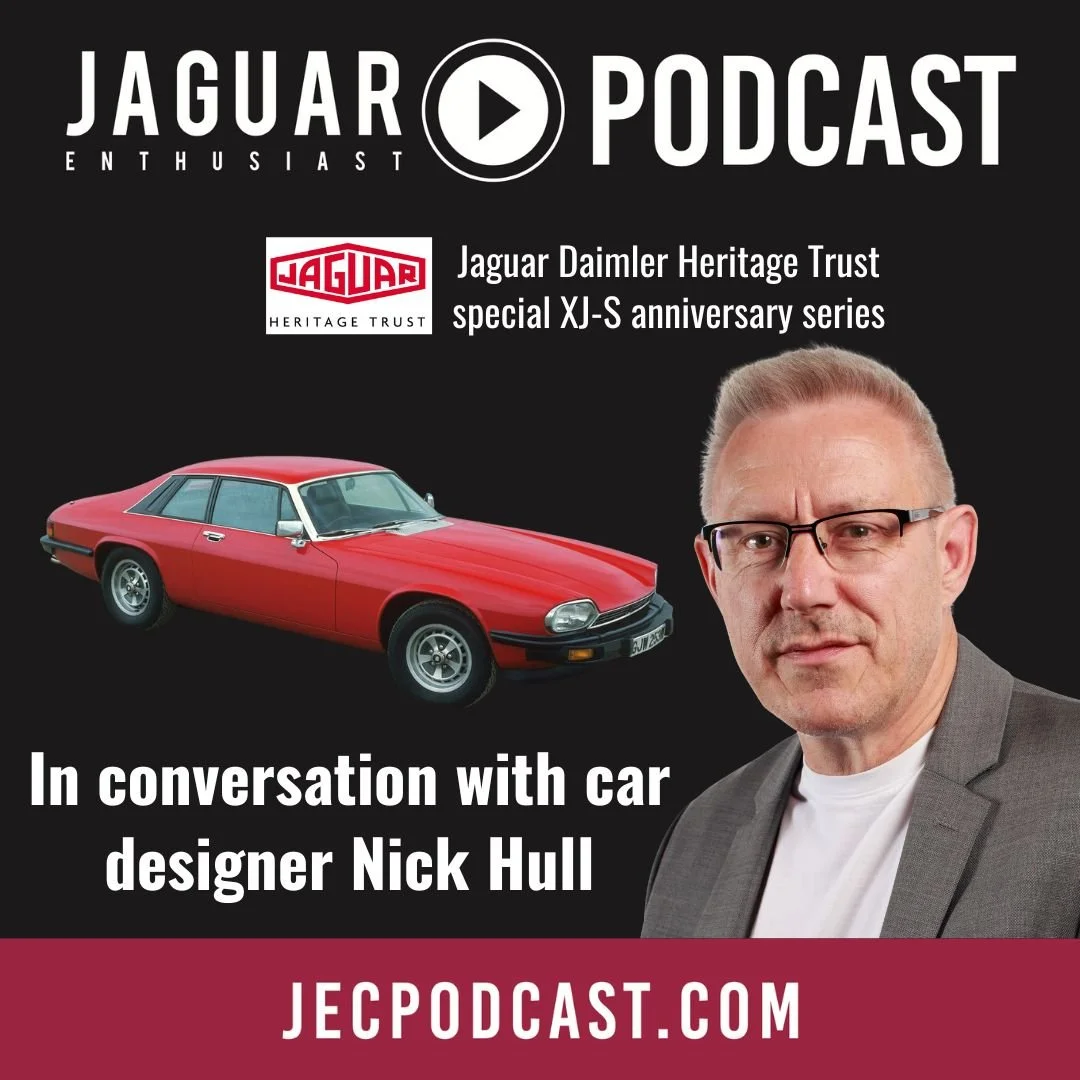
Jaguar Enthusiast magazine has teamed up with our Heritage partners, the Jaguar Daimler Heritage Trust, to track the human stories behind one of Jaguar's best-selling model ranges. Over a period of nearly a quarter of a century in production, it evolved through V12's, straight six's, convertibles and special editions, carving out its own legacy.
As one of Jaguar's longest-running models, to celebrate its 50th anniversary, we're going to explore the highs, lows and lasting impact of Jaguar's misunderstood masterpiece, the XJS.
On this episode, we're joined by Nick Hull, a designer, author and historian with a deep connection to the Jaguar XJS story. Nick was involved in the XJ-41 project aimed at replacing the XJS
and also responsible for the design work on the XJS facelift throughout the 1990s. Nick also worked at TWR, where he was involved in bringing the fabulous XJ220 design into production.
Nick's acclaimed book Jaguar Designer Story of Style is considered a definitive account of how Jaguar has blended engineering and artistry across the decades, from the earliest saloons to the most modern sports car.
Welcome to the podcast, Nick Hull. Hi there, thanks very much then Wayne. Do you have fond memories of your time at Jaguar as you look back?
I do actually, I think it was a very lucky period that in the 1980s, under Johnny Egan, and when I joined in 1984 and the summer of 1984, they had just become an independent company.
Literally the month I joined in September, the month before, they had become independent from British Leyland, and there was such optimism in the company at that time.
You could feel it right the way through. It was at five years that I was there at Brown's Lane, and then Whitley was a very optimistic time for the company, really.
Coming out of the difficulties of the 1970s and into the 80s. As I'm like XJS, it really began to blossom in the 1980s in a way that where it struggled for the first five years of its life, into the 1980s, it just sort of got more and more successful. It was quite a surprise really.
In terms of all of Jaguar's different and most iconic models, where do you think the XJS fits amongst all of those?
Yeah, I must admit, when I worked at Jaguar in the 80s and I wasn't a great fan of the XJS, now in retrospect, I think the XJS, particularly the facelift versions and the later ones, it's a very distinctive and elegant car, actually, that I think stands well in sort of test of time.
I suppose when I kind of loved when I was working for the company, I loved Mark II's, I loved E types, of course, and XK's and so on, and XJ sort of stood apart from that.
But like I say, I think it's grown on me more and more, actually. I see one now on the road, particularly a convertible XJS, and they do look very, very elegant, actually.
We were talking to Barry Thrustler earlier about how the perception of the model has changed over the years, from being a bit of a shock, as it replaced the E type in some people's eyes, although, of course, it was never supposed to.
Through to its kind of fallow years where it was just old, to now where it really is coming into its own as a classic car and an iconic design, isn't it?
Absolutely, yes. And again, I think it's one of those cars that, if it had been made in the volumes of, say, a Maserati, it would have been much more appreciated along the way, in the same way that the E type was, because we're so familiar with the E type, particularly in the UK,
had it been made in Ferrari or Maserati volumes, the values would be ten times what they are.
The XJS sort of falls into it slightly into that category as well, really.
Let's talk about you then and how you ended up being at Jaguar, because it's always fascinating to explore the story of how people get to work with the brand.
And often, how much it's revered by youngsters as they sort of map out their careers. Was that the same for you? Did you always look up to Jaguar as a child? Was it something you were aware of?
I was only aware of Jaguar. I had an uncle who had a mark one, actually, and this would be in the mid-60s, so I was aware that it wasn't quite the most modern Jaguar.
It was about ten years old then, but it was a lot nicer than my dad's voxal victor. From a very early age, probably from about the age of seven, I wanted to become a cardison.
I had no idea later on as a teenager how that might come about, and there was really no guidance at school.
And then I saw an auto car, an article about the Royal College of Art course, and when I was about 16, I went to London and saw that degree show, and realised there was an academic route into it.
And the Royal College of Art said, yeah, where you need to go and do a first degree course, which was the only one then, was at Coventry University.
And once I discovered there was this course, I was determined to get onto that course in Card Design at Coventry.
And when I got onto that course, I knew that an unreachable sort of dream of becoming a Card Designer was feasible.
And when I was on that course, I did a placement at Mercedes-Benz in Germany for six months.
And I suppose that was the point we realised actually, when I came back from that, I'd learnt a lot.
And I had a good portfolio then, I realised I could get a job in this industry.
And then a year later, one of the tutors said Jaguar Interview, you know, your name put forward, I said of course, and I was interviewed by Jim Randall and Keith Helford.
And offered me the job, so that was great. I was very fortunate to do that.
So that's how I got into working for Jaguar then.
The styling studio was at Brown's Lane, was really small.
And I must confess that in the first week after a couple of induction days, and then he said okay, now you go to the styling studio.
And nobody seems to know where it was quite.
They sort of faded you where it was. It was a very anonymous building around the back of Brown's Lane.
And so I knocked on the door and was let in. And it was quite a small studio really, with about ten people working in there.
And then next door to that, there was the model shop with clay models in, about two or three full-size cars in there.
And so when I saw XJ40 for the first time in there, and XJ41 in its early iterations was in the styling studio there.
So that was sort of fantastic. And I sort of thought after about the first day, this must be the annex.
There must be a bigger studio somewhere. But there wasn't, you know, that was it.
It was actually a very small setup then. The later studio weekly was a much bigger facility and a much more impressive facility.
And, you know, more like a proper styling studio.
But I have fond memories of that Brown's Lane studio.
And all the flop was done there in very sort of limited facilities really, certainly compared to today.
Was it still a very analog setup in those days? Not many computers, certainly probably no CAD design going on much.
It was. The only real area where, I suppose, you know, CAD in its Vegas terms with being used was in digitizing of body surfaces.
And that was done using a probe on a steel form iron machine so you take stations and take points off.
And the probe did, you know, very accurate points. But you still had to set it up.
You know, it had to be done manually by an operator taking points, you know, across a, you know, a front fender or across a bonnet surface to capture all the data.
So that was really the only. We, as designers, we weren't using computers at all.
Everything was, you know, a sketch, a hand drawing, you know, a large tape drawing, giving sections to modelers to carve out.
And then working in 3D in clay or maybe in polystyrene foam and so on.
So no, it was totally analog, really.
1984. Incredible year for Jaguar. There was all sorts going on in that year.
Obviously, John, he's going to take the company out of British Leyland. It now become independent.
Employees were being offered share options. The XJS had won European Touring Car Championship later that year.
And the model had gone from the doldrums of 1980 where production had stopped because of lack of demand.
And it was starting to pick up. Was there a sense when you walked into that styling studio on day one that there was an upbeat mood about the place?
Definitely. Yes, indeed. I have to say that I would say that XJS wasn't the main focus at that point.
In the studio, XJ40 was in 1984, was in its final stages of development.
Particularly the interior was going through a complete redesign. They had done clinics in 1983, early 1984.
At that point, the interior was much more like a sort of Rover SD1. It didn't have much wood and chrome and leather in it.
And it hadn't cleaned it well. And although the main architecture of the dashboard and doors and so on and seats was fixed, there was a big program to get more enrichment into the interior.
And so that's what I was involved on initially as well was small details of steering wheel, doors.
Let's say just starting some chrome escutchions, a little bit more wood here and there.
And so on, just getting a little bit more of the English richness back into the interior.
So XJ40 was one of the main focuses. The other one actually was XJS replacement, XJ41, which was a big program in 1985, which was in the studio then.
So we were kind of in advance of a bit of XJS. So that was kind of not being ignored or forgotten because the facelift was being done in in 1984, 85 as well under Fergus Pollock.
And but a lot of that was being done off site. So we didn't see that day today in the studio.
And so just slightly different focus maybe from the rest of the company in terms of XJS and where it was at that moment.
What's referring though that some lessons have been sort of learned from XJS over the past few years that were then being applied to XJ40 as you were working through that?
Well indeed, particularly say the interior exactly the same had happened with XJS that the initial interior was a little bit of steer feeling.
And then with the HE when they introduced a little bit more wood and richness into that interior and it was exactly the same with XJ40s that was being applied to do that.
So yes, that was definitely an influence on that.
So with XJ41 they'd realized it was a mistake to not do a cabrio right from the start even if that might not actually be productionized but it would be foolish to not do a coupe and a cabrio in absolute parallel at the styling stage so that it would be possible later on.
Obviously that was one of the big mistakes with XJS was that the cabrio wasn't really developed early on in the 70s.
It was stopped very early on and then had to be sort of reinvigorated with the cabrio lay and then later on the full convertible as a very expensive program is really quite late on in its life.
XJS and XJ40 that you were on at the time marked a new era really for Jaguar and design terms didn't it because more than ever before in Jaguar's history he had a model set including even Series 3, XJ6 that had come just before it but perhaps less so than XJS and XJ40 but had been really moulded and shaped not just by the design but by the adherence to legislation.
And to rules and in particular to what was changing in the American market.
Where of that how did you deal with that?
We had almost jealous of what happened in the 50s and 60s they could have such a free hand.
Up to a point I mean that that thing of the you know that as a designer that rules and regulations you know hamper you and hindi you in terms of your creativity.
I think like many designers I'd slightly push back on that in that you know those are there are always regulations and rules whether it's headlamp height or crash safety or vision angles whatever.
All designers have to deal with that and they're just one of the sort of challenges that are there you have to design around that is what makes the job interesting.
Yeah challenging how do you how do you approach that in a new way whether it's the way the you know the headlamps operate on something like XJ220.
You know another way of exposing headlamps that still meet the headlamp height and can be aerodynamic or wings and downforce you know how you deal with those.
That it isn't just about you know artistic styling you're dealing with with rational practical issues hard issues that have to be solved.
Particularly things like aerodynamics and those are the enjoyable part of the job so that yes there was you know much more freedom in the 1950s.
I know I never found rules and regulations that challenging and then later on when there were things like pedestrian safety things and again the whole front end of cars had to change again how we thought about them.
You know again it brought out new and exciting solutions from different different people yeah.
But what's the legislation and the regulations were changing over in engineering as we've heard from others there were huge changes where you know emission regulation departments were being formed at Brown's Lane to deal with all of the different changes and constraints on engineering as well.
Despite all of those modern changes and updates there was still an old fashioned feel about design at Jaguar wasn't there at that time and in particular if we look at the modern day JLR you've got literally hundreds of people in styling.
As you've already described it was a pretty small department did that therefore then mean that it was being led by really strong personalities and did you find those inspiring as a youngster coming into the brand.
Yes I was very fortunate with Jeff Lawson as our boss there he was new into the company had come from Voxel so he'd been part of GM big American company big processes so he admitted he found the sort of Jaguar and Brown's Lane quite restricting for him in a way in terms of budgets and processes and so on.
But he was a great lover of Jaguar and like there's an intimacy of it. Jim Randall particularly worked with styling very closely. Jim often had quite fixed views but he had quite strong views about different things which he could make his point quite forcefully.
You'd often comment on something and ask you if you know well think about it a different way and in a couple of weeks time he might be and have a look at it again.
So some of that was this sort of challenge you just to make you think a bit hard about could some detail or some point be done a different way.
So people like yes Jim Randall was a strong influence Jeff Lawson as well.
I'd say John Egan less so John Egan there were monthly styling reviews in the styling studio which were led by product planning and marketing and engineering represented usually by Jim Randall where you know at any one time there were multiple things going on where it was you know it might just be.
Next year's exterior color changes or some interior trim updates there are constantly sort of updates and styling changes going on on production models.
Or it might be something that was quite mage you know a key review on XJ41 or something else which was still just a paper project at that point.
So there was monthly styling reviews and Egan would come to those as a young designer you weren't you weren't really invited to those we might be sort of sitting around the edges trying to listen in on the comments.
And Egan was you could sense it.
So John would would make comments but he was he would usually defer back to Jim Randall or to Jeff in terms of you know design matters he was he was always thinking about it I guess from the businessman's point of view about was just going to be profitable or did it save cost and so on.
So you know his background was much more from the marketing side and the business side and it was interesting kind of watching that into play going on between the board members.
So again the styling studio could kind of very fortunate in that you know within the drawing offices and so on they didn't you know young engineers wouldn't get to see the board members that up close and in the styling studio you did we were kind of very lucky on that point of view.
And so you do get to meet them talk to them and so they kind of knew your name as well if you're walking around the factory and so on they didn't know who you were so it was it was you're quite fortunate really from that point of view.
Of course at that time you had the likes of Mike Beesley in particular who were championing a different way of making cars for Jagger in the sense that they were trying to share more common components when they across production so for example XJ41 you were basing that on an XJ40 underpinning to make it all economically viable.
Was that something that was that you were conscious of even as a young designer that was a changing culture for the company at the time.
Yeah there were always I think in the past with Jagger there hadn't been so much sharing of for instance on the interiors of sharing switches and componentry between sort of series three and XJS and that with the other new models that we're doing with of the XJ40 was had been a big investment.
So other things that we were designing we were trying to use XJ40 componentry and systems as much as possible because clearly you know it made sense to do that.
And the other thing was that was nice at Brown's Lane was that you were very close to the production lines and it was very easy to walk up to the tracks and see how things were put together you know difficult areas like you know how the dashboard fitted and what goes on.
And some processes which were real pain and so when you're designing you know the next one you know how can you make some of that a little bit easier we encourage to do that as much as possible.
So you do have to have this understanding of you know not only just how you want something to look artistically but also how the heck that's going to be built.
Yes I know things like the wood shop as well so for interiors we would we were often doing small prototype parts for something and you go ask the wood shop to make a sort of one off thing which they were quite happy to do.
You know it was something I enjoyed doing rather than just production work.
And something it was good to talk to the craftsman there during the years about you know how much what curvature could you get and where would something become really quite difficult.
You could do one of them or you could do ten of them but you couldn't do 50 a day and so on and understanding where those limits were was you know quite important as a young designer.
The Jaguar in comparison to many of the competition was a small scale manufacturer.
What we've heard through these conversations especially about these early 80s times is that XJS in particular was up against some really stiff rivalry from Mercedes, from Porsche.
And how is a designer do you balance the need to be up there but also the need to sort of curb your enthusiasm in a way because you know what budgets are ultimately going to be worked within.
Yes I mean it was brought home quite early on the fact that Jaguar in terms of some of its technologies or what its suppliers could do you know it was limited by budget.
For instance when working on XJ41 interior I was a big fan of the Porsche 928 and that interior and that definitely influenced what we were doing on XJ41.
But that had been very expensively tooled up with lots of soft field plastics and so on which was quite different from Jaguar's then suppliers.
The kind of things they were doing on not just XJS but also XJ40 was a lot cheaper but a lot more traditional type of technology compared to some of the German suppliers.
Having said that in the 1980s Jaguar were expanding its supplier base once they were out of British Leyland and the restrictions I think that they had on suppliers there they were going much more sort of pan European about suppliers and were starting to use more for instance German suppliers for key components and so on so it kind of helped us a bit early.
So what was the point then where the facelift XJS came into your remit and you became aware of XJS as a project that was on your desk again?
In 1985 it definitely wasn't on the horizon and I have to say then once the convertible the decision had been made to go with the convertible in May 1985 that became a big and a rush program.
In terms of styling really our job had been for the XJS had been sort of completed by May 1985 it was in a case of getting into production.
On the interior there were lots of small changes again particularly driven by legislation in terms of airbags needing to be fitted.
Also in America there was a need for much more knee bolsters in the lower dashboard area and also wanting to sort of internally wanting to commonize with some of the XJ40 switch gear in terms of seats and electric seats and so on.
So lots of small changes were coming on the interior and it was a little bit piecemeal the way that was being done every six months has seemed to be sort of changes.
So I worked mainly on the interior side and so for XJS on the even on the non-face lifting sort of 88 model year 89 model year there were lots and lots of interior small changes on there which were introduced quite quickly.
So we were quite up against it in terms of timing stuff had to be done within a couple of weeks to get it to the drawing office to get it to suppliers and tooled up in time for 12 months hence or whatever.
With the facelift there were quite big, there was a little bit more investment went into that and in terms of the seats the seats were changed completely with higher backrests so the seat frame was changed and that gave us an opportunity to redesign the seats away from that original XJS seat into one that had a rigid backboard which gave a nice sort of a nice high quality to it like some of the German competitors.
And so on and yeah that was one of the things I was involved in was the XJS facelift seats with a different way of different tipping release lever and a different backboard on those and different side bolsters and so on so they were much much more comfortable much more supportive seats and the original quite flat XJS ones.
Was it still an interaction as well between your studio and your team with Carmen over in Germany? Were you sharing ideas with those guys still work this late on in the project?
Yes, I mean there were two projects with Carmen, mum's the XJS facelift that was the initial big project with Carmen.
I guess from the Browns Lane side in body engineering they were possibly a bit resentful that had been outsourced to Carmen in Germany it was quite a nice juicy project why had that been outsourced at the same time in 1985 the drawing offices were really still up against it with XJ40 and getting all the last minute.
And issues with XJ40 for production in 1986 sorted out and so I can understand you can understand full well why the board were key not to interrupt that process whatsoever and outsource this other project to Carmen.
So really from the starting side the Carmen liaison was all handled with Fergus Pollock he was the main designer for XJS and so he would go out every couple of weeks or so with a small team and they would go out and review the changes that were being done out there or review the prototypes and so on at that point.
So they were mainly done with folks on the interior side that was shared between sort of Carmen and Browns Lane so we could handle that ourselves a little bit more.
It's a funny place isn't it as a designer and as a design team because whilst the rest of the company are getting on with building current models, servicing current models, making sure that the quality is bright and feeding back changes that might need to be done.
Your years ahead in many respects aren't you got an eye and a view on what's happening in the company seven eight ten years away.
You're almost like the soothsayers of the car company aren't you you can see the future that perhaps the rest of the company aren't seeing yet.
Yes because even in eighty eight eighty nine we were we were looking at the replacement for XJ40 with initially what's called XJ90 which was a complete re-skin of XJ40.
And then that sort of morphed into a slightly reduced version of that which became X300 where you know front and rear were extensively revised but the center structure sort of remained unchanged.
We were also looking at smaller cars even in the late eighties.
So you know the designs you do can do that because it doesn't really cost a huge amount of money to you know obviously sketches and drawings don't cost anything.
But even doing full-size clays and so on it's it's it's small beer can be you know going to that stage you know where it starts to get expensive it's been building prototypes and engineering and so on.
But up to that point you know you can explore lots of different avenues so we were looking at one stage at V12 minivan's something like a Renault Spass with a V12 mid-mounted engine.
Again you know it only went as far as sketches and ideas and that and what if could we do something you know like that.
And you know the group B car with Jim Randall that became extra 220 you know there were different avenues explored in the early stages of that project particularly in terms of styling.
You know it could have been something much closer to the TWR race you know Le Mans cars of that time or it could have been something which took more inspiration from XJ13.
You know both both avenues explored and you know so it was it was nice to be able to do that.
But yes you're right you are always looking at least three or four years ahead really.
So in a typical week you know some of your job would be a long-term project something which is you know five years ahead and you know there would be always a couple of projects you know small things which are you know for something actually a small change or you know a detail that needs sorting out for next year as well.
So you know that would be a typical week would be spending three days on one project and a day or two on other things.
So yes it's important to kind of look at what competitors are doing and where trends are going for sure.
And would that go to the extent of buying in competitor cars and pulling them apart and looking at how they design them from your point of view?
Being brutally honest that was one of the nicest parts of working with Jaguar was the competitor cars.
Yeah there was always a 911 and there was a competitor fleet so yeah there was you know and the Steining Studio together with other departments you know those cars were readily available and you were encouraged to drive and evaluate competitor cars.
So Porsche 911 there would always be at least one or two S-Class Mercedes BMW 7 Series BMW 6 Series probably Porsche 928 so maybe a Cadillac or something like that.
And those were regularly sort of updated each year so it was the latest model. So you do get to drive cars like that quite regularly.
Your listening to the Jaguar enthusiast's podcast to find out what events you can get along to or to discover local club meets in your region.
Visit jec.org.uk
Nick perhaps you can tell us what happened to the vertical gauges.
Yeah I am the design who designed the original XGS instruments instrument pack was Colin Holtum who then in the late 80s was the manager of the interiors.
And I confess when I was working on XGS facelift items I did ask Colin what was the thinking behind them because I had never fully understood them.
It was quite a sort of citron approach to instrumentation. And yeah he had quite a strong philosophy behind them that it was much easier to read minor gauges where the sort of normal level of coolant or oil pressure and so on were simply horizontal lines that were lined up that at a glance you could see immediately if something was high or low.
So that was the philosophy behind it. I have to say by sort of mid 80s that and somewhat as a reaction to XJ40 instrumentation there was a strong push to go back to much clearer largest analog gauges like the XJ40 instrument pack change and that's what very much drove the XJS facelift instrument pack was something which was
just white figures on the black background big analog gauges rather than trying to mix digital pixelated information as have been tried with the XJ40 or the XJS the vertical kind of gauges.
In retrospect I'm quite fond of those gauges they were a quirky part of XJS and they are effective. It is a good way to present information but at that stage in the late ages it was just do good analog gauges. BMW particularly was held up as being the exemplar of really clear.
So what other market forces were in play then that you'd identified as a design team that instructed the changes to XJS through those last few years of its production.
Obviously the American market was quite key to the success of XJS and there were two cars competitors in America the Cadillac Alainty and the Chrysler Maserati which came about in about 86 maybe 87.
So with XJS facelift those two were kind of known about as being key competitors you know both those they were two seat roadsters very much in sort of Mercedes SL XJS kind of idiom.
So yeah those you know we were aware of those and you know what those what those trains were with those so there was some input from American ideas of the time.
I've say with XJ220 there was but we're also quite a big American influence from things like the some of the GM concept cars of the middle late late 80s and superb things.
So GM Aerotech mid-engine Corvette and so on you know seeing those or pictures of those from motor shows you know did have quite an influence on what we were doing an early ideas for XJ220 as well.
Was there ever identified this sort of a version to using hyphens then at some point because the fact that that was dropped is a bit strange isn't it the facelift XJS came along and the hyphens suddenly disappeared which for people writing about XJS is now is a real pain because you never quite sure what it's put in a box.
Yeah I confess it was only when the car was the the facelift car was launched that I was kind of aware that the hyphen had been dropped to be honest it was a surprise to you guys as well.
Well I guess we'd designed the badge at some point forget who you actually designed that but that was very much a sales marketing you know driven exercise and to try and simplify the you know the nomenclature of XJS at that point.
Yeah there were other designs out there though and in particular just behind us here and we're recording this at the Jaggedoma Heritage Trust and British Motor Museum buildings there's the links event which of course is the estate version of the XJS your thoughts on that Nick I always loved the event and I can remember there was quite a heat you know.
Yeah deep discussion about why we weren't doing that in house because it would have been fairly straightforward to do and with a bit more investment maybe you know it could have been made look even more elegant.
I thought that the job that the links are done with the event was superb given you know the limitations they have with finding a real tailgate from a citron amy estate and using that and so on mixing that with a with an XJS trunk lid and that long twisted real glass that it has to take the twist out of it is very cleverly done.
I've always liked actually shooting wagons you know something like a Volvo 1800 s or a similar to GTE the kind of cars I've always I've always liked I was like sort of sporty estate cars actually I like that mix of you know practicality and sportiness.
And so yeah the links event there was a discussion about you know whether we could do that but it was always about we could do the Capri you know convertible or we could do a shooting wagon and really it was no contest in terms of potential sales in America especially.
But no whenever I see links event or you know I do love the look of it I think it's a very very elegant car indeed a particular facelift version of it with the horizontal tail amps it just gets better with that and some of the detailing with the hinges is kind of cleaned up a bit with the later event as yeah great there was another element to XJS design that we haven't explored in quite so much detail.
In any of our previous conversations and that was of course the Jaguar sport models initially by TWR then eventually brought in house to Jaguar of course they really took the XJS from being its luxurious sporting grand tour to something that appeared to a younger slightly more should we say Larry audience didn't it.
I have to say that in the early days there was a slightly uncomfortable relationship between TWR and and the in-house design studio that Tom Walkins or particularly didn't want his TWR designs to be done in house he wanted to keep control of those.
So I can remember we were a little bit skeptical of the very early TWR series 3 and XJS you know body kits, particularly Jeff Lawson they were about you know he could have done a better job and then later on when Jaguar sport was formed so with the XJ40 and the XJS that they were done in house as that trust was built up.
And yeah both both of those you know the XJ40 the TWR the 4.0.0.1 with a slightly neater rear end panel on it and the XJS particularly the facelift TWR cars were actually very elegant nicely nice balance of the kind of hardcore sportiness and the sort of elegance from XJS then.
I guess you're trying to always make it look lower wide and more aggressive aren't you and it's how you achieve those three things really.
Yeah that's basically the formula I mean later on I worked at a Honda I worked on quite a few Type R civics and so on and that's the formula you're applying there push the tracks out make it wider make it lower and make it make it sportier.
So that basic formula is kind of well understood people you know understand and get that.
Yeah and then there's also in Jaguar's case you know there was the TWR influences from the Le Mans cars was quite you know helpful you know there was that as a possible input and influence that could be used
I mean the race cars were you know they're not style they are very very functional whether it's sort of XGR8 XGR9 so you know there are details on some of those whether it's using sort of knack hard ducts or you know some motifs which could be brought onto a production car just to give that link between the two.
That also leads on to some of the different special editions that XJS had along its lifespan as well now we've got marketing coming back to you guys saying we think this or sell can you make it happen and XJS had all sorts of these different celebration models the Le Mans being one of them was that how that dynamic work marketing would come to you and instruct you then on how to next do it.
Yeah there are two as there's marketing directly and there's also then that becomes more formalized through product planning.
So product planning's role is to you know schedule what changes are going to be carried out next year what's the sort of how do you rationalize that and what's the budget for that you know how do you feed that through into the production at a key moment.
What changes do you want to introduce at the same time is it a slight engine update or an update to breaks or some other you know functional engineering change or is it simply a special edition where it's more sort of cosmetic changes to simply push sales maybe till the end and model life or to celebrate an anniversary.
Something like that is more sort of straightforward. I don't knock those I think you know they're they're they're legitimate ways to push sales and at certain points you know if that can generate extra sales and extra profits then that's that's a good business sense to do that so yeah.
It's like a specific paint color plus a new set of wheels maybe slightly different badging and some interior changes.
It's funny you mentioned wheels actually because I think XJS really heralded the start in Jaguar at least of wheels becoming a thing didn't it really it was the first car I think to be production car with alloy wheels for Jaguar the XJS I believe.
So how do all these different accessories now and it's we sort of got used to it haven't we in the car world where you buy a car and there's like a million different accessory choices that you have to make when you order it in previous years that wasn't so much the case but with XJS that started to become more prevalent didn't it that's true.
You know initially with XJS there was you know the one style of what we call the the banana wheels that sort of you know displayed a fire spoke wheel which I think actually predated XJS it was actually introduced on to series two feet 12s about the year before but there was that
display displayed wheel and then with the HE they were the staffish alloys that came in but you know so there wasn't there wasn't a lot of choice of wheel you know there wasn't a large a diameter wheel or a different choice of wheel until you know the
but then with the the the cabriolet you know in the pepper pot wheels that we used on on that. So particularly under Jeff Lawson I think that's one of the things that the Hebrew was was pushing for that area much much more I think Jeff Lawson and sort of Roger Putnam you know together realized there were lots of potential
and and you know extra profit to be had in offering different types of wheel and that that started to take off really in the late ages yes and you're right XJS was the model where that was exploited quite successfully actually with that.
So again the sort of lattice alloys that there were on the on the came in with the sort of 89 model year with the convertible and so on.
And by then you know they've got several wheels pepper pot alloys you know the original staffish wheels the lattice alloys and those were kind of you know used.
On different on different on different models different engine sizes and so on quite successfully as you go into the 90s then with jacket that that whole area really really kind of explodes with lots of different wheel sizes offered different.
Different style you know of of of wheel and different finishes on them whether it's black or satin and so on that's become a huge area of any design studio these days now.
Then we should start campaign to bring back lattice alloys.
That is alloys yes fantastic.
Night man to clean but fantastic looking.
Yeah your fingers get sore after clean four of them.
Yeah you keep going to buy new toothbrushes I know XJS is as a form especially from the side on is an incredible design in the sense that it was known as a coupé we know the reasons why it had to be
a coupé in those early days mainly driven by all these different legislation changes to do with crash and impact zones and potential banning of convertibles of course.
But it was very famous for those big buttresses wasn't it in the early days.
But somehow managed through the convertible and the cabaret to still live on with that without them and it still very much looks a complete XJS without those buttresses.
That's quite an amazing achievement with the design isn't it to lose such a major standout component but not lose the essence of the car.
Yeah well one XJS has it has a nice very elegant stance to it and there's a very long rear overhang.
And that rear wing the top surface of that which is the buttress the twisted buttress on the coupe and on the convertible cabaret is quite a soft surface which doesn't twist but it's a very long surface which gives a lot of elegance to that car.
The other area is quite sort of unique the XJS is the front wing which starts off with quite a crisp line right by the A pillar as it goes further forward it gets softer and softer that that top corner of it and eventually becomes very soft as it goes into the oval headlamp.
And I always liked the way that that that's very elegantly done really and is there's not many other cars that do that you know other cars which have a very soft front corners of the fender you know it's soft all the way through something I can you know port 911 crisp all the way through like a port 928 and the XJS sort of does both but does it very very successfully.
I think with the buttresses they were there was a fairly controversial feature that they're quite an important part of the XJS you know it was there right from the beginning with with Malcolm Sayers you know concept for XJS of how you control the airflow you know down over the sides and they do definitely contribute that you do help with that.
And some of that was was you know came out of what Ferrari were doing with the Dino in the late 60's as well and some of the the the couple of Dino concepts that we're showing the sort of 6566 I think that also influenced the say on you know how do you treat that with a mid engine car and of course with the mid engine car the difficulties is how you treat the rear window because the engine is long way forwards.
You don't want the cabin to be this short cabin and so you know doing doing a buttress where the the rear window is fairly vertical and you've got a long sale panel to give some length to the cabin is what you inevitably do with a mid engine car.
So the XJS sort of caught up part of that mid-engine look with the way that the rear window and the buttresses work with that.
Again with the facelift that was I mean that was always a tricky area to manufacture and interesting with with Carmen they suggested you know with their with their pressing and tooling expertise that they could simplify the way that the rear fender was manufactured from five separate pieces down to you know one main pressing so that when the facelift have done that that buttress is actually subtly different in terms of its serving.
It's more twists but it is actually every every millimeter of it is very slightly different and the rear window was pulled back to meet the the boot shut line as again a way of giving a little more difference to the car but also to simplify the manufacture of the of the buttress which was you know helped both quality and and peace cost for that.
If you think about that original bootlead as well there's one other car which does something a little bit similar to what they were doing with that with that sort of capping on the back of the of the of the bootlead was the Citroen SM which again has a slightly slightly odd fussy rear panel but it does a very similar thing to the XJS with that training edge of the bootlead there and a way that it then sort of links to to tail lamps as well.
Underneath and sort of odd sort of slightly odd strips of chrome used in that as well so it's so much obvious of its time the XJS of this sort of early 70s trends that we're going on.
It's remarkable you think about it you know the bonnet is central the bonnet is lower than the than the wing and yet you've got you know huge engine under there so it's quite quite achievement really to just make the bonnet just clear the engine in the
V12 but now it was interesting coming to GWR Jaguar sport it was a very small team a lot of I was really the only designer there Keith was was part of the main studio in Jaguar.
I think I think maybe involved was was a bit of a sort of political decision from from Tom and Jeff Lawson that somebody that they could sort of trust to be a bit of a go between between the politics on both sides
which were never very smooth and you know I could you know I had Keith's ear and understanding and Keith trusted me to you know smooth the path through into discussions with Tom you know on various things because there were potentially you know quite quite big arguments to be had along the way there.
As you look back on XJS which of course we're celebrating the 50 years of this year with this special series of podcasts to critique the design if you'd seen it for the first time today what would you say was its biggest strength from your point of view.
I think it's what I've used before but elegance is a very elegant car it it it it first sighted it doesn't shout performance it's quite so understated there's a kind of quietness to to the design.
I think it also manages to bridge that area between you know appealing to an American market with big GT front engine big GT's that you know the Italians was also important to the Italian brands as well.
And something which still kept some of this you know the sportiness of the E type not an easy balance a very different car from the top of course it was a luxury GT it wasn't it wasn't in essence you know a two seat more hardcore sports car like like the E type.
And yeah you know it had a timelessness to it which as we've said because it it it managed to to sell well into the into the 90s way beyond its original intentions and that could only happen with with really quite a timeless design that it was really.
To see it being looked upon with such affection now must be great feed you still feel a sense of pride at your involvement in the XJ story as you see them out on the road today.
Yeah I mean my involvement was quite small in in in in in in in the big store in big picture of it.
But yes I do particularly the later facelift ones I think that really successfully re rejuvenated the car and even into saying to the into the 1990s it still sort of looked contemporary and wasn't wasn't being completely outclassed or outdated looking at that point.
So yeah you know it was a happy chapter in in Jaguar's history and you know it was a it was a complete sea change from what I've gone before with the with the E type so in 1975 that was kind of difficult for many people to take.
But is it it's a nice example of where Jaguar can go through a big sea change and bring customers round to its way of thinking.
You know that that has that has happened in Jaguar's history and it can be shown to to be a successful strategy as well.
Well let's hope it remains so for whatever future we see for Jaguar from this point onwards if you want to see the full story through Nick's eyes of the XJ S right the way back to Jaguar days before his time at the launch in 1975 onwards.
Do have a look at the May and June editions of Jaguar enthusiast magazine 2025 where across two parts Nick tells the story of the XJ S from a design perspective and of course you can get those issues online digitally if you're listening.
A long time in the future from when we're recording this to this podcast via JC dot org dot UK and of course you can catch up with the other XJ S 50th anniversary podcasts via JC podcast dot co dot UK and of course via the JDHT website as well.
The Jaguar don't know which is trust for now thank you very much Nick help.
Thank you Wayne.
Well that's all for this episode of the Jaguar enthusiast podcast do keep in touch with us though and let us know about your own Jaguar stories by the contact form at JC podcast dot com where you can also sign up to receive new episodes of this podcast automatically for free by subscribing by your favorite podcast provider.
We're on them all Google apple Spotify pick which one works for you. You can also join the Jaguar enthusiast club online by clicking the join now button on the top right hand side of the podcast page at JC podcast dot com when you join you'll also get our big chunky glossy lovely 180 page monthly magazine.
It's all included in your membership of the worldwide Jaguar family that is the Jaguar enthusiast club.
About this episode
Celebrating the 50th anniversary of the Jaguar XJS, this episode features designer Nick Hull, who shares his insights into the evolution of this iconic model. Hull discusses his experiences at Jaguar during the 1980s, the challenges of design amid changing regulations, and the impact of the XJS on the brand's legacy. He reflects on the car's misunderstood status, its elegant design, and the influence of competitors. The conversation also touches on the transition from analog to modern design processes and the significance of the XJS in Jaguar's history.
Jaguar Enthusiast Magazine has teamed up with our heritage partners, The Jaguar Daimler Heritage Trust, to track the human stories behind one of Jaguar's best-selling model ranges that was in production for nearly a quarter of a century!
Launched in 1975 as the successor to the legendary E-type, the XJS celebrates 50 years this year. So, buckle up — we’re going to explore the highs, lows, and lasting impact of Jaguar’s misunderstood masterpiece: the XJS.
Nick’s career has seen him working for Honda, Peugeot, Jaguar and TWR, going on to lecture on automotive design at Coventry University and around the world.
Nick was involved in the XJ41 project aimed at replacing the XJ-S. Early clay models were labelled F-TYPE, and there was great hope for a world-class vehicle to serve as the E-type's spiritual successor.
That led to the XJS facelift project for Nick, and we hope to hear more from him about that in the future.
Nick also worked at TWR, where he was involved in bringing the fabulous XJ220 design to production.
Alongside his design career, Nick became an educator and writer, documenting the history of automotive design with clarity and passion. His acclaimed book Jaguar Design: A Story of Style is considered a definitive account of how Jaguar has blended engineering and artistry across decades, from the earliest saloons to the most modern sports cars.
Nick brings not only professional expertise but also an insider’s understanding of the challenges and triumphs that shaped Jaguar’s design DNA. His insights into the XJ-S help us understand how design decisions of the past continue to influence the cars we celebrate today.
As we commemorate the 50th anniversary of the Jaguar XJ-S, it’s a privilege to welcome Nick Hull to explore how design shaped Jaguar’s identity and what the XJ-S truly means in the wider story of the marque.