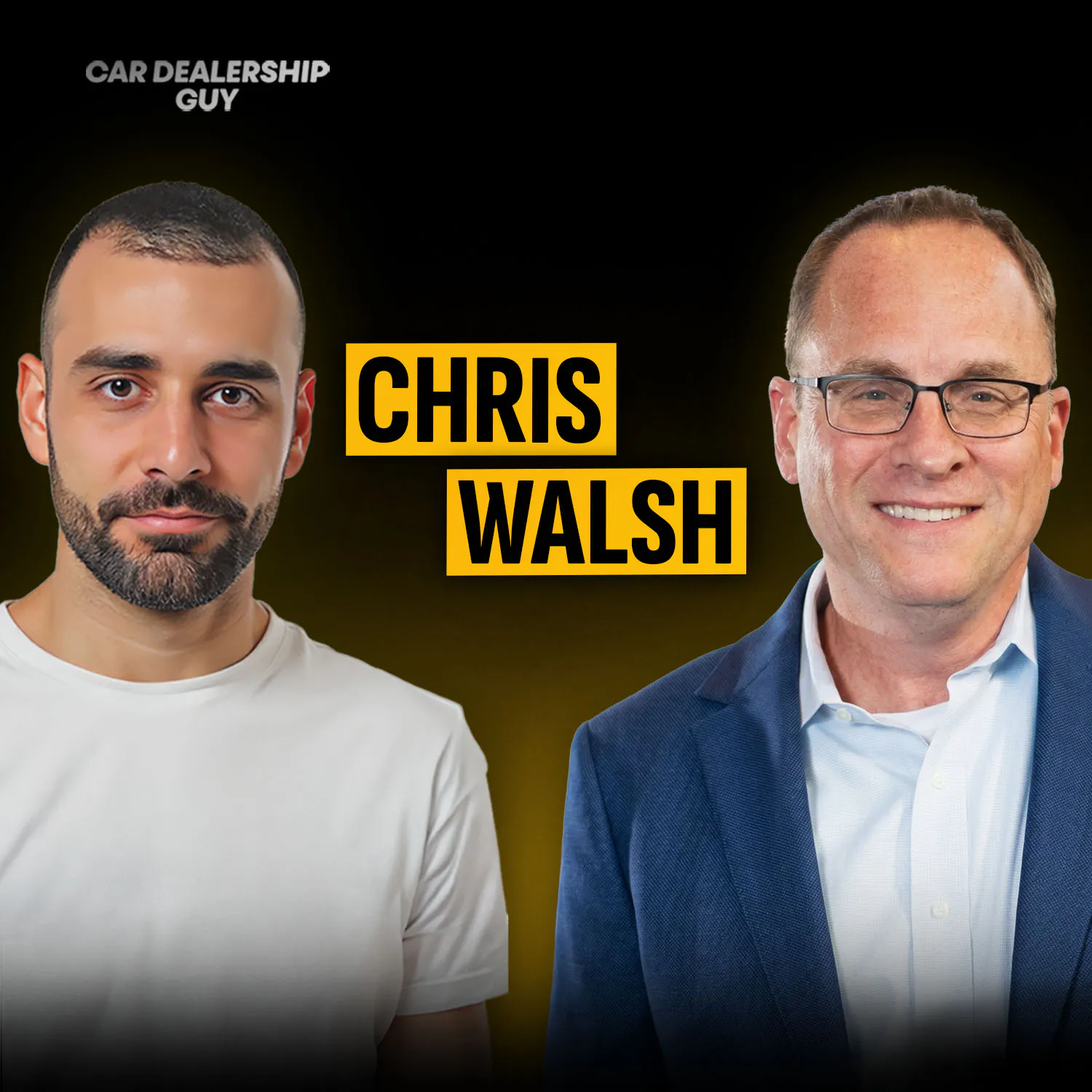
“Your Headcount is Wrong!” Designing The Dealership of the Future (And the 5-Year Dealer Playbook) | Chris Walsh, President and Acting CEO at The Reynolds and Reynolds Company
Car Dealership Guy Podcast
“Your Headcount is Wrong!” Designing The Dealership of the Future (And the 5-Year Dealer Playbook) | Chris Walsh, President and Acting CEO at The Reynolds and Reynolds CompanyCar Dealership Guy Podcast · Mar 26, 2026
Operationally efficient means doing more with less—like getting the same work done faster or with fewer people. For dealerships, that matters a lot when profits are squeezed.
Reynolds and Reynolds is a company that provides software used by car dealerships. They help dealers run things like customer and business workflows with technology.
Margin compression just means the dealership makes less profit on each sale than before. When that happens, you have to cut waste and run operations more efficiently to keep the business healthy.
Agentic AI is “AI that does things,” not just talks. It can take steps to complete tasks, which can cut down on paperwork and repetitive admin work at a dealership.
Administrative overhead is the “paperwork and back-office” work that takes time and people. Cutting it helps the dealership run leaner and keep costs down.
DMS stands for “dealer management system.” It’s the computer system a car dealership uses to keep track of things like cars on the lot, customer records, and paperwork.
Parts inventory control means keeping the right parts in stock. The system helps the dealership know what it has, what it’s running low on, and what to order.
Telematics is the use of connected-vehicle data (often via cellular/GPS) to monitor vehicle status and usage. In a dealership context, it can support things like fleet tracking, usage-based insights, and proactive service.
Cybersecurity is about keeping the dealership’s computer systems and customer information safe from hackers. Since the DMS connects a lot of business functions, security matters a lot.
This is the system dealerships use to let customers pick a date and time for car service. It helps the dealership plan ahead so appointments don’t get messed up.
Enhanced workflow means making the dealership process smoother and more connected. Instead of customers and staff jumping between disconnected steps, everything flows together.
Invoicing is when the dealership creates the bill for the work done on your car. If it’s connected to the appointment process, it’s usually faster and more accurate.
Dealer feedback is what dealership people tell you about what they like and what they struggle with. It helps companies improve their tools and processes based on real problems, not guesses.
An advisory summit is a structured meeting where leaders from different disciplines (like parts, service, accounting, and customer-facing teams) gather to review how products are being used and where gaps exist. It’s essentially a feedback loop designed to identify unmet needs and prioritize improvements.
UI and UX are about how a website or app looks and how easy it is to use. UI is the screens and buttons you see, while UX is whether the whole experience feels smooth and intuitive.
Customer feedback means listening to what customers say about their experience. It helps companies improve what they’re selling and how they support it, because customers see problems first-hand.
Podium is a software tool dealerships use to talk to customers. It can use AI to answer calls and messages, schedule appointments, and help move customers to the right place.
Call routing means sending a phone call to the right place. For dealerships, that can help customers talk to the correct team faster instead of getting bounced around.
Instead of laying people off, some dealerships move employees to different jobs. As software handles more of the routine work, staff can focus on the parts that still need a person.
Generative AI is the kind that can write or respond to you in a natural way, like a chat assistant. In dealership tools, it can help turn information into useful answers.
Ray is the name of the AI assistant this company is building for dealerships. It’s meant to help with dealership work while staying within the dealership’s guidelines.
A condition report is a checklist-style description of what the car looks like and what issues it may have. Dealers use it to decide if the car is worth buying.
A progressive dealer is a dealership that thinks ahead and updates how it runs. The goal is to stay competitive and keep more customers as the market changes.
They’re talking about how dealerships follow up with people who reach out online. If the response is slow or poorly handled, those shoppers often move on.
OEMs are Original Equipment Manufacturers—the companies that build the vehicles (and often the major components). In EV cycles, OEMs are heavily impacted by policy changes, demand swings, and inventory risk.
“GM” is commonly shorthand for “general manager” in dealership operations. Dealership GMs oversee day-to-day performance across sales, service, staffing, and profitability, so their perspective is valuable when discussing how dealerships should be run.
LIVE
The tech stack has expanded kind of horizontally,
you know, versus vertically.
I think that's causing, you know,
some of that systems don't always work together.
Data's not always shared.
It makes, you know, you require more people to do that.
So I think what a lot of dealers are looking for now is,
how do I get more operationally efficient?
How can I run my business, you know, with less people
than I have, you know, right now?
And how can I leverage technology
to do a lot of the things that people are doing right now?
Today I'm joined by Chris Walsh,
president and acting CEO at the Reynolds and Reynolds Company.
With the automotive industry facing margin compression
and a zero growth vehicle market,
the pressure to find operational excellence
has never been higher.
Chris breaks down the five year playbook for dealers,
moving beyond basic chat tools into agentic AI
that performs autonomous work
to reduce administrative overhead
and radically restructures departments across the dealership.
A big thank you to our sponsors
for making this episode possible.
Podium, Open Lane,
and of course, Reynolds and Reynolds.
And now let's get into the show.
Chris Walsh on the CDG podcast, Chris, welcome.
Yossi, thanks for having me.
It's great to see you and meeting a person
for the first time, I think.
I know, first time, other than our social media exchanges,
so. Yeah, which I love your content.
Thank you for putting everything out that you do.
It's very educational.
Thank you and a recently discovered Philly guy
as of five minutes ago.
I didn't know that.
Tell me, what's the background here?
So did you grow up in Philly or how did you grow up in Boston?
I grew up in Boston or outside of Boston.
I lived there until I was 14 or 15.
Then my dad, we moved around a little bit as a family.
My dad actually worked at Reynolds.
He was a regional sales director.
He retired after 31 years with the company.
So I haven't beat by eight years.
And yes, I started my career in Philadelphia as 23,
24 years old, something like that.
I was a trainer.
So when a sales rep would sell a DMS,
I would be the guy, one of the people that would go out
and teach the customers how to use it.
So that was my exposure to the car business
and the car industry.
And but I will say this is, this would have been like 1988.
So a DMS in 1988 was like accounting, payroll,
and parts inventory control.
So way different world, much easier to install one
compared to what it's like now,
but that's kind of how I learned the business.
Yeah, so 1988, I was negative five, so not a good call there.
I didn't see that DMS.
Look, I did come from the dot matrix era though.
So give me some credit, right?
The dot matrix noise, that is ingrained in my head.
Like I dream about that stills.
They actually have that.
They have that AOL sign on noise
that will never get out of our heads.
I love it.
I love the dot matrix.
Okay, so you've seen that evolution.
Tell me about where we presently stand.
When you think about today's DMSs,
which I view them as these like ecosystems.
I mean, a DMS is, everything is connected to it, right?
What is in your mind, what is the present way?
What is the expectation of the dealer
for the present DMS today?
Well, I mean, I think a DMS has evolved from
probably a system that help dealers count money.
You know, like an adding machine,
into now an ecosystem, which is a good word,
that helps dealers make money.
It helps them run their business.
I mean, there's not a department and a dealership
that isn't really run by a DMS.
So it really is the lifeline of the operations for a dealer.
So when it's expanded beyond the applications
I talked about and gotten into,
I know get into things like AI and data
and advanced reporting and things like telematics
and managing fleet and rental vehicles
and cybersecurity, managing keys and those kinds of assets.
So the opportunities have expanded dramatically.
So I did what I naturally do before this conversation.
I put some feelers out in circles and ask dealers,
hey, what do you want to ask Chris?
What do you want to know?
One topic that was brought up was people seem to be happy
with your service scheduling tool
and you can educate me on exactly what that encompasses.
Here's my question to you though.
You still go to dealerships today
and the process feels very fragmented in many places.
Some places have it dialed in, amazing, many do not.
Where are you putting more emphasis?
Are you putting more emphasis on vertical integration
and actually owning these products, right?
Like you acquired Goobaboo and many other software out there
or are you putting more emphasis on bolting on external products
or forming integration so that the dealer
can have more tools integrated into their system?
Like what do you think is more important
and what ultimately creates a better experience
for the dealer?
Well, I think our primary focus is what I refer to
as enhanced workflow.
So how can we take, you mentioned an online service reservation,
how can we take a consumer from making that service appointment
online all the way through the invoicing
or the cash sharing process
and make it as seamless and easy for the consumer
as we possibly can?
At the same time, how do we do it
where we're not sacrificing all the things
that you want to do operationally?
So things like, you know, MPIs and vehicle walk around.
How do you do it and make it easy
and seamless for the customer
but do all the things that you need to do internally
to maximize, you know, that visit with the customer?
I mean, a dealer told me recently
that he typically sees a customer three to four times a year,
you know, is when they in the service department
and obviously as they own that vehicle longer,
you know, that's when they begin to defect
and, you know, go other places.
So how do they maximize, you know, the opportunity
they have with that customer,
not just to serve them and generate revenue for the dealership
but to make it a great experience?
So how can we do all that seamless for the customer?
So I think enhanced workflows
is the main thing that we're trying to accomplish.
And when you think about enhanced workflows,
I think a lot about how do you untether service advisors
and technicians from kind of traditional devices,
whether it's, you know, PCs or tablets
and allow them to do more, you know, on a phone
where a phone becomes a completely embedded part
of the DMS, you know, ecosystem
and they can do more on that platform.
So they're not leaving their service base, for example,
you know, to do things, everything's being done
completely in a completely connected way
right in their, you know, service bay.
How do we get advisors, you know, maybe out from behind,
you know, the podium and interacting with the customer
in a different way and doing those MPIs
and vehicle walkarounds, again, with, you know,
a phone versus, you know, having to type everything in,
you know, a computer and that phone just becomes, you know,
part of that ecosystem.
So those are big parts of what we're doing right now.
We're always looking for ways to make our applications easier
for, you know, people to use.
We're certainly looking for ways to inject AI
into service as we are across, you know,
your entire dealership and allow and enable people
to do their jobs differently, more effectively,
more efficiently than they are now.
Okay, a couple of follow-up questions on that.
So the first thing that came to my mind is you were like,
that was very specific, which is what I wanted,
but where are you getting your feedback from,
from dealer feedback?
Like how are you collecting dealer feedback today?
Well, a couple of different ways.
You know, one, I still visit a lot of customers.
I still go out and visit with customers
or prospective customers.
It's pretty rare that I'm not in front of a dealer
or at least talking to a dealer probably every week.
So I do get a lot of feedback from them that I funnel up.
But really where we get most of our valuable feedback from
is our advisory summit.
So we have different advisory summits.
We have a parts, a service, you know, an accounting,
NFNI, we have a CRM advisory summit
where we bring in customers that are from those disciplines
and we sit down and we talk about
how they're utilizing our products.
You know, what do our products not do for them
that we need that they would like us to do?
So what holes exist in a product
that they feel like are not currently being plugged
by someone right now?
What they really like about it
and how they're using it really well,
that's driving operational excellence for them,
that can be shared across the entire group that's there.
Having them kind of peek under the covers
about things that we're working on now
and things that we're gonna be coming out with
to get their feedback on, you know, directionally,
are we going the right direction?
What do you think about, you know,
for instance, the UI or the UX?
What do you think about the functionality?
What do you think about our philosophy
of doing whatever it happens to be with that?
And I'll be honest with you,
probably five or seven years ago,
that was just not something that as an organization,
we really liked to do, you know,
and every, you know, leadership change
that we've gone through around us
is brings in somebody different
that has a different, you know, philosophy
on how, you know, we should do things.
And we have an executive team, you know,
now that we meet and talk about
what we're gonna do with the company.
And that was one of the key changes that we made is,
you know, I'm a firm believer in listening,
you know, to our customers.
I always have been.
And I started in the customer support side of the business.
So that's where I kind of cut my teeth.
And I always felt like, if you wanna know
how well your products are working,
the best person to tell you that is a customer.
If you wanna know how well a product's gonna work,
customers can give you that feedback
on how well, you know, something's gonna work,
you know, for them, you know, in the context of,
you know, think about a service department, you know,
the chaos that exists from like seven to eight AM
in the morning, right?
And from maybe four to five o'clock, you know,
in the evening, you know, how do we,
they'll know how it's gonna fit in
those kinds of environments.
So we've been doing that for five or six years now
and we get a ton of great information
that I think has helped us build better products.
This episode is brought to you by Podium.
If you're like most dealers,
you've probably tried some version of AI by now.
The real question, is it actually doing the work
or just answering with generic messages?
In our CDG circles groups,
I keep seeing Podium come up
when dealers are talking about vendors.
And it's not hype.
It's because they're meeting the needs
of dealers right now.
One in three dealerships is already using Podium
and thousands of their customizable AI agents
are actively running sales and service workflows every day.
What makes them different
is they're not just another AI add-on.
They consolidate sales, service, messaging,
and especially voice into one customizable platform
so you're not stacking a bunch of disconnected systems
and let's be real.
The phone is still where a lot of money is won or lost.
Podium's voice AI books, appointments,
routes calls correctly and escalates
when it should based on your dealership's playbooks.
If your AI isn't driving real outcomes,
it might be worth a look.
Check out podium.com slash CDG
or click the link in the show notes below.
What do you think is most important to dealers right now?
Like we know we're in a time where volume is
there's just pressure on production and unit sales.
New car margins have declined tremendously
for the most part, for most brands.
Use remains that we use and fix
is fixed has always been the breadwinner
but used is an area where people are really,
or there's a lots of competition on sourcing,
especially off to street where I think we have
a record number of dealers sourcing off to street today
versus traditional off lease or auctions.
What's a theme where you simply observe and think
dealers that lean into X or Y can increase profits,
become more efficient or what can move the needle today
for today's dealers from your vantage point?
Well, what I hear a lot from dealers
is really around operational excellence.
And if you think about it, if you went back,
I don't know the exact numbers or the exact number of years,
but let's say you went back 10 years
and you looked at what the average number of employees are
in a dealership, it was probably around 50,
if you think about an average dealership.
And then you look at that average dealership today,
do you think there's more people there
or do you think there's less people there?
The gut reaction would say maybe fewer people
but I think there's more people.
Yeah, you're right, there's more.
And I think some of that is,
the tech stack has expanded kind of horizontally
versus vertically, I think that's causing,
some of that systems don't always work together,
data's not always shared,
it makes you require more people to do that.
So I think what a lot of dealers are looking for now
is how do I get more operationally efficient?
How can I run my business with less people
than I have right now and how can I leverage technology
to do a lot of the things that people are doing right now?
I think that's one of the reasons why AI has become
such an attractive thing for dealers
is the idea that it could help you do that.
I think consumer experience is still something
that's extremely top of mind for dealers,
how do I provide the best possible consumer experience,
whether it's buying a newer used vehicle,
whether it's coming in and visiting fixed operations,
how do I maximize the experience
or maximize the time I have with that customer
to create an experience where they're gonna be elated by
and they're gonna wanna come back and remain
kind of in brand and with that dealer right now.
So those are a lot of the things that I hear right now.
And then the other one I guess would be data.
There's a lot of talk around data
and how can we leverage data differently
and more impactfully than we have in the past?
And the problem that we're solving for there,
I think is that you've got data that exists
in a variety of different kind of siloed products
and it's not always shared.
So it's a very inefficient data ecosystem
and I think a lot of viewers are looking,
how do we unify that more to give me better insights
to help me be more operationally efficient and effective?
I think used cars is a great example of that, right?
I mean, I've learned as the used cars
have become a much more important part
of the operations of a dealership,
I've learned how complex the used car business really is
when you get right down to it.
Like it's not a simple process to acquire merchandise
and price the right used vehicles.
I mean, it's a complex workflow.
It's really difficult to do.
I think that's why you hear and see so much content out there,
whether it's on LinkedIn or on your content
around talking about used vehicles
and how dealers can get better with used vehicles.
So those are probably the main things that I hear.
Yeah, it doesn't help that the quality supply
is still relatively short from the last couple of years.
But tell me more about, I wrote this out,
you were talking about fewer people.
I think there's no doubt that one of the goals for dealers
who are signing up for AI tools, which are not cheap,
these things are many thousands of dollars
in many cases per month across all vendors.
One of the goals is fewer people and right,
and more consistency, operational excellence.
So comes to your tools.
I'm curious if you're seeing dealers already getting
to the point where they're able to operate with fewer people
using any of your current tools
or are we still in the enhancement phase
where the dealers you're in contact with
are not so much replacing yet or eliminating roles,
but rather enhancement.
Where are we on the spectrum?
And I can tell you very clearly from all my conversations
that dealers are looking for ways to have fewer people.
Like you mentioned, we've grown in the headcount
and the market wants to reduce the headcount.
Like that's abundantly clear.
I speak with any dealer, right?
I would say it's a combination of reducing,
but it's also filling in the gaps
where there's maybe understaffed or unevenly staffed,
like you mentioned service in the morning, it's packed,
and you don't have 10 receptionists from seven to 9 a.m.
You just don't have that.
So you might miss calls during that time period
and stuff like that.
So where are you seeing the impacts right now
of dealers who are using your tools
and how is it impacting just headcount with a dealership?
Yeah, what I'm seeing is more repurposing of people.
Like if you have an accounting staff of five
and you're leveraging some additional tools,
whether it be automating your accounts receivable
and accounts payable functions
where maybe you may not need a person to do that anymore,
that that person is getting repurposed
into maybe a different part of the organization
where they can add value and there's a need for people.
So I'm seeing more of that than I am the elimination of people,
but I am seeing some elimination of people,
particularly in larger organizations.
I am seeing that as they strive to,
you talked about it early on,
the margin compression that's happening now.
So there's still a fair number of dealers
that are a little bit cautious about adopting AI,
particularly if you get into kind of into the semi-agentic
and the agentic side of things
where it's actually doing things for you kind of autonomously.
There's still some caution there, I think,
from a dealers perspective,
which I don't know is necessarily a bad thing.
I think we should be careful about how we go forward.
Without you're talking about interacting with
the light blood of your organization, which is a consumer,
that you wanna make sure that one responsibility
you give to technology,
it's gonna perform the way you'd want it to perform
the way you'd want a person to perform,
but hopefully at a higher level.
So you mentioned agentic.
There is no shortage of information online.
You can see now like Claude Baud
and all these just AI tools out there
that do stuff for you.
It's happening, it's already live.
People are using it, I'm tinkering with it.
Dealers are as well, by the way.
Much more than I would have imagined,
just from seeing conversations again online,
that dealers are really leaning into this in many cases.
So how much are you leaning into this,
or how much are you subscribing to this,
the DMS that does it all for you?
If we say agentic, I say like does it for me,
essentially in other words,
but is that what you are developing?
Is that what I should expect?
Like will the DMS do my debits and credits in accounting?
Is that the future, Mark, what should I expect
and how much are you as an organization
leaning into agentic technology?
Well, we're leaning very heavily into it.
So we looked at AI in kind of three phases.
You know, the first phase would be kind of
like the generative feature.
So think about chat, GPT, type stuff that was out there,
and kind of the connective tissue
to create what we would call an AI-driven DMS.
We moved through that,
but the whole time we were doing that,
or even a precursor to doing that,
we spent a couple of years creating something called Spark,
which is a unified data layer.
So I talked earlier about the data existing
in all these different silos.
How do we unify all that data
to create one data layer that the AI tools are pulling from?
Because the quality of that data layer
will determine the quality of the AI tools
that are being used out there.
So we knew that was the foundational work
that needed to be done.
So we did that, did the generative kind of connective tissue
for AI-driven systems, moved into AI assistance,
capable of kind of gathering information for you
and providing recommendations.
An example might be to ask the system,
hey, what analyze my used car inventory
and tell me where I have opportunities to improve,
what kind of used cars that I have in inventory
that will give you some kind of a response back?
And the more information you give it,
the higher the quality of the response
that you'll get back and the more information
you'll get back.
And you see that with AI tools, you mentioned Claude,
you see that now with a lot of these AI tools.
And we introduced Ray, which is our agentic AI assistant.
We introduced that at Amplify,
which is our customer event held every year,
I think it was last August in Dallas.
And so we're building on Ray
and as we enter into the agentic phase three part of AI,
where it's actually doing things for you autonomously,
within the confines of the policies
and the way the dealer wants to operate.
I mean, there are dealers out there
that are highly concerned about AI doing things for them,
kind of unfettered.
There are other dealers that are kind of like,
all in on that.
So everybody's different in how they view deploying AI
within their organization.
So we're cognizant of that.
So the tools that we built can be used
and applied in a variety of different ways
at a variety of different levels.
So we are for sure, all in on agentic AI
and what it can do to drive operational excellence.
And to us, it's not really about human being replacement,
it's about human being augmentation.
How can we help a used car manager do his job better
by giving them better data and better insights
into that data and recommendations on
what the system thinks it should do.
We've got massive amounts of data, right?
You got transactional data,
you've got demographic data,
you've got first party data.
So you've got all this data that we can unify
to provide better insights to allow people
to be more effective in how they're doing their job.
Okay, so here's the money question.
How good is this already?
You mentioned that inventory question.
Inventory, I mean, it plagues everyone.
It's the biggest line item on the balance sheet
for a dealer and it's everything, right?
You got to buy the car right, you got to price the right,
it's the entire process of being a dealer.
And so just how good is this?
I view these things as success
and quality is really unlocked at the margins, right?
Because it's easy to get these things to like 90% effective,
but that 10% swing can really impact your bottom line.
So how good is this right now
and how quickly is this evolving?
And using your example that you specifically mentioned,
right, like inventory and me as a used car manager,
whether it be sourcing or pricing.
Yeah, I don't know that I can answer that.
I'm not in the weeds enough for the product to know
where all the sourcing is happening from.
But as an example, like it's good to look at the used car,
the space, it's going to look at market comps
in a specific geographic area and tell you
what things are selling for, how dealers are pricing,
used vehicles, what used vehicles are selling
in a geographic area.
So you get a lot more data than really you ever had before.
So it's sourcing from a variety of different places
to give you tremendous amounts of data.
And that was the whole reason behind us buying AutoVision,
which is a used vehicle, you know, inventory management,
essentially about a couple of years ago.
It's now completely part of our core Erick Knight platform.
And it's something that comes with our core Erick Knight
platform with every Erick Knight customer.
Is there any specific platform or capability
that you'd say is very interesting to you right now
for the aspiring tech entrepreneurs listening in
and looking to find, you know, create a new solution
for this industry?
One of the things that I'm really interested in,
when you think about what's happening in a dealership,
you think about the number of people that are out there.
The accounting office as an example is typically
a very posting intensive office, right?
I mean, they're stocking in vehicles,
they're recording sales, they're recording
repairs and parts tickets.
And I think it's really interesting to me and to us,
how can we change that department to be less
of a posting intensive organization
and more of a cash flow at expense management,
you know, organization?
I think there's a lot of opportunity there to do that
and to make that a much,
not only a much more efficient organization,
but change the actual nature of what that organization,
what that department actually does in a dealership.
There's lots of opportunity.
Still, I think in the used car,
our organization in the used car industry,
you know, to provide tools that help there,
I think there's opportunities in cybersecurity.
We all know that the downside of what can happen
in cybersecurity, which is one of the reasons
that we invested in Proton, which is an IT management
and cybersecurity platform.
We built a whole cybersecurity department within Reynolds
to manage not just our infrastructure,
but the infrastructure for our customers.
So I think there's still tons of opportunity there.
Chris, looping back to your dealership interactions,
you obviously interact with lots of successful dealerships.
I'm curious if there's any common traits or strategies
that you've identified across the most successful ones.
It could be across any vector,
but like, is there, you know, some through line?
Is there a common theme that you're noticing
or, you know, some capability, something that you're doing
that's just, you know, common across
the highest performing dealers you're interacting with?
Well, I think one of the things that I hear a lot,
you know, from dealers as far as, you know,
how they're learning is, frankly,
I'm not trying to like make this, you know, about you,
but I think the content that is out there
is helping people share information
and help dealers get better by learning
what other people are doing.
So I think that's one of the cool things about, you know,
this industry and the things that are happening
in this industry is, you know, people being really curious
about what other dealers are doing in this case
and how should or could that be something
that they could implement within, you know,
their organization.
So, I mean, we are in a, you know, kind of a zero growth mode.
I think you might have mentioned this earlier.
You know, we're gonna go from roughly around 16 million
new vehicles last year to maybe 15 and a half million
this year.
So, you know, we're not selling more cars.
We're selling, you know, less cars,
certainly from a new perspective.
So, you know, how could we really maximize
and look at everything that we're doing internally,
whether it's fixed operations
or use cars in the accounting office,
you know, look at everything that we're doing
and try to find ways to make it 5% better
or 10% better or, you know, leveraging the people
that we have, maybe in different ways
than they ever had before, certainly leveraging,
you know, the technology that's out there,
you know, to be more efficient and take advantage
of opportunities they have with customers to be,
you know, to connect with customers in a different way
in a more effective way.
This episode is brought to you by Open Lane.
Once again, voted the most preferred digital wholesale
marketplace by dealers.
And they've been busy using the power of people
and AI to build a transparent wholesale experience.
Open Lane Intelligence guides their condition reports,
recordings and OBD2 codes decoded into plain English.
Open Lane Predictive Pricing provides historical
and future pricing guidance, allowing you to buy confidently.
If you've never used Open Lane before
or it's been a while since you have,
you're eligible to earn up to $2,500 in buy
or sale fee credits.
Learn more at openlane.com slash CDG
or click the link in the show notes below.
Folks, I didn't even, I didn't even team up for that.
I mean, what an unbelievable answer.
I'm just kidding.
So I would agree with you because here's the thing.
When I was coming up in this industry,
there was no good ways to learn on a daily basis.
There just wasn't.
You could read some news, but you never had insights.
And there wasn't the ability to just be on the cutting edge
with what other dealers are doing
to the extent that it is today.
So we're not the only show in town,
but I think we call it, when we talk about
how do we add more value to the industry,
we talk about it like the progressive dealer,
meaning the dealer who's thinking ahead
and about how the dealership needs to evolve
for them to continue capturing market share.
So I like that answer.
Now, before we wrap up, I'm curious to know your thought
on just the day-to-day of a dealership
in five years from today, right?
You're literally architecting what this, right?
You're architecting the ecosystem,
the nucleus of the dealership,
and what thousands of dealers use across the country daily.
And so as you're architecting this,
like what should we expect?
What does that day-to-day look like in a couple years out?
Yeah, I think that, well,
we spent a lot of time talking about AI.
So I think there's gonna be much greater use of,
AI-driven insights and likely a greater use of a gentic AI.
So it's gonna change how the communication and work gets done
is gonna get changed within a dealership.
There's still gonna be people.
I think people are a core part of this business,
and I think it always will be a core part of this business,
but I think you'll see people more focused on the things
that only people could really do effectively, right?
I always think about responding to internet leads, right?
Are we great at it?
Are sales people great at it?
Probably not.
Do they even wanna do it in the first place?
Probably not.
What they wanna do is they wanna get the customer
in the showroom and they wanna interact
with that customer one-on-one.
That's what they're good at.
So I think you'll see more of those kinds of things.
I think you'll see more automation of routine processes,
I think between automation and AI,
how do we look at things that are kind of high volume,
low risk tasks that occur in a dealership
that we can automate through just standard automation tools
or through things like AI?
I think this will result in employees spending more time
with customers and less time on administrative tasks
or kind of entering information.
I think there'll be less information
that will be entered and it will come
kind of before the consumer even comes in.
Stronger integration across these dealership systems
and that's something that we've always been really focused on.
And as this becomes kind of a wider ecosystem,
we know we don't do everything.
And there are companies out there that do things
that we don't do or that do things that we do
but they just do it better
that dealers are gonna wanna adopt.
So how do we make sure that those things are allowed
to be part of that ecosystem
and be integrated with our platform
so that the customer gets to take advantage
of what they deem to be best in class
that's available for them.
And I think technology actually has an assistant
for really every role in the dealership.
You always think about,
there's still a ton of phone calls that occur in a dealership
and some of those phone calls will occur
when there is someone there to answer it,
some will occur after hours.
How can we capture all that?
So maybe when a general manager or a GSM
comes in in the morning
instead of sifting through everything,
he's got a list of,
because we tagged the phone call,
we looked for keywords, you've recorded it, transcribed it.
How does he know that these are the customers
that I need to call first thing in the morning?
He did their low funnel customers
that are saying things that were recorded
that are buying signs
or maybe a customer had a really bad experience
in the dealership that they wanna get in front of quickly.
So I think those are some of the things
that I think will be different in dealerships
five years from now that aren't there today
or aren't there quite as pervasively.
Are you optimistic?
I'm hugely optimistic.
I've been in this industry my whole life.
It's the only industry I know.
This is the only company I know.
I love the people I interact with,
whether it's at Reynolds or customers.
I love going out and visiting with customers.
I love the fact when you ask a dealer
what he thinks about how you're performing for them
that they give you really sometimes brutally
but really honest feedback on what they think.
But I think that's really important.
I think everybody talks about the resiliency
of this industry and how it's evolved.
It's always an amazing thing to me.
And right now that their resiliency
is kind of needed more than ever.
Think about it.
Think about EVs and what's going on with EVs right now.
We went from an administration that pushed EVs
to an administration that pumped the brakes on EVs
yet the OEMs, Mitheed holidays,
electric vehicles that are now,
now we've got a misbalance and inventory
from an EV perspective.
And when you read it every day,
it's costing manufacturers billions of dollars
in doing this.
But you know what?
We're gonna be okay.
We're gonna recover from it.
We'll be fine.
There will always be challenges in this industry
for manufacturers, retailers and companies like Reynolds
to face and fix.
But over the last decades, we've faced them all
and we've come out, I think, healthier on the other end.
Chris, you mentioned challenges
and this isn't your first rodeo.
I mean, you've done a lot,
but does anything keep you up at night?
I mean, is anything right now,
like any top concerns that are just really,
you know, on your mind a lot lately?
I mean, I think a lot about complacency, you know?
And, you know, just being okay with where you are.
You always tell people, you know,
the biggest reason why, you know,
the biggest objection you have to deal with
is if you're selling something is status quo.
It's always easier just to stay with what you have right now.
And I, you know, I worry a lot that we can get complacent,
that I can get, you know, complacent
and just be happy, you know, where we are
and that we're not being curious enough and challenging,
you know, the way we're doing things today.
Is it the right way?
Should we be doing it at all?
You know, should we do it just better?
Are there things that we're not doing,
you know, that we should be doing?
I mean, we should, I view part of my job as evolution,
you know, and making sure that our organization
is evolving to meet the demands of our customers
and the industry in general.
And I don't want us to be a company
that becomes satisfied with where we are.
I want us to be a company that's continually looking,
you know, to raise the bar in every way imaginable.
I mean, we think of ourselves,
and I think of us as a company
that the reason we exist
is to help our customers be successful.
My job is to help our customers be successful
in whatever way that I can.
And we should always be looking
and exploring different ways to do that.
Obviously in our case, it's around, you know, technology,
but we also have a lot of people that work here.
We have a lot of institutional intelligence,
you know, because of how long we've been,
you know, in this industry, how do we deploy people
to help our customers use things
that they bought from us better
so that they can be more efficient, effective,
make more money?
So how can we contribute, you know,
to our customers being, you know, more successful?
And I see that as, you know, something that I worry about,
but I'm also very optimistic, you know, about as well.
Well said.
And I have to ask you,
for someone who started as an in-store trainer,
what was more fun, being in-store training,
implementing or being president and CEO,
what did you enjoy more at most?
Well, installing was a lot less stressful.
I can tell you that.
That's why I learned how important it is
to serve your customer.
And I think I've just, you know, carried that with me,
but, you know, the idea of being in the position
that I'm in and, you know,
I get to have the acting CEO title,
but there is, you know, an entire executive committee
that I'm part of that, you know,
is contributing to what we're doing every bit as much as I am,
and in many cases, probably, you know, more than I am.
But every job that I've had,
every way that I've interacted with customers,
and there's been probably a dozen,
I've enjoyed every bit of it.
I feel like I've learned something from it.
I've made great friends in this industry
that are customers.
And maybe some that are not even customers yet.
But, you know, there's so many great people in this industry.
I love to be around them.
It's just a fascinating place to work.
I ask that because you've gone through, you know,
obviously a tremendous arc.
And I've lately been thinking about,
I was speaking with one of my former GMs the other day,
and we were just, you know, riffing on just growing up
in the industry and, you know, a little nostalgia.
So anyways, I have to imagine, you know,
if you're someone like yourself, it's a, you know,
you came up from, you know, who worked up the ranks
and you experienced that as well.
Being in store, there's nothing like it.
Drenaline and the rush of just being in physically
in the store when there's the action.
So I'm sure those were fun times.
And I think that's one of the great things
about this industry is, you know,
where, how people kind of grow and move up
in the industry to become, you know,
kind of whether it's, it's dealers
or they build a product that becomes
this hugely successful product that's out there
or they start something that, you know, from nothing.
And, you know, it's, it's people like me
that just started off in, you know,
very basic kind of entry level, you know, positions.
And this industry gives you opportunities for advancement
that I think is unlike any other industry
that exists, you know, in the United States.
So that's what I think is,
is so there's a million stories out there.
You know, and I'm sure you know many of them.
You are one of them.
People that have just, you know,
just saw a niche and took advantage of it,
created a great product or company
or whatever it happens to be
and help the industry advance in its own way.
Yeah. And it's, I think it's the ability
to have this wide exposure
across so many different disciplines,
so many different departments.
Right. And so you're not just stuck
in this like two dimensional role.
You're seeing so much happen.
And naturally my brain always gravitated
to the marketing, the content.
Like that, that was where I was bothered
that things were not good.
And so that's where I went.
But other people will go to the accounting office
or go to the variable ops or whatever it may be.
So, well said.
Chris Walsh, Reynolds and Reynolds, Chris.
Thank you so much for coming on
and sharing your insights with us.
And we're, you know, we're looking forward
to seeing how you steer this ship
and what just the company looks like
and auto retailing in general
looks like over the next coming years
as we integrate more of this new technology
and change the way car buying and selling is done.
So, Chris, thanks so much for joining the platform.
Thanks for having me on.
It was a real pleasure.
All right. Hope you enjoyed that episode.
Please give the podcast a rating.
Consider subscribing to the show
and check the show notes for links
to what we talked about.
Thanks for tuning in.
I'll see you guys next time.
About this episode
Chris Walsh of Reynolds & Reynolds argues dealers’ “headcount is wrong” because today’s DMS ecosystem grew horizontally, creating fragmented workflows and siloed data that still require too many people to glue systems together. With margin compression and flat new-vehicle growth, the focus shifts to operational excellence, better consumer experiences, and unified data. Reynolds’ 5-year direction centers on “enhanced workflows” and agentic AI (phased from generative to assistance to autonomous actions) to reduce admin work, repurpose staff, and improve service and used-car decisioning. Walsh also stresses cautious, policy-bound AI and ongoing evolution to avoid complacency.
Today I'm joined by Chris Walsh, President and Acting CEO at The Reynolds and Reynolds Company.
Chris breaks down how to transition from a fragmented "bolt-on" tech stack to a unified AI ecosystem that automates routine administrative tasks.
This conversation provides the blueprint for "agentic" AI and the radical restructuring of the accounting and service departments over the next five years.
This episode is brought to you by:
1. Podium - The AI platform trusted by one in three dealerships. Podium helps dealers consolidate sales, service, messaging, and voice into one connected system that actually runs the work. If your AI isn’t driving real outcomes, it’s time to take a closer look @ here.
2. Openlane - The world’s best online dealer marketplace for used cars, bringing you exclusive inventory, simple transactions, and better outcomes. If you’ve never used OPENLANE before, or it’s been a while since you have, you’re eligible to earn up to $2,500 in buy or sale fee credits. Learn more @ here.
3. Reynolds and Reynolds - Reduce your cycle time with ReconVision, an automated reconditioning workflow that tracks vehicles from start to finish and helps maximize used vehicle profits. Visit @ here for more information.
Check out Car Dealership Guy’s stuff:
For dealers:
CDG Circles ➤ https://cdgcircles.com/
Industry job board ➤ http://jobs.dealershipguy.com
Dealership recruiting ➤ http://www.cdgrecruiting.com
Fix your dealership’s social media ➤ http://www.trynomad.co
Request to be a podcast guest ➤ http://www.cdgguest.com
For industry vendors:
Advertise with Car Dealership Guy ➤ http://www.cdgpartner.com
Industry job board ➤ http://jobs.dealershipguy.com
Request to be a podcast guest ➤ http://www.cdgguest.com
Topics:
13:30 Why Dealerships Now Have More Employees Than 10 Years Ago.
17:10 The Real Reason Dealers Aren’t Eliminating People—Yet.
19:55 The Three-Phase AI Playbook Every Dealer Needs To Know.
22:40 Why Agentic AI Is About Augmentation, Not Replacement.
24:10 The Used Car Data Advantage That Changes Pricing Forever.
25:20 The Accounting Department Overhaul No One Is Talking About.
31:20 Why Salespeople Will Stop Answering Internet Leads Entirely.
34:45 How EV Policy Whiplash Created A Multi-Billion Dollar Inventory Problem.
35:55 The “Status Quo” Objection That Keeps Chris Walsh Up At Night.
Car Dealership Guy Socials:
X ➤ x.com/GuyDealership
Instagram ➤ instagram.com/cardealershipguy/
TikTok ➤ tiktok.com/@guydealership
LinkedIn ➤ linkedin.com/company/cardealershipguy
Threads ➤ threads.net/@cardealershipguy
Facebook ➤ facebook.com/profile.php?id=100077402857683
Everything else ➤ dealershipguy.com