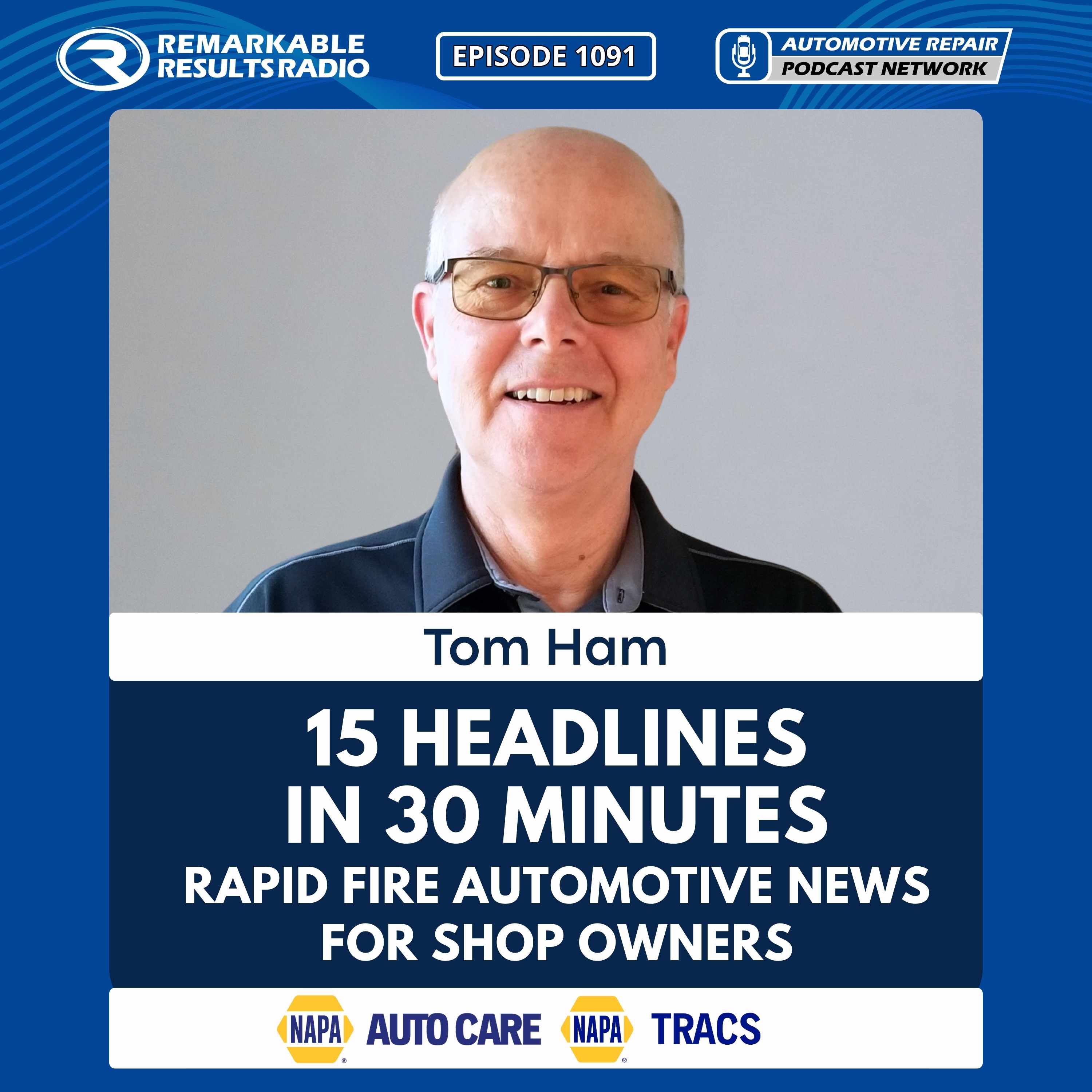
15 Headlines in 30 Minutes: Rapid Fire Automotive News For Shop Owners [RR 1091]
About this episode
Rapid-fire headlines for shop owners move from AI-driven workforce disruption to parts logistics, pricing, and regulation. Hosts discuss Amazon’s one-hour delivery rollout and how faster parts could change repair workflows, then pivot to new-car affordability, luxury market share, and higher total cost of ownership. They also cover remote vehicle heating rules, EV/ADAS training gaps, and why EV repair demand may peak without enough technicians. Between stories, they promote Napa AutoCare Gold and Napa Tracks shop management tools.
In this fast-paced episode, shop owner and founder of the Automotive Management Network, Tom Ham, breaks down 15 major industry headlines in just 30 minutes, offering insight into the rapid changes reshaping automotive service, technology, and consumer behavior. From artificial intelligence and electric vehicles to rising car ownership costs and the exploding demand for automotive repair, this conversation connects today’s news with what it means for shop owners, technicians, and the future of the industry. Along the way, Ham also shares several quirky and entertaining stories making waves across the automotive world.
What You’ll Learn
- Why major tech companies are investing heavily in AI and what that could mean for jobs, pricing, and the future workforce
- How rising vehicle prices and soaring monthly payments are changing consumer behavior
- Why maintaining and repairing existing vehicles is becoming a smarter financial decision for drivers
- How the average age of vehicles on the road is creating unprecedented growth opportunities for auto repair shops
- Why automotive specialists and skilled trades are becoming some of the most valuable careers in the economy
- What slowing EV sales mean for automakers and the growing demand for EV-trained technicians
- How repair shops can benefit from changing economic trends, including larger tax refunds and deferred maintenance
- Fun and unusual industry stories, including remote-controlled vehicle heaters, backup camera cleaning devices, and vintage vehicle restoration programs
The automotive industry is entering one of the most profitable and transformative periods in its history. While technology, AI, and shifting consumer habits continue to disrupt traditional industries, the need for skilled automotive professionals is only increasing. As vehicles stay on the road longer and repair demand rises, shops that adapt, invest in training, and embrace emerging opportunities will be positioned for long-term success.
Tom Ham, Automotive Management Network. Tom’s previous episodes HERE.
Running a shop is a never-ending cycle of preventing problems and looking for solutions. Automotive Management Network is a 15,000+ member Website full of high-value documents, resources, and tips. Being a member gives you quick access to all the information you need to run a smooth, profitable shop.
https://www.automotivemanagementnetwork.com/
https://laborratetracker.com/
Thanks to our Partners, NAPA Auto Care and NAPA TRACS Learn more about NAPA Auto Care and the benefits of being part of the NAPA family by visiting https://www.napaonline.com/en/auto-care NAPA TRACS will move your shop into the SMS fast lane with onsite training and six days a week of support and local representation. Find NAPA TRACS on the Web at http://napatracs.com/ Connect with the Podcast:- Visit the Website:https://remarkableresults.biz/
- Subscribe on YouTube:https://www.youtube.com/carmcapriotto
- Follow on Facebook:https://www.facebook.com/RemarkableResultsRadioPodcast/
- Follow on LinkedIn:https://www.linkedin.com/in/carmcapriotto/
- Follow on Instagram:https://www.instagram.com/remarkableresultsradiopodcast/
- Join Our Virtual Toastmasters Club:https://remarkableresults.biz/toastmasters
- Join Our Private Facebook Community:https://www.facebook.com/groups/1734687266778976
- Join our Insider List:https://remarkableresults.biz/insider
- All books mentioned on our podcasts:https://remarkableresults.biz/books
- Our Classroom page for personal or team learning:https://remarkableresults.biz/classroom
- Buy Me a Coffee:https://www.buymeacoffee.com/carm
- Special episode collections:https://remarkableresults.biz/collections
The Automotive Repair Podcast Network: https://automotiverepairpodcastnetwork.com/
- Remarkable Results Radio Podcastwith Carm Capriotto: Advancing the Aftermarket by Facilitating Wisdom Through Story Telling and Open Discussion.https://remarkableresults.biz/
- Diagnosing the Aftermarket A to Zwith Matt Fanslow: From Diagnostics to Metallica and Mental Health, Matt Fanslow is Lifting the Hood on Life.https://mattfanslow.captivate.fm/
- Business by the Numberswith Hunt Demarest: Understand the Numbers of Your Business with CPA Hunt Demarest.https://huntdemarest.captivate.fm/
- The Auto Repair Marketing Podcastwith Kim and Brian Walker: Marketing Experts Brian & Kim Walker Work with Shop Owners to Take it to the Next Level.https://autorepairmarketing.captivate.fm/
- The Weekly Blitzwith Chris Cotton: Weekly Inspiration with Business Coach Chris Cotton from AutoFix - Auto Shop Coaching.https://chriscotton.captivate.fm/
- Speak Up! Effective Communicationwith Craig O'Neill: Develop Interpersonal and Professional Communication Skills when Speaking to Audiences of Any Size.https://craigoneill.captivate.fm
...
Luxury brands market share shift
"But here's an interesting one. Luxury brands, you know, Lexus, for instance, luxury brands are now 19% of the market. Pre-COVID, they were 11% of the market."
They’re talking about how more people are buying luxury cars now than before COVID. They use Lexus as an example and compare the market share over time.
The hosts discuss how luxury brands (like Lexus) are taking a larger share of the overall new-car market. They compare current market share to pre-COVID levels to highlight a demand shift.
plateau on the technology of the gadgetry
"And one thing that's happening, we're kind of hitting a plateau on the technology of the gadgetry and cool stuff that's on the cars. It's kind of plateauing out."
They’re saying car tech and cool features may not be improving as fast as before. So an older car can still feel pretty similar to a brand-new one in terms of features.
The segment argues that automotive technology and in-car features are reaching a “plateau,” meaning new cars aren’t adding as many genuinely new or transformative gadgets as they used to. This can affect how quickly older cars feel “outdated” compared with newer models.
Lexus
"that Lexus has an option. Toyota has an option on their cars, otherwise due to, but where, ... Lexus had the ability to do that remotely on all the cars."
Lexus is Toyota’s luxury car brand. In this story, Lexus had a remote-warming feature that the government required them to shut off.
Lexus is Toyota’s luxury brand, and the segment discusses Lexus offering an option on certain cars to warm up remotely. The key point is that Lexus could disable that feature remotely after government pressure.
Toyota
"Toyota has an option on their cars, otherwise due to, but where, ... Lexus had the ability to do that remotely on all the cars."
Toyota is a major car brand (and Lexus is its luxury line). Here, Toyota is mentioned as also having a remote warming option that was later turned off.
Toyota is the parent company behind Lexus, and the hosts say Toyota also offered a remote warming option on some cars. The segment frames it as a feature that could be controlled remotely and then disabled by government order.
remote start
"So you hit the button on your app, on your smartphone and the car warms up for 10 minutes."
Remote start means you can start your car from your phone without getting in first. Here, it’s used to warm the car up before you leave.
Remote start lets you start a car’s engine (or activate heating) from outside the vehicle—often through a smartphone app. In this segment, the hosts describe using an app to warm the car while it’s parked on the street.
remote software disablement
"Lexus had the ability to do that remotely on all the cars. ... The government said we had to."
Some car features are controlled by software. In this story, the government required the feature to be turned off, and the company could do it remotely on lots of cars.
Modern cars can receive changes to features via software, including disabling functions remotely. The hosts describe a case where the government required Lexus to turn off remote heating, and Lexus could enforce that across many vehicles without physical dealer visits.
CO2
"And I think it had to do with the CO2."
CO2 is a gas that comes from burning fuel. The idea here is that limiting car heating that runs the engine helps reduce CO2.
CO2 (carbon dioxide) is a greenhouse gas produced by burning fuel. The hosts connect the government’s order to disable remote heating/engine warm-up with reducing CO2 emissions.
plug-in hybrid vehicles
"[1195.5s] number seven. [1197.4s] Stellantis scraps the Jeep Chrysler plug-in hybrid vehicles. [1201.6s] Interesting. [1203.3s] It's the whole Chrysler gang, Ford, Honda, everybody else,"
A plug-in hybrid is a car that uses both gas and electricity. You can charge it like an EV, and when the battery runs low it switches to gas.
Plug-in hybrid vehicles (PHEVs) combine a gasoline engine with an electric motor and a battery that can be charged from an external power source. They’re designed to run on electricity for short trips, then switch to the gas engine when the battery is depleted.
Stellantis
"number seven. [1197.4s] Stellantis scraps the Jeep Chrysler plug-in hybrid vehicles. [1201.6s] Interesting."
Stellantis is a big car company that makes brands like Jeep and Chrysler. Here, they’re changing course on some plug-in hybrid plans.
Stellantis is a major global automaker formed from the merger of Fiat Chrysler Automobiles and PSA Group. In this segment, it’s described as abandoning a plan to sell certain plug-in hybrid vehicles under the Jeep/Chrysler umbrella.
EV plans
"[1203.3s] It's the whole Chrysler gang, Ford, Honda, everybody else, [1206.7s] everybody, they put together these fantastic EV plans over [1209.5s] the past few years. [1210.4s] And now they find out, yeah, it ain't working."
“EV plans” means a car company’s plan for making and selling electric cars. The segment says those plans are being slowed because people aren’t buying them and government support is changing.
“EV plans” refers to an automaker’s roadmap for producing and selling electric vehicles—often including timelines, model launches, and charging-related strategy. In this segment, the host argues those plans are being scaled back because sales and policy support aren’t matching expectations.
subsidies
"[1228.3s] it turns out to be not as bad as we thought [1229.4s] it might be. [1229.4s] And just the $7,500 subsidies are gone. [1232.2s] You know, those are gone, I think last September or whatever."
Subsidies are government money that helps make EVs cheaper. The host says when those incentives go away, fewer people buy EVs, which affects what car companies decide to build.
Subsidies are government financial incentives intended to lower the effective cost of buying or producing something—in this case, EVs. The segment claims that when EV subsidies like the “$7,500” incentive are removed, demand can drop and automakers may adjust their product plans.
EV future not as brave as it once was
"[1234.7s] So just the whole EV thing has really, the EV future is not as [1239.0s] brave as it once was. [1239.9s] So a lot of the EV stuff that was going to happen ain't going [1242.4s] to happen now."
The host is saying the EV boom might not happen as quickly as people expected. If incentives disappear and sales don’t rise, companies slow down what they planned to do.
This is a market-and-policy concept: the idea that the expected pace of EV adoption can slow when government incentives are reduced and consumer demand doesn’t meet projections. The segment contrasts that with the earlier belief that EV growth would be faster.

Toyota Highlander
"...r doesn't look that different from my 2015 Toyota Highlander. Except, you know, I only paid whatever 15 grand ..."
The Toyota Highlander is a family SUV that can usually seat up to seven people. It’s built for everyday driving and carrying passengers and cargo. The podcast mentions it because a newer-looking Highlander can be similar to a 2015 model, even if the price is much lower.
The Toyota Highlander is a midsize three-row SUV designed for family use, with seating for up to seven and a focus on comfort and practicality. It’s often discussed because it’s a common, dependable choice in the used market, and small changes between model years can make older versions feel surprisingly similar. In the podcast context, it’s referenced as a baseline example of what a previous owner paid for a 2015-era Highlander.
vintage vehicles
"I think this is an amazing story and to your point about the vintage vehicles. I think Tom, when this whole disappearing ice thing started to happen..."
“Vintage vehicles” just means older cars that people collect and show. People like them because they’re from a different era and can be hard to find in good condition.
“Vintage vehicles” are older cars that are kept, collected, and often shown for their historical styling or engineering. In the enthusiast world, the value is frequently tied to originality and how many comparable examples still exist.
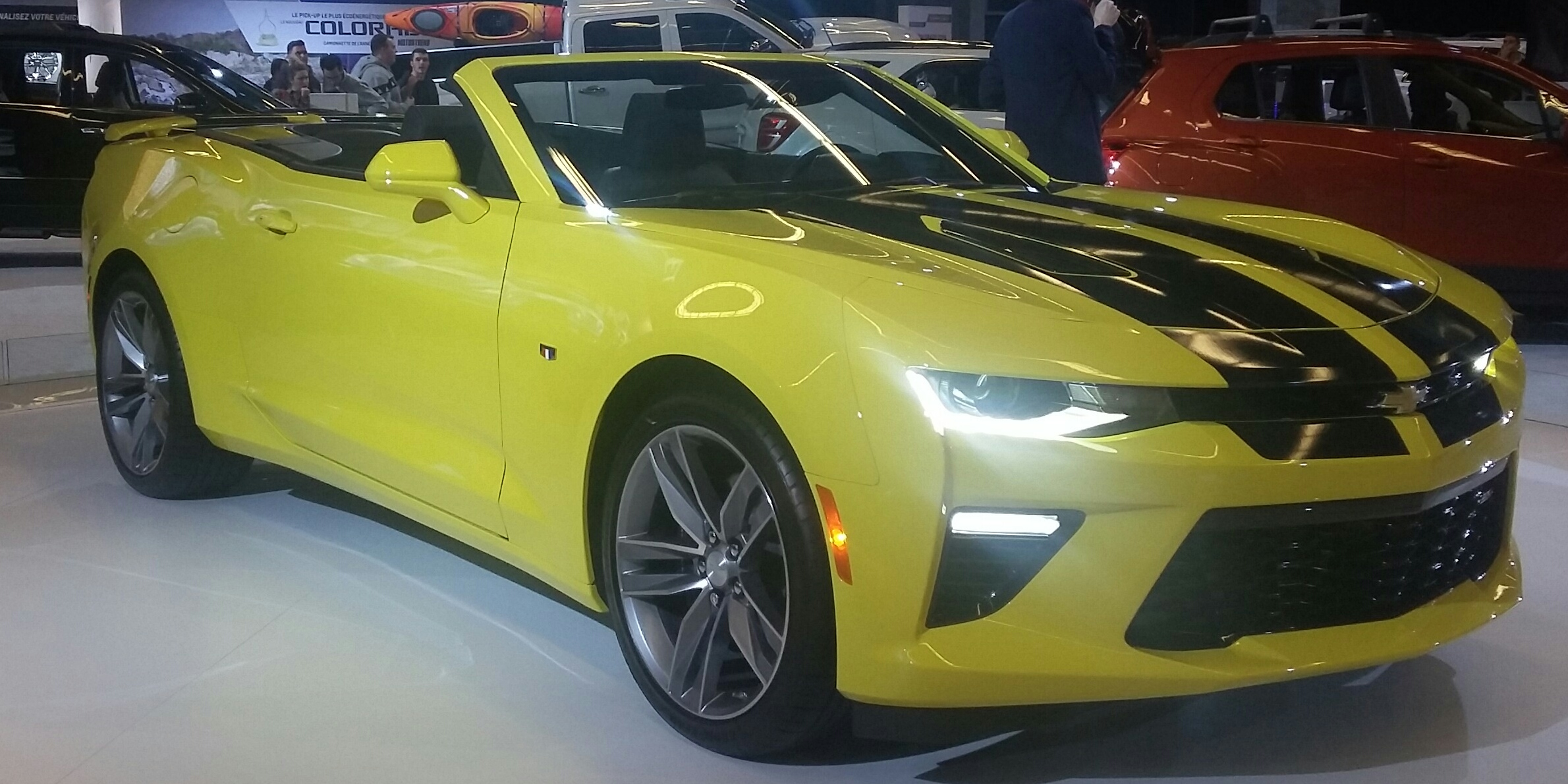
Chevrolet Camaro
"It is a split bumper Camaro from 72. And you don't see many split bumpers with it with the nose peak on this Camaro."
This is a special-looking version of a 1972 Chevrolet Camaro. The “split bumper” means the front bumper is split into two parts, and that kind of detail can make the car harder to find.
A “split bumper” refers to a specific 1972 Chevrolet Camaro front-end design where the bumper is divided into two sections. Enthusiasts track these details because small styling differences can make certain cars rarer and more desirable at shows and auctions.
EV sales slowing
"[1990.1s] Wow. [1981.4s] Cool, cool, cool. [1982.4s] Finally, number 15, urgent training plea as EV sales on strip repair capabilities. [1988.8s] That's cool. [1989.9s] Yeah. [1990.1s] One thing that's happened here now, EV sales indeed are slowing."
They’re saying fewer people are buying EVs right now than before. But the EVs that are already on the road will still need repairs and maintenance as they get older.
The hosts are talking about a market shift: electric vehicle (EV) sales growth is decelerating. For shop owners, that matters because the service demand still grows over time as EVs age and accumulate miles, even if new sales slow.
EVs reaching an age where components wear out
"[1996.5s] And also keep in mind, they've been out there for a few years now and they're going to start [2000.7s] to hit a point in time and age where they're going to break a lot. [2005.6s] There's a lot of things on those cars that are going to wear out and need attention."
They’re saying EVs won’t stay “new” forever—over time, parts wear out like they do on any car. That’s when repair work tends to increase.
The hosts predict a timing effect: as EVs get older, more parts will naturally wear out and require attention. Even without discussing specific components, the key idea is that service demand shifts from “mostly new-car maintenance” to more frequent repairs as the fleet ages.
EV repair capability gap
"[2005.6s] There's a lot of things on those cars that are going to wear out and need attention. [2010.1s] And what's happened is the EV training is really thin. [2016.3s] Then EV trained technicians, specialists are few and far between. [2022.7s] At some point here, this thing's going to kind of peak where you have this massive number [2026.9s] of cars, EV cars coming in to need service with nobody to service them."
They’re warning that there may not be enough mechanics who know how to work on EVs. As more EVs come in for service, shops could struggle to keep up unless staff gets trained.
The segment highlights a skills mismatch: EV training is described as “thin,” meaning there aren’t enough EV-trained technicians to handle incoming EV service volume. This creates a near-term capacity problem for independent shops as EVs start reaching ages where more components need replacement or repair.
hybrids
"A comment here, 20 years ago when people put up the hybrid sign was a brilliant, brilliant move for them. ... we repair hybrids, EVs"
Hybrids are cars that use both gas and electricity. They usually have a small battery and an electric motor along with a gas engine. Shops often need extra knowledge to work on the electric parts safely.
Hybrids are vehicles that use more than one power source—typically a gasoline engine plus an electric motor and battery. For shops, hybrids can require different diagnostic and repair procedures than purely gas cars, especially when high-voltage components are involved. The segment frames hybrids as a stepping stone toward broader EV readiness.
ADAS
"So anyone who decided, it's kind of like this whole ADAS thing. ... talking about being specialists in ADAS, you know, special calibrations, we need to commit to this."
ADAS means “driver-assist tech.” It’s the stuff in newer cars that helps you drive—like lane-keeping or emergency braking. After certain repairs, the car may need re-aiming or re-calibration so the sensors work correctly.
ADAS stands for Advanced Driver-Assistance Systems. It’s the suite of technologies in modern cars that help with tasks like staying in the lane, adaptive cruise control, and automatic emergency braking. Because these systems rely on cameras and sensors, they often require careful setup after repairs.
special calibrations
"for any of us in this industry, talking about being specialists in ADAS, you know, special calibrations, we need to commit to this."
“Special calibrations” means adjusting the car’s safety sensors so they read correctly again. If a camera or sensor gets moved or replaced, the shop has to set it up properly. Otherwise, the driver-assist features may not work right.
“Special calibrations” refers to the process of aligning and programming a car’s sensors and cameras so ADAS features work as intended. After windshield, bumper, camera, or sensor work, the system may need calibration to restore correct measurements. This is a key shop capability for modern vehicles.
VEBs
"You remember that, Tom? PEBs, VEBs, EVs. It's getting so damn crazy is that, and who did I just recently?"
VEBs is another acronym used for certain kinds of electric or electrified vehicles. The hosts are saying there are so many abbreviations that it’s hard to keep up. In this clip, they don’t explain the meaning of VEBs.
VEBs is another acronym grouped with PEBs and EVs, suggesting the industry is classifying multiple electrified vehicle types. The excerpt highlights “all these damn acronyms” as a growing source of confusion. The transcript does not define what VEBs stands for.
PEBs
"You remember that, Tom? PEBs, VEBs, EVs. It's getting so damn crazy is that, and who did I just recently?"
PEBs is one of the acronym labels people use for certain types of electric or electrified vehicles. The point here is that there are a lot of different abbreviations, and it can get confusing. The transcript doesn’t spell out what PEBs stands for.
PEBs is an acronym mentioned alongside VEBs and EVs, implying different categories of electrified vehicles. In this context, the hosts are pointing out that the industry uses many acronym labels that can be confusing for shop owners and technicians. The exact expansion isn’t provided in the excerpt.
gas engine was going to make the EV
"Oh, God, Tom, remind me what I read about where someone was going to have this EV, but the gas engine was going to make the EV."
The idea being mentioned is: instead of the gas engine directly moving the car, it would mostly act like a generator that makes electricity. Then the electric motor would do the driving. The transcript doesn’t name the exact technology, but it’s describing that kind of setup.
This refers to a powertrain concept where a gasoline engine generates electricity to power the vehicle’s electric drive—often discussed as an “electric” vehicle with a generator. It’s distinct from a conventional hybrid because the engine’s job is primarily to produce electrical power rather than directly drive the wheels. The excerpt frames it as a recent idea someone read about.
Request an Explanation
Heard something you'd like explained? We'll add it to this episode.
Sign in to request explanations for terms you heard.
Want to learn more?
Browse our glossary for plain-English explanations of automotive terms, jargon, and concepts.
Help improve this episode
See something that's not quite right? Our annotations are AI-generated and can sometimes miss the mark. Click the flag icon on any annotation to suggest a correction.