They’re talking about how more people are buying luxury cars now than before COVID. They use Lexus as an example and compare the market share over time.
They’re saying car tech and cool features may not be improving as fast as before. So an older car can still feel pretty similar to a brand-new one in terms of features.
Toyota is a major car brand (and Lexus is its luxury line). Here, Toyota is mentioned as also having a remote warming option that was later turned off.
Some car features are controlled by software. In this story, the government required the feature to be turned off, and the company could do it remotely on lots of cars.
“EV plans” means a car company’s plan for making and selling electric cars. The segment says those plans are being slowed because people aren’t buying them and government support is changing.
Subsidies are government money that helps make EVs cheaper. The host says when those incentives go away, fewer people buy EVs, which affects what car companies decide to build.
Concept
EV future not as brave as it once was
The host is saying the EV boom might not happen as quickly as people expected. If incentives disappear and sales don’t rise, companies slow down what they planned to do.
The Toyota Highlander is a family SUV that can usually seat up to seven people. It’s built for everyday driving and carrying passengers and cargo. The podcast mentions it because a newer-looking Highlander can be similar to a 2015 model, even if the price is much lower.
“Vintage vehicles” just means older cars that people collect and show. People like them because they’re from a different era and can be hard to find in good condition.
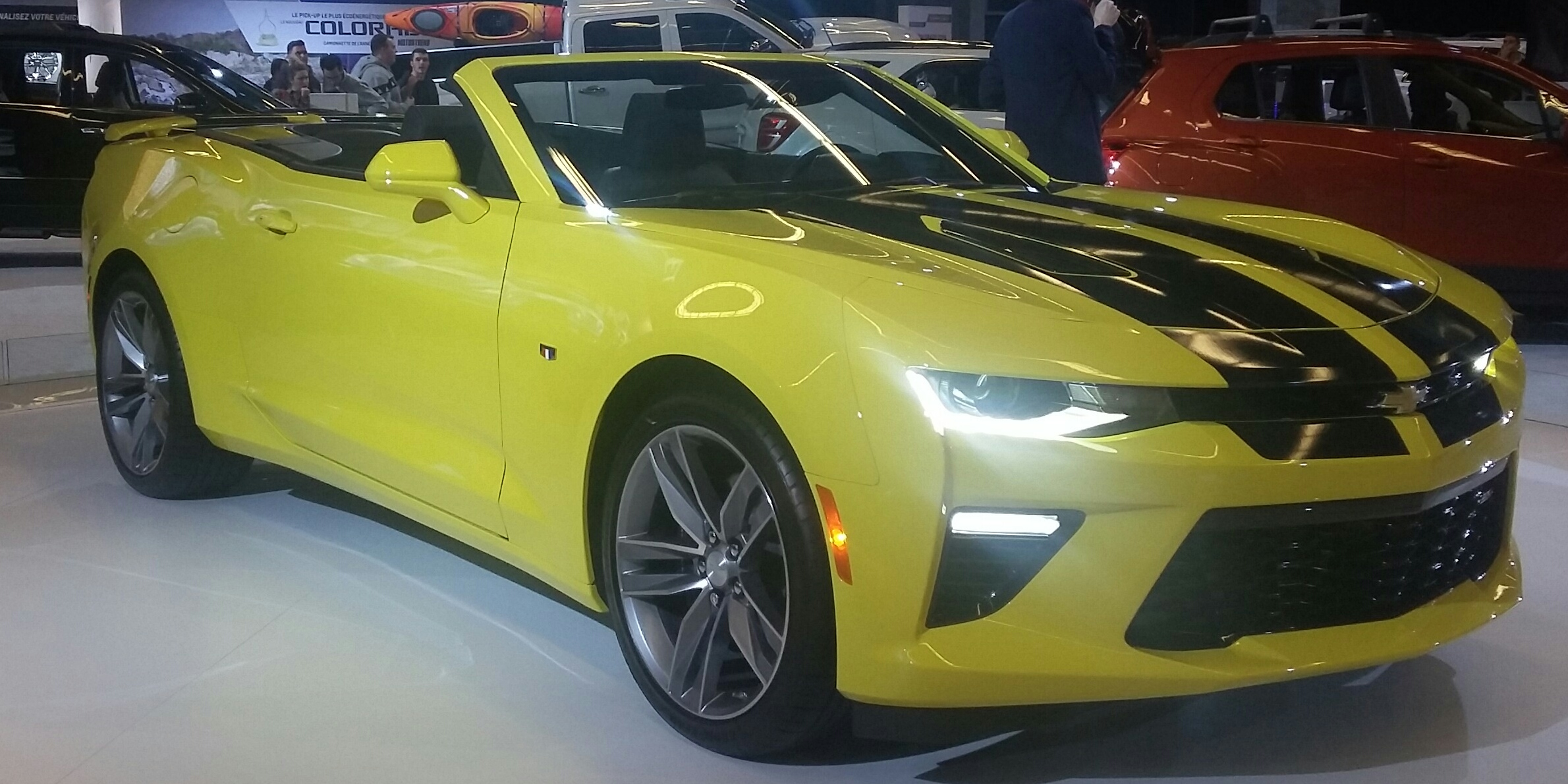
This is a special-looking version of a 1972 Chevrolet Camaro. The “split bumper” means the front bumper is split into two parts, and that kind of detail can make the car harder to find.
They’re saying fewer people are buying EVs right now than before. But the EVs that are already on the road will still need repairs and maintenance as they get older.
Concept
EVs reaching an age where components wear out
They’re saying EVs won’t stay “new” forever—over time, parts wear out like they do on any car. That’s when repair work tends to increase.
They’re warning that there may not be enough mechanics who know how to work on EVs. As more EVs come in for service, shops could struggle to keep up unless staff gets trained.
Hybrids are cars that use both gas and electricity. They usually have a small battery and an electric motor along with a gas engine. Shops often need extra knowledge to work on the electric parts safely.
ADAS means “driver-assist tech.” It’s the stuff in newer cars that helps you drive—like lane-keeping or emergency braking. After certain repairs, the car may need re-aiming or re-calibration so the sensors work correctly.
“Special calibrations” means adjusting the car’s safety sensors so they read correctly again. If a camera or sensor gets moved or replaced, the shop has to set it up properly. Otherwise, the driver-assist features may not work right.
Term
VEBs
VEBs is another acronym used for certain kinds of electric or electrified vehicles. The hosts are saying there are so many abbreviations that it’s hard to keep up. In this clip, they don’t explain the meaning of VEBs.
Term
PEBs
PEBs is one of the acronym labels people use for certain types of electric or electrified vehicles. The point here is that there are a lot of different abbreviations, and it can get confusing. The transcript doesn’t spell out what PEBs stands for.
Concept
gas engine was going to make the EV
The idea being mentioned is: instead of the gas engine directly moving the car, it would mostly act like a generator that makes electricity. Then the electric motor would do the driving. The transcript doesn’t name the exact technology, but it’s describing that kind of setup.
LIVE
This is the Automotive Repair Podcast Network.
Hey everybody, Karm Capriotto,
remarkable results radio. Good to have you here.
Nice to see you as always each and every week
as we strive so hard for our purpose to advance
the professional automotive repair service industry
with all of our great podcasts and all of our great content.
$7,500 or more in Napa parts monthly and participate in a Napa
business development group.
It's a true partnership and in return Napa rewards Gold
certified shops with premium benefits like free priority
placement on the Napa online.com locator, annual marketing
funds, enhanced warranties, rebates, training opportunities
and a whole lot more.
Are you ready to take your shop to the Gold level?
Well contact your local Napa sales representative today to
see if you qualify and start your journey to Gold certified.
Increase car count, build trust with customers and stand out
as one of the best.
Talk to your local Napa representative today.
Let's face it, your shop management system is the single
most important tool in your shop, period.
Napa Tracks was built from the ground up to make your business
more profitable and efficient.
We provide an extensive set of tools to increase and track
profitability in real time.
Napa Tracks offers the industry's best post sale support
hands down and we train your people on site, yep on site
and we offer remote refresher training 10 times a week
and customer support is open six days a week.
Give us a call, visit the website or join our Facebook
community today to learn more.
We'll prove to you that Tracks is the single best shop
management system in the business.
Napa Tracks is always customized and tailored for you
whether you're a one man shop or a large multi-bay
or multi-location company.
After all, it's your shop, so it's your choice.
Visit us on the web at Napa Tracks, that's N-A-P-A-T-R-A-C-S dot com.
Number six, if you're freaking out about a future jobless
AI dystopia, oh my God.
Interesting video from Mark Andreessen who's in the tech
world is fairly well known.
There's a video you can find, YouTube or wherever else.
It's probably an hour or an hour and a half long,
something like that where he just talks about it and he
kind of sees it just the opposite of all the doom and gloom.
He says it's going to be one of the greatest thing that
happens in general is AI and he goes into details.
Why is it, you know, production is going to go way up,
technology is going to go up and because of that,
prices are going to go down, which means the economy is
going to go up, wealth is going to go up,
safety nets will be easier to finance and almost
everything is going to be better for everyone.
And also he says it's hitting at the perfect time because
a problem that you don't hear much discuss nowadays is
population growth in the developed countries,
for instance, United States, Japan, et cetera, et cetera.
Population is, I mean, is headed for extinction.
If you look at this, if you look at it statistically,
there's maybe, I think in Japan, it's something like
every couple is producing I think 1.2 children.
So they can show you on a graph where the population in
Japan is going to go to zero here as time goes on.
There's just nobody having babies anymore.
This ties back in with that where you get the robots
coming in doing certain other things and also ties in with
income going up or humans being in more demand.
There won't be as many jobs that demand humans,
but there won't be as many humans.
So the value of a human doing something that A.I.
can't do is going to go up and going to be of more value.
So anyway, that's kind of a rough sketch,
but that's what he's talking about.
And it's just a complete opposite of the doom and gloom.
I agree.
You're bringing up, when you say the opposite of doom and gloom,
there's always two sides to every story, Tom.
There really always is.
I appreciate how you're approaching this because I can be
very neutral on how it hurts and how it helps.
And you have to decide what side of the fence you want to be on.
Yeah.
Of course, a lot of that with people in general is just the
attitude that the old glass, half full, half empty type thing.
I mean, there is always, and what we were referring to,
the bootstrap thing a few minutes ago.
I mean, well, what's next?
I like the analogy of if you watch car racing at all,
NASCAR race, whatever, you know, you crash,
you spin out after things are going, you restart last.
Well, what are we going to do?
Well, we're going to go after the car ahead of us and we're
going to be second from last.
That's what we're going to do.
And we just keep doing that,
which can be fun.
It really can be fun and challenging and just good for us in a
lot of ways.
Well said.
Thank you.
I'm here with Tom Ham, 15 headlines in 30 minutes.
These are rapid fire topics that we're working with Tom on
number seven.
Stellantis scraps the Jeep Chrysler plug-in hybrid vehicles.
Interesting.
Yeah.
It's the whole Chrysler gang, Ford, Honda, everybody else,
everybody, they put together these fantastic EV plans over
the past few years.
And now they find out, yeah, it ain't working.
The governments are de-emphasizing them.
The people aren't buying them.
You know, they're not selling, the inventories are stacking up
and the ice vehicles are becoming more efficient.
And the climate scare, it turns out to be not as bad as we thought
it might be.
And just the $7,500 subsidies are gone.
You know, those are gone, I think last September or whatever.
So just the whole EV thing has really, the EV future is not as
brave as it once was.
So a lot of the EV stuff that was going to happen ain't going
to happen now.
Got it.
So, so interesting.
You know, I read the article, very interesting how they're all
looking at it.
Number eight, we are all paying for Big Tech's AI fire sale and
nobody's talking about it.
Yeah, this is probably the most serious story among our lineup
of the 15 stories here.
It's a difficult one to explain in just a minute or two.
But to overemphasize it, AI is being sold to us at a massively
discounted rate.
I think currently open AI is spending about $2.25 for every
dollar they're taking in.
AI is a massive loss leader at this point.
And at some point, they're going to have to recover that money
because they're taking in billions, if not trillions and investments
and at some point they got to pay them back.
So what's going to happen is the cheap AI is the prices in the
future at some point are going to skyrocket.
And when it does, that's going to change that whole thing.
You're going to say, I think maybe getting rid of all those people
wasn't the smartest thing I did.
Thank you for that scary piece.
Number nine, it's just crazy.
High car payments make ownership feel impossible.
This kind of tax onto that other thing, yeah.
Yeah, here we circle back to that.
The average car payment now $7.44 in 2021 is $5.88.
That's a huge increase in just five years.
20% of car payments now are over $1,000.
Total cost of car ownership from car payments to repairs,
everything else is up 40% in six years.
40%, that's amazing.
Average car age 13 years and still climbing.
Here's an interesting one, tariffs, the evil tariffs.
What tariffs have done, they have slowed new car purchases,
but they have increased car repairs at the car repair shop.
Tariffs have ultimately been good for car repair shops,
not as good for car sales.
And then it just what we referred to a minute ago,
the whole car payment thing, nobody can afford it.
There's a simple fix for that.
Don't get car payments.
It's something that I swear people are indoctrinated
that they need to do, but they're unnecessary.
They're not something one needs to do.
As a matter of fact, they're probably the biggest financial
drain negative that your typical family has is car payments.
Depreciation, interest and all that is just a massive,
massive drain on finances.
And you can hear people call in to, I can hear Ramsey telling them
that they'll call in, they'll tell their financial situation.
They can't afford a house.
They'll go, how much is your truck payment?
They'll say $800.
And that's why you can't afford a house.
Right, exactly.
You know, Tom, I look around when I'm out on the road.
We did a lot of traveling this particular past weekend.
We went to New York.
Tracy did a keynote down there at the TST Big Event.
And thank you so much to G Trulia for his great hospitality.
But I'm looking as we drove down the hardware that's on the road.
I'm thinking, wow, I've never seen a vehicle like that.
That is so new.
It's so slick.
Look at the lighting.
You know, look at the design.
And I'm thinking, how can people afford this?
And it's either we've got to keep up with the Joneses.
I want something brand new.
I am blown away.
Tom, I own both my cars.
I have no payments.
I feel like there's this level of, ooh, I can't tell you.
It's gooey.
It feels so good that I don't have to do that.
And you know what?
I guess I would love a brand new high tech slicker than anything vehicle.
But I think I have a level of practicality in me that says, don't be stupid.
Don't be crazy.
It's really cool for the first month.
And after that, you realize now is an expensive month.
Your brand new car doesn't look that different from my 2015 Toyota Highlander.
Except, you know, I only paid whatever 15 grand for it.
Especially today, as long as cars last so that I could go on for hours in this one.
But I've never spent more than $19,000 on a car in my life.
I spent more than NRVs, but not on a car.
That's a ridiculous waste of money.
What would people do?
I have not had a whole time of 30 some years since I last had a car payment.
None of my cars have been towed either.
So, but anyway, it's us.
Okay.
But you bring up such a great point.
We've done some great episodes on the 250,000 mile maintenance mindset that we as shop owners
can bring out to our clients and say, do you really want that
and show them some math as to what's the investment in keeping this vehicle going
and these miles right and what the manufacturer recommends we need to do
at all of these intervals of mileage and to show people how much money
they can have in their pockets by just investing in their current vehicle.
So, thank you.
I'm glad we brought that up now.
Number 10, auto repair and maintenance to reach an unbelievable 2.07 trillion by 2035.
That's nine years away.
And today it's just a fuzz over one trillion.
So it's going to double.
It's going to go up about 7% a year.
People say, yeah, is there going to be enough business for car repair shops?
Oh, yeah, there's going to be a lot of business.
Plus at the same time that you're going to happen, have car repair shop population decreasing.
So you're going to have more per shop.
So the future for a repair shop, it looks really good.
So anyway, thank you for that.
And so I guess my comment about that to my audience, our audience is, are you prepared to be growing at 7.5% and if you're not, then you're missing an opportunity.
And there's so much you can do inside your business, your culture, your leadership, your systems, your processes, your protocols to make a company that can get that business and maintain it.
Thank you for that.
Number 11, American values are under attack.
A county places four ways stop with a roundabout.
Now, Tom, I love roundabouts, by the way.
Now, this is one of our stories from the Contributor of the Babylon Bee.
And it just refers to Batesville, Indiana, where they replaced a four way stop.
The roundabout in the population is not happy with all this woke D I communist socialist road stuff.
They want to have the roads back the way God intended them like back in Rome with the first roads that intersect in Rome were four way stops.
You know, we know that from history.
And here we've gone, that's worked for 2000 years.
And now we're going with this communist crap of roundabouts.
The first week in that town, they had 32 accidents at the roundabout.
Okay.
Well, you and I are aligned on a lot of things, but in this one particular thing, I love roundabouts.
I don't know why we have one of the towns close by eight miles away.
They put in five roundabouts about five or six years ago.
And I remember waiting at red lights forever trying to get through this town just to go from one end to the other.
And now it's a flash.
I guess that's why I like them.
Obviously, this is where we're just doing the B story here, which is kind of humorous.
I know that it's so cool.
Okay.
So that's cool.
Thank you for bringing that up.
Number 12 tax season will bring record refunds.
Use them wisely.
Yeah, we're looking at average tax payers going to get about $1000 more this year.
Average tax filer will get about 1000 more.
Military is going to get about 1700 more this year due to some changes they made in the tax law and so on and so forth.
So bottom line is there's going to be a ton of money coming out there.
And repair shops should certainly be prepared to get a chunk of it.
You know, look for it.
It's going to be there.
You know, be ready to compete for it.
Be ready to take care of folks quickly and just tie that in.
Your tax refunds larger.
Save some of it for your car.
Your car would like a little bit of it, would like a piece of it.
So anyway, that's just plain great news for auto repair.
A lot of these stories are really great news for auto repair shops.
Yeah, they really are, Tom.
And take this information, get it to your service advisor.
And if you're a service advisor listening, it may not be bad to explain to your customer.
Listen, I know you've declined some work and I know the tax season is coming out
and I know you're going to realize some extra money.
Please remember this is really critical and important to this vehicle.
This jobs need to be done and maybe you can use your tax refunds for that.
So that's a great point.
I'm here with Tom Ham special episode 15 headlines in 30 minutes.
Boy, am I having a ton of fun.
Number 13.
This guy's solution for cleaning backup cameras with a push of a button is why
America is the greatest.
I left.
Okay.
This is from the other Babylon B website called not to be Babylon B is anyway,
you got to enjoy a couple of websites.
You want to smile?
Those are two websites.
Start with Babylon B and you also check not to be serious.
This is from not to be enough.
So this is not a joke.
This is serious.
And what's it called?
It's called the lens lizard.
I mean, what a great name in the first place.
You know, depending on where you are and where you drive and all these kind of things,
sometimes what happens is your rear backup camera gets covered with stuff,
mud and crud and all kinds of stuff.
And this thing, it's a license plate frame with a sprayer on it.
So you can change it in about three minutes.
All you got to do once you get it in there is just get it aimed assuming you have the
backup camera, which is over the license plate, which is most cars.
And then you just, just a button that you hit and it'll spray it off and it just cleans
it like new.
Great idea.
One of those, you know, Henry Ford type things that develop car a hundred years ago.
It's just one of those inventor stories of something that's really cool.
Anyway, that's a great thing.
Tom, thank you for that.
And I started to realize that I actually do have one of them.
And if you're watching a video, you can see it.
It's called my finger.
In the video where the guy sells them, he says, instead of stopping your car and getting
your finger and doing this, just hit the button inside your car.
And anyway, everybody can catch that lens lizard.
Lens lizard.
Interesting.
I don't know the guy I've never heard of, but if you want to clean your lens lizard,
go get it anyway.
I'm having a blast here with you on this.
This is great.
Thank you.
Number 14, students learn skills of restoring vintage cars in a one of a kind program in
a Kansas city college.
Yeah.
This is very cool.
There's I think 175 students enrolled in this program.
And when they say vintage cars, they mean vintage.
I mean, there's stuff in there from like 1905 all the way up to obviously classics in the
50s and 60s.
And the program is really dedicated towards this.
I don't know if you've noticed that classic cars have become a staggering industry after
going to auctions and so on and so forth and finding out that there are thousands and
I don't know how many thousands, maybe tens of thousands of people.
Apparently, you know, guys like you that are loaded that have a massive pole barn or series
of pole barns on their property packed with classic cars.
They're like their own private museums.
These things are tens of millions of dollars.
And it's just and then, of course, what they need, one thing they need, they need staff
to take care of all the cars.
So this is kind of an interesting industry.
This is more in your league though, Tom.
Yeah.
The house in Florida.
The anyway.
Yeah.
Yeah.
I try.
I get by.
I think this is an amazing story and to your point about the vintage vehicles.
I think Tom, when this whole disappearing ice thing started to happen, maybe four or
five years ago, I think people looked and I started to talk about my first vehicle that
I ever, ever had.
And every time I go to a car show, I look for this vehicle.
It is a split bumper Camaro from 72.
And you don't see many split bumpers with it with the nose peak on this Camaro.
You know, I looked it up as to what it would cost today.
I think it was like 50 grand or something like that.
The point is, we won't make them like that anymore.
They won't run like them anymore ever.
And I think holding on to this stuff is precious.
It's fun.
Yeah.
It's a fun family oriented hobby that if you've never been to a car auction, go to a
car auction sometime, one of the big meekum or whatever car auctions, buy a bidder's ticket
sit down on the floor and it'll be one of the coolest experiences you've ever seen.
But to teach young people who have that skill or that I want to repair, fix, I
want to be involved with something with my hands and teach them how to restore vintage
vehicles, they'll never hurt for a job in my opinion forever.
Oh, I agree.
Yeah, absolutely.
Wow.
Cool, cool, cool.
Finally, number 15, urgent training plea as EV sales on strip repair capabilities.
That's cool.
Yeah.
One thing that's happened here now, EV sales indeed are slowing.
That's true.
But keep in mind, they're still out there.
They're going to continue.
And also keep in mind, they've been out there for a few years now and they're going to start
to hit a point in time and age where they're going to break a lot.
There's a lot of things on those cars that are going to wear out and need attention.
And what's happened is the EV training is really thin.
Then EV trained technicians, specialists are few and far between.
At some point here, this thing's going to kind of peak where you have this massive number
of cars, EV cars coming in to need service with nobody to service them.
And it almost looks like we're already too far behind to catch up.
So it's coming, you know, getting your staff trained on EVs be a very profitable way to
go at this point and getting the infrastructure and getting things in place.
Absolutely.
A comment here, 20 years ago when people put up the hybrid sign was a brilliant, brilliant
move for them.
I think they started to realize that because they were doing the hybrids, they needed to
get into EVs.
So anyone who decided, it's kind of like this whole ADAS thing.
I don't want to get into this and listen, we've been to the Napa EV Ready training
center in Canton, Ohio.
It's a beautiful center.
They've got all the right stuff there from safety to whatever jacks they need to get
batteries out and to get inside and start playing with them.
And I do know that there are some great training companies around the US like Napa that really
continue to have and will continue to improve their EV training program.
And for any of us in this industry, talking about being specialists in ADAS, you know,
special calibrations, we need to commit to this.
It's not like it's a huge investment.
But if you can't put the shingle up there that says, we repair hybrids, EVs, and again,
one of the articles that I think you brought up that I read was all these damn acronyms
that describe what these vehicles are.
You remember that, Tom?
PEBs, VEBs, EVs.
It's getting so damn crazy is that, and who did I just recently?
Oh, God, Tom, remind me what I read about where someone was going to have this EV, but
the gas engine was going to make the EV.
It was, well, that sounded like a hybrid to me.
It's like, can't these manufacturers get this thing straight or right or at least simplify
things?
Anyway, that's just me being crazy thinking here.
One of the most amazing things with EV predicting for the future, and then sales are slowing
down.
We mentioned that earlier, and a story that we didn't use in there is Honda has taken
a right off of, I think, $15 billion right off.
It's Honda's first financial loss since the Lions were last in the one in NFE Championship
game, which if you're a football fan, that means 1957, almost 70 years ago since the
Lions won that game and almost 70 years since Honda had a negative profit year.
We didn't call that one up, and maybe we should have, and I think that's an illumination
part of why we in this industry need to pay attention to the over-global industry and
what's going on with it then.
Oh, there's so much going on, and that's obviously what I do as a hobby.
I try to keep track of this, and I do it on a worldwide basis.
Anything related to cars and transportation, that kind of thing, and it's fascinating
right now.
It is absolutely fascinating.
Just amazing, amazing stuff.
Tom Hamm, Automotive Management Network at AutoCentric Import Specialty Shop in Grand
Rapids, was here.
We did 15 headlines in 30 minutes.
We had a lot of fun doing it.
There were a lot of great talking points here, and also while you're hanging out on Automotive
Management Network.com, check out the Labor Rate Tracker, I think is the coolest thing
in the industry.
Tom, thank you for this.
It was fun and very enlightening.
Yeah, thanks.
Great time.
About this episode
Rapid-fire headlines for shop owners move from AI-driven workforce disruption to parts logistics, pricing, and regulation. Hosts discuss Amazon’s one-hour delivery rollout and how faster parts could change repair workflows, then pivot to new-car affordability, luxury market share, and higher total cost of ownership. They also cover remote vehicle heating rules, EV/ADAS training gaps, and why EV repair demand may peak without enough technicians. Between stories, they promote Napa AutoCare Gold and Napa Tracks shop management tools.
In this fast-paced episode, shop owner and founder of the Automotive Management Network, Tom Ham, breaks down 15 major industry headlines in just 30 minutes, offering insight into the rapid changes reshaping automotive service, technology, and consumer behavior. From artificial intelligence and electric vehicles to rising car ownership costs and the exploding demand for automotive repair, this conversation connects today’s news with what it means for shop owners, technicians, and the future of the industry. Along the way, Ham also shares several quirky and entertaining stories making waves across the automotive world.
What You’ll Learn
Why major tech companies are investing heavily in AI and what that could mean for jobs, pricing, and the future workforce
How rising vehicle prices and soaring monthly payments are changing consumer behavior
Why maintaining and repairing existing vehicles is becoming a smarter financial decision for drivers
How the average age of vehicles on the road is creating unprecedented growth opportunities for auto repair shops
Why automotive specialists and skilled trades are becoming some of the most valuable careers in the economy
What slowing EV sales mean for automakers and the growing demand for EV-trained technicians
How repair shops can benefit from changing economic trends, including larger tax refunds and deferred maintenance
Fun and unusual industry stories, including remote-controlled vehicle heaters, backup camera cleaning devices, and vintage vehicle restoration programs
The automotive industry is entering one of the most profitable and transformative periods in its history. While technology, AI, and shifting consumer habits continue to disrupt traditional industries, the need for skilled automotive professionals is only increasing. As vehicles stay on the road longer and repair demand rises, shops that adapt, invest in training, and embrace emerging opportunities will be positioned for long-term success.
Running a shop is a never-ending cycle of preventing problems and looking for solutions. Automotive Management Network is a 15,000+ member Website full of high-value documents, resources, and tips. Being a member gives you quick access to all the information you need to run a smooth, profitable shop.
Thanks to our Partners, NAPA Auto Care and NAPA TRACS
Learn more about NAPA Auto Care and the benefits of being part of the NAPA family by visiting https://www.napaonline.com/en/auto-care
NAPA TRACS will move your shop into the SMS fast lane with onsite training and six days a week of support and local representation. Find NAPA TRACS on the Web at http://napatracs.com/Connect with the Podcast: