They’re talking about a company that sells oil through a monthly subscription. The idea is you keep getting oil delivered so your car always has their preferred oil.
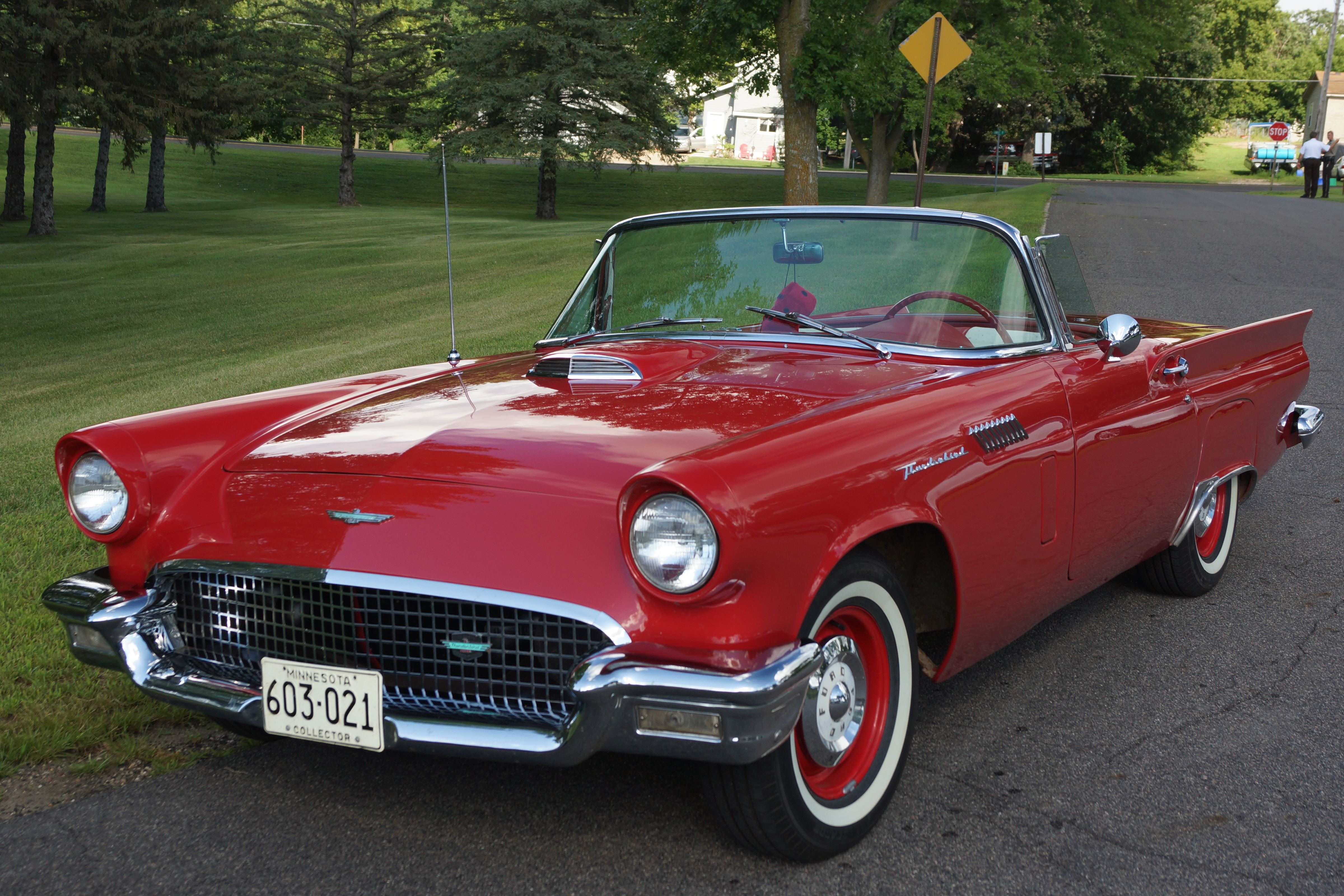
The Ford Thunderbird is a Ford car that was built to be comfortable and stylish. It’s not mainly about racing performance; it’s more about a smooth ride and a nice interior. It’s often mentioned because it’s a well-known model from past decades.
They’re talking about a “youth boom,” meaning more young people were entering the market. The idea is that this demographic shift affected how many new cars were sold.
The Ford Mustang is a famous American sports car. They’re talking about how Ford marketed it to people who wanted a sporty look without spending as much to drive.
A World’s Fair is a huge international event where companies show off products. The speaker is saying Ford used that kind of event to market the Mustang worldwide.
Lamborghini is the Italian company behind some of the most famous exotic supercars. They’re mentioning it to show Chrysler was making big, unusual investments.
The Ford Grand C-Max is a family-oriented car designed to fit several passengers and everyday cargo. It’s shaped more like a minivan-style vehicle than a sporty coupe. People talk about it when discussing practical cars that prioritize space.
Concept
jellybean cars
“Jellybean cars” is a nickname for cars that look too rounded and generic. The speaker is saying some people didn’t think that style would sell to regular buyers.
They’re saying Chrysler got government money and then paid it back fairly quickly. The implication is that the company’s changes worked enough to become financially healthy again.
The Chrysler New Yorker is a large, comfortable car that was meant to feel more upscale than a basic family sedan. It was designed for people who wanted a smooth ride and a nicer interior. It’s often mentioned in discussions about Chrysler’s history and major model changes.
The Dodge Viper is a super-sporty, high-performance car. They’re bringing it up as the kind of car people would be excited about—like a flagship to make the brand look cool.
The Dodge Neon is a small, everyday car model. The point is that Chrysler/Dodge needed popular, affordable cars to sell while they tried to build bigger, cooler projects too.
Concept
halo car strategy
A halo car is the “cool” car that makes people want to look at the brand. Meanwhile, you still need regular cars that sell every day to keep the company financially healthy.
The Dodge Caravan is a family minivan. They’re using it as an example of the kind of practical, everyday vehicle people might not see as “cool,” but that sells in volume.
Car
Jeep
Jeep is a car brand known for rugged, off-road vehicles. They’re referencing a dramatic stunt to make a point about how someone marketed or promoted the company.
The “Lutz guy” is Bob Lutz, an auto industry leader known for being outspoken and marketing-focused. They’re using a wild story to show how he was seen as a hype-man for car brands.
LIVE
Emily EP38: Should we start the show? Are you ready? Hi.
Emily EP38: No, we haven't. 'cause we got other things to get
Rose EP38: Short story, long. Emily looked it up and the answer was right there.
Emily EP38: Oh, wow. I don't know what to say to that
Rose EP38: I saw that comment that he was like, you gotta make some concessions. Well, you know what, Lee? Suck it. We'll talk about that a little bit later.
Rose EP38: ouch. Yeah.
But let's take a moment to pause on the future of Lea Coca and his personal review within the Industrial Arts Tool library. And take a moment to thank our sponsor. And that sponsor is oil And go. It's a new artisanal oil refinery. You go in, you get a subscription card. And so this is sort of like the lifetime oil.
Emily EP38: I've tried oil and go for six months now, and my car smells like oil every time it gets to temperature.
Then you'll wear out your whole electrical system and you'll need something else. That's why we've created oil and go the monthly $45 subscription service. That's right. Dual viscosity oils, 10 W 30, all your favorites. Five W 30 zero W 20. Nothing less than that. You can't have zero weight oil.
Emily EP38: Why any other countries would be pissed at us right now. I have no idea.
Rose EP38: Really remember Kevin was telling us that he, wanted to go work for Rivian, but they only offered him like $20 an hour.
Rose EP38: R Well, well we didn't even talk about the Honda models that aren't happening.
Rose EP38: Well, exactly. It's just, energy repellent at this point. Anything good is just, getting shit on. Yeah. 'cause one of those cars looked really cool.
you know, back to the future, Biff was based on Donald Trump. The, like, the future Biff that gets the Beckett really and goes and makes the bets. Yeah.
Rose EP38: Bob Gale, the screenwriter of Back to the Future has stated that Donald Trump was an inspiration for Biff Tannin, particularly in Back to the Future Part two. The 1985 alternate timeline version of Biff, who becomes a wealthy casino owner with a massive ego, was influenced by Trump's persona as a brash real estate mogul and tabloid celebrity in the 1980s.
Emily EP38: Yeah. He's pretty squeaky clean. It turns out.
Rose EP38: But I think, like, I think that's a good thing. Yeah. And you know what, my friend growing up, like he and his sister and brother had junior Dragsters and his dad raced the Camaro, the 67 or
Rose EP38: I think it exists as a concept, and then they still made the, which is still heavily based on his drawing, I think.
Rose EP38: the number of drivers on the road, maybe that was, had gone up 56% and a large, only like 3% of those were like male yeah, I think he was, president at Ford, Rose EP38: go. Here's some factoids. And this is, from my Mustang or Thunderbird. And there was a quote that I liked that, that Lee Hooka said. We have experts who watch for every change in the customer's pulse beat. And then for a long time now, we've been aware that an unprecedented youth boom was in the making. In 1960, only 21% of households in America had two or more cars. The number of women drivers increased 53% between 56 and 64. While male drivers only rose 6%, something's a brewing. Also, college graduates were 19% of the population, but made up 40 6% of the new car sales. Big market
Aya Coca, once again showing us how men are constantly focused on female physique to place value on things. Said you can
Those were my notes that far in. Alright, so let's now continuing to quote, take the same girl in ups, swept hair, contact lenses, spike heels, fill her figure top and fill out her figure top and bottom, and you've got a sex pot. We did much the same thing with a car.
Rose EP38: Yeah, I mean, , they like puffed out the quarters and whatever. I just, I don't know. I didn't, I thought the analogy was like kinda kind of, uh, objectifying, you know.
Emily EP38: Uh, what do we, sorry, I was gonna go back to the UPS swept hair thing.
Rose EP38: It's in elegant. I mean, it mentions that in the book, you know, this is from a Centia style.
Unsubstantiated claim. And he wouldn't, he didn't name the name or anything, or it could have been somebody that he, that knew, somebody that he knew, or so I don't know. Basically he was just like, I don't think that it happened.
mean, when, when the NSRA started letting in Tri Fives, they had, people had NSRA shirts that said not street rods anymore. , You know, they're trying to run a show,
And so they had an international marketing campaign because it was at the World's Fair. So they had like, uh, the Mustang being promoted in all these different European countries at the same time it was in America. And the day before, either the day before the World's Fair opened, or the day before it went on the market, they had all of these billboards up all around the country.
Oh. And the men wanted the v eights. They were like, women want like something that looks sporty, but is economy to drive. And I think cheaper too, because it was a V six. So just all overall more economical with, but with the same like, slick look. And one of the ads that they had was based off of a movie at the time, which is really racy.
Rose EP38: it's the small sixes, which is the 1 44, the one 70, the 200 and the two 50, which some mustangs had.
Emily EP38: Yeah. It was very, and it had a blue stripe. It was white with a blue stripe up the, center.
Rose EP38: Yeah, he does. Oh, how the mighty have fallen. But you know, in his time at Ford, I read this little section about like him and, , gene Borden att , wanting to get rid of Larry Shiota and Bunky Newtson.
So he. Sees it as like he's, well, okay, I don't wanna lose these key people. It's really disruptive. But he felt like Iaccoca blackmailed him. So Iaccoca didn't name him, the president of the company right away and made him the, like the head of national production.
Rose EP38: not getting the vice president of design, you know, 'cause he was a hothead and put his hands on people.
Rose EP38: but one of the funny things I wanted to tell you Emily EP38: Yeah. So it was, he didn't, he wasn't, un unemployed for long, so I think it was the late seventies. , So 400,000 in cash and then 22,500 per month for a year.
Rose EP38: So Iaccoca has done the Mustang and the Thunderbird and the Thunderbird was a competitor to the Corvette and the Thunderbird outsold the Corvette 24 to one first year.
Rose EP38: in an interest accruing account of some Rose EP38: Yeah. So, like, 10 years later, it's the eighties. He's at Chrysler. Well, 10 years later he is 63. So two more years, just a, a little bit into the eighties.
Emily EP38: we, uh, oh, what did we forget?
Rose EP38: The Chrysler rollercoaster was still going uphill in 1985 when the company found itself so cash rich that it started buying businesses worldwide. Iacocca bought Lamborghini, the Italian maker of exotic cars from the My Room family, then arranged with his friend Aro
Rose EP38: you know, I thought as I'm reading, like them selling things off again, I thought Lamborghini was gonna be right up front, but I don't know. I
As soon as all the kooks bought Tauruses. Iacocca predicted Ford's Grand roll of dice would come up. Snake eyes. Middle Americans didn't want jellybean cars. Your
Rose EP38: Okay. Nevermind. Okay. Anyway, when that didn't happen with the Taurus observed Chrysler executive designer Neil Walling, that's when Lee realized he was no longer qualified to pick the designs. Old man, Iacocca's done,
Rose EP38: it says in Misjudging, the Taurus, then Ia Coca lost some of his personal confidence to choose the product. It was around that time in June of 86, Iaccoca brought in Bob Lutz.
Rose EP38: Yeah. I'm like the, I mean, there's a lot of importance in that with a cheap car, right? Yeah.
Okay., He was a Swiss born pilot in the US Marine Corps, and then he entered the University of California at Berkeley, got an MBA with highest honors, graduated in 62, went to Opal in Germany, BMW, then offered him 10 times his opal salary to go work as a sales vp. Then he did, uh, three really good years with BMW.
Rose EP38: some days when he's not borrowing the Kosh from the design Emily EP38: Yeah. Maybe they would just let 'em get away with it or the cop would pull 'em over and cop was probably, would probably be like, I can't catch that car. First of all, how am I gonna pull that car over?
Rose EP38: Like, like, it sounds like a kid designing a car like it's blue 'cause his eyes are blue and he signed it and then it's got the wheels with the things the looks like my bike, like smokes Emily EP38: What about the Kardashians have all that They needed something that was sporty. They wanted to do something with Shelby. They had done some stuff with Shelby. Okay. And then they were like, Hmm. And then they like put out a, concept and people, I, was gonna say, people shit their pants. But they did better than that. They cleaned their pants up and then they sent in thousand dollars checks made out to Lee Iacocca for orders for a
Rose EP38: sporty Roadster, big power impresses people and gets 'em excited that Chrysler might be able to build something they like for once Rose EP38: so they were working on a really big truck motor at the time, a V 10. And they were like, well, why don't we just put that in there and then it'll be like a Shelby, and then let's do something that's cool.
I dunno. Yeah, I don't know either. But,
Rose EP38: So it's just a, it's like a, just, it's a much more compact thing.
what How? And it was just, did he have
Emily EP38: And were all those doors for going wing for a going situation or sometimes people just bought slider, fiberglass just because they couldn't find a Emily EP38: And this is the thing with like, we wanted to kind of villainize him, but the more research that I did, the more I was like, did he make mistakes?
Rose EP38: yeah, I mean he was really in favor in the political circles and then like everybody, shit on him, it was like Dukakis and all these people like saying that, yeah, we thought he was a hero. And it turned out he was a fake kind of.
Emily EP38: I could took it for granted that it was, in the eighties. It was way before the 2009 bailouts, obviously the eighties. And he convinced the government to do like something, billion dollars, but he had turned Chrysler around so much after getting that money that he paid off the loan within seven years.
Rose EP38: some, it sounds like Dan Aykroyd. Yeah. It's Iacocca and he is talking about the new Chrysler and then like, there's a, a Japanese draftsman in the room and he is like, I'm sorry, sir, that piece is made in Japan. Yeah. And then he is like, well, and he keeps going through all kinds of stuff and they fi I think they finally get to like turn signal.
And they were like, they're trying to build the Viper and get into like the Dodge Neon. Like, they're like, we need new cars. We need 'em now we, we have to sell something cool. Yeah, we've gotta get rid of Iacocca's grandpa cars.
Rose EP38: Caravan's a win in there Emily EP38: Speaking of stuff that people get in trouble for he was around for the Pinto, right?
Rose EP38: Yeah. I just think that people like look down on him, like he's like a drug dealer and then like you look at somebody like Iaccoca and he like fucked up lots of people's lives.
Emily EP38: I don't know what the Lutz guy did besides drive the Jeep through the glass. Yeah. And whatever else you've told me during this episode,
Emily EP38: I don't know why he wouldn't have thought that once a MC was unsettled with everything, like once they just had the Jeep, that it wouldn't be a good thing. I'm gonna say it was a win.
Rose EP38: of, of more wages than most of us would
About this episode
The hosts dig into Lee Iacocca’s legacy, mixing auto history with pop-culture and marketing takes. They debate how Iacocca “objectified” audiences with car-as-sex-pot analogies, then pivot to real-world shifts: rising women drivers, youth buying power, and Ford’s push for smaller, more economical V6 Mustangs. The conversation covers Iacocca’s Chrysler turnaround, government loan repayment, and his later confidence shake after the Taurus misstep—leading to Bob Lutz’s arrival. Along the way, they touch on Lamborghini, the Viper/Neon era, and the ethics of corporate decisions.