A famous Japanese sports car from the 1990s that uses a unique rotary engine instead of a normal piston engine. It is highly prized by car enthusiasts for its beautiful, curvy styling and incredibly sharp handling on twisty roads.
A professional race car driver and car tuner from New Zealand who moved to America and became famous for building and racing fast Mazda RX-7 sports cars.
An engine that doesn't have normal pistons going up and down. Instead, it has a triangular part that spins in a circle to create power, making it very smooth and compact but prone to wearing out faster.
A system with two turbochargers where one works at low speeds to help the car accelerate quickly, and the second one turns on at high speeds to give maximum power.
An aftermarket computer used to control a car's engine. It was very popular because it let tuners plug it in and easily adjust how much fuel and spark the engine got using a small handheld screen.
A small add-on computer that plugs into a car's existing factory computer to trick it into making more power, rather than replacing the whole computer entirely.
A famous, compact 1.3-liter engine made by Mazda that uses spinning rotors instead of pistons. It is loved for its high-revving power but requires careful maintenance.
The Ford Orion is a simple, vintage four-door family sedan that was sold in Europe. It was basically a hatchback car with a traditional trunk added to the back.
The Ford Expedition is a very large, three-row family vehicle made by Ford. It is built like a truck, which makes it good for carrying lots of people and towing heavy trailers.
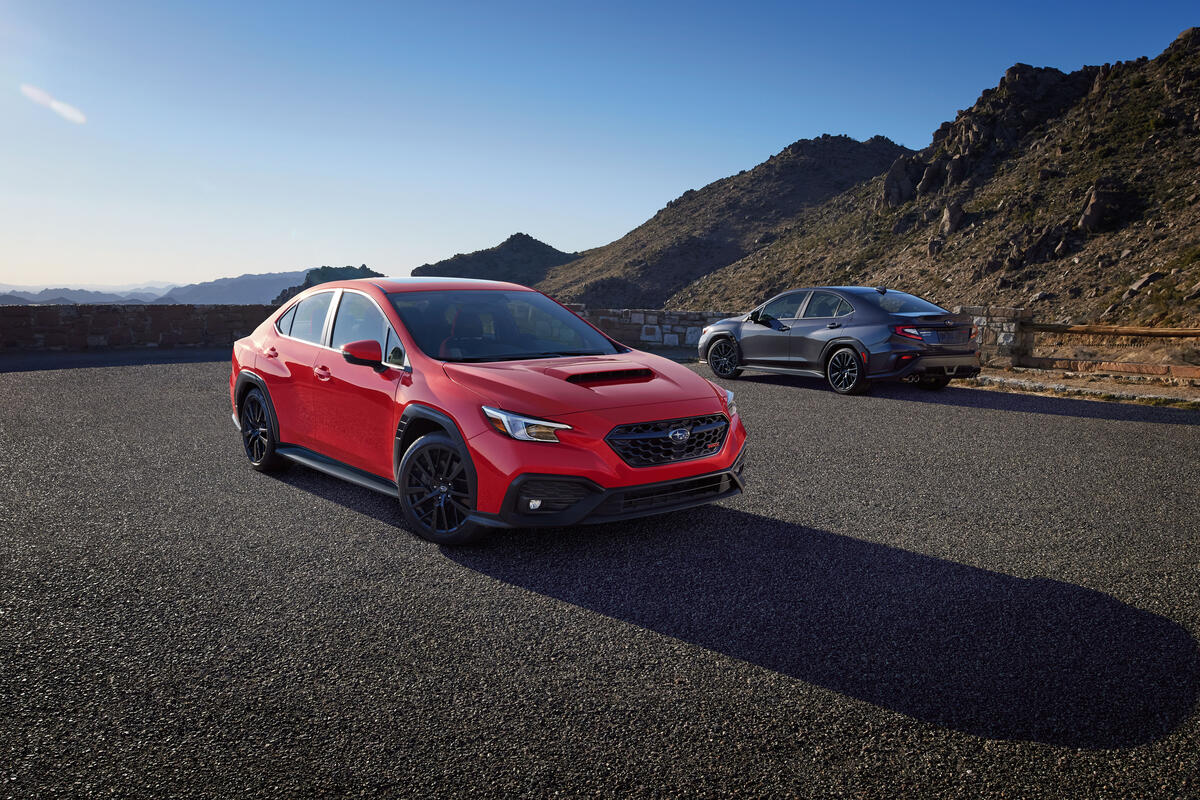
The Subaru WRX is a sporty, four-door sedan made by the Japanese company Subaru. It is famous for having a powerful engine and an all-wheel-drive system that helps it grip the road well in all kinds of weather.
When the fuel inside an engine explodes too early and violently instead of burning smoothly. This creates a metallic pinging sound and can easily break engine parts.
A system that sprays a fine mist of water and alcohol into the engine's air intake. This cools down the engine internally, allowing it to run more boost safely without exploding.
A measurement of how tightly the engine squeezes the air and fuel mixture inside its cylinders before igniting it. Squeezing it less (lower compression) helps prevent engine damage when using a turbocharger.
The Mitsubishi Lancer Turbo is an older, sporty four-door sedan from the 1980s. It used a turbocharged engine to go much faster than a standard family car.
The Peugeot 205 T16 is a rare, high-performance racing car built in the 1980s. Although it looks like a small hatchback, the engine is actually in the back seat, and it has four-wheel drive to go extremely fast on dirt roads.
The Cupra Born is a modern, sporty electric hatchback. It runs entirely on battery power and is designed to be fun to drive while producing zero emissions.
The Plymouth GTX is a classic, powerful American muscle car from the late 1960s and early 1970s. It was designed to be both fast and comfortable, featuring a very large V8 engine.
The Audi Quattro is a famous German sports car from the 1980s. It was the first major racing car to use all-wheel drive, which helped it win many races on slippery dirt roads.
The Datsun 510 is a small, classic Japanese car from the late 1960s and early 1970s. It is loved by enthusiasts because it is lightweight, simple to work on, and fun to drive.
The Datsun Bluebird is a classic, small family sedan from Japan. It became very popular because it was affordable, reliable, and surprisingly fun to drive.
This is a sporty hatchback version of a Dodge car from the 1980s that was upgraded by a famous car designer named Carroll Shelby. It was designed to be affordable, lightweight, and fun to drive.
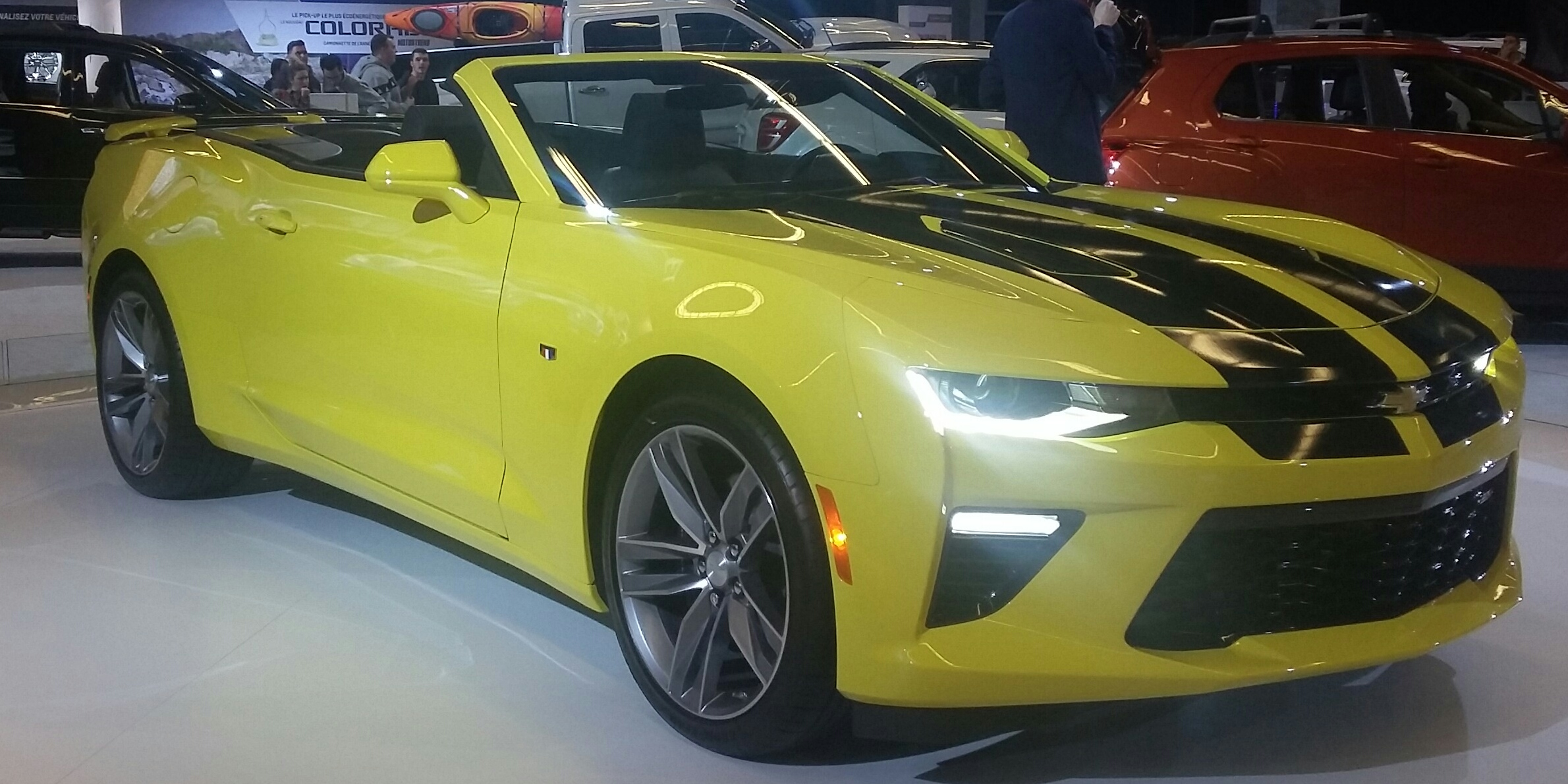
The Chevrolet Camaro is a classic American two-door sports car built by Chevrolet. The 'Z28' version is a special model designed to go faster and handle corners better than the standard version.
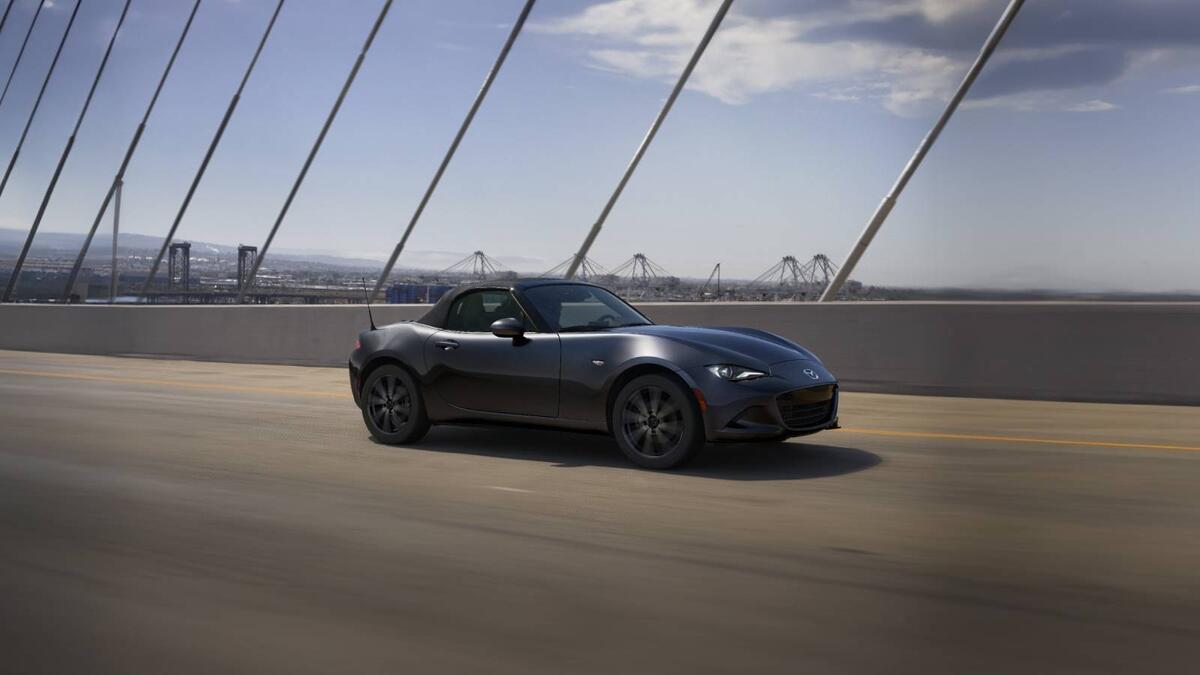
The Mazda Miata is a small, two-door convertible sports car made by Mazda. It is famous for being very fun to drive, easy to park, and highly reliable.
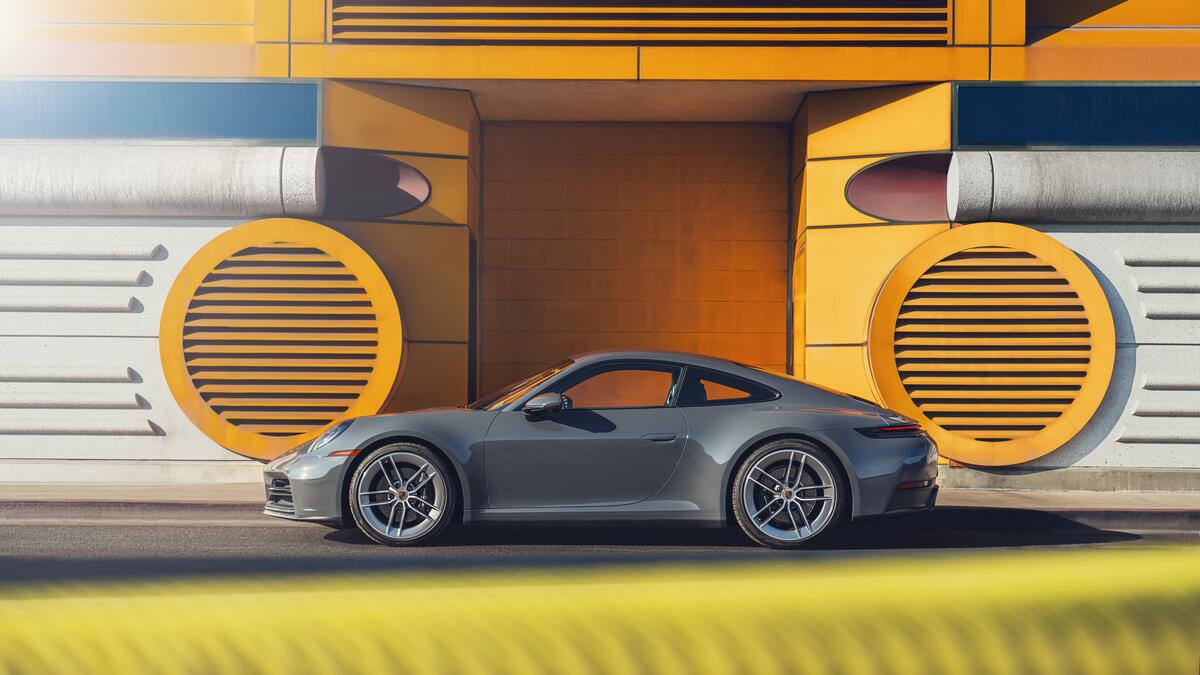
The Porsche 911 is a high-end German sports car with its engine located in the very back of the vehicle. The 'Turbo' version uses a special system to force more air into the engine, making it much faster.
Very expensive, high-tech racing shock absorbers that let mechanics adjust how the car reacts when hitting bumps and when settling back down, helping the tires grip the track better.
The BMW 5 Series is a comfortable, mid-sized four-door luxury car made by the German company BMW. It is designed to be both a comfortable family car and fun to drive on the highway.
A metal brace that connects the transmission directly to the rear axle gears. It keeps the drivetrain stiff and prevents it from twisting under hard acceleration.
The Datsun 240Z is a classic, two-door Japanese sports car from the early 1970s. It has a long hood, a short rear end, and is highly prized by collectors for its beautiful design.
The Nissan GT-R is a highly famous Japanese sports car. The 'R32' version from the early 1990s is loved for its incredible speed, high-tech grip, and racing success.
The Eagle Talon is a sporty two-door car from the 1990s. It was built through a partnership between Chrysler and Mitsubishi, sharing almost all of its parts with the Mitsubishi Eclipse.
The Mitsubishi Eclipse is a sporty two-door car that was very popular in the 1990s. Some versions had all-wheel drive and a turbocharger, making them very fast and popular for customizing.
The Mitsubishi Lancer Evolution is a high-performance version of a standard four-door family car. It has a powerful turbocharged engine and all-wheel drive, designed to go very fast on both paved roads and dirt tracks.
The Jensen Interceptor is a vintage luxury sports car from the 1970s. It was built in Britain but used a large, powerful American engine to make it fast and smooth to drive.
The Ford Mustang is a famous American sports car. The '5.0' version refers to a model with a large, powerful V8 engine that makes a loud, classic rumble.
The Lucid Air is a high-end, fully electric luxury sedan. It is designed to travel very long distances on a single battery charge and has a very modern, spacious interior.
A sporty four-door car from the 2000s that used a unique rotary engine and had small rear doors that opened backwards to make getting into the back seat easier.
LIVE
He set me up in a conference room at a big table with all the heads of departments for the FDR-X7.
So on my left was Kojima, who designed the suspension.
You know, next to him was the head engine development guy, and then, you know, there was the head of brake department there.
So I had all these engineers at a table in front of me that were there to just answer my questions.
Wow.
Welcome to the HPA Tune In podcast, I'm Andrey your host, and in this episode we're joined by Peter Ferrell from Peter Ferrell Supercars.
Peter interestingly is a Kiwi, despite that his company, Peter Ferrell Supercars, or PFS, was founded and developed in the US.
Now Peter's got a very interesting background with a love of rotaries and a love of competition racing both on gravel and on tarmac.
At a point in his life, he made the leap of faith to move to the US to pursue this racing career, and following that spent around 38 years living stateside.
He saw a lot of success over there, even competing as a factory back driver in the IMSA series.
And this moved into developing his PFS company where he built parts for the FD3S RX7 platform.
This is a platform that's quite difficult to provide an aftermarket standalone ECU for due to the complexities around the sequential twin turbo system.
And PFS was actually the first company to bring a tuning solution to market even before the popular ApexE Power FC.
This was a piggyback tuning system, and it did have its limitations of course as you could imagine, but this unlocked the performance of the RX7.
On top of this electronic tuning piggyback, he also built a bunch of hard parts to optimise the performance of the RX7 platform.
We also get into some of the intricacies of the 13B engine, or rotary engines in general, why they sometimes get a bad reputation and what needs to be done with the tuning in order to keep them reliable.
Before we jump into our chat, for those who are new to the TuneIn podcast, High Performance Academy is an online training school.
We specialise in teaching people how to build performance engines, how to tune EFI, how to construct wiring harnesses.
We also cover topics on fabrication, 3D modelling and CAD, race driver education and data logging just to name a few.
You can find all of our courses at hpecamerie.com forward slash courses.
All of these courses are delivered in high definition video modules that you can watch from anywhere in the world, provided you've got an internet connection.
This means you can learn from the comfort of your own place, and you can learn at your own pace.
All of our courses also come with a 60 day no questions asked, money back guarantee.
So if you purchase them for any reason at all, decide it wasn't quite what you expected, no problem, let us know, we'll give you a full refund.
And for podcast listeners, you can also use the coupon code podcast75, that will get you $75 off the purchase of your very first HPA course.
We'll put the coupon code in the show notes to make it nice and easy for you to find.
Lastly, if you like free stuff, then I've got a great deal for you.
We are constantly partnering with some of the biggest names in the aftermarket performance industry to give away some great prizes.
You can always find our latest prize at hpacademy.com forward slash giveaway.
It might be an aftermarket ECU or dash, it could be some engine components or engine building tools, or just about anything in between.
They are great prizes and we will ship them free of charge to your door if you're the winner.
There's no tricks here, no purchase required to get your name into the draw.
Alright enough with our introduction, let's get into our interview now.
Welcome to the podcast, Peter. Thanks for joining us and as always, let's start by digging into your past a little bit.
How did you first develop an interest in cars?
Well it's been a long, long task.
When I was 13 years old, I joined the Hamilton Car Club in New Zealand and that got me officially involved.
And it wasn't until I was probably 16 or 17 that was my first chance to compete.
I competed in the Mystery Creek Rally Cross in a 3-litre V6 Capri Ford Capri English car.
And that was my first shot at it but unfortunately another competitor in a less of a street car decided to take the right side out of my Capri.
And that taught me the first lesson of motorsport that you know you better bring some money.
It's not a cheap sport is it?
No, you know I probably spent about a month or more of my wages to fix the damage on the car at the time.
I was just an apprentice at actually New Zealand Aerospace Industries, starting to be an aircraft engineer.
And that so anyhow, so that put the brakes on it for a little bit until 1979, 1979 I bought a Mark I Ford Escort RS2000 Rally car.
Actually I'll just jump in here, obviously we quite often find people will go in one or two parts.
It's either rally or road race.
And what was it about rally that really appealed to you?
Truthfully watching the Walmart, Mike Marshall and Hanoomickler in the Mark I Escort RS 1600 BDAs back in the early rallies in New Zealand,
in the Heatway rally etc.
And I just love the sound of those BDAs screaming at 9000 RPM.
And you know so that's I guess what pulled me towards rally and that's where I went initially anyhow.
As the story goes on I've of course changed the road racing but...
Sure yeah, I mean it doesn't always have to be mutually exclusive but generally I kind of find that drivers will go in one of those two parts.
The old story, the circuit racer sees one corner a thousand times and the rally driver sees a thousand corners one time.
I personally think rally drivers are probably the most talented in the motorsport world but I'm sure others would disagree on that.
You mentioned you were doing an apprenticeship, so what did your sort of work history look like?
Well I started off in that apprenticeship building aeroplanes basically but I actually kind of quit that about a year and a half
and I joined the Royal New Zealand Air Force because I found my interest was actually more with the engine side of planes
and not so much you know pop rivets and building you know doing production lines sort of work.
So even though I was getting some training in the mechanical side as well.
So I quit aerospace and joined the Air Force in 1976 and I went on to survey years in New Zealand Air Force,
worked on the C-130s and the P3 Orion's Iroquois helicopters and I really found my home with the P3s and the engines,
the big T56 turboprops and you know I was qualified to do high power test runs on those engines and stuff and that sort of really excited me.
So I enjoyed my time in the Air Force right up until the point where I moved to America but during that period of course I competed,
pursued my career in rally in New Zealand.
Like I said I bought that Mark I escort.
My first event was the 79 Maramaruah Forrest Rally and I've never done a rally and I just started, so it was a five stages and I started the first stage
and drove as hard as I could.
I probably should add that I actually did do a race driving course at Bay Park with actually my boss at the time, Salon Melville.
It was called the Peter Wirth Advanced Driving School.
So I actually went to Bay Park and learned car control understeer over steer, you know balance of a chassis and you know the basics you need to know,
you know how to take a line through a corner.
Yeah sure.
I'm interested to dive into that just briefly as well.
So how does that driving course work?
How do you learn those skills and how much is sort of practical hands on in the car versus sort of classroom based?
Well it was a little bit of classroom, you know, I told you the line through a turn, the apex, all that good sort of stuff,
but I think it was actually fantastic.
It was only a one day course, but it took me away from just the voodoo grit your teeth form of competing.
I actually had a kind of clue what I was doing, had some training and that I think got me off to a great start.
And you know, next thing I knew I was in a rally car facing a flag to start a gravel stage at Maramuru and of course the lines and everything are different.
But I did have a good feeling for car control grip.
So I charged into there blindly not knowing whether I was going fast or slower, just went as fast as I could without going off the road.
I'm going to assume that that would have not had pace notes at that point?
No, pace notes were illegal.
You'd be disqualified if you were caught with pace notes.
So you're literally driving each of those stages blind if you haven't done that rally the year before?
That's right. You're blind.
But in those days the roads were fantastic in Maramuru.
They were smooth and outstanding, not too rough.
So anyhow, I charged off and thought, hey, this is fun.
And I think I got through the end of stage three.
I had no clue how I was going at that point.
It was like 128 entries and I think I seated 62 because I had a pretty good car for the field.
And at the end of stage three, they brought the results through.
And I found that I was in like ninth overall in the rally.
Wow. That's pretty impressive.
I couldn't believe it.
And that in as the story goes, I go into stage four and I'm pretty cocky at this point now.
Top 10.
Dangerous.
So we get to the last stage.
Now I'm really cocky and I make the cardinal rule to finish first.
You have to finish and I lost it.
Hive sided it probably half a kilometer from the end of the last stage and went up a bank and broke the steering rack and DNF.
And I always tell this story when I got back to the Air Force, my mates on Monday, they said,
so Farrell, how did you do?
I bet you crashed.
And I had to say, yes, I did crash, but I was going bloody well up until that point.
And then I realized that you can't, unless you complete it, you can't.
No, it doesn't really count, does it?
It doesn't count.
So I guess that put some fire in my blood right back then.
And I thought, look, I can't tell these guys how well I was really doing because I didn't finish.
And I made a pact, which I pretty much held for most of my life that I'm not going to overdrive.
I'm not going to let it get away from me.
I'm going to go hard, but I'm never going to go over 9 and a half, 10 tenths because crashing, you know, you don't win a medal.
And so I set off on a path of finishing events.
And I've had a pretty fantastic record of finishing rallies, and that often rewarded me with high placings against potentially faster cars.
Yeah, good work.
So anyway, so we went through that and that was 79.
So I got the bug, 80.
I did a lot more events and got a little bit more knowledgeable and that is still paying for this thing out of my Air Force wages.
I might point out, but I started to enjoy the benefit of my mechanical expertise.
So I jumped on a C 130 Hercules Air Force plane and hitchhiked a ride to the United States.
And I ran around all the top tuners at that time buying parts for the two liter Pinto motor, of course, RS 2000.
So we went to Crower, met Brian Crower, bought a set of connecting rods from him and went over to Hillbourne and looked into buying some mechanical injection
and filled my bag up with TRW rockers and went over to Edis, Gaderian and bought a camshaft, met Ed and T Willy.
So my bag came home full of car parts.
So literally a free trip to the States hitching a ride on a C 130 and it was a shopping expedition.
Yeah, it was called indulgence travel if anybody's concerned about the tax toll.
There wasn't the thing that sprung to my mind.
I guess at this point in time as well, it would have been much more difficult to source these parts inside of New Zealand, right?
It's not like it is today where we sort of really have free access to everything the rest of the world's got.
Absolutely true. What you just said, no, the stuff was not thick on the ground, it was difficult to get.
But anyhow, I put my name on the list and when they have available space, you get a call up the day before and say, hey, do you want to go to America?
So I was all set to go and so came back with the parts, built up another good Pinto motor, you know, about 180 odd horsepower, 185 on 45 side rough weathers and had had the good hardware inside.
But that's 1980 campaign that carried 1981.
I competed in the 1981 motor guard international rally.
And once again did really well on day one.
I think I was leading group two at the time, but halfway through day two.
These events, by the way, were three or four days long back in those days.
And, you know, nighttime, everything, you know, big, long 18 hour days.
But anyhow, I lost it on the on the Cricketwood stage on a wire, rolled the escort, let my desire to win exceed my ability to do it.
Like you're rolling.
Yeah. So we damaged that escort and that was it for that event.
So I worked at home and regroup for 1982.
I built up a brand new Mark two escort and moved all the driveline from the Mark one over to it.
I campaigned that 1982 with quite good success.
I actually won my first event, which was the Woodhill rally where I had the privilege of actually beating possum born.
Wow. That's a very much a claim to fame.
It is.
It's true.
The record shows.
Although I must say that he got a puncher in the first stage.
Kind of had about a two minute.
If you kept that to yourself, we would have never been any of the wiser.
For those international listeners who have absolutely no idea who we're talking of,
possum born is a New Zealand rally driver, I think probably our most successful who ran in the WRC.
Yeah, well, I mean Hayden Padden's.
Hayden Padden is now our claim to fame.
But yeah, possum born back in the day.
I think he won the Australian rally championship a number of times.
Didn't he?
Yes, he did. Absolutely.
One of the reasons possum was so well known international folks might relate to us.
He was driving the Subaru WRX at the same time as Colin McCray, etc.
and competed as a teammate to Colin McCray in various events.
And of course, Colin had his fame through the game, the rallying games that were just starting to come online on the internet.
So anyway, I beat possum and he was driving the Mazda RX3 at that point of coop with a 13bpp motor, kind of X-Rod Millen sort of stuff.
So I was thrilled with that.
Went on to do quite well all year in that one.
And I particularly like rally sprints, which is like about a five or six kilometer sprint up a hill or whatever through a stage.
And you have a runoff system and I seem to do a dat well to those.
So actually, I just want to let's just dive into that because my, I don't do rally, something I'd definitely like to try out.
But I'd liken that to a tarmac hill climb.
I personally find for me, if I'm in a race car out on the racetrack, it will take me, you know, maybe five laps or so to kind of fire my groove and get into the right headspace to rally push.
And I kind of find if I go to a club level hill climb event,
it's a lot of sort of standing around waiting for maybe three or four runs up a hill.
And by the time you're sort of starting to feel like you're into the groove, you've gone across the finish line.
So I've never really kind of felt that they work, I don't find that I work that well for that sort of event.
So obviously you're the polar opposite?
Yeah, I would say that's true because generally in those events you pick up, you know, three or four seconds or five seconds each run.
And that's so, you know, and the pressure's on.
So no, I generally improve on each run and that because I learned the road.
I mean, I do learn the road.
I remember the grip level and, you know, I remember the turn.
So in rallying, as you know, you're probably aware, it's a momentum sport and it's also a risk and reward.
In a rally car, you have to carry speed into the turns.
And, you know, that's you better get it right because if you get it wrong, you crash off the road.
This is the first time you've seen the corner.
You don't know what the grip level is like.
And that's one of the talents of blind rallying is being able to read the road.
Oh, you couldn't agree more.
And I sort of was kind of pretty good at that and managed to keep a good balance.
I might not have always been the fastest guy, but I didn't go off the road.
So I used to put down pretty decent stage times and, you know, be very consistent and finish and that sort of rather than bounce off all the banks all the way through.
Anyhow, the big deal there that I think could be of interest to some people is those rally sprints were became very competitive and some of them were televised.
And so I got an opportunity to drive a guy's.
This is 1983, I'll point out.
And a friend of mine had an escort RS 2000 with a turbocharged Pinto in it and that had belonged to a guy called Bruce Mannan who's still around.
You probably heard of him.
He became well known with turbo cars from back then.
So this is 82, 83.
I charmed the guy, my friend on the streetcar, uses engine for the next rally sprint.
So we pulled my engine out and put in the rally car and put mine into his, which he liked.
And that, but unfortunately there wasn't a dyno on every corner and there was certainly no wide bands to be found.
So we broke, put a leg out a bit of use to say we broke a Conrod from detonation.
And next thing I was into building fresh engine, which I did.
And we had to just tune it by thrashing up and down the road basically.
And the setup was a, it used actually a divided pulse, a split pulse T4 manifold.
And that came out of Australia and it was a cast piece that was actually pretty nice.
A T04 S turbo, I think it was 0.58 AR housing actually.
And that, but what was special is it was sucking the fuel system was sucking through a side draft Weber.
So it was a draw, a draw through setup.
Yeah, draw, draw through.
Yeah.
A draw through side draft Weber 45 Weber and it used water injection to prevent detonation.
Yes, the problem with a draw through setup of course is that you can't run an intercooler,
which is kind of an essential realistically if you're running any reasonable level of boost.
So the water injection, another way of getting around that.
It's pretty effective actually.
Back then intercoolers were thin on the ground too.
Of course, yeah.
In fact, you know, keep in mind there was hardly any production turbocharged cars.
The first Mitsubishi's like the Cordia turbos and stuff were just coming out on the market.
And you know, so the turbo charging was brand new for street cars.
Yeah, the stuff that we sort of take for granted now of being able to buy all of these parts after market,
that simpler times, and I guess the knowledge probably wasn't there like it is now as well.
No, it's just amazing to me.
And honestly, I was in in the early days of it and what we have today,
I just think, my God, if I only had this stuff 40, 50 years ago, you know.
Oh, spoiler for choice.
I even look back at my old drag car and that was a 1400 horsepower Mitsubishi 4G63 2.0L
and we had an HKST51R SPL turbocharger which at the time was, that was brand new.
But looking at how far turbo technologies come since the early 2000s when I was running that car,
I'd sort of often think if I could have my time again, I'd have been making more power with less boost
and had a wider power band as well but of course we can't have our time again so it is what it is.
Well, of course that's what we're experienced counts, you learn these things.
I think the point, the takeaway from this though is for the younger listeners is
you've got it very good at the moment.
It's never been easier to build a turbocharged engine and have it hold together,
make great power with great reliability.
Well, not to speak of, if you don't know what you're doing, you just log on to HP Academy
and Andre's fills you in on everything you don't know that you need to know.
Correct, do I my best?
There you go. I mean, I actually say that sincerely. I mean, your content is just phenomenal.
I appreciate it.
And very rarely if maybe never do I think he's bullshit.
I try very hard not to.
Yeah, yeah, no, no, I find you on the mark pretty much.
So, anyhow, the water injection, 5 pound hob switch on the manifold.
When she made 5 pounds of boost, it turned on a cheap windscreen washer pump
and that squirted water methanol through a brake line that had hit with a hammer on a vice to make a jet.
And it sprayed water methanol down the throat of the carby and that might that was good for another 5 pounds of boost without detonation.
And also we cut the compression ratio back to like 7 to 1.
Yeah.
So we used to machine the top off the TRW forged pistons and drop the compression way down,
use water injection and we could run 15, 20 pounds of boost and I picked up about 100 horsepower.
So I went from 180 normally aspirated to about 280 boosted.
Wow.
And I took that to the next rally sprint and boarded I take it to the other guys.
I shocked them all.
I mean, I picked up 100 horsepower between events.
Yeah, that's no, that's no small feat.
And the car was a rocket and I won the Riverhead rally sprint and I went back to Woodhill,
won the Woodhill rally for a second year, but this time on Merritt completely.
Well, I was on Merritt the first time, but no punches involved.
And the car was just a rocket down the straights.
And I mean, Escort's only way, you know, 900 kg or, you know, 21, 2100 pounds.
So the thing flew down the straights.
Talk about turbo lag down in hindsight, had a lot of turbo lag.
Yeah, I was a couple of things I want to dig into there.
First of all, detonation.
So back then you couldn't ring up link engine management and buy a knock block or...
I mean, I don't think there was any real option available back at that sort of era.
So how were you figuring out when the engine was knocking?
Is it just when it threw a ride out of the block?
So, you know, I back it off a few degrees.
That was, no, I listened to Ping.
I could hear Ping and it's not like a rotary.
We'll get to that next, I'm sure.
But they were a little bit forgiving.
Yeah.
But what we did, the only tool we had, and I think you might find this interesting,
is the only tuning tool we had at that point was an ISOPRO Pyromator, EGT gauge.
So we used to tune off EGT, basically.
And the ignition had a distributor and that was just fixed.
It didn't have fly weights.
It was a fixed maybe eight degrees, something like that.
So we didn't, couldn't adapt, couldn't move the ignition around.
So and low compression of the water, methyl injection and tuning, you know,
keeping exhaust gas temperatures down.
Yeah.
And, you know, fortunately Bruce Mannen had done a pretty good job with that web
of getting it to getting it in the ballpark.
So I didn't make big changes.
I would not have wanted to be the one to start from scratch with the...
No, well, I mean, it'd be a very steep learning curve there.
Again, simpler times, forums, well, probably there's not enough other people
doing what you were doing to sort of get a wealth of information anyway.
So it really literally is sort of hard learned lessons.
Totally.
At that point in time, the only turbo rally cars in New Zealand was mine,
Morrie Chandler's Lancer Turbo.
He just got that.
Of course, Reg Cook got a Bluebird Turbo, a Works Bluebird Turbo.
And there's a couple of guys in the South Island, Trevor Parmenter.
But that was about it for turbo cars.
So they were a real novelty.
All these years later when I talked to my friends 45 years later, or 42 years later,
and they just all remember that turbo car, that I was a pioneer and what a difference,
and it was a way of the future.
Oh, absolutely.
Well, just actually before we carry on, the other part that I wanted to ask about
was the turbo lag, which you mentioned.
Obviously, turbo technology back then isn't where it is now.
So yeah, just with another 100 horsepower,
also with the lag, the way that power's delivered, did that give you,
obviously it worked because the car was fast, but did it give drivability problems
when the boost would come on?
Well, it did, but I didn't know it at the time.
I knew that when I got jumped on the gas, I mean it wasn't, I had what I used to have.
And then when it made boost, it went like a rocket.
So basically you had to plan your corner.
When you get on the gas, you were going to get wheel spin.
You had to try to adapt your driving style, so you took advantage of rocketing
out of the turns and down the straights.
And going back to what I was saying earlier, the speed in, you had to just be cautious.
Basically, I had to be fairly cautious going in because I didn't have good throttle control.
In a rally car, you steer with the throttle, and that's why BDGs and Rotaries
are actually so good because they have a fairly progressive power
and they're fairly instantaneous when you crack open the throttle plate.
So I didn't have that, but boy, having another 100 horsepower made up for it all.
And the big thing that's so satisfying for me now is, you know, I was a shoestring budget
sort of guy, like so common back when you're young.
And I found the secret source that put me up with the guys with the big budgets,
the peripheral port 13Bs were kind of still new at that time.
Rod Millen and Rotary Power and Bill Shields was a pioneer of that.
So I've had about the same power as a good 13BPP, like 280 horsepower,
and actually had more than a BDG.
So I found a cheap way and a Kiwi way to match the top budget cars for horsepower
and deliver it.
I'm assuming at this point as well what you'd cobbled together on your shoestring budget
versus a peripheral port 13B would have been a factor of what, 10 times the cost
for the 13B maybe more?
Oh well, you know, I don't even know what they cost. I knew I couldn't afford one.
So I don't know what the guys were paying back.
Probably a moot point, but suffice to say, much, much more money.
Yeah, but there was some, you know, iconic names of course back then.
John Wolf was a friend of mine. He had one and took it to America.
And of course, Rod Millen went on to be iconic.
And back when we talked about rally drivers, he's right up there in that elite
of the Hayden Padden and Rod Millen Parson-Born.
I'd say the other three biggest names.
Yeah, I mean, Rod Millen would probably be the most internationally recognised name
given the business he set up in America and his success at Pikes Peak as well,
as well as all of his other success.
Yeah, oh yeah, no doubt about it.
And probably there's a good time to actually bring in that my co-driver,
when I started in the Mark II, brand new Mark II,
I recruited an Air Force mate to co-drive for me and his name was Tony Serkham.
And Tony ended up becoming probably one of the few professional
international rally co-drivers.
And Tony and Greg Ford, my mechanic, we moved to the States in 1984.
Tony came with me and he co-drove for me in the States in 1984.
And I guess I'll just stay on Tony for a second.
Well, after a year in rallying in the States in 1984, Tony went on to co-drive
for John Woodner, a guy that a good friend of mine had a Peugeot 205 T16.
And then, unfortunately, John was killed in a small aircraft crash about 88.
And Tony went on to co-drive for Rod Millen in many of the US rallies
in the Asia Pacific series.
And he also co-drove for Possum in the Australian series.
I remember seeing that name on Possum Bourne's car, yes.
Yeah, yeah. In fact, his car, his name's on the 323 GTX that's down
at the museum in Southland. I saw it a couple of months ago.
So, anyway, Tony went on to have a successful career.
Well, I got Tony started. He co-drove for me in the escort and in the turbo escort.
And, you know, we kind of did a little bit of a Bert Munro, to be honest with you,
put everything we had in our suitcases.
I put all my money and future retirement from the Air Force in my pocket
and went to America to go rallying.
So, it was to go rallying. That was the whole plan.
Oh, yeah. Yeah, yeah. No clear path of what to do, where to live.
Nothing, really.
And that sort of kind of brings, I guess, bridges me into my USA adventure.
Just before we go any further, I'm interested here.
I've never really seen the US as being sort of what I'd say home of international rally.
I think it's fair to say, if you look at WRC, sort of Europe's kind of the epicenter,
yes, of course, there is rallying in the US and it's at a very high level these days.
I don't know what it was like back then.
The question here, I guess, is why choose the US over Europe?
Oh, OK. Well, the answer, everything...
Well, why I chose was because one of those good Air Force free trips on the C-130
took me over there in, I think, 1980, and I crewed for John Wolf
in the last event for the Mazda Rx3, John and Grant, out of Las Vegas, Nevada.
So I kind of got the feel for what it was about and Rod was there in the RX-7s
and it was about the time he just got his built his four-wheel drive car.
John Buffum was running an Audi Quattro and they were brand new hot machines at the time.
And I realized that I couldn't go much further in New Zealand rallying
because I was buying the used, worn tires from the guys I was trying to beat.
So, you know, I was income limited with wages.
So, you know, I had a sense of adventure.
So I sold up everything I had in New Zealand, put the money in my pocket
and put my belongings in a suitcase and off to America we went.
So what made it work is I bought a Datsun 510 coupe off John Woodner.
And this is a car that was actually built up for Rod Millen in 79
or when you had a deal with Datsun, let's call it what it was, Datsun.
And Woodner bought it.
Woodner was a fairly wealthy real estate guy from Washington, D.C.
and Woodner put a Cosworth BDG engine into the 510 in the Atlas diff
because it used to break the Nissan axles.
But SCCA and doing motor swaps between different manufacturers.
So I didn't get the BDG.
I had to put an L20 Nissan single camber back in it.
That would have been a big step back from the BDG.
Oh yes, it was.
So I had to go back to having the old 180 horsepower normally aspirated.
But, you know, what made that work is Woodner offered us to work out
at his race shop in Washington, D.C.
and also gave us, he owned or from his family,
a 1,200 unit apartment building about three miles from the White House in D.C.
called the Woodner.
And there'll be some old school Kiwis that are going to know all about that
because quite a few went over and visited.
But anyway, we got to live in, we got to stay in the Woodner
and prep our car and that helped a lot.
And we got going, Tony and I got to win a rally, the Arkansas Traveler Rally,
but that was just the regional sort of rally so the top guns weren't there.
And I competed in some of the famous events over there
in Pennsylvania, the STPR rally, the whole season in 1984, 1984.
So how were you funding all of this?
What were you doing to make ends meet in the U.S.?
Good question.
I sometimes wonder how.
Just real shoestring, you know, no income really.
I had an American Express card and my dad used to pay it off a little bit back in New Zealand.
OK, the old bank of mum and dad.
Yeah, but my parents weren't wealthy, but dad, you know, did what he could do.
So not too much. And that's why I learned I couldn't crash.
All my life, with a few exceptions, I've been in a situation that if I crashed it, I would be done.
Anyhow, the most memorable point in 1984 in my U.S. rally career
was the Reno, Nevada International where Hanoi Mikola was in a Quattro,
Millen in a four-drive RX-7, Steve Millen brother, Steve Millen driving another RX-7.
You know, there was like five or six FIA seeds in it.
So there was some top guys in that event.
It was the 180 horsepower didn't work for me.
We weren't competitive and, you know, and that.
So we took it back to the wood and did the old Kiwi turbo charge trick again.
But worked once, why won't it work again?
That's right. That's what I thought. So we pretty much cloned the Pinto turbo
and grafted on a T4 flange onto a cast manifold and bolted up a T04.
Got a Weber. The good thing is all these parts were really cheap and available in the States, of course.
So we did the same thing, you know, and dropped the compression, water injection,
and it went well. It went all right. I mean, we picked up some grunt for sure.
And we actually never broke a motor. I mean, I got the tuning pretty bloody close.
That's quite a pretty. Were you dealing with dinos at this point?
No, no, but dyno, but dyno and fingers crossed and EGT cage.
Like I said, we had that EGT cage.
So just sort of followed the formula that we learned with the pin, the escort,
and that got us back out there and we were actually faster, but still, of course, not fast enough.
We're too well drive against four drive and that.
But I had a very memorable event, one of my last events at Reno,
where we made it up to through attrition, mostly millen rolled and everything.
But I found myself fifth overall, you know, in an internet in the second to last stage of the rally,
a two day event, big long event through the deserts of Nevada.
And I found myself fifth overall behind, you know, honey, Micola and and I can't remember all the other names,
but and that until second to last stage, same old thing.
We're bouncing through the desert. You know, it's kind of barhouse sort of territory.
And went over a jump and landed and there was a big rock in the middle of the road and my diff,
my Atlas diff, the diff head crashed onto the rock, bent what we called a strong back,
which was an aluminum plate that gave the difference strength and we're going to leak basically the rear gasket broke loose and I started
leaking diff oil and came out of the stage real looked under the car, saw all the oil, had no servers,
no oil and we went into that second to last stage and of course the diff seized halfway through.
And that was another would have been but yeah, it's the same. Yes, but I read I recently was quite thrilling.
Some media coverage from Martin Holmes, who was a famous journalist back then popped up within the last year that we're talking
2026 that actually covered me and that event and had a picture of the car and talked about me running up the top.
So it took me 40, 40 years to be recognized, but you got there in the end.
I finally got something out of it.
If you're a fan of the podcast and you're interested in topics like engine tuning, automotive wiring, performance engine building,
3D modelling in CAD or anything else in the high performance industry, I have something that you might be interested in.
Introducing the High Performance Academy VIP package.
This package of courses gives you lifetime access to all of HPA's online training for one price.
These courses cover everything from tuning and reflashing, petrol and diesel engines through to motorsport wiring, engine building,
fabrication, design, car setup and plenty more.
Right now you can get $500 off High Performance Academy's VIP package using the code podcast500 at checkout.
Becoming a VIP means you'll never pay for another course again.
You'll get instant access to all 40 plus courses we currently offer plus every new course we ever release in the future.
Want to define maps or tune with WinOLS, curious about Canbus devices, or how CAD can help make your dream build a reality.
These in depth topics, as well as many others, each have their own dedicated course that are going to help you master whatever it is you want to learn.
And as a VIP member, you're not just getting the courses, you'll also join HPA's online community with lifetime access to our member forums
and member's webinar lessons.
Again the code is podcast500 for that $500 discount, just head over to hpacademy.com to check out the full VIP package and everything it contains.
Alright, let's get back to the episode.
So, anyhow, that was it. So I realized now that going back to what you said, how did I live?
And I realized I'm not going to live. I'm running out of money.
It's not sustainable.
It's not sustainable. I'm not going to win any rallies and I've got to come up with a plan B.
So what happened is it was really great timing, really great timing.
It was the boom of production based showroom stock endurance racing in America.
And a series started called the Playboy Endurance Series. Yes, once a Playboy magazine.
And I thought, well, how hard can it be driving a car around a race track when you get to see the turns and it's daylight?
So let me give that a shot.
So I went and being a turbo guy, I went and managed to sell a rally car to a guy, collected the money,
and I went out and bought a brand new Mitsubishi Starion ESI in 1985.
So that was a 2.6-litre four cylinder, the G54B turbocharged with an intercooler.
The I meant intercooler. It just came out on the 85 models.
84s didn't happen. So I looked at that and thought, man, that was fuel injected.
How good is all this? So, you know, a real-wheel drive, independent suspension,
disc brakes all the way around. And I thought, that's the car for me.
So I bought a brand new one, took it back to the Woodner and got the roll book out
and made it perfectly blueprinted the motor and it was right to the rules.
And we got done just in time to get it, put a bag in the back and drive for three days straight
to San Francisco from Washington, D.C. So I managed to persuade a friend to come with me.
Literally, it was non-stop. It was nearly 2800 miles.
So 5000 kilometres. So we had to get over there.
And this was the shakedown for the car, for the car we just built.
So anyway, we made it to see this point and because I had an FIA rally license,
they gave me a racing license. I've never done a race in my life.
That's interesting that they just give you that. I mean, obviously driving a car is similar,
but there's a lot of differences in rules, et cetera, and formalities between circuit racing and rally.
Well, they were looking for, they were happy to have good entries and they figured if this guy's got a world-level
rally license, he's probably pretty capable of driving a car.
So, and it was true. So I went out in the track and I went out in the car and I was competitive,
fairly competitive. Well, I was competitive with other starians, but I learned the golden rule
in professional shum stock racing in America at that time.
And I was trying to decide whether to share this, but some friends of mine at the time,
the Archer Brothers Bobby Archer came up to me, said, Peter, there's only two kinds of people in this racing,
the cheaters and the losers. And I listened to that and then I worked out, well, how come my 175 horsepower
starian is getting the doors blown off down the back straight by a Dodge Shelby Charger that's meant to be
145 horsepower and that's gone by me like I'm standing still.
And that's when I realized that, you know, we were going to have to regroup.
So we, you know, finish the race. Okay. And that took her back to Washington, another three-day drive home.
We didn't have a trailer. I'd borrowed pit crew and stuff in San Francisco, drove it back.
It was still in one piece and regroup. And next time we were out, we were a match.
We'd learned what you have to do and we did it. And I was fully competitive and so competitive
that the Mitsubishi factory team, a guy, a friend of mine still today, Dave Wallin, he had a dean
who was called team Mitsubishi. And Dave invited me, figured if I could run competitively with them,
then I should be driving for him. So, you know, I guess this is really a turning point because I found myself
getting paid to go racing.
It's quite a change around. Nice when the money flows the other way.
Absolutely. I've got to dig into this. What made it competitive?
Because you've sort of alluded to the fact it might not have entirely been within the rulebook.
Well, I guess I did do that. The thing is where everybody was doing it.
Of course. So it wasn't really cheating.
You're just getting on the same playing field.
That's right. So what I learned is it was up to the sanctioning bodies to regulate the rules.
And they wanted a race. So they let cars that weren't as good do things to be competitive.
And that so, you know, and nobody was going to say if you didn't work, if you lost and you say what they were cheating,
nobody wanted to hear that you had to win.
So while it's tempting to get some of the things, I probably shouldn't.
Although the statute of limitations has certainly passed.
I think you probably be just fine.
And the people that know, they're smiling too, because they know, they know what they were doing.
So, you know, there's no mad.
I mean, obviously you had to get some more boost into it and, you know, you had to get some more boost into it.
Because depending which series, I ran two series, but Suspension was opened up.
Spring, Shocks, Wave R's.
Yeah. OK. So it's really the power, which is what you had to chase.
And that's quite a while ago compared to current regulations.
Did they have a boost limit or what limits were put around what you couldn't do inside of the engine and the tuning?
They did. In later series, I ran more turbo cars, but, you know, they did.
I mean, electronic, there was a thing called a recording boost gauge, a boost recorder.
So it was a black box that could data log boost manifold pressure and that.
So I only did this once or twice, I'll say.
So to get around that, you had to run a hose from the intake manifold through the firewall into the car.
And they connected the logger into the car and strapped it down to the floor.
And I started scratching my head and thinking, OK, so we're allowed whatever, 13 pounds of boost.
So I teed off into that hose back up into the firewall, put one of those pressure relief valves.
Yeah, I was going to say, wouldn't it be a hell of a shame if that line just happened to develop a small leak?
Oh, that'd be a crying shame.
Well, better than that, it had a relief valve that popped off at 13.
So when they came in or 12 or 13.
When they came in and downloaded my data, you still have a beautifully smooth 13 pound curve.
And that so there was tricks like that.
You had to be think, think outside the box a little bit.
Yeah, think outside the box.
So, you know, so, you know, but anyway, so we'll go past that.
There's lots of more of those yarns to tell, but I probably said enough and that, you know, so we ran this, ran the star.
It ran the 24 hours and Nelson ledges with Dave and a star and teammate rolled it like three hours into the race.
And, you know, I had that Kiwi spirit persuaded Dave to get it back from the swamp and let's get it going again.
So we spent about 45 minutes putting chicken mesh for a windscreen.
There was no rear glass and it mechanically was fine.
So I got back in that sucker and I was a second, second half lap faster than I had been qualifying because it was, you know, probably 200 pounds lighter now with no glass and stuff.
And I drove what makes that story memorable for me is I drove 15 hours of a 24 hour race myself personally.
Wow.
So I was doing three tanks of gas like four and a half hours stints and this thing and just hot lapping, hot lapping and unlapping and unlapping going past the car driving through the field doing a mini SVG but over 15 hours, not 30 minutes.
But, you know, so I'm lapping on that.
So we worked our way back up to in the closing hours of the race be in the podium.
Wow.
And that because, you know, it's a brutal 24 hour race production cars.
A lot of people have trouble with this and that.
Anyhow, Dave, I guess, was impressed with that.
So he invited me to move to California.
So moved out back from DC to California, worked for Dave, Wollin, Tim Mitsubishi and help prepare the star.
It's the new star in ESIRs, the wide body ones, which are lovely.
So we had brand new red ones and we built 87, 88.
And I used all my expertise with that and to get make sure it's competitive.
Did a lot of testing.
Willow Springs Raceway.
And I had of I was getting a paycheck for being help and prep the cars and driving.
And we did a lot of testing with Toyo.
Now, Toyo was brand new in the United States in 1986.
So we used to go out to Willow Springs Raceway, which is a track in the plains of Cali, near Palmdale with Space Shuttle and Nasserers.
And do spend a whole day is hot lapping Willow and testing to entire testing.
And it was really great to, you know, really help my driving.
And I went on to the season got underway 86.
And I had my very first professional win.
I won the Portland SCA escort endurance race.
With my co-driver Dave Vega.
And what made that special was it was the very first professional win in America for Toyo tires.
No, well, back then, very first time they'd won a professional race.
And so that they were pleased and they did a lot of win ads.
And I started getting publicity at that point.
Still pre internet.
We're talking mid 80s.
Yeah.
And then, you know, so look, people say to me, Peter, how do you get a career in racing?
And my answer to those people is contacts, make contacts.
Okay.
Yeah, your network's so important or bring lots of money of your own.
So I didn't have the money.
So I had to make contacts.
Well, the guy that interviewed me at that Portland escort race, working for the TV station at the time.
I can't remember what it was.
His name was Steve Potter and Steve interviewed me.
And that turned out to be the most important connection I have made in my life, frankly, to do with motorsport anyhow.
So I met Steve and Steve was, apart from being the TV commentator, was a celebrity, a media driver for John Woodner in the Puget 505 Turbo Turbos and that same escort endurance series.
So with the Puget America support.
So at the end of the race, after winning in the Mitsubishi, John asked me to go to dinner with him and invited me to come back to Washington, DC to the Woodner.
Take over the preparation and driving of the Puget factory team.
And, you know, I'd have my own shop and I'd get paid, had a monthly budget to do it.
And I did.
So I unfortunately had to drop.
So backwards and forwards between Washington and Washington, DC and California.
Yeah, I had to abandon Dave and I apologize for that day, but it was probably the right thing for me to do.
And back to DC and I got stuck into the 505 Turbos and we went back out in those and I should point out that my co-drivers was, you know, John Woodner, of course, but most importantly, Janet Guthrie.
And Janet is famous for being the first woman to ever race in the Indy 500.
So I was teammates with Janet and she was very pleased that I'd come on board and got the cars competitive.
And we had a pretty good season overall and that was 86, 87.
The Puget deal went away and I told you Steve Potter would come into play.
Well, Steve went out and promoted up some Dodge Ram race trucks.
There was a brand new series called the race Curse race truck series.
And Steve had really good contacts all through the automotive industry.
He called his friend Dick Maxwell at Chrysler and Dick gave us a couple of new Dodge Ram 50s and called his friends at Yokohama and they agreed to supply us free tires.
And so Steve called around all his contacts, promoted up a lot of stuff for the team.
And Steve and I drove the race trucks in the 1987 Curse race truck series.
And that was probably a super competitive series.
All the trucks were fairly equal and that's where I learned to do bump drafting.
We'd have like eight car, eight truck trains down the front straights smacking into the back of each other and Nascar style.
So that got me through that, but I wasn't getting paid.
I was back to find a money myself and that's how I had to win and I'll jump through that.
But then that series, it still became difficult financially difficult.
So I bailed out and I bought back those Puget 505 turbos that I'd run with Woodner the year before.
And there was a business, I saw a business opportunity and back then there was a lot of people with money that wanted to go racing.
They had some money, wanted to go racing, but didn't have the resources to run their own team.
And of course logistics in America is massive.
There's 5000 miles between races.
So I bought an old CMI and I loaded up three of these Puget's in and I was selling seats, rental seats.
So I had the first car for me and another good driver and sometimes we had 23 drivers per car.
So I made a business renting race cars.
So, you know, it still exists today and I actually did very well with it because Puget had a contingency program that was lucrative.
It paid like 5000 dollars for first finishing Puget, 3000 for second finishing Puget and I know 2000 for third.
So and the series itself had really good prize money and that so I was able to come away and then on top of the rental money,
I was able to come away with 45000 dollars a race.
Well, it's no joke.
Which was in the eighties, late eighties.
So that was like a gold mine at the time.
I'll tell you one thing for sure.
That doesn't happen in New Zealand.
No, I know.
I know.
Well, many of the things I tell would never have happened to me in New Zealand.
They just wouldn't.
The country's too small and that so 8089 was the Puget's make a money, you know, even enough money to buy a house.
And I found a wife and that put my name on the map and it really established me.
I made a lot of good contacts.
And then 1990 because I had actually done so well overall, I was invited to drive for the Oldsmobile Factory team.
The Hacker Brothers.
So I went out and drove these olds.
Calle's not very attractive looking cars.
I might have to say.
And they had the quad four engines in them.
GM's first kind of twin cam four cylinder effort and good support from Oldsmobile.
Oldsmobile engineers involved and went out and won West Palm Beach Grand Prix Firehawk event and so Firehawk event in that.
And that put my name further up the pole.
I started to be seen as a as a winning driver in the series.
And that then a really great opportunity came in 1991
There was a brand new car company owned by General Motors called Saturn and it was meant to be a General Motors attempt to compete with Honda.
And we had these little cars called the Saturn SC coupes and there are one point nine liter four cylinder twin cam four valve motors and front wheel drive.
And that while I teamed up with a guy Dave Rosenblum, I see why racing and became partners with him and I did the engine development on those and prep the cars.
But we had sponsorship from Valveline, a Valveline oil.
I don't mean the guy down the road, the Ashland Oil Company, a Valveline.
And it was a part of the say no Valveline say no to drugs program at that time.
So there was in our cars were painted up in the blue and the Valveline factory colors.
And then they also did the same with Alan Sir Jr. and the Indy car program and now I think Joe Amato and drag racing.
So there was a different motorsport forms that all were part of say no to drugs of Valveline deal.
So got the Saturn's out in the track and they were competitive.
We were competing against the Honda factory teams back then with the Honda CRX SIs that had been dominating in the smaller categories and that I found myself with a competitive car.
And I guess the bridge over real quick to technical stuff rather than just the racing.
I did the engine development. I had support from the Saturn engineers, but I actually had to do the work and that's when I set up.
I bought a Stutzka 500 engine dyno from Woodner from the Woodner estate.
And so that was in the basement of my house in Manassas, Virginia.
So it was a water break, you know, and yeah, I'm guessing this is before proper like digital control strategies as well.
So not like a modern dyno.
No, no, not at all. A water break. But it gave me a talk to test and measure horsepower.
So we got those running pretty good.
Well actually what at this point, what are you doing around the fuel injection system?
Well, like I said, I had Saturn with ship me ECUs that they had tuned.
They had probably super flow dinos at that time.
So, you know, one of the crew members was on the engine development team.
So they were shipping me ECUs and stuff that had what they thought.
And I still didn't have a wide band.
So I just I just ran the ECU they gave me basically.
So I was more interested in the mechanical side of it because I was doing the nuts and bolts.
I was doing the blue printing of the engines and machine work and, you know, bolting them together.
So was there any sort of regulations around what you couldn't couldn't do to the engine outside of capacity?
Yeah, same rule I told you earlier. Do what the other guys were doing.
Yeah.
The reason why Honda CRX is we're going down the back straight besides Z28 Camaro.
Yeah, just don't get caught.
Yeah, don't get caught. But there was reinforcement.
But it's like I said, you know, it was really the sanctioning bodies that were keeping the plane field level.
Bottom line is my Saturns were equal.
We were competitive with the Hondas and they were faster sometimes and we were faster sometimes.
Both teams had excellent drivers and it came down to the wire.
In fact, that let me get to that.
I won, I think five of the races.
I won the first race in the world for Saturn and and that and as the season went on,
I was super competitive and won five of the races out of I think an eight race or nine race, maybe nine race series.
But the highlight of that Dave had a great program going where we use kids for high school kids from Philadelphia,
the suburbs of Philadelphia that maybe had we were sort of role models to them.
Young kids that might have been otherwise getting into trouble and stuff and that was, you know, the say no to drugs theme.
We had that crew and so we got quite a bit of publicity from it.
In fact, I guess I'll say when I won those races Saturn will really pleased to see it's exactly what they wanted.
The GM Honda fighter was winning endurance races against Hondas.
So they made probably my first experience of getting really big publicity is Honda made billboards,
those giant billboards and they're on the side of the I5 freeway in Los Angeles and and they did print ads,
double page print ads and 23 magazines like Time Magazine Newsweek and you know, I still have copies of that today.
But so I really got a lot of publicity in 91.
It was the first time that my name was out there, you know, kind of in major media.
So that was really good.
But the feature of that event was I got to co-drive with Alun Sir Junior and was a top Indy car driver at the point at that time.
And little Al was asked to be guest and team with me in the Watkins Glen four hour endurance race.
And that's so I was probably in my prime as far as a driver goes at that point or maybe 33, 34, 33 years old.
And Al jumps in.
He was there as a driver for IROC International Race of Champions.
So that's why he was at the event.
But Al came over and drove in the Saturn with me.
He had not driven one.
And I remember going out with little Al and he followed me in the 10th second car and we would and I did hot laps around the Glen.
And it took little Al about three laps following me to get down to the hot time of the second.
So showing his talent.
Yeah.
Yeah.
So I think I qualified at the front in our class and we're in racing against other faster cars as well, different classes.
So bottom line is Al and I won the race.
He ran the car in the lead.
I kept it in the lead and we won a race.
So that was really quite a satisfying experience for me to get to co-driver with an Indy car driver.
I can imagine.
At this point, sort of where are you sort of seeing the trajectory going?
Are you sort of aiming to get to NASCAR or Indy car or something of that nature?
Are you doing that's your drive?
Absolutely not.
Something I learned at that point was I would and it was told to me by another experienced guy, I'd rather be the king of the shits than the shits of the king.
So what that meant is I was competing at a level that I could pull the resources together to be a winner and a champion.
And you know, at that point, the logical step would have been to try to go to Trans Am or something like that.
I didn't have the money to do that.
And I'd found a niche where people were prepared to pay me, like I've told you.
I was able to get deals from car manufacturers and I made my name and reputation as a competent car preparer and a champion driver.
Yeah, it's a good combination.
I was able to get deals, get deals and pull the resources together.
So I knew that if I tried to go further that I would burn out.
I wouldn't have the resources.
So anyhow, the grand finale, I'm here finally after all of that.
It became it was 1992 and we get back to that name Steve Potter again.
Well, by this time, Steve had become the public relations manager for Mars and North America on the East Coast.
And Steve and I were really good friends.
He had been the best man at my wedding, all that good stuff.
And we'd co driven the race trucks together.
Well, Steve's now in a position at Mars, though, where he can help me.
And what he did to help me is he hired me, the public relations department hired me to help with the product launches of new masters.
So they were called long lead press events.
So all the media would be invited to drive the cars like three months before launch because it takes them three months to write a story for current driver road and track all those magazines.
So Steve hired hired me to help with the logistics of the cars for these press events.
And what that did is I got to meet all the senior management of master worldwide, frankly.
And it was the end of 1991.
It was time for the launch of well, I helped with the Miata, the MX five launch that was massive, but I didn't walk away from that with a race deal.
So we'll skip that one.
But it was now time for the FDR seven launch and that was held in Asheville, North Carolina at the Grove Park in in September of 1991.
OK, 91.
These were 93 cars.
It was very early.
And that was a long lead and all the top media automotive media in the United States and Canada were there.
And all the senior management of master with the including a guy named Kobe Kabaka who was.
Who was the head of master speed at that point in time and also the father of the FDR seven.
He was the top guy at Hiroshima that managed the development of the FDR seven.
So Kobe was there and I became good friends with Kobe at that event.
I spent like two almost three weeks living at that Grove Park in and having dinners with Kobe taking him out for sushi.
And he was a great guy and I got to meet everybody that, you know, the president of Mars.
There was the air so found myself at tables, you know, with senior management.
This is a guy wants a race car deal.
So pretty pretty good time.
The right side.
I'm in the right spot.
So anyhow, so we played that out and the event went well and and I also met all the journalists, you know, Chabot Chatter, Tony Swan, Rich Seppos, all the editors of all the top magazines were all with us at those dinners.
So, you know, it was a really phenomenal networking opportunity.
Thank you, Steve.
So here's the funny part at the end of there wasn't coming to an end and Kobe pulled me aside 111 of those dinners and said, Peter, son, he says, why don't you get Steve to help write a proposal for you to race the RX seven and the IMPSA Supercast series next year.
Kobe bloody good idea.
So I can hardly, you know, leave the table fast enough and I bolt back and we settle in a motel room and in the hotel room.
And my good friend Steve is an excellent writer.
So we sit down and we write a very detailed, well written proposal to field of a fleet of baddies in the Supercast series in 1992.
That got passed out at the event to all the senior management of Master America, all the VPs, the president.
And that's how I was there to smile while they were reading it almost.
So I did a pretty thorough public relations job myself and managed to get tremendous support.
This would have also been kind of the height of the win on Sunday, sell on Monday sort of part of motor racing, wouldn't it?
Yes, it definitely was.
And in that series, there was strong manufacturer involvement.
Porsche factory team, you know, Brumos Porsche, Hanstuck, Hurley Hayward, Walter Roll, drove those, the Porsche Turbos and, you know, Chevrolet Corvette Lotus,
factory Lotus team with the Lotus Esprit X180R, which was a specialty Lotus Esprit that was built for racing and 300s X20 Turbos,
Super Turbos, they weren't competitive, but a car called the Consulia, which was a very lightweight special.
The Porsches, the Lotuses, the Corvettes, all the high performance cars of the early 90s were there.
So in terms of developing this FDX7 platform, obviously now it's got a rich history in road racing.
Did you have, obviously it's brand new at this point though, so did you have any support from maybe teams of the
maybe teams in Japan that had developed it into a race car or you just figured it all out for yourself?
No, I was first. mean, so we're talking.
So after that press event, let me quickly wrap that one up.
But at that, we had five brand new FDs for the press, three yellow ones, by the way, competition yellow, Michael, which are gold now,
they made 300. So at the end of the event, I got to take all five cars back to my shop, brand new RX7s,
and keep them for free. Kobe wanted this to happen.
And there was another division, the Mazda America's Motorsport division, were doing the GTP car, the famous Silver Blue four-rotor GTP car.
So that was the primary focus of Mazda North America's racing program.
So I sort of came in on the coattails of that.
In fact, to be truthful, the guy that was running that is named with Dick St. Ives, he did not want my program to happen because he didn't want the budget to be diverted from the GTP program.
And, you know, he really was against it and that.
But fortunately for me, I had Kobe backing me and Kobe had what it took to overall everything.
In fact, I was later told that Kobe had met and gone to Japan and asked the vice president of marketing of America and went up to her, Jan Thompson, and said,
so Jan, I hope we're going to be racing the RX7 and the Imprison Supercar series with Peter Farrell next year.
And she says, well, because Dick had been PR and heard not to do it.
And she went, oh, yes, yes, sir.
Yeah, yeah, we'll do that. So basically it was ordered from Kobe to do it.
So next thing I knew, I had five brand new RX7s and I had, well, what ended up being nearly a million dollars of resources to run a racing campaign, including an 18 wheeler tractor trailer that was the spare Mazda Motorsport rig was given to me.
And I had a free parts budget so I could call up the parts distribution centers and say, send me three sets of turbos, Federal Express overnight, please.
Just put it on the tab. And that's where the dealers ordered the parts from.
So, you know, I just had unlimited parts, you know, cars and money.
And, you know, we all had to run Bridgestone Expedia tires. It was a spec tire series.
And I love Bridgestone, but in all honesty, that kind of ruined the series because the tires sucked.
They were rock hard compound. Not that Bridgestone tires are excellent, but that particular one, that one, there was a special compound for the series.
And when they did the tire testing, they thought they were there was going to be Corvette ZR ones racing and they knew they had to be aware and they were going to be longer races like three hours.
So the compound they used and we all had the same compound and the series ended up being 45 minute races and I had a like way to RX7.
So the tires, the race tires were actually slower than the tires that came from the showroom on.
So you've got a tire that essentially would do a whole season of racing.
Well, yeah, they just didn't have much grip. And what that did is it made the series very challenging, should I say.
I mean, and even the Porsche guys, Han Stuck used to say, these are some very interesting tires, I might say.
So we didn't want to badmouth them, but they were they were really the cars were difficult to drive and that because they had poor grip.
We all had the same tire, of course, but the turbo 911 turbos were better because they had the weight over the rear axle.
And they, you know, so I struggled a bit getting the cars to be competitive because of the lack of grip.
All of that came together three weeks before the first race, which was the Miami Grand Prix.
So I had gone from, you know, being on a shoestring race, race budget all my life to factory backed factory backed everything I could dream of.
But I only had three weeks to put three cars on the grid in Miami.
Geez, that's a tight time frame. It sure is. And that so that brings me to another Kiwi named Mitch Piper was working with my brother back in New Zealand.
And he heard I'd had a race deal and I get this call from Mitch, who was cleaning boats in Long Beach Harbor.
And he says, oh, my dad works with your brother. And then he says, you know, I was wondering if you've got any jobs over there.
And I said, I said, well, what's your skills?
He says, oh, well, I'm a I'm a grade mechanic and I like rotaries.
And I said, how fast can you get to the airport? Can you come on the red eye?
And he literally went and packed his bags, got on the red eye from California to Washington overnight that same night.
And he went on to work for me for several years and was the key guy in making my racing program successful.
And he still lives there to this day, actually, and has his own fabric race fabrication business.
So we managed to get the cars to Miami.
And I was really lucky there because the GTP cars were really behind on development.
And Mazda had thrown a big dealer meeting.
They had like 300 Mazda dealers at this huge hospitality suite at the Miami Grand Prix, you know, big catered, you know, spreads and stuff.
Well, the GTP cars had caught on fire the day before the test at Charlotte testing the hot exhaust system was burning the carbon fiber bodywork.
So they weren't able to be at the race.
So Clark Vitulli was the president of Mazda America.
And he came over to my truck and said, Peter, look, I got 300 dealers over there meant to be looking at race cars.
And they aren't here. Would you bring your RX 7s over to the big team, the A team?
And I did. And that was like the best feather in my cap because it saved the day at Mazda America.
So they weren't embarrassed with all their dealers who, of course, are the most important people that exist for them.
Sure. And you end up looking like a hero saving the day.
I was. It really reinforced my program has been valuable to them and that.
But shortly thereafter, this is probably one of the most memorable things of my motorsport career is Kobe arranged for me to fly to Japan to Hiroshima.
And he set up a set me up in a conference room at a big table with all the heads of design of departments for the FDR X seven.
So on my left was the was Kojima who designed the suspension.
You know, next to him was the head engine development guy.
And then, you know, there was the head of brake department there.
So I had all these engineers at a table in front of me that were there to just answer my questions.
Wow. So I had about a one hour or maybe 45 minute conference with the creators of the car at the factory in Hiroshima.
So that was bloody cool. I might say.
Yeah, that stuff that just doesn't really happen.
No. And, you know, it was just amazing.
And then I went out in the Cosmo 20B round the test Mazda test track, etc.
So wonderful memories.
You know, I got to meet just all the iconic people of the early 90s master and in both Japan and in America.
Just to dive into some of the specifics around developing a car like this.
I guess how do I put this in a politically correct way?
The road to engine is probably not globally renowned for its reliability.
And I think a lot of that is because of people not understanding how to build them and not understanding how to tune them.
But that still is the situation we've got.
They've got sort of a bit of a reputation for maybe not being that reliable.
How much of a problem was was that and what needed to be addressed to make these cars reliable and fast?
Yeah, what you said is true. That's a good question.
And I do have the answer.
And that answer is calling the key to making a rotary work properly is keeping it cool.
So downing helped me get some good oil coolers on it with proper ducting.
A simple thing that so many people overlook even today.
And then to call her an oil caller or radiators only effective is the amount of air that's flowing over it.
It's a heat exchanger.
So I learned about ducting.
So I made sure my my all callers had great airflow.
I made sure my radiator had had great airflow and I made sure the intercooler was getting proper airflow.
And that helped helped a lot.
And the rules were fairly restrictive, so called similar to what I said.
But I had EC. I was very fortunate to have ECUs from Japan that had had the chip had some changes not to boost.
We're actually they were very careful not to do things that they thought could be breaking the rules.
But the sequential turbos used to switch over at 4300 and they would pre-spawn and then 45 the second turbo would come online.
So they dropped that down to three grad because they wanted me and twin turbo mode all the time.
So I wasn't going through the transition from primary to secondary.
Oh, it makes sense.
Yeah.
Yeah.
So because that gives you a big dip in the torque curve.
So that put that dip in the torque curve essentially out of the RPM range you're actually using on a racetrack.
That's right.
That's right.
So that helped.
And also something that was gold dust in those days is the FD had a boost over boost cut at like 12 pounds or 11 and a half pounds.
So, you know, shut the fuel off if you went over 11 and a half pounds and and that.
So in those days was nothing to deal with that.
So I managed to get some ECUs out of Japan that had the fuel cut removed basically.
So we could run the boost out till we ran out of injector basically.
So that was extremely helpful.
But although we really didn't run much boost as such at that point.
So I had reliability.
There was some challenges to do with the sequential turbo hoses.
Those famous the rats nest 73 rubber hoses that come off and stop the sequential from working properly.
So we had a learning curve there.
We were the first ones to do this and you know to deal with this.
Oh, that reminds me actually to pop back to a question from a few minutes ago.
You said, were we able to tap into Japanese teams and stuff?
The answer is no, we were the first.
There was I'm not saying that the famous arm amirs and this weren't playing with them, but that sort of parallel development essentially dead.
They're learning at the same time you are.
Yeah, right.
This is extremely early days.
In fact, they'd kind of to bring it back down to the Southern Hemisphere here.
It was a time that Mazda Australia was running their cars in the in the endurance series.
Those BP sponsored cars.
Yeah, they were incredibly successful.
They were.
Well, Alan Horsley.
I got a call from Alan Horsley in Virginia, my shop and he, you know, pick him a brain and that I was a little bit ahead of them.
And I was I sold him brake pads and some other parts.
And so I was actually helping them.
They were using my stuff from the States.
No, in fact, Alan invited me to come and drive on the team at Eastern Creek or maybe it was Bathurst in their team.
And I was kind of excited to do that, but it was really tight timing for me.
And I think a couple of weeks before the race, I got a call from him and said, look, Peter, it's really tight for you.
And, you know, it's probably best that he says I've got Alan Jones, X Formula One champion, you know, driver that wants to do it.
So, you know, we're going to sub Alan instead of you.
I said, well, I understand.
So I didn't do it.
And actually, I regret it today because it would have been really cool to actually have had the bragging rights to say I'd driven the factory master team and at Bathurst and all that stuff.
But it didn't happen.
But I did get invited.
So no, so there was no, I was the first.
There was nobody for me to pick their brain and that, but I had the support of master Japan and we got a little bit of help there.
Like I said, with the ECUs.
I had good suspension.
I had Pinsky double adjustable suspension.
That was when Pinsky were just getting into the shock absorber business.
So because I was the master factory team, we had Pinsky engineers come to the track with us to help dial in the shocks and, you know, we had Bridgestone tire engineers come to help us with the tire testing and that.
So just, you know, good resources and our own efforts.
I'm interested just on the ECU front, obviously now we're talking sort of early 90s and aftermarket stand-alones differently were a thing, although somewhat problematic to put on a sequential twin turbo FD anyway.
But is the rules around not being able to replace the ECU?
Just the fact you say they're using Mazda tunes or Mazda ECUs.
Right.
You see that was a 92 in 93, but as the series evolved, the other cars, the Porsches were basically, you know, they were making 600 plus horsepower.
The evolution of the rules increased dramatically and the cars were all a lot faster, a lot more powerful and they let me, they let us be more powerful.
So they let me go single turbo.
So I ended up with a T78 Greedy kit on mine and of course we couldn't use, we didn't use the factory management.
I had a Electromotive, I think it was a Tech 2 and they had a Tech 2 and, you know, we were up on horsepower.
We were up, you know, the 455 horsepower at this point on these horrible tires.
But I went, I was allowed to go to big wheels.
I went to, you know, a 10 inch, 17 inch, 10 inch on the rear, 275s.
So a lot more rubber under it and we were allowed to have Brembo brakes in the front.
So it sort of really stepped up.
No longer really a production race series.
Well, really to be truthful, it was getting up a little bit like Group A cars I see from like the Commodores and stuff, but not quite as far as that.
Along those sort of lines, big brakes, lots of horsepower, you know, but stock, no transaxles or anything, no close ratio boxes.
Well, in my car, the BMW guys at the time did, there was a, the BMW 5 series had the European transaxles in them because they were struggling to be competitive and
put these Hewland, um, transaxles in them.
So we had FD with a stock FD transmission racing and BMW with a Hewland in it.
Yeah, that doesn't really seem like a fair fight.
Well, it wasn't, but we were actually about equal.
So it made them competitive, kept them in the series.
So, anyhow, that's the racing of the RX7.
So I've told that story pretty well and that, and I think I probably should bridge over to the performance products business at this point.
Yeah, naturally.
Yeah, but before you do that, when you sort of, I think you said 450,500 horsepower you were getting once you went to that single turbo kit?
400 wheel horsepower, yeah.
Ah, okay, that, yeah.
Cause I was sort of thinking 450,500 horsepower under race conditions with the stock 5 speed gearbox probably isn't a match made in heaven.
Well, look, you know, and honestly, Andres, I see here that in New Zealand now these days and people
Rubbishing, you know, the Mazda Diffs and gearboxes and they were good to me.
And that, and we'll get into drag racing.
If you kind to them, they actually pretty, pretty good.
The weakest link of an FD gearbox is when we did the 20B three-rotor single turbo conversions, we were breaking the teeth off third gear.
But that was talk doing that.
But if you're the rest of it in the road racing, they were, they held up pretty well.
And that, you know, but I was kind to them.
And same with the Diffs.
I mean, I went, I went 9.9 at 140 miles an hour in the quarter mile, a 137 60 foot time on a completely stock FD driveline stock gearbox, power plant frame and stock diff with a torsion.
It's impressive.
And I've got the time slots for that.
That's, that's a given that, but I broke axles because we were almost doing a wheel stand.
So I had to go to Chrome Mully axles, but the actual diffs.
Oh, and I think I take credit for being the creator of the diff girdle on the FDs.
So I snapped.
It was the first that I know of to snap the snout off the FD diff casing, you know, doing a 60 foot, you know, doing a drag launch.
And so we took it back to the shop and I looked hard and I saw where it broke and I thought, my God, look at that diff casing.
It's only, you know, an eighth of an inch thick where it snapped.
There's no material in that, in that diff.
It was a power plant frame rigidly connected to the gearbox, rigidly connected to the front of the diff.
All that torque is going through the nose of the diff casing.
Yeah.
So I worked out, well, hang on, it's not very strong.
So we better bypass that baby.
So we manufactured a steel plated girdle that took the load from the front mounting bolts and went bypass the diff and went straight up to the subframe.
So none of the torque went through the diff casing and I never broke another one.
And they're still sold.
I see them all over the world being sold today and that, well, I think we made the first one and that I never marketed them.
But that solved the breaking the diff case problem.
Yeah, I think you're dead right though.
A lot of the reliability of drivetrain does come down to how you treat them.
And it's interesting for me, you can have two drivers that are essentially just as fast as each other and one will be launching a gearbox every second race meeting and the other will go a season of racing and the gearbox will be just fine.
No, you're absolutely right.
And there's a reason for this.
Remember, my whole heritage was endurance racing.
So production based endurance racing, my whole racing career.
So in that it's just as important.
You've got to have a car that's still running to win a race at the end of 6, 12, 24 hours.
I've done, I think, eight or 10, 24 hour races.
So mechanical sympathy was basically built into you.
Absolutely.
And that's why I enjoyed durability and, you know, I'm pretty easy on it.
I mean, that doesn't mean I don't shift fast and hard, but I'm sympathetic to what I'm doing to the mechanicals of the car.
But I'll tell you what, skipping back to the engine management part.
So we're fortunately for me, my shop was I was next door neighbors to a electromotive who were the designer of the of the tech to tech one, tech two, tech three.
So they were my neighbors.
So I tapped into them and Jim Long was the son of the founder Alex.
So, you know, I learned a lot about engine management systems.
That was the beginning of it for me and that.
But in fact, I put a couple on my boat.
I had a big fountain boat with 25 or two big blocks.
So we even put tech threes on those because I was intrigued with the fact you could hook up a laptop and do data logging and stuff.
It goes back to what we spoke about earlier on.
You know, this was just magic stuff, you know, here we were able to use a laptop and change the ignition and measure the air fuel ratio and change the.
So it was just, you know, things that dreams of those early 80s for me.
But anyway, I got to learn a lot about engine management systems by being neighbors with with electromotive and that in fact, I hired a young guy, Russell, Russell came to me to buy some parts and and I sold him some parts.
And when he was walking out the door, he says, oh, I made my own engine management system for my 240Z.
And I said, hang on, come back here.
Take a seat.
I said, what's this about?
And he was an electrical engineer, just got his degree at Virginia Tech or something, you know, top college.
And I said, well, how about you come and work for me?
He was looking for a job.
It's come and work for me.
So he came and worked for me at PFS, Peter Ferrell Supercars, and that and well, after a year or so, I just looked so much from Russell and electromotive sculpted him from me.
And he actually went over to work for electromotive and he's the designer of the tech three, the new tech, the tech three, which was their more modernized version.
Well, Russell did the electrical engineering side of that and all the prototyping and some of the software development.
So so I had a friend, a close friend who was a engine management designer.
And we're talking about 2000 at this point, maybe 2001, maybe.
And Russell actually is still very successful over there with his own company, Powertrain Control Solutions.
He was one of the early guys to do laptop, tunable, automatic transmission control and stuff.
Right.
And that so anyhow, so that that got me once again, I made contacts and that actually taught me a lot about engine management.
And about that time, I bought my first dyno, a dyno jet.
So I had a dyno jet, I had a wide band, a big boxy thing that but it measured air fuel ratio.
It was one of the first.
So you can finally finally move away from relying on just EGT.
That's right.
So I had a dyno jet, I had a wide band, I had an engine management system that was laptop programmable.
I had the engine management company next door.
So we were on a roll.
That's about the time I took the FD into drag racing, probably more interesting to some of your listeners.
But, you know, I'm a guy that looks for the boom, the sweet spot and motorsport.
So my road racing career had sort of started to slow slow down.
You know, the Japanese economy had collapsed and, you know, deals were getting harder to come by.
And so I got into, I was, Kip Kington was the editor of Turbo magazine back then.
And I just run the Long Beach Grand Prix in the supercar, one of my last events.
This is 1995 in the supercar and I think finished third there.
And that, and Kip says, hey, we're going to drag.
There's an event, a Naira drag racing event at Palmdale this next weekend.
Why don't you stay over and bring the RX7 up and run it down the quarter mile.
And I thought, oh, that sounds sort of like fun.
And I'd been sponsoring a guy named Adam Sarataru in an FD that was really.
Oh, he's one of the old names from the drag scene.
Well, you just have big PFS on the side and that, you know, I was here to all my products.
So I went over there, Adam was the E-Loam, you see the 10 inch slicks.
And I bolted the big wing off the back of the road race car and put the slicks on
and just had stock FD wheels on the front and crank the boost up.
And what else do we do?
I softened up the plate with the shock valve in a little bit and I pull up on the line
and I had to wave someone over Adam over, what do I do?
You know, where do you go?
You know, he told me about the Christmas tree.
So next thing, you know, I looked at the oranges and I saw a green and away I went.
And that's so my very first pass down the quarter mile was an 11-2 in a batty.
It was like 130 or something.
My first pass down the quarter mile.
That was fast back then, believe me.
Trustingly enough, I built, I guess my reputation sort of built off drag racing
with my old Evo 3 that had the world record.
And that went 8-2 at 180 mile an hour, ultimately.
And I built that up and the whole reason I got into it was at the time
the New Zealand drag scene with the foreign rotary nationals.
There was a few guys floating around that were running in the 11s.
One guy had a GT-AR in the San Pauxa, there's a couple of GT-Rs, R32 GT-Rs,
and a couple of Evo's.
And I saw, look, shit, it can't be that hard to run a 10.
And I'd been following what was going on with the Talon Eclipses in the US
and I ended up with a Mitsubishi Evo 3 and built that up.
And I don't really know how much power I needed so I think at the time to start with
it might have had 450 horse or something like that.
And the very first event that I went to, I think, I might have run an 11-2 or 11-3
on my first pass and then my second Evo pass on the drag strip was a 10-8.
Which was a bit of a hollow victory.
I built that whole car to run a 10 and it did it on its second Evo event.
So now what, but of course that's the bug of drag racing is there's always that next
bracket to go down to, oh well obviously I've got a 10, now we need to run a 9,
now we need to run an 8 and ultimately I was trying to shoot for 7s.
So I ran out of my frustration levels peaked before I managed to get there.
I can understand that. That's a little bit. My drag racing career is very short-lived.
That got me going. And then the next year I got a bit more serious.
It was still the road race car, we stripped it out and we still had the stock
drive line, stock transmission and diff and all that stuff.
But I managed to get down, what I found is I was getting like 2-minute live interviews on ESPN.
I was getting way more television exposure than I ever got when I was a road racer
because it was the big deal right then, import drag racing.
And I was invited to the battle domestic versus import battles at MIR,
Maryland International Raceway.
I think it's probably fair to say that that's now shifted to drifting.
Oh it has, it has. And that's so, but I thought, hey this is easy.
I mean I burned 5 gallons of gas, I'm using the same tyres I had at the last event.
So I couldn't believe it, the amount of, I could win and I was getting a huge publicity
and I was spending nothing to do it.
Yeah, pretty easy on fuel and brake pads but...
Yeah, I was speaking of fuel, the secret source then was VPC 16.
Yep, couldn't agree more.
And that VPC 16 let me run boost and I'll tell you the numbers it took.
At my best I went 9.98 at 140 miles an hour in a 13760 foot time with a completely stock driveline.
That's impressive for a stock driveline.
It is, yeah. And that was no nitrous and that was just, you know, a Streetport 13B with a T78 or equivalent.
I think maybe I had another turbo but similar to a T78, same manifold.
And C16 and tuned to 25 pounds of boost.
Yeah, that C16, although those proper race fuels were such an unlock and we were going through that same thing
in the late 90s with learning how to get these Mitsubishi's to go down the drag strip fast.
And in the end, VP came out with Q16 which was oxygenated so that was just another level above the C16
but such a good fuel and weirdly I actually still miss the smell of it.
Yeah, no, I hear you.
It's probably not good for your health.
It's probably $50 a gallon these days.
Oh, I hate to think.
But this kind of bridges back to the way back when you asked about rotary liability.
And that was the other thing.
Apart from cooling, I learned detonation.
The two killers of a rotary engine is heat, overheating and detonation.
So with C16, basically you can't make that stuff detonate.
You've got to go way out of limits.
So I was able to run 25 pounds of boost on C16 and make, I believe, about 500 rear wheel horsepower,
something like that on my diner jet.
And that let me go down the quarter mile at 940 and it was lots of fun.
But anyhow, I quit that.
I think we probably be wise to get over to the performance products business at this point.
Yeah, let's do that.
Yeah.
Yeah.
So I came back to that 1992 where I was in the prime of racing, the factory, a three car RX-7 FD,
Imsa Race T, Imsa Super Car Team, three car team, myself, Willie Lewis,
and the third car was journalists.
Editors of all the magazines and stuff came and drove.
So I was making my name a little bit there.
And one day I got a call at the race shop from a guy by the name of Mike Levittis.
And Mike was a Porsche racer at that point and a turbo guy,
the company named Turbo Performance Center, TPC, and now actually owns DS Sport,
the programmable shock absorber suspension company.
Oh yeah.
So anyhow, Mike calls me up and he says, Peter, you're getting this race in these FDs.
He says, well, I've got one.
I really like them.
He says, why don't we do some performance products for them?
I said, oh, Mike, look, I'm so busy with the race cars.
I mean, I don't know too much about their performance products business.
And he says, well, look, let's be partners in it.
And he says, I do.
And he says, you know, and we'll be partners in it.
And I thought, well, give me a few days to think about it and that.
So I did.
And I thought, well, I don't know how long this whole racing gig is going to last.
So maybe I better look at another way to feed the family.
And so Colin Beck said, yeah, so we get together.
And that was the beginning of a Peter Farrell Super Cars.
And the word super cars came from the Super Race Program.
So it was Peter Farrell Super Cars, PFS.
And I got another FD off Mazda and we painted it Fuchsia Pink and made it put all of the
PFS products on that we were developing and different nose and a wing and intercoolers
and stuff, took it to SEMA.
So my and we bought a booth at SEMA in, I'd say, 1993.
And my, I think I'm the first person to bring an FD RX 7 to the SEMA show.
And I'm sure there's been hundreds of them since.
I would imagine you did right.
But Mike, so Mike was very smart technically and very good with turbos.
And he was, you know, clipping wheels and all this sort of stuff back then.
Modifying production turbos to work and that.
But Mike, once again, contacts.
So we went to SEMA and Mike introduced me to the right people.
George Spears, he was an intercooler guy.
And, you know, I already had that.
Oh, and Doug, most importantly, Doug Wallace, he knew he was friends with Doug and Doug was
running that 300 ZX Twin Turbo in the Supercar series I mentioned earlier.
But Doug was an electronic genius at that time.
And he had a device called the crane interceptor and that which he,
which was a piggyback computer that he had designed and was being sold through
crane cams for the 5.0 Mustangs.
I think I even remember that product.
Never used one, but I remember.
Yeah. Well, it was a computer, a microprocessor based computer.
And well, it worked on the Mustang, but I got Doug to involve to do a development for
the RX 7, which had no engine management options at that point.
The other than the HKS F Con, that was the only thing, but they weren't great,
frankly, at that point.
Is that sort of even pre-paracidos?
Absolutely.
Well, that paracid was not around at that point, probably in R&D in Japan though.
Sure.
And that so it was a standalone or, you know, so Doug, we made, we co-developed that together.
Like he made a handmade wiring harness, shipped it to me.
We put it on an RX 7 and he re-douged, redid the hardware and the software in the interceptor,
the crane interceptor.
And basically we created what became known as the PFS Purple Box.
And what it did is it intercepted the signal from the factory computer for pulse width
and it could recalculate an offset, either plus or minus, you know, milliseconds.
And that so it intercepted the injective outputs from the factory PCM and that and also the ignition.
So, and also boost to the boost control valves.
So we had a keypad, a little handheld keypad that had a digital display and had buttons on it.
And we could add percentage like plus 2% fuel, plus, you know, 4% whatever you wanted or subtract.
So it gave us capability to control the pulse width of the injectors and the ignition timing and some other things.
And it had a display, a digital display of pulse width, etc.
So that was a very breakthrough device at that point.
And we were able to therefore go, remember, I told you that the factory ECU had a clamp on boost at about 12 psi.
So that meant you couldn't, nobody could go over 12 psi or the injectors shut off.
So the PFS computer, though, Doug clamped the map sensor input to never go over that 12 psi.
So the factory and then we were able to add the compensation fuel after 12 psi by adding percentage to pulse width and ignition.
You follow what I'm saying, of course.
Yeah, yeah.
I guess that begs the question.
I guess this was interceptors back then were probably quite popular compared to we don't really see them now.
It begs the question, if you've got this capability with an electronics engineer, why go that interceptor route rather than just develop essentially your own standalone?
Oh, because of cost, cost and simplicity.
This was a plug in device.
I sold about seven or 800 of these things.
I mean, they're still trading on the forums today.
Here are people talk about this, the iconic Peter Farrell computer.
You had a guest recently that was schooling you on it.
We were the only game in town at that point in cost.
So I was able to, you know, I talked about the other hard where we did our own intercooler PFS intercooler, Spearco mass produced them for me.
We did a prototype, had a used a really good Blackstone core.
I paid the money to do cast tanks and tanks and tubing.
So they're with my logo.
I still have one today.
And that's always good high quality stuff and it worked very well.
Most importantly, I'll come back to a point I made earlier.
We made we did the work to make a proper duct.
So I made the molds to make a fiberglass duck that scoop the air from the nose and and attached mechanically attached to the intercooler.
So all the air that went through the intake of the intercooler duct went through the core.
You have already mentioned the ducting but it is worth just reiterating.
I think people just don't realise how lazy air is and if you give it away of going around an intercooler core or a radiator for that matter, it's going to.
So ducting right up to that core to force that air through it, the effect or the improvement on the efficiency and effectiveness is just hard to believe.
And it's hard to believe in this. You've actually tested pre and post.
And you know the shocking thing and I'm sure you've pounded away on your web nas etc.
But I still see it today. The year 2026 I still see people with giant big intercoolers with no airflow with piss poor ducting and that and same with radiators and stuff.
You know, they have an overheating so they keep putting in bigger radiators.
I thought just put a decent duct on the one you've got or give you probably 30% improvement.
Yeah, you know, so but anyhow, so we we to our credit we were smart enough then to know this.
I went and that's from racing. I knew from racing that you had to get proper airflow over your heat exchangers.
So all my PFS streetcar consumer product was engineered very well from that point of view.
We had proper duct work. I still see people and even the big names at that time, HKS and Granny.
They were hanging an air filter on the on the front of the turbo there and suck an air off the back of the radiator and that and whereas mine,
my intake, the PFS intake was getting the air out of that intercooler duct.
So it was cold air and that you know, so all that stuff made a difference and it made my stuff work very well.
And to go back to your original question is I had a package.
I had a bolt on package that we could put on a FedEx truck or UPS truck and ship it right across the country to someone and any shop with basic skills could install and bump that
batty from 255 horsepower to 360.
Wow, that's no joke.
Oh yeah, we'll crank the boost up 15 pounds.
And my computer just unplug was a matter of unplugging the four connectors on the factory ECU plug in an adapter harness plug in the factory plugs back into the other side of that that connector.
And it was connected to that purple computer which gave you control the engine management.
So anybody could do that.
And then the intercooler intake was all designed to work with the in the existing engine bay without any fabrication or anything like that.
It was all nice bolt and easy to install stuff.
And then we had an exhaust had a fantastic exhaust three inch high flow exhaust that I was very proud of and it wasn't loud and raspy and stuff.
It had a deep throaty sound and I told you about Seema.
It's a quality piece probably the most high quality piece that was sold.
And that was because I met a company called Dynaflex, which was a truck.
They made those big chrome stacks for track for Kenworth's and stuff.
I met them at Seema.
So I sent them our prototype piece and they set up mass production and it was all built on, you know, CNC welders and you know, top notch quality stainless steel was used.
These things are invincible.
I mean, I've never heard of one going rusty and people like them even today.
I see them for sale and they talk to them like they're antiques, but still a good piece.
So they last.
Yeah, they last.
So anyway, we developed a good product line that was easy to install and I sort of cornered the early FD RX 7 market in the United States for sure.
And it was a year or so, so later that the Japanese big names came on with the Paris Paris C and and that's when stand alone.
So the first AIM was starting to was developing a piece.
They did AIM did a computer.
So computers were getting more sophisticated just straight out PCs and stuff.
So computing power was much more available.
And in hindsight, the weakness of the purple box, I want to say that some gave it a bad name that called it the Peter Motor Eater.
And that was basically because they couldn't they didn't know how to use it properly.
And I will concede that it's probably not the most.
It was a fairly weak processor and stuff because we're talking 80s stuff.
So so the accuracy of those changes and percentages may not have been not as precise as what they would be today.
So you had to be careful what you did and that, you know, I mean, yeah.
So but anyhow, moving past that.
So the product line, I ended up buying my cat.
I was saying after a year or so and I actually made a living for a decade in the RX 7 Batty Performance Products Market.
And they had customers all over the world, you know, Italy, Greece, maybe a couple in New Zealand and the United States.
And because of all those good connections I'd made with the magazines back in those race days,
I was able to get feature stories and all the top automotive magazines in the country.
Network just comes up again and again and again.
Yep. And I built projects cars that went in the Supertuna Challenge went up against, you know, John Lingenfelder, the iconic Corvette guy and
and auto authority Porsches and, you know, Chuck Mallet's Corvette and Rentech Mercedes.
So we didn't in the line.
So I got cover stories on massive magazines.
So that really helped the PFS name back in those days.
But all good things do come to an end.
And I saw the writing on the wall in the late 90s that the FD went out a bit, went off the market in American 95.
And then you then the series, your series sevens and eights were revised.
So a lot of my men wouldn't work and there was better stuff.
The power of sea was a fantastic piece.
And I'm first to say that, you know, I don't plug the purple box and plug one of those in any day.
I mean, there's no there's no comparison between a proper, am I going to call a power of sea a proper standalone?
I guess essentially it still is versus an interceptor.
I mean, they're different tools for different jobs.
Absolutely. Yeah.
One's 80s, one's late 90s.
And interestingly, though, even looking now with the popularity of the FD RX7, there's very, very limited options.
If you want to run a standalone and retain the factory sequential turbo system to a turbo system.
And I guess that's the complexity of controlling that rat's nest that you referred to before with the solenoid block.
I guess you could argue though at the same point, if someone's going to get to a point of being serious enough to put a standalone in it,
chances are they've probably also gone to single turbo, not always.
But yeah, I guess that's where the ECU manufacturers decided the juice on that wasn't worth the squeeze.
Well you brought up the rat's nest and I've got to eat up a 30 seconds here or even one minute on this story.
You're going?
Yeah, it was in Greece.
That had an RX7 very rare in Europe, very, very rare.
And he spent a year trying, the turbos weren't working properly.
So he spent a year trying to get someone to fix it in Greece.
And then frustration, he read one of those magazines with my name in it.
He calls me up from Greece and asks me to, sorry, Turkey got wrong country, Turkey.
And he calls me up and tells me the sob story about how everybody in the country had had to go trying to fix this RX7.
And what I fix it from, I say, sure, he says, I'm going to ship it over.
So he shipped it all the way from Turkey to Washington, DC, Virginia.
Wow.
And he called me up at about 1030 in the morning.
He says, I've just talked to the shippers and they're delivering the car to you about noon today.
And that's so expectant.
I says, fine.
I can't remember his name now.
And that's so noon the car arrives and I put it in the shop.
The boys bring it in the shop, pull the hood up.
Well, they move all the hoses around to the right place, put the hood back down, drive up the road and away she went.
So I called him back an hour later and said, hey, have them come back and pick it up, take it back to Turkey.
That's must have been about the most expensive fix in history.
Yeah, there you go.
But that was the killer for that car in America was the rats nest expertise.
People didn't know where to put the hoses and the more they tried, messed up.
I will say though, I mean maybe it's easy to get a hold of factory workshop manuals these days.
I've done that exact job for a customer through my old business.
I definitely was not an FDRX7 specialist.
I remember cursing and swearing and wasting a lot of time on it because I didn't know what I was doing.
But I still managed to actually fix it.
I think the crying shame is that these things age and all of those little vacuum hoses go brittle from the heat.
It's kind of it's a built in time bomb essentially is going to fail.
Yes, we were one of the first using that blue silicone hose and we had what we call the tie wrap job.
It costs 4.95 and we were running three or four of those through the shop every day.
And that really made a huge difference putting little zip ties to hold them on and stuff.
And why the RX7 went off the market is people take their RX7s to the master dealer and the turbines went working
under warranty and they blow $4,000 or $5,000 of warranty time, put new turbos on, screw up all the hoses.
The guy would leave the dealership, go up the road and blow them up again.
So the warranty claims were just tremendous.
It was just because it was so simple.
They didn't know how to put the hoses on properly.
But anyhow, we're eating up our last time here and I'd like to just cover that.
I went on to be an entrepreneur.
I built a building and learned about construction in Manassas, Virginia.
And that was also a car dealership for me just doing high-loan independent car dealer.
So the next 15 years of my life, I was a car dealer in Virginia and a real estate developer.
And then finally that gas station, I bought and built a gas station.
I've done everything.
Yeah, done everything.
But life moved on and then I'm starting to get older.
We were talking about the 2019, 2020 and I sort of had enough of it.
Over that whole period, I was too busy to do any motorsport.
I was just overwhelmed with my business responsibilities.
And I decided, well, look, I'm going to kind of retire.
And I want to head back to New Zealand Drive rally cars for fun.
And I just divorced and that my daughter was growing adult and moved off.
I really didn't have any family ties there.
And I decided to pack up and move back to New Zealand, which I did in 2021.
And I went, of course, bought a RX7 baddie rally car.
And that's how I've been doing the rallies and that I'm now 68 years old.
So I found that it was more difficult at 68 to be competitive than it was when I was 32.
But I still really enjoy it.
And I ran rally New Zealand and infamously went off the road,
fung a coast down 100 meter bank and was all caught on the evening news.
And they played that out some and I'm back.
So I figured the rallying's great and I still love it.
But I'll let me have a go at road racing.
So I'm currently running a RX8 and the Mazda RX8 series.
And we get, you know, 28, 30 cars on the grid at all the, you know,
top tracks in New Zealand, Hampton Downs, et cetera.
I found it to be extremely competitive and I'm still optimistic that I can make it
to Victory Lane one day in that.
But I think you've probably seen enough success through your life that if that didn't happen,
you probably wouldn't be too unhappy.
Well, that's true.
And today I can honestly tell you that I am doing it for fun because there's no chance
I'm going to get somebody else to pay me for it.
Yeah, I think that's the reason you should be doing it.
And as I kind of alluded to here in New Zealand,
the winner's check is probably not going to pay for the fuel that you just used during the day.
Unfortunately, it's not like the US or bigger countries where there are actually
proper price purses.
But yeah, doing it for fun is definitely the reason you should be doing it.
It is.
It is.
And at my age, I'm just delighted to still be able to do it.
I mean, you know, I've been in motorsport for 45 years and I've done a lot.
I've done, you know, been down to Baja and I've done pikes, peak hill climbing.
So I just have tremendous memories of iconic things that I've achieved.
Yeah, it's amazing.
And I've got to say it all started.
A lot of it started with that good friend of mine, Steve Potter.
Steve and I are still good friends.
Yeah, Steve sounds like he's responsible for a lot of good in your life.
So you just never know what's going to happen when you meet someone.
Absolutely.
Yeah, well, I'm playing the trip back there to see him soon.
So we're all getting older.
And so that's it.
That's probably my story in two hours.
That's a hell of a story, Peter.
I appreciate you sharing it with us.
I do have one question.
Just with the Peter Farrell Supercars business, when you saw the writing was on the wall as
you put it with the RX7 coming to the end of its life, I can only imagine that you could
have segued that success into other Mazda models or even to other manufacturers.
Were you too deep in that Mazda world to go and start applying what you know to Nissan
or Toyota or Chevrolet, for example?
No, what I learned is it wasn't the easy money.
That's the truth of it is you do a lot of work, man hours.
And, you know, all the Chinese exhausts were coming in for half price.
All the Japanese companies had good product that were good.
And so there's too much competition.
Yeah, OK, that's fair.
That explains it.
I was in it when I was one of the only guys and I was never...
I learned another thing is my prices were fair and reasonable but I made sure I had
proper profit margins so it was profitable.
Yeah, you need that margin.
And I mean what I saw, not that we ever made parts through my old business was it sort of
became a bit of a race to the bottom with everyone undercutting everyone else.
Yeah, if you can't have a decent margin, well it's not much of a business unfortunately.
No, and what happened is the HKS's and Greedy's, no disrespect to them.
But they let everybody with a repair shop be a dealer.
But those guys didn't have any special extra skills and they were all just who could sell
the cheapest exhaust for five bucks over cost.
And I wasn't prepared to play with that.
In fact, a lot of customers, I had a little bit of a bad name.
I'll tell you right now because people would want to go buy it on the internet was just coming out.
You know, bargain basement prices and bring it to me to put it on.
And I just said no.
I mean, I'll go hungry doing that.
So you buy my stuff, you'll get the benefit of our expertise and quality product that we know what to do.
And your car's going to work well.
But you've got to buy my stuff.
I don't install other people's stuff.
And that's about when I learn to get out of it.
Yeah, I think that all sounds about right.
I think that ability to stick to your guns and say, no, you buy my stuff or go somewhere else
is something that will set you apart.
And I think that's an absolute fair line in the sand to have.
I think in New Zealand, not that again we weren't making our own parts,
but the flip side of that was we would have a package of upgraded parts for a Mitsubishi EVO.
And a customer come in, get a quote for all of that,
and then come back three weeks later with, here's all the parts, can you just fit them?
There you go.
Yeah.
And I mean, because New Zealand's a small country, you don't have such a big customer base.
If I'd said no, I would have been going hungry.
So that's sort of the problem.
I think when you've got a good reputation and you're in a country with a large customer base,
that makes it much easier to hold tight on that line.
Yeah, well, and I got out because I saw the writing on the wall on that.
So in closing, one thing I want to say is I only wish I'd found HP Academy and Andre Simon back in those days
because the content that you provide to people worldwide is just such a benefit.
I had to do it the hard way and they get to get all this expertise and knowledge from you
and then they can go buy all the very best hardware to implement it.
And it's just a night and day from my memories, you know?
I do appreciate it.
I'm never going to get angry hearing that sort of feedback.
Ultimately I think my path was similar to yours just maybe a few years later where I was figuring out for myself.
I mean I did have the benefit of forums but the knowledge wasn't there and essentially with our platform
I've created what I would have loved to have been able to pay for back when I was learning how to tune
or build race engines or wiring harnesses or whatever it might be that you want to do.
Yeah, I think the feedback resoundingly is positive so we'll just keep on doing what we're doing.
Yeah, you still go to SEMA and the shows every year over there, don't you?
Oh yes, I didn't go to SEMA last year, my GM did.
Typically we go to SEMA every year this year because I don't think we've been to PRI since pre-COVID.
Yeah, bit of a difficult one for us.
The timing between SEMA and PRI is annoyingly close enough that you sort of want to stay in the States
but too far apart that it's not really practical with a family.
So this year I think we're going to skip SEMA and we're going to go to PRI because it's a bit more laser focused on our target market.
Right, fair enough.
OK, great.
OK, well look, thank you very much for this opportunity and I really enjoyed logging my history.
So that's something that my story...
Yeah, absolutely, it's been a great story.
But we aren't quite done with you yet, Peter, because we do still have the same three questions we asked all of our guests.
So we'll get into those.
The first of those is what's next in the future for you?
Retirement, more rallying?
No, well I'm enjoying being back in New Zealand and I love the motorsport here
so I hope to be doing more rallying and more circuit racing
and I can tell you that I'm actually waiting for a business that I own a small part of to be sold in America
that's extremely lucrative.
So I'm waiting for that big money to come and if I get that, I'm going to go spend it racing and rallying cars
Enjoy the last decade of my useful racing life, having fun, doing what I've loved all my life.
So that's my plans, I don't really plan on being too entrepreneurial
and I don't really want to run any day to day business so have fun and enjoy the last chapter.
Can't argue with that.
Next question, is there any advice you'd give to a younger version of yourself to help reach where you are today in your career faster?
Yes, well the advice I do give young people is to make contacts.
Yeah, I thought you were going to say that. It's been a backbone of your success clearly so yeah, makes sense.
Absolutely, make contacts and you know when I think Steve, I'll just say one thing, he says to me,
yeah Peter, I opened some doors for you but you had the talent to make the most of it.
Yeah, it's more than just the contacts, you've still got to put in the hard work.
Yeah, yeah, yeah, so you've got to work hard, pursue contacts, if you've got some talent, that's going to be important too.
But if you don't have your own money, if you're not bringing your own money, you've got to get to meet people that do some resources
because racing costs money.
Sure does. Alright Peter, last question for today and maybe there isn't an option here but let's see,
if people want to follow you and see what you're up to, how should they do so?
Well, my presence is on Facebook and that's mostly people that actually know me.
I do have a YouTube channel but I haven't really developed it but that's PF Supercar One.
There's some of my racing history on there, the races themselves.
But I might actually revamp that and actually I might revamp that.
So they could keep an eye on that PF Supercar One and I am on Facebook but I really don't respond to people that I actually don't know
but you can give it a shot.
You're going to get inundated with technical questions on the rat's nest.
Well, look, honestly, one of the reasons I don't want to do that, quite often I find I have information to contribute
but with all the keyboard worries and stuff, you end up in controversy.
Yes, I know that well.
So I don't want to be arguing with somebody that thinks that I don't know what I'm talking about.
Yeah, that's fair. That is the downside of the internet for sure.
Yeah, that is. But it's fantastic. I love the internet and I still follow all of the forums and stuff.
So I pretty much got my finger on the pulse but I'm probably beyond being somebody that they can reach out to and consult
because I didn't really enjoy doing the tech support for my purple computers 35 years ago
and it's probably one of the last things I want to be doing now.
Don't want to reboot that now.
No, I don't want to reboot that now.
I think it sounds like you've worked too hard to be going back to those days.
I have to let sleep and dogs lie, I think.
I think this guy's finished with his performance products tech support.
It's more than fair.
OK Peter, look, really appreciate your time today.
It's a hell of a story.
It went in all different directions and you've got some achievements in your life that you should be absolutely proud of.
So thank you very much for taking the time out today.
Right, well thank you for the opportunity.
No problem.
Thank you, bye bye.
I hope you've enjoyed this episode of Tune In and don't forget by using the code podcast500 at checkout,
podcast listeners can get a huge $500 off our VIP package which includes over 40 current courses
as well as a long list of courses to be released in the future.
As a VIP, you'll also get lifetime access to our members only webinars and our community forum.
Lastly, we'd love it if you could leave a review or comment on your preferred podcast platform.
Your feedback really helps us to reach a wider audience which in turn allows us to continue bringing you
more high quality guests.
As a thank you, each week we'll randomly select a review or comment from Spotify, Apple Podcasts
or YouTube and send the winner a free HPA t-shirt shipped anywhere in the world.
It's also a great place to ask any questions you might have too and if your review or comment is chosen,
I'll do my best to answer them directly.
So this week a big shout out to Second Tour CNC from YouTube who has said,
can't wait for the next episode, I love it.
I'm interested in what New Tech people are working on daily to keep the industry growing.
Well you know what, so am I.
The New Tech that constantly comes out in our performance industry is what continues to keep me excited
and motivated about this industry that I love so much and it's only getting better.
If you wanna reach out with your t-shirt size and shipping details,
we'll get a fresh t-shirt straight out to you.
Alright that concludes our interview and before we sign off, I just wanted to mention for anyone
who's been perhaps hiding under a rock and hasn't heard of High Performance Academy before,
we are an online training school and we specialise in teaching a range of performance automotive topics,
everything from engine tuning and engine building through to wiring, car suspension and wheel alignment,
data analysis and race driver education.
Now remember you've got that coupon code, you can use podcast75 at the checkout to get
$75 off the purchase of your first course.
You'll find our full course list at hpacademy.com forward slash courses.
Important to mention that when you purchase a course from us, that course is yours for life as well.
It never expires, you can rewatch the course as many times as you like, whenever you like.
The purchase of a course will also give you three months of access to our Gold membership.
That gives you access to our private members only forum,
the perfect place to get answers to your specific questions.
You'll also get access to our regular weekly members webinars which is where we touch on a
particular topic in the performance automotive realm, we dive into that topic for about an hour.
If you can watch live, you can ask questions and get answers in real time.
If the time zones don't work for you, that's fine too.
You're going to get access as a Gold member to our previous webinar archive.
If you're interested in more than 200 to 300 hours of existing content in that archive,
it is an absolute goldmine.
So remember that coupon code podcast75, check out our course list at hpacademy.com forward slash courses.
About this episode
Peter Ferrell of Peter Ferrell Supercars joins the show to share his journey from Royal New Zealand Air Force engineer to factory IMSA racer and legendary Mazda RX-7 tuner. The discussion dives deep into the complexities of the FD3S RX-7 platform, detailing how PFS pioneered the first aftermarket tuning solutions for its notoriously difficult sequential twin-turbo system. Ferrell also demystifies the 13B rotary engine, explaining why these powerplants get a bad reputation and sharing the tuning secrets required to keep them reliable on and off the track.
We often hear about drivers who built successful racing careers, but Peter Farrell’s story goes far beyond the driver’s seat. While many enthusiasts know him for his work developing the legendary Mazda FD RX-7, his career stretches from rallying on a shoestring budget in New Zealand to developing some of the first performance upgrades for the FD and competing in factory-backed racing programs in the United States.
After discovering rallying as a teenager, Peter combined his engineering background with an obsession for making cars faster. Whether it was pioneering turbocharged Ford Escorts, competing against legends like Possum Bourne, or moving to America with little more than ambition and mechanical skill, every chapter of his story was built on finding opportunities and making the most of them.
That determination eventually led Peter into professional endurance racing, where he drove for manufacturers including Mitsubishi, Peugeot, Saturn, and most famously Mazda. Along the way he helped develop the FD RX-7 into a race-winning platform, worked alongside Mazda's engineers in Japan, pioneered performance parts for the iconic rotary sports car, and experienced the golden era of factory-backed motorsport in America.
Beyond the racing, Peter shares invaluable insights into engine development, turbocharging, cooling, reliability, and why understanding the fundamentals matters just as much as having the latest technology. His stories highlight how ingenuity, persistence, and strong relationships opened doors that money alone never could.
This episode is packed with incredible stories from a fascinating motorsport career. From grassroots rallying and endurance racing to rotary development and factory engineering, Peter's journey offers lessons that every racer, tuner, and enthusiast can appreciate.
0:00 Pioneering the Mazda FD3S RX-7 3:55 How did you first develop a passion for cars? 7:25 Competing in rally in New Zealand 17:39 Early turbo setups on 2.0 Pinto engines 28:58 Moving to America to go chase the rally dream 38:17 The switch to circuit racing and getting paid to race 1:00:18 Starting the relationship with Mazda 1:03:00 Building the FD RX7 to race in the IMSA Supercars 1:12:19 How to keep a Rotary reliable and fast? 1:17:40 Were you not allowed an aftermarket ECU? 1:20:05 Did you have problems with the factory gearbox? 1:32:51 Starting a performance parts business (PFS) 1:35:58 Peter Farrell Purple Box piggy back ECU 1:57:40 Final 3 questions