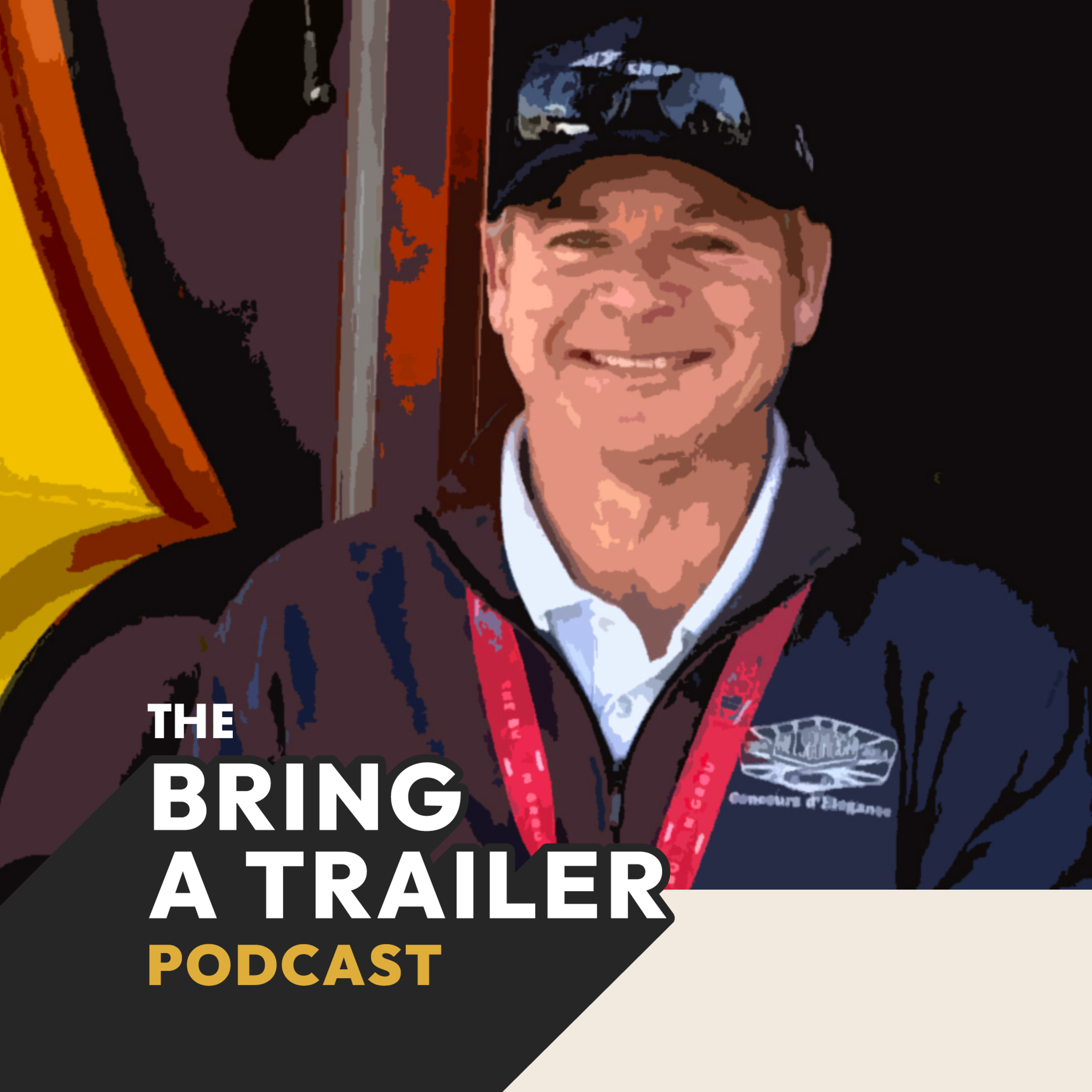
Rob Fisher of the Hillsborough Concours d'Elegance joins Bring a Trailer Podcast to walk through a 70th-anniversary celebration built around judging, community, and logistics. The hosts lay out the weekend’s rhythm—June 28, plus a June 26 kickoff and Saturday’s Tour d’Elegance with 80–100 cars. They preview featured themes like Mercedes-Benz’s 100th anniversary and a 1939 540K with royal provenance, while also discussing how concours culture has evolved, including volunteer judging and the Phoenix Award.
This week Randy hosts Rob Fisher (@Acecaracer on BaT), chairman of the foundation behind the Hillsborough Concours d'Elegance, who claims the mantle of longest continually running concours in the world. BaT will be sponsoring and joining the 70th annual running of this three-day event, culminating June 28 at Crystal Springs Golf Course in Burlingame. Discount alert! The first 200 people to buy their tickets for Sunday, June 28 on the Hillsborough Concours website using the code BAT26 get $10 off the ticket price!
Randy and Rob talk about having a 250 GTO and a Wienermobile in the same show; the Concours' all-volunteer organization; featuring the hundredth anniversary of Mercedes-Benz with a 1939 540K Special Roadster from the Keller Collection; the increased difficulties in getting pre-war halo cars to a venue; the charities that benefit from the proceeds of the event; the origins of the show as a community gathering with guests like Bing Crosby and Abigail van Buren; the turmoil of big changes in 2009, and the evolution since. They leave time to talk about Rob's discovery of BaT, some of the cars he's bought and sold here, and transporting important cars to Moscone Center through San Francisco's less-than-stellar neighborhoods in the wee hours.
Follow along! Links for the listings discussed in this episode:
"I mean, we've had everything from SP2 Ferrari to
250 GTO to last year, we had the Wiener Mobile."
The 250 GTO is a legendary old Ferrari. It’s famous with collectors and shows up at top-tier car events because it’s rare and historically important.
The Ferrari 250 GTO is one of the most famous classic grand tourers ever made, built for 1960s racing and collector demand. It’s a benchmark for 1960s Ferrari performance and design, which is why it’s frequently referenced in concours and auction conversations.
"I mean, we've had everything from SP2 Ferrari to
250 GTO to last year, we had the Wiener Mobile."
Ferrari SP2 is a rare, special Ferrari supercar. It’s the kind of car you’d expect to see at a fancy car show because it’s limited and hard to find.
The Ferrari SP2 is a modern, limited-production Ferrari built around the company’s mid-engine supercar formula. It’s notable for its distinctive open-top, single-seat/2-seat design language and for being a rare, enthusiast-targeted model that shows up at high-end concours events.
"we had the Wiener Mobile. And by the way, it was amazing because it took me
over 10 years. It's a little unknown secret. You have to apply online and there are five
Wiener mobiles all over the country.
...when I got that email telling me that the Wiener Mobile
was going to be coming, I absolutely flipped out."
The Wiener Mobile is the big hot-dog truck from Oscar Mayer. It’s a fun, recognizable novelty vehicle that people get excited to see at car events.
The Wiener Mobile is the famous hot-dog-shaped vehicle associated with Oscar Mayer. It’s a pop-culture novelty that shows up at events as a crowd-pleaser, and in this segment it’s treated like a “special guest” alongside actual show cars.
"No. And the Wiener Mobile won the Children's Choice Award, as you would expect."
A Children’s Choice Award is a prize where kids pick their favorite car. It’s basically the kids’ version of a “best car” award at the show.
A Children’s Choice Award is a concours-style trophy where kids vote for their favorite car. It’s a way for the event to engage families and recognize vehicles that appeal beyond traditional judging criteria.
Term
special roaster
"And so we're getting this beautiful 1939 540K special roaster that has unbelievable provenance history, royal history."
A roadster is an open-top car, usually without a hard roof. The host is describing a special version of the 1939 Mercedes-Benz 540K with that kind of open-body style.
A “roadster” is an open-top car style without a fixed roof, typically emphasizing lightweight, sporty driving. The host’s “special roaster” appears to refer to a special roadster body variant of the 1939 Mercedes-Benz 540K.
"And so we're getting this beautiful 1939 540K special roaster that has unbelievable provenance history, royal history."
Provenance history means the car’s “paper trail”—who owned it and what its background is. For collectors and car shows, that history helps prove the car’s story is real and important.
Provenance history is the documented ownership and background of a car—where it’s been and who has owned it. In concours culture, strong provenance can dramatically increase a car’s historical interest and perceived authenticity.
"you see a lot of those types of shows are still very popular these days. You know, tuner shows, low rider, modified hot rod, you know, resto mods. The good guys are still going"
A restomod is an older car that’s been fixed up, but also upgraded with modern parts. It keeps the classic style, but tries to make it drive and feel better than the original.
“Resto mods” (restomod) are classic cars that have been restored but also modified with newer technology or performance upgrades. The goal is usually to keep the original look while improving drivability, reliability, or power compared to the factory setup.
"But traditional Concord, which the core of that is unmodified, you know, original, that's getting harder and to get people that have their cars like that. And when you start talking about the really older cars, the pre-war cars..."
In this conversation, “Concord” refers to car-show events where people bring cars to be displayed and judged. The host is saying it’s getting harder for certain owners and cars to participate.
“Concord” here is being used as shorthand for multiple concours-style car events (car shows focused on judging and preservation). The speaker discusses how participation is changing due to parts availability, owner demographics, and insurance/transport costs.
"And when you start talking about the really older cars, the pre-war cars, a lot of the folks that owned those no longer own them have passed away. You can't work on them, can't get parts."
“Pre-war cars” refers to automobiles built before World War II. They’re often harder to maintain today because many parts are scarce, and fewer specialists and owners remain who have the knowledge and access to original components.
"And then when you talk about some of these, you know, these marquee cars, what really is interesting is some of those have become so valuable that it's too expensive to take them out, you know, because of the insurance."
“Marquee cars” are the big-name cars—usually the most famous or valuable ones at a show. When they’re extremely expensive, owners may avoid taking them out because it costs more and carries more risk.
“Marquee cars” are the headline, most famous, or most desirable vehicles at an event—often the ones that draw attention and prestige. In this context, the speaker notes that their high market value changes how owners participate because the risk and cost of moving them becomes significant.
"what really is interesting is some of those have become so valuable that it's too expensive to take them out, you know, because of the insurance. And before it used to be, yeah, we'll just put it on a trailer"
Here, “insurance” is the coverage cost for expensive cars. If a car is worth a lot, moving it to events can raise the risk and the insurance cost, so owners may keep them at home.
In collector-car circles, insurance is a specialized cost driver because it can be tied to agreed value, stated usage (like transport to events), and risk of damage while being trailered or displayed. The speaker is highlighting that insurance costs can discourage owners from transporting high-value cars.
"And before it used to be, yeah, we'll just put it on a trailer and we'll take it. But because of, again, like values and insurance and risk and all that kind"
A trailer is how you haul a car instead of driving it. For expensive classic cars, owners often trailer them to shows, but now the cost and risk can be higher.
A trailer is the common way to transport high-value or fragile collector cars to events, since driving them long distances can add wear and risk. The speaker contrasts the old habit of simply trailering cars with the newer reality where value and insurance make transport more complicated.
"Now, very few take their cars out anymore, unless they get a special rider. And frankly, they a lot of times elast the Concord itself to pay for that."
A “special rider” is extra insurance coverage added to a policy for a specific situation. In this case, it likely means coverage for taking a valuable car to an event.
A “special rider” is an add-on to an insurance policy that changes coverage terms for a specific situation—here, likely allowing a collector car to be transported or displayed at an event. The speaker implies that without this extra coverage, owners can’t justify taking cars out.
"...Standard and Chronicle, Hillsborough Boutique and Villager, you know, it was quite popular, you know, and th..."
The Mercury Villager is a minivan, meaning it’s a family-focused vehicle built to carry people and cargo comfortably. It was made for everyday driving rather than sports performance. People might mention it because it’s a distinctive model from the minivan era.
The Mercury Villager is a minivan that was produced under the Mercury brand, aimed at family transportation with practical space and comfort. It’s a notable “period piece” because minivans from this era reflect how mainstream family vehicles evolved in the late 20th century. In a podcast, it may come up as part of a broader discussion about unusual or memorable cars that were popular at the time.
"Yeah, with Kruco. And it's funny, [2123.0s] I bought a Putnam Mazda, I bought an RX7 from that. Is that right?"
The Mazda RX-7 is a sports car from Mazda that’s famous for a unique engine design. Instead of a normal piston engine, it uses a rotary engine, and people often love it for driving feel and mod potential.
The Mazda RX-7 is a classic Japanese sports car known for its rotary engine (Wankel) layout. In enthusiast circles, it’s especially associated with sharp handling and a strong aftermarket for tuning.
"Neutralize it now. It's just [2158.7s] Porsche Burlingame. Yeah, that's right."
Porsche Burlingame is a Porsche dealership. The host is mentioning it to explain how local car dealers support the event.
Porsche Burlingame refers to a Porsche dealership in the Burlingame area. In the context of the Hillsborough Concours d'Elegance, it’s mentioned as part of how local dealer sponsorship and support are organized.
"And they had a phenomenal like [2183.3s] Lambo on the field. And the guy walked up and was like, [2186.8s] I want it."
“Lambo” is a casual nickname for Lamborghini, a brand that makes expensive supercars. The speaker is saying someone saw a Lamborghini on the show field and wanted it.
“Lambo” is a nickname for Lamborghini, a brand known for high-end exotic cars. Here it’s used to describe one of the featured cars on the event field that a visitor wanted to buy.
"I actually joined the Royal Automobile Club. Oh, is that right? Wow, cool."
The RAC is a long-established UK organization for car enthusiasts and motorists. The host brought it up as a way he got involved in car culture while living in London.
The Royal Automobile Club (RAC) is a long-running British motoring organization. In the context of the episode, it’s mentioned as part of how the host immersed himself in UK car culture while living in London.
"I joined Goodwood Road Racing Club and just immersed myself in it and really became in love with both British cars and Italian cars."
This is a UK car club tied to the Goodwood area. People join to connect with track events and the historic racing scene.
Goodwood Road Racing Club is a motorsport-focused club associated with the Goodwood estate in the UK. Joining it is a way for car enthusiasts to get closer to track events and historic British-car culture.
"and try to look for different cars. You talked to different people and I was looking for either a 1956, 1957 Alpha Spider, which is really kind of my sweet spot, Spider Veloce, right? So I was looking at all kinds of different spots and my buddy said, you know, you ought to check"
The Renault Sport Spider is a small open-top sports car, meaning you can drive with the top down. It’s made to feel sporty and fun on the road. People bring it up when they’re talking about roadsters they want to own or compare.
The Renault Sport Spider is a compact roadster built for open-top driving, with a focus on a lightweight, sporty feel. It’s often discussed by enthusiasts because it represents a specific style of small, driver-oriented performance rather than a large grand touring approach. In the podcast context, it’s mentioned alongside other “Spider” models as part of someone’s search for a particular kind of classic Italian-style roadster experience.
Term
Spider Veloce
"I was looking for either a 1956, 1957 Alpha Spider, which is really kind of my sweet spot, Spider Veloce, right?"
“Veloce” is Italian for “fast.” When people say “Spider Veloce,” they mean a sportier, more performance-oriented version of that Alfa Romeo Spider.
“Veloce” is an Italian word meaning “fast,” and in Alfa Romeo Spider context it’s used to denote a higher-performance trim/version. It typically implies more sporting specification compared with a baseline Spider.
"And one day, somebody put in a link that you guys publish to an eBay ad for 1957 AC Aseca
Racecar. I had no idea what the hell AC Aseca was."
This is a 1957 AC Ace-based car that was turned into a race car. The important part is that it wasn’t just a normal classic—it was modified and used for racing.
The 1957 AC Aseca Racecar is a rare, race-prepped version of the AC Ace platform, known for its lightweight, classic British sports-car shape. In this story, the key detail is that the car was set up as a dedicated race car and later acquired by the host.
"Well, the original car, so it had a Bristol motor.
So the AC Aseca Bristol."
“Bristol motor” just means the car used an engine made by Bristol. In this case, it’s the reason the car is called an “AC Ace Bristol.”
A “Bristol motor” refers to an engine from Bristol Cars/its engine family that was used in some AC Ace variants. In this episode, the host explains the naming logic: “AC Ace Bristol” means the AC Ace chassis paired with a Bristol engine.
"But the AC Ace is the car that the AC
Cobra was that became. Carol Shelby got the chassis from AC and turned those into the Cobra."
The AC Cobra is the famous AC-based sports car that Carroll Shelby helped turn into a V8-powered legend. The host is connecting the Cobra’s look and chassis roots back to the AC Ace.
The AC Cobra is the iconic British-American sports car created when Carroll Shelby took the AC chassis and fitted it with a powerful V8. The host highlights the lineage: the AC Ace chassis became the Cobra, which is why the front-end look is so recognizable.
"...tol engine. But the AC Ace is the car that the AC Cobra was that became. Carol Shelby got the chassis fro..."
The Shelby Cobra is a classic sports car known for being fast and exciting. It’s associated with Carroll Shelby and is built with a focus on road-racing performance. People talk about it because it has an iconic design and a strong racing history.
The Shelby Cobra is a high-performance sports car associated with Carroll Shelby, built to deliver big power and lightweight road-racing character. It’s discussed because it blends an iconic look with serious performance, and because many enthusiasts consider it a benchmark for classic American sports-car excitement. In a podcast, it may be mentioned in the context of how the Cobra’s development connects to earlier chassis and design ideas.
"Well, picture a Coupe Cobra. Because you look at it from the front, it looks just like a Cobra.
But it's a Coupe, two door Coupe."
A “Coupe Cobra” is a Cobra-style car with a closed two-door body. It’s basically about the body shape—more like a coupe than an open-top roadster.
“Coupe Cobra” refers to a Cobra-bodied configuration with a closed two-door coupe shape rather than the more common roadster look. The host uses it to describe how the car can resemble a Cobra from the front while being a coupe.
"It had a at a four speed with an
overdrive in it."
This means the car has a manual gearbox with four gears, and the top gear is designed to let the engine spin slower at speed. That can make the car easier to drive without revving as high.
A “four-speed with an overdrive” describes a manual transmission setup where the top gear includes an overdrive ratio for lower engine RPM at cruising speeds. In race-car contexts, it can help keep the engine in its power band while still allowing efficient highway-speed running.
"Locked a Norma build overdrive had a straight six Bristol engine, which is the
motor that came out of the early BMWs."
A “straight six” is an engine with six cylinders in a single row. The host is saying this car used that kind of engine.
A “straight six” is an inline six-cylinder engine layout, where all six cylinders are arranged in one line. The host notes this engine type as part of the Bristol-powered setup in the AC Ace/Bristol race car.
"because he wanted to run in the La Carrera, Pan Americana.
And it ran in the La Carrera."
“La Carrera” is the name of a racing event. The host is mentioning it to explain why the car was modified for competition.
“La Carrera” is a named endurance-racing event the host says the car was prepared to enter. In this context, it’s used to show the car’s competitive pedigree and why it was converted into a race car.
"because he wanted to run in the La Carrera, Pan Americana.
And it ran in the La Carrera."
“Pan Americana” is part of the racing-event name the host mentions. It’s included to show what kind of competition the car was built for.
“Pan Americana” is referenced as part of the event name the owner targeted for racing. The host is using it to connect the car’s build to specific historic competition goals.
"And he actually, I believe either the Colorado Grand or the
Copper State, one or the other in it. Because it was a great
road rally car. Event car, yeah."
A road rally car is a car prepared for rally events where you drive a route on roads, often with navigation. The goal is usually to finish the event reliably and consistently, not just to go as fast as possible.
A road rally car is built or prepared for rally-style events that emphasize driving on public roads (or road-course-like routes) with navigation and consistency. It’s typically set up for reliability and predictable handling rather than only outright track speed.
Term
Fulva
"Perfect. I mean, it previously had a Fulva in it, you know, the whole old school mileage thing."
“Fulva” sounds like a specific engine or performance setup that was installed in the car before. It’s the kind of detail enthusiasts mention because it affects how the car makes power and how it’s raced.
“Fulva” here appears to refer to an engine or performance component previously installed in the car. In classic racing circles, such names often denote specific engine variants or setups used to make the car competitive.
Term
HMSA
"So, after buying it, yeah, I raced it in HMSA and CSRG, Hunan and Sears and Thunder Hill."
HMSA is a racing series/club the speaker raced with. It’s the kind of group that organizes races for older cars so they can compete in the same events.
HMSA is an acronym for a vintage/club racing organization or series the speaker competed in. These organizations run events for historic cars with rules that keep older machinery racing together.
Term
CSRG
"So, after buying it, yeah, I raced it in HMSA and CSRG, Hunan and Sears and Thunder Hill."
CSRG is another racing group/series the speaker raced in. These acronyms usually stand for organizations that put on races for specific classes of cars.
CSRG is another acronym for a racing organization/series mentioned alongside HMSA. It likely refers to a historic or club racing group with event calendars that include tracks like Thunder Hill.
Term
middle of the pack
"And what am I going
to get? You know, it's a hundred and 2000 and thirty horsepower car. We're always
going to be in the middle of the pack."
“Middle of the pack” is a racing placement description meaning the car is competitive enough to finish regularly but not consistently challenging for the top positions. In motorsport terms, it often reflects a balance of power, setup, and driver pace relative to the field.
"...ou know, and the problem is within that, that has Corvettes and there's Ferraris in there too. You get your d..."
The Chevrolet Corvette is a sports car made by Chevrolet. It’s designed to be fast and fun to drive, and it has been around for many years. People talk about it a lot because there are many different versions that collectors look for.
The Chevrolet Corvette is a long-running American sports car known for its performance and for being a popular entry point into the world of enthusiast cars. It often comes up in collector and auction discussions because many generations have distinct designs and engineering milestones. In a podcast context, it may be mentioned alongside other famous sports cars to compare what makes each one desirable.
"I sold my 1960 Austin Haley BT-7.
[2872.7s] There you go.
[2873.4s] I sold my 2007 Audi RS4.
[2879.2s] Nice."
This is a performance Audi RS4 from 2007. It’s the kind of car enthusiasts buy for a more exciting driving feel than a normal A4.
The Audi RS4 is a high-performance version of the regular A4, built to deliver a more track-capable, enthusiast-focused driving experience. The 2007 RS4 is especially notable because it’s part of the last era of naturally aspirated V8 RS4s, which many fans consider more characterful than later turbo-only setups.
"So, well, when I was living in London, I got turned into the RS4 and the RS4 Avant.
[2895.6s] They had stuff we didn't have.
[2896.8s] The wagon. The wagon is the ultimate grocery getter."
“Avant” is Audi’s word for a wagon. So “RS4 Avant” means the fast RS4, but in a body style that can carry more stuff than a sedan.
“Avant” is Audi’s name for a wagon/body style—essentially a station wagon version of a model. When someone says “RS4 Avant,” they mean the performance RS4 configured as a wagon, combining power with extra cargo practicality.
"But you sold it on BAT.
Yeah, I had it delivered to my friend before I even moved back from London.
...
I wish you would say you're buying all these on BAT."
BAT is short for Bring a Trailer, a website where people buy and sell cars through online auctions. It’s popular with car enthusiasts because the listings tend to be interesting cars, not just basic transportation.
BAT stands for Bring a Trailer, an online auction site focused on enthusiast cars. In the transcript, it’s used as the marketplace where the host sold the car and where buyers can find similar enthusiast-spec vehicles.
A “sleeper” is a car that doesn’t look like a big deal, but it’s secretly very quick. “Ultimate sleeper” means it’s the best example of that idea.
A “sleeper” car looks relatively normal but is actually very fast or highly capable. Calling it an “ultimate sleeper” suggests the car’s performance is far beyond what its appearance would lead you to expect.
"So I sold that and I got a 2009 R8.
Oh, wow.
Yeah, Rugello Blue with Silver Blades."
The Audi R8 is a supercar made by Audi. In 2009, it was the first-generation R8, and it’s known for being a real mid-engine sports car that still feels usable day to day.
The Audi R8 is a mid-engine supercar built by Audi, known for its exotic look and everyday usability. The 2009 R8 is especially notable because it’s part of the first-generation R8 era, when the car became a mainstream gateway into the supercar world.
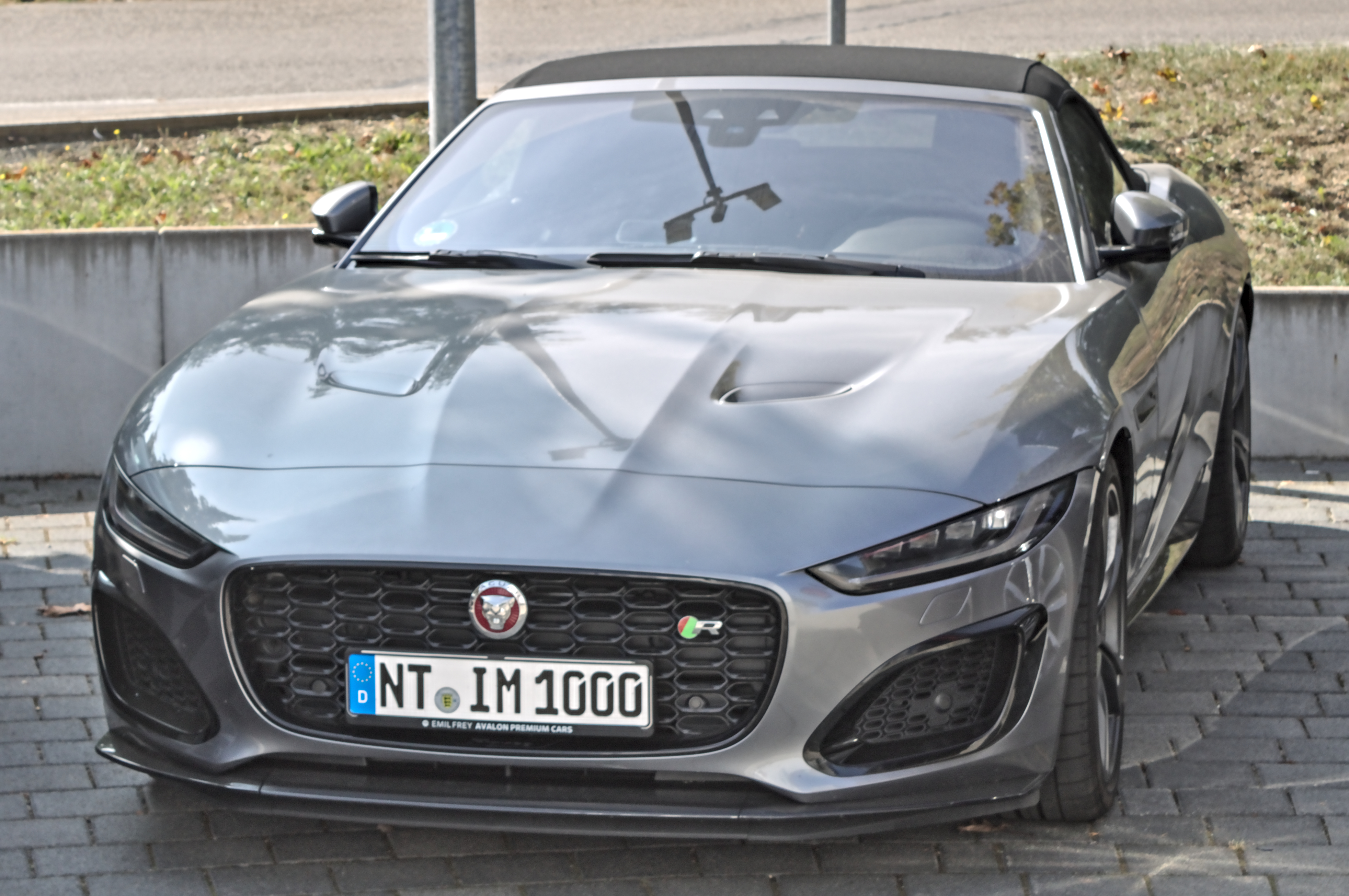
"That Audi Q3 replaced it. But now I've got my Jag F-Type."
The Audi Q3 is a smaller Audi SUV/crossover. He’s saying he switched to it after the R8 situation didn’t work out.
The Audi Q3 is a compact luxury crossover/SUV that’s typically easier to live with than a supercar. Here it’s mentioned as the replacement for his previous daily-driving setup.
"That Audi Q3 replaced it. But now I've got my Jag F-Type."
The Jaguar F-Type is a sporty Jaguar car. He’s saying this is what he’s driving now.
The Jaguar F-Type is a front-engine sports car known for its classic roadster/coupe feel and performance-focused engines. In this segment, it’s the car he has now after moving away from the earlier daily-driver choices.
"Yeah, I brought a 275 GTB.
That was sweet.
Red and tan."
The Ferrari 275 GTB is a famous old Ferrari. It’s known for its smooth V12 engine and classic design, and it’s the kind of car car people get excited about seeing in person.
The Ferrari 275 GTB is a classic grand touring (GT) car from Ferrari, famous for its V12 engine and elegant 1960s styling. In this context, the host is describing bringing one to an office “familiarization walk,” highlighting it as a notable, enthusiast-grade car.
"...body had pulled in a Porsche 9146 and then an old Mustang. And then we had a couple Alpha GTBs here we talk..."
The Ford Mustang is a sports car from Ford that’s known for its powerful engines and classic styling. It’s been made for a long time, so there are many different versions. People often mention it because it’s easy to recognize and has a big enthusiast following.
The Ford Mustang is a classic American muscle car that became a defining name in the pony-car segment. It’s frequently discussed because of its huge production history, wide range of trims, and strong collector interest in both early and later examples. In an auction or enthusiast setting, it can be brought up as a recognizable benchmark against other sports cars.
"...like buy sandwiches. And somebody had pulled in a Porsche 9146 and then an old Mustang. And then we had a couple..."
The Porsche 914 is a sports car made by Porsche with the engine placed in the middle of the car. That layout helps it handle more like a true sports car. It’s talked about because it’s a recognizable Porsche model with a dedicated fan base.
The Porsche 914 is a mid-engine sports car that’s often remembered for its balanced driving feel and for being an accessible way to experience Porsche engineering. It’s a frequent subject in enthusiast discussions because it has a distinct place in Porsche history and a strong aftermarket and collector community. In the podcast context, it’s likely mentioned as part of a lineup of notable cars that were present or compared.
"Before I was working there, I had this awesome 1970 Mini Cooper S.
That was Robin's Egg Blue, White Top, Australian."
This is a 1970 Mini Cooper S, a small classic British car that’s famous for being fun and agile. The speaker’s specific one is an Australian version with right-hand drive, so some parts and exterior details are different from other countries’ Minis.
The 1970 Mini Cooper S is a classic British hot hatch/sports Mini, known for its compact size and lively handling. In this story, the key detail is that the speaker’s example is an Australian-spec right-hand-drive car, which affects the body and hardware details compared with other markets.
"So really rare Australian right-hand drive.
Super great cars."
Right-hand drive just means the steering wheel is on the right side of the car. It’s common in countries that drive on the left, and it can also change some parts and layout details versus left-hand-drive cars.
Right-hand drive means the steering wheel is on the right side of the car (with the driver sitting closer to the center of the road in countries that drive on the left). For classic Minis, right-hand-drive Australian imports can come with market-specific exterior and interior hardware.
Rain gutters are the little channels along the roof that catch water and route it away from the car. Different versions of the same model can have slightly different gutter shapes.
Rain gutters are the channels along the roofline that help direct water away from the body and toward the drains. On certain market-specific classic cars (like Australian Minis), the gutter design can differ, which is why the speaker calls it out as a distinctive feature.
"The window handles and the door handles were different.
That's right."
Window handles are the knobs or levers you use to move the car’s windows. The speaker is saying the Australian version used different handle parts than other versions.
Window handles are the controls used to open and close the side windows. The speaker notes that Australian-spec Minis had different window-handle hardware, which is the kind of small detail that helps identify a specific market car.
"The window handles and the door handles were different.
That's right."
Door handles are the outside parts you grab to open the doors. The speaker is pointing out that the Australian version had different door-handle hardware than other Minis.
Door handles are the exterior hardware used to open the doors. In this segment, the speaker highlights that the Australian-spec Mini had different door-handle design compared with other markets, along with other latch-related differences.
The exterior latch is the part that the outside door handle works to lock or unlock the door. The speaker is saying the Australian car used different latch hardware.
An exterior latch is the mechanism the exterior handle operates to secure and release the door. The speaker mentions the exterior latch as being different on the Australian-spec car, which implies different body/door hardware than other versions.
See something that's not quite right? Our annotations are AI-generated and can sometimes miss the mark.
Click the flag icon on any annotation to suggest a correction.