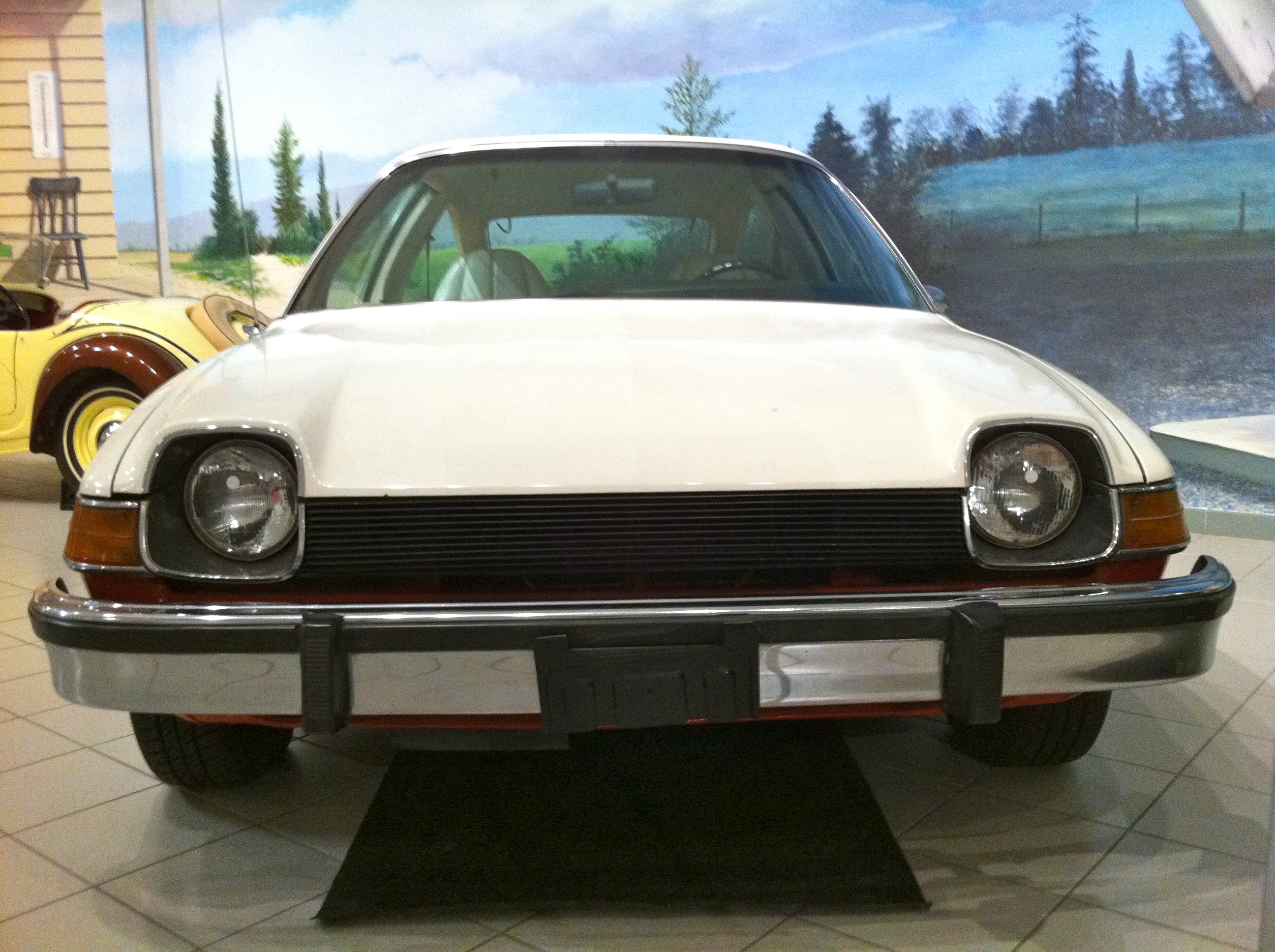
The AMC Gremlin is a small 1970s car with a very unusual, compact shape. In the discussion, it’s brought up as one of the cars that came out of that AMC design era.
“Retooling” is what factories do when they need new equipment to build a redesigned car. The point here is that the changes between model years were small enough that they didn’t have to overhaul the entire production setup.
Term
rear quarter
The rear quarter panel is the big body panel behind the rear wheel. They’re talking about how the shape/fit between panels can affect how the whole car looks.
The front fender is the outer panel over the front wheel. It’s part of the car’s body shape, and in this discussion they’re comparing how different panels line up.
“Horseless carriage” is an old-fashioned way of saying “early car,” from the time people were still comparing it to horse-drawn vehicles. They’re about to ask what the difference is between that term and what we call a car today.
LIVE
Emily BB25: It's Friday. It's Friday.
Emily BB25: Duer. Dua, Dua, Doers, Doers, Duers? Duer. Trophy. And how they won it was, it was really a feat. It was really great. They had what?
What about Emily BB25: I'm just saying, they weren't in ankle-deep mud. I,
Rose BB25: it was a muddy world Uh, I, I can't explain why, but no, I don't think that there were probably a lot of dry places the way we think of it. I mean, I've been to the UK, and I'll tell you that, like, when you're driving, when you're driving around, like they, they took us out and, like, you get into the back roads and it's like, uh, it's not a lot of...
He's like, "Nope, I didn't think about any of that. It's just matched up with the road." That building's cold as shit all day. It's cold all day long. And
Emily BB25: Well, maybe I will, and then I'll bring that back for next episode.
Rose BB25: think Medieval Times is even worse. When I think of feudal times, I do think of people constantly in the mud.
Rose BB25: let's hear it. Do you really, do you think that these Cadillac builders were in up to their ankles in water? Were
Rose BB25: And they were just, uh, Jezzie, Fred Savage, eh. The g- okay, let me remind you of the question. What child actor oversaw some of the great mid-60s and '70s AMC car designs? And Jezzie said Fred Savage, eh. Tracy, Tommy Ivo, or Ivo, eh. Uh, Alex Forrester,
I didn't hear back whether that was Google or not, so sorry if, like, I'm not gonna give you cred. But I got Alex's correct answer first. And Alex had a story, which Alex just came in full, uh, full confidence and said, "Dick Teague played Dixie Duvall in an older version of 'The Little Rascals,' right?"
He, um... Okay, going back a little bit though. Dick Teague was an, a child actor, and his mom found him some additional acting roles that were outside of "Our Gang" and four other movies that were fairly similar. But then they got hit by a drunk driver, and Dick lost an eye, and it broke his jaw, and he lost some teeth,
Um, so he's like a, just a SoCal legend, and he restored cars and, like, did really nice. That was how he burned off steam from Detroit. But he, uh, loved planes, but he could not be in the military because of his missing eye. And he wanted to be a pilot, and he did go work at Northrop. Um, and a friend at Northrop was like, "You know..."
And so what this says was that, uh- And basically what I told you was that he, uh, always drew cars as a kid, couldn't get into the military, so at 19 he took a job as an illustrator at Northrop Aircraft. Uh, and Teague loved airplanes as much as cars, and he worked under Paul Brown, a former GM auto designer, who'd been in Bill Mitchell's studio during the '38 Cadillac Sixty special creation.
The interviewer turned out to be Frank Hershey. Hershey was also a friend of Paul Brown. He's in. He's in. So with those connections, Teague got the job. He started at GM on the March 15th of, uh, 1948, and, um, wound up in an experimental studio called Planet Eight, and, uh, basically got to do cool stuff. And, um, he remained a designer in advanced Cadillac and then left GM in early '51, uh, married and came back to California, uh, and worked at, uh, Rhodes-Lewis doing, uh, weapons designs, uh, of tanks and rocket launchers and stuff.
um, then he, uh, gets into AMC under Ed Anderson, and, uh, he said, "It's funny how you go around in a circle." And, uh, he said, "You stay in styling long enough, you'll eventually be working for your mother-in-law." But, um, this says Ed Anderson left AMC in late '61, and Teague took over as the corporation styling director, and he was named vice president on February 6, 1964, and remained with AMC for 24 years until his retirement in 1983. Um, it says that he had a, uh, a very long and passionate love affair with classic and antique cars.
Rose BB25: yeah, I mean, that goes on, that goes on into the Gremlin and the Pacer and the Hornet. I mean, he's, he's the man. He's, like, the guy calling the shots. Nice. And I, you know, I, like I said, I, I could... There's lots of really good, um, there's lots of really good quotes I feel like in here about that, and there's a bunch in this book, again, citing the same Centuria-style book.
So, like, year-to-year changes that were really minor without retooling the whole car and stuff. So, uh, there is, though, there is their Cavalier where the front fender matches the rear quarter, and so it sort of, like, looks like a car that's going two different directions, like when you weld two halves of a car together.
Emily BB25: one. And first I got something from Regina.
Emily BB25: Always trying. And then we got something from Rizzo, uh-
And so at dawn, on, uh, August 5th, 1888, she took her two boys, um, let's see, Richard, 13, and Eugene, 15. She was 39 years old, and she drove from Mannheim to Pforzheim, and that was 65 miles. She did it without permission of authority, of the, of any authorities or her husband's
Rose BB25: Yeah. I think, yeah, we've touched on this in the past because we've talked about doing a deep dive, but yeah.
Emily BB25: Yeah. So it was, so it was Bertha Benz. She was out there doing it, and she wrote a book, which I actually have, and I can't remember what it's called, so this is not a very good story.
Rose BB25: That, that car I do not think would be what it is without her.
Emily BB25: style.
You ready with your question? All right. My question is, what is the difference between a horseless carriage and a car? I thought
You've already, y- y- you've, you, you can just balance it out. You're a little smarter. You'll be a little dumber come Sunday. It's all gonna be good on Monday.
About this episode
The hosts trace classic car design history through Dick Teague’s work at AMC, including how he led styling and later moved into executive leadership. They also discuss how AMC handled model-year updates—often keeping changes minor without retooling the entire vehicle. The conversation then pivots to early automotive terminology, setting up a definitional question about the difference between a “horseless carriage” and a “car.”