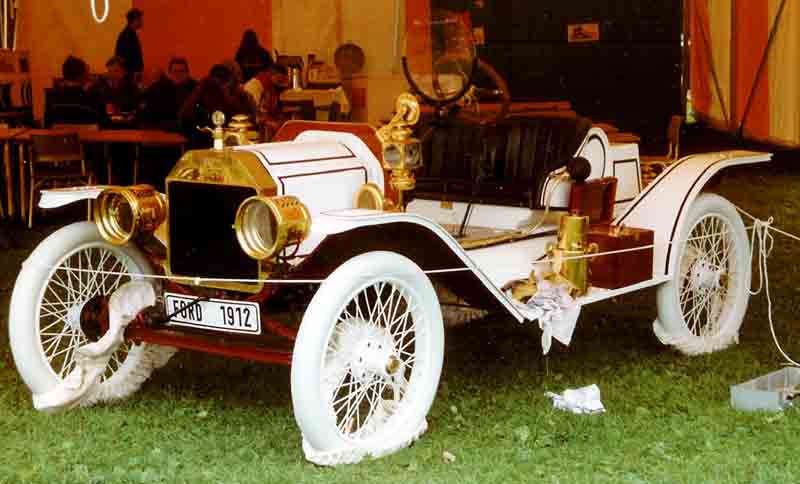
“Horseless carriages” means early cars that were basically trying to replace horse-drawn carriages. They often looked like carriages even though they didn’t use horses.
The Ford Model T was one of the first cars that many regular people could afford. It helped make cars common, not just a novelty.
Car
1896 Quadricycle
The 1896 Quadricycle was one of Ford’s earliest attempts at a self-propelled vehicle. The idea was close to a bicycle, but with a motor—an early step toward real cars.
The Curved Dash Olds was an early Oldsmobile that lots of people wanted because it was relatively affordable. It also had a recognizable look, including a short front end.
Car
1901 Duryea
The 1901 Duryea is an early car that started with a body design meant for horse carriages. It shows how early cars borrowed a lot from carriage design.
Japanning is an old-school way of coating or finishing surfaces to make them look shiny and last longer. In this segment, it’s discussed as a paint/finish step used on early cars.
Term
linseed
Linseed is a type of oil (from flax) that’s used in old paint/coating recipes. It helps the coating dry and harden into a protective layer.
A solvent is a liquid that helps paint or coating mix and spread evenly. It usually evaporates as the finish dries.
LIVE
Rose BB26: don't even worry about it. No, I think it's cool. Don't even worry about... I mean, but yeah, sure. Bugs love to do that. They're like, they can stick to anything, and then all of a sudden, somehow when they're crawling above you, they just fall off.
Rose BB26: Yeah, Mateo, big time listener. Might, might be number one
Emily BB26: Well, you're hearing about him now. Oh. What did, when did Bertha Benz do hers? It was like 18-
in the late 1800s, the horseless carriages were a j- the transition between a carriage and a car. Uh, and many were designed like carriages, so they had, like, large wheels. Um, I like to think of them as the original donks.
Rose BB26: So low I can't hear it? That doesn't... Th- that's a music joke. I don't know, that, that didn't quite-
Emily BB26: So car became a widely used term in the early 1900s, especially after the advent of the Model T Emily BB26: karros. Yes. They called it karros. Um, and then, uh, uh, the Celtic language got squished. I'm not gonna go into the whole etymology because it's, there's a fucking lot when it comes to words. But anyway, basically Latin comes along later
Rose BB26: Yep, they talk about sweeps basically coming from shipbuilding. I mean, they're not, but they're similar. But it's more the plan view, uh, and the side view, uh, and translation of curves comes from ships
Emily BB26: gray. Uh, well, the answer to my question is it's a gray area. Yeah, it is.
Rose BB26: \ I'm looking at the front of the book here, at, uh, "Century of Style," because it does mention coach builders and carriage making, but it says that, um, it said the French especially set the styles and published the important books about carriage making. Garsault's "Traits des voituriers," I'm sure I just butchered that, "Treatise on Carriages" is the title of the book, appeared in Paris in 1754 and in 1771.
Common folk, like farmers and merchants, might have wagons, and if crops and businesses went well, they might even have a, a buggy or a runabout.
Rose BB26: I subscribed to that. Yeah, me too. Uh, which published fashion plates of the latest continental body types.
She points out that the carriage designers usually, uh, made presentation sketches on translucent paper. Um, and basically they could show customers with and without the horse. Um, and people wanted to see the horse out front." Uh, the horse-
Rose BB26: Still others, including Henry Ford, borrowed bicycle technology. Ford's first self-propelled motor car, the 1896 Quadricycle, was basically a four-wheeled bike, just as the earliest German Benz and French De Dion-Bouton had been motorized tricycles.
Uh, the bicycle soon prepared middle income citizens not only to accept, but to clamor for inexpensive cars like the Curved Dash Olds and the Model T Ford. The Curved Dash Old is a big one. That's a fucking big one. Just, just wanna throw it out there. The Curved Dash Olds is like Uh, I don't even wanna say it looks weird, 'cause it's not weird. It's ... I, I, I would dare say it's fucking sick. I like it. Um, and the Duryea. The 1901 Duryea used a body style originally designed for carriages. Fish motif had a symbolic Christian significance. The Duryea is pretty neat. It's kinda wacky. Uh, but the Curved Dash Olds, that was a very popular car. Uh, is ... I mean, it's super short in the front when you see it.
Rose BB26: Yeah. I mean, the '03 Cadillac is, um ... It's got a coiled tube radiator ahead of the front axle, so it's, it's, like, got a Cadillac logo on the radiator. I mean, it's just a radiator, you know?
Rose BB26: It's all just stewing around up there. You just get-
Emily BB26: Hosing it down and Um, and really, I think it, it involves something with a heavy black background and then an ornate pattern on it. But they were literally just painting cars like that. Um, now I did find this, uh, this book. Uh, it's an e-book, but it's, uh, from March 11, 1920, and it's called Automotive Industries: The Automobile, and this is like page 669.
The average commercial Japan usually comprises the following ingredients: linseed or other oxidizing oil, gums or pitches, dryer, color, and solvent." I mean, so like I think this is kinda interesting. This is how the article starts. It says, "While the Japanning operation is one of the most important from the standpoint of finish and appearance, it is one of the few manufacturing operations that the average automobile manufacturer carries out on a rule-of-thumb basis, trusting to traditions that the result will be satisfactory." That's not Detroit today. Absolutely nothing is left to chance. Uh, it, it, yeah, it sounds just totally haphazard, but paint was a big deal back then.
Emily BB26: It smells too pretty Rose BB26: Yeah. Let me know. Same,
Rose BB26: I'll actually go research it, but I, I think I got this one. You're gonna owe me that $100.
About this episode
The hosts trace early auto history and the language around it, moving from carriages to “cars” and the rise of the Model T. They also break down how early designs borrowed from bicycle tech, pointing to Ford’s 1896 Quadricycle. The conversation gets specific with period engineering details like the “coiled tube radiator” layout on an ’03 Cadillac, then pivots to finishing methods, quoting an old description of japanning ingredients.