
2022 Toyota 4Runner Pre Purchase Inspection
About this episode
Bernie Pawlik and Mark walk through what a thorough pre-purchase inspection covers using a 2022 Toyota 4Runner with about 70,000 km. They explain the goal: avoid buying a “lemon” and uncover whether the price matches the vehicle’s real condition. The shop’s digital, 102-item inspection uses green/orange/red notes, includes battery and brake measurements, checks maintenance items, and documents underbody scrapes. They also highlight interesting 4Runner tech details like hydraulic power steering and an integrated brake system tied to modern safety features.

Toyota 4Runner
"So today's guest is a 2022 4Runner. [19.0s] What was this vehicle in for?"
This is a Toyota 4Runner, a tough SUV built to handle rough roads. Since it’s a 2022 with about 70,000 km, the inspection helps you find out if it’s been cared for and if anything expensive is starting to show up.
The Toyota 4Runner is a body-on-frame SUV known for rugged off-road capability and durability. A 2022 4Runner is a relatively recent model, so a pre-purchase inspection focuses on how well it’s been maintained and whether any hidden issues have developed by around 70,000 km.
pre-purchase inspection
"This vehicle came to us for pre-purchase inspection. [37.8s] And I thought we'd talk about what you get in a pre-purchase inspection when you bring it to our shop. ... [46.8s] So what is the idea behind a pre-purchase inspection?"
A pre-purchase inspection is a mechanic’s check of a used car before you buy it. It helps you spot problems you might not notice and helps you judge whether the price is fair.
A pre-purchase inspection (PPI) is a professional inspection done before buying a used car. The goal is to uncover mechanical or safety issues, estimate repair needs, and confirm whether the asking price matches the vehicle’s condition.
70,000 kilometers
"The vehicle has about 70,000 kilometers on it. [34.1s] I can say that much. [35.6s] Visually looks really nice from the outside."
Kilometers are just how far the car has been driven. Higher mileage usually means more wear, so it’s an important clue for what maintenance or repairs might be coming next.
Kilometers (km) are the distance unit used in Canada and many other countries to measure vehicle mileage. In a used-car context, the number of kilometers helps estimate wear items’ remaining life and whether maintenance should be up to date.
timing belts
"Timing belts are not very common anymore. But you know, in a day when a vehicle had a timing belt, you might be at the mileage where that's due."
A timing belt helps keep the engine’s moving parts in sync so everything opens and closes at the right time. If it hasn’t been replaced when it should be, it can turn into an expensive repair.
A timing belt synchronizes the engine’s crankshaft and camshaft(s) so the valves open at the correct time. If it’s due and hasn’t been replaced, it can become a costly maintenance item during a pre-purchase inspection.
mileage
"But you know, in a day when a vehicle had a timing belt, you might be at the mileage where that's due. And if it hasn't been done, then that's an expense you're going to have to incur."
Mileage is how many miles the vehicle has been driven. Mechanics use it to estimate when certain maintenance—like replacing a timing belt—should be done.
Mileage is the odometer reading that indicates how far a vehicle has been driven, and it’s commonly used to determine when maintenance items are due. In this context, it’s tied to the service interval for timing belt replacement.
body on frame
"This is basically a body on frame. So similar to a truck. Is that correct?"
“Body on frame” means the car’s body sits on a separate, truck-like frame. That can make the vehicle tougher for towing and rough driving, though it may be heavier than some other SUV designs.
Body-on-frame is a construction method where the vehicle’s body is mounted to a separate ladder frame, like many trucks. It generally improves durability for off-road use and towing, but can add weight compared with unibody designs.

Chevrolet Suburban
"...s the actual start of an SUV. I sometimes think a suburban was the, we go way back because those things have..."
The Chevrolet Suburban is a large SUV made for carrying people and gear. It’s been around for many decades, so it’s often mentioned when people talk about how SUVs started. It’s designed to be practical for families and everyday use.
The Chevrolet Suburban is a full-size SUV known for its long-running history and reputation as a family and utility vehicle. It’s often discussed in the context of early, practical “real” SUVs because it helped popularize the idea of combining passenger comfort with truck-like capability. That makes it a common reference point when talking about how the SUV category evolved.

Ford Bronco
"...ut you're Tahoe, not Tahoe, the GMC, Jimmy or the Bronco. Those are like early SUVs."
The Ford Bronco is an SUV made to handle rough roads and off-road driving. It’s one of the older models that helped define what people think of as an SUV today. That’s why it’s often mentioned in conversations about early SUV history.
The Ford Bronco is a classic off-road-capable SUV that’s frequently brought up as one of the earlier examples of the modern SUV idea. In podcast discussions like this, it’s used as a reference point for how vehicles shifted toward higher-riding, rugged-purpose formats. That’s why it comes up when comparing “early SUVs” from different eras.
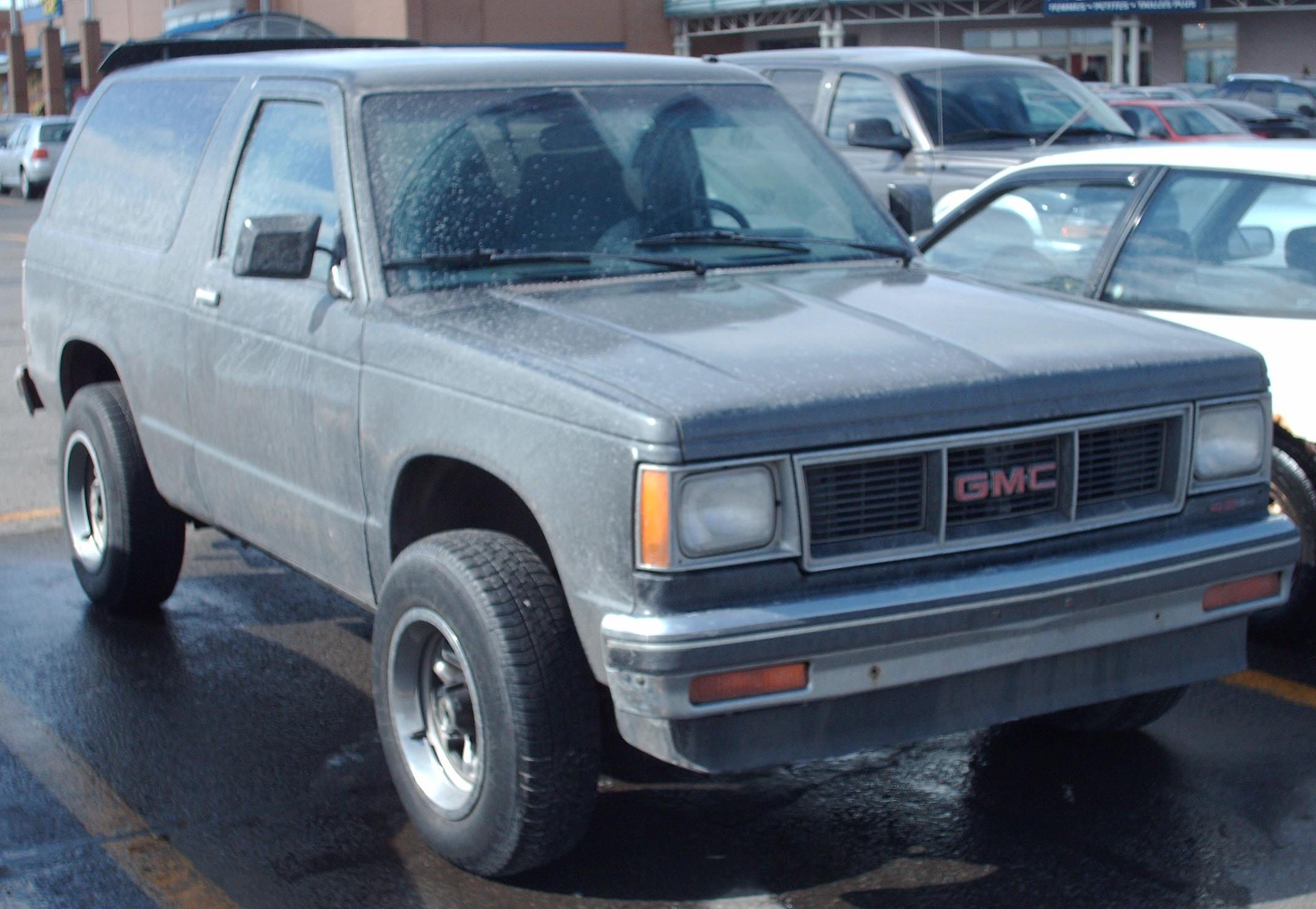
Gmc Jimmy
"since the 60s. I don't know if that's the original, but you're Tahoe, not Tahoe, the GMC, Jimmy or the Bronco. Those are like early SUVs."
The GMC Jimmy (3-door) is an older-style SUV made for carrying people with a more rugged, higher-riding setup. It’s a smaller SUV compared with full-size models, and the 3-door design is part of what makes it feel “classic.” It’s mentioned as an early example of the SUV type.
The GMC Jimmy (3-door) is a compact SUV from earlier decades that’s often cited as part of the foundation of the SUV market. In the context you provided, it’s grouped with other early SUVs to illustrate how these vehicles emerged as a distinct alternative to traditional cars and trucks. Its 3-door layout is a key part of its classic, period-correct design.

Toyota Highlander
"A lot of them, I noticed the other day I was out driving somewhere, Toyota has a Grand Highlander and it's not quite as big as a suburban, but it's almost the size."
The Toyota Grand Highlander is a big family SUV with three rows. The hosts are basically saying it’s getting almost as large as older, full-size SUVs.
The Toyota Grand Highlander is a larger three-row SUV positioned to feel closer in size to traditional full-size SUVs. In this segment, it’s used as a comparison point to show how modern crossovers and family SUVs have grown.

Honda Odyssey
"It's funny. Even Honda Odyssey, like the minivans are like, this thing's almost ..."
The Honda Odyssey is a minivan designed mainly for families. It’s built to be roomy and easy to live with, especially for passengers and daily errands. People sometimes compare it to SUVs because it can feel similar in how it’s used, even though it’s a minivan.
The Honda Odyssey is a minivan built for families, focusing on space, comfort, and easy everyday usability. It’s mentioned in the context of minivans being “almost” like SUVs, which highlights how these vehicles can overlap in purpose even though they’re built on a different body style. That makes it relevant when discussing how family vehicles evolved over time.
hydraulic power steering
"This vehicle still has hydraulic power steering, which you can see the reservoir of the fluid"
Hydraulic power steering uses fluid pressure to help you steer. You’ll often see a fluid reservoir for it, and it feels different from newer electric steering systems.
Hydraulic power steering uses a pump and pressurized fluid to reduce the effort needed to turn the steering wheel. It’s different from electric power steering, which uses an electric motor instead of a hydraulic pump.
electric power steering
"A lot of cars these days have electric power steering, but this one still has hydraulic"
Some cars use a motor to help you steer, rather than hydraulic fluid pressure. That’s what “electric power steering” means, and it’s common on newer vehicles.
Electric power steering (EPS) uses an electric motor to help turn the wheels, instead of relying on engine-driven hydraulic pressure. It’s common on newer cars because it can be more efficient and easier to control electronically.
vacuum pump
"and to the left of that's a vacuum pump buried under a cover."
A vacuum pump makes suction (vacuum) that other car systems use to work properly. Some cars need one because they can’t get enough vacuum from the engine alone.
A vacuum pump creates vacuum pressure used by engine accessories and emissions-related systems. On some vehicles, it replaces engine vacuum from the intake manifold, especially when packaging or engine design doesn’t provide enough vacuum.
brake master cylinder assembly
"Here we have the brake master cylinder assembly."
When you press the brake pedal, the master cylinder turns that input into brake fluid pressure. That pressure is what makes the brakes actually clamp down and stop the car.
The brake master cylinder assembly is the hydraulic control unit that converts brake pedal force into pressurized brake fluid. That pressure is then sent to the brake calipers or wheel cylinders to slow the vehicle.
vacuum booster
"It doesn't have that big round vacuum booster that you're familiar with on a lot of vehicles."
A vacuum booster helps you brake with less pedal effort by using suction from the engine. Some cars have a big round one; this one doesn’t, so the braking assist is arranged differently.
A vacuum booster uses engine vacuum to multiply the force applied to the brake pedal, making braking easier. The speaker notes this vehicle lacks the large round vacuum booster many people expect, implying a different braking assist setup.
hydraulic unit
"If you look under hoods, basically it's a hydraulic unit, but it's integrated with only electronics of the braking system."
In this context, “hydraulic unit” means the brakes use pressurized fluid to do the stopping. It’s describing how the braking system creates the force, even if it doesn’t use the typical vacuum booster.
A hydraulic unit in the braking context means the system uses pressurized fluid to control braking forces. The key point here is that even without a traditional vacuum booster, the car still uses hydraulics to generate and manage brake pressure.
cruise control
"So you can have cruise control where it'll actually slow the vehicle down."
Cruise control keeps your speed steady without you pressing the gas pedal. On newer cars, it may also work with braking so the car can slow down if traffic changes.
Cruise control is an electronic driver-assist feature that maintains a set speed without holding the accelerator. In modern systems, it can be integrated with braking and sensors so it can slow the car when needed.
emergency braking features
"If the car in front of you stops and emergency braking features and those kind of things."
Emergency braking features are designed to help prevent crashes by braking automatically if the car thinks a collision is coming. They use sensors and the brake system to react faster than a human might.
Emergency braking features are safety systems that detect a potential collision and apply the brakes automatically or with increased force. They’re part of the car’s electronic braking control strategy, often working alongside sensors and stability systems.
V6 engine
"This is a V6 engine."
A V6 engine has six cylinders arranged in a V shape. It’s a common engine type that usually feels smoother than a 4-cylinder while still fitting in the engine bay.
A V6 engine is an internal combustion engine with six cylinders arranged in a “V” shape. This layout is common because it balances smoothness and compact packaging compared with larger V8s.
multi point inspection
"So we have a multi point inspection that we do and we mark things off and reds, oranges [250.6s] and greens."
It’s a checklist-style car inspection where the shop looks at lots of different parts. Instead of just saying “it looks good,” they mark items so you can tell what’s fine and what might need work.
A multi-point inspection is a structured pre-purchase checklist that evaluates many different areas of a vehicle, not just one or two obvious systems. Inspectors score or flag items so you can quickly see what’s normal versus what needs attention.
reds, oranges and greens
"So we have a multi point inspection that we do and we mark things off and reds, oranges [250.6s] and greens. [252.2s] There's no reds on this vehicle because it's in pretty good shape."
They use a traffic-light style system: green is basically okay, orange means “pay attention,” and red means “this is a bigger concern.” It helps you understand the inspection results at a glance.
“Reds, oranges and greens” describes a color-coded grading system used in inspections to communicate severity. Typically, green means no issues, orange means something to watch or address soon, and red indicates a more serious problem or priority repair.
cabin air filter
"and could be issues like [259.8s] the cabin air filter. [261.4s] There's just a note that says check maintenance records."
This filter cleans the air that comes into the car’s cabin through the heating and air conditioning. If it’s dirty, the fan may feel weaker and the air can smell stale.
The cabin air filter is a filter in the HVAC system that cleans the air entering the vehicle’s interior. If it’s overdue, airflow and air quality can suffer, and it can contribute to musty odors.
wheel lock location
"And then wheel lock location is really just more of an internal note for ourselves that [275.4s] we know where it is because we often fight to find those things."
Some cars use a special key to remove the wheels. The “wheel lock location” is just where that key is kept, so you don’t waste time hunting for it later.
Wheel lock location refers to where the anti-theft lug key (used to remove wheels with locked lug nuts) is stored. Inspectors note it so the key can be found quickly if a wheel needs to be removed for service or a tire change.
digital inspections
"They're all digital. [297.4s] So we send them out that you get a link and you just click on it and it looks like this [300.5s] and you can scroll down through it."
Digital inspections are pre-purchase inspection reports delivered through a link or app rather than paper. They often include item-by-item photos and notes, making it easier for the client to review and for the shop to keep consistent records.
body damage
"When you click on that little paper clip to the left of where it says body damage, these pictures show up here. And so the body damage is really some scrapes from underneath."
“Body damage” means visible damage to the outside of the vehicle—scrapes, dents, and scuffs. Even if it looks minor, it can be a clue that the truck was hit or used off-road, which can lead to other hidden issues.
In a pre-purchase inspection, "body damage" refers to visible exterior damage like scrapes, dents, and scuffs on panels and underbody areas. It matters because it can hint at prior off-road impacts or barrier strikes that may also affect alignment, mounts, and underbody components.
battery condition
"Going to the next page, you can see the battery condition. So there's measurements for the brake pads and rotors, front and rear."
“Battery condition” is how healthy the battery is. Inspectors test it so they can tell if it’s likely to start the car reliably or if it’s near the end of its life.
"Battery condition" in an inspection is an assessment of the battery’s health using test results (often voltage and load/CCA-related checks). A weak battery can cause hard starts and may point to broader electrical or charging issues.
brake pads
"So there's measurements for the brake pads and rotors, front and rear. So we inspect all the brake components."
Brake pads are the parts that squeeze against the brake rotors to stop the car. Checking their thickness tells you if they’re worn out and might need replacement soon.
"Brake pads" are the friction material that clamps onto the brake rotors to slow the vehicle. Measuring pad thickness during a pre-purchase inspection helps estimate remaining life and whether brake service will be needed soon.
rotors
"So there's measurements for the brake pads and rotors, front and rear. So we inspect all the brake components."
Rotors are the metal discs the brake pads press against. If they’re badly worn or damaged, braking can feel worse and may require more than just new pads.
"Rotors" (also called brake discs) are the metal discs the brake pads clamp onto. Rotor condition affects braking performance and can indicate issues like heavy wear, scoring, or overheating.
spark plugs
"There's notes about the spark plugs. Generally, we don't remove spark plugs because it's difficult, but if there was an issue with the spark plugs, it might just be that they're due by mileage."
Spark plugs are what create the spark that starts combustion in the engine. If they’re worn out or due for replacement, the engine can misfire or run rough.
"Spark plugs" ignite the air-fuel mixture in the engine’s cylinders. During an inspection, technicians note their condition and service interval; worn or failing plugs can cause misfires, rough running, and poor fuel economy.
steering suspension items
"And then here we have more items and mostly steering suspension items here, exhaust system, and then near the bottom, we have tire measurements too."
These are parts in the front end that help the wheels steer and move smoothly. If they’re worn, the truck can feel loose or shaky and tires may wear unevenly.
"Steering suspension items" refers to components that control how the wheels move and how steering inputs translate into tire contact—like bushings, links, and other front-end suspension parts. Wear here can cause wandering, vibration, uneven tire wear, or loose steering feel.
exhaust system
"And then here we have more items and mostly steering suspension items here, exhaust system, and then near the bottom, we have tire measurements too."
The exhaust system routes fumes from the engine to the back of the car. If there’s a leak or damage, it can make the car louder and may affect emissions.
The "exhaust system" carries engine gases from the engine to the tailpipe and includes components like pipes, muffler, and catalytic converter. Inspectors look for leaks, damage, or corrosion because exhaust issues can affect emissions and create noise.
tire measurements
"and then near the bottom, we have tire measurements too. So that kind of goes over it."
Tire measurements are checks of how much tread is left on the tires. Uneven wear can be a clue that the alignment or suspension isn’t right.
"Tire measurements" in an inspection usually means measuring tread depth and sometimes checking for uneven wear patterns. This helps estimate remaining tire life and can reveal alignment or suspension problems.
Request an Explanation
Heard something you'd like explained? We'll add it to this episode.
Sign in to request explanations for terms you heard.
Want to learn more?
Browse our glossary for plain-English explanations of automotive terms, jargon, and concepts.
Help improve this episode
See something that's not quite right? Our annotations are AI-generated and can sometimes miss the mark. Click the flag icon on any annotation to suggest a correction.