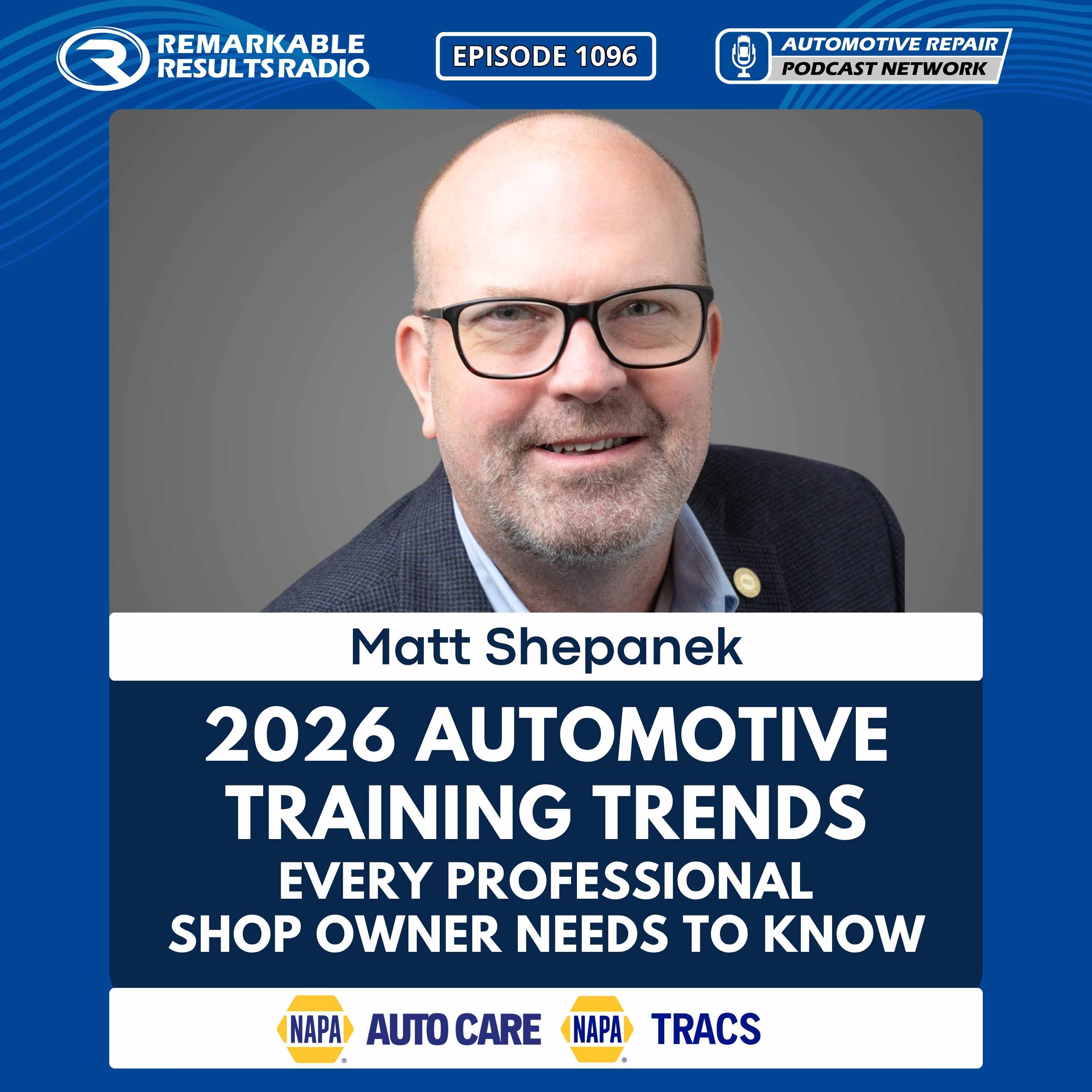
2026 Automotive Training Trends Every Professional Shop Owner Needs to Know [RR 1096]
About this episode
The hosts break down the 2026 ASE benchmark survey and the ATMC’s annual training benchmark, then translate the results into practical shop decisions. They discuss who’s responding (mostly OE dealers), why training access can be limited (often the right topics aren’t available), and how training funding differs between dealers and independents. The conversation also highlights what technicians want—hands-on learning—and the growing importance of electrical and hybrid/EV systems as vehicles become more software-driven.
How are automotive technicians learning today, and who is investing in their future?
Matt Shepanek, President of the ASE Training Managers Council (ATMC), discusses the findings of the 2026 ATMC Benchmark Survey. The survey offers valuable insight into technician education, training preferences, emerging technologies, and the industry's commitment to continuous learning.
The conversation highlights significant differences between dealerships and independent repair shops, reveals what technicians most want to learn, and reinforces why ongoing professional development remains essential in an era of rapidly advancing vehicle technology.
What You'll Learn- How dealerships continue to lead the way in training investment, paying for technician education 85% of the time, while many independent technicians still share the cost or pay out of pocket.
- Why Hybrid/EV systems and Electrical/Electronics training top the list of requested subjects as vehicle technology continues to evolve.
- What the survey reveals about technician learning preferences and why hands-on, instructor-led training remains the gold standard despite the growth of online education.
- The wide gap in annual training hours, from technicians receiving no structured education to others completing more than 56 hours each year.
- Why continuous learning has become a business necessity, not an option, for shops hoping to remain competitive and profitable.
The 2026 ATMC Benchmark Survey reinforces a simple truth: the future belongs to technicians and shops that embrace lifelong learning. As vehicles become increasingly dependent on advanced electrical systems, software, hybrid technology, and diagnostics, professional development is no longer a luxury. Shops that invest in training, provide access to relevant education, and foster a culture of continuous improvement will be better positioned to attract talent, improve performance, and thrive in a rapidly changing automotive landscape. Download the 2026 ATMC Benchmark Survey: https://bit.ly/4aOaigM Matt Shepanek, President, ASE Training Managers Council (ATMC) Learn more about NAPA Auto Care and the benefits of being part of the NAPA family by visiting https://www.napaonline.com/en/auto-care
NAPA TRACS will move your shop into the SMS fast lane with onsite training and six days a week of support and local representation. Find NAPA TRACS on the Web at http://napatracs.com/
Connect with the Podcast:
- Visit the Website:https://remarkableresults.biz/
- Subscribe on YouTube:https://www.youtube.com/carmcapriotto
- Follow on Facebook:https://www.facebook.com/RemarkableResultsRadioPodcast/
- Follow on LinkedIn:https://www.linkedin.com/in/carmcapriotto/
- Follow on Instagram:https://www.instagram.com/remarkableresultsradiopodcast/
- Join Our Virtual Toastmasters Club:https://remarkableresults.biz/toastmasters
- Join Our Private Facebook Community:https://www.facebook.com/groups/1734687266778976
- Join our Insider List:https://remarkableresults.biz/insider
- All books mentioned on our podcasts:https://remarkableresults.biz/books
- Our Classroom page for personal or team learning:https://remarkableresults.biz/classroom
- Special episode collections:https://remarkableresults.biz/collections
- Buy Me a Coffee:https://www.buymeacoffee.com/carm
The Automotive Repair Podcast Network: https://automotiverepairpodcastnetwork.com/
- Remarkable Results Radio Podcastwith Carm Capriotto:Facilitating Wisdom Through Story Telling and Open Discussion.https://remarkableresults.biz/
- Diagnosing the Aftermarket A to Z:From Diagnostics to Metallica and Mental Health, Matt Fanslow is Lifting the Hood on Life.https://mattfanslow.captivate.fm/
- Business by the Numbers: Understand the Numbers of Your Business with CPA Hunt Demarest.https://huntdemarest.captivate.fm/
- The Auto Repair Marketing Podcast: Marketing Experts Brian & Kim Walker Work with Shop Owners to Take it to the Next Level.https://autorepairmarketing.captivate.fm/
- The Weekly Blitz: Weekly Inspiration with Business Coach Chris Cotton from AutoFix - Auto Shop Coaching.https://chriscotton.captivate.fm/
- Speak Up! Effective Communication: Develop Interpersonal and Professional Communication Skills with Craig O'Neill.https://craigoneill.captivate.fm
virtual coaching and mentoring
"But then we have a question around virtual coaching and mentoring video self paced e learning. So we kind of go through, you know, all the different methods of training."
“Virtual coaching and mentoring” means getting help and guidance remotely, usually over video or online. For training, it can be used to walk someone through problems and improve skills without being in the same room.
“Virtual coaching and mentoring” is remote guidance delivered through video calls or online sessions, rather than in-person instruction. In technician training, it’s often used to reinforce procedures, review diagnostics, and support skill development when hands-on time is limited.
self paced e learning
"But then we have a question around virtual coaching and mentoring video self paced e learning. So we kind of go through, you know, all the different methods of training."
“Self paced e learning” means online training you can do whenever you have time. It’s usually better for learning concepts, while hands-on practice happens in the shop.
“Self paced e learning” is online training content that learners complete on their own schedule, rather than following a live class. For shop environments, it’s commonly used for theory and fundamentals, while hands-on work is handled separately.
hybrid
"And so this is, you know, asking them, what type of training content are you looking for? And so you can kind of see right here, we've got, you know, the top two hybrid and EV systems and then electrical electronics."
Here, “hybrid” is about the kind of car technology people want training on. It points to learning how hybrid power systems work and how to fix problems in them.
In this context, “hybrid” is used as part of “hybrid and EV systems,” referring to training content demand rather than a specific course format. It highlights that technicians want education focused on hybrid powertrains and their related diagnostics.
EV systems
"And so you can kind of see right here, we've got, you know, the top two hybrid and EV systems and then electrical electronics. And I can't say I'm really surprised by either of those."
“EV systems” means the key parts that make an electric car run. That includes the battery and the electric motor/control electronics. Shop training on this is about understanding how those parts work and how to troubleshoot problems.
“EV systems” refers to the major subsystems in an electric vehicle, such as the battery pack, electric drive motor(s), power electronics/inverter, and charging interface. In a shop-training context, it usually means learning how these components work and how to diagnose faults safely.
electrical electronics
"And so you can kind of see right here, we've got, you know, the top two hybrid and EV systems and then electrical electronics. And I can't say I'm really surprised by either of those."
“Electrical electronics” means the car’s electronic systems—wiring, sensors, and computer modules. Since modern cars depend on electronics for lots of functions, technicians need training to diagnose electrical problems.
“Electrical electronics” in automotive training usually points to the vehicle’s wiring, sensors, modules, and control systems, plus how they communicate. Modern cars rely heavily on electronics for everything from engine management to driver-assistance features, so diagnosis often involves scan tools and electrical testing.
software
"My next question is, okay, it's software. But there's got to be devices that get hooked to that software that make some of these things happen. And we have got to pay attention to that."
They’re talking about the car’s computer programs. Those programs control what the car does, so technicians need to understand how the software connects to the parts that make things happen.
In modern cars, software is the code running the vehicle’s control systems (often across multiple modules). The speaker emphasizes that software isn’t standalone—it drives real-world actions through connected devices and sensors, which is why shops must understand both the software and the hardware it controls.
structured training
"We asked them, how many hours of structured training do you get in a year? There's some things that are kind of interesting here."
They mean organized training—like scheduled classes or a real program—rather than just learning on the fly. The point is to measure how much training people actually get each year.
“Structured training” refers to planned, organized learning (like scheduled courses or defined programs) rather than informal or ad-hoc learning. The speaker uses it to discuss how many hours technicians get per year, framing training as measurable and trackable.
lifelong learner
"I always felt like as a technician, you got to be a lifelong learner because the systems are changing so quickly and you have to stay on top of it."
They’re saying good techs keep learning throughout their career. Since cars keep changing, you can’t rely on what you learned once—you have to stay up to date.
“Lifelong learner” is the idea that technicians must continuously update their skills because vehicle systems change quickly. The speaker ties it to the pace of new technology in modern cars, arguing that staying current is part of the job rather than a one-time effort.
Request an Explanation
Heard something you'd like explained? We'll add it to this episode.
Sign in to request explanations for terms you heard.
Want to learn more?
Browse our glossary for plain-English explanations of automotive terms, jargon, and concepts.
Help improve this episode
See something that's not quite right? Our annotations are AI-generated and can sometimes miss the mark. Click the flag icon on any annotation to suggest a correction.