“Virtual coaching and mentoring” means getting help and guidance remotely, usually over video or online. For training, it can be used to walk someone through problems and improve skills without being in the same room.
“Self paced e learning” means online training you can do whenever you have time. It’s usually better for learning concepts, while hands-on practice happens in the shop.
Here, “hybrid” is about the kind of car technology people want training on. It points to learning how hybrid power systems work and how to fix problems in them.
“EV systems” means the key parts that make an electric car run. That includes the battery and the electric motor/control electronics. Shop training on this is about understanding how those parts work and how to troubleshoot problems.
“Electrical electronics” means the car’s electronic systems—wiring, sensors, and computer modules. Since modern cars depend on electronics for lots of functions, technicians need training to diagnose electrical problems.
They’re talking about the car’s computer programs. Those programs control what the car does, so technicians need to understand how the software connects to the parts that make things happen.
They mean organized training—like scheduled classes or a real program—rather than just learning on the fly. The point is to measure how much training people actually get each year.
They’re saying good techs keep learning throughout their career. Since cars keep changing, you can’t rely on what you learned once—you have to stay up to date.
We are going to do something very interesting here today.
We're going to cover an ASE survey, the 2026 benchmark survey from the Training Managers
Council, and yeah, very important part of ASE.
We're going to introduce you to the ASE Training Manager Council President here in just a moment.
Hey, when customers choose a NAPPA Auto Care Center, they get more than a repair.
They get trust, savings, and peace of mind.
Want your shop to stand out?
Connect with your local NAPPA representative and get the conversation started to become
a NAPPA Auto Care Center.
Hey, let's face it, your shop management system is the most critical tool in your shop.
And NAPPA Tracks will move your shop into the SMS Fastlane with on-site training, six
days a week support, and local representation.
Find NAPPA Tracks on the web at NAPATRACS.com.
Hey if you've not gotten our app, please do me a favor.
We have a brand new URL for you, arpn.apb, all in one place, some really cool stuff all
about our app.
For your smart phones, save your favorite, share cool episodes with your friends.
We sure really appreciate all of you that have downloaded the app and are having fun
with it and educating yourself.
Look at, I've got, as I said, the President of the ASE Training Manager's Council and
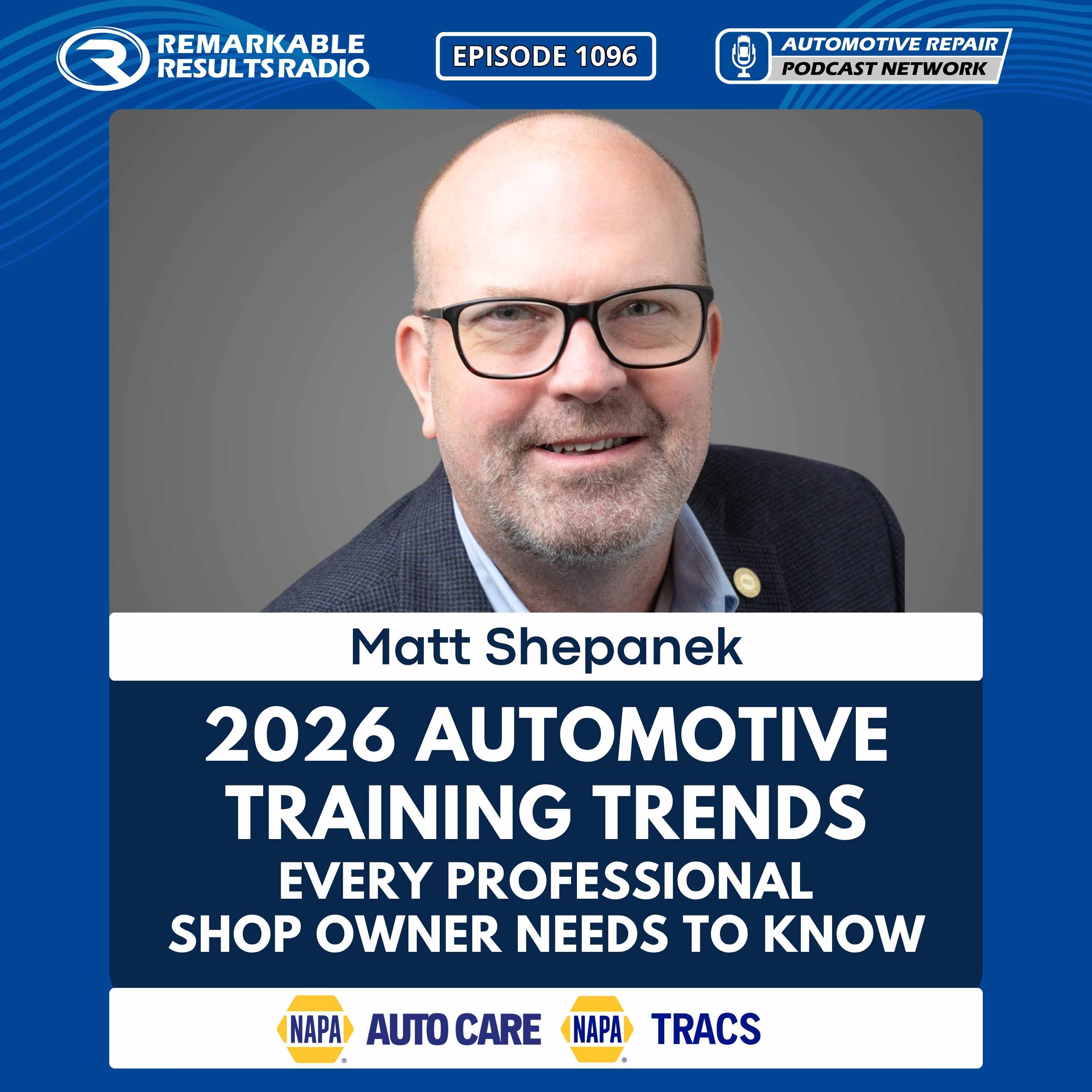
the VP of Credential Testing Programs, Matt Shepanek, good to have you here.
The ASE Training Manager's Council, an important thing I remember attending some of the sessions
you guys have at APEX a few years back.
It's so cool to see all the trainers involved in moving our industry forward and you do
a survey every year.
We do.
Before I jump into that though, can I just talk a little bit about the ATMC?
The ATMC started back in 1984, so it's been around for over 40 years and it was really
started to promote the advancement of training and professional development in the automotive
industry.
Actually, I became a member probably back in 2005 or so.
I was a new training manager at an OE.
My boss at the time had asked me to go down the street.
I was in Michigan at the time.
At the time, it was Daimler Chrysler to their training center and I walked into this room.
I didn't know a single person in there, but by the end of the day, I had 30 new best friends
that were all training managers from different OEs across the industry.
It was super helpful to me because they would share information.
If I had an issue with something, I could pick up the phone, I could call one of these
guys.
It was a fantastic organization.
I feel honored to be leading this organization right now.
But as you mentioned, one of the things that we do provide for our members and actually
just to the industry because we don't charge for this, our benchmark survey that we're
going to go over today, it's all available on our website.
At the end of this, we can talk a little bit about where you can find that as well.
That would be great.
We have the survey up on the screen.
Let us bring it up and show you.
I have it and I printed went through it and I took notes.
I was kind of mesmerized, Matt, by some of the results.
What I would like to say to our independent, because the majority of my listening audience
is the independence, please pay attention to this.
We talk about training and education all the time and I think there's some results of how
well we're doing in the industry to solve education learning curve problems, knowledge
transfer.
Thank you for coming on and doing this.
We cannot go through every slide.
What Matt is going to do is take some featured highlight slides and go over them with you.
Let's start, my friend.
Yeah.
As Carm said, we don't have time to go through every slide, but you'll be able to download
this from the website.
I'm just going to go through some key highlights here.
The first one I wanted to show everybody is we track participation by every year of the
survey.
This one's interesting because you look and you can see back in 2020, 2021, the participation
went way up.
If you remember, this was during the pandemic.
I always figured, well, there was a lot of people sitting around stuck at the house or
whatever and people were taking surveys.
You could see once that ended, survey participation went down quite a bit.
Then 24 and 25, we pretty much flattened out at right about 1700.
The good news is this year, we picked up about a thousand people, so a lot better participation.
Typically, as long as we're getting right around 2000, the survey information is pretty
statistically sound, so we're going in the right direction and we just got to continue
to get the word out there so that we get more people to participate.
Thank you for that.
Let us as an industry pay attention to when the survey comes out and you're seeing stuff
on social media, please share this stuff and get involved in it.
If you're listening in audio, I think this is going to have value.
If you're watching on our YouTube channel, you're going to have 10 times the value because
you're actually going to see the actual survey results here in front of us.
Okay.
One of the first questions that we ask is what best describes your job in the industry?
As you can see, majority of the folks taking the test were automotive repair technicians,
but we do have some instructors, we have collision repair technicians, service advisors,
shop managers, but the bulk of the respondents are automotive technicians, which is great.
I did want to put this up here too to explain what I do with the data that we get is we
make it available to everybody, but for my slides, I filter it by just the technician
responses so that we can just see what the texts are saying about this stuff,
but we do capture the other data as well.
Next slide is really important to me that 87% of the respondents were from OEDealers
and only 11% came from aftermarket and independent.
From an independence perspective, this is so interesting to be able to see what the automotive
technician, the specialists and the OEDealers are doing and saying as we get into the survey
a little deeper, but my challenge to the industry is let's get in this survey as independence.
Let's do that. I'm sure if we go back to when you had 6800 from COVID era,
there was a lot more independence that played in this.
Oh yeah, I'll take a little bit of the heat on this one though too because we pass out the link
to some of the OE partners and the aftermarket partners. We were probably a little bit late
this year getting it to everybody, so we might have just got more OE participation this year
because the links went out on that side, but any help that we could get would be appreciated.
We do post this on the ASC Facebook page and also on our LinkedIn, so as long as you're subscribed
to those, you'll see them. And my point to the independent is that a lot of the results are
skewed toward the OEDealership and I think that helps you see what's going on over there.
Right. We ask everybody how many years in the industry, and this is 2025 and 2026,
you can see that here at the top, people with 30 or more years, there was about a 6% drop
this year, so people are retiring, they're aging out of the industry, so they're moving on.
But you can kind of see year over year, most of the indicators are kind of flat,
but this kind of gives you an idea of the age groups of the folks taking the survey.
Carmen, I were talking before the broadcast here and we thought this would be a good one to cover,
so who pays for training? And we asked this question and then we filter it out by fleet
respondents, by aftermarket and independent respondents, and then OE. And then the green
indicators are shared costs, so that's the technician and the shop owner or dealer paying
for it. The employee is in red on all three of these, and then the employer is in blue.
Hey, think about your customer's journey. How did they find you, trust you, and continue to come
back? With the Napa AutoCare program, you can deliver that positive experience every step of the
way. It starts with visibility. Customers can find your shop through the Napa online locator at no
cost to you. And thanks to fully integrated national marketing campaigns, Napa AutoCare
shops are showcased as part of America's largest network of parts and care. Whether they're driving
by to see your co-branded Napa AutoCare sign or they hear about you through national advertising,
the Napa name, trusted by over 95% of the motoring public, builds instant confidence.
Inside your shop, that trust grows using digital vehicle inspection and Napa Service Assistant,
you can clearly show customers what's wrong with their vehicle through pictures and videos.
SmartSign creates an engaging waiting experience, while exclusive consumer offers help save them
on services. And when your shop becomes gold certified, customers know they'll receive a
consistent top level experience every time. Customers also gain peace of mind knowing your
technicians are ASC certified, trained by Napa Autotech, and backed by the Napa AutoCare nationwide
peace of mind warranty. For an unexpected repair expense, the Napa credit card helps them get back
on the road. And when the repair is complete, their satisfaction is captured through the Napa
CSI survey, turning great service into long term loyalty. Hey, you want to create this customer
journey only one way connect with your local Napa representative and get started. Hey, when
customers choose a Napa AutoCare center, they get more than a repair, they get trust savings and
peace of mind. Once your shop to stand out, connect with your local Napa representative
and get the conversation started to become a Napa AutoCare center. Hey, let's face it,
your shop management system is the single most important tool in your shop, period. Napa Tracks
has made selecting the right shop management system easy by offering the industry's best,
most comprehensive SMS. Now it all starts when a local representative meets with you to learn
about your business and how you need to run it. After all, it's your shop, so it's your choice.
And having local representation is a huge plus. Customizing tracks to your business,
whether you're a one person shop or a large multi-bay or multi-location company,
a representative consults with you to help optimize your shop's workflow, efficiency and
profitability. Tracks always has the flexibility to do business how you need to do it, which means
it can also grow as your business grows. And unlike the other guys will be there for you after
installation with the best training and support in the business. Yes, a learning management system
tailored to each role in your company. Simply put, tracks was designed and built for shop owners
just like you. Visit us on the web at Napa Tracks. That's N-A-P-A-T-R-A-C-S dot com.
Thank you for the independence, 56% or more are paying for training. That's a good thing.
And we got to get that up. We really do. If you look at your, and again, I'm not saying that the
dealers are competitor, but in this space of automotive repair, the dealers are paying at
85% of the time. It just seems logical to me. You can't argue with that number. That's what
they're there for. They want to keep their people as current as possible. But I think we as
independents need to do a better job. And technicians want the training. For the most part,
they want to go to training. It's a thing that helps with retention as well, by giving them
access to the training and not making them pay for it out of their pocket. I think that's the
thing that can really help with that. Great question. So we asked a question,
do you have access to the training you need? And we've been tracking this over the last
four or five years. As you can see, it's been pretty flat between 2022 and 2025. It's always been
about 60% saying, yeah, they have access to it and about 40% saying no. But this year, we saw
a jump up of about 10% with people saying they have good access to the training that they're
trying to get. So I thought this was one that was important to point out.
Showing we're going in the right direction as an industry.
Right. We asked some question on top reasons for lack of access to training. And the number one
thing with about 53% of them saying the right topics are not available. We have a slide here
and a couple that we'll cover and it actually asks them what topics they're looking for.
That's a wow to me. When I looked at this thing, I wrote wow next to the 53%. The right topics are
not available. And I think we have to stop and ask ourselves a question. Well, where are we coming
up with the topics? Why are the topics being offered? And I guess when we put one out for
anyone, we have to ask ourselves a question, is this a right topic for our industry at this
current time? So I think it's a great question and a great result here that I think we need to think
through. Okay. This is always an interesting one. So we ask a question on training methods.
So what types of training are they getting? And so you can see we break it up by a classroom
instructor led lab hands on these kind of overlap because you know, a lot of instructor led training
is a little bit in the classroom and a little bit in the shop. But then we have a question around
virtual coaching and mentoring video self paced e learning. So we kind of go through, you know,
all the different methods of training. And then on the next slide, we look at what they're getting
versus what they want. This slide's a little cut off, you know, when the comparison, the overlap.
But what we saw is the instructor led, they want even more. That's really what they're looking for.
And I think that, you know, having been in training and development for a good portion of my career
and being a former technician, you know, technicians are tactile learners. So they learn by doing and
touching and, you know, getting their hands on things. And that continues to be something that
they want to get, you know, we made a big shift during the pandemic. Everything went virtual,
you know, for a number, you know, a year or a year and a half. The feedback back then wasn't great.
They liked that they had access to some training. What they really want is they love the hands on
training that a lot of folks offer. It's a great slide. A lot of great stuff there that classroom
instructor led and hands on are a big want from the industry. This one kind of ties back into what
we talked about a couple slides ago. I think that one was the top reasons for not participating in
training. And they were saying, oh, the great topics aren't, aren't available. So this question
kind of ties into that. So this is, you know, asking them, what type of training content are
you looking for? And so you can kind of see right here, we've got, you know, the top two hybrid
and EV systems and then electrical electronics. And I can't say I'm really surprised by either of
those. You know, electrical is always something that's way up there. And then the hybrid and EV
thing, you know, EVs are still very popular and they're going to continue to be popular. But,
you know, there was a shift, you know, back here this last year or two, a lot of manufacturers
going back into hybrids, there's probably some people out there feeling like they've got some work
to do and a little bit of learning ahead of them. Hybrids have been around for, I think, 20 years.
Somewhere in that zone. And if we need more training in that, then the realization that
owners haven't been paying enough attention to this, or they're missing out on a huge opportunity,
huge, huge opportunity. So electrical, that was a really shocking slide for me to see.
And hopefully it's an eye-opener or a wake-up call.
You know how complicated all the cars are getting and the electrical electronics,
that they're in everything, they're in every system. So, you know,
you got to stay on top of this stuff for sure.
It's scary to hear what they have planned that these vehicles are going to do. My next question is,
okay, it's software. But there's got to be devices that get hooked to that software that
make some of these things happen. And we have got to pay attention to that.
I hear you. This one is what we kind of always end on. We asked them, how many hours of structured
training do you get in a year? There's some things that are kind of interesting here. You know,
when you look, you get a 7% of the respondents saying they don't get any. I just look at that,
and I'm like, how do you stay up on all these technology that's coming without going to anything?
I always felt like as a technician, you got to be a lifelong learner because the systems are
changing so quickly and you have to stay on top of it. And then you see like the 1 to 8 bracket,
you know, you got 15% of the people saying that's what they get. And then it's kind of,
you know, 9 to 16, we got 13, you know, 13 again, 17 to 24. And then it really spikes at the other
end where we got 18% of the folks saying that they get more than 56 hours. So kind of a,
you know, interesting slide to see it. You kind of got both ends of the scale there.
I would love to do follow up questions on these. It's too bad this wasn't a human to human thing
and say, so this none thing, can you explain to me why? Is it your choice? owner's
choice? What's the reason that you get none? And that to me is the hit upside the head. But
more than 56, 18% the highest number. God bless you to your point about being a perpetual student.
There are people that they just want to learn as something new every day and they'll invest the
time to do it. So as we mentioned before, all this information is available. You can download
the entire deck and kind of go through the whole thing that is available on our ATMC website,
which is www.atmc.org. And if you go, I think up at the top, you go to events and you'll see
2026, you'll see our conference. We have all the presentations from the conference there,
including this training benchmark survey. So I really encourage everybody to go take a look at
it. And, you know, next year, when the survey comes out, usually we post it in January and we
close it out in March. And then we present the results usually in April at our conference. So
we'd love to get those participation numbers up. And to your point, please get there, download
this. If you want to make sure that your company and your people are current, use the information
from this survey to help guide some of your training educational strategies. We cannot get
through and be successful. We can have all the great marketing in the world. We can have all
the great equipment in the world, but we don't know how to do any of it. We don't have to do
anything with those great tools. We're going to struggle. We're never going to meet
required times in order to be a profitable company. So I see this survey as being so valuable. And I
also see the investment of our specialists slash technicians in the industry to invest in time to
take this survey. Tell the world what's going on in your life as it relates to this. Matt,
thank you so much. The ASC Training Manager Council President and VP of Credential Testing
Programs. That's got to keep you busy too. Oh, we got a lot of stuff going on at ASC these days.
Yeah, I know you do. Is Dave driving all this? He keeps us on our toes. That's for sure. I love
it. I love it. Well, thank you so much for coming on. Yes, we highlighted this. I get it. And it's
like a 40 or 50 page report downloaded as Matt said, you know what we'll do? We'll make sure we
put a link to ATMC in the show notes so people can just kind of hit it with their finger and
see it. Matt Shepanek, thank you for all that you do for ASC in the industry, sir. Thanks for being
here. I appreciate it. Thanks, Carm. Thanks for being on board to listen and learn from the Premier
Automotive Repair Business Podcast, Remarkable Results Radio. Get your episodic education on the
ARPN listening app at automotiverepairpodcastnetwork.com. Also, enjoy the podcast on our Carm Capriato
YouTube channel. Carm is all for advancing the professional automotive service industry. Until
next time.
About this episode
The hosts break down the 2026 ASE benchmark survey and the ATMC’s annual training benchmark, then translate the results into practical shop decisions. They discuss who’s responding (mostly OE dealers), why training access can be limited (often the right topics aren’t available), and how training funding differs between dealers and independents. The conversation also highlights what technicians want—hands-on learning—and the growing importance of electrical and hybrid/EV systems as vehicles become more software-driven.
How are automotive technicians learning today, and who is investing in their future?
Matt Shepanek, President of the ASE Training Managers Council (ATMC), discusses the findings of the 2026 ATMC Benchmark Survey. The survey offers valuable insight into technician education, training preferences, emerging technologies, and the industry's commitment to continuous learning.
The conversation highlights significant differences between dealerships and independent repair shops, reveals what technicians most want to learn, and reinforces why ongoing professional development remains essential in an era of rapidly advancing vehicle technology.
What You'll Learn
How dealerships continue to lead the way in training investment, paying for technician education 85% of the time, while many independent technicians still share the cost or pay out of pocket.
Why Hybrid/EV systems and Electrical/Electronics training top the list of requested subjects as vehicle technology continues to evolve.
What the survey reveals about technician learning preferences and why hands-on, instructor-led training remains the gold standard despite the growth of online education.
The wide gap in annual training hours, from technicians receiving no structured education to others completing more than 56 hours each year.
Why continuous learning has become a business necessity, not an option, for shops hoping to remain competitive and profitable.
The 2026 ATMC Benchmark Survey reinforces a simple truth: the future belongs to technicians and shops that embrace lifelong learning. As vehicles become increasingly dependent on advanced electrical systems, software, hybrid technology, and diagnostics, professional development is no longer a luxury. Shops that invest in training, provide access to relevant education, and foster a culture of continuous improvement will be better positioned to attract talent, improve performance, and thrive in a rapidly changing automotive landscape.
Download the 2026 ATMC Benchmark Survey: https://bit.ly/4aOaigM
Matt Shepanek, President, ASE Training Managers Council (ATMC)
Learn more about NAPA Auto Care and the benefits of being part of the NAPA family by visiting https://www.napaonline.com/en/auto-care
NAPA TRACS will move your shop into the SMS fast lane with onsite training and six days a week of support and local representation. Find NAPA TRACS on the Web at http://napatracs.com/