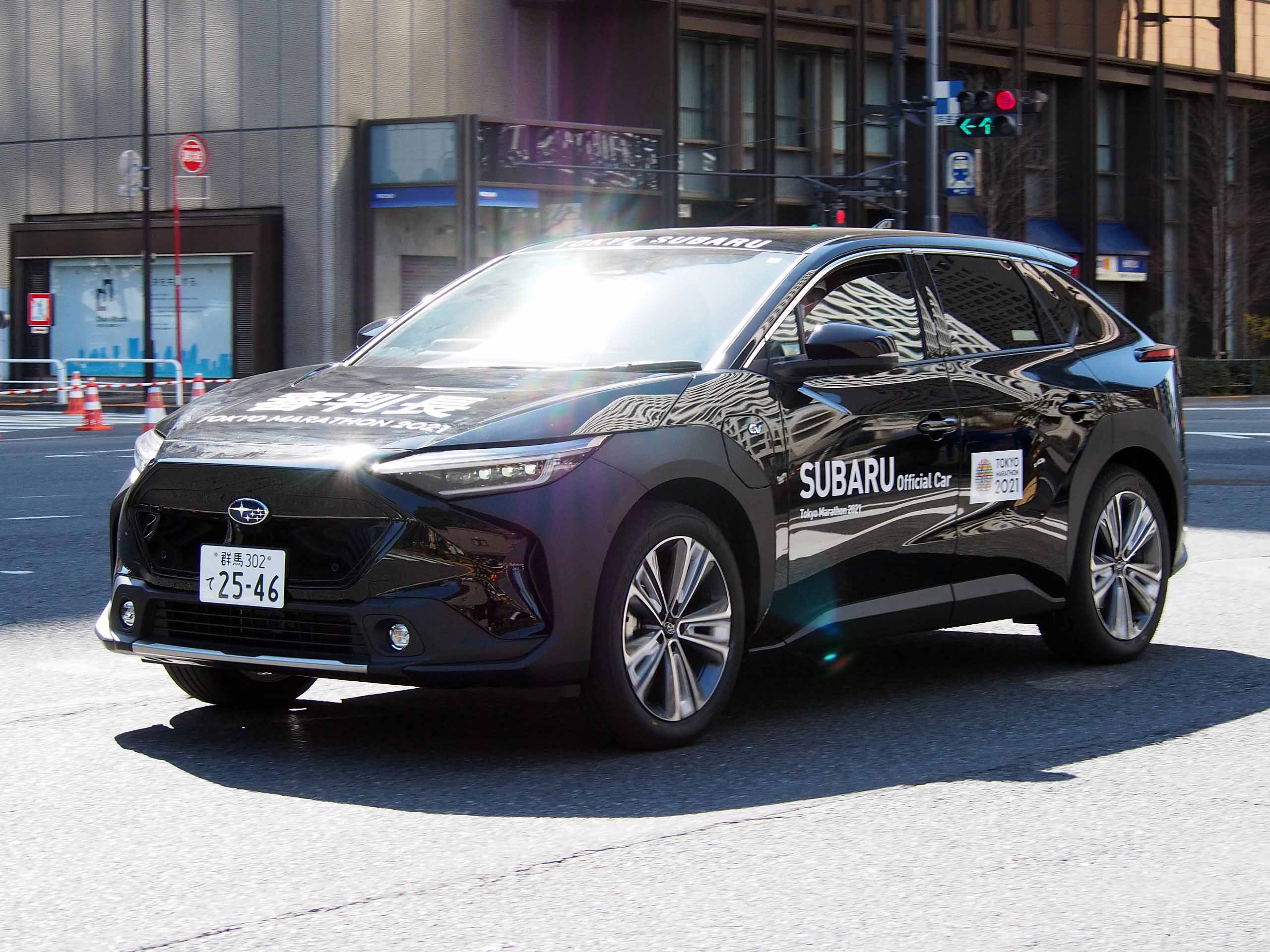
The Subaru Solterra is an electric SUV, which means it uses a battery instead of gasoline. The podcast notes it’s Subaru’s first all-electric model and that they drove it for a week. That kind of test helps show how it works day to day.
The Ford F-150 is a very popular pickup truck that Ford sells in massive numbers. Here, the hosts say a shortage of aluminum could limit which versions of the F-150 are available.
An aluminum body means parts of the car are made from aluminum instead of steel. Aluminum can help the vehicle weigh less, but if aluminum is hard to get, production can slow down.
A supply chain is how parts and materials get from suppliers to the factory. If one key supplier has a problem, the factory can’t get what it needs, and vehicle availability can suffer.
Sheet aluminum is aluminum made in big flat sheets. Car factories use those sheets to stamp out body parts, so if there isn’t enough sheet aluminum available, fewer trucks can be built.
Lightweighting means making the vehicle lighter. Using lighter materials like aluminum can help, but it also means the car depends more on those materials being available.
A recall means the car maker says, “We found a problem and you should get it fixed.” Here, the problem is with the rear-view camera, so it can show the wrong picture—or not show anything—making it harder to see behind you.
A recall notice is a message from the car maker telling you that your car needs a fix. It’s not just a suggestion—it's the official warning that something could be unsafe.
“Lemon law” is a consumer law that helps you if a car keeps having the same problem and the maker can’t fix it. The speaker is saying their camera issue was part of why they were able to get the car handled under that kind of process.
The Volkswagen Golf R is a sporty version of the Golf. In the story here, the speaker says the rear camera kept flashing, and that problem played a role in getting the car handled through a legal process.
Rear visibility is how clearly a driver can see behind the vehicle while reversing or maneuvering. If the backup camera goes blank, it can drastically reduce the driver’s ability to judge distance and obstacles, which can raise the risk of a crash.
Crash risk means the chance of getting into an accident. If you can’t see behind you because the camera fails, it’s easier to miss something and hit it.
This is a safety test for the car’s “helping” features, like automatic braking and lane guidance. It checks whether those features actually work well when it matters.
The Tesla Model Y is the first car to do well on a new government safety test for driver-assist features. It suggests the car’s safety systems are being judged more strictly than before.
This means the way cars are rated for safety is being updated. The new focus is more about active safety features that help prevent crashes, not only what happens after a crash.
This is a safety testing group that evaluates cars and gives them ratings. They’re starting to require certain driver-assist safety features for their top awards.
Automatic emergency braking is when the car senses a crash might happen and brakes by itself. It’s meant to help avoid the collision or reduce how hard it is.
Blind spot intervention is when the car detects something you can’t see and helps stop you from making a dangerous lane change. It’s more than a warning—it can help take action.
Radar sensors use signals to “see” how far away something is and how fast it’s moving. Cars use them to help with safety features like warnings and distance control.
Ultrasonic technology uses high-frequency sound waves to measure nearby distances, often at low speeds. It’s commonly used for parking assistance and close-range obstacle detection.
The Mazda MX-5 (Miata) is a small two-seat sports car focused on being light and easy to drive. Because it’s not heavy, it can feel very quick to respond when you steer. That’s why people compare it to a go-kart for the driving feel.
Mercedes-Benz is a luxury car brand. They bring it up to compare how different brands charge for safety features—sometimes making them optional instead of standard.
Lane Departure Warning is a safety feature that watches your lane position. If you start drifting without signaling, it alerts you so you can correct it.
The TX/TZ mentioned in the podcast is described as a three-row electric SUV. That means it’s designed to carry more passengers and it runs on electricity. The discussion also ties it to safety equipment, so it’s being highlighted for how it’s built to protect occupants.
This is the guess of how far an electric car can go on one full battery charge. Your actual distance can be more or less depending on how you drive and the weather.
The Toyota Grand Highlander is a larger version of the Highlander. The host is saying you can still buy it, even while Toyota adds an electric version of the regular Highlander.
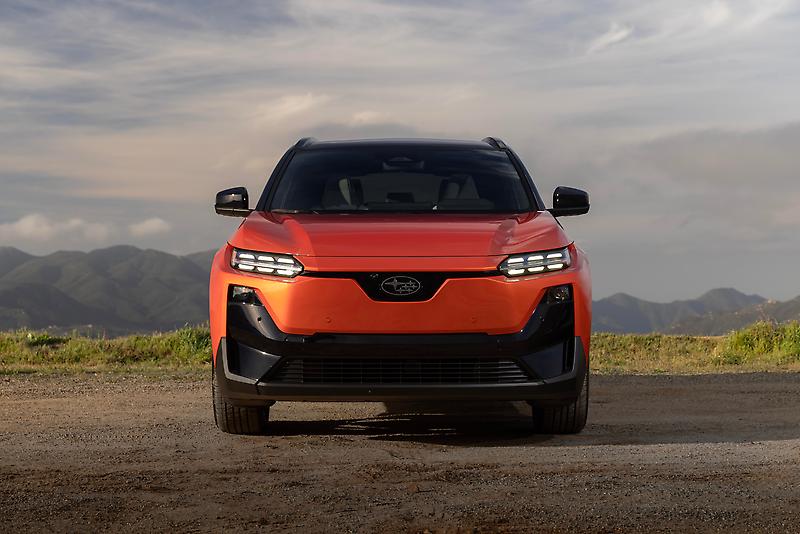
The Subaru Uncharted is a Subaru model name mentioned in the podcast. The host says Subaru has more than one new model now, and the Uncharted is one of them. It’s discussed as part of Subaru’s lineup changes.
Car
2026 Subaru Saltera Limited
This is the 2026 Subaru Saltera Limited, an electric SUV. The hosts are talking about the specific trim level and what you get for the money, including the battery and motor setup.
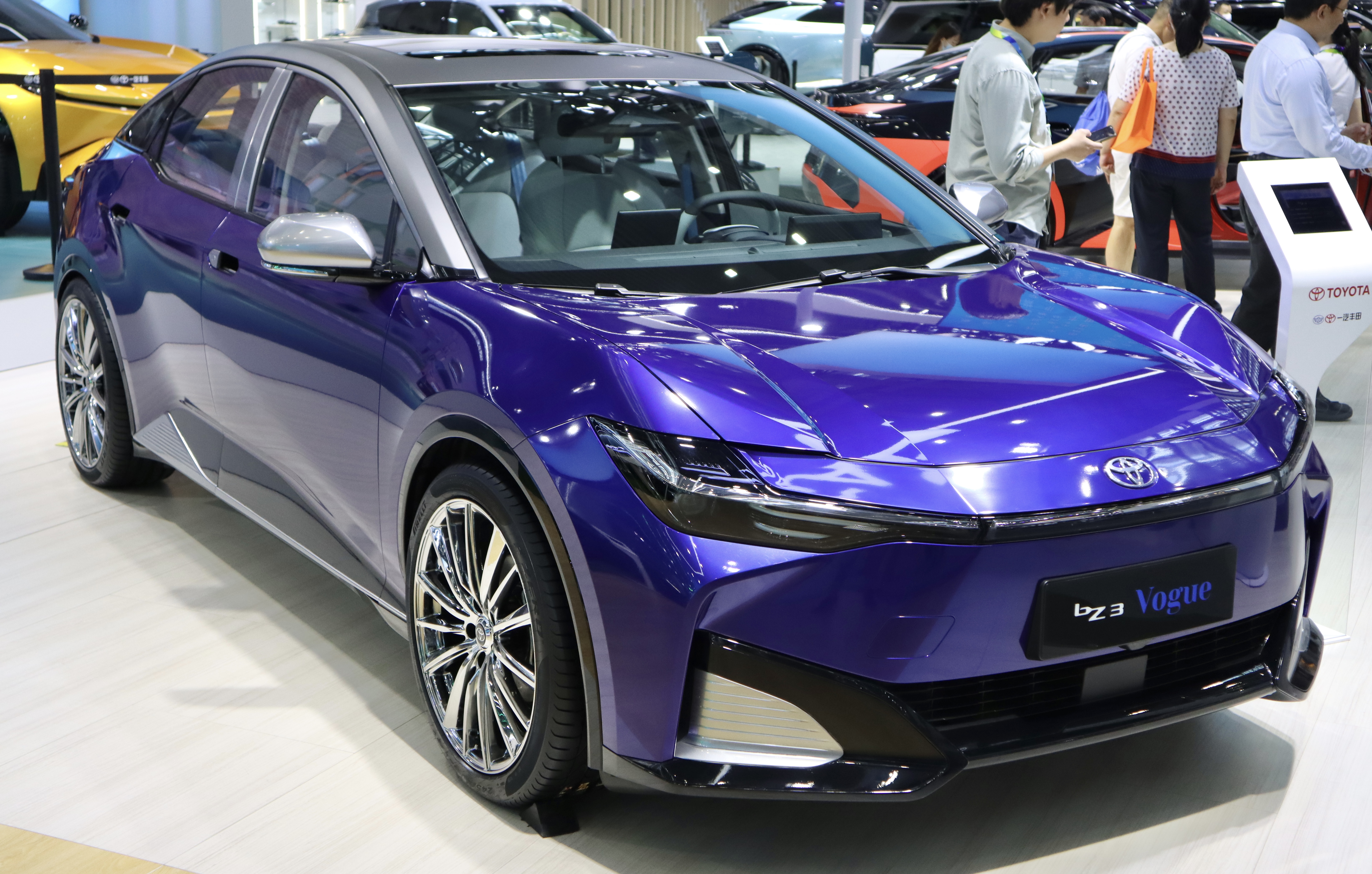
They mention the Toyota BZ because it’s basically the same underlying EV design as the Subaru. That helps explain why the cars feel similar in how they drive and what tech they share.
They bring up the Lexus RZ because it’s related to the Subaru’s EV design. That usually means the cars share important components and engineering choices.
“Dual motor all-wheel drive” means the car has two electric motors and can send power to all four wheels. That usually helps with grip and makes the car feel more responsive, especially on slippery roads.
A kilowatt-hour (kWh) is how much energy the battery holds. More kWh generally means the car can go farther, which is why they pair it with the range number.
Torque is the force that helps the car pull away and accelerate. EVs usually have strong torque right from low speeds, so it can feel quick even in normal driving.
All-season tires are made to handle a mix of weather, but they’re not as grippy as more off-road-focused tires. The host thinks the tire choice affected how much the ride felt on gravel.
All-terrain tires are tougher and usually grip better on rough surfaces than regular road tires. The host is saying some trims can come with them, which could make gravel driving feel better.
Horsepower is a way to describe how much power the vehicle can produce. The host is saying 233 horsepower is enough for normal driving—no need to race at stoplights.
The Subaru Solterra is an electric SUV. The host brings it up to say that this kind of power is meant for normal driving, not racing from red light to red light.
A heated steering wheel uses built-in heating elements to warm the wheel for comfort in cold weather. The host lists it among the GV80’s cabin features, alongside heated seats.
The gear shifter is how you choose what the car does—like Park or Drive. The host doesn’t like this one because it works like a dial you press and turn to pick the gear.
In cars, ergonomics means how comfortable and easy the controls are to use. They’re saying the buttons and screens are placed so you can reach them and see them easily.
A digital gauge cluster is the screen behind the steering wheel that shows your speed and other info. They’re saying it’s been set up so you can see it clearly from where you sit.
An infotainment system is the car’s main screen and controls for things like music, maps, and settings. They’re praising how bright and responsive the screen is in this setup.
Processing power is how fast the car’s screen computer can handle the software. More processing power usually means the menus and features feel quicker and less laggy.
The Genesis GV80 is a luxury SUV from Genesis. The point here is that it’s meant to feel more straightforward to use than some German luxury SUVs, while still looking really stylish.
Concept
German SUVs
“German SUVs” is a general way of talking about luxury SUVs from German brands. The hosts are saying those cars often have lots of features and menus, which can make them feel more complicated than some alternatives.
Genesis is a luxury brand from Hyundai. The podcast mentions the GV80, which is a premium SUV designed to look and feel more upscale than regular SUVs. It’s discussed because it’s the kind of vehicle that draws attention.
Third-row availability refers to whether the vehicle is offered with an additional seating row behind the second row. In SUVs, that usually trades off some cargo space and can affect how comfortable the third row is for adults.
Rear-wheel-drive means the back wheels do most of the work to move the car. It can feel a bit more “classic” to drive, and how well it grips depends a lot on the tires and weather.
Prestige Black is a special version of the GV80 with a particular look. Think of it like a trim/appearance package that changes how the SUV is presented.
A turbocharged V6 is an engine with six cylinders plus a turbo that helps it make more power. The turbo helps the car feel quicker without needing a bigger engine.
This is an automatic transmission with eight gears. It helps the car choose the right gear for smooth driving and better acceleration without you shifting.
EPA numbers are fuel-economy estimates published by the U.S. Environmental Protection Agency based on standardized testing. They’re commonly reported as city and highway MPG, which helps shoppers compare vehicles even though real-world results can vary.
A mild hybrid is a car that has a small battery and electric motor to help the gas engine. It usually helps the car use less fuel, but it’s not like a full electric car.
Electronically controlled suspension means the car can adjust its shock/ride settings automatically. It helps the SUV feel comfortable over bumps but still stay steady at higher speeds.
Terrain mode is a button or menu setting that helps the car adapt to different road conditions. It can change how the SUV responds so it’s easier to drive on things like dirt or slippery surfaces.
Front-wheel-drive cars send power to the front wheels. The hosts mention them because more people are driving these kinds of vehicles now, which changes what trailer setups need to be like.
The Honda Passport is a bigger Honda SUV that families use for everyday driving. In this discussion, it’s an example of the type of vehicle people are using when they’re thinking about towing and trailers.
Lightweighting means making something lighter while keeping it strong and safe. Here, it matters because more people are driving smaller cars and still want to tow or camp.
Concept
trailer market
The trailer market refers to the range of trailers people buy for camping, hauling, and other uses. Here, the hosts claim most offerings are “very heavy,” and they argue there’s an opportunity to serve customers whose daily drivers are lighter and more car-like.
CUVs are crossover SUVs—vehicles that look and feel SUV-ish but are usually built like regular cars. The point here is that many people are using these lighter daily drivers instead of heavy trucks.
Premium gas is just a higher-grade gasoline than regular. Some cars are set up to run best on it, so using it can help the engine work the way the manufacturer intended.
Octane is a rating that tells you how resistant the gas is to knocking inside the engine. Higher octane helps keep the combustion smooth, especially in cars that are tuned for it.
Engine knock is when the fuel burns in an abnormal way inside the cylinders. It can be damaging, so the car tries to stop it by adjusting engine settings.
Ignition timing is when the spark happens in the engine cycle. If the car senses knock, it can delay or adjust that timing to reduce the chance of damage.
LIVE
This is America on the Road named Best Radio Show by the International Automotive Media
Conference and now in its 34th year on the air.
Thanks for being with us as we bring you the latest automotive information from around
the world.
I'm Jack Neerad with me is co-host Chris Teague and Chris I know you're a chef and
what did you end up cooking for Mother's Day?
I did homemade lamb and feta sausages on the grill.
It came out quite well despite some pouring rain.
How about you guys?
Well, we were a little less adventurous.
We had some steaks, different type steak for Sandy and then the one for me, but they came
out pretty well.
So I finally figured out how to cook those on the grill.
This is not a cooking show, however, there's plenty happening in the automotive world this
week.
Ford dealers are running short on America's best-selling pickup truck.
There was a fire at a major aluminum supplier that disrupted F-150 production, which of
course uses an aluminum body, so we'll talk about that.
Millions of vehicles on U.S. roads may be driving with faulty backup cameras.
New Carfax data shows that nearly 7 million, yes, I said 7 million vehicles have unresolved
recalls tied to their rear view camera systems.
That's an amazing number, so we'll talk about that.
Meanwhile, Tesla has reached a major safety milestone.
The 2026 Model Y is the first vehicle to pass NITSES, the National Highway Traffic Safety
but 0 to 60 time of 5.7 seconds is not bad at all.
Plenty quick enough, I think, for most luxury SUV buyers.
And it just feels strong in everyday real-world driving too.
A lot of low-end torque, I think, contributes to that.
I would say where it might fall a little short is in EPA numbers,
16 miles per gallon in the city and 22 miles per gallon on the highway.
So there are some mild hybrid competitors that outdo that,
but I can't believe that a lot of buyers in this segment care all that much about
optimizing fuel economy.
As great ride comfort at the same time, it's fun to drive.
I wouldn't say it's as edgy fun to drive as, say, an M version of one of the BMW SUVs or
something like that, but electronically controlled suspension.
So it's good over rough pavement and at the same time, good highway composure.
This is a great vehicle for making highway miles disappear.
Your thoughts on the driving of this vehicle?
I think they've done a good job.
The powertrain is excellent.
I love that engine.
It's smooth.
It's pretty quiet, but as you say, it's more than quick enough.
Yeah, it has terrain mode for those.
You can count on your thumb people who are going to take this vehicle off road.
Certainly the interior is one of the strongest attributes.
I mean, this is a gorgeous interior and this expansive infotainment system screen is kind
of blows you away too.
Without, I think, maybe this is about as big a screen as you should ever have,
but it sure looks cool and it seems to work well.
It certainly does.
Nice stuff in terms of comfort, a napa leather seating and all that.
So, you know, this is a vehicle that I obviously like a lot.
And to your point, Chris, it's hard to say an $85,000 vehicle is a bargain,
but I think in a lot of ways this is a bargain.
A lot of cargo capacity.
The tech is good.
Doesn't complicate things so much that you can't deal with it.
It has two rotary knobs on the console, so that's even more confusing,
I think, than the Solterra.
But from a lot of points of view, I just like this vehicle a lot.
Yeah, I'm a big Genesis fan.
Yeah, so plenty of good stuff in the Genesis.
I think the Solterra is the right vehicle for that Subaru buyer who wants an EV of that size.
It makes good sense to me, so good stuff all the way around.
And when we come back, we're going to have a terrific, terrific guest.
Dylan Kane is with Honda Development and Manufacturing,
talking about some really interesting stuff that he's been working on.
So, stay with us for that.
We'll be right back right here on America on the Road.
I received a letter from a reader this week and I thought I'd share it with you.
Here's what he wrote.
I just got around to reading Dance in the Dark and wanted to say how much I enjoyed it.
I'm a compulsive reader and this one was right up my alley.
An unlikely hero, a lot of twists and turns, some adult content,
and humor that rose naturally from the action.
Keep on writing and I'll keep on reading.
Of course, that's just the kind of letter any author would love to get.
I hope that others get the same enjoyment from reading Dance in the Dark
and my newest crime novel, Only One Thing Stays the Same.
Both are available exclusively at Amazon.com.
That's Dance in the Dark and Only One Thing Stays the Same,
both written by me, Jack R. Neyred.
Thanks for looking for them today.
Welcome back everybody to America on the Road, Jack Neyred back with you.
And we have a really interesting guest.
I'm really excited about this interview.
Dylan Kane is Senior Product Lead for Advanced Development at Honda Development
and Manufacturing of America.
Wow, that's a mouthful, but a very cool job.
I think I have a cool job, but I think your job is even cooler.
Tell us a little bit about what you do, Dylan.
Sure, Jack.
I'm a Senior Product Leader.
So basically what that means is I work with new product development
all the way from initial concept and idea through sketching and design,
through development, manufacturing, and then out into the market.
So basically quarterback the whole way through,
help any way I can and try to keep the gears of development moving.
And advanced development, right?
I mean, you're developing things as cool as car design is.
I think you're doing stuff way beyond car design, right?
Tell us a bit about that.
Sure, yeah.
Car design is very cool.
It's what I went to school for originally.
What we're doing in advanced development is really kind of pushing
the limits of what Honda does.
So Honda is a very broad company.
We do a lot of cool things.
And my job and the job of our team here is to kind of broaden that limit.
So we're trying to find out what does it make sense for Honda to do?
What do our customers need and want?
And how can we bring that to fruition?
I mean, you do all kinds of stuff.
I mean, we've seen Honda airplanes.
I think they're Honda hovercraft or that kind of thing.
I think there's Honda boats.
I have ridden on little Honda scooters and in one wheel kind of things back in the past.
In the deep dark past, there's probably some video of me on YouTube nearly falling off one
of those things somewhere in the bowels of Honda back in the day.
But so you have a very broad portfolio, right?
A broad canvas.
Yeah, we have a broad canvas.
We're trying to figure out what brings people joy.
That's really what our driving motive is.
So here in advanced development, so far we've been responsible for Moto Compacto,
a little scooter you mentioned that folds up into kind of a briefcase shape.
You can take it for your last mile transportation.
And now we're showing the base station prototype,
which is kind of our Honda unique camper that we revealed back in November.
And got a bunch of other things on the burners here that I can't tell you about today.
But I'm sure we'll get back together in the future.
Yeah. Well, you know, base station concept attracted our attention on America on the road
when you publicized it.
And I guess that's back in the fall.
We talked about it on the show.
Interesting stuff and walk our listeners through what that's all about.
Sure. Base station is a lightweight modular camper that we designed to kind of work best
with our Honda vehicles, but really to democratize camping for anyone.
So our goal with base station is to kind of show what this industry could be,
what we could do with the Honda know how and the design and engineering thought
we put behind our products.
It seems like an industry that's really ripe for disruption right now.
So I think it's growing in popularity.
It's been a very fun design project for us.
And really we started from what people need and what people want.
So what were the pain points?
What were the joy points in the current market with the offerings that are out there?
What were people saying and what's missing?
And we kind of designed around those requirements and engineered around those requirements
and created the prototype you guys saw.
Yeah. Well, it seems like one of the pain points is weight, right?
I mean, people have smaller cars these days.
They have a lot of front wheel drive vehicles.
They certainly have vehicles like the Honda CR-V, one of the most popular vehicles out there.
Our family just bought a Honda Passport over the weekend.
So one member of my family is deep into the Honda territory right now.
But talk about that.
Talk about lightweighting because I think that's probably an important design parameter there.
Sure. So when we're studying the trailer market, the vast majority of products
on offer are very heavy.
And what we're seeing is people are moving toward camping more with their daily drivers.
So these are what we would call CUVs, kind of the light truck segment and EVs in the future.
So we wanted to make sure that we were filling this gap where we saw the trailer industry
kind of leaving these people behind as their mode of transportation,
their main mode of transportation changed.
So we thought this is a big opportunity.
We can show what can be achieved in that lightweight segment and kind of reinvigorate
that area of the trailer space.
And so that's what we're trying to do.
So we have a unique construction.
We have a unique design that's kind of built around that main parameter of lightweight.
And so we are, like you said, going to be told by those lighter class of vehicles,
as well as the traditional class of vehicles for anyone who really wants to
kit their base station out.
So what we showed at the prototype is our modular architecture.
And that was showing windows that can be replaced with any number of accessories.
At the prototype reveal, we showed a kitchen, an air conditioner, and a privacy shower module.
So those are just the first three ideas we were showcasing.
Did you benchmark smaller trailers or was this kind of a clean sheet of paper?
We're just going to design something to be towed.
And we don't need to look at what others are doing.
I'm really curious as to how you started with this.
Sure. Yeah, I guess the answer is a little complicated, some of both.
So initially what we did was look at, like I mentioned, the pain points and the joys,
what is kind of driving people, what is kind of pushing people away.
And what was hard for us, we tried the experience ourselves multiple times.
We were trying to do a deep amount of research, quantitative and qualitative,
to figure out what works and what doesn't, what can be improved,
what's just kind of carry over from the past,
and what is an opportunity for us to innovate and do something new.
So quick answer to your question, a little bit of both.
Long answer to your question is we did a lot of homework and we figured out
what is something we can improve on and what is something that works for people.
And we kind of created the design from those parameters that we found in our research.
I think one of the pain points with a smaller trailer, and I see a lot of them,
and for some reason I'm drawn to them, I don't know why,
but I think they're just kind of cool design pieces, a lot of them,
is standing headroom, right?
I mean, a lot of times you want that, often these trailers don't provide that,
but you have a solution for that, don't you?
Absolutely, yeah. So one of the pain points of a smaller footprint
is usually that standing room.
And we've designed the base station around kind of a unique package design.
So we have this rear tailgate that opens up, gives you some shade.
It also opens the entire rear of the vehicle so that you can step in very easily.
And within that space, we've created what we call a ginkhan,
so it's kind of a Japanese-style entryway.
So even with the futon bed pulled out into bed mode,
you still have a space you can stand and change thanks to our pop-up roof.
So it's very easy to actually step in, push a lever,
and push that roof up, and you get over seven feet of headroom there.
And that space is also usable with an additional top bunk that you can add in.
Yeah, so you have that queen-size fold-out futon.
That's right.
Kind of up against, you know, I guess the front end, well, one would say the...
Exactly, yeah.
The towing side of the trailer, and then you have that,
the standing headroom, and that pops up.
Are those power pop-ups, or are those assisted with some kind of hydraulics?
How does that work?
Yeah, it's a gastro-assist, so all you have to do is give it a little push,
and it takes over and raises the rest of the way up.
And same thing with the futon, like you mentioned, it's an RV queen-size sleeping area,
and all you have to do is pull a lever, and it can drop from a couch.
You can use an inclement weather just to hang out inside,
maybe throw a table and chair in if you're going to have a meal,
and then you can pull it out into that queen-size sleeping area,
or push it out of the way if you want to access your storage underneath,
or any of the controls, that kind of thing.
Yeah.
Is there some provision for a table in there?
I mean, when I see something like this, you know, I'm a sailor,
so a lot of this reminds me of boat design, right?
You have the same kind of issues to deal with.
You have a limited space, and you have to make it work various ways.
Talk about that a little bit.
Well, I think the tough thing about living out on a boat
is you can't really spread out into your space.
The nice thing about being in a camper is that you can kind of spread out into nature.
So one of the things we try to do is, with the design,
allow people to spread out into their campsite,
and kind of make that additional living space.
So the interior kind of becomes your bedroom,
and then the surrounding space kind of becomes your living room,
your kitchen, and all that.
Yeah.
So I mentioned the window modules.
Yeah, all of those fold out into the exterior space
so you can make full use of that campsite as a living space.
Talk about the kitchen module.
That's pretty interesting stuff.
A lot of stuff in a fairly small space.
Sure.
Yeah, so what we showed was a fold-out kitchen module.
So typically, with a small camper,
your galley kitchen is usually going to be at the back end,
and it's going to take up about a quarter of your floor plan.
And that's a lot of space to take up for something you're going to use,
maybe an hour, maybe two hours a day.
So as part of our Honda package magic,
we try to do continue our ManMax machine-min philosophy over from our other products.
And we wanted to make sure that that kitchen space made sense
in terms of how much time you're going to use it,
while still being easily usable and maximum user-friendliness.
So what we came up with was packaging it into the sidewall.
So the whole thing folds up very neatly,
and what you can do is extend it into the exterior.
So you simply fold it down and pull out a drawer,
and you've got a sink, cutting board, an induction burner to cook on,
and some storage space inside the module as well.
Yeah, and you have an exterior shower
that must make people at the campsite very happy sometimes.
Yeah, I hope so.
How does that work?
Do you just some quick plumbing there and it comes out of a module?
Yeah, it all folds up into a module nice and neat.
Everything stores inside those modules,
and then what we're able to do with the privacy module
is kind of expand a shower space.
It's kind of like a beach shower where you're covered,
and then you have your chargeable hot water system
so you can hook up the shower, get clean,
or use it as a privacy space for changing
or going to the bathroom, anything else you need at the campsite.
Yeah, very cool.
You alluded to kind of the overarching philosophy within design.
Walk us through that a little bit.
Talk about that because it's fascinating stuff, I think.
Sure, yeah.
So at Honda, we have a philosophy we called
man max machine min or man maximum machine minimum,
and basically what it means is we want you to feel
like you're the priority whenever you're using our products.
So for base station that meant controlling
where all of the internals go,
making sure that the space felt like it was tailored
for your use during the day, during your camping,
and making sure that any of the processes or systems
that run in the background are
and are not in the way and not something you're tripping over
or having to fiddle with a lot.
So what we try to do is utilize our package design
to make sure that all of those things are
where you might expect them to be
but where you don't necessarily have to interact
with them all the time until you have to.
So you can have as smooth of an experience as possible.
Yeah, I mean ergonomics is something that Honda has been a champ at.
Basically, since I've been in the business,
which is one heck of a long time, Dylan,
so it's something I think a tradition you're continuing, right?
Oh, thanks. That means a lot.
What do you think?
Well, two questions, probably a more important question
for our listeners is, is there any production plan
for the base station concept?
Do you have a partner?
Is Honda going to build travel trailers?
What's the thought there?
I can't share anything with you other than the prototype today,
but we will have more information for you soon
and I'm happy to get back together then.
Yeah, I look forward to that.
I look forward to that.
What do you think is the coolest thing about the base station?
Yeah, it's my baby, so it's hard to choose,
but I really think the modularity is something unique.
I think it solves a lot of the problems that we saw
with these products,
and I think it's something that would really be a benefit.
Well, very, very cool.
I look forward to talking to you about more stuff as it develops,
and we thank you so much for being with us.
Dylan Kane of Honda Development and Manufacturing of America,
thanks so much for being with us. We appreciate it.
Thanks, Jack. I really appreciate talking to you.
And stay with us, everybody.
We'll be right back right here on America on the Road.
Welcome back to America on the Road with co-host Chris Stevens.
Jack, if you and his listener question time,
we'd love to answer questions for you
based on our long experience, some longer than others.
Providing car advice to those who need it,
please send your questions to editoratdrivingtoday.com.
That's editoratdrivingtoday.com.
Here's what I think is a pretty good question from Tim.
He's in Ontario, California.
He says, gas prices are so high that I'm wondering if I can get by
with regular gas, even though the owner's manual recommends premium.
Well, I'm going to tread carefully with this because I'm not a mechanic,
and I also think it varies.
It differs between automakers and vehicles, right?
If your vehicle is premium recommended,
I think you might not see the best fuel economy or performance
with regular fuel.
The vehicle's computers have been tuned to run on the higher octane fuel.
I don't think that running it occasionally on regular fuel
is going to cause a problem, maybe.
If your vehicle is premium required,
you may actually see engine problems over time
if you run regular fuel,
and you could void your warranty if those problems arise.
And I would say to be safe if it's premium recommended
just to go for it, that would be my pathway here.
I might throw in a little regular here and there
and run some premium now and then and mix and match.
I think in a lot of modern cars, they have a knock sensor.
That's what you're trying to avoid here with the premium fuel
is to avoid engine knock,
which is destructive to pistons and just a bad thing all the way around.
They don't want that to happen,
so now it backs down the timing and does some things,
so engines don't knock.
So you probably get away with it.
You won't have nearly as much power.
I don't know that it will affect your fuel economy all that much.
That wraps up our show for this week.
I'd like to mention that my crime novel,
only one thing stays the same,
is available in e-book and paperback form at Amazon.
So look for that.
If you like our show, please pass it on.
Listen on this radio station each week.
Let your friends know where you hear America on the Road.
We'd love to double our listenership this year
and we need your help, don't we, Chris?
That's right, and you can do that with a quick Google search
for the America on the Road podcast.
We'll come to you on all the major platforms,
Apple, Spotify, all the rest of them.
Like the show, download the episodes,
and sign up for, well, subscribe to the show,
I should say.
All those things help us out
and you can take us with you wherever you go.
Right.
We have a YouTube channel, so look for that.
We put up a lot of our interviews recently
on the YouTube channel, so look for those.
Road tests and all kinds of other stuff, some shorts.
Our thanks to Mercury Insurance for sponsoring the show
and to our sports byline network stations for carrying it.
We love Terrestrial Radio, Long Live AM.
Most of all, thanks to you for listening
and please join us again next time,
right here for another edition of America on the Road.
I'd like to tell you about my newest crime novel,
Only One Thing Stays the Same.
As the story unfolds, an unemployed aeronautics worker
named Bill McCurdy becomes disillusioned with his wife
and slips into an illicit affair with a teenager
from down the street.
Before long, he begins to think of doing the unthinkable.
And before the roller coaster ride stops,
he learns quite personally and very finely
that only one thing stays the same.
Only One Thing Stays the Same is available in Kindle e-book
and paperback form exclusively at Amazon.com.
I'd appreciate it if you'd look for it today.
About this episode
The hosts kick off with auto headlines, from an aluminum-supplier fire disrupting Ford F-150 production to Carfax data showing “nearly 7 million” unresolved backup-camera recalls. They then zoom out on safety testing and driver-assistance standards, noting the Model Y’s NITSES win and how more systems are becoming standard. After that, the focus turns to road-testing the 2026 Genesis GV80 3.5T Prestige—praising its smooth electric AWD feel, strong low-end torque, and usable tech, while critiquing the dial-style shifter.
This week on America on the Road, Jack Nerad and Chris Teague review two very different SUVs — the luxurious 2026 Genesis GV80 3.5T Prestige and the practical 2026 Subaru Solterra electric crossover. They also discuss Ford F-150 shortages, millions of vehicles with unresolved backup camera recalls, Tesla’s safety test success, MINI’s safety push, and Lexus’s new three-row EV. Our special guest is Honda’s Dillon Kane.
Jack reviews the 2026 Genesis GV80 3.5T Prestige AWD, an eye-catching luxury midsize SUV with a potent 375-hp twin-turbo V6, exceptionally comfortable ride, stunning interior featuring Nappa leather, a massive 27-inch OLED display, and a long list of standard luxury features. At $84,475 as tested, it delivers premium refinement, advanced technology, and strong value compared to German rivals.
🚗 Chris Teague’s Road Test: 2026 Subaru Solterra
Chris tests the 2026 Subaru Solterra, a compact battery-electric crossover with standard Symmetrical All-Wheel Drive, dual-motor power, over 220 miles of range, and practical everyday utility. He covers its responsive electric performance, X-MODE off-road capability, quiet ride, modern tech including a large touchscreen with wireless Apple CarPlay/Android Auto, and strong safety features with EyeSight.
🎙️ Special Guest Interview
Dillon Kane from Honda Development & Manufacturing discusses an exciting new concept, the Honda Base Station travel trailer..
📰 This Week’s Headlines
Lexus Unveils 2027 TZ Three-Row EV
Lexus enters the luxury electric three-row segment with the new TZ offering up to 300 miles of range, “Driving Lounge” comfort, and premium sustainable materials inside
Ford F-150 Shortage Hits Dealers
Fires at a major aluminum supplier have slashed F-150 inventory by nearly 24%, driving up prices and limiting availability of America’s best-selling pickup.
7 Million Vehicles Have Unfixed Backup Camera Recalls
CARFAX warns of widespread safety risks as millions of vehicles continue to drive with unresolved rearview camera defects.
Tesla Model Y Passes Updated NHTSA ADAS Tests
The 2026 Model Y becomes the first vehicle to pass the stricter new federal advanced driver-assistance safety evaluations.
MINI Expands Safety Technology
The entire MINI lineup now features advanced driver aids, strong Euro NCAP ratings, and sophisticated pre-crash systems.
❓ Listener Question
Tim from Ontario, California asks: “Can I use regular gas instead of premium if the manual recommends premium?” Jack and Chris give their take.
📚 Jack Nerad’s New Book
Jack’s crime novel, Only One Thing Stays the Same, is available now in paperback and eBook on Amazon — currently at a sale price.
🎧 Where to Listen
Catch America on the Road on your local Sports Byline Radio Network station each week and subscribe to the podcast on Apple Podcasts, Spotify, YouTube, and more. Follow for new car reviews, guest interviews, auto news, and road tests.
Sponsored by Mercury Insurance and DrivingToday.com
📺 Watch & Subscribe
Find America on the Road on YouTube and Rumble. Subscribe for road test videos, shorts, and extended reviews.