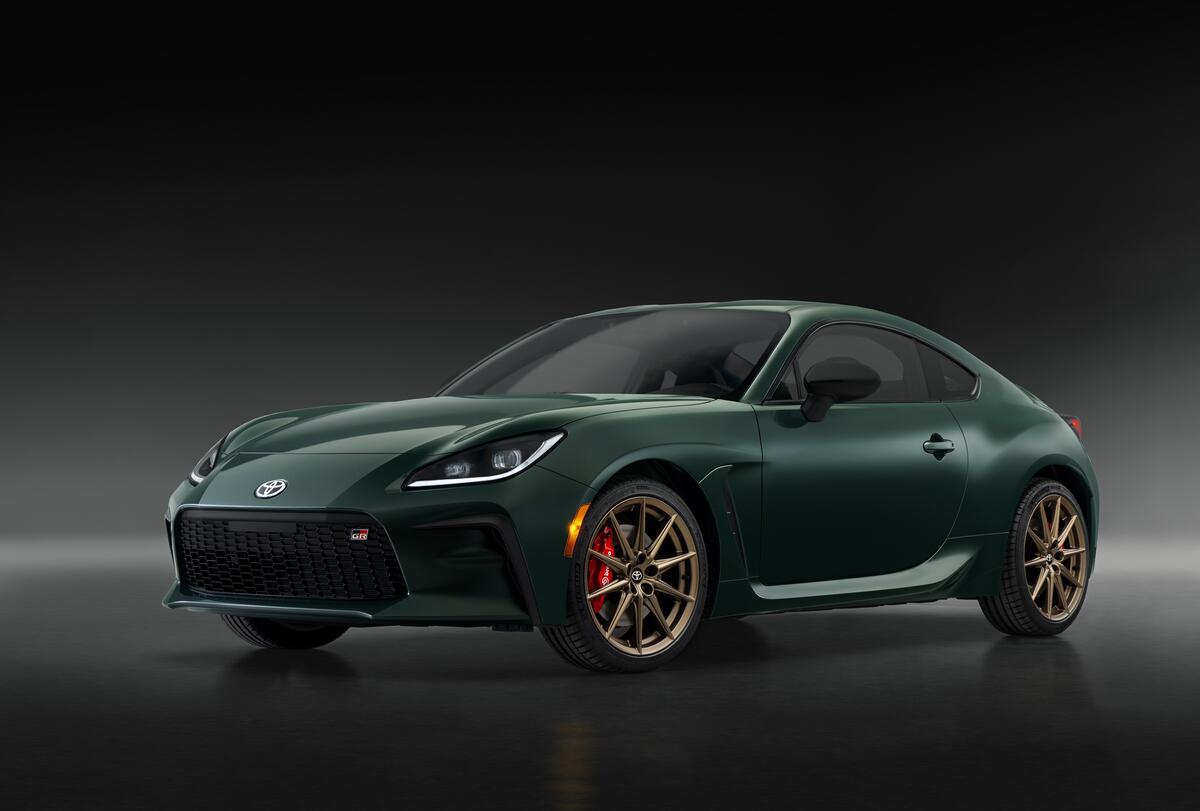
The GR 86 is a small sports car made for fun driving. It’s the kind of car people talk about when they want something quick and engaging without being a huge, expensive vehicle. The episode mentions it’s coming back for 2027 with changes.
The Bentley Flying Spur is a high-end luxury sedan. They’re saying the new one adds hybrid technology and a performance version, and it also looks distinctive—like with its headlight setup.
A hybrid uses two kinds of power: a gasoline engine and an electric motor. The electric part can help the car move more efficiently and sometimes even drive briefly without using gas.
“TurboCharge” means the engine uses a turbo to push more air into it. That usually helps the engine make more power and feel quicker when you accelerate.
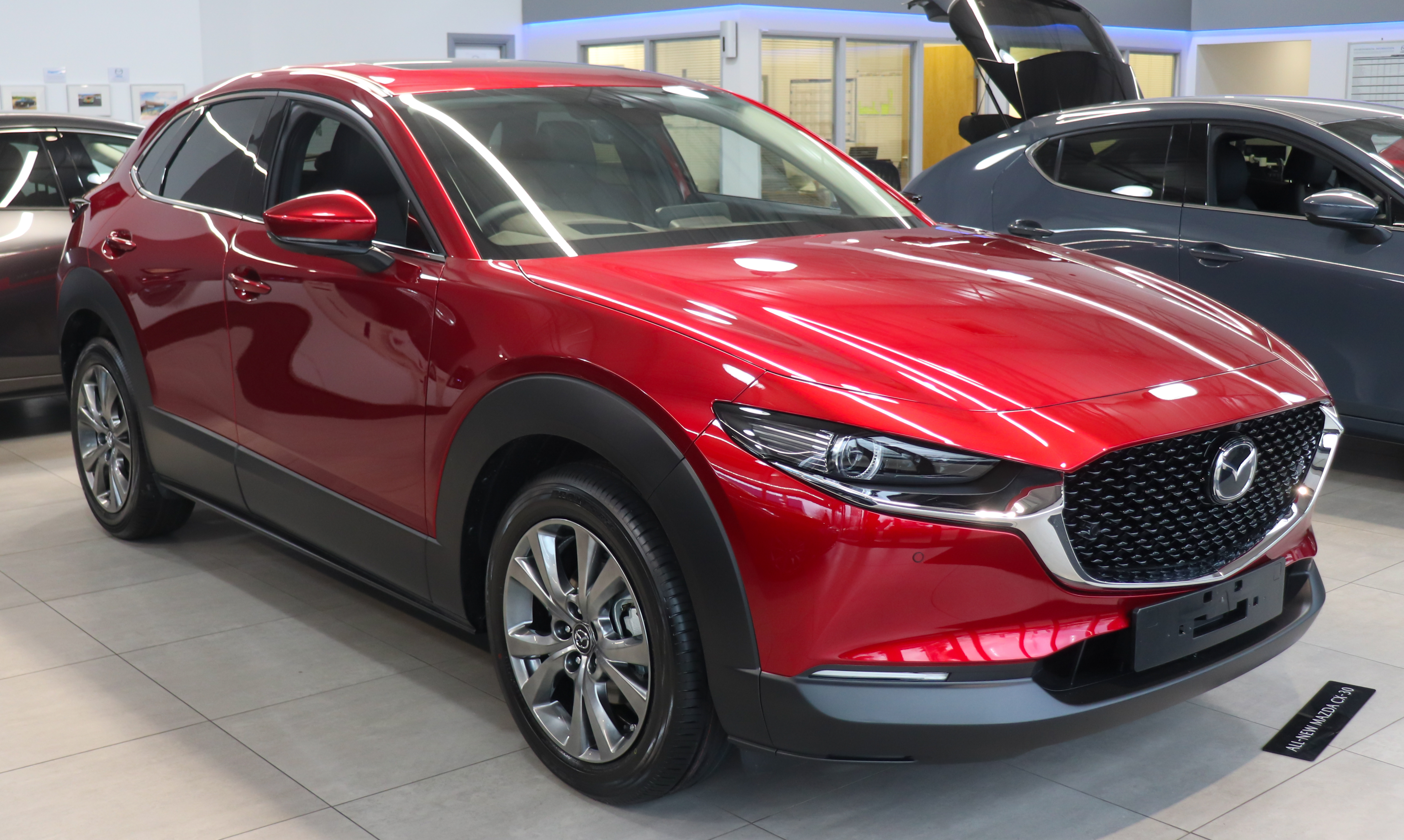
The Mazda CX-30 is a small SUV made by Mazda. It’s the car the host is talking about, and the episode is basically asking whether it drives more like a sporty hatchback than a typical SUV.
The Ioniq 9 is an electric vehicle from Hyundai. The podcast is grouping it with other Ioniq electric models and talking about how demand affects how much they’re used or prioritized. It’s mentioned as part of Hyundai’s EV plans.
The Kia Sportage Hybrid is a Sportage SUV that uses both gas and an electric system to help it use less fuel. Here, they’re talking about how Kia can build it at a plant that was originally set up for other vehicles.
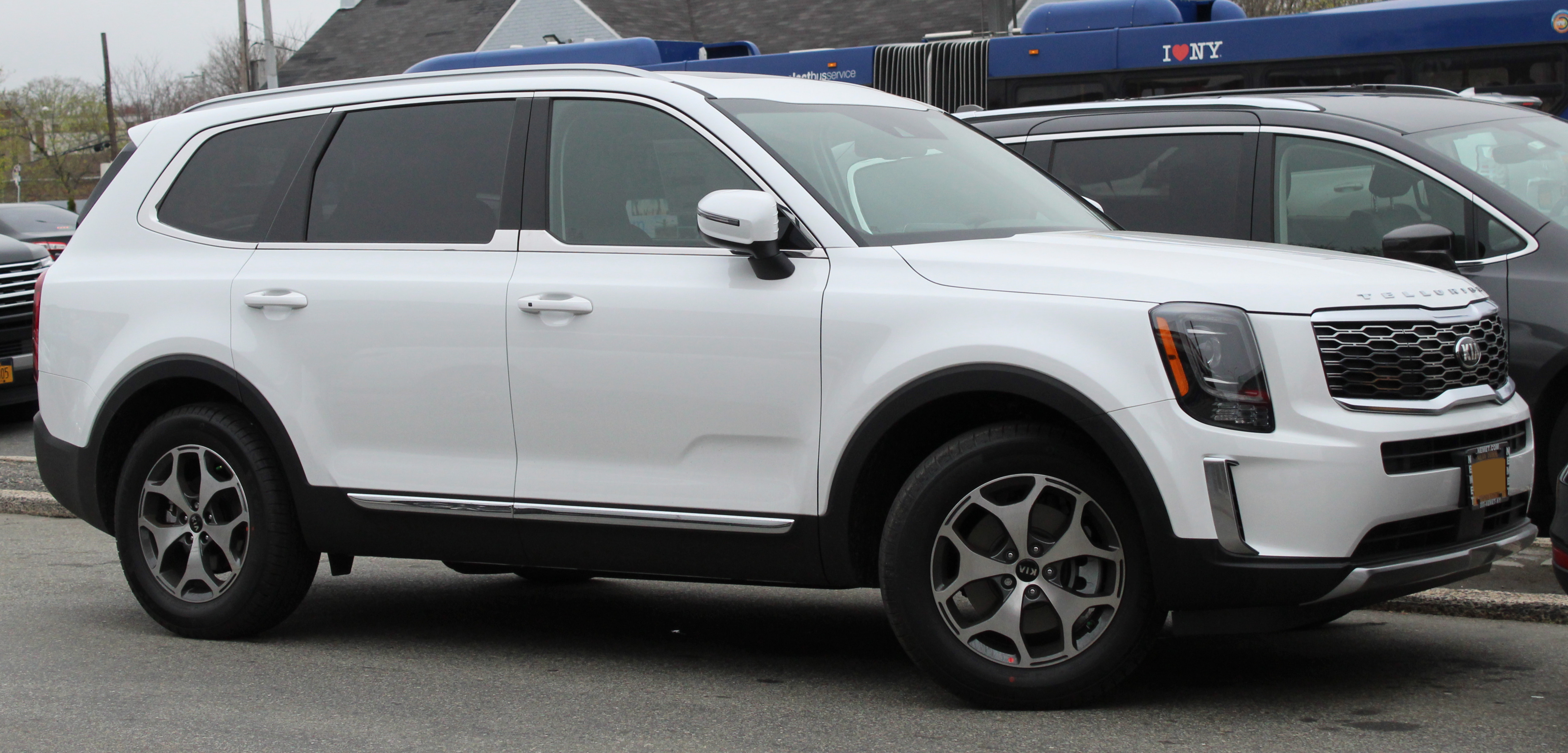
The Kia Telluride is a popular family SUV. Here, the host is saying Kia is using the Telluride’s newer, more upscale look as a model for how its smaller SUVs are starting to look.
A head-up display shows important info on the windshield, like your speed or directions. That way you don’t have to take your eyes off the road to check the dashboard.
Price escalation means the car gets more expensive as you add more features. The host is worried that the more equipment Kia adds, the less affordable these compact SUVs will be.
Compact SUVs are the smaller, more city-friendly version of SUVs. The host is saying most people want them to stay affordable even as they get more upscale.
A manual transmission is the kind of gearbox where you choose the gears yourself. You use a clutch pedal to shift, and the way downshifts feel can be improved with updates.
Throttle calibration is the car’s programming for how it responds when you press the gas. If it’s revised, the engine can feel smoother and more predictable when you accelerate.
Downshift feel refers to how a manual car’s gear change feels when you shift to a lower gear—things like smoothness, engagement timing, and how “crisp” or “notchy” it feels. The hosts say Toyota improved it, which suggests the update targets the subjective driving experience during downshifts.
Term
approved downshift
They mean they want the downshift to feel right—smooth and properly timed—rather than rough or uncertain. It’s about how the shift feels to the driver.
“Thunder” is a named exterior paint color for the refreshed Toyota GR86. Named colorways are common in model updates and can be a quick way to identify the latest spec or trim on the road.
Torque is the engine’s “twisting power” that helps the car get moving. Higher torque usually helps with quicker pull-away, and here they’re debating whether the stated number matches what you’d actually feel driving.
Aftermarket support means there are lots of third-party parts and upgrades available for the car. If you like tinkering, it’s helpful because you can find performance parts and other people who’ve already done similar upgrades.
Turbocharged means the engine uses a device that forces extra air into the cylinders. That helps a smaller engine feel stronger and pull harder than you’d expect.
Power delivery is how the car actually feels when you press the gas. It’s not just how much power it has on paper, but whether it responds quickly and smoothly when you drive.
This is the car’s automatic gear system with eight different gear ratios. It helps the engine run in the right “range,” but it can still feel a little slow to react when you step on the gas.
Air suspension is a suspension system that uses air pressure to support the car. It can smooth out the ride and sometimes adjust the car’s height for different driving conditions.
Turbo lag is the momentary hesitation you feel in a turbocharged car before the engine really “wakes up.” The turbo needs time to build boost, so the car may accelerate later than you expect.
Spooling the turbo up means the turbo is spinning faster so it can start pushing more air into the engine. If it hasn’t spun up yet, the car can feel slow to accelerate.
A digital gauge cluster is the screen behind the steering wheel that shows your speed and other driving info. It can show more details than older-style dials.
A four-cylinder power means the engine has four cylinders. It’s often smaller and cheaper than engines with more cylinders, so the price question is whether it’s worth it.
CarPlay and Android Auto let you use your phone’s navigation and music through the car’s screen. “Wireless” means you can connect without plugging your phone in.
Cruise control that can slow down and speed back up to match traffic is “adaptive cruise control.” If it also helps steer, it’s still not fully driver-free—you have to stay alert.
“Hands-free” would mean the car can drive without you steering. The host is saying this one still needs you to stay in control and be ready to intervene.
“Hemi” refers to a specific engine design where the combustion chamber is shaped like a half-sphere. It’s commonly used as a nickname for certain high-performance engines.
A subcompact SUV is a smaller SUV/crossover. The host is basically saying people expect these to be practical and good-value, not necessarily “fun” or premium.
A “hot hatch” is a small car (usually a hatchback) that’s tuned to be fun and quick to drive. Here, they’re saying this SUV feels more like that kind of driving experience than like a normal SUV.
Napa leather is a type of higher-quality leather used in nicer car interiors. It’s usually softer and feels more premium than standard cloth or lower-grade leather.
MSRP is the price the automaker lists on the car’s sticker. It’s a starting point, but the final price you pay can be higher after taxes and dealer add-ons.
This is the car’s automatic gear system, and it has six different gear ratios. Having multiple gears can make the car feel quicker and smoother because the engine can run in a better range.
CVT stands for a continuously variable transmission. Instead of set gears, it can smoothly change the ratio all the time, which can help fuel economy—but some people find it doesn’t feel as engaging as a normal geared automatic.
Zero to 60 time is how fast a car goes from standing still to 60 mph. Lower numbers usually mean faster acceleration, but it doesn’t tell you everything about how the car drives.
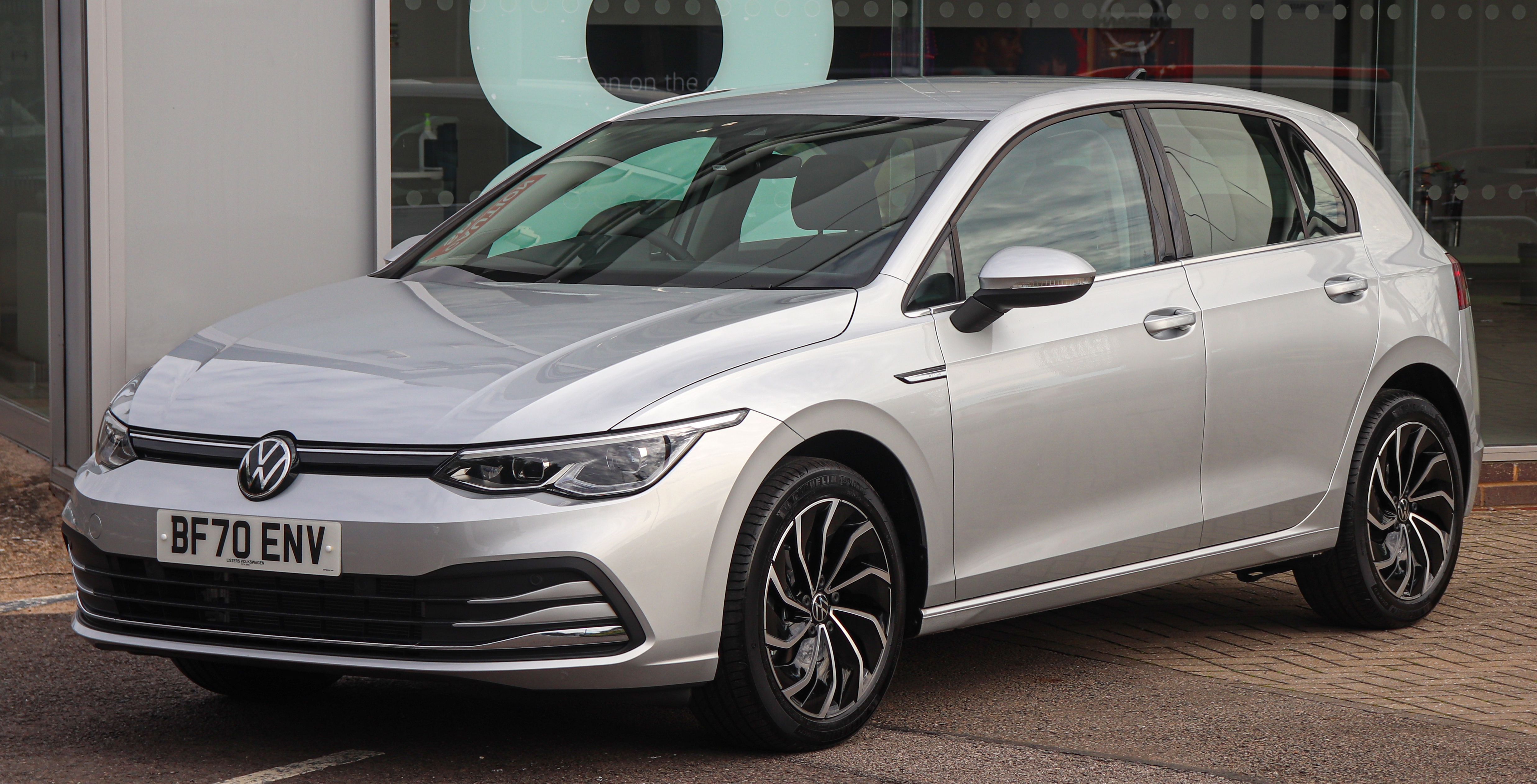
The Volkswagen Golf GTI is a sporty hatchback that’s famous for being quick and fun to drive. Here, the hosts are saying the SUV’s speed and power feel similar to what you’d expect from a GTI.
The F-150 is a large pickup truck used for everyday driving and work. The podcast is basically saying that the truck’s tech features depend on how you set them up and what you expect them to do. If you buy specific versions, you need to know what you’re getting.
The Silverado is a large pickup truck. The episode mentions it because some buyers can run into problems depending on the exact truck and setup they choose. It’s being brought up as part of that broader “watch out for issues” discussion.
The Renault Wind is a small car that’s built like a convertible. In the episode, it’s brought up because someone expected one kind of car but ended up driving something else. It’s a brief mention tied to that story.
The Honda Passport is a mid-size SUV. It’s the kind of vehicle people buy when they want room for passengers and cargo without going to a very large SUV. The episode references it because someone recently purchased one used.
It’s an electric car where the wheels are still powered by an electric motor, but there’s also a small engine onboard that helps generate electricity. That extra generator can help the car go farther without you having to charge as often.
This is the same general concept as a range-extender EV: it still drives like an electric car, but it has an extra engine that helps supply power. The goal is to make the car go farther between charges.
The Ford Lightning is an electric version of the F-150 pickup. The host is talking about a possible future version that would still be electric, but with an extra onboard engine to help it go farther without charging.
Ram makes pickup trucks. The podcast is talking about Ram’s plans for an electric-style truck that can go farther using a range-extender idea. That’s why it’s brought up in a discussion about future truck power.
The host is saying some truck buyers don’t want to switch to fully electric yet. A big reason is that charging can be inconvenient compared with filling up with gas.
The Maverick is a smaller pickup truck. It can be bought with a hybrid setup, which is meant to help save fuel. The podcast mentions it while discussing hybrid technology in general.
LIVE
This is America on the Road, named Best Radio Show by the International Automotive Media
Conference and now in its 34th year on the air.
Thanks for being with us as we bring you the latest automotive information from around
the world.
I'm Jack Nierad, with me is co-host Chris Teague.
Chris, have you made anything special in your brand new kitchen?
My brand new kitchen, I made a pizza dough and then I used my stone fired pizza oven
outside to make the pizzas, but it's nice having countertops in a mostly working kitchen
by now.
How are things on your side of the world?
Well I'm doing pizza too, I mean maybe there's some psychic connection here, I'm doing some
new pizzas and I'm doing them on the grill using a stone on the grill.
I'm not brave enough to grill my pizza yet.
Well on a stone it doesn't take all that much courage.
Plenty happening in the automotive world as well this week, I'm so excited about pizza
that I barely can talk.
Kia has begun building the Sportage Hybrid at the Hyundai Motor Group's massive meta-plant
in Georgia.
I was there to see the first one come off the line, so we'll talk a lot about that.
The Sportage Hybrid is getting a major update and it has new power, new technology, fresh
styling, all kinds of stuff, so we'll talk about that.
And there's a reason they're doing all this.
Hyundai and Kia are gaining ground in America in the hybrid market.
They were not necessarily first on the hybrid bandwagon but have jumped on it with both feet
and so we'll talk about that very fuel-efficient SUVs.
And then here's a vehicle that I think you're going to be interested in, Chris.
It's the GR86.
It returns for 2027 with new stuff.
And I'm real curious at you being the Toyota fan as to your opinion on that.
And then for those of you with too much money, if you can have that, Bentley has unveiled
an all-new flying spur luxury sedan.
It's got hybrid, it's got interesting performance and a performance model and interesting styling
as well.
Single headlight on each side, so I think that's kind of cool.
Are you a Bentley, a Rolls-Royce guy?
Well, let me point out that I don't have too much money and I like Bentley's performance
but I still lean Rolls-Royce myself.
Okay, interesting.
That's kind of a Ginger Mary Ann thing if you remember all that from Gilligan's Island.
I would say maybe I'm a little bit more Bentley, but I don't know.
America on the Road is brought to you by DrivingToday.com, EMLancy.com, the publisher of my latest
book.
Only one thing stays the same, and Mercury Insurance.
If you're looking to save some money, you should switch to Mercury for your auto and
home insurance.
California saved an average of $670 with Mercury, so imagine how much you could save.
Get a quote today at DrivingToday.com slash auto insurance.
Well, Chris, what is your test vehicle for this week?
I spent the week driving the 2026 Jeep Grand Cherokee Summit with the new Hurricane TurboCharge
4-cylinder engine.
I can't wait to tell you all about it.
Can't wait to hear about it.
I was driving the Mazda CX-30, so stay with us and we'll be right back right here on America
on the Road.
Welcome back, everybody, to America on the Road with Chris Teague, Jagdney Radback with
you and we're so glad you're with us right here on America on the Road.
We do appreciate it.
If you like our show, please pass it along.
You can pass along a podcast very simply to others and let people know when and where
you hear it on the radio.
This is news time, and I was in the middle of news this week.
Kia has passed a major milestone by introducing the Sportage Hybrid at the Hyundai Motor Group
meta-plant.
This is outside Savannah, Georgia.
I've spent a lot of time in Savannah recently at this plant.
I think I'm going to get a worker badge there.
But it was very, very cool.
Governor Kemp of Georgia was there to drive the vehicle.
Actually, he came on a robot off the assembly line and do that major ceremony.
That hoopla is always kind of interesting.
But major deal for Kia, and it just shows, I think, Chris, how much hybrids are kind
of taking the market by storm right now.
Are your thoughts on that?
Yeah.
We've talked about this before.
EVs are still too expensive and not ideal for a lot of people.
Hybrids have a great middle ground, good fuel economy.
Kia and Hyundai have always done a good job at packing the value into their vehicles.
I think people are starting to see that with the hybrids.
This is throwing a lifeline, I think, to the meta-plant, which was initially built to build
all electrics.
It builds the Ioniq 5, the Hyundai Ioniq 5, and the Ioniq 9, and largely underutilized
because the demand, it just has not been there for those vehicles.
It's gotten immense capacity.
I think they can build something like half a million vehicles there a year, been running
well under capacity.
But the ability to throw the Kia Sportage Hybrid into the mix, I think, is great for
that facility, and it's just an amazing facility.
I got to see both that facility and then the assembly plant that Kia operates in West Point,
Georgia, kind of across the state.
That is fully operational, running at full capacity, three shifts.
They build about 550,000 cars there.
They have, Chris, they have 13,000 cars sitting on the ground there at any one time, 13,000.
It's just kind of amazing the sea of cars there.
Yeah, I was there in October of last year.
We went to the Kia facility in West Point.
And it's interesting to see how many parts and logistics they share with the Hyundai plant.
So it's not a lot surprising they were able to move the Kia production there.
But as you point out, that West Point facility for Kia is busy.
There's a vehicle rolling off of the line, several vehicles.
They make all of them on the same line.
It's so interesting to watch.
Yeah, and it was interesting that it kind of contrasts the two facilities, too.
I mean, the Kia facility, I think, was founded around 2006 or so.
I mean, certainly it's been updated since then.
But there's technology in the meta-plant that's way different than in the use of robots.
And just the whole kind of situation is way different than the West Point plant.
Of course, the West Point plant is operating at full capacity while the meta-plant is not nearly at full capacity.
So we will see.
But I think we're going to see more vehicles go into that plant, into the meta-plant.
And they could be Kia brand vehicles or they could be Hyundai vehicles.
And of course, those brands try and keep some degree of separation while at the same time having the same parent and a lot of the same technology.
Yeah, I mean, I think people recognize them as related.
But once you look under the hood or under the skin, there's a lot more shared parts and engineering than a lot of people realize.
But it's great they're able to keep those jobs or at least keep some jobs at the meta-plant with the Kia vehicle since the EVs aren't moving as quickly.
Yeah.
These plants employ something like 3,500 people just in the plant itself.
And then there's, of course, all the ancillary stuff and the suppliers and then the local businesses that get the advantage of that.
So it's a real boon for the economy in that area.
It's very, very cool.
And then there is the Sportage Hybrid, which is kind of a cool vehicle and been updated.
Fresh look, more technology, better performance this time around, redesigned, using the same philosophy.
I think it's a good looking vehicle.
And of course, then they have these special models, including an X-Line model of the kind of their off-road-ish, off-road light kind of vehicle.
What'd you take on that?
Yeah, I think it looks great.
And I think I mentioned this in a few shows ago is that Kia's done a good job at kind of downsizing the styling of the Telluride, which has been super popular.
Yeah.
And it makes the smaller vehicles like the Sportage look more upscale.
They look more premium, like I said.
So I'm all for it.
Yeah, they're making a more premium too.
I mean, they're going to get a head-up display, for example.
The only thing I'm worried about, Chris, is price escalation.
You know, as they add equipment, of course, the prices go up.
And I kind of like these compact SUVs to be affordable.
I think most people would like that.
So it's interesting.
Yeah, looking at $40,000 of the benchmark for some of the class leaders now is kind of a tough bill to swallow.
But yes, I agree.
You read my mind when I'm going to be talking about 630, which is actually a size down from that.
Sportage has one of the roomiest cabins.
It has more performance, 2,232 horsepower now, kind of a complicated power trade, a turbocharged hybrid system.
Goodness, a lot going on under that hood.
I hope it all goes well.
But it's a very likable vehicle.
I can't wait to spend some significant time in it.
And Hyundai and Kia are set to become maybe number two in hybrids.
I think maybe Honda has something to say about that.
But their sales in May were very, very strong.
And their hybrid sales were all kind of rocketing through the moon.
So good stuff there.
Let's talk about this GR86 from Toyota renewed.
I think the GR86 is a vehicle we both kind of like, but are not on fire about.
But I don't want to speak for you.
You speak for you.
I love that it exists.
I think that platform, a small lightweight car with rear wheel drive and a manual transmission,
is a great thing to have in 2026 and 2027.
I'm not a huge fan of the car itself.
It has always been, even with the updates, a little bit underpowered for me and not quite as refined.
But I'm willing to give this one a chance.
I'm a Toyota fan, as you said.
So I can't wait to try it.
One of the things they've done is they've revised the throttle calibration.
This is for smoother power delivery, something we kind of complained about.
Updates to the manual transmission.
So that's good.
I like, they say they have improved the downshift feel, which is something I want.
I want an approved downshift.
And they have a new exterior color called Thunder.
Like, I can't picture what color Thunder is.
I would, what is it, a gray?
I don't know.
I guess it is.
Yeah, not quite sure.
But I would guess it would be some kind of gray.
When I was in these factories building cars, there were gray black cars,
and there were white cars.
And Kia has that kind of really dark green, sage green color, which is cool.
But in terms of cars with color, you just don't see them anymore, do you?
Yeah, I think the used car market is going to be packed with varying shades of drying
concrete colors for years and years to come, the number of grays and flat colors we've seen recently.
Yeah. Getting back to the GR86, 228 horsepower.
So not as much horsepower as the Sportage Hybrid horsepower.
Maybe that's one of the reasons we don't warm up to it all that much.
184 pound feet of torque is not real torque either.
But I think a pretty cool car in a lot of ways.
And one of those cars that's affordable and fun to drive, and you can just have a blast with it
on a Saturday morning, finding twisty roads.
Yeah, I agree.
And for people who like to tinker with their cars, the aftermarket support for these vehicles
is very strong.
I mean, there's a huge community of people building and making these things faster.
So if that's your thing, you're definitely in good hands.
Yeah, absolutely true.
Well, Bentley has shown the next generation of the Flying Spur.
Of course, that's the, as everyone knows, the flagship of the brand, the luxury sedan,
that combines handcrafted British craftsmanship, of course, makes sense.
With hybrid performance, interesting, advanced technology.
More modern exterior styling this time around.
I kind of love the idea of single front headlamps.
You know, that seems like a really classic kind of look.
And that dates back to 1962, way before you were born.
Yeah, I do like the kind of throwback look to it.
And they've made it look modern while keeping the sort of sweeping dramatic
lines that they've had for years.
So no problems with the new design.
Yeah, V8 hybrid powertrain.
So that's cool.
There's going to be a performance version with 680 horsepower, 0 to 60 time in 3.6 seconds.
So very, very cool.
And we look forward to that.
We look forward to test driving that maybe next week.
OK, it won't be next week.
But maybe we'll test drive it along the way here.
When we come back, we will do some test driving of some other cars.
What is your test drive vehicle for this week, Chris?
I had the 2026 Jeep Grand Cherokee.
Can we tell you all about it?
Very, very cool.
I was driving the Mazda CX30.
And we'll discuss whether that's an SUV or not.
When we come back, among other things, we'll talk about when we come back.
So stay with us.
We'll be right back right here on America on the road.
Welcome back, everybody, to America on the road with Chris T. Jackney Redback with you.
It is road test time.
And Chris, you are testing a vehicle.
And I really want to hear your test of this vehicle.
It's a vehicle I tested recently, but I only had a fairly short time in it.
I'm really curious about the whole thing.
Tell us about this Jeep Grand Cherokee.
Yeah, this is the 2026 Grand Cherokee Summit.
So the top trim of the line with the new Hurricane turbocharged 2.0-liter four-cylinder engine.
Taking a step back, you can get into this vehicle for around $39,000, $40,000 after destination.
My test vehicle fully loaded with some options was almost $70,000.
Jack, before I go too far on the four-cylinder,
what do you remember most about that powertrain in this vehicle?
I remember that I wasn't really impressed with it.
You know, and maybe it was the test vehicle I had.
Maybe it was the route we were on.
Maybe my expectations were too high.
You know, it's highly touted.
It's got really interesting technology.
But in terms of power delivery, I guess I was slightly underwhelmed.
Yeah, I was going to say.
So you get 324 horsepower, 332 pound-feet of torque.
The problem here really isn't a lack of power.
It's how that power is given to you when you're driving.
You have an 8-speed automatic transmission, four-wheel drive,
and then a full set of train management systems in this vehicle along with air suspension.
On the engine, it is a little bit coarse, right?
So it's a four-cylinder engine.
When you're going at it in this vehicle, you know that it's a four-cylinder engine.
You can hear it and you can feel it, which in the summit trim,
which is kind of a luxurious vehicle, you're wrapped in leather and wood and everything.
It feels a little bit out of place.
And the other thing here is that it's not all that responsive.
So there's a little bit of a difference in time from when you put your foot down
to when the vehicle actually starts going.
And after that, there's some turbo lag, which is when it's taking time to spool the turbo up.
So you get a little bit of acceleration and then a lot of acceleration.
And it takes a little bit of deciphering to figure it out.
Is that what you remember about it?
Yeah, I do.
And I think it's largely turbo lag.
And it kind of reminded me of some of the other Stellantis turbos that we've driven through the years,
where I think they emphasize power, but not necessarily immediate power.
And I think we drive torque, like immediate torque is much more satisfying in day-to-day driving,
I think.
Yeah, I can tell you, comparing this back to the Grand Cherokee 4 by E that I drove either last
year or the year before, we took this on a little trail just to go hiking.
Nothing super serious off-roading, but the lack of torque down low really makes itself
apparent when you're on a dirt surface or when you're on a bumpy surface trying to get over things.
And I don't know how many people are going to take their $70,000 Grand Cherokee off-roading,
but it's a point.
The ride quality is great.
As I said, you get adjustable air suspension in this trim.
It was an option.
Decent handling, good ride quality.
And so there's no problem with acceleration.
It's just how you get there that's kind of bothersome.
Inside the Summit trim has Palermo leather.
Mine had a very beautiful saddle color.
It's standard with this trim.
You can get black or the brown inside.
Wood trim.
No problems with the styling or the quality of the materials inside this vehicle.
You get heated and ventilated front seats.
He didn't ventilated second-row seats.
Plenty of room, American-sized front seats for my American-sized rear end.
And there's no problems there.
Good ergonomics.
Once you figure out where the start button is and everything kind of is, it kind of settles in.
So there's no problems there.
Second-row seats are good too.
I was able to pack my nine-year-old and our 85-pound dog in the back seat with his restraints.
He had a little bit short headroom, but he's just a giant dummy.
So I think normal people would be just fine in the second row.
And mine was only a two-row version, but you can add a third row,
which is very small to this vehicle.
In terms of technology, there's plenty of it.
So this vehicle has a 12.3-inch touchscreen, a digital gauge cluster.
Everything runs on the Uconnect infotainment system,
which as we've talked about many times before, is packed with features,
but it's easy to use.
Everything is nicely labeled.
It's very responsive.
And I think the interface looks pretty good.
What do you think, Jack?
I think absolutely.
I love the infotainment system in this vehicle.
I think it's terrific.
I think it's one of the best in the industry.
So I love all that.
I love the interior.
I mean, I really like this vehicle a lot.
It just kind of puts me in a quandary.
It's like, what powertrain would I choose were I to buy this?
And there's kind of baggage on both of them, right?
I think so.
I think so.
And then the question for me, and we can talk about this later,
is $70,000 for a four-cylinder power, really, where people are going to be.
But with the infotainment system, this vehicle also had an optional passenger side display.
So you get a touchscreen for the passenger that can view navigation and audio details
and things like that there.
Wireless Apple CarPlay and Android Auto, HD Radio.
And this vehicle also had a Macintosh audio system,
which will blow your socks off.
I think it's one of the best in the business.
It's extremely loud and clear.
So no shortage of tech in this model.
But some of these features that like the Macintosh and the passenger side display are options.
So those contribute to the higher price.
The Summit trim also has plenty of safety features.
So you get blind spot monitoring, rear cross-traffic alerts,
adaptive cruise control with steering assistance.
This is not a hands-free system.
So that's just something to keep in mind.
And then Ford collision alerts and all the rest.
So Jack, if this were me and I were shopping a Jeep Grand Cherokee,
I would probably wait a model year.
I'm pretty sure we're going to see a Hemi back in this thing at some point soon.
But I think a lower trim with the V6 engine and a fewer features would be a better value
for most buyers.
Yeah, I think this is one of the issues where we get a powertrain based on
former fuel economy and emissions requirements that are not existing right now.
And the result is not necessarily the best thing for the consumer.
So I'm right with you.
Yeah, I think as soon as they can figure out where the V8 fits in there, it's going back.
Yeah, I think that's going to happen.
And that's probably the best of the three choices where we'd have three powertrain choices.
Well, I'm driving a vehicle that asks the question,
can a subcompact SUV be a bargain at $40,000?
And that's a tough sell.
I'm talking about the 2026 Mazda CX30.
This is in 2.5 turbo premium plus all wheel drive form.
So there's a lot of letters after the name of the vehicle and a lot of numbers and letters
and that they all add up to a big number in terms of price, I think is what we're looking at here.
I think this vehicle continues to occupy a unique position in the segment.
And I think a lot of these vehicles are just utilitarian there.
They focus on things like maximizing cargo space and interior volume,
which is not a bad thing for an SUV to do.
Mazda has spent the last several years, though, making this something different.
I think it's a hell of a lot more fun.
It's more premium than its brand suggests.
But it's driving dynamics that's what's separated.
And what's your take on this?
I got to believe this is more of a hot hatch than it is an SUV.
Yeah, I think it does lean closer to the hot hatch.
But to your point earlier, $40,000 for a vehicle this size,
you got to really lean into that driving experience and premium interior to get some sales.
But I think it's it could be worth it for the right people.
Yeah, I mean, this is, as I mentioned, turbo premium plus trim.
This is the top trim.
We have a tendency to get a lot of top trims here because they want to show off everything
that the vehicle has a particular vehicle has turbocharged engine,
of course, all-wheel drive, Napa leather seating, so very nice seating.
Tons of safety technology.
Mazda really piles this onto the point where a lot of people are touting them now as among
the safest of that brand's out there.
Nearly every available convenience feature.
So Mazda is not a premium brand, but this is really very much like a premium vehicle.
The MSRP of the vehicle I had was $40,000, including the destination charge.
There were some extras like gray metallic paint and some dealer installed accessories.
It's just a lot of money for a subcompact, especially not from a luxury brand, right, Chris?
Yeah, I mean, Mazda's been doing the work.
I just don't know that people recognize it yet, right?
So like it has the features that people want.
It has the upscale look, but I don't know that a lot of people are on the knowledge train yet.
Yeah, one of the things where they've done the work is with this powertrain.
I think it's a great powertrain.
Turbocharged 2.5-liter four-cylinder engine.
Pretty nice.
Not a coarse four-cylinder engine that produces 250 horsepower, 320 pound feet of torque
when you run premium fuel in it.
So here in California, $7 a gallon or something like that, kind of crazy.
Six-speed automatic transmission.
That's one of the things that Mazda, I hope I'm not calling this Honda throughout here,
but that Mazda has done is stick with a six-speed automatic transmission.
A lot of vehicles in this class use a CVT, use a continuously variable transmission.
This is a real driver's transmission.
This is one of the separators, not only the horsepower, but this transmission.
What you take on the driveline here, Chris?
Yeah, I think you could argue for a couple extra gears, maybe for extra fuel economy
on the highway and things like that.
But the six-speed is so much more engaging than a CVT and they've done a good job tuning it.
Yeah, I think what you would lose with the gears is it'll go through gear and gear and gear,
and you'll be between gears so often.
And I think in this instance, you're in a gear for a while and zero to 60 time of 5.8 seconds.
So it's not the quickest vehicle in the class, but man, it's fun to drive.
And I think it's a hot hatch in a lot of ways, reasonable fuel economy.
As I mentioned, it has great driving dynamics.
And the interior, of course, we've talked about Mazda interiors
until we were kind of pink in the face, but we like them, don't we?
Yeah, they're much nicer than you'd think from a mass market brand.
Yeah, black leather seats, heated front seats, heated steering wheel,
power adjustable front seats with memory.
You know, this kind of has all of the upscale bells and whistles.
So I like it.
It's just in some ways hard to justify 40 grand.
Of course, you don't have to spend 40 grand on a CX-30.
You can get one much closer to $30,000 that still has a lot of good stuff,
probably doesn't have the same powertrain and all the good stuff.
But it's a nice buy.
Your thoughts?
Yeah, I agree.
I like it.
The lower trims are still pretty nice.
You still get some decent features.
The top trims really do push it into premium territory.
And those performance numbers you mentioned,
they're competitive with the Volkswagen Golf GTI.
I mean, the power delivery, the 0-60, so yeah, definitely hot hatch territory.
Good stuff.
And we didn't sing it for its infotainment system.
We're not going to in this show.
And our special guest this week is Charlie Daniel.
He works for a company called FPT Americas.
It's a longtime auto retailer.
He offers great information about the used car market
for both consumers and dealers alike.
So stay with us for that.
And we'll have more coming up right here on America on the Road.
We're so glad you're with us and stay with us.
We'll be right back right here.
I received a letter from a reader this week,
and I thought I'd share it with you.
Here's what he wrote.
I just got around to reading Dance in the Dark
and wanted to say how much I enjoyed it.
I'm a compulsive reader and this one was right up my alley.
An unlikely hero.
A lot of twists and turns.
Some adult content.
And humor that rose naturally from the action.
Keep on writing and I'll keep on reading.
Of course, that's just the kind of letter any author would love to get.
I hope that others get the same enjoyment from reading Dance in the Dark
and my newest crime novel.
Only one thing stays the same.
Both are available exclusively at Amazon.com.
That's Dance in the Dark and only one thing stays the same.
Both written by me, Jack R. Neyred.
Thanks for looking for them today.
Welcome back everybody to America on the Road.
Jack Neyred back with you.
We have a really interesting guest.
Talking about an interesting topic.
Charlie Daniel is head of Automotive Retail Solutions for FPT Americas.
And we're going to talk about AI.
What it is doing to the dealer business.
What it is doing to auto auctions.
And thus what it's doing to people who buy used cars from car dealers.
Number one, Charlie, thanks for being with us.
We appreciate it.
I appreciate you having us.
Give us a little background about FPT Americas.
What you do and how it relates to the auction scene out there that's so prevalent.
Well, FPT Automotive Americas, which is basically a subsidiary of FTP software.
We're a global company.
We deal in IT services in the United States as FTP America.
And we're basically focusing on automotive sectors.
And we've been behind the scenes for decades,
building some of the biggest technologies that are out there.
I have stepped in as the head of Retail Automotive to bring it to other consumers.
It's exciting because I've been this automotive industry for 30 some years
and I've watched everything evolve and everything grow.
And being an early adapter to the automotive or to the technology aspect of it.
It's exciting.
I mean, it really is.
And especially with AI today, it's just mind boggling.
It really is mind boggling, isn't it?
I mean, I was editorial director at Kelly Blue Book for a long time.
Of course, Kelly Blue Book relied on auction information for a lot of its pricing information.
I mean, that was basically the source when I joined Kelly Blue Book 20 or 25 years ago.
And certainly, auctions have changed markedly since then.
Tell our listeners how auctions were and how they are now.
So back in the early days, I mean, even when I first started in the industry,
we used to fly to the auctions.
I mean, they would be at certain locations in Detroit, Orlando,
major locations throughout the United States.
And we would, as buyers, we would stand in line with a run sheet,
which is a list of every vehicle that's being run at the auction that day.
And we would decide based on what we felt was the best vehicle to be able to purchase.
And then as the decades changed and evolved, we went to, you know,
Somalcast, where that you didn't have to necessarily go to the auctions.
I mean, it was on your computer.
And you would sit there and you would watch it and try to do your background,
your reports to be able to understand what the vehicle looks like,
the condition reports, and their base office scales.
Today, it has just morphed into this really, really interesting, you know,
scenario where that, you know, dealers are able to go on to AI,
build guardrails with inside AI of saying, I want this specific vehicle,
this age, this mileage, this color, this model, and for this price.
And it goes out and it searches every auction house that's out there
and it finds the vehicle for it.
It coordinates the transportation back, it does everything.
And I mean, it's really speedy.
It's really sped up the process.
But I have to warn, just like with everything, technology is only as good as your gut.
If you tell it to just go buy me five, 2025 F-150s, you know, that are dark color,
you do not know what you're going to be getting.
And you might be shocked by what you're getting, I would imagine, right?
Exactly.
And there's a lot of that because, you know, AI is so new for all of us.
And look, I love it.
I think it's fantastic.
But the agentic AI that is formulating now, it really needs you to tell it exactly what to do.
And in the automotive industry, I always tell everyone,
don't be afraid to say no to AI.
Just because it's fantastic at giving you history and giving you projections,
it cannot predict, you know, the unforeseen, you know, a crisis in Iran.
You know, oil prices going through the roof.
All of those are like the black swan in the industry that will cause a disruption,
which can change every scope of what the market does.
I mean, I kind of look at AI as my intern on those few occasions when I use it.
I mean, it's somebody that-
That's exactly the best way.
You kind of look at it and then you check, right?
Check big time.
I mean, it can maybe do a little of the grunt work for you.
Maybe a lot of the grunt work for you.
But the stuff that requires precision, it can't do.
And you can't trust it to do that, I don't think.
And I imagine it's absolutely the same when
dealers are trying to buy inventory, which is what we're talking about.
Well, everybody is very focused on getting the best deals, the turn of the other vehicles,
the turn cycle is basically when the time that they purchase it to the time the consumer
purchases it.
And they've got a very small window before that turn time actually costs.
You know, so it's important for them to be able to get it right, get it to market,
and get it sold as quickly as possible.
Otherwise, it just starts eating all your profits.
In one way or another, dealers are financing their inventory, right?
I mean, they're paying for their inventory and they have to turn that over.
They have to turn over the inventory.
They have to sell the vehicles they buy to make that money back or to get the return on that investment.
And it's a difficult business, right?
I mean, in a lot of industries, you just buy commodities.
You buy large quantities of stuff.
In the car business, every used car is an individual product, isn't it?
It really is.
And I mean, there's historical maneuver, you know, how things are priced in certain
parts of the time of the year, like we're heading into the summer.
Historically, trucks lose value and then they pick it back up in the fall.
You know, smaller SUVs, mid-compacts, you know, things like that start to increase
in the wintertime they drop off.
You know, that's been historical for decades.
But there's disruptors.
I mean, we saw it in 2008.
I mean, when the stock market crashed, everything lost.
And it doesn't mean what has happened in the past will circle around and become the new wheel.
You know, you have to look at the disruptors.
And I mean, right now, we're living something.
I mean, what you bought two weeks ago might be $2,000 or $3,000 less today.
So, and then you've got to look at the EVs that are coming into the market that are causing a lot of shift.
You know, EVs are coming off a lease.
They're getting flooded back into the market, which skews what the market is actually doing.
It says that the market is showing that it's extremely high.
Well, no, not necessarily.
If you take a look at a deeper dive, it's really into EV.
It's not into the others.
So, AI is great, but it doesn't take away the human instinct and the gut.
You know, that gut feeling when you look at something.
It's called experience, right?
I mean, you know, using that experience separates us from, I think, animals, among other things.
But how does a dealer go about using AI properly and kind of bridging these gaps that can be out there?
You know, getting the right inventory, pricing it right, and then getting it out the door?
Well, the first part, and this is kind of where the FPT kind of plays a little role,
you have to make sure that your data is actually clean.
Because if you plug AI into a solution that is not connected properly or the information is duplicated.
I think everyone has bought a vehicle and they traded in a vehicle and eight months later,
the old dealer is actually sending you an email saying, hey, we'd love to have your trade.
And you just traded that vehicle in.
Why doesn't it read together?
That's called dirty data.
You know, the CRM, which is a customer management tool, is not feeding into the DMS,
which is the main hub.
Yeah, the dealer management system.
Yeah.
Yeah, and if you put AI on dirty data, guess what happens?
You get bad information.
Yeah, garbage in, garbage out.
I mean, the oldest IT phrase in the world, right?
Yeah, so you have to clean that up before you get AI involved.
Once you get AI involved, you have to really be able to build the guardrails.
You know, be very specific.
You know, I want a 2017 Ford F-150 A302 with less than 38,000 miles on it,
but no more than this.
The condition report needs to be at a 4.7 or above, which is a one to five.
And it no greater than $21,350, including transport fees.
Now, those are guardrails because it's really defined.
When you start getting into, I just want some Ford F-150s or some Silverados,
that's where you get into some problems.
You know, the guardrails are really key.
That's for the dealer side.
How can this help the consumer?
Matching the right person with the right car helps everybody, right?
I mean, it helps the dealer, consumer.
It largely even helps the OEM, the original equipment manufacturer.
Walk us through that a little bit.
So for a consumer, basically it opens up your market.
I mean, you actually have what you're looking for instead of going through 15 or 16 different
dealerships to try to find the one, you know, golden vehicle that you're looking for,
which pins them against each other.
So now they have to become more competitive because if I'm in Pittsburgh, Pennsylvania,
and I'm going to the auction and I'm using AI to understand what I'm looking for,
and my other competition is using AI to look at what we're looking for.
Guess what?
We're all buying the same vehicle because AI is saying this color, this vehicle,
everything fits for this market.
So for the consumer, it gives them, to me, buying leverage.
It gives the dealer the ability to turn the vehicles faster
because you're not sitting with a purple vehicle that is sitting there that nobody wants.
Yeah, a miss-bought vehicle that's lying on the lot forever, right?
Exactly, yeah.
And I mean, that's really what causes all the conflict.
I think every consumer out there is walked into a dealership and they said,
I want a black car.
And they wind up driving out with a blue SUV.
I mean, there's a reason why that happens.
So there's two parts.
One, the consumer really doesn't understand exactly what they're looking for.
And the best salespeople in the world are designed to ask questions to revolve around
what they actually need.
And it's their job to be able to show you multitudes of choices.
Right.
And determining what the consumer needs is better than trying to sell what the dealership
really wants to sell, which a lot of times it seems like what is foisted upon the first
person who walks in the door each day.
Well, and that's where AI comes in, because it takes all the historical data where
everybody is searching for, and then it provides that to the dealerships.
Could the consumer use AI the same way you're talking about dealers doing it?
I mean, we just bought a Honda Passport over the weekend, actually.
Used Honda Passport, 21 Honda Passport.
And let me tell you, it was hard to find in the desert communities where we were looking.
Plenty in Los Angeles where I live, but out in the desert, not so much.
But we did find that kind of needle in the haystack.
But maybe AI could have simplified that process.
What do you think?
It helped me three months ago.
And it really sped up the whole entire process.
I mean, will it buy it for you?
I probably wouldn't go that far.
It could, but I still believe kick the tires type things.
I believe in starting online, educate yourself.
Well, a lot to talk about, Charlie.
And unfortunately, we don't have any more time to talk about this.
But thanks so much for being with us.
We do appreciate it.
Charlie Daniel, head of Automotive Retail Solutions for FPT Americas.
We appreciate it.
Thanks for being with us.
Thanks, Jack.
Thanks for having me.
And stay with us, everybody.
We'll be right back right here on America on the Road.
Welcome back to America on the Road with co-host Chris Teague.
With you, it is listener question time on America on the Road.
We'd love to answer your questions based on our long experience providing car advice.
Send your questions to editoratdrivingtoday.com.
That's editoratdrivingtoday.com.
Chris, I have a great question, I think, from Brandon in Fillmore, California.
He says, are range extender EVs the next big thing for truck buyers?
Oh, wow.
Well, this is definitely going to be an opinion because I don't have a crystal ball,
as we've said so many times.
I think range extended EVs are coming, right?
We've got Scout coming down the line with a pickup truck and an SUV.
I've heard rumors of Ford converting the lightning into a range extended EV.
Ram has been talking about it.
Look, I think there will be several choices probably in the next four to five years
that we can come through.
I think they're going to face the same challenges that some of the electric trucks have faced,
which is truck buyers are really reluctant to go for electric power, right?
I mean, you have a gas engine and a range extended vehicle,
but it doesn't power the wheels at all.
It's just a generator that's charged the batteries.
I think capability will matter.
I mean, range is obviously going to be better,
but I think there's still going to be a lot of questions for truck buyers.
I hope that automakers can kind of come through with the education campaigns
to kind of get them behind these things, but we'll see.
Yeah.
I think truck buyers are very conservative buyers, right?
They like what they've got before and they want to get another one that kind of does
exactly what they've done before.
And they might be a diesel buyer.
They might be a big V8 gasoline power fan.
I think only in the smallest trucks are we seeing any kind of hybridization even,
like the Ford Maverick truck, and you could argue that's not exactly a truck.
It's enough truck for most people, I would say.
Yeah, I think it is.
Even the smallest truck is probably enough truck for most people.
That wraps up our show for this week.
My crime novel, Only One Thing Stays the Same,
of course, is available in ebook and paperback form at Amazon.
So look for that.
A lot of suspense there.
If you like our show, please pass it on.
Listen on this radio station each week.
Let your friends know where you hear America on the road.
We'd love to double our listenership this year, wouldn't we, Chris?
Yes, and you can help us do that with a quick Google search for the America on the road podcast.
That will bring us to you on all the major platforms, Apple, Spotify, many others.
Subscribe to the show so you get our automatic downloads.
Leave us a review.
Those things help us out and you can take us with you wherever you go.
Right.
Check out our YouTube channel.
We're posting a lot of stuff there, some interviews, some shorts.
Recently, I just did a short when I was in Georgia looking at these various plants.
So look for that.
Our thanks to Mercury Insurance for sponsoring the show
and to our sports byline network stations for carrying it.
We do appreciate that.
And most of all, thanks to you for listening.
We know you have a lot of choices.
So we're honored by the fact that you're listening to America on the road.
And join us again next time for another edition of America on the road.
I'd like to tell you about my newest crime novel.
Only One Thing Stays The Same.
As the story unfolds, an unemployed aeronautics worker named Bill McCurdy becomes disillusioned
with his wife and slips into an illicit affair with a teenager from down the street.
Before long, he begins to think of doing the unthinkable.
And before the roller coaster ride stops, he learns quite personally and very finally
that Only One Thing Stays The Same.
Only One Thing Stays The Same is available in Kindle e-book and paperback form
exclusively at Amazon.com.
I'd appreciate it if you'd look for it today.
About this episode
The hosts kick off with hybrid momentum, then pivot into their Mazda CX-30 Turbo road test debate: is it really a hot hatch in SUV clothing? They compare the CX-30’s turbo 2.5L character and six-speed automatic feel against hot-hatch expectations, while also discussing pricing and tech creep. The conversation broadens to Kia/Hyundai hybrid production in Georgia and why hybrids can be a practical middle ground—plus a quick look at turbo lag and low-end torque realities in the Jeep Grand Cherokee Summit.
This week on America on the Road, Jack Nerad and Chris Teague review two strong performers — the luxurious 2026 Jeep Grand Cherokee Summit and the fun 2026 Mazda CX-30 2.5 Turbo. They also cover Kia’s major Sportage Hybrid production launch on scene in Georgia, look at record hybrid sales from Hyundai and Kia, critique Toyota’s updated GR86, and discuss the all-new Bentley Flying Spur. Their special guest is car-buying expert Charlie Daniel.
🚙 Jack Nerad’s Road Test: 2026 Mazda CX-30 2.5 Turbo Premium Plus AWD
Jack reviews the 2026 Mazda CX-30 Turbo Premium Plus, a sporty and premium-feeling subcompact crossover that brings high expectations. Though it doesn’t come from a luxury brand, its 250-hp turbo engine, engaging dynamics, upscale Nappa leather interior, and comprehensive safety gear make it a compelling near-premium choice. Is it worth its $40,730 as-tested price? We’ll offer our opinions.
🚗 Chris Teague’s Road Test: 2026 Jeep Grand Cherokee Summit
On the roads and byways of Maine, Chris tests the top-trim 2026 Jeep Grand Cherokee Summit 4×4, a premium three-row SUV that blends luxury and off-road capability. With a smooth ride, upscale Nappa leather interior, large 12.3-inch touchscreen, available McIntosh audio, and V6 or turbo four-cylinder power, it competes with luxury SUVs while retaining genuine off-road ability. But the newest version presents us with a quandary — what powertrain is the right one?
🎙️ Special Guest Interview
Charlie Daniel from FPT Americas, a longtime auto retailer, shares expert insights on the current used car market for consumers and dealers.
📰 This Week’s Headlines
Kia Sportage Hybrid Production Begins in Georgia
The first Kia and first hybrid built at the Hyundai Motor Group Metaplant marks a major U.S. manufacturing milestone, and our Jack Nerad was there.
Updated Kia Sportage Hybrid Unveiled
The popular compact SUV gains more power (232 hp), fresh styling, new trims, and advanced tech.
Toyota Refreshes 2027 GR86
The lightweight sports car gets throttle and transmission improvements, new colors, and tech upgrades. What color is Thunder anyway?
Hyundai & Kia Hybrids Set Sales Records
Both brands posted strong gains in May, with hybrid sales surging significantly.
All-New Bentley Flying Spur Debuts
The flagship Bentley luxury sedan features hybrid power, modern styling, and a high-performance S model with 680 hp. Bring money…
❓ Listener Question
Brendan from Fillmore, California, asks: “Are range-extender EVs the next big thing for truck buyers?”
Jack’s crime novel, Only One Thing Stays the Same, is available now in paperback and eBook on Amazon — currently at a sale price.
🎧 Where to Listen
Catch America on the Road on your local Sports Byline Radio Network station each week and subscribe to the podcast on Apple Podcasts, Spotify, YouTube, and more. Follow for new car reviews, guest interviews, auto news, and road tests.
Sponsored by Mercury Insurance and DrivingToday.com
📺 Watch & Subscribe
Find America on the Road on YouTube and Rumble. Subscribe for road test videos, shorts, and extended reviews.