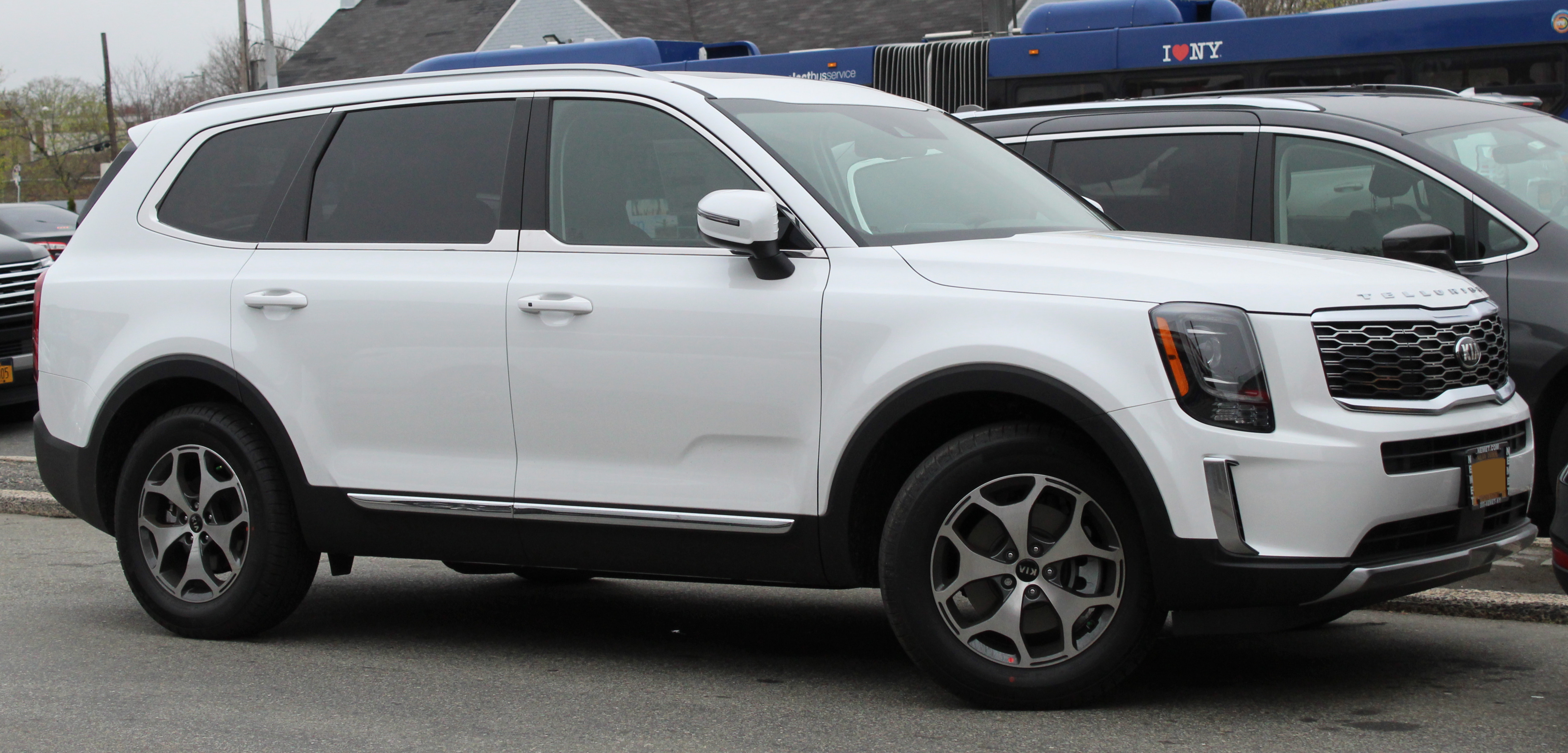
This is the 2027 Kia Telluride in the EX trim, with all-wheel drive. They’re talking about their first impressions based on the exact test car they bought, including what it cost “out the door.”
All-wheel drive (AWD) sends power to all four wheels, improving traction when roads are slippery or uneven. In SUVs like the Telluride, AWD is often paired with a specific drivetrain setup and can affect how the vehicle feels in low-grip conditions.
The Hyundai Palisade is a similar family SUV from Hyundai. They bring it up because the Telluride and Palisade are built on related hardware, so what Hyundai does can hint at what Kia will do.
A turbocharged four-cylinder is a smaller engine that uses a turbo to push extra air in. That helps it make more power than you’d expect from its size.
An 8-speed automatic is the car’s automatic gearbox with eight different gear settings. It helps the engine stay in the right “power band” for smoother driving.
A hybrid uses both a gas engine and an electric motor. It can save fuel by using electricity in certain situations and by recharging the battery when you slow down.
Driving position is how you sit while driving—seat height, how far you reach the pedals, and how the steering wheel lines up. If it’s good, it’s easier to drive for a long time and easier to get in and out.
Body control is how well a vehicle manages its body movement over bumps and during cornering—think how much it leans, bounces, or feels “loose.” When body control is weak, the ride can feel less composed even if it’s still comfortable.
Powertrain is the parts that make the car move and send that power to the wheels. That includes the engine and the drivetrain, and it can affect how smooth or rough the car feels.
Chassis shutter means the car’s body feels like it’s shaking or shuddering. It’s different from a rough engine feel—this is more like the whole structure is vibrating.
The Range Rover is a large, luxury SUV made by Land Rover. It’s designed to be comfortable on regular roads but still capable on rough or uneven terrain. People mention it a lot because it’s one of the most premium SUVs in the lineup.
Headlights are the lights at the front of the car, and taillights are at the back. The exact shapes matter because other drivers can recognize the car from far away.
A grille is the front “face” area of a car—usually the patterned opening between the headlights. It can affect airflow, but it’s also a big part of how the car looks.
The front bumper is the body panel at the very front of the car designed to absorb minor impacts and protect key components. Its size and shape also strongly affect the vehicle’s overall “stance” and visual proportions.
The Dodge Power Wagon is a tough, older-style pickup truck made for heavy work and rough driving. It’s the kind of vehicle people remember because it shows up in older TV references. The podcast brings it up as an example tied to that “Simon and Simon” mention.
Bump absorption is how smoothly the car soaks up bumps in the road. If it’s good, you feel less bouncing and jostling when you hit rough pavement.
Car
Kia Palisade
The Kia Palisade is another Kia family SUV that’s close in size to the Telluride. They mention it because they’re comparing which one feels smoother over bumps.
Center console intrusion means the middle part between the seats takes up too much space. If it intrudes, it can crowd your knees; if it doesn’t, you feel more comfortable.
Recline adjustability is how much you can lean the seatback backward. If it adjusts a lot, it’s easier to find a comfortable position for your height and seating preference.
Emergency flashers are the hazard lights that blink all the turn signals together. They’re used to warn other drivers when you’re stopped or something’s wrong.
A capacitive touch button is a control you press without a physical click; it detects touch through the user’s skin and the button’s electrical field. The speaker prefers physical, tactile buttons because they’re easier to hit quickly and confidently while driving.
Climate controls are the dashboard systems used to manage cabin temperature and ventilation. In this segment, the hosts specifically discuss physical climate buttons for temperature, fan speed, and airflow mode.
The center stack is the main cluster of controls and screens mounted in the middle of the dashboard. It often houses audio, climate, and drive-mode controls, and this speaker prefers using its physical buttons.
The transmission is the gearbox that selects the appropriate gear ratio so the engine can deliver the right amount of power and speed. In this segment, the hosts judge how responsive and smooth the transmission feels during acceleration and passing.
A downshift is when an automatic transmission changes to a lower gear to increase engine speed and provide more acceleration. The speaker describes the transmission responding by downshifting when the driver “nudges” the accelerator.
A V6 is an engine with six cylinders. They’re comparing it to a V8, and the number of cylinders can change how much punch the car feels like it has when you try to pass.
Torque is the engine’s pulling force. More torque helps you move from a stop, but if the engine is asked to do that at very low RPMs, it can feel strained and sound rough.
To “lug” an engine means it’s running at too-low RPM for the load, so it struggles to maintain smooth operation. That can create extra vibration, harshness, and an unpleasant sound until the transmission/engine speed rises again.
“Lift off” refers to easing off the accelerator pedal. The host is describing how the cabin is quiet when the engine is not driving the car (with the engine’s influence reduced), which helps isolate the engine noise as the main source of sound.
A “turbo four” is a small 4-cylinder engine with a turbo. It can pull strongly at low speeds, but it may also sound different than you’d expect in a smooth, quiet SUV.
A panoramic panel is a wide screen area that looks like one big display. Here, it’s used to show the driver information, including climate settings, in a more “screen-like” dashboard layout.
A climate display is the part of the dashboard screen that shows and lets you adjust the car’s heating and air conditioning. They don’t like it here because it’s tucked behind the steering wheel, so you have to look around more to change settings.
Infotainment is the car’s main screen system for things like music, maps, and phone features. They’re saying the Telluride has infotainment on the center screen, but the climate controls are shown somewhere else, which makes it harder to use while driving.
The climate panel is where you control the car’s heating and air conditioning. If those controls are hard to find or take extra steps on the screen, it can pull your attention away from the road.
A touch bar is like a strip on the dashboard that you tap instead of pressing a real button. Since it doesn’t feel like a normal button, it can be easier to hit the wrong thing unless you’re looking.
A rolling stop is when you slow way down and move through without fully stopping. They’re saying the car hesitates more in that “creeping” moment than it does after a complete stop.
Power surges are when the car’s acceleration feels uneven—like it jumps forward, then backs off, then jumps again. They’re saying it happens when they accelerate pretty firmly from a stop or slow roll.
Bumpy upshifts are when the car changes into a higher gear and it feels jerky instead of smooth. They’re describing that as part of the uneven acceleration they felt.
“Heaves up” means the car lifts up noticeably when the road changes shape. It’s like when you go over a dip or hump and the whole body rises. If it happens too much, passengers can feel more bouncing or floating.
“Underdamped” means the suspension doesn’t slow the bouncing down enough. So after you hit a bump, the car keeps moving a bit instead of settling right away. That’s why the ride can feel floaty or bouncy.
“Secondary ride” is how the car behaves after the bump is over. Even if it absorbs the impact, the suspension can still keep bouncing for a moment. The hosts are saying this car doesn’t calm down quickly, so passengers may feel more motion afterward.
“Primary ride” is how the suspension handles the first hit from a bump. It’s the part most people notice right away—whether the car feels like it soaks up the impact. The hosts say that matters more to most buyers than how the car behaves after the bump.
“Pitching” is when the car tilts forward or backward over bumps. For example, the front might dip while the back rises (or vice versa). The hosts say the older Telluride had less of that, so it felt more stable.
When people say steering is “vague,” they mean the wheel doesn’t clearly communicate what the front tires are doing. It often feels like there’s less on-center feel and less feedback, so small steering inputs don’t translate into confident, predictable movement.
Feedback is what you feel through the steering wheel that tells you how the car is responding. Better feedback usually makes the car feel easier to control.
The throttle is basically how you ask the engine for power. Here they mean the SUV doesn’t react as quickly or precisely when you press the pedal to fine-tune your speed.
The shifter stock is the gear lever itself. They’re saying where it’s located makes it uncomfortable for their leg and hard to see depending on how they sit.
They’re talking about the push-button that starts the car. They don’t like where it’s placed because it can be hard to see from their driving position.
Muscle memory means your body learns a movement after doing it many times. They’re saying you’d probably get used to the button and shifter layout over time.
Genesis is a line of cars made by Hyundai that focuses on a more upscale, luxury-style interior. The podcast is talking about how the inside layout is designed, including the center area where controls are located. It’s mentioned because the speaker is comparing that layout to other cars they’ve seen.
Adaptive cruise control is like regular cruise control, but it also watches the car in front of you. It can automatically slow down and speed up to keep a safe gap.
The Ford Expedition is a big SUV made to carry more people and luggage. It’s often used for family trips because it has a lot of space. The podcast is bringing it up because the speaker doesn’t like it and thinks others may not either.
AEB is a system that can automatically brake if the car thinks a crash is about to happen. It’s meant to prevent or lessen the impact if you don’t react quickly enough.
This feature helps the car recognize people and bikes ahead. That way, the safety system can warn you or brake more appropriately than if it only looked for other cars.
Rear cross traffic warning alerts you to vehicles approaching from the sides when you’re reversing out of a parking spot. It’s meant to reduce accidents caused by limited rear visibility.
Auto high beams automatically turn your headlights up or down depending on what’s around you. It helps you see better while avoiding glare for other drivers.
Lane centering assistance tries to keep the car centered in the lane by gently steering. The hosts are saying some cars move side-to-side too much, but the Telluride seems to do it more smoothly.
This system watches the driver to make sure you’re paying attention. If it thinks you’re distracted, it can alert you and may limit the car’s assist features.
Here, “intervention” means the car steps in and helps steer you back into the lane. The idea is that it corrects you first, then warns you afterward if you still need help.
The Toyota Highlander is another family SUV with three rows. In this segment, the hosts compare it to the Telluride, mainly talking about price and how the trims/features line up.
MSRP is the price on the car’s official sticker—the number the manufacturer suggests. If someone charges well over MSRP, they’re selling it for more than that sticker price.
The Telluride is a family SUV with three rows of seats. The podcast is talking about a possible hybrid version, which would use a different kind of power system to improve efficiency. They’re basically waiting to see if that hybrid idea happens and gets fixed if there were issues.
The Honda Prelude is a Honda sports car, usually a two-door coupe. It’s meant to feel fun to drive rather than just be practical transportation. The podcast mentions it because someone looked into buying one after seeing a review.
This is about whether the car has satellite radio built into the screen. If it doesn’t, you might not be able to use that service the same way without using your phone or another device.
Embedded navigation means the car has its own built-in GPS and maps. Sometimes it works for free for a while, and then you have to pay to keep using it.
When Android Auto or Apple CarPlay are described as wired or wireless, it refers to how your phone connects to the car. Wired typically uses a USB cable, while wireless uses short-range connectivity, which can affect setup time and reliability.
A vehicle’s built-in navigation system is the infotainment unit’s own GPS mapping and route guidance, rather than relying on a phone app. Depending on the setup, it may require connectivity for live traffic and map updates, or it may work with preloaded maps.
Live updates are the “current” information the car gets over the internet. If you don’t have a connection, the car may only use what you downloaded earlier.
Volvo is mentioned because it may include a longer trial period for connected services. After the trial, you might need to pay or rely on offline features.
SiriusXM is a paid radio service with lots of channels. In this conversation, the car doesn’t have it built in, and that’s why someone is unhappy about the car.
Satellite radio is a radio service that comes from space, not regular radio towers. The big question here is whether the car already has it built in, or if you have to use your phone instead.
Some car features only work if you keep paying a monthly or yearly fee. The hosts are comparing which brands lock features behind subscriptions versus offering them as one-time purchases or included with certain trims.
An SD card is a removable memory card used in some vehicles to load software updates or map data. The segment mentions a system where updates can be downloaded onto an SD card for free, which is a different approach than always relying on cellular connectivity.
Offline data means the maps are already saved, so navigation can still work even if you don’t have cell service. That’s what they’re describing with “offline data” from map providers.
LIVE
Hi, everybody. Welcome to another episode. I'm Mike Monticello.
I'm Maddie McCarty. And I'm Ryan Pulekowski. So today we're going to be focusing the podcast
mostly on our first impressions of the all-new redesigned 2027 Kia Telluride. And these impressions
are going to be based on the the test vehicle that we purchased for our program. And that's an EX
all-wheel drive with a out-the-door price of $48,080. Now, before we get into kind of our first
impressions, just a little some quick hits on what you really need to know about this this new
Telluride. It is like I said, it is a full redesign, first full redesign since it came out for the
2020 model year. This is an important vehicle. It was hugely popular, highly rated during that time
on Consumer Reports' ratings. It is larger and heavier than before. As with the original model,
it is, you know, shares its platform and some mechanical bits with the Hyundai Palisade,
the 2026 Hyundai Palisade, which we've already tested both the regular Palisade and the Palisade
Hybrid. Powertrain-wise, there is some, they're switching it up. So the 291 horsepower 3.8 liter
V6 is gone. Now it's a, Ryan's crying. Now there's a 2.5 liter turbocharged four cylinder with 274
horsepower with an 8-speed automatic. And for the first time, big news, the Telluride will be
available as a hybrid. And this was, this would be a 2.5 liter turbo four cylinder as well with
electric drive, 6-speed automatic, not an 8-speed and a total system output of 329 horsepower.
And then just kind of, I already mentioned it, but just one thing we have to talk about is just
how, what a game changer this vehicle was when it came out as a 2020, right? And, you know, it pretty
much did everything well and really stepped up, forced everyone to step up their game in the mid-sized
3.0 SUV segment. Had an exceptionally high road test score. So anyway, it's a very, go ahead.
Sorry, you know, I shook up the group back then, I mean the Highlander, all that stuff.
We ended up using this vehicle for tire testing, or SUV all season tires.
Oh, really?
So I spent a lot of time in that car. I was very fond of it.
Yeah.
So.
Well, then we're intrigued to find out what you think about the new one, because this really is
a pretty big change. And so to that end, let's just get right into it. And let's just start with
what we like. And Ryan, what are you liking so far with this new tail you're at?
So I'm mixed on this thing, unfortunately. And I've never, I don't think I've ever said this,
like as the first thing that I like about a car, but the driving position,
yeah. It's like the first thing that stuck out to me, because it's easy to get in and out of the
access is pretty good. And then once you get inside, it's very roomy. Like hardly any dash and
console on my knee, dead pedals nicely spaced, tons of headroom just nicely laid out. I don't
care for the almost squarish, what did Jeff call it, a squircle?
Oh, the steering wheel?
Yeah, it's a square circle. I don't care for that. But the driving position is great.
I do like the way it rides. I'm a little mixed on that because I think the bump absorption is
good. It's a little bit loose when it comes to body control, but it's still pretty comfortable.
I think the general perception will be like, oh, this is ride pretty nice, right?
And then the powertrain, this is very mixed because I like the grunt that it has.
But there are other things I don't like, and I'll save that for after.
I love that you're saving. Yeah, it handles okay, but I'm very mixed on it, which is why
we need to hear the other side of it too. So yeah.
Well, for me, my impressions were, it's kind of like you said, most people are probably going
to be happy with the ride. Nothing normally stuck out to me. I did feel some like vibrations
coming through the steering wheel, but it wasn't too terrible.
Like chassis shutter or more from the powertrain?
Honestly, I don't know.
Okay, but you're feeling some kind of like little kicks or something coming through.
Is that what it is?
Yeah, just like when the steering wheel really vibrates and it kind of tickles your hands.
But other than that, it didn't last very long, but it's something that I noticed.
But otherwise, I felt like, yeah, it was easy to get into, easy to set my driving position.
I really liked, I know this isn't something we evaluate, but I really liked the color.
So that color is, that is an optional paint color. It's called black jade green.
And I kind of dig it too.
No, it's a good looking car, yeah.
$500, but maybe it's $500 that makes you happy to see your car every day.
Yeah, $500 well spent.
You don't see it. I haven't seen that on another Hyundai Kia,
but it's a nice color. I agree.
Yeah, hopefully age as well.
Yeah. Yeah, you never know, but I think it will.
Yeah. And the styling of the outside, people were comparing it to a Land Rover,
which I thought was interesting. I think it looks more like a Jeep with that grille,
which is fine. I think it still looks nice on the outside.
Do you think it looks like?
I can see why they're saying that. It's got sort of those long, like the headlights are like long,
tall and the long panels, the windows are tall. It kind of has that a little bit.
I can see why they're saying that, but I do the grille, you're right.
It kind of has that Jeep-ish type grille.
And maybe the very sleek sides, right? It has very, you know, not a lot of panel.
Yeah. I think maybe that's a little bit Range Rover-ish, right? The current Range Rover.
I'm glad you brought up the styling because I wasn't sure, honestly, where you guys were
going to go with that. So if you have, we can talk about some negative stuff after,
bless you, whoever just sneezed, but I kind of dig it.
And it's not the outside or the inside?
The outside.
Okay. Yeah.
Yeah. So because I just do think it has just kind of this kind of sleek sort of semi-futuristic
shape and the head and tail lights are just kind of unique and really stand out.
And even that grille, like I can see a lot of people not liking the grille. It's really kind of
in your face, but it also kind of, I feel like when you're coming up behind people on the highway,
they're going to see that and kind of, it's kind of like, you know,
it's like big green is coming through. Get out of the way.
Get out of the left lane, totally. Stop hogging it, you know.
And one of our producers sometimes hangs out in the left lane, as people have noticed,
some of our coworkers. Anyway, so, and also, you know, and then it's got that weird like
bumper that is huge, right? The front bumper is like kind of large.
I did not notice.
Reminds me of this is an old, old reference. Rick Simon's Dodge power wagon
from Simon and Simon. It was an 80s private investigator TV show.
Wrong generation.
Okay. All right. So anyway, the old people will know what I'm talking about.
But anyway, yeah, so I'm glad that you guys like it too.
I'm mixed into styling, though. Sorry.
No, I was just going to say, so, you know, we talked about the Outback on a recent podcast and,
you know, very strange styling in general. But one of the weirdest things about the Outback,
the Super Outback, is that it has these things on the fender flares that almost looks like
handles that you should push and they pop out. And this has a smaller version.
I noticed that. But it looks, no, but it looks more like seamless.
Like it looks more intentional. Like it's a design part and not like
a cup holder that you're trying to push it. It looks like it's part of the design.
Totally agree. You know, I totally agree with you on the ride, Ryan.
It definitely is very comfortable and really definitely more comfortable, better bump absorption
than the last Telluride. And I honestly think better than the Palisade as well.
From a bump absorption standpoint, not necessarily body control.
Last Telluride was firmer riding, for sure. But it had arguably a little better body control,
I would say so. They kind of flip flopped on that.
Love the lack of center console intrusion. You know, that's one of my pet peeves,
is my right knee. It's roomy in there. Super roomy.
As you guys said, it's easy to get in and out. Now, that is pretty common for compact and
mis-sized SUVs. And of course, it does have that large entryways seats that are just below
hip height and second row, maybe even right at hip height. So very simple to get in.
And I also like the second row seat is quite comfortable, you know, in terms of plenty of
headroom, lots of space and adjustability. You can, you know, it has really long range
moving it forward and backwards and really long recline adjustability.
And with the lever on the bottom cushion, so it's very easy to use.
And also for me anyway, really good under leg support. You know, it's high.
The seat is high enough off the floor that you, you, it really supports your legs quite nicely.
Yeah. I found the front seats to have nice long cushions. I like that.
And that was a downside for me. Yeah.
I think yeah, for me too. We'll leave that for our negatives.
That was a positive for me. So work well for you.
And then the other thing I was going to say, and maybe this is going to be more end up in the
negative, but before we get into the negative, I know there's probably going to be some controls
that you're going to talk about, Maddie, because that's one of your specialties.
But for me, there are some, you know, normalish controls that I like,
like the emergency flashers button. Now that's a hang up of mine. I love to be able to just
press it really quickly. If I need to, it's large, it's physical, it's centrally located,
meaning it's not a capacitive touch button. I'm a little lukewarm on the ignition button,
then is so far inward. But at least there's, and then there's the whole climate controls, right?
Like there are physical climate controls. There's that weird driver screen that I'm sure you're
going to talk about. But for me, the things I mostly adjust, temperature, fan speed,
and airflow mode, I can do with the physical buttons on the center stack and they show up
in the main screen. So they also probably, I assume they show up over in the driver screen,
but so you can do, I can do a lot of my normal stuff fairly easily.
Yeah, I agree. I think that's probably it saving grace is having those physical toggles.
Like if it didn't, it'd be a real problem.
It would be a real problem. Yeah, and we'll talk about that.
And they just sprinkle a few things in for you.
And I also will say, Ryan, you touched on it, like, because I think we're going to get into
some negatives about the engine or the powertrain, really most of the engine, but it's if you, I
think if you take the sound out of the equation, it actually operates quite well. And we can talk
about the sound after, but in terms of the good grunt you talked about, and very smooth shifts,
and really has really strong passing power. Yes.
And I thought the transmission was pretty responsive when you just kind of give it a
little bit of nudge, you know, of the gas puddle, it does typically downshift when you want it to.
I had a different experience. Talk to me.
Well, we're not in the negatives yet.
I'm ready. We're about to cross that threshold now.
Let's start with the negatives. And if you want to go powertrain first.
Okay, powertrain first. I really disliked the gurgling that it sounded like.
So that's a noise thing.
Okay, okay. You're right.
I think we're saying we like the way it operates, but we totally agree that this grumbly, so talk
to us. I like the gurgling. I was thinking grumbly, but the gurgling.
It sounds like when you have like a motorcycle, and I've heard you're my motorcycle.
Yeah. Your motorcycle makes that sound. I feel like most probably do.
You don't like the sound of my motorcycle.
No, I didn't say that. It works on a motorcycle.
Don't think it works on a telluride, but that never goes away and it gets really annoying.
But in terms of the powertrain itself, I felt like it didn't have enough passing power.
I had to put it in sport mode to actually like feel comfortable like passing on the highway.
So I just felt like it was a little bit underpowered and I wish that it had a more like the Palisades.
Was it V8?
V6.
V6 for you.
V8. I was like, where did I miss that?
Wow. That would be a fantastic Palisade.
Okay. That's understandable. I mean, yeah. But I think the main hiccup is the sound though.
The sound is something. I think I just wrote in the logbook. I'm surprised they allowed this thing
out in the wild like this because it's loud. I mean, it almost has a diesel sound and you almost
feel it through the steering wheel. I think that might have been.
Maybe that's what I was feeling.
It hangs out in lower rpms a lot and that's lower rpms when it sounds is worse.
And I think that's what you're feeling, the lower rpms vibration.
And it said, sorry, it has that torque though. So it will lug and it will give you that sensation,
but it will pull itself out of the hole. I was surprised, but it's just this grumbly,
gurgly sound like a little diesel on it. I didn't like.
At first I was like, oh, that's kind of a cool characteristic. It gets annoying.
But then, yeah, I reached the end of the first mile and I was like, all right, I'm ready.
Can I turn this sound off? Is this fake?
I found that the car itself is actually extremely quiet. I thought.
There's almost no road noise. There's some road noise at speed, like highway speed.
But like if you lift off at, you know, get the motor out of the equation, it's quiet.
It's just that engine and it's loud. It's like right there.
And I think that's maybe the most, the weirdest thing about it is that we talked about the styling
and this great paint color and it has this kind of upscale appearance.
Yeah, it takes it right out.
And then, and it's a pretty large vehicle too, right?
And so, I mean, it looks expensive. I honestly would say it looks more expensive than it actually
than $48,000, you know what I mean? It has some presence. And then it's got this really kind of
not great sounding turbo four. It just doesn't, it seems so out of place with the vehicle,
you know, with everything else about it. So that's enough about the engine. I will say this,
I didn't hate the sound. It's just, I don't think it fits the vehicle. And I think some people maybe
disliked it a lot more than I did, but I don't think it fits with the vehicle. And I think it
is a little bit like you said, I think it's a bit of a mistake.
Because it's kind of, when you're in the car, it's kind of a relaxing environment.
Like, but then that noise comes in and it's like, oh man, like this is what I want, you know, right?
Yeah. I mean, you get a lot with this vehicle and this trim. So yeah, it does feel like
like a lot of features and yeah, yeah. Yeah.
Yeah. Okay. So what else aren't you liking about this new tailuride?
Well, you kind of previewed it with the controls and the climate.
So I think- Yeah, but there's a lot more to talk about. Do you want to talk about that sort of
driver's specific climate thing? Yeah. So we have kind of a panoramic panel or seamless panel with
the driver screen, what they call the climate display and then the center screen with all of
like the infotainment features. And they decided to put all the climate in this little display
that gets hidden behind the steering wheel. And it's made up of all these like thin white lines.
And it's just not easy to use. And I found myself just like pretending that that was just a display.
And you can interact with it, but just the position of it and how small everything is,
it's not very- You kind of have to look around.
You have to look around to get to it, right? And so you can't, because you can't see everything.
Yeah. With your hand on the steering wheel, I could see, I think,
just the defrosters and I took it away and then you can see other things like
auto, I think, and maybe recycle air. But yeah, the point is you don't want to have to
move around out of your driving position around the steering wheel in order to adjust your climate.
Yes, you have temperature and fan speed, which is really helpful to have those.
But then once again, you have the adjustments that you're actually making down here. And then you
can see what's happening up here. So you're kind of like going back and forth between all of the
different areas, just makes it a little bit more complex interaction than I would like.
And it's a little weird because you, there is a button you can press on this
weird driver's screen, driver's climate thing, right, where you press it and then it kind of
like brings up the climate thing over there. There's a whole other menu.
But it's just silly that- It's completely redundant and I would be surprised if anyone uses it.
Yeah. The driver's, the driver's screen part, or that you'd press that button and then bring it
up. Maybe if you make it a habit, but I just, I can't picture that like people are going to want
to do what is the quickest thing. And I'm guessing the quickest thing is going to be just using that
weird climate panel. And I don't know if people are going to be using the extra climate menu,
even though it looks better, easier to use. Regardless, distracting, correct? Yes. The way
that this current setup that they have it. Yes. Yeah. Yeah. I found myself like having to be very
careful as I was using that and making sure that I kept looking at the road in between because it
just took a while. Yeah. Yeah. So downside of that. I agree with you. And then they have a touch bar.
So it's like touch capacitive below the screen. And it has the shortcuts that you see in a lot of
KIAs and Hyundai's really nice shortcuts to like the media. You can also set your own custom
button, which is really nice. However, since there's no like physical differentiation between the
buttons, you have to look in order to use it. And it's actually right where my wrist wants to
land in order to use the touchscreen. So I found myself like making an adjustment and then it would
switch the menu to something else. And I'm like, what is happening? And I realized it was because
I was just brushing really lightly over the touch bar. So you have to get used to that.
Hence the problem with these capacitive touch or whatever you want to call them.
Layouts, right? Yeah. There's a lot of input errors, you could say. And you have to really
watch what you're doing. Probably wouldn't happen or would happen less if they were physical.
Absolutely. Yeah. Yeah. Cause then you can also adjust like the resistance of those
Uh, those were like the biggest issues that I had with it. It's funny,
I'm touching this table because it reminds me of what the interior of the tele-ride looks like.
Oh, you mean like that one strip across that? What is that? It looks like like recycled plastic.
Yeah. Which is probably eco-friendly. Yeah. But it looks doesn't look as nice.
Out of place and kind of cheap. Like it should be in some very old bathroom or something like that.
I don't know. Talk to us about the seat or is that like I was lukewarm on the seat, but partially
because of what you were talking about, the bottom cushion is a little long for us shorter-legged
people, correct? Yeah. Yeah. That was interesting. I hadn't really experienced that in a long time.
I wanted it to be able to like curve down how you can in some vehicles. So yeah,
I think it's had to adjust my driving position because of that. Yeah. And I felt, and you can
tilt it down. You can tilt it down, which is funny because remember the palace, I don't know if it
was both palisades or one of our palisades, the whole seat moves. Remember when you do the,
this one, luckily you actually can just tilt the leading edge of the bottom cushion up and down.
You can twist the actual control so it'll actually do that set, right? Right. Right. Which is key.
Yeah. So I had some issues with the seats because of that. And also the part of the seat back is a
little hard, but you know, toward the upper portion, but it's not, but the main thing was just,
there was a little bit too, bottom cushion is a little too long for me. The other thing about,
while I do think a lot of the Turbo 4 does work well, I did have some low speed hesitations,
less from us, full stop, but more from a rolling stop. Did you notice that too when you tip in
sometimes? Yeah. It takes a minute to like figure out where it wants to be. Yeah. A little longer
than, it's noticeable, a little longer than you would want. It's not terrible, but it's enough.
Yeah. I'd say maybe not as bad as some dual clutch transmission. Sure. Oh, no. Yeah. Okay.
But there's still a little bit of annoyance this year in there. And also sometimes I remember,
like if I'm pulling out onto sort of a busier secondary road and I get pretty hard, not full
throttle, but pretty hard, then it, the whole thing feels a little frenetic. Like you get some,
kind of the power surges up and down a little bit and some, you know, bumpy upshifts and those
kinds of things. So there's still a little, few things that could be worked out there.
Ryan, you touched on the body control earlier. Talk to us about that because we were, I think
we were in agreement that it, bump absorption is excellent in terms of just like, you know,
absorbing transverse ridges across the road and potholes. But when we talk body control, which
is actually considered primary ride in the, you know, geek out, you know, car techno stuff,
we're talking like, what is the body doing? Right. And so you had some, there was more
movement than you would have liked to have seen. Right. So when you talk about ride in general,
it's like, it's just a balance of two things, right? It's, it's how, when you hit a bump in the
road, how, how, how, how well does the suspension deal with that? And then there's like, if you,
you know, you're going higher speeds and you go over like an undulation and the whole car,
like heaves up a little bit. How does it deal with that after the fact? Is it kind of floaty and
bouncy or is it tied down? But bouncing the two of those can be tricky to do both well. Right.
You have to do it well because what happened that I've noticed with some Hyundai's lately,
in Kia's, is they get good bump absorption, but they make the car so soft. It feels a little
under, underdamped in the sense that now the rest of the car is floaty, right? And that's what
this car does. And it's not terrible, but it does do it. And I, I haven't driven the car with a
low, you know, full load of people, but I mean, imagine if you have five people in this car and
you hit a good bump like that, it's going to be real. It's going to be more flying in the backseat.
Right. Yeah. But then it's going to be sitting in the backseat of the school bus, right? Just
flying to the steering. That's a best seat when I was a kid. It was fun. Yeah. This, this struggles
with that a little bit, but it does in general, like we always joke, like primary ride, secondary
ride, primary ride really, I think, like to the average consumer is bump absorption is more important.
Right. When you hit a bump, that's the first thing someone goes, wow. Exactly. If the car's a
little floaty, like, oh, this car rides nice. Right. But like, that's like second to me. Right.
I know. It's weird that it's kind of weird. It seems like they have it in the wrong
way. Yeah. So, so it's just not settling all the time. It doesn't settle as quickly as you would
like. No, right. So, like, you drive the old Telluride. It's a little firmer on some impact,
but it's very, the body control is very, there's no head tossing, no pitching, or it's just very,
like, but it's got a firmer feel to it. Right. And then there's this, right? I just, I prefer a
little more of a firmer ride to, I'll compromise that a little bit, just to have that body control.
I don't mind the sportiness per se, right? But a lot of people do that. They want a more,
more of a comfortable ride, which I think would be this car. Right. And to that end,
you probably also prefer the last Telluride's handling. Is that fair?
Yeah, absolutely. Because this one's bigger, heavier, and softer, right?
I didn't get into that, but they had better steering. It's just more composed.
This is a little bit, the steering is vague. There's not a lot of feedback.
It doesn't roll a lot, but it, you know, you turn, it doesn't feel that eager to want to go,
but it is a bigger car that meant to halt things. It's more of a, it's not meant to handle. I get
that, but that the other Telluride was more tied down for sure in that sense.
Yeah. You get into a turn, and this thing seems like it just gets into whatever set it gets into.
And it just goes, yeah. That's it. You're not going to, you know,
you can't do much with the throttle to kind of make a little minor adjustments. It's just not
as responsive as the old Telluride. Yeah. And it's okay. It's fine for it.
But it's just not what I would prefer, I suppose. Right. But yeah, so that, you know,
I was more just like Luke Warmon. I didn't really care for the ride in that sense,
but I did like the bump absorption. Yeah. You know, I don't like, it's just a jump,
get off of that. It's just, and Hyundai Kia have been doing this for a little while now.
The shifter stock. Oh, the twist action. The action's fine. It's where it is.
I can't see it. And I, the way I sit, my leg's close to it. Like uncomfortably close to it.
I don't like that. And then, like we sort of touched on earlier,
and then they put the ignition start on the inside. That's a little weird.
Depending on where you sit, you can't see it. If the wheels turn this way, you can't even see it.
You would get used to it, of course. Yeah. Muscle memory will kick in.
Yeah, right. But I just wish it was up higher or something, but they,
because, and what they, the idea behind that is that they give you the nice two,
normal stocks. And I would rather have the two normal stocks.
I appreciate it. Right. Then have the gear shifter be up here,
top, and then you have to combine the windshield wipers with the headlights,
and that just creates a mass. No, right. Lighting the way they have the stocks.
I would, yes. Yes. Okay.
That's the compromise, right? We had the nice normal two stocks, but I would have had a dial
or something, something else, you know. Yeah. They do have that option, right? I mean,
that's how a lot of Hyundai Kia Genesis used to be with, with the monostable center console.
Yeah. So that thing. So yeah, I guess they, they forwent that.
Yeah. Forwent. Forwent.
And it does work. I mean, the twisting action is not the end of the world. I don't think it's
not unintuitive or anything, but it's. Yeah, you get used to it.
Yeah, but it's just where it is for me. It can be a little weird when you first get into it,
but then yeah, you get used to it and figure out how it works.
Ryan, you touched on how much you like the driving position, and I mostly agree.
Especially like the lack of center console and tons of headroom and all that kind of stuff.
I had a few quirks and we've seen some of this with other Hyundai Kia vehicles recently.
And again, it has partially to do with this sort of square driver's instrument screen, right?
And that's wide. And so even though they adjusted this, maybe I think the steering wheel is supposed
to somehow, you know, being square and square is supposed to adapt to that, but it really doesn't.
When you have the steering wheel in a lower position like some of us like, and I'm curious,
Matt, if any of this affects you, because I know I feel like you must, you probably sit
higher up than I do. Probably. So I would think it would make it even worse then. But anyway, so
it blocks off the turn signal icons, the headlight icons, because they're all at the top of the screen
as along with the ACC, the adaptive cruise control speed readout. So that's a little bit annoying.
We're seeing that. We've seen that in other, like I said, Hyundai Kia products before.
And both armrests for me are a little bit hard. And then just by sheer dumb luck because, and you
probably don't have this because you are 6'2", more like 5'7", 5'7' and a half, maybe we've
rounded up to 5'8". So I have to sit closer. And where my right elbow goes on the center armrest,
it usually falls right in on the seam in between where the armrest flip up and the front of the
center console. And so it's kind of an uncomfortable, slightly unpadded area there. Do you have any of
these quirks or am I just quirky, Mattie? Because I mean, I know you're kind of shorter like I am
too. I am shorter. And I also have a long torso with short arms. So that means that I could never
use the armrest comfortably. My arms do not reach them. So I would have to be like sitting like
all a skew if I wanted to use them. So I have no input whatsoever on the armrests, unfortunately.
What about the driver screen? Okay, so the driver screen. So I'm comparing this to other
vehicles that have a squircle steering wheel so that you can lower it to whatever you want. And
you don't have any blockage on the, from the driver screen. So we're talking about like
the expedition, which I hate and I don't think anyone likes for the steering wheel.
So this one, giving it a little bit of grace, but I still, it's still forcing me
into a driving position, as opposed to me being able to adjust it how I want.
Because you have to have it higher than you want?
Yes. So that I can actually see all of the icons that you're talking about. So it is forcing me
into a driving position. Yeah. One last thing I want to touch on, and we would have touched on
this, of course, with the, with the new Palisade, because they're, you know, very similar vehicles.
And that's what I'm calling an uncomfortable, but spacious third row seat. So like space is actually
not bad. Like I have, you know, several inches of headroom left over back there.
I'm not a big guy. So it's not like it's amazing, but you know, and we don't expect third rows even
in mid-sized SUVs to be amazing. But the problem is that, and knee space is actually not bad.
And of course, that would depend a lot on how generous the second row people want to be,
because they can move the seat forward and backward. But foot space underneath those second row
seats is quite squished. And the bottom cushion is just so low to the floor. And again, to give
that headroom, right, that now you have, so your knees are uncomfortably bent and you have no under
legs. Yeah, which can, that's pretty common for third row. It is. Yeah. And then it has this,
the outer armrests are unpatted plastic and they're kind of high. So you've got this,
you're in this weird like... Maybe it'll work for me. Maybe. Yeah, you should sit back there. Yeah,
I should try it out. I want some notes on that for the road test when we do that. Yeah, no worries.
I got you. Okay, so I think we've kind of touched on a lot of points there, unless there's something
I feel like you're going to say. I do have something else. So as a resident, Advanced
Driver Assistance Systems person, I would just like to go into a little bit about what systems are
equipped as standard on the vehicle. Sure. And then my general impressions of some of them.
This is all the stuff I turn off when I... And that's why I'm here. I know, thank God for you,
man. Yeah, seriously. So it comes standard with blind spot warning, AEB and Ford collision
warning with pedestrian and cyclist detection, rear cross traffic warning, rear occupant alert,
auto high beams, lane keeping assist, lane departure warning, lane centering assistance,
adaptive cruise control, a direct driver monitoring system. Holy. That's a lot and that is standard.
So that's impressive. On the base trim even. Yes, yes. And I think actually for the most part,
a lot of these systems perform decently well. So something that we've seen a lot in a lot of
KIAs and Hyundai's and even Genesis is that they tend to sway. If you have lane centering on,
which is supposed to keep you like straight way to the center, but they tend to just like kind of
maneuver within the lane line for no reason. And I feel like in the Telluride, I didn't get as much
of that. So I'm hoping that they tuned it a little bit better. That's like the ping-ponging
kind of thing? Yeah. Yeah. So it's not lane keeping where it's legitimately like pushing you back in
at a sharper angle. If you're starting to depart, this is keeping your vehicle smoothly in the center
of the lane. And if you were to take your hands off the wheel, what you're not really supposed to do,
but if you did, you would see the steering wheel kind of making these little extra corrections
within the center of the lane, right? That's more than and maybe it should be, but this one is
actually doing a good job of that. It's doing a better job, I think. Yeah. But we'll see what
other people have to say, especially on the AS testing team. Yeah. You haven't fully tested that
aspect yet. Right. Right. Yeah. And I think in general, especially, I mean, and it's true to the
Telluride, but Hyundai and Kia do lane keeping pretty well. It's very comfortable. They tend to
give you the warning, the lane departure warning after you've kind of reached a point where lane
keeping is intervening. So you get the intervention first, which is kind of pretty smooth. And if
it's something that you can help, you can kind of override it if you need to. So you get the
intervention first and then the warning. So ideally, you wouldn't even really notice that it's doing
something in the background until it's a more serious situation. So I think it's maybe hopefully
people will keep it on and benefit from that safety. So meaning it's not as bad as some systems
where say you're on a tighter back road and it appears to be giving you a lane departure warning
before you even touch the line, those systems are the ones that are going to make people want to
turn them off, right? Because you're like, I'm not even on the line yet and it's yelling at me, right?
Okay. This one is good about that. I think so. And you can choose if you want a steering wheel
vibration or if you want audible alert. Which do you prefer? Steering wheel vibration. Absolutely.
Because I don't want everyone knowing in the car that lane departure warning is going on.
That's a good point. I'm kidding. I'm sure you're an excellent driver.
Thank you. A couple more things. Yeah, yeah, okay. So we do have standard wireless
Android Auto and Apple CarPlay, which I think should be pretty ubiquitous across all vehicles at
this point, but it's not. And then we have a standard dual wireless phone chargers. Love those.
Yeah, that's a pretty sweet setup. So you and your passenger can charge your phone.
Yeah, no one feels like they're a second rate, you know, from a passenger.
Some cars that get in and like, I have a phone case that's supposed to be compatible,
blah, blah, blah. And some cars just doesn't work. It won't.
Or it's super sensitive. Like you take a turn and it like moves.
This thing, you just throw it at it and it works pretty well, which I appreciate.
It's got like a rubber pack that's raised up. They do a nice job with that.
Yeah, I do think though that it reduces the amount of usable storage space that you have.
Because now you have... It's a big area. Yeah. And it's shallow and it's kind of curved at the
edges. So I feel like things that could just go flying off. But you do have
cup holders and you have a little other storage cubby next to the cup holders.
And then of course, the center console. So I feel like there is enough storage.
It's just maybe not a good utilization of all of that space. All right, I'm done.
Okay, that's it. Yeah. Okay, so I do have a question for you guys. Okay. And Matty,
I'm going to start with you. Okay. And the question is... So we know this is an important
segment. You know, the three-row mid-sized SUV. It's very popular in the US.
And the question is, do you think this new Telluride will dominate the way it once did,
the way the first generation did? And if so or not, what do you see as its strongest competitor?
I think it is going to be a strong entry into this race. I think that the Highlander
is going to be a strong competitor. Absolutely. The Telluride does have
the benefit of starting at about 39,000 for an all-wheel drive. And the most popular
trim of the Highlander is about 45. It starts at about 45. So you do have that six grand
difference and you get very similar features in both. So I feel like...
Is that Highlander or Grand Highlander? Highlander. Okay. Yeah. And then now with the hybrid version
of both, also the Toyota Highlander is only about a grand more expensive. And you get
excellent gas mileage. You get excellent gas mileage for both as hybrids. But I think with
the reliability of Toyota, I think they're going to be probably neck and neck. Honestly,
I think they're both great cars. Yep. Great. Ryan, what do you think? We'll see. She said it.
Enough said. Let's end the podcast. I think you're absolutely right. First of all,
it's a Telluride. I mean, it was popular with us, but it's popular out there. There was a time when
you couldn't even get your hands on one of these things. Exactly. And they were charging like
well over MSRP for a while there. Yeah. So they're already coming in with a great name plate.
And it's an exciting looking car. I think people are going to love the looks of it. So stuff we
are nitpicking. I don't... Some people might not care. When the hybrid comes out, we haven't driven
a hybrid, but it might be wonderful. Yeah. You know, it might fix... And in the past,
we've seen hybrids actually do better than the regular ice counterpart. With the exception
of the Palisade, right? So we'll have to see if that carries over to the Telluride hybrid.
There's a chance for this to be fixed. And yeah, the price point. I mean,
if I had to buy a car in the segment, I'd buy a Grand Highlander personally. But
it's much more money. They're talking about more money. So I totally agree. I think you nailed it
on the head there. Okay. So we... Like I said, this is our purchase test car. It's going to be
going through our full road test program. So be sure to look back, check out consumerreports.org
in the next few months to see our full road test results, see where it does stack up against the
Highlander, the Grand Highlander, as well as the Palisade, the Hyundai Palisade and all the other
competitors. And if you're watching this on YouTube, we will have a full review video of the
2027 Kia Telluride coming very soon. So be sure to check out for that. Okay. So now let's move on
to our audience question of the week. Don't forget, the best way to reach us is to text us
your questions, comments or video clips to TalkingCarsaticloud.com. And remember to give you kind
of extra incentive to not just send us a question or a comment or a video, but to send us an amazing
question or comment or video. If we use your question on the show, we will send you some
CR swag like a CR branded t-shirt or something like that. Maybe something similar to what I'm
wearing. And don't forget, we love, love those video questions. So make sure you send those in,
but we don't have a video question this week. So, but we do have a question from David from
Orange, California. So let's see what David is asking us. This is going to be a really good
question because there's no video. And because it was chosen by one of our producers. David Abrams.
Yeah, it has to be a great question or he wouldn't have put it on here. And this guy's getting some
swag. Yes, he is. Okay. He's already got, yeah. I'm losing, I'm losing control of the show.
Sorry for doing that. That's okay. So David says, actually, I better put my glasses on.
Whoops. And bump into that. You're really losing control of the producer. Our producer's gonna,
he's gonna fire me. I'm not going to get the $10 a show anymore that I used to get.
Anyway, so David says, I saw, I saw your review on the Honda Prelude. I went to a couple of
dealers to look at it and fell in love, but discovered Honda is not providing an embedded
serious XM app in the car. This was a deal breaker for me. It also seems that the Prelude does offer
embedded navigation, although it's only for three years and then it becomes a paid plan.
I've heard manufacturers are slowly removing navigation and satellite radio and cars because
of the capability of phones. But if you can't get a signal for several miles, then you could be in
big trouble, especially using navigation. Why are they doing this? Can I ever buy a Prelude and
enjoy the peace of mind of not losing a signal? Thanks for your help. So Maddie, this really is
more in your expertise area of the testing of all of our cars. So talk to us. What do you have for
David? So David, I feel your pain. First off, your question of why are they taking all the
stuff away? And the answer is because they can and charge you money.
Money. Yes, bottom line, which I don't agree with, but that's what the reality is right now.
So we looked into, so there's other alternatives to using the built-in navigation, right? You can
use Android Auto or Apple CarPlay if you have it because most vehicles now come either wired or
wireless versions of it. So you can use that, but not everyone is going to want to use that.
And so we did a survey in 2025. So last year, to ask people, are they still using their built-in
systems for navigation or are they using Android Auto or are they using something else? So we found
that when we asked these respondents, they could choose as many as they wanted. So it doesn't have
to be exclusively Android Auto. So 62% of people are just using their phones, right? So they maybe
have them mounted up on the dash. 38% are using Apple CarPlay or Android Auto. Oh, you're saying
they're not even, oh, I see. They're not even using a system. Yeah, I get it. Okay, that's
actually more than I would have expected. Yeah, I'm sorry, go ahead. No, it's okay. And then the
vehicle's built-in navigation system, 30%. So you have most people likely using their phone
or their phone connected to the system, but that doesn't mean that's an excuse for OEMs to not equip
navigation. So Honda has recently started turning their fleet over with infotainment systems that
are powered by Google Automotive, Google's Android Automotive, not to be confused with
Android Auto. So there's also Google's Android Automotive with Google Automotive Service,
which is abbreviated as gas. So that's going way into the details. But if you have one of these
cars or you're looking into them, some brands will give a trial for connectivity so that your
Google Maps and your Google Assistant will still work. And then after that, this is really important,
after that, you can still use the map, but it has to be pre-downloaded. So you have to go into
your Google Settings in your vehicle, and you have to go into the Privacy Center,
Offline Maps, and then you have to turn on Auto Download Offline Maps. So this is the whole
process that you have to go through. Or, and they don't tell you this because they want you to get
their plans, you can use your phone as a hotspot. And they don't want you to know this.
You're like a detective. I went deep into this because I wanted to know.
I know what that is either. Another old reference.
I've heard of it. That's it. I'm sorry. So long story short, if your vehicle has
Android Automotive, you can still use the features. You just can't get live updates.
You have to have everything pre-downloaded or use a hotspot, which is now your phone bill.
But certain OEMs will give longer trials than others. So like Volvo, you'll get four years,
whereas with Nissan or Mazda, you'll get one year and then you have to figure out something else.
And what about the serious, the lack of serious XM in this Honda Prelude? Is there a way,
there's really no way? Go through your phone. Okay. Yeah. Unfortunately. Yeah.
Because that was one of his questions. He said it was a deal breaker because he wants to have
the serious XM. Yeah. I don't think, as far as I know, they're not going back to built-in
serious XM. Honda specifically. Do you see other automakers going that way as well,
going away from built-in satellite radio? Yeah. If they're going to use this Google interface,
then I do want to talk just briefly about other implementations. So for Toyota and Nissan and
Ford, some of those require a subscription no matter what. So even if your vehicle has the
capability of using navigation, you're not going to get anything unless you pay that subscription
fee. So a monthly or yearly subscription fee, in other words. Yes. And then there are others
where you can have a one-time purchase and then it might come included with the trim that you buy.
And then you can actually download updates onto an SD card for free. Okay. So those are some options
too. And then those systems will still work with offline data from the mapping suppliers like Tom
Tom or here. And then lastly, there are some OEMs that you can't use Apple CarPlay or Android Auto
and those are going to be more of your EVs. So like Tesla, Rivian and some GM EVs. And that's
probably because they're integrating the maps in with the EV information. So like route planning
and taking into account your vehicle's range. Right. Okay. So I know that you're testing a lot,
but what do you do when you're not testing a car? You're driving, say, to Vermont or New Hampshire
or something. Maybe you're going skiing. What do you do as far as are you using Android Auto or
what's your go-to? I do both the infotainment system built in if it has it and then Android Auto
because I'm worried about what Dave was talking about. What if I lose connectivity on my phone?
So typically I'll start the route at home on my phone so that when I plug it in,
it's got it going for Android Auto. But then I also have the route in the native system as a backup
because I find that Android Auto, it's more familiar to me obviously. I can use it in any car,
but it's also sometimes it's just more user friendly and I can use like, hey, Google to
reroute and stuff and not have to fiddle around with whatever is in the touch screen.
That's my personal preference. And what about you, Ryan? You're hopping in a test car,
heading home, nothing special. You just bringing up Sirius XM and hitting some
satellite radio or what's your go-to? It depends on how long I'm in the car for. If it's like one
night, I don't live far from here. I don't even bother hooking it up because it takes too long.
What about your music? What do you do for your music? I'll pop on Tom Petty radio on XM or something
because I'm eight miles from here. And what about on the longer drive?
Yeah, the longer, I have recent in the last year, maybe not even last like eight months,
I've really become fond of car play, Apple car play. I never used it. And I just, I don't even
know why. I'm not like a big tech guy. So like I never, and I really like it now. So like on
the weekends or I'm in a car for more than a day or two, I will hook that up. The maps work
nicer. It's just easier. And yeah, you can run out of service in places, but that really happens,
I feel like, for me. It almost never happens to me. I'm a big Apple car play guy because I have
an iPhone and I used to listen to Sirius XM all the time, partially because I want to make sure
I'm up to date on whatever the latest country songs are that are coming out. And then I realized
that Apple music, you know, has a kind of a new section. So they're always telling you what new
music is coming out. So I don't. And so now why would I listen to Sirius XM when I'm going to
listen to a whole bunch of songs that I don't like, right? Just because I like some genres doesn't
mean I like every single one on there. There's this awesome playlist on Apple music called Mix Mix.
My nickname is Mick and it's Mix Mix. It's my because I made it and it's like 7000 handpicked
songs. So do you have to make a disclaimer now that we're not funded by Apple?
Maybe. Yeah, we're not funded by Apple. But anyway, so yeah, so I just listened to I'm always Apple
CarPlay cranking my country tunes. It works well. I like it. I mean, it's a familiar screen,
right? It looks like. Yeah. And then you can use Apple Maps. You can use Google Maps and it's just
Waze. I'm a big Waze user. And just so simple and it's going through the center screen. And so
it's yeah, it's fantastic. It is disappointing that automakers are, I mean, I get it. They're in
the business to make money, right? It's a money making unlike us that we're going to talk about
in a second. We're a nonprofit, but they're in it to make money. But it does seem like they're
just going for more money grabs than maybe ever, right? Doesn't seem like that. Yeah, I mean,
yeah, I always think about how BMW tried to make people pay for the heated seats when their seats
already came equipped with that. People rioted and then it went away. That's the power of people.
We need to riot. Let's hit the streets. Take it to the streets. A good friend of mine buys a
Highlander hybrid, loves it. He's a remote. It's on the app, whatever. It was a trial period.
She calls me one day as if I was the owner of Toyota and ripped me a new one because
it went away. She's like, I couldn't understand. I have to pay for that. I'm like, I'm sorry.
I don't know what to tell you. It's what it's upsetting because you spend a lot of money on
these things and then all of a sudden they take it away from you. That's the worst part.
Some of the trials are short and they're like a month or three months. Once that time expires,
you're like, well, what do I do now? I have to pay for it. But then other times, oh, this is
something, if you lease vehicles, sometimes the automaker will make the free trial as long as
like three years or four years. So you might not even notice, but that's only if you're leasing
a car. Okay, well, David, hopefully that helps. We don't have a total solution for him, but just
kind of laying out the way things are right now and what probably more of us are going to be looking
at down the road. So that's going to do it for this episode. If you want to learn more about the
topics and the cars that we talked about, you can click on the link in the show notes. Don't
forget to send us your questions, comments, videos. You can text those to talkingcarsaticloud.com.
And as we were just talking about, we are a nonprofit. So you're not going to see any ads in
our videos or on our website. And we also pay for all of our own test cars. That's very much
unlike other media outlets. They get the free vehicles from the automakers. We're not doing that.
We're buying these cars at regular dealers like everyone else does. And that costs a lot of money.
So we survive on those subscriptions and we survive on donations. So if you are watching
this on YouTube, we do have a donate button. So it would really help us out if you can give a
little or even give a lot if you can to support our cause, to test cars and then to tell you guys
exactly how it is without any bias whatsoever. So thanks in advance. We appreciate any of your
support. As always, our podcast is produced by Dave Abrams, and it's edited by Andrew Belize
and Toly Shumsky. Thanks so much for watching, and we'll see you all next week.
About this episode
The hosts kick off with “mostly on our first impressions of the all-new redesigned 2027 Kia Telluride,” including pricing for their EX AWD test car and the biggest drivetrain shake-up: “So the 291 horsepower 3.8 liter V6 is gone.” They weigh comfort and ride quality against steering/vibration and low-speed drivability quirks, then dig into usability—physical controls vs touch, climate-screen frustration, and lane-centering behavior. The conversation closes by comparing the Telluride’s comeback odds against the Highlander, especially once the hybrid arrives.
The 2027 Kia Telluride gets a major redesign, but is it enough to keep this three-row SUV among the best in its class? On this week's episode, we discuss the Telluride's powertrain, styling, comfort, and biggest competitor. We also answer audience questions about navigation systems, satellite radio, and why manufacturers are charging for certain telematics software.