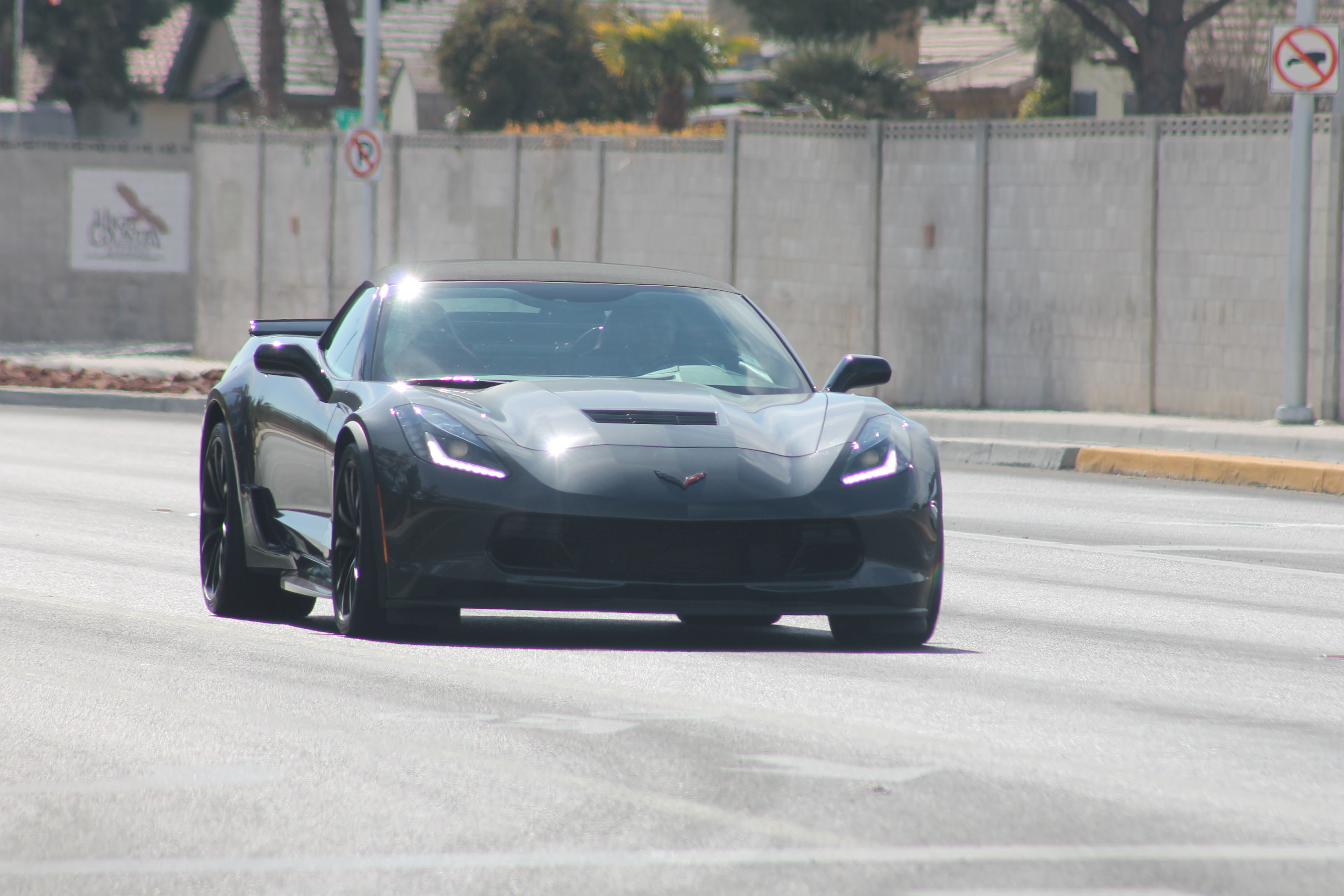
The Chevrolet Corvette is a famous fast car from America that many people love because it looks cool and goes really fast. When someone talks about 'shrinking it,' they might mean making a smaller version of this fast car.
The paddock is like a parking and work area for race cars and their teams at a race track. It's where they get ready before racing and fix things if needed.
Track Mod is a type of racing category where cars are allowed to be changed a lot to go faster on the track. They have special safety gear and parts to help them race better.
Muscle cars are big, fast cars made in America a long time ago. They have strong engines that make them go really fast in a straight line and look cool.
Road course racing is car racing on a track that has lots of turns and hills, not just going around in circles. It’s about how well the driver can handle the car in tricky spots.
The Chevrolet Camaro is a popular sporty car from America that many people like because it looks strong and can go fast. The 1993 Camaro was a version made about 30 years ago and is often a favorite first car for people who like cool cars.
Alignment means adjusting the wheels of a car so they point in the right directions. This helps the car drive better and keeps the tires from wearing out too fast.
Lime Rock Park is a race track where cars compete by going around a set course with many turns. It's known for being tricky because of its tight corners.
LIVE
Hi, I'm Scott, and I'm Seth, and I'm Andy Vogel, and we are track walking tonight.
We have a gentleman who got tired of winning in a Corvette.
So he shrunk it. That's got to be what, like a third of a Corvette, like size and weight-wise.
Size and weight-wise, yeah, for sure. You could probably park it sideways with two others,
and it would be a Corvette at that point. But he traded in the Corvette for a tiny little rush car,
and enjoyed that, I think, but we're going to talk about it a little bit because it is for sale.
I feel like we're just selling cars on the podcast recently. But yeah, anyway, Andy, how are you doing?
Good. Can't complain. I'm enjoying the warmth of Arizona right now,
as I know many of our track friends are not.
It's supposed to be above freezing for nearly 12 hours tomorrow, and that is groundbreaking here.
Literally, the ground might actually thaw a little bit. I'm so sick of it, dude.
Yeah, that's why I moved. So sick of it.
Anyway, I don't actually remember the first time I met you, but I know, like,
that you and I have shared the paddock space for years upon years and whatnot.
Many times. How did you, I guess we can talk about the grid life paddock in particular,
but how did you find your way into that paddock? Yeah, so I was sitting at my desk one day,
and I was in the marketing space for a company called RideTech, and we were trying to branch
out into newer places to advertise and potentially race. They had a racing program there,
and stumbled upon an ad for grid life, and I saw this ad for Midwest Festival,
and at the time, I was pretty big into going into music festivals, and I had just started
getting interested in racing. I was actually semi-professionally playing Call of Duty at that
time. Yeah, 300-pound kid playing Call of Duty, but I saw that ad, and I was like,
I need to go check this out, you know, market research, and so I went to, in the fall,
the rev up was in the fall when I started going. Yes. So I went to that fall special,
I think it was called, at Gingerman. Are we talking like probably 18?
I think it was 2019. Okay. Because so my dad had a C7 Corvette, he let me borrow,
showed up, thought I classed myself in the right class, turned out I needed to be in
Track Mod instead of Street GT. So you know, I ran this lap time, and everybody's like,
coming up to me, and you're like, you're cheating, you're cheating, and I was like,
what the heck? I was like, I'm not trying to cheat. I'm like, this is just my first time here.
But I mean, everybody was nice about it, you know what I mean? Like, yeah,
I forget the guy's name, Ron, something.
Mullet. Yeah, Ron Mullet. Yeah, he walked me through the rules and told me what I was doing
wrong, and got me classed appropriately, and got spanked appropriately. And for some reason,
I just wanted to keep coming back. Obviously, you know, COVID happened. So in that timeframe,
I ended up getting a C8 Corvette, didn't really do much in 2020. And then 2021 was when I started
playing with the C8 in Gridlife, did a couple of events, and just went from there.
I remember that 2019 fall special, because that was the end of the first year of GLTC.
Oh, and it was raining that evening. And GLTC ran at night in the rain.
Well, I think Chris Stewart was shooting fireworks off Spectator Hill. And none of the
racers knew about it until like, we're just on track racing, and then all of a sudden,
massive fireworks. I miss that. I'm sad that I miss that now. Yeah, it was wild that nobody got
seriously damaged. Like they have, it felt like flashlights aimed at the apexes, like you couldn't
see anything. Oh, yeah, no, and that track's not wet. So I mean, you can, I mean, you have your
headlights and that's it. Yeah. And sometimes under glow next to you, that helps. Right. No, dude,
people were spinning on the out lap. Like it was wild, wildly slippery.
That had to be so much fun, though. It was. I mean, that was, again, that was first year. So we've
got, you know, speck me out as we had, you know, old Mercedes, diesels and stuff like that.
But, you know, I was on most, a lot of us were on street tires. There were a few who had Hoosier
Wetz and were doing just fine for themselves. Oh, yeah. Yeah, I was just, you know, trying not to
die. No, yeah. So, yeah, Ron, Ron is a genuinely good character. I kind of wish he was around
more, but a good guy to have run into it your first time.
For sure. Yeah, no. And I mean, I've had experiences in other series like,
I'll go ahead and call it out. Like the old optimal ultimate streetcar series. And I mean,
I don't think I would have gotten the same reaction there that I did coming to grid life,
not to throw shade or anything. But it was definitely a welcoming paddock for sure.
Yeah. What, where were you living at the time? Were you?
I was living in Jasper, Indiana at the time. Okay. I was, like I said, pursuing the call of duty
thing and had an opportunity to move to Florida and actually be a part of something big in that
realm and that space that was kind of forming in that time call of duty franchised and states
had their own teams and stuff. Oh, wow. Yeah. So had an opportunity. I actually ended up passing up
on it simply because, you know, I started dabbling and racing a little bit, started losing weight.
And, you know, at the time I was single. So, you know, 19, 20 year old chasing girls.
And I found out pretty quick that I was getting, you know, more response out of girls, you know,
saying I was losing weight and racing cars than I was, you know, when I was eating Taco Bell at
3am, you know, every day playing call of duty. So I started pursuing it for the wrong reasons
and then ended up falling in love with it. Yeah.
I want to, I want to rewind. I want to hear about this call of duty thing because I've,
I want to hear about everything leading up to it. Like there's, you're like 19 playing call of duty
semi-professionally and then you just grab your dad's C7. There's got to be like years of some
backstory going on here. There is. Yeah. That's what I'm interested in. I want to know where you
came from. I want to know what's going on here. Yeah. So my dad owned a company called Red Tech.
So I've been in the automotive industry my whole life. Red Tech made suspension
components for pro touring muscle cars or any muscle car really.
So he actually ended up starting, I don't know if you've ever heard of the car show
circus called good guys. Yeah. So he started the autocross series there.
And that's kind of like my first introduction into like racing. I took ride-alongs, you know,
with him and, you know, his friends and that paddock. And I mean, it was cool, but I didn't
really think much of it at the time. And then I think part of it too, why I didn't think much of
it at the time was, you know, I started working in his warehouse at the age of seven. So I think
through that, I got this like semi burnt out type thing going on where I was like,
I despise cars because, you know, on a snow day, instead of going sledding with my friends,
I was, you know, in the warehouse putting nuts and bolts and bags and stuff like that.
So I had a little bit of resentment, I think. So yeah, I just, and, you know, eventually,
you know, you grow up and you start to get into your later teens and start, at least I thought I
was getting a grip on life, you know, as you get older every year, you look back on the year before
and you're like, wow, I still didn't have it figured out. But yeah, as I got older, I started
appreciating it more. And then at 16, he let me, you know, out across some of the muscle cars that
they had laying around in the shop. And I thought it was cool. And then I found road course racing.
First road course. How did that come about? Was that magazines or what?
No, my dad was competing in the Optimus series. So they, you know, part of that weekend is road
course, one of the segments is. And I thought it was cool. I thought it was just a bigger
version of autocross really. And then I got to do my first Optima event at Daytona.
So Daytona road course was my first, actually, I take that back. NCM was my first road course
because he wanted, yeah. So he put me in the C seven zero six went to NCM.
How, wait, how old were you? 18.
Geez, that's still, that's a lot of car and that's a lot of turns.
Yeah. And a lot of walls. And, and he didn't give me any insight of that track. So like,
what's, what's the blind blind right hander after the deception kind of deception. Yeah.
So like, he didn't tell me anything about deception. So I run through there, you know,
thinking it's still flat. And then all of a sudden, you know, it turns to the right a little bit.
And that was the first time I almost been to car. But it definitely taught me to, you know,
take an out lap and not go, you know, not go 10, 10 to right out the gate.
So yeah. And then we went to NCM just so I could get, you know, an idea of what I was doing.
We did some lead follow stuff. I think we did like 10 laps. And after that, he, you know,
said I was ready for Daytona. So we, we went down there. I did 180 miles an hour around turn four.
And it was, it was over after that. Ironically, almost died, should have died.
Because, you know, 180 miles an hour, the cars pushing so much downforce that the, the fender
was cutting into the sidewall of the tire. And if it wasn't for Michelin run flats,
I had a right front tire go out on me at 178. And the run flat completely saved the car.
The car didn't move at all. I heard it, the tire blow, car didn't move an inch. And I think I was
more pissed than anything because I was like seven seconds on my Delta. And, you know, of course,
watch it go out the window, you know, and then my dad's manager of the racing program, you know,
he looks at me and he's like, why are you mad? We should be putting you in a coffin right now.
So yeah, but you're, you're going to live forever at that point.
Yeah, exactly. I didn't, I didn't understand the severity of what had just could have happened.
So the people around you had just confidence in you. They're like, yeah, he can handle it. He'll
be fine. Yeah, this seems wildly inappropriate or like reckless. I don't know. I mean, he had me in,
you know, a boat of a Chevelle, a 69 Chevelle, it was a boat. He had me autocrossing on that and I
managed to, you know, never step out of bounds. I always ran clean, you know, didn't really hit any
cones. So I think, you know, there was a little bit of confidence there. I don't know what he was
thinking, to be honest. I really don't. But he was always that way when I was a kid, you know,
he always, you know, let me learn the hard way, you know, when you're, when I was a kid, you know,
I wanted to put my hands on the fireplace and my mom had always stopped me. And so finally, you know,
when she wasn't around, he let me put my hands on the fireplace, burn myself and never wanted to
touch it again. So yeah, there, there is some validity in being hurt firsthand and learning,
learning well. Quick, quick question, because I too worked at my father's business when I was
younger. How was it for you as a young kid working in the warehouse? Did, did the other men and
women like treat you well? They give you a hard time? How, how'd that go? No, my dad definitely,
you know, told them to treat me like any other employee. I got yelled at for, you know, things
that I wasn't supposed to do or, you know, screw ups that happened. If I put, if I missed, you know,
a nut in a bag or something like that, you know, usually the older guys would catch it and, you
know, I'd get called out on it. You know, they treated me just the same as they would have treated
anybody else in there, you know, which, you know, it was harder. But at the same time, I think I'm
26 now. And I think a lot of people that I've met don't realize that I'm as young as I am because
I've, I feel like I've grown up to be like an old soul, so to speak. Yeah, warehouse guys are
something else too. Yeah, yeah, I definitely learned a set of vocabulary that I took to school
and got me in trouble a lot. But amazing. So growing, growing up in the world you did, what
you're surrounded by, I'll call them cool cars, because most everybody would describe them as
cool cars. What was your first car? It was a 1993 Camaro. Yes. It was, I forget what generation
that was, but it was that, it was that real, not, it was the generation before the Catfish Camaros,
but they still had that terrible teal color. Paint was falling off it,
had the 305, you know, one wheel peel car. So yeah, that was my first car.
Yeah, everybody knows that car and that color. Yeah, yeah. So kind of cool, but also not cool at
all. At that point in time, definitely not cool. You know, there's, it was, it stood out, but not
in a good way. So you had all this car stuff going on around you again, like you said,
kind of taking it for granted, but you know, doing the work and
had you been playing video games this entire time, like playing
first person shooters or how did, how did the video game aspects kind of play in?
I mean, I had always played video games, you know, when I was younger, I went to the babysitter and
you know, the babysitter son, he was always playing Call of Duty on his Xbox and you know,
I would play with him sometimes or sometimes he would let me play. And, but it was something
I didn't have at home. So it was like something that I always look forward to. And then so finally,
I saved up enough. Actually, I got an Xbox for my birthday and then that's, you know, but I had
rules, you know, I could only play at certain times, stuff like that. So
played as much as I could. And then I ended up, you know, buying my own Xbox with work money.
And then at that point, I was like, well, I paid for it. I can make my own schedule,
which didn't really work out too well, but I was really good at hiding, you know,
getting on late at night and playing until four or five in the morning and then pretending that
I slept all night. And then, yeah, so like, I think at like age 14 or 15, one of my friends was
kind of competing and he showed me some websites where you could play, you know, at the time,
wager matches where you put, you know, a dollar or $10 on the line and play against other people.
It's like heads of drag racing or something for, uh, yeah, yeah. And so I started doing that and
started getting better, you know, I lost some money, but, you know, I started learning different
things with, you know, playing with the level of guys that were in doing that stuff, you know,
definitely changed every aspect of it for me. And then, uh, started traveling all over the east
coast to tournaments. And, uh, at the age of 16, um, I think like a few months after I just got
my license, my dad, like, let me drive to Philadelphia and pick up a couple of, you know,
gaming buddies along the way, um, you know, from Jasper, Indiana, I think it was like 14, 16 hour
drive. Um, didn't, didn't mind it all as long as I paid for it. Uh, so I would go to Philadelphia,
you know, three, four times a year, uh, and compete in a local tournament called NJ Rod.
And that's kind of where, you know, these kids went to become prospects and, uh, ended up meeting
a lot of cool people along the way. A lot of friends that I think will last a lifetime,
you know, even though I don't see them hardly ever, we still talk every now and then. Um,
but yeah, uh, once I, once I moved to Phoenix, um, instead of Florida, kind of
became boring to me. You know, it was, it was, it was the same thing every day, same,
you're practicing the same map, same game modes. And I think that's why I like racing,
because it is a, it's a change of pace, you know, even though we go to the same track sometimes,
and grid life specifically, you know, like ginger men every year, but it's not back to back to back.
You know what I mean? We're not going to ginger men five times in a row. Right. Um,
so it's not boring in that, that regard. Um, you know, great, great. Yeah.
I want to stay on this video game aspect because I've, I've got some, some questions about it. So
when you started, you know, nothing makes a kid want something like not having it.
So yeah, always like looking forward to something that you don't have is a such,
has such this allure to it. So, so you were playing this game and just like enjoying it
because it was this novel thing. And then you step up to actually like owning it and
grinding is what the kids call it. And you were doing this like to hang out with friends or like
that immense ramp up in time and energy spent on that. What, what was that transition like?
Um, well, it kind of started out, you know, as, you know,
what I would say is shits and giggles. I, I met some people online and we kind of started playing
together and these guys ended up becoming like really good friends of mine. And, uh,
I, that was like the first time I like learned that you can't really team with best friends
because when things go wrong, you start to hate each other. So it was kind of funny,
the four of us decided not to ever team with each other so we could maintain our,
you know, friendships. And, uh, so, you know, the four of us, you know,
two of them ended up becoming photographers, videographers. They went down that route.
Um, and then the other two of us, we played on separate teams. We would get on, you know,
after work, I would get on about 530 and, uh, I would, you know, do scrimmages with my team
at the time. I had a whole separate team that I would play with and, you know,
you're always trying to find like a balance of players. There's different roles, you know,
kind of like basketball. You have a point guard, you have center or point guard and center are
the same thing, but, you know, you have different positions. Um, so finding a mix of four to five
people depending on the game. Um, and being able to have that natural ability to just know what
each other are doing and trusting each other to do their job. Um, you know, you, you go through a
lot of different teammates, I think. Um, and then I found like a set, you know, of two guys where
we all the jive together. So we would always find that, try to find that fourth piece.
Um, so I team with them for a couple of years. We actually ended up doing really well together.
Um, and of course, you know, just like, like I was saying, you know, you have one bad event
where everybody's, uh, kind of there's this streak of bad luck, right? And then you have that one
event where it's like the final straw and then everybody just hates each other and then it
explodes and then you're back to, you know, your solo self trying to find three others.
Yeah. Um, but I would always scrim, you know, three, four hours. Um, sometimes more just
dependent, but at the end of the night, I was always, I would always get back on and with the
original core for, and then we'd play whatever games we wanted, whether we still played Call of
Duty or whatever was hot at the time. And when you're practicing, like what, what are you practicing?
It was at specific skills? Was it strategy?
So there's different game modes, right? So at the time, and my heyday that I was playing,
there was three game modes and competitive rotation. It was one called hardpoint, which is
basically like King of the Hill. Uh, so the hill would rotate throughout the map every 60 seconds,
first team to be in the hill for 250 seconds, won the game. Um, so when a, when a player would
die, right, they would spawn somewhere on the map. So there was one player that could manipulate
bait. They would spawn on a certain point of the map based off where others were. So I could set
myself up in the back of the map close to where the next hill would be. And so we would spawn
closer to there and the other team would spawn further away. So there's different intricacies
like that. There's, there's one game mode called search and destroy where there's two bomb sites.
You start on one side of the map. You either try to plant or defend. Um, so, you know,
there's different lanes to watch, you know, if a person's sitting on the left side of the map
where the bomb B is, and all of a sudden, you know, you see two or three guys from the other team
kind of rushing that site, you would call out to your team, you know, three guys at B or towards
this part of the map. So then they would rotate from A to B, um, or, you know, try to flank.
There was all, all sorts of, you know, it just like basketball or football, you have different
plays, you have different ways of going about the game modes. So yeah, we would just practice.
Mostly hard point was the biggest one. Hard point kind of was the, if you went hard point,
you're going to win the series, the best of three, right? Or best of five, depending on where you're
at in tournament. Um, early stages of the ladder was best of three, later stage, best of five.
But hard point was always played twice in a best of five. So if you can win your hard points,
you have a really good chance of winning a series. So we would always practice hard point for the
most part, um, different ways to break into the hill if you're getting spawned out away from it,
stuff like that. And as you kind of got into this initially, and as you
practiced and progressed, you, of course, I'm sure encountered different players
and different teams that were much better than you a long way. How did you,
I guess, how did you interact with those experiences? Like what were, you know, when you
went up against a competitor who was better than you, what was that like? And then
I guess the second part of this question would be, did you try to seek out the absolute best
to play against? Or did you try to keep it to like a competitor who is just like one step ahead of you?
I think it varied. You know, I think, you know, in terms of going to your second question first,
because it'll lead another first, you know, to start out the day, to start out the day of
scrims, sometimes you would, you would play a team that, you know, was either a step above you or
even a step behind you, because, you know, just like racing, Call of Duty took a little bit of
confidence. And if you could go stomp a team and kind of get your confidence up, you know,
find a good flow, you would feel good going into your next scrimmage, whether it was with harder
players or not. We did a lot of tournaments that's, you know, there was always tournaments every day,
like any day of the week, any day, you could find a tournament. And usually you would find,
you know, really good teams towards the end of these tournaments. And Twitter was the big thing
for gamers, still is. So if you could, I think the mindset when you're playing like these professional
teams, when you're an amateur team, your goal is to be able to get on Twitter and be like,
we just stomped, you know, whoever, right? That was, that was like the fuel, you know, because
you knew in your head, if you could beat that person, and then you look at their record of
people they beat, then you're like, you start having that mindset of like, I can do this,
I can beat them, I can beat these, you know, the best players in the league, whatever, right?
So that was kind of the fuel. And I mean, don't get me wrong, whenever we would go up against like
signed professional teams, you know, I would say probably seven times out of 10, we'd lose.
But the nice thing about Call of Duty, just like racing is we have data, you know, we would go back
into the feeder mode. We would watch what they did. We would see what we did wrong.
And, you know, make adjustments accordingly. So you were, you were doing game reviews.
Yeah. That's amazing.
Yeah. I mean, it's just as intense as anything else. I think a lot of people knock it because,
you know, it's just a controller and some sticks. But it was, there was a lot of,
you know, in-depth knowledge and outside of just gaming and playing the game, you know,
there was a lot of footage to be watched. Even on the days that you did good, you know,
you look back and see why you did good. So yeah.
And that desire to want to get better, had you, was that just part of who you were or did that
only come out when you started getting kind of serious with Call of Duty?
Actually, I talked to my therapist about this at one time. So in school, when I was in school,
you know, I was, I was a terrible student, right? Getting into trouble a lot, never the best grades,
unless I liked the teacher. If I liked the teacher, I would work hard to have a good grade in that
class. But I had a number of teachers that I think I had one specifically telling me that I was
probably going to amount to nothing. And so like, you know, going through that, you know, in high
school, middle school, you know, for however many hours you're in school, six, seven hours,
you know, I always had that mindset or that precedent put on me, which I think, you know,
put a little bit of a depression spin on my childhood and that degree. So anytime I could
do good playing Call of Duty and find success, it made me feel better about myself. Yeah. And I
think for me, it was like a way of proving them wrong. And I think that's what really fueled it.
I don't, I don't know if it was the right fuel, but it worked. Yeah, heck yeah. It was, and even
in the Call of Duty world, you know, there's, you obviously make rivals. It was definitely not as
friendly as the racing community. You would make rivals like, like for example, you know, in the
racing world, you know, me and Edo Waxman had this rivalry. But we always talk to each other. We have,
you know, a huge amount of respect for each other. But I had a rival when I was playing Call of
Duty and this kid's name was Joey, and we would slander each other. We'd, we'd try to, we did
nasty, nasty things to each other, right? You know, called each other. We would make Twitter posts
about each other. There was no respect. And so like part of that too is like, you want to be better
than that guy. I always wanted to be better than Joey. So there was always that, I guess,
trying to be better than somebody. But as I, as I grew up, I figured out pretty quickly that
collaboration is a lot better than, than not collaborating.
Yeah, there, there also seemed to be some sensitivity there too, right? Because if
you got along with a teacher, you'd work hard for, for them, it sounds like.
Yeah. For sure.
But if a teacher puts you down like the one did, some students would rise to that occasion,
like the whole fuck you attitude, I'm going to prove you wrong. And it sounds like you didn't,
you, like you took that to heart and you found, you had to find an outlet for that. So it wasn't
like a screw you, but like you, I mean, it hurts you. There were, there were things going on.
I'm not like an astrologist or anything like that, but I'm, I'm born June 30th, so I'm a cancer,
right? And cancers, according to my girlfriend, are traditionally very emotional.
And that's me. I do take things to heart. You know, if somebody says bad things about me,
on the surface, I might let it go. But yeah, deep down, you know, I felt it.
I'm definitely better, I think nowadays at not holding onto it and kind of just letting
it brush across my shoulder. It took some time for sure. But back then, definitely would hit harder.
I don't know why. I don't know why I was incapable at that time of letting things go.
But I found my, found my path. So from the age of 14, through the age of 19,
you're pretty much all into this gaming,
competitively gaming, getting better. It's five years. So by the time you're 20,
you'd spent more than a quarter of your life playing a game, playing a game. I mean,
it's, and I'm not, I'm not shitting on that. It's, oh yeah, no, yeah. I'm, like I said,
I made friendships that I think will last a lifetime. I don't have any regrets about it.
Yeah. Did it make my childhood a little harder? Yeah, because gaming wasn't cool like it is now.
For some reason, now it's cool. But I would wear these team jerseys or sweatshirts and get made fun
of for it. That was the one thing I didn't really care about because I was passionate about it,
right? I think if I'm passionate about something, even if somebody tries to knock my passion,
I don't really care. I didn't care. There was a team that I always wanted to be on called
OPTIQ Gaming and I would wear that hoodie every day and people would make fun of me for it,
but I didn't care, you know, because like my vision was like, you know, what if I make it on that
team someday and you know, I'm living in this team house and like sponsored by Chipotle and stuff
like that, you know, that's what I was thinking towards.
So when did this experience start to turn for you? Because it sounded like it was such,
like it's not only like what you did and how you spent your time and energy and some money,
I assume, on this whole thing. But when did it start to, I don't want to say sour, but it obviously
lost some of its charm. Yeah. Competing got to a point where I think I just got burnt out on it
and I like lost the fun aspect of it, right? I wasn't having fun and in that fifth year,
I find this this group of guys that I tried to compete with and I really enjoyed like hanging
out with them. But they weren't really as motivated as I was. But for some reason, you know, I still
like playing games with them. I had a lot of good moments with them. And I think, you know, we started
playing other games and like started taking it, you know, if we did play Call of Duty, we wouldn't
really take it serious. And I started to enjoy it again, because, you know, we'd have, you know,
drinking games. Even I was I was totally 21 when we were doing this. Yeah. But, you know, we would
play, you know, these games in between us, you know, if somebody died, you know, you took a shot
and it just made it more fun. So it took that seriousness aspect out of it. And I started
really enjoying myself. And, you know, COVID happened. And, you know, that's all we could do
is play video games. And so, you know, I kind of found my love for it, you know, hanging out with
this, you know, core group of guys. And, you know, I got invited to their weddings and stuff like that.
But, you know, when I was gaming with them, it didn't have to be serious.
So, I think that's why I stepped down from the competitive side of things. Because I was having
more fun just hanging out instead of competing at such a high level.
Yeah. And you definitely don't have to defend yourself against us for making friends online.
I still talk with car forum friends from 2006, 2005.
It's wild because I remember even like making fun of myself at the time. It's like, yeah,
my internet friends, you know, it sounds totally dumb. And it's like, it's like, oh, have you,
where, you know, where did you guys meet? It's like, oh, I haven't met them. Like,
it's like, they're some of my best friends. I am. I got lucky. I got to meet most of them
that I was hanging out with, you know, just by going to gaming tournaments or
going to just a competition with them to watch. You know, there was a trip to Vegas,
you know, stuff like that. So, I mean, yeah, internet friends can be some of the best friends
that you ever meet. So you find your love for it again. You find the enjoyment and that,
I think, interestingly leads you to want to step down your involvement in it, which I think at
least for me is almost counterintuitive because if you found like the fun and join it, why not
keep doing it? But you had like worked to such a level in competition that
not doing that stuff anymore was the fun part. Yeah, the playing the game not seriously was fun.
You know, not having the chip on your shoulder. If we lose this match, you know, I'm going to
feel bad about it. You know, I started to learn to not feel bad about it. You know, we'd make fun
of ourselves for the stupid things we did instead of criticizing. So I think it was just a different
aspect to it. Don't get me wrong, like I'm a competitive person by nature. Even if I,
you know, pick up the game nowadays and we start playing around, you know, I feel a little bit of
a competitive edge where instead of sitting back in the seat, I'll kind of start leaning forward
again. So I mean, that's always going to be there for me, that competitive nature. But I also
know that's not what I want to do anymore. I can 100% listen to this conversation and in the
back of Scott's brain, he's going, wait, can I drive cars for fun? Yeah, of course I can.
You can see him bleeding off your experience and being like, wait, something that's very serious
and important to me can someday be fun again. This is an inspiring true life
I was about to roast him because he found the fun in gaming again. So you had to go find
competition elsewhere. Yeah. Enter cars. Yeah. Well, it's interesting drug habit with another one.
It's interesting that Seth brought that up because like I'm honestly, I'm at that stage with racing
too, where I... It's been about five years. It's been about five years, ironically. Yeah.
You know, I take racing to heart just as much as I did with Call of Duty. You know, if I don't,
if I'm not on the podium, I'm fuming, right? You can ask Peter Zhang. He's seen me in my lowest lows.
So yeah, I'm trying right now to find this balance again, where I can have fun
and not worry about my results so much. But I'm still competitive. If it's not at least the top three,
I'm just not happy with myself. Don't get me wrong. We get to compete and arguably, in my
opinion, the best sport in the world, certainly my favorite. And there are some days, I think,
I have to pull myself back a little bit and realize the things that I get to do
and not be so upset about it. So I think now that I'm older, even though it's the five-year
mark, right? I think I've learned to take that step back and appreciate that I get to do this.
But at the same time, I'm a racer just as much as you are. I know you want to win just as
bad as I do. That's racers at heart. I envy the people that can race and just have fun,
like Ron Mullet, right? Ron Mullet can get in a car, go fast. He may not be the fastest guy out
there, but he doesn't care. He's vibing, right? I kind of envy that to a degree of like, if I'm
not fast, I'm pissed. But again, like I said, you take that step back and appreciate the fact
that you get to do this. And do you think that's what was missing from your Call of Duty days?
Was just not appreciating it, stepping back to say like, I get to do this?
I think it was different for Call of Duty because I was trying to prove a point that I could turn
it into a full-time job. So if I didn't get results, I think that hindered the potential of
doing it full-time, right? Obviously, I had a lot of criticism from my parents because I mean,
gaming back then, it was kind of like in its infancy in terms of like these sponsorships
and partnership deals. And now you see streamers that are like sponsored by big companies that
are paying them six figures to drink their product in a stream, right? It was kind of in its infancy
to that degree when I was playing. And I saw the vision of where gaming was going, but my parents
being a little bit older, they couldn't see that. So there was that pressure, I think,
where I was trying to prove to them that I could make this a job. And anytime that I didn't do good
or I didn't win money, it hindered it. And then it's like, okay, are you going to go to college?
Are you going to do this? Because obviously, this isn't working out. They would even call my guidance
counselor and he tried to convince me to do things that on the surface I thought I wanted to do.
I almost went to culinary school to become a chef, but stopped myself because I knew
ultimately five years down the road, I probably wasn't going to be jiving with it.
Yeah, you want to talk about a competitive atmosphere?
Yeah. Yeah, no doubt.
All consuming.
Yeah. So I think the difference between gaming and racing for me is I'm not trying to,
don't get me wrong, I think all of us would love to be in Emsa and getting paid to be a
Porsche factory driver, right? Like who wouldn't want to do that. But I think there's some realism
built into me now. To get that, and we all know it, to get to that level, it doesn't just take
talent anymore. It takes a number of other things, whether it's money, followers on Instagram,
you name it. So there's the realism factor that I think that I've grown into. And so I think
that's where the difference between how I just quit gaming, not quit, but I gave up the competitive
aspect. I don't think that'll happen with racing. If I get in a car and the visor goes down,
I can be outside of the car and tell myself I'm going to have fun, but as soon as I put the helmet
on and the visor goes down, you're back in that tunnel vision, you're back in that kill or be killed
mindset. I ended up watching Rush the other night with my girlfriend because I'm trying to get her
to understand my mindset a little bit. And there's a quote, I forget it was James Hunt,
I think it was James Hunt that said it, but it's like you're playing chicken with these other
drivers. You know, you've got that fire pilot mindset. I think that mindset is hard to give up,
right? Like that feeling that it, I don't think I'll ever give that up.
So you transition from that first week into 19 from even being in the wrong class initially.
You bought a C8, right? A lot of car, a new car, and you enter street GT with it.
How was your progression over the seasons with that?
So 2021 was my first like season doing four events and chasing quote unquote chasing the
championship, right? Didn't make any modifications to the car at the time other than tires and wheels.
At the start of 2021, I went to an Optima event before a grid life event and met the fine folks
of Langenfelter at the time, Mark and Linda Rapson. And you know, just talking with them,
I did pretty decent that first week in an Optima and I was the only C8 there at the time. Well,
my dad had a C8 too, but I was faster than my dad at that point in time. So they approached me about
doing some development stuff. Nothing really happened right away because the car was new.
So they were still in the development stages, but you know, once they had things developed,
they wanted to test them on the car. So I think I got like an intake towards the end of that season.
But, you know, I was new to racing. I didn't understand alignment. I didn't understand,
you know, shock settings. So I was kind of infant. And then as years progressed,
I always thought that I could do better. And for three years in a row, I got third in the
championship. And after that third year of getting third in a row, because I was really
close to getting a second for the first time. I think that I had a mindset change where I was
going to put everything into it. You know, I was going to put my full focus into it. That's that
same year that I got third for the third time in a row. I ended up, before the grid life season
started, I was friends with a guy named Garrett who knew Devin Hoffman, one of your students.
And we were at PRI. And he told me he's like, Hey, I'm going to go to dinner with one of my friends.
She runs grid life. Like, do you know her? And I was like, I heard of her. I don't know her,
but I'd be glad to join you for dinner. And so I met her. And we became friends. And that first
year was 2023 at CMP. She had just joined Tony Barber and turned in concepts. So she's like,
you should just come paddock with us. So I met Peter Zhang for the first time. He actually tried to
kick me out of his, his paddock because, you know, he didn't realize I was supposed to be there. He
didn't realize I was Devin's friend. That sounds right. Yeah. And like looking back on it now,
like I would have never thought in that moment because like Pete, Pete has become one of my
best friends. Like I call him probably at least once a week, if not more. So yeah, I met all
those guys and like, I didn't really, you know, I was just kind of hanging out with them, you know,
I was included, but like not on the team, I don't think. And then at the end of 23, Tony hauled
my car to Laguna Seca. And I was starting to ramp up a little bit in terms of, you know, my work
life. It was getting harder to, because I was living in Phoenix, so I'd fly to Indiana where
me and my dad's shop was to prep the car. And then I would drive the car to and from events.
So I would drive it 14 hours to, you know, Lime Rock Park, and then drive the car home
after racing it. So, you know, there was that level of like, I can't crash this car because
if I crash this car, then I'm not going home, right? So, you know, Tony, a person with an
opportunity where he would take care of prep. And then that's when I learned the importance of
alignment. You know, Tony, Tony looked at the alignment after that car of the car after Laguna,
and he's like, dude, what is this? And I was like, I don't know. And so once he, you know,
kind of shamed me on it, I started looking things up. And then, you know, I started sim racing with
Pete, you know, in iRacing, you have all these settings, right? So, you know, Pete starts teaching
me a little bit of alignment. I started toying it with it myself. And yeah, Adam said it once,
you know, I strategically aligned them, aligned myself with them. And it was, it really just
happened by accident. But yeah, after working with Tony and Pete, the car became a whole different
animal. And, you know, that year in 2024 was the year we shined and ultimately ended up taking the
championship. Yeah, you were, did you sweep that year? Almost. It makes me so mad. So,
not enough domination. Yeah. Edo got me at Road America. And I mean, not for the lack of trying.
And I know how hard I pushed at Road America. I almost bend it in the kink on that second.
What do they call podium sprint lap? Really, really could have got cross up there.
God, I do remember that. Yeah. Yeah. Yeah. So, it wasn't for lack of trying.
But yeah, he got me once. So, almost, almost a full sweep. But I actually, the one thing
that's cool about that year, I guess, is me and Jackie Ding are tied for having the most records
in a season. That's pretty cool. Yeah. So, I almost got Jackie's record of having the most
records if it wasn't for Road America. Yeah. Edo. Yeah. But then, so you win that year and
you decide you're done with, you're done with your C8?
Well, yeah, but it was a culmination of things that led up to it.
Yeah.
Things at Langenfelter were changing. So, I didn't have the development aspect or, you know,
I wasn't doing anything for them anymore. There was a change in the upper management. So,
you know, we decided to go our separate ways. So, there was that aspect to it.
Obviously, I was doing a lot of sim racing with Pete and Osamath Mohamed who runs in GLTC.
So, you know, I started, you know, growing into the fender to fender stuff. Tony Barber,
you know, they run a champ car team with turning concepts. And he started inviting me to go out
to those and got to have, you know, some real fun doing that. And I think that's when I started,
you know, falling into love with wheel to wheel racing. And then everybody, you know,
Pete and Osamath, they were in GLTC. Rush was kind of new. We had our opinions of Rush. You know,
we kind of wanted to show up, you know, these grassroots guys wanted to show up to the steak
and champagne party and, you know, kind of kick the tables and, you know, when that was our mindset.
And, you know, we were half successful in doing that. So, yeah, that was kind of like the push
factor to go to Rush. You know, I wanted to do wheel to wheel and I wanted to do,
I didn't really want to compete against Pete and Osamath because ironically, it's that same
Call of Duty thing, right? Where I didn't want to compete against my best friends. Interesting.
So, I went to Rush route and it's a pretty good first year. I can't complain.
Did you, had you always been interested in wheel to wheel or like, but through
Pete and Osamath, you, you were like, oh, this might actually be interesting.
Yeah. Yeah. I mean, we would do some races. And I mean, I know a lot of people knock the
bit, but I think it's a great tool. Sure. Sure. It's a different way of driving, I guess.
But it's, you know, you got the competitive aspect. You still got the driving aspect.
A lot of the simulators nowadays, whether it's iRacing, Le Mans Ultimate,
Cedro Corsa, you know, they're getting better and better by the year in terms of accuracy of realism.
So, yeah, I just started wheel to wheel racing with them and
started paying attention to IMSO, started, you know, I liked the endurance racing,
don't get me wrong, I love F1, but I love the endurance racing more.
So, I mean, even though GLTC, GLGT and Rush, you know, that's not endurance racing, it's still,
you know, wheel to wheel and it's fun. And not to knock like the people in a champ car,
but it's more competitive, you know, you're fighting a lot harder. I think Gridlife, I mean, is,
I'm not, obviously I'm a Gridlife guy, but I think Gridlife is the absolute pinnacle
of grassroots motor sports. I mean, that is, I mean, frankly, I mean, I think you could take
the top 25% of drivers in Gridlife and take them to IMSO and there would be a lot of surprised
looks because the level of talent, you know, between, you know, you guys and GLTC,
you know, for sure, you know, top 10, top 20 drivers really could go to IMSO and I think
really open up some eyes if they had the budget or the resources. Yeah, that would be cool if
there was a more direct line. Yeah, that's, that's the unfortunate aspect of our sport right now,
I think, you know, the companies that want to spend money on motor sports
aren't necessarily worried about the result. Obviously, I think they want them to do good,
but it's numbers, it's corporate, I've worked for corporations before, right,
and it's all numbers to them, it's numbers on a spreadsheet, how many views is this
person going to get us? And what is my ROI? There's very few team owners or companies that
I think are looking at talent and putting people in seats that deserve to be there.
I'm not saying that there's people that don't deserve to be there, but I think there's people
that get seats based off certain parameters of social media or whatever it is.
You know, if Driver A has a success rate of winning, you know, call it 30% of their races,
right? But then you have Driver B that wins maybe 5% of their races, but they get a million views
as to where Person A gets, you know, call it 5,000. They're more likely to take that 5%
chance of winning and get those views than the other guy, right?
Sure. Yep.
So it's a weird time. I think I would wish that more team owners would look to Roger Pinsky,
because I mean, who's the top driver in that Southern car that won Daytona?
Felipe Nazar, right? Felipe Nazar, like, that guy was all talent. And you know, like they said
in the broadcast this year, they met in a parking lot at a mall and Pinsky signed him. And I mean,
he didn't have a massive following or anything, but he had the talent.
So I definitely wish there was more Roger Pinsky's out there.
So you decide to do Rush to not have to compete against your friends?
Yep.
And Rush was just coming into its, was it its third year at that point?
Second year.
Second year. How did it go for you? What was your experience like, you know,
with the competition aspect and with the performance mindedness that you brought to it?
It was definitely eye-opening. You know, we probably had our heads up our butts,
me and the team kind of going into it because we just had this dominant year.
And part of the other factor too is I had heard some gremlins that, you know,
I had one street GT because it was just a car. So the fact that it was spec kind of interested me
because it was that way of proving that, you know, I can be fast and not just the CA Corvette.
I'm seeing a trend here with the proving of things.
Yeah. It's a bad habit, I guess.
So, yeah, I wanted to do the spec series and kind of prove that wrong.
And I think we were pretty successful at it. You know, the first seven races,
we got second behind Ryan Leach. And there was many times where it was pretty close between us.
So, you know, we were fast out of the gate without even knowing the car.
And then, you know, Gingerman rolls around for Midwest Fest. And we still got,
you know, a podium at Midwest Fest. But that's when we started really learning,
you know, how to take care of the car. And like we were making mistakes.
You know, we put too much, you know, oil in the engine. And all of a sudden,
it's not making the same amount of power that it was. And, you know, I'm thinking, you know,
the motor's bad. But, you know, it turns out it, you know, Chris Guevara ended up calling us out
at Road America because we were down like 10 mile an hour and just getting eaten up.
And we were chasing the problem, chasing the problem. And Chris was like,
oh, is there too much oil in it? And we let some of the oil out and boom,
all of a sudden we're fast again. So, you know, there was just, you know,
learning curves, I think, that, you know, hindered the potential of doing better than what we did
ultimately. I mean, don't get me wrong, second, first year in the car, not complaining,
I would call that a success in a competitive spec class.
And a very competitive spec class. I mean, there's guys, you know, Ryan Leach to his own degree,
you know, if he had, he's another one of those drivers where if, you know,
he got looked at by Roger Pinsky type deal, I think he would have a real good success rate
in any kind of professional racing. And then you got guys that have had it, right? You know,
Blair Hosey comes from a very successful go karting background, even did some formula
stuff in Europe. You know, James French, you know, he's won 24 hours before, he's won,
you know, multiple prototype championships. You know, he's a phenomenal driver, actually
learned more from James, I think, this year than anybody, just in different, you know,
we went into turn one side by side at Lime Rock Park, for example, and I had the inside, he had
the outside. But, you know, the way that Lime Rock is, you know, when you're exiting kind of one,
two, you want to run out, but he kept me pinned to the inside so I couldn't run out. And, you know,
of course, you know, the next corner turn three is, you know, he had the inside and I mean,
I was game over at that point, it's, yeah, it was game over, you know, he had the inside. And,
you know, if you get on the outside of turn three at Lime Rock, you're in the dirt, you're not going
fast. So that, that keeping the person pinned to the inside so they can't run out, you know,
that was a learning moment for me. So I, I'm very thankful and grateful that I did rush,
because I learned more about wheel to wheel racing than I did in the sim. But now,
after having this experience, I'm now going into the sim and like, you know, when we do 24 hours
of Daytona, the iRacing one and Pete and I were practicing the same deal, we went into turn one,
I kept him pinned to the inside and, you know, got the pass off and he's like, what, what, what? And
I was like, yeah, James French taught me that. So it's, you know, and but I get to pass that
knowledge down to him now, you know what I mean? So I'm kind of excited to watch Pete in this next
GLTC year to see if he might make that move sometime. Yep. But I mean, not just rush though,
I mean, look at GLTC, look at GLGT, you know, even, even the guys running club TR, right?
They're all incredible drivers, you know, the top three in any class are, if you look at their
video, they're, there's something to them, they're special. Yeah. Even, even, even outside of the
top three, I mean, grid life is so competitive, you can look at the top 10 in each class or of
anything and be impressed by them. Yeah. Yeah, kind of drivers that, you know, if they take a step
back and just go do a normal HPD and all of a sudden it's like, oh, yeah, yeah, you measure
yourself with a different yardstick and it becomes apparent for sure the waters that you swim in.
Yeah. So what's next? Because I did see a for sale sign with your car on it.
The rush is for sale. But that was simply, we are going to say on rush next year.
Same car?
No, I was trying to get a newer car that had the halo already on it. But I'm starting to,
after conversations with, you know, some other teams and stuff like that about, you know, the rush
market, so to speak, right? Probably just going to stick to just upgrading this car unless I can,
you know, get it to sell in the next two weeks. But yeah, it was, it was primarily only because
I wanted a fresh car. You know, we always, we had some stuff, you know, bolts and stuff,
they rattle loose and stuff like that. So I just wanted a clean slate, so to speak,
to where we didn't have to worry about some stuff. And I was really hoping to just,
you know, get the car off to, it's Russia starting to grow out here in Arizona at some of the club
tracks. So I was really hoping, you know, one of these guys would pick it up and just start
toine around with it. That didn't want to be competitive or anything. So that was the main
reason of selling it was just to get a fresh slate. But I think we'll start putting the halo
on the car and start upgrading it and just getting it buttoned up for this year. And then we'll see
what happens after this year. I love the rush community. I've loved the friendships that I've
gained from doing it, you know, especially with, you know, some of the guys that I mentioned, you
know, I really enjoyed talking to Blair Hosey and getting his insight in terms of, you know,
his experience in racing and how he goes fast. But it's a fun class. Do I want to be there in five
years? I don't know. They are having, there's plans to make a new car that sound pretty interesting.
The faster one? There's a faster one in the worst. I don't know how much I can talk about it.
Because I went and did a test with Blair actually at Podium Club here in Arizona. And
him and Alan Schrammer, the president, they were showing me some stuff and I was like,
so I don't know how long I'll stick it out. I'm definitely doing it, you know, and this year
in 2026. But I'm also eyeing that GLGT field a little bit and might, might try to go play around
in there. Yeah, like in like any sophomore class, I think it's about to escalate this year. And I
think certainly by year three, it tends to hit its stride. Yeah, I agree with that. I agree with that.
So you're going to bring the C8 back and put it in GLGT?
I was, I was really paying attention to Aaron Lichty and how he did with it. And like when
I looked at the car, you know, it kind of inspired me a little bit because he did a phenomenal job
of building out that C8. And it was still pretty basic for the ruleset. It was. Yeah. And he did
great with it too. So maybe down the road. But, you know, at the same time, I also talked to PRI
and talked to you at PRI and, you know, mentioned the coaching role, you know,
still dabbling with the, like we talked about, you know, with the gaming thing where I
found it not to be fun. I'm still dabbling with that, but I'm trying to trying to push past it,
I guess. I know, I know for a fact that I will always want to be in motorsports,
but, you know, maybe taking a year of coaching or more might, might help. I don't know.
So 2026 is for sure a lock in. 2027 is definitely a big question mark for me.
But we'll see. And you never know. I mean, there's always opportunities that open when you lose
expector, right? Right. Yeah. It'll be interesting to talk to you this season to see how you are.
I don't, it's not coping, but how you're managing with, because coming into a new season with that
question already on your shoulder, that can, that can go one of many different ways. And so it'll be
interesting to see how you kind of wrestle with that and settle as you kind of go through this next
season. I think I've already thought about it a little bit. You know, I think the whole coping
thing with it, I think I need to leave some of it in the helmet, so to speak, right?
I think, you know, in my current mindset and the way I handle myself after a tough race,
you know, I've, my girlfriend lives with me now, so she gets to see it, you know,
after I get home from a tough race, you know, I'm pretty down on myself, you know, I'm not the
same happy person that I normally would be. So I think after all the travel and after all that.
Right, right. You know, so I think for me, it's more of finding how to leave it in the helmet
and, you know, come home and, you know, get away from the racetrack and, you know, still be a happy
person. Yeah, it's just that balance, right? You know, but I'm sure like I think you could relate
to this, you know, whenever you have a bad race, I'm not sure how it is for you when you get home,
but, you know, on the surface, you try to act like you're not thinking about it, right? But
in the back of your head, you're, you're replaying everything in your head and you're,
you're overthinking it, you know, what if I did this, even though like you can't go and change
the past, right? And you're, there's always those what ifs and I think that's where it is,
right? I need to not do that. I don't know how, what's your experience in that regard?
I'll say that a bad weekend bothers me for a week, like I spend a whole week and it can
be if I'm doing endurance racing and then sprint racing, like if I have one bad sprint race,
it'll bother me. The whole rest of the weekend can be great. Great. One bad sprint race will
bother me for a week. And if I could shrink that down to like two days, it would be a huge thing.
Right. Well, I think like Seth said that that's a, that's a good point that progress can look like
six and a half days. Yeah. Over a week. Like that, that can be progress, you know, it's
right. The, the quote is, you know, perfect as the enemy of good. So it's like getting rid of it is
I maybe not even desirable. For me, it's, it's was a progress over probably three or four years
where early on, you know, really wanted to be competitive and, you know, kind of get in there.
But of course, always, always having had a limited budget to be able to, you know, do
anything with the car and stuff like that. Right. Always a struggle. But of course,
in the shark infested waters of GLTC, you get beat down enough. And, you know, I just kind of
started believing that that's where I belonged in the field. And so the, the results that weren't
what I had hoped just became like reinforcement of, oh, maybe this is my ceiling sort of thing,
which spoiler alert is not the case. But like, again, if that's all you do,
that's all you get to experience. And so driving other things, driving in other places like you
do with the endurance racing, right? That can be a way of practicing a different mindset
and bringing some of those lessons in rather than just beating your head up against the same
wall over and over and over. If you put yourself in a different place, try to be a different person
for that day, that weekend, whatever it is. And like, take the good, dump the bad,
figure out what's next. Right. So there's always, there's always that self-doubt that creeps in.
And there's bad performances, right? So yeah, I mean, you nailed it. You think you found your
ceiling, but then all it takes is, you know, one, one mishap to be like, oh, that wasn't the ceiling,
right? And honestly, I think a lot of people don't look at this factor of racing sometimes,
you know, there's some luck involved, there really is. Granted, there's people that find it more than
others, right? But it's just, it's with anything, there's luck with anything, whether you're playing
the lottery or whether you're looking for the next job, there's always those right place,
right time or wrong place, wrong time, moments. And I think there's cases in racing where you
have to look at that and not be hard on yourself, just knowing there's nothing that you could do
about it. Yeah. And that's part of why I often think, especially in wheel to wheel, if you come
saying, I want to be like P five or better. Man, that's a bad goal.
For sure. Because who's going to show up? You know, did they practice more than you?
It's, you don't get to control so many things in wheel to wheel. And so really the best you can do
is the best you can do. And then the rest of it, like, you know, I got to learn on the one lap,
which was kind of my, my introduction to competitive motorsport is it is a lot of luck,
luck of the draw. It may, it may rain for your session only, which I've had happen.
Yep. And sometimes you're the only dry session, which I've had happen. It's like,
it's going to come around like, do the best you can, but it can be hard in the moment, for sure.
Yes. Yeah. Most definitely. So you got rush coming up this year. Are you doing more endurance racing?
I do the tracks that I like. Rotolana is my favorite track. So we just did champ car at
Rotolana this past weekend. I saw that. Yeah. That's, that was always fun. So yeah, I mean,
Tony, Tony and Greg, the guys that I run champ car with, they always offer me, you know, spots at
events, but I typically will do the tracks that I like. Nice. So we'll see. I would, I would like to.
Obviously, I would love to go do WRL and stuff like that, but, you know, spending
in $25,000 for one weekend when I can spend, you know, $25,000 and do, you know,
anywhere from half to three quarters of a grid life season, I think I'd rather take the grid life
season. We call that value for money, I think. Yeah. Yeah, exactly. And I mean, frankly,
again, not trying to praise grid life, but, you know, I've, I've made a family there, right? You
know, I get to see you in the paddock. I get to, you know, talk to you every weekend at grid life.
I get to talk to Jackie Ding. You know, I've, I've made a, what I call it, you know, the track
family, you know, Kyle Hire, always love conversating with him, Adam. I don't necessarily
know people like that, whether it's WRL or anything like that. So I think there's that
aspect to it too. I, I enjoy the company that comes with the grid life. So
the sense of belonging is a, it's a big deal. For sure. For sure.
Well, thanks for, thanks for hanging out with us
for a while. Anytime. Pouring your soul out. That's a, that's great. No, I, I enjoy talking
about it. I think, you know, there's more people that deal with stuff like that than we think.
Um, you know, I'm, I'm, I'm person that, you know, my girlfriend, she always tells me that,
you know, I hide too much from her and that's the truth, I think for a lot of us, you know,
where you, we want to seem strong on the outside and not a lot of us are, don't get me wrong,
but I know a lot of us deal with, you know, those mental battles too. So for sure.
Well, where can people go to follow what you do and learn more about all that?
Yeah. Uh, just look up my name, Andy vocal, A N D Y V O E L K E L that is my name on pretty
much all social platforms. Nice. Anyone do you need to say thank you to or say hi to
hi mom? Yeah, uh, for sure. Uh, you know, thank, well, thank you to my, my parents and my girlfriend
for the continued support. They always, uh, they always got my back and a huge thanks to
all the friends that I've made in this motor sports world. Um, you guys make it more fun
than what it really is sometimes, you know what I mean? Yeah. It's like, well, looking at the
pictures after an event, you're like, uh, yeah, that, that looks cooler than it felt like at the
time. For sure. For sure. Especially. Yeah. No, there's those, a lot of people, uh, a lot of,
I think speaking about track photographers real quick, I think, you know, obviously the shots
on track are cool, but the paddock shots, those really tell the story. Yep. That's, uh, I tell
the photographers that it's like, you know, I'm not on track much anymore, but like, if you get
shots of a round paddock with us, like I will pay for those. Those are the good ones. Speaking of, uh,
you being on track, are we going to see you on in a car again soon? Well, I'm trying to sell my car
right now. Um, so it depends on if that goes or not. Um, if it doesn't, I'm, you know, I'm still
going to be driving it for as long as I have it. Um, oh yeah. Yeah. It's an upcoming episode,
probably in the not too distant future. Um, my spouse will be, uh, getting out there more than,
more than I will this year. She, uh, she wants to try. So. Nice. Yeah. Well, if you ever, uh,
if you ever feel like jumping in a rush for fun, let me know. I will always take an opportunity.
I appreciate that. Of course. Well, thank you, Andy. I do appreciate your time and, uh, sharing
all that. Uh, you can for having me. Absolutely. Uh, you can find us at track walking podcast
pretty much everywhere. Click the discord link. That's where we like to hang out these days.
And, uh, thanks for listening and you know, like rate review, all that good stuff for the three
of us. Comment and subscribe. Smash it. I'm Scott. I'm Seth. I'm Andy. Have a good week. We'll talk to
you next.
About this episode
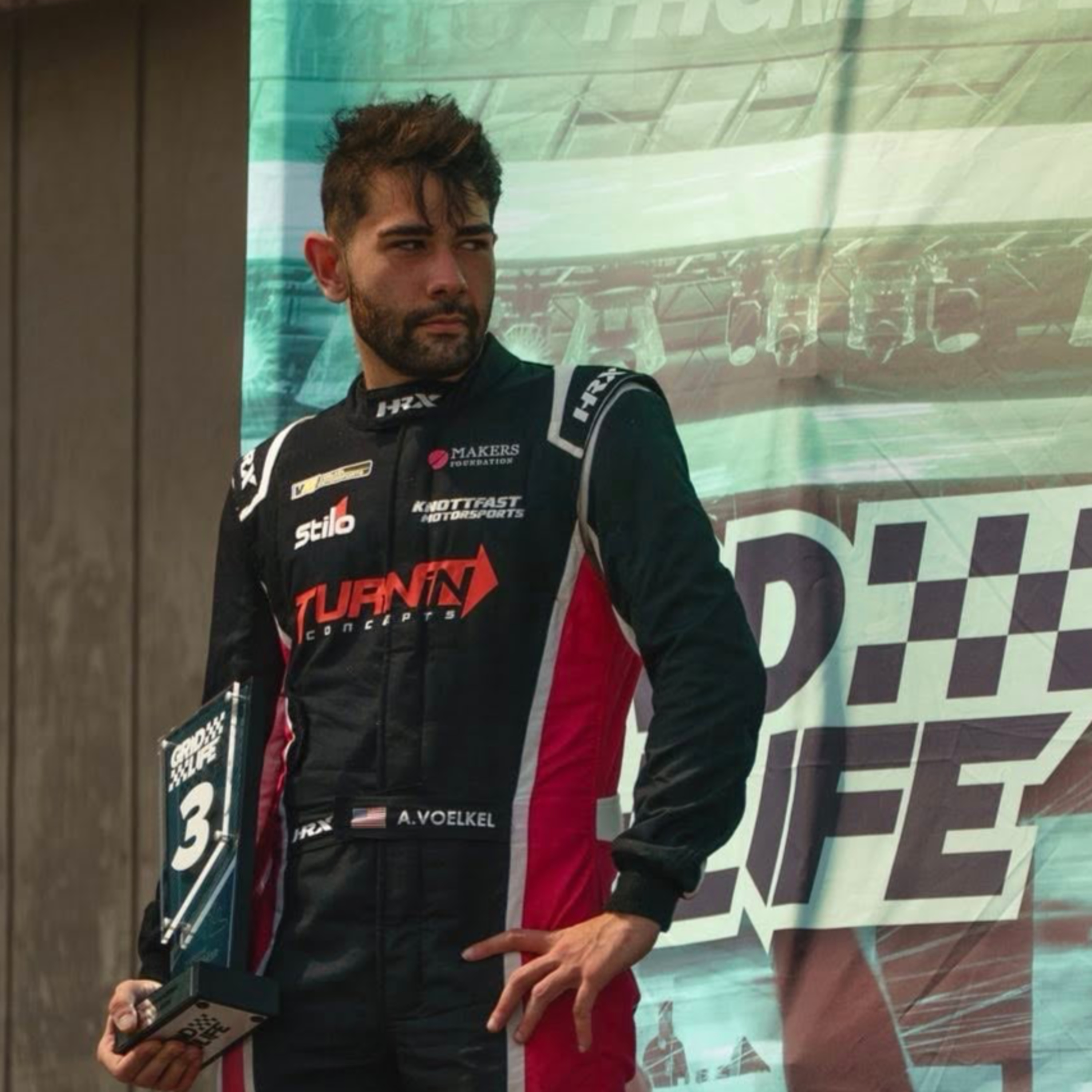
Andy Voelkel shares his journey from a semi-professional Call of Duty player to a passionate road racer, trading his dad's C7 Corvette for a smaller, lighter rush car. He recounts his early racing experiences, including a harrowing near-crash at Daytona, and how his upbringing in the automotive industry shaped his path. The conversation highlights the welcoming community of Gridlife events, the challenges of learning racing the hard way, and the personal growth that comes from embracing motorsports beyond just competition.
Andy doesn't want to compete against his friends... Seth needs more background info... and Scott really wants to do a deep dive on CoD now...
Andy Voelkel joins us to talk about why he takes sighting laps now, working in a warehouse when he was in elementary, competitively playing Call of Duty, getting into motorsport, and looking to find a way to balance his competitive nature while keeping his joy.