Hydrogen cars make electricity using hydrogen, instead of using a big battery like most EVs. The big challenge is that you need places to refuel with hydrogen, which isn’t as common as charging.
Topic
EV vs hydrogen debate (merch slogans)
They’re joking around with EV and hydrogen shirt slogans, but it points to a real debate: which type of clean vehicle will become more popular. Battery-electric cars and hydrogen cars work differently, so people argue about which makes more sense.
They’re basically saying that when more people search for EVs online, it can be an early sign that sales might rise later. It’s like a “heads up” before the buying numbers fully show up.
They’re referencing how much people are looking up EVs online. More searches usually means more interest, and that can eventually show up as more people buying EVs.
They’re comparing diesel prices to gas prices. If diesel costs a lot, fewer people may want diesel cars, even if that type of car used to be popular.
Concept
Oldsmobile kind of ruined it for everybody
This is a historical reference to how earlier attempts at popularizing a certain kind of car (likely diesel or a fuel/engine strategy) didn’t go well in the U.S. The point is that past market failures can shape consumer trust and long-term adoption patterns.
Volkswagen is referenced as part of the “more modern era” of diesel adoption and the broader European approach to diesel cars. The mention sets up a likely discussion about how major automakers influenced diesel popularity and later EV strategy.
EFTA is a group of European countries that trade together. When people talk about EV sales in “EFTA,” they usually mean a wider set of countries than just the EU.
They’re saying more people are signing up new fully electric cars than before. The “51% jump” is about registrations, and the “22% of new car sales” part tells you EVs are taking a bigger slice of the market.
Concept
EVs are hot in Europe (market adoption differences)
EVs are selling faster in some European countries than others. The hosts think it’s partly because people there have dealt with expensive fuel for a long time, so switching to an EV feels more worthwhile.
Concept
EV range needs (non-freeway vs freeway driving)
EVs don’t use energy the same way in every situation. City or shorter trips usually go farther on a charge, but on highways—especially at high speeds and in wind—an EV can use energy much faster.
When you drive faster, the car has to push through more air. That extra air resistance makes the EV burn energy faster, so it may not go as far on the highway.
A charger is what plugs into your EV to add electricity to the battery. Public chargers are usually slower than the fastest ones, but they still work for everyday charging.
If you can’t charge at home, you can still charge while you’re out. You park at a public charger, plug in, and let it charge while you do something else like shopping.
The Dodge Charger is a car model made by Dodge. It’s usually known for being a bigger, more powerful sedan. People might mention it when talking about what kinds of cars are available locally or what people drive for performance-style needs.
Off-street parking means you can park your car somewhere off the public road, like a driveway. Having that makes it much easier to charge at home; without it, you often have to use public chargers.
Concept
electric in Europe / in the UK / in England
They’re talking about how EV charging works differently in the UK/England. In some places, people don’t have driveways, so they depend more on chargers in public areas.
Concept
EV investment
EV investment is money put into electric-car companies to help them build cars and grow. The hosts are basically saying more funding is happening, which can keep these companies moving forward.
Lucid is a company that makes electric cars. Here, they’re talking about big investors putting money into Lucid, which helps the company keep building and growing.
Company
Saudi PIF
Saudi PIF (Public Investment Fund) is a sovereign wealth fund that invests in major companies and strategic industries. The segment claims Saudi PIF already has a large ownership stake in the companies being discussed and adds more capital to support EV/robotaxi-related ambitions.
Uber is the app people use to request rides. Here, they’re saying Uber put money into Lucid, likely because Uber wants to be part of the future of self-driving ride services.
Nuro is a tech company working on self-driving systems. In this discussion, they’re teaming up with Uber and Lucid so the vehicles can operate as robo-taxis.
Robo taxis are self-driving cars used for ride-hailing. Instead of a person driving, the car’s technology handles the driving, and it’s meant to pick up and drop off passengers like a taxi.
They’re talking about Lucid’s Gravity being used for self-driving ride-hail cars. A “robo taxi” is basically a car that can drive itself for passengers instead of a human driver.
Mainstream brand means lots of regular people can buy the cars, not just a small group of early fans. The hosts are talking about what it takes for an EV company to grow beyond the niche stage.
Rivian is a newer electric-vehicle company. They make EVs like trucks and SUVs, and the hosts are saying Rivian might be getting closer to being a widely sold brand, not just a niche one.
Cash burn rate means how fast a company is running through its money. If it burns cash too quickly, it may need more funding before it can start making enough profit.
“Ramp up” refers to increasing production capacity and scaling manufacturing to build more vehicles over time. In EV contexts, ramping up is often the difference between staying niche and becoming mainstream, because it affects costs, delivery volumes, and cash burn.
EVs are run by computers. When people say “software issues,” they mean the car’s computer systems aren’t behaving correctly, which can cause annoying bugs or even affect how the car drives or charges.
Lucid Air is an all-electric car. “Pure” is one of the versions/trim levels. They’re saying the car has had software problems, even though the company’s electric-car efficiency is impressive.
The powertrain is the EV’s “go” system—everything that helps the car turn electricity into movement. It includes the motor and the electronics that control it.
Cash flow is basically whether a company has enough money coming in to cover what it needs to pay. If cash flow is tight, it can slow down production or force the company to raise more money.
The Mercedes-Benz GLC is a popular luxury SUV. When people talk about it in an EV context, they’re usually referring to Mercedes-Benz’s broader shift toward electrified models and updated styling.
Mercedes-Benz EQ is the company’s name for its electric cars. The hosts are saying the early EQ designs didn’t always look clearly “premium” or “distinct,” so people weren’t convinced by the look.
A hood ornament is the emblem you see on the front of the hood. Here, they’re saying Mercedes added the familiar Mercedes symbol to help the EV look more “Mercedes,” but it still didn’t fully convince people.
The grille is the front opening on a car. It’s partly functional for cooling, but it also strongly affects the car’s look, which is why they’re reacting to it.
A concept car is like a design preview. Automakers build them to show what future cars could look like, and sometimes those ideas later show up in real production vehicles.
The Mercedes-Benz C-Class is a popular Mercedes sedan. They’re talking about how a new, bold front design looks better or worse depending on which Mercedes model it’s used on.
Concept
cars have to introduce lower levels again
When cars get bigger, they often cost more. To keep options for people who don’t want the biggest/most expensive version, brands add cheaper trims or smaller variants.
The Honda Accord is a midsize family car. It’s known for being comfortable and easy to live with. Different model years can feel bigger or more spacious than older ones, which is why people talk about how the newest versions look and size up.
That 94.3 kWh number is how much energy the EV’s battery can store. More stored energy usually means you can drive farther, but it’s not the only factor.
WLTP is a standardized way to test how far an EV can go on a charge. Different testing rules can make the reported range look better than what you might see under the U.S. EPA test.
EPA is the U.S. testing standard used for official range numbers on EVs. The hosts are saying the EPA-style estimate is likely lower than the WLTP number.
A dual-motor EV uses two electric motors to help move the car, often improving grip and acceleration. “482 horsepower” is a measure of how strong the power output is.
Rear wheel steering means the back wheels can steer too, not just the front wheels. That can make the car easier to turn in tight spaces and can help it feel more stable when driving faster.
The Mercedes-Benz S-Class is Mercedes-Benz’s big, luxury flagship. Because it’s a large car, adding rear-wheel steering can help it turn and maneuver more easily, especially at lower speeds.
Quadra Steer is a rear-wheel-steering setup that GM used on some SUVs. The hosts mention it to show this idea has existed for a while, and it may come with reliability or performance quirks.
The Honda Prelude is mentioned as an example from the past where rear-wheel steering showed up. It’s used to argue that this tech has been around before, so expectations should be realistic.
They’re talking about a Mazda RX-7 (FC) they owned that had a simpler, passive rear-steering effect. Instead of a computer-controlled system, it used mechanical parts (like bushings) to change how the rear wheels behave when you steer.
Bushings are little rubber pieces that help the suspension move smoothly. Solid bushings are much stiffer, so the car feels more precise, but the ride can get bumpier. People often do this when they’re building a car for more aggressive driving.
Spherical bushings are a more rigid, joint-like version of suspension bushings. They help the suspension move in a more controlled way when you’re driving hard. The tradeoff is they can be noisier and may need more attention over time.
Rear steering means the back wheels can turn too, not just the front wheels. That can make parking and tight turns easier, and it can help the car feel more stable at speed. The downside is it adds complexity, which can mean more things that can go wrong.
The Chevrolet Silverado EV is a big electric truck. The point here is that when a vehicle is huge, it can feel like it takes a lot of effort to turn. Rear steering is one way manufacturers try to make that easier.
The speaker means that adding extra features can make the car more complicated to fix later. If something breaks, it can cost more and take longer to diagnose. That matters a lot when you’re buying a used vehicle.
“Zero to sixty” means how fast a car can go from stopped to 60 mph. It’s a popular way to compare performance, especially for EVs because they can feel very quick off the line. But the hosts are saying the exact number isn’t the only thing that matters.
The Ford Mustang Mach-E is an all-electric Ford SUV. The big deal with EVs is how quickly they can speed up, and this conversation is about how the Mach-E feels when you merge onto the highway. They also mention that different versions can behave differently when power meets the road.
All-wheel drive means the car can send power to more than one set of wheels. That usually helps the car grip better, especially when accelerating. But even with AWD, if the road is slippery or the power comes on very suddenly, wheels can still spin.
Traction control is a safety system that helps prevent the wheels from spinning when you accelerate. If it’s set up aggressively or not quite right, the car can feel like it’s slipping or surging. The hosts are basically saying the car’s control behavior might not have been dialed in.
EVs can send power to the wheels almost instantly. That’s why the car can feel like it “jumps” forward when you accelerate—especially when you’re merging onto a highway. This surge is part of what makes EVs feel fun and responsive.
Two-motor EVs have one electric motor for the front wheels and one for the rear wheels. That helps the car put power down better and can change how it drives depending on conditions.
They’re saying the car mostly drives the rear wheels. The front wheels may get power only sometimes, like when you need extra traction or acceleration.
A two-speed gearbox lets the car use two different “gears” to drive the rear wheels. It helps the car accelerate well from a stop and still feel efficient at higher speeds.
In an EV with a multi-ratio gearbox, a “downshift” means the transmission selects a lower ratio to increase wheel torque for quicker acceleration. The speaker suggests that when you “gun it,” the car will shift to the more responsive ratio.
Rear drive means the car’s power goes to the back wheels. That can change how it grips the road and how it handles compared with front-wheel or all-wheel drive.
It sounds like the car can add power to the front wheels when conditions demand it. That helps the car stay stable and grip better, especially in slippery situations.
Mercedes-Benz has an electric version of the CLA. In this conversation, they’re saying it’s a smaller EV that’s meant to be easier to buy than the bigger, more expensive options.
“Entry level” just means the cheapest model in a lineup. They’re saying that, for Mercedes-Benz EVs, the cheapest option has moved up, so the CLA electric isn’t the lowest anymore.
If the trunk lid is short and the opening is small, it can be harder to put bigger stuff in the car. Liftback-style openings usually make loading easier.
A “mail slot” trunk is basically a small, narrow opening at the back of the car. Even if the trunk has room inside, it can be hard to get big items in because the opening is too tight.
The Kia Stinger is a sporty Kia with a rear opening that lifts up like a hatchback. That shape can make it much easier to load big, awkward items compared with cars that only have a narrow trunk opening.
Dropping the rear seat means you fold it down to make more room behind you. It helps when you’re trying to fit something long or bulky that wouldn’t fit with the seat upright.
They’re talking about people starting to prefer sedans again instead of crossovers. The idea is that tastes and pricing can swing, and sedans can look like a better value or fit for some drivers.
Concept
crossover vs sedan preference shift
The hosts describe a market preference shift: crossovers becoming “meh” and sedans regaining interest. They also connect it to pricing and affordability—when prices rise, buyers may move to models that feel more attainable or practical.
The “fuel crisis” refers to historical periods when fuel supply and prices spiked, strongly influencing what cars people could afford and what automakers built. The speaker uses it to explain why younger buyers in the 1980s might not have had access to “big engines,” shaping preferences.
They’re talking about how, for families, minivans became popular for a while because they’re spacious and easy to get in and out of. The speaker is using it as a timeline of how car shapes changed.
Station wagons are cars with extra space behind the back seats, usually with a long roof. They’re often seen as practical family cars, and the speaker is saying people are moving back toward that kind of practicality.
SUVs are bigger, taller vehicles that many people like for family use. The speaker is using SUVs as one step in the evolution of what people wanted in a “family car.”
Crossovers are like a mix between an SUV and a regular car. They’re popular because they’re comfortable and practical, and the speaker is saying family-car preferences have moved through different styles over time.
Sedans are the classic 4-door cars with a trunk in the back. The speaker is saying people may be getting interested in them again, especially if they come with easier-to-load rear doors.
Term
contact free plug and charge
This is an EV charging idea where you don’t have to do as much with the cable. The car and charger communicate so charging can start with less effort and fewer steps.
BMW is talking about making EV charging easier. Instead of doing lots of steps in an app or at a charger screen, the car and charger can handle it more automatically.
Concept
contract free plug and charge
They’re saying you might not need a special deal with one charging company. Your EV can recognize you and let you charge without signing up for a separate contract.
Electrify America is a company that runs fast-charging stations. The speaker is saying older charging networks often require you to sign up or use an account before you can charge.
They’re comparing what they’re describing to how Tesla cars can start charging automatically. Instead of you tapping a card or logging in, the car and charger “talk” to confirm payment.
A “handshake” is just the back-and-forth message exchange that confirms the car and charger are allowed to connect. It’s like a quick verification step before charging begins.
LIVE
This is the What Car? EV podcast for Thursday, April 23rd, 2026, Episode 267, Nice and Juicy.
You ready for a normal episode?
What's normal anymore?
I'm tired of these episodes.
It's nice to have a break from the usual talking about EVs and talk about the world
imploding, which we did last week, and we've done multiple times throughout this last month.
So this week, we'll do something different, we'll kind of touch on it a little bit, the
whole oil crisis, but kind of the positives of that in some of these news items that
have come out in the last week, hopefully, I think, is that a good assessment of what
we're about to do, and then we're going to go off into a field, turn left, and talk about
random other things that have nothing to do with oil and whatever.
I'm Phil Royal.
I am wearing a hoodie that you can get at thewalkcar.com slash store, which I had to
stop and think about that because I so rarely remember to tell people to go there,
but I've got a little black hoodie on, you can get in different colors as the
walk car.
It's got a hood.
If you're looking at us on YouTube, youtube.com slash at the walk car, you can see some of
this stuff.
Ed is wearing a hat.
I think that's on there as well.
Is it?
I don't know.
Before I forget, I have a funny walk car apparel story for you before we get into the
main content.
Okay.
Where was I in?
Please.
I don't know.
I do content.
Resume experience.
Resume and experience.
What are you?
Okay.
Ed Sanchez.
Many moons in automotive world, content creation, moderation, currently an
automotive electronics analyst and a podcaster of five plus years with my fearless
compatriot Phillip.
That's me.
That's you.
So my funny walk car related story.
My high school English teacher who I've somehow stayed in touch with through the magic of social
media and various methods.
He recently bought a Toyota BZ and he's been enjoying that.
And he very graciously purchased some apparel off her store.
Sweet.
Thank you.
And he got a shirt.
He got the EVAF shirt.
One of the better ones.
Yes.
I guess one of his grandkids asked him, Grandpa, what does EVAF stand for?
And his answer was EVs are fun.
That's what it is.
That's what our shirt is.
Yes.
Funny.
Funny.
He should say that.
That's the PG version.
That's exactly what we intended when we made the EVAF shirt.
There are other ones.
If you like driving hydrogen cars, you can get our hydrogen is the future and always will
be shirt and the rest.
We've got some other ones.
Check it out.
Controversial fun.
The whole gamut.
Yep.
So this kind of bounces off from last week.
But just for a short period of time, so don't pass forward.
So we noted, I guess, since the start of the war, EV searches on like admins, I've also
seen on like cars.com and whatever been trending upward.
And I guess in some parts of the world, that's actually translating into real tangible sales
increases, most notably Europe, which by the way, so I have a lot of my coworkers
are based in the UK.
So when I belly ache about $5 a gallon gas, they just kind of chuckle, because I guess
it's the equivalent of about 10 over there and rising.
And a lot of parts of the world, I guess diesel is around 12 bucks a gallon effectively, which
is insane.
And Europe went big time into diesel.
America had never really took off as like a car.
They tried to, but I think Oldsmobile kind of ruined it for everybody.
And Volkswagen, more modern era, but that's a whole other topic.
But yeah.
So EV sales, you're up in March across the, there's something called the EFTA, which
is I guess, broader than the EU.
So it includes like kind of peripheral broadly European countries that are not technically
in the EU, like Norway, Sweden, some other countries.
They include others.
That's nice.
So Europe at large, I guess, battery electric vehicle registrations jumped 51% in March, 2026.
That seems like a lot.
It is.
I know mathematician, but 50% jumps, it's like a significant number.
So that's up to 224,000 new EVs were registered in March alone, accounting for 22% of all new
car sales in those markets.
So that's pretty good.
I mean, that's about, I think about what California is.
I think California is about 20ish percent.
So funny thing is, and I'd not done no research on this, I thought that they were in that range.
I thought the EU was in that 20 to 25% already, or maybe I'm just thinking of a specific
country.
It depends on the specific market, like between like France, Germany, Italy, UK, it varies
a lot.
There's a lot higher uptake in some countries than others.
Some have been kind of laggards and are now kind of hopping on the bandwagon, so it varies
quite a bit.
But TLDR, EVs are hot in Europe.
I think they've gotten the memo, Europe's been dealing with high fuel prices for quite
a while.
So I don't think it takes quite as much to convince them.
Yeah.
And EVs really are well suited for Europe.
The non-freeway type driving, the shorter distance, they're just kind of, you don't need as much
of a range necessarily, like it just, like in America, we got big freeways because everything
is so far away.
And as soon as you get an EV on the freeway, that's where they struggle, got high speeds,
high wind resistance, rev in the thing high, and it's not as friendly here toward that.
So it makes a lot of sense.
I mean, I was about to say even my mom, but my mom has an EV in England.
It was an MG SUV, right?
I think so, yeah, I think so.
And there, I mean, I don't, I don't know exactly.
And they figured out charging because I remember you told me when she got it, they were
still trying to figure that out.
Yeah, they don't have a driveway.
I don't, I've honestly never asked.
So I'm assuming there's like a, probably a charger in town or something they go to?
Yeah, I know they're, yeah, I know that they can go into town.
And when you go in to get groceries, whatever, you just park and charge.
And I assume that that's what they're doing.
But there's no chance of her ever having off-street parking her flat because it just
doesn't, like it literally doesn't exist.
I guess she could convert her yard, her backyard, but I'm not even sure that you could get a
car.
No, you couldn't even get a car into the yard.
So no, there's never, like there is no front yard.
So I guess she'd have to go to the town council and try to petition to have one installed
nearer.
Yeah, she'd have to, she'd have to go and talk to like, it's electric in Europe.
In the UK, what do you mean?
Yeah, in England.
And that's the kind of solution that she'd need.
But then somebody else would just park in front of the house.
And then you're like, you know, I don't know.
Anyway, so good.
More EVs for going on, more EVs selling.
That's good.
What then is more companies making EVs because companies have started back.
More investment in companies making EVs.
Or more investments, which is happening with Lucid, I guess.
Step one was fire the original CEO.
Step two was hire a new CEO.
And step three was profit.
Get more money.
Yeah, more investment.
Yeah.
So who is Saudis and Uber?
I mean, they're already majority owned by basically the Saudi PIF, I think 62%, I think.
But now they have a new investor with not in substantial stake, Uber, the ride hailing platform,
the new de facto taxi for a lot of people.
So Uber invested 200 million in Lucid.
So I think, gosh, it was a while ago, they're going into a deal, I think with another
company called Nuro that does like the software and sensor stack.
But basically it's a three way collab between Uber, Nuro and Lucid that they're going to
be doing Lucid gravity robo taxis effectively.
So with that investment, Uber now has an 11.52% stake in Lucid.
And in addition to Uber's investment, I guess the Saudi Arabia public investment
fund also gave them another 550 million on top of that.
So this is some serious cash.
Yeah, somebody believes in them.
I probably probably shouldn't even say this.
I do have a small amount of Lucid shares in my portfolio.
And candidly it has been the worst performing stock in the past year.
But it's not enough where it like, you know, it's like feast or famine for me.
I just kind of they're just kind of there.
I just kind of forget about them for the most part.
I really hope they succeed.
I really do think they have some really impressive technology and efficiency.
But yeah, they've they haven't really been able to get over the hump of being cut
like kind of a niche premium automaker to be being more of a mainstream brand.
I'd say Rivian is probably a little further down that road than Lucid is,
even though I would still consider them kind of niche premium.
But yeah, but I guess the Saudis really believe in them because
yeah, they keep keep funding him.
I don't know if this number is correct that I just looked up.
What's up?
I looked up, what is the cash burn rate for Lucid?
How long will this last them?
And according to Google, I answer, they have a quarterly cash burn rate
of about one point two billion dollars per quarter per quarter.
Twenty twenty in twenty five.
So while.
Seven hundred and fifty million a billion dollars sounds like a lot.
It's not much.
So quarterly burn in Q4 twenty twenty five.
The company went through one point two four billion dollars.
But I wonder if that's a constant or if that's just like kind of a one time
because they're they're trying to ramp up for the what is it?
The earth and the cosmos now, the new like midsize.
Oh, yeah, yeah.
You don't think it was Peter Rawlinson's
golden parachute.
Well, maybe they want to rethink that if that was the case.
But I yeah, I don't know.
Like I said, I'm rooting for him.
I hope they make it.
I know they've had some some software issues.
I know if you've watched Engineering Explained the past few months,
I guess he recently got a Lucid Air Pure
and it's had some software issues.
So to put it mildly, but in terms of their powertrain,
their efficiency, they're really, I think, kind of world class.
So Lucid, we're rooting for you.
That number might be correct as well.
I looked up what is their their twenty twenty four financials
and they reported a two point seven one billion dollar
net loss in twenty twenty four.
So there you go.
Yeah, they're not out of their proverbial production.
Hell, yeah, they've got all this money in,
but it buys them two months in cash flow that they need.
So anyway, there's that.
So some from a somewhat more established auto maker
that hopefully has a bright future ahead of them.
And we discussed this a few months ago when they came out with the new GLC
with it, like for a while, they were like with the EQ,
EQ as the EQ, it was kind of that kind of amorphous,
kind of bubble. Yeah, Mercedes said,
here's our EV and we're going to make it look like a jelly bean
and make it so you know that this is an EV.
Yeah, they had very distinct looks.
Yeah, and that did not really pay off for them.
The S class just didn't look classy.
And the EQ S. Yeah, it just.
Yeah, it just.
Yeah, and what's funny is kind of the stop gap they tried.
It kept the same basic shape, but they added the tri-star hood ornament
and like different lighting on the grill.
But it was still kind of the same shape and it just looked kind of like.
It wasn't offensive.
It just didn't know, but it was like it wasn't really convincing.
Yeah. Yeah.
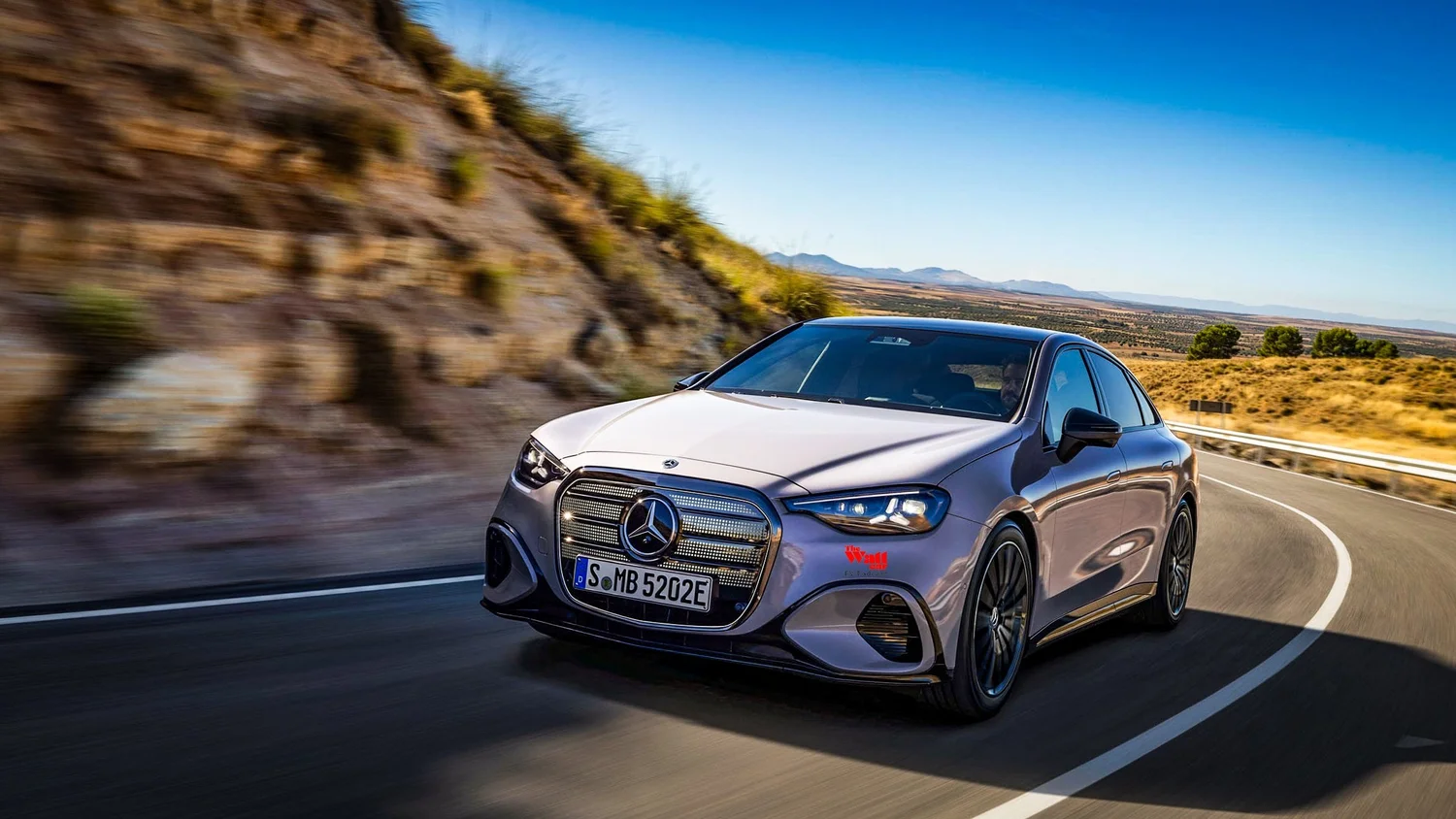
It was. So now they've gone all in on these massive, big, bold grills,
which when they revealed the grill and they did like a release just on the grill,
which, you know, somebody in the marketing department was like,
seriously, I've got to write something just on the grill.
Like I don't get a car attached to it, just the grill.
We're just going to talk about the grill.
And then they're like, yeah.
And so the marketing person's like, OK,
let me go to chat GPT and type this in and then I'll pump out anything I can.
So they released that release, that they released the release on the grill.
I don't remember last year.
And I liked it.
I really liked the grill.
And then they did this concept car.
It was like a Cruella de Vil.
Yeah, I don't remember the order.
I think they released the grill and I was like, I don't really like it.
Then they did the Cruella de Vil car and I was like, wow, this is it.
Like, yes, I like this.
This is great.
And then they put it on a mini SUV or something.
That's the GLC.
Yeah. And it was like, now I don't like it so much.
Now they've put it on the C-Class, Evie.
And? I like it.
Yeah. Yeah.
I like it again.
Yeah, which means I won't like the next car that they put it on because so far
it's been floppy. Yeah, this is a very.
Yeah, it's a bold look.
It's a very prominent, I guess, for a lack of a better term.
And the C-Class has grown a lot.
I saw in the release, the wheel base on that thing is almost 117 inches,
which I mean, I'm going to date myself.
I remember, you know, granted, I was pretty young, but I remember when the
190 came out, I must have been like seven or eight years old or whatever.
And that was a small car.
That was like BMW three series size.
So they had the 190 and then they had the C-Class that kind of
proceeded and each generation has just gotten bigger and bigger to the point
where I would probably consider the latest C-Class more of a midsize.
I wouldn't consider it like a compact sports sedan anymore.
But yeah, all cars, they seem to grow and then they have to introduce
lower levels again. Yeah.
And then you end up with like 15 different models when you used to only have three.
Like the newest Honda Accord is massive.
I don't know if you've seen them.
They're big. Yeah, big cars.
Yeah. But anyway, speaking of big, the new C-Class EV ninety four point
three kilowatt hour battery pack.
It's nice for nice and juicy car.
Yeah, that's good size.
They're claiming a WLTP range of four hundred seventy three miles.
So good, healthy, through EPA, probably closer around four hundred.
But still, that's still pretty good.
And 482 horse dual motor.
And you kind of go into the weeds a little bit with some of the technical details.
That's what we're here for, isn't it?
Yeah, with some somewhat interesting, I thought was they're going to do
they're doing rear wheel steering on this.
And I could under kind of understand why they did it on the S-Class
because that's a big car and maneuverability and this and that.
And I'm like, well, the new C-Class is big ish, but it's not huge.
So I'm like, did they really need this?
But I guess it also has benefits and like stability and handling.
So there's I don't know what to think about before we get into the weeds.
I don't know what to think about. Let's get into the weeds on this.
What to think about rear wheels, rear wheel.
Steer. Yeah, I'm afraid it's not working today.
Back in the 80s or was it 90s?
They were putting rear, rear, you know what I'm talking about.
The steer in the back.
I'm thinking of the Honda Prelude.
The Honda Prelude, they had it on some of the GM SUVs.
Quadra Steer, that was more in the early 2000s, but yeah.
So this is nothing new and it's generally always failed.
My RX-7 that I've got had a passive rear wheel, rear steer thing.
I'm not going to be able to say it, but it had a passive system
on the FC where it was like bushings that when you turned the wheel would adjust.
And so that many and the first thing that you do when you go on
RX when I bought my RX-7 and it was like, what do you do?
What are the first mods that you do to turn this thing?
Because I turned it into a race car.
What is the first thing you do?
And it is remove that, get rid of it.
Solid bushings.
Yeah. So like I can go to spherical bushings.
I do all sorts of stuff.
But none of that rear steering stuck around.
And now we're on the second or third coming of rear steer.
And I get it with some of these vehicles like this, the Silverado EV.
That's like, that's like turning an oil tanker.
That's massive.
So cyber trucks, similar cyber trucks you see going through parking lots
and they turn the wheels and you go, wow, that looks efficient.
That looks well designed.
They needed it.
They put it in.
As a person who buys used vehicles, maybe Mercedes isn't.
Maybe I'm not Mercedes market.
Maybe this is not for me.
But I view that as an additional
complication, something that is not necessary on this size vehicle.
And ultimately will break.
And cost five thousand dollars to repair.
I don't understand why it's on there.
Well, because Mercedes, I guess, but yeah,
it gives them a selling point to something else.
I don't get that part.
Now, other interesting, did you say acceleration zero to sixty two
and three point nine seconds?
So these things, it hustles.
Pretty quick.
People might say, ah, it's not, you know, two and a half seconds.
It doesn't need to be.
Doesn't need to be.
I was in who's I was in a
like a pretty base model Mach E over the weekend.
And we merged onto the freeway and it's scoots.
I don't know what the specs are on this thing, but it's a base model.
And you fly in this.
It needs to be no faster than that.
Well, I remember a few years ago when you had the Mach E GT.
It was the all wheel drive and the front wheel spin was just like comical.
Yeah.
And I don't know if that was intentional or they just did a sloppy job
kind of calibrating the action control.
It was one of those.
But it was like, oh, you know, yeah, like.
This he didn't try to do that, but he was just merging.
And it's just it was just the surge of torque that sells people on EVs.
It was exactly what everybody talks about the butts and seats.
And this is a base model.
So, OK, this C class will be a little bit more expensive than a base model Mach E.
So it needs to have additional features.
But three point nine is nothing to see said into the weeds.
This has.
Two motors, you said.
A door motor.
One is at the front, providing like five percent power or something
to the front wheels on normal.
Like, I guess it can vary, but it is majority rear wheel drive.
Like most of the time, this thing's a real drive car.
So I don't completely understand that other than getting off the line
or maybe in slick conditions that it could help you.
Safety, I don't know, something like that, but it's neat.
And it's a two speed rear gearbox.
So I guess it's a four to one ratio that swaps to five to one
at like 70 miles an hour, 75 miles an hour.
If you like gun it, it will downshift and go.
Whereas I think the the Porsche.
Was doing it.
I don't know if they changed it or what.
But initially, I seem to recall that being like you would get on it
and it had a lower initial gear and then it would click into the
second gear by like 30 or 40 miles an hour, that it was kind of the flip
side of this from what my memory is.
I think it was like if you floor it, it it it clicks down to the low
like the quicker ratio.
Yeah, but I thought it was only under a certain speed.
And I thought it was pretty low.
So like off the line, it could launch fast and then it would go into the higher
gear to default.
If you're just kind of, I think the default is the higher ratio, the more
efficient ratio, but if you're really stomped on it, this struck me as the
opposite way when I heard this, that I thought the Porsche was it was doing
the quick acceleration off the line.
This is going more for if you're going on the freeway and you want to
accelerate, then you accelerate and then it clicks and you go into the quicker
ratio.
That's how I interpreted this.
So I thought that was interesting.
They're doing something different.
Ultimately, what it came back to me on is Mercedes is not just
doing a also ran here.
They've changed up the looks, which we'll get to some more looks in a
second because I want to touch on something else.
They're changing up the looks.
They've thrown in a big battery, which I don't remember what
their others had, but this seems like a long range and a big battery.
The rear steer, I don't care about it, but it's still something that helps
sell the car and differentiates it.
And then they're doing this little bit of trickery in there with a
multi-gear ratio and then rear drive.
So you get that kind of dynamic, but it also has a safety of the
fronts can kick in.
I think it's overall a winner.
I don't know what its price is, but I like it.
Well, that's the big question is what's the price?
I mean, I could see this being like about a $60,000 car, which
would be great.
I think it would justify that for that level of performance and
equipment and being a Mercedes.
You're buying the name.
You know, it's a status brand.
And you know, if you want something a little more attainable,
they do.
They just brought out the CLA electric, which is smaller.
It's no longer the entry level vehicle.
Yeah, no, that stopped being that years ago.
Yeah, so 60 is fine.
What do you think of the rear of the car?
It's interesting you brought up the styling because that's so
from the front, like the front three-quarter angle, it looks
like really beefy and like purposeful.
Yep, the rear and low slung and everything.
Yeah, I think there's a little to me, at least there's a
little bit of a mismatch between the front and the rear.
The rear looks a little more kind of blonde generic to me.
I don't know, it's just me.
It's not as like, it's not as impactful as the front to me.
I mean, I don't hate it, but it's like, I don't know, the rear
angle doesn't do it for me as much as the front angle.
So the rear, I really like.
Really?
Okay.
But it reminds me of the Nissan Leaf.
Mm-hmm.
It reminds me of Mustang with the way the taillights, the
loops are.
It doesn't strike me as something that is definitively
Mercedes, but I like it.
Even though they're trying it with the little, little, little
tri-star taillight.
I kind of wonder with that, if somebody said, this
doesn't look definitively Mercedes, and so they're like,
well, I'm literally put the Mercedes symbol in there and
make it good because the front has it.
The front has three of the little tri-star things.
And so the rear has four.
Fine, because it's got the one in the, it's got the
insignia in the, in the logo, and then it's got two on
the left and two on the right in the, in the taillights.
I quite like the rear.
And I really like the front in some pictures.
Yeah.
I think, I think it's more the, the rear, I don't really
have particularly strong feelings about one way or the
other.
It's fine.
But it's not like, wow, that's so cool.
Yeah.
So.
The guy at Lincoln, the show notes to inside EVs
article, the guy that did their review noted that the
rear kind of looked like it could be a lift back.
It's not, maybe it's not a lift back, but it looks like
it would be.
And I wonder if that's a missed opportunity to lift
back all the things.
Yeah, I'm a big fan of lift backs.
I think basically all sedan should be lift backs in
my opinion, even though I don't own one, even though
I wish it was, but yeah, I'm not a big fan of this,
this trend toward stubby little trunk lids and like a
mail slot sized opening.
I kind of like the older school, like, you know, long
trunk lid, big generous opening, if you're going to
go back like in the 1970s, the way a dining room
table as your rear truck lid.
Yeah.
So, so yeah, this new trend of just these little
mail slot trunk openings, I'm like, to me, that's
wasted space.
It's like, make it a lift back for crying out loud.
No, when I drove the Stinger, when I was testing
the Stinger, I had a entire like, it was kind of a
coffee table that I put in.
It was very long and multiple drawers and whatever.
There was no way I was going to have to put it in
my pickup truck, but I had the Stinger and it
was a lift back.
So I went and popped the, I dropped the rear seat
down, popped the trunk lid, put the thing in.
No problem.
It fit.
Like, I mean, it took every inch of the room, but
man, it was something you just couldn't do in
anything else.
Yeah.
And it swallowed the whole thing.
And I remember my Sharoko that I transported a
tree in that thing.
Yeah, I'm a big fan.
If that's one trend that comes back, I'm hoping
that's it.
I did read some stories, a past couple of weeks,
how they're saying there's like a sedan
revival all of a sudden.
Like, I don't know if it's like Gen Z, like
preferences, but, you know, all of a sudden
crossovers are kind of out and they're like, you
know, people are like, meh.
So nobody wants what their parents drop the
affordability issue to everyone was chasing, you
know, higher margin, higher price points, but
people are just kind of being priced out.
So it sounds like there's a little bit of a
pivot back to sedans.
So it'll get there eventually because, like
I said, nobody wants to drive what their parents
drove.
So I don't know with the 80s, if we the younger
people had an option because you couldn't get
the big engines because of fuel crisis and all of
that.
It's kind of gone through, you know, I remember
like when I was back in my day growing up, you
know, the family car was, I was, I think
I was maybe a little slightly before the
minivan era.
It was still station wagons when I was
growing up, and then that morphed into
minivans and then it became SUVs, then
crossovers and now, yeah, so it's kind of
coming full circle, I guess.
Yeah, I think sedans are on their way back
and it'll be glorious, glorious.
As long as they're lift backs, that's, that's
the whole, yeah, lift backs on, on every
sedan and mid gates and every pickup
truck.
There you go.
That's that.
That's the world you want to live in.
It's my campaign motto.
So also plug and charge for everyone.
I think that's another good one.
Contract free plug and charge.
Yes.
Which you were initially excited and then
you re-read it and you're like, yeah.
Back to my brain not working today.
I read BMW introduces contact free
plug and charge in Germany.
I went, oh, this is amazing.
Wireless, yeah.
Sign me up.
You just pull up, park and walk away
and that's great.
But no, I've still got to get my hands
filthy with the unwashed masses.
Put, touch a plug into the side of the car.
I'm no longer in on this.
Yeah.
So, so yeah, BMW launched this and I'm
like, cool, I guess, even though Tesla's
been doing this for 14 years.
So what does it mean?
Contract free plug and charge.
What do they mean by that?
They want you to sign.
Well, so traditionally, like a lot of
the charging networks, you know,
charge point, Electrify America, whatever,
you either have to set up an account
or there's like a payment terminal.
So it's either or sometimes it's both.
I've tried to do one or the other and it says,
even if you tap a card on the terminal,
says, oh, you need to open an account.
It's like, I'm trying to pay you.
Yeah.
Why do I need to take my money?
It's like, anyway, so I guess this is
literally just basically like the Tesla model.
It's plug and charge.
So I think from a technical standpoint,
the way this works is basically your
payment info is stored on the vehicle
and there's like kind of a handshake
communication process that happens
between the vehicle and the charge point.
And it just so in theory, just plug it in
and it just kind of makes a handshake
and starts charging.
Assuming the EV charge provider
is part of BMW's brain network.
That or there is there is like a technical standard.
I believe it's ISO 15118,
which is the technical standard for plug and charge.
So I don't know if this is an implementation of that
or their own kind of secret sauce.
My guess is it's an implementation of 15118.
So anyway, so we're moving slowly but surely
moving toward kind of universal plug and charge.
Pain free charging.
Yeah, which, you know, not to be a dead horse.
But again, something Tesla's had for the past 14 years.
And this is a problem, though, that the industry
is made for itself.
Like Tesla, they went with the plug and charge type thing.
And that's great.
And they had a closed ecosystem so they could do it.
They knew they could control all of the vehicles
and they could easily make it.
You bought a Tesla.
It was easy for them when you're trying to do it for a BMW
charging on a whatever other charge.
It would be CCS too.
But but like, no, like whatever other company it is
that's providing the fire.
Yeah, that that now you got this cross communication.
And so I get that that's difficult.
But they've all when this all started, all these companies
wanted to get you on their app.
Instead of just putting a swipe on the fricking machine
with a credit card that accepts a credit card, we would not
have this problem where you've got to have 15 different apps
and they're now trying to solve this with contract free plug
and charge.
If they simply would have said from day one, everybody's
got to have a payment swipe on the terminal and you can
pay with a credit card or with Apple Pay or Google Pay
or whatever it's called that Google has, if they just
accepted payment and you didn't have to use an app,
this was not a problem.
They they tried to solve something that wasn't.
They tried to solve it with this great engineering
method of like, oh, it's through an app.
It doesn't have to be.
They can be through a credit card or through a phone payment.
Yeah, not.
I don't have to have these other apps.
I've got like $20 sitting on a charge point app account that
I'm never probably going to access.
And every time I drop below that amount, then they want to
charge me another 20 bucks on a thing.
And I'm like, I don't use you.
I just need you once every like four years.
Yeah.
No, I mean, in the early, you know, the early days,
I'd say like the early 2010s, it was, I think all the
charging networks were kind of trying to do their own thing.
But they were just layering complication on each other.
And it just made for a really wonky, kind of, like, not very
enjoyable experience.
When you go to a farmer's market, they all use a phone with
swipe attached to it.
A little square or whatever it is square.
Yeah, it is simple.
They all use it in whatever form.
I mean, there's like one main company and then I'm sure there's
others doing similar things.
But it is one solution.
You don't go to Larry's avocados and have to download Larry's
avocado app.
They never came up with that as a solution.
And farmers markets are great.
They're better now than they were because before you had to
pay with cash and now you can just like tap your phone on
the thing or swipe a credit card or whatever it is that you
got to do EVs for being like all tech bro startup companies
where everybody's so plugged in.
They got it so wrong.
Except for Tesla, except for Tesla.
And ironically, that's the rest of the industry is coming
toward their solution.
Yeah, they kind of figured out what are we doing?
This has already been solved.
Yeah, but Tesla had it easy because their closed ecosystem.
They had a captured market.
They had it a lot easier.
In fact, it would have been disappointing if you had to swipe
at swipe a credit card or tap your phone at a Tesla charger
with your Tesla and the superchargers were basically
the only game in town for what you could charge like that
would have been a silly solution.
So they did what made sense.
Everybody else didn't do what made sense.
Yeah.
So charting.
Yeah, that's I haven't had a good rant in a while like that.
Thank you.
Well deserved.
So from charging to batteries.
So, oh, I got the rant on this too.
Yes.
So CATL, the world's largest EV battery provider.
I think literally I'm not I'm not exaggerating when I say this.
One third of world EV batteries globally is CATL.
Seems like a lot.
Seems like a lot.
So they just unveiled.
I'm probably going to butcher this.
Shenzhen, third generation LFP battery.
They're claiming the world's lowest internal resistance for ultra fast charging.
Just 0.25 milliohms.
I'm not an electrical engineer.
So I guess that's good.
So I don't know what that means nor do I.
Yeah.
So they're claiming charging from 10 to 98 percent in seven minutes.
So that is pretty much approaching the speed of fueling with gasoline.
Definitely pretty darn close.
That's right there.
Like, yeah.
And especially if you don't have to swipe a credit card at the thing, you pick up time.
Yeah.
And what's especially impressive, you know, all these claims are true is that's
LFP because traditionally LFP, even though they're very durable from a charge cycle standpoint,
like they can do a lot of charging discharge cycles may hold up well.
They were kind of temperature sensitive, I guess, for lack of a better term.
They were sensitive to cold temperatures.
They were sensitive to hot temperatures.
Like they wanted to be like in this kind of happy temperature range where they operated best.
And one of the knocks against LFP was they didn't charge as fast on fast chargers.
So the fact that this is an LFP that can charge this quickly is really impressive.
The other thing of this number is 10 to 98 percent is significant only because it's LFP
because LFPs are happy going to 100 percent and sitting above it.
The older batteries that you want to stop at 80 and you only want to go above
if you have to, you're doing trips or whatever, that that's why this is so imagined
in 10 to 80 percent on this, that could be like five minutes, five minutes.
Yeah.
Yeah.
And even more impressive is they said they can do 10 to 98 percent charge at minus 30 Celsius,
which is I don't know what that is Fahrenheit.
It's really cold.
Seems seems in nine minutes.
So that's still pretty impressive.
So they're saying even at super cold temperatures that can charge fast.
So good on them.
If it happens, what do you mean if it happens?
It's already happened.
Is it?
I mean, it says its newest battery can do this.
So I assume you need the car and then you need a charger that is designed
specific to charge that battery.
That's the other thing too, is, you know, you hear about these 800, 900 watt,
you know, kilowatt architectures or excuse me, volt.
A hundred volt architectures, you know, you know, there's supposedly some
electrify America, 350 kilowatt chargers and all that.
But they're kind of, you know, they're kind of unicorns out in the wild.
So, you know, theoretical, you know, best case scenario.
So there's a lot of factors that need to align to get this kind of perfect
storm of, you know, fast charging.
But yeah, the chances are you're not going to come across the charger,
which probably needs a different cable sheathing.
You're not going to have the car, you know, you know, this doesn't apply.
But if they get, I mean, I guess the bit where it is significant is this is
CATL and as you said at the beginning, the 30 percent of batteries
apply of EVs.
So there is if they start implementing this, there is a big global push
that they can do essentially with the technology and they can get it out
there, whether or not then the chargers can all be compatible to get
this kind of rate in there, whether they can push that amount of juice
at where you are.
There's so many.
Yeah, so this is like, to your point, it's kind of a hypothetical best case
scenario, but the capability is there.
And I think this is more realistic than every one of those solid state
battery press releases that we get that are always like, oh, we can charge,
you know, a hundred kilowatt hour battery in 30 seconds and it can have
a range of 9000 miles.
And you're like, yeah, you know, I got that same press release from
somebody else a week ago and it's never happened.
It's been beginning those announcements for years and they've never happened.
It used to be Toyota was regularly on this.
And I was like, if anybody can crack this, not it's Toyota.
And now Toyota doesn't even put out those announcements anymore.
Well, I mean, the whole thing with solid state is, you know, how
quickly they can scale and the cost.
LFP is a pretty low cost kind of commoditized chemistry.
So if CATL can do that with LFP, that they're, you know, pretty widely
acknowledged as being the leader in that, that they perfected it to this level
and they can give it to the market quickly, scale it quickly.
I mean, could be could be a game changer.
I'll tell you what was not a game changer, though.
Even though they're kind of like your Phantom Money Python, right?
You remember, what was it?
I can't remember.
It's history drill.
Oh, like bring out your dead.
Oh, no, that.
Bring out your dead, that's different.
Yeah.
So that's, that's Sony Honda.
They're claiming we're not dead yet.
So that we announced that a Fila was dead because they announced
that a Fila was dead.
That was the Sony Honda joint venture thing where they announced
a car that had nothing going for it.
That was spectacular.
And then they announced it again the next year and again the next year
and again the next year.
And then the next announcement was it's dead.
So they're now saying it's dead, but.
Is that right?
Yeah, basically, they're still going to try to collaborate and try
to salvage something from the ashes and bones that remain.
But they need it.
Sony, they need to continue to progress, I guess.
I don't know.
I mean, and Honda's like been struggling.
Bigly.
But, but this, this level of collaboration is much less involved
and much, gosh, I hate even saying this, it's kind of less
impressive than like a collaborative car would have been.
So they said they're going to cooperate on an AI assistant
and an audio system.
Cool.
Wow.
I watch this one, YouTuber, and she does car builds and stuff,
but she also does new car reviews and she just reviewed the Mazda
CX-5 that has Google Assistant to do things like chain, turn
on seat heaters, change the temperature or stuff like that.
And most of the time in her review, it worked.
Most.
That's not all.
Yeah.
If you want to turn on your seat heater and you can do it most
of the time, that's not good.
It needs to be 100% at the time.
Well, and so here, if they're working on AI, whatever, I don't know.
I was also a big, I was against Tesla removing the
Prandle, the Park Reverse thing, the handle.
Yeah.
And that Elon Musk was saying, well, the car will just know,
which maybe it will, but they ended up putting like an overwrite on
there and it's just a swipe thing.
And it's not quite the car will just know, which was what it
was originally sold as, but at some point you're solving
problems that don't need to be solved.
Or you're solving problems that don't, that's incorrect.
You're solving problems.
Problems do need to be solved.
You're solving problems that don't exist.
And here, if you're getting to putting AI in a car, unless
you're talking like traction systems or something where it
can proactively view the ground that's coming up and because
they have that with potholes where it can scan and then it
can extend and retract a wheel depending on whether it sees
a pothole coming up and all this stuff, I just don't, a car
should be a car, shouldn't it?
Am I old?
Is this, is this the day I came old?
AI is kind of a hotness in the tech world overall, especially
an automotive, you know, at least initially it's going to
be the voice assistants.
What you're describing would be kind of higher level and there
is kind of a higher bar of like security and reliability for
that, to the point where AI can start affecting like basically
drivetrain and chassis dynamics functions.
There is a higher level of rigor for safety and security
than that than just like, like, hey, Google, you know, what's
the temperature going to be today?
You know, that's like, you know, who cares?
But yeah, yeah.
But yeah, so cool for them, I guess.
I wonder if they're, I didn't look at stocks like that because
I don't, I don't do stocks.
So I don't, I don't look at any of that stuff.
But I wonder if when they announced that they're no
longer doing a Fila, if that hurt the companies, whether
held, because I think, but I wonder if this is trying to
put a Band-Aid on the damage that they caused by stepping
back because Sony was suddenly going to get into the
car biz, which expands their industry or their business.
And Honda all of a sudden was going to have all of this
technical know-how that Sony has.
And then they said, no, poof, gone.
And that can't be good when investors on both sides are
like, oh, we get a bigger market, we get whatever it is.
And I wonder if this is the Band-Aid on that to go, no,
no, no, we're still talking, we're still talking.
And like, we'll tease each other.
I mean, good on them.
Like I said, it's just not as impressive as if they
could have, you know, truly brought, I mean, the car
was not impressive.
No, the car itself was kind of, so, you know, but anyway,
yeah, last item.
Oh, you weren't talking about something else?
Yeah, you were kind of like, don't care, but I'm
like, yeah, I might as well.
So vehicle to get ready.
It's going to be a great story because only one of us
cares about this one.
So vehicle to grids been talked about for a long time,
basically effectively using your car as a backup
battery during a power outage or as a way for you
to offset your power bill.
So you plug it into your house.
Ford has a system.
GM has a system.
I'm sure I think Hyundai maybe talked about one or has one.
Tesla's kind of a latecomer to this.
Elon said they never do it.
Well, it kind of competed with part of their business
till they realized like, no, maybe there's something here.
Yeah, maybe you can do both a power wall and have your car
be VDG.
Maybe both can exist.
Yeah, I think that that was initially kind of the
pushback is like, well, that would compete with our
power wall business.
We want to sell more power walls, not just have
people relying their cars, but anyway.
So this is my local utility for better or for worse.
PG&E.
So this is your local utility that is constantly
interrupting our podcast with power outages.
Yes, to clarify.
Unfortunately, that is pretty common.
There is a significant percentage of number of
episodes that have ended on battery backup power.
Yeah, where I suddenly like, yes, freeze frame.
And you're like, oh, yeah, I guess I'd had another
outage.
So PG&E has started a program doing what?
No, so they've approved the Cybertruck for their VDG
program.
Okay.
So anyway, I guess they also have relationships with
GM and Ford, like the Ford pro power backup and
whatever the GM thing is called.
But anyway, so you can get, I guess you can still
get some money for this.
I don't know.
I'm assuming this is state money.
Or from PG&E, you can get up to $4,500 toward the
purchase of bi-directional charging equipment and
their connection costs.
So additional compensation is available for
participation in grid events and continued
enrollment, grid events, meaning outages, I guess.
Or like, you know, the middle of summer when
everyone's running their AC and they could draw
power from your vehicle to kind of stabilize the
grid.
I guess that's, that's that.
I've had to Google this because it's your little
quickie notes to me.
Say, system allows customers to install Tesla's
Power Share home backup.
I've completely missed that this exists.
So I had to look up the price and it, according to
the Googles, says like two grand pre-order
through Tesla shop, then installation is two to
4,000 plus.
So your project cost is four to $6,000.
So $4,500 if you get that back for most of that
thing is that is significant because the Ford
one was something like $8,000 to buy it and then
an installation cost, which would be the two to
4,000.
It would be the same inflation.
Yeah.
I wonder, and once again, I don't know this
system at all.
I just heard of it now.
I wonder if you can do just a cable to like, is it
already are the powerwalls already set up for
something like this?
The powerwalls are.
Yeah, I think so.
You could just plug your Cybertruck into the
powerwall directly.
I think I think it still needs to go through
like a special inverter thing.
That'd be pretty slick.
If it was just already compatible.
Yeah, I don't know.
I'll tell you what's interesting is we
both have a little portable portable battery pack
things.
Is so anchor that the brand I bought and it's
not just anchor.
I think I think I think Blue Eddie,
EcoFlow, Jackery, they all have a similar
system, but basically kind of like a powerwall,
but it's modular.
Like you can start out with with, you
know, just a few batteries, but you can
stack them up to like 90 kilowatt hours.
Yeah, if you want to be off grid for like a
month.
Yeah, they're crazy now.
They're huge.
But yeah, but so they have that now.
So I mean, that's starting to be a thing.
So but a lot of people, I remember,
like, you know, when the lightning was
still a thing, you know, at rest in peace,
but that a lot of people would say,
why would I buy it by a powerwall?
When, you know, if I just have my truck,
but.
No, when they come to sell me solar here
and battery power, because I don't have
either of those on my house.
I just they sell me, they tell me,
well, you know, in these credits are going
away, they've been saying that same song
for 10 years, these credits are going
away and the price is increasing.
I'm like, yeah, but the efficiency is
increasing as well in solar panels.
They're double what they were before.
So now they're 50% more, but but I
need to buy half as many.
So it's still cheaper to wait until
I get to the threshold that I need.
And it's the same thing with these
battery systems that I know people that
have spent tons and tons of money on
these battery systems that they bolt
into their house and now you can go
and buy an anchor or any one of these
others like I just I was just watching
one that I don't remember if it was
I think it was Blue Eddy sells ones
for refrigerators that is designed
to slot just sit on top of your
refrigerator and then you run the
power through that and in a power
outage, it just kicks your
refrigerator on and it keeps your
refrigerator running for something like
nine days and you can daisy chain
like four of these things together
and then it's like one or two of them
can fit on the fridge underneath that
little gap how normally you slide
your fridge and then there's like a
little gap and because nothing size
correctly and it's designed to fit in
there it seems from the video that
I was watching.
So these things are coming like it's
the technology is coming to us.
I don't need to install these
crazy battery systems that stick with
my house.
I think if I hold off for another
few years, I'll be buying a
battery system because I could do it
now.
I'll be buying this asset that yeah,
I take with me to the next house and
then it will already be.
It's only a matter of time before
that's plugged.
You can J1772 it to your car and
it's just compatible at the time.
So then you've got your big battery
or your big power outage and it
knows how to two way level between
the battery, the Blue Eddy and the
and the Cybertrop and you're just
unfortunately the big loser with
this would be the power utilities.
So yeah, and I just used the word
1772, which is like that doesn't
exist anymore.
It's like a record player.
Yeah, who has those?
That's where it's out, baby.
Yeah.
Anyway, so we went longer than
anticipated, but there we go.
Yes, there's our episode.
Uh-huh.
The walk car dot com slash store
by March.
It helps support us, which sports
markets can be Evie.
Yes, you too.
Evie's are fun.
YouTube dot com slash at the walk
car and or, you know, where our
podcast is available.
If you're listening to this, you
already know it.
Why am I promoting that?
But I'm just telling you, we're
on YouTube, but we're also on.
Most people listen to us, but it
would be nice to grow our YouTube
audience and we're on social
media.
Don't like us on social media.
Don't don't do it.
But share our content.
You can go to the walk car dot
com.
There'll be a podcast on there
or share whatever the YouTube
video or Spotify link or whatever
you want to do.
Share it and tell people that
we don't know what we're talking
about because I only just heard
about Tesla's power share home
backup system today.
Well, I for for better or for
worse, I read the comments on
our shorts and they're
constantly telling me I don't
know what I'm talking about.
So.
Excellent.
Come next week and hear more
about what I don't know what
I'm talking about.
Let's end the podcast.
That's the one thing I do know is
how to end the podcast.
See y'all.
About this episode
Fuel prices and the “oil crisis” backdrop set the stage, but the show pivots to brighter EV momentum: Europe’s EV registrations jump 51% in March, with battery-electric uptake helped by shorter-distance driving and high fuel costs. The hosts then dig into big news and tech: Lucid gets major investment (Uber + Saudi PIF), Mercedes goes bold with a new C-Class EV featuring a large battery, dual motors, and rear-wheel steering, plus a two-speed gearbox strategy. Charging gets a rant and a reality check—BMW’s contract-free plug-and-charge, CATL’s ultra-fast LFP claims, and PG&E approving Cybertruck vehicle-to-grid incentives.
Mercedes-Benz has unveiled its new C-Class EV, boasting not only the company’s bold new grille, but also a nice and juicy 94.3 kWh battery. At the same time, EV sales have surged in the EU, Lucid receives funding from two sources (but will it be enough?), BMW follows Tesla in ease of charging, and more, all on this week’s podcast.