The Tesla Model X is an electric SUV made by Tesla. It’s known for its unusual door design on the back, which helps with access in tight spaces. It may be mentioned when people talk about memorable Tesla features from earlier years.
“Hands-off” means the car can do some driving tasks by itself, like steering, without you gripping the wheel. It usually only works in specific situations, and you’re still expected to be ready to take over.
A “nudge” is a small steering correction the car makes. Here, it sounds like it shifts you a bit away from a big vehicle while you’re passing so it doesn’t feel dangerously close.
An “add-on” here means you pay extra to get extra features or better behavior from the car. Sometimes it’s just software that turns on capabilities you didn’t have before.
“Robotaxi service vehicles” are self-driving cars that can take passengers like a taxi or rideshare. The idea is that you get the ride without a human driver in the front seat.
Nuro is a company working on self-driving vehicles for services like delivery and ride-style experiences. The speaker is saying passengers will experience the kind of vehicle Nuro plans to use.
Uber is a rides company that’s also been exploring self-driving vehicle services. In this quote, it’s grouped with Nuro as a company planning to use robotaxi vehicles.
Here, “charging” means plugging an electric car in to refill its battery. They’re talking about whether they charged it at home or at a public charger, which changes how easy and how expensive it is.
A press fleet vehicle is a car provided to media outlets or reviewers for evaluation, typically under a fleet or program arrangement rather than a normal consumer ownership setup. Because it’s not tied to a typical owner account, charging can require different payment steps (like using an app) and can cost more than expected.
The Porsche 928 is a classic Porsche grand-touring car with a big V8 engine. Here they’re discussing how far it can go on a tank and how the car’s range estimate compares to other vehicles.
A range estimate is the number your car shows for how far you can drive before you need to refuel or recharge. They’re comparing how believable that number is between cars.
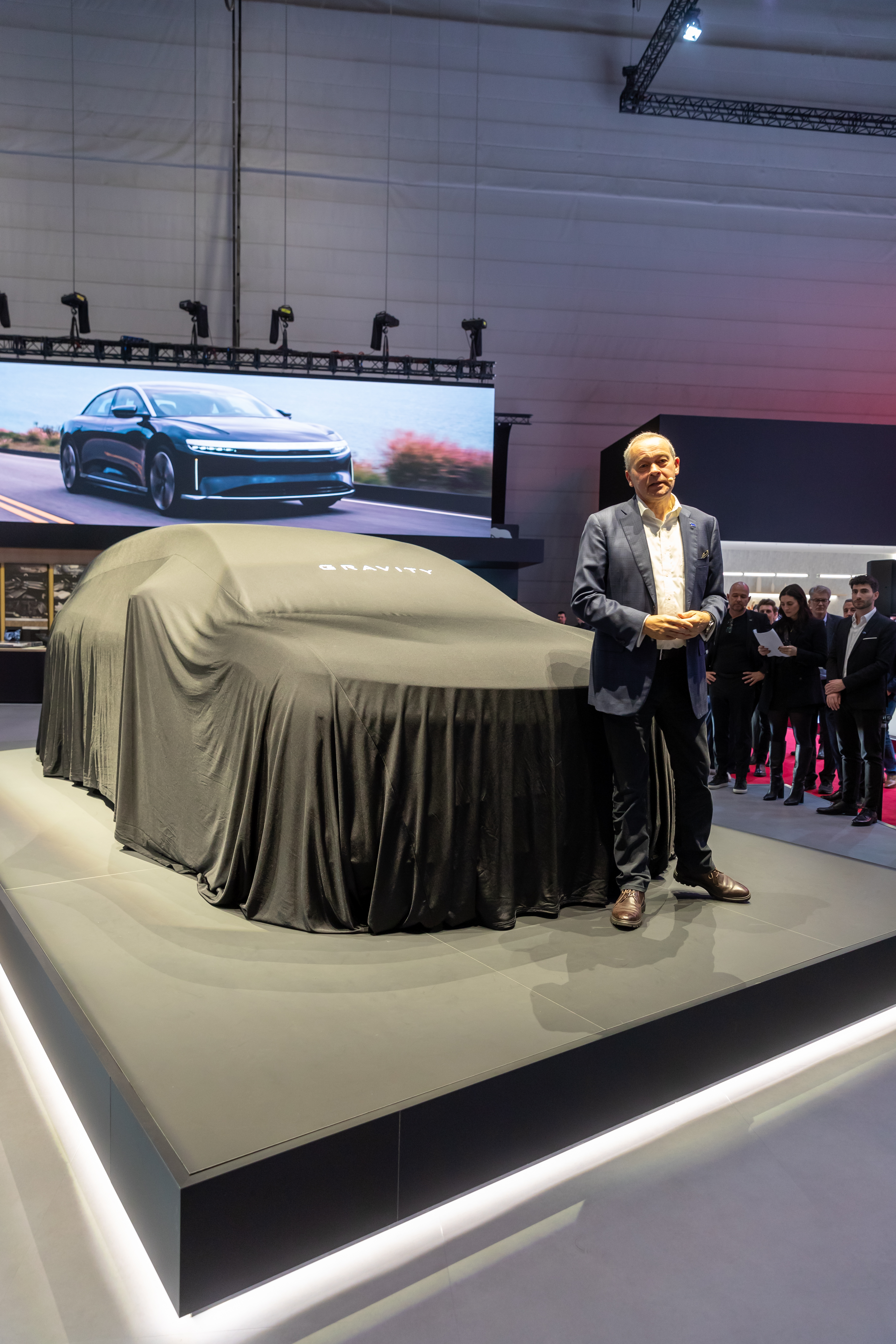
Lucid Gravity is Lucid’s big electric family vehicle. The hosts are talking about how the car’s large doors might matter if it’s used by itself as a taxi.
A robot taxi is a self-driving car that acts like a taxi service. The idea is that it has to handle real passenger mistakes, like doors not being closed, without a human to fix it.
Automated doors are doors that can open and close automatically. For self-driving taxis, that matters because the car can’t rely on passengers to always close the door correctly.
“Drivability” means how pleasant and controllable a car feels to drive. They’re saying the Lucid Gravity’s behavior on twisty roads is part of what they’re judging.
Air suspension is a suspension system that uses air-filled “springs” rather than traditional coil springs. It can make the ride smoother and help the car handle rough roads better.
Tesla’s Model S is an electric luxury sedan. In this conversation, it’s the speaker’s reference point for how smooth the ride feels compared to the other car’s suspension.
Independent suspension is a suspension setup where each wheel can react to bumps on its side. That generally makes the ride smoother and helps the car stay more stable when turning or hitting uneven roads.
A 1977 Fleetwood is a big American luxury car that was built to feel smooth and comfortable. The host is using it to show that older cars often couldn’t be both super comfortable and super sporty at the same time.
They’re saying there used to be a trade-off: cars could feel comfortable, but then they wouldn’t handle as well. Or if you tuned them to handle better, they rode rougher.
Even though the car is doing the driving, there’s still a person in the driver’s seat watching and ready to take control if something goes wrong. It’s usually used during early self-driving testing.
A driverless permit is government approval to let self-driving cars operate without a person driving. The hosts say they got the approval, but the actual driverless testing hadn’t started yet.
Sensor integration is how the different “eyes and ears” of a self-driving car are put together to work reliably. Good integration usually means the sensors are mounted and connected in a clean, organized way.
A fleet is just a lot of vehicles working together. With self-driving cars, it’s harder because you have to keep the modified parts working and easy to service across many cars.
The Jaguar I-Pace is an electric SUV. In this story, Waymo takes that car and modifies it for self-driving, then keeps many of them running as a fleet.
A retrofit means taking a normal car and adding self-driving equipment to it. The downside is that it can make repairs and maintenance more complicated.
Creaky suspension refers to audible noises coming from the suspension system, often caused by worn bushings, ball joints, or other suspension components. In this segment it’s mentioned as a minor issue observed on one corner of a ride, suggesting the fleet vehicles are mostly in good condition.
Sensor pods are the “boxes” on an autonomous car that hold its vision/measurement equipment. Here, the speaker says they’re placed so technicians can reach them more easily for repairs and upkeep.
A fleet car is used by lots of different people and usually gets driven harder and more often. That means the upkeep has to be more standardized and frequent—especially for the sensors that autonomous driving relies on.
Autonomous cars use sensors like cameras and radar. “Sensor axis” is basically how those sensors are aimed on the car—if the alignment changes, the car’s driving system can be less accurate.
An AV deployment is when self-driving cars are actually running in the real world. The point here is that the company you hear about may not do everything—other companies often handle maintenance and operations.
Hertz is known for renting cars, but here it’s being used to run the day-to-day logistics for a self-driving taxi fleet. That includes keeping the cars charged, repaired, cleaned, and staffed at the storage/depot locations.
A “robotoxy” service is a coined term for a premium robotaxi-style ride experience—self-driving vehicles used like taxis, but positioned as a higher-end product. The segment frames it as a multi-partner operation, combining ride-platform branding (Uber), autonomy providers (e.g., Waymo/Nuro), vehicle supply (Lucid), and fleet operations (Hertz).
Auro Mobility is described as a newly established affiliate used to carry out Hertz’s robotaxi-fleet operations. The key point is that fleet management and support services may be organized through a dedicated corporate entity.
A “hardware issue” means a physical part of the car’s system isn’t working right. For self-driving, that could be sensors or computers, and it has to be handled safely.
A “software issue” means the car’s computer programs aren’t behaving correctly. The self-driving system has to be designed so it can still act safely when that happens.
Term
remote operations issue
“Remote operations” means people or systems helping the vehicle from off-board. If that help doesn’t work correctly, it can affect how safely the car handles a problem.
A “stack” is the whole set of software and systems that work together to make the car drive. If one layer has a problem, the rest of the system needs to handle it safely.
“Failure modes” means the different ways the system can fail. The goal is to plan for those problems ahead of time so the car can stay safe even when something goes wrong.
Here, “robust” means the autonomous system can tolerate faults without losing safety-critical behavior. Instead of assuming everything works perfectly, the design accounts for hardware, software, maintenance, and operational issues.
“Apportion responsibility” means figuring out who is to blame when something goes wrong. With self-driving systems, multiple companies may share duties, so contracts have to decide who’s responsible for what.
The speaker describes a regulatory mechanism where law enforcement can issue traffic violations to autonomous-vehicle operators, but instead of a driver fine, the violations are logged and sent to the vehicle manufacturer. The manufacturer then must report the data to the relevant DMV/regulator within a set window (e.g., ~72 hours), enabling oversight and enforcement based on patterns.
Concept
72 hours reporting window to the DMV
The speaker says the company has to report the violation information to the DMV pretty fast—around 3 days (72 hours). The idea is that regulators can react quickly if there’s a recurring problem.
FedEx is used here as an example of a company that manages lots of vehicles at scale. The point is that for big fleet companies, the cost and handling of violations can work differently than for individual drivers.
The idea is that regulators care more about repeated problems than one-off mistakes. If the same kind of violation keeps happening, the DMV can step in.
Even if two cars look the same, they can be running different software versions. If a bug is version-specific, that helps explain why some cars have the problem and others don’t.
A VIN number is like a car’s unique ID card. It helps companies and regulators figure out exactly which specific cars are affected by a software issue or recall.
A recall is when the car maker says, “This problem needs fixing.” With modern cars, the fix might already be delivered through software updates, so the recall announcement can feel delayed.
An over-the-air update is a software update that gets sent to the car wirelessly. That means the car can change or fix things without you going to a shop.
Rider support is the help system for passengers in a self-driving taxi. The question here is whether that help can step in if something goes wrong or if someone is doing something inappropriate.
“Abuse fleets” means a shared fleet of cars getting mistreated by riders. The point they’re making is that this kind of misuse can drive up cleaning and maintenance needs for the company running the cars.
Waymo uses cameras inside the car. The point of the question is whether people try to block or cover them, which could interfere with how the system checks what’s happening inside.
The Tesla Model Y is an all-electric SUV made by Tesla. It uses a battery instead of gasoline, and it’s built for regular driving like commuting and errands. It may be mentioned when people talk about how Tesla’s cars and features have changed over time.
This is a Tesla Model S from 2017. The point here is that some versions didn’t have a camera watching the driver, and that affects how the car’s advanced driver-assist features work.
A driver monitoring camera is a camera inside the car that watches you to make sure you’re paying attention. It helps the car decide whether it’s safe to keep using its driver-assist features.
“Hardware three” is Tesla’s name for a certain generation of the computer inside the car that runs the driving-assist features. Newer hardware can enable different capabilities and requirements.
“Hardware 2.5” is the car’s onboard computer version that powers the advanced driving features. Different hardware versions can handle the software differently, so the same feature may work better or worse depending on the car.
FSD 12 is Tesla’s latest version of its advanced driving software. The host is saying that, even with a capable setup, it wasn’t able to drive an entire trip perfectly without issues.
They mean the system could (or couldn’t) handle an entire long road trip by itself the whole way. In this case, they’re saying it still needed help rather than working perfectly the entire time.
FSD 14 is Tesla’s newer software version for its advanced driving features. The speaker is saying the latest version feels much more capable than earlier ones.
“Full self-driving” means a car tries to do most of the driving by itself. Even when it’s doing a lot, the driver often still has to watch and be ready to step in.
Backing into a parking spot means you reverse into the space instead of driving in forward. Some people do it because it can make it easier to drive out later.
The Ford Flex is a crossover-style vehicle made by Ford. It’s known for having a lot of interior space and a very noticeable, boxy shape. It may be mentioned because it’s an unusual-looking car that people remember.
LIVE
What do you guys think?
Do you think that it's enough of a stick in a way
to have the data component which has real consequences
and that you don't need to have a finite touch to it?
Alex, you go first.
No, you go first.
No, no, I wanna hear your take.
Yeah, take a stand, man.
No, no.
Really?
I mean, I'll give you my take if you insist.
Hello, and welcome to the Autonic Cast.
As always, I'm Alex Roy,
the co-founder and general partner
at New Industry Venture Capital
and the founder of the Human Driving Association.
And I'm Kirsten Korosek,
transportation editor at TechCrunch.
And I'm Ed Niedermeyer.
I am the author of Ludicrous,
The Unvarnished Story of Tesla Motors
and Elon Take the Wheel,
which is now available for pre-order.
And I also just spent the last week
wandering around the desert.
So I'm gonna rely a little bit on my capable co-host here
to fill us all in on the events of the last week.
Well, we should...
Wait, wait, wait, yeah.
Kirsten, who is the author of Ed's very handsome haircut?
Because Ed, I'm not trying to connect you to people
that are maybe not your personal friends,
but you are absolutely looks maxing.
You are mogging every man who lost his hair.
What's up?
Yeah, I mean, I thank you.
I got a haircut at a random, I went on vacation.
I was unable to book my usual haircutter
before I went on vacation.
So I got a random haircut at the,
I believe it was the Sedona Barber Shop.
So shout out the Sedona Barber Shop.
And thank you so much for the kind words.
Okay, so we should set the scene a little bit.
So first of all, Ed's audio is terrible today
because he is actually recording from my guest house.
And he made a trek down to Arizona.
Alex flaked on us
and had to do other more important things,
which is totally fine.
A special operation was going on, I guess.
He's back as director of special projects of Alex, Inc.
And he wasn't able to get together,
but Ed's been traveling around Arizona
and then he spent the last couple of days with me.
So right now he's sitting just yards away
from my recording studio.
Just far enough that our mics aren't picking each other up.
Exactly.
Yeah, I mean, there is a lot to talk about,
but I think one thing that I should mention
is that this past week, in addition to Ed being here,
I had a lucid gravity.
Wow.
And so...
So it's everything.
Well, so I feel like here's my headline.
It is fun to drive
and it's a joy to be a passenger in,
but I think it's gonna be a pain to own.
Why?
There's a lot going on.
There's just a lot of fiddly bits going on.
That's how I would describe it.
Software interface, what?
Yeah, so a little bit of bugginess,
which I've actually reached out to Lucid about.
I feel like every time you have a Lucid,
there's something along those lines.
Yeah.
I'm beginning to wonder if software is really
the key to the auto business.
There's, I mean, it's not like it's all bad,
but I will say this, like, okay,
the back seats are these, you have to set it up.
So there's three rows.
And so the second seats, second row seats are great.
Ed was sitting in the second row seat
and I think enjoyed himself back there,
but there's a third row.
I will say second row is much, much better than my usual,
like in a cage in the trunk, you know,
usually the kennel is...
Sorry, exactly.
But yeah, we let him out.
But like getting that third row set up
was just like kind of dumb.
Like you had to take this sort of like
flat pad out of the vehicle
and then like pull a strap to open it
and then like grab this plastic handle
and like thrust it up into position
and then put that thing that's been sitting on the ground
back in the car.
It just was like...
And then my other big complaint is
they have these amazing glass roof,
but they don't have a...
There's not like an automatic, you know,
roof cover, you know, interior shade.
So instead they have these removable ones
and they fit, but like I took it off
and immediately like the little clips like flew off
into like a thousand directions.
So...
It's shades of...
I remember when the, was it the Model X came out
and Tesla, you know, the glass was...
There was more glass than ever in any Tesla
and they had the little like spring loaded screen
that you just sort of pop in there.
And like Lucid has just gone the same route.
Tesla has made it like okay and acceptable
for a 100000 dollar cars.
Just have these little like, have way more glass
than actually makes sense from a design perspective.
And then you make up for it
by putting these chintzy little, little screens
like, you know, in place manually.
It's not a very premium experience.
It does the...
So Tesla, you know, sells for like a hundred bucks
like the additional shade, like you have to pop in.
Yeah.
Yeah.
Lucid was meant for free.
Well, I have to look at the Mineroni
and see if those are free or not.
Okay, maybe they're not.
Interesting, interesting.
But I did test the 8S as well,
which Ed was not in the vehicle for.
So the good news with that is that
if you've been in an air like,
I don't know, a few years ago,
their 8S was their dream drive as they called it,
was not good.
It was really ping pong-y like in between the lane.
And I did not enjoy it.
It also would put you like very close.
If you're passing like a large truck or something,
it would put you very close to that vehicle.
It is definitely improved, like much better.
I didn't have a hands-off version of it.
So this is like hands-on wheel,
but operationally, it does well.
It has a feature, a setting feature
where it will nudge you over a little bit.
So as you're going down the highway
and you're passing a big rig,
it will actually nudge you over a little bit
so it doesn't feel close.
I mean, it's centered,
but then it nudges you a little bit over,
which is kind of nice and it has lane changes.
So much better, much better improvement for sure.
I mean, it is like a $6,200 add-on.
So not sure if it's worth that,
but definitely much improved from what it was.
So that's a good news thing.
But the passenger piece I think is really interesting
because these are gonna be the premium
Robotaxi service vehicles that Neuro and Uber are gonna use.
So that was interesting to like check it all out
because this is gonna be what people experience
once that Robotaxi service launches,
which is supposedly by the end of the year.
So question about the charging,
did you charge it anywhere but home?
Yeah, I charged it at a Tesla charger.
How'd that go?
Tesla super charger.
Fine, except for I ended up having to pay
because it's a press fleet vehicle,
like the financial setup,
if you owned this vehicle,
you would have a credit card tied to the Lucid
and it would be easy.
I had to do it through the Tesla app,
but it was fine.
I mean, I had my credit card on a Tesla app
and then I just did it through that.
It wasn't cheap though.
It was like 27 bucks.
I mean, services is one of the few areas of Tesla's business
that's actually been growing for the last couple of years.
Well, yesterday I filled the tank on my 928
and it cost $115.
It must be a pretty good size tank.
I guess it's a touring car, right?
What's the range on a 928?
Yeah, what kind of gas are you putting in your 928?
Because my 928 doesn't cost that much to fill.
I got premium and it was $5.20 a gallon.
And I don't know how many gallons I put in,
but I mean, the car gets the display,
if you trust the 1989 German OEM fuel range calculator.
Honestly, probably more reliable
than Tesla's range estimate.
Anyway, to you.
300, it says 367 miles.
Okay, that's a pretty decent range, yeah.
Yeah, I know that we don't fill up our 928 very often,
but we also, it's not like a daily driver, so, yeah.
Famous last words, we don't fill up our 928 off of it
because we can't.
It's not a daily driver.
But yeah, I mean, Ed, you sat in the back of the Lucid,
what were your thoughts?
Like if you were a road with a Maxi passenger,
would it be a good experience?
Yeah, so, I mean, you know, I, so,
so Alex and I sat in the gravity at CES,
was it the year before?
No, that you were with me, dude.
Oh, no, it was you, that's right.
You two are interchangeable.
So we actually talked about this the other day.
No, Kirsten's.
I've said on the show before, I really like the gravity,
it's, I have a soft spot for it, they call it an SUV,
but it's really a big, you know, people hauler.
I do agree with Kirsten that I think that there are some,
some, you know, I think already it's,
it's not setting the sales charts on fire.
I think there's some issues with it
as an American market, personally a vehicle,
but I do think that it has some really interesting potential
as a, as a robot taxi.
Like one of the things that, that immediately,
so the doors are kind of big and the back doors,
they're quite big and a bit heavy.
So I think one of the things they're gonna have to do,
right, we know with, with Waymos,
this is a big thing that they, they lack,
the iPaces lack the automated doors.
And so if someone doesn't close the door properly,
they have to, so I don't know if Uber and Lucid,
I think they're planning on doing some kind of
automated door for the back seat.
I think that would be a good thing.
Cause it is kind of a big, heavy door to swing open,
but it has a really nice low floor.
I think that's something that people really don't think about
in vehicles, especially in like shared vehicles.
That low floor, especially for older people,
it just makes it really easy to step in
and get into the vehicle.
The back seat is really spacious.
Kirsten pointed out the conversion of the third row
is like kind of clunky, but I presumably like,
I think when you, you can have all three rows up
and still have quite a bit of, of, of space for luggage.
So I assume the robotaxes will probably be just
set in three row mode, in which case, you know.
I would think that that would be good because then, yeah.
Well, I mean, and if you think about it,
what other robotaxes have, have rows for that many people
or seats for that, right?
Cause you can fit, you know, 66 footers in a,
in a gravity.
I don't know.
You can't even, can you do that in the Ohio
and the new, in the new way, Ohio, I don't think you can.
I don't know.
Maybe you can do, maybe you can do three and three.
Yeah. I guess cause they have the bench seating,
at least in the front.
No, Kirsten, for anyone like me, who, I mean,
who owns a Citroen and Morgan and a Tesla, you know,
I look at the gravity.
I'm like, this thing is so beautiful.
I want one so badly.
I mean, like I'm not dissuaded from buying a gravity-based.
I think it's a perfect car for you.
I like that.
It's a very, it's the most,
it's the most French car for sale in the US right now,
which means it's a perfect Alistair car.
Yeah. Yeah.
I will say this, like I, the air, I will say this,
like the one thing in terms of drivability.
Now, if anyone from Lucid is listening,
you should know that Ed kept trying to get me to drive
really fast up the mountain roads.
And I was going far above the speed limit,
but he felt like I wasn't pushing the,
pushing the car enough.
And I ignored that because safety first.
She's the responsible one on this podcast.
I was driving it far above the speed limit.
I just wasn't, you know, taking me into the rails,
you know, but I think you would really like
the driving performance piece of it.
The air suspension is super nice.
And like the roads in Tucson are-
I think it's a nicer ride than the air a little bit.
Because the air is way better than my Tesla S.
Well, Alex.
No, no.
Your 928 is probably-
You got some actual insights from this on the show, Alex.
I know many other vehicles have better suspension,
but the air suspension is interesting
because it reminds me of like when we took the ride in the Zooks,
that wasn't like a plush,
it was a little jaunty, right?
You could feel this like hitting a pothole or something.
And, you know, it's a different kind of vehicle.
But in terms of a robotaxi, like the comfort of the ride,
that was something that like stood out on the Lucid.
Yeah, I think you would love it.
I think it's really interesting.
So I've been researching the history of the cannonball.
And I found from a hundred years ago,
I found all the records that were set by Irwin Baker.
And I found all the ads
that American OEMs published around his records.
Would you like a list of the innovations
that were communicated to Americans
based on these cannonball records?
Get ready for it. You ready?
Independent suspension.
Can you imagine what it was like back then
to go cross-country?
No interstate in those cars with those suspensions.
So any, literally, the gravity suspension could be broken.
It would be a gift.
People forget how bad suspensions were 30, 40, 60 years ago.
It was crazy.
On American cars specifically.
Well, it was possible to get decent suspension
on a car 30, 40, 50 years ago.
Okay.
My dad's 77 Fleetwood was plush,
but it was literally, it was an inverse correlation.
It was suspension.
It was comfort or handling.
Right.
Never both.
Never both.
They were at war with each other.
But that's a distraction.
Go on about the gravity.
No, no.
I mean, that's it.
That's, I just, those were like my insights of that.
And it's kind of relevant now because, you know,
Nuro and Uber are the ones kind of doing all the testing.
Lucid's delivered.
I think it was like 75 engineered cars to,
to Nuro and Uber.
Nuro's tech is in those vehicles.
And they've been, they're testing autonomously,
but with like a human safety operator behind the wheel.
But I had like a little story based on some disclosures
that they did just receive a driverless permit,
but they haven't started doing that testing,
but that should be coming like very soon.
So we'll likely see like driverless Lucid gravities
around California in testing mode pretty soon.
So I saw, when I was in San Francisco for ready,
I saw that there were a few, we had,
we had one in front of the event, but we,
I saw a couple around and I will say this about the gravity.
It looks cool.
Like the robot.
So the Uber Nuro ones, they've,
they've, the sensor integration is very clean,
very nice looking.
And they're just these long, low black vehicles.
And I don't know, there's just something cool about it.
So I also, when I was in San Francisco,
I got to visit the Waymo depot.
So, you know, you could see there, among other things, the,
well, you can see the challenges of operating a fleet
of Jaguar I-paces, you know,
it was really interesting seeing some of those Waymo's
with the, with the panels off and just the amount of,
you could tell that, you know, these are retrofitted vehicles
and there's a lot of inefficiencies in like accessing
the internals for service and, and, you know,
huge amounts of parts around.
I'm actually really curious now about like,
like is Waymo, like, like are the suppliers of that program
doing better than they thought they would do?
Because Waymo's buying somebody's spare parts.
Cause they're, by the way, they're keeping those,
those I-paces in really nice shape.
Like when you hail a Waymo in San Francisco,
in most places, they, they're clearly spending a lot of money
on, you know, maintenance and, and, and all that.
And they're in really good shape.
I heard 11 a little bit of creaky suspension
in one corner from one of my rides,
but otherwise they're really doing a good job.
But the Ohai fleet in that San Francisco depot is really,
which is the, the Geely vehicle that's their next generation,
really starting to grow that fleet size.
I would say there was definitely over, over a hundred,
probably close to 200 now.
And so, and you're starting to see them more on the streets.
And one of the things that was just really obvious was like,
that vehicle is, is much more built for, for, for maintenance.
It's not a retrofitted vehicle.
It's, it's, you know, the kind of sensor pods that,
that stand off from the vehicle a little bit are,
are in part like that because they're so much easier to,
to access for maintenance and things like that.
So aren't they,
can you argue that they're like just more exposed than two?
Like they're more exposed to damage.
You want your AV to not, to not be contacting things anyway, right?
Hopefully that's not a major factor.
Anyway, the point that I want to make though is, is that,
you know, the Ohai is going to be really interesting.
We sat in it quite a few years ago, but it's, it's also,
it's a very, it feels like a taxi.
It's not premium. It's not fancy.
And so it'll be, but, but it's,
it's also very well thought through from an operations perspective.
I think it'll be interesting to see this lucid as a comparison
point because it is premium.
It has this sort of, yeah, kind of,
kind of cool premium look and feel to it.
But I wonder from an operational perspective if,
if that vehicle is really built for, for the kinds of, yeah,
like, like a sensor axis and just general, like,
like maintaining a fleet vehicle is not the same as maintaining
a privately owned vehicle.
It'll be interesting to see how well that,
that vehicle fits into that regardless of how the, the stack
and all that.
Do we know who's, who's managing the like lucid neuro fleet?
Is there anything?
They just say, well, so in development, obviously it's neuro,
but, but when they deploy all they're saying right now is Uber.
And actually that brings up, so I haven't read it yet.
Uber just, well, it's great.
So it's, it's, it's the vehicle, it's the stack and then it's operations,
right?
So the vehicle is lucid, the stack is neuro and the operations supposedly
are Uber, but what, what does that mean?
Like it's not, it's not clear.
I think it's been disclosed.
I'm going to refer to some of my coverage while you're talking.
Please Kirsten GPT, ask it.
It's not a straight Kirsten.
Okay.
So while I'm looking this up, you can continue to speak.
Oh, thank you.
Yeah, you're welcome.
But I do know this, that all of the relationships that Uber has with,
you know, Waymo and other companies where they have like commercially
deployed, it says Uber is like handling maintenance, but it's almost always
a third party as well.
So I, I just don't know which one I believe that move is one of the ones
that they've, they've used.
There's, there's definitely other ones and I'm just looking to see where,
where it's listed.
But move, move operates Waymo's in, in a number of jurisdictions now.
I think they're, they operate the Phoenix fleet and a couple others.
Is that right?
Yeah, that's accurate.
Yeah.
So already, you have Waymo's, you know, Waymo services in certain
cities that aren't even operated by Waymo anymore.
So.
Yeah.
So there's going to be, there will be like under the qualifier of Uber,
but likely, you know, it's going to be another company.
And, you know, there's, I'm so bummed that I can't find this right now,
but Uber recently, oh, Hertz.
Thank you.
Gosh, I knew we wrote about it.
That's it.
Yup.
So Hertz is providing the day-to-day vehicle asset management,
including charging maintenance repairs, cleaning and depot staffing.
They just announced this a week ago.
This is for, for Uber?
Yeah.
Uber, Uber, this is specifically for the luxury Robotoxy service with Lucid and
Neuro.
So, you know, Hertz is the fourth partner.
Hertz is going to handle, you know, all of this work through apparently like this
newly established affiliate called Auro Mobility.
Okay.
So there you have it.
So four companies are involved in this premium Robotoxy service.
And by the way, that's not unusual.
When you look at some of the other deals, there's at least usually like another third
party.
So it's really interesting to me that like behind the scenes, there's a lot of
people involved with a money exchanging hand and a lot of people involved.
Yeah.
So, so Lando Juarez, who's the head of the policy for government affairs for Uber,
spoke a bit at the right ASM and had some really interesting comments about the,
the agreements.
Obviously he wasn't, he didn't give away too much, but he said enough that was very
provocative.
I think the, the discussions that are going on between Uber, it's sort of stacked
technology partners and its operations partners.
And then of course the local regulators at the city and federal levels are really
interesting because, you know, it seems clear Uber, Uber wants to, at least at this
point, they're pushing hard on this partnership model.
But, you know, when you have all these different parts of the service being sort of
chopped up between these different partners, how you manage, you know, everyone,
the hot potato is legal liability, right?
And so, and so, you know, all of those pieces can play into it.
So it sounded like based on Lando's comments that, that Uber is doing some really
interesting work in, in the sort of realm of contracts to, to sort of figure out
what do you mean?
What do you mean?
Well, I mean, like I said, you have, you know, these services are a product of,
right, like the, the, the technology, the vehicle operations and the vehicle itself,
right?
So there's, there's all these different pieces and like we're, we're something to
go wrong where a crash to happen, right?
You could have a hardware issue involved in that.
You could have a software issue involved in that.
You could have a vehicle maintenance issue involved in that.
You can have maybe a remote operations issue involved in that.
You can have, right?
So, so, so each of those pieces I mentioned in one of these partnership structures is
being handled by a different party.
And so you kind of have to, just as when you're developing a stack, you have to go
through and anticipate, you know, likely failure modes and engineer your system to,
to be able to handle them, to be robust to them.
In the same way, I think they're having to put together contracts that are similarly
anticipating the ways in which things can go wrong and litigating, you know, in
advance, hopefully as much as possible when these different things go wrong, that,
that again, could be a product, you know, you could have a failure mode that is the
result of, you know, both an issue on the hardware side, on the software side, on
the maintenance side or the operation side.
Like in theory, if you get a Swiss cheese problem where, you know, where safety issue
runs through all those things.
And so again, like it's like, how do you apportion responsibility in a scenario like
that?
It's not, again, you didn't give away too much, but clearly they're, they're looking
very closely at how you make that work within this kind of partnership framework.
So you bring up an interesting idea that you actually didn't say the word, but it
got me thinking about data and data collection.
And the reason why, like there's an extreme data bottleneck.
Uber has this new AV labs, which is going to be using data for supposedly collecting
data and sending it back to their autonomous vehicle partners and helping them train
their models.
I, I have my other ideas about maybe what they're up to, but data is going to be a
really interesting in the state of California, because you probably saw that the DMV just
updated all of their regulations.
There's a bunch of new data requirements, data sharing requirements.
So all this data is being collected.
It's not that it's not being collected, but you might all be shocked that all the on
background conversations I had with many autonomous vehicle companies did not want to
speak on the record, but all kind of were complaining about the data piece.
How much data do they have to share?
Well, not only that, but the time, it's actually more the timeframe.
So there's some like very specific, like within a day or within a couple of days, like
reporting certain things and some new rules about remote guidance, like operators, new
rules around how quickly a first responder can interact with the vehicles.
I believe it's like within 30 seconds, 30 seconds remote.
And then I think that any kind of, and I don't have it in front of me, but I believe it was
like within 48 hours, there were some reporting requirements and it ranged.
So a lot more, the trade off, of course, is that big rig trucks can now test there.
There's a way forward for them and that have been banned.
So that data piece is going to be really interesting.
And I'm just thinking of like, okay, who's in charge of all the reporting?
Is it Uber?
Yeah.
No, that's a great example because you have to have a unified framework for this partnership
to report regardless of what part of the partnership the problem arises in, right?
Yeah, exactly.
I find it fascinating.
I remember being at Argo and discussing things like this.
I don't think, I think there are regulators who just don't understand like how complex
it is to assemble the data, even to share it, even if one was absolutely required to.
Like it's not like, hey, let me just create a zip file and send it over.
And then on the other side.
It's just like too raw.
I mean, it's like the data is like.
It's a lot.
It may be desperate, you know, the protocols internally for a story and categorizing it.
And, you know, they may not necessarily be in the same format, company to company.
And so whoever's receiving it, like who over there is even capable of parsing it.
It's not like, you know, the local and state, you know, state offices have necessarily even
the staff that do that.
Even storing it securely is not as easy as it is.
Yeah.
And it's easy to say to also how many incidents there were, then you have to agree on how
to classify the incidents.
But it's a different story.
If it's like the actual raw data, come on, please be serious.
Yeah.
But now, but now there, you can just have an agentic AI do all of the, all the data
is sorting for you.
So, you know, government will just vibe code.
Yeah.
We say that, but we all know that, you know, AI as a term is so vague and, you know, agents
very Alex.
Right.
Are you an AI skeptic?
Are you?
No.
An AI scouts.
This sounds remarkably like.
I'm not an AI skeptic, but like electricity, it's a very broad term.
I'll say this, you know, I, I have a window open.
I have this, I have this widescreen monitor and I have a window open.
I have, well, depending on what I'm doing, I have, you know, three or four LLMs open
at a time and I'll ask them all the same question.
And, and then I have like an aggregator, an LLM aggregator and I ask it the same question.
And the quality of response varies a lot.
Yeah.
It's hurtful that you go to all this effort when you know someone who already knows everything
about everything.
You could just ask me.
Oh, oh yeah.
You know, a funny thing happened the other day.
I know.
So I was putting together a deck and I have a creative agency.
Well, I have a very high level agency working with me on this very critical deck for this
stealth project.
And there was, you know, buried on like page 19, there was like six small images with
subheads and like some texts.
And I scanned it.
I read it.
I, you know, it was presented by one of my portfolio companies and everyone's like,
this is amazing.
This is brilliant.
And then it was second, third, fourth pitch and then someone points out, it's like, have
you looked at one of those small images and it was an AI generated image like a road
sign.
And if you scroll, if you went in real close, there was some foul language on it.
Oh no.
Really?
I was like, what would have happened?
So yeah.
What image generator were you using?
I don't know.
I don't know what was used.
What I think.
It wasn't.
Generator names have been changed to protect the innocent.
Yeah.
It wasn't grok.
Okay.
I don't know.
But I don't know exactly which one it was.
But yeah.
Well, at the risk of, of steering the conversation back towards autonomous vehicles, I just
wanted to mention that one of the things that, that's interesting about this California update
that has happened is at least an edit.
So, you know, as always with this, this technology, there's like, what's actually happening and
then there's like, what's happening in the public conversation around this technology
and the headlines that we've been getting out of this update from California.
The focal point is something that I've been seeing a lot in, in sort of AV critical discourse,
which is this idea of like, well, now cities can, well, now, now someone can give AVs tickets.
Right.
That's not totally.
It's, but it's not exactly.
That's what I'm saying.
This is right.
So that's why I set it up a little bit.
There is that, is that you get that headline, which is responsive to something that people
have been saying.
Again, AV critics.
I've been seeing things for a lot for more and more for in recent months, which is if
they're breaking the law, you should be able to ticket them.
So if you'll just sit on the details of what's actually happening in California.
Right.
So, so I have a question.
I would like each of you to answer this.
So this is what the rule, as far as I've been able to discern and I've read a lot of the
regulations very, very long.
And I've reached out to like DMV and also SFPD, SFPD continues to ignore me, which is awesome.
But yes, law enforcement now has a mechanism.
It's stated the ability to issue, quote unquote, traffic violations.
But as far as I can tell, and I've talked to a fair number of people, there's no fine attached
to it.
Instead, what it is, it's really a, it's a data mechanism in which these violations get
logged to the manufacturer who has to then share them with the DMV, the regulatory agency
involved here within a certain amount of time.
I forget, I think it's 72 hours or something.
And what I, the argument I've been told is that companies like FedEx and others that
do like a lot of big fleet stuff, they are big fleet management.
They bake into their budgets like traffic violations is just a line item.
And that, that the argument for not having a fine is that really what's more important
here is that the DMV now has data to take action if they see like repetitive behavior
or something like that.
And then it's more valuable than the fine.
And my question is like, well, why not both?
Like why not collect the fine?
Because now you're using taxpayer dollars to manage all these autonomous vehicles.
Like they, I'm certainly, they probably had to hire people to manage all this.
So shouldn't AB companies like pay for part of that?
I don't know.
What do you guys think?
Do you think that it's enough of a stick in a way to have the data component, which
has real consequences and that you don't need to have a fine attached to it?
Alex, you go first.
No, you go first.
No, no, I want to hear your take.
Yeah, take a stand, man.
Oh, really?
I mean, I'll give you my take.
If you insist.
Yeah.
So I mean, look, I actually do think there should be some a fine, right?
Like if you're making a driver, right?
It's a Waymo driver, the Aurora driver, whatever.
Like if that's what you're doing, you know, driving is a physical act.
And that's what the technology has been focused on and has achieved a really
remarkable level of maturity in, but driving is also a social act, right?
There are, there are aspects of driving and, and, and there are things you have to do to
be a driver that go beyond the physical act of driving, being insurable, being of age
to get a license, you know, all these different things.
And so I think if the goal is to create automated drivers, then like they should, they should
be treated like other drivers to the extent that the technology is, you know, that it's
possible using that with this technology.
And so I think, you know, a financial incentive around, around don't break the law is, is
good.
I would say also I have to put this in the context of the California DMV's total inability
to enforce its explicitly written rules dating back to like 2016 on Tesla, which Tesla has
just like rampantly violated for a decade.
Like great, you put rules in place until I see evidence that you're good at like actually
enforcing those rules.
It doesn't mean anything.
What I will say, what I will say is this, the thing that I've seen create a lot of
furor lately around Waymo and specific is this, this issue, and it kind of came up in
London, but it's come up in other places as well around Waymo telling, being upfront
about the fact that like when we do pickups and drop offs, we may stop in, in a cycling
lane.
Now I will say on blue sky, this has created a furor.
People, people see this as the worst thing, you know, possible, certain people, some people
do relatively small, but noisy group.
And what you have to like, what's fascinating about it is that when you say like, Hey, have
you, you know, taken a human driven Uber ride in San Francisco, or any of these cities,
if so, the chances of being able to take a human or automated Uber ride that doesn't
involve stopping in a, in a bike lane at some point are almost zero.
And like when you're out anywhere, you constantly having to cross double yellow lines because
there are trucks double parked in bike lanes.
Like the idea that, that, that bike lanes are this like sacred, inviolable thing that are
only being like sullied by these evil robot, you know, cars is totally absurd.
But it points to the fact that people have a double standard around the stuff that people
accept things from human drivers that they, that they are less likely to accept from robots.
I think one of the ways you mitigate that is you, is you say, okay, well, the robots
are just going to be playing by similar rules, which is that, you know, human drivers violate
the, the sanctity of the, of the bike lane all the time with pickups and drop offs.
But if they get caught doing it, they will get a fine.
I think that there's no reason not for, for robotics is not to face the exact same rules,
unless Alex has a good one that can change my mind.
Listen, I mean, UPS and fed, you know, trucks, you know, when they stop in New York City
or any city, but especially New York to, you know, unload their stuff, it will rack up
dozens of tickets and it just becomes part of the cost of doing business.
And they, it's factored in and it just, it's not consequential to the company.
And I can, you know, your point is a strong one, Edward, for, for once, it's, it's a
good one.
Very, very kind of you.
No, I can't, you know, you, you're saying it makes sense.
It's, it is peculiar.
We share, you know, the Waymo driver, there isn't one Waymo driver on the road at all
times because, you know, there are different, like different software is running different
vehicles, different cities from time to time.
But when a vehicle gets a fine, let's say Waymo gets a fine.
And, you know, you're basically finding one driver distributed across, you know, all
these vehicles.
It's not like giving a fine to like a UPS driver who like speeds or makes a wrong
turn. And so the double standard is, there's even like a third, it's like a triple
standard of like moral inversion, because if we wanted to play this game, you know,
be signing blame to like an AV for doing something, which is really doesn't matter.
You know, then why aren't all human drivers at fault for the actions of one?
Why isn't there like a moral consensus?
Like, oh, it's a really bad driver in my neighborhood and, and he's getting a ticket
and it's, it's a million dollars.
So we're going to charge everyone in the neighborhood for not like shaming that
person to be a better driver.
Like there's no, there's no, go on.
Well, no, I just, I just, there's two parts of this, right?
There's one, there's the fine that you get, which I agree, like we agree is, is not
being ported over to this new paradigm.
But the other, the other piece that I think is, is the, is that when you get
enough tickets, you get, it's the point system and you may lose your license.
That I think, I think what the DMB is doing where it's like, okay, you get a
violation, we review it, that's like a version of that, of like, do we see patterns
of misbehavior that justify us pulling your permit to operate?
That's like, that's like taking that one piece of the enforcement mechanism.
But what's not there is just that day-to-day incentive of like, if I do
this thing that's illegal, but, but sort of socially acceptable, like I may get
caught and, and I may have to pay a fine for it.
And I think, I think we need both of those pieces to have sort of equity
between humans and robots.
Alex actually brought up a really good point that I did.
I don't know if you intended to make it, but I didn't think of it before, which
is that if there is different software running on these different vehicles,
it's essentially like they're like all coming from the same model, but like
potentially slightly different.
And so then, then the data component becomes even more important because
the DMB would, I guess, need to know what software was running on it.
And then what the, you know, obviously with the VIN number was, and if it's
like a repeat offender on that VIN or specifically that software, then that
could help identify an issue, right?
Like if, you know, seven out of a hundred Waymos in this example, could
continue to make the same or get caught making the same, you know, traffic
violation, and it all comes from a similar software in its point of time, then
it could like be valuable data.
The thing is, is that this stuff is constantly updated and like who's
tracking that and figuring that out.
And by the time it's figured out, it could be six months down the line.
Like that's why Tesla recalls are like so ridiculous.
Cause by the time the recall is declared, it's a news story.
It software's been updated.
This happens at all.
Well, sure, but it's important for the public to still know that there is
like, you know, a bug in a software that is like, I would like to see, I would
like to see, you know, you know, the position of the human driving association.
If it deserves to survive human driving, then the harshest penalties
must be levied on drivers who are irresponsible, repeat offenders.
A hundred X harsher than we have today.
Okay.
So then would you apply that to Robotoxies as well then?
Of course, of course, except I want to say, except of course, and I, and I
also have complete faith that the AV companies will improve at a fantastic
rate in a way humans, the average human rarely does.
And then at a certain point in life, human skills decline.
And so, yeah, I, yeah, I would, I'm fine with that because I know the AV
companies, at least the good faith ones will improve.
Whereas humans are, you know, at least in this country, it's, it's minimum
viable skills to get a license.
The argument, yeah, the argument I see a lot is people saying like, okay, well,
these are like automated systems.
And so like, as a matter of policy, they can decide whether or not it's
okay to violate the law.
Like, like the, the critique is, is by allowing these cars to stop where
they're not supposed to stop, that, that this is done in code, which is not
strictly speaking, like it's a little more complicated than that.
Um, but, but also like it's the centralized control, the capability to
have centralized control over the policies that affect this entire fleet of
vehicle.
And, and what's interesting about it is it's like, okay, so, so fine.
Okay.
So that creates a level of responsibility that, that they have that, but, but
then look at, look at, you know, the existing Uber ride, hail fleet or lift
ride, hail fleet, they certainly, I'm sure they have policies that say their
drivers must file or must, must follow the law at all times when they're
driving, of course, right?
Like how could you operate a fleet without that policy being in place, but
because they're humans, they have agency and individuals can choose to follow
the law and Uber's policy or, or not.
And the reality is, is most of the time they're responding to what their,
what their riders, you know, want in that moment, which oftentimes trades off
with, with the law or Uber's policy.
What I think is dangerous is creating incentives where it's like, you have two
systems, right?
Where, where Uber, where, where the human ride hailing model has competitive
advantages because of the fact that humans can break the law and Uber's
policies and oftentimes do like, like, I think that's a dangerous thing.
Uh, and I think that it's not necessarily better to just say, like, Oh,
it's okay for autonomous vehicles to also break the law.
I think that's dangerous as well.
But I think we want to, like from an incentives perspective, I think disincentivizing
robot taxis because they, they, you know, again, like, I mean, I think, I think
what's, what's being, coming out of all this is the fact
that like we have rules of the road and the laws are all very important and are
all safety critical, but the reality is that like what happens on the road is
not moment by moment, like actually guided by the laws that like we break,
whether it's the speed limit, whether it's the bike lane, whether it, like laws
are constantly broken all the time on the road.
And I think that's the, the interesting and dangerous.
But speaking of laws being broken, did you see the Playboy article yesterday?
Waymo is killing sex and cars?
No.
Yeah.
Well, that's that, that's what it's about.
And, but the thesis of the article is exactly what you think it is.
Oh, you're in a Waymo, but you're being surveilled.
Therefore, you can't have sex in a car.
And oh, this, the era of sex and cars is coming to an end.
I'm like newsflash.
Like, I mean, how many people, I mean, there are people, I don't think the
number of people having sex in human driven taxis is that high.
I mean, I'm sure it exists, but, um, not in, you know, some, maybe in
yellow checker cabs, the old days in New York City, which had a big backseat.
But if you've been in an Uber X, this is not an optimal environment.
So I, yeah.
And actually, I would, what is Waymo's policy on this?
Do you, what do you, do you know?
We know that, okay.
I'm having sex in car, well, what is Waymo's policy on?
So please, please don't.
Yeah.
We know that people are having sex in cars because there's been a couple
of articles about that.
And we know people on the other end, the end result have had babies in Waymo's.
Will Waymo's rider support stop the vehicle if you're having sex in the car?
That's a question for Waymo.
And what will they do?
Will they call me like, Hey, please stop.
I mean, that would mean that they were actively monitoring.
I mean, I, I've heard stories of people using the restroom in Waymo's.
I mean, this is what I mean is, is the people do not understand how badly
abuse fleets get used.
And when you, when you hail a Waymo, the level of maintenance that has gone
into that car is, is not a considerable to, to provide that level.
This makes me want to simulate a sex act in a way.
I'm going to see what happens.
Simulate.
Cause I would never, you can just, you can just pretend and see what
for science, simulating science and for science.
Yeah.
For science, my guess is what happens.
And I'm just completely speculating is that it's a logged and that, you know,
if there's a one or two bad behaviors, you can't use the app anymore.
Yeah.
And then actually, actually, cause they're cracking down on under 18 writers.
That's actually been an interesting, some semi-related.
Let's not put two topics together.
That's not appropriate.
I mean, but from a practical standpoint, I would love to see the bro,
the manual it up at Waymo ops.
So, so people are doing this in the backseat, writer support calls, says,
please stop the vehicles to pulls over to a safe location.
And then what, and then what a mobile van comes with Waymo staff.
And then what, then they escalate to the police and then what?
I think it just stops moving.
And then people have to, I don't think, please exit the vehicle, or we will
post this on a Twitter account.
Well, it becomes a surveillance issue then, right?
Like on the one hand, there is video, but is there a live feed coming from these?
I don't think that there is.
I think, I don't know.
There has to be what they say.
What they say is that they can only access camera and audio when, when you contact.
So, so that is when you contact support, then they can access the videos in the camera.
But, but so how do they know?
So how do they know if you're smoking a cigarette?
I don't know.
Sensors, these are all important questions.
Do they, do they, I mean, yeah, do you get kicked out of a Waymo?
If you, if you, if you jump in a Waymo and light up, like what happens?
I don't know.
These are the things when you operate these services, like you got to figure
them out and, and not having like, when you have a human on board, you know, you
have a gruff New York cabbie and they're like, put that fucking thing out
or kick your ass.
Like, you don't, you don't have that.
It's a family friendly show.
Come on.
No children are listening to this show.
Please.
What did that, what did that happen?
No, no, no children have ever listened to this show.
Has anyone ever taped over the Waymo interior camera?
I don't know.
These are questions for our audience.
If you have, you should reach out.
Yeah.
I feel like maybe we need to have someone from Waymo back on the show.
It's been a while.
I got to tell a story right now that, that is going to make Ed jump for joy.
And Kirsten, you can read a story about it.
So I was in with a friend last week who has a 2017 Tesla Model S, which I believe
is the last one that did not have a driver monitoring camera.
I think they installed them like in 18 or 19, I think.
Anyway, it's, it's hardware three in a model.
Yeah, it has hard work.
Model S didn't get until the, until the refresh.
So the plaid, the model three is started in 27.
Yeah.
2017.
I said this S.
Does not have a driver monitoring camera and it has, you know,
hardware three, maybe two or three and 17.
There would have been hardware 2.5 or whatever.
Okay.
So it's running FSD 12, um, which I ran FSD 12 with hardware
for going cross country and it was not the best.
I remember you saying it was, it was right around the corner.
Well, it was better.
But when I say not the best, I mean, it wasn't capable 100% cross country.
But, uh, so this car, no DMS and hardware 2.5 and FSD 12, something or other.
And, uh, we're driving or he's behind the wheel and I'm in the passenger seat.
And this is a highly trained professional driver.
Like this guy's raced.
Like this is a real guy.
The only kind of person who should use these kinds of systems.
And, uh, and, and at one point, you know, FSD is engaged and he pulls out his phone.
So I was playing with it and I turned to him and I almost smacked him.
I'm like, are you out of your mind?
Are you like, are you like smoking crack?
Are you crazy?
And then I realized what a hypocrite I am because two years before that car was built,
I'm going cross country in a 2015, 2014 Tesla Model S with no DMS.
And I'm like, yeah, this thing's real pretty much good.
It's there.
And if so, if I was capable back then, and this gentleman was capable right now of
believing that this thing is safe enough that one can do that.
Wow.
The, uh, Ed was not, I'm going to say right all along, but largely right.
Wait, wait till you read the new book, Alex.
Wait till I'll get you guys advanced copies soon.
You know, you can forget.
Get used to saying that though.
Get used to saying Ed was right because hard.
No, but Ed is also wrong because hardware for in my current Tesla running FSD 14,
like 233 is it's incredible and one can use it.
Liberally, take a little nap.
I wouldn't nap.
I can use it liberally and it's fantastic.
Can you have some of your Tesla while it's driving?
Not in the driver's seat.
And on that bombshell only while parked at the super charging station, right?
Yeah, I will say that, um, I'm confident that there will be, I'm not
sure my Tesla will be driverless in all domains, but I have a lot more faith,
but I have a lot more faith in them than I've ever had before.
But the progress, the progress is awesome.
What if, what if full self-driving was just the, the friends we made along the way,
Alex, we all just for reference, I did go cross country, a hundred percent
hands off just a few months ago.
So yeah, I, I, I was at, uh, in Vegas, I hit my number in roulette.
It was pretty cool.
And on that note, I'll be going across again in a cyber truck and Ed can come along.
And that would be great.
That would be great.
Let me clear my calendar.
Well, you have a clear calendar now that you've finished your book finally.
Yeah.
All I have to do is a million house projects and, um, I have an important
question before we end this show, because we had this debate.
Will I live stream going across country with Ed, uh, at home while I'm
doing it in my Tesla?
Yes.
Well, I think that we should actually recreate the, the trip many years
ago that you guys attempted to make it human driving across India that you
should really, you know, team up again.
Yeah.
You say that as the one person who wasn't on that trip.
The future is autonomous.
Okay.
And that is where I want to go with cross country drives.
For real people, people, people ask me all the time, people are like,
Alex says all this crazy stuff about Tesla.
How do you, how do you put up with it?
And when I tell them is, listen, Alex Roy once drove me into Mumbai in the rain.
And like, from that moment, I will like forever have at least a certain
level of trust in Alex Roy, no matter what he says about that.
On that, but I've actually, I have one important question because it came up.
Um, we had a very quick, very quickly, we had a debate about why people are back
always backing into their parking spots now.
Oh, that's like a whole episode Kirsten.
We got to do a whole episode on that.
We got to get like a psychiatrist and like it'll be a cliffhanger.
It'll be, it'll be a cliffhanger.
Alex, do you back into your parking spaces?
I do.
So to Kirsten's theory is that this is a thing that truck owners and Tesla owners
do and the, the anecdotal data, we don't have like scientific data yet, but, but
the anecdotal data kind of supports your thesis.
What's the thesis?
It's more of a mental health issue.
But well, well, no, I think that, that for Tesla drivers, it's
because they back into superchargers a lot.
And so I've see them now applying it to all parking.
And then for truck drivers, I think it's just like a flex to show that they
though like are good drivers.
I'll tell you why I do it.
Uh, well, because I do it in all my cars always, uh, because, uh, it's very hard
to see if you're back at 928 is a great example.
It's hard to, if you're, if your nose in, when you're backing out of a spot,
it's very hard to see and you want someone to hit the car.
Like, let's see.
That's the beauty of cameras.
The beauty of human driving, Alex, is that we have to like have faith in each
other that like you just sort of back out whether you can see or not and trust
that someone will see you and doesn't want to hit you.
As part of the magic of human driving, isn't it?
Don't you agree?
That's magic with a K.
All right, we do need to do a whole episode on this sometime.
Yeah, we will.
And when maybe we should have a, like someone who studies humans.
Someone who's not just talking about their ass.
Yeah, talking in their house.
Yeah, but we've now just said on that note several times, but I will end the show.
Thank you guys for having a news episode.
It's been a while and thanks to our listeners for tuning into another episode of
the Atonicast.
About this episode
Lucid Gravity ownership and usability get a reality check: the ride impresses with air suspension, but the third-row setup is “just like kind of dumb,” and the panoramic glass roof lacks an automatic interior shade. The hosts then connect those passenger details to robotaxi design—low floors, luggage space, and even automated doors. From there, the conversation pivots to AV operations and policy: Nuro/Uber testing with human safety drivers, California’s data-sharing rules, and how enforcement may rely on logged violations instead of fines.
Did Kirsten enjoy her Lucid Gravity? What’s the Citroen CX of EVs? How’s Waymo Ops doing? Do the CA AV reporting rules make sense? Did Alex enjoy his friend’s use of FSD on a HW 2.5 Model S? Ed & Alex keep it feisty, and Kirsten tries to keep them under control.