EV means electric vehicle—an electric car you charge with electricity. They’re discussing how charging an EV at home changes the value of having solar panels.
Net metering is how your electric bill can work when you have solar. If your panels make more power than you use, the utility may give you credits for the extra electricity.
Net billing is another solar billing model where the utility pays you (or credits you) for the electricity your system exports to the grid, but typically at different rates than the retail price you pay for electricity. The segment frames these rate structures as a reason solar economics can be less favorable than people expect.
Weatherization is about making your house harder for heat to escape (and harder for drafts to get in). The host is saying some companies bundle that with solar so the whole home uses less energy, not just the solar part.
“Vertical integration” means one company tries to handle several parts of the solution end-to-end. The host is saying Tesla sells solar as part of a bigger plan for your home’s energy use, not just the panels.
The host is talking about a 2016 deal involving SolarCity, a solar company tied to Tesla’s energy plans. They’re questioning whether it was meant to help a struggling company rather than just support a good business idea.
A battery storage system is a home battery that saves solar energy for later. The host is asking whether the setup includes batteries, not just solar panels.
“Driverless product” means a self-driving service that’s supposed to run on its own. Even when it’s marketed as fully driverless, it can still have trouble in certain situations.
Austin is the city in Texas where this robotaxi service is being tested and reported on. The discussion uses Austin as the example of how the service is performing day-to-day.
A robot taxi is a self-driving car you can request like an app ride. The point here is that if it takes too long to arrive, the whole experience feels less convenient.
ODD is the “where and when” self-driving is allowed to work—like certain roads, weather, and mapping conditions. If the service covers a big area but there aren’t many cars, you can get long waits.
This is about where the self-driving car will actually pull over to start and end the trip. If it can’t stop exactly where you expect, it may walk you farther than you’d think.
Left turns are tricky for self-driving cars because they have to merge across traffic and follow right-of-way rules. The hosts say Tesla may avoid left turns and take a different route using right turns instead.
Tesla is being used as the example of how an AV company might push for broad adoption quickly. The hosts are comparing different ways companies talk about progress and readiness.
Robotoxytracker sounds like a dashboard/tool that tracks how robotaxis are doing in the real world. The idea is to spot delays and understand why they happen so the service can improve.
Company
Argo
Argo is brought up as an example of an AV company that had internal tracking tools. The host’s point is that robotaxi services need lots of data to understand delays and improve pickup performance.
“Unsupervised” means the robotaxi is operating without a person in the loop watching it constantly. It’s a big deal because it tests whether the system can handle situations on its own.
Bay Area is a larger robotaxi region in the discussion. The host says it has lots of vehicles, but they’re not operating in the most autonomous (unsupervised) mode.
FSD is Tesla’s software that tries to do more of the driving for you. Even when it’s running, a person may still be responsible for supervising or taking over, so it isn’t the same as fully autonomous driving.
Waymo is a company that runs robotaxi services. They’re being compared to Tesla on how far their self-driving coverage goes, and the hosts also mention problems like robotaxis sitting empty.
This is about controlling the message. Even if there are problems behind the scenes, a company can still win attention by telling the most convincing story.
Concept
thought terminating
It means a phrase or argument that stops people from thinking deeper. The hosts are saying some public claims may be designed to end the conversation instead of addressing real issues.
San Francisco is the city used as an example. The hosts are describing a situation where robotaxis show up but aren’t carrying passengers, which suggests operational challenges.
A robotaxi is a self-driving car that acts like a taxi. The hard part is dealing with messy, real-world situations safely, not just driving on perfect roads.
Atlanta is mentioned as a city where the hosts saw the same kind of robotaxi behavior. It’s used to illustrate that these issues can show up in multiple places.
A recall is when a company admits there’s a problem that needs fixing and then updates the affected vehicles. For self-driving cars, that can mean pushing a software update to make the cars behave more safely.
A software update is like a patch for the car’s computer. With self-driving cars, updating the software can change how the car sees hazards and decides what to do next.
Flooding is dangerous because it can hide where the road is and how slippery it is. The segment says Waymo updated its cars to better recognize flooded spots and avoid them.
San Antonio is mentioned because flooding there caused a self-driving car incident and made Waymo delay a planned launch. It’s used to show how severe weather can become a safety issue.
Brand
Wayma
“Wayma” is talking about Waymo, a company that runs self-driving cars. They’re discussing how the cars can still struggle in real-world situations—like water on the road—and what that means for damage and insurance.
A “write-off” is when an insurance company decides the car is not worth fixing. They treat it like a total loss, so you typically get paid out instead of repairing it.
AV insurance is regular car insurance, but customized for self-driving cars. It has to deal with tricky questions like what happens if the car gets damaged—like in a flood—and who is responsible when the automation is involved.
It’s a way to describe a self-driving car acting weird in a dead-end street. Instead of smoothly turning around or continuing, it may hesitate, repeat maneuvers, or move in a confusing pattern because it’s not sure what the best safe action is.
“System design and validation” is the engineering side of self-driving cars. Design is building the system, and validation is testing it to prove it works—especially in tricky situations—before it’s used in the real world.
Term
L4
“L4” is a label for how automated a self-driving car is. It means the car can drive itself in certain situations and areas, but it might not be able to do everything everywhere, so a human may still need to take over outside its limits.
“Sensors” are the car’s eyes and measuring tools. They help the self-driving system understand what’s around it, like other cars, lanes, and obstacles—especially in hard conditions.
“Self-driving” means the car can drive itself—steering, speeding up, and braking—without a person doing those actions. The discussion is basically about how hard it is to make that work reliably.
AV Ride is a self-driving program/company mentioned in the context of robotaxis. The hosts say it started under Yandex, then its operations changed, and it has been investigated after multiple crashes.
NHTSA is the U.S. government agency that looks into vehicle safety problems. The hosts mention it because regulators investigated AV Ride after crashes.
Stationary objects are things that don’t move, like a parked car or an obstacle. The hosts say the self-driving system struggled to react to those safely.
Mobileye is a company involved in self-driving technology. The hosts list it among the players they expect to help make robotaxis widespread.
Brand
Moya
“Moya” sounds like it might be Moia, a mobility company. The hosts mention it alongside Uber to point out that multiple companies are teaming up to roll out self-driving rides.
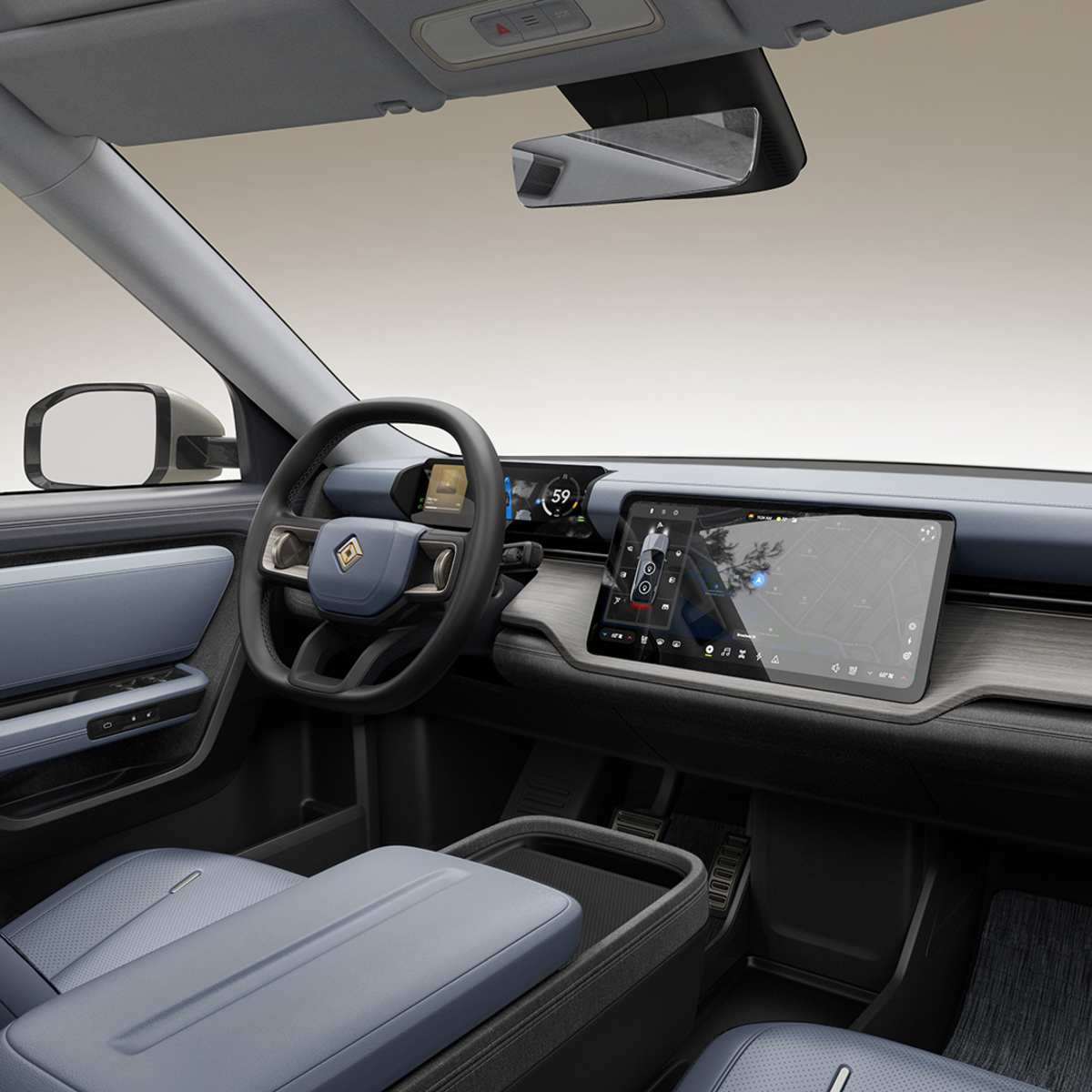
The Rivian R2 is an electric car made by Rivian. In this podcast, it’s mentioned because it could be used as a self-driving taxi in large numbers.
Term
AV
AV means autonomous vehicle—basically a self-driving car. Here they’re talking about the hard part of making it work well for passengers, not just the technology itself.
“UX component” refers to the user experience—how riders understand, interact with, and feel about the service. For robotaxis, UX includes things like onboarding, in-app instructions, and how the system communicates what it’s doing and what the rider should expect.
Uber is the big rideshare company. They’re also trying to build self-driving car systems, and here they’re talking about what rules and real-life situations self-driving cars must handle.
“Dara” is Uber’s CEO. The host is pointing out that he talked about working with government regulators so self-driving cars are handled safely in tricky situations.
“Robotoxies” means self-driving taxis. The point being discussed is how governments should regulate them so they act safely around people and in emergencies.
This is about what happens if the self-driving system loses power. The host is saying there have been reports that Waymo vehicles can get stuck and need help from emergency personnel.
School zones are areas near schools where kids may cross unexpectedly and drivers are supposed to be extra careful. The host is using it as an example of a tough real-world situation regulators care about for self-driving cars.
First responders are the people who show up during emergencies. The host is saying that in some reported cases, emergency staff may have to take control of a self-driving car.
This means Uber would build its own self-driving technology instead of using outside help. The host thinks pressure in the AV space could make Uber go back to that plan.
Travis Kalanick is one of Uber’s founders and a former CEO. Here, he’s mentioned because the host says Uber’s earlier leadership favored building self-driving tech internally.
A “fast followers” strategy means not being the very first, but moving quickly once someone else proves something works. The host is saying Uber may have been taking that approach with self-driving tech.
Freeway access refers to whether an autonomous service can operate on limited-access highways, which typically have higher speeds and more complex merging and lane-change behavior. The segment suggests that access constraints (including freeway and airport access) may be part of why robotaxi growth is limited in certain markets.
A “hybrid model” means the self-driving service isn’t completely hands-off—there’s still some human involvement somewhere in the system. The hosts are saying Uber keeps more human backup, while Waymo is going more all-in on autonomy.
Topic
AV Kremlinology
It’s a nickname for reading between the lines about self-driving companies—figuring out their strategy from what they say and do. Here it’s used to explain why their approaches might differ.
LIVE
companies like Citrone, Alex, that do well, innovating and pushing the boundary forward
don't necessarily then go on to dominate the sort of mature version of that industry, right?
Yeah, that's fair. I accept that.
Look at that. We can agree about things. Let's find something we don't agree about.
What's next?
Hello, good morning. Welcome to the Atomic Cast. As always, I'm Alex Roy, the co-founder and
general partner at New Industry Venture Capital and founder of the Human Driving Association,
purveyor of the finest stickers for your bumper in the world, which say AI-free.
And I'm Ed Niedermeyer. I'm the author of Ludacris, the Unvarnished Story of Tesla Motors,
and Elon Take the Wheel, which is now available for pre-order coming out December 1.
And I'm Kirsten Korosak, and I'm fed up. Let me talk.
You sound a little fed up this morning, Kirsten.
I had a visiting family and had a little bit of a late night.
Oh, big nights for baby.
Yes, yes. But we should jump in. There's stuff to talk about. Alex and Ed want to talk about Tesla,
which fine. Well, not yet. But there's other stuff we can talk about too.
All right. So here's my news. So I've stopped recording in about 50 minutes,
because the Tesla solar install team has hit my house, and they have to turn off my power for
a few hours. Edward, anything to say to that? No, I mean, you're in Phoenix. It makes sense
that you might be getting solar power. There's a lot of sun down there. From my,
from my, I did a little investigation the other day and my preliminary findings are that there's
definitely a bit of sun down Arizona way. Nice. Do you predict that Tesla solar is the
Citroën of home power install? Of all the solar I would pick, I probably wouldn't have picked
Tesla solar. There's in Arizona actually like many, many, many solar places to choose from.
But I guess it's what, what's the benefit, I guess? Like you must have shopped around.
So what was it that was so appealing? What makes you assume that, Kirsten?
Yes. You bought, you bought a Morgan. Surely you must have shopped around. Yeah, it's clearly
a rational consumer we're dealing with here. Kirsten, did you ever shop for solar in Arizona?
I have. And we actually need to do it again. We live in a historic district and home. So
getting solar on there is a little bit of an issue, but, you know, I was looking at solar
super early. And all I have to say is that because I consume such little amount of electricity,
because I'm such an environmentalist, it like didn't pencil out, but it's been probably five
years since I've assessed it. So it's probably worth doing it again. I'm not charging an EV,
you know, like off of my house. Which alternative to Tesla was made sense, if any, at the time?
I mean, there's just like a ton of different like local, I forget the names now. There was,
there was a bunch. I remember I had to come out to the house. There's just a ton of different
solar companies out there. I will say this. So many of them are like kind of like third parties.
So it's not like they're, you know, they're not make, they're buying these panels from wherever
China. And, you know, it's not like this bespoke, you know, branded solar panel situation,
but it's been, like I said, it's been five years. I don't remember the names.
Okay, good. You? No, no, I was going to, to ask you to elaborate on your buying
decision process here. So I, you know, it's frightfully expensive to keep a home air conditioned
in Arizona over the summer. And I've got an EV and I've got a bunch of electronics. So
like, okay, this makes sense. I watched some videos, which explained how, you know,
net metering and net billing and how these systems really are not that great for solar owners.
So I watched enough to be in me, calculating whether it made sense. And it did make sense,
given my enormous power consumption. And also I'm not a prepper, but I would like to have power
if somebody goes down. So, and it's happened to me once. So I specced out the biggest system,
and I ran the numbers and I'm like, it did make sense. Not hugely, but enough that I'm like,
okay, sure. So my experience trying to shop for solar was like, imagine trying to shop for cars
and then walking to a Tesla store. Because Tesla here solar immediately sent a guy out
to look. And then like within like hours, I think it was in that they had like the things
specced out in their website with like real like a simulator and a calculator. And it was
actually really well done. Everyone else I called didn't even send a guy had no web interface and
couldn't like basically model stuff for me quickly or easily. And it was super high friction. So
given that the numbers were almost identical for Tesla solar versus some of the alternatives
and how much better the customer services and selling process was, I did it. And the guys
have been great. Do you think it's because they like have your name and they're like
no influencer Alex, right? I don't think so. Because I don't get that service like at Tesla cars
that you know of. Listen, listen, here's the thing. So so I have not purchased solar power from my
from my home, but I have a friend who works for a company here in Oregon who does not only like
specs for for solar, but also like this company does weatherization and a whole bunch of other
things that aren't done, right? Like Tesla's move into the solar business was framed as like,
right, there's going to be this vertically integrated, you know, consumer ecosystem.
And the reality is, is that like solar panels are can be vertically integrated, but often
with other services, right? Like like home weatherization, improving your your windows,
for example, and things and things like that, right? Like like your house's energy use and
efficiency is a system, your house is a system. And, and, you know, come there are companies
that do very much tailor to your your home as a holistic, like energy using and and and conserving
system. So, you know, I think there are alternatives out there. And then and then well, so I'm curious
what I want to know. So I want to test the the theory, right? Because, because right people
cynics, cynics like me believe that the the the solar city bailout or the solar city deal in 2016
was a bailout of one of Elon's failing companies that he did. I don't care the image of success.
Well, so I'm curious. Don't care. Are you just getting solar panels from Tesla?
Are you also getting a battery storage system? Is this a comprehensive thing or as many power
walls as I could fit? Okay, so it's the whole the whole story and the nice the nice thing I did
because I'm such environmentalist to Kirsten is when the installers arrived, one of them said,
you know, these these power walls exterior mounted where there will take some sun and
they're rated to like 150 degrees whatever the ambient temperature, you consider getting some
trees. So I took the entire 25 year theoretical savings of having the system and I just spent it
on buying trees. That's that's amazing. I mean, that's amazing, right? I mean, you you you're
building systems that are designed to supposedly be be used in these in these high solar energy
environments and you got to build it. You got to build a tree. Well, I don't mean to, but but I do
believe it was strongly encouraged. Are you opposed to planting trees? No, I'm just saying
there's a commonality here between right like like Tesla, you're looking
the biggest the biggest screen in in any car, but then you know, it melts in like the adhesive
well, if I if I bought the trees and no solar, you'd be cool with it.
But no, no, no, I'm just I'm just saying the implication that that that the solar system
needs shade in order to be robust to sunlight is and have like a full lifespan.
Talking about wait, stop. Fascinating. Everyone stop. So first of all, you guys are picking
on the dumbest stuff right now because the powerwall is rated 150. The powerwall is weighted
to 150 degrees and it would be better if it was in more shade, which I don't think is necessarily
like it doesn't all of a sudden upend the entire argument for it. You know what I mean? Like I
think that any energy storage, usually you kind of are like, let's not put it in
the most the spot that it gets blasted the hardest. Like that's kind of common sense. I don't think
it has anything. I'm also helping the environment, right, Kirsten? I mean, sure. Planned some trees.
All right, moving on to the next topic. Can I say one more thing about solar city though,
because I actually covered solar city quite a bit back in the day when I was an energy reporter.
And I knew, I had interviewed Lyndon Rive and those folks many times. The interesting thing
about solar city and what was exciting for people at the time is that there really wasn't
the idea. And they're not the only ones, but it was very, very few, maybe just them and then a
couple others, but then it caught on, which is the idea of solar financing. And that is really what
pushed and helped that company take off. Now, they may have been not doing well.
Well, but it did make it accessible. And I think that there was a lot of other things. I mean,
I was literally all I did was write about energy at the time. And I don't want to rehash like
but back in like whatever 2010, there was a lot of other trade situations and other
dynamics going on that put pressure on companies like solar city. I mean,
if you had removed the fact that Elon Musk was attached to it, I think that you would probably
have a slightly maybe more empathetic view. But there was a lot of other things going on
that made it. But what popularized that company is the fact that they offered solar financing. And
it really did like, even if they had failed and never survived after that and like hadn't been
rescued, they did popularize something that ended up getting more solar in people's hands at that
time. It had that kind of idea. It wasn't really. Listen, this is, you can say the same thing about
Tesla. And I think if there's a through line that cuts across a lot of Elon Musk businesses,
right? It's that he creates solutions that are very attractive during like the early transition
period of new technologies. And that's fine. You're right. That is great. It's good to encourage
the transition towards new technologies. It doesn't intrinsically make a good business,
I think, is the sticking point in all of this. That's fair. Yeah. So the valuation always seems
to imply that just because you've created a solution that makes sense in the transition
period that it will then inevitably grow into an extremely large profitable business.
And I think that that doesn't always prove to be the case, right?
Companies like Citroen, Alex that do well innovating and pushing the boundary forward
don't necessarily then go on to dominate the sort of mature version of that of that industry,
right? Yeah, that's fair. I accept that. Look at that. We can agree about things.
Let's find something we don't agree about. Well, let's not talk about it. I'm so tired.
There was a big Reuters. When Reuters goes in on Tesla, we got to give them credit. Reuters does
some of the better journalism out there, particularly when it comes to Tesla these days.
They just kind of did. I won't say this is the best journalism that Reuters has ever done on Tesla,
but they went to Austin where Tesla has really sort of hung its hat in terms of demonstrating
its ability to create a driverless product of any kind. And it turns out that kind of as I
concluded from my own visit there last summer, it's really more of a show than a serious service.
The high points here are the low points. The headline here is that the wait times
for a Tesla robot taxi in Austin seem to be, according to the experience of Reuters investigative
reporters, longer than the rides themselves. So in other words, if you call a robot taxi,
you will be waiting for it longer than it takes them to actually get you to your destination.
In a market that's flooded with Ubers and Waymos that are available on Uber, that's not a great
look. Alex, what do you make of Tesla's prolonged and seeming perennial struggles with this Austin
service? I don't know. I haven't gone there to check. I mean, is it a function of too few cars
and too much demand? What is it? Clearly, they're fleeting all.
Well, because the wait times are often determined by the number of cars relative to the size of the
ODD. So wait time is just one of the issues that's here going on here. No, it's fair. Let's talk about
some of the other ones that Reuters observed. One was that the pickups and drop-offs can be
as much as a 15-minute walk away from where the destination was marked for the ride. That is
15 minutes away. The other thing and these two behaviors, I think, in pair point to a little
bit of what's going on here. The other one is Reuters observed that Tesla's really struggling
or even refusing to make a left-hand turn instead making a series of right-hand turns in order to
sort of achieve the same result. I think those two behaviors, the pick-up and drop-off are from
destination and this struggle with the left-hand turns, this reminds me of some of the challenges
Waymo had in, what would you say, Alex, 2016, 2017, 2018? I'm feeling like Nostradamus over here
because Tesla, I said on this show months ago, Tesla, their narrative command requires the
perception of forward motion. They have to announce more markets. It doesn't matter,
necessarily, if what does matter. They don't necessarily need to fill the ODD with the
sufficient vehicles to cut ETAs and they probably are still growing the operational depth of bench
they needed to provide a service for the good UX. Yeah, you're correct. This is all the stuff that
the book Waymo's been writing going back 10 years. Every company that is deploying is going to
face these problems. The only question is, are they going to do what Tesla's doing, which is try to
give the impression that mass ubiquity is with a great UX as imminent or if they're going to keep
stretching the narrative to maintain this forward, like narrative momentum to maintain the stock price.
Yeah. Well, if you're curious, I just rolled up the Robotoxytracker, which apparently the guy
who created this is now going to go work at Tesla. So I'm not sure how I felt about the
because I know he had an internship there. He actually, I actually think the Robotoxytracker
is a great tool. I think he shouldn't work at Tesla because I think, I think it's,
it's not at all competent. He should, he should because, listen,
every one of these companies, Argo had this internally, we know, we would look at the ETAs,
look at the, you know, any factors leading to delays, big ever drop in distances of
requested pickup to actual pickup. And you need a lot of data internally and people looking at it
and trying to figure out how to improve those things. And so that guy going to Tesla, even
temporarily is a great, it's a great ad because he understands how to build a tool quickly that
can look at these things and figure out, create the data quickly.
I would really, I would very much hope that Tesla has an internal tracker like this,
but maybe they don't and they need to hire this guy. Well, regardless, I'm looking at it right
now and I can tell you that there are 45 total rider vehicles, 27 of them currently are unsupervised
in Austin and the two other markets that they announced and got coverage for, they have five
in Dallas and they have six in Houston. And then Bay Area is really something that we can't even
talk about because they have 555 vehicles, but we know that none of these are using unsupervised
FSD, that these are being driven by a human being who is a contractor for Tesla. It's interesting
because I recently talked to investor who lives in that area and was like, or who goes to that
area a lot and said, oh, they love the Tesla quote unquote Robotoxy in the Bay Area because
it's clearly being subsidized by the company and it is like, it is incredibly cheap, cheaper than,
well, at least 50% cheaper than a Waymo, but then oftentimes like 30% cheaper than an Uber
or a Lyft. So they just take it because they don't care about the quote unquote innovation,
they just, it's cheaper. Well, yeah, I mean, let me tell you, Ed, what's happening over at Tesla
right now. So they announced, they announced more cities and then the waymo has, expands
the ODD in that city, then Tesla, someone Tesla that says, well, we have to expand our ODD to at
least match or exceed the Waymo ODD in this city. And then they do, and then there aren't enough
cars necessarily to pop, to populate that ODD with reasonable ETAs, but they can't walk back the ODD
announcement. And so they're in this weird like another world of tension. This is going to happen
over and over as they both fly to show that they're the fastest growing AV operator in the country.
But, but they're not showing that that is the problem, right? I mean, they have like Kirsten
just said, they have 27 actual unsupervised vehicles operating in one city, you know, Waymo has
officially as almost 4,000. Well, and 200 in Austin alone, right? So, so, you know,
if you look at Austin's going to exceed Waymo's, yeah, so yeah, but that's called narrative command.
No, it's not really it's it's it's called a thought terminating, like
it looks like, you know, I ride Waymo's all the time, it's a better product. It's I mean,
tip of the spear. But you can't say that Tesla doesn't have an error to command.
Sure. I think it's interesting, though, that in spite of the fact that Waymo's been at this for
a while, they continue to struggle as well. So a couple of highlights, I'm not sure if you saw
this story this past week, but these empty Waymo's, we saw this happening in San Francisco, but it's
now happening in Atlanta, where empty way, the one I'm about to talk about, no. But
something like 50 Waymo's on like any given morning have been invading this specific neighborhood
in this cul-de-sac and just like sitting there, like just totally empty Waymo's just queued up
waiting in this like cul-de-sac nice neighborhood in Atlanta. We saw the same thing happening in
San Francisco. I want to say a year or more ago, maybe even two years ago. So to me, it's fascinating
that here's a company that's been at it for a long time and you could argue is like has a much
better, smoother service, like far less incidents. And it's not perfect by any stretch. I mean,
Waymo has struggled as it scales, as we all expected, right? And I would hope as they had
planned for, because this is what's happening. But to me, it shows or illustrates that like
no one is, we have yet to see anyone come in and like nail it in a way like
where there isn't any problems. We're going to continue to see problems.
When you say struggle, I see the absolutely anticipated and expected
minuscule rate of issues as you scale the service. As soon, if you have an object which
moves, a product that moves, something's going to happen at some rate. So is that rate
acceptably low? I mean, to me, it seems obvious that in Waymo's case, yes, it is.
It's acceptably low, but I would say that you could break it up into two spots. One is operational.
So the going into the cul-de-sac thing, you would think that they would have anticipated that,
but that's like an operational wrinkle that's not necessarily a safety one. I think that the
recall that they just had, which is based on a software update, which they did make to all
their entire fleet about the vehicle's ability to navigate around or spot flooded areas,
it falls more into a safety issue. There was one of their vehicles, which was empty,
was swept away in flash flood. During all the flooding that was happening in San Antonio,
it's the reason why they delayed their planned launch there. They were responsible about it.
They addressed it. They went through the recall process. That's all correct and good.
I think it's a good thing that they did that and reflective of how the company is trying
to be responsible here. But I would put those two incidents in very different brackets. One is
operational and becoming the annoying neighborhood thing. And the other one is more of a safety
issue. You need to have the vehicles be able to understand and spot flooded areas and not
enter those flooded areas. Those are a little bit higher stakes.
Can you guys answer for me the question of what happens when a wayma goes into water,
gets flooded, the vehicles is a write-off? What does that insurance can look like? Do you guys
know? I'd love to know. We have to get their insurance on to answer some of those questions.
AV insurance is a fascinating and difficult to probe, I would say, world these days. But I think
Kirsten, those two examples that you noted in Atlanta and in Texas, what's fascinating about
both of them, you mentioned this about the Atlanta one, right, that we'd seen this sort of cul-de-sac
parade behavior before. We'd also seen this issue with puddles of water before from Wayma earlier
when they were in Arizona. And as you say, Alex, you call these problems that should be
anticipated. I mean, absolutely they are in the sense that we've seen this happen before,
like a year ago or more in different cities. What this says to me is that, as Kirsten said,
that this is a challenging business. No one has got it right, but even the leader has to
continually face the same challenges repeatedly, right? When you go to a new city, it's like there's
this repertoire of problems that we've seen in the past that surface again when we go there. Now,
exactly why this continues to happen, as Kirsten says, there's blurry areas between what is
about system design and validation and what is just about operations, right? That line
isn't always super clear. But what this shows is that you have to go place to place and work at
this stuff. And meanwhile, Tesla continues to, its valuation continues to hang on the idea of a
general solution. And I think you look at Wayma's challenges building L4 solutions and these recurring
problems when they go to new cities, you see it Tesla getting stuck with a very small fleet
in what doesn't look like a very serious service in Austin. And again, I just don't,
it's just incomprehensible to me how people are extrapolating the possibility that like,
oh, Tesla's just going to skip all these problems, right? That this just isn't going to be a slog
for them the way it has been for Wayma with all its experience and sensors and operations.
They're not going to skip them. They're going to have to go through all the same phases.
So where's the confidence that they're going to? Because again, Wayma is a large, well-funded
organization that's focused on one singular problem. Tesla has a lot of irons in the fire.
At some point, there's just a matter of priorities of what do you put your resources
towards and solving this problem takes a lot of resources.
Well, I think that I would agree with Alex that they will end up having to
dedicate a lot of time and energy to it because they've pinned the entire future
valuation of the company on AI, robotics, and self-driving. So I think they'll have to.
I think though that in looking at it in like a very broad stroke, every single company,
like we talk a lot about Tesla and Wayma because they tend to be most on our minds and in Wayma's
truly scaling and they have thousands of vehicles, every single other company that promises to scale.
By the way, starting by the end of this year and into 2027, it's going to be a very busy year
for me covering all this stuff because they all are having problems. Here's another example.
The AV Ride, which was part of Yandex. This was the kind of Russian spin-off.
It now is under completely different operations because of the Ukraine war and that's all done.
But it's called AV Ride. We know them of their sidewalk delivery robots, but they also have
some self-driving vehicles. They have a partnership with Uber. They have the Hyundai Ioniq Fives.
They have NHTSA just to open up an investigation into them because more than a dozen crashes and
one minor injury. According to the safety regulators, all 16 crashes that it has identified
have to do with the competence of AV Ride's self-driving system, which apparently struggled
with changing lanes, responding to other vehicles in the same lane, and responding to stationary
objects. That's just picking one company. Let's go down the list of all the companies
that by 2028, so in two years, we'll have these everywhere. We've got Motional,
we've got AV Ride at Waymo, supposedly also Tesla. Mobileye and Moya. Oh yeah, Moya with Uber.
Mobileye, yeah. There are thousands of R2 Robotaxis from Rivian if we believe that that will happen.
LucidNurrow. LucidNurrow and then, of course, Wave.
And Wobby. And Wobby, and then that's not even touching We Ride and Pony and all these others
that are launching in the Middle East. Literally, we could have an episode on this
every single week, I think, and that's just going to be bigger, which is why, and I'll get to the
point. I'm interested to see if Uber will get any movement forward on this idea of them
launching this operations company, Uber Autonomous Solutions, to take responsibility on the
operations side. I have thoughts about whether it's a good idea or not. I'm just curious to see if
companies actually go, you're right, we don't want to deal with this. You take it.
So this dynamic between Uber and Waymo and the rest of the sector is really fascinating,
because Uber is involved in almost every new funding round. Every new Robotaxi project that
gets announced for the last year or so has been with Uber's involvement or to be available on
the Uber platform. And so Waymo is the halo, right, showing that this is possible and showing
that autonomy can be the next step for Uber's business. And Dara Kursali has done an amazing
job of turning Uber into an actual, truly functional business, but investors are looking
for that next step. Clearly, autonomy is it. And so Waymo shows us what's possible and
Uber is clearly spreading a lot of bets around. But the relationship between Uber and Waymo is
kind of one more of equals. And therefore, it seems to be creating a bit of tension.
And it looks like what Uber is hoping is that by spreading a bunch of money around to a lot of
sort of fast follower companies, that they're able to create competition for Waymo and therefore
reduce its power in negotiating, I'm sure, the value exchange and the operating
relationships that these companies are forming together. It's questionable whether that's
going to work, right? Because again, Waymo's example shows that this is an insanely capital
intensive business. And whether Uber can just sort of spread a lot of money around to a lot of
little sort of more marginal players and get the same results that Waymo has been able to
demonstrate so far is very far from a proven thing. And yet sort of the entire ecosystem sort
of hinges on this a little bit, right? Alex, you look skeptical. Well, every time you speak,
I'm like, I'm just going to buy some, I'm going to go long Tesla. Really? That's your default?
Okay. I don't own any Tesla now, but honestly. Well, no, I mean, because again, we were just
talking about Tesla's, again, Tesla has shown the challenges of trying to build a serious
L4 service. They've been at it for almost a year now and they have 27 vehicles. They have no more
than 50 vehicles on the ground. What I find amazing is why everybody, and I mean literally
everybody developing AV tries to solve the UX component last. They think the technical stuff
should come first. If anyone had years ago had just come out and be like, hey, this is going to be
complex and difficult, take a long time, but we're going to make it as fun as possible even
though the cars are not yet driverless and educate consumers as they're first engaging with any
surface area of the technology. And everyone's doing it last. It's incredible to me. Only Waymo
is out of the woods on this and not even 100%. Yeah, their UI is pretty good though, I would say.
No, it's great. It's absolutely great. And it's tip of the spear best there is,
but everyone else is just so far behind customer education. It's crazy. Anyway, rant over. What
else we got? Well, speaking of Waymo, this has come up on our show in the past. Actually,
I remember noting more than a year ago, so that would have been March 2025,
how bizarre it was when I was in Austin. And it was the launch of Waymo on Uber,
which was the name, how they call it. And this was the big launch of Robotaxis in Austin, but
Uber and Waymo partnering. And I recall noting then, and even I wrote about it, it was very weird
for me to be at this party where Uber and Waymo people were like, very hugging each other and
toasting and cheersing, because I guess I'm just that old. They were once at odds, at extreme odds,
and also were at all went to trial over a trade secret theft case. At the time I said,
this, it feels so weird. And I kind of wondered out loud how long it would last.
And I know there's been some speculation of like, oh, they're going to break up and all this. And
I would say that there is interesting things happening in the public sphere where Uber seems
to be flexing on Waymo. And more than just the video of the CTO like noting some like activity
or questionable activity by Waymo, that kind of has been talked about. There's other things too.
And I pulled up the transcript of the Q1 of Uber just from a week ago. And I'm going to read it.
And I believe that Dara was asked, you know, about regulations and whether there should be
questions around robotoxies and what does that look like. And he said, you know, we need to make
sure we have dialogue with regulators. They're asking the right questions. And this is where I
think this is like a very much targeted at Waymo. Which is, quote, how are AVs going to interact
with in situations where the power goes out, or interacting in school zones, or working with
firefighters, etc. in the city. Now, those three things are very specifically and uniquely things
that happen to Waymo, which is their behavior around school buses, the power outage that like
locked down all their vehicles, and our reporting and other reporting around first responders having
to jump in these Waymos and drive them. That seems pretty bold, even though they didn't say
Waymo's name to say that on a quarterly call. Well, and Business Insider has a whole piece
that's a sparking fall on coverage that sort of suggests that there's a rift forming between
between Waymo. Clearly a lot of ins and outs here, you know, it's a little bit like it reminds me
of sort of the US and China, where it's like, there's this fundamental understanding that
they're at odds and that there's a certain amount of zero sum in their sort of dynamic with each
other. But at the same time, they're so deeply interrelated that, you know, one economy literally
doesn't exist without the other. So it's a major case of frenemies. And it'll be really interesting,
you know, the implication of this coverage and the sort of reading the tea leaves here is that
the tension will push Uber back towards its posture under Travis Kalanick, which was that it
needs to develop an autonomous solution in-house. That would be yet another development from its
current sort of fund a lot of fast followers approach and would certainly mix things up in
this space a whole lot, right? Yeah, I think that that's like a worthy item to speculate about.
I also think that even if they didn't do that, even if they didn't pursue an autonomous stack in
house, they have spent the past almost, well, two years now locking up partnerships with 30
different AV partners across drones, sidewalk delivery, trucking, and robotexies. And I think
that the relationship with Waymo will remain until the rest of these companies are in a place where
they can scale. Uber seems to be throwing money at anything and taking equity stakes in it.
And I would predict that as soon as one or two of those companies looks like they're legitimately
going to make it and scale and they start operationally, I think that that relationship
with Waymo will become far more tense because Waymo has also proven that they don't really need
they don't really need Uber for, you know, I mean, they have a third-party operator,
they built their own app. Their growth is slowing in some of their more mature markets.
Some of that may be freeway access and free and airport access, but I think part of it may well
be, you know, you're more widely available on Uber in the Bay Area, your volume will go up if
they need to scale. Sure. But right now in the Bay Area, they don't have a partnership with Uber
in the Bay Area. Well, exactly. That's my point. And you see the growth sliding, right, or slowing.
And so potentially, right, to restart that growth, especially if they get a new larger fleet,
you know, accessing more demand will probably require going to two places like Uber, which
aggregate demand for mobility. Yeah. But it also begs the question, which Dara actually brought
up in the earnings call, and I can't remember exactly how you phrased it, but you know, or
actually, no, it wasn't during the earnings call. It was a paper that they put out, and they very
much view autonomy as like hybrid, their whole ride-hailing service as hybrid and still betting
on the human being. And, you know, if you were to look just at Waymo's data in the Bay Area,
maybe there is like just always going to be a very specific ceiling of use cases for robotaxis,
and it won't go above that. You know, it's possible. Yeah. Well, and Uber is at least
hedged, right, with, like they say, with their hybrid model, whereas Waymo and everyone else is
all in. So another thing, possibility here is in the, if you play like AV Kremlinology,
because of exactly the situation you described. So Uber is hedged with part of what different
people occasionally overlapping in different cities. They could, this could be kind of a method of
trying to signal to other parties, future partners, potentially investors, that Uber is
not going to seed too much power to Waymo. It could just be theater. And yeah, I remember back
of the day, Brian Sileski said to me, you know, we really, we can't, we can't message too hard
that about AV capabilities and their timeline to deployment, because that's going to message to
Uber, a potential partner in the future, and their own drivers that were a threat to them
as they, as they exist. And so this, this messaging around a hybrid fleets versus pure place is as
much AV Kremlinology than it, as it is a real attack, because the last thing Uber wants is for
Waymo to walk away, deploy its scale direct. It doesn't matter what success rate they have,
and then not have Waymo on their platform. That's the last thing they want. They want to be all,
it's like, imagine Expedia getting cranky with Delta, like, is there any universe which Delta
doesn't sell tickets through Expedia? No, there's pressure flowing in both directions behind the
scenes. And we'll, we'll know soon what it means. And I'll, I'll, I'll make, it's not our prediction
episode, but I'll make a prediction about one way in which Waymo will try and mitigate some of this,
this pressure, this sort of building confrontation with Uber. And that is by going to the other
potential aggregator of mobility demand that is out there, which is the public sector.
So we've seen no public transit, like we've seen already in Los Angeles, Waymo do things like
offer discounts for rides that start or end at a bus stop or public transit stop. I am going to
predict that we will see more of this in the future because this is a way for, for, for Waymo
to a right provided contrast in, in how it deals with cities relative to, to Uber, but also to,
you know, to tap into aggregated demand that isn't just coming from, from, from Uber as a platform,
right? The public transit is another source of that that it could use to again hedge against
its own dependence on, on Uber. So I would look for more of those deals in the future. In fact,
I may have even heard some rumblings about where those deals coming in the future.
I'm long both companies, honestly. So this is just theater, just it doesn't matter.
Well, it's just interesting to watch the dynamics of it. I mean, I think the fact that we spent,
you know, the last, you know, whatever few minutes really focusing on Uber and Waymo,
and we don't really bring up the other companies very often is reflective of the scale
right now. So hopefully we have some more companies to talk about you guys, you know, soon.
No kidding. No kidding. I really, I really hope some more companies hit these deadlines so that,
so that we can mix up this pot a little bit because it is sort of the same names.
I'm sure that Waymo and Uber people are sick of listening to
before we wrap this up. Any guesses as to what would the effect on AVs in LA if Spencer Pratt
wins the election? Oh, I don't know. I don't know what his position is on that.
All right. Next, let's get him on the episode. I'm sure he'll do the interview. All right.
Any final words? No, no final words.
All right. My final word, it was, it was so fun hanging out with you in Arizona,
Kirsten, Alex, I'm so sorry I missed you. Come back, stay at the house. I got cars for you.
I'll just have to try again. Yeah, you, you, let's just be clear to the audience. Alex has long
said to us, come anytime you're invited and it's like, except last Friday, I had a secret mission
for a stealth project and we'll get to that. It was more important than his old pal Ed.
Oh my God. Yeah. Kirsten, take us out. Well, thanks you guys for showing up on time and
talking and if anyone's going to be in Detroit for the reindustrialized conference, I'm having a
party. And you know where you can learn more information about the party at alexroyparty.com.
Alexroyparty.com. Great. All right. Well, on that note, thanks to our audience for listening to
another episode of The Atonicast.
About this episode
Solar panels and Powerwall heat ratings kick things off, with Alex’s install in Arizona and a debate over whether home solar “pencils out” once net metering/net billing and EV charging enter the picture. The conversation then pivots to robotaxis: Reuters’ Austin reporting on Tesla’s long waits and awkward maneuvers, Waymo’s scaling realities (ODD, queuing, and a fleet-wide flooded-areas software recall), and Uber’s plan for an operations-focused autonomy company. The hosts close by weighing Uber’s hybrid strategy against Waymo’s “all in” approach.
The gang discuss Alex’s new Tesla solar install, Waymo ops challenges, and Uber’s evolving self-driving strategy. Also, Ed has issues with you-know-whose robotaxi rollout in Austin. Kirsten and Alex then bring it back to an odd Waymo/Uber flareup, whilst Ed pouts.