
#364: Alex Got Solar, Uber’s AV Future, Waymo Ops, Gossip, Ed’s Fave Robotaxis
About this episode
Solar panels and Powerwall heat ratings kick things off, with Alex’s install in Arizona and a debate over whether home solar “pencils out” once net metering/net billing and EV charging enter the picture. The conversation then pivots to robotaxis: Reuters’ Austin reporting on Tesla’s long waits and awkward maneuvers, Waymo’s scaling realities (ODD, queuing, and a fleet-wide flooded-areas software recall), and Uber’s plan for an operations-focused autonomy company. The hosts close by weighing Uber’s hybrid strategy against Waymo’s “all in” approach.
Morgan
"[140.6s] Yes. You bought, you bought a Morgan. Surely you must have shopped around. Yeah, it's clearly [145.6s] a rational consumer we're dealing with here."
Morgan is a car brand. Here it’s just used as an example of someone buying a car and presumably shopping around.
Morgan is a British car brand best known for producing small-run, traditional-style sports cars. In this segment, it’s mentioned as a consumer-shopping example (“you bought a Morgan”), not as a technical discussion of the vehicle.
EV
"[177.2s] years since I've assessed it. So it's probably worth doing it again. I'm not charging an EV, [181.8s] you know, like off of my house. Which alternative to Tesla was made sense, if any, at the time?"
EV means electric vehicle—an electric car you charge with electricity. They’re discussing how charging an EV at home changes the value of having solar panels.
EV stands for electric vehicle, meaning a car powered by an electric motor and charged from an external power source. The hosts connect EV charging habits to whether home solar makes financial sense.
net metering
"[230.7s] decision process here. So I, you know, it's frightfully expensive to keep a home air conditioned [237.1s] in Arizona over the summer. And I've got an EV and I've got a bunch of electronics. So [241.2s] like, okay, this makes sense. I watched some videos, which explained how, you know, [245.9s] net metering and net billing and how these systems really are not that great for solar owners."
Net metering is how your electric bill can work when you have solar. If your panels make more power than you use, the utility may give you credits for the extra electricity.
Net metering is a utility billing arrangement where excess electricity your solar panels produce can be credited against the electricity you draw from the grid. The hosts mention it because it strongly affects whether solar “pencils out” financially for a homeowner.
net billing
"[241.2s] like, okay, this makes sense. I watched some videos, which explained how, you know, [245.9s] net metering and net billing and how these systems really are not that great for solar owners."
Net billing is another solar billing model where the utility pays you (or credits you) for the electricity your system exports to the grid, but typically at different rates than the retail price you pay for electricity. The segment frames these rate structures as a reason solar economics can be less favorable than people expect.
weatherization
"a friend who works for a company here in Oregon who does not only like specs for for solar, but also like this company does weatherization and a whole bunch of other things"
Weatherization is about making your house harder for heat to escape (and harder for drafts to get in). The host is saying some companies bundle that with solar so the whole home uses less energy, not just the solar part.
Weatherization refers to home improvements that reduce heat loss and drafts—like sealing gaps, insulating, and upgrading building envelope details. The host contrasts providers that only sell solar panels with those that also do weatherization, arguing that overall energy efficiency is a system-level problem.
vertically integrated, you know, consumer ecosystem
"Tesla's move into the solar business was framed as like, right, there's going to be this vertically integrated, you know, consumer ecosystem."
“Vertical integration” means one company tries to handle several parts of the solution end-to-end. The host is saying Tesla sells solar as part of a bigger plan for your home’s energy use, not just the panels.
“Vertical integration” means one company controls multiple steps of a product or service chain, from hardware to installation and related services. Here, the host argues Tesla’s solar push is framed as a vertically integrated home energy ecosystem that could include solar plus other upgrades that reduce energy use.
solar city bailout or the solar city deal in 2016
"cynics like me believe that the the the solar city bailout or the solar city deal in 2016 was a bailout of one of Elon's failing companies"
The host is talking about a 2016 deal involving SolarCity, a solar company tied to Tesla’s energy plans. They’re questioning whether it was meant to help a struggling company rather than just support a good business idea.
The “SolarCity deal” in 2016 refers to the financial and corporate transaction involving SolarCity, which was closely associated with Elon Musk and Tesla’s broader energy strategy. The host frames it as potentially being a bailout of a failing company, and uses it to question the motivations behind Tesla’s solar expansion.
battery storage system
"Are you just getting solar panels from Tesla? Are you also getting a battery storage system? Is this a comprehensive thing or as many power"
A battery storage system is a home battery that saves solar energy for later. The host is asking whether the setup includes batteries, not just solar panels.
A battery storage system stores electricity generated by solar panels so it can be used later, such as at night or during outages. In residential solar setups, pairing panels with storage is often what makes the system more “comprehensive” rather than just producing daytime power.
driverless product
"They went to Austin where Tesla has really sort of hung its hat in terms of demonstrating its ability to create a driverless product of any kind."
“Driverless product” means a self-driving service that’s supposed to run on its own. Even when it’s marketed as fully driverless, it can still have trouble in certain situations.
“Driverless product” refers to a robotaxi or autonomous service that can operate without a human driver taking over. In practice, it usually depends on limited operating conditions (like specific areas and mapping) and can still struggle with edge cases.
Austin
"They went to Austin where Tesla has really sort of hung its hat... The headline here is that the wait times for a Tesla robot taxi in Austin seem to be... longer than the rides themselves."
Austin is the city in Texas where this robotaxi service is being tested and reported on. The discussion uses Austin as the example of how the service is performing day-to-day.
Austin is the Texas city where Tesla’s robotaxi demonstrations and operations are being discussed. The hosts use it as the real-world test location for evaluating wait times, pickup/drop-off behavior, and turn-handling.
robot taxi
"The headline here is that the wait times for a Tesla robot taxi in Austin seem to be... longer than the rides themselves. So in other words, if you call a robot taxi, you will be waiting for it longer than it takes them to actually get you to your destination."
A robot taxi is a self-driving car you can request like an app ride. The point here is that if it takes too long to arrive, the whole experience feels less convenient.
A robot taxi is an autonomous ride-hailing service where the vehicle drives itself to pick up and drop off passengers. The segment highlights that operational issues—like long waits—can make the experience worse than a human-driven ride.
ODD
"Well, because the wait times are often determined by the number of cars relative to the size of the ODD."
ODD is the “where and when” self-driving is allowed to work—like certain roads, weather, and mapping conditions. If the service covers a big area but there aren’t many cars, you can get long waits.
ODD stands for “Operational Design Domain,” meaning the specific set of conditions under which an autonomous system is designed to work. Wait times can be affected by how many vehicles are available relative to the size/complexity of the ODD.
pickups and drop-offs
"One was that the pickups and drop-offs can be as much as a 15-minute walk away from where the destination was marked for the ride."
This is about where the self-driving car will actually pull over to start and end the trip. If it can’t stop exactly where you expect, it may walk you farther than you’d think.
In autonomous ride-hailing, “pickups and drop-offs” refer to where the system will actually stop to let passengers get in and out. The transcript notes that these can be far from the exact location marked in the app, which is a practical limitation of real-world autonomy.
left-hand turn
"Reuters observed that Tesla's really struggling or even refusing to make a left-hand turn instead making a series of right-hand turns in order to sort of achieve the same result."
Left turns are tricky for self-driving cars because they have to merge across traffic and follow right-of-way rules. The hosts say Tesla may avoid left turns and take a different route using right turns instead.
A “left-hand turn” is a common autonomy stress test because it requires judging oncoming traffic gaps, crosswalks, and complex right-of-way rules. The segment claims Tesla was struggling or refusing left turns and instead making a sequence of right turns to reach the same destination.
ETAs
"They don't necessarily need to fill the ODD with the sufficient vehicles to cut ETAs..."
ETAs are the estimated time until a ride arrives. For robotaxis, getting ETAs right depends on how many cars are available and how they’re dispatched.
ETAs are “Estimated Times of Arrival.” In robotaxi operations, ETAs are a key customer-facing metric that depends on fleet size, dispatching, and how often vehicles are available near pickup points.
Tesla
"The only question is, are they going to do what Tesla's doing, which is try to give the impression that mass ubiquity is with a great UX as imminent..."
Tesla is being used as the example of how an AV company might push for broad adoption quickly. The hosts are comparing different ways companies talk about progress and readiness.
Tesla is referenced in the context of autonomous-driving strategy—specifically whether it will aim for “mass ubiquity” with a strong user experience sooner, or take a slower approach to maintain momentum. The discussion frames Tesla as a benchmark for how AV companies communicate progress.
Robotoxytracker
"if you're curious, I just rolled up the Robotoxytracker, which apparently the guy who created this is now going to go work at Tesla..."
Robotoxytracker sounds like a dashboard/tool that tracks how robotaxis are doing in the real world. The idea is to spot delays and understand why they happen so the service can improve.
Robotoxytracker is discussed as a tool for monitoring robotaxi operations—especially metrics tied to rider vehicles, pickup performance, and delay causes. The hosts treat it as an example of how data visibility can improve service quality.
Argo
"every one of these companies, Argo had this internally, we know, we would look at the ETAs..."
Argo is brought up as an example of an AV company that had internal tracking tools. The host’s point is that robotaxi services need lots of data to understand delays and improve pickup performance.
Argo is mentioned as having built internal tools for robotaxi operations, including tracking ETAs and diagnosing delay causes. The host uses it to illustrate that data-driven operations are a common need across AV companies.
unsupervised
"I can tell you that there are 45 total rider vehicles, 27 of them currently are unsupervised in Austin..."
“Unsupervised” means the robotaxi is operating without a person in the loop watching it constantly. It’s a big deal because it tests whether the system can handle situations on its own.
“Unsupervised” refers to robotaxi operations where the vehicle can drive without a human safety driver actively monitoring the system in real time. It’s a major milestone because it implies higher autonomy and different operational risk controls.
Dallas
"...and the two other markets that they announced and got coverage for, they have five in Dallas and they have six in Houston."
Dallas is another city where robotaxis are operating. The host is giving a quick count of how many vehicles are active there.
Dallas is mentioned as another robotaxi market with a specific number of rider vehicles. The host uses these figures to compare operational scale across cities.
Houston
"...they have five in Dallas and they have six in Houston. And then Bay Area is really something that we can't even talk about..."
Houston is another city in the robotaxi rollout. The host is listing how many vehicles are running there.
Houston is cited as a robotaxi market with a stated number of rider vehicles. It’s part of a city-by-city breakdown of fleet size and autonomy level.
Bay Area
"And then Bay Area is really something that we can't even talk about because they have 555 vehicles, but we know that none of these are using unsupervised..."
Bay Area is a larger robotaxi region in the discussion. The host says it has lots of vehicles, but they’re not operating in the most autonomous (unsupervised) mode.
Bay Area is referenced as a robotaxi region with a much larger fleet count than the other markets mentioned. The host also notes that none of those vehicles are using unsupervised operation, highlighting a difference in autonomy readiness.
FSD
"FSD, that these are being driven by a human being who is a contractor for Tesla. It's interesting"
FSD is Tesla’s software that tries to do more of the driving for you. Even when it’s running, a person may still be responsible for supervising or taking over, so it isn’t the same as fully autonomous driving.
FSD stands for “Full Self-Driving,” Tesla’s driver-assistance software package aimed at automating more of the driving task. In this context, the hosts are discussing how “FSD” is still being driven/managed by a human contractor rather than being fully autonomous.
Lyft
"but then oftentimes like 30% cheaper than an Uber or a Lyft. So they just take it because they don't care about the quote unquote innovation,"
Lyft is another rideshare app. Here it’s just part of the comparison for how much robotaxis cost versus regular rides.
Lyft is mentioned alongside Uber as part of the pricing comparison for robotaxi services. The hosts are arguing that riders may choose the cheaper option regardless of the “innovation” narrative.
Waymo
"the waymo has, expands the ODD in that city, then Tesla, someone Tesla that says, well, we have to expand our ODD to at"
Waymo is a company that runs robotaxi services. They’re being compared to Tesla on how far their self-driving coverage goes, and the hosts also mention problems like robotaxis sitting empty.
Waymo is the autonomous-driving company whose robotaxi operations are used as the benchmark in this discussion. The hosts talk about Waymo expanding its ODD and also note operational issues like empty vehicles showing up in neighborhoods.
narrative command
"so, so, you know, if you look at Austin's going to exceed Waymo's, yeah, so yeah, but that's called narrative command. No, it's not really it's it's it's called a thought terminating, like"
This is about controlling the message. Even if there are problems behind the scenes, a company can still win attention by telling the most convincing story.
“Narrative command” is a rhetorical idea: whoever controls the story about performance (like “fastest growing AV operator”) can shape public perception even if the underlying operational metrics are messy. The hosts contrast it with other ways of framing the same situation.
thought terminating
"but that's called narrative command. No, it's not really it's it's it's called a thought terminating, like it looks like, you know, I ride Waymo's all the time, it's a better product."
It means a phrase or argument that stops people from thinking deeper. The hosts are saying some public claims may be designed to end the conversation instead of addressing real issues.
“Thought terminating” refers to language or messaging that shuts down further scrutiny—essentially preventing people from digging into inconvenient details. In the segment, the hosts use it to criticize how AV operators may frame growth claims to avoid discussing operational shortcomings.
San Francisco
"but these empty Waymo's, we saw this happening in San Francisco, but it's now happening in Atlanta, where empty way, the one I'm about to talk about, no."
San Francisco is the city used as an example. The hosts are describing a situation where robotaxis show up but aren’t carrying passengers, which suggests operational challenges.
San Francisco is used as an example location where Waymo robotaxis have been observed behaving oddly—specifically, “empty” vehicles appearing in neighborhoods. The hosts later mention the same kind of issue in Atlanta, implying it’s not isolated.
robotaxi
"in this cul-de-sac and just like sitting there, like just totally empty Waymo's just queued up ... I mean, Waymo has struggled as it scales, as we all expected, right?"
A robotaxi is a self-driving car that acts like a taxi. The hard part is dealing with messy, real-world situations safely, not just driving on perfect roads.
A robotaxi is a self-driving taxi service where the vehicle performs the driving task without a human driver in the car. The key challenge is handling unpredictable real-world situations—like moving objects or unusual road conditions—while keeping incident rates low.
Atlanta
"waiting in this like cul-de-sac nice neighborhood in Atlanta. We saw the same thing happening in"
Atlanta is mentioned as a city where the hosts saw the same kind of robotaxi behavior. It’s used to illustrate that these issues can show up in multiple places.
Atlanta is referenced as one of the cities where Waymo robotaxis were observed waiting/queuing in a neighborhood setting. The point is to show how operational behaviors can repeat across deployments.
recall process
"I think the recall that they just had, which is based on a software update, which they did make to all their entire fleet about the vehicle's ability to navigate around or spot flooded areas"
A recall is when a company admits there’s a problem that needs fixing and then updates the affected vehicles. For self-driving cars, that can mean pushing a software update to make the cars behave more safely.
A recall process is the formal procedure manufacturers use to address a safety-related problem, often involving software updates or hardware fixes. In autonomous fleets, recalls can be triggered by issues discovered after deployment, then rolled out across the entire fleet to reduce risk.
software update
"I think the recall that they just had, which is based on a software update, which they did make to all their entire fleet"
A software update is like a patch for the car’s computer. With self-driving cars, updating the software can change how the car sees hazards and decides what to do next.
A software update is a change to the vehicle’s onboard code—such as perception, planning, or behavior logic—that can improve how it drives or handles hazards. For autonomous systems, updates can be safety-critical because they alter how the car interprets and reacts to the environment.
flooded areas
"about the vehicle's ability to navigate around or spot flooded areas"
Flooding is dangerous because it can hide where the road is and how slippery it is. The segment says Waymo updated its cars to better recognize flooded spots and avoid them.
Flooded areas are a hazardous driving condition where water can obscure road boundaries, depth, and traction, making it hard for autonomous systems to judge what’s safe. The hosts describe a Waymo fleet update aimed at improving the vehicles’ ability to detect and navigate around flooding.
San Antonio
"During all the flooding that was happening in San Antonio, it's the reason why they delayed their planned launch there."
San Antonio is mentioned because flooding there caused a self-driving car incident and made Waymo delay a planned launch. It’s used to show how severe weather can become a safety issue.
San Antonio is referenced in connection with flooding that affected a Waymo vehicle and delayed a planned launch. The hosts use this example to distinguish operational annoyances from safety-related incidents.
Wayma
"Can you guys answer for me the question of what happens when a wayma goes into water, gets flooded... Kirsten, those two examples that you noted in Atlanta and in Texas... we'd also seen this issue with puddles of water before from Wayma earlier in Arizona."
“Wayma” is talking about Waymo, a company that runs self-driving cars. They’re discussing how the cars can still struggle in real-world situations—like water on the road—and what that means for damage and insurance.
“Wayma” appears to refer to Waymo, the autonomous-vehicle company known for operating self-driving cars in public areas. The segment discusses Waymo’s recurring challenges when expanding to new cities and how incidents like flooding raise insurance and write-off questions.
write-off
"Can you guys answer for me the question of what happens when a wayma goes into water, gets flooded, the vehicles is a write-off? What does that insurance can look like?"
A “write-off” is when an insurance company decides the car is not worth fixing. They treat it like a total loss, so you typically get paid out instead of repairing it.
A “write-off” means the insurer determines the vehicle is too expensive to repair and treats it as a total loss. In autonomous-vehicle contexts, this becomes especially important because damage events (like flooding) raise questions about coverage, liability, and how the vehicle is recovered or replaced.
AV insurance
"AV insurance is a fascinating and difficult to probe, I would say, world these days. But I think Kirsten, those two examples that you noted in Atlanta and in Texas..."
AV insurance is regular car insurance, but customized for self-driving cars. It has to deal with tricky questions like what happens if the car gets damaged—like in a flood—and who is responsible when the automation is involved.
AV insurance is coverage tailored to autonomous-vehicle incidents, including questions like who is liable when the vehicle is operating on its automation stack. It also has to account for high-cost scenarios like vehicle damage from flooding and whether the vehicle is treated as a total loss (write-off).
cul-de-sac parade behavior
"Kirsten, those two examples that you noted in Atlanta and in Texas, what's fascinating about both of them, you mentioned this about the Atlanta one, right, that we'd seen this sort of cul-de-sac parade behavior before."
It’s a way to describe a self-driving car acting weird in a dead-end street. Instead of smoothly turning around or continuing, it may hesitate, repeat maneuvers, or move in a confusing pattern because it’s not sure what the best safe action is.
“Cul-de-sac parade behavior” describes a recurring autonomous-driving failure mode where the vehicle behaves in a socially awkward or inefficient way in dead-end streets—often involving repeated slow maneuvers, waiting, or looping patterns. It’s an operations/behavior-planning issue that shows up when the system can’t confidently interpret the environment or choose a safe maneuver.
system design and validation
"Now, exactly why this continues to happen, as Kirsten says, there's blurry areas between what is about system design and validation and what is just about operations, right?"
“System design and validation” is the engineering side of self-driving cars. Design is building the system, and validation is testing it to prove it works—especially in tricky situations—before it’s used in the real world.
In autonomous vehicles, “system design” is building the driving stack (sensing, perception, planning, control) to meet requirements, while “validation” is proving it works through testing—often including edge cases. The discussion highlights that it can be blurry where engineering/testing ends and real-world operations begin when failures repeat in new cities.
L4
"And you look at Wayma's challenges building L4 solutions and these recurring problems when they go to new cities..."
“L4” is a label for how automated a self-driving car is. It means the car can drive itself in certain situations and areas, but it might not be able to do everything everywhere, so a human may still need to take over outside its limits.
“L4” is the SAE autonomy level for highly automated driving. At L4, the car can handle most driving tasks in specific conditions/areas without a human constantly supervising, but it may still require human help outside its designed “geofenced” domain.
sensors
"That this just isn't going to be a slog for them the way it has been for Wayma with all its experience and sensors and operations."
“Sensors” are the car’s eyes and measuring tools. They help the self-driving system understand what’s around it, like other cars, lanes, and obstacles—especially in hard conditions.
In AV discussions, “sensors” refers to the hardware used to perceive the world—commonly cameras, radar, and lidar. The transcript contrasts “experience and sensors and operations” with the idea that another company (Tesla) can avoid the same real-world challenges.
self-driving
"they've pinned the entire future valuation of the company on AI, robotics, and self-driving. So I think they'll have to."
“Self-driving” means the car can drive itself—steering, speeding up, and braking—without a person doing those actions. The discussion is basically about how hard it is to make that work reliably.
“Self-driving” refers to an autonomous driving system that handles driving tasks without a human actively controlling the vehicle. In the segment, it’s framed as a resource-intensive problem that companies must keep iterating through multiple development and deployment phases.
AV Ride
"Here's another example. The AV Ride, which was part of Yandex. This was the kind of Russian spin-off."
AV Ride is a self-driving program/company mentioned in the context of robotaxis. The hosts say it started under Yandex, then its operations changed, and it has been investigated after multiple crashes.
AV Ride is discussed as an autonomous-vehicle operation that originated as part of Yandex and later changed due to the Ukraine war. The segment also ties AV Ride to real-world robotaxi/safety scrutiny and crash investigations involving its self-driving system.
Yandex
"The AV Ride, which was part of Yandex. This was the kind of Russian spin-off."
Yandex is mentioned as the earlier company that AV Ride came from. The hosts use it to explain the background of AV Ride’s autonomous program.
Yandex is referenced as the original parent context for AV Ride. This matters because it explains why AV Ride’s operations and corporate structure shifted over time.

Hyundai Ioniq Fives
"They have a partnership with Uber. They have the Hyundai Ioniq Fives."
The Hyundai Ioniq 5 is an electric car. The hosts are saying AV Ride uses that kind of vehicle in its self-driving/robotaxi operations.
The Hyundai Ioniq 5 is an electric crossover that’s being used in the AV Ride robotaxi/self-driving context mentioned in the segment. The key point is that autonomous fleets often rely on specific EV models as the “robotaxi platform,” not just generic cars.
NHTSA
"They have the Hyundai Ioniq Fives. They have NHTSA just to open up an investigation into them because more than a dozen crashes and one minor injury."
NHTSA is the U.S. government agency that looks into vehicle safety problems. The hosts mention it because regulators investigated AV Ride after crashes.
NHTSA (National Highway Traffic Safety Administration) is the U.S. federal agency that investigates vehicle safety issues and can open formal probes. In this segment, it’s used to describe regulatory scrutiny after multiple crashes involving an AV Ride self-driving system.
changing lanes
"have to do with the competence of AV Ride's self-driving system, which apparently struggled with changing lanes, responding to other vehicles in the same lane, and responding to stationary objects."
Changing lanes is when a car moves from one lane to another. The hosts say the self-driving system had trouble doing that safely around other cars.
“Changing lanes” is a driving maneuver that autonomous systems must plan and execute safely while accounting for nearby traffic. The segment specifically claims AV Ride’s system struggled with lane changes, which is a common hard problem for robotaxis.
stationary objects
"with changing lanes, responding to other vehicles in the same lane, and responding to stationary objects."
Stationary objects are things that don’t move, like a parked car or an obstacle. The hosts say the self-driving system struggled to react to those safely.
“Stationary objects” in autonomous driving refers to fixed things in the vehicle’s path—like parked cars, debris, or obstacles that don’t move. The segment uses this to describe a specific perception/planning weakness attributed to AV Ride’s self-driving system.
Motional
"Let's go down the list of all the companies that by 2028, so in two years, we'll have these everywhere. We've got Motional,"
Motional is another company in the self-driving/robotaxi space. The hosts mention it as part of a broader list of companies trying to scale AVs.
Motional is listed as one of the companies aiming to scale robotaxis/AV services by 2028. The segment groups it with other AV operators to emphasize how many players are working on the same deployment challenge.
Mobileye
"We've got Motional, we've got AV Ride at Waymo, supposedly also Tesla. Mobileye and Moya."
Mobileye is a company involved in self-driving technology. The hosts list it among the players they expect to help make robotaxis widespread.
Mobileye is mentioned as part of the AV ecosystem expected to scale by 2028. Mobileye is known for driver-assistance and autonomy-related technologies, so its inclusion signals the role of sensing/compute platforms in robotaxi development.
Moya
"Mobileye and Moya. Oh yeah, Moya with Uber."
“Moya” sounds like it might be Moia, a mobility company. The hosts mention it alongside Uber to point out that multiple companies are teaming up to roll out self-driving rides.
“Moya” is likely a mis-transcription of Moia, a Volkswagen-affiliated mobility/robotaxi initiative. The segment pairs it with Uber, suggesting a partnership-driven approach to scaling autonomous mobility services.
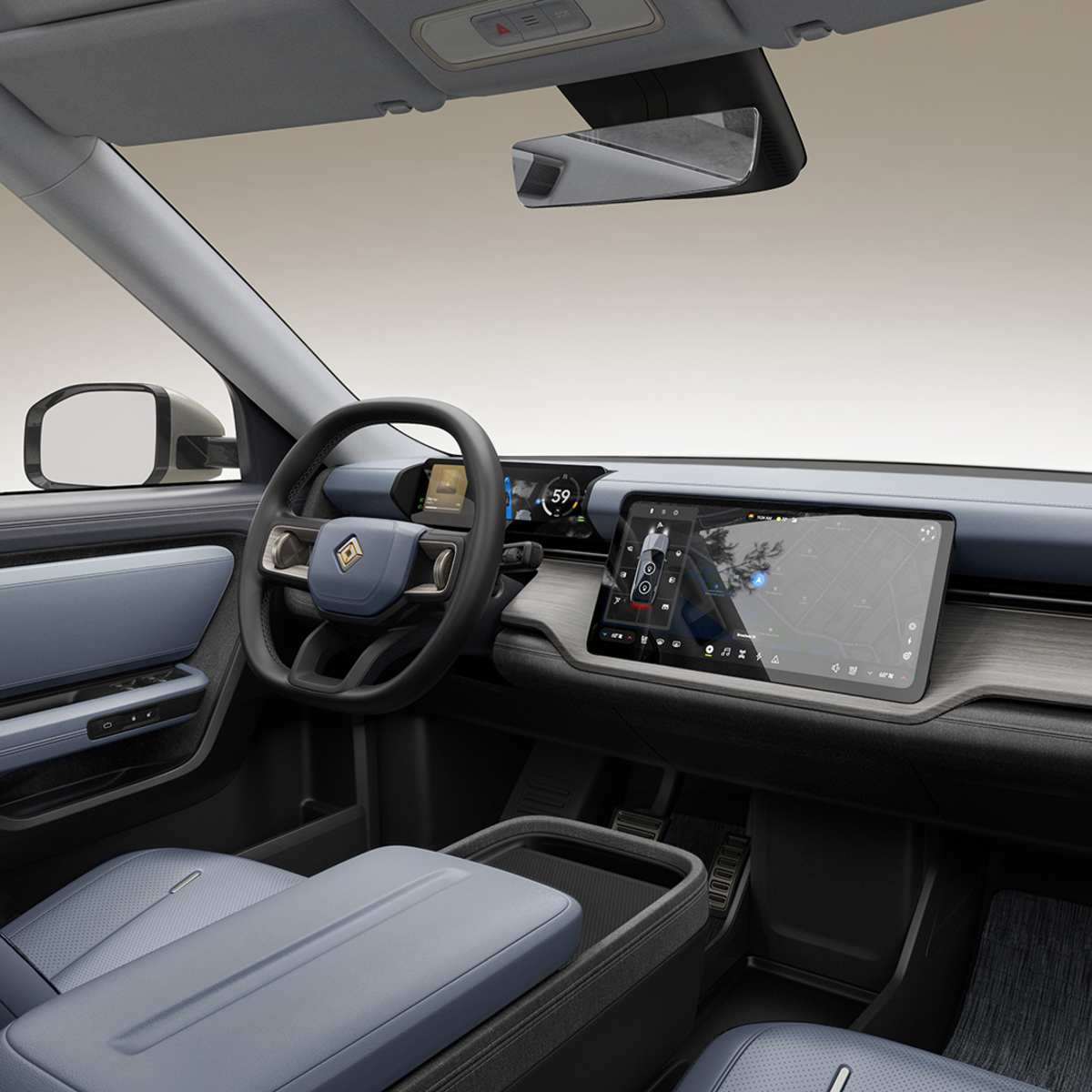
Rivian R2
"...with Uber. Mobileye, yeah. There are thousands of R2 Robotaxis from Rivian if we believe that that wil..."
The Rivian R2 is an electric car made by Rivian. In this podcast, it’s mentioned because it could be used as a self-driving taxi in large numbers.
The Rivian R2 is an electric vehicle from Rivian, discussed here in the context of robotaxis—autonomous rideshare vehicles. The podcast is highlighting the idea that large fleets of R2-based autonomous vehicles could be deployed, which is significant because it ties the car to real-world self-driving operations rather than just consumer use.
AV
"everybody developing AV tries to solve the UX component last."
AV means autonomous vehicle—basically a self-driving car. Here they’re talking about the hard part of making it work well for passengers, not just the technology itself.
“AV” stands for autonomous vehicle—cars or shuttles that use sensors and software to drive without a human driver controlling the vehicle. In this context, it’s about the broader challenge of making autonomous tech work for real riders, not just in demos.
UX component
"everybody developing AV tries to solve the UX component last."
“UX component” refers to the user experience—how riders understand, interact with, and feel about the service. For robotaxis, UX includes things like onboarding, in-app instructions, and how the system communicates what it’s doing and what the rider should expect.
Uber
"And I pulled up the transcript of the Q1 of Uber just from a week ago. And I'm going to read it."
Uber is the big rideshare company. They’re also trying to build self-driving car systems, and here they’re talking about what rules and real-life situations self-driving cars must handle.
Uber is a ride-hailing company that’s also pursuing autonomous vehicle (AV) technology. In this segment, the host discusses Uber’s quarterly call messaging about how AVs should work with regulators and in real-world edge cases like power outages and school zones.
Dara
"And I believe that Dara was asked, you know, about regulations and whether there should be questions around robotoxies and what does that look like."
“Dara” is Uber’s CEO. The host is pointing out that he talked about working with government regulators so self-driving cars are handled safely in tricky situations.
“Dara” refers to Dara Khosrowshahi, Uber’s CEO at the time of the discussion. The segment highlights his comments about engaging regulators and framing AV behavior questions—implicitly contrasting Uber’s approach with Waymo’s incidents and operational scenarios.
robotoxies
"And I believe that Dara was asked, you know, about regulations and whether there should be questions around robotoxies and what does that look like."
“Robotoxies” means self-driving taxis. The point being discussed is how governments should regulate them so they act safely around people and in emergencies.
“Robotoxies” is a slangy reference to robotaxis—autonomous vehicles operating as on-demand taxis without a human driver. The host uses it in the context of regulations and how AVs should behave in public settings like school zones and during emergencies.
power goes out
"Which is, quote, how are AVs going to interact with in situations where the power goes out, or interacting in school zones, or working with firefighters, etc. in the city."
This is about what happens if the self-driving system loses power. The host is saying there have been reports that Waymo vehicles can get stuck and need help from emergency personnel.
In AV operations, “power goes out” refers to scenarios where the vehicle’s systems or supporting infrastructure lose power, potentially causing a shutdown or requiring fallback behavior. The host claims this is a uniquely discussed Waymo scenario where vehicles were “locked down,” and first responders had to intervene.
school zones
"Which is, quote, how are AVs going to interact with in situations where the power goes out, or interacting in school zones, or working with firefighters, etc. in the city."
School zones are areas near schools where kids may cross unexpectedly and drivers are supposed to be extra careful. The host is using it as an example of a tough real-world situation regulators care about for self-driving cars.
“School zones” are a high-risk driving environment for AVs because of unpredictable pedestrian behavior, crossing patterns, and strict speed/behavior expectations. The host frames this as a specific operational context where Waymo’s behavior has been discussed in the context of regulatory scrutiny.
first responders
"and our reporting and other reporting around first responders having to jump in these Waymos and drive them."
First responders are the people who show up during emergencies. The host is saying that in some reported cases, emergency staff may have to take control of a self-driving car.
“First responders” are emergency personnel (like firefighters and paramedics) who take over during incidents. The host claims there have been reports that first responders sometimes have to jump in and drive Waymo vehicles when the AV can’t safely continue on its own.
autonomous solution in-house
"the tension will push Uber back towards its posture under Travis Kalanick, which was that it needs to develop an autonomous solution in-house."
This means Uber would build its own self-driving technology instead of using outside help. The host thinks pressure in the AV space could make Uber go back to that plan.
“Autonomous solution in-house” means building the self-driving stack internally rather than relying on partners or a “fast followers” strategy. The host suggests that regulatory tension with Waymo could push Uber back toward developing its own AV technology directly.
Travis Kalanick
"the tension will push Uber back towards its posture under Travis Kalanick, which was that it needs to develop an autonomous solution in-house."
Travis Kalanick is one of Uber’s founders and a former CEO. Here, he’s mentioned because the host says Uber’s earlier leadership favored building self-driving tech internally.
Travis Kalanick is a co-founder and former CEO of Uber. The host uses his name to reference Uber’s earlier strategy—pushing for an in-house autonomous solution—contrasting it with Uber’s more recent “fast followers” posture.
fast followers approach
"That would be yet another development from its current sort of fund a lot of fast followers approach..."
A “fast followers” strategy means not being the very first, but moving quickly once someone else proves something works. The host is saying Uber may have been taking that approach with self-driving tech.
A “fast followers approach” is a strategy where a company moves quickly to adopt or refine proven ideas after others have already validated them. In the segment, the host contrasts Uber’s earlier in-house AV push with a strategy of following what leading AV operators (like Waymo) are doing first.
freeway access
"Some of that may be freeway access and free and airport access, but I think part of it may well be, you know, you're more widely available on Uber in the Bay Area, your volume will go up if they need to scale."
Freeway access refers to whether an autonomous service can operate on limited-access highways, which typically have higher speeds and more complex merging and lane-change behavior. The segment suggests that access constraints (including freeway and airport access) may be part of why robotaxi growth is limited in certain markets.
hybrid model
"they very much view autonomy as like hybrid, their whole ride-hailing service as hybrid and still betting on the human being. And, you know, if you were to look just at Waymo's data in the Bay Area, maybe there is like just always going to be a very specific ceiling of use cases for robotaxis"
A “hybrid model” means the self-driving service isn’t completely hands-off—there’s still some human involvement somewhere in the system. The hosts are saying Uber keeps more human backup, while Waymo is going more all-in on autonomy.
In autonomous mobility, a “hybrid model” usually means the service still relies on humans in some role (for example, remote assistance or human supervision) rather than being fully driverless. The hosts contrast Uber’s “hybrid” approach with Waymo’s more fully autonomous strategy, arguing that this affects risk and scalability.
AV Kremlinology
"So Uber is hedged with part of what different"
It’s a nickname for reading between the lines about self-driving companies—figuring out their strategy from what they say and do. Here it’s used to explain why their approaches might differ.
“AV Kremlinology” is a playful term for trying to infer what autonomous-vehicle companies are really doing (and what their next moves might be) from partial signals like strategy statements, partnerships, and market behavior. In this segment, it’s used to frame the debate about Uber’s hedging versus Waymo’s all-in approach.
Request an Explanation
Heard something you'd like explained? We'll add it to this episode.
Sign in to request explanations for terms you heard.
Want to learn more?
Browse our glossary for plain-English explanations of automotive terms, jargon, and concepts.
Help improve this episode
See something that's not quite right? Our annotations are AI-generated and can sometimes miss the mark. Click the flag icon on any annotation to suggest a correction.