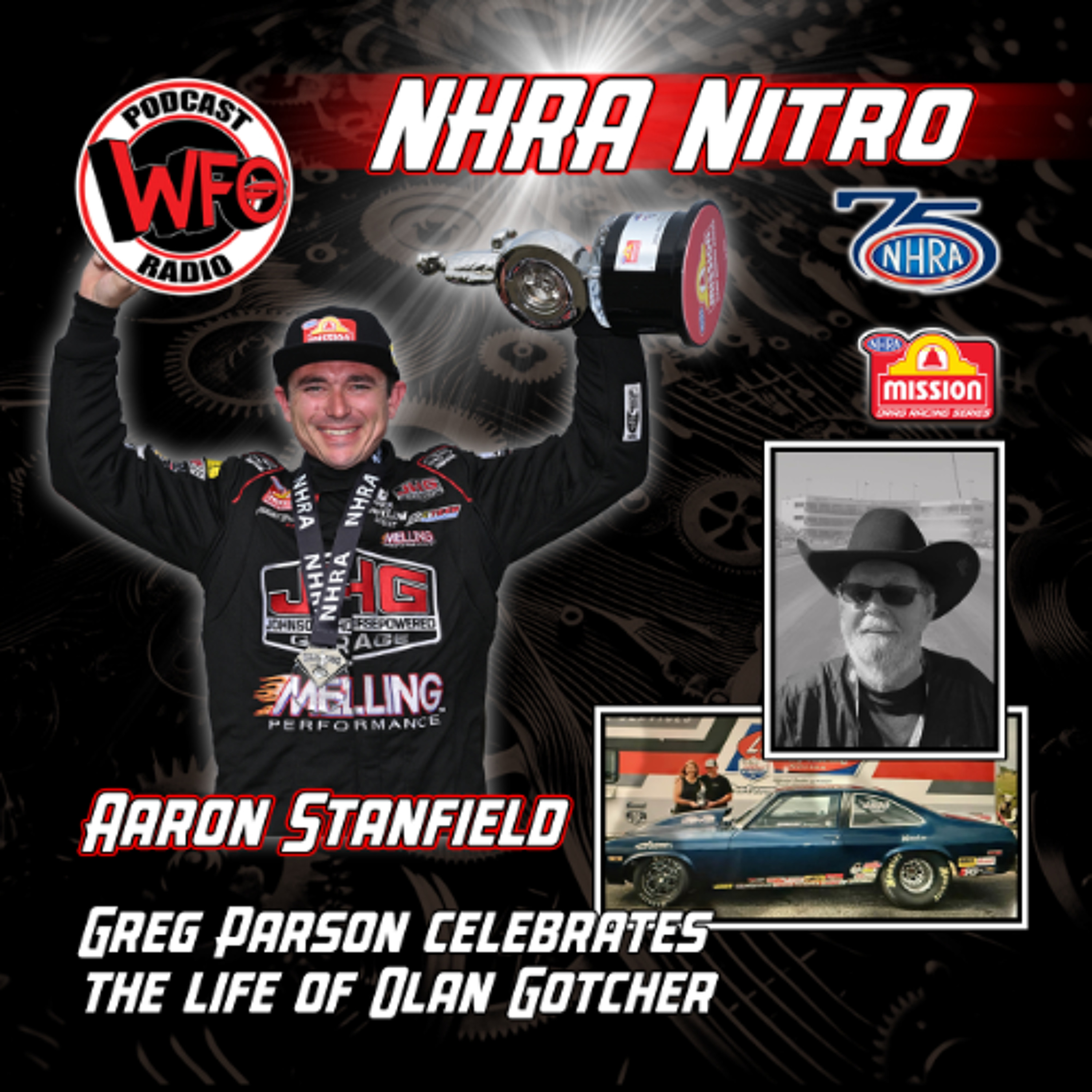
Aaron Stanfield goes WFO and Greg Parson Celebrates the Life of Olan Gotcher Plus Nitro Joe Morrison
About this episode
Hosts kick off with NHRA weekend hype, then shift into Pro Stock-to-Top Fuel talk as Aaron Stanfield describes getting fitted for a Top Fuel Dragster and what it takes to punch it in the winter circle. The conversation turns technical—Pro Stock sensitivity, clutch/trans-brake timing, and reaction-time control—before a detailed, emotional tribute to Olin Gotcher. Greg Parson recounts how Olin’s car and legacy carried on, including a divisional win and behind-the-scenes race-office work.
Red Line Oil
"The Red Line Oil. [4.1s] Formulated to win, proven by me. [6.3s] Red Line Oil."
Red Line Oil is a company that makes special engine oils. The idea is that better oil can reduce friction inside the engine and help it handle extreme driving.
Red Line Oil is a brand of high-performance lubricants aimed at engines that see hard use. In drag racing and other motorsports, oil choice matters because it affects friction, heat control, and how well the engine survives repeated high-load runs.
friction in your engine
"The number one source of friction in your engine is not what you think. [57.4s] This is WFO Radio."
Engine friction is the resistance created when parts rub against each other as the engine runs. Less friction can mean less wear and better efficiency, especially when the engine is worked hard.
“Friction in your engine” refers to the resistive forces between moving parts (like bearings, piston rings, and rotating components). Reducing friction can improve efficiency and help engines survive high-load conditions by lowering heat and wear.
NHRA JEGS Potomac Nationals
"Get ready for the NHRA JEGS Potomac Nationals. [75.1s] Our first time up there to Maryland International Raceway."
This is a drag racing weekend run by NHRA, with lots of different race classes. “Potomac Nationals” is the specific event name, and it’s where teams compete for wins and points.
The NHRA JEGS Potomac Nationals is a National Hot Rod Association (NHRA) drag racing event. It’s part of the NHRA’s regular race schedule and features multiple drag racing classes, including Pro Stock and Top Fuel.
Maryland International Raceway
"Our first time up there to Maryland International Raceway. We're going to be the Buds Creek Mechanicsville Maryland area."
Maryland International Raceway is the drag strip where this NHRA event is happening. Different tracks can change how well cars hook up and perform.
Maryland International Raceway is a drag strip venue in Maryland used for NHRA events. Track layout and surface condition can influence traction and how consistently cars can launch and run their best times.
Gerber Collision and Glass NHRA Nationals
"We're going to double back to the Gerber Collision and Glass NHRA Nationals Route 66 Raceway in Chicago."
That’s the name of an NHRA drag racing event for that weekend, with a sponsor attached. It helps identify the specific race you’re watching.
The Gerber Collision and Glass NHRA Nationals is an NHRA-branded event name tied to a specific race weekend. Sponsor naming is common in NHRA, and the event name helps identify which weekend and class lineup you’re talking about.
Route 66 Raceway
"double back to the Gerber Collision and Glass NHRA Nationals Route 66 Raceway in Chicago."
Route 66 Raceway is a drag strip where NHRA races are held. Track conditions can affect how fast and how consistently cars can run.
Route 66 Raceway is a drag racing track in the Chicago area that hosts NHRA events. Like other strips, it’s known for how it affects traction and race-day consistency.
Pro Stock
"If you're a fan of Pro Stock, you definitely want to share this show because he had one of the greatest single days driving that I can remember."
Pro Stock is a class in NHRA drag racing. The cars are purpose-built for racing but based on production models, and the races are usually very competitive.
Pro Stock is an NHRA drag racing class where cars are built to compete in very specific rules while still resembling production vehicles. It’s known for tight competition, high power, and precise shifting/launch strategies.
gone red
"Through the first three rounds at least, I'm sure he'll bring up the final, but it doesn't matter after your opponent has already gone red."
On the drag strip, “going red” means you started too early and the lights show a mistake. If that happens, your run usually doesn’t count even if you’d have been fast.
In drag racing, “going red” means the driver triggered a red light on the starting line, indicating a false start or leaving too early. Once a car goes red, it’s typically disqualified for that run regardless of how fast it would have gone.
Nitro cars
"but maybe you're a fan of Nitro cars and you just love the Super Fuel and you love 12,000 horsepower"
“Nitro cars” are race cars that use nitro fuel. Nitro helps them make huge power quickly, which is why it’s common in the fastest drag racing classes.
“Nitro cars” refers to drag racing cars that run on nitromethane-based fuel. Nitro fuel allows very large power production in a short time, which is why it’s central to Top Fuel and Funny Car racing.
Super Fuel
"but maybe you're a fan of Nitro cars and you just love the Super Fuel and you love 12,000 horsepower"
“Super Fuel” is a nickname for the nitro fuel used in the fastest drag racing cars. It’s part of what lets those engines make massive power.
“Super Fuel” is a common drag-racing nickname for nitromethane-based fuel used in Top Fuel and related classes. It’s associated with the class’s explosive power and the way these engines are tuned for nitro combustion.
Top Fuel Dragster
"He just drives Pro Stock. Well, he just got fitted for a Top Fuel Dragster this past week."
A Top Fuel Dragster is the fastest class of NHRA drag racing cars. They use nitro fuel and are designed to launch hard and go as fast as possible down the strip.
A Top Fuel Dragster is the NHRA class with the most extreme acceleration, using a purpose-built dragster and a highly specialized fuel system. These cars run on nitro (nitromethane-based fuel) and are known for very high power output and short, explosive runs.
Olin Gocher
"the story that I am really interested in is this man, Olin Gocher, friend of drag racers everywhere, friend of mine, passed away earlier this year."
Olin Gocher is described as a friend of drag racers and the subject of a celebration of life. In this segment, he’s central to the episode’s human-interest story tied to the drag racing community.
Greg Parson
"Olin's driver or the man who drives Olin's car, Greg Parson, went to the celebration of life and then went to the race and won the race."
Greg Parson is the driver connected to Olin Gocher’s car. The hosts mention him because he attended the celebration and then won the race afterward.
Greg Parson is identified as the driver associated with Olin Gocher’s car. The segment highlights him attending the celebration of life and then going on to win a race, emphasizing his role in the drag racing community.
Texas Motorplex
"they did a celebration of life for Olin at the Texas Motorplex in line with their divisional race"
Texas Motorplex is a drag strip in Texas. It’s where the celebration of life and racing-related events in this story took place.
Texas Motorplex is a drag racing facility in Texas that hosts NHRA-related events and divisional races. Venues like this can be important to the local drag racing community and to the timing of celebrations and race weekends.
NHRA drag racing
"So I ask you to share the show. Let's get the word out as we talk NHRA drag racing."
NHRA drag racing is a type of racing where cars race in a straight line to see who can accelerate the fastest. The cars are built and tuned to fit specific rules for their class.
NHRA drag racing is the National Hot Rod Association’s drag racing series, where cars accelerate in a straight line over a short distance. It’s organized into classes based on vehicle type and rules, and it’s known for highly specialized builds and tuning.
DPF Xfit
"Now you heard about a couple of our sponsors. I want to mention the fine folks at Jesse Converters, the DPF Xfit brand Jesse."
DPF Xfit sounds like a brand that makes parts related to diesel emissions equipment. The DPF is the system that helps trap soot from diesel exhaust.
DPF Xfit appears to be a sponsor brand name tied to emissions-related hardware, likely connected to diesel particulate filter (DPF) products. In performance and off-road circles, DPF-related components can be discussed in terms of flow, filtration, and compliance.
FTI performance transmissions
"Larisse for supporting WFO radio and FTI performance transmissions and torque converters."
FTI performance transmissions is referenced as a sponsor connected to transmission and torque-converter products used in performance applications. In drag racing, transmission components are often selected and calibrated to match the car’s power and launch/shift strategy.
winter circle
"This is the first win. It had been a minute, as they say, to punch it in the winter circle for elite motorsports, for Aaron Stanfield."
The “winter circle” is where drag racers go after they win. It’s basically the victory area at the track.
The “winter circle” is the celebratory area at the drag strip where winning drivers and teams go after a race. In NHRA-style events, it’s a shorthand for earning the win and being recognized on the day’s results.
tune up
"it's not in the car. It's at the computer. It's with the tune up. It's testing. It's chassis."
A tune-up in racing means adjusting the car’s settings so it runs right. It’s about getting the engine to respond correctly and consistently for the track and weather.
In drag racing, a tune-up refers to calibrating the engine and related systems—often including ignition timing, fuel delivery, and other settings—to match the track and conditions. The goal is to make the car repeatable run after run, not just fast for one pass.
chassis
"It's at the computer. It's with the tune up. It's testing. It's chassis."
The chassis is the car’s main frame and suspension setup. In racing, it affects how the car stays stable and how well it grips the track when launching and accelerating.
In racing, the chassis is the car’s structural and suspension foundation that determines how the car behaves under load. Even in straight-line drag racing, chassis setup affects traction, stability, and how well the car can put power down consistently.
naturally aspirated engines
"they're naturally aspirated engines and it doesn't take much for for something to throw it off."
Naturally aspirated means the engine makes power without a turbo or supercharger. It depends on getting the right amount of air and correct tuning, so changes in conditions can throw things off.
Naturally aspirated engines make power without a turbocharger or supercharger. Because they rely on airflow through the intake and engine tuning, they can be very sensitive to setup changes like fuel, ignition timing, and air conditions.
top fuel car
"The top fuel car, the 2027 rules."
Top Fuel is the fastest class in NHRA drag racing. It uses specialized race cars (dragsters) built for maximum acceleration, and the episode is talking about new rules for it.
Top Fuel is the premier class in NHRA drag racing, known for extremely powerful dragsters and a focus on maximizing acceleration over a short distance. The hosts mention the “top fuel car” while discussing upcoming rules, indicating it’s central to the segment’s racing context.
2027 rules
"The top fuel car, the 2027 rules."
“2027 rules” means the racing rulebook changes coming in 2027. When rules change, teams often have to adjust how they build and tune their cars to stay competitive.
“2027 rules” refers to upcoming NHRA regulations that will govern how teams build and run their cars in the future. Rule changes can significantly alter engine design, tuning approaches, and overall race strategy.
NHRA.com
"I'm trying to bring up the ladder on NHRA.com."
NHRA.com is the NHRA’s website. NHRA is the organization that runs and sanctions a lot of drag racing, and the site is used to look up race brackets and results.
NHRA.com is the website for the National Hot Rod Association (NHRA), the sanctioning body for major drag racing events in the U.S. The hosts reference it while trying to pull up a “pro stock ladder,” implying it’s used for event results and bracket information.
tire shape
"I think both of us kind of went through a little tire shape that round on it and make a very good run."
They’re talking about how the tires are doing after being worked hard. If the tires get worn or don’t grip the same way anymore, the car can feel different and slower or harder to drive.
“Tire shape” here means the condition/shape of the tires after loading them hard—how the tire is wearing and responding to grip. In racing, tire condition can change lap-to-lap, affecting traction and how stable the car feels through corners and transitions.
shake zone
"my car barely made it, you know, made it through that shake zone and his, his took the tire off and, you know, gave us, gave us a round win there."
A “shake zone” is a part of the track where the car gets unstable—like it starts to bounce or lose grip. Drivers have to be careful there because it can slow them down or mess up the tires.
A “shake zone” is a section of the track where the car tends to unsettle—often due to bumps, traction changes, or aerodynamic instability. Drivers try to manage throttle/brake inputs there because the car can “shake” and lose grip, costing time or even causing tire damage.
change engines
"So we, we change engines and second round, he didn't make a very good run."
They swapped in a different engine between rounds. That usually happens when the first one broke or got damaged, and they have to keep racing with a replacement.
“Change engines” means swapping the engine between rounds, usually because the prior engine failed or was damaged. In motorsports, this is a sign of a high-stakes, limited-time competition where reliability and quick service can decide who advances.
clutch linkage
"in my head, I was thinking about, I knew I was on the edge as far as my clutch linkage and, you know, on the tree."
The clutch linkage is what physically/hydraulically moves the clutch pedal/actuator to engage or release the clutch. If it’s not working right, the car may not shift or launch smoothly, which can cost races.
Clutch linkage is the mechanical linkage (or hydraulic actuation components) that moves the clutch to engage/disengage it. If it’s worn, misadjusted, or failing, the clutch can slip, drag, or not fully disengage—hurting launches and gear changes in a race.
the tree
"in my head, I was thinking about, I knew I was on the edge as far as my clutch linkage and, you know, on the tree."
“The tree” is the set of start lights used in drag racing. You time your launch to the lights so you don’t go too early or too late.
In drag racing, “the tree” is the starting-light system that counts down and signals when to launch. Reaction time and launch timing are critical; drivers time the clutch/throttle to hit the lights and avoid a bad start or wheelspin.
broke his engine
"And we had a heck of a race and, you know, he broke his engine there at the finish line."
“Broke his engine” means the engine failed badly and couldn’t keep going. It likely held up through most of the run, then gave out under the hardest part of the drive.
“Broke his engine” indicates an internal failure severe enough that the engine couldn’t continue running—often from mechanical damage, overheating, or catastrophic component failure. When it happens at/near the finish line, it usually means the engine survived most of the run but failed under peak load.
cheat the clutch
"They couldn't be like 40 and, you know, either cheated the clutch or whatever. Who knows what happened. But for Greg Anderson to go red against you."
This is about how you use the clutch at the start of a drag race. If you don’t release it the right way, you can mess up your launch—or sometimes people try to “game” it to get a quicker start, which can backfire.
In drag racing, “cheating the clutch” usually means using the clutch pedal in a way that helps you launch faster than the rules or intended technique—often by slipping or manipulating engagement timing. It’s risky because small errors in clutch pressure can cause bogging, wheelspin, or inconsistent launches.
red light
"And of course, the drivers, when you see somebody just, you know, really laying, laying some lights down... you didn't have a good light, but I think it's because he red light."
A “red light” in drag racing means the driver reacted too early and triggered the start light before the allowed timing window. It’s recorded as a foul, and it can decide the race even if the car is otherwise fast.
laying some lights down
"And of course, the drivers, when you see somebody just, you know, really laying, laying some lights down and it definitely, I wouldn't say it's an intimidation factor."
“Laying some lights down” is drag-racing slang for producing strong timing on the starting lights—typically meaning a very good reaction time or consistent launch. It’s often used as shorthand for “great starts” that put you ahead before the car even reaches peak speed.
clutch pedal
"I can't stress it enough how easy it is to cheat the clutch pedal in these cars. I mean, you got to, you got to hold the perfect amount of clutch pressure or pedal on the pressure on the clutch pedal."
The clutch pedal is what you press to connect and disconnect the engine from the gearbox. At the start, you have to find the right pressure so the car launches hard without stalling or bogging.
The clutch pedal controls the clutch’s engagement between the engine and transmission. Getting the “perfect amount” of clutch pressure is crucial for a consistent launch, because too little or too much slip can hurt acceleration or cause the car to bog.
trans break button
"For those who are thinking about the clutch, here's what I like. If you let go of a trans break button at all or hit a practice tree at all."
In drag racing, a trans brake is a feature that lets the car rev up while it’s still stopped at the start line. When you release it, the car launches hard and tries to hook up quickly.
A trans brake button is used on drag cars with an automatic transmission to “lock” the transmission so the car can build engine RPM while staying staged. Releasing the button at the start helps the car launch with maximum traction and a very consistent reaction time.
practice tree
"For those who are thinking about the clutch, here's what I like. If you let go of a trans break button at all or hit a practice tree at all. [950.3s] Most practice trees have the button."
A practice tree is the set of starting lights drag racers use to practice. It helps drivers practice their timing so they react consistently when the real race start happens.
A practice tree is a drag-racing starting light system used for training and dialing in reaction time. It lets drivers rehearse the start sequence without the same stakes as a real elimination round.
reaction time
"Most practice trees have the button. You know that if you push hard, you can slow your reaction time. [956.2s] And if you get super light on it, you can control your reaction time a little bit like that."
Reaction time is how fast you respond when the starting lights tell you to go. In drag racing, that timing matters a lot because it can affect whether you’re competitive or get a bad start.
Reaction time in drag racing is how quickly a driver responds to the starting signal. Because the lights are timed, even small differences can determine whether you get a good launch or get penalized for being too slow or too quick.
sea level air
"You know, whether we're in Las Vegas or at sea level air. So, you know, it's something that's a kind of, you know, a moving, a moving target"
Air at sea level is denser, so engines can usually make more power. If you race somewhere with different air density, the car may feel different because it’s getting less oxygen.
“Sea level air” refers to air density at lower elevations, which affects how much oxygen the engine can ingest. Drag cars can behave differently at higher elevations or different conditions because reduced air density changes power and how the car launches.
beaded seats
"[1114.8s] And it was a very informative couple days and, you know, they did a great job pouring the seat. That's the first time I got to do one of the beaded seats where, you know, normally there's a two part liquid that they pour into a plastic bag and it forms around your body."
Beaded seats are custom racing seats that mold around you using lots of small beads. The idea is to hold you in the right position so you’re not sliding around during hard launches and braking.
Beaded seats are custom-fit racing seats filled with small beads (often a gel-like or bead medium) that conform around the driver. They’re used to improve fit and support so the driver stays positioned under high acceleration forces.
canopy
"[1145.9s] But one thing I will say is, man, them guys make it look easy getting in and out of them because definitely, you know, you're, you're tight, you're definitely really tight in there. [1156.3s] And they sat the body on there and close the canopy and it's, it's definitely long."
The canopy is the cover over the driver’s cockpit. It can make getting in and out tighter and changes how the cockpit feels compared to more open cars.
In drag racing, the canopy is the clear or enclosed cockpit cover that surrounds the driver. It affects how you enter/exit the car and can change the overall “feel” of the cockpit because it limits space and visibility.
ET slips
"[1278.0s] If you I don't want to do that, but you get to get yourself one of them 330 mile per hour ET slips."
ET slips are the race results paper you get after a drag run. They show the car’s elapsed time (how long it took) and other timing details so you can judge how the run went.
“ET slips” are the timing printouts (elapsed time and speed) produced by the drag strip’s timing system after a run. They’re how teams and drivers review how fast the car went and how well the run matched expectations.
Richard
"[1284.9s] But I hear what you're saying there between the lines. Richard was on been a couple of years ago when he broke the news that he wanted to do this. [1292.8s] And I always got to say, oh, a lot of people didn't believe him."
Richard is the person being talked about who originally said he wanted to do this racing plan. Here, he’s also pushing to get the right drivers into the right cars.
Richard is referenced as the person who previously “broke the news” about wanting to do this, and who now wants another driver in a car. In this segment, he’s acting as a decision-maker/manager figure tied to the racing effort.
Captain Chaos
"[1310.7s] And it sounds like you just said that you feel like you could handle that running top fuel, running pro stock Captain Chaos did it way back in the day. [1320.3s] I know Richard wants that."
Captain Chaos is a nickname for a drag racer. In this conversation, they’re saying someone with that reputation used to race in more than one drag racing class.
Captain Chaos is a racing nickname referenced here as someone who previously competed across drag racing categories. The hosts are using the name to point out that cross-class driving has precedent.
ladder
"Like if it's a ladder, we always talk about the ladder and like I'm on the Super Street, man, super excited. The first rung of that ladder 1090 cars and the top of the ladder is top fuel..."
They’re talking about a step-by-step path in drag racing. You usually start in a lower class, learn the ropes, and then move up to bigger, more expensive classes as you get better and have more support.
In drag racing, a “ladder” describes the typical progression through classes as you gain experience and resources. The idea is that you start in entry-level categories and work your way up toward the most specialized, highest-budget classes.

top fuel
"The first rung of that ladder 1090 cars and the top of the ladder is top fuel and anybody that really wants to can climb that ladder of progression..."
Top Fuel is the highest level of drag racing. The cars are specialized dragsters that use nitro fuel and are built to go incredibly fast in a straight line over a short distance.
Top Fuel is the premier class in drag racing, using purpose-built dragsters that run on nitromethane and are designed to make extreme power for very short, straight-line sprints. It’s the “top of the ladder” the speaker references—typically the most expensive and most technically demanding category to compete in.
warm up cycles
"But, you know, we got plenty of time to maybe get some get some warm up cycles in and, you know, and just continue to learn exactly what we need to be doing to drive the car."
A “warm up cycle” is a controlled set of runs or operating cycles used to bring the car’s systems up to temperature and stabilize performance. In drag racing, teams use these sessions to learn how the car responds and to dial in the setup before making more serious passes.
South Georgia Motorsports Park
"All right. What about Maryland International Raceway? The last first was South Georgia Motorsports Park. Pro Stocker's kind of had a tough time..."
South Georgia Motorsports Park is another drag strip location they’re comparing against. The hosts are saying the Pro Stock cars struggled there, which suggests the track was challenging.
South Georgia Motorsports Park is the prior venue mentioned before Maryland International Raceway. The speaker notes that Pro Stockers had a tough time there, implying track conditions or setup challenges influenced results.

Pro Stocker's
"The last first was South Georgia Motorsports Park. Pro Stocker's kind of had a tough time, but generally the event was a positive one."
Pro Stock is a specific drag racing category. It uses cars built to resemble production models, but they’re heavily modified for racing, and they can struggle if the track conditions aren’t right.
Pro Stock is a drag racing class for highly prepared, production-based cars with strict rules about engine and vehicle configuration. The speaker’s comment that “Pro Stocker's” had a tough time suggests class-specific tuning and traction challenges at that event.
McLeod driveline components
"We've joined forces with McLeod driveline components under the leadership of top fuel [1882.3s] funny car pilot Paul Lee and now have a larger distribution network, more resources and more [1888.8s] power."
McLeod is a company that makes performance parts for the drivetrain (the parts that send power to the wheels). Here, they’re teaming up to help get those parts to more racers.
McLeod driveline components is an aftermarket supplier focused on driveline parts used in performance and racing applications. In this segment, they’re partnering to expand distribution and resources, implying more support for race teams and builders.
Paul Lee
"We've joined forces with McLeod driveline components under the leadership of top fuel [1882.3s] funny car pilot Paul Lee and now have a larger distribution network, more resources and more [1888.8s] power."
Paul Lee is a drag racer who competes in the top-fuel funny car category. That’s one of the most extreme types of drag racing cars.
Paul Lee is described here as a top fuel funny car pilot, meaning he drives a “funny car” in drag racing’s top-fuel category. That’s a specialized class known for extremely powerful engines and short, high-intensity runs.
Drag Race Bracket Bonanza
"Drag racing fans, check out Drag Race Bracket Bonanza. [1905.8s] It's the free, family-friendly fantasy bracket game. [1909.5s] Now, after your final qualifying at every national event, you can fill out your bracket"
This is a fan game where you make picks for drag racing results. It uses a bracket format, like tournament predictions.
“Drag Race Bracket Bonanza” is a bracket-style fantasy game tied to drag racing. The segment explains that fans fill out brackets after qualifying and pick winners for pro classes.
final qualifying
"Now, after your final qualifying at every national event, you can fill out your bracket [1913.9s] for all the pro classes. [1915.5s] It's free, easy to click on your picks."
Qualifying is when racers run to earn their spot in the tournament bracket. “Final qualifying” means the last runs that decide who gets matched up.
In drag racing, “qualifying” is the session where cars run to set their positions for the elimination rounds. “Final qualifying” refers to the last qualifying attempt/session that determines the bracket matchups.
water box
"And rolling into the water box on the left side is going to be Ray Todd out of Belleville, [1968.3s] Texas."
The water box is a spot near the start line where the track puts down water to help the tires grip better. It’s meant to make the launch more consistent.
The “water box” is a staging area in drag racing where the track applies water (or sometimes other traction aids) to the starting line. The goal is to improve traction and consistency for the launch.

Chevrolet Nova
"And rolling into the water box on the left side is going to be Ray Todd out of Belleville, [1968.3s] Texas. [1972.3s] 68 Chevy Nova. [1973.6s] And the other side, Greg Parson."
The 1968 Chevrolet Nova is a classic muscle car from the late 1960s. Here it’s being raced in a drag-racing final, showing how popular Novas are for performance builds.
A 1968 Chevrolet Nova is a classic American muscle car platform that’s frequently used in drag racing and street/strip builds. In this segment, the “68 Chevy Nova” is the car Ray Todd is running in a super street final round.
Olin Goacher
"And the other side, Greg Parson. [1977.1s] The car owned by the late Olin Goacher. [1980.5s] We celebrated his life last night."
Olin Goacher is the person the car belonged to, and he’s being honored in this episode. The hosts say he also helped develop parts related to the engine’s timing.
Olin Goacher is referenced as the late owner of the car driven by Greg Parson in this final round. The segment also credits Olin with helping develop “timing blocks,” tying him to specific racing hardware/tech.
timing blocks
"We celebrated his life last night. [1983.7s] Olin helped to develop the timing blocks and it's so much for the motor flags here."
Timing blocks are parts that help control when the engine’s ignition happens. In racing, getting that timing right can make the car launch and run better.
“Timing blocks” are racing components used to control or set ignition timing (and/or related timing events) more precisely than stock hardware. In drag racing, small timing changes can strongly affect how the engine responds and how consistently it performs.
win light
"Greg trying to turn on one more win light. [2000.7s] Put this car in the winner's circle. [2006.7s] I'm sure that would mean more than just about anything to Greg."
The win light is the signal that tells everyone which car won the race. Turning on another win light means winning the next round.
A “win light” is the illuminated signal on the drag strip that indicates which car won the race in that elimination round. Drivers often “try to turn on one more win light” because each win advances them in the bracket.
winner's circle
"Put this car in the winner's circle. [2006.7s] I'm sure that would mean more than just about anything to Greg. [2012.1s] It sure would mean just about more than anything to Ray, too."
The winner’s circle is where the winners are celebrated after the race. It’s basically the “you won” moment at the track.
The “winner’s circle” is the ceremonial area where winning cars/drivers are recognized after a race. It’s a common drag-racing tradition tied to elimination-round victories.
Rusk
"and the race at Rusk was happening and Nacho couldn't come and drive the car. [2138.9s] So my buddy Craig called me and said, hey, the car is there."
“Rusk” is where they went racing. It’s the track/venue name, and the story is about what happened at that event.
“Rusk” refers to a racing venue where the bracket race and subsequent events took place. In drag racing culture, the track name matters because rules, scheduling, and local competition can shape how a season plays out.
license passes
"Once you see about driving that one too, you know, so in the meantime, I guess my license had expired or something. [2171.3s] So we had to go back to Rusk and get my make some license passes"
“License passes” are the qualifying runs you have to do to be allowed to race at that track. It’s basically the track checking that you can drive safely and properly.
“License passes” refers to the required runs a driver must complete to qualify for or renew permission to race at a track. Tracks often use these practice/qualification runs to verify the driver can control the car safely and follow procedures.
bracket race
"So we had to go back to Rusk and get my make some license passes and that was during a bracket race. [2177.3s] And Olin said, well, this is the end of the bracket race."
A bracket race is a type of drag race where everyone is matched up using a target time. The winner is the car that gets closest to its own target, not necessarily the one with the biggest power.
A bracket race is a drag racing format where cars are given a handicap based on their expected performance, and the winner is determined by who finishes closest to their target time. This reduces the advantage of raw horsepower and makes driver consistency and tuning strategy more important.
tail
"It's been 149 has been changed, but thanks a little tail. [2696.2s] It goes usually 147, 148 in that range. [2699.3s] What does it weigh? [2701.5s] 3100 pounds."
Here “tail” likely means a tailwind. If the wind is blowing with the car, it can help the car go faster.
In drag-racing talk, “tail” usually means a tailwind—wind blowing in the same direction as the car. A tailwind can increase top speed and help produce faster trap speeds.
grading points
"I was trying to get grading points for a couple of years ago because maybe I was able to run Project Pontiac at the Gator Nationals. [2915.6s] but it was the year that I ran Bo and Randy Lynn's Dragster."
“Grading points” are points you earn based on how you do in a race or series. The speaker is talking about trying to earn points by racing in the right class.
“Grading points” refers to an event scoring or points system used to track results across races or classes. In this segment, the speaker says they were trying to earn those points by entering a specific car/class.
Gator Nationals
"They ended up not having Super Street at the Gator Nationals since then, [2915.6s] but it was the year that I ran Bo and Randy Lynn's Dragster."
The Gator Nationals is a drag racing event. It’s where different types of cars race against each other in specific categories.
The Gator Nationals is a drag racing event where different classes compete under a common event umbrella. In this segment, it’s referenced as the venue where “Super Street” was (or wasn’t) offered that year.
Super Street
"They ended up not having Super Street at the Gator Nationals since then, [2915.6s] but it was the year that I ran Bo and Randy Lynn's Dragster."
Super Street is a category in drag racing. Cars have to fit certain rules to compete in that class.
Super Street is a drag racing class/category. It determines what kinds of cars and setups are eligible, and it’s used here to explain how the speaker earned a “grading point” for that class.
right to breathe
"What about right to breathe? You got a bunch of stuff going on... we've already had right to breathe out at Charlotte again, which was a very successful event for us screened a ton of people..."
“Right to Breathe” sounds like a community program that hosts events where people get checked for breathing problems. The goal is to help people figure out what’s going on and get the right help.
“Right to Breathe” is being discussed as an organized screening/event effort aimed at helping people with breathing-related conditions. The hosts mention screening large numbers of people and taking action based on what’s found (like asthma or COPD).
Charlotte
"And we've already had right to breathe out at Charlotte again, which was a very successful event for us screened a ton of people..."
They’re talking about an event they held in Charlotte. It’s just the place where the screening happened.
Charlotte is referenced as the location of a “right to breathe” screening event. In motorsports contexts, Charlotte is also closely associated with major racing venues, but here it’s specifically used as an event location.
Norwalk
"And our next event with right to breathe will be in Norwalk... The question will be, am I driving one car in Norwalk or am I going to do like I did at Maple Grove last year..."
Norwalk is where their next event is planned. They’re also talking about what cars they’ll bring to race there.
Norwalk is mentioned as the next “right to breathe” event location. The hosts also connect it to their drag-racing schedule, discussing whether they’ll run one car or multiple cars at that event.
front half and a back half
"The dragster, the Tom Pickett Racing top alcohol dragster was sent out to Richie Crampton and got a front half and a back half and all kinds of updates."
In dragster/drag-racing build language, “front half” and “back half” usually refer to major chassis sections (front and rear) that can be replaced or rebuilt. That kind of modular repair/update is common when teams want to refresh structure, mounting points, and setup for the next competition cycle.
sepsis
"So sepsis is caused can be caused by a number of different infections. It's not just pneumonia that can cause sepsis."
Sepsis is when an infection causes a dangerous reaction throughout the body. The point they’re making is that it can come from different infections, not just pneumonia.
Sepsis is a life-threatening body-wide response to infection. In the segment, the host explains that pneumonia can progress into sepsis, and that sepsis can be triggered by multiple types of infections—not only pneumonia.
nitro funny car
"I don't care if I'm driving a VW or, or, or a top fuel drags or nitro funny car. Get me on the track."
A “Funny Car” is a drag-racing car type with a special body designed for straight-line speed. “Nitro” means it runs on nitromethane fuel, which helps it make huge power for racing.
A “Funny Car” is a drag-racing body style that uses a lightweight, aerodynamic shell over a purpose-built chassis. “Nitro” indicates the fuel type—nitromethane—which enables very high power output and distinctive engine sound and performance in drag racing.

Hyundai i30
"Yes, sir. I 30 to 6 30. It's called the barn at new market and it's it's in the area."
The Hyundai i30 is a small car made for regular driving, like getting to work or school. It’s meant to be practical and comfortable without being overly large. People may mention it because it’s a common type of car on the road.
The Hyundai i30 is a compact car from Hyundai, designed for everyday commuting and family use. It’s often discussed because it represents Hyundai’s mainstream approach—practical size, comfortable ride, and features aimed at value. In a podcast, it may come up as a recognizable, common car people encounter in daily life.
Maple Grove
"And and we think about you mentioned Maple Grove, you know, Maple Grove went to the [4301.9s] I side and you know, it's all green now and at least it's alive. [4305.3s] And that's what matters the most."
Maple Grove is a drag racing track. The hosts and racers keep coming back for years, so it becomes famous for big NHRA events.
Maple Grove is a drag racing venue that became well known through long-running NHRA events. In drag racing, a track’s reputation is built over years by hosting major national races and consistently drawing competitors and fans.
NHRA national event
"But that place became what we know it as because of decades and decades of NHRA national event, [4316.2s] national event promotion going there and the cornerstone of having an NHRA national event."
NHRA is the big organization behind organized drag racing in the U.S. An “NHRA national event” means a major race that brings top racers and lots of fans.
NHRA stands for the National Hot Rod Association, which runs major drag racing series and national events. When a track hosts an NHRA national event, it typically means higher-level competition, more promotion, and more consistent attendance.
US 131
"So now Maryland and South Georgia and US 131 and Rockingham, they are going to have that opportunity [4329.7s] that you don't just become a beloved super track from one night to the next. [4336.0s] You become a beloved super track by building a legacy."
US 131 is a well-known drag racing track in Michigan. People remember it for big events like the Northern Nationals.
US 131 refers to the drag racing venue at US 131 Motorsports Park in Michigan, which hosts major NHRA-style events. The speaker connects it to the “Northern Nationals,” highlighting how specific tracks build fan culture and racing history.
Northern Nationals
"So I'm going to go on the record and say because you mentioned US 131. [4377.0s] Yeah. [4377.5s] Having raced there at the Northern Nationals in the Frantic Ford,"
The Northern Nationals is a recurring drag racing event. It’s the sort of race that makes a track feel like a tradition, not a one-off.
The Northern Nationals is a recurring drag racing event associated with US 131. It’s the kind of meet that helps a track earn a long-term reputation because racers and fans plan around it year after year.
match race
"Nostalgia Nitro Funny Car, a car that I actually my buddy Rocky's car that I got to match race against Bruce Larson a bunch of times. [4390.6s] And Bruce is an amazing guy and I'm honored to have been able to race against a legend like Bruce."
A match race is basically two cars racing directly against each other. It’s often set up as a special showdown rather than part of the normal bracket.
A match race is a head-to-head run between two cars, usually arranged outside the standard bracket structure. In drag racing culture, match races are a way to settle bragging rights and create memorable one-off showdowns.
Bruce Larson
"Nostalgia Nitro Funny Car, a car that I actually my buddy Rocky's car that I got to match race against Bruce Larson a bunch of times. [4390.6s] And Bruce is an amazing guy and I'm honored to have been able to race against a legend like Bruce."
Bruce Larson is a well-known drag racer mentioned as someone the speaker got to race against. The speaker is saying it was a big deal because he’s respected in the sport.
Bruce Larson is referenced as a notable drag racing figure the speaker raced against. The context frames him as a “legend,” which is typical of how drag racing communities talk about well-known competitors.
John Forrest
"But at US 131 in a nostalgia car, you would have thought I was John Forrest. [4401.2s] The fans out there are spectacular."
John Forrest is a famous name in drag racing. The speaker is saying the fans reacted to his car like they would for a top Funny Car driver.
John Forrest is referenced as a benchmark for how the speaker’s nostalgia car presence felt at US 131. In drag racing, Forrest is associated with Funny Car history, so the comparison is about style and crowd impact.
ring seal
"Steve Johnson, of course, we talked about ring seal and why it's important and the piston and the speed of the piston and ring deflection and oil rings and Keith Jones did a great job."
Piston rings have to seal tightly inside the cylinder. If they don’t seal well, combustion gases can slip past and cause problems like lower power and more oil getting burned. “Ring seal” is basically how well that sealing works.
Ring seal is how well the piston rings seal combustion pressure inside the cylinder. Good ring seal helps control blow-by (gases leaking past the rings), which affects power, emissions, and oil consumption. In drag-racing engines, small changes in ring seal behavior can be especially noticeable under high load.
ring deflection
"Steve Johnson, of course, we talked about ring seal and why it's important and the piston and the speed of the piston and ring deflection and oil rings and Keith Jones did a great job."
Ring deflection is how much a piston ring flexes away from its intended shape under operating forces. That flexing can reduce sealing contact, increasing blow-by and hurting efficiency. It’s influenced by piston motion, cylinder pressure, and ring design/materials—topics that matter a lot in racing engines.
oil rings
"Steve Johnson, of course, we talked about ring seal and why it's important and the piston and the speed of the piston and ring deflection and oil rings and Keith Jones did a great job."
Oil rings are the piston rings designed to control how much engine oil remains on the cylinder wall. They scrape excess oil down while still allowing proper lubrication. If oil ring function is off, you can see higher oil consumption and changes in combustion behavior.
piston
"Steve Johnson, of course, we talked about ring seal and why it's important and the piston and the speed of the piston and ring deflection and oil rings and Keith Jones did a great job."
The piston is the part that moves up and down inside the engine’s cylinder. When the fuel burns, it pushes the piston to create power. How the piston moves can affect how well the rings seal.
The piston is the moving part inside the cylinder that gets pushed by expanding combustion gases. Its motion and stability under load influence how the piston rings maintain seal. In high-performance engines, piston behavior can also affect ring wear and oil control.

Ford Granada
"...t there, Steve Johnson talks about being a kid in Granada Hills, California. You know, who else lives in Gr..."
The Ford Granada is an older Ford car that was built for everyday driving when it was new. It’s not a modern model you’d typically see today, so it often comes up in stories about the past. If someone mentions “Granada,” they may be talking about the car from that time period.
The Ford Granada is a mid-size car model from Ford, best known as an older generation vehicle that’s now more of a classic or enthusiast topic than a current daily driver. It may be mentioned in a podcast because it connects to a specific place or personal history—like growing up around a certain car culture or era. The name “Granada” can also be a clue that the discussion is about the car itself rather than a location.
total seal
"It's on the total seal hidden horse power page. ... And so check out that YouTube video. ... total seal trackside tech talk."
Total Seal is a brand known for piston ring products used in performance and racing engines. The segment mentions Total Seal’s “trackside tech talk,” tying the discussion to ring technology and installation/usage in real racing contexts. For enthusiasts, the brand name often signals aftermarket ring sets aimed at improving sealing and reducing blow-by.
trackside tech talk
"And you're going to get that too. You're going to get it at the track, both Friday and Saturday, total seal trackside tech talk."
“Trackside tech talk” refers to technical discussions happening at the racetrack environment. In this segment, it’s used to frame where listeners can hear more about ring technology and engine behavior. It’s a format/topic marker rather than a specific technical component.
Synthetic Motor Oil
"and all of our friends like Red Line, Synthetic Motor Oil. Thank you, Mark. Thank you, Red Line for being on board with WFO."
Synthetic motor oil is a type of engine oil made to work better than regular oil in hot and cold conditions. It’s often chosen for cars that see harder driving.
Synthetic motor oil is engineered lubrication made from chemically modified base oils rather than crude-derived oils. It’s commonly used because it tends to resist breakdown better at high temperatures and flows more consistently in cold starts.
torque converters
"Thanks to FTI performance, transmissions and torque converters. [5291.3s] These guys, Paul Lee is in the news."
A torque converter is a part in an automatic transmission that uses fluid to transfer power from the engine to the gearbox. Performance versions are often used to help the car launch harder and stay in the engine’s best power range.
A torque converter is the fluid coupling in an automatic transmission that transfers engine power to the transmission. In performance applications, builders often choose specific torque converters to improve launch feel, shift behavior, and how the engine stays in its power band.
PowerEdge
"That's right. Paul Lee is bringing on the folks at PowerEdge [5298.7s] for their upcoming events. [5301.1s] Read that right off of NHRA.com."
PowerEdge is a motorsports-related organization mentioned as partnering on upcoming events. The host is saying Paul Lee is working with their folks for what’s next.
PowerEdge is referenced as the group Paul Lee is bringing on for upcoming events. The context suggests it’s part of the NHRA/performance ecosystem, likely tied to motorsports support or promotion.
Jesse converters
"Thanks to Larisse Motorsports Insurance. [5315.7s] You know, the Jesse converters people. [5318.2s] Eric Latino, supporting WFO radio and Matt Latino."
“Jesse converters” is a name used here for a torque-converter supplier. Torque converters are the automatic-transmission part that helps the car launch and transfer power.
“Jesse converters” refers to a torque-converter brand or supplier associated with the show’s transmission/converter sponsors. Torque converters are a key performance component for automatic transmissions, especially in drag racing.
catalytic converters
"These are catalytic converters. [5324.8s] They got all kinds of different catalytic converters. [5328.0s] Over the road trucks, replacement DPFX of it."
Catalytic converters are parts in the exhaust that help clean up the gases coming out of the engine. Some performance exhaust systems use different converter designs to reduce restriction while still meeting emissions rules.
Catalytic converters are emissions-control devices that use catalysts to convert harmful exhaust gases into less harmful compounds. Performance-oriented exhaust setups may use different converter designs to balance emissions compliance with exhaust flow and power.
G sport
"You want performance. [5333.2s] That's the G sport that just all depends on what you need, [5336.8s] what you're looking for."
“G sport” sounds like a named product option for emissions hardware. The point being made is that you choose the right version based on your goals and vehicle needs.
“G sport” is referenced as a specific catalytic-converter option or product line. The host frames it as performance-oriented, implying different designs depending on what the buyer needs.
Request an Explanation
Heard something you'd like explained? We'll add it to this episode.
Sign in to request explanations for terms you heard.
Want to learn more?
Browse our glossary for plain-English explanations of automotive terms, jargon, and concepts.
Help improve this episode
See something that's not quite right? Our annotations are AI-generated and can sometimes miss the mark. Click the flag icon on any annotation to suggest a correction.