In cars, connectivity means the car can connect to the internet and share data. That can enable features like real-time services and remote communication.
Ford is a car company. Here, the guest says they worked there on technology that connects cars to the internet using cellular networks.
Term
vehicle as a service
“Vehicle as a service” means you get access to a car through a plan or subscription, instead of owning one. The guest is saying this could help people who can’t drive get transportation anyway.
General Motors is a big car company. The guest explains that at GM they noticed similar problems in how leadership understood accessibility needs for disabled travelers.
The American Community Survey is a big U.S. government survey that gathers information about communities. The guest uses it as a source for disability statistics in Detroit.
Detroit is the city the guest uses as an example. They say local data shows many residents have disabilities, and that local barriers affect how easy it is to get around.
This means the world around someone can make it harder to live with a disability. The guest is saying barriers in transportation and health care can create those difficulties.
The EV charging industry is the world of places and equipment that charge electric cars. The guest is saying accessibility isn’t just about the car—it’s also about charging locations and usability.
The autonomous vehicle industry is about self-driving car technology. The guest is linking it to accessibility—suggesting that partial automation could help some people drive longer or more safely.
Micro-mobility means small vehicles for short trips, like scooters or e-bikes. The guest is saying accessibility planning has to consider how these fit into real city streets and sidewalks.
This means looking at the whole picture instead of just one part. The guest is saying accessibility works best when the vehicle and the surrounding streets, sidewalks, and charging areas are all considered together.
The Ford Mustang Mach-E is Ford’s electric vehicle. The guest’s wife helped design part of it (the climate system), and the discussion connects the car’s tech to accessibility for a wheelchair user.
The climate system is what controls the car’s heating and air conditioning. The guest’s wife helped design it, and that matters for accessibility because it affects how easy it is for the driver to stay comfortable.
BlueCruise is Ford’s hands-on-assistance feature for highway driving. In this story, it helps reduce how much effort the driver has to put in, which matters for accessibility.
Hand controls are modified car controls that let someone drive using their hands rather than foot pedals. In this segment, they’re part of how the driver can manage the car more comfortably.
Charging stations are the places where you plug an electric car in to recharge it. The hosts are talking about making those stations easier for people with disabilities to use.
Ionia is a company that helps plan and run EV charging locations. In this discussion, they’re praised for designing those sites to be easier for people with disabilities to use.
An access aisle is extra space near the charger so someone using a wheelchair or mobility device can get close and use the equipment. The point here is that the charger setup is easier to reach.
“After fact” here means accessibility tools are not installed at the factory; instead, they’re added later as conversions or add-ons. The segment emphasizes that this often shifts cost to the customer, affecting affordability.
The Chevy Traverse is a larger SUV. The speaker says it’s one of the few that can be converted so a wheelchair can get in, with a ramp and other modifications done by BraunAbility.
BraunAbility is a company that modifies vehicles so people with disabilities can use them. Here, they’re the ones fitting the wheelchair lift and ramp on the SUV.
LIVE
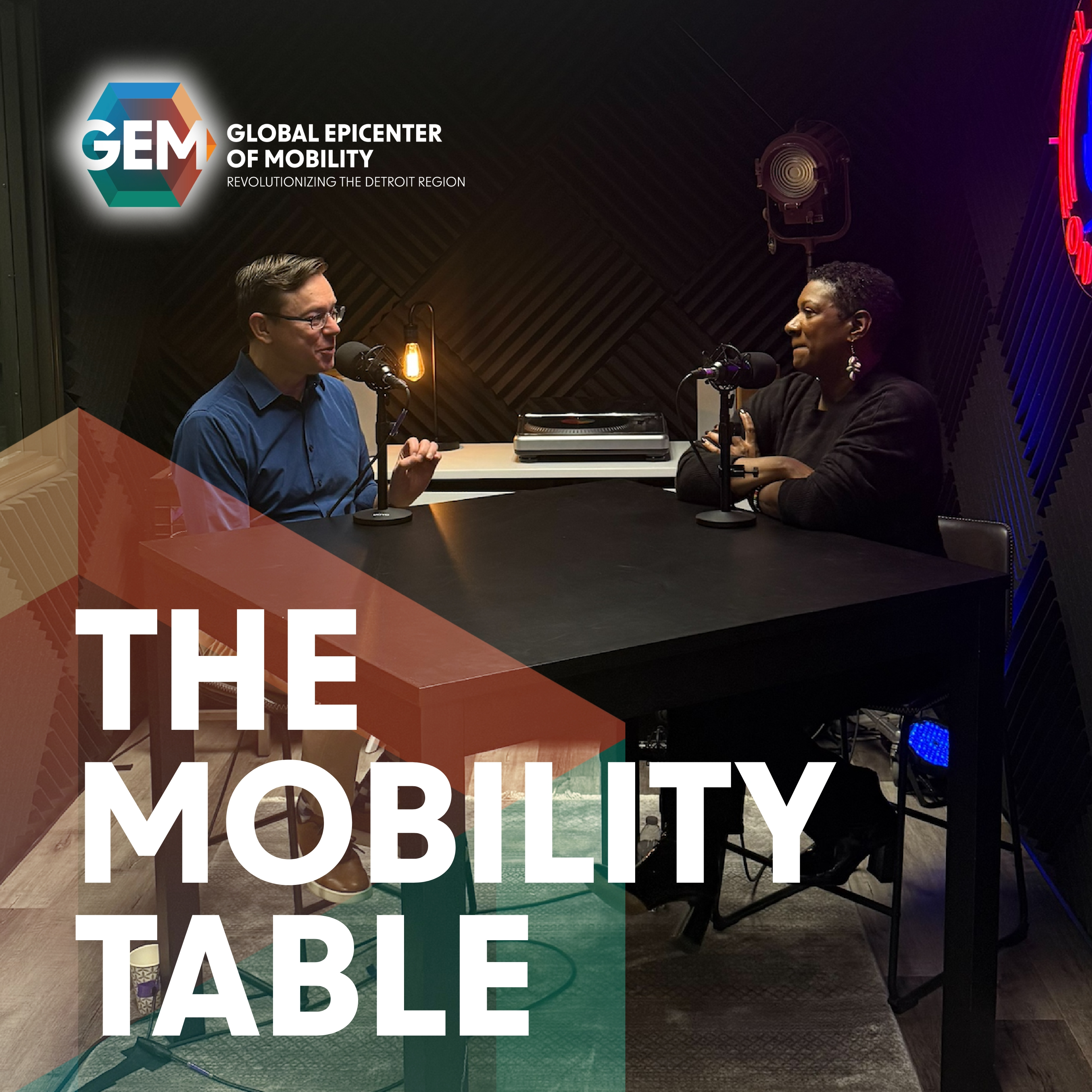
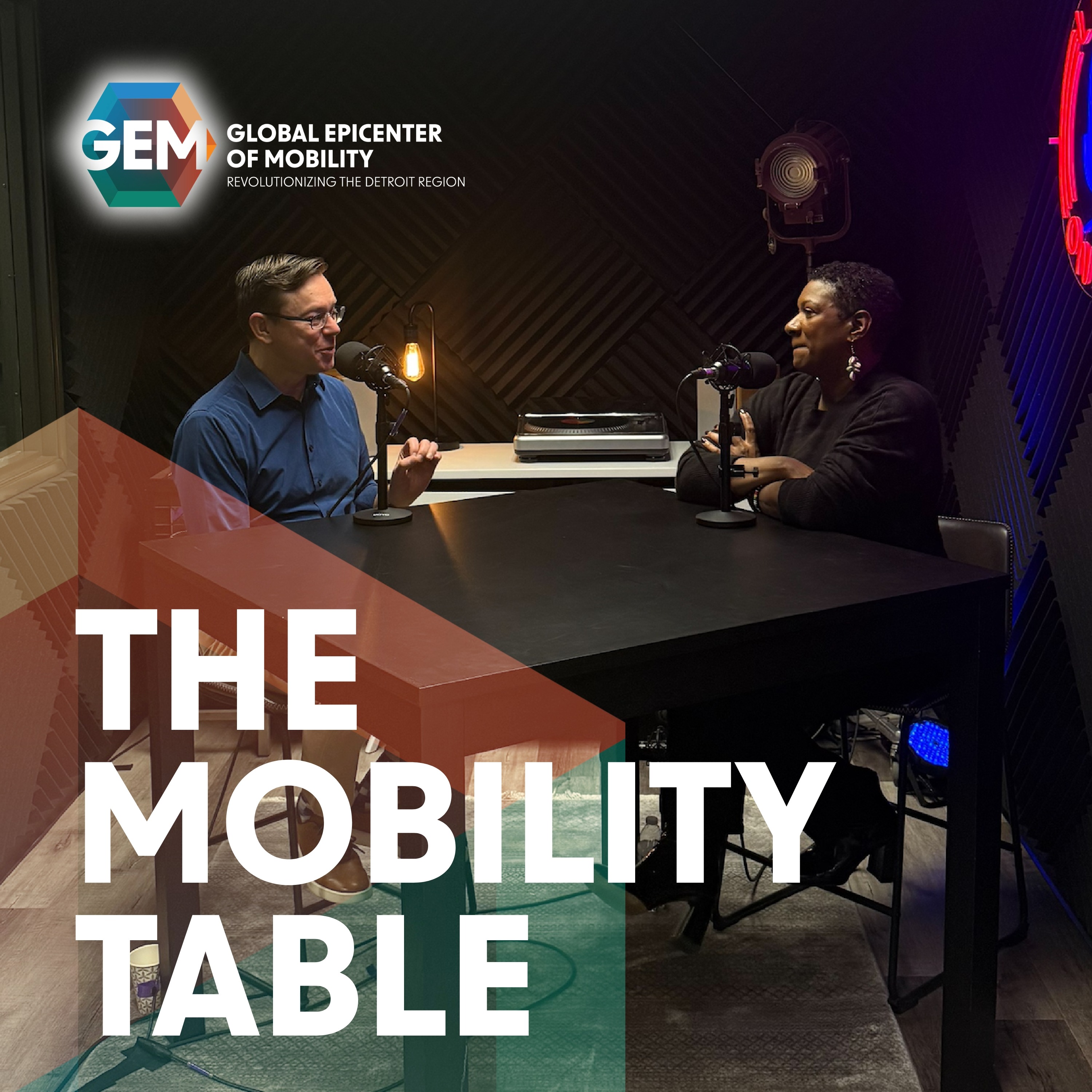
Welcome to the mobility table powered by Jim.
This is a table where we talk about all things advanced mobility in the Detroit region.
I am Jeanine Gant, mobility engagement officer at the Global Epicenter Mobility,
and I am joined by my amazing and astute and smart co-host Bernard Zwicky.
Thank you for that, Jeanine. Bernard Zwicky, Vice President of Mobility and Research at the Detroit Regional Partnership and at GEM.
You know, the thing I love about our podcast is we talk about a variety of topics,
so people can really begin to understand what this advanced mobility ecosystem is all about.
And one of the things I've seen, Bernard, and you probably have too over the past couple of years,
is just how expansive this mobility ecosystem is and how it is creating opportunities for a variety of folks to get involved from workforce to supply to innovation and all kinds of opportunities and ideas.
Yeah, and you know, Jeanine, mobility, especially in the United States where we don't necessarily have the best public transit systems, right?
It's a life enabler, and there are parts of the population that don't necessarily benefit to the full extent from all these wonderful solutions that the companies are making.
And so that's really, to me, the heart of today's conversation is we often talk about the wonderful products or technologies and so on that are coming out,
but it's also how do we let more people take advantage of them, and that's just as much a part of mobility as the technology itself.
Well, absolutely. It's about accessibility, right? And I'm excited for our guests because we're going to talk about accessibility from a variety of different perspectives,
so not just infrastructure, but how we actually design our technologies and our solutions to make sure that they're accessible for everyone.
How do we create a workforce that is inclusive for folks with disability?
Just how do we think about those things from the very beginning as we're designing and planning, and that is an afterthought.
Yeah, and exactly, it's one of those topics where the more I learn about it, the more it blows my mind and you realize it needs to be taken into account in the planning stages.
You know, when whether that's designing a product or designing, you know, a parking lot or a sidewalk or a building, you name it, you know,
but I believe it's best done upfront because the retrofits are likely never going to be, they're never going to be as good and you're going to spend more that way.
And so it is something we need to be very intentional about.
And we need to think about it. You know, we have one of our partners at the Global Epicenter of Mobility is Design Corps.
Kevin Gilboe always likes to say, you know, are we designing for all?
I don't know if you know this, but when I was growing up, my dad had multiple sclerosis and was in a wheelchair.
I was very active with the Americans with Disabilities Act and getting that, you know, approved.
And, you know, there are things that we don't even think about that have made it convenient for all of us to have greater ease as we move around the world in spaces.
I think about I'm a bike rider and I think about, oh, I'm so glad there are cuts in the sidewalk.
Those cuts weren't made for me in riding my bike.
They were really made to make it more accessible for people that may be in wheelchairs, but these are things we don't think about.
So I like to say when we design for the least of these, and I hate to use that term, we make life better for everyone.
That's very true. These are solutions that do contribute to the full community, whether or not you're the intended user.
Exactly. And as we are building out this new ecosystem and as folks are thinking about new technologies, EV charging stations, how do we make sure that they're accessible for folks?
How do we make sure that there aren't cords that are going across sidewalks where folks need to, you know, be able to be mobile?
I'm excited for Alan Hale, which is our guest coming on, because he has a really great perspective on all things related to creating accessibility from folks,
from the workforce, to the infrastructure, to how we design, create policies that can help make things more thoughtful and intentional for everyone in our community.
So without further ado, I think let's go ahead and bring on Alan. I'm excited to bring on Alan Hale, lead consultant and founder of Spark Access.
Alan, welcome to the mobility table.
Yeah, thanks for having me. And it's definitely a pleasure to answer the call and be here with you today.
I really appreciate it. You have been my guy in terms of all things accessibility in the Detroit region and globally, frankly, but you always answer my phone call.
You're so knowledgeable about how we create accessibility for folks in our region and through our technologies, through our workforce, through our infrastructure.
What drew you to this work?
Yeah, how long you got?
I know.
I think my origin story really lies with meeting my wife back in 2014, who we were both at Ford Motor Company at the time, and she was a wheelchair user, or she is a wheelchair user.
And we really traveled the world together. We found just tons of hobbies together between hand cycling and cycling and adaptive scuba diving was a big thing that we traveled the world for.
And we really, I got to see the world of travel through her eyes and her experiences.
And then just quickly found myself part of the disability community as part of that just that kind of natural path of advocacy.
And it really is something that every facet of my family is tied to disability and it was a bit of my cultural awakening that I'm part of the disability community.
And I come from a long line of once you find out things like neurodiversity and ADHD are hereditary.
I am a professional with ADHD and my father is undiagnosed with ADHD, my sister has ADHD, my cousin has ADHD.
So many folks, right? Yeah.
And then on top of that, I had a viral fever at one point about seven years ago and ended up with chronic occipital neuralgia after that, which is just nonstop nerve pain that you can manage in different ways.
And so through professionally at the time, I have a background in connectivity.
You were at Ford, right?
Yep, I was at Ford doing connectivity and was really passionate about bringing internet to vehicles and working with the cellular industry to make that happen.
And then I started working on autonomous vehicle connectivity and that started to shine a light where autonomous vehicles were held as this thing that would just improve the lives of people with disabilities and non-drivers across the board.
And from a market opportunity was this kind of vast unknown of people who can't drive today could suddenly find themselves with like a vehicle as a service and transform that.
And what I found was a lot of folks just didn't know how to talk about disability in those rooms.
And then through my career, I transitioned to General Motors and saw a lot of the same trends and a lot of the ways leadership just didn't know how to understand the market for disabled travelers.
And so through kind of a combo of that and my community experience, I started listening to the voices of employees with disabilities across GM and knowing kind of the experience from Ford.
And at the end of the day, across the entire GM portfolio, we had GM employees who had no vehicle options.
And there are a lot of reasons why that is the case.
Just systemically, a lot of folks don't understand disability or how to count it in data and marketing representation and so forth.
You know, I do want to ask you this question. This is something I do want to use this opportunity at this table to dispel dispel myths to give accurate information.
I mean, I think when people think about disability or accessibility that it's a small number of people.
So why focus on that group of folks because they're a small number of people, but give us some data, some statistics.
Yeah, I think a really key example is the city of Detroit where through kind of our census data and the American Community Survey that help enumerate this.
And it's a statistic that's front of a lot of our policy work for local housing and voting initiatives.
It's more than 30% of Detroiters have disabilities.
And it's due to a lot of things in our system where it's inequities and transportation inequities and health care where disability isn't always about kind of our status as an individual.
It can be a product of our environment.
And when you're in a city that has those barriers that creates that gap, you end up in kind of a disabling environment in a lot of ways.
A disabling environment.
So what are you solving for now?
So with Spark Access, you know, you've kind of made that journey.
You started as an engineer and saw that there were some gaps and some opportunities that needed to be lifted up.
What are you solving for now as you think about the mobility industry?
Yeah, so after kind of the wake of, I had started the auto industry's first accessibility department with the Accessibility Center of Excellence at General Motors,
and really through that strategy and seeing how much it could be duplicated and replicated across the industry from just that simple facet of what happens when you start counting people with disabilities and your data and research,
and what happens when you start staffing up product teams to address that to the long term like community engagement.
So through kind of that cross-functional approach, I built all this knowledge and skills that I really decided would be my mission with Spark Access to share with the mobility industry.
So now I work primarily across my clients range from state and local governments across the U.S. and Canada to the autonomous vehicle industry, to the EV charging industry,
and then the fun one for me is also kind of the urban planning industry and where it intersects with micro-mobility and where you're working with complex city environments
and trying to fit all these new technologies in our existing infrastructure.
But then the underlying pillar across kind of all those domains is the workforce development and what your capacity is to bring people with disabilities to the table
to help really unlock the changes needed to address accessibility across all those different disability communities that these technologies have the opportunity to really provide solutions for.
When I say we've got someone who can talk about this stuff, he can talk about this stuff.
Well, from every angle.
Yeah, from every angle.
Yeah.
And so it's the intersection of those angles that's of interest to me because, for example, we now have the potential for electric vehicles that are not necessarily fully autonomous in terms of driverless travel, but they can be more autonomous.
So let's say if you have not the best eyesight or if you're getting older, you may be able to drive longer, for example.
And what is very interesting to me is how much, or can you maybe provide a general sense, how much of the solution lies in the product that is the vehicle in which people would move
and how much of it is in the infrastructure of, you know, the sidewalks, the driveways, the charging stations, the things that don't actually move the person that we're talking about.
Yeah, I mean, it's why the world of accessibility is it's designed for system thinkers and it's designed with systems in mind because you can't leave one aspect behind without kind of cutting out the circular need for accessibility.
So it's equal parts kind of environment and how we're developing products to the point of electric vehicles and all the technologies those have behind it in terms of like safety.
That's an example where they might incidentally be helping people with disabilities today and my wife, she's a Ford Motor Company employee and helped design the climate system for the Ford Mustang Mach-E.
So that's our vehicle that we have.
And for her driving with BlueCruise, they're kind of assistive driving that helps with highway driving.
It really alleviates as a wheelchair user, she drives with hand controls and it really alleviates the strain on her.
So now when most of our families in the Baltimore area and we live here in Ferndale just north of Detroit, that's about an eight hour road trip that before between my chronic nerve pain and my wife driving with hand controls, we'd be pretty exhausted after a drive like that.
But now we're able to do that drive in the Mach-E and not have that exhaustion.
Something I think that's an opportunity though is to lean into that use case a lot more and then build those systems up that help get more voices of people with disabilities to better refine that.
And it's just an opportunity across the industry to really lean into of how do we acknowledge these wins and then capitalize on that to then reach more customers.
Yeah, that's a great example.
I'm curious because again, you always share information with me and if you don't follow Alan on LinkedIn, LinkedIn because there's always great stuff.
Are there some technologies that excite you in terms of accessibility that you've seen from vehicle design or even infrastructure, charging stations, things like that?
Yeah, great question. I think I'm very critical of the industry after having been in it so long. So it takes a lot to get my attention and to know kind of what goes into really refining accessibility.
There's the charging station designer and manager Ionia. They've really partnered with a lot of the auto OEMs. They're expanding a lot across the East Coast and a lot of different communities.
They've really leaned into accessibility as a core part of what they do and what they provide and they're really going for that customer experience is their leading quality as they're developing charging sites.
And so they have covers on them so you're out of the elements. They often have small dog parks. They often have small convenience stores and they're really going for taking the best of what we have for the fuel station model where it's somewhat a third space in different ways
and turning that into an EV charging experience and what they've done is they've made essentially all of their sites share like an access aisle. They make sure everything's within reach and you don't have to worry as someone with a disability who might be driving.
You don't have to worry when you pull up to their sites if you'll be able to use those chargers or not.
And that's kind of at the end of the day like that's the customer centric question is what's that experience for people with disabilities when they show up. They're one that's addressing that.
Yeah, go ahead.
It's really exciting to see of that philosophy that this is going to be a vehicle as a service and really designed from the factory level by Kia to address.
Well we talked about that. I remember us talking about this last year that these accessibility tools are not factory installed. So it's an after fact right and that folks have to pay for that out of their own pocket.
I remember you were doing some advocacy policy work around that.
Yeah, I mean the key difference having come from General Motors where the big win was incidentally Braun ability had chosen the Chevy Traverse just due to some of its core dimensions and the Chevy Traverse is one of the only SUVs on the market that can be wheelchair accessible.
That's Chevy Traverse is about like 45 to $55,000 depending on how much you're packaging into it.
Once it gets the wheelchair up fitting from Braun ability and gets the ramp installed and kind of all the bells and whistles. It can be $90,000 to $110,000.
So it's another level of accessibility right. It's one the product itself but then can you access it afford it financially.
But I'm curious Alan are we maybe in a little bit of a golden age right because we have a little bit more of the recognition of this is important and we need to be providing these helpful services.
But it also seems like maybe now the technology itself is more ready than it has been in the past and you know hopefully that key example you gave is hopefully the start of maybe a coming wave.
I mean I'd like to keep that optimism that this is hopefully the start of something more. I think it really involves like more automakers coming to the table though and and acknowledging what the business case and what the opportunity is.
Because we're still at only a handful of wheelchair accessible electric vehicles that can be on the market.
I think we're at the start of what could be a really big opportunity but it really involves having that like spark with businesses where they can see the customer opportunity and especially with this transition of vehicles as a service where things are more becoming fleets and fleet components.
Accessibility needs to be far more upfront to properly address.
You know I wonder you know there's all this talk about A.I. and you know I wonder what if A.I. is going to change the way in which people engage folks with disabilities and what I'm saying is is it oh we don't need to have conversations with people we can just go ask A.I.
where you you don't shortcut the human experience and at the end of the day human centered design and testing still has to happen and we still need humans in the loop for that kind of critical component or we risk really getting things wrong and that's happening right now across
different pockets of the industry where there hasn't been a responsible use of A.I. and it is leaving people behind.
I think a few years ago the conversation around A.I. was was really acknowledging it's really great at tackling the like 80 to 85% of like general cases and using agentic A.I. to really solve the like easy questions.
Where does that leave the hard questions and I think a few years ago I heard a lot more talk that rather than A.I. just replacing everything it's using A.I. to make the bulk process more efficient and then redirect resources into more specialist concierge type
as it is and so when we're thinking of things like healthcare help desk or something often when people with disabilities are calling it might be their 10th call in a week to to try to navigate something and to be met with A.I. when you already know you need a human to solve that problem and you
need kind of your acute needs met replacing those instances with A.I. can often lead to a lot of harm for people with disabilities. So being mindful of where it's really needed to keep that human in the loop and where resources are still needed to address those hard challenges.
If I can use just like in a quick example, my wife and I were just in Denver for one of her big sports adaptive curling and we showed up at the Denver airport for our rental with Hertz and when we request a vehicle we we request it out of fitted with hand controls and we wanted a small SUV and there was no way to confirm in advance
and what a lot of like the rental car companies have done is remove their call numbers kind of entirely and when you call the number it might be an international help desk it might be kind of a genetic A.I. handling the call but it doesn't account for the kind of disability support desk
and without any way to confirm with like the specific location where you're picking up your car for any person with a disability who's been through that process you know it's not going to be there unless you confirm kind of three times in advance.
That's you know that's really the idea of barriers getting created so that people do not have access to mobility is really frustrating and frankly disappointing as well.
You know one of the things that we've been able to do Allen together over the last couple years is work with some of the founders that we are that we have coming through the global epicenter mobility.
Are there a couple projects that you've worked on through Jim.
Yeah I think some that really come to mind. Design Corps has been a really great partner of they host the design jam every year and it takes place during Detroit's month of design in September partnered with kind of CCS and that umbrella and they do a challenge of design.
Something for people with disabilities is range from I think in its first few years was like fashion centered has evolved to be like outdoor recreation and it's really an open prompt that people can innovate on any aspect.
And I've had the privilege of helping do their kind of inclusive design training to help prime everybody of how to work with people with disabilities because the program they run is centered entirely on co creation with people with disabilities where you might be given a person or an archetype of different people with disabilities where it could be an amputee it could be wheelchair user it could be someone who's a white cane user and is blind.
And it kind of brings them to life of they create these personas that detail people with disabilities are just their people families their people with kids their people who want to just go into the outdoors and experience the same fun everybody else does.
And the surprise with design jam I hope I'm not spoiling it for anybody is by all means is often the people in the room who are there as the coaches end up being the personas.
So that's usually the Easter egg is they get into kind of a generic persona but then start seeing the parallels with the coaches that they're partnered with.
And then that light bulb goes off that oh I'm designing with you on this and that these are real people real human beings and I thank you for putting the humanity in that these are folks with families jobs dreams whatever right they're just regular folks that just happened to have an accessibility challenge.
Yeah yeah I'm curious how often you know for example we're talking about Detroit right and it's the motor city but those streets were laid out in the era of horse and buggy right it's it's a it's a very old city in that regard or at least in terms of the core.
And I'm curious how much of an additional burden is that to try and design around a city that really wasn't thought of this way and how much of an advantage is there when this mobility technology.
Can be deployed in a new development where you can have some thought ahead of time not just for the product that the people you know would be transported in but also for the environment in which that transporting takes place.
Yeah great question. I think in terms of Detroit it's we've got the advantage of being a very flat city and it in all of its different levels of chaos. It's actually a pretty orderly city of we've got a pretty solid grid format based on kind of the hub and spoke out of campus
marshes and it provides at least some level of order to a lot of our corridors that we still have this opportunity to capitalize on. I never like framing accessibility and the need to update and modernize things through the age of American cities
because as a world traveler who's been to Europe been to Japan been to all sorts of places they're accessible without without question. That's a great point. And there are role models to follow as a result.
Yeah one of one of our funnest I think vacations was San Sebastian in Spain which the history of San Sebastian is it's one of the only really like unconquered cities and kind of the Basque region and there's not a building there that's less than 800 years old and they're fully accessible.
So when people try to pull the like oh it's an old building car around the Detroit area it's it's hard to justify in my mind from that global experience. But to your question on kind of the advent of mobility.
I think we do have this opportunity where there's flexibility to play with the infrastructure a little bit and explore like what can be done that other cities that have a lot more constraints and where their streets are completely full and built out.
There's a lot of opportunity in Detroit to experiment with new infrastructure that can work and one example that I'm working on with a few different layers is for the autonomous vehicle industry.
There's a big challenge of how to how to pick people with disabilities up from the curb and and have the vehicle in a space that works best for them whether that's whether someone wants to be dropped off near a curb cut at a corner or whether somebody wants to be as close as possible to wherever their destination is.
A good example is if it's a white cane user different blind people navigate differently some might be using an app with a service like Ira or be my eyes to help them navigate.
Some may love just their independence with their white cane and know how to get around just fine and people come at the disability community from different ways different technology levels and whatnot.
So having that modality is really important and it's one where a lot of cities where autonomous vehicles are launching today.
There's not really a choice and it's very hard some cities you're never going to get curb access and so it's really difficult to navigate that in some environments but I think in Detroit.
There's an opportunity to really lean into testing and experimenting and doing it in a way that's not disadvantaging anybody because that's often also a trade off of how do you introduce new technology without removing or distracting from the levels of accessibility that might be there already.
Yeah it's a great example because the autonomous technology is a fantastic enabler to increase that mobility access but at the same time without a driver there if there were a driver they might recognize hey I need to pull into this particular location where it's easier to get in versus there
but it's difficult to program into a vehicle with code or there's a physical driver they may be able to help with luggage but if there isn't then you don't have that option.
So it's kind of the increase in that capability of the technology also brings the requirement for different solutions because you don't have that human that could just figure out the assistance.
Yeah and it's a bit of a how the industry traditionally with like rideshare and Uber and Lyft and whatnot a lot of their responsibility for that has been deferred because it is mostly contract drivers and what not.
There's only so much they can do for training and awareness in a lot of cases and so a lot of the examples of like litigation that are out there for discrimination against people with disabilities in rideshare.
It's a human issue but now as we're transitioning to autonomous vehicles it becomes a systems issue and the systems got to account for it.
Alan we have to wrap up and we could talk for another couple hours I'm sure you're just such a wealth of knowledge and information.
Thank you so much for joining us and for having this what I think is a really important conversation.
Hopefully you know we'll begin to see our roads and our spaces more accessible over the next little while right.
So thank you for joining us.
This is we've got to wrap up the mobility table.
I want to thank everyone for joining us and listening in.
Follow Alan on spark access great guide great information.
We'll see you next time.
Thank you.
Thank you.
About this episode
Accessibility in mobility tech is framed as an upfront design problem—retrofits often fall short and cost more. Alan Hejl shares how his work at Ford and General Motors shaped accessibility thinking across vehicles, charging infrastructure, and connected systems. He connects disability inclusion to real-world details like EV charging access aisles, hand controls, and BlueCruise reducing strain. The conversation also warns against AI-only support and highlights why autonomous vehicles require curb access and systems-level responsibility.
Alan Hejl took a seat at The Mobility Table to discuss the importance of accessibility as a consideration during the development of mobility technologies. The conversation explored the benefits of prioritizing accessibility in the early stages of mobility technology design, the value of systemic thinking and the need to receive input from individuals with disabilities when creating human-centered solutions.
Alan Hejl is the founder and lead consultant at Spark Access. Prior to the creation of Spark Access, Alan spent over 13 years in the automotive industry in roles across Ford and General Motors, including accessibility strategy manager at General Motors.