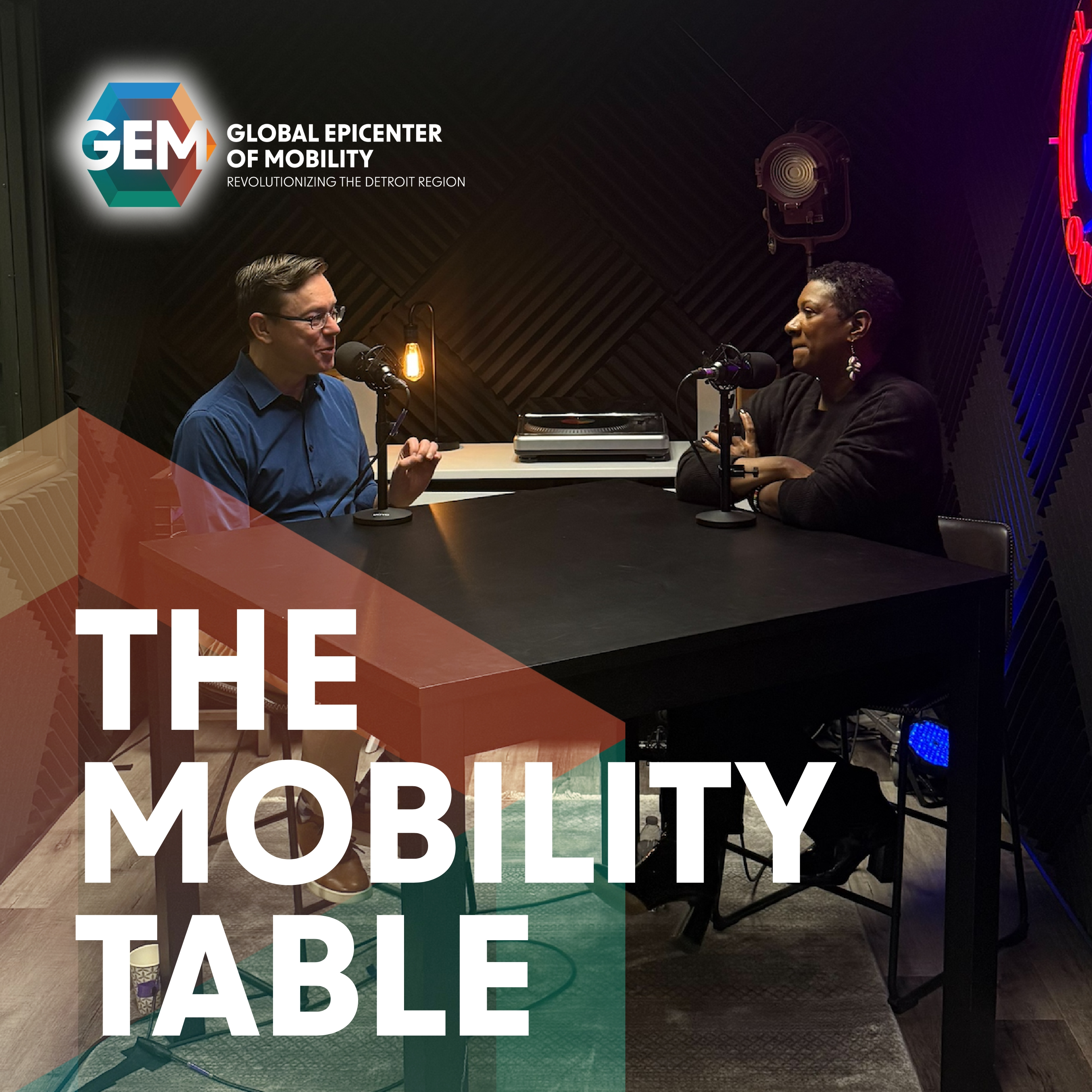
Accessibility in Mobility Technologies with Alan Hejl, Founder and Lead Consultant of Spark Access
About this episode
Accessibility in mobility tech is framed as an upfront design problem—retrofits often fall short and cost more. Alan Hejl shares how his work at Ford and General Motors shaped accessibility thinking across vehicles, charging infrastructure, and connected systems. He connects disability inclusion to real-world details like EV charging access aisles, hand controls, and BlueCruise reducing strain. The conversation also warns against AI-only support and highlights why autonomous vehicles require curb access and systems-level responsibility.
Alan Hejl took a seat at The Mobility Table to discuss the importance of accessibility as a consideration during the development of mobility technologies. The conversation explored the benefits of prioritizing accessibility in the early stages of mobility technology design, the value of systemic thinking and the need to receive input from individuals with disabilities when creating human-centered solutions.
Alan Hejl is the founder and lead consultant at Spark Access. Prior to the creation of Spark Access, Alan spent over 13 years in the automotive industry in roles across Ford and General Motors, including accessibility strategy manager at General Motors.
connectivity
"[433.9s] And so through professionally at the time, I have a background in connectivity. [439.7s] You were at Ford, right? [441.4s] Yep, I was at Ford doing connectivity and was really passionate about bringing internet to vehicles and working with the cellular industry to make that happen."
In cars, connectivity means the car can connect to the internet and share data. That can enable features like real-time services and remote communication.
In automotive, connectivity refers to a vehicle’s ability to communicate—typically via cellular networks—with cloud services and other systems. The guest frames their Ford work as bringing internet access to vehicles by partnering with the cellular industry.
Ford
"[439.7s] You were at Ford, right? [441.4s] Yep, I was at Ford doing connectivity and was really passionate about bringing internet to vehicles and working with the cellular industry to make that happen."
Ford is a car company. Here, the guest says they worked there on technology that connects cars to the internet using cellular networks.
Ford is a major automaker that employs engineers and product teams working on connected-car technology. In this segment, the guest describes working at Ford on vehicle connectivity—bringing cellular internet to cars.
vehicle as a service
"[464.6s] And from a market opportunity was this kind of vast unknown of people who can't drive today could suddenly find themselves with like a vehicle as a service and transform that. [476.1s] And what I found was a lot of folks just didn't know how to talk about disability in those rooms."
“Vehicle as a service” means you get access to a car through a plan or subscription, instead of owning one. The guest is saying this could help people who can’t drive get transportation anyway.
Vehicle as a service (often abbreviated MaaS in industry discussions) is a business model where mobility is delivered as a subscription or on-demand service rather than through owning a car. The guest uses it to describe how people who can’t drive might gain access to transportation through service-based options.
General Motors
"[481.2s] And then through my career, I transitioned to General Motors and saw a lot of the same trends and a lot of the ways leadership just didn't know how to understand the market for disabled travelers. [493.8s] And so through kind of a combo of that and my community experience, I started listening to the voices of employees with disabilities across GM and knowing kind of the experience from Ford. [508.4s] And at the end of the day, across the entire GM portfolio, we had GM employees who had no vehicle options."
General Motors is a big car company. The guest explains that at GM they noticed similar problems in how leadership understood accessibility needs for disabled travelers.
General Motors (GM) is a large automaker with a broad vehicle lineup. The guest says they transitioned to GM and found similar issues around leadership understanding the market needs of disabled travelers, including GM employees having no vehicle options.
American Community Survey
"[553.9s] Yeah, I think a really key example is the city of Detroit where through kind of our census data and the American Community Survey that help enumerate this. [563.2s] And it's a statistic that's front of a lot of our policy work for local housing and voting initiatives."
The American Community Survey is a big U.S. government survey that gathers information about communities. The guest uses it as a source for disability statistics in Detroit.
The American Community Survey (ACS) is a large U.S. Census Bureau program that collects detailed demographic and social data. Here, the guest cites it—along with census data—to support the claim that a large share of Detroit residents have disabilities.
Detroit
"[553.9s] Yeah, I think a really key example is the city of Detroit where through kind of our census data and the American Community Survey that help enumerate this. [563.2s] And it's a statistic that's front of a lot of our policy work for local housing and voting initiatives."
Detroit is the city the guest uses as an example. They say local data shows many residents have disabilities, and that local barriers affect how easy it is to get around.
Detroit is used in this segment as a concrete example for disability prevalence and how it informs local policy. The guest ties the statistics to barriers in transportation and health care that can create a “disabling environment.”
disabling environment
"[585.9s] It can be a product of our environment. [590.5s] And when you're in a city that has those barriers that creates that gap, you end up in kind of a disabling environment in a lot of ways. [598.9s] A disabling environment."
This means the world around someone can make it harder to live with a disability. The guest is saying barriers in transportation and health care can create those difficulties.
A “disabling environment” is the idea that disability is shaped by external barriers—like inaccessible transportation, unsafe streets, and gaps in health care—rather than being only an individual condition. The guest argues that inequities in systems can turn everyday surroundings into obstacles to mobility.
EV charging industry
"So now I work primarily across my clients range from state and local governments across the U.S. and Canada to the autonomous vehicle industry, to the EV charging industry,"
The EV charging industry is the world of places and equipment that charge electric cars. The guest is saying accessibility isn’t just about the car—it’s also about charging locations and usability.
The EV charging industry refers to the ecosystem of charging hardware, networks, and services that enable electric vehicles to be powered. The segment frames charging infrastructure as part of accessibility—because where and how charging is deployed affects who can use EVs.
autonomous vehicle strategy
"So now I work primarily across my clients range from state and local governments across the U.S. and Canada to the autonomous vehicle industry, to the EV charging industry,"
The autonomous vehicle industry is about self-driving car technology. The guest is linking it to accessibility—suggesting that partial automation could help some people drive longer or more safely.
The autonomous vehicle industry covers technologies and companies working toward self-driving cars, including sensing, software, and safety systems. The guest connects this to accessibility by discussing how more automation could help people who can’t drive as long due to limitations like vision changes.
micro mobility
"and then the fun one for me is also kind of the urban planning industry and where it intersects with micro-mobility and where you're working with complex city environments"
Micro-mobility means small vehicles for short trips, like scooters or e-bikes. The guest is saying accessibility planning has to consider how these fit into real city streets and sidewalks.
Micro-mobility refers to small, lightweight transportation options—like e-bikes, scooters, and similar devices—used for short trips. The guest highlights how accessibility planning gets harder when micro-mobility interacts with complex city infrastructure.
system thinkers
"Yeah, I mean, it's why the world of accessibility is it's designed for system thinkers and it's designed with systems in mind because you can't leave one aspect behind without kind of cutting out the circular need for accessibility."
This means looking at the whole picture instead of just one part. The guest is saying accessibility works best when the vehicle and the surrounding streets, sidewalks, and charging areas are all considered together.
“System thinkers” is a mindset where you treat mobility and accessibility as interconnected parts rather than isolated features. The guest argues that you can’t improve one piece (like the vehicle) without also addressing the surrounding environment and infrastructure.

Ford Mustang Mach-E
"my wife, she's a Ford Motor Company employee and helped design the climate system for the Ford Mustang Mach-E. [814.6s] So that's our vehicle that we have."
The Ford Mustang Mach-E is Ford’s electric vehicle. The guest’s wife helped design part of it (the climate system), and the discussion connects the car’s tech to accessibility for a wheelchair user.
The Ford Mustang Mach-E is an electric crossover built around an EV powertrain and modern driver-assistance features. In this episode, it’s used as a real example of how accessibility work can show up in vehicle systems like climate controls and how the car supports a driver with disabilities.
climate systems
"my wife, she's a Ford Motor Company employee and helped design the climate system for the Ford Mustang Mach-E. [814.6s] So that's our vehicle that we have."
The climate system is what controls the car’s heating and air conditioning. The guest’s wife helped design it, and that matters for accessibility because it affects how easy it is for the driver to stay comfortable.
A vehicle climate system is the heating, ventilation, and air-conditioning (HVAC) hardware and controls. Here it’s called out because accessibility can include how easily a driver can manage cabin temperature and airflow.
BlueCruise
"And for her driving with BlueCruise, they're kind of assistive driving that helps with highway driving. [825.2s] It really alleviates as a wheelchair user, she drives with hand controls and it really alleviates the strain on her."
BlueCruise is Ford’s hands-on-assistance feature for highway driving. In this story, it helps reduce how much effort the driver has to put in, which matters for accessibility.
BlueCruise is Ford’s driver-assistance system that can handle certain highway driving tasks. It’s relevant here because the guest describes it as “assistive driving” that reduces workload for a driver using hand controls.
hand controls
"It really alleviates as a wheelchair user, she drives with hand controls and it really alleviates the strain on her."
Hand controls are modified car controls that let someone drive using their hands rather than foot pedals. In this segment, they’re part of how the driver can manage the car more comfortably.
Hand controls are vehicle controls adapted so a driver can operate functions (like acceleration/braking) using their hands instead of traditional pedals. The guest specifically mentions hand controls to explain how the Mustang Mach-E and BlueCruise reduce strain for a wheelchair user.
charging stations
"Are there some technologies that excite you in terms of accessibility that you've seen from vehicle design or even infrastructure, charging stations, things like that?"
Charging stations are the places where you plug an electric car in to recharge it. The hosts are talking about making those stations easier for people with disabilities to use.
Charging stations are the EV infrastructure where vehicles plug in to recharge. In this episode, the discussion focuses on accessibility at charging sites—like layout, reachability, and whether drivers can reliably use the chargers.
Ionia
"There's the charging station designer and manager Ionia. They've really partnered with a lot of the auto OEMs."
Ionia is a company that helps plan and run EV charging locations. In this discussion, they’re praised for designing those sites to be easier for people with disabilities to use.
Ionia is described here as a charging-station designer and manager that partners with automakers (auto OEMs) and expands charging sites across the East Coast. The episode frames Ionia’s approach as accessibility-first, shaping the physical site layout and amenities.
access aisle
"what they've done is they've made essentially all of their sites share like an access aisle. They make sure everything's within reach"
An access aisle is extra space near the charger so someone using a wheelchair or mobility device can get close and use the equipment. The point here is that the charger setup is easier to reach.
An access aisle is a dedicated walkway/clear space near EV chargers designed to be reachable and usable by people with mobility impairments. The segment explains that Ionia’s sites make key items “within reach” so drivers don’t have to struggle to access the chargers.
after fact
"I remember us talking about this last year that these accessibility tools are not factory installed. So it's an after fact right and that folks have to pay for that out of their own pocket."
“After fact” here means accessibility tools are not installed at the factory; instead, they’re added later as conversions or add-ons. The segment emphasizes that this often shifts cost to the customer, affecting affordability.

Chevy Traverse
"the big win was incidentally Braun ability had chosen the Chevy Traverse just due to some of its core dimensions and the Chevy Traverse is one of the only SUVs on the market that can be wheelchair accessible."
The Chevy Traverse is a larger SUV. The speaker says it’s one of the few that can be converted so a wheelchair can get in, with a ramp and other modifications done by BraunAbility.
The Chevrolet Traverse is a full-size-ish three-row SUV that’s highlighted as one of the only models that can be made wheelchair accessible. The segment ties its “core dimensions” to feasibility for wheelchair conversion by BraunAbility, including installing a ramp and the associated accessibility hardware.
Braun ability
"the big win was incidentally Braun ability had chosen the Chevy Traverse just due to some of its core dimensions and the Chevy Traverse is one of the only SUVs on the market that can be wheelchair accessible."
BraunAbility is a company that modifies vehicles so people with disabilities can use them. Here, they’re the ones fitting the wheelchair lift and ramp on the SUV.
BraunAbility is referenced as the accessibility-conversion specialist that fits the wheelchair lift and installs the ramp and related equipment. In this segment, BraunAbility’s work is the reason the Traverse can be wheelchair accessible.
Request an Explanation
Heard something you'd like explained? We'll add it to this episode.
Sign in to request explanations for terms you heard.
Want to learn more?
Browse our glossary for plain-English explanations of automotive terms, jargon, and concepts.
Help improve this episode
See something that's not quite right? Our annotations are AI-generated and can sometimes miss the mark. Click the flag icon on any annotation to suggest a correction.