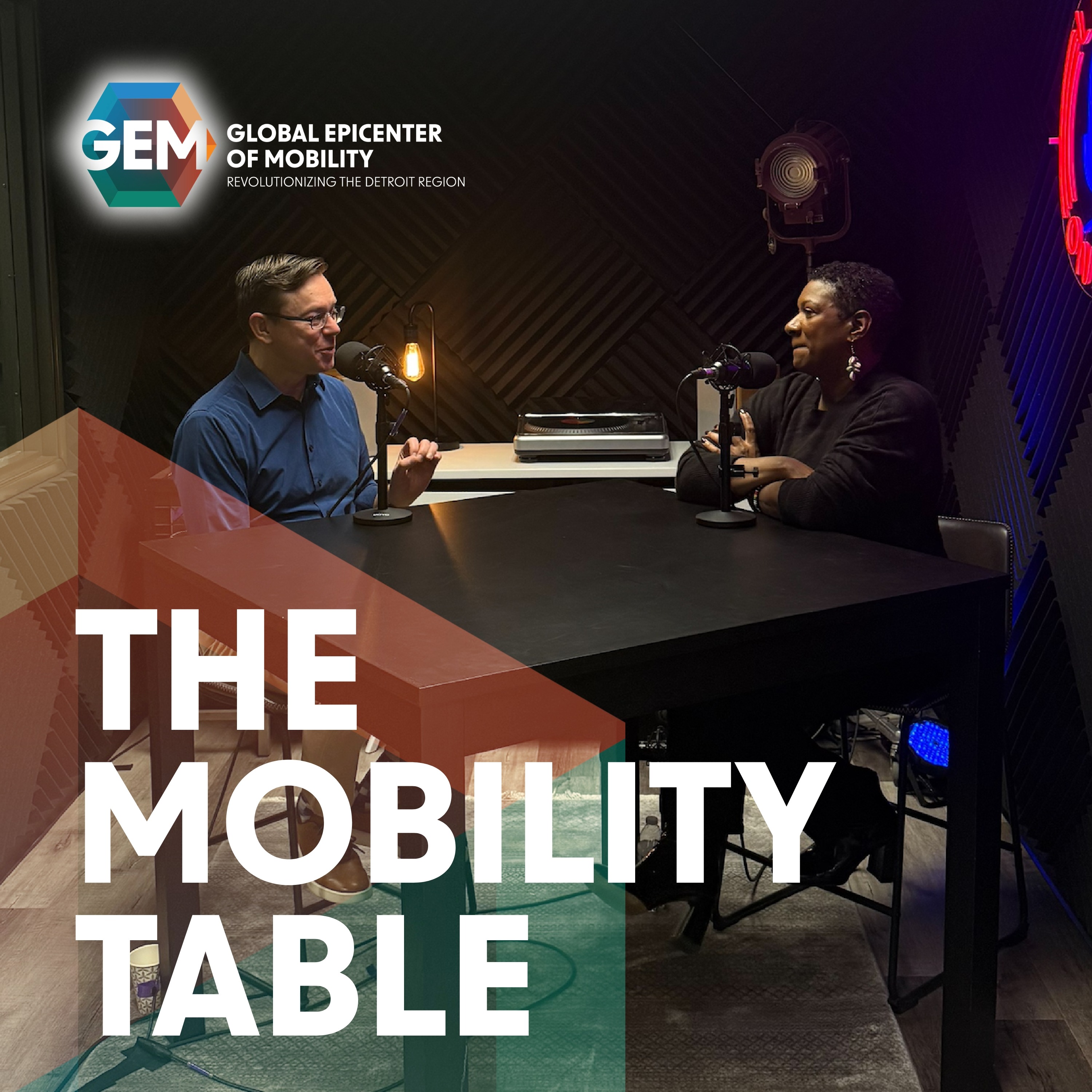
Exploring the transformative landscape of Detroit's Advanced Mobility ecosystem, this episode features insights from Maureen Donohue Krauss, CEO of the Detroit Regional Partnership. The discussion highlights the shift from traditional automotive manufacturing to innovative mobility solutions, emphasizing collaboration among diverse stakeholders. Krauss shares her vision for the Global Epicenter Mobility (GEM) initiative, which aims to connect resources, talent, and technology to foster economic growth and inclusivity in the region. The conversation underscores the excitement surrounding new opportunities in electric and autonomous vehicles, as well as the broader implications for community and industry.
Maureen Donohue Krauss is the first guest to take a seat at the table, joining Jeannine and Bernard in discussing the way the Global Epicenter of Mobility (GEM), a signature program of the Detroit Regional Partnership (DRP), first came together as an initiative and its ongoing impact on the Detroit region’s advanced mobility industry.
Maureen is the President and CEO of the Detroit Regional Partnership, an organization which serves as the point of contact for business as well as marketing the region to out-of-state and international companies. She has over 30 years of leadership in economic development, non-profit and government work.
"...have you been in an autonomous vehicle I have kind of okay I've never done a full full trip..."
An autonomous vehicle is a self-driving car that can operate on its own without a driver. It uses technology to understand its surroundings and make driving decisions.
An autonomous vehicle is a car or truck that is capable of traveling without human input. It uses a combination of sensors, cameras, and artificial intelligence to navigate and drive itself safely.
"...things like the super crew system at General Motors those things themselves there are little entry points..."
Super Cruise is a feature in some General Motors cars that lets you drive hands-free on certain highways. It uses cameras and sensors to help the car stay in its lane and maintain speed without you having to do anything.
Super Cruise is a hands-free driving assistance feature developed by General Motors. It allows for automated driving on certain highways, enabling the vehicle to steer, accelerate, and brake without driver intervention.
Term
smart features
"...that's where you can see you know i have a vehicle now that has that smart um the autonomous feature which i've yet to try on..."
Smart features in cars are special technologies that make driving easier and more convenient, like being able to control your car with your phone or having navigation that helps you find the best route.
Smart features in vehicles refer to advanced technologies that enhance the driving experience, such as connectivity, navigation, and driver assistance systems. These features often integrate with smartphones and provide functionalities like remote start, real-time traffic updates, and automated driving assistance.
Select text to request an explanation
Hello and welcome to the Mobility Table. I'm Bernard Swicky and I'm Janine Gantt.
Both of us are with this amazing initiative called the Global Epicenter Mobility. We are
housed at the Detroit Regional Partnership and we are really looking at how we pivot
from our traditional automotive manufacturing to this new awesome and exciting space called
Advanced Mobility. Exactly, Janine. I think this podcast is really going to get at
some of the topics around that but also mainly the people that are making it happen because
this really is a historic time in the Detroit region but also in mobility overall. We're
electrifying, we're automating, we're moving into new mobility sectors that we couldn't
really service before. So I think we're really going to bring some insights and I think a real
look at the people that are making it happen. Absolutely and I think that's why we're at
this table, right? This is the Mobility Table. It's how we are going to be bringing different
voices to the table because we want everyone to be heard as we move into this new movement of
Advanced Mobility. That's going to be really important that whether they're with industry or
they're a part of community or they're founders, there's so much energy and excitement and we want
to make sure that everyone knows that they are part of this new table that we're building here
in Detroit. Let me ask you a question Bernard because you've been in this automotive mobility
space for a while. What excites you about what's happening right now in Detroit?
Well, Janine, I've been in mobility literally since I was a kid. I grew up in Detroit,
Polish immigrant working at my parents' car repair shop and at that time mobility really
meant automotive and all these changes and so on but they were really evolutionary when you look
back in time at them. I feel like this is a moment when it's revolutionary, when we have this
confluence of transformation that this really is a unique time and you really have to go back
to maybe the founding of the industry a hundred years ago to go back and find
the previous time we had this much transformation happening. I feel like this is the time for
something like GEM to exist and this is the time to be talking about this work as well.
So how about you? You've had a different career. You've had some different paths. What excites you?
I love that you use the term revolution. I think that's really cool but you know I think what
excites me about what's happening right now is I mean my background is is nonprofit work. I've
been doing it for the past 30 years. I did a small stint with an advertising agency that did
work for Ford Division so I had my automotive experience but for me as I think about this
opportunity to build something this this emerging ecosystem that we do it with a lens of the region
and the place in which we are, the people, the resources, the organizations that don't often
get heard. I think I guess what I'm saying is sometimes when we think about automotive it's
always been like the automotive industry right and I think this advanced mobility space is providing
an opportunity for us to look at things differently to build differently right not to retrofit but
to actually start this way and to really think about how do we ensure that everyone who wants to
be a part of this has an opportunity right that they they know about this work and so I I guess
that's what's excited me about it. I mean selfishly too it's such a hip cool space to be in you know
I go around this advanced mobility ecosystem in Detroit and there's just so much energy and so
much excitement new technologies new things that are being developed it's just it really is amazing
to see so I think that's what excites me about it but also I just want to be able to lend my voice
to this work I've been in Detroit and working all of my career and I love Detroit I mean I was on
this panel one time and and someone said oh Detroit wants to become the new Silicon Valley and I was
like yeah now like they're not like us you know what I'm saying like Detroit is Detroit versus
everybody it is it is uniquely us and we want to make sure that that authenticity continues to to
really be a part of this emerging ecosystem so yeah yeah absolutely and you know you mentioned
Detroit and what's been happening in this town for the last few decades and that's one more
revolution right so this is the intersection of the place being revolutionized at the same time
as the industries that it serves are and so this is truly a unique point in time and I think maybe
a good time to start talking about why it is that gem came to be now and here and in the form that it
is and I think first of all let's just mention mobility right because that word can mean different
things to different people absolutely and in our case you know as you mentioned we're used to talking
about it in terms of the industry that produces it which has historically been automotive but now
that we're electrifying we're automating one industry wise we can propagate a little bit
further we can talk about maritime and aviation and you know vehicles that are electric and
self-driving and suddenly that definition broadens so much but it's not just about the products right
it's the software it's the movement of goods not just people it is a much larger definition
than we have historically used and I think that's necessary right I think a lot of the
research that you've done and some of the research that I've seen really talks about how do we
diversify right so I mean as you think about who we have been historically we have been very dependent
on the automotive industry I mean we have some of the greatest assets in the country right as it
relates to mobility but I think this advanced mobility space is showing us there are lots
of more opportunities for us right in terms of manufacturing in terms of workforce in terms of
opportunities for suppliers and I'm excited about the ability to be able to share a lot of that
information with folks through our podcast because I think people need to be able to see
where there might be opportunities for them to get involved with this right so again I think back
in the day it was your choices were very limited in terms of what you could do as a part of the
of the automotive right of the automotive industry there were certain things that you could do
but boy when I'm seeing with this advanced mobility ecosystem it's just a whole different
kind of thing it's a whole different vibe you know you mentioned something that I thought was key
which is this is easier to find an open door than automotive has traditionally been
right and we're going to talk a little bit about gem and gem's work but there are no wrong doors
as we like to say you know and the idea is that it is much easier as a startup as an entrepreneur
you know even if you're working on a college project that you think might have some kind of
footing you know this mobility ecosystem can open a door and welcome you in much more than the
traditional closed system that has traditionally defined it absolutely and I feel like our work
at gem is giving people more of that access as well yeah and that's a part of I think the
role of gem and we'll talk more about it because I'm excited about our first guest because she was
like one of the original folks that really helped to bring this this idea of a global epicenter
mobility to the Detroit area and to really take a look at how we take all these folks and assets
that have traditionally been related to automotive and bring them into this new space
but you know as you were talking I'm thinking about like those those open doors that are
available for people in all kinds of different spaces and I know we're going to get to this as
we kind of continue to set our table but I'm thinking about a young man that I met who's a part of
co-313 17 year old got his drone pilot license through some of the funding that we were able
to provide through our partners and gem and I mean this kid is he's got a real job like he's
actually using his drone technology to actually now go and video industrial properties you know
when I was growing up when I was 17 it was a job at McDonald's you know what I'm saying like it's
a whole different kind of opportunity that's available for folks and not just the engineers
but yes of course we need engineers you know in this area we have one the largest number of
engineers per capita in the country but there's opportunity for everyone here
and I'm excited that we're going to be able to talk a little bit more about that as we move forward
yeah no no and I like that code 313 example that you used because what I feel it really calls
attention to is this new mobility ecosystem has elements of what we think of as the tech world
in it right if you want that open door you know it no longer has to start with you know
a job on the line somewhere making parts right you can really start moving the needle much
sooner at a much younger age you know in some of the ways that we think of you know taking place
in Silicon Valley or or Austin or some of these other tech hubs where you know people in college
or people at a much younger age have been able to have an impact and I don't think maybe automotive
Detroit's bread and butter has traditionally had that reputation but as it evolves as we talk
mobility as we factor in so many more of these dynamic dynamics of the tech world into our
bread and butter industry you know it's great to see those examples right what you just talked about
is concrete it's happening we can point to people that we've seen have that journey where I think
a few years ago that'd be a much harder thing to find yeah absolutely absolutely so I'm excited
about um well you know what's next in terms of you know talking about how we're building this
thing out and how we're pivoting and how we're a part of that you know I think going back to
something that you said and I know we keep saying this we're going to get into who Jim is and what
Jim is all about um but you know this was really about how do we transition right so we automotive
is still going to be there like let's like automotive is not going anywhere that's our
region's bread and butter combustible engines you know in this kind of political environment
they're not going anywhere either right but we are definitely looking at how we continue to
expand and create opportunity within this region for economic mobility as well as the ability to
move people and goods differently than we have in the past so I'm excited about it let me ask
you a question this is going to be random because why not random have you been in an autonomous
vehicle I have kind of okay I've never done a full full trip I've done you know little demo
labs here and there you know but I could tell you it is a little bit ominous for the first few
minutes right and it's amazing how quickly you learn to trust the force and it is unsettling
and I've never interacted with traffic in an autonomous vehicle you know but things like
the super crew system at General Motors those things themselves there are little entry points
that we've been getting into and I personally love the sensation I'm all about it how about you
how how much interaction have you had I have not been in an autonomous vehicle and I think that's
a part of this whole like buy-in to this advanced mobility and ecosystem I think that there are
a lot of people that just don't know like what it is and what it's really all about and that people
have a little bit of fear I've heard folks who have EVs talk about range anxiety I think I'm over
that that piece in terms of that but the autonomous piece I don't know it still makes me a little
nervous but people seem to really like it as I was coming in today and going throughout this
traffic I was thinking it would be so great if someone else was driving right now and there was
this idea like an autonomous lane or something and you know I could just kind of sit and do my work
and drink my coffee or whatever the case might be so I think that's kind of the cool stuff that
we're going to start seeing happening you know in this in this region in this market around
advanced mobility so excited about this you know so Jeanine your example about self-driving vehicles
and autonomy I think it brings to mind one really critical thing which is you know I've been doing
automotive research for a few decades now and if you back it up 15 20 years you know I remember
talking to automotive industry executives who were concerned about young people finding cars vehicles
to be essentially appliances right no more excitement and sexiness behind it you know and I feel like
they did look upon their cell phones and other devices as that new exciting product and now
when we can talk about a car that drives itself about bridging that industry to drones and boats
that pilot themselves down the water you know suddenly we are bringing that cool factor to
mobility that tech has had for so long so I feel that's a very exciting time for us to be undergoing
this transition as well but let's talk quickly about Jim and what it is you know and I'll start
us start us off quickly you know but it's a program at the Detroit Regional Partnership funded by
the US Department of Commerce Economic Development Administration you know but what what does that
all mean you know that means we got four years and you know a few million dollars to essentially
take 24 different stakeholders in the Detroit region and not duplicate what they do right we
are not about being an additional provider because this region is already so rich in these entities
that can help people they can help companies we are the body that aligns it that informs it gets it
all working together and in the same direction so it's about talent and people it's about helping
startups it's about helping existing companies transition to future products helping companies
get testing and lab space helping companies get the sites that they need when they ultimately
grow to that size you know and so because gem is helping that full value system I feel we're
gonna have a full range of topics to talk about at this podcast as we bring on our guests absolutely
at this table that we're creating for folks I absolutely agree with you and I think you know
as I think about Jim as well it is you know it's a coalition it is the ecosystem and I know we're
going to talk about the ecosystem we're going to have a guest that's going to come on and talk more
about that and and what that means but it really gem really creates an opportunity as you said for
all these different folks to come together that historically have probably worked in silos I think
one of the things our region has begun to see and and evidence shows us that we are so much better
together you know we're bigger together and as we look to emerge this new kind of
advanced mobility industry again as I said you know let's go back let's do it the right way
and in order for us to do it the right way we have to look at the whole ecosystem and I think that
the the way in which Jim is set up by bringing all these different partners to the table and not
just those primary partners but the other partners that are associated with this as well right there's
so many folks in this advanced mobility ecosystem that as a kind of a backbone initiative we're
able to to see all those different partners and all those different folks and all those different
players and assets and how they connect together how information is shared across each other how
folks look at building partnerships and sharing information and research and so forth so I think
that has been one of the benefits of the global epicenter mobility is to have an entity in this
region that has that lens and is really looking to just bring people together it's it's like this the
north star right that we want to create and help guide that for people to to get involved
I'm going to stop after this but you know one of the things that's interesting is people are coming
into Detroit from all around the world like they are moving here specifically to be a part of this
advanced mobility ecosystem and they're really trying to figure out where do I go like how do I
get in what's what's my on and ramp where's the opportunity and I think Jim has been able to create
that space to say yeah we're almost like a one-stop shop like if you were interested in knowing
where to go who you need to talk to what resources are available who the stakeholders are that you
need to contact that Jim is really I think positioned itself the value of Jim has is to be able to do
that kind of work in this region. Janine I feel that's a perfect segue to our first guest here at
the mobility table and that'll be Maureen Krauss the president and CEO of the Detroit Regional
Partnership the parent organization of Jim. Maureen welcome to the table. Well hello I'm thrilled to be
at this table the mobility table. We are excited to have you here I mean as as we think about and
talk about advanced mobility and the global epicenter mobility I know you were extremely
instrumental in in making this happen in Detroit can you talk a little bit about that process and
what we went through what three four four five years ago now. Yes it was about four years ago
right when the Detroit Regional Partnership was brand new and the federal government the EDA had
put out a request for proposals for a regional effort to help us get past a lot of the economic
downturn that occurred during COVID and you know be innovative be transformational here's
some money that we want you to use as a region to build up your economy. So several people
called me texted me before I knew what it was before I knew what BBB RC meant build that better
regional challenge and they're saying you have to do this and I said let's figure out what this is
but you know we were seen as a regional neutral convener the Detroit Regional Partnership represents
the city of Detroit and the 11 surrounding counties five and a half million people but it really is
alliance with the fact that economies talent supply chain are all regional in nature. So we took a
look at it they wanted a topic we were tossing around a few topics but the reality is for the
past few years the bulk of the work we've seen has been in the mobility space you know the conversion
from internal combustion engine to electric vehicle is a piece but it's much bigger than that.
So we put together a group to talk about this possibility and we were grateful to find an
amazing grant writer that helped us guide it guided us through the process and we met every
week and I will point out never in person because we were still remote. We would have at least 80
people on every meeting and at the end of every meeting I would look at them and say who's not
at this call or table who is not at the table invite him next week. So that's how we started
we ended up with about 140 people working on this. We wanted to be very transparent with
the work that we were doing until we got in the competition with other regions in the country
then we had to be a little quiet because it was a competition and we really worked around a broad
definition of mobility. How do we take the assets we have the talent we have the supply chain we have
the engineering manufacturing and workforce you know generators our education system how do we
take those assets which we already have in very strong ways due to our history and move them
forward look forward you know mobility is changing so rapidly how do we look at taking assets we have
and not lose them but find ways to enhance them include as many people as possible include as
many companies as possible and really build on a strength that we already had that's really how
it started and we were beyond thrilled we were one of only 21 in the country regions that were
awarded the funds to do this and so all that effort led to 52 million dollars in this region
for the region and I always remind people that did not go in my budget or the Detroit Regional
Partnerships budget we thought the best way to do this was to share it with 23 other
entities that existed that were doing good work but what we really wanted to do and we
learned lessons from the past right we wanted to be very clear about that we wanted to provide
greater access to amazing resources we already have you know and I will get in trouble if I
start listing them but as an example the American Center for Mobility Centropolis in Southfield
Techtown these assets are there but sometimes it's hard for entrepreneurs for people who might be in
more rural areas for people from disadvantaged communities but who have brilliant ideas
entrepreneurs to have access so it was really to build on our strengths that we already had
and provide greater access to those and as I think you know make sure there's connectivity
there you don't want to get someone down a path and then they're at a cliff yeah right what is
next and by bringing all of these assets together convening them we have a greater chance of success
for individuals entrepreneurs communities yeah the connectivity is critical yeah no and Maureen I
we didn't really add new capacity to help people or help companies directly right the new capacity
gem added its research its alignment its focus it's getting everybody rolling in the same direction
but this region was already so rich in universities think tanks workforce groups you name it that we
did not need to add to it in terms of actually helping the companies we added to it in terms of
alignment and focus and coordination research is such a great example of that you know and you've
worked on some amazing research projects already when you think about it the big three the tier
ones they have access to great information great data great research that's what they do think about
entrepreneurs small and medium-sized companies they don't have that access but we want them to
be thinking forward as well so being able to provide that key research that strategic research
for this moment in time is very helpful to those who don't have the resources or don't have you
know I don't even know how many you know research staff are at our big three but it's hundreds and
hundreds so why not provide some of that insight to companies who need it it's just as important
for them to make future investments and strategies so that is what we were trying to do is think about
the pieces that would help others you know when you look at and I'll say the big three but it's
all the big companies they need strong a strong entrepreneurial system they need strong they need
strong small and medium-sized companies also to be successful so we want to help guide them
into what the future is in mobility yeah no and Maureen sometimes I think back to the very first
broad gem meeting with all those stakeholders that I attended and it was early in the program
and I'd only been on the job for about a month but one thing that struck me was not only were the
insights about mobility and technology interesting to them but several of them pointed out the fact
that they did not know what each other did they did not know that right here within their region
you know the people the companies that they're working with there is already someone else in
the ecosystem or another entity that could be fulfilling a complementary function but they
just didn't know that they existed until we put them together into something called gem and that's
that connectivity yes absolutely and Janine continues to do such important work along these lines
at the beginning we had to introduce people it was kind of like a I don't want to say an
awkward school dance in high school but they didn't know what they did or who they were
who they should talk to so we did spend a lot of initial beginning time making those introductions
having people explain what they did but that work always has to continue there are always audiences
that we need to talk about or talk with about you know this is in your backyard this is right
down the street this is three communities over from where you're at you don't have to travel the
world to get all of those assets in a you know relatively small geographic location so let me
ask you a question Maureen so where did this idea of gem come the name like the global epicenter
mobility why not like I don't know Detroit mobility hub or something like that what was this idea behind
global well a couple of things first of all it started there was an acronym that name that
the federal government had for this program that was at least eight letters long that no one could
remember so we needed something that really had a stickiness to it that people would remember
and I hate to keep using the example but I do Silicon Valley it it really it's not just the
companies who are there it's the whole vibe of that community global was really important to us and
it's not just that we look at Canada every day from our office but when you think about it the
Detroit region has over 1400 foreign firms we're very strong in the international marketplace
so we wanted to recognize that because we wanted gem to align with our work at the Detroit regional
partnership to find the most innovative companies in the world that it makes sense for them to locate
here so that was one component of it the other component was you know we have all these assets
and we're really strong here but we know the world was gone and after us to get them there's a fierce
competition globally and I've seen this in my travels through the years you know in China where
I've had local leaders say we want to be the Detroit of China I had the same thing said to me in
India we would like to be the Detroit of India sometimes we lose sight of that locally how
well regarded our assets and our success is globally so you know we in a moment of great
confidence said we are the global epicenter and through the efforts of gem we want to remain
the global epicenter and marine to me you know so you talked about the Detroit of China the
Detroit of India but it's also not just geography right it's what Detroit has been to automotive
the heart globally of where it happens you know can we take advantage of this transformation right
now to be the Detroit that we have been to automotive can we be that to maritime can we be
that to aviation the agricultural sector right if we don't jump on that chance now in this moment
of transformation we'll never have this opportunity again as openly as we do the transferable skills
are so critical when you look at what's next and it's around talent and it's around supply chain
that can support it's around research so we wanted to make sure we didn't lose that no one wants to
lose their talent you don't want to lose amazing technology that's being developed in your communities
we've seen the success though that automotive technology has had in other sectors so a silly
one i one time had a call from a hospital system who said you know we know cars have
bring parts from all over and it makes a car which is true it's amazing when you think about all
the different companies that are engaged to make a product that functions well and the hospital
system said we can't even get meals to our patients in a timely fashion can we can you
introduce us to some logistics people at an auto plant to tell us how they do this which i thought
was an amazing thought process about how a skill like that which is really a basic skill when you
think of all the technology involved in an auto so when we put our application together we you know
final review of it we had to list one of the questions was what assets do you have to support
this effort we had over 400 assets in this region already that supported the mobility industry
already when we started counting it just was a never-ending oh and this supports so there is no
other region in the country or the world that could say that at that time now that we dig deeper
and we find more of these assets it's over a thousand that we have in this region so why wouldn't
a smart you know entrepreneur or growing technology company think i need to be there where it's
literally all when i turn around when i go to the next office building when i go to the next
community there's something that will help my business succeed so the smart ones are taking
advantage of that and are very interested in exploring here and then you know as we hope
settling here and growing here because we have those resources that you're just not going to
find anywhere else you know we have just a few minutes left with you unfortunately this has
been a really great conversation and you know one of the things that i think going back to
bernard's question and something that you said it's not so much about you manufacturing something
or the the economic impact of something but it is the life changing of the the ability of this
new technology to change lives to be able to see what used to be an automotive and other spaces
in places to be able to see drones that can deliver blood that might be needed for a hospital
right i mean so you know the idea that we are making people's lives better not just through
economic prosperity but through ways in which we can make people's lives better efficiency
no you know that's really important we always believe that first of all every job is important
to the person who has it but every technological advance that we can say is occurring here
is going to make life better for people with those efficiencies i know bernard used to use
the stats so he'll correct me if i'm wrong but what did we do one new patent a day or whatever
in the auto industry it was some you know detroit was the first location outside of
washington dc for a patent office yes for a good reason you know it's that innovation that we bring
innovation is here and why can't you use it whether it's lightweighting vehicles or efficiencies on
using energy in a vehicle we own that and we need to keep it here and expose it to not only
internally to our own people so they can use it to advance their lives but really to advance
our community in the world's standing so last question yes um what do you see what do you
hope to see in ten years in detroit what is the advanced mobility ecosystem the global epicenter
mobility look like in ten years you know um of course when you're naming something you google
it and say who else uses gem or whatever but we have seen this already the stickiness of the gem
name so that people say immediately oh that's where mobility is happening that's where we're
going to see the latest that's where we're going to see the first roads where you can charge your
vehicle everywhere that's where you can see you know i have a vehicle now that has that smart um
the autonomous feature which i've yet to try on oh i would have been all over it see i know
day one day one let's go to the parking lot and see that but i happen in autonomous vehicles and
they're the future yes and you know every time you're in your car now you think is there a better
way for this traffic jam to work and maybe uh that will help so um i am hoping though that globally
when someone says gem they will have this image of innovation talent that delivers and really
success awesome thank you so much for being here with us thank you this was a great conversation
oh this is fun and i look forward to more of these podcasts really i mean i can learn as much as
anyone on all of the work that's going on here already well that's a wrap on our first like the
launch of our mobility table podcast i'm really exciting conversation i'm looking forward to
just who else we're able to bring to the table indeed it feels kind of historic and marine
very appropriate that you should be our first guest thank you very much and we look forward
to having you join us on our next episode of the mobility table
Request an explanation for:
Request an Explanation
Heard something you'd like explained? We'll add it to this episode.
Sign in to request explanations for terms you heard.
Want to learn more?
Browse our glossary for plain-English explanations of automotive terms, jargon, and concepts.
See something that's not quite right? Our annotations are AI-generated and can sometimes miss the mark.
Click the flag icon on any annotation to suggest a correction.