April 4, 2026 | Weekend Drive: Q1 sales dipped for several major automakers; New York International Auto Show recap
Automotive News Daily Drive
April 4, 2026 | Weekend Drive: Q1 sales dipped for several major automakers; New York International Auto Show recapAutomotive News Daily Drive · Apr 4, 2026
“First quarter sales” just means how many cars were sold by automakers in the first three months of the year. Analysts use it to see whether the market is getting stronger or weaker.
“EV demand has cooled” means buyers are purchasing fewer electric vehicles than earlier in the year. This can happen when incentives change, pricing rises, or consumer interest shifts.
“Selling days” refers to how many days dealerships are open and able to sell vehicles during a period. Fewer selling days—like when weekends fall differently—can reduce sales totals even if demand is unchanged.
Toyota is one of the biggest automakers, and here the show is quoting its brand leadership. The point is how Toyota views the affordability pressure on car buyers.
They’re saying the overall cost of owning a car is going up in several ways at once—buying the car costs more, and everyday costs like fuel and insurance are also higher.
Dealers are saying people aren’t shopping just because they want a new car. They’re coming in because they need a replacement, like after an accident or because their current car has problems.
They’re talking about whether regular people can still afford to buy a new car. If costs keep rising, fewer people can qualify, and companies may have to adjust prices or how many cars they build.
They bring up the Volkswagen Jetta as an example of a cheaper car. Cheaper cars can sell more when budgets tighten, but the company may make less money on each one.
Tesla is an EV maker that sells cars directly to customers. The point here is that this direct-sales model can create legal and political friction with traditional car dealers.
Washington state is highlighted as the specific jurisdiction where direct-to-consumer plans faced resistance from regulators and dealers. The discussion ties the state’s citizen-initiative process to how Rivian could pressure the dealer franchise framework.
Citizen initiatives let regular voters propose changes to laws through the ballot. The segment is saying that in some states, dealers may have to defend their rules directly to voters.
The Kia EV3 is an electric car made by Kia. Instead of using gasoline, it runs on electricity. The podcast mentions it because Kia introduced it in North America as a new EV option.
Genesis is Hyundai’s luxury car brand. It makes more upscale cars than Hyundai’s regular lineup, with more comfort and premium features. The podcast is talking about Genesis because Hyundai says it will bring new vehicles to North America.
Body-on-frame means the car’s body sits on a separate metal frame underneath. Trucks use it because it can be tougher for towing and off-road driving, but it can be heavier than other designs.
“The Detroit three” is a nickname for the big traditional American automakers: Ford, GM, and Stellantis. Here, they’re being called out as the leaders in full-size pickup trucks.
The Chevrolet Colorado is brought up as an example of a midsize pickup. The conversation is basically about which size categories are already served and which might be missing.
They compare the Hyundai concept to a 2004 Ford Bronco concept. The point is that the Boulder looks familiar—like it’s echoing design ideas from that older Bronco concept.
“37 inch tires” indicates very large tire diameter, which strongly affects a vehicle’s stance, wheel well packaging, and perceived off-road capability. The hosts are using the tire size to explain why the Boulder looks especially aggressive and why it feels reminiscent of classic rugged concepts.
An auto show reveal is when a company unveils a new car to the public. The speaker is saying people might be skeptical now because not everything shown actually becomes a real car.
Body cladding is the protective or decorative plastic/trim panels on a vehicle’s exterior, often around wheel arches and lower body sections. The speaker contrasts how the cladding is finished/painted on these show-floor examples, affecting the overall look.
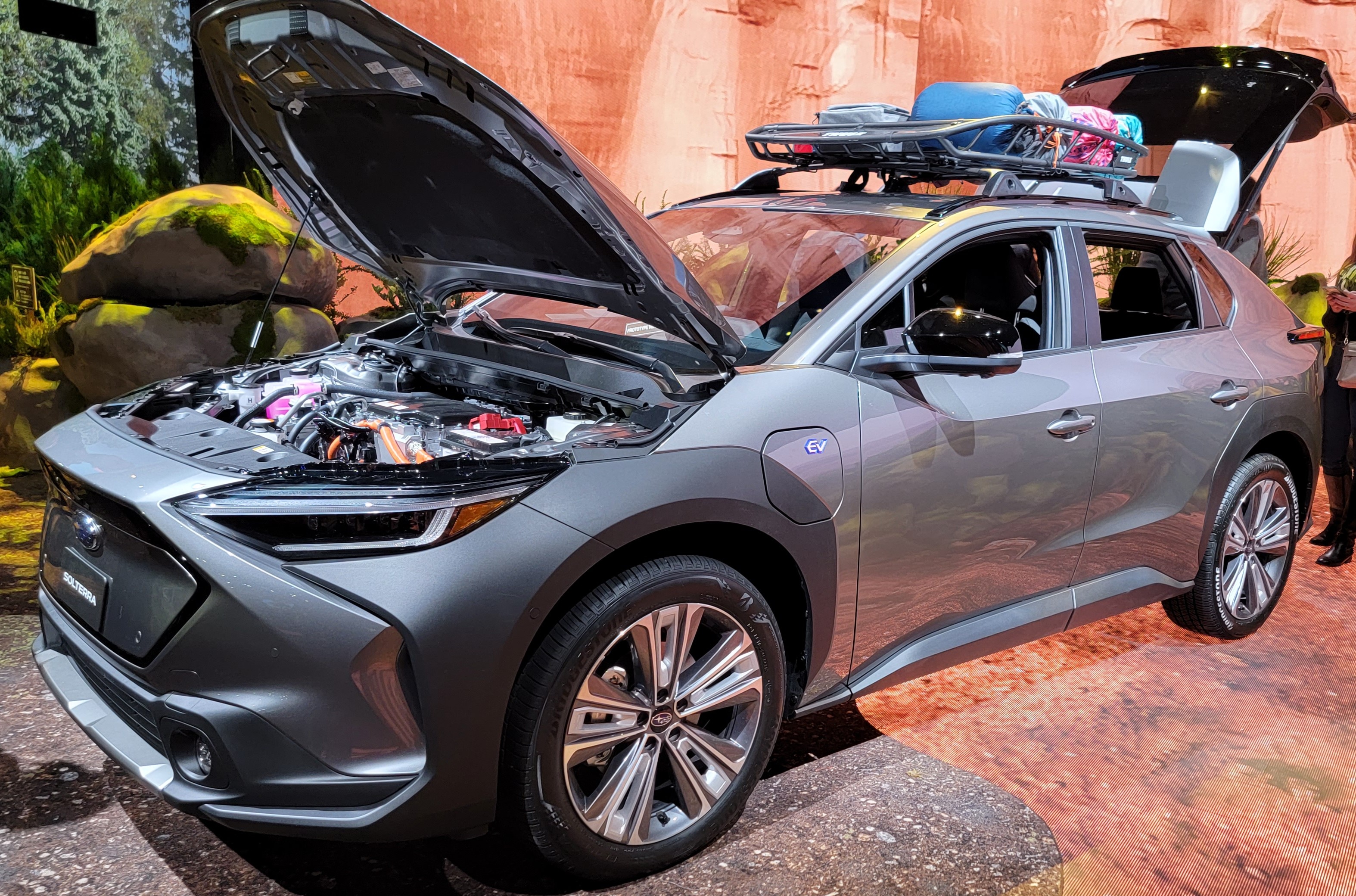
The Subaru Solterra is Subaru’s electric SUV. They’re saying they see it a lot now, but they expect people’s interest to evolve over time.
LIVE
This podcast is brought to you by Cintas, helping keep your automotive business looking
great from showroom to service bay with essentials like durable work wear,
absorbent shop towels, and high performance floor mats. Get ready for the workday at cintas.com slash
automotive. Welcome to this weekend drive edition of Daily Drive for the first week of April
2026. I'm Kellan Walker in New York City. We're breaking down some of the biggest stories in
the auto industry from the past week and looking forward to what's in store in the days ahead.
We'll talk about first quarter sales, the highs and lows, a California court ruling
regarding the scout brand, and a snapshot of the media day at the New York International Auto Show.
Joining me today as usual is Larry Veliquette, who covers Toyota, Mazda, and Subaru for us at
Automotive News. Larry Legend, welcome back sir. Good to be in New York City. Kell, how you doing?
I'm doing all right. And Jack Wallsworth, who covers VW Group, BMW, and Mercedes-Benz for us.
Jack, thanks for joining. Good to be here. All right, guys. So first quarter sales are in for
automakers that report quarterly. The US auto market is starting to lose a little momentum.
First quarter sales dipped for several major automakers at the same time. We're seeing a shift
in what people actually want. Hybrids are gaining traction while EV demand has cooled for a bit after
federal incentives expired. Larry, what's your reaction to Q1? So there are a couple things
going on in the market. Number one, the March comparison was pretty brutal for a lot of automakers
that still report monthly. That's because last March, we had a number of people who were
pulling forward purchases out of fear of tariffs because of and rising prices. So that was kind
of a brutal comparison. We also had fewer selling days this month. We had two fewer selling days
this month than we did a year ago because of how the weekends fall. So it was going to be a brutal
month. On a quarterly basis, most automakers were down. A few that were up or flat. Stilanus was up
slightly. Most were down. Most of the rest of the reports that we've seen so far, we haven't seen
quite the full market yet. And Hyundai Kia was up as well. What we're looking at in the market,
is rising prices. And we're looking at, from executives that I spoke to yesterday,
consumers who are getting squeezed on car ownership, really from every angle. I talked to Dave
Christ at Toyota, who's the head of the Toyota brand. He talked to us about consumers facing
higher car prices, higher gas prices, higher insurance prices, everything that they use every
input that they have in their vehicle. The cost is going up all at once. And not to mention the food
that they're paying for, which is also going up because of the war in Iran. So I think we are
probably on the cusp of something. To me, it does not feel like a sustainable model. The one thing
that Dave did tell me is that what he's seeing from dealers and what dealers are telling him
is that the consumers that are coming in to buy new vehicles are more what he called have to
customers. They have to get another car. It's not a question of they want another car, which is
what largely fuels our economy. But a case of they have to, they have a driver coming on,
they had a wreck, there's some issue with an existing vehicle. And the age of vehicles
is at an all time high, continues to grow. So we're on the cusp of something and people better
be prepared. Now, Jack, how should automakers be thinking about affordability right now? Are we
hitting a ceiling where consumers just can't stretch any further? And does that force a broader
reset in pricing or production strategy? Yeah, I think kind of to go off what Larry was mentioning
with the hefty, I think we're definitely hitting a point where it's tough to be buying a car right
now unless you're super wealthy. Affordability was something we heard about throughout the show.
It's something that I think, like Larry said, we're going to continue to kind of keep focusing
on. And it's interesting, some brands I think are probably better suited than others to handle this.
You look at the Volkswagen, for example, they talked a little bit about this yesterday.
They seem to think they're kind of set up for it because most of their model lineup
starts under like around 41,000. They do have some that started both that. But on the flip side of
that, that's probably on mostly margins that won't be as great. Like the Jetta, for example,
that's not going to be a high margin car. So it's kind of like you could potentially be selling
more of those because customers want to buy something more affordable, but you probably aren't
making as much money. So I think, like Larry said, on being on the cusp of something, something's
got to give, I guess I would say. One quote that stuck out to me from our sales coverage was from
Jessica Colville that Edmunds, pit of insights, that the new car market is being sustained by
more practical needs based purchases rather than splurges. And splurges would probably be better
for automakers. That's better for sales. But I think a lot of people just right now, unless you
had to buy a car, you're probably not going to. So it'd be interesting to see how it keeps going
from here. And obviously something we're going to keep tracking. In February, the average new
vehicle selling price was almost $50,000. And I feel like once we officially get over the $50,000
threshold, you know, maybe that's the point of no return, I guess kind of to be determined. But
you know, it's going to be interesting to see how it plays out because
obviously you would want to have more affordable vehicles for everybody, but
there's only so much automakers can do on that front.
You know, it's funny how what different automakers quantify as affordable, right? Affordable is
also true under $41,000 under $35,000. I don't know what affordable is anymore.
I know there are an awful lot of 72 and even 84 month loans getting offered to try and make monthly
payments more affordable. And we talked about this before, you know, months ago, it's just a long,
that's a long, long time to be paying in a car. And especially when you're not building any equity
in the first place because of the depreciation of the new car lot.
Yes, the word affordability is very subjective.
Yes, it is.
So let's make a quick pivot. Now, a federal judge just handed a key win to the California New Car
Dealers Association in their legal fight against scout motors and Volkswagen Group of America,
allowing the lawsuit over direct to consumer sales to move forward at the center of it is
whether Scout owned by Volkswagen Group can bypass the traditional franchise system in
California. Now, Jack, you've been following this story for some time now. What does this
ruling mean for the future of the Scout brand?
I guess, you know, put simply, I would say TBD, you know, it's easy to think, oh, this is a huge
one for car dealerships to the California Car Dealers Association, which is true. But,
you know, I think Scout probably went into this realizing that there's going to be a lot of,
you know, legal legwork to come. And I wouldn't, until this lawsuit is officially over, it's kind
of hard to really make a verdict, I guess, not to be too punny. But, you know, I'm not sure what
happens next with this, you know, and again, it kind of depends on what the final verdict is,
I guess, but I wouldn't count Scout out just yet. You know, this is a per Volkswagen Group. This is
a really big deal to them. Clearly, they want Scout to be able to do what it wants to do,
which is direct sales. That's the plan for now. And until we kind of hear otherwise,
you kind of have to assume they're still going to pursue it. Obviously, California,
if there was one car market you wanted to be able to sell in, it would be California,
just given the size. And I think Scout's product portfolio would definitely fit there well.
But we're kind of at the mercy of how the core system works. So we'll see. I mean,
there's a few other cases throughout the country that kind of keep close tabs on.
There's some lawsuits in Florida. There's some dealers in Colorado are pursuing the state because
Scout got a license there. So I think not all the dominoes have fallen just yet. So definitely
stay tuned. But it will be, you know, it seems like just about every other week,
there's some new legal update with Scout and Volkswagen. So, you know, I'm sure I'll be
talking with you again about it very soon. But, you know, in the quick reaction, it does seem,
it is notable for the California Car Dealer Association. I mean, this lawsuit can continue.
That's still big for them. And, you know, who knows where it goes from here,
but the fact that it's still alive is not worthy.
So there was also a recent move by lawmakers in Washington state that will allow Rivian to sell
direct to consumers. Now, it was approved after Rivian threatened to put the state's franchise
laws directly before voters. Now, Larry, how is this different than Scout?
Well, there are a couple of things going on here. Number one, it's different because Rivian is not
a component of a legacy automaker, like Scout is. Scout is another factor of Volkswagen group,
as Jack talked about. The difference is they don't, Rivian doesn't have any existing relationships
with franchise dealers, you know, in those states, that it's where it's trying to sell
direct to consumers, the same as Tesla does. With Scout, the real rub, and the reason that it has
Volkswagen dealers so incensed is that the Scout products, the products that Scout wants to
introduce to the market, are products that Volkswagen dealers have literally been asking
for for 30 years, at least, right? They wanted pickup trucks. They've wanted SUVs like this
for 30 years. And they've never gotten a pickup truck until before now. Scout comes along and says,
hey, we're going to build this, but you don't get it. All of you who invested in our company
over the last, how long have they been here, Jack? Almost 60 years, right?
Long time. Long time. Long time. So the difference here is the preexisting relationships with Scout.
This threat by Rivian in Washington state is really interesting, though, if you think about this.
So Washington state was not going to let them do it. The dealers there were,
were not going to let them do it. And then Rivian threatened because Washington state is,
allows citizen initiatives. Rivian threatened to put basically the dealer franchise laws
in front of voters directly. And suddenly dealers back down and said, okay, the legislature approved
that. It's a really interesting question. Now, not every state allows citizen initiatives,
but there are a dozen states that do. And I'd be really curious to ask dealers in the dealer
associations in those dozen states, whether they think their franchise laws could survive
direct interaction with voters. All right, good stuff. Well, coming up,
we'll recap the New York International Auto Show. That's next on Weekend Drive.
Are you a dealer creating a workplace culture your employees are proud to be part of?
Applications are now open for the 2026 automotive news best dealerships to work for program.
This isn't just an award. It's a chance to get real insight into what's working at your dealership
and where you can improve. And we've expanded the categories this year, recognizing everything
from technician experience and leadership development to AI enablement and employee
retention. The registration deadline is April 17. Find out more and apply at autonews.com.
Picked up, washed and returned back to you with no upfront cost required. Get a single source
partner to keep you firing on all cylinders. Visit syntas.com slash automotive to get ready for the
workday. Welcome back to Weekend Drive. I'm Kellan Walker with Larry Bellacuette and Jack
Wallsworth. So at this year's New York International Auto Show, Hyundai Group came in full force.
They debuted the Kia EV3 for the first time in North America.
Hyundai CEO Jose Munoz says the Genesis luxury division will be getting new vehicles
and model variants 22 total by 2030. But the head turner was the unveiling of a new Hyundai
concept, the Boulder. It's Hyundai's first body on frame vehicle. Larry, how competitive is the
body on frame truck space? And what does this mean for the company's North American manufacturing
footprint? Well, if they decide to move forward with a body on frame vehicle, they're going to have
a uphill fight. They're going to have the same uphill fight that Toyota has had that Nissan has
had. They're going into a market that is dominated by the Detroit three in terms of body on especially
body on frame pickups, full size body on frame pickups. Now, there is white space in the body
on frame market in compact pickups. So an affordable compact pickup, the Tacoma, the Colorado, the
Ranger, those are midsize. A compact pickup is something like a Maverick, right? Where it's just
it's a smaller frame if you can. And if there is no right now, there is no compact body on frame
vehicle. Now, that's not going to have as high a margin as what a full size is. But it depends on
where they go, where they come in with this vehicle. Now, what we saw with the Boulder and you and I
talked about this a little yesterday as we as we sat there, Cal, what we saw with the Boulder was a
statue that did move. They lifted a curtain around it. It had a differential in the back and
nothing in the front that indicated how the front wheels were going to move, right?
The suspension was for show only it wasn't did not look very real. This this looked like a
it was really pretty. Don't get me wrong. It was a it was a very pretty thing. It was probably 30%
too big. It depends on what they're, you know, what they're going to do with it. That's my take on
it. It's going to be it's going to be an uphill fight where the Detroit theater not going to give
up easily. Jack, what's your take on the Boulder? Yeah, so I haven't gone back and forth on this.
I kind of have mixed feelings. I on one hand, I give Hyundai a lot of credit for still bringing
out a concept car. They've done that now two shows in a row. Cal and I were in LA got to see
the crater. So crater Boulder, maybe next to this mountain, maybe that's what they'll call the pickup.
So that part is cool. At the same time, I think a lot of us thought, oh, that looks really familiar.
Where have we seen this before? On the Google machine, you know, the thing the easiest comparison
is the 2004 Ford Bronco concept, which was also silver. And I guess that's kind of a
quick comparison. I'm sure some other people thought maybe Hummer from the early 2000s,
things like that, just given like the stance of the Boulder, those tires were, I don't know if
I've ever seen bigger tires before. I mean, 37 inch tires, I believe. Yeah, there are some big boys.
Hey, the grill looks a little GP with the slants. So I guess the thing I struggle with is
it's cool. They brought a body on frame SUV concept. I just would have liked something a little bit
more unique or more Hyundai. I realize it's 2026. There's only so many ways you can design
a body on frame SUV. That's not Hyundai's fault that there's been several decades of Broncos and
Jeeps and all that good stuff, even Scouts. And Hyundai doesn't have that heritage in that space
to really lean off of, you know, there wasn't a Boulder 30 years ago to kind of resurrect. I kind
of would have liked to have seen something a little bit more uniquely Hyundai, which I'm not
sure what I necessarily would have looked like. I just don't think that what we saw is what I
envisioned. I also thought of like the Santa Cruz concept when I was first shown at the Detroit
show is kind of like this sleek pickup. And then what we got was a little kind of funky. You know,
I've met a couple of people that drive Santa Cruises and they love them. But when you see them
on the road, it's not like the greatest looking thing. I think like the way Ford did with the
Maverick looked a little bit more put together. So I am curious, like if Hyundai does go through
with the Boulder, what segment it is, you know, how big it is, things like that, because if it
comes down the road three, four years and it's like a smaller thing, that might work. But then
how will the proportions be, you know, things like that. So I guess long story short, I give credit
for Hyundai for bringing out a concept that's cool. The fact that they kind of kept the very
under wraps until they revealed the curtain is also kind of neat. That's kind of like
auto show of yesteryear type thing. But I'm just like, Oh man, it's just like another big
boxy SUV that looks kind of like a barco. Do you guys think we're a little jaded though when it
comes to reveals at this point? Because yeah, okay, I was going to say like, we've been let down a lot.
Okay. I remember, was it was it two years ago, Larry? Was it two years ago, the unveiling of the
Ram EV that never came to market? And it was just full of bells and whistles, had all these things
and had the inductive charging, you know, the Roomba that comes out and it goes and charges,
all this stuff. I like the Boulder. I thought it was cool. It's a concept. So like, I don't get my
hopes up too much because it's concept. It's when people spitball a bunch of things and say,
All right, let's just put it into one thing, show it and then show people like, Hey, this is the
these are the future possibilities, right? So yeah, I've learned now being in this industry,
not to get my hopes up. So what's interesting in the point that Jack made, we got to talk about why
automakers don't do as many concepts as they used to, right? They now have better feedback
mechanisms with the internet than what they used to. You mean concept cars used to used to be,
they used to do a concept car every show and almost every automaker did one,
because they needed to get direct feedback from consumers on what you know, on how what they thought
about these designs, where they were going, etc. They don't need feedback that that kind of feedback
anymore. They get it every single hour of every single day from their customers and from, you
know, the bots that are shopping and the feedback that they get that they can tell off the internet
now and from focus groups, they just don't need to go through the expense of a concept car. Now,
concept cars are still cool and certainly auto journalists love them and they have a place,
but they are they are expensive toys that like in the case of this Hyundai one, don't don't move
very well. And you know what, Kelly, you brought up, you asked about, you asked about, you talked
about the manufacturing footprint and we didn't address that. I mean, I just want to go back.
Right now, Hyundai does not have a body on frame plant in North America. They don't have the ability
to make a body on frame vehicle in North America. So committing to a body on frame
vehicle, which is built, you know, with a rolling chassis, and then you drop the body onto it.
So you build the engine of the frame, then you drop the body onto it, as opposed to a unibody,
which gets kind of built up and wrapped around it. Anyway, they don't have the built the ability
right now, you can't build them on the same line as a unibody. The methods are different.
So you have to do them differently. You need a separate line
to make body on frame vehicles. So no matter what, if they commit to making body on frame
vehicles, that's going to mean an expansion of some kind or a redirection of some kind,
one of their existing plants. Interesting. And also Subaru introduced its first three row EV,
the getaway. It's the sister vehicle to the Toyota Highlander EV. Now, Larry, you cover those two
brands. What were your initial thoughts? So the Subaru getaway is a three row EV that's coming
later this year. It'll have over 300 miles of range. And interestingly, it will have more
power than the Highlander. And the reason it will, it's standard, right? It'll be over 400 horsepower
available at peak. The reason is, is that Subaru took on the Toyota, there's a powerful front motor
and a less powerful rear motor that drives the rear axles. Subaru took the powerful
motor from the front and put it on the back as well, because they realized that under normal
driving circumstances, which you have to read as the EPA driving cycle, which is how your fuel
economy gets tested, right? How they how they certify the vehicle under normal driving driving
circumstances, they could add that extra power for no additional cost performance cost. Now,
if you're using all that power, you know, you're, you're doing fast starts or you're climbing hills
with this vehicle. Yeah, your battery is going to drain quicker. But under normal circumstances,
it's not. So they made the decision to go with the more powerful setup, which to me is fascinating
that they that they wanted to differentiate themselves from the Highlander. Because if you
look at the other two vehicles, the trail seeker and the busy woodland and the Subaru Uncharted
and the Toyota CHR, which are twin vehicles like this as well. There really is no difference
between them. There's a lot of a whole lot of difference between them, other than a little
exterior style. The, you know, the cockpicks are identical. So this is a really interesting choice.
And I'm curious to see how this is going to play out in the in the market.
What were your thoughts on it, Jack? Did you like it? Confused? Wasn't sure? Loved it?
Yeah, I was, I guess kind of indifferent. The ones they had on the show floor, one was white,
and one was kind of like this darker, almost purplish color. It was kind of hard to tell with
the lighting. And, you know, I still think of Suburbs, I think of all the body cladding,
things like that. And these ones were more the paint was kind of like or where the cladding
was was painted. So I just, you know, it's okay. The front end is interesting because there's no
grill, obviously. So it's like a very large piece of, you know, material with just the Subaru logo.
So it is interesting that, you know, for so long, Subaru didn't have large crossovers, you know,
they had tried with the Tribeca that didn't connect. They finally brought the Sun out that's
been around for a very long time. And now they have basically two large crossovers. So that part
is interesting. And, you know, living in Seattle, Suburbs are everywhere. And even the Solterra,
I see quite often, but eventually people are going to grow out of that Solterra. So for the
EV Subaru customer, you know, this makes a ton of sense. And I would imagine, you know, in certain
markets, this will do very well. And it does seem lazy, but I don't like the name. Get away. I just
get away. Maybe like the Subaru Pacific, you know, there's like so many
more Subaru names out there. And I just, I gave them credit last night for not going with the
lowlander. That is low hanging fruit, man. Larry Jack is a pleasure. Thank you so much for joining
me. Thanks for having you. Good seeing you all in person. Yeah, it was wonderful hanging out with
you guys this week. That's all for this weekend drive edition of daily drive. I'm Kellen Walker.
You can get the latest news on first quarter sales results. The New York international auto
show and everything happening in the auto industry at auto news.com. We'd love to hear from you. Let
us know what you think of the show and the topics we covered today. Send us an email at daily drive
at auto news.com or leave us a voicemail at 313-444-2774. And if you enjoyed the podcast,
remember to like, leave a review and subscribe so you never miss an episode.
About this episode
Q1 sales came in weaker across much of the US market, with automakers pointing to brutal year-over-year comparisons, fewer selling days, and—more importantly—affordability pressure. Hybrids are gaining while EV demand cools after incentives expired. The hosts debate whether pricing and production strategies need a reset as consumers increasingly buy only when they “have to.” They then cover legal battles over direct-to-consumer sales: a California ruling keeping Scout’s fight alive, and a Washington state change that lets Rivian sell direct after a voter-threat tactic. The New York Auto Show recap highlights Hyundai’s Boulder body-on-frame concept and Subaru’s three-row EV “Getaway,” plus what these moves mean for manufacturing and market positioning.
Automotive News’ staff reporters Larry Vellequette and Jack Walsworth discuss first-quarter sales results. A California ruling that could determine the future of the Scout brand. Plus, a recap of the New York International Auto Show.