
April 4, 2026 | Weekend Drive: Q1 sales dipped for several major automakers; New York International Auto Show recap
About this episode
Q1 sales came in weaker across much of the US market, with automakers pointing to brutal year-over-year comparisons, fewer selling days, and—more importantly—affordability pressure. Hybrids are gaining while EV demand cools after incentives expired. The hosts debate whether pricing and production strategies need a reset as consumers increasingly buy only when they “have to.” They then cover legal battles over direct-to-consumer sales: a California ruling keeping Scout’s fight alive, and a Washington state change that lets Rivian sell direct after a voter-threat tactic. The New York Auto Show recap highlights Hyundai’s Boulder body-on-frame concept and Subaru’s three-row EV “Getaway,” plus what these moves mean for manufacturing and market positioning.
Automotive News’ staff reporters Larry Vellequette and Jack Walsworth discuss first-quarter sales results. A California ruling that could determine the future of the Scout brand. Plus, a recap of the New York International Auto Show.
first quarter sales
"All right, guys. So first quarter sales are in for automakers that report quarterly. The US auto market is starting to lose a little momentum."
“First quarter sales” just means how many cars were sold by automakers in the first three months of the year. Analysts use it to see whether the market is getting stronger or weaker.
“First quarter sales” refers to how many vehicles automakers delivered during Q1 (January through March). It’s a key industry metric because it shows demand trends and how well brands are selling relative to expectations.
EV demand has cooled
"Hybrids are gaining traction while EV demand has cooled for a bit after federal incentives expired."
“EV demand has cooled” means buyers are purchasing fewer electric vehicles than earlier in the year. This can happen when incentives change, pricing rises, or consumer interest shifts.
pulling forward purchases
"That's because last March, we had a number of people who were pulling forward purchases out of fear of tariffs because of and rising prices."
“Pulling forward purchases” means people buy sooner than they intended. Usually it’s to avoid higher prices or changes that might come later.
“Pulling forward purchases” is when shoppers buy earlier than they planned—often to avoid future price increases or policy changes. In auto sales, this can make one month look unusually strong and the following month look weak.
fewer selling days
"We also had fewer selling days this month. We had two fewer selling days this month than we did a year ago because of how the weekends fall."
“Selling days” refers to how many days dealerships are open and able to sell vehicles during a period. Fewer selling days—like when weekends fall differently—can reduce sales totals even if demand is unchanged.
quarterly basis
"On a quarterly basis, most automakers were down. A few that were up or flat."
“Quarterly basis” means looking at sales over three months instead of just one month. It helps reduce the impact of unusual timing.
“Quarterly basis” means comparing results over a full quarter rather than a single month. This helps smooth out one-off effects like calendar differences, incentives, and short-term buying surges.
Hyundai Kia
"And Hyundai Kia was up as well. What we're looking at in the market, is rising prices."
Hyundai Kia refers to the Hyundai and Kia brands. The hosts are saying they were doing better than many competitors in the early sales numbers.
Hyundai Kia is mentioned as being up as the market data comes in. This matters because it highlights that not all automakers are experiencing the same demand slowdown during Q1.
rising prices
"What we're looking at in the market, is rising prices. And we're looking at, from executives that I spoke to yesterday,"
“Rising prices” means cars are getting more expensive. When that happens, fewer people can afford to buy right away, so sales can slow down.
“Rising prices” refers to higher vehicle pricing (often due to costs, tariffs, and mix). Higher prices can reduce affordability and slow sales, especially when incentives end or buyers become more price-sensitive.
Toyota
"I talked to Dave Christ at Toyota, who's the head of the Toyota brand. He talked to us about consumers facing higher car prices, higher gas prices, higher insurance prices..."
Toyota is one of the biggest automakers, and here the show is quoting its brand leadership. The point is how Toyota views the affordability pressure on car buyers.
The speaker interviews Dave Christ, identified as the head of the Toyota brand. Toyota is using its brand leadership perspective to discuss how consumer affordability is being squeezed by rising costs.
higher input costs (gas, insurance, prices)
"...consumers facing higher car prices, higher gas prices, higher insurance prices, everything that they use every input that they have in their vehicle."
They’re saying the overall cost of owning a car is going up in several ways at once—buying the car costs more, and everyday costs like fuel and insurance are also higher.
The speaker lists rising “inputs” that affect total cost of ownership: higher car prices, higher gas prices, and higher insurance prices. The concept is that multiple cost categories are increasing at the same time, tightening budgets.
dealer-driven demand ("have to" buy)
"...what dealers are telling him is that the consumers that are coming in to buy new vehicles are more... have to customers. They have to get another car... they had a wreck..."
Dealers are saying people aren’t shopping just because they want a new car. They’re coming in because they need a replacement, like after an accident or because their current car has problems.
The speaker reports dealers are seeing buyers come in out of necessity rather than desire—e.g., replacing a wrecked vehicle or covering a life change. This “have to” demand differs from discretionary buying that typically supports broader sales growth.
car affordability
"Now, Jack, how should automakers be thinking about affordability right now? Are we hitting a ceiling where consumers just can't stretch any further?"
They’re talking about whether regular people can still afford to buy a new car. If costs keep rising, fewer people can qualify, and companies may have to adjust prices or how many cars they build.
The segment frames affordability as the key constraint on new-vehicle demand. It connects higher prices and operating costs to whether consumers can “stretch” financially, and whether that could force changes in pricing or production strategy.

Volkswagen Jetta
"...on the flip side of that... Like the Jetta, for example, that's not going to be a high margin car."
They bring up the Volkswagen Jetta as an example of a cheaper car. Cheaper cars can sell more when budgets tighten, but the company may make less money on each one.
The Volkswagen Jetta is used as an example of a lower-priced model that likely won’t carry high profit margins. The speaker’s point is that affordability-driven demand can increase volume, but not necessarily profitability.
Scout
"ruling mean for the future of the Scout brand? ... I wouldn't count Scout out just yet... it kind of depends on what the final verdict is..."
Scout is a car brand. Here, the big question is whether it can sell cars the way it wants, even though it’s dealing with legal challenges.
Scout is an automotive brand that has been tied to legal and regulatory fights over how it can sell vehicles. In this segment, the discussion centers on whether Scout can continue its planned sales approach despite lawsuits.
Rivian
"...a recent move by lawmakers in Washington state that will allow Rivian to sell direct to consumers..."
Rivian is an electric-vehicle company. Here it’s used as an example of how it can get permission to sell cars directly to customers.
Rivian is an EV maker mentioned here as an example of how lawmakers can change rules to allow direct-to-consumer sales. The segment links Rivian’s situation to franchise-law pressure and legislative outcomes.
Tesla
"...Rivian doesn't have any existing relationships with franchise dealers... that it's where it's trying to sell direct to consumers, the same as Tesla does."
Tesla is an EV maker that sells cars directly to customers. The point here is that this direct-sales model can create legal and political friction with traditional car dealers.
Tesla is cited as the example of a manufacturer that sells directly to consumers. The comparison highlights how direct sales can bypass or challenge traditional franchise dealer laws.
Washington state
"This threat by Rivian in Washington state is really interesting... Washington state was not going to let them do it. The dealers there were, were not going to let them do it."
Washington state is highlighted as the specific jurisdiction where direct-to-consumer plans faced resistance from regulators and dealers. The discussion ties the state’s citizen-initiative process to how Rivian could pressure the dealer franchise framework.
citizen initiatives
"...Washington state is, allows citizen initiatives. Rivian threatened to put basically the dealer franchise laws in front of voters directly... Now, not every state allows citizen initiatives, but there are a dozen states that do."
Citizen initiatives let regular voters propose changes to laws through the ballot. The segment is saying that in some states, dealers may have to defend their rules directly to voters.
Citizen initiatives are ballot measures that allow voters to propose or change laws directly, without the proposal originating in the legislature. The segment notes that only some states allow them, which affects how dealer franchise rules can be challenged.

Kia EV3
"...i Group came in full force. They debuted the Kia EV3 for the first time in North America. Hyundai CEO..."
The Kia EV3 is an electric car made by Kia. Instead of using gasoline, it runs on electricity. The podcast mentions it because Kia introduced it in North America as a new EV option.
The Kia EV3 is an electric vehicle that Kia debuted in North America as part of its expanding EV lineup. It’s discussed because new EV models are a major part of the current market shift toward electrification. In the podcast, it’s mentioned alongside leadership comments, tying the vehicle to broader brand plans.

Hyundai Genesis
"...n North America. Hyundai CEO Jose Munoz says the Genesis luxury division will be getting new vehicles and..."
Genesis is Hyundai’s luxury car brand. It makes more upscale cars than Hyundai’s regular lineup, with more comfort and premium features. The podcast is talking about Genesis because Hyundai says it will bring new vehicles to North America.
Genesis is Hyundai’s luxury vehicle division, and the podcast is discussing its plans for new vehicles in North America. Genesis is significant because it focuses on higher-end trims and features compared with mainstream Hyundai models. It’s being mentioned because the CEO’s comments signal upcoming product expansion for the luxury brand.
body on frame
"“the Boulder. It's Hyundai's first body on frame vehicle. Larry, how competitive is the body on frame truck space?”"
Body-on-frame means the car’s body sits on a separate metal frame underneath. Trucks use it because it can be tougher for towing and off-road driving, but it can be heavier than other designs.
“Body on frame” is a truck construction method where the body is mounted on a separate ladder-like frame. It’s common for pickups and SUVs because it can handle towing and rough-road use well, but it usually adds weight compared with unibody designs.
Detroit three
"“They're going into a market that is dominated by the Detroit three in terms of body on especially body on frame pickups, full size body on frame pickups.”"
“The Detroit three” is a nickname for the big traditional American automakers: Ford, GM, and Stellantis. Here, they’re being called out as the leaders in full-size pickup trucks.
“The Detroit three” refers to the traditional U.S. automakers—Ford, General Motors, and Stellantis (Chrysler). In this context, they’re described as dominating the body-on-frame pickup segment, especially full-size trucks.

Chevrolet Colorado
"“...the Tacoma, the Colorado, the Ranger, those are midsize.”"
The Chevrolet Colorado is brought up as an example of a midsize pickup. The conversation is basically about which size categories are already served and which might be missing.
The Chevrolet Colorado is mentioned as a midsize pickup example in the discussion of compact vs midsize body-on-frame trucks. It’s part of the speaker’s argument about where the market currently has coverage and where it may not.

2004 Ford Bronco concept
"On the Google machine... the easiest comparison is the 2004 Ford Bronco concept, which was also silver."
They compare the Hyundai concept to a 2004 Ford Bronco concept. The point is that the Boulder looks familiar—like it’s echoing design ideas from that older Bronco concept.
The 2004 Ford Bronco concept is used as a visual reference point for the Hyundai “Boulder” concept’s look. Concept cars often borrow familiar design cues, and the comparison suggests the Boulder’s styling reminds people of earlier Bronco concept-era proportions and color.
37 inch tires
"those tires were, I don't know if I've ever seen bigger tires before. I mean, 37 inch tires, I believe. Yeah, there are some big boys."
“37 inch tires” indicates very large tire diameter, which strongly affects a vehicle’s stance, wheel well packaging, and perceived off-road capability. The hosts are using the tire size to explain why the Boulder looks especially aggressive and why it feels reminiscent of classic rugged concepts.

Ford Maverick
"on the road, it's not like the greatest looking thing. I think like the way Ford did with the Maverick looked a little bit more put together."
The Ford Maverick is a small pickup truck. The speaker is basically saying it looks more cohesive than some other new vehicles they’ve seen.
The Ford Maverick is a compact pickup truck that became known for its modern design and practical size. In this segment, it’s used as a comparison for how “put together” a new vehicle looks on the road.
auto show reveals
"The fact that they kind of kept the very under wraps until they revealed the curtain is also kind of neat... Do you guys think we're a little jaded though when it comes to reveals at this point?"
An auto show reveal is when a company unveils a new car to the public. The speaker is saying people might be skeptical now because not everything shown actually becomes a real car.
Auto show reveals are major marketing moments where automakers unveil new vehicles or concepts to generate buzz. The speaker suggests that audiences may be “jaded” because many past concepts or announcements didn’t reach production.
inductive charging
"And it was just full of bells and whistles, had all these things and had the inductive charging, you know, the Roomba that comes out and it goes and charges."
Inductive charging means charging an EV without plugging it in. You typically park over a charging pad, and the car charges wirelessly.
Inductive charging is a wireless method of charging an electric vehicle using electromagnetic fields between a pad (or infrastructure) and the vehicle. It’s often highlighted in EV concepts because it can reduce plug-in hassle, though it requires compatible charging setups.
concept car
"Concept cars are still cool and certainly auto journalists love them and they have a place, but they are they are expensive toys..."
A concept car is like a “show car.” Automakers build it to preview ideas, but it usually isn’t ready to be sold to customers right away.
A concept car is a prototype built to show off new styling, technology, or future design directions. It often isn’t meant for immediate production, so it can be expensive and may not reflect what will actually be sold soon.
manufacturing footprint
"...you talked about the manufacturing footprint and we didn't address that... Hyundai does not have a body on frame plant in North America."
Manufacturing footprint is basically the automaker’s production map—where their factories are and what they can build there.
Manufacturing footprint refers to where and how an automaker produces vehicles—its plants, capacity, and production capabilities. The discussion ties footprint to whether Hyundai can build body-on-frame vehicles in North America.
battery is going to drain quicker
"...if you're using all that power, you know, you're, you're doing fast starts or you're climbing hills with this vehicle. Yeah, your battery is going to drain quicker."
If you drive harder—accelerate quickly or go uphill—you use more energy. That makes the battery run down faster, so you get less driving range.
This refers to how using more power—like fast starts or climbing hills—draws more current from the battery, reducing range. EV range is strongly affected by driving style and load, not just the vehicle’s rated efficiency.
body cladding
"...I still think of Suburbs, I think of all the body cladding, things like that. And these ones were more the paint was kind of like or where the cladding was was painted."
Body cladding is the protective or decorative plastic/trim panels on a vehicle’s exterior, often around wheel arches and lower body sections. The speaker contrasts how the cladding is finished/painted on these show-floor examples, affecting the overall look.
no grill
"...The front end is interesting because there's no grill, obviously. So it's like a very large piece of, you know, material with just the Subaru logo."
Most cars have a front grille. This one doesn’t, and instead uses a smooth front panel with the logo, which is common on some EVs.
A “grill” is the front opening/mesh area on many cars that houses cooling components and provides a traditional styling cue. The speaker notes this vehicle has no conventional grille, using a large front panel with just the Subaru logo instead—an increasingly common EV design language.
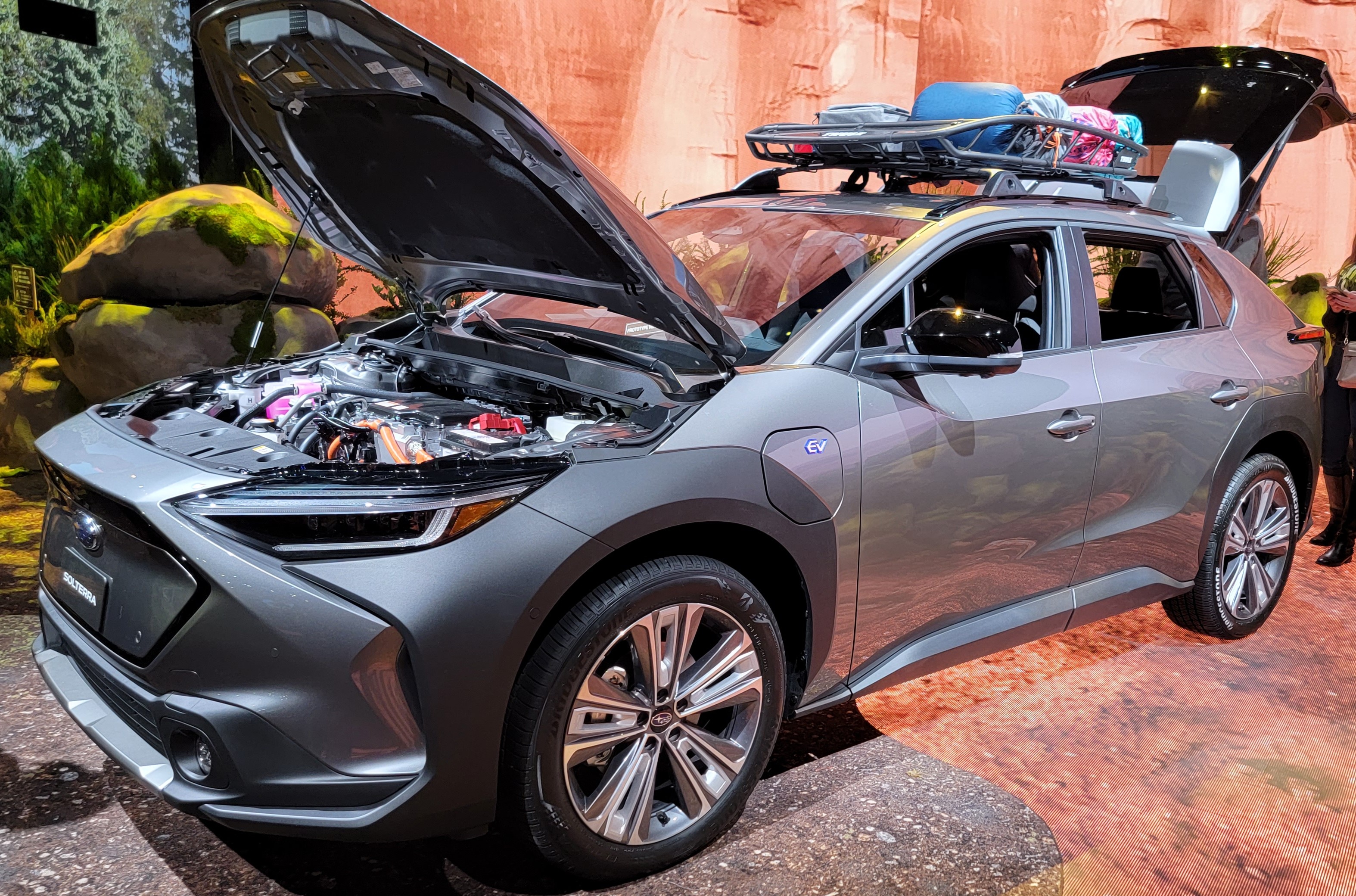
Subaru Solterra
"...living in Seattle, Suburbs are everywhere. And even the Solterra, I see quite often, but eventually people are going to grow out of that Solterra."
The Subaru Solterra is Subaru’s electric SUV. They’re saying they see it a lot now, but they expect people’s interest to evolve over time.
The Subaru Solterra is Subaru’s battery-electric crossover SUV. The hosts mention seeing it frequently in Seattle and connect it to Subaru’s growing EV lineup and customer base.
Request an Explanation
Heard something you'd like explained? We'll add it to this episode.
Sign in to request explanations for terms you heard.
Want to learn more?
Browse our glossary for plain-English explanations of automotive terms, jargon, and concepts.
Help improve this episode
See something that's not quite right? Our annotations are AI-generated and can sometimes miss the mark. Click the flag icon on any annotation to suggest a correction.