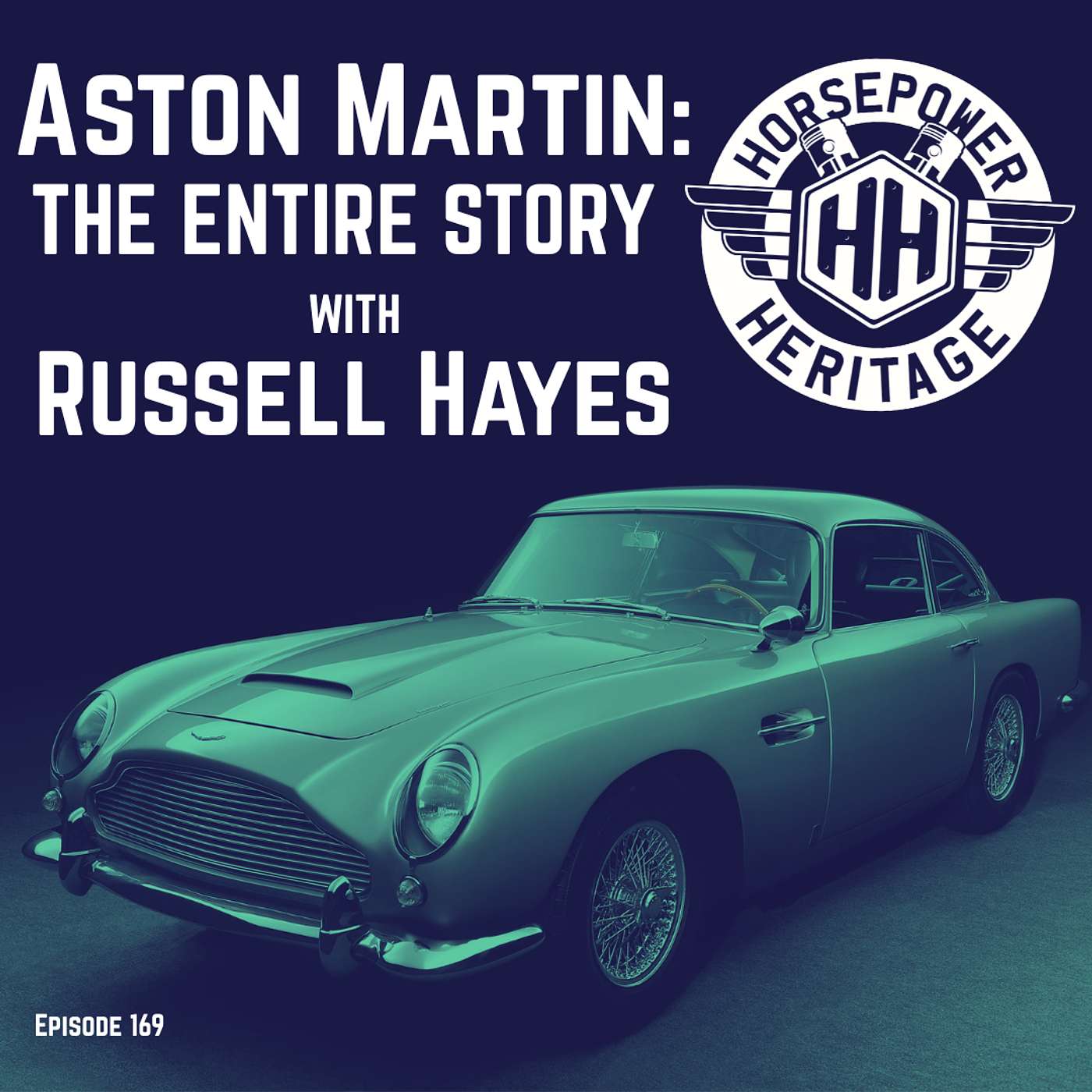
Thanks for joining me once again, and this time we're talking about a name synonymous with
sports cars, Aston Martin.
But we're going to go far beyond the obvious James Bond connection, which is probably the
first thing you think of.
My guest is author Russell Hayes, discussing his new book, Aston Martin, the entire story.
It's a treasure trove of history and personalities and racing and period photographs, and it's
actually a two-volume set.
It weighs 8.4 pounds, and it's terrific stuff.
And in fact, in keeping with the book, I'm going to break this up into two episodes
because we covered so much ground.
So whether you're an Aston Martin neophyte or a longtime fan, I think you'll learn a lot.
And now, here's my conversation with Russell Hayes.
Enjoy.
You know, Russell, I didn't know a whole lot about Aston Martin before I read your
book.
I knew bits and bobs, but the book is so comprehensive.
I think for those of us who have an automotive library, this would be the one book that you'd
want on Aston Martin because it is so comprehensive.
So it was a great read.
Thank you.
Thank you.
I appreciate that.
That's what I wanted.
I wanted something that would be a reference.
The one thing that I come away with having read the book is how tenuous Aston Martin's
very existence has been since day one, and it continues to this day.
I know it's extraordinary.
Its perpetual state of being is to be permanently on the edge.
I guess the most stable period in retrospect was the 20 years that Ford owned it.
That was the only time it's had true stability.
Absolutely.
And you know, that Ford infusion of cash and resources and all of that, you know,
as you say in the book, you know, Aston Martin finally made it to the big time.
Yeah.
It was one of the things which it had never experienced before, investment which it had
never experienced before, and Ford just opened all its facilities to it.
Russell, before we get into the story, I'm interested to hear about how this book project
began and kind of a little bit about your background as an automotive writer.
Okay.
Well, I've had a bit of a broken up career, but cars have run all the way through
my life since I was about five.
I started as a motoring journalist on English magazines in 1989 and eventually worked my way
into the original Top Gear program as a researcher at the end of the 1990s just by writing a letter
to the producer.
So I stayed with them for a few years, then I freelanced, then that wasn't going so
well and I decided to try my luck at something else.
So I became a press officer in several government departments.
I didn't think that would last very long, but it lasted 16 years.
But in the meantime, somebody had asked me to write car history books.
So I wrote my first history book in 2005 on Lotus and one book came after another and
I think I'm up to about 12 published now.
That's fantastic.
Does it just flow to you?
I mean, that's quite an output.
I'm lucky in as much as largely they have been commissioned.
People, publishers have come to me and said, we'd like a book on this subject.
But several have been my own idea.
In about 2012, I noticed that the 40th anniversary of the Volkswagen Golf was coming up in 2014.
So I suggested that as a book to the Haynes Publishing Company.
And to my surprise, nobody else had thought of the same idea.
So that came off really well and that's still being printed in the second edition and that
was translated into German.
So sometimes my own ideas come up trumps.
Wonderful.
So let's talk about this book, Aston Martin, The Entire Story.
Was this a commissioned project as well or was it something that you perhaps had
a passion for for a long time that was kind of simmering?
Well, I had a background in Aston Martin and as much as I did a book on the V8
series from 1969 to 2000, a few years ago, that was that came out in 2019.
And that was a very rarefied book.
It was very high end limited edition books.
So not many people saw it.
Then I started writing for various Aston Martin magazines.
So I'd had a by about 2020, I had a good grounding in Aston Martin.
And I rang up the Everow Publishing Company, the guy knew there just by chance
in 2020 and said, have you got any work?
And this was the start of the pandemic.
And by chance, he said, yeah, actually, we would quite like a history of Aston
Martin. So it went from there.
Terrific.
And it is an ambitious title, The Entire Story.
Yeah, it wasn't originally going to be called The Entire Story, but
they let me expand it and the word limit kept getting broken and the
deadline kept getting broken.
And I would stress I'm not always like that with my deadlines.
But it just got bigger and bigger.
There was so much more material came up.
And I decided that I had to include all the racing and there just hadn't
been a book of that scope for a very long time, which tried to cover everything.
So in the end, my publisher said, you know, we can make this two volumes
instead of one and we can call it The Entire Story, which is a real honor, really.
So the story begins in 1913 with Lionel Martin.
And there is no Aston as a person, by the way.
This is a common misconception, right?
Yes, yes.
Originally, the original company informed in 1913 was called Banford and Martin.
After Robert Banford, the the friend he went into, engineer
friend he went into the car business with.
And they started as a dealership selling singers.
But they soon developed tuning kits for them.
And Lionel Martin was fanatical about racing.
Robert Banford was the quieter engineer type.
But Lionel Martin just wanted to go racing all the time
rather than get a car into production.
So he decided on a name.
And it's also said that his wife, Kate Martin, had a hand in this
where there was a hill climb that he competed in in his singer
near the village of Aston Clinton, and it was called Aston Hill.
So he combined his name with Aston Hill to form Aston Martin.
Yeah, and I think it's evocative, of course, because, you know,
it's got it says racing.
If you were around in that time, that probably reference
would have been recognizable if you're into auto racing.
Yes, it would, because hill climbs were the very big things.
They weren't any at that time.
They weren't any motor racing circuits.
Brooklands didn't come along till the 1920s.
So the hill climb was the biggest thing in motorsport.
Yeah, for sure.
Now, I say they're founded in 1913,
but really they don't produce a car for sale for quite a while.
They don't really get going until after the First World War.
So we're not seeing cars produced in anything,
not even singing and not even double figures until the very
early 1920s because Lionel Martin would keep refining.
They would build another racing car.
They would put another body on it.
They would put a new engine into it.
They would experiment and all the while he was getting bailed
out by wealthy benefactors.
He had money himself, but he still managed to run at big debts.
So there was a continual process of development
and he managed to keep the motor in press on board by giving
them rides and prototypes and they were always very encouraging.
But yes, it took a very long time for something
which we would call production to start.
Right. And of course, the war stalled everything for everyone
in terms of the motor trade.
And in fact, during this period right before the war
and then afterwards, so many automakers were,
they had come and gone.
And a lot of them actually never produced a car
in any great number.
So this wasn't unusual.
No, there was this great, there was a great purve
of attrition of car makers because people wanted
to build a car, but they didn't have a business plan.
You often got, you know, the passionate enthusiasts
and the passionate engineer not combined
with any business sense.
So there was always going to be a process of evolution.
And luckily Lionel Martin's family
were extremely wealthy in their own right.
They had had China clay mines in Cornwall
and there was a great demand for clay during the war
and after the war.
And also he hit a demand from on the whole wealthy young
men who'd survived the war and they just wanted to have fun.
So a relative expense of sports car
could easily find its place in the market.
Yeah, it's a similar story to Bentley, for example.
Exactly, yeah.
And the whole idea of men in sheds,
this is where it comes from.
Like this is a very British concept
in terms of the automotive world.
You know, men in sheds tinkering,
building something, going racing, maybe we'll sell it.
You know, maybe we can get some investors here and there.
It's fascinating.
Exactly, it's this sort of process of development
by trial and error, literally trial and error.
You know, let's build this, oh, that's blown up.
Let's build something else and just keep going
all the time, usually hemorrhaging money.
And that's carried right through
to people like Colin Chapman and Lotus.
Definitely.
All right, so when does it really get going as a business?
When do they finally get a car to market?
Early 1920s, about 1921.
Then you can say they're actually starting to make cars
which are in a sort of series, very small series.
Although the first car, which is Aston Martin,
which is actually sold to a private individual,
was in 1923 and that was a second hand car,
one of the old racers.
So by the time they get to 22, 23,
they are starting to produce cars.
And the motoring press likes the Aston Martin product.
Yeah, they appreciated it as something of quality
which had quality components,
quite exotic components for the time.
And even quite fundamental things,
such as brakes on the front wheels
were extremely unusual in those days.
And in the early 1920s, in 1923,
there was a magazine called the Light Car and Cycle Car
actually did a test,
accepted a test that Lionel Martin had done
where he braked from 50 miles an hour
and stopped in 27 paces.
And that was considered absolutely remarkable for the time.
So, you know, you couldn't guarantee
that cars would stop at all at that point.
So four wheel brakes were a big thing.
Yeah, absolutely.
That was kind of an engineering challenge
to figure out how to make the steered wheels
break evenly and not grab to one side or the other.
Yeah, I believe they use a French mechanism
called the Perot mechanism, I think,
which linked the brakes together.
The French were very innovative.
A lot of stuff trickled into the entire industry from France.
You know, the Dillon axle,
which figures into Aston Martin history much later,
things like that.
Hey guys, I want to take a quick break to say
if you enjoy horsepower heritage,
there are a few ways you can support the show.
Go to buymeacoffee.com forward slash HP heritage
and become a patron.
There's a link in the show notes.
You can make a one time donation
or you can support the show monthly.
It's easy and for the price of a latte,
you can help me continue to bring you more
of the people and stories behind the machines.
You can also leave five stars and a review
on Apple podcasts or Spotify
because that helps new listeners discover the show.
Thanks for your support and now back to the show.
I think we should talk about the Bertelli brothers.
These guys were Italian extraction,
but I think they were reared in whales, if I'm remembering.
Yeah, they were, I'm quite fond of the Bertelli's
because they're so unusual amongst Aston Martin's owners
because Aston Martin's owners on the whole
come from the upper classes or they come from money.
And these guys didn't come from money at all really.
Augustus Bertelli, who was known as Bert,
was, as you say, the son of Italian immigrants
who had moved to Cardiff in Wales
when he was a child, along with his brother Enrico, Harry.
And the pair of them set themselves up
in a local garage, working for a local garage.
And Bert Bertelli was actually recruited back to Italy
to work as a racer mechanic for Fiat.
So he had a fantastic use,
and he wanted to come back to Cardiff
because the Italians wouldn't place football on a Sunday.
And he loved football.
So that's why apparently he came back.
But he was, I found an audio recording of him as an old man,
which was quite rare,
and he had this fantastic Welsh accent,
which you don't expect at all
from a guy with such an Italian name,
but he had a really lovely Welsh accent.
But yeah, he was a talented engineer,
had come from a car company to Aston Martin
and met this other engineer called Bill Renwick,
and they had started to build a car together.
But then they were recruited as they were
for a journalist who knew that Aston Martin
was looking for a new owner, and they took it on.
Yeah, and the Bertellis were very talented.
I would say that they're sort of the lynchpin
of Aston Martin in this period.
Yeah, I think they help it get into its teenage years,
effectively, because they start a level of,
in the early 1930s, they start a level of serious production.
They, you know, Bertellis does make the kind of mistakes
that Lionel Martin makes in as much as he introduces
too many bespoke parts into the cars.
But after a while realizes that he can still achieve
what he wants by buying in more components,
and then they dropped the price quite substantially
in the early 1930s, which really helped.
And again, he goes racing, and he's one of the
unusual manufacturers of the time
who actually raced the cars that they built.
They weren't very many owner, owner-racers
of car companies at that time.
And Bertellis was at Le Mans from 1928 all the way through,
and he realized that was crucial
for the success of the company.
And we should say, from the start,
Aston Martin was focused on sporting models,
which is really perilous.
And if you look at the history
of any sports car manufacturer,
they're always on the edge
if they're only building sports cars.
You need another model in order to bring them the money in.
Yes, they tried different types of bodies
because Harry Bertellis was of course a coach builder,
and he had his workshop very near the Aston Martin factory.
So they would try four doors,
they would try closed saloons,
but in a very haphazard way,
they would just reel one of them out of the motor show,
each year, see if anybody bit,
would get about 10 orders,
and then that would trickle down,
so the next order, next motor show
would be a different kind of car.
So it's still very trial and error,
but trying to build different kind of body types.
Although most people in the end
converted the saloons and the turrets back to
two-seater sports cars,
because that's the true heart of Aston Martin then.
Right.
We should talk a little bit about
the technical specs of these cars.
Of course, they're sporting,
most of them are open cars,
and the heart of the car
is a 1.5-liter four-cylinder engine,
which actually gives pretty good power.
And like you say,
these young sportsmen with money
are attracted to it immediately.
Yes, it was a single overhead camshaft
designed by Battalion and Rennick,
which did the business all the way through the 1930s really.
They tried laterally enlarging it to two liters
at the end of the 1930s,
but that was quite short-lived.
But it was always a kind of not under-engined,
but small capacity car for the time
when two liters were starting to become
and three liters were starting to become predominant.
And it was always a four-cylinder as well.
But it had that quality of liveliness to it.
And it was a quite durable engine
as evidenced by the Le Mans races,
which had many owners and would keep coming back
to Le Mans time after time.
And really the first landmark Aston Martin,
I suppose, the one that is iconic
is the two-seater Le Mans model, right?
Yeah.
And that's where they also established
a kind of design language in terms of the styling,
like the Aston Martin grille in those years
is very distinctive.
The car has cycle fenders, incredibly sporting.
Yes, yes, one thing I should mention
about the technical specification of the engine
is they went to dry some lubrication very early on.
That was unusual for the time.
And they paid attention to the fundamentals
for sporting drivers.
They put a lot of effort into cooling
and a lot of effort into good oil circulation,
especially during hard cornering
with the dry some lubrication.
Which drove the cost up,
but it did produce a very durable racing engine.
Right, and they also experimented
with multi-valve engines and monoblock castings.
The engines had a comparatively higher compression ratio
than most cars of the time,
I think nine to one,
which is to the moon in the 1930s.
Yeah, the monoblock casting
and the multi-valve engines,
they were quite early on.
They were in the Lionel Martin days.
And the cars that went to the 1922 French Grand Prix,
one of them I think had a multi-valve engine,
which was very, very advanced for those days.
So they weren't a realistic prospect.
You could have them on request,
but on the whole Lionel Martin would say,
I would stick with the side valve engine
because it's much more reliable.
Yes, yeah.
No, it's a good point though about the dry sump.
Yeah, and it gave a lower sense of gravity
and the engine could sit lower in the chassis.
And it's nice that some of today's Aston Martin
still have a dry sump engine.
Yeah, it's a neat innovation.
The bodies were lightweight.
That was very important.
They were drilling things very early on for lightness.
Yeah, I think the chassis's weren't so light,
but they were durable.
So they would have to drill holes everywhere in the chassis
just to try and get the weight down.
So they were relatively heavy for their time,
but there were things they could do for racing
as far as they could stick within the rules
to try and take weight out of it.
So Aston Martin has gained favor with a certain clientele,
the motoring press like the cars,
but the problem remains they're always short of cash.
In fact, at times they're unable to fill orders
because of this and because of supply chain issues.
They're not building everything in-house.
No, no, they're bringing stuff in.
With any small-scale manufacturer
who's depending on a larger scale,
when they're always at the mercy of large-scale suppliers.
So if the large-scale supplier has a better customer,
the smaller company goes further down
the pecking order for parts.
But their business plan is, as I said, haphazard,
but they gradually get there.
And they're always rescued by a dealer
with a bit of money who loves the company and comes in.
And that always got you a directorship.
So the membership of the board was always changing,
usually to do with who had the largest amount of cash.
Now, Robert Bamford and Lionel Martin,
their tenure with the company isn't that long, really.
No, we think that Bamford had gone by about 1920.
And Lionel Martin went with the liquidation
of the company in 1925.
And there was quite a bitter court case.
After that, there was a lot of mud slinging
about whether he'd gone into the workshops
and tried to reclaim parts he said he was owed.
So, yeah, they were out of it by 1925.
So that's 25, 26 is when the Battelleys come in,
backed by the money of the Charnewood family.
There's usually an aristocrat somewhere in there,
in the picture.
Yes, Lord and Lady Charnewood.
Oh, yes, and their son, John.
John was really the enthusiastic one.
He kind of got his parents to put their money into it
and buy the car.
Yes, and I think it was a thing at the time
where Lord and Lady, the Lord and Lady
would think of something for their young son to do
who didn't really have a job.
So they would buy him a car company
so he could play around with cars.
Yeah, rather than being a ne'er-do-well, right?
Yes.
Must be nice.
Yep, that's not bad, is it?
They do commit to racing.
The Charnewoods are, I mean, racing is an expensive thing.
Yeah, they're prepared to stump up for racing cars.
And then the Sutherland family arrived
in the early 1930s, I think, 33.
Again, Gordon Sutherland, the son of a shipbuilder.
So he's plunged in with huge enthusiasm.
And he really has some success of making a go of it.
But they commit to funding a whole series of cars
to go to Le Mans, which just get built alongside the saloon cars
and sometimes actually slow down production,
which wasn't really the aim of it.
Yes, and of course, Le Mans by this time is well-known,
world-class event.
That whole national pride thing really comes
into figure with Aston Martin.
Oh, it does.
And the way the classes were organized by that point
allows smaller cars, cars with smaller engines,
which would never have the hope of winning outright
to win a class win, which is excellent advertising.
And also the fact that if your car can survive Le Mans
in the 1930s, it's a really good testament
to its durability.
Speaking of racing, there's an interesting character
that figures into Aston Martin history.
Sammy Davis, who won Le Mans in 25 in a Sunbeam.
And then he became a Bentley boy,
raced Bentley's at Le Mans with A.J. Benjafield.
Yeah.
He's also involved with Aston Martin.
Yes.
I mean, he was a big friend of Bertelli.
And as he was the sports editor of Auto Car,
I think, and later maybe the editor of Auto Car,
he had real influence.
So he was Aston Martin's patron saint, really.
And he also would at times manage the racing team.
And they got a reputation for very good pit work
in the 1930s very early on.
So that was part of the reason they stayed in the game.
But yeah, Sammy Davis was a big help.
And in those days, a lot of teams would drive the cars.
They would get off the boat
and drive across France to Le Mans.
And there's a scene you talk about in the book
where I think they've got a British flag up,
flying the colors, racing through town.
Yeah, it was just huge fun outing.
And they used to drive down and picnic along the way.
And if the cars were going to break down,
they would break down then.
So they would get a good idea of their reliability
on the way to the circuit.
But it was a big social event.
And a lot of the people in that group
would have been just friends, just friends of the company.
They weren't being paid.
They just did it for the love
and the fun of the whole experience.
The cars often did have mechanical trouble along the way.
Yes, yes.
And very specific faults.
There was a thing they constantly had with Le Mans,
with vibration, would just make the cycle wings come loose.
So year after year, they used to fail
because the wings were coming apart with the rough roads.
So they developed a system of tying them together
with bits of rope.
Right, because every year they revised the metal bracing
that was supposed to keep the wings on and solid.
And every year there would be metal fatigue.
Of course, at the time, the Circuit de la Sartre
was pretty rough, nothing like it is today.
It was a punishing circuit.
The rope story is hilarious
because I think one of the drivers pulls over
in the middle of the race to lash wings back on the car.
Yeah, I mean, Sammy Davis called it
Bertely's Indian Rope Trek.
He had to do this so regularly every year.
Also because the headlamps that had to be used
for the night driving were so heavy
that they really strained to stays.
Yes, it was constant battle with the headlamps
and the headlamps stays and the wing stays as well.
Also in keeping with the family atmosphere,
friends and family atmosphere of all this racing,
there are privateers that are racing Aston Martin
as well as some works cars
and that really improves their chances.
I mean, it improves the odds, right?
The more cars you field,
the more likely you are to finish well.
Oh, sure, they always did very well
just on the numbers game.
They would have friends of Aston Martin
who would buy an ex-racer from the previous year
but then bring it back the next year
to join the new races in the works team
because they would have their own entry.
So yes, it was quite possible for them to have 10 to 11
Aston Martin's in the Le Mans race
and the public perhaps doesn't care so much
whether it's a works car or it's a privateer car.
It's still an Aston Martin doing well in a race.
So the numbers game really helped.
Yeah, and that was something
that all of the manufacturers were doing
virtually from day one, right?
I mean, it's, yeah.
And I think you could say it goes on today.
Of course.
You know, a privateer race,
a plenty of private racing teams mixed in works teams.
It's a good formula.
Yes, it's been very successful approach
for many manufacturers over the years.
One of the Le Mans racers that I thought was
interesting that you note in the book
is a gentleman named Mortimer Morris Goodall.
Yeah, he sounds like a great guy.
I mean, the name, that's quite a name.
But he was an 11 time Le Mans veteran.
He founded the Aston Martin Owners Club in 1935
and later went on to be part of the racing management
at both Healy and Jaguar.
But I was surprised to read
that Mortimer Morris Goodall was the father of Jane Goodall.
Yeah, I didn't know that.
Yeah, that was quite a bit of trivia.
Yeah, that's good to know.
Yeah, you don't, when you think of Jane Goodall,
you, of course, you think of guerrillas
and it's the farthest thing from motor racing.
Yeah, yeah.
But I guess if you have an extraordinary father,
you might have extraordinary children.
True, true.
Of course, the second world war comes
and changes everything for everyone.
And Aston Martin had kind of a nascent car in development,
the Aston Martin Atom.
Yes, Gordon Sutherland realized that coming out
of the second world war,
there was gonna be need for something with a two liter
engine, but a saloon car with four doors
because that AP thought that there would be a bigger
market for that rather than sports cars.
So the Atom was in development right through the war
to a limited extent.
But when it came to actually put it into production,
the money had just run out, same old story.
Same old story.
And the development that did occur was sort of secret,
right, because under wartime rules,
you couldn't be doing that.
You had to be focusing on war production.
Yeah, they could only really get into development
as the war was drawing to a close.
Then the British motor manufacturers
were allowed to free up some time for development
because British government realized that you would need
a motor industry when we came out of the second world war.
And when the war does finally end,
all manufacturers are scrambling
for their post war products.
And Aston Martin is no exception.
And again, true of many others,
they kind of retool or rework what they had
prior to the war.
But a very important figure comes into the picture here.
And that is David Brown.
Yes, completely by chance.
David Brown, the son of the David Brown Gears dynasty,
already a managing director of the company,
company that's made, had a very, very good war,
making Gears, of course.
And then now a post war food production
needing lots and lots of tractors.
So his tractor factories in the north of England
are going flat out.
So he has a lot of money to spend.
And he was always a true motor racing enthusiast,
loved fast cars.
So as the legend goes,
he sees this story in the times,
motor car company for sale, not specified what it was.
Thinks, oh, I'd quite like to have a look at that.
And finds out to his surprise that it's Aston Martin.
What is it with tractor manufacturers and sports cars?
I mean, David Brown, Frucio, Lamborghini,
even Porsche, right?
Yes, yeah, yeah, yeah.
Well, the sons of the dynasty,
like their motor racing, I think.
Yeah, well, and of course,
the tractors are really what's bringing the money in the door.
Yes, and the gearing,
you know, the large industrial gears.
David Brown's business concerns have many divisions,
many business interest facilities
in the north and south of England.
So they're quite diversified.
And another interesting historical point here
is that after the war in Britain,
there's some tax reform on motor cars.
The horsepower tax goes away.
Yes, and it made it possible to produce larger engines,
which of course, we needed for export markets.
The British government did realize that to succeed
in places like the States and the colonies,
you needed larger engines.
So it encouraged the development of larger engines.
And the other factor at play here
is that after the war,
Britain needs to increase its exports as much as possible.
The mantra was export or die.
We've talked about that on the show before,
and that's why you get through the 1950s
so many British manufacturers making sports cars
for the American market.
And of course, Aston Martin is one of them.
Yes, and able to benefit from a ready supply of aluminium,
which was left over from an aircraft manufacturer
because steel was rationed according to
how many cars you could build.
So if you wanted to build a small volume car,
aluminium was the way to go.
Yeah, and Aston Martin was trying to get steel,
but the government wouldn't give it to them
because they said, you're too small.
We've got more important things to worry about.
We have a much bigger volume going to other businesses.
Yeah, but I believe they had a little bit of a help
because David Brown tractors were such a major importer
and had such a major allocation of steel
that there were some left for the Aston Martin chassis.
Right, right.
But for the bodies, it was gonna be aluminium.
Yeah, also for lightness and for ease of manufacturers,
they couldn't afford large-scale steel presses.
And they were the skills there
to rework aluminium bodies quite readily.
Now, David Brown buys another company
in the same period, 1947, and that's Lagonda.
Yeah, he was always very fond of Lagonda.
He'd had two of the top-line V12 Lagondas
before he actually had one of the last ones
they ever built.
So he always had a soft spot for Lagonda,
and he'd bought Lagonda before he'd bought Aston Martin.
He'd actually paid more for Lagonda
than he paid for Aston Martin.
So there was this unusual combination.
He had the Lagonda producing this lovely new 2.6-litre
six-cylinder engine, and he bought Aston Martin
with a quite unexcited two-litre four-cylinder engine
in development, which he more or less
poo-pooed straight away and worked out
that he could use the 2.6 for the Lagonda
in an Aston Martin to create something
truly a sort of European grand tourer.
Yes, and the 2.6-litre Lagonda engine
had a fantastic pedigree, right?
Because W.O. Bentley was the chief designer,
and then he had help from a gentleman named William Watson.
Yes, and William Watson came over to Aston Martin
as an engine designer in the early days
and helped with some of the early racing cars.
So yeah, the Lagonda tied with W.D. Bentley
had an interesting quirk to it in as much
as Lagonda had plans to produce this 2.6-litre car
under their own name, but they wanted
to call it the Lagonda Bentley,
and Bentley just took them to court
and said, no, no, you can't do that.
So it was always, it had to become the Lagonda
with designed by W.O. Bentley,
which kind of put pay to their plans.
Right, because Rolls-Royce had purchased Bentley motors
in 1931, and part of the deal
was that W.O. Bentley was sort of considered
an asset of the company, and he was more or less
forced to work for Rolls-Royce,
and I think he did a lot of test driving
and consulting, and then eventually did
design the Lagonda engine, but very interesting history.
It's a shame that W.O. Bentley
wasn't really allowed to use his name in trade.
No, no, no, but he was just a very interesting
character, wasn't he?
He went off and founded his own consultancy
after that, I think quite happily.
I think so too, yeah.
Yeah, he's a fascinating character.
I don't know if you've ever read My Life and Cars
by W.O., but it's a really good read.
I've dipped in and out of it, I think, yeah.
Yeah.
There's a quote that I have from David Brown
from the book, even the most skeptical thought
that perhaps my organization, which was
accustomed to making only farm machinery and gears,
could, after all, produce an efficient and successful
high-performance car.
Yeah, there were some people who thought that David Brown
bought Aston Martin solely for the purpose
of getting publicity for David Brown gears,
and they did make the most of it,
but that wasn't the reason at all.
He didn't need to keep Aston Martin.
It was such a small part of the David Brown empire.
He kept it as a true passion project.
I think in 1966, he told an interviewee
that it represented 2% of the turnover of David Brown group.
So it was his play thing, and he poured money into it,
and he allowed it for a long time not
to make any money at all.
Yes, and he also said later he thought that perhaps he'd
lost, I don't know, something like 15 or 16 million pounds
on Aston Martin over the years.
Well, he had spent that in racing
during the entire time they were racing.
Right, right.
So 1948, the new model is the Aston Martin 2-Liter Sports.
Yes.
And the chassis is based upon what
they had done with the Atom.
So the Atom chassis, which was designed by Claude Hill,
and then the development process
was fettled by a guy named Jock Horsefold, right?
Yeah, Jock Horsefold, yeah.
And he's a fascinating character.
It's thought that he was the basis of the inspiration
for In Fleming to create James Bond.
That's right.
Because he was a spy during the war.
And he was a fearless, maybe slightly unwise racer,
because he had very bad eyes, so he refused to wear glasses.
But he was a real daredevil gentleman racer.
So the 2-Liter Sports, now that's the four-cylinder
engine, right?
Yeah.
We don't get to the 2.6-liter from the Lagonda
until, I think, 1950.
No, the first experiment with that 2.6-liter
is in one of three cars which are sent to Le Mans
as a tryout in 1949, which are 2-Liter Sports
with special bodies on them.
But these, in the end, turn out to be the prototype DB2s.
So two of those went to Le Mans with 2-Liter engines,
and one of them had the experimental 2.6.
And they did much better than they thought they would.
So that was the death knell for the 2-Liter Sports, really,
which hadn't sold.
I think they made about 13 in the end,
because it was extremely expensive.
And they moved on to the DB2 by then.
And the 2-Liter Sports was retrospectively titled the DB1.
And by the way, we'll get back to Ian Fleming and James
Bond, because you can't think of Bond
without thinking of Aston Martin, right?
No, all the way through.
All the way through.
All right, so the DB is a swooping, two-place sports car
designed by Frank Feely.
And there are some cars that there's, I would say,
some questionable post-war styling,
until Frank Feely really just refines this and gets it right.
And it's a marvelous shape.
It sort of sets the stage for Aston Martin's
next several decades.
It redefined what Aston Martin was.
David Brown had encouraged Frank Feely to go to Italian motor
shows and check out the styles coming from there.
And the DB2 owes a lot to special-bodied Ferraris.
So it came out with this beautiful Italian styling
and large engine.
And it redefined Aston Martin as a grand tourer
in the luxury bracket, the Sporting Grand Tourer.
And that's where it was.
Yeah, it's the basic shape becomes almost ubiquitous
in the sports car world in the 1950s.
And of course, you say Ferrari, so like the 212 inter
would be one model that's very similar in appearance.
The AC Asica, very much like this.
Yes, very close, yeah.
Yeah, so it really kind of, it sets a paradigm, I guess.
Yeah, and the Bristol 401 as well.
Bristol 401, yeah, good example.
Yeah, they're all lovely, but the DB2 is beautiful,
but it's not all that functional.
For example, you can't reach the luggage compartment
from the outside of the car.
It's all fixed bodywork.
That's just one example, but they quickly refined that
with the DB2-4, right?
They finally have a boot that opens.
Yeah, yeah.
They realized that there was a bigger market
if you could have something resembling two seats.
So they redesigned, I think Ted Cutting might have read it
when he came to the company, redesigned the chassis
and relocated the petrol tank
and they added this hatchback to it,
which had been seen on one of the Le Mans,
the hard top body DB3s.
But that was quite an innovation
and a fold at two occasional seats
and a folding luggage platform.
Right, they set the petrol tank lower in the chassis
and you say in the book it was often cited
as the first sports hatchback.
Yes, it was, yeah.
We should talk about the chassis for a moment
because it's really just two large diameter tubes
running parallel with some cross bracing.
It's not particularly innovative or sophisticated.
No, I think you could say it was strong, not too heavy,
but able to withstand torsional twisting
and able to produce a convertible
without too much extra reinforcement,
which was very important.
Yeah, and they had a lot of trouble over the years
getting that stiffness for the convertible models.
Yeah, well, I think that was common
to a lot of manufacturers.
Sure, sure, yeah, that makes sense.
Eventually the Lagonda engine,
which started out at 2.6 liters
is stretched to nearly three liters
but there's an interesting guy
who comes into the picture in the 1950s named Tadak Marek.
Yes.
And he's a Polish immigrant, right?
Yes, yeah, yeah.
He came over after after the war
and he's had a very colorful and eventful war
as I think trying to escape Poland through Europe
ended up as an engineer at Austin
was designing six engine at Austin.
Got a much better job at Aston Martin
and liked it much better
because it was a smaller company
and he had much more for free reign.
So yeah, he comes in and starts producing
the new generation of Aston Martin engines.
So he really becomes the chief engine designer at Aston?
Yes, he does.
And Aston Martin was always proud
that it made its own engines.
And that especially became important
towards the end of the 1950s
when other British manufacturers started to put in American V8s
out of expediency in order to get larger engines
but Aston Martin first of all pursued its six cylinder,
took it up to four liters eventually
and then of course the V8 comes
right at the end of the 1960s.
Right, but that Tadak Marek designed six cylinder
is like, it's like the small block Chevy
or the Colombo V12.
I mean, it is the Aston Martin engine for so many years
and through so many iterations.
Yeah, yeah, continually improved.
Often by trial and error,
there's the great story
about how when the DB4 was launched,
a load of them kept coming back with blowing engines
and they could not work out what it was.
And it was because in Britain
they had never run one on a motorway
at top speed for a sustained mirror at a time
because we didn't have any motorways
until the late 1950s.
And what was happening was Italian owners
were taking their cars out at weekends,
giving it the beans straight away on the orders strider
and the oil temperature just went through the roof
and they blew their bearings.
So they had to put an oil cooler in standard very early on.
In the United States, we had the good fortune
to have the interstate highway system construction
begin in 1955.
And I mean, it was a perfect time
because that was when the horsepower wars began,
you know, here with big American V8s.
But Britain was still largely narrow secondary roads, right?
And motorways weren't a thing yet.
Yeah, yeah.
I think the first motorway,
stretcher motorway opened in 1959.
And then the road building we really got in
became in the 1960s.
I think the first one was the part of the M6.
It's the M1 was the next motorway to be built
and that was near Aston Martin's new factory, Newport Pagnell.
So that became their test track
and that became Jaguar's test track as well.
Take a minute and talk about Newport Pagnell
because it's a small town and it became a company town.
Aston Martin employed many, many locals.
Absolutely, yeah.
Yeah, and it's still proudly the home
of Aston Martin heritage.
David Brown also bought a coach builder,
the coach builder, Tickford in 1954
because quite astutely, he saw that his supply of bodies
would be running out because the major body builders
were starting to get taken over by the large car companies.
So he saw that Aston Martin,
people at Aston Martin were going to be squeezed out
so he bought the Tickford concern
and then built a factory across the road from it.
And so he had a supply of bodies and engines
and the whole thing all in one town
across two sides of the road.
Another thing about the early David Brown year is that
although the factory was established at Newport Pagnell,
there are still kind of disparate facilities.
There's, I think there are some facilities in Yorkshire
and then of course there, which is up North
and there are facilities in the South.
So things are a bit spread out, aren't they?
They are.
When David Brown first took over the company
in the late 1940s, he established them
in Felton in west of London
in the grounds of the Hanworth Air Park.
So he could eclase and fly his plane into the factory
and they were in old aircraft hangars
and when Newport Pagnell was set up in the early 1960s
as a new factory, the racing department stayed
at Felton in west London.
Newport Pagnell was North London quite a way outside
and all the David Brown gear making
and panel making tractor business
was up in the North of England.
But it really held because the chassis
for the lower part of the chassis
for the DB4 was made in Huddersfield,
parts of Prestil and shipped it down to Newport Pagnell
and then the Superleggera tubing
was tacked on by the craftsmen there.
So it was, they made them, David Brown made sure
that the Aston Martin made good use for his facilities.
You mentioned Superleggera construction.
We're gonna come to that in a moment
because by the middle 1950s,
it's all the rage for many car manufacturers
to have historic European coach builders
kind of take a turn at their cars
and of course, famously Chrysler did this with Gia
but Aston Martins are built by coach builders
like Vignale and Graeber, which is a Swiss coach builder
and there are some very interesting
one and two off cars in that period.
Yeah, Bertone as well.
It's a name that figures quite often.
I think there were a couple of Pininfarina as well.
So yeah, David Brown would supply a chassis
to whoever he thought would do a good job.
Right, and it wasn't customary for them
to entertain requests from a client for just a chassis.
They kind of prefer to build them in-house
but he realized this was great marketing.
Yes, it was great for the image
and I think the best example was the touring spiders,
the three touring spiders that were made in the mid-1950s
which really established the link
between Aston Martin and touring
which then led to the DB4.
And prior to the DB4 in middle 1950s, sales are very slow.
In fact, I think they kind of have to shut down for a period.
They're not building cars because there are no customers.
They've done some facelifting of the DB2-4.
Yeah, the DB2 series goes on much longer
than they anticipate and they can't really
figure out a way to get out of it.
So going with the Italian coach builder
and the new all-aluminium six-cylinder
eventually becomes the way forward
but it's quite a painful process.
And the DB2 ends up as the DB3
going all the way through to I think 59.
So it becomes a very long running car.
One of the interesting design elements
that carried over from I think the Mark III
to the DB4 was the dashboard.
Yes, it's almost exactly the same.
And the interesting aspect of the dashboard
is that prior to that, prior to this change,
all the instruments were centrally located
and that of course made it easy
to make either a left or right-hand drive model.
But when the instruments move
to a position behind the steering wheel,
it's a hooded or cowled instrument cluster
and the dash is painted black
and the shape of the cowl sort of mirrors
the shape of Frank Feely's grill work
on the front of the car, which I thought was interesting.
It's a really neat touch.
Yeah, I love that motif.
Let's talk about racing in this period
because of course all these manufacturers
are very anxious to make their mark in motor racing
and I suppose Aston Martin's strongest competition
is Jaguar.
When you think about it, it's amazing
that Jaguar is competition
because Aston Martin is so small
in comparison to Jaguar.
But I think what Jaguar had
was much better streaming lining
and of course disc brakes, full wheel disc brakes.
That's what made the difference.
Yeah, and you say so much smaller,
it's really true.
I mean, we're talking about during this period
Aston Martin's annual production
of cars for sale numbers in the hundreds.
Oh yeah, and sometimes quite often below 500.
It's incredible.
I mean, of course Ferrari was in the same boat.
I mean, they weren't building thousands
and thousands of cars, never had really.
But it's interesting to just keep in mind
how small they really are as a manufacturer.
But anyway, getting back to the racing,
so strong competition from Jaguar,
Aston builds a lightweight competition chassis.
You mentioned it before, the DB3
and that lightweight emphasis is there.
Frank Feely works to streamline the bodywork.
And in fact, they test the car
in a wind tunnel at Vickers aircraft.
Yeah, I think that was a model that they tested at Vickers.
Okay.
And that's the DB3 becomes the DB3S,
which is styled by Frank Feely,
who made the good point
that you should have a racing car,
it should actually look beautiful.
And the DB3 was a bit functional.
It was a bit slab sided,
but the DB3S is a truly beautiful car.
And that benefits from models in the wind tunnel, certainly.
But at that time, there aren't any full scale
wind tunnels available to the British motor industry,
not until the close of the 1950s
to we have our first full size wind tunnel for cars.
Good to know.
There's also the issue of the ill-fated
Lagonda V12 engine,
which they experiment with in racing.
Yeah, because David Brown is still in love with Lagonda
and that love does not fade
and he always wants to have a Lagonda in the range
and have Lagondas doing well as a luxury saloon car
in parallel with Aston Martin.
And that's something I cover in my book.
And all the way through the 1950s,
they're trying and trying to make Lagondas sell
these big, stately Lagondas with four doors
and large engines,
but they're always too expensive compared to Jaguars
and other cars, even such as Armstrong-Sidleys.
And the wonders, the advantages they have
is they could never offer automatic gearbox.
So by the end of the 1960s,
they just virtually have to give up on the Lagonda.
Although David Brown insists that he wants a Lagonda
and there comes the Lagonda Rapide,
which is essentially a stretched DB4.
Why was the Lagonda V12 unsuccessful on the track?
It was too heavy.
The V12 engine was too unreliable
and I think it was quite difficult car to drive.
So Aston Martin was better off concentrating
its resources on the smaller six-cylinder cars.
Some interesting drivers come into the picture
in the 1950s with Aston,
one of which is George Abacassus.
Yes.
A couple of years ago,
I interviewed Simon Taylor and Guy Jenner.
Guy Jenner, of course, is an Aston Martin dealer
and he's at the oldest Aston Martin dealership.
He pays him a book, I interviewed him for my book as well.
Yes, that's right.
I forgot about that.
So, and Simon, of course, a renowned automotive journalist,
Simon wrote a book called The HWM Story.
Yes.
If people wanna look that episode up,
if you haven't heard it before, it's episode 93,
fascinating tale.
But so George Abacassus is driving for Aston Peter Collins,
Reg Parnell, Tony Rolt, Roy Salvadori
and of course, Prince Birra.
Yes, the kind of exotic celebrity driver of the time.
Right, he was Thai royalty
and he had driven in the pre-war era
but he kinda comes out of the woodwork in the 1950s
to race with Aston's.
Yeah, he has a brief spell racing
but he and the other guy that was racing at the summer
had a bit unlucky because they had the DB3S coupes
which really had very dodgy aerodynamics
and they both crashed.
What is your favorite story from Aston's racing
in this period, 1950 to 1960?
There are many, but I'm sure you have some favorites.
I think the way in which the development
was still quite homespun, really,
to get the aerodynamics of the DBRs correct,
they didn't have recourse to wind tunnels
so at one point, they stuck little tufts of wool
all over one of the cars and lay on their fronts
watching where the wind was flowing
as the cars went round and round and round in front of them.
That's the kind of ingenuity they had to have.
Yes, definitely.
They also experiment with some closed cars.
Sports car racing is largely still open cars
in this period but they do realize
that in order to get that speed
that they need on the mozan straight
in closed bodywork is something that they should consider.
Yes, and for the 1959 race,
they had per-specs covers over the passenger seat
to give as much of a closed effect as possible
without having a roof.
In the 50s, most manufacturers are overshadowed
by Ferrari and Jaguar at Le Mans.
Of course, in 1955, there's the terrible accident at Le Mans
which kills over 80 spectators when Pierre Levet's 300 SLR
hits the back of Lance Macklin's Healy
and flies into the crowd and bursts into flames
and just completely disintegrates.
Mercedes pulls out of sports car racing
but Ferrari and Jaguar really are dominant at Le Mans
throughout this period.
But Aston stays with it, they're persistent
and finally their day comes in 1959.
Yeah, and it's a combination of circumstances
that help this persistence is one.
David Brown just throwing money at it
till they keep on, they keep on, they don't give up.
And Jaguar by that point has ended works racing
because William Lyons considers there's nothing left to prove.
He did it to sell cars.
That was it.
So the only Jaguar's racing with private teams
and I believe the engines were stretched sort of 58, 59
to beyond what they could stand.
So the D-type were starting to fail.
Plus Aston Martin finally had reliability
which the Ferraris didn't have.
So and a great pit lane strategy,
a great manager in the shape of John Wyre.
And another driver I have to,
we should mention is Carol Shelby of course.
Of course.
Yes.
Who started at Sebring in 1954.
So he's an integral part of the Aston Martin story
at that time.
So Aston Martin wins Le Mans in 1959
and I wanna come back to Carot Sedia Touring.
We mentioned that earlier
and they had developed a relationship with Aston Martin.
That relationship was solidly consummated with the DB4, right?
Because that featured Touring's signature
super legetta construction.
Yes.
Aston Martin was struggling to provide it
to build a successor to the DB2 series or the DB24.
And they produced this car themselves
which looked quite plain
and the only solution for John Wyre
was to send it to an Italian coach builder
to just get some advice.
And Touring, I think, I believe Pin and Freener
couldn't take the job.
And Touring said, well, if we can take it on
but you have to use our method of construction
because we can't deal with the chassis
that you put together.
You've got to scrap it and start again
and use our super legera construction
which was being used by Bristol already.
Bristol was the first British car maker to use it in series.
And Touring provided the styling
which was unbelievable.
One of those beautiful cars in the world.
So that's when they entered a totally new era.
Yes, absolutely incredible appearance.
And the in-house effort was, I mean, you say it was plain.
It would have been a disaster
if they had gone with that design.
Yeah, nobody would have bought it, no.
But they were big enough to realize
that they needed somebody to come in from outside.
By the way, you mentioned John Wyre.
And I think he's a fascinating character.
We need to tell people about this guy.
So John Wyre was,
when they officially established a racing department
in the 1950s, John Wyre led the team.
Yeah, and he was a very astute piece of recruitment.
And he also became manager director.
He took a big hand in the development of the road cars
and the racing cars.
And his pit lane strategy was superb
and took Aston Martin right through Le Mans in the 1950s
and gave them a huge advantage.
Explain the strategy.
I think very, very well timed pit stops.
Very well organized pit stops.
Drivers who behaved as a team,
not competing with each other.
He recruited drivers with good temperaments
who could work with each other
who would not try to race against each other.
And if they'd won a race,
they would split the prize money between all the drivers.
So it was a combination of timing,
having components ready to fit on the cars
and having a good team of drivers
who would work literally as a team.
Right.
And I think John Wyre was a very serious man,
a very strategic guy.
Yeah.
They had a nickname for him that if you displeased him,
he would give you a stare and they called it death ray.
The death ray, right?
Yeah.
He wouldn't say anything.
He would just give you that glare.
Yeah.
Yeah.
He was a very talented, smart guy.
Right.
And of course he went on to the golf racing team
with the GT40s later on.
Yeah.
And then Porsche.
And then Porsche, that's right.
Yeah.
Another landmark Aston Martin model in the 1950s
is the DB4 GT Zegato, designed by Ercole Spada.
So yeah, the DB4 GT was a lightweight,
shortened version of the DB4 for gentlemen races.
But it needed a bit of help in the sales department.
So they followed Bristol's example
and sent one to Zegato to be re-bodied
who came back with this beautiful creation.
But at the time they were very slow sellers.
They had trouble selling them.
They revered today, but they were slow sellers at the time
because they carried a hefty premium
even on top of the DB4 GT.
So they were very, very expensive cars at the time.
They are sexy beasts though, aren't they?
I mean, I think it's my favorite Aston Martin
designer of all time.
Yeah.
And I gather that every one of them
was slightly different.
You can, slightly different shapes on them,
slightly different dimensions.
A true, a true coach for a car.
Yeah, wonderful.
That's all for this episode of Horsepower Heritage.
You can find more great stuff on the YouTube channel
and on Instagram.
And if you enjoy the podcast,
leave a five star rating and a review
on either Apple Podcasts or Spotify.
That helps new listeners find it.
It's really true.
Support the show by becoming a patron.
Go to buymeacoffee.com forward slash HP Heritage
and for just a few bucks each month,
you'll help keep these wheels turning.
And until next time, I'm Maurice Merrick.
Thanks for listening.
About this episode
Russell Hayes and host Maurice Merrick dig into Aston Martin’s “entire story” with a focus on why the brand has always lived on the edge—financially, technically, and competitively. Hayes traces the origins from Lionel Martin’s racing obsession and the “Aston Hill” naming, through the Bertelli brothers’ production push, and the company’s constant cash crunch. The conversation highlights key engineering choices like dry-sump lubrication, Le Mans reliability battles, and the postwar David Brown takeover. It culminates in the DB era, Touring Superleggera coachwork, and Aston’s 1959 Le Mans win driven by pit strategy and teamwork.
Aston Martin is a name synonymous with sports cars, and it's a marque that has survived against all odds for over a century. Aston has always teetered on the edge of oblivion only to hang on for yet another chapter, being rescued time after time by wealthy benefactors and brilliant engineers.
Russell Hayes' new book, "Aston Martin: the Entire Story" chronicles the people, the cars, the racing and the seemingly perpetual troubles of this quintessentially British brand.