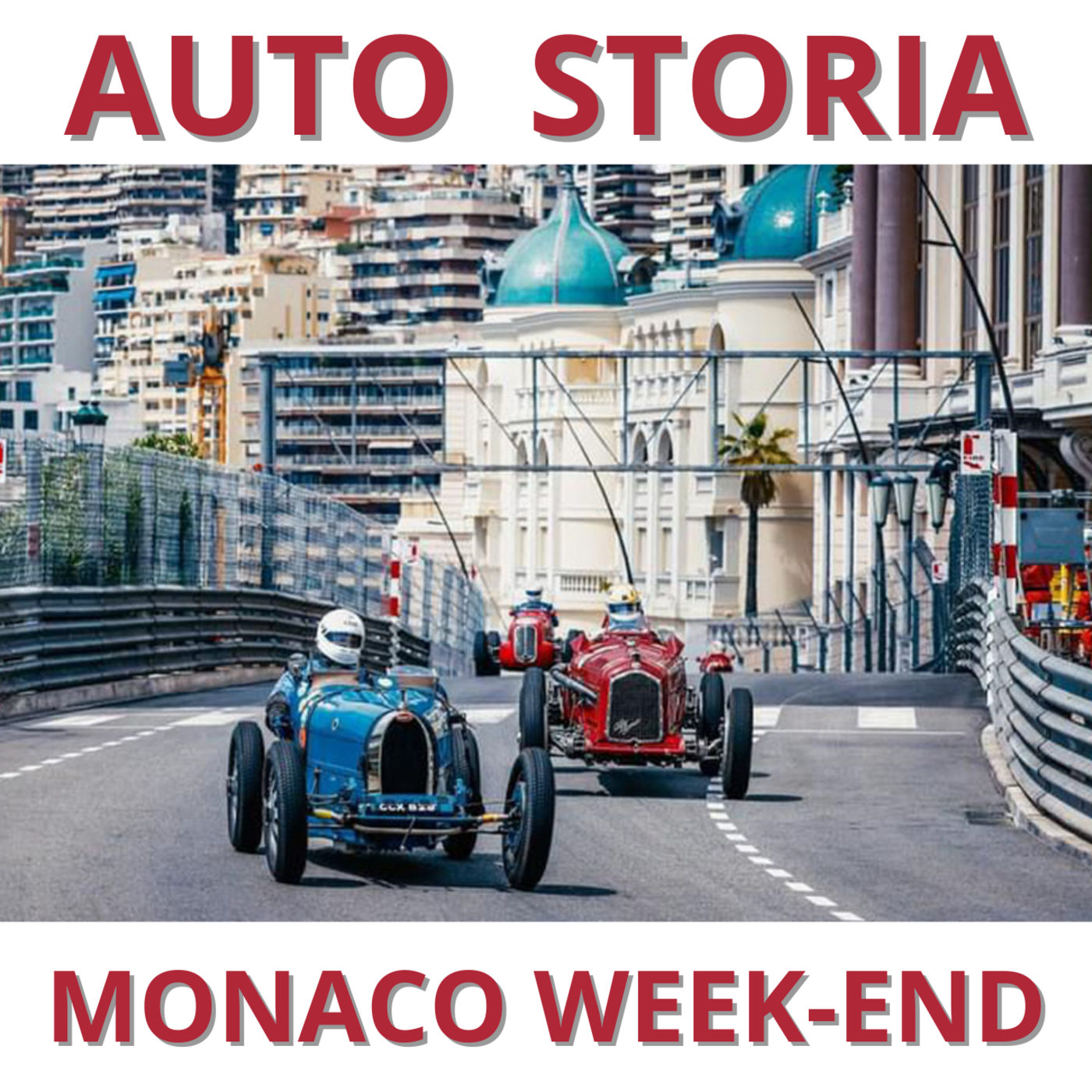
AUTO STORIA Buying and Racing Multi Million Cars at Historic Week End in Monaco
Auto Storia : Automobile Talk , Facts and Stories about Vintage Cars , Drivers and Racing
AUTO STORIA Buying and Racing Multi Million Cars at Historic Week End in MonacoAuto Storia : Automobile Talk , Facts and Stories about Vintage Cars , Drivers and Racing · Apr 16, 2026
They’re talking about Monaco, a small country known for luxury and big events. In this context, it’s where racing energy replaces the quiet, museum-like vibe.
“Biennial” means happening every two years. In this context, the speaker is describing how the Monaco historic event evolved from a one-time weekend into a recurring schedule.
Traction control helps prevent the wheels from spinning when you accelerate. If a car doesn’t have it, you have to be smoother with throttle to avoid losing grip.
The Bugatti Type 251 is a race car made by Bugatti in the years before World War II. It’s remembered because it was built for competition, and it helps explain why Bugatti became famous for racing cars. Podcasts mention it when talking about the earliest “legendary” cars from that time.
The Bugatti Type 35 is a legendary old race car. It’s especially famous at Monaco because it won the first Monaco Grand Prix back in 1929.
Car
Ferrari
Ferrari is a major racing manufacturer. The speaker is saying that, back then, only huge companies like Ferrari had the money and engineering talent to build winning F1 engines.
DFV is the name of a famous Cosworth V8 engine used in Formula One. It was designed to be strong and affordable, so smaller teams could race competitively.
An “inverted airplane wing” describes how the underbody can act like a wing flipped upside down. Instead of producing lift upward, the underbody geometry produces downforce by creating pressure differences as air speeds up under the car.
The “massive low pressure zone” is the area of low air pressure under the car. Lower pressure underneath helps push the car down, giving the tires more grip.
Turbo lag is the hesitation you feel before the turbo starts making boost. You press the gas, but the car doesn’t pull right away—it waits a beat, then suddenly goes.
FIA is the organization that oversees international auto racing. They make the rules so only qualified drivers can race the fastest, most dangerous cars.
Front-engine means the engine is in the front of the car. That affects how the car feels and handles compared with cars that put the engine in the middle or rear.
Maserati is an Italian car brand that’s been involved in racing for a very long time. The host is pointing out that this Monaco weekend lines up with a Maserati racing milestone.
In Formula One, a “debut” means someone’s first race appearance. They’re talking about how this weekend matches up with the first F1 entries for McLaren and Lige.
RM Sotheby’s is an auction company that specializes in expensive collector items, including rare cars. The host is saying they use the excitement of the race to sell these cars to wealthy buyers.
Car
1999 Bugatti EB112 prototype
This is a Bugatti prototype from 1999 called the EB112. Prototypes can be extremely collectible because they show a rare glimpse of what the company was planning before things changed.
A carbon fiber chassis is a lightweight, strong frame made from carbon fiber. It helps the car feel more solid and responsive without adding a lot of weight.
“Atmospheric” means the engine doesn’t use a turbo or supercharger. A 6.0-liter V12 is a huge engine with 12 cylinders, usually known for smoothness and strong sound.
An ecosystem here means a whole chain of connected things—racing, collectors, and maintenance. The speaker says they all depend on each other to keep these cars running.
Heavy steering means you have to push harder on the wheel to make the car turn. Many older cars didn’t have power steering, so it takes more effort.
LIVE
Imagine, just for a second, a traditional museum.
Okay.
There's this very specific expectation of reverence, right?
Like you walk into a hushed, climate-controlled room.
Right.
It's very sterile.
Exactly.
You stare at a priceless, one-of-a-kind artifact sitting safely behind velvet ropes.
You read a little brass plaque.
But you definitely don't touch it.
You do not touch it.
It's safe, and above all, it's completely static.
Yeah, it's basically history under glass.
I mean, it's beautifully preserved, but it's been entirely divorced from the violent, uh,
chaotic environment.
It was actually built to exist in.
Exactly.
A race car sitting in a silent room is, well, in a way, it's just a sculpture.
It is.
But then, you know, you look at what happens in the Principality of Monaco over a very
specific weekend, and suddenly that entire museum concept gets completely shattered.
Oh, absolutely shattered.
Welcome to Autostoria, the number 36.
Glad to be here.
And before we get started, please make sure you subscribe and support Autostoria.
We really appreciate it.
We definitely do.
So today, we are immersing ourselves in what is basically the ultimate sensory overload
for any automotive enthusiast.
Oh, without a doubt.
We're talking about Monaco, from April 24 through the 26th, 2026.
The mission of is to explore the 15th Monaco Historic Grand Prix, and its incredibly lucrative
shadow, the 87 million euro RM Sos The Bee's auction.
It's such a wild combination.
It really is.
We're going to unpack the thrill of the track, the high stakes world of classic car commerce,
and the psychology behind a weekend where people take irreplaceable, multi-million dollar
museum pieces and risk destroying them against steel barriers.
It really is a paradox of an event, you know, and to understand it, before we even look
at the auction block or the specific cars, we have to look at the stage they are performing
on.
Right, the track itself.
Exactly.
The historic Grand Prix is not a parade.
It's not an exhibition run where everyone just, you know, waves to the crowd at 30 miles
an hour.
Yeah.
It is a genuine, flat-out race on the exact same brutal street circuit used for the modern
Formula One Grand Prix.
And the history of how this started is actually completely accidental, isn't it?
It really is.
Because it wasn't supposed to be this massive, recurring, biennial institution.
Not at all.
Back in 1997, the automobile club to Monaco organized the very first historic Grand Prix
strictly as a one-off celebration.
Just a single weekend.
Right.
They just wanted to mark the 700th anniversary of the Grimaldi family's presidency over
Monaco.
Wow.
700 years.
Yeah.
So the idea was simple, bring out some vintage machines to honor the deep motorsport heritage
of the Principality, just for that one weekend.
But the reception was so overwhelmingly positive, right?
Yeah.
And I imagine the sheer visceral thrill of it was so contagious that they realized they
couldn't just pack it away.
They couldn't.
It was too good.
So by the year 2000, it had become a regular biennial event.
Alternating years with the electric Monaco E-Prix.
And the reason it resonated so deeply is precisely because of the circuit itself.
I mean, Monaco is legendary in motorsport because on paper, it's a terrible place for
a race.
Oh, it's an absolute nightmare on paper.
Mm-hmm.
Right.
It is incredibly tight.
It's unforgiving.
There are blind corners, massive elevation changes, and absolutely zero margin for error.
None.
The steel arm-co-barriers are literally inches from the tires.
So if you take that unforgiving geography, you populate it with cars that have zero modern
safety nets.
Right.
No traction control.
No anti-lock brakes, no electronic power steering.
It transforms from a race into a high-speed tightrope walk.
It's like a time machine, but the ghosts of motorsport past aren't sitting behind velvet
ropes.
They're actually hitting the apexes.
And scraping the barriers.
Exactly.
Which brings us to the machines themselves.
We're looking at a grid of roughly 205 cars, right?
Yeah, 205 cars spanning six decades of history from 1925 all the way up to 1985.
That is a massive range.
It is.
So they divide them into eight different series, starting with Series A1.
And A1 is the really early stuff, right?
Exactly.
Series A1 is where you find the pre-war legends.
For example, the Bugatti Type 35.
Wow.
And to put that in perspective, a Bugatti Type 35 actually won the very first Monaco
Grand Prix ever held back in 1929.
That is crazy.
So you're watching a car drive the exact same streets it conquered nearly a century
ago.
Precisely.
It's literal history repeating itself.
But while the pre-war cars are beautiful, the real meat of the event, the era that most
purists consider the golden age of this Grand Prix, is the three-liter Formula One era.
Okay.
And what years are we talking about there?
This spans roughly from 1966 to 1985.
And when we talk about the three-liter era, we are essentially talking about the reign
of one specific engine, right?
The legendary Ford Cosworth DFV V8.
The absolute legend.
I've heard this engine described as the thing that completely changed the business model
of racing.
Why was it so revolutionary?
Well because it completely democratized Formula One.
How so?
Before the DFV, if you wanted to win an F1, you had to be a massive manufacturer like
Ferrari.
You had to have the resources to design and build your own complex engines entirely from
scratch.
Which takes a massive budget.
Exactly.
But in 1967, Cosworth, backed by Ford, introduced the DFV.
It was a three-liter V8 that was light, incredibly powerful, very reliable, and relatively cheap
to buy.
So it was essentially the open-source software of 1970s Formula One.
That is a brilliant analogy.
You could just buy the engine off the shelf, build a custom innovative chassis around it,
and suddenly a small team operating out of a shed in England could compete toe-to-toe
with the Titans at Ferrari.
And that's exactly what happened.
Privateer teams like Lotus, McLaren, and Tiro bought the DFV and literally went on to
win world championships.
That is wild.
And the DFV was also ingenious mechanically because it was designed as a stressed member
of the chassis.
Wait, explain what you mean by a stressed member.
So in older cars, you basically built a metal frame.
Right.
And then you dropped the engine inside it.
Like a cradle.
Exactly, like a cradle.
And the frame took all the stress of cornering and bumping.
But with the DFV, the engine block itself was so rigid that teams literally bolted the
rear suspension directly onto the engine.
No way.
Yeah.
And then they bolted the front of the engine to the cockpit.
The engine was the back half of the car's frame.
Oh, wow.
This saved massive amounts of weight and made the cars incredibly nimble.
Which perfectly set the stage for the aerodynamic revolution.
Because once everyone had the exact same engine, you had to find speed somewhere else, right?
Exactly.
It became an era war.
And this is where we get the wing cars, like the famous Lotus 78 and 79, which are heavily
featured in these middle categories.
Tell me how these ground effect cars actually worked.
Right.
So the engineers in the late 70s realized that instead of just putting wings on top of the
car to push it down, they could shape the entire underside of the car like an inverted
airplane wing.
Okay.
As the car moved forward, it channeled the air underneath it, accelerating that air and
creating a massive low pressure zone.
So it's essentially creating a vacuum.
Exactly.
It literally sucked the car to the road.
They even used these flexible skirts along the sides of the car that touched the ground
to seal that vacuum in.
That sounds intense.
The cornering speeds these cars could achieve were just mind boggling.
But the physical toll on the driver was brutal.
Because of the G-forces.
That and the suspension had to be rock solid to maintain the aerodynamic seal.
Yeah.
So every single bump on the Monaco streets was transmitted directly into the driver's
spine.
Ouch.
Now, just when you think the cars couldn't get more extreme, the 2026 historic Grand Prix
is introducing something new, which I find genuinely terrifying.
Oh, the Series G edition.
Yes.
They are opening up Series G to include the turbo engine Formula 1 cars from 1981 to 1985.
This is a monumental shift for the event.
I mean, the early 80s turbo era is infamous.
Why is that?
Well, engineers figured out how to use exhaust gases to spin a turbine, forcing compressed
air back into tiny 1.5 liter engines.
By doing this, they were extracting well over 1,000 horsepower in qualifying trim.
Over 1,000 horsepower in a car that weighs nothing.
Exactly.
But the catch was the power delivery, right?
It wasn't smooth.
Explain the mechanics of that turbo lag because I think that's the key to understanding
why driving these cars around Monaco is absolute madness.
Right.
Because the turbos were huge and primitive, they took time to spool up, so a driver would
approach a tight corner like the Monaco hairpin, hit the brakes, and the engine RPMs would
drop.
Yeah.
When they step back on the gas pedal to exit the corner, nothing would happen.
You're just sitting there waiting.
You're waiting.
The exhaust gases are slowly building up pressure in the turbo.
One second passes.
Two seconds.
That feels like an eternity in a race car.
It is.
You are steering the car, waiting for the power.
Yeah.
And then, violently and all at once, an extra 600 horsepower explodes through the rear wheels.
Man.
So imagine you're staring at the barrier.
You ask the car for power.
It gives you a moment of dead silence, and then a rocket goes off behind your head while
you are trying to navigate a street barely wide enough for two normal cars.
It was vicious.
Mm-hmm.
And because these cars are so violently fast and unpredictable, the FIA and the organizing
committee aren't just letting anyone with a thick wallet buy a turbo F1 car and enter
the race.
Oh, really?
No.
For Series G, they're requiring drivers to hold an international B license.
Meaning, you can't just be a rich amateur enthusiast.
What exactly does an international B license entail?
It means you have a proven, documented racing pedigree in high-level competitive motorsport
over several years.
Okay.
So real professionals.
Exactly.
You have to have finished consistently in sanctioned championships.
It's the FIA's way of saying, you know, we don't care how much money you have.
If you're going to pilot a 1000 horsepower bomb with 1980 safety standards through the
streets of Monaco, you better be a professional.
That is perfectly fair, and that actually transitions us perfectly into the sensory experience
for the fans.
Yes.
The atmosphere.
We've talked about the mechanics, but I want to put you, the listener, right there on
the sidewalk, because if you go to a modern Formula One race today, the Patek is an absolute
fortress.
Totally.
You can't get anywhere near the cars.
Right.
You have mechanics hiding the floors of the cars behind massive privacy screens so rival
teams can't see their aerodynamic secrets.
The drivers are hidden away in luxury motor homes.
It's highly sanitized.
It is.
Modern F1 is basically an aerospace-level engineering exercise muffled by hybrid energy recovery
systems.
Yeah.
But the historic Grand Prix strips all of that away.
What stands out to you immediately when you attend this event is the complete lack of
barriers between you and the mechanics.
Yes, because if you buy a regular grandstand ticket for the weekend, it automatically includes
free access to the Pateks on Kwai Zai Albert Winner.
You literally just walk in.
When you walk in, you aren't just looking at cars parked in a row.
You are walking through a living, breathing, screaming timeline of automotive evolution.
I love that.
You walk past a 1950s front-engine Maserati where a mechanic is elbow-deep in grease adjusting
a carburetor.
10 feet away, they're warming up at 1970s Lotus Ford.
And the sound must be unbelievable.
I want to know about the sensory difference.
Why does a 1970s F1 car feel so different from a modern one?
Because it's entirely raw.
Yeah.
You don't just hear a grid of Cosworth V8s revving up.
The sound waves physically hit your chest.
It rattles your ribs.
And the air smells like rich, unburnt hydrocarbons and hot racing oil.
It's totally democratized.
And mixed in with all that incredible machinery are the actual legends of the sport.
Oh yeah.
The people you run into in the Patek.
For the 2026 event, Jean Alessi, the iconic 90s Ferrari driver, is returning to the track.
He'll be racing a 1969 Ferrari 312 V12 in Series D.
Hearing a classic, naturally aspirated Ferrari V12 echoing off the high-rise buildings in
Monaco, driven by someone with Alessi's aggressive, passionate style, it's going to be unforgettable.
Truly.
And he's surrounded by massive history this year.
2026 is a convergence of anniversaries.
What are they celebrating?
They are hosting a major tribute to Nicci Lauda to celebrate the 50th anniversary of his iconic
1976 win.
Wow.
50 years.
Plus, it's the 100th anniversary of Maserati's racing debut.
They are honoring 80 years since Amity Gordini built his first car.
And it marks exactly 60 years since McLaren and Lige made their Formula One debuts.
It is a profound celebration of heritage, but let's be real for a moment, this is Monaco.
So while we love the gritty, accessible nature of the Patek Pass, there is another side to
this weekend.
The ultra-exclusive luxury side.
Exactly.
If you want it, that luxury is baked into the DNA of the Principality.
You can opt for hospitalities like the classic club above Tribbunti, where you can literally
arrive by private boat to a pontoon, bypass all the crowds, and watch the race with an
open champagne bar and a gourmet buffet.
Of course.
And that luxury tier is crucial because it serves as the bridge to the second half of
this weekend.
The auction.
Yes.
Seeing these cars push to the brink of destruction on track triggers something fascinating in
the billionaires watching from those hospitality suites.
It transforms these machines from static assets into living adrenaline rushes.
Which is exactly what RM Sotheby's capitalizes on.
And here we go, the world's most high stakes souvenir shop.
That's exactly what it is.
Right in the middle of the Grand Prix weekend on April 25th, RM Sotheby's is holding an
auction estimated to bring in 87 million euros.
It is staggering.
The curation of the catalog is incredible.
And the absolute marquee item, the car that will have the room in dead silence, is Ayrton
Senna's very first Formula One car.
Which is just the ultimate piece of motorsport mythology.
It is.
But what makes this specific lot so valuable is that it isn't just a dusty relic, it has
a living legacy.
What do you mean?
Well, just recently, Martin Brundle drove it for a documentary in 2022.
Oh, wow.
And Pierre Gasly pushed it around Silverstone in 2024 to mark the 30th anniversary of Senna's
passing.
So it's a functioning, screaming piece of Senna's origin story.
That makes sense to me.
The historical significance validates the price.
But then you look at the supercar and hypercar lineup and things get a little, well, stranger.
How so?
I want to talk about the 1999 Bugatti EB112 prototype.
Unpack the story behind this because it feels like a bizarre anomaly in an auction full
of racing champions.
The EB112 is a brilliant case study in the psychology of the collector market.
Long before the Volkswagen Group bought Bugatti and built the Veyron, the company was revived
in the 1990s by an ambitious Italian businessman named Romano Artioli.
He built the famous EB110 supercar.
But his real dream was the EB112.
What was it?
It was an ultra luxury four-door super sedan with a carbon fiber chassis, an atmospheric
6.0-liter V12, and get this, a manual gearbox.
So a massive manual V12 luxury sedan.
That sounds crazy.
Exactly.
But Artioli overextended.
The company went spectacularly bankrupt before the EB112 could ever reach full production.
Only three prototypes were ever completed.
Only three.
Only three.
And this specific one hitting the block was finished for a monogasque businessman, and
it only had 388 kilometers on the odometer.
It's estimated to sell for between 1.5 to 2 million euros.
I find this fascinating.
It's the ultimate failing upward story of the automotive world.
That's a great way to put it.
Right.
A failed four-door from a bankrupt 90s venture commenced 2 million euros precisely because
the company collapsed before they could make more.
It's the psychology of absolute scarcity triumphing over commercial success.
That is exactly how the top tier of collecting works.
Rarity is the ultimate currency.
And you see a different kind of scarcity with another Bugatti crossing the block, the 2024
Bugatti Bolito.
Now, this one I really want to push back on.
Okay, let's hear it.
The belate is estimated at 3.5 to 4.5 million euros.
It's a modern track-only monster built around Bugatti's massive W16 engine.
Only 40 were made, and this one has 359 kilometers on it.
But I struggle with this.
You can't legally drive it on the street to get a coffee.
No, definitely not.
And you can't even race it in a sanctioned racing series because it doesn't fit any rulebook.
So is paying 4.5 million euros for this just pure cynical speculation?
Is it just a stock portfolio you happen to park in a garage?
Well for some buyers, absolutely it's just an investment vehicle.
But you have to view the belate as a mechanical swan song.
A swan song for what?
For internal combustion.
It represents the absolute zenith of engineering before the industry pivot to electrification.
It is Bugatti taking their legendary W16 engine and removing every single road legal
constraint.
So it's just pure performance.
Pure performance.
For the billionaire who buys it, it's not about racing a series.
It's about booking a private track day at Paul Ricard, flying in their team and experiencing
lateral G-forces that defy physics.
It's the ultimate private toy.
Which contrasts beautifully with the 1989 Ferrari F40 Berlinetta there also.
Oh, the F40.
Beautiful car.
Yes, and this one was meticulously restored by Michelotto, essentially Ferrari's premier
race car builder.
That car is pure analog terror meant for the open road.
Very different vibe from the bull ride.
Totally.
But let's bring these two worlds together, the roar of the track and the quiet tension
of the auction house.
How does the energy of the historic Grand Prix physically influence the bidding paddles?
It creates a brilliant psychological symbiosis.
Think about the sensory overload we've been discussing, right?
Yeah.
A collector spends Friday and Saturday morning standing at the swimming pool chicane.
They're watching a grid of vintage Ferraris and Lotuses sliding around corners, literally
spitting fire.
It's intoxicating.
Their adrenaline is pumping.
They are fully immersed in the romance, the noise, and the sheer danger of classic motorsport.
That environment completely lowers your financial inhibitions.
So when you walk into the RM South Abbey's auction on Saturday afternoon, you aren't
just looking at metal, carbon fiber, and a spec sheet anymore.
No.
You are looking at an entry ticket.
You just watched an exclusive thrilling club risk their lives on the track and the auctioneer
is handing you the pen to buy your way into that exact same club.
That raises a critical question though.
Does the historic racing validate these astronomical auction prices because it proves these cars
still work and have a dynamic purpose?
Or has the collector market effectively hijacked this gritty, dangerous street race and turned
it into a high-speed rolling catalog display for the ultra-wealthy?
Wow.
That is the core tension of the entire historic racing scene today.
I'd argue it's entirely interdependent.
The collector market desperately relies on this event.
Mechanical exclusivity creates insatiable demand.
When a collector sees an F40 or a Lotus 79 screaming around Santé de Vos, it shifts
from being a static asset to an experiential one.
The race validates the car's dynamic worth.
But conversely, you can't ignore that the sheer monetary value of these cars, tens of
millions of euros racing wheel-to-wheel, adds a massive voyeuristic thrill for the audience.
We are watching people risk absolute fortunes going into turn one.
Exactly.
The history validates the commerce and the commerce funds the preservation of the history.
If these cars weren't worth millions on the auction block, owners wouldn't be willing
or able to spend the hundreds of thousands of euros required every year to keep complex
1970s and 80s racing engines in race-ready condition.
It is an ecosystem unlike anywhere else on Earth.
The entire principality of Monaco during this weekend becomes dedicated to extraordinary
out-of-the-norm automobiles.
It completely takes over the town.
You walk down the street to get a coffee, and the traffic jam is made up of modern McLarens,
vintage Porsches, and limited-edition Ferraris.
The ambiance is just electric.
The organizers actually have a brilliant tagline for the 2026 event.
What is it?
Where Atmos rhymes with turbos.
Oh, that's clever.
It perfectly captures the contrast of the weekend.
You have the glorious screaming atmospheric engines of the past, meeting the violent fire-spitting
turbo era of the 80s.
It's where gritty racing heritage meets the absolute pinnacle of luxury commerce.
It proves that automotive history isn't just something you read about in a textbook.
Definitely not.
It's something you can hear, something you can smell, and well, if you happen to have
a spare four million euros, something you can take home from an auction.
It's the ultimate living museum.
It really is.
But as we wrap up, I want to leave you the listener with a provocative thought to mull
over.
We talked extensively about the mechanics, the history, and the staggering amounts of
money exchanging hands, right?
But imagine the immense psychological pressure of being the person actually behind the wheel
on Sunday.
I can't even fathom it.
Imagine strapping yourself into a multi-million dollar, completely irreplaceable artifact.
You have no modern safety nets.
The steering is heavy.
The brakes require massive physical force.
And you're surrounded by steel barriers.
Now imagine pointing that priceless piece of history at a barrier, hitting the accelerator,
and pushing it to its absolute mechanical limit around the tightest, most unforgiving
street circuit in the world.
How do you silence the rational part of your brain that knows exactly what the car is worth
so you can actually find the apex and race it?
It takes a very specific, almost detached type of mind to find the limit when the financial
and physical stakes are that incredibly high.
It really does.
It requires a total surrender to the machine.
Cool.
Well, that's all the time we have for today.
Please remember to subscribe and support AutoStoria so we can keep bringing you these stories.
Yes, please do.
Next time, we'll be changing gears to focus entirely on the man behind the wheel.
Exploring the life and unmatched natural talent of the Scottish racing legend Jim Clark.
You won't want to miss it.
See you then.
About this episode
Monaco’s 2026 Historic Grand Prix (Apr 24–26) is framed as the ultimate “history under glass” paradox: priceless, museum-like race cars are driven flat-out on the same unforgiving street circuit as modern F1, inches from barriers. The show breaks down the 205-car grid across eras, highlights the 1966–85 three-liter Cosworth DFV revolution and ground-effect wing cars, then spotlights the new Series G turbo F1 inclusion (1981–85) and its terrifying turbo lag—plus stricter driver licensing. It also connects the track chaos to RM Sotheby’s €87M auction, featuring Senna’s first F1 car and rare Bugatti oddities, and debates whether racing validates collector prices or turns the event into a luxury showroom.
April 24-26 2026 , The Monaco Historic Grand Prix , and RM Sotheby's auction ,
a thrilling week-end for classic car nuts !
With Hosts Bill Jenkins and Lisa Ascari.
Discover the story !
Relax and enjoy , this is easy listening and learning.
AUTO STORIA : Talk , Facts and Story about Cars , Drivers and Racing .
Subscribe is Supporting Us !
#classic cars #classic racing cars #monaco historic grand prix #acm #automobile club Monaco #f1 #Formula One #Monaco Grand Prix #RM Sotheby's #Ayrton Senna #Toleman F1 #Mercedes-AMG one #Bugatti EB112 #Bugatti #monaco #principauté de Monaco #Bugatti Bolide #Fangio #Jean Alesi #Monte Carlo #Pierre Gasly #Ferrari #Maserati #Lotus #Mc Laren #auto storia #podcast