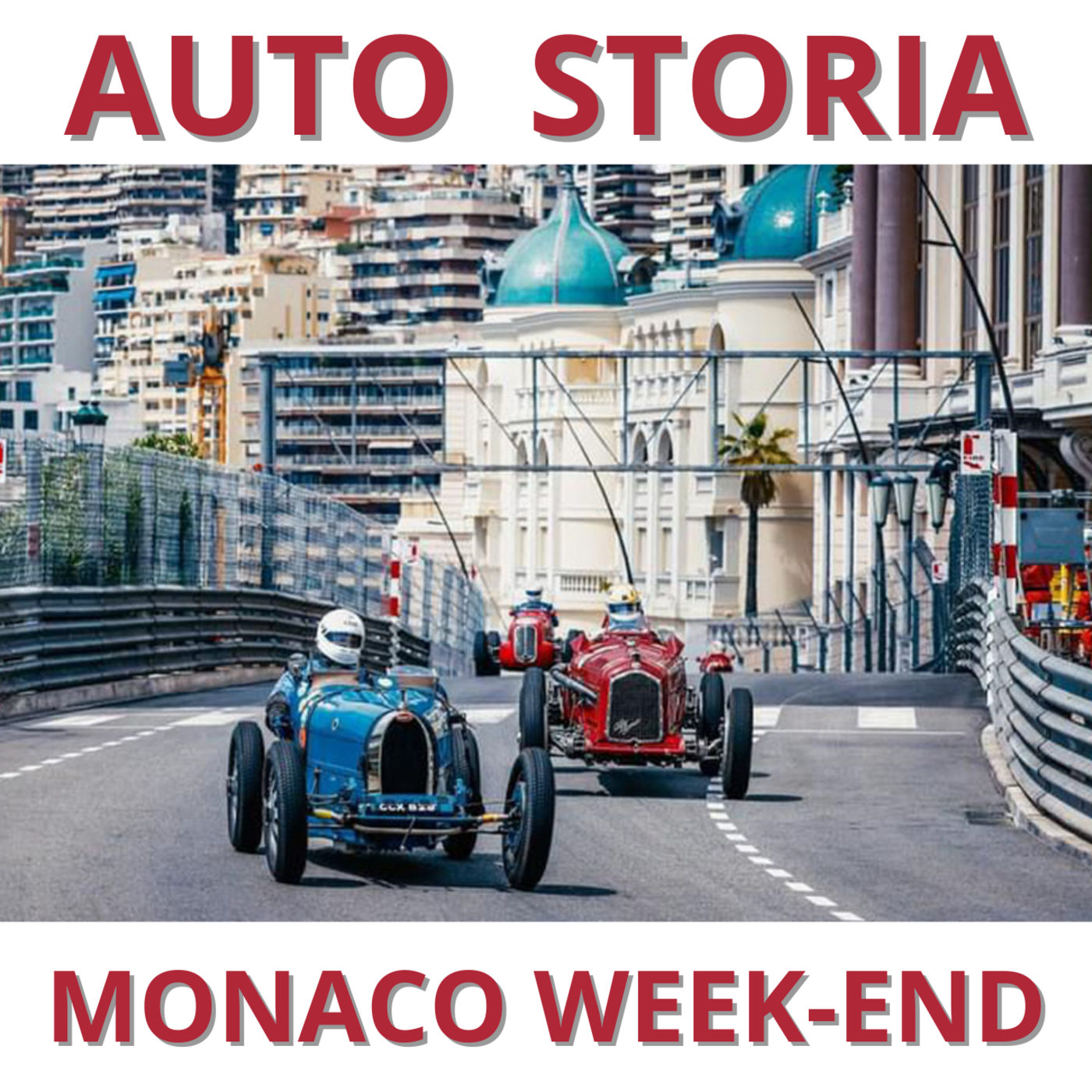
AUTO STORIA Buying and Racing Multi Million Cars at Historic Week End in Monaco
About this episode
Monaco’s 2026 Historic Grand Prix (Apr 24–26) is framed as the ultimate “history under glass” paradox: priceless, museum-like race cars are driven flat-out on the same unforgiving street circuit as modern F1, inches from barriers. The show breaks down the 205-car grid across eras, highlights the 1966–85 three-liter Cosworth DFV revolution and ground-effect wing cars, then spotlights the new Series G turbo F1 inclusion (1981–85) and its terrifying turbo lag—plus stricter driver licensing. It also connects the track chaos to RM Sotheby’s €87M auction, featuring Senna’s first F1 car and rare Bugatti oddities, and debates whether racing validates collector prices or turns the event into a luxury showroom.
AUTO STORIA .
Season 2 , Episode 36 :
April 24-26 2026 , The Monaco Historic Grand Prix , and RM Sotheby's auction ,
a thrilling week-end for classic car nuts !
With Hosts Bill Jenkins and Lisa Ascari.
Discover the story !
Relax and enjoy , this is easy listening and learning.
AUTO STORIA : Talk , Facts and Story about Cars , Drivers and Racing .
Subscribe is Supporting Us !
#classic cars #classic racing cars #monaco historic grand prix #acm #automobile club Monaco #f1 #Formula One #Monaco Grand Prix #RM Sotheby's #Ayrton Senna #Toleman F1 #Mercedes-AMG one #Bugatti EB112 #Bugatti #monaco #principauté de Monaco #Bugatti Bolide #Fangio #Jean Alesi #Monte Carlo #Pierre Gasly #Ferrari #Maserati #Lotus #Mc Laren #auto storia #podcast
Principality of Monaco
"But then, you know, you look at what happens in the Principality of Monaco over a very specific weekend, and suddenly that entire museum concept gets completely shattered."
They’re talking about Monaco, a small country known for luxury and big events. In this context, it’s where racing energy replaces the quiet, museum-like vibe.
The Principality of Monaco is referenced as the setting where the “museum under glass” idea breaks down. Monaco is famous for high-profile motorsport events and a glamorous, chaotic atmosphere that’s the opposite of a sterile museum.
biennial institution
"Because it wasn't supposed to be this massive, recurring, biennial institution."
“Biennial” means happening every two years. In this context, the speaker is describing how the Monaco historic event evolved from a one-time weekend into a recurring schedule.
traction control
"So if you take that unforgiving geography, you populate it with cars that have zero modern safety nets. Right. No traction control."
Traction control helps prevent the wheels from spinning when you accelerate. If a car doesn’t have it, you have to be smoother with throttle to avoid losing grip.
Traction control is an electronic system that limits wheel spin by reducing engine power and/or applying brakes. Without it, older cars rely much more on driver technique to manage grip.
apexes
"They're actually hitting the apexes. And scraping the barriers. Exactly."
The apex is the inside “turning point” of a corner. Hitting it well helps you go through the turn efficiently instead of running wide.
An apex is the point in a corner where the car is closest to the inside. Hitting the apexes consistently is key for maintaining speed and minimizing distance traveled—especially on tracks where barriers are close.

Bugatti Type
"...e you find the pre-war legends. For example, the Bugatti Type 35. Wow."
The Bugatti Type 251 is a race car made by Bugatti in the years before World War II. It’s remembered because it was built for competition, and it helps explain why Bugatti became famous for racing cars. Podcasts mention it when talking about the earliest “legendary” cars from that time.
The Bugatti Type 251 is a pre-war racing car from Bugatti, known for its place in the brand’s legendary competition history. It’s often discussed in the context of the era’s standout race machines—especially when a podcast is highlighting “pre-war legends” and the roots of modern motorsport engineering. Because it’s tied to that early racing period, it comes up as a reference point for how performance and design evolved before World War II.

Bugatti Type 35
"For example, the Bugatti Type 35. Wow. And to put that in perspective, a Bugatti Type 35 actually won the very first Monaco Grand Prix ever held back in 1929."
The Bugatti Type 35 is a legendary old race car. It’s especially famous at Monaco because it won the first Monaco Grand Prix back in 1929.
The Bugatti Type 35 is one of the most famous pre-war Grand Prix race cars. It’s historically important because it won the very first Monaco Grand Prix in 1929, which is why it’s such a centerpiece for Monaco history.

Ferrari
"Before the DFV, if you wanted to win an F1, you had to be a massive manufacturer like Ferrari."
Ferrari is a major racing manufacturer. The speaker is saying that, back then, only huge companies like Ferrari had the money and engineering talent to build winning F1 engines.
Ferrari is referenced as the kind of large, factory-backed manufacturer that dominated early Formula One. The point is that before the DFV, only teams with massive resources could design and build their own complex engines.
DFV
"But in 1967, Cosworth, backed by Ford, introduced the DFV. It was a three-liter V8 that was light, incredibly powerful, very reliable, and relatively cheap to buy."
DFV is the name of a famous Cosworth V8 engine used in Formula One. It was designed to be strong and affordable, so smaller teams could race competitively.
DFV stands for Cosworth’s “Double Four Valve” V8 used in Formula One starting in 1967. It was a lightweight, powerful, and relatively affordable engine that enabled privateer teams to compete at the front.
McLaren
"Privateer teams like Lotus, McLaren, and Tiro bought the DFV and literally went on to win world championships."
McLaren is a famous racing team. Here it’s used as an example of a smaller team that could still win because it could buy the DFV engine.
McLaren is mentioned alongside Lotus as a privateer team that used the DFV. The takeaway is that the DFV wasn’t limited to factory giants—it helped teams with different budgets reach the top.
Lotus
"Privateer teams like Lotus, McLaren, and Tiro bought the DFV and literally went on to win world championships."
Lotus is a well-known racing team/brand. In this segment, it’s mentioned as a privateer that used the DFV to become competitive.
Lotus is cited as one of the privateer teams that bought the DFV and went on to win world championships. It’s an example of how the DFV ecosystem enabled smaller teams to compete with the biggest names.
inverted airplane wing
"So the engineers in the late 70s realized that instead of just putting wings on top of the car to push it down, they could shape the entire underside of the car like an inverted airplane wing. Okay."
An “inverted airplane wing” describes how the underbody can act like a wing flipped upside down. Instead of producing lift upward, the underbody geometry produces downforce by creating pressure differences as air speeds up under the car.
massive low pressure zone
"As the car moved forward, it channeled the air underneath it, accelerating that air and creating a massive low pressure zone."
The “massive low pressure zone” is the area of low air pressure under the car. Lower pressure underneath helps push the car down, giving the tires more grip.
A “massive low pressure zone” under the car is the key outcome of ground effect. By channeling and accelerating airflow beneath the chassis, teams create a pressure drop that increases downforce and improves cornering performance.
turbo lag
"Explain the mechanics of that turbo lag because I think that's the key to understanding why driving these cars around Monaco is absolute madness. Right. Because the turbos were huge and primitive, they took time to spool up..."
Turbo lag is the hesitation you feel before the turbo starts making boost. You press the gas, but the car doesn’t pull right away—it waits a beat, then suddenly goes.
Turbo lag is the delay between when you press the accelerator and when a turbocharger produces boost. It happens because the turbo needs time to spool up using exhaust gas energy, so the engine feels “dead” for a moment before power arrives.
FIA
"...the FIA and the organizing committee aren't just letting anyone with a thick wallet buy a turbo F1 car and enter the race."
FIA is the organization that oversees international auto racing. They make the rules so only qualified drivers can race the fastest, most dangerous cars.
The FIA (Fédération Internationale de l’Automobile) is the main international governing body for motorsport. In this context, they set rules and licensing requirements to control who can drive high-risk race cars.
front-engine
"...You walk past a 1950s front-engine Maserati where a mechanic is elbow-deep in grease adjusting a carburetor."
Front-engine means the engine is in the front of the car. That affects how the car feels and handles compared with cars that put the engine in the middle or rear.
“Front-engine” describes an engine layout where the engine sits at the front of the car, driving the wheels through a drivetrain that runs rearward. In classic racing, this layout was common and influences weight distribution and handling balance.
carburetor
"...You walk past a 1950s front-engine Maserati where a mechanic is elbow-deep in grease adjusting a carburetor."
A carburetor is an older way to mix fuel with air so the engine can run. Mechanics often have to adjust it carefully to get the engine running right.
A carburetor is a fuel-mixing device used on many older engines, where it blends air and fuel before it enters the cylinders. It’s mechanically adjusted and can be sensitive to tuning, temperature, and altitude.
1969 Ferrari 312 V12
"He'll be racing a 1969 Ferrari 312 V12 in Series D. Hearing a classic, naturally aspirated Ferrari V12 echoing off the high-rise buildings in Monaco, driven by someone with Alessi's aggressive, passionate style, it's going to be unforgettable."
This is a classic Ferrari race car from 1969 with a V12 engine. The V12 is known for a distinctive sound and strong, immediate feel.
The Ferrari 312 V12 is a legendary 1969-era Formula 1 car powered by a V12 engine. The “312” name is tied to Ferrari’s engine configuration, and the V12’s character is a big part of why these cars are so memorable to hear and watch.
50th anniversary
"2026 is a convergence of anniversaries. What are they celebrating? They are hosting a major tribute to Nicci Lauda to celebrate the 50th anniversary of his iconic 1976 win."
A 50th anniversary is a big “half-century” milestone. The event is using that to honor a famous racing moment from 1976.
A 50th anniversary tribute is a major milestone celebration, often tied to a specific historic achievement in motorsport. In this case, it frames the event around Nicci Lauda’s 1976 win and the legacy of that era.
Maserati
"Plus, it's the 100th anniversary of Maserati's racing debut. [764.0s] They are honoring 80 years since Amity Gordini built his first car."
Maserati is an Italian car brand that’s been involved in racing for a very long time. The host is pointing out that this Monaco weekend lines up with a Maserati racing milestone.
Maserati is an Italian automaker with a long history in racing. The episode references Maserati’s racing debut anniversary, tying the brand to Monaco’s motorsport heritage.
Formula One debuts
"And it marks exactly 60 years since McLaren and Lige made their Formula One debuts. [772.0s] It is a profound celebration of heritage, but let's be real for a moment, this is Monaco."
In Formula One, a “debut” means someone’s first race appearance. They’re talking about how this weekend matches up with the first F1 entries for McLaren and Lige.
A “debut” in Formula One refers to a driver/team’s first appearance in an F1 race. The episode uses these anniversaries to frame Monaco as a place where racing history is celebrated.
RM Sotheby's
"Which is exactly what RM Sotheby's capitalizes on. [827.4s] And here we go, the world's most high stakes souvenir shop. [831.4s] Right in the middle of the Grand Prix weekend on April 25th, RM Sotheby's is holding an"
RM Sotheby’s is an auction company that specializes in expensive collector items, including rare cars. The host is saying they use the excitement of the race to sell these cars to wealthy buyers.
RM Sotheby’s is a high-end auction house known for selling rare and valuable collector cars. The episode connects the auction to the track action—turning cars from static display items into “living” performance spectacles for wealthy bidders.
1999 Bugatti EB112 prototype
"I want to talk about the 1999 Bugatti EB112 prototype. Unpack the story behind this because it feels like a bizarre anomaly in an auction full of racing champions."
This is a Bugatti prototype from 1999 called the EB112. Prototypes can be extremely collectible because they show a rare glimpse of what the company was planning before things changed.
The Bugatti EB112 is a famous 1990s concept/prototype that helped define modern Bugatti’s identity before the brand’s later revival. As a prototype, it’s especially valuable because it represents a “what could have been” design and business direction.
psychology of the collector market
"The EB112 is a brilliant case study in the psychology of the collector market. Long before the Volkswagen Group bought Bugatti and built the Veyron, the company was revived in the 1990s by an ambitious Italian businessman named Romano Artioli."
They’re talking about why collectors pay huge money for certain cars. Sometimes the story and rarity matter more than how fast or how new the car is.
This is about how collectors value cars beyond performance—often prioritizing story, rarity, cultural impact, and emotional resonance. In auctions, a car’s “myth” and historical narrative can outweigh technical specs, especially for prototypes and legendary firsts.
carbon fiber chassis
"It was an ultra luxury four-door super sedan with a carbon fiber chassis, an atmospheric 6.0-liter V12, and get this, a manual gearbox."
A carbon fiber chassis is a lightweight, strong frame made from carbon fiber. It helps the car feel more solid and responsive without adding a lot of weight.
A carbon fiber chassis uses carbon-fiber composite structure to reduce weight and increase stiffness. In a car like the EB112, it would help the heavy luxury sedan feel more agile while also supporting high-performance engineering.
atmospheric 6.0-liter V12
"It was an ultra luxury four-door super sedan with a carbon fiber chassis, an atmospheric 6.0-liter V12, and get this, a manual gearbox. So a massive manual V12 luxury sedan."
“Atmospheric” means the engine doesn’t use a turbo or supercharger. A 6.0-liter V12 is a huge engine with 12 cylinders, usually known for smoothness and strong sound.
“Atmospheric” means naturally aspirated—no turbochargers or superchargers—so the engine makes power by breathing air through the intake system. A 6.0-liter V12 is a very large, smooth engine layout, and in this context it’s paired with a luxury sedan body.
Only three prototypes were ever completed
"Only three prototypes were ever completed. Only three. Only three."
Only three prototype cars were finished. When there are so few cars in existence, collectors treat them like rare trophies.
Prototype scarcity matters because it limits how many real, physical cars were ever built. With only three completed prototypes, the EB112 becomes a “known quantity” for collectors, which can strongly influence auction pricing.
Rarity is the ultimate currency
"That is exactly how the top tier of collecting works. Rarity is the ultimate currency."
The idea is that rare cars are worth more because people can’t get them easily. So rarity becomes the main reason collectors pay big money.
This is a market concept: rarity functions like “currency” because it drives willingness to pay. When a car is rare due to limited production, prototypes, or historical collapse, its value can rise even if it was a commercial failure.
Paul Ricard
"It's about booking a private track day at Paul Ricard, flying in their team and experiencing lateral G-forces that defy physics."
Paul Ricard is a well-known race track in France. The speaker is saying the buyer would use the car on a private track day there.
Paul Ricard is a famous motorsport circuit in France, often used for high-profile testing and track events. In the segment, it’s referenced as the kind of venue where a track-only hypercar like the Bugatti Bolito would be experienced.
ecosystem
"The history validates the commerce and the commerce funds the preservation of the history... It is an ecosystem unlike anywhere else on Earth."
An ecosystem here means a whole chain of connected things—racing, collectors, and maintenance. The speaker says they all depend on each other to keep these cars running.
In this context, an “ecosystem” is the interlocking cycle between racing events, collector investment, and preservation work. The speaker’s thesis is that racing validates value, and value funds the maintenance needed to keep historic cars alive.
heavy steering
"You have no modern safety nets. The steering is heavy. The brakes require massive physical force."
Heavy steering means you have to push harder on the wheel to make the car turn. Many older cars didn’t have power steering, so it takes more effort.
Heavy steering means the driver must apply a lot of force to turn the wheels, which is common in older cars without power steering. It’s a sign of how mechanically demanding these cars are at speed and during cornering.
Request an Explanation
Heard something you'd like explained? We'll add it to this episode.
Sign in to request explanations for terms you heard.
Want to learn more?
Browse our glossary for plain-English explanations of automotive terms, jargon, and concepts.
Help improve this episode
See something that's not quite right? Our annotations are AI-generated and can sometimes miss the mark. Click the flag icon on any annotation to suggest a correction.