The Shelby Daytona Coupe is a special race car made in the 1960s by Carroll Shelby. It was built to be very fast and won many races, making it an important car in racing history.
The Chrysler Daytona is a sporty car from the late 1960s and early 1970s that was designed to be fast and look cool. It was popular in racing and is known for its unique shape.
The Chevrolet Corvette is a famous sports car from America that is known for being fast and stylish. It has been around for many years and is loved by car enthusiasts for its design and performance.
Aerodynamics is how air moves around things, like cars. A car designed with good aerodynamics can go faster and use less fuel because it cuts through the air more easily.
Drag is the force that slows down a car when it's moving through the air. The faster you go, the more drag you feel, and it gets much stronger as you speed up.
The Shelby Cobra is a classic sports car from the 1960s that is known for being very fast and exciting to drive. It was created by a famous car designer named Carroll Shelby and is loved by car fans.
Instead of just turning the steering wheel to steer the car, some drivers use the gas pedal to help control the car's direction, especially when going fast. This helps them stay balanced and in control during turns.
This is a school where people can learn how to drive fast and handle race cars better. It's named after a famous car designer and racer, Carroll Shelby, who is known for making powerful cars.
A fabricator is someone who makes or builds things, especially using metal. In cars, they often create or change parts to make them better or look different.
These are ways to modify a car's body. 'Chopped' means making the roof shorter, 'channeled' means lowering the car's body, and 'sectioned' means cutting parts out to change its shape.
Holley is a popular brand that makes parts for cars, especially for those who want to improve their vehicle's performance. They have many products available for different types of cars.
A supercharger is a part that helps an engine get more air, which can make it more powerful. It's often used by people who want their cars to go faster.
Shrinkers and stretchers are tools that help change the shape of metal. Shrinkers make metal tighter, while stretchers make it longer or wider, which is useful in car bodywork.
A GT car is a type of sports car that is built for both speed and comfort, making it great for long drives. They usually have powerful engines and nice interiors.
The Opel GT is a small sports car from Germany that was made in the late 1960s and early 1970s. It is known for its cool design and is fun to drive, similar to the Corvette.
The Chevrolet Stingray is a special version of the Corvette sports car, famous for its stylish look and strong performance. It's a well-known car in the sports car world.
The Koenigsegg CCR is a super-fast sports car from Sweden that was made in the early 2000s. It's known for being one of the fastest cars you could buy and has a lot of advanced technology.
The Jaguar XKE, or E-Type, is a classic British sports car known for its beautiful design and speed. It was made in the 1960s and is still admired today.
The Ferrari 250 GTO is a very rare and beautiful sports car from Italy made in the 1960s. It's famous for being very fast and is now worth a lot of money because there are only a few of them left.
The Pontiac GTO is a classic American car that became popular in the 1960s for being fast and powerful. It is considered one of the first 'muscle cars,' which are cars designed for speed and performance.
The Ford V8 Sedan is a type of car made by Ford that has a powerful engine called a V8. This engine helps the car go fast and run smoothly, making it popular among drivers.
LIVE
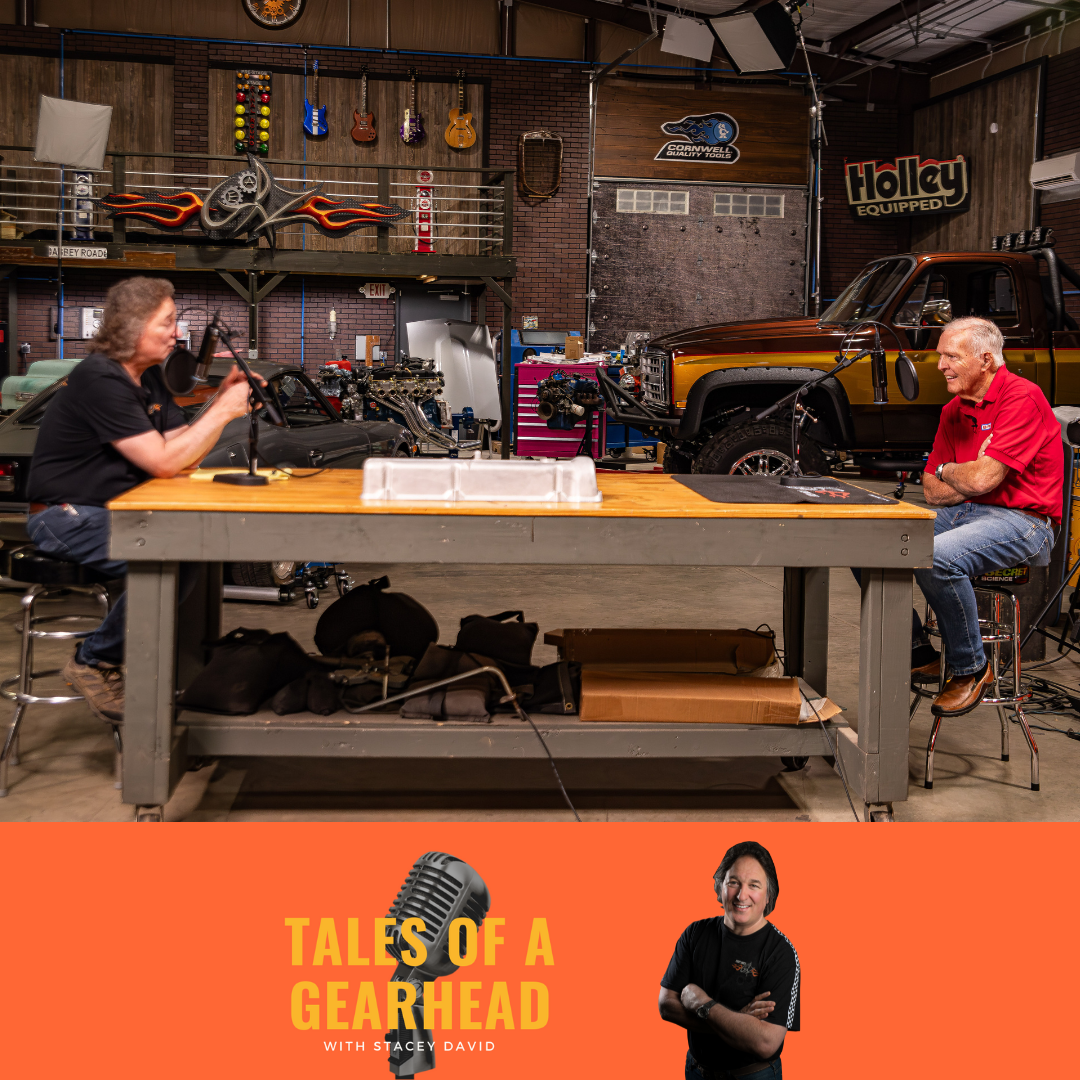
Hey, Stacy David here with the Tales of the Gearhead podcast. Now this is a
podcast about everything automotive, everything mechanical. You're gonna get
people that are just like you. Everything is gonna be wrapped around the
automotive lifestyle so we know you're gonna love it. Today's podcast is brought
to you by Holly Performance Parts and Woodward Fabrication. Alright, let's get
it rolling.
Alright, we have a special guest here today on the podcast. I have an absolute
automotive legend here and somebody from that magic era of racing and car
design. I have Peter Brock here and if you're not familiar with Peter, he was
instrumental in the second-gen Corvette design. Obviously the Shelby Daytona
Coupe and he is the the namesake behind BRE Racing and if you guys ever saw any
of those 240 Z's and 510 Sedans, you know Peter Brock's work. Peter, welcome to the
podcast man. Stacy, what an honor to be on the show. I'm really really stoked to be
here with you. Of course I'm here in town for the Zcar convention. You know, let's
talk about that. We're in here for Zcon. Yeah. A lot of people don't realize how
instrumental you are for introducing the 240 Z to the American public. So my
first question to you is with through BRE Racing, do you think the 240 Z would
have been as popular as it was if it wasn't for your success on the racetrack?
Well, I'm sure that we helped on it but the car itself is such a beautiful
design. It was so successful in the American market. Price-wise availability,
styling. It was hard not to be popular with the general public but as far as the
race car goes, I don't think it would have been nearly as successful without
the development that we did at BRE. Now, BRE is still around. People can still buy
parts for their Z cars, right? Right, yeah. We still make a few things on it. We don't
run the full development shop that we used to have because we're just too
busy building Aeroval trailers today. Yes. Actually, I want to talk to you about
that here in a minute too because that's the trailer that folds up. No,
it's a full aerodynamic super lightweight trailer. It's the big advantage, of
course, is that in towing it, it's so light and aerodynamic that you hardly even
know it's behind you and you can't appreciate how good it is really until
you've towed a conventional trailer. Conventional trailers, of course, are
designed to hold as many square boxes as possible. Yeah, yeah. But if you looked
at that from a design point of carrying automobiles, you'd be carrying all this
extra space up in the corners that you don't need. So the whole background of
the Aeroval trailer is to utilize the space as best as possible and reduce the
frontal area. So if people want to find out more about those trailers, where do
they go? You go to Aeroval on online. Aeroval. Yeah. Just look up trailers,
you know, automobile trailers, the Aeroval trailers, but. Okay. And these are car
hauler trailers, correct? Just car haulers, yeah. All right. Now, do you do
enclosed and open trailers? We make five different sizes. You know, I started
out simply making one for myself and it was immediately so popular that we had
to build a few more and then people wanted them for bigger cars, longer
cars and then guys from the rods that, you know, they had 44 coops or old
model A's wanted. So then we made a taller model as well. So by combining the
three links and the different highs, we've got five different models
available. Yeah. Now, if somebody looks into Peter Brock a little bit, they
understand you're all about aerodynamics. Yes. You from the cars, clear
back to the stingray. Have you always been into that? What is it about body
shape and aerodynamics that just always captured you? What is it? Well, the
first thing you've got to understand is as you double the speed on any shape
going through the air, the drag goes up by the square. Okay. You know, so you
can see it instantly if you're interested in anything that with of higher
speed or more efficiency that you're going to get the air to flow over that
shape as efficiently as possible. So it's the cheapest horsepower you can get if
you just think about what things you're going to look like. I think one of the
biggest things too and one thing that really makes your design work stand
out. A lot of people design from aesthetics. In other words, if they think
it looks aerodynamic, they think it is and that's not necessarily the case as
in the case of the Shelby Daytona Coupe. All of that is again, it's let's call
it the dogmob design because that all came from what the French did originally
in the 1930s. You know, taking the original shape of a fish or a raindrop or
anything considering looking at that thing you think from an engineering
standpoint, that would be the most efficient shape for an automobile. But
you can't apply that particular area and shape to an automobile because it just
doesn't work. An automobile would end up being, you know, 10 foot longer than it
should be. Yeah. So the minute that you try to compromise that you lose all the
advantage of trying to try to make this sort of graceful looking shape. And
there are other ways to solve that that don't look as good, but work far better.
Yeah. Okay. So when you look back, obviously the Zcar thing and BRE racing
was very popular. You had a lot of milestones like that. When you kind of
look at that, what thing are you kind of most proud of that you've kind of
achieved? When you look back on it, is there one thing that you're like, gosh,
I was sure. I'm just really happy I was involved with that. Well, I think the
thing that I'm most proud of is working with all the guys that helped me build
all this stuff. And looking back on it, all I see is the compromises that I had
to make during those periods of time. Wow. Everything that's been done has
never been done as much as I'd like to have it done. So I'm never really happy
with it. I'm very proud of the things that have been done. But I know how much
better each one of them could have been done if there hadn't been either
resistance or management standpoint or finances or disbelief in what was going
on. So everything could have been better. That is an amazing statement. It's hard
to imagine because of the amount of success that you did have with your
designs. What could have been? Now, do you think that's just part of maybe you
being a perfectionist or because obviously that's part of it? Well, I
think everything, if you try to be a perfectionist all the time, you hurt
yourself. You've just got to get stuff done and out on the road and prove it.
And then you can keep developing. And that's a far more successful way than
trying to do it all at once and then come out and then put it on the road and
realize that there's a lot more that could be done. So by doing stuff in
stages, it's faster and cheaper and more successful. Yeah. When you're at places
like ZCon or at some of these, because I know you do a lot of the Shelby or the
Cobra events and things like that. When you're out there at those events and you
see people building replicas of cars that you designed, how does that make you
feel? Oh, I'm always very, very honored that people would recognize where
those particular forms or shapes show up in automotive history. And I think that
those two cars have definitely got a spot. And I'm very, very proud of that.
And then I've got to look back and say, how did that occur? Like the
split window Corvette could never have happened without Bill Mitchell.
Yeah, that is Bill Mitchell's car. He directed the design. I drew it for him,
do exactly what he wanted. He knew what he wanted. But even when I tried to defer
a little bit from that, Bill was exactly pointing it back on the what he wanted
on it. So I can't claim that design totally on my own. The overall concept is
Bill Mitchell's completely. And I just did the refinement for him.
Yeah. Now the Shelby Daytona Coupe, though, that was your design, correct?
Completely, absolutely. Every line on it, every idea on it was... But there again,
because of the resistance in terms of finances and most important time just
to get it done, there was so much more that could have been done. And then the
fact that no more development would have been allowed on the car because they
just, the car, the attitude at Shelby's once we had the car going fast enough
was like, we're not going to spend another dime on it. It's already fast enough.
We're not going to do any more development. I said, the car can be so much better.
Let's do this. Let's do that. And they said, we don't have time to do it.
We're winning with it. Leave it alone. If it's good enough for today, it's good
enough for tomorrow. Wow. So he was already on to other stuff.
Yeah. Yeah. Have you ever thought about doing your own cars, your own BRE cars?
Not completely because I realized, having been in the industry, what it takes to do that,
I would better stick to what I do best as overall
concept and form with it and work with great engineers. I mean, I've worked with so many
good engineers and realized what they can contribute that I don't have because I don't
have that background. And they are as great an artist. You don't appreciate it because it's all
underneath the skin, but working with the great designers like Trevor Harris,
who I've got incredible respect for. It has done so much good stuff. Again, it takes a combination
of very tight people that all in the same goals to make something good.
Just like a band. I'd love to.
When you look at your life, a lot of people don't realize what a great driver that you were.
They look at you, they see you're a designer and this and that. They don't realize that you were
a really good race driver. Did you ever want to do that more or did Carol just not let you do it?
Because you taught the driving school for Carol for a while, correct?
Everything that I learned was from Ken Miles, believe me.
And that's like learning to play guitar from Jimi Hendrix.
I mean, it couldn't have been any better. But from the time that I got interested in cars and
that was working at a small shop in Sausalito when I was 12 and 13 years old and saw my first
race car fabricated from scratch and then taking a ride in that car and understanding that you
don't steer with the steering wheel, you steer with the throttle. That was probably the most
life-changing moment I've ever had. I always wanted to be part of that and want to be a race driver.
But I just got to the point in my life that I had to either make a joint to be a race driver
or team manager and to run the organization. And there are lots of good guys out there
that especially like John Morton that I ran into at the Shelby Driving School that when I put John
on the car, I mean, there was just nobody out there better. And not only was he a tremendously
skilled driver, but it was being a fabricator himself. He had a great sensitivity for machinery
and took care of stuff. So when the car came in at the end of two and a half, three hours,
I mean, it's still in very, very good shape. A lot of drivers out there by the time the car is
finished, the car is finished. You have to rebuild it completely. So that's where a great,
great driver like Ken Miles or John Morton shows up. Is there sensitivity to the machinery?
Yeah. People like to pigeonhole people into one situation, you know, how they know you. So they
look at you and they think, okay, so he's a sports car guy or he's a race car guy and they
don't realize you're also a hot rod guy. That's kind of your background.
Oh, it's all Southern California. That's where it came from, you know.
Because didn't you win the Oakland Roadster Show with the Ford Lack or whatever it was?
Yeah. Tell me, what was that? Ford with the Cadillac motor in it?
Yeah, it was the 46 Ford. I bought it sort of as a half-completed automobile and it was a
really beautifully done custom job. You know, it'd been chopped, it'd been channeled, it'd been
sectioned. But I continued on with the car and put one of the first overhead valve engines in
that people that were putting in. That was a Cadillac engine. I had a 54 Caddy engine in it,
36 lapel gearbox and stuff. So it was still fast, but it was a good looking car. So that was the
sort of combination. I couldn't see myself having a Ferrari or anything like that.
Briggs Cunningham was the guy that first started my thinking about building American cars and he
came very close to being able to do it. He never really completed the cars the way I think that
he'd like to have done. But the fact that he started doing it and was out there leading everybody
in that direction, you know, there wouldn't be people like Jim Hall out there that have done
the great stuff without guys like Briggs. You know, one of the most popular names in the automotive
aftermarket is Holley. But what a lot of people don't realize is that Holley now has a bunch of
brands that they represent and these are all very famous brands just like them. So when you're
looking for any kind of parts for your project, it would behoove you to go to Holley and look
through their brands, look at all the stuff that they carry. You can pretty much build a whole
project right off of their website. So if you need products, if you need something for an
electrical system or suspension or truck parts or motor parts or superchargers or anything like
that, Holley is the place you need to check out first. You know, if you've watched my shows very
much over the years, you know that I'm really into metal fabrication and metalwork. And people are
always asking, hey, you know, what's the best tools to use? What do you use? And obviously,
I've got a lot of really nice tools. But most of the stuff that you need to do really quality
metalwork is not that sophisticated. And it's not that expensive. It's body hammers, it's shrinkers
and stretchers, it's sheet metal brakes. And these are all things that you can pick up at Woodward
Fab. It's the stuff that I use on the show. And I tell you why, man, it'll get the job done. And
you don't have to spend a lot of money, but you do have to spend time getting to know the tools
and understanding how to make metalwork and how to make metal move. And that is what the Woodward
Fab tools will do for you. So if you're looking to get into doing some metalwork, man, check out
some of their hammers, their dollies, their shrinkers, the stretchers, their sheet metal brakes,
and get into it because I'll tell you why. Once you start to make that metal move,
you will be hooked, man. I'll tell you. And you'll love it. And there's nothing like having the
freedom to take a panel and go, you know, I think I'm going to change that panel because now I can.
So check out Woodward Fab.
You know, one of the things too that you were right in the middle of, you know, American car
culture was very drag race oriented, especially through the late 50s into the 60s. So to change
the public's mind into road racing was very difficult. You know, it was all happening in
Europe. We didn't have road racing as much. How difficult was that to try to get people
in America to get into road racing? How were you guys able to do that? Because you definitely
did it with a Z car. Well, the Z car was something that changed the perception of what automobiles
should be on the road. Because I mean, even though we had the Corvette here in the United States
as a really nicely done GT car, and we had the Cobras in very limited production, which were
all outperformance. We didn't have a car that had the best combination of low price,
very elegant styling, something that could match anything that came out of Europe.
And the Z car was that automobile, I think, that really changed the American perception of what
a good car could be. I mean, we saw the Opel GT, which was pretty good. It's pretty good.
And it could have been a lot better. But of course, the guy that was responsible for that,
Tony Lapine, went from Opel over to Porsche and led Porsche Design for 35 years, and tried to
convert a lot of the Porsche guys over to front engine, water cool stuff. And the whole Porsche
contention would never go along with it, because it wasn't what they considered a Porsche. But
they were very fine automobiles. And if you look at everything that Porsche has used finally,
and in terms of outright competition, they've gone either to front or mid-engine, not rear-engine.
So Tony had a lot to do, basically, as a stylist that worked on the program,
who actually did the production version of the Stingray Coupe with Larry Shenoda.
And he had left before Larry left the GM. So Tony never got as much credit for doing that car
as Larry Shenoda did when they did the production car. I'm very, very proud of the concept car,
which is the XB87, from which the Stingray developed. But actually, it was Larry Shenoda
that did the production version. When you look at the cars that are out there now,
is there anything new that you see coming out that you like as far as the designs and stuff?
Is there anything new that manufacturers are coming out with that you like?
The guys that are really doing this stuff is, I'm not sure how you pronounce the name of it,
but that's a GZ engineering and stuff out of California. They've taken the whole
idea of developing any component on a computer and designing that shape and form for as light and
as strong as possible. And you look at all the parts and there's nothing that came off a drawing
board. Everything has come off the computer. And it is so exciting in terms of looking at
all the components that they've made. That's really, really fantastic. It's far ahead of
whatever anybody else is doing. And I think it's going to probably have more influence
on what we see in the future than anything else.
You know, I'm glad you brought that up. You described designing cars using tape and string
with Ken Miles sitting in the car and these cars went on to win Le Mans.
So what do you think of the computer design stuff? Do you think you could have used that?
Would you have liked to use that? Or do you think something's missing that guys aren't
designing by the seat of their pants? I am still, I'm a dinosaur. I still work with the
string and cardboard and cut out paper dolls and whatever because everything's just,
if you, I don't care what you design on paper and I do all my cards on paper first before I
do them three-dimensionally. When you finally start putting that car together full-size,
you've got to put somebody inside it and see how it really works. At that point,
you begin refining it. Now, there's been so much done on that basis from computers. You can pick a
lot of those dimensions out and move them around and get a very sort of comfortable cockpit,
you know, whatever you want to design. So a lot of future automotive design is going to be
sort of prescribed by what's already been done because we've got so many regulations and so
much federal oversight on what's been done that automobiles as we know them now are not going to
be the same in the future. All that great era that was privileged to grow up in is gone and won't
come back. You know, I talked to guys about that a lot that are trying to get into fabrication
and building and building hot rods and that kind of thing. And I always tell them, it's like,
listen, you can draw it out as much as you want, but eventually you've got to build it.
Absolutely. And sometimes you step back after you've put all that work into it and it's like,
that just doesn't work. Absolutely. And it worked on paper, but now that you've actually done it,
you're like, oh. No, you've got to make it so much easier to mark stuff up. You know, you can go
down to the market and get a bunch of big cardboard boxes and a couple of, you know,
knives and stuff and tape, duct tape and stuff. And you can build that whole thing on the floor
and figure out what it all looks like, then take those dimensions and put them on paper,
and you'll be a lot closer than trying to put them on paper and then make them.
Yeah. Yeah. Okay. So you, because we always talk about music on here too, cars and guitars go hand
in hand. So you grew up in Southern California in the sixties. So what kind of music did you
listen to? What did you like? Were you a Beatles fan? Well, I think that, you know,
creating clear water or something like that. Oh, so you're talking, you're talking the magic now.
I mean, that's that whole era, you know, that's still my favorite. Yeah. So when you get in the
car and you turn some, something music on, what is one of those songs that you just love to drive
to? Well, I actually turn the radio off. The sound I like is what I can hear because I, my,
I'm almost totally deaf now, having ruined my hearing, but with all those racing engines,
that and, and a gunfire, you know, enjoyed shooting for a while. And I think that
without the proper protection, I've destroyed my ears. My dad did the same thing. He was a
competitive shooter for the military for years. Was he? Yeah. And so he's got some hearing loss,
too. Yeah. Because you didn't wear a hearing protection. That was untough, uncool. Right.
Exactly. You know, and even when I thought I had the correct protection in there, it, it, the,
the sound is so, so preventive and so destructive immediately that you don't realize until one
or two hours after you've been doing it. Yeah. So anyway, as far as the music, is there any
particular songs that you like to put on? You did say CCR. So I'm sure there's absolutely, you know,
anything from, I think anything from that particular era, you know, I mean, even stones,
it's always fun to listen to. If I look at all the great music that I really, that I,
that I liked when I was growing up, it was all before my time. All the big band stuff.
Really? Is stuff that I have a greater appreciation for, you know, because I love great dance music.
Yeah. And so. You know, that makes sense though. When I look at your style of design,
it's very classic. Yeah. So that totally fits in what kind of music that you would like. Yeah.
Yeah. No, I think I'm, I'm, I'm, I'm a forties guy in terms of what I really appreciated most
and the great big band eras. I mean, because those arrangements were just, they were so beyond to be
that many instruments and put it all together was stuff that I have the greatest appreciation
like the Glenn Miller stuff. Oh yeah. Miller, you know, just fabulous during the war was great.
Yeah. Going back to design a little bit. Okay. So you were in the middle of the, of the battle
with the Shelby Daytona Coupe. Then of course, there's the Jag XKE Coupe, which has that same
shape roughly. And then you have the Ferrari 250 GTO, same kind of shape Corvette and 68 comes out
similar type shape. And then there's this Z car that comes out with a similar type shape.
Did it kind of give you a warm fuzzy feeling that that's what your design is part of that influence?
I don't think I can claim anything that at all. I think because as designers, we all look at what
else is going on in the world and we draw a little bit from this or a little bit from that
and interpret it ourselves. So the Z car is definitely an interpretation of many great forms
and proportions and stuff that was appreciated by the designer. And that's what makes the car
so great. But it's not a steal of any particular car. It's a great amalgamation of all of the
great things. Yeah. And that's what makes you such a great, you're so, you're so humble with
the things that you've done. You're so appreciative. And that's, I tell you, it's a great lesson for
people that it takes a team to put things together, whether it's a band or a car builder or a show,
whatever, it takes a group of people. And that's awesome. Let me ask you this. When you look back
on your life, you've lived a very productive full life. Is there anything particular that you want
or would like to be remembered for? When people think back and they go, well, Peter Brock was
blank. He was this. Is there anything particular? I mean, that's a hard question because nobody
looks at himself that way. I look at it probably the most exciting period of my life, which I had
more fun doing than anything else was hang gliding. I actually had the largest hang gliding
manufacturing company in the world. Son of God, you are like an onion, man. You just keep,
this is more stuff. Well, this hang gliding, because the whole thing started really on the
sand dunes out near my race shop. We were jumping off of sand dunes. So you were one of those thrill
seeker guys. Oh, yeah. I mean, it was just, it was ably. And these things were all made out of
bamboo and duct tape and, and, and we were just, you know, flying these things on the sand dunes
there and then started really developing it, you know, with aluminum tubing and sail cloth and,
and starting to jump off higher mountains. And then we discovered thermals where we could start
climbing and circling and going for distance. And this became the whole development of the
whole hang gliding and foot launch. So you were right there at the beginning of that hang gliding
thing? I did it myself. Yeah. Oh my gosh. There was three companies really in Southern California
that did it. Yeah. And we were all competitive. And of course, this was a sport that was literally
unseen because we were all the places we were flying. People never saw we were up in the mountains.
And, and, but when we finally came to have our international championships, we're held in the
Owens Valley up in, in California. People have no idea that, you know, that you've got this little
80 pound lighter and that you're taking off, you know, on the side of a mountain and you're
climbing to 12 to 15,000 feet and you're flying hundreds of miles across the desert. Oh my gosh.
You know, that is real thrill because what you're, you're climbing and thermals and you're
using all natural energy for it. And it is. Purist type of flying. It's got to be the purest type
of flying. It's the purest form of flying. Yeah. Because it's all weight shift controlled and,
and you can develop it even farther. So there are now some really beautiful little
super light foot launch sail planes now that are full three-axis control. There's
exciting to fly as any super sail plane. So from a standpoint of something
really thrilling to do and catching a thermal and climbing those thousands of feet, that's
every bit as exciting as it ever was driving race cars. Now, are you still involved in that at all?
No. I screwed up my back ears back and can't even lift anything anymore. But, you know,
every day I go out and look in the sky. Oh man. That's got to be awesome. You know, if you can
see those great cumes like we've got outside out there, look, I just see how much lift is being
developed by those clouds and what kind of flying it would be. That's where I'd like to be. Yeah.
Well, for people that want something for their Z car, there's BRE. They can still go to BRE and
get you like your spoilers and your air dams and your mirrors and things like that. Yeah. These
are all things that will, they actually improve the performance of the car in terms of overall
driving. Yeah. And those are still available from BRE. But there's some really good shops in California
that if you want to build up a really fine Z car that nobody's going to touch them or guys that
specialize in those L series engines that are putting out so much more horsepower than we did
back in the day. Sure. Sure. It's like anything else like the Flathead Ford V8. You know,
just amazing what happened with that engine over the years. Oh my gosh. Yeah. Nobody would have
ever suspected what was going to happen with that. Yeah. And it took the overhead valve engine really
to supplant it. Yeah. And then of course, if they want a trailer, there's aero vault. Absolutely.
There isn't anything better. Yeah. And if you don't know much about Peter, you need to just
Google him and just look at his history and his biography. It's very amazing. Peter, it's an honor
to have you on here. It's great to talk with you. You are a national treasure. You really are. Oh,
thank you. You're just one of those guys from that magic era and you were in the middle of it.
And it's just having a great to meet you and have you on here. Well, thank you. You know,
it doesn't happen by yourself, believe me. I was going to say, I may just put you to work here
because I see you looking at some of this stuff. Oh man, your shop looks so good. I just come in
here and spend hours in here. Yeah. Yeah. That's awesome. Thank you. Thanks, Dave.
All right. That's our show for today, which means you need to get out there and start working on
something. Spend some time turning wrenches. You might be surprised how much you like it.
Now, make sure that you check out our website, StacyDavid.com, because we've got all kinds of
new products and some other great stuff that you're just going to love. I've got a new children's
book called Iggy and the Stick Man. This is a story about a lowly stick that has dreams of
greatness only to be ridiculed by his friends. But then through a series of events, he learns that
it is possible to get up off the ground and change everything if you're willing to persevere.
You need to check it out. Also, make sure you check out our social media. That's Instagram,
TikTok, Facebook, YouTube, all at official Stacy David. Our social media is where you're going
to find all of our bonus content, the giveaways, the contests, the trivia. We even have extra viewer
projects that focus on what you are working on. Also, the new season of Gears will be on Racer
Network and YouTube will be the place where you can view all of your favorite Gears episodes,
as well as the full project builds that follow a project from beginning to end. So that's really
nice. But remember, the most important thing is you need to get out there and turn some wrenches
yourself. So get a project and start working on it. Also, if you want to take your project to the
next level, check out Holly and all of their related brands. They will definitely have something
that will help you. Finally, if you need to work some metal, check out Woodward Fab. These are the
tools that I use in the shop and they've been making quality metal products since 1966. All right,
that's all the announcements. We're all up to date. We'll see you next time.
Marketing is hard. But I'll tell you a little secret. It doesn't have to be. Let me point
something out. You're listening to a podcast right now and it's great. You love the host,
you seek it out and download it. You listen to it while driving, working out, cooking,
even going to the bathroom. Podcasts are a pretty close companion. And this is a podcast ad.
Did I get your attention? You can reach great listeners like yourself with podcast advertising
from Libsyn Ads. Choose from hundreds of top podcasts offering host endorsements or run a
pre-produced ad like this one across thousands of shows to reach your target audience in their
ads. Libsyn ads.com today.
About this episode
Peter Brock, an automotive legend, joins the podcast to share insights from his illustrious career in car design and racing. Known for his work on the second-gen Corvette and the Shelby Daytona Coupe, Brock discusses the impact of his designs on the popularity of the 240 Z and the evolution of BRE Racing. He also delves into his passion for aerodynamics, the challenges of perfectionism in design, and the importance of teamwork in automotive innovation. The conversation highlights Brock's experiences at events like ZCon and his ongoing work with Aeroval trailers.
Stacey has the legendary PETER BROCK in the shop. They dig deep into Peter's history working with Carroll Shelby designing the Shelby Daytona coupe, his BRE racing days, working with Nissan perfecting the original Z-Car engine, and his early pioneering work in hang glider designs. Yes, you read that right, hang gliding! Peter describes how he took those early bamboo, duct tape, and plastic "kites" people were using in the late 1960's and turned them into state-of-the art hang gliders which led the industry in safety improvements.