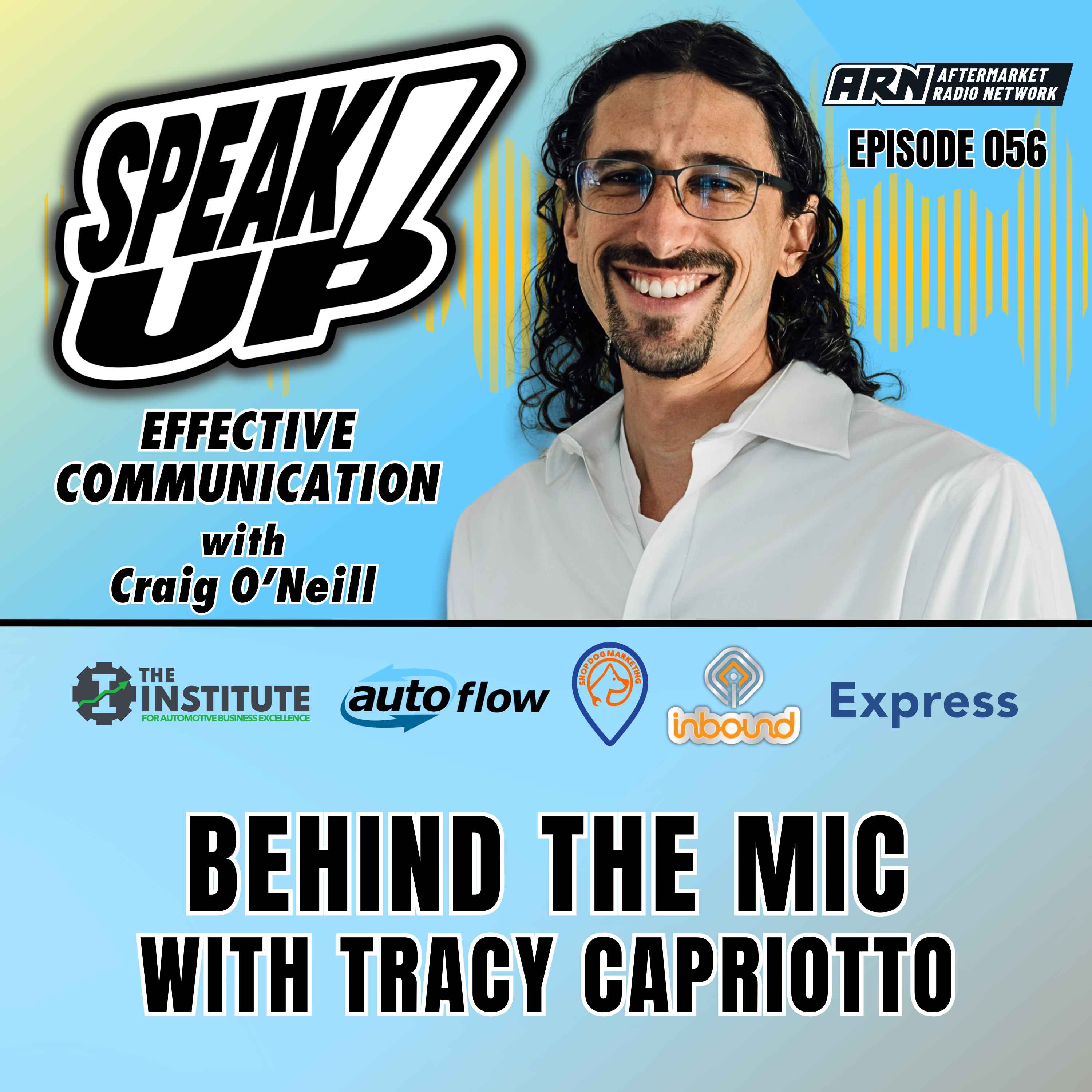
Welcome to another episode of Speak Up Effective Communication, the show on the Aftermarket Radio
Network focused on our communication, leadership, and listening skills.
In our episode today, I'm so pleased to introduce, well, really my boss, Tracy Capriato.
Thanks for joining me, Tracy.
Thank you so much, Craig.
It's an honor and a privilege to be on your podcast.
We have so enjoyed having you a part of our Aftermarket Radio Network family, and really
your podcast every week, I learned something from it.
So it has been a great communication podcast and really rounds out our entire network
of kind of a one-stop shop of running a successful auto business and also just personal life
stuff.
Absolutely.
This has been such a fun journey, too.
Learning to podcast is a communication platform, by the way.
Learning tons from you, too.
So I really appreciate that.
Now, here's the thing.
What I want to do today is we're introducing Tracy.
This is a ton of fun for a lot of reasons for me because, Tracy, you're usually behind
the mic.
You're usually behind the scenes.
You're doing a lot of stuff.
You've been amazing.
And you've recently been the president of our Toastmasters Club, remarkable results
Toastmasters, as the immediate past president.
That's an official title in Toastmasters, by the way.
The IPP, the immediate past president.
I'm going to add that to my email signature.
Yeah, perfect.
But no, the role now as the outgoing president is that you continue to coach and mentor the
new president and their term.
So Josh Cagle is our new president.
We'll have a conversation with him eventually, too.
But I just thought it was such a great time.
I want to hear some of the reflection on your communication journey coming to that
point.
So it was such a big deal to even accept the nomination when it was suggested for you to
take the role as club president.
And a lot of other people out there are probably wondering, gosh, do I have what it takes?
Is that something I could do?
Anything like that?
Taking the leadership executive type role in a volunteer organization with an actual
mission.
And it's about communication skills, too.
Good stuff.
So, hey, this is the thing.
We're going to go into Tracy's story.
We're going to hear from her about her past and all of the things that she's
learned through being president in the club and well before that.
We have a word of the day as we do in each episode.
And we picked this one out just before we started the episode here.
It was a good one.
The actual Webster word of the day is winsome.
It's an adjective and the definition of this word we will give you after we hear
a word from our sponsors who make this show possible.
Did you know the Institute helps shop owners scale to multiple locations?
Here's the solution for building productivity, profitability, and growth.
Learn more at WeAreTheInstitute.com slash business dash assessment.
Your partner in technology, Autoflow is able to enhance your client interactions before,
during, and after the visit from a single thread.
To see how Autoflow makes it simple, visit autoflow.com.
Your trusted companion, Shop Dog Marketing, is right by your side, attracting the best
customers and building long-term growth.
Call Shop Dog Marketing today or visit shopdogmarketing.com.
Unlock your communication insights with Inbound's AI-powered call analytics for auto repair shops.
Learn more at callinbound.com.
Are you passing along credit card fees to your customers?
No one likes that.
Express is the only 0% fee alternative to credit card surcharging.
Visit myexpress.io.
All right, we're back.
Thank you so much for joining us today.
We have Tracy Capriata with us.
And as I mentioned, the word of the day selected just before this conversation, so perfectly
from Webster themselves as their word of the day.
And today, right now, as we're recording this, it's August 8th.
But winsome is the word of the day.
Adjective meaning generally pleasing and engaging, often because of a childlike charm
and innocence.
Perfect word of the day, Tracy.
Yes, it really worked out.
It did.
No, I hope you can take that as a compliment, too, because I do feel that word absolutely
describes you.
Oh, thank you.
No, totally.
But this is the thing, Tracy, the people who get to hear from you, they see a side
of you that I feel like, as I've gotten to know you, you haven't always seen yourself
a quiet beginning, as you put it.
I think people would actually be really surprised to hear that I really struggled with public
speaking in all capacity.
I was a kid in school that never raised their hand.
I didn't want to speak out loud.
Reading a passage out loud in front of the class was the worst.
I would count the heads ahead of me so I could find out what was my paragraph so I
could just memorize it and try to get it down pat perfectly, even calling to order
like a pizza or calling a doctor's appointment.
Like, I did not want to do any of that.
I had major social anxiety about speaking.
And so when I tell people this now, they're like, what are you talking about?
You're so friendly.
We see you at conferences.
And I think it really took a big transition and more of my later life in my 20s, and
especially with this job now and through great mentors like you, Craig, and also
your boss, Chris Cloutier, have really helped me find my voice and kind of get
my sea legs a little bit.
Chris is an amazing guy.
He's put me on this path as well.
His mentorship inside of the communication circles has just been so
priceless.
Toastmasters was referred to me, as you know, by Chris.
And it's been six years now that I've been in Toastmasters.
And I think now it's what, how long for you?
A little over two years?
Over two years.
Yep.
Wouldn't have happened.
That club that we had created, so Remarkable Results and Autoflow, both
sponsor the Toastmasters Club.
We call it Remarkable Results Toastmasters.
And anyone listening, of course, you are welcome to be our guest on the first
and third Thursdays of each month.
But man, this wouldn't have existed for you to even become president of.
I started out in the role as president as my term ended on that first year
as we had this newly chartered club.
It's just getting its routine down.
I approach you.
I ask you to consider accepting nomination as club president.
What went through your head?
Well, and through my head is I can't say no to Craig.
I'm not going to be able to say no, you know, we're both co-sponsoring
this club, I have to say yes.
And that is also something that I've learned through people in our
business in the repair industry, just say yes.
And I've heard so many people say that when it comes to opportunities,
even the scary ones, especially the scary ones, to just say yes and do it.
So you asked me, I said, sure, I'm not even going to bring up the fact
that I was nominated when I was out of town.
So technically I was a little voluntold, like I wasn't even here.
And then all of a sudden I got an email like, great, Tracy,
like everyone said, you're club president.
And even that first year of us having the virtual Toastmasters
club, I would sweat those meetings so bad.
I have no idea why.
It was, I think, just another stepping stone of me getting comfortable
in the virtual world with speaking up.
And before every Toastmasters meeting, I would be so nervous.
What am I going to say?
What is my role?
I'd be looking over the notes, trying to memorize them.
And I would feel at the end of Toastmasters, oh, I'm so glad I did this.
So those small steps really helped.
And then, of course, becoming the president, now you're in it.
And now you have to take a leadership role.
And, you know, through your guidance that helped me a lot kind of find my
ground of how am I going to get my own groove when it comes to presidency.
You know, you had said, have creativity, you know, make this your own.
And I really love that idea.
So now I'm in charge of leading the meetings and sending out the agenda.
So it also really gave me great skills for meetings in general, which Sara
and I use a lot in our communication class of structuring meetings
and taking kind of the stigma out of meetings.
You know, this should have been an email and Toastmasters has a really great
format with the hour, you know, minute by minute is locked in there.
And I think it really helped me learn that leadership.
It doesn't mean a C-suite executive when we were younger, especially for me.
I would think, oh, the CEOs, those are the leaders, the authors,
those big people on stage, like they have it all figured out.
And then really, it's through this business that I learned leadership comes
in all roles, no matter what role you have in a business,
whether you're an apprentice at a shop or a service advisor, everyone can
lead their own role and have the autonomy to do so.
And so I think all of that kind of really helps solidify like I can do this.
And I have obviously the support of everyone in our Toastmasters Club.
It's a very supportive group, a very supportive group.
And this, I think, is the big difference.
As an adult, I personally find these sort of situations easier.
And you talked about this, we talked about this before, too,
when you're a kid and you're in class, is that the same experience?
Oh, my gosh, totally not.
Because I was a kid in class where you raise your hand, you answer a question.
If you're wrong, you get laughed at.
The teacher jokes at you and says, no, who has the right answer?
That can add a lot of hesitancy and also anxiety about being right or wrong.
And then you learn to almost shut down.
Like, I'm not going to speak because I don't know if it's right or wrong.
And I don't want to be made fun of.
I didn't realize how dramatic of an effect that that would have on me
in those formative years and that it is totally different when you're an adult.
Also, when it comes to training events, we're at conferences all the time,
the adult education is really not talked about a lot in most other businesses.
You know, I look at my friends that are in all sorts of businesses
and they don't have training conferences.
They're not doing personal growth.
They're not measuring anything like that.
And this industry has a huge advantage.
But I think a lot of times people might get a little gun shy about attending
training because it brings back all those thoughts about school.
I don't want to sit there.
I'm going to fall asleep.
Like it's so boring.
Like, you know, what are they going to teach me now?
And it's not rewarding because it maybe hasn't been rewarding in the past
being in school and going through the whole rigid system that we have.
I could see how people might not understand training and going to
automotive conferences if they've never been.
And also with Toastmasters, if they've never been to a Toastmasters
meeting or ours, you know, there are in-person ones that we encourage
people to go to in their own area.
But this little group that we have, we are so supportive.
You're not going to feel out of place or, oh, my gosh, what happens if I make a mistake?
You realize this is common.
This is part of the journey is making mistakes.
And really with Toastmasters, the critical feedback and listening to other
people giving critical feedback, that really clicked in for me on,
oh, critical feedback isn't scary.
Critical feedback doesn't mean you're hurting someone's feelings.
And those examples were huge for me.
I think this is the big difference and why the Toastmasters Club is a great
spot for people to flex their leadership skills, to take a role of leadership
and still practice developing the communication, because this is one
of the unique environments where actual mistakes are expected
and totally expected in the sense that, yeah, you're going to get feedback
on it, but since everybody's there for feedback on exactly those types of
thing, it's a community that has a high degree of grace and wants to see you succeed.
I've never had that sense when I was coming up in school either.
People don't think of Craig back in the school days, a small thing kid.
Super quiet.
I didn't start finding my voice probably till, oh, junior year of high school.
And I was just more of the class jokester at that point.
And that was just the how it was.
But this is as adults, learning gets easier.
I firmly believe that as long as you continue to keep some of that brain
elasticity going and trying to stretch yourself into new roles and do new things,
it's not scary anymore when you're with a group of people like this.
And you don't have to feel like a mistake is now a part of your identity.
The awareness you develop with Toastmasters was pun intended, remarkable.
The um or counter, once you take that role,
your ears will never be the same for the rest of your life.
And having also listening skills for different parts of the meeting,
depending on your role, I always equate it to like a radio dial
where you're like tuning a station like, OK, I'm going to be the counter.
I'm only going to listen to that.
I'm going to be the general evaluator.
And you listen to the meeting completely different.
If you're the um counter, it can be hard to understand the context
of what the person is speaking about because you're doing your little tallies.
And you realize that the listening skills you have are fine tuned
and can be kind of tapped in and tapped out depending on the conversation
or the environment you're in.
And that for me was huge, building that awareness of what we're saying,
how people are perceiving it more importantly.
I think a lot of times, like especially in this generation,
we're so self-centered of I'm going to post a selfie and I'm going to do this.
I'm going to the grocery store today.
It can be so ingrained of like, this is what I'm going to be saying.
This is what I'm doing, but we don't actually have curiosity with other people.
And then it can even backfire where people think, well, my intentions were the best.
So if they took it the wrong way, that's totally on them.
Oh, yeah, shift of responsibility.
Most masters in communication, you learn that accountability for the words
that you say and how it can affect other people because we are all so different.
So our perception of even one sentence in an email could be taken so many
different ways. And if you're not stopping to think about that before
you're communicating, you're already setting up barriers.
The top shops in the industry don't stop at one location.
At the Institute, we work with shop owners who want to expand,
whether it's opening a second shop, acquiring new businesses or building
systems for long-term growth.
Some of our clients are aiming for hundreds of shops and we're helping
them get there. Ready to scale? To get started.
Visit. We are the Institute.com slash business dash assessment.
It's time for today's suck less spotlight from Auto Flow.
Today's spotlight is on advisor eye twitches.
Listen, clients like to stay informed throughout the repair process and studies
indicate clients are most satisfied receiving text updates versus phone calls.
But call you they will interrupting everything from estimating
to quality conversations and your game of solitaire.
That is unless you text them first using Auto Flow with
Auto Flow's automated text update, your phone only rings for the right reasons.
That way, with less phone interruptions, your eye twitch will definitely suck less.
For this and more things that could suck less, visit AutoFlow.com.
Ready to boost your auto repair shop success?
Shop dog marketing is here to help you.
We put customers first using AI to create standout content that ranks,
harness the power of mobile first and voice search
and let our expert team help you sweeten your revenue with more car count.
Shop dog marketing offers a free guide on using AI to drive more repair orders.
Get your guide today and watch your auto repair shop thrive.
Visit shopdogmarketing.com.
Inbound has exclusively served independent auto repair shops
with expert communication solutions for years.
Now, our robust VoIP platform ensures you stay connected
while our industry leading AI analytics take your business to the next level.
We provide the tools you need to understand your customers
and optimize every interaction.
Choose Inbound for proven expertise and unmatched innovation.
Visit callinbound.com and discover the difference we can make.
Credit card surcharging sounds effective,
but is this single most damaging action to your shop in the last decade?
If you're surcharging, you're tarnishing your reputation
and losing customers as we speak.
Express is the only zero percent fee option to surcharging
that your customers already know how to use.
No tricks, no hidden fees, just a smarter way for auto shops
to keep what's yours and do right by your customers.
Book a free consultation with Express today by visiting myexpress.io
and see how the most successful shops in the country
are flipping the script on credit card processors.
You've heard me quote Bob Greenwood a number of times.
You've known Bob long time yourself here to rest in peace, Bob.
One of the things that stuck out to me in his class was his message
on why he dresses nice.
He's wearing a suit and tie to these automotive events.
And this is the thing is Bob made a great point of you always do
attention to it in the best way possible.
He says, you know why he would say ask his class.
You know why I'm dressed nice.
It's out of respect for the people that I'm meeting with.
You're worth it.
And so I see communication as a sense of your clothing yourself
with good communication skills out of respect for the people
that you're meeting with.
It isn't to try to impress people with how great and wonderful you are.
It shows respect to an audience to give it the respect that communication,
good communication skills truly deserves.
It's not about trying to be better than someone else.
It's trying to be your best for respecting others.
And Toastmasters is not just for if you want to be a presenter
on a stage somewhere.
This is for everyday communication.
I think that can get lost.
I'm glad you said that.
People might have, you know, the stereotype, oh, Toastmasters.
Well, I'm not going to be a public speaker.
So why would I join?
But this is everyday use in our lives at work and at home.
And it's so critical.
I mean, Sarah and I have had multiple classes on communication.
Sarah Fraser, for those of you that don't know Sarah, yeah.
Sarah Fraser, I just like Sarah.
Everyone knows Sarah.
Yeah, everyone knows Sarah.
And we've received amazing feedback that really validate what we're
presenting and what we're talking about is very important for today's world.
Completely. Yeah, you've heard a few of the episodes on the podcast.
Of course, I seem very against AI and it's not that I can't embrace
all the good that it's doing in the world.
It's just that, oh, when I see it communicating better than people
can communicate, honestly, it just feels like, no, now people are going to take
the easy road and they're never going to work on their communication skills.
Again, we're going to have this big disconnect.
Like if you don't have the AI, you won't be able to communicate good at all.
You're going to become so hyper dependent on it.
I see the world heading this way too fast.
Absolutely. Technology, you know, kids are not playing outside like they were.
They're not picking up the phone to call a landline home and say,
hey, Mrs. Smith, can I talk to Sam?
You know, those skills aren't being developed.
I think about that a lot with my niece and nephew.
There's five and seven and what is their world going to be like when they're older?
Like they already know how to stream into Netflix.
Kids now are also used to the immediate satisfaction of watching exactly what they want,
no matter what time.
They're not even doing the, you know, Tivo like we used to and you got to
fast forward those commercials or wait through the commercials or there's nothing on.
So you just watch whatever you go play outside and the stream of immediate sense
experiences as we quoted in the last episode.
They can't be bored being in a car.
They're on a tablet being at a restaurant.
They're on tablets. Well, what is that doing?
It's showing them that if you're not doing something, you should be.
Oh, it's absolutely the case.
Yeah, I'm sitting on my desk here right now to his book.
I pick up and take sips of the anxious generation, how the great rewiring of
childhood is causing an epidemic epidemic of mental illness by Jonathan Haidt.
Wow. Fantastic read, but a little bit depressing.
Yes, I can imagine.
Yeah, because no, we've made mistakes.
We moved into technology too quick.
But hey, that's the world we're in right now.
The world that you started out in, you didn't even realize this.
It sounds like as we go back to your childhood, Jeremy Glasgow,
a wonderful initial sponsor of this program as we rolled out.
He was on, I think it was episode six, we called it Jeremy in the jungle.
We had the concept of being, he was raised in the jungles of New Guinea and he came out.
Great, he did.
But when he came back to the US, he has the term, the third culture kid,
where he's like, not, hasn't been raised with the same experience
as these people that he's around.
Your experiences are dramatically different.
And that was your case.
In case someone doesn't know, I am adopted.
My brother and I are adopted.
You know, we laugh all the time that people think I'm Karm's wife
when they see us at conferences because they see our last names on the badge.
Oh, OK, must be, you know, Karm's young wife.
So no, that's my dad.
That means your mom needs to go with him more often.
Yes, that's true.
There's a stigma there too.
I mean, Bill Belichick is not helping our case at all.
So my brother and I are both adopted from South Korea.
And even that is something that I've started to tap into in my adult life
of kind of exploring more of adoption.
The initial stages of me going through my childhood in those early months,
I went from the hospital to a foster care for three months.
And then I'm being flown halfway across the world, 22 hours to now join my family.
And I didn't realize like that could have probably had a mark a little bit
on just those first initial months of growing up.
I've struggled of wondering, you know, why was I adopted?
You know, why was I put up for adoption?
Why couldn't my birth parents take care of me?
Did they not want me?
And you kind of get that feeling of I wasn't chosen,
even though my parents chose me and I have a wonderful life with my family.
They are my family.
You know, when you're little and young and you're thinking about adoption
and you're wondering why that can be really hard to go through.
And when I was going through school,
my brother and I are really the only two Asians in a predominantly,
you know, all Caucasian school district.
So we looked different.
And this was in the 90s.
It's different today.
There's a lot more diversity today.
But back in the 90s, there really wasn't a lot.
And adoption wasn't as kind of mainstream as it is now.
I struggled with racism and looking different.
And that also, I think, fed into I don't really want to speak up
because I'm already different.
I don't want to be more different.
And I think that kind of held me back where I was so shy
because I kept wondering, why do I not look the same?
I'm adopted. What does that mean?
And then, you know, kids just tormented my brother and I for being Asian.
And that's also really hard to understand growing up.
You know, we can't help the way we look and why are we getting made fun of?
I understand everyone gets made fun of in school.
I totally get that.
But I will say when you're a different race
it can add a lot of baggage.
And so that's why I really resonated with Jeremy's episode talking about
third culture kid because, you know, I was Asian and so I was different.
But then if I didn't meet any Asian children, they were from an Asian family.
They weren't adopted into an Italian family that has sauce every Sunday.
And so even that context was different for me.
And so there was a little bit of feeling of being lost.
And I think that also fed into, you know, who am I and what am I going to be doing?
And that's something that we all search for in life.
And I'm slowly starting to understand it more.
But yeah, I think in the beginning it was challenging
and it took some big moments for me to kind of move forward.
I mean, it felt safe to be quiet is what I'm hearing for quite a while
in your life.
And that is so what's funny to me is like how much time you spend behind the mic
in the podcast.
I've heard so many of them and I've done podcasts with calm and you're there.
You're producing the thing.
And yet when you speak, it's so on point.
Your listening skills are so sharp that I feel like you've done
so much more listening than most of us that now at this point,
you have more to say that we should all listen to.
So I mean, I think those experiences are a blessing.
And it sounds like you look back on them now as as a blessing, too.
Then you can look at it as a bit of a trough, if you will.
And that trough is long and it's probably very challenging
and more challenging even than you're describing in some cases here.
But the peaks are there as well.
And it seems like, yeah, you finally started peeking out a little bit more too.
So this is good.
And that role as president, big step forward in it.
Oh, yeah. That's great.
That's a tough thing.
And I was so glad Jeremy did put that out there.
I had a few comments from people on that third culture thing.
It's like, ah, yes, that's a perfect term.
You're in this group, but you don't quite fit in.
You fit in with this group, but you seem a little different
and all the things that go with that.
But then here's the funny part for you.
Now you became an influencer in the automotive aftermarket
and you're a female.
Right. I'm female and I'm Asian.
So there's like a trifecta there somewhere.
But no, this is the thing.
And it's been so good.
And the women in auto care group that started to manifest itself really well.
It's like this whole other culture now inside of the industry
that has been desperately needed for so long.
I don't feel like the aftermarket gets recognized as a true profession
until everybody who's anybody different or whatnot
feels welcome and listened to inside of it.
And this industry I grew up in the 90s, too.
I remember the idea of ever bringing in a female service advisor
in the shop seemed like taboo because by golly,
then we're going to have to clean up our sense of humor
and everything else that goes with it.
Bathroom is going to have to be cleaned.
What? Yeah, that too.
All of the things, right?
But these are all the things that really, you know,
everyone should be moving towards, I hope.
I do love how the industry with women in auto care
and also amazing women in automotive have really had a place
for women and also Napa Auto Care is also creating a women's group for everybody.
So I think that is needed, especially in a male-dominated industry.
It is what it is.
And it can be a little daunting when you're maybe the only female in the room.
I mean, it does come in handy when you have to use a bathroom
because there's never any lines.
That is the plus.
But I really enjoy attending the Women Auto Care Conference every year.
And I love attending the amazing women
automotive social events that they have at most conferences now
because you kind of have that belonging of, hey, there's a girl's night
and we're going to set the guys over there.
We have our own girl time and it's a nice space to have, even if you're a spouse,
you know, it's everyone is welcome.
And that can also be if you're a spouse of a shop owner
and maybe you're not in the business, you're still welcome.
You know, you're still a part of the business no matter what as a spouse.
So I'm really thankful for those organizations that have opened up,
you know, a place for women.
Nice. And you won an award with Women in Auto Care Best Media Outreach
to female audience.
And that was my first podcast ever.
I did a solo podcast.
I don't even know what I was thinking, but I was so jazzed up from women
in auto care that I wanted to capture my experience.
And so I recorded a podcast on my very own and I talked about the challenges
I had where I had imposter syndrome, where I couldn't walk into the breakfast
on the first day by myself because that big room full of 300 women.
Oh, my gosh.
But if I don't know anybody and I waited in the lobby for my friends
and then a huge moment for me was at that same conference,
I couldn't walk into breakfast by myself the next day.
There was a segment where we were able to share on the microphone
anyone who wanted in the audience, just an experience that they went through
that they want to share to maybe help others.
And again, don't know what I was thinking.
I was in the back of the room, my hand shot up
and I talked about on a microphone from 300 women,
a sexual harassment experience I was involved in in my early career in my 20s
and how I didn't realize at that time how significant it was
and how it was downplayed by the company, downplayed by the co-workers
and how embarrassing it was for me to the point where I just said,
no, it's fine, everything's fine.
You know, you don't want to be the ripple in the water,
even though it was inappropriate and wrong.
Now looking back on that, you know, I wanted to share that story
for other women so they can reflect on maybe past experiences
and have the courage if something happens to them now to your voice
and speak up because it's really important to you.
And I think maybe women, especially there's such a stereotype of like,
you know, being quiet and being presentable.
And what's really helpful is I've met so many amazing people
in this industry that are very aligned with the human side of connecting,
the curiosity side.
And I think that's what really helped elevate me and my communication journey
that's what you need to do.
If you want to be a better communicator, you have to surround yourself
with people that also view that as a high priority in their life.
Yeah, they're on that same journey.
I'm really glad you shared that stuff, too, as a father to two daughters.
I have one son, two daughters.
And I'm fully cognizant of the fact that the world has changed
and I feel like it's changed so much for the better
that sometimes I forget that the problems that you're describing
for how women might feel like they need to stay quiet still exist.
I wouldn't know about some of the racism that exists in the world still.
And except for the experience, my wife has two sisters that were adopted
as well from African American families and raised with Caucasian
Dutch Christian reform family here in West Michigan.
Yeah, they stood out, too.
But my goodness, the stories that we hear.
Those are really important to hear about sometimes.
I mean, just going around town.
The mean things that people will say or just how they feel at work sometimes.
And the things different managers will tell them this stuff still exists in the world.
It still exists.
And like you say, speaking up about it, I mean, the title of the show is Speak Up
and never really intended to be like, speak up about something terrible
that's happening, right?
But sometimes you have to.
It isn't just like, let the bad stuff go away, speak up about it.
It's the only way it gets better.
I feel it's improving, I think, at least publicly.
People recognize that there's a wrong way to treat individuals and they won't do that.
But there are some people who think that the eye of the world isn't on them.
And in that moment of privacy, they might be more mean than they would.
And I know what happens.
My parents never knew of that story until I told them after women auto care.
Oh, my gosh, you never told your parents.
I never told my parents.
I was so embarrassed that I just, you know, in my early 20s, this was a great job.
I don't want to lose my job.
And so, yeah, and they were really upset.
They were like, you know, why didn't you tell us this?
And why did you feel like you couldn't?
And it was really just an embarrassment where I just didn't want to deal with it.
And but there should have been repercussions and there wasn't.
It's interesting.
Sometimes that fear of embarrassment is what makes us do things.
I had just listened to a book on a drive the other day, a guy in the Vietnam war era.
There's thinking about escaping to Canada to dodge the draft.
And what was interesting, he was afraid of going to war.
But the fear of being embarrassed by this decision and haunting him the rest of life
was greater than the fear of going to war.
Even the war absolutely is one of the most terrifying things you can do.
The fear of embarrassment is more powerful than even going
and confronting a scenario like combat.
Oh, my gosh, even the fear of being wrong, I think.
And that is something I realize that I really internalize with,
because when you're growing up, you need good grades, you know, get the test
questions right, and you're in such a black and white right and wrong
that you start really focusing on not being wrong.
And I think that can be such a slippery slope of trying to do everything
you can to not be wrong, you're going to miss out.
And that fear is huge for people, I think.
Oh, I think so, too.
And I've talked to a lot of technical trainers.
Obviously, we know several of them in our networking circles.
And I can't think of a more intimidating course to have to teach
than a group of experienced, skilled, brilliant diagnostic technicians
to go and talk about how to diagnose this particular vehicle,
make model or technology or whatever, because they all have their processes
and they all know they know their stuff and some of the groups in that.
Oh, my gosh, you could get crucified in front of an audience in there
if you say something that goes against it.
Especially if Matt Fonzel is in the audience, you don't want that.
Yeah, you got to heckle him. That's necessary.
But no, that's interesting.
Yeah, being wrong in front of a group of experts, especially,
I think that bar is going up enough in certain circles in our conferences
that does seem intimidating.
And you mentioned this, too, just from your position,
going into a conference, being in training, not even feeling like
in a group of other women to go and sit and have breakfast with someone.
I think that same fear is there for a lot of other people.
So if you're listening to this and you're hearing Tracy talk about that fear
of like walking in a large room, going to breakfast, that is pretty normal.
And I think there's like that I think you've given people
permission to still feel that and do something here.
You're not the only nervous one.
I think for me, it was, what am I going to say?
And with Toastmasters that impromptu kind of speaking really helps.
I have a different mind frame when I walk into a room,
especially if networking.
I know some people are like, ah, networking, such a buzzword.
We're not doing that.
I'm hanging off my friends and that's it.
If you don't know kind of what to say, it can be really daunting.
And so from John de Julius, he's been on a couple of episodes.
Carmen and I were able to meet him actually in person in the Transformers
Institute Summit.
He said the concept of Ford is a great way to kind of be the icebreaker
in any social situation that you're in.
So it's perfect for our industry, but I think the acronym means something else.
Yes, they might recognize that word for it.
I don't know.
But Ford stands for family, occupation, recreation and dreams.
Those are four points that people love talking about, that they're passionate
about, that are easy topics that you can dive into, you know,
asking about someone's family, asking, hey, are you a shop owner?
Are you a technician?
Where's your shop?
Those are easy questions.
And, you know, we spend most of our time at work then at home.
So talking about jobs and what you do, what your responsibilities are easy.
And then also recreation.
What do you like to do on your fun time, your hobbies?
And that always connects really well when you're able to find the
commonality of I like to do this too.
And then dreams, you know, those are kind of like those big aha,
like I would love to do this and kind of thinking futuristic of, you know,
a timeline is also nice.
You kind of can get an idea of what people's goals are, where they are in life
and what's really important to them.
Once that clicked in to me, like I was able to have a lot more confidence
walking into a room because I kind of had my arsenal of questions
that are easy to kind of bring up in topic, the very neutral questions as
well, you're not asking difficult ones, you're just trying to get
to know someone, but even getting to know a new person can seem challenging,
especially if you're not used to kind of the networking, you're meeting new
people a lot.
And, you know, now I'm kind of in that routine.
But when I first started going to conferences, oh my gosh, it was very
intimidating for me because I didn't know anybody, you know, who am I going
to talk to, why would they even want to talk to me?
And now, you know, I love going to conferences.
I really do.
And I've luckily have now friends all around the country that I'm
very close with, and it's really expanded my bubble.
Do you ever find that you still gravitate towards the people you
recognize and are familiar with?
Yes, well, especially now.
Yes, I'm like, I got to go to my people.
Yep.
No, and I think that's always going to be the case for everyone.
I ask that question to people a lot too, because it's very challenging
even when you are established and you have a good network there to
just remember, stop for a second.
Go introduce yourself to the new people who probably do feel awkward.
Maybe haven't learned this.
Don't know the Ford acronym, family occupation, recreation dreams.
Maybe don't start with dreams.
Walking up to someone and say, what did you dream about?
Or what do you look could be weird.
But hey, that's OK, too.
That's fun. Oh, my goodness.
No, that's really interesting.
I will say I had great, great mentors for some of the early conferences.
Bob Greenwood, number one.
I remember when he encouraged me to go to Apex the first time 2017.
And thank goodness I knew he was going there to meet up with him at a spot.
I had no idea.
Never been to Las Vegas was there by myself.
And it's like, oh, man, I was hiding out in my room.
No kidding.
I was like, that street is weird.
Vegas is not my scene.
And I didn't know enough people to have a large group of people
to text or meet up with that sort of thing.
But you know who also saved the day over there, Eric Ziegler.
You know, Eric. Oh, he's the greatest one of the absolute best.
Eric Ziegler also is the guy I rode with him all the way to Vision.
I drove to Peoria from Grand Rapids, Michigan here, drove to Peoria, Illinois,
met up with us about six hours, another six hours, basically,
in the car with Eric and Mike Prosciutto as we drove to Vision.
That was 2018 March, first time going there.
There must have been a car ride.
It was.
We didn't have many moments where there wasn't a great conversation
active at that time, if you know, Eric
and me got to throw myself in that one.
But you know what, when somebody actually took the time to make sure
I felt good going into these events, it was like someone pulling you up
and pulling you in and then you're off on your own two feet in no time at all.
And you replicate that for someone else.
I think this is something you're rather gifted at, too, Tracy.
Thank you.
Well, you know, like you said, I remember being the kid in the corner,
you know, or hiding in the hotel room.
And so, you know, that is a good point to have is, you know,
if I see someone or any of us see someone that's maybe alone
to go over to them, because we've all been in that situation before.
And then we've all had someone come to us to lift us up
and how important that was.
So let's go back to Toastmasters.
Being club president, you had to speak on a regular basis.
That's obviously the space where that would go.
Every meeting doesn't go according to plan.
Did that help you?
Having it not go according to plan.
Not go to plan.
I think so.
That helped with the flexibility, learning to be flexible.
You do all the pre prep.
I know you're a prepper.
Yeah, you prep.
I am.
And when things don't line up.
I think that really helped me not be as controlling because you're right.
I am a prepper.
I think, though, the environment is what made it so easy to be flexible on the fly.
We have a lot of fun.
We laugh a lot.
And I always started my meetings by bringing up something
that happened in my everyday life that made me think about this club.
Seems like you had something every single time, too.
There's always the recent inspirations.
You brought that into each of the meetings.
I loved it.
That's, you know, an important part of my communication journey
because I wanted to be prepared for the meeting.
I wanted to have a good meeting.
I also wanted to have an example because for me, I'm a very tactile learner.
I'm a very experienced learner.
And when I have that light bulb moment, it's me experiencing something
and being able to share that with others.
I hope it does help them as well get their light bulb moments.
Yeah, let me ask this, something I've noticed even doing podcasts at a weekly
interval, it makes me constantly tuned into looking for things that will be
worth sharing and knowing going into a meeting that you'll be opening up this
meeting, you'll want to have something to inspire others or share with others
that could be valuable.
Did that start to change the way you experience whatever it was you were
doing or those interactions that you were having?
You know, that is a really good point.
I never thought about it like that, but I think it really did.
It's being intentional and having that focus and, you know, being intentional
doesn't mean it's by the seat of your pants, you have to think about it
and kind of set yourself up.
So you're right.
That kind of setting the stage is so important for so many parts of our
lives that we probably take for granted.
And especially for presenting at classes, you know, I need to get myself.
I know I need to get myself in the right mind.
I know I need to do a refresher and I kind of have a routine almost.
I think that's really helped me understand and kind of prepare
because before it would seem so daunting.
How the heck am I going to run this meeting?
How the heck am I going to present a three hour class?
And once you get in that overwhelming stage, like game over, you're spiraling.
But I think knowing yourself, learning about yourself, what makes you tick,
what makes you reset, what makes you feel confident and comfortable.
And then tapping into those that kind of diffuses the anxiety
or the anticipating, what am I going to say?
Because you kind of framed it up for me, especially like I have it framed up
a little bit, I have some notes, I review it, and that's kind of just my
routine of getting in the right mind before I'm presenting.
And, you know, it took a while for me to get there to understand
what my process was, but you only learn by going through it.
That's interesting because I remember a vision last year.
We kind of gave you no time for a process to prepare something.
So, hey, Tracy, we're about to start the second half of our course.
Do you want to open that up?
Yeah, another voluntold moment.
And of course, I can't say no to Craig and Chris.
And this is a huge opportunity.
I've never spoken at vision.
I'm going to speak at vision.
You said, OK, come back in an hour.
Carmen, I booked it to eat as we're eating at the bar.
I'm writing on my cell phone notes.
Oh, my gosh. OK.
How am I going to open this up? Is this good?
Like, what story should I tell now?
And I can't believe I'm going to be saying this in front of a class.
And so I had a little bit of a shortened kind of time frame of prepping,
but I did prep.
I wanted to kind of feel like I was going to have something to share
that's going to be impactful.
And luckily, through Toastmasters and the classes I've been doing,
I was comfortable, you know, still scary being in front of a class.
Everyone's looking at you, but I was more comfortable in my skin
than I ever was.
And it still was weird, though, when you, you know,
announced me as I would be coming up and kind of addressing
as the Toastmaster president, everyone starts clapping.
I'm walking up like, oh, my gosh, like, why are people clapping?
This is making it worse.
This is what I wanted.
All right. So the true intent for me on this now,
I had to be a club president.
My first time as club president for my local club was during covid
and it was completely online.
And I had never had the chance to preside over a live meeting
at that point.
And when I did get a chance as later on, it was really cool.
And so what I was hoping for was exactly that because we are an online club.
You don't get a room where you get to experience what it's like
to open a meeting with people and with applause in the room.
And I just thought it was beautiful.
It was so great.
And the whole goal, too, of besides that for your own experience
was that the audience in our class had an opportunity to see
what it might be like in a Toastmasters meeting if they get to attend.
That was one of my favorite vision moments.
Mine, too, really. It's mine, too.
That was a pinch me moment.
Yeah, no, you did great.
And then Karm came up.
He gave his educational minute to and Karm, you both have spoken
in front of groups of people before.
But it's just a different experience
when we're trying to get what it's like in a meeting experience
to be doing that with people.
It always reminds me that I do wish,
like, my dream is that at an event,
we'll be able to actually host one of our Toastmaster meetings.
We'll just use a room.
We'll have one of our regular monthly meetings
and we'll conduct it in person so that the club gets that experience.
I hope that'll happen.
But the good thing is, it feels like you've really,
I saw through that entire year that you were the club president.
It felt like you really found your groove.
And that's what these sort of things are.
You stretched yourself, you put yourself into a position
that you said yes to it.
Like you said, you said yes to Sarah.
When you guys teach your class, that's been great for you.
You did this, too.
I would ask this, like, do you have anything you wish
you would have done different during your term as president?
Is there anything that's like, I wish I did this or that?
Or do you just feel like it went really, really good?
I think it went well, but there's always areas of improvement.
I wish I would have had meetings like Josh has made.
Oh, I pushed him into that.
But yeah.
I wish I would have done that.
I didn't attend any of the extra trainings
for Toast Smash until recently.
Carmen and I both attended that.
And it was wonderful to hear them talking about disc
and, you know, just having the curiosity of other people.
I really enjoy how Josh kind of has more of a theme
to every meeting, and that's something I would always forget.
So, you know, it has been really interesting for me
to have Josh on board as a new president
because I'm already seeing him take off in a different way.
And it's been wonderful to watch.
Nice. It's good.
And I got to take some ownership on the officer training thing.
I didn't want to put you all through the officer training
that district sometimes puts on because it can be really long
and be really dry and it can be really not a great experience
for new Toastmasters.
So I figured I'm just going to teach the officers what I know
for that first year.
And so I'm glad you did do the training now.
And now that you have enough experience
of what a Toastmaster club can look like
and versus what maybe some other people try to make it look like.
I remember it's volunteer organization
and each club takes on its own unique identity over time.
And I definitely like the fact that ours is free flowing and fun.
Another thing I really want to set as a goal for this year is pathways.
And Toastmasters has a robust website with all different pathways.
No matter what communication journey you're on, they have benchmarks.
I know Autoflow uses that for their employees.
And I think that's wonderful.
You know, these business coaches that we know in the industry,
this would be great for them to tap into with service advisors,
shop owners or even the technicians.
Yeah, it is the part now that our club has such a good routine.
We have an established footprint.
We have a good member base.
Focusing on those pathways is definitely one of the goals for this year.
And as my role as vice president of education for the club,
generally that role in the club is going to continually push
the members to keep going through those pathways.
Don't stall out, get level ones done, get the level twos done.
It'll be a good sequence of speeches of the five speeches in level one.
And the club gets points when you do that, too, for distinguishment.
There's lots of neat elements to it that goes far beyond just showing up
and meeting and just practicing.
It's structured practice, too, and you have some homework.
I know that's a dirty word.
No one says homework in this industry.
But I like the gamification, you know, once you said, well,
if we have three officers attend this meeting, we get points.
I was like, points, points, OK, points, right?
Because sometimes we need something more than our own motivation to do it.
A lot of people are not motivated to only something that benefits themselves.
They're far more motivated to do something that benefits others.
And I think that's a beautiful thing to behold.
But yeah, the club does better, the better, the people in the club do.
I'm so glad that you kind of explained that the pathways
and the point system, because that was a better visual for me
to kind of understand Toastmasters and how huge of a communication,
you know, education this is. Yeah.
Well, we needed, during your term, we achieved growth.
We achieved routine, having a good established
parameters of what a meeting needs to look like.
I think that is just a resounding success.
And it put us on the path to be where we are now in the third year
of the club's charter to be able to start doing some of the higher level
Toastmaster things. It's all part of the process.
So, hey, any advice for our new president, Mr. Kegel?
He doesn't need any advice. I love his energy.
My only advice is be creative and have fun with it,
because it really is a role that you don't think of as part of,
you know, your professional career.
You know, it's a volunteer organization.
This is an online club, but it's a big deal.
And I think kind of having that pride of, wow,
I was a president of something that's kind of cool moment.
So I think Josh is going to just soar with this.
And it's going to be interesting for me to experience this now
on the other side again.
Yeah, no, it's good.
It's a little easier sometimes when you're not
responsible for every detail of the meeting.
Awesome. Well, Tracy, this is so much fun.
I got to ask, so if you have any final thoughts
or anything that you haven't shared that you would love to share with the audience.
My initial thoughts of leadership as being big executives and CEOs,
when it comes to speaking, you know, I think people, again,
they have that connotation of, well, it's a public speaker and someone on stage.
And that's not me or, you know, someone that's very talkative
and very outgoing and is a big personality.
That's a great speaker.
Once you go through Toastmasters, once you focus on communication,
you realize that is not the case.
Just because someone's the loudest in the room doesn't mean they're a great speaker.
Just because they're on TV doesn't mean they're a great speaker.
And I think having that distinguished of what's a good speaker
and what's a good communicator, you know, that is really important.
So my final words is everyone can hone in on their speaking skills
no matter what position that you have in your career,
because it also bleeds into your family time, your friend time with your kids.
And we need that tune up.
We need a communication tune up to kind of keep us in check
to help us move forward, trying to be concise and drop those arms.
And when you're able to do that, it kind of eliminates those distractions.
And you want to be able to have efficient communication
on what your message is and how is it coming across and is it received?
Better than AI can do it, right?
On the spot, in the flesh, right now, in person.
That's where the skills come in handy.
Absolutely, because everyone can click the button now.
No, I love it, Tracy.
And that confidence that you described,
I think that's one of the most important things.
I've sit in boardrooms with high level executives on occasion
and they are often very quiet meetings
because I see even in those environments, almost especially in those environments,
people are afraid to speak up.
Yeah, I could see that.
I'm not. Maybe I should sometimes, but no, I definitely was.
Oh, Tracy, thanks so much for doing this with me.
This has been an absolute pleasure having you on the podcast on this side of the screen.
Thank you so much for having me, Craig.
I really enjoyed being here.
Oh, this has been so much fun.
Thank you, Tracy.
And hey, thanks to our loyal listeners for joining us today on this.
I hope this was insightful and helpful.
I do want to invite you to reach out to us here on the show.
Reach out to me at SpeakUp at CraigOniol.net.
Email with any questions.
We have a whole bunch of topics we'd love to bring to you,
but we want to know which ones are important to you that you want to hear about.
And we also want you to listen to the other shows on the aftermarket radio network.
Tracy, what's the name of that one your dad started?
Remarkable Results Radio Podcast.
Of course, Remarkable Results Radio with Karm Capri out of the podcast.
That really, in my opinion, honestly was the first podcast
I'd ever heard of in this industry.
I don't think anything was before that, to my knowledge.
Ten years running.
It's amazing.
The less amazing is Matt Fonslow's Diagnosing the Aftermarket A through Z.
No, I think of all the people in the world,
mean you probably enjoy rousing Matt Fonslow the most.
The most every day is a joy.
Yeah, because that's how he is in person to everybody he meets.
He deserves it. He deserves it.
Yeah. And Hunt Demarest.
Hunt Demarest is a perfect gentleman and always gets his podcast in on time.
Always. He is months ahead, actually.
It's wild. Hunt, thank you so much.
Business by the numbers, folks.
Numbers is not my game either.
If that is for you running a business, truly listened in to Hunt.
That would have probably changed my business in a number of ways.
If I had ever had anything like that 10, 15 years ago, it would have been great.
And the Auto Repair Marketing Podcast, Brian and Kim Walker.
Tracy, I get to see them coming up here in September
at the Mars Intensive by the Institute.
Enjoy. I can't wait.
They're so much fun.
And then coach Chris Cotton, the weekly Blitz.
I have to get Chris on here.
I've been on his a long time ago.
Same for Kim and Brian, but good eggs.
You really pick some great hosts.
You know that? We hand select them.
So, you know, it's we're really lucky to have amazing people in this industry
as friends, as colleagues, as mentors.
It's been a huge transition in my life joining this industry.
And I absolutely love it.
Thanks so much, Tracy.
And thank you to our listeners.
Remember to get out there before you speak up.
Listen up. And hey, thanks for listening today.
You've been listening to Speak Up.
Effective communication with Craig O'Neill on the aftermarket radio network.
Follow Craig on your favorite podcast listening app and on his YouTube channel.
Let him know what you'd like him to speak up about.
Craig is all for advancing the automotive service aftermarket.
About this episode
Tracy Capriato shares her journey from a shy child with social anxiety to becoming the president of the Remarkable Results Toastmasters Club. Through candid discussions, she reflects on the importance of effective communication, leadership, and the supportive environment of Toastmasters. Tracy emphasizes how overcoming her fears has transformed her into a confident speaker and leader, while also addressing the challenges faced by women and minorities in the automotive industry. The episode highlights the value of mentorship, community, and personal growth in both professional and personal contexts.
Director of Content/Producer - Tracy Capriotto, joins the podcast to discuss her communication journey - which led her to LEAD the Remarkable Results Toastmasters Club as Club President in the 2024-2025 term.
As the Immediate Past President, Craig invites Tracy to reflect on all she has learned by saying YES to taking a new role and stretching past her comfort zone.
Tracy is well known in the industry as Carm Capriotto’s daughter, but she is commonly behind the microphone, not in front of one!
Listen in on the conversation as she shares experiences from early childhood when she was shy and quiet, and how her experiences being “a 3rd culture kid” shaped who she became as an adult. (The 3rd Culture concept was discussed with Jeremy Glassco in Episode 006).
In this Episode:
Tracy shares about her first time speaking up
How Toastmasters helped build confidence
How being behind the mic was a great way to find her voice
How conferences help YOU build confidence (Even if you’re shy!)
FORD for Small Talk (Family, Occupation, Recreation, Dreams)
Listeners will enjoy getting to know more about Tracy and how she makes it very clear that you don’t have to be the loudest voice in the room to have something worth saying.
Our WOTD for this Episode:
Winsome:
Adjective
Generally pleasing and engaging often because of a childlike charm and innocence
Thank You To Our Partners The Institute, AutoFlow, AutoLeap, Shop Dog Marketing, In-Bound, Express:
The Institute at WeAreTheInstitute.com. "Stop stressing over your business, you deserve a good night's sleep. The Institute’s coaching helps you achieve success and financial peace.
AutoFlow at AutoFlow.com. Your partner in technology, Autoflow consolidates your client interactions - before, during and after the visit to a single thread. Learn more at Autoflow.com
Shop Dog Marketing at Shop Dog Marketing.com. "Want to see your auto repair shop thrive? Let Shop Dog Marketing be your guide. Our customer-first approach, combined with AI-driven creative content, ensures top rankings.
In-Bound at CallInBound.com. Cover your communication needs and revolutionize your auto repair business with AI-driven call analytics from InBound.
Express by Facepay myexpress.io. Keep your existing merchant processor and software at your service counter. Express is integrated into your workflow to make the experience better.