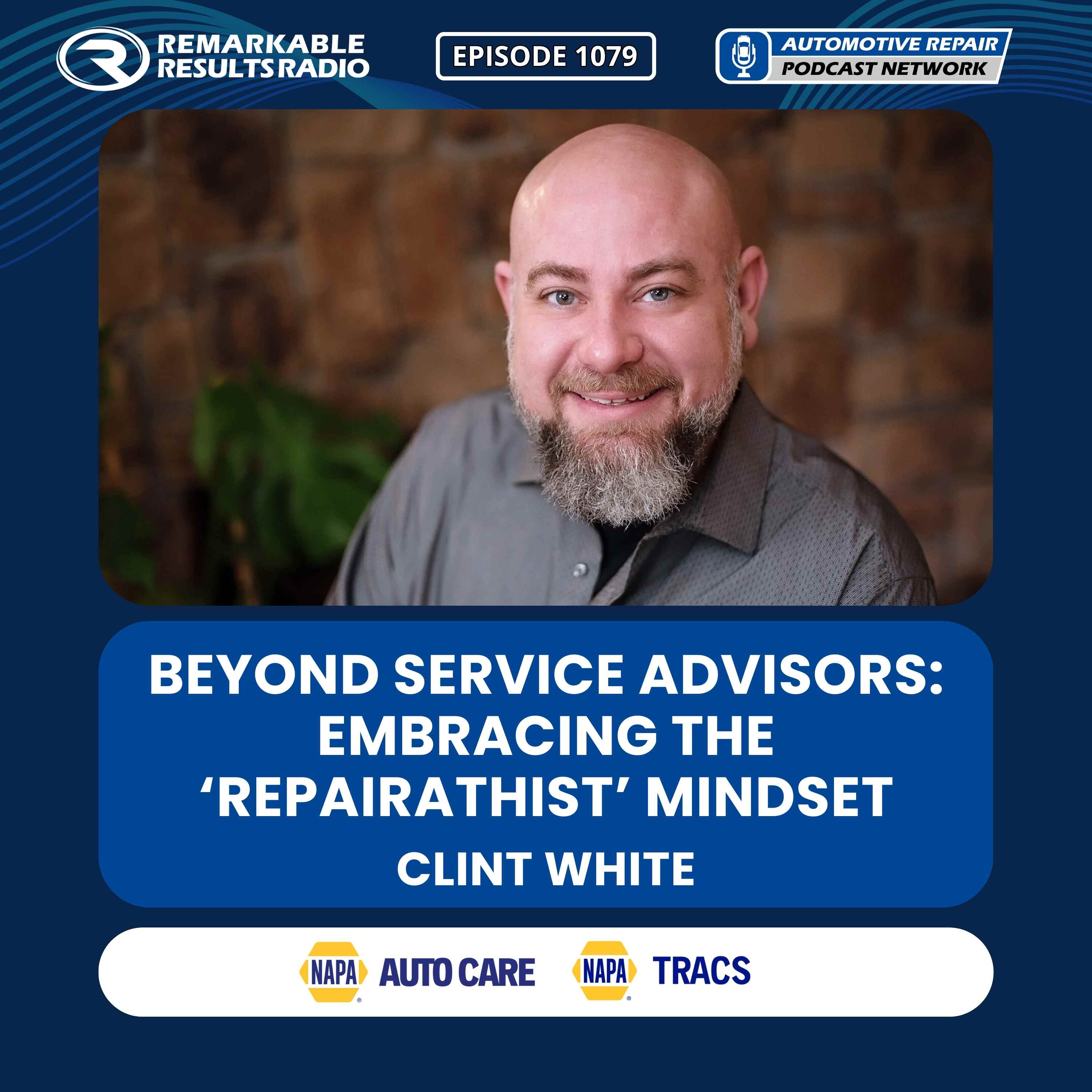
Exploring the concept of the 'Reparathist,' this episode emphasizes the importance of emotional intelligence in automotive service. Host Karm Capriotto and guest Clint White discuss how service advisors should evolve into client advocates who understand and alleviate customer fears about repairs. They highlight the need for effective communication, active listening, and reframing the role of service staff to focus on emotional support rather than just transactional interactions. The conversation challenges traditional titles and encourages a mindset shift towards building trust and providing relief to clients.
Thanks to our Partners, NAPA Auto Care and NAPA TRACSWatch Full Video Episode
"The reality of a client advocates daily work is translating fear into clarity."
Shop owner and coach Clint White explores a powerful shift at the auto repair front counter, from “Service Advisor” to “Repairathist.” He explains that because vehicles represent freedom and control, many customers arrive feeling anxious and financially defensive. As a result, the Repairathist’s role becomes part technician, part therapist, focused on translating fear into clarity and helping people feel understood. Customers aren’t buying parts, he says; they’re buying relief.
The conversation dives into how to put this mindset into practice, starting with a “language shift” that replaces industry jargon like “diag” and “DVI” with clear, value-based explanations. This approach invites customers into the process instead of making them feel excluded. White also stresses the importance of transparency, showing clients the “MRI and X-ray” of their vehicle before prioritizing repairs, and ensuring that front counter promises align with what happens in the shop.
Ultimately, the episode defines the Repairathist as a professional with an “others first” mindset who builds trust through empathy, honesty, and consistency—delivering an experience so positive that customers remember how they felt more than what they spent.
Timestamps
00:00:00 – Introduction
00:01:45 – Introducing the "Repairist"
00:03:15 – Therapy at the Counter: Clint explains that a Client Advocate's role is akin to a therapist, tasked with "translating fear into clarity" for anxious customers.
00:06:45 – The Psychology of the Car: Discussion on how vehicles represent freedom and control, making repairs an emotional issue rather than just a mechanical one.
00:10:15 – Selling Relief, Not Parts: Clint delivers the key insight that customers are not buying repairs; they are buying "relief from their current situation".
00:11:30 – The Experience Economy: The "Steak Dinner" analogy—customers don't remember the price as much as they remember how the experience made them feel.
00:14:00 – The Language Shift: Clint warns against using jargon like "diag" or "DVI," which makes customers feel excluded or stupid. He suggests using "testing and procedures" instead.
00:19:15 – Transparency & The MRI: Clint advocates for showing the customer "everything that is knowable" (the MRI/X-ray) before asking them to make a decision.
00:20:45 – Hiring for Heart: Clint explains that he hires for a "servant's heart" first; technical knowledge is secondary to empathy.
00:22:00 – The ROI of Empathy: Discussion on the business benefits of this mindset, including "sticky" clients, reduced staff turnover, and better reputation.
00:26:45 – Relationship vs. Transaction: Clint defines success not by money, but by building relationships strong enough that clients send Christmas cards years later
Thanks to our Partners, NAPA Auto Care and NAPA TRACS
Learn more about NAPA Auto Care and the benefits of being part of the NAPA family by visiting https://www.napaonline.com/en/auto-care
NAPA TRACS will move your shop into the SMS fast lane with onsite training and...
"...hank our great sponsors. We'll prove to you that Trax is the single best shop management system in the ..."
The Chevrolet Trax is a small SUV that is great for city driving because it's easy to park and has a lot of space inside for passengers and cargo. It's known for being fuel-efficient, which means it doesn't use too much gas, making it a good choice for people who want to save money while driving. People talk about the Trax because it offers a lot of features for its price.
The Chevrolet Trax is a subcompact SUV that offers a blend of practicality and efficiency, making it a popular choice for urban drivers. It features a spacious interior, advanced technology options, and a fuel-efficient engine, which makes it suitable for both daily commutes and weekend adventures. The Trax is often discussed for its value proposition in the competitive SUV market.
"...not a DVI and not an ADAS, but getting your vehicle back into safety specifications from the manufacturer so that all of those great technology features work in your vehicle, not an ADAS because no one knows what that is."
ADAS means Advanced Driver Assistance Systems. These are smart features in cars that help keep you safe while driving, like warning you if you're drifting out of your lane or helping you stop if you get too close to something.
ADAS stands for Advanced Driver Assistance Systems, which are technologies designed to enhance vehicle safety and facilitate driving. These systems include features like adaptive cruise control, lane-keeping assist, and automatic emergency braking.
"It says Nancy brought her Nissan Sentra in today because for the last three days, it's been making a strange noise under the hood."
The Nissan Sentra is a small car that many people buy because it's cheap to own and good on gas. It's a common choice for everyday driving.
The Nissan Sentra is a compact car known for its affordability and efficiency. It has been a popular choice for budget-conscious buyers looking for reliable transportation.
"She's concerned the belt may be coming loose. She didn't have a friend look at it and he thinks it's loose too."
A belt in a car helps parts of the engine work together. If it's loose, it can cause problems with how the engine runs.
In automotive terms, a belt typically refers to components like the serpentine belt or timing belt, which are crucial for the engine's operation. A loose belt can lead to various issues, including poor performance and engine damage.
– Introduction
– Introducing the "Repairist"
– Therapy at the Counter: Clint explains that a Client Advocate's role is akin to a therapist, tasked with "translating fear into clarity" for anxious customers.
– The Psychology of the Car: Discussion on how vehicles represent freedom and control, making repairs an emotional issue rather than just a mechanical one.
– Selling Relief, Not Parts: Clint delivers the key insight that customers are not buying repairs; they are buying "relief from their current situation".
– The Experience Economy: The "Steak Dinner" analogy—customers don't remember the price as much as they remember how the experience made them feel.
– The Language Shift: Clint warns against using jargon like "diag" or "DVI," which makes customers feel excluded or stupid. He suggests using "testing and procedures" instead.
– Transparency & The MRI: Clint advocates for showing the customer "everything that is knowable" (the MRI/X-ray) before asking them to make a decision.
– Hiring for Heart: Clint explains that he hires for a "servant's heart" first; technical knowledge is secondary to empathy.
– The ROI of Empathy: Discussion on the business benefits of this mindset, including "sticky" clients, reduced staff turnover, and better reputation.
– Relationship vs. Transaction: Clint defines success not by money, but by building relationships strong enough that clients send Christmas cards years later
Select text to request an explanation
This is the Automotive Repair Podcast Network.
Hey everybody, Karm Capriotto, remarkable results radio, good to have you here.
And I'm also so thankful for your support over all these years and especially as we've
jumped into our new listening app.
Of course you can find a lot of the features on wherever you're currently listening now,
but I really believe you're going to love all the cool features we have.
Of course, it's for your smartphone.
It's the ultimate professional automotive playlist.
You can read show notes, find links, get all the shows in the entire Automotive Repair
Podcast Network.
You can find all kinds of QR codes all over the place.
Don't forget we'll be out at the big event in Tarleton, New York from TST, big event
March 28th, 2026.
Ken Zanders, Andrew Fisher, Adam Roberts are going to be there.
One day technician training, keynoter, Tracy Capriotto.
I think I know her, excited about that.
I've got this really cool episode coming up.
I'm going to kind of tease you a little bit about it and here it is.
You know my passion about specialists.
You know my passion about this language shift in the industry.
Well, we're going to kick it up about 20 notches with Coach Clint White here right
after we thank our great sponsors.
We'll prove to you that Trax is the single best shop management system in the business.
Find Napa Trax on the web at NAPATRACS.com.
Are you ready for this, Clint?
Or what?
You ready?
I'm absolutely ready.
100%.
Coaching with Integrity, Clint White, shop owner.
We were on a recent episode, Town Hall Academy 456 with two other coaches.
We were chatting about you buying shops.
So anyway, if you have our app, you can just go to the search icon and type in 456.
It'll come right up and you could listen to that episode.
Look, you've heard me say that I believe that mechanical and technology specialists are
the new titles in our industry and I frame the entire reason why please go to my downloads
page, bring this 10-page declaration into your hands and read it, and please let me
know.
Carm at RemarkableResults.biz and I've known Clint for years.
We were kind of hanging out on the Karm Cruz and he says, Karm, it's the Reparithist.
Like specialists, I've never realized, Clint, how important that the training or the education
at our counter can eclipse almost everything going on.
Yes, great leadership training, yes, good finance training, yes, education on all the
great tools and equipment and the way we need to diagnose.
But if you can't close the deal, you can't bring that client in, we have nothing to work
on and all the great education just is for naught.
And so I love where the industry has, if you will, kicked it up a couple of notches and
I feel that Clint coming in here and talking about the Reparithist and his slant on this
and his gutsy, gutsy move like I made, I don't want to steal any thunder, but we've got
to reframe what we call our client advocate.
Yeah, absolutely.
I think the term client advocate, it's a wonderful upgrade from service advisor or service writer
and it does pretty well in explaining the role of that advocate and early in my coaching,
I came to the conclusion that what I'm training these advisors at the time to do was to be
a therapist for the client.
It's the way my silly brain works.
Yeah, you're a Reparithist.
No, you're right because I am depressed because I got to get my car fixed.
Yeah, absolutely.
That's that we see emotion, we deal with emotion, we pedal in emotion as you will and we have
to be very concise and clear and understand the direction that we need to go in every
conversation and understand who we're talking to and it's more than just a script, it's
more than a roadmap.
I love it.
You were telling me, Karm, the reality of a client advocate's daily work is translating
fear into clarity.
I've heard an awful lot lately about fear and trying to set removing fear from your
goals and we want to go, I want to do all these great things.
I want to climb the mountains and I want to go and camp and I want to buy an RV and all
this stuff, but there was someone that said, if you could set a goal to reduce your fears,
you'll be a better person.
Yeah, fear is one of the leading factors of the lack of progress.
We don't jump out.
We don't step forward.
We don't take that big chance because of the what ifs and our clients with their vehicles
and needing, we know what they need.
We're smart, right?
They need that made us.
They need that repair.
They don't know that.
They're afraid of the things that we speak to them.
They're afraid of cars.
They're afraid of spending money.
The list goes on and on why we live in, unfortunately, a culture of fear of the unknown.
In my keynote, I occasionally talk about the fact that when we go to the doctor, the general
practitioner and here, listen, you need to go to this specialist and the specialist
will save lives.
Specialists really can dig in deep and to call a client advocate a reparathist.
Customers, they don't come in neutral.
They have anxiety.
Again, the fear of what it's going to cost and when can I get it back?
My life goes on.
Are they really trusting us?
There's so many things that this reparathist can do to take this individual off of their
anxiety.
I think, number one, we need to understand that vehicles are an emotional extension of
life.
How do you get to where you need to go and really go deeper than that?
It's not just about getting somewhere, not just about transportation.
It's about freedom.
We as human beings are inclined to want to be in control of our situation and in control
of when we come and go and control of how fast we go and so on and so forth.
Understanding that, again, vehicles are emotional.
The cars aren't, but they're an extension of that which is behind the wheel, that being
our client.
You know, I guess if you teach an individual reparathist, client advocate, how to understand
that emotion, how to knock people off their fears and ask probably what better clarifying
questions.
Clint, this must be a huge way for them to understand the emotion they're going through.
Yeah, absolutely.
Logic alone just fails in high stress conversations.
You can't just speak logic.
Your breaks are grinding, you need breaks.
It doesn't sell well.
We have to ask questions that are probing.
We have to listen correctly, actively, not just passively.
We truly need to hear our clients and they need to know that they are being heard.
Boy, I know and clarify something I always learned way back in the day that you were
listening actively, that you understood what they were saying and you gave them, if you
will.
Isn't that what therapists do?
Yeah.
In fact, you can look at some of the key similarities of a therapist.
So if we look down the line of a therapist, what do they do?
What do they deal with?
So their client comes into them emotionally guarded.
Does that sound familiar?
On our side, on the reparathist side, the client's financially defensive or the therapist is
seeking to understand before he offers a treatment and we also need to seek trust before selling
repairs.
So again, the list goes on and on.
Wow.
And what about the fact that they don't want to spend a whole lot of money and just being
able to take them off of that?
Listen, we're going to do the best that we possibly can to get you in the best, safest
shape we can and I'll let you know how much it's going to be.
I'm going to do right for you.
Well, I think if you have the right mindset, you understand that customers don't buy repairs.
When they spend their money, they're not buying repairs.
They buy relief from their current situation.
And your role as a reparathist is not just to sell repairs, it's to guide, educate and
really ultimately stabilize emotionally.
I love that.
They don't buy repairs, they buy relief from their current situation.
I mean, that's it.
If you're listening to this and you are a client advocate and you're not writing these,
I mean, I'm sure there's going to be a lot of these major key points, these bullets are
going to be in the show notes.
And what I think you need to do is to open up the show notes and kind of copy and paste
them and put them there.
And if not, as you're listening to this, maybe you're driving, maybe you're exercising.
Who knows?
Maybe you're in the shower.
The point is that you may want to re-listen to this thing with a pen in your hand and
jot some notes and in those notes, the checkbox near that little line item says, yes, I can
do this.
Yes, I can do this.
Yes, I can do this.
I can change.
I could be a repair-ethist for clients that come in.
I could tell there any really good repair-ethist has got to know just by the sheer sagging
eyes and sad face and terrible frown that there's pain ready to be inflicted on me.
It can be perceived that way.
I teach and coach this that everything that we do, everything that we say, our mindset,
the way that we view our client and everything, make sure that the perceived value of that
client's experience and all that we do is worth more than the actual cost of the repairs.
And when we make sure, like the chef makes sure that the dish is presented perfectly,
tastes amazing, delivered at the right temperature at the right time, when we do that, he didn't
sell you a meal, he didn't sell you a steak, he sold you an experience and it doesn't matter
at that point what you paid for the meal.
You know what I love about this whole thing is we continue to talk to language shift in
the industry and we want to maybe introduce this repair-ethist.
You are introducing it and I love it.
If you want to become it, how do I do that?
We'll move from order taker to trusted professional.
I love that theory.
Stop being an order taker.
Yeah, okay, I'll fix your brakes.
I'll call you in an hour.
Okay.
Yeah, we'll take it around the block.
I'll call you in an hour.
No, I think clients want more than just, here, give me the keys.
I'll call you in an hour and I'm not saying that that may work with some key droppers.
I get all that, but there's some other people that really want some embracement.
Thank you for recognizing that my life is a little screwed up today.
I got to get a ride, a car, a ride share, a loaner.
I'll tell you, I've got a great analogy.
Clint, oh, a great analogy.
Your refrigerator dies.
Mine did.
It's not fun.
It was 15 years old, Clint.
I called everywhere.
I made five phone calls.
Nobody would be willing to fix it, Clint.
We decided to go out and look around and buy it.
And a snowstorm hit, travel bans and everything.
Go without a refrigerator for four days, Clint.
No.
Right, Clint.
I'm not doing that.
OK, so as a reparatist, as an individual who's walking in and the miracle of car
fixing is that we're going to do this thing in a day.
What if we can't do it in a day, or at least the person doesn't quite understand
that, oh, my God, what was me?
How long is it going to take?
Think of the refrigerator story.
So speed of service, that's something that is, I think, a kind of hot topic
in this industry and coaches, trainers are divided on that.
And me being a coach, trainer, 30 plus years in the industry, I own an
operator shop, I still go in when I want to and do the things at the shop.
I'm a firm believer that speed of service is something that I don't hang my hat on.
Can we, when we can, do we, when we can?
Yeah, absolutely.
You bet, when absolutely necessary.
But speed of service would be like, again, the stake analogy.
You order a steak and it comes out 30 seconds later.
You're going to question its quality.
You're going to question that doesn't make sense.
I'm spending that much and it came out.
And so we have to find, I think, a level playing ground when it comes to speed
of service and not necessarily make that our selling point.
Is this have to be a language shift?
Yeah, absolutely.
The way that we speak, how we talk, who we talk to, absolutely.
We can't speak as though we're talking to one another.
We have to avoid using words that are industry specific.
I like to jokingly say that if you sell loafs, maybe you're a baker.
If any rye, I like marble rye, by the way.
Do you sell diag?
I don't know what diag is.
And maybe it's a language you don't speak, but diag, do you sell that?
So on and so forth.
So stop using those types of words or those abbreviations that make the customer
feel unincluded, make them feel stupid.
Are you a Napa Auto Care Center ready to elevate your shop?
Then it's time to step into the premier tier Napa Auto Care Gold Certified Program.
Gold Certified Centers are recognized as the best of the best, delivering a
See something that's not quite right? Our annotations are AI-generated and can sometimes miss the mark.
Click the flag icon on any annotation to suggest a correction.