The Chevrolet Trax is a small SUV that is great for city driving because it's easy to park and has a lot of space inside for passengers and cargo. It's known for being fuel-efficient, which means it doesn't use too much gas, making it a good choice for people who want to save money while driving. People talk about the Trax because it offers a lot of features for its price.
ADAS means Advanced Driver Assistance Systems. These are smart features in cars that help keep you safe while driving, like warning you if you're drifting out of your lane or helping you stop if you get too close to something.
Now, that consistency means more repeat business, more referrals and more
opportunities to grow your car count.
Now, when you're Gold Certified, you unlock advanced resources, maximizing
technology, boosting your local marketing presence and keeping your team fully
trained on the latest trends and tools.
In short, Gold Certified status separates you from the rest.
So what does it take to be gold?
To qualify, your shop must be a Napa Auto Care Center for at least one year, have
been open for two years or more, employ an ASE master technician or hold ASE
blue seal status, co-brand with the pro image program, maintain a four star
rating or hire on Google Yelp or Napa CSI, use digital vehicle inspections,
offer Napa consumer financing, purchase $7,500 or more in Napa parts monthly
and participate in a Napa business development group.
It's a true partnership.
And in return, Napa rewards gold certified shops with premium benefits like
free priority placement on the Napa online.com locator, annual marketing
funds, enhanced warranties, rebates, training opportunities and a whole lot more.
Are you ready to take your shop to the gold level?
We'll contact your local Napa sales representative today to see if you qualify
and start your journey to gold certified.
Increase car count, build trust with customers and stand out as one of the best.
Talk to your local Napa representative today.
Let's face it, your shop management system is the single most important tool
in your shop, period.
Napa tracks was built from the ground up to make your business more profitable
and efficient.
We provide an extensive set of tools to increase and track profitability in real
time. Napa tracks offers the industry's best post sale support hands down and we
train your people onsite.
Yep, onsite and we offer remote refresher training 10 times a week and customer
support is open six days a week.
Give us a call, visit the website or join our Facebook community today to learn
more. We'll prove to you that tracks is the single best shop management system
in the business.
Napa tracks is always customized and tailored for you, whether you're a one
man shop or a large multi bay or multi location company.
After all, it's your shop.
So it's your choice.
Visit us on the web at Napa tracks.
That's N-A-P-A-T-R-A-C-S dot com.
If we have to diagnose the car, if we have to do die egg, okay, we really need to
spend some time figuring out what's exactly wrong, why the lights on.
What is Reparatus to roll in that?
First of all, going back to using that language that is valuable but neutral.
So Mr.
Customer, we're going to perform an in depth series of tests and procedures on
your vehicle and pinpoint the cause of said symptom.
We'll reach out to you with the answers just as soon as we have them.
And I'll check in later today with you.
That is much better than die egg, even diagnose.
You're absolutely right.
I hate the word die egg.
I love to get together with these guys smarter than me and listen to the
conversation in a networking environment and hear all of our slang.
But when it comes time to greet the customer, which is what our whole
language shift concept is about, if people are looking in and they hear a
speak, a comprehensive vehicle inspection, not a DVI and not an ADAS, but getting
your vehicle back into safety specifications from the manufacturer so that all of
those great technology features work in your vehicle, not an ADAS because no one
knows what that is.
We've got to stop using our shortcuts slang to the client.
That's part of your point.
And if you can rethink yourself as a reparatist, those doctors don't talk
and slang to us when we go to a specialist.
They don't.
They tell us straight up front what's going to happen.
I think it's also important that we have consistency throughout the entire
process, not only with the client and the experience and touch points with the client,
but with our team.
And so I use the analogy.
Carm, do you go to church?
Don't answer that.
This is recorded.
But let's say you do.
Maybe there's church, Carm, and then there's not church, Carm.
How do you talk at church on Sunday, Carm versus Monday through Saturday, Carm?
So the same thing applies.
And what happens one time when weekday, Carm shows up at church and says weekday,
Carm things, and you look really stupid.
So you don't want to do that, right?
Same thing happens in our shop.
Mr. Customer, we're going to perform a series of tests and procedures and so on and so forth.
We use this valuable language as a counter that we walk out in the shop.
Yeah, we got a diag out here.
Why is that okay?
It's not.
So one of the things that I teach is have a story written that's a narrative that's
personalized and it actually bridges the gap between technician and client.
So when my technicians get a repair order, it doesn't say diag, loaf, break inspection.
It doesn't say any of that.
It says Nancy brought her Nissan Sentra in today because for the last three days,
it's been making a strange noise under the hood.
She's concerned the belt may be coming loose.
She didn't have a friend look at it and he thinks it's loose too.
Dot, dot, dot.
Please advise.
Okay.
While I was listening to you, here's what hit me.
And I've said this about you.
If Clint was my shop, I would have all kinds of trust.
It's just your way of delivery.
It's your confidence that I gain from how you say what you say.
After I heard what you just said, I'm wondering if an individual who's listening
to this can say to themselves, look, I want to become that kind of a
parathist and I want to be able to sell ice to an Eskimo.
And that would be the Karm church day, maybe to your point.
Church car, church car, church car, church mosque, church car.
Sometimes what people need is they just need that mental leap to say,
how can I do this and how could I remind myself that I need to change
my delivery, the relationship that I'm building by, hey, get out there
and sell ice, baby.
It's 32 degrees, but boy, do I got a boatload to sell you.
We don't have to remind ourselves.
And oh, by the way, Clint, I'm not talking about sell as far as selling up.
I'm just, if you're solving problems to a client at the end of the day,
when they pay the bill, you've sold them something.
Presenting solutions.
Thank you. I appreciate that.
It works. It's a little lengthy, but it works.
Any tips in your ideas, in your plans, the way you coach on presenting
a treatment plan to someone?
Yeah, absolutely.
I think prioritization is something that is key.
It's very commonly taught in the industry and many shops will prioritize,
but there's bigger picture to that.
One of the things that I think is important that we understand
in the, and I'll use the sales process or the client experience,
is absolute transparency, one of our core values.
Many shops carry that as a core value.
And I tell every client that comes in, even for an oil changer,
for a major diagnostic adventure, whichever it might be,
I want you to see the vehicle through the eyes of a factory trained technician.
I want you to know everything that's knowable before you decide.
I want you to see the MRI and the X-ray results.
I'll help you decide for them.
We will work on prioritization, but first things first,
you need to know everything that is knowable.
That should be done.
When that is done, then we can have that next conversation about how do you present?
Do you present safety first?
Do you present maintenance and repairs first?
Yeah, absolutely.
There is a way to present correctly in which the client has the ability to draw a line somewhere
and say, I'm going to stop at safety, or I'm going to stop at safety and repair,
or I'm going to stop at safety repair and maintenance and we'll just do everything.
Does that make sense?
It makes all kinds of sense.
Do you find a shift like this amongst the clients you have to be insurmountable,
or do you find that once something clicks, they got it?
How hard is it to get this through?
As far as the concept of presenting all and then prioritizing?
Yeah, I mean, everything we're talking about here,
someone says, oh my God, I don't know if I could do all this.
GWC, I'm going to steal that from someone else, I'll give you credit later.
You got to get it, you got to want it, you have the capacity to do it.
So if you love to talk to people, it doesn't make you a great client advocate.
It just doesn't.
You have to have a heart of servitude, a servant's heart.
It's not a bad thing to use that word.
If you don't have a servant's heart, I don't care how well you speak.
I don't care how much you know about cars.
I don't care that your dad owned a shop.
I'm not going to hire you.
You have to fit that criteria.
If you fit that criteria, then the answer is no, it's not insurmountable.
You can do all this.
It's easy.
What is it?
Is it heart?
Is it brain?
Is it self-confidence?
Is it self-awareness?
It's all of this in the big package?
Everything.
Others first.
Others first.
Others first mentality.
We put others first, always.
Being a reparatist, is there any magic on handling objections or resistance at all?
Yeah, absolutely.
You're going to get some of those common emotional objections.
I need to think about it.
That seems expensive.
I don't trust this.
I want a second opinion.
The short answer is going to be, as a reparatist, your responses need to be empathy first.
Not sympathy, but empathy.
Then you're allowed to clarify.
Clarification comes second.
And lastly, we want to present options.
But empathy is key to this entire thing.
And the empathy goes back to having a heart.
Remember, sales at its core.
I've said this how many times we've done shows together.
Sales at its core is truly the transference of feelings.
That was ziggler, I believe.
It's a transference of feelings.
And if you can't do that because you struggle with emotions,
this might not be your industry.
And that's okay.
We'll find a seat on the bus for you.
If I was an owner, Clint, and I said, I absolutely love this,
is there any ROI on someone shifting their mindset to being a reparatist?
Or at least the training that you're providing to people,
what's the impact to a business as they take it up to another new level?
There's a number.
I don't like spitting out this guaranteed X return on investment dollar amount.
But everybody that I work with that embraces what I teach grows immensely.
Not just financially.
Customer reputation is enormous.
A lack of attrition, a lack of turnover or slough is amazing to see clients stick.
Sticky clients, we like those.
Keychuckers, we really love those.
And so what we do is we set our goals for those things.
And I coach a little bit differently.
I'm not going to come in and spend an hour tearing apart your numbers.
And they're going to talk about numbers and talk about how you sell more numbers,
because money, money, money, money, money.
And I can say that because I'm a shop owner.
I get it.
I'm not stupid.
We don't coach the money.
We coach the heart and the soul.
We coach the why first.
And when you understand the why, you'll do the things that need to be done.
But if you do the things that need to be done and you don't understand why,
this doesn't stick.
Makes all kinds of sense to me.
And yet there are counters out there that are just machine in and out.
Yeah, they have a space in our industry.
And that's something I should clarify is there's room for all of us guys stop fighting, right?
So if you want to be a mobile guy and you just do breaks in the mud in an alley,
there's a market for that.
I'm too old for that game.
And if you want to own 28 stores and you want to blast out a bazillion dollars a year
and a bazillion cars a month and have just this assembly line of cars, you know what?
There's a market for that and people will pay money for that.
I'm looking for what's in between.
It's kind of like an Oreo.
I'm looking for the cream.
I love your point.
And there's room everywhere in our industry for all these different ways or strategies of going to
business.
And I just so happen to love this one from, if you will, the salt of the earth thing.
That's just what I keep thinking about.
It's, oh, salt of the earth.
Yeah, maybe that's it.
But okay.
So I love this and I really want to try to do something with it.
Can anyone learn this on their own?
You know, it's a role playing, for example, you get a team together and they say,
we're all going to try to repair at this mentality.
Can they role play amongst each other and help each other?
Or do they have to go to specific training?
What I know, where I'm at, 30 plus years of doing this, I did not get here on my own.
I didn't get here working next to guys that were really neat guys, right?
I got here because I was invested in.
I've done a lot of training.
So I'm an advocate for training.
Again, if you don't speak Spanish and I don't speak Spanish, but we're going to role play Spanish,
no way, no, probably won't work.
So having a coach is I think a key element in success in life.
Look at any successful individual, whether sports or whether business or
they all have a coach, they have an mentor, they have an accountability partner.
And I think everybody needs one.
I agree.
And I love your answer.
It's the right answer.
Don't try to become an expert in being a reparatist on your own.
I think you need some help in order to get where you need to get.
And like anybody who's doing something brand new, you're going to climb the hill,
then you're going to fall down a little bit, try some different things and keep going.
This is why you go to continual education and coaches continue to help form and shape
the things that you do.
Reparatist, I love it.
So are we undervaluing?
And I can't help but think the emotional intelligence is a very big part of this,
because it's still all about the individual, the reparatists themselves,
and how they deal with all of these things.
Are we undervaluing emotional intelligence?
And do we even really understand it well enough?
So yeah, emotional intelligence, that's another show, right, is another concept.
Understanding the client's emotional signals, that's something I push for.
Understanding the roadblocks, I push for that.
I really think that's important that we understand that.
But it's important that we not overcomplicate things.
So I'll use the example of if I've taken a personality test and I'm a, we'll keep it neutral.
I'm a high A or a low B or a middle C. Those are great tools.
And I've seen and been through personally coaching where we hyper focus on trying to
label that customer so quickly.
And we know exactly where he's at.
And frankly, there's some people that are really good at that.
But the overwhelming majority of the populace, you're going to spend more time trying to figure
that out than actually just having a conversation with an individual.
Oops.
I get that.
I get that.
We've talked about disk and all those assessments on our show.
For the last 10 years, there's no doubt.
Great tools.
I use them.
They're good tools.
Here's the deal on that.
Let me show you my opinion.
If you're just starting out, it's going to take you time to figure it out.
But if you've really gone to that particular school or whatever, or committed to learn it,
it won't take you about a few seconds to figure out who you're dealing with.
But yet you want to have their conversation with them, but you still have to bring the
repair at this mentality to the relationship.
Let's just dump on a couple of final points here.
Lately, some of our episodes have gone into this relationship versus transactional mentality,
Clint, an awful lot of our discussions of late.
And these podcasts, they're probably just released just a few weeks earlier than yours.
You're going to hear a lot of that relationship versus transaction.
That needs to be one of those high, if you will, definitional moments of
what a repair artist is, is that they're building trusted relationships with the people that call.
And I can't help but think that the individual who picks up the phone and calls you
from whatever, be it a referral or something on your webpage,
I was told recently that a high majority of those calls want to do business with you.
But we haven't dropped out because we go in wrong directions from their anticipated value.
You agree with that?
Yeah, absolutely.
We have to embrace the consultative approach to sales.
And I'll just lay it out here, right?
So this is my reality.
This is my truth, is that having done this for so long,
I have clients that I worked with as a service advisor a long time ago that still reach out,
that have a contact information, maybe they have an address or they know what shop I'm at now,
and call or send Christmas cards or just,
why would you do that for the guy that fixed your breaks?
That's the goal.
We have to have a goal.
What's your goal?
And when I work with shop owners, what's your goal here?
And it fits.
Money, money, money, money, money, money, money.
I'm not your coach.
Have a great day.
I'm not your coach.
I can't be.
But if your coach is to say, 20 years later,
I want somebody to remember me and send me a Christmas card and thank me for taking care of
their car all those years ago or refer people in because they had such an amazing experience.
That's a goal I can get behind.
And that's the reality of I think what people are looking for is our society's missing relationship.
We hold up.
We talk on Zoom if you're lucky.
I might get to see it, but it's phone calls and texts.
We don't really interact anymore.
And we were created for community.
We were created for relationship.
That's why we're here and by golly, people want it at their shop.
They want it at the restaurant.
They want it with their doctor.
They want relationship and that's up to us to help navigate that.
That was powerful.
I think it's one of those terms where a self-assessments in order.
What is it that you're giving to the client experience?
Is it the way you go to market?
Is the way that you like or hate life?
How is it?
And I think we're seeing too much of the negative because of our shortness,
our three-second sound bites that we seem to live for.
Here comes somebody walking in and you can't three seconds scroll them out of your life.
You have to stop.
Oh my God, what an analogy.
Here comes a client or a phone call.
You cannot scroll past them.
Oh my God, what an idea.
Wow.
Yeah, you can't swipe left.
You can't swipe left.
So with the mindset of knowing that you truly,
but you do sell experience, you don't sell a product or a service, you sell an experience,
there's times where I made delay the delivery of a vehicle just a little longer because I want to
have that ability to call at 11 o'clock and say things are going great.
I just want to let you know we're taking care of you.
And I still anticipate being done by two today.
Maybe the car's already done or very, very close.
And I can tell them, come on down.
We're almost ready.
But I want them to have another touch point with me because that's what people
truly want and desire is that touch point, human connection.
How many come in and say thank you so much for all that you did to make this vehicle good again?
All the time.
Because it wasn't a transaction.
It wasn't a transaction.
Look at our reviews.
Look at many thousands of shops in the country.
Look at the authentic feedback we get.
That's called word of mouth, right?
Word of mouse.
Look at that feedback we get.
And it's not just five stars would recommend.
It's sometimes novels of how amazing things went.
That right there, that's our win.
People just don't remember if the relationship is right.
They don't remember the money they spent.
No, people don't remember the dollars that they spent.
They remember how they felt while it was happening.
We sell experience and nothing else.
That's it.
From moment one to final Z, A to Z.
A to Z.
So did you wake up one morning at two o'clock saying reparatist?
Where'd this come from?
What I first started coaching, it was something that just kind of came to me.
That we're therapists.
We truly are therapists.
Now, disclaimer, asterisks, fine prints, you're not really a therapist.
Please don't think that you are.
Not a licensed one.
But you provide those same types of services.
And when people come to you distraught, people come to you heartbroken,
people come to you defensive, they come to you emotionally, well, in a people.
And let's flip the script for a second.
Think about this.
Imagine your therapist was as transactionally minded, cold and calloused,
as many of the counter staff at many of the shops can be.
Next, second couch from the left, please.
Can you imagine you'd probably go out of business as a therapist and probably be sued?
I don't know.
Flip the script.
We can do better.
I'm elated and inspired by this great discussion.
And here's my takeaway for everyone is when any interaction with anybody in your life,
as a client advocate on a counter at any of our shops in this independent life of automotive
repair is always switch, read the words, let them float through your mind.
The Reparathist Mindset.
In fact, that's what the title of this episode should be the Reparathist Mindset.
And that's what you're doing, Clint, is yeah, you're creating a brand new word.
But what does that mean?
It's a brand new mindset to realize your new role.
It is.
It truly comes from deep within one's soul to embrace this way of doing life.
It's not even just the way of sales or the way of doing business.
The individual that is going to be successful at this is the person that leaves work and drives
and sees somebody broke down or sees somebody in need or whatever scenario in life where you
walk into and you can say to yourself, self, I can improve their situation.
I can make it better.
Has nothing to do with me.
Has nothing to do with making me more money or making me more famous or none of that.
It has to do with others first.
If you can live a life like that, I think that you're a better human being.
If you can be a better human being by golly, I'll put you on the counter in my shop.
Clint, how do we get a hold of you?
Yeah, you can find me at coachingwithintegrity.llc on the interwebs.
And there is a contact form there.
Reach out with any questions and I'd love to be able to help.
Thanks, man.
Coaching with Integrity and shop owner Clint White, the Reparatist Mindset.
Thanks for the inspiration, my friend.
Thank you, Karmic. Appreciate the opportunity.
Thanks for being on board to listen and learn from the Premier Automotive Repair Business
podcast, Remarkable Results Radio.
Get your episodic education on the ARPN listening app at automotiverepairpodcastnetwork.com.
Also, enjoy the podcast on our Karm Capriato YouTube channel.
Karm is all for advancing the professional automotive service industry.
Until next time.
About this episode
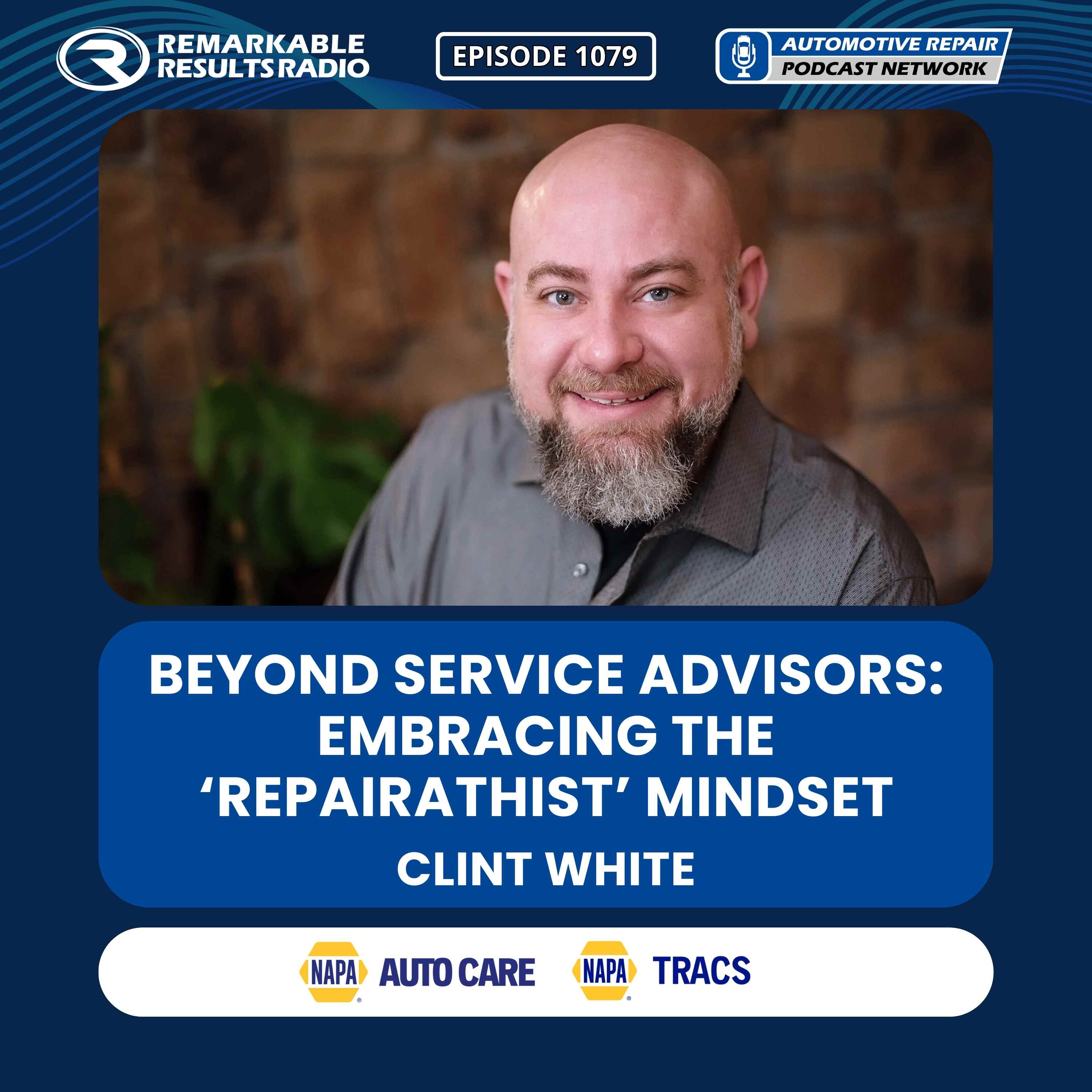
Exploring the concept of the 'Reparathist,' this episode emphasizes the importance of emotional intelligence in automotive service. Host Karm Capriotto and guest Clint White discuss how service advisors should evolve into client advocates who understand and alleviate customer fears about repairs. They highlight the need for effective communication, active listening, and reframing the role of service staff to focus on emotional support rather than just transactional interactions. The conversation challenges traditional titles and encourages a mindset shift towards building trust and providing relief to clients.
Thanks to our Partners, NAPA Auto Care and NAPA TRACSWatch Full Video Episode
"The reality of a client advocates daily work is translating fear into clarity."
Shop owner and coach Clint White explores a powerful shift at the auto repair front counter, from “Service Advisor” to “Repairathist.” He explains that because vehicles represent freedom and control, many customers arrive feeling anxious and financially defensive. As a result, the Repairathist’s role becomes part technician, part therapist, focused on translating fear into clarity and helping people feel understood. Customers aren’t buying parts, he says; they’re buying relief.
The conversation dives into how to put this mindset into practice, starting with a “language shift” that replaces industry jargon like “diag” and “DVI” with clear, value-based explanations. This approach invites customers into the process instead of making them feel excluded. White also stresses the importance of transparency, showing clients the “MRI and X-ray” of their vehicle before prioritizing repairs, and ensuring that front counter promises align with what happens in the shop.
Ultimately, the episode defines the Repairathist as a professional with an “others first” mindset who builds trust through empathy, honesty, and consistency—delivering an experience so positive that customers remember how they felt more than what they spent.
Timestamps
00:00:00 – Introduction
00:01:45 – Introducing the "Repairist"
00:03:15 – Therapy at the Counter: Clint explains that a Client Advocate's role is akin to a therapist, tasked with "translating fear into clarity" for anxious customers.
00:06:45 – The Psychology of the Car: Discussion on how vehicles represent freedom and control, making repairs an emotional issue rather than just a mechanical one.
00:10:15 – Selling Relief, Not Parts: Clint delivers the key insight that customers are not buying repairs; they are buying "relief from their current situation".
00:11:30 – The Experience Economy: The "Steak Dinner" analogy—customers don't remember the price as much as they remember how the experience made them feel.
00:14:00 – The Language Shift: Clint warns against using jargon like "diag" or "DVI," which makes customers feel excluded or stupid. He suggests using "testing and procedures" instead.
00:19:15 – Transparency & The MRI: Clint advocates for showing the customer "everything that is knowable" (the MRI/X-ray) before asking them to make a decision.
00:20:45 – Hiring for Heart: Clint explains that he hires for a "servant's heart" first; technical knowledge is secondary to empathy.
00:22:00 – The ROI of Empathy: Discussion on the business benefits of this mindset, including "sticky" clients, reduced staff turnover, and better reputation.
00:26:45 – Relationship vs. Transaction: Clint defines success not by money, but by building relationships strong enough that clients send Christmas cards years later
Thanks to our Partners, NAPA Auto Care and NAPA TRACS
Learn more about NAPA Auto Care and the benefits of being part of the NAPA family by visiting https://www.napaonline.com/en/auto-care
NAPA TRACS will move your shop into the SMS fast lane with onsite training and...