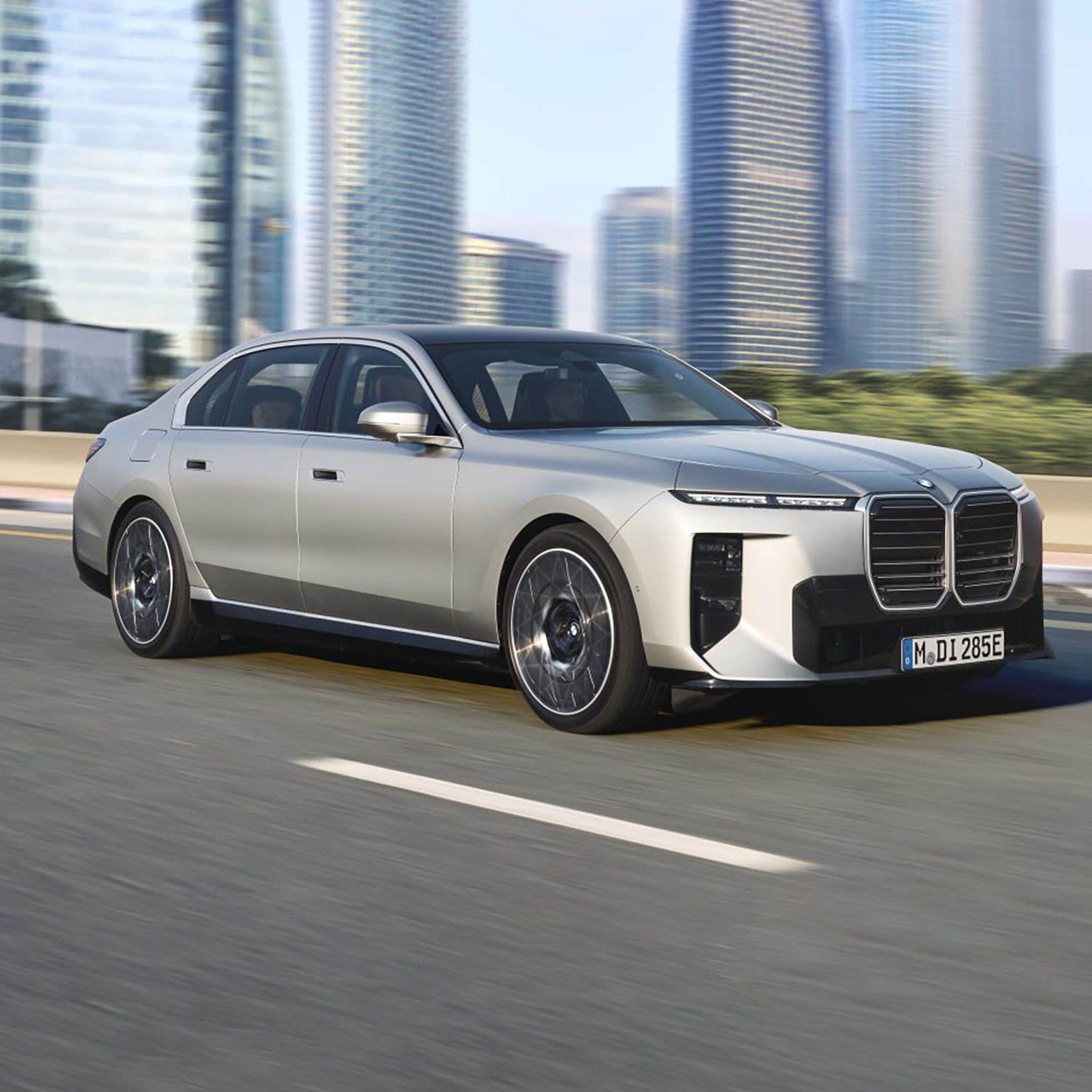
BRIEFLY: BMW i7, Rivian R2, Smart Hashtag 2 & more | 23 Apr 2026
About this episode
Capital One’s “Chat Concierge” is highlighted as deployed multi-agentic AI for car shopping—using self-reflection, layered reasoning, and live API checks to help buyers find vehicles, schedule test drives, get pre-approved financing, and estimate trade-in value. EV updates include BMW’s refreshed i7 with a larger battery, big range gains, and faster 250 kW charging; Rivian starting R2 production with spring deliveries and a lower-cost build outlook; and Smart’s revival of the 4-2 spirit as the Hashtag 2. Other news covers GM truck denials, VW ID Buzz Pro 4-motion details, ChargePoint’s 600 kW standalone charger, and expanding V2G programs.
It's EV News Briefly for Wednesday 22 April 2026, everything you need to know in less than 5 minutes if you haven't got time for the full show.
Patreon supporters fund this show, get the episodes ad free, as soon as they're ready and are part of the EV News Daily Community. You can be like them by clicking here: https://www.patreon.com/EVNewsDaily
BMW GIVES I7 MORE RANGE AND SCREEN SPACE
BMW has revealed what it calls the most extensive refresh ever applied to a BMW, with the updated electric i7 arriving first in September 2026 and plug-in hybrids to follow, with pricing expected to rise from the current £105,000 starting point. The new i7 swaps its old 105.7kWh battery for a 112.5kWh pack using Gen6 cylindrical cells, pushing maximum range from 387 miles to 452 miles and DC charging speed from 195kW to 250kW, while adaptive dampers and active rear steering become standard across the whole range.
The styling adopts BMW's Neue Klasse design language with slimmer crystal-embedded headlights, a horizontal-slat grille, 22-inch alloys as standard, and up to 500 exterior colour combinations including a new two-tone option. Inside, the i7 becomes the first BMW to offer a front-passenger touchscreen (14.6 inches), gains a 17.9-inch central display and a sweeping 43.3-inch Panoramic iDrive dashboard, while rear passengers keep their 31.3-inch 8K cinema screen and 35-speaker Bowers & Wilkins system.
***
RIVIAN STARTS R2 PRODUCTION IN ILLINOIS
Rivian has begun production of the R2 at its Normal, Illinois plant, with CFO Claire McDonough confirming the start in a Reuters interview and first customer deliveries expected later this spring. Reservation holders will receive configuration invitations in June, with the $57,990 Launch Edition shipping first, followed by the $53,990 Premium later in 2026 and the more affordable Standard and entry variants arriving through 2027.
Rivian expects R2 to cost less than half of what an R1 costs to build once higher volumes are reached in 2027, and the vehicle also underpins the company's broader ambitions including the $2,500 Autonomy+ self-driving package and an Uber robotaxi partnership worth up to $1.25 billion across 25 cities.
***
GM SAYS NO DELAY TO ELECTRIC TRUCK PROGRAMME
GM publicly denied cancelling any electric trucks after Crain's Detroit Business — citing three anonymous sources — reported that the automaker had indefinitely delayed its next-generation electric truck programme, which had been targeting a 2028 production start for refreshed versions of the Silverado EV, GMC Sierra EV, Hummer, and Escalade IQ. GM told Motor1 that "EVs remain the end game" and confirmed no impact to current electric truck production, though the company gave no timeline for when the next-generation programme might resume.
Supplier executives and analysts told Crain's they do not expect a new generation of GM's all-electric truck line until 2030 or beyond, suggesting the delay is substantial even if GM stops short of calling it a cancellation.
***
SMART #2 SETS UP FORTWO RETURN
Smart has unveiled the Smart #2 concept, a two-door, two-seat electric city car that revives the spirit of the original Fortwo, with a production model expected to launch in October 2026. Built on the Electric Compact Architecture platform, it offers an estimated 186-mile range — a dramatic leap over the old EQ Fortwo's 58-mile range — along with a 10–80% charge time of under 20 minutes and vehicle-to-load capability.
Expected to measure around 106 inches (2.7 metres) long, the Smart #2 would be smaller than the Dacia Spring and Renault Twingo, placing it among Europe's smallest new EVs at launch.
***
ID. BUZZ ADDS AWD AND NEW TECH
Volkswagen Commercial Vehicles is rolling out a 2026 model year update for the ID. Buzz this summer, headlined by the new Pro 4MOTION variant that pairs a 210kW rear motor with a front motor for a combined 250kW and raises towing capacity to 1.8 tonnes on the standard wheelbase. The update also brings one-pedal driving capable of bringing the vehicle to a full stop, a new Innovision infotainment system with an integrated app store, traffic-light-responsive Connected Travel Assist, a welcome return to physical steering wheel buttons, and optional vehicle-to-load capability at up to 2.0kW.
***
CHARGEPOINT LAUNCHES 600KW EXPRESS SOLO
ChargePoint has unveiled the Express Solo, a standalone DC fast charger capable of delivering up to 600kW, which the company says sets a new benchmark for public charging in the US. The unit supports two simultaneous sessions, accepts direct DC input for integration with on-site battery storage, enables bidirectional charging, and uses an Omni Port combining CCS1 and NACS connectors — all at a claimed 30% lower purchase and operating cost than comparable high-power chargers.
***
FRANCE SETS 2035 ROAD CHARGING PLAN
France's government has published a national strategy to deploy around 30,000 EV charging points on motorways and national roads by 2035, targeting corridors that carry roughly one third of all traffic despite representing just 2% of total road length. The plan includes approximately 22,000 fast chargers at around 150kW for light vehicles across 900 service areas — a fivefold capacity increase — plus 8,000 heavy-duty charging points across 560 locations.
***
COKE CANADA ADDS VOLVO ELECTRIC TRUCKS
Coca-Cola Canada Bottling is expanding its electric fleet to nearly 40 vehicles by adding Volvo VNR Electric trucks in Quebec City and the Vancouver area, building on a 2023 pilot programme that tested six of the trucks in real-world conditions. Each VNR Electric uses a six-battery configuration with a range of up to 440km, and the expansion is supported by a new 180kW Heliox Flex charging station in Quebec City and two additional chargers in Vancouver.
***
PG&E ADDS CYBERTRUCK TO V2G PILOT
PG&E and Tesla have added the Cybertruck to PG&E's residential vehicle-to-grid programme, using Tesla's Powershare Gateway and Universal Wall Connector in what is the first AC-based V2G application approved for California customers. Participants can receive up to $4,500 in incentives for bidirectional charging equipment and earn additional compensation for exporting electricity back to the grid during peak demand events.
***
VOLKSWAGEN SETS GERMAN V2G LAUNCH FOR 2026
Volkswagen and its energy subsidiary Elli plan to launch a fully integrated vehicle-to-grid service for private customers in Germany in Q4 2026, with pre-registration opening in June, promising annual earnings of €700–€900 under favourable conditions. Elli will manage the full stack — dynamic tariff, DC bidirectional charger, smart meter integration, and a control app — backed by around one million bidirectional-capable MEB-platform EVs already on European roads.
multi-agentic AI
"Capital One's tech team isn't just talking about multi-agentic AI. They are already deployed one."
Instead of one AI doing everything, multi-agentic AI uses several AI helpers that split up the work. That can make it better at tasks like comparing cars and helping you plan next steps.
Multi-agentic AI is an approach where multiple AI “agents” work together, each handling a different sub-task (like research, comparison, and scheduling). The goal is to make the system more capable than a single chatbot, especially for complex workflows like car shopping.
Capital One
"Capital One's tech team isn't just talking about multi-agentic AI. They are already deployed one. It's called Chat Concierge and it's simplifying car shopping."
Capital One is talking about its own AI assistant for car shopping. It’s meant to help you with the steps you’d normally do separately—like comparing cars and lining up financing.
Capital One is describing its in-house AI product (“Chat Concierge”) aimed at simplifying car shopping. The segment frames it as a deployed customer-facing tool that can handle multiple steps in the buying journey.
test drive
"It helps schedule a test drive, get pre-approved for financing, and estimate trading value. Advanced, intuitive, and deployed."
A test drive is when you actually drive the car before buying it. It helps you confirm the car feels right, not just looks good online.
A test drive is the hands-on evaluation step where buyers confirm fit, comfort, visibility, and real-world drivability. In modern shopping flows, AI assistants may schedule it automatically once you choose a vehicle.
trading value
"It helps schedule a test drive, get pre-approved for financing, and estimate trading value. Advanced, intuitive, and deployed."
Trading value is the price you might get for your current car if you trade it in. Knowing it upfront helps you figure out what the new car will really cost after your trade.
Trading value refers to what your current vehicle may be worth as a trade-in toward a new purchase. Estimating it early helps buyers understand the net cost of the new car and compare offers more accurately.

Chevy Colorado
"Chevy Trucks have you covered when the road takes you from smooth sailing to... Chevy Colorado will eat up some of the toughest terrains with five available drive modes."
The Chevrolet Colorado is a midsize truck. The “drive modes” are settings that change how the truck behaves for different surfaces like sand, snow, or rough terrain.
The Chevrolet Colorado is a midsize pickup, and this segment highlights its off-road capability via “drive modes.” Drive modes typically adjust throttle response, traction control behavior, and sometimes steering/shift logic to match terrain.
drive modes
"Chevy Colorado will eat up some of the toughest terrains with five available drive modes. And Silverado and Silverado HD have the muscle to take you out for some serious, with multiple engine options and impressive towing."
Drive modes are different settings you can choose to make the car act differently. For example, one mode may help you get better traction on slippery or rough ground.
Drive modes are selectable settings that change vehicle behavior for different conditions—commonly throttle mapping, traction control sensitivity, and sometimes transmission or steering characteristics. In trucks and off-road vehicles, they’re designed to help traction and control on varied terrain.
towing
"...multiple engine options and impressive towing, while Silverado EV is the perfect combo of performance and capability."
Towing is how well a vehicle can pull a trailer or another vehicle. It depends on the truck’s power and how well it can stop and cool while hauling.
Towing refers to the vehicle’s ability to pull a trailer, typically limited by factors like engine torque, cooling capacity, drivetrain gearing, and brake performance. Pickup marketing often pairs towing claims with engine choices and drivetrain configurations.

Silverado EV
"...impressive towing, while Silverado EV is the perfect combo of performance and capability."
The Chevrolet Silverado EV is an electric version of the Silverado pickup. The ad is basically saying it’s fast and still useful for real truck jobs.
The Chevrolet Silverado EV is an electric full-size pickup, and this segment frames it as combining “performance and capability.” For EV trucks, that typically points to strong acceleration plus features that support real-world utility like towing/hauling readiness and usable range.

BMW i7
"“BMW's revealed what it calls the most extensive refresh ever applied to a BMW, with the updated i7 arriving this September.” ... “The new i7 swaps out the battery for a bigger one… 105.7 becomes 112.5 kilowatt hours.”"
BMW i7 is BMW’s big electric luxury sedan. In this update, BMW is increasing the battery size, which helps the car go farther on a charge. They’re also improving fast-charging so you can recharge quicker on trips.
BMW i7 is the fully electric version of the BMW 7 Series, and this segment focuses on a major refresh BMW is calling its most extensive update. The hosts mention a larger battery, improved range, and faster DC fast-charging, plus that plug-in hybrids are expected after the i7 update. This is the kind of change that can materially affect real-world usability and charging strategy.
kilowatt hours
"“The new i7 swaps out the battery for a bigger one, 105.7 becomes 112.5 kilowatt hours.”"
Kilowatt-hours (kWh) tell you how big the battery is. A bigger kWh number usually means the car can store more energy, which can translate into more miles between charges. It’s not the only factor, but it’s one of the biggest.
Kilowatt-hours (kWh) measure battery capacity—how much energy the EV can store. The segment says the BMW i7 battery capacity increases from 105.7 kWh to 112.5 kWh, which typically supports more total driving range. Capacity alone doesn’t determine range (efficiency matters too), but it’s a key lever for longer trips.
Gen 6 cylindrical cells
"“They use the new Gen 6 cylindrical cells at BMW, pushing maximum range…”"
“Gen 6 cylindrical cells” refers to a specific generation of battery cell design and chemistry packaged in cylindrical form factors. Cell format and generation can influence energy density, thermal behavior, and how effectively the pack can deliver power for acceleration and charging. The hosts connect these Gen 6 cylindrical cells to improved maximum range for the updated BMW i7.

BMW Neue Klasse
"...ging goes to 250 kilowatts, so there's a chunk of Neue Klasse in this, but it's not the whole new full beams l..."
BMW Neue Klasse is the name BMW uses for its next-generation electric-car design. It’s meant to help EVs charge faster and work better, and it can be used across multiple future BMW electric models. The podcast is pointing to those technical targets to explain what’s coming.
BMW’s Neue Klasse refers to a new EV platform and technology direction from BMW, not a single car model. The podcast mentions power and charging capability (like up to around 250 kW) to highlight how the platform is designed to improve performance and fast-charging efficiency. It’s discussed because platform changes can affect many future BMW EVs at once.
DC fast charging
"“DC fast charging goes to 250 kilowatts, so there's a chunk of Neue Klasse in this…”"
DC fast charging refers to charging an EV using direct current from a high-power charger, which can significantly reduce charging time compared with slower AC charging. In this segment, the BMW i7 refresh is said to increase DC fast-charging capability to 250 kW, which affects how quickly you can top up during road trips. Higher kW doesn’t guarantee the same real-world speed for every minute of charging, but it generally improves peak and early-session charging.

Bmw Ix3
"“…but it's not the whole new full beams like you get on the BMW iX3.”"
BMW iX3 is BMW’s electric SUV. In this segment, it’s mentioned as the example of a car that gets the more complete version of BMW’s next-generation EV approach. The i7 update is described as having some of those improvements, but not all of them.
BMW iX3 is an electric SUV in BMW’s lineup, and the hosts use it as a reference point for what they call the “whole new” Neue Klasse implementation. The comparison implies that the updated i7 has partial Neue Klasse tech, while the iX3 is associated with a more complete application. This is useful context for listeners trying to understand how BMW’s EV platform rollout is staged.
crystal embedded headlights
"But the style-wise design language, with the crystal embedded headlights and the horizontal slat grille."
This is a fancy headlight design detail. It’s mainly about the look—using crystal-like elements inside the headlamp housing.
“Crystal embedded headlights” refers to a design/lighting treatment where crystal-like elements are integrated into the headlamp assembly. It’s mostly an aesthetic and branding feature, but it can also be paired with advanced LED lighting signatures.
22-inch alloys
"Yep, that's carried over now, 22-inch alloys as standard inside, you've still got the huge 18-inch screen in the middle, and the 43-inch panoramic iDrive dashboard rear passengers still get their 8K cinema screen that folds down from the roof."
“Alloys” are wheels made from a metal alloy (typically aluminum). Saying “22-inch alloys as standard” means the car comes with large wheels from the factory, which can affect ride comfort, tire cost, and appearance.
iDrive dashboard
"...the huge 18-inch screen in the middle, and the 43-inch panoramic iDrive dashboard rear passengers still get their 8K cinema screen that folds down from the roof."
iDrive is BMW’s main screen-and-controls system. They’re describing a very wide dashboard screen that makes the cabin feel more like a digital cockpit.
iDrive is BMW’s infotainment and user-interface system. Here, “43-inch panoramic iDrive dashboard” describes BMW’s wide, integrated display layout that spans across the cabin for a more immersive cockpit experience.

reservation holders will receive configuration invites
"Reservation holders will receive configuration invites in June, they say, with the $57,990 launch edition shipping first, if you want the bargain basement one you'll be waiting through to 2027, Rivian expect R2 to cost less than half of what R1 costs to build when they factor in higher volumes."
If you reserved an EV, the company later lets you pick your exact options. That helps the factory build the right cars and helps the company plan production.
A “configuration invite” is when a company invites reservation holders to choose specific options (like trims, battery/drive choices, and interior features) before production locks in. It’s a key step in EV ordering because it helps manufacturers forecast demand and manage production constraints.
launch edition
"Reservation holders will receive configuration invites in June, they say, with the $57,990 launch edition shipping first, if you want the bargain basement one you'll be waiting through to 2027, Rivian expect R2 to cost less than half of what R1 costs to build when they factor in higher volumes."
A launch edition is the first version of a new car that comes out. It usually has a fixed set of features and may cost more than the later, more basic versions.
A “launch edition” is an early, limited-production version of a new model, often with a specific set of features and a higher price than later trims. Launch editions are commonly used to generate early demand and simplify initial production.
electric trucks cancellation report vs denial
"General Motors publicly denied a report this week, which said they'd cancelled their future electric trucks after Crane's Detroit business... GM says, no, that's false, Crane spoke to supplier executives, and they'd said, albeit unnamed sources, that orders had been cancelled and the programme's unashelved."
This segment describes a public dispute: a report claimed GM canceled future electric trucks, and GM publicly denied it. The key business concept is how EV programs can be adjusted or delayed based on supplier capacity, orders, and internal planning—sometimes leading to conflicting statements from media and companies.
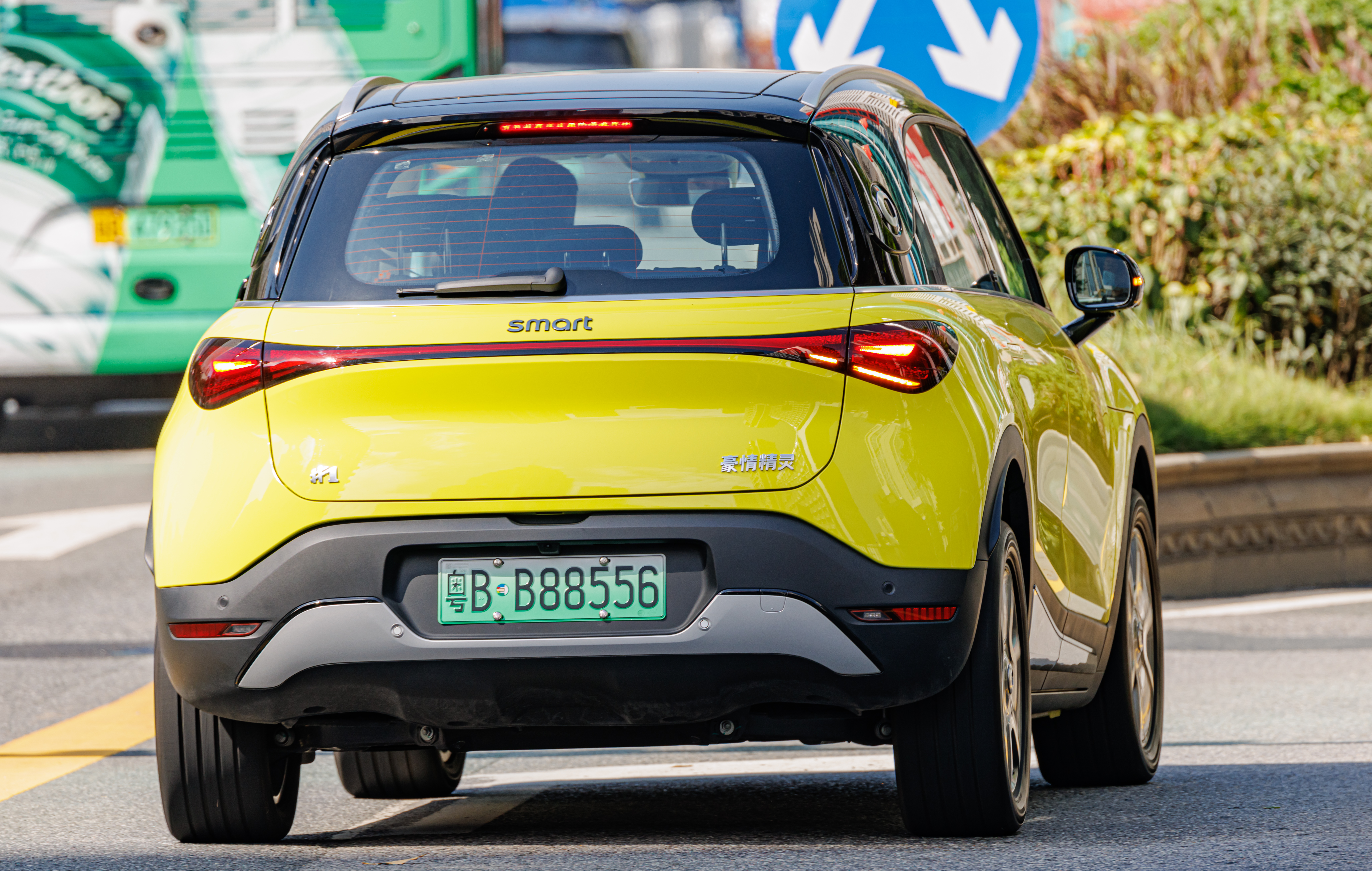
Smart Hashtag 2
"Smart has unveiled the new Smart 4-2, except in the new naming convention called the hashtag 2, two-door, two-seat, electric city car, and it is reviving the spirit that so many love of the original 4-2."
The Smart Hashtag 2 is a small electric city car. It’s a two-seat, two-door design meant to bring back the vibe of an earlier Smart model.
The Smart Hashtag 2 (introduced here as “Smart 4-2” under a new naming convention) is an electric city car from Smart. The hosts emphasize its two-door, two-seat layout and that it’s intended to revive the spirit of the original Smart 4-2.

Volkswagen Id Buzz
"Volkswagen commercial vehicles rolling out the 2026 ID buzz... the new Pro 4-motion, so four-wheel drive, Pro spec, that is basically the GTX, but without being the GTX, so towing goes to 1.8 tonnes on the standard wheelbase,"
This is the electric Volkswagen ID. Buzz van, in a version called Pro 4-motion. It’s a higher trim with four-wheel drive, and they’re talking about how it stacks up to the more performance-focused GTX.
The Volkswagen ID. Buzz is an electric van, and this segment focuses on the 2026 ID. Buzz Pro 4-motion variant. “Pro 4-motion” indicates a higher-spec trim paired with four-wheel drive (4-motion), and the hosts also compare it to a GTX version while noting differences like towing capability.
4-motion
"...the new Pro 4-motion, so four-wheel drive, Pro spec, that is basically the GTX, but without being the GTX, so towing goes to 1.8 tonnes on the standard wheelbase,"
“4-motion” is Volkswagen’s branding for four-wheel drive. In this context, it means the ID. Buzz Pro 4-motion uses AWD to improve traction in low-grip conditions, which can be especially useful for a van used year-round.

Plymouth GTX
"...our-wheel drive, Pro spec, that is basically the GTX, but without being the GTX, so towing goes to 1.8..."
The Plymouth GTX is a performance car model name. In the podcast, they’re talking about a version that’s similar to a GTX but not identical, including practical details like drivetrain and towing. That’s why it comes up—people want to know what that specific setup can do.
The Plymouth GTX is a performance-oriented model name associated with classic-era muscle cars, and the podcast is referencing a variant described as “basically the GTX” but not exactly the same. It’s being mentioned in a context that includes drivetrain and towing figures, which suggests the discussion is about specs and how closely a particular version matches the GTX identity. That kind of detail is common when comparing trims or describing a specific configuration.
vehicle to load
"there's also one-pedal driving, there's vehicle to load, and some nice upgrades as well."
Vehicle-to-load means your EV can act like a power source. You can plug in devices or power something else using the car’s battery.
Vehicle-to-load (V2L) lets an EV power external devices or buildings using its battery through an outlet or adapter. It’s a practical way to run tools, appliances, or temporary power without a separate generator.
one-pedal driving
"there's also one-pedal driving, there's vehicle to load, and some nice upgrades as well."
It’s a driving mode where you can slow down mostly by lifting off the accelerator. Instead of using the brake pedal all the time, the car recovers energy while slowing.
One-pedal driving is an EV driving mode where the accelerator also controls deceleration. Lift off the accelerator and the car uses regenerative braking to slow down, often to a near-stop without touching the brake pedal.
DC fast charger
"Chargepoint has unveiled a new standalone DC fast charger, so it's quite a large box by modern standards..."
A DC fast charger is the kind of charger that can add a lot of battery power quickly. It’s usually what you use when you’re traveling and need to charge fast.
A DC fast charger uses direct current to charge an EV battery much faster than standard AC charging. It’s typically used for road trips and quick top-ups, and the key differentiator is the maximum power level (measured in kilowatts).
Chargepoint
"Chargepoint has unveiled a new standalone DC fast charger, so it's quite a large box by modern standards..."
ChargePoint is a company that builds EV charging stations. They’re showing a new fast charger that can deliver a lot of power quickly.
ChargePoint is a major EV charging network and hardware provider. In this segment, it’s unveiling a new standalone DC fast charger designed to deliver very high power in a compact footprint.
600 kilowatts
"This is all in one, but still... pretty small footprint, 600 kilowatts though..."
600 kilowatts is how powerful the charger is. Higher power can mean faster charging, but the car still has to be able to accept that much power.
600 kW is an extremely high charging power level for DC fast charging. At this rate, EVs can add significant energy quickly, but real-world charging speed depends on the vehicle’s onboard charging limits and battery temperature.
CCS-1
"...this will be both CCS-1 and NAX compatible."
CCS-1 is the plug/charging standard used for fast charging in many places. Your EV has to support CCS-1 to charge at these DC fast stations.
CCS-1 (Combined Charging System) is the dominant DC fast-charging connector standard in North America. Compatibility matters because the car must support the same charging standard to use the charger at full speed.
NAX
"...this will be both CCS-1 and NAX compatible."
NAX is another charging standard/connector mentioned alongside CCS-1. The point is that the charger is meant to work with more than one system.
NAX is referenced here as a charging compatibility standard alongside CCS-1. The key takeaway is that the charger is designed to work with multiple connector/charging ecosystems, reducing the chance of “wrong plug” issues.
PowerShare Gateway
"...using Tesla's PowerShare Gateway, and you can now, in California, sell the energy back to the grid."
PowerShare Gateway is the system that helps the car share power with other places. Here, it’s what lets the Cybertruck work with the grid-sharing program.
The PowerShare Gateway is Tesla’s hardware/software interface that enables bidirectional energy features. In this context, it’s used to connect the Cybertruck to a vehicle-to-grid program so the vehicle can exchange energy with the grid.
vehicle-to-grid program
"PG&E and Tesla have added the Cybertruck to their vehicle-to-grid program..."
Vehicle-to-grid means your EV can send power back to the electric grid. It’s like using the car’s battery as a backup power resource.
A vehicle-to-grid (V2G) program allows EVs to send electricity back to the power grid when it’s needed. This can help balance demand and supply, and in some cases provide the EV owner with compensation.
PG&E
"PG&E and Tesla have added the Cybertruck to their vehicle-to-grid program..."
PG&E is an electric utility in California. They’re working with Tesla so EVs can help manage the grid and potentially sell energy back.
PG&E (Pacific Gas and Electric) is a major California utility company. In the segment, it partners with Tesla to run a vehicle-to-grid program that allows participating EVs to interact with the grid.

Tesla Cybertruck
"PG&E and Tesla have added the Cybertruck to their vehicle-to-grid program using Tesla's PowerShare Gateway..."
Tesla’s Cybertruck is being used in a program where the car can help the electric grid. Instead of only charging, it can also send energy back when conditions call for it.
Tesla’s Cybertruck is being added to a utility vehicle-to-grid (V2G) program. That implies it can participate in bidirectional energy flow—using its battery not just to charge, but potentially to supply power back to the grid.
fully integrated vehicle-to-grid service
"...plans to launch a fully integrated vehicle-to-grid service for customers in Germany..."
A fully integrated V2G service means the whole setup—car features, software, and participation—works together as one package. It’s meant to be easier for customers to use.
A fully integrated vehicle-to-grid service bundles the EV, charging/bidirectional hardware, software, and customer enrollment into one offering. Integration matters because it reduces friction for customers and helps utilities coordinate energy flows reliably.
Chat Concierge
"It's called Chat Concierge, and it's simplifying car shopping..."
Chat Concierge is an AI assistant that helps you with car shopping. It can help you find a car, set up a test drive, and even help with financing and trade-in estimates.
Chat Concierge is the name of Capital One’s deployed AI assistant for simplifying car shopping. The segment describes it as using reasoning plus live API checks to help with tasks like scheduling test drives, pre-approvals, and estimating trade-in value.
live API checks
"Using self-reflection and layered reasoning with live API checks..."
Live API checks mean the AI looks up up-to-date information from other systems. That helps it give more accurate answers while you’re shopping.
Live API checks mean the AI consults real-time data sources through application programming interfaces. For car shopping, this can improve accuracy for availability, pricing, or eligibility compared with relying only on what the model learned earlier.
pre-approved for financing
"...it doesn't just help buyers find a car they love, it helps schedule a test drive, get pre-approved for financing..."
Pre-approved financing means a lender checks you ahead of time and tells you what kind of loan you might qualify for. It can make buying the car faster once you pick the one you want.
Pre-approval for financing is an upfront assessment by a lender that determines the amount and terms you may qualify for. In a shopping workflow, it can speed up the purchase process once you choose a specific vehicle.
car shopping
"It's called Chat Concierge, and it's simplifying car shopping. Using self-reflection and layered reasoning with live API checks, it doesn't just help buyers find a car they love, it helps schedule a test drive, get pre-approved for financing, and estimate trading value."
They’re talking about using AI to help you buy a car from start to finish. Instead of only finding cars you like, it can also help you set up a test drive and figure out financing and trade-in value.
“Car shopping” here is being treated as an end-to-end workflow, not just browsing listings. The segment highlights how AI can guide a buyer from choosing a vehicle to booking a test drive, arranging financing, and estimating trade-in value.
trade-in value estimation
"it helps schedule a test drive, get pre-approved for financing, and estimate trading value. Advanced, intuitive, and deployed, that's how they stack."
Trade-in value estimation is figuring out how much your current car might be worth. If you know that early, it’s easier to understand what you can afford for the next car.
Trade-in value estimation is the process of predicting what your current vehicle is worth to apply toward a new purchase. The segment implies AI can estimate this earlier in the shopping journey, which helps buyers understand affordability sooner.
Request an Explanation
Heard something you'd like explained? We'll add it to this episode.
Sign in to request explanations for terms you heard.
Want to learn more?
Browse our glossary for plain-English explanations of automotive terms, jargon, and concepts.
Help improve this episode
See something that's not quite right? Our annotations are AI-generated and can sometimes miss the mark. Click the flag icon on any annotation to suggest a correction.