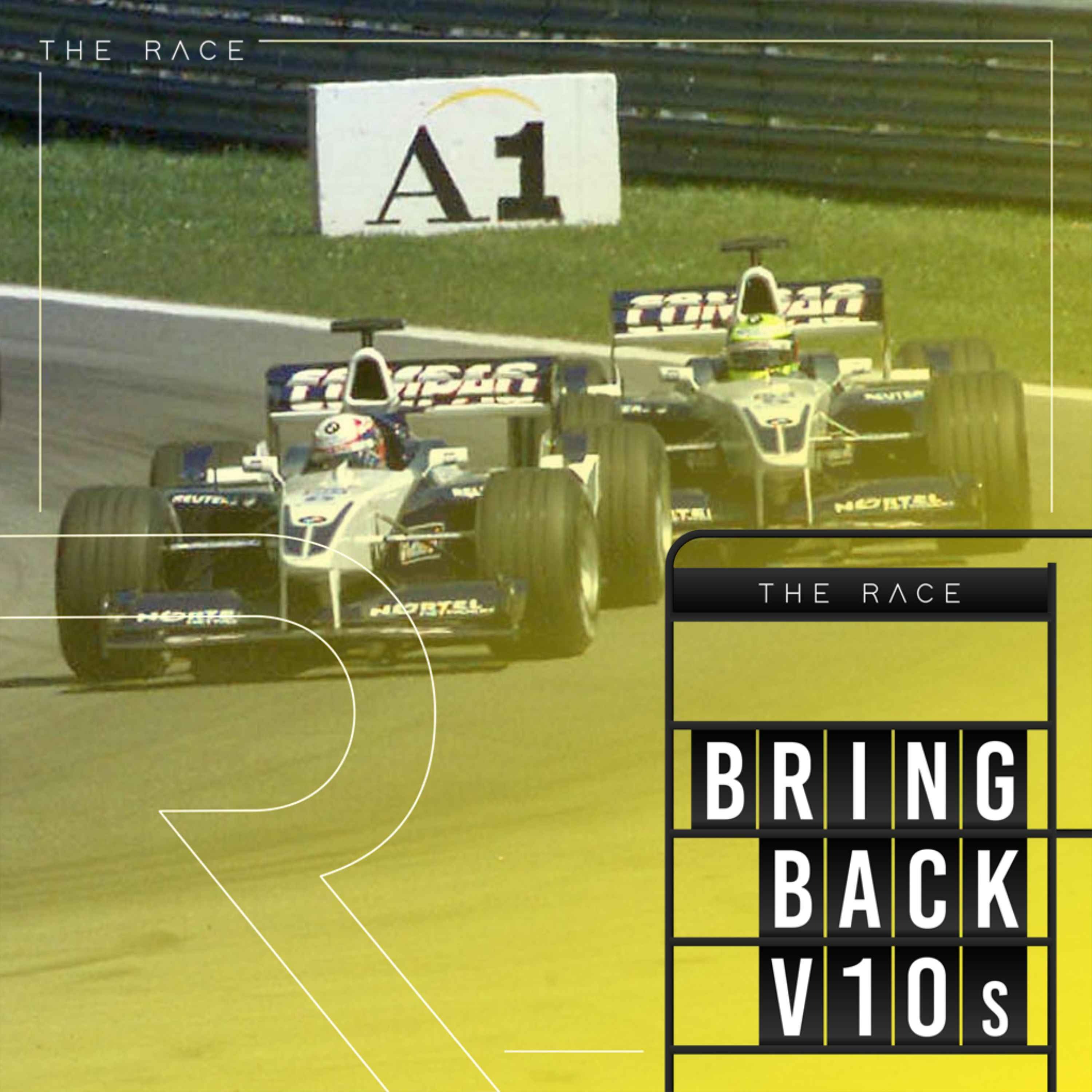
“Williams-BMW” refers to the F1 partnership where Williams used BMW engines/power units. It matters because engine development and integration with the chassis can turn a team into a race-winning contender.
Practice is when teams drive during the race weekend to try out settings and get the car ready. It’s like testing and tuning before the important sessions.
“Detonated” here means the engine was burning fuel in an uncontrolled way, like it’s exploding instead of smoothly pushing the pistons. That can quickly ruin the engine, which is why they say it failed early.
A dyno is a machine that runs the engine on a stand and measures how it performs. They’re saying the engines looked okay on the dyno, but still had problems when used in an actual race.
“Bring back V10s” means people want Formula 1 to use V10 engines again. The hosts are joking that even though everyone expected problems, the cars still did well.
The checkered flag is what race officials wave to show the race is over. They’re saying people expected the cars to break before they could make it to the finish.
A “Le Mans programme” is a company’s whole plan for racing at the 24 Hours of Le Mans. It includes building and preparing the race car and running it in endurance events.
In F1, “power unit” means the whole engine package that powers the car. It includes the main engine and the hybrid energy parts that help the car accelerate and recover energy.
Paul Rosha is an engine specialist mentioned as being in charge of BMW’s early project. The hosts are saying BMW didn’t just show up—they had the right technical people.
A “prototype partnership” means two companies worked together on race cars designed specifically for racing. In this episode, it’s mentioned to show BMW and Williams had already succeeded together before F1.
“Turbo engines” use a turbocharger to cram more air into the engine, which helps it make more power. When the host says “BMW turbo engines of the 80s,” they’re talking about BMW’s turbo era in racing.
In F1, the “engine formula” is basically the rulebook for what engines teams are allowed to use. If a manufacturer joins an existing set of rules, they have to build to those rules instead of starting from scratch.
The host is saying BMW had a lot of control over how the team’s branding was presented. That included the team’s colors, and it could even make it harder to fit other sponsors’ preferences.
“Color codes” are specific, standardized identifiers used to match exact shades across branding materials. The host says they checked BMW’s logo history and color codes to confirm the Williams scheme matched BMW’s corporate look rather than a playful retro homage.
“Naming rights” means a company pays to have its name attached to a team or event. In F1, that usually shows up in the team name on TV and in official branding.
“TV graphics” are the on-screen overlays broadcasters use to label drivers, teams, and sponsors during coverage. In F1, sponsor and team branding in these graphics can reflect commercial control agreements like naming rights.
Formula 1 is the highest level of car racing with open-wheel race cars. Teams spend a lot of time designing and improving their cars so they can go faster and handle better on race day.
This is the name of an older Renault Formula 1 engine program. The host is saying BMW’s early engine was largely built from that previous design, so it wasn’t expected to be the absolute fastest right away.
A bespoke engine means the engine is tailored for that specific team’s race car, not just a generic version. In racing, that kind of customization helps the whole car work together better.
This means the engine and the car frame are designed to fit and work together from the start. When they’re integrated well, the car can be set up more efficiently and perform better.
This means the car’s main structure and its engine are developed together, not separately. When they’re “integrated,” the car is easier to tune and usually works better as a whole.
Berger is described as someone who could translate between Formula 1 teams and BMW. The idea is that better communication can prevent misunderstandings that slow down development.
Person
Mario Tyson
This name is used in a comparison about who was involved and how close or far apart their approaches were. The host is basically talking about how leadership and communication can change how well a project runs.
Audi is mentioned as an example of a company that tried to get involved in Formula 1. The host’s takeaway is that big changes inside the company can make racing plans harder to execute.
The host is saying that when the top leaders at a company change, big racing projects can get shaky. That’s because the new leaders may not follow the same plan or priorities.
In F1, “integration” is how well a team coordinates its different groups. Instead of each department working separately, they share goals so the whole car improves together.
“Levers to pull” means the controllable things a racing team can adjust. The better the team is at coordinating, the more they know which adjustments will actually make the car faster.
Term
pucker engine
“Pucker engine” is a nickname for BMW’s new engine that made a huge improvement. The point is that it was a major upgrade that helped the team get much faster.
Term
P80
P80 is the designation for BMW’s Formula 1 engine used by Williams in the early 2000s. The key point in this segment is that it represented a major evolution from the prior season, with big gains in power and weight.
“Kilos lighter” means the engine weighed less. A lighter engine can help the car feel quicker and easier to handle because the whole car is easier to move around.
“Tolerances” means how accurately the engine parts are made to fit together. If the tolerances are tighter, the engine can work more precisely, which can help it make more power.
The center of gravity is the “balance point” of the car. Lowering it usually helps the car feel more stable and less likely to tip or roll during hard cornering.
Peak power is the highest power number the engine reaches at its best RPM. The point here is that the engine was also good across the rev range, not just at its single best moment.
A power curve is how strong the engine feels at different engine speeds. If the curve is good, the car feels responsive and usable, not just fast at one specific RPM.
A “manufacturer boom period” means lots of big car companies are spending heavily on F1. When that happens, the competition gets tougher and improvements come faster.
When they say the engine “blows up,” they mean it fails badly and can’t keep running. In racing, that usually happens when a new engine isn’t fully sorted yet.
“Engine wars” means teams and engine makers competing fiercely to build the fastest, most powerful engines. Eventually the rules and durability limits start to restrict how far they can push it.
This is about the point where there are hard limits on what teams can do—either because of the rules or because physics makes it too difficult. The host is saying we’re nearing that stage.
Teams sometimes use their best, most aggressive engine setup just for qualifying. The host is saying F1 may tighten rules so teams can’t do that as easily.
F1 teams don’t get to just swap engines whenever they want. The rules force an engine to survive for a set amount of time, like an entire race weekend.
RPM tells you how fast the engine is spinning. The host is pointing out that these F1 engines got up to about 21,000 RPM, which is extremely high and very hard on the engine.
The host is talking about an estimated maximum engine speed—around 19,000 RPM—based on how well the engine can breathe. They’re saying the technology eventually surpassed what people thought was the limit.
They’re talking about what matters more for speed: the car’s overall design (especially aerodynamics) or the engine. The idea is that you can’t explain everything by the engine alone.
Downforce is the “suction” from the car’s shape and wings that presses the tires onto the track. More downforce usually means better grip, especially in corners.
Car
FW19
FW19 is the name of a specific Williams F1 car chassis from that era. The point here is that the car’s design development was starting to fall behind, even if the engine was still strong.
“Aero” means aerodynamics—how the car’s shape interacts with air. It affects how much grip the tires have in corners and how fast the car can go on straights.
Person
Frank Derney
Frank Derney is mentioned as an expert in how air flows around the car. The speaker’s point is that aerodynamics specialists help teams turn their cars into real race winners.
Efficiency here means the car gets more speed out of what it has, instead of wasting energy. In F1, that can mean better straight-line speed and stronger overall race performance.
“Ralph” is Ralph Schumacher, an F1 driver. He’s quoted here talking about how his car and the Ferrari behaved on straights and how that influenced the race.
“Michael” is Michael Schumacher, another F1 driver and Ralph’s brother. They’re describing a race where the two competed directly, showing how small technical differences can matter a lot.
Car
Williams BMW
“Williams BMW” means the Williams F1 team using BMW engines. The discussion is about how strong the engine was, but how the whole car still had trouble being consistently competitive.
Horsepower is a measure of engine power output. In F1 discussions, it’s often used to explain why a car can be fast on straights even if other areas (like aerodynamic efficiency or chassis balance) are lacking.
Jenson Button is a famous Formula 1 driver from the UK. In this segment, they’re debating how well he might have done if he stayed with Williams in 2001.
Spa is a famous Formula 1 track in Belgium. It has lots of fast corners and big changes in elevation, so it rewards skilled driving.
Term
motorhubs
“Motorhubs” here is being used to describe the team’s garage/paddock-side areas for different manufacturers or sides of the operation. The key point is that Ralph and Montoya were associated with different sides, creating a different day-to-day atmosphere even within the same overall team.
They mean that, at the time, German drivers were especially popular. The idea is that Ralph Schumacher fit what BMW and Williams were looking for in that period.
Toyota is mentioned as where Ralph Schumacher went later in his career. The hosts are saying he had some good moments, but it wasn’t as strong or consistent as his Williams period.
In Formula 1, an engine supplier is the manufacturer that provides the power unit to a team. Because the engine is a major performance driver, a new engine supplier can noticeably affect results in the first seasons.
This means the F1 rules weren’t changing dramatically. When the rules stay steady, teams can improve their cars without constantly redesigning for new requirements.
Ferrari is mentioned as one of the teams that was ahead of the rest. It’s used to explain how far behind (or close to) the leaders Williams and others were.
This means how much extra improvement is still left in the car or engine. Even if it starts strong, there may not be much more speed available after a certain point.
BAR is the Formula 1 team name referenced in the comparison to Williams, Toyota, and Renault-era progress. In F1 discussions, team comparisons often hinge on how quickly each outfit improved under its engine and technical package.
Robert Kubitsa is a Formula 1 driver. In this segment, the hosts mention him to highlight how strongly people felt about BMW’s decisions and how that affected results.
In F1, an engine partner is a company that provides the engine to another team. It’s different from owning the team, because the engine supplier usually can’t make all the same decisions.
Patrick Head was a major figure at Williams, involved in running the team. In this discussion, he’s portrayed as refusing to give BMW ownership control.
Adrian Newey is a famous Formula 1 technical designer. The hosts are saying Williams fell behind partly because they lost him.
LIVE
By the time Williams lost its Renault engines at the end of 1997, it already knew what it
was going to do next, bringing BMW back to F1 at the start of the new millennium.
On track, the partnership got off to a solid start in year one and then became a race winning
force thanks to a monster of an engine that was developed for 2001.
But off track, the relationship was never completely harmonious.
Upheaval at BMW between the deal being signed and the partnership beginning led to tension
from the start and while everything was heading in the right direction results-wise,
the dysfunction behind the scenes that would eventually undo this relationship was already
apparent. And to help me, Glenn Freeman, revisit the first two years of the Williams-BMW
partnership. In a slightly different episode format for you today, we have Mark Hughes and Ed
Straw. Mark, welcome to the show. You covered the Williams-BMW relationship closely during
your time in F1. When you think back to the first two years of that relationship,
what's the first thing that comes to mind? I was actually quite closely involved because
the magazine we worked for at the time didn't really pay me enough to be able to afford to
cover F1. So I had to do a little bit of work around the side. And one of those was to do some
regular updates on how they were doing. And that involved talking to them after every practice
session, both the BMW side and the Williams side. So I got to know them quite well.
And what I remember was that it was an exciting partnership. And there were moments of real
potential you could see. But that wasn't without its personal tensions. They were there right from
the start between the two halves. It was very much a combination of two halves,
rather than a real partnership. There wasn't animosity there, but there was niggle there
all the time. There was an underlying niggle there. And I think every time they became a bit
more competitive, that niggle sort of subsided for a while. But as soon as there was a little
hiccup, then it came back. So that was the sort of undercurrent of the team. But it wasn't an
unhappy place. It was just a different sort of vibe to, I guess, how it had been previously.
Yeah, maybe not as harmonious as it should have been. That will come up a few times in this episode.
Now, Ed, I know that you've been preparing for this episode by watching old F1 season reviews.
So presumably whatever the first thing is that comes to mind for you is wherever you were in
one of the season reviews when you had to stop to do this recording.
Well, actually, it's going to make me sound very unimaginative. It's not where I stopped,
but it's where I started. But it was the thing that was in mind already, because the thing that
I always think of when it comes to BMW and the start of it with Williams BMW is actually that
first race, because they went to Australia with nobody giving them any chance of finishing,
because the BMW engines are generally detonated somewhere fairly early in their life. And they've
done a race distance on the dyno even with the engines. So the fact that Ralph Schumacher
managed to get that podium, and actually Jensen Button wasn't far off finishing
in Australia as well, was a good old fashioned bring back V10s. Oh, they'll never finish.
Oh, they finished and they've got a good result. So that sort of surprised start,
because the narrative was very, very much at the time, no chance of making the checkered flag.
It was quite funny doing that early phase when the engines were, we kept detonating.
There was a certain sound that it would make, apparently from inside the cockpit,
just before it went. And if you were on to it quickly enough, you could catch it and,
you know, switch it off and bring it in. And Ralph could identify it and Button couldn't,
he just couldn't hear it. He didn't know what Ralph was talking about. So when you looked at the
retirement rates on the engine side, they were more heavily in Button's favor,
because Ralph kept hearing it, catching it. And it's just, I don't know whether it was,
just the frequency was more attuned to his ear, or whether it was just because he was more
experienced and he could, you know, unscramble all the different sounds. But it's quite an
interesting phenomenon. That's Ralph getting ahead of the phenomenon now that we see where
people park the cars before they blow up. I much prefer the old school. I prefer the Jensen style,
keep your foot in until it explodes. Now I mentioned we've got a slightly different episode
format for you here. We've enlisted the help of the Race Members Club to put this show together.
We chose the subject, but then we turned it over to our members, asking what they wanted to know
about the first two years of Williams BMW. So we're going to see how this goes. And hopefully
it's a format we can use again in the future, maybe even branch it out to some of our social media
followings as well. But let's see what they've come up with for us. Mark, we're going to start
with a question from Jonas Moore who says, was Williams pairing with BMW in 2000 considered
a big risk at the time since they hadn't been a part of the sport for more than 10 years?
Was it like the Audi project in 2026 or even like Aston Martin going back to Honda?
I don't think it's considered quite as a big new thing. Because yes, they've been out the sport
a long time, but BMW was still very much involved in competition. And with its Le Mans programme,
which they did in association with Williams as well, they were properly prepared for it. And
they did have a racing heritage, a very, very strong racing heritage. So at the time,
you know, we weren't really looking at a new technology in terms of power units like this
season or 2014, it was quite an established formula. And the general principles of racing engines
still very much held sway. And BMW was still absolutely up to the minute and that and they
had one of the legendary engine designers, Paul Rosha, in charge of the project in its early days.
So no, it wasn't really seen as a risk. It was more BMWs coming back to F1 and it's great.
We've got this newcomer coming, what are they going to be like? It was assumed that they would
be good, not necessarily straight away, but nobody's expecting BMW not to prevail and to succeed.
It's worth throwing in that they've been the kind of prototype partnership as well for the
sports car programme with BMW and Williams that was very successful. So there was kind of some
momentum and success. Exactly. Yeah. So they kind of went in with a certain amount of positivity.
It's like stage one has been completed successfully. So even during that kind of
interim phase, the long period between the announcement and it actually happening in F1
all seemed to be going well. I just remember it being like huge excitement. The BMW turbo
engines of the 80s were very slightly before my time, but they were held in such high regard
that the idea that F1 had got BMW back was just hugely exciting news. I like the point actually
Mark about coming into an established engine formula. I feel like across all forms of
motorsport where your series are trying to attract manufacturers now, manufacturers will never come in
in the middle of an established formula. They always want a fresh start because they feel that
everyone else has got an advantage. This is how it was back then though, that if you were coming
in, you just came in and you played by the rules and there were maybe fewer, fewer politics and
BMW came in. Sure. Other manufacturers have been doing these engines for a long time. We'll come in
and we'll roll our sleeves up and get stuck in. Next question is from Richard Royal for you, Ed.
And Richard wants to know, was the Williams livery deliberately chosen to resemble those 1980s
Brabham BMWs? No, is the short answer. It was said a lot at the time, but they never claimed it was
and although I look back through some of the original press stuff they put out and obviously
they referenced the Brabham era, but BMW controlled delivery and it was a corporate thing. It was the
BMW colors that were really important. In fact, that was so important to them that it caused
problems in terms of other sponsor deals in terms of what color so you could have and that kind of
thing. So that actually made life quite difficult in terms of those on the commercial side. But
I think it's one of those things that probably people said, oh, this is a bit like the Brabham
BMWs and probably people didn't disabuse them with that notion, but it definitely wasn't. Oh,
let's make it look like those cars. And remember, the Brabham colors didn't actually come from BMW.
They became associated with it, but Brabham had that before they had BMW as well. So I think it's
just one of those things and fundamentally it was the BMW corporate look and I was going back
looking through their logos and checking the, checking the color codes for it and that kind
of thing. But nothing I found suggested it was anything other than just that. That was the
BMW thing. I don't think they were big on, oh, let's go with a fun retro F1 heritage thing. It's
very much right. This is very corporate, what's BMW's corporate colors. And I'm sure it went
through the world's most rigorous and tedious process of everybody responsible for the brand
management and presentation within BMW. I dread to think how many times there were
infinitesimal changes made that were then probably reverted about a month later when
they were going through the whole process. It would be interesting to ask Gordon Murray actually
about why he chose in for 1980 to switch from red to blue and white, because by that stage,
they would have known that they've got potentially BMW coming the following year. So I wonder if he
made that switch in anticipation of that partnership, because you're right, that Brabham ran it
before they were using BMWs, ran it in the 1980 first time. That's a really interesting point.
I was looking back and trying to work out if I could find a justification for why Brabham did
that. Could have been that. Actually, that's really interesting. So yeah, the connection could be that
BMW went with its corporate colors, but Brabham kind of anticipated going down the Brabham line.
That's a really interesting point. I haven't thought about it yet. I like that.
Because they were working on that deal in 1980 and they were testing the BMW turbo
in the 81, weren't they? Yeah, and you had the primary Parmalat sponsorship stayed the same
through the switch from red to blue and white as well. Well, those of you in our audience always
tell us we should talk about the 80s more. We'll be happy with how this episode started. But on
the delivery thing, it's hit upon the key point that is a one I think we should highlight, which is
BMW basically bought the rights to delivery from Williams and naming rights within that. So if you
look at TV graphics from the time, you had that slightly confusing thing where it always came up
as BMW Williams underneath the driver's name in the old school kind of 90s 2000s graphics. And that
was because BMW were effectively in a way title sponsor or partner as well. And that gave them
the control delivery, which meant, as Ed said, they got to make it blue and white as they wished
and probably paid lots and lots of people far too much money to make all those tiny changes
that Ed mentioned. But let's let's get a bit more into the politics of this relationship. Now,
I've got a selection of questions here about the BMW management. So I'll read through all of them
and then we'll kind of summarize where we're at. Stuart Colter asks how important was Gerhard
Berger in building the foundations of the BMW Williams partnership? Did it help that he driven
for the likes of Benetton and McLaren therefore understood the dynamics of a British racing
team? And Stuart says, I got the impression from reading reporting at the time that he worked well
with Frank Williams and Patrick head. But once he stepped back and Mario Tyson became the chief
BMW voice, that's when the relationship broke down. Neil Bate says how much of an impact did
Gerhard Berger have in maintaining the relationship early on? Was it after his exit that Tyson and
Patrick had their relationship started to become strained? Michael Horner asks how the Mario
Tyson relationship with the key Williams people was in these seasons? And when did the first
doubts from BMW in Williams start to show? And Jeremy Rybakov says, was the relationship always
difficult? Or was it harmonious in the early years? Before we answer that, wanted to add some context.
There's some great insight around the beginning of this relationship in Maurice Hamilton's book
about the history of Williams that I've cited many times on the show. In there, Frank Williams said
it was apparent from the start that BMW were being aggressive and he felt it was not a partnership
of respect and friends. He said there was a disagreement immediately when Berger and Tyson
came in as a double act over the contract that had been agreed with the previous BMW management
who'd been ousted before the Williams project was up and running, which Frank believed was due to
BMW's poor financial performance. Former Williams commercial chief Jim Wright, who we've had on
the show before, said there was a lot of politics going on at BMW and that Berger and Tyson were
the new regime that was put in place. Jim said that Berger and Tyson didn't like the contract that
BMW had originally drawn up with Williams and that Frank agreed to tear up that deal and start
afresh as he felt it was important to start the relationship on the right foot. Jim also said
that he wasn't being critical of Berger and Tyson as they believed what other people had committed
to at BMW was wrong and they wanted to do it the way they believed was right. Mark, with all of that
in mind, before a wheel has even turned, is it fair to say that this relationship was rocky
in some ways from the start? Yeah, I think it was because as well as the culture difference between
the German and the English sides, BMW itself was quite a political place at that time that just had
big losses on the automotive side that had a change of senior management who inherited this
program and it was all a little bit uncertain. So the deal that the Williams believed had
signed turned out not to be the deal that the new management wanted. So yes, there was a certain
amount of politics. I think Mario Tyson felt the responsibility of representing this big automotive
company very keenly in terms of his own career and this was serious stuff. This was serious,
high corporate stuff and he could not afford to just let this go in whatever direction it was
going to go. He felt he needed to be in control and you can quite understand that. And I think
because he didn't have any Formula 1 experience, Berger was extremely valuable in being in between
Williams and Tyson and I think that was a very important part of that partnership. But at the
same time, BMW did have this assumption that they were inherently the best, the best at making
engines, the best at making competition engines and it was probably well placed and they didn't
instantly produce the best but they knew they had the know-how within the company to be the best
and if they sensed any little sign that they were not going to be represented by a fully
competitive chassis then it was very, very sensitive. It was potentially problematical
and the first year it wasn't such a big deal because the engine wasn't the best. It was just a
starting engine to get experienced. It was based essentially on the old Renault Supertec engine.
It was based very much around the dimensions of that engine. So it was previous generation
just to get them up to speed with some data and it's ready to do their own bespoke engine in 2001.
So it wasn't such a big deal that they weren't running at the front immediately but for sure
they would have expected to be running at the front immediately when they got their
Pucker engine in 01. It's worth noting as well that this is a period when Ferrari in particular
is raising standards for how closely you integrate the chassis and engine. Yeah, it's easy to do
when you control both of it and McLaren and Mercedes were doing it and I think Williams
were a little bit behind on that and BMW perhaps didn't have quite the collaborative mentality.
So I think there's kind of a there's a negative spiral there, isn't it, of both sides not quite
connecting and that's so important and in fact really you can go all the way back to the McLaren
Tag Porsche project for realising how big a potential there is in terms of really trying to
get the chassis and the engine side properly integrated. So I think there are sort of weaknesses
on both sides there although I suspect without Berger it would have got a lot worse a lot quicker
because Berger kind of plays that louder role as louder with Mercedes because he was somebody he
spoke the language of Formula One and understood Formula One teams but he also understood BMW.
He'd had long associations with BMW as well so he understood the company spoke the same language
as them as well literally you could say but also in the broader sense and that will have helped
paper over the cracks even though it wasn't quite possible to completely bridge the disconnects that
were there. So I can imagine it would have been much much worse without Berger who probably
helped in terms of the natural space there would have been between say Mario Tyson and
the Frank Williams and Patrick Head. So making a louder comparison there the answer is if you're
a German manufacturer coming into F1 get yourself a Larry Austrian who says exactly what he thinks
at all times to calm things down. I'm interested though we had the question earlier about if there
could be a comparison made to Audi in modern day F1 and we said no not really but something I think
you can compare it is what we talked about there of the management that were in charge by the time
the project started inheriting a project that the previous management had committed to that was
very Audi and there's always dangerous manufacturers isn't it even manufacturer programs that are
active I feel like they become more at risk when there's a management change at the top of the
company and I had the same reservations about Audi when they were going through their big upheaval
before they even got to the grid. You'd always wince a bit with manufacturers when there's
a management change at the very very top because those are the people ultimately who signed the
checks. Yeah absolutely and it's when push comes to shove usually there's a big personal element
in terms of these programs because you'll get decisions made it'll normally be a board of
a number of people who'll make the decision but you'll always need people who drive it and sign
things off so you've got that element as well that you might have successors who actually don't
really like Formula One or care about it or see the the point of it and then you've just got the
normal thing haven't you of when there's a change in leadership there's a certain mindset of person
who takes over who will think well this is these are my projects that's the previous guys project
and rightly or wrongly that that can create problems so there's all of these these things going on
these factors and the moving of the goalposts and that can be very very dangerous in Formula One
because as we always talk about the best possible thing you can do as a manufacturer in Formula One
is give your Formula One program the flexibility and the autonomy and the the the ability to be
dynamic enough to actually keep pace in Formula One and do what it needs to do so as soon as you
get any of these politics it just creates drag for the whole process so yeah it's never a it
well it's rarely a positive thing sometimes you do get changes and there is good continuity or
sometimes you can even get a gain but normally it's not good because you just know that a lot of
the time the the next person will be looking at that project and think oh that's a legacy project
if it goes well I can't say it was mine or they might just genuinely think it's not a good idea
I'm Paul Tenorio I cover soccer for the athletic and I'm Amy Lawrence I cover football for the
athletic whatever you call it the biggest competition in the sport is happening right now
and the athletics world cup coverage has everything you need to follow the tournament
there's 48 countries taking part from the tiny island of Curaçao to the five time champions
Brazil even if you don't know you're offside from your onside if you're eager to know more
about the teams the matches all the stories on and off the pitch we've got you sorted maybe you're
the kind of person who's already up early every weekend waking the neighbors when your favorite
club scores we'll make sure you get equipped with more information more insight than anyone you know
we've got more than 70 obsessive reporters on the ground covering the ins and outs from every game
I almost forgot to mention the best part Amy free access to the athletics world cup coverage in our
app download the athletic app and see you there
okay let's move on to a hypothetical next these always fun in bring back v10s it's a question
from Kyle Payne who says in an alternative world where bar doesn't exist yes please and uh Vilner
Jack Vilner sticks it out with Williams for 1999 then Montoya is signed for 2000 to replace Ralph
how would a Montoya and Vilner partnership have got on would Montoya have been less hostile to the
team since JV was an established champion I'm just going to add here that actually if Vilner
had stayed I've seen quotes from Patrick head where he said Montoya would have been promoted
to be Vilner's teammate in 99 yeah uh they just the reason they didn't do they didn't promote Montoya
at that point was they already knew they had Alex Zanardi coming back from champ car and they felt
that that might be a bit like having two rookies so they wanted the established presence of Ralph
so however you want to slice that up Ed Montoya Vilner is there any chance that is any more
harmonious than Montoya Ralph was at the time careful how you answer this Ed you you're talking
to Glenn I would say there is about as much chance of it being more harmonious as me winning
Olympic gold in 100 meters which is about as unlikely as you can get I just don't I just
don't see it I can't see Montoya going in and being oh he's a world champion I'm going to be the
meat character here Vilner would have been I don't know throwing his breakfast in the bin and doing
all those tricks not no chance it would have been worse actually that's what I was going to say I
think it would have been worse yeah absolutely and you have to remember in in the world where
Montoya did come in right even before the 2001 season started he was already making public noises
of a little bit of disharmony with with Ralph Schumacher so yeah there's no chance and Montoya
would still have gone in because remember if he if he'd gone in for for 2000 he just still made
his name had the first year of success in carton everything so it's not like I don't think even
if he'd gone in a year before that would have been any different but that's his character isn't it
and we know Vilner was was somebody who very much wanted to assert himself in the team
so I think I kind of feel that any animosity with Ralph kind of emerged more on Ralph's side
just came more from the the character clash whereas I feel Vilner for perfectly legitimate
reasons because a lot of drivers did this really actively thought oh I need to make sure that I
keep this guy in his box and he just started immediately so you've got this it would have
built up quicker it would have been more hostile I suspect and been more of a problem
and it would have been absolutely brilliant and hilarious so it's a shame they didn't do it because
no question Montoya would have been ready as well it would have been fantastic yeah I agree it
definitely it definitely would have been worse you've also had the dynamic obviously Montoya had
been at Williams as a test driver before going off to cart so you've had to sort of understudy
and master dynamic between them at least in Vilner's head I would imagine and I mean they
they didn't get on when they weren't in the same team any that thing is Canada in 2001 they basically
had a fight in a driver's briefing or something so yeah it would have definitely definitely blown
up it would have been absolutely brilliant you know I would have
enjoyed I'd have enjoyed the fireworks so they've definitely been a bring about V10s episode about
it and it would be one of the bring about V10 staples wouldn't it Montoya Vilner have
blow up so that's that's some BB V10s lore that we've lost definitely yeah maybe we can do a full
episode mapping out how that would have gone but yeah it would have been superb
it would have been a lot I think the Montoya Ralph hostility often kind of bubbled under the
surface and only was visible over the surface occasionally I feel like Montoya Vilner would
would have just been constantly out in the open I was interested to see that in recent years Montoya
and Ralph both say really nice things about each other now and I think I think it was one of them
it might have been Montoya said that Ralph's basically the only F1 driver from his era that he
would go to dinner with or something like that so I was kind of I found it quite heartwarming that
that they're well known for having this weird tense relationship and it was kind of oil and water
and that it just wouldn't mix and now they're both kind of like well he was really quick I really
he was probably my favorite teammate he was mega as well and yeah we could go to dinner now and I
thought oh I really like that yeah you always have to remember that these competitive scenarios
being a big team mates in Formula One is really weird because you're meant to be allies but you're
also enemies and there's a whole competitive element so it's not a normal environment I
don't think you could throw two people in and say that kind of judges how their relationship
would be plus of course people mellow with age and distance as well so it's amazing how often
how often you see that and I think there's an element of as soon as you put two people who are
really high quality performers together you inevitably get a degree of problems and I think
it was always avert in Formula One in that period when it happens but it's still there now it's just
that in F1 there has to be this pretense that teammates are best best mates for social media and
that kind of thing and while that doesn't necessarily mean they're all sworn enemies
the rivalry underpinning it is always there and there are there are drivers I know in Formula
One now who are who are irritated by the fact you have to kind of go through this pretense
not the necessarily more stab your teammate in the back but this sort of idea that you have to be
sort of close friends and and go on because any two people thrown together there's no reason why
you'd be be friends you can be kind of work friends I guess or something can't you but
it doesn't necessarily work so it doesn't surprise me at all that you see this so often
you get these drivers that hate each other then becoming friends and the most famous one I guess
is that we only saw a little bit of was the whole process anything but as soon as one
wasn't racing kind of all that dissolved and suddenly the the doors to friendship were opened
yeah they realize they're the only people that can understand each other let's take a question
from George next Mark you can take this one George says despite it only being three years
after Williams's last title win by the time the B&W partnership began had Ferrari and McLaren
move the goalposts for what a championship winning team had to be by 2000 for sure they had that's
very much the case um McLaren under Run Dennis had really changed the scale of a top Formula One
what a top Formula One team was with a huge investment and Ferrari or they already had that
investment but they were you know they they were being completely reorganized by
Ross Braun and John Tott with the the full backing of look at the Montesemolo and could
finally start exploiting the inherent advantages of of integration that they'd always had but it
squandered and they were really you know along with Rory Bern they were really setting the standard
there in terms of integration getting all the departments working together and understanding
which which levers to pull and by how much and so yeah they those two teams had made what a top
Formula One team looked like very different from just three years earlier when when Williams won
its title in 97 when it was still a still a bit of an artisan shop really um you know that
it had expanded but it expanded in a haphazard fashion and not with much sort of overall vision
I would say really so yes Williams had definitely fallen behind us Williams was no longer a top
team by then and I think it took a while for this to become apparent to those that weren't
hadn't been in those teams so people going from one to the other would have very very seen clearly
seen the difference in scale I remember talking to Steve Hallam once when he'd been at Lotus in
the center years and then went to McLaren and he was just blown away thought god I thought we were
a top team we just weren't we know in here look at this and it was a bit like that with Williams as
well let's talk about BMW a bit more next we've already hinted that in the second year with BMW
got what I think Mark called its pucker engine and made a big step Sam Bedford asked how did BMW
make such big improvements so quickly this this is really about the pucker engine was called the
P80 and that it was in an enormous step that BMW made from 2000 to 2001 Patrick Head called the engine
brilliant and absolutely fantastic and said Williams should have won the championship
in 2001 and 2002 we'll talk about why they didn't a bit later Mario Tyson has said that BMW
ended 2000 with around 800 horsepower but the 2001 engine had 880 from the beginning and was
15 kilos lighter he said it was a very aggressive engine that BMW took risks with resulting in
becoming in his words the benchmark immediately in F1 obviously Mark Mario was Mr BMW at the time
so he would talk it up but he is not overplaying how good that engine was is he no that's that it
was absolutely far and away the most powerful engine not the most reliable but definitely the
most powerful Mercedes at the time and Ferrari were believed to be level pegging on about 830,
840 and this thing did have a genuine 880 so 50 horsepower advantage straight away
and it was it was super light it was the lightest of those three as well so yes it was a fantastic
engine largely conceived by Andy Cowell although he didn't get the recognition at the time he did in
in hindsight the P80 was an Andy Cowell design went on to do some brilliant things with the
Mercedes of course so yeah it was state-of-the-art they'd gone extremely aggressive on tolerances
really really aggressive on tolerances and that was the the heart of it basically that did
all did all the standard things like you know lower the center of gravity and as much as
they could and made it as light as they could but did the real the power came from just a new
sort of scale really of how close you could machine the tolerances and it was yeah it was an
amazing engine and it did just sort of made the likes of Ferrari and Mercedes realize that wow
BMW really are something a bit special and that that sort of just reinforced BMW's own belief
in itself you know they came in thinking yeah we will be the best as soon as we just get enough
data from this first season we will you know and you felt that in 2000 you felt that attitude but
it was you think really and then they delivered this and you think yeah for enough okay it was
really that good it's worth noting as well that the engine wasn't just just power it was it was
pretty responsive as well so it was actually a good all-round drivable engine as well it would
have been easy to focus too much on on peak power but you know the power curves all those
kind of things were were genuinely genuinely good it's funny though because actually I was looking
back through a lot of the stuff that was being talked about in 2000 and actually the kind of
narrative is perfectly set up for a ride we do this engine and we're going to take a big step
next year it's for the oh yeah it's going to be the usual I will do this and we'll take the big
step and we can't do it and we're a bit useless and corporate and but actually that they pulled it
off spectacularly rare example of that if it happening yeah I couldn't I couldn't help but
think of what happened later with BMW salvo with the kind of 2008 right next year kind of thing
yeah it's very similar disaster yeah yeah yeah only this is the other side of it so
hugely hugely hugely impressive and I think it would be a mistake to overlook how big
and impressive that step was they I quite I sometimes talk about this with drivers they kind
of go from a year one driver to a year three driver talked about that with piastry last year and you
could probably say the same about Anson Ali this year and that's kind of what BMW did with this
engine yeah yeah and you think of the caliber of the manufacturers it was um it was outclassing you
know Ferrari, Mercedes, Honda you know that these aren't lightweight you know they came in and just
immediately was a step beyond them very impressive yeah it's so it's so rare that a manufacturer
I think even back then you look at 10 years earlier when Renault came back you know the engine
it was felt that the Renault V10 in 89 and 90 was pretty good but it wasn't necessarily oh you know
if Renault became amazing in the couple of years that followed for BMW to come in as you guys have
already said F1 has moved on a long way from even 10 years previous when someone like Renault came
back and worked up to this for BMW to come in I mean Tyson even said in on beyond the grid
that they went from 750 to 800 horsepower over the course of 2000 so it wasn't like the 2000
engine was just this brick that just kind of sat there and then they put everything into 2001 they
you know they made big steps in 2000 as well and then just yeah it created this absolute beast of an
engine at a time when F1 is in one of its manufacturer boom periods as you say so much so much competition
as well and how many times since then have we seen manufacturers including BMW in their
their salvo attempt as you mentioned come in and go right year one this year two this year five this
BMW just yeah went right year one the engine blows up a lot at the start but somehow we
finished the first race then we make some gains and then year two best engine on the grid there's
incredibly incredibly rare that anyone can pull that off and it's worth noting this is a really
interesting time in terms of F1 engine wars because we're getting towards the point where
the technological limitations get put on it and it's never quite as extreme but there's loads of
interesting material stuff going on at this stage and probably stuff that we've never heard about in
terms of what they're doing so it does tell you just as a technology company where BMW was able
to be in terms of harnessing some of that stuff because these weren't conventional engines by
this point there was a lot going on and again to be able to come in and quickly get on top of a
of that stuff and see the opportunities is a great testament to what they could do
yeah and Mark this is we're kind of approaching the very peak of manufacturers being able to throw
anything they want at F1 here aren't we we're not that far away from losing qualifying engines
we're not that far away from engine has to last a weekend engine has to last two weekends
at this point it is still do whatever you can pretty within the rules but you can do whatever
you want in terms of how many engines you use how many you blow up just go out there and throw all
the resources you can it was unsustainable but at this point BMW have still come in when
it's is uncontrolled in many ways the resources and the spending you can throw at it absolutely
it's just about the the technical denseness that you have in your company the the density of
knowledge and expertise and facilities that you have and it's a flat out contest between
them all to see who can jump the highest and they demonstrate they could jump the highest
so yeah it was very very impressive I mean it was the era where we eventually saw
21,000 rpm something that had previously been deemed theoretically impossible you know 19,000
was always going to be the the theoretical limit this was calculated even when engines were only
doing like 12,000 it was sort someday when we get the technology the actual physical limit of
moving that much air through that outer space will be about 19,000 revs went way beyond that
and that is you know that very quickly as well so yeah there was amazing times for engine technology
and they didn't run out of power halfway down the straight anyway let's move on so we've established
that we've got an incredible engine for 2001 what about the Williams cars then we had lots of
questions about this I'll pick out a couple Max Camposano said at what point did it become clear
that possibly the best engine we've established it was definitely the best engine
was in a pretty average car was it ever publicly acknowledged and how did that mismatch in
performance affect the relationship between BMW and Williams and Hugh says the popular conception
of BMW powered Williams is is that they were under airroad overpowered dragsters how true is this of
2001 was Williams's chassis game in 2001 any worse than it was in 1998 Ed help us unravel
the the balance between chassis and engine in this period yeah I would say like any such
statement it simplifies it but broadly speaking it's it's about right you can just look at the
performance trends over the season in terms of where they're quick Williams is really quick at
Spa at Monza any of those those sort of Canada Hockenheim yeah Hockenheim's quick and then the
old compromise circuit they're quicker and they're poor at some of the very very downforce dependent
tracks as well so yeah they are and ultimately Williams had been struggling with this for a
long period and I think they did have a touch of the the McLaren Hondas in terms of underestimating
the fact that during that period where they had the the the old continuation Renault engines
that were not being developed enough by Mechachrome and Supertec as it was late later called and it's
very easy just to blame it entirely on the engine but you can it's the departure of newy isn't it
and you see that even starting to come in during 1997 with the development of the FW19 through
the year can't you that you're seeing that that they just no longer quite that that cutting edge and
I think aero wise it continues so because whenever you look at what the strengths were
of the the Williams BMW say in 2001 quite often people talked about it of having good efficiency
and it's like well actually no good efficiency is a lot of power yeah well it's just got loads of
power and it hasn't got enough downforce because not having enough downforce can be pretty good
for your drag level that's not actually efficiency that's that efficiency is you've got the downforce
but it's pretty efficient if yeah so yeah there's I think that the characterization is pretty much
fair that said we do have to remember the BMW wasn't bulletproof in 2001 so I don't want to go as
far as saying it was BMW perfection and Williams were terrible because I think that's that's over
simplifying it too much but there's no question I think that the BMW in the right car would have won
the 2001 championship provided the reliability was okay there are a few a few wins lost potential
wins lost to that but definitely you've got this problem of BMW looking and thinking hang on a minute
Williams aren't really where we need them to be Williams probably not being entirely honest about
it and later they would but I'm just speaking to Patrick head about it when I did a piece about
kind of the whole Williams rebuild because they had that after which one well this the main one was
kind of after the BMW partner obviously this is kind of outside the scope of the episode but
when they parted company with BMW that created huge financial problems for the team they went
through a lengthy period financial retrenchment they like to term it and sort of looking at that
that sort of arc because they lost HP their title sponsor in that stage and it's a huge financial
implications actually financial implications that could have bankrupted Williams and that was a
realistic possibility at one stage but I'm ever speaking to Patrick head and he was very frank
about the fact they weren't where they needed to be and that was an aero thing because Patrick
head was not actually your aero guy he was great technically but you needed him with a newie or a
Frank Derney in order to really make the most of things and I think it's perfectly fair that if
you look at yeah 2001 the BMW I think if you were playing your if you're playing fancy F1 and you
could pick your engine at the start of the year you'd pick BMW so the majority of the negatives
unfortunately did lie with Williams that's not to say that BMW was absolutely perfect yeah I'm
going to I'm going to while you were talking you guys were talking about the efficiency it reminded
me of a quote I saw from Ralph which I wasn't going to use in the episode but I've dug it out so
this was him talking about winning in Canada in 2001 where he beat his brother Michael in a
straight fight and he said that the on straight line speed the Ferrari was maybe better than it
got credit for because of efficiency so he said although we had a the much stronger engine these
are Ralph's words aerodynamically it was like a garage door a little bit and he said the car was
good it was well balanced but efficiency was a problem so that comes back to what you said it
just because they were quick on the straights didn't actually mean it was efficient downforce
that was actually what Ferrari had so they could get almost a better top speed out of
slightly less power there were a couple of other quotes from Williams people on this so I know Max's
question said was it ever publicly acknowledged not really at the time but since Williams people
have been pretty out front about this Frank Williams said previously Williams wasn't up to it
by the time of the BMW years even going as far as saying we were no longer very good then
he's this is a great line Frank said show the car a lot of corners and it was not up to the task
and the only thing that saved it was the horsepower and even Patrick Head has admitted that Williams's
cars weren't good enough during this time Ed mentioned if you were building a fancy F1 team
there I can tell people that BMW engines are being introduced to the lesser known bring back V10s
management game for the second season if you don't know what that is get yourself over to the
race members club and see if you want to pick up a BMW engine for your fake F1 team right a couple
of fun questions here Ed we can do this is kind of a a double hit and you can take them Scott
Beresford is first asking if Williams had kept Jensen Button for 2001 would he have managed to win
a race that year and motorsport Mike says who had the better rookie season at Williams Montoya
or Button yeah Button I would have thought would have won a race in 2001 the only thing I think
would have stopped him would have probably been reliability Williams BMW didn't actually win that
many races in 2001 they should have won more but if reliability didn't let him down I can't imagine
there wouldn't have been a weekend when he was really on it Button obviously was was still very
much early in his learning curve there and there would have been still sort of technical weaknesses
and that kind of thing but he was very very very quick and I can imagine that he'd
won races so it would have surprised me if he wouldn't have done the better rookie season is
actually quite an interesting question because if you benchmark them against Ralph then it is
clearly Montoya but when you come come in to talk about better rookie season you've also got a factor
in the the age of the drivers the experience levels etc so I would say that you would expect
Montoya to be at a higher level than Button in their respective rookie seasons so how do you factor
that in in terms of it I would I would still say Montoya had the bigger overall impact but Button
was coming from you know coming from F3 a much more unexpected thing he hadn't done an F3000 he
hadn't done cart so they're they're kind of both really impressive in different ways and Button
obviously emerged overall as the the better all-round Formula One driver but it was a long
journey for Button to get to that point whereas Montoya was closer to his to his peak I guess
when he came in and then probably didn't evolve quite as much as he he needed to be so I've kind
of I've kind of hedged there but I think if you're talking purely about better rookie season
you do have to say Montoya just because his performance level overall relative to Ralph
was better but as soon as you put that where you expect them to be curve it's a bit muddier the
bottom line is they're both really impressive rookie seasons yeah when you look at where they were
when they came into Formula One what they'd just done Jensen had done a season of Formula Four and
a season of Formula Three that was it Montoya had done not only 3000 but the full season of Indycar
very was the champion so you know they were at different stages of their careers when they came
in Jensen was much more of a rookie in much the way that Antonelli was last year so yeah you're
not comparing like with like you'd probably say if you were to slightly alter the question say who
had the more impressive rookie season I think that's easy to answer because I think you could say
Button just because the expectations for Montoya were sky high the expectation for Button's there
was some excitement but it was a bit he'd been thrown in a bit earlier there was all the kind
of will they won't see taking stuff so I think probably yeah most most impressive against
expectations it probably was Button but I think if you're running through
most impressive F1 rookie campaigns that the 21st century say or even all time they both go on the
list don't they yeah I'd agree with that I think back to the expectations point is really interesting
because I think to Montoya's debut in Melbourne where I think he qualified in the middle of the
grid and I remember being really disappointed by that because I'd expected him to be right there
from the beginning kind of like he was in Brazil a race or two later right up the front kind of
bulging into Michael Schumacher and we got to Melbourne for the first race and he was kind of
nowhere I was like oh let's let the air out of the balloon having just watched this guy tear up
American racing for a couple of years and Mark very quickly do you think Jensen would have won a
race in 2001 if he'd been at Williams yeah I mean opportunities permitting but yeah reliability
exactly yeah but yeah he was easily he was comfortably good enough by that stage to convert
a car as quick as that into a victory yeah he'd probably he'd probably be an on-course to win
Spa and they mess it up yeah Spa would be a good shout actually because he was he's so good around
it yeah and I also think that you know Jensen had a horrible 2001 but that was because he went into
a situation that put him massively outside of his comfort zone and you know we've talked previously
that he perhaps hadn't realized how literally learned at Williams because everything was quite
smooth so I think that dip in 2001 doesn't happen if he stays at Williams let's get back to the Ralph
and Montoya dynamic mark we've got a question from Michael Holden who says did BMW quietly
back Ralph Schumacher from day one and did Montoya ever really have equal status inside the team in
2001? I think he had equal status inside the team because he was seen very much as Williams'
driver it was it was Williams that brought Montoya in and I think BMW I guess sort of
rubber stamped it but they they didn't really know them I mean they they
knew Ralph and you know the Ralph was very much sort of seen as as BMW's driver and Montoya was
seen as as Williams' driver but I don't think that impacted on the equipment they
got or anything like that I think you know that the BMW was fully capable of providing both the
drivers with the maximum possible opportunities and I don't think there would have been any
favoritism in in that sense but in terms of the ambience yeah Ralph used to used to be
used to hang out on the BMW side of the well it was two different motorhubs they were linked
but they were completely separate and the left hand side one was BMW and the right hand side
one was Williams and Ralph used to stay in the BMW one and Montoya was always on the Williams one
yeah Montoya said they're their their actual changing rooms where they got ready one his was
in the Williams one and Ralph's was in the BMW and like in different houses with a with a linking
chamber you know joining rooms I think as journalists we all like it when teams find
physical ways to create a metaphor for what the team's doing that's perfect isn't it yeah yeah it was
yeah yeah that's that's actually right we did actually we got a few questions I didn't include
about were BMW involved in the signing of Ralph 499 before um before they actually came in obviously
that as we said the deal was signed in late 97 so BMW knew what was going on I've seen Mark
quotes from Mario Tyson where he said that he went with Frank Williams to meet Montoya in 2000
at a champ car race and did as you said just kind of shrugged and went I don't really know who this
guy is but if Frank was to sign him that's fine with me do you think obviously people make the
link because Ralph was German do you think BMW had that much influence over Ralph being in that car
I don't think that they um they said we want Ralph in that car I think it was more a case of Frank
anticipating that he would maximise his chances chances with BMW if he had a quick German driver
and Ralph was the obvious choice quick German drivers were very much in vogue at that time
that's very true
right let's talk about Ralph Schumacher a bit more Ed Pete wants to know was this period also
Ralph's best period in F1 while he probably lacked the mentality of his brother he seemed super quick
yeah he was very quick and obviously the the Williams years are his peak and
that came a point later on when we started having a few crashes I think took a little bit of the
the edge off and kind of later in his career with Toyota you see you see moments with him but
kind of as any driver would struggle to make such a big impression with Toyota but I still
think he was quite peaky you'd have stretches where you think oh yeah this is this is kind
of Ralph back on form but so yeah Williams was his best I mean yeah he wasn't Michael but that's
such an unfair bar isn't it because you're just just because I mean and that that is the curse
really isn't it in terms of because he's always being compared because he's uh he's the product
for the same at the same gene pool you're in expecting him to be as effective and good as
someone who is still regarded as one of the greatest of all time is he's pretty unfair isn't it and
actually I think if if he wasn't called Schumacher he would have had a he would be regarded slightly
differently that said there were also things about I mean Ralph's Ralph's character I know
didn't always come across perfectly he's quite abrasive etc but I mean I've always found that a
few dealings I've had with him never had a problem with him and I don't know others will say the same
but he was very very quick he wasn't necessarily the most refined driver I think he probably lacked
that that Michael ability to kind of make something of anything if you see what I mean it's like any
race kind of absolutely maximizing it whatever happens okay you've got to do 20 qualifying laps
in a row whatever you'll do it Ralph could kind of do that on his day but he he was very easy to
kind of I think knock out of that that window and probably wasn't quite as refined in terms of the way
he just relentlessly improved his his craft just classic case of a very very good Grand Prix driver
who he wasn't a wasn't a great one but it worked best with Williams I think a lot of people are
expecting Montoya to to bury him at Williams and he never really did and I think it's a this is a
bring back v10s regular theme actually that Ralph Schumacher is better than people remember he was
because I think just as a pure driver someone who had he was who was happy to kind of really sort of
bully the car at times and get on top of it when when he could he he could really do that not always
but I think we definitely saw his best days with with Williams yeah and anyone who thinks that
Ralph only got to f1 and only you know got the opportunity got in f1 because his brother because
his name was Schumacher you're wrong it completely overlooks a you know a very very fine level of
talent but as Ed says okay you're not Michael Schumacher nobody else was either um two fun
questions coming up next actually Mark that I'll put to you I really enjoyed this perspective
the first one's from Joshua Primiano who says what made BMW Williams so much more successful in its
initial phases than other new teams or engine partnerships BAR took several years to come good
Toyota struggled and when Renault came back it took them three to four years to look like contenders
BMW came out of the blocks flying in its first years and Tim Ray says is the BMW Williams partnership
the gold standard of first year achievements I can't think of a better first two years for a
new engine supplier entering the sport during a stable time of regulations um I'll answer the
second part first no not quite the gold standard probably probably um silver I would say the gold
standard was um McLaren tag or McLaren tag Porsche and 84 and 85 when the won two world
championships straight off the bat in the first two years of partnership um but in terms of why
were they why were they relatively good so quickly although we've said Williams wasn't it was no
longer at the top of the the pile in terms of the where the team was at in Ferrari and McLaren had
moved the game on it was still at a pretty good level it was you know the those two teams had
opened up a gap over them but they were still probably among the best of the rest teams you
know maybe maybe the best of the rest so they there was still a pretty good operation and you
combine that with BMW who was just we discussed earlier in the in the podcast um were an extremely
high caliber engine manufacturer the competition engine manufacturer and you put those two together
and yeah they worked it it was you know up to a certain level it had a a limited headroom of
potential as it turned out in hindsight but yeah I think it's you know it niggles aside those first
two seasons if you just look as as an achievement I think pretty damn impressive yeah I guess to
to look at and the the BAR and Toyota comparison it was in one of the questions as you
were saying there Williams were a much better team than BAR were certainly than Toyota were in those
early years so they're they're making a a significant contribution even if they're not at Ferrari
and McLaren's level and the there's a reason we've grouped the first two years here we've not done
the whole Williams BMW story we've not included say 2002 before the the 03 title challenge or
anything like that because it does feel like everything's still heading in the right direction
yeah by this by this point and then the the story and the narrative changes from 2002 onwards so
that's why I kept us stuck to these two years and I'm sure we'll find a way to talk about
the years that followed afterwards but on that point of where this was in 2001 let's take a
question from Chris Parrot Edd who says was the end of 2001 actually the high watermark
for Williams and BMW with everything that followed actually being below expectations
I'd say you'd probably have to put the high watermark as 2003 because the title challenge
exactly Montoya could have won the world championship and maybe if the tire thing
that we've talked about a length elsewhere hadn't happened that they would have won it
that said what you just referred to there in terms of that upward curve you could argue it's the
high watermark in terms of the whole Williams BMW dream progression you know great step in the
second year everyone's saying this is a really impressive great engine okay the car's not there
but the end of 2001 is the last probably the last time where you think oh everything's going great
and it's on a really good uninterrupted trajectory because you could say even in 2003 obviously
it started poorly that year as well so even that was slightly stuttering campaign for various
reasons so it depends how you characterize it but I think people will look at that 2003 as
the high watermark but I don't actually think that if even if they won the championship in 2003
that would really change anything I think we'd still look at Williams BMW as a promise unfulfilled
thing so that perhaps supports the idea if you take a more nuanced look at it in terms of the
happiness and the positive trajectory that then 2000 was in that regard the high watermark because
it felt like it did feel like Formula One was kind of at their feet at this stage didn't it and
I think at the end of 2001 you'd have you'd have backed the farm on them winning
world championship world championships rather than it turning into what it did
yeah and that's where the BMW Sauber comparison comes back doesn't it solid first season so 2000
or 2006 I guess there's it's slightly different in that there's a step forward to being a regular
front runner but not a race winner in year two with Sauber whereas they're a race winner
in 2001 with Williams but then you have the 2002 and you got the race wins period which for them
is 2008 with Sauber and I guess because BMW had done it once that way kind of climbed the stairs
they thought oh we can do it again because we've got more more control and as we've as we've hinted
at many times when we've done some of our v8 stuff particularly 2008 we've talked about how
BMW maybe dropped drop the ball there and and even as we speak somewhere in Italy there's a small
percentage of Robert Kubitsa's brain devoted to being furious to this day about that yeah and he
certainly wasn't just hinting was he he said yeah even even at the time he wasn't hinting yeah
he's not he's not someone who sort of mellows with age when it comes to those sorts of missed
opportunities he doesn't do hints no no no we talked only about things that are going on beneath
the surface yeah if you haven't listened to it go back to our Monza 2008 episode where uh yeah he's
being incredibly public about his dissatisfaction with BMW imagine if you could put 2006 spec of
Robert 2008 spec Robert Kubitsa into the 2001 William season with BMW that would do it that would
yeah yeah that'd be explosive in more ways than one i think uh right let's finish uh with a different
side of the relationship and something that never quite came to pass but understandably people asked
about this because of the direction BMW took when they went to Sauber so mark we've got a couple of
questions here uh Frederick Sorgren uh says did BMW ever own part of the Williams team or was
it solely an engine partner as i understand it BMW were interested in becoming majority owner
later on but Frank Williams and Patrick Head refused uh but were they ever a minority owner of the
team and Chris Casabianca says was it after 2001 or 02 at the latest where Williams needed to sell
the team to BMW to reach its full potential yeah so uh taking the first one first uh no they were
never um shareholders in the team uh they wanted to be buy the team out right i
certainly have at least have a majority shareholding in it uh that came i think noises were being made
about that in 2001 um but uh Frank and Patrick were not interested in that at all um it was their team
and they they weren't ready to sell um Williams was at that stage this sort of ran out of momentum
they hadn't made a great succession plan and they'd lost Adrian Newey they'd lost that sort of
technical drive i think if they were ever to close the gap to the new standard said by
Ferrari and McLaren yes i think that would be about the time they would need needed to have
done that um but it wouldn't have just been selling to BMW um wouldn't have i don't think
achieved that like as a switch that just wouldn't have just suddenly switched on to that level of
team there was still been several years worth of uh reinvestment and reorganizing and and
reintegrating um or integrating the two parts of the partnership so yeah i think that would have
given the team the potential but it would probably have taken quite some time i've always felt and
this isn't something you can kind of test because it's a counterfactual i suspect were it not for
Frank Williams's accident very possibly they would have sold to BMW because i i feel obviously
that changed his life completely i mean before his accident he was obviously devoted to the
formula one team to the to the exclusion of everything else in his life but maybe it well i
think he'd been a different Frank Williams at that time and maybe there would have been other
things that he could have done i i think Patrick had probably would have been willing to to sell
at this stage because it wasn't too long before he kind of ended up having two and he was getting
towards the point where he was skating back a little bit anyway but obviously he had great
loyalty to Frank so i don't think that that that was viable i mean there's no way of testing that
or anything but i feel maybe that would have been how it would have played out but then of course
you're changing 15 the 15 previous years aren't you so it doesn't necessarily happen but it it's
interesting thing i always thought that meant that of all the team owners Frank Williams was the one
who was in the unique position because you know for the rest of his life he you know he literally
lived at the factory that that was that was absolutely everything to him in his life could
well have been had things gone differently but i suspect that created a factors that would not
have been there for a potential sale decision had it happened in a different set of circumstances
but like i say that's completely my just reading of a situation and not really sourced in in in
terms of anyone saying that but that that's the impression i've got and that probably would have
been better for Williams overall that said Williams is in a good place now so maybe maybe it was
20 more difficult years but they're in a better place now and the Williams name probably isn't
on the formula one grid today and that if that happens so it's not i'm not saying that in the
longer term it wasn't for the best that what happened happened well this is what i wanted to
pick up on because i i was a Williams fan in my childhood um but i've always i've always had this
fear that if they had sold to BMW i still think BMW pulled out when the financial crash happens at
the end of the decade you look how close salvo came to going to the wall and it took kind of a
peter salvo led rescue mission to bring his team sort of back to life that again ed you said like
the Williams name might be not going on a grid that team could have gone away at that point so
yeah you might have had this becomes a manufacturer team although i think as mark said it doesn't
instantly make it harmonious because then you've got the kind of jaguar ford stewart problem where
a manufacturer comes in and it's got it's got a race team are already there and they're going oh
this feels like a bit of a clash you potentially lose that team at the end of decade
because yeah manufacturer interest in f1 aside from a very very small number of manufacturers
i guess at the moment you could say you know Mercedes commitment to f1
there's quite a lot of longevity there alongside Ferrari the rest of them kind of come and go
and manufacturer own teams that's i mean your existence can be a little bit scary on the
kind of point of should they have sold there was some more Ralph Schumacher quotes i wanted to
cite from his beyond the grid interview which is really good actually Ralph was in a good
chatty mood with Tom Clarkson on that and his view was that frank and patrick overestimated
their possibilities and capacities and chances to run the team he said i think they should have
used BMW more BMW were prepared to spend a lot of money to help the team but frank and patrick
refused Ralph said it wasn't even just a case of buying in they admits they probably would have
done that eventually but he said at the time frank and patrick was so stubborn it was unbelievable
they didn't listen at all we had clear obvious problems and there were lots of possibilities
to fix that problems a lot of support was given and offered but they didn't want it
if ed we accept there's some truth to that is that just the classic case of these guys built
this thing from pretty much nothing they've run it their way you know this is part of the reason
Adrian Newby left wasn't it these two guys run it their way and they kind of don't want anyone
else coming getting involved and having too much of a say yeah that doesn't have to be but i think
that's that's human nature to a degree but you always need to keep evolving don't you and what a
Grand Prix team is and was was evolving very rapidly in this period you saw it McLaren Ron
Dennis turning it into a kind of multi-company group and really aggressively expanding it and
that was clear you know you didn't need the whole BMW thing to happen with Williams to see
that McLaren was moving very very quickly in that regard so we're in this phase where teams
are changing dramatically in terms of what they are and how they work so you always need those
freshness of ideas and without that and without really embracing the need to change and evolve
and really stay at the cutting edge you can hold yourself back to a to a degree so
I sort of agree with the principle that of what Ralph Schumacher said that they could have used
BMW more and I think they'd have definitely there's a way for them to have better harness that
relationship without selling right they could have done that okay yeah yeah and I think there were
ways to improve their facilities and technologies and just push things along a little bit but I
don't think that necessarily means that if you sell to the manufacturer all of that happens
brilliantly it might happen for a bit and then as we've talked about everything falls apart and
who knows where the where the team is it's it's such an interesting team Williams because
that period that particularly that followed BMW and kind of the period from between BMW
and the sale to Dorrelton there's that the wider story is one of underachievement and Williams are
they're not the team they once were but actually underneath it all there's this kind of miracle
going on of the team surviving at all and having periods when it was good so it's how many times
did we say in the Audisport office Williams are the new Tyrell yeah yeah but unlike Tyrell they've
survived I put I put that very question to front Williams once he didn't really like it but I think
I think the I think that the broad principle is right because you see it the whole history of
Grand Prix racing is is littered with the teams that get to the top of the ones that really drive
things on Ferrari are doing it in the period we're talking about McLaren sort of a few years earlier
they start to do their version of it Red Bull have done it more recently and you see this and
you know the Tyrell example there was an example there of a team that was obviously it was Ken
Tyrell organising it but Jackie Stewart driving it in terms of all those commercial deals the
decisions the teams that dominate they set new standards for what teams are and I think as soon
as you're not evolving you are as soon as you're standing when you're standing still you're going
backwards there's a reason that cliche exists so I think that's that's what it comes
down to we'll leave it there then for Williams and BMW well the first two years of Williams and BMW
I'm sure it's the subject we'll come back to in the future thanks to Mark and Ed for joining us to
tackle those questions thanks to everyone in the race members club for getting involved and helping
us put a different style of episode together let us know what you thought of this format and if
you'd like us to do more of these in the future and we'd love to hear your suggestions for other
topics we could perhaps take this approach with and as I said before we may broaden out where the
questions get asked as well so that we get the perspectives of some of our bring back V10s
social media followers as well ultimately it's always fun when we get to put you guys in control
of the things we get to talk about
I am outraged that LaRuce's question I asked didn't get selected though
the athletic
About this episode
Williams’ switch to BMW set up a V10-era comeback with real on-track pace—yet the relationship was never fully harmonious. Hosts trace how BMW’s return was framed as an established formula, not a gamble, and how early reliability worries (including engines “detonated somewhere fairly early”) coexisted with surprise podiums. They dig into the P80 step, the power-vs-downforce story, and the politics/communication issues that shaped Williams’ 2001 struggles and driver dynamics.
Bring Back V10s looks back on the first two years of the Williams-BMW partnership in 2000 and 2001, with the help of our members!
We asked them what they wanted to know about how this partnership started across its first two years, and from that we created a list of subjects for Glenn Freeman to put to Edd Straw and Mark Hughes to explore what was going on both on track and behind the scenes.
We cover the expectations ahead of BMW's F1 return in 2000, and why there was tension between the two parties from the very beginning. We look at how the first year laid the foundation for the huge step that came from BMW in 2001 with its incredible P80 engine, and if Williams did enough on the car side to hold up its end of the bargain.
We also discuss Williams's three drivers during this time, looking at how Ralf Schumacher and Juan Pablo Montoya fit into the sometimes divided dynamic between team and engine supplier, and wonder what Jenson Button could have achieved if he'd stayed on board for 2001.
Get bonus F1 podcasts, extra content and ad-free listening, sign-up to The Race Members' Club on Patreon today.