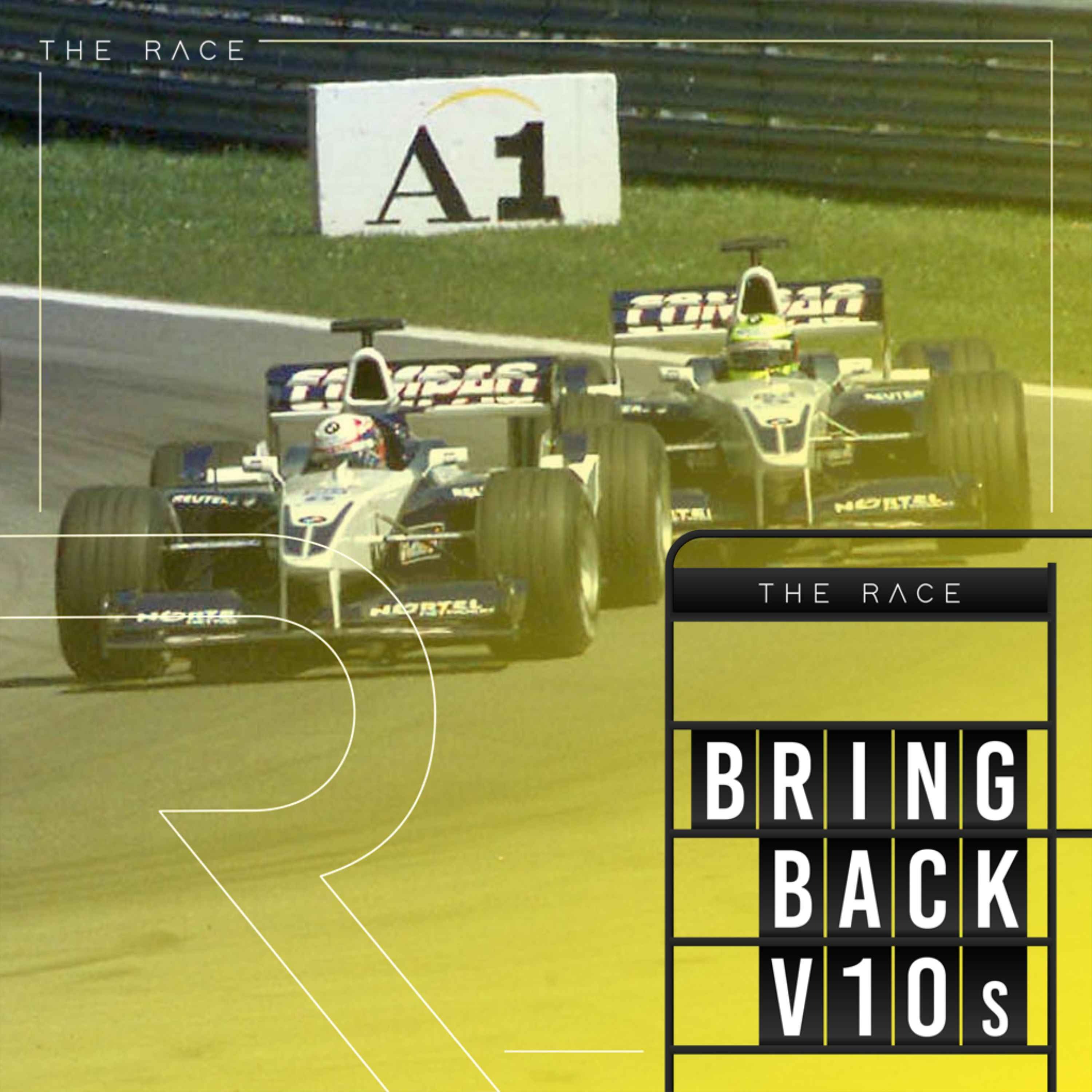
Bring Back V10s: The rise of Williams-BMW
About this episode
Williams’ switch to BMW set up a V10-era comeback with real on-track pace—yet the relationship was never fully harmonious. Hosts trace how BMW’s return was framed as an established formula, not a gamble, and how early reliability worries (including engines “detonated somewhere fairly early”) coexisted with surprise podiums. They dig into the P80 step, the power-vs-downforce story, and the politics/communication issues that shaped Williams’ 2001 struggles and driver dynamics.
Bring Back V10s looks back on the first two years of the Williams-BMW partnership in 2000 and 2001, with the help of our members!
We asked them what they wanted to know about how this partnership started across its first two years, and from that we created a list of subjects for Glenn Freeman to put to Edd Straw and Mark Hughes to explore what was going on both on track and behind the scenes.
We cover the expectations ahead of BMW's F1 return in 2000, and why there was tension between the two parties from the very beginning. We look at how the first year laid the foundation for the huge step that came from BMW in 2001 with its incredible P80 engine, and if Williams did enough on the car side to hold up its end of the bargain.
We also discuss Williams's three drivers during this time, looking at how Ralf Schumacher and Juan Pablo Montoya fit into the sometimes divided dynamic between team and engine supplier, and wonder what Jenson Button could have achieved if he'd stayed on board for 2001.
Get bonus F1 podcasts, extra content and ad-free listening, sign-up to The Race Members' Club on Patreon today.
Hosted on Acast. See acast.com/privacy for more information.
Renault engines
"By the time Williams lost its Renault engines at the end of 1997, it already knew what it was going to do next, bringing BMW back to F1 at the start of the new millennium."
Renault was the engine supplier for Williams at that time. In Formula 1, the engine is a huge factor in how fast the car can be.
This refers to Williams using Renault power units in the late 1990s. In F1, the engine/power-unit supplier is a major part of the performance equation, so switching suppliers can dramatically change competitiveness.
race winning force
"On track, the partnership got off to a solid start in year one and then became a race winning force thanks to a monster of an engine that was developed for 2001."
It means the team’s car was good enough to win races. In this case, the big reason was a major engine upgrade.
In F1, a “race-winning force” means the car and engine package is strong enough to consistently challenge for wins. It’s usually driven by a major performance step—here, the engine development aimed at the 2001 season.
monster of an engine
"On track, the partnership got off to a solid start in year one and then became a race winning force thanks to a monster of an engine that was developed for 2001."
They’re saying the engine was really strong compared to what they had before. In F1, that usually means it made the car faster in races.
“Monster of an engine” is a fan-style way of saying the engine was unusually powerful and/or effective for racing. In F1 context, it typically points to a big performance gain from development work targeted at a specific season.
Williams-BMW
"And to help me, Glenn Freeman, revisit the first two years of the Williams-BMW partnership."
“Williams-BMW” refers to the F1 partnership where Williams used BMW engines/power units. It matters because engine development and integration with the chassis can turn a team into a race-winning contender.
practice
"And that involved talking to them after every practice session, both the BMW side and the Williams side. So I got to know them quite well."
Practice is when teams drive during the race weekend to try out settings and get the car ready. It’s like testing and tuning before the important sessions.
In F1, “practice” sessions are track time used to test setup changes, learn tire behavior, and prepare for qualifying and the race. The transcript highlights that the speaker was updating both sides after each practice session.
detonated
"because the BMW engines are generally detonated somewhere fairly early in their life. And they've done a race distance on the dyno even with the engines."
“Detonated” here means the engine was burning fuel in an uncontrolled way, like it’s exploding instead of smoothly pushing the pistons. That can quickly ruin the engine, which is why they say it failed early.
In this context, “detonated” means the engine experienced uncontrolled combustion (often called knock/detonation), which can rapidly damage an engine. The hosts are describing early BMW engine reliability problems where failures happened very early in the race weekend.
dyno
"And they've done a race distance on the dyno even with the engines. So the fact that Ralph Schumacher managed to get that podium..."
A dyno is a machine that runs the engine on a stand and measures how it performs. They’re saying the engines looked okay on the dyno, but still had problems when used in an actual race.
A “dyno” (dynamometer) is a test stand that measures engine output and behavior under controlled load. The point here is that BMW’s engines were tested for race-like distance on the dyno, yet still suffered failures in real racing.
podium
"So the fact that Ralph Schumacher managed to get that podium, and actually Jensen Button wasn't far off finishing in Australia as well, was a good old fashioned bring back V10s."
In F1, “podium” means finishing in the top three. It’s a big deal because it’s where the drivers get trophies and the best points.
“Podium” in Formula 1 means finishing in the top three positions, which earns trophies and maximum points. The hosts use it to highlight how surprising Ralph Schumacher’s result was given the engine-failure narrative.
bring back V10s
"was a good old fashioned bring back V10s. Oh, they'll never finish. Oh, they finished and they've got a good result."
“Bring back V10s” means people want Formula 1 to use V10 engines again. The hosts are joking that even though everyone expected problems, the cars still did well.
“Bring back V10s” is a fan/driver rallying cry for returning to V10 engines in F1, typically associated with the high-revving sound and character of that engine era. In this segment, it’s used as a punchline to contrast the expected unreliability with the fact that they actually finished and scored.
checkered flag
"because the narrative was very, very much at the time, no chance of making the checkered flag."
The checkered flag is what race officials wave to show the race is over. They’re saying people expected the cars to break before they could make it to the finish.
The “checkered flag” is the traditional signal that the race has ended, shown when the leader crosses the finish line. The hosts are referencing the expectation that the BMW-powered cars wouldn’t survive long enough to reach the finish.
retirement rates
"So when you looked at the retirement rates on the engine side, they were more heavily in Button's favor..."
“Retirement rates” means how often a car has to stop racing early due to a problem. They’re comparing which driver’s car was breaking down more often.
“Retirement rates” means how often a driver’s car fails and is forced to stop (a DNF) rather than finishing the race. Here it’s used to compare how frequently Ralph Schumacher vs Jensen Button were affected by the BMW engine failures.
Le Mans programme
"BMW was still very much involved in competition. And with its Le Mans programme, which they did in association with Williams as well, they were properly prepared for it."
A “Le Mans programme” is a company’s whole plan for racing at the 24 Hours of Le Mans. It includes building and preparing the race car and running it in endurance events.
A “Le Mans programme” means a manufacturer’s structured racing effort for the 24 Hours of Le Mans, including car development, testing, and race operations. In this context, it’s used to argue BMW had recent endurance-racing experience even while being away from F1.
power units
"we weren't really looking at a new technology in terms of power units like this season or 2014, it was quite an established formula."
In F1, “power unit” means the whole engine package that powers the car. It includes the main engine and the hybrid energy parts that help the car accelerate and recover energy.
In Formula 1, the term “power unit” refers to the complete hybrid engine system that includes the internal-combustion engine plus energy-recovery components and related controls. It’s more than just the engine block, because the hybrid parts and software strategy are part of how the car makes and manages energy.
Paul Rosha
"they did have a racing heritage... and they had one of the legendary engine designers, Paul Rosha, in charge of the project in its early days."
Paul Rosha is an engine specialist mentioned as being in charge of BMW’s early project. The hosts are saying BMW didn’t just show up—they had the right technical people.
Paul Rosha is referenced as a key engine designer tied to BMW’s early F1 project. The point of the mention is that BMW had experienced technical leadership, which reduced the perceived risk of returning to F1.
prototype partnership
"It's worth throwing in that they've been the kind of prototype partnership as well for the sports car programme with BMW and Williams that was very successful."
A “prototype partnership” means two companies worked together on race cars designed specifically for racing. In this episode, it’s mentioned to show BMW and Williams had already succeeded together before F1.
A “prototype partnership” refers to collaboration on prototype race cars—typically purpose-built endurance machines rather than production-based vehicles. Here, it’s used to connect BMW and Williams’ prior success in sports-car racing to their confidence entering F1.
BMW turbo engines
"The BMW turbo engines of the 80s were very slightly before my time, but they were held in such high regard"
“Turbo engines” use a turbocharger to cram more air into the engine, which helps it make more power. When the host says “BMW turbo engines of the 80s,” they’re talking about BMW’s turbo era in racing.
“BMW turbo engines” refers to BMW’s turbocharged power units used in 1980s-era racing. Turbocharging forces more air into the engine, which can boost power output and was a major part of BMW’s reputation in that period of motorsport.
engine formula
"I like the point actually Mark about coming into an established engine formula. I feel like across all forms of motorsport where your series are trying to attract manufacturers now, manufacturers will never come in in the middle of an established formula."
In F1, the “engine formula” is basically the rulebook for what engines teams are allowed to use. If a manufacturer joins an existing set of rules, they have to build to those rules instead of starting from scratch.
In Formula 1, an “engine formula” is the set of technical regulations that define what kind of engines teams are allowed to build and how they must operate. When the host says F1 had got BMW back into an established engine formula, they mean BMW was returning under existing rules rather than creating a new rule set.
BMW controlled delivery
"they never claimed it was and although I look back through some of the original press stuff they put out and obviously they referenced the Brabham era, but BMW controlled delivery and it was a corporate thing."
The host is saying BMW had a lot of control over how the team’s branding was presented. That included the team’s colors, and it could even make it harder to fit other sponsors’ preferences.
“Controlled delivery” here means BMW managed how the car’s branding and presentation were handled, including the corporate visual identity. The host links it to BMW colors being important enough to affect other sponsor arrangements.
color codes
"I was going back looking through their logos and checking the, checking the color codes for it and that kind of thing."
“Color codes” are specific, standardized identifiers used to match exact shades across branding materials. The host says they checked BMW’s logo history and color codes to confirm the Williams scheme matched BMW’s corporate look rather than a playful retro homage.
naming rights
"…BMW basically bought the rights to delivery from Williams and naming rights within that. So if you look at TV graphics from the time…"
“Naming rights” means a company pays to have its name attached to a team or event. In F1, that usually shows up in the team name on TV and in official branding.
In Formula 1, “naming rights” are the commercial agreement that lets a sponsor’s name appear in the team name and branding. It’s a form of title sponsorship that affects how the team is presented in TV graphics, merchandise, and official materials.
TV graphics
"…So if you look at TV graphics from the time, you had that slightly confusing thing where it always came up as BMW Williams underneath the driver's name…"
“TV graphics” are the on-screen overlays broadcasters use to label drivers, teams, and sponsors during coverage. In F1, sponsor and team branding in these graphics can reflect commercial control agreements like naming rights.
title sponsor
"…And that was because BMW were effectively in a way title sponsor or partner as well. And that gave them the control delivery…"
A “title sponsor” is the main sponsor that gets the biggest branding spot. Here, it means BMW’s name was shown as part of the team’s identity.
A “title sponsor” is the top-level sponsor whose name is used as part of the official identity of a team or event. In this context, BMW’s title-sponsor role is why BMW branding appeared alongside Williams in on-screen graphics.
Formula 1
"I think Mario Tyson felt the responsibility of representing this big automotive company very keenly in terms of his own career and this was serious stuff. This was serious, high corporate stuff and he could not afford to just let this go in whatever direction it was going to go."
Formula 1 is the highest level of car racing with open-wheel race cars. Teams spend a lot of time designing and improving their cars so they can go faster and handle better on race day.
Formula 1 (F1) is the top tier of open-wheel racing run under the FIA. Teams build and develop race cars with strict technical rules, and success depends heavily on how well the engine, chassis, and aerodynamics work together.
Renault Supertec engine
"It was just a starting engine to get experienced. It was based essentially on the old Renault Supertec engine. It was based very much around the dimensions of that engine."
This is the name of an older Renault Formula 1 engine program. The host is saying BMW’s early engine was largely built from that previous design, so it wasn’t expected to be the absolute fastest right away.
The Renault Supertec engine refers to Renault’s F1 engine program used in the late 1990s/early 2000s era, associated with the Supertec branding. The speaker is saying BMW’s early “starting engine” was essentially based on that older Renault design, which affected competitiveness in the first year.
bespoke engine
"So it was previous generation just to get them up to speed with some data and it's ready to do their own bespoke engine in 2001. So it wasn't such a big deal that they weren't running at the front immediately"
A bespoke engine means the engine is tailored for that specific team’s race car, not just a generic version. In racing, that kind of customization helps the whole car work together better.
A “bespoke engine” is a custom-built power unit designed specifically for a particular team’s car and integration needs. In F1, that matters because the engine’s packaging, mounting points, and control systems must work with the chassis and electronics to maximize performance.
integrate the chassis and engine
"And if they sensed any little sign that they were not going to be represented by a fully competitive chassis then it was very, very sensitive. It was potentially problematical and the first year it wasn't such a big deal because the engine wasn't the best. It was just a starting engine to get experienced... It's worth noting as well that this is a period when Ferrari in particular is raising standards for how closely you integrate the chassis and engine."
This means the engine and the car frame are designed to fit and work together from the start. When they’re integrated well, the car can be set up more efficiently and perform better.
Integrating the chassis and engine means designing the car so the engine and chassis work as a single system—sharing packaging constraints, mounting geometry, and performance targets. The speaker notes Ferrari was raising standards here, implying better coordination leads to faster, more reliable race performance.
McLaren
"when you control both of it and McLaren and Mercedes were doing it and I think Williams were a little bit behind on that"
McLaren is a famous Formula 1 racing team. Here it’s mentioned as an example of a team that worked well together across the car’s main parts.
McLaren is a Formula 1 team and constructor known for strong engineering integration between its chassis and power unit. In this episode, it’s referenced as a team that was “doing it,” meaning coordinating closely across the car’s major systems.
Mercedes
"when you control both of it and McLaren and Mercedes were doing it and I think Williams were a little bit behind on that"
Mercedes is a major Formula 1 team and engine brand. The point here is that they were good at making the car’s main systems work together.
Mercedes is both a Formula 1 team and an engine/power-unit supplier brand. The host uses it as an example of a manufacturer that coordinated effectively, helping the chassis and engine work together instead of staying disconnected.
chassis and the engine side properly integrated
"you can go all the way back to the McLaren Tag Porsche project for realising how big a potential there is in terms of really trying to get the chassis and the engine side properly integrated."
This means the car’s main structure and its engine are developed together, not separately. When they’re “integrated,” the car is easier to tune and usually works better as a whole.
“Chassis and the engine side properly integrated” refers to coordinating the car’s structural setup with the power unit’s needs. In F1, that means the engine/installation, cooling, mounting points, and electronics are developed as one system so the car behaves predictably.
Berger
"although I suspect without Berger it would have got a lot worse a lot quicker because Berger kind of plays that louder role as louder with Mercedes because he was somebody he spoke the language of Formula One"
Berger is described as someone who could translate between Formula 1 teams and BMW. The idea is that better communication can prevent misunderstandings that slow down development.
Berger is referenced as a key intermediary who helped Mercedes and BMW-related efforts communicate better. The host says he “spoke the language of Formula One,” understood the teams, and also understood BMW, helping reduce the disconnect between organizations.
Mario Tyson
"helped in terms of the natural space there would have been between say Mario Tyson and the Frank Williams and Patrick Head."
This name is used in a comparison about who was involved and how close or far apart their approaches were. The host is basically talking about how leadership and communication can change how well a project runs.
Mario Tyson is mentioned as part of a comparison involving the people leading or influencing the BMW-to-Williams relationship. In this segment, the host is using names to illustrate the “space” between key figures and how communication dynamics can affect outcomes.
Audi
"we had the question earlier about if there could be a comparison made to Audi in modern day F1 and we said no not really but something I think you can compare it is what we talked about there"
Audi is mentioned as an example of a company that tried to get involved in Formula 1. The host’s takeaway is that big changes inside the company can make racing plans harder to execute.
Audi is discussed as a modern comparison point for how manufacturer involvement in F1 can succeed or struggle. The host says Audi’s situation involved a major upheaval before even reaching the grid, and that management disruption can make manufacturer programs riskier.
management change at the very very top
"there's always dangerous manufacturers isn't it even manufacturer programs that are active I feel like they become more at risk when there's a management change at the top of the company"
The host is saying that when the top leaders at a company change, big racing projects can get shaky. That’s because the new leaders may not follow the same plan or priorities.
A “management change at the very very top” is described as a risk factor for active manufacturer programs in F1. The host argues that when leadership changes, the people who originally committed to the project may no longer be in place, increasing the chance of disruption.
integration
"…could finally start exploiting the inherent advantages of of integration that they'd always had but it squandered and they were really you know along with Rory Bern they were really setting the standard there in terms of integration getting all the departments working together…"
In F1, “integration” is how well a team coordinates its different groups. Instead of each department working separately, they share goals so the whole car improves together.
In Formula 1, “integration” means getting different departments—like aerodynamics, engineering, and operations—working from the same priorities so the car develops as one system. The idea is that when teams coordinate well, they can choose the right technical “levers” and improve faster.
levers to pull
"…understanding which which levers to pull and by how much and so yeah they those two teams had made what a top Formula One team looked like…"
“Levers to pull” means the controllable things a racing team can adjust. The better the team is at coordinating, the more they know which adjustments will actually make the car faster.
“Levers to pull” is a metaphor for the specific technical and operational adjustments teams can make—like setup choices, development priorities, and component changes. The point is that integrated teams know which levers matter most and how much to change them.
pucker engine
"…with BMW got what I think Mark called its pucker engine and made a big step Sam Bedford asked how did BMW make such big improvements so quickly this this is really about the pucker engine…"
“Pucker engine” is a nickname for BMW’s new engine that made a huge improvement. The point is that it was a major upgrade that helped the team get much faster.
“Pucker engine” is the hosts’ slang for BMW’s big performance leap in the early 2000s. It refers to a radical step in engine development that helped Williams-BMW move up the grid quickly.
P80
"…this this is really about the pucker engine was called the P80 and that it was in an enormous step that BMW made from 2000 to 2001 Patrick Head called the engine brilliant…"
P80 is the designation for BMW’s Formula 1 engine used by Williams in the early 2000s. The key point in this segment is that it represented a major evolution from the prior season, with big gains in power and weight.
kilos lighter
"…but the 2001 engine had 880 from the beginning and was 15 kilos lighter he said it was a very aggressive engine…"
“Kilos lighter” means the engine weighed less. A lighter engine can help the car feel quicker and easier to handle because the whole car is easier to move around.
“Kilos lighter” refers to reducing engine mass, which can improve how the car accelerates, brakes, and changes direction. In F1, even small weight reductions can matter because they affect the car’s overall balance and tire/traction performance.
tolerances
"so yeah it was state-of-the-art they'd gone extremely aggressive on tolerances really really aggressive on tolerances and that was the the heart of it basically"
“Tolerances” means how accurately the engine parts are made to fit together. If the tolerances are tighter, the engine can work more precisely, which can help it make more power.
In engine building, “tolerances” are how precisely parts are manufactured to fit and function together. The segment emphasizes BMW’s aggressive tolerance targets as a key reason the engine could extract more power and run efficiently at the limit.
center of gravity
"lower the center of gravity and as much as they could and made it as light as they could"
The center of gravity is the “balance point” of the car. Lowering it usually helps the car feel more stable and less likely to tip or roll during hard cornering.
Center of gravity (CoG) is the point where the car’s weight effectively balances. The segment says BMW aimed to lower the center of gravity as much as possible, which generally improves handling and stability in racing.
peak power
"it would have been easy to focus too much on on peak power but you know the power curves"
Peak power is the highest power number the engine reaches at its best RPM. The point here is that the engine was also good across the rev range, not just at its single best moment.
Peak power is the maximum power the engine produces at a specific RPM. The hosts note that while peak power matters, the BMW engine’s broader characteristics (like the power curve and drivability) were also genuinely strong.
power curves
"it would have been easy to focus too much on on peak power but you know the power curves all those kind of things were were genuinely genuinely good"
A power curve is how strong the engine feels at different engine speeds. If the curve is good, the car feels responsive and usable, not just fast at one specific RPM.
A power curve shows how engine power changes across the rev range (RPM). The segment argues the BMW engine wasn’t only about peak power; its power curve and responsiveness made it easier to drive.
manufacturer boom periods
"it created this absolute beast of an engine at a time when F1 is in one of its manufacturer boom periods as you say so much competition as well ..."
A “manufacturer boom period” means lots of big car companies are spending heavily on F1. When that happens, the competition gets tougher and improvements come faster.
A “manufacturer boom period” describes a time when multiple car makers heavily invest in F1 teams and engines. That typically increases competition, accelerates development, and makes it harder for a new engine program to stand out quickly.
engine blows up
"BMW just yeah went right year one the engine blows up a lot at the start but somehow we finished the first race then we make some gains ..."
When they say the engine “blows up,” they mean it fails badly and can’t keep running. In racing, that usually happens when a new engine isn’t fully sorted yet.
“Engine blows up” means the engine suffers a catastrophic failure—often from overheating, mechanical breakage, or severe internal damage. In F1, early-season blowups are a sign of teething problems with a new or heavily revised power unit.
engine wars
"interesting time in terms of F1 engine wars because we're getting towards the point where [2160.1s] the technological limitations get put on it"
“Engine wars” means teams and engine makers competing fiercely to build the fastest, most powerful engines. Eventually the rules and durability limits start to restrict how far they can push it.
“Engine wars” is a shorthand for the competitive arms race between F1 engine manufacturers and teams to gain performance advantages. In this context, it’s about how teams push technology until rule-imposed limits and reliability constraints start to cap what they can do.
technological limitations
"the technological limitations get put on it and it's never quite as extreme but there's loads of [2164.8s] interesting material stuff going on at this stage"
This is about the point where there are hard limits on what teams can do—either because of the rules or because physics makes it too difficult. The host is saying we’re nearing that stage.
“Technological limitations” here refers to the point where engineering progress is constrained by rules and practical physics rather than pure ambition. The host frames it as a phase of F1 where the sport’s regulations begin to limit how extreme teams can make the engines.
qualifying engines
"Mark this is we're kind of approaching the very peak of manufacturers being able to throw [2194.9s] anything they want at F1 here aren't we we're not that far away from losing qualifying engines"
Teams sometimes use their best, most aggressive engine setup just for qualifying. The host is saying F1 may tighten rules so teams can’t do that as easily.
“Qualifying engines” are engines used specifically for the qualifying session to maximize performance. The host is saying the sport is moving toward rules that would make it harder to dedicate separate engines just for qualifying.
engine has to last a weekend
"we're not that far away from losing qualifying engines [2199.9s] we're not that far away from engine has to last a weekend engine has to last two weekends"
F1 teams don’t get to just swap engines whenever they want. The rules force an engine to survive for a set amount of time, like an entire race weekend.
In Formula 1, engine usage is regulated by rules that limit how long an engine can be used before it must be replaced. When the host says “engine has to last a weekend,” they’re referring to the idea that teams can’t treat engines as disposable for every session.
21,000 rpm
"so yeah it was very very impressive I mean it was the era where we eventually saw [2246.2s] 21,000 rpm something that had previously been deemed theoretically impossible"
RPM tells you how fast the engine is spinning. The host is pointing out that these F1 engines got up to about 21,000 RPM, which is extremely high and very hard on the engine.
RPM (revolutions per minute) is a measure of how fast the engine’s crankshaft spins. The host highlights that F1 engines reached around 21,000 rpm in this era, which was a major engineering milestone because it pushes mechanical stresses and airflow demands to extreme levels.
19,000 revs
"the actual physical limit of [2263.6s] moving that much air through that outer space will be about 19,000 revs went way beyond that"
The host is talking about an estimated maximum engine speed—around 19,000 RPM—based on how well the engine can breathe. They’re saying the technology eventually surpassed what people thought was the limit.
“19,000 revs” refers to the expected upper limit for engine speed based on physics and engineering constraints. The host explains that the practical limit was tied to how much air the engine could move at very high rotational speeds, and that real-world results went beyond earlier expectations.
balance between chassis and engine
"Ed help us unravel the the balance between chassis and engine in this period yeah I would say like any such statement it simplifies it but broadly speaking..."
They’re talking about what matters more for speed: the car’s overall design (especially aerodynamics) or the engine. The idea is that you can’t explain everything by the engine alone.
This is the core technical debate: how much of F1 performance comes from the chassis/aerodynamics versus the engine. The segment argues that it’s too simplistic to blame results purely on the engine, because the aerodynamic package (downforce, efficiency) and development direction also matter.
downforce
"they're poor at some of the very very downforce dependent tracks as well so yeah they are and ultimately Williams had been struggling with this for a long period..."
Downforce is the “suction” from the car’s shape and wings that presses the tires onto the track. More downforce usually means better grip, especially in corners.
Downforce is the aerodynamic force that pushes a car down toward the track, increasing tire grip. In F1, it’s largely generated by wings and body shape, and cars can be “downforce dependent,” meaning they perform best when they can generate lots of it.

FW19
"you see that even starting to come in during 1997 with the development of the FW19 through the year can't you that you're seeing that that they just no longer quite that that cutting edge..."
FW19 is the name of a specific Williams F1 car chassis from that era. The point here is that the car’s design development was starting to fall behind, even if the engine was still strong.
FW19 refers to the Williams Formula 1 car (the chassis) used in the late-1990s/1997 development period. In the discussion, it’s used as a marker for when the design stopped being cutting-edge, affecting how competitive the Williams package was alongside the BMW engine.
bulletproof
"we do have to remember the BMW wasn't bulletproof in 2001 so I don't want to go as"
“Bulletproof” means something that almost never breaks. The host is saying the BMW wasn’t that reliable in 2001.
“Bulletproof” is a motorsport term meaning an engine or car is extremely reliable and rarely fails. The speaker notes that the BMW power unit wasn’t bulletproof in 2001, implying reliability issues affected results.
aero
"about the fact they weren't where they needed to be and that was an aero thing because Patrick [2509.0s] head was not actually your aero guy he was great technically but you needed him with a newie or a [2513.7s] Frank Derney in order to really make the most of things"
“Aero” means aerodynamics—how the car’s shape interacts with air. It affects how much grip the tires have in corners and how fast the car can go on straights.
“Aero” is short for aerodynamics—how airflow over the car creates downforce and drag. In F1, aero efficiency strongly affects cornering grip and straight-line speed, which can decide races and championships.
Frank Derney
"because Patrick [2509.0s] head was not actually your aero guy he was great technically but you needed him with a newie or a [2513.7s] Frank Derney in order to really make the most of things"
Frank Derney is mentioned as an expert in how air flows around the car. The speaker’s point is that aerodynamics specialists help teams turn their cars into real race winners.
Frank Derney is referenced as an aerodynamics specialist who could help Williams “make the most” of its package. The point is that aero development expertise matters as much as raw engine performance in F1.
efficiency
"yeah I'm [2538.4s] going to I'm going to while you were talking you guys were talking about the efficiency it reminded [2542.1s] me of a quote I saw from Ralph which I wasn't going to use in the episode but I've dug it out so"
Efficiency here means the car gets more speed out of what it has, instead of wasting energy. In F1, that can mean better straight-line speed and stronger overall race performance.
In F1, efficiency usually means how effectively the car converts engine output into speed with minimal losses from drag and poor aerodynamic performance. A more efficient car can run faster lap times or use less fuel/energy, which helps over a race weekend.
Ralph
"it reminded [2542.1s] me of a quote I saw from Ralph which I wasn't going to use in the episode but I've dug it out so [2547.0s] this was him talking about winning in Canada in 2001 where he beat his brother Michael in a"
“Ralph” is Ralph Schumacher, an F1 driver. He’s quoted here talking about how his car and the Ferrari behaved on straights and how that influenced the race.
“Ralph” refers to Ralph Schumacher, who raced in Formula 1 and is discussed here in the context of the 2001 Canadian Grand Prix. The quote is about how the Ferrari’s straight-line speed and aerodynamic behavior affected the outcome.
Michael
"this was him talking about winning in Canada in 2001 where he beat his brother Michael in a [2553.0s] straight fight and he said that the on straight line speed the Ferrari was maybe better than it [2558.8s] got credit for because of efficiency"
“Michael” is Michael Schumacher, another F1 driver and Ralph’s brother. They’re describing a race where the two competed directly, showing how small technical differences can matter a lot.
“Michael” refers to Michael Schumacher, Ralph’s brother and a top F1 driver. The segment uses their on-track “straight fight” to illustrate how engine strength and aerodynamic efficiency can still be decisive even when one car has an advantage.

Williams BMW
"by the time of the BMW years even going as far as saying we were no longer very good then [2608.6s] he's this is a great line Frank said show the car a lot of corners and it was not up to the task"
“Williams BMW” means the Williams F1 team using BMW engines. The discussion is about how strong the engine was, but how the whole car still had trouble being consistently competitive.
“Williams BMW” refers to the Williams Formula 1 team running BMW engines during the BMW-powered era. In this context, the hosts are discussing how the package’s strengths (like engine power) and weaknesses (overall competitiveness/reliability) affected results.
horsepower
"and the only thing that saved it was the horsepower and even Patrick Head has admitted that Williams's [2619.5s] cars weren't good enough during this time Ed mentioned if you were building a fancy F1 team"
Horsepower is a measure of engine power output. In F1 discussions, it’s often used to explain why a car can be fast on straights even if other areas (like aerodynamic efficiency or chassis balance) are lacking.
Jensen Button
"Scott [2649.5s] Beresford is first asking if Williams had kept Jensen Button for 2001 would he have managed to win [2656.6s] a race that year"
Jenson Button is a famous Formula 1 driver from the UK. In this segment, they’re debating how well he might have done if he stayed with Williams in 2001.
Jenson Button is a British Formula 1 driver who later became a World Champion. Here, the hosts discuss whether keeping him at Williams for 2001 could have changed race results and his rookie impact.
Montoya
"motorsport Mike says who had the better rookie season at Williams Montoya [2662.4s] or Button yeah Button I would have thought would have won a race in 2001"
Montoya is a well-known Formula 1 driver from Colombia. They’re comparing how strong his early rookie season at Williams was versus Button’s.
Juan Pablo Montoya is a Colombian Formula 1 driver known for his aggressive driving style. The hosts compare his rookie-season performance at Williams against Jenson Button’s, focusing on who would have been more likely to win early.
rookie season
"motorsport Mike says who had the better rookie season at Williams Montoya [2662.4s] or Button yeah Button I would have thought would have won a race in 2001"
A rookie season is a driver’s first season in Formula 1. The discussion is about who adapted faster and could deliver race-winning performance sooner.
A rookie season is a driver’s first year in Formula 1 (or first year in a particular top-level series). The hosts use it as a benchmark for early adaptation, speed, and race results.
reliability
"the only thing I think [2669.4s] would have stopped him would have probably been reliability Williams BMW didn't actually win that [2673.6s] many races in 2001 they should have won more but if reliability didn't let him down"
Reliability means the car doesn’t break down. If it’s unreliable, even a fast driver can lose races because the car fails before the finish.
Reliability in racing means how consistently the car can finish races without mechanical failures. The hosts link reliability to whether a driver can convert speed into results across an entire season.
Melbourne
"bulging into Michael Schumacher and we got to Melbourne for the first race and he was kind of nowhere"
Melbourne is where the Australian Formula 1 race is held. It’s an early-season stop, so teams are still figuring out how their cars will work.
Melbourne is the location of the Australian Grand Prix, which is held at Albert Park. In F1 discussions, “getting to Melbourne for the first race” usually refers to the early-season race where teams and drivers are still sorting out setup and form.
Spa
"he'd probably be an on-course to win Spa and they mess it up yeah Spa would be a good shout actually because he was he's so good around"
Spa is a famous Formula 1 track in Belgium. It has lots of fast corners and big changes in elevation, so it rewards skilled driving.
Spa refers to Circuit de Spa-Francorchamps in Belgium, one of F1’s most famous tracks. It’s known for high-speed corners and elevation changes, so drivers who are strong at car control often do well there.
motorhubs
"but in terms of the ambience yeah Ralph used to used to hang out on the BMW side of the well it was two different motorhubs they were linked but they were completely separate"
“Motorhubs” here is being used to describe the team’s garage/paddock-side areas for different manufacturers or sides of the operation. The key point is that Ralph and Montoya were associated with different sides, creating a different day-to-day atmosphere even within the same overall team.
quick German drivers were very much in vogue at that time
"and Ralph was the obvious choice quick German drivers were very much in vogue at that time [3077.9s] that's very true"
They mean that, at the time, German drivers were especially popular. The idea is that Ralph Schumacher fit what BMW and Williams were looking for in that period.
“In vogue” here is describing a driver-market trend: teams and manufacturers were actively seeking German talent during that era. The hosts use this to explain why Ralph Schumacher was seen as a strong fit for the Williams-BMW setup.
Toyota
"that came a point later on when we started having a few crashes I think took a little bit of the [3106.9s] the edge off and kind of later in his career with Toyota you see you see moments with him but"
Toyota is mentioned as where Ralph Schumacher went later in his career. The hosts are saying he had some good moments, but it wasn’t as strong or consistent as his Williams period.
Toyota is referenced as the later team/engine context where Ralph Schumacher had “moments” but struggled to make a consistent impression. In this discussion, Toyota is used as the contrast point to his Williams peak.
engine supplier
"Tim Ray says is the BMW Williams partnership [3288.8s] the gold standard of first year achievements I can't think of a better first two years for a [3295.8s] new engine supplier entering the sport during a stable time of regulations"
In Formula 1, an engine supplier is the manufacturer that provides the power unit to a team. Because the engine is a major performance driver, a new engine supplier can noticeably affect results in the first seasons.
stable time of regulations
"I can't think of a better first two years for a [3295.8s] new engine supplier entering the sport during a stable time of regulations um I'll answer the [3302.4s] second part first"
This means the F1 rules weren’t changing dramatically. When the rules stay steady, teams can improve their cars without constantly redesigning for new requirements.
“Stable time of regulations” means the sport’s technical rules are not changing much, so teams and engine suppliers can develop within a consistent framework. That stability makes it easier to compare progress and for a new supplier to show results quickly.
Ferrari
"although we've said Williams wasn't it was no [3328.5s] longer at the top of the the pile in terms of the where the team was at in Ferrari and McLaren had [3335.2s] moved the game on it was still at a pretty good level"
Ferrari is mentioned as one of the teams that was ahead of the rest. It’s used to explain how far behind (or close to) the leaders Williams and others were.
Ferrari is used as a benchmark for the top-of-the-field teams that had pulled ahead. In F1 analysis, naming Ferrari and McLaren helps contextualize where Williams and other teams stood relative to the leaders.
headroom of potential
"it was you know up to a certain level it had a a limited headroom of [3373.7s] potential as it turned out in hindsight but yeah I think it's you know it niggles aside those first"
This means how much extra improvement is still left in the car or engine. Even if it starts strong, there may not be much more speed available after a certain point.
“Headroom of potential” means the remaining performance margin left in a design—how much more it can improve as development continues. In engine-supplier partnerships, limited headroom can explain why early gains fade even if the package is strong.
niggles
"two seasons if you just look as as an achievement I think pretty damn impressive yeah I guess to [3389.6s] to look at and the the BAR and Toyota comparison it was in one of the questions as you"
“Niggles” here means small problems that keep showing up. They might not be catastrophic, but they can still make the car harder to run well.
In motorsport talk, “niggles” are small recurring problems—annoying issues that don’t necessarily ruin the car but can cost time, reliability, or development focus. The host suggests the BMW era had minor issues even if the early results were impressive.
BAR
"yeah I guess to [3389.6s] to look at and the the BAR and Toyota comparison it was in one of the questions as you [3395.6s] were saying there Williams were a much better team than BAR were certainly than Toyota were in those [3400.7s] early years"
BAR is the Formula 1 team name referenced in the comparison to Williams, Toyota, and Renault-era progress. In F1 discussions, team comparisons often hinge on how quickly each outfit improved under its engine and technical package.
Robert Kubitsa
"at many times when we've done some of our v8 stuff particularly 2008 we've talked about how BMW maybe dropped drop the ball there and and even as we speak somewhere in Italy there's a small percentage of Robert Kubitsa's brain devoted to being furious"
Robert Kubitsa is a Formula 1 driver. In this segment, the hosts mention him to highlight how strongly people felt about BMW’s decisions and how that affected results.
Robert Kubitsa is referenced here in the context of Formula 1 team performance and missed opportunities involving BMW. The host is using his frustration to underscore how closely drivers and teams track technical direction and results.
engine partner
"Frederick Sorgren says did BMW ever own part of the Williams team or was it solely an engine partner as i understand it"
In F1, an engine partner is a company that provides the engine to another team. It’s different from owning the team, because the engine supplier usually can’t make all the same decisions.
An engine partner in Formula 1 is a team that supplies power units to another team under a technical and commercial agreement. The distinction matters because an engine partner typically doesn’t control the whole team the way an owner or majority shareholder would.
majority shareholding
"they wanted to be buy the team out right i certainly have at least have a majority shareholding in it that came i think noises were being made about that in 2001"
Majority shareholding means one party owns more than half of the team. That usually gives them the power to push big decisions.
A majority shareholding means owning more than 50% of a company, giving the holder decisive influence over major decisions. The hosts use it to explain why BMW’s desired level of control would have changed how Williams could be run.
Patrick Head
"but uh Frank and Patrick were not interested in that at all um it was their team and they they weren't ready to sell"
Patrick Head was a major figure at Williams, involved in running the team. In this discussion, he’s portrayed as refusing to give BMW ownership control.
Patrick Head is referenced alongside Frank Williams as another core figure who resisted selling ownership to BMW. The segment frames this as a missed chance to close the performance gap versus top teams.
Frank Williams
"but uh Frank and Patrick were not interested in that at all um it was their team and they they weren't ready to sell"
Frank Williams was the founder/leader behind the Williams F1 team. Here, he’s described as not wanting to sell control to BMW.
Frank Williams is mentioned as the key decision-maker who refused BMW’s attempt to take a majority stake in Williams. In F1 history, ownership and control strongly influence how quickly a team can execute technical changes.
succession plan
"Williams was at that stage this sort of ran out of momentum they hadn't made a great succession plan and they'd lost Adrian Newey"
A succession plan is how a team prepares for important people leaving. If you don’t have one, the team can struggle to keep improving.
A succession plan is a structured approach to replacing key leadership or technical staff when they leave. In motorsport, weak succession planning can stall development because critical knowledge and decision-making aren’t transferred quickly enough.
Adrian Newey
"Williams was at that stage this sort of ran out of momentum they hadn't made a great succession plan and they'd lost Adrian Newey they'd lost that sort of technical drive"
Adrian Newey is a famous Formula 1 technical designer. The hosts are saying Williams fell behind partly because they lost him.
Adrian Newey is cited as a major technical talent Williams lost, which the hosts connect to the team losing its “technical drive.” In F1, losing a top designer can quickly affect car development direction and competitiveness.
Request an Explanation
Heard something you'd like explained? We'll add it to this episode.
Sign in to request explanations for terms you heard.
Want to learn more?
Browse our glossary for plain-English explanations of automotive terms, jargon, and concepts.
Help improve this episode
See something that's not quite right? Our annotations are AI-generated and can sometimes miss the mark. Click the flag icon on any annotation to suggest a correction.