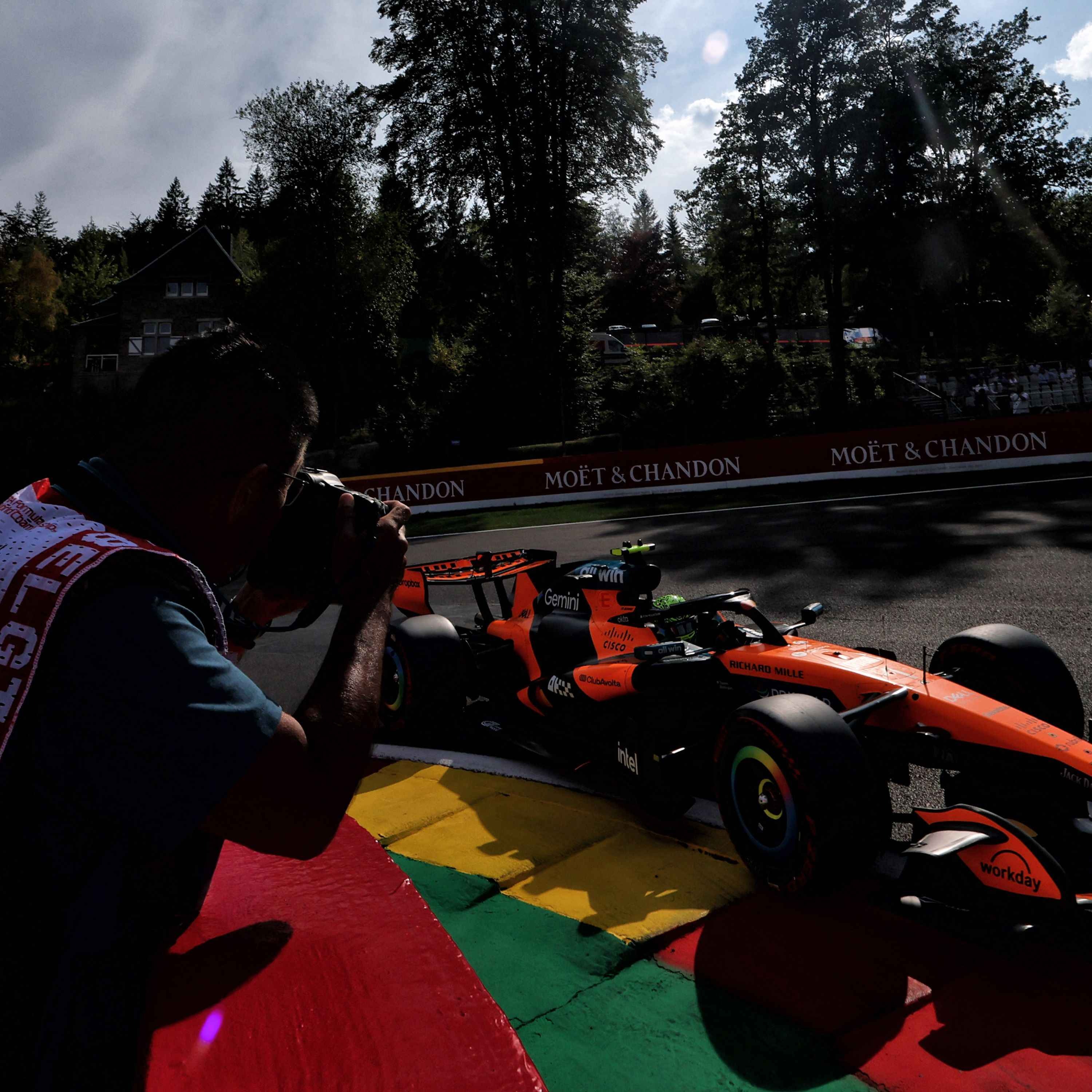
In-Car Insights: We discuss Friday's F1 action in Belgium
About this episode
Friday’s Belgium running gets an in-car style debrief, with Mercedes’ pace standing out but their FP1 struggles and a big FP2 change explaining the swing. Spa’s fast sections highlight why the cars can look skittish—downforce loss, plus hybrid deployment warnings and long braking zones shaping what drivers feel versus what TV shows. The hosts also unpack rear-wing safety checks, McLaren and Haas upgrade details, and why energy management could make Sunday’s one-stop race more interesting.
As a special bonus, we're making the Friday edition of our In-Car Insights podcast - usually only available to The Race Members' Club - free for everyone to listen to.
This one was recorded as Edd, Ben and Val were winding their way through the Ardennes countryside en route to their lodgings, taking in parts of the classic Spa track. On the drive they discuss all of the day's big talking points, but Ben kicks things off by sharing his thoughts on seeing 2026 F1 machinery in the flesh for the first time. Has watching trackside made him to change his mind about this generation of cars, or does he still dislike them as much as before? Listen in to find out!
If you like what you hear - and we're confident you will - head to Patreon.com/therace to sign up to The Race Members' Club and enjoy these bonus episodes (and much more besides) on every grand prix weekend.
Hosted on Acast. See acast.com/privacy for more information.
La Source
"they're deploying all the way down the hill from La Source. They arrive at a real rate of knots."
La Source is a notable part of the Spa track. It’s where cars start setting up for the next corners, so you can really feel how much grip the car has.
La Source is a key uphill section at Circuit de Spa-Francorchamps. It’s where cars transition from the high-speed approach into a braking/turning phase, so changes in grip and downforce show up quickly.
O Ruge
"They arrive at O Ruge faster than they were before. Yeah and it looks that way..."
O Ruge is the dramatic uphill section at Spa that F1 cars attack fast. It’s a good spot to judge whether the car has enough grip and stability.
O Ruge (often written “Eau Rouge”) is the famous uphill complex at Spa, taken at very high speed. Because it’s so demanding, it’s a great reference point for how much downforce and traction the cars have.
downforce
"Obviously they've lost downforce too so that was quite spectacular to watch..."
Downforce is the aerodynamic force that pushes the car’s tires into the track, improving grip. If downforce is reduced, the car can feel skittish and lose traction—especially in high-speed corners like the ones discussed at Spa.
Radeon Grand Stans
"I left O Ruge after maybe 25 minutes of the session and did that yomp that you have to do where you loop around the Radeon Grand Stans down and then go up the hill..."
This is the grandstand area at Spa. The host is basically saying they walked around the stands so they could watch the cars from a better spot.
“Radeon Grand Stans” appears to be a mishearing of the “Racetrack Grandstands”/grandstand area at Spa. The speaker is describing a walking route around the spectator areas to line up with the Kemmel Straight.
Kemmel Strait
"and then go up the hill so that I could get level with the Kemmelstrait and I joined the Kemmelstrait towards the end..."
The Kemmel Straight is a fast straight at Spa. After it, the cars have to slow down hard for the next corners, so it’s a great place to watch braking and control.
The Kemmel Straight is a long high-speed straight at Spa-Francorchamps. It’s followed by heavy braking zones, so it’s where you can see how quickly cars lose speed and how stable they remain under deceleration.
MGUK
"you see the other side of F1 2026 which is flashing red lights indicating MG UK not running at full power, engine note dying..."
MGU-K is the part of an F1 hybrid system that recovers energy when the car slows down. If it’s not working at full power, the car can’t use as much of that stored energy to accelerate.
MGU-K (spoken here as “MG UK”) is the kinetic energy recovery system component in modern F1 that harvests energy from braking. The speaker says it’s “not running at full power,” implying reduced energy deployment/harvesting, which affects acceleration and overall pace.
Lecombe
"therefore they don't attack the corner in the way they used to. Lecombe used to be a really good place to watch people having to stop an F1 car..."
La Combe is a corner at Spa where drivers have to slow down a lot. The host is saying it doesn’t feel as dramatic as before because the cars aren’t being pushed as hard.
La Combe is a braking-heavy corner at Spa-Francorchamps. The speaker notes that the deceleration zone feels longer now, which changes how drivers set up the car to attack the corner.
Stavolo
"because he said basically from the exit of O Ruge pretty much all the way to Pujon all the way up to well pretty much Stavolo..."
Stavolo is a named corner area at Spa. The host is pointing out that the power-management behavior lasts across several sections, not just one corner.
Stavolo (likely “Stavelot”) is another Spa corner/sector reference point. The speaker uses it to describe how long the cars are running with reduced power and energy deployment.
harvesting
"they're running with the MG UK turned down and harvesting in fact and harvesting so it's not"
“Harvesting” here means the car is collecting energy while it brakes. That collected energy can be used later to help the car go faster.
In F1 hybrid terms, “harvesting” means capturing electrical energy during braking via the MGU-K. That energy can then be used later for acceleration, so reduced harvesting changes how the car’s power feels through a lap.
disconnect
"the same driving challenge but then you get another disconnect so if you go round to no name"
A “disconnect” means the driver’s experience doesn’t match what you can tell from the outside. The car might look like it’s going fast, but the driver may feel it’s not working the way they want.
In racing commentary, a “disconnect” describes a mismatch between what the driver feels in the car and what spectators see from outside. It often comes from differences in grip, braking/turn-in behavior, or how quickly the car is actually slowing compared to appearances.
Pujon
"which is the left hander before Pujon that's quite a quick corner and obviously Pujon's a very very quick corner to the naked eye"
“Pujon” is a named corner at Circuit de Spa-Francorchamps. It’s a fast section where drivers aim to carry momentum, and small changes in braking or traction can strongly affect how “quick” it looks and feels.
no name
"the left hander before Pujon that's quite a quick corner and obviously Pujon's a very very quick corner to the naked eye"
“No name” is a corner at Spa that people in racing use as a nickname. It helps everyone talk about the same spot on the track.
“No name” is a named corner sequence at Spa-Francorchamps. It’s used in F1 discussion as a shorthand for a particular turning point, helping commentators and drivers reference where the car’s behavior changes.
Spa
"Yeah very much so and you could tell that the drivers were not delighted with the experience of Spa you referred to Liam Lawson"
“Spa” is a famous Formula 1 race track in Belgium. It’s known for tricky corners and hills, and the weather can change quickly.
“Spa” refers to Circuit de Spa-Francorchamps in Belgium, one of Formula 1’s most famous tracks. It’s known for high-speed corners, big elevation changes, and weather that can swing lap-to-lap.
Liam Lawson
"Spa you referred to Liam Lawson I did the the thing on Friday that you have the the Friday pen they do the TV stuff"
Liam Lawson is an F1 driver. In this segment, they mention him because he was doing media on Friday and also because drivers were talking about how the track felt.
Liam Lawson is a Formula 1 driver who was referenced here in connection with Friday media activities and driver feedback about the track. His comments are treated as part of the broader driver sentiment from that session.
Lewis Hamilton
"Lewis Hamilton asked him about it as well and it's sparse still"
Lewis Hamilton is one of the most famous drivers in Formula 1. They mention him because he also asked about what happened, showing it mattered to the drivers.
Lewis Hamilton is a top-tier Formula 1 driver and multiple-time World Champion. Here, he’s mentioned as asking about the incident/issue, which signals how widely the topic was discussed among drivers.
sprint qualifying
"I remember talking about this as early as China remember watching china through turn 123 in sprint qualifying I think and saying actually the cars look better here"
Sprint qualifying is a weekend format where there’s a shorter race that helps decide where cars start for the main race. Teams have to balance speed and strategy because it matters for the grid.
Sprint qualifying is an F1 format where a shorter race (the “sprint”) is used to determine grid positions for the main Grand Prix. It changes how teams approach setup and tire/energy management because the weekend’s results are decided earlier than in traditional qualifying.
wheelbase
"they work very slightly quicker not by much but because they've got that responsiveness and it's only a small amount of weight and a very slight reduction in wheelbase but it makes so much difference"
Wheelbase is the length of the car measured from the front wheels to the rear wheels. A shorter wheelbase can make the car feel more nimble and easier to turn, which is why it can affect lap times and handling.
Wheelbase is the distance between a car’s front and rear axles. In F1, a shorter wheelbase generally helps the car change direction more quickly, improving agility, while also affecting stability and how the car feels over bumps and under braking.
TV vs on-board perspective distortion
"you just can't again disconnected the tv you never get the sense of speed and that that plays well for this formula one and badly at the same time because the bad bits you can't see are as bad on the tv as easily but equally the bits where they're really impressing you with the sense of speed and that nimbleness you that doesn't get picked up either"
They’re talking about how different camera views can make the racing look better or worse than it really is. TV angles might hide some problems, while in-car cameras can make everything feel more intense.
The hosts discuss how broadcast angles and camera framing can change viewers’ perception of speed and handling. They argue that TV-wide shots can miss the worst moments and also fail to capture the nimbleness that drivers feel, while onboards can exaggerate roughness or issues.
onboards
"the tv impression kind of distorts it the onboards is a different thing because the on board show some of the worst aspects of f1 2026 really clearly"
In F1 coverage, “onboards” are the camera views mounted on the car, typically showing the driver’s perspective of braking points, steering inputs, and how the car behaves through corners. Because they emphasize what the driver sees, they can make certain issues feel more severe than they do from trackside or TV-wide shots.
racing prototypes
"awesomeness these are still like incredible racing prototypes probably the fastest fastest racing cars on the planet"
A racing prototype is a one-off, experimental race car. It’s built to try new tech and improve over time based on what the team learns.
In Formula 1, “racing prototypes” are experimental race cars built to test new performance ideas. They’re not production vehicles; they’re purpose-built to evolve quickly as teams learn what works on track.
blue flags
"it's very much traffic blue flags blue flags everywhere now what else do we have today"
Blue flags mean a faster car is coming up behind you to lap you. You should let them through safely so they can keep racing.
Blue flags are a race signal used in F1 to warn a driver that faster cars are approaching to lap them. When you see them, you’re expected to make it easier for the leader to pass safely.
Mercedes
"what else do we have today obviously uh we've talked before about Mercedes not having [618.7s] the macarena rear wing the flip top wing as i prefer to call it"
Mercedes is the F1 team/manufacturer referenced here in relation to its rear-wing hardware. The segment focuses on whether Mercedes can run a specific wing concept at Spa after prior issues were identified and addressed.
flip top wing
"obviously uh we've talked before about Mercedes not having [618.7s] the macarena rear wing the flip top wing as i prefer to call it"
A “flip top wing” is a rear wing design that can change position or configuration using a mechanism. The point is to adjust aerodynamics, but it has to be reliable and safe to run in a race.
A “flip top wing” describes a rear-wing concept where the wing’s configuration can change via a mechanism, rather than being a fixed aerodynamic element. In this segment, the host links it to a mechanical/safety issue and discusses whether it will be run at Spa and later at Budapest.
pierre vache
"i spoke to pierre vache the [624.5s] technical director today at red bull just to go and talk a little bit about it"
Pierre Vacher is a senior engineer/technical leader at Red Bull. In this episode, he’s the source for what went wrong with the wing and what they’ve done to fix it.
Pierre Vacher is identified as the technical director at Red Bull in this segment. The host uses his comments to explain what the team believes caused the wing problem and what changes were made to make it safe to run.
FIA
"so that's partly because the fia as has been reported the race reported it [650.3s] very much taking a very close look at this in terms of the safety aspect of it"
The FIA is the organization that oversees Formula 1 rules and safety. If they’re worried about a car part being unsafe, teams may have to remove it from the race.
The FIA (Fédération Internationale de l’Automobile) is the governing body that sets and enforces F1 safety and technical rules. Here, the host says the FIA is closely reviewing the wing’s safety implications, which affects whether teams can run it at certain races.
actuators
"it's it's a fix it basically said it's a mechanical problem so it's related to the [681.1s] actuator or the the interface between the actuator and the wing itself"
An actuator is a device that physically moves something when the car tells it to. Here, the problem is likely in the actuator or the connection between the actuator and the wing.
An actuator is a mechanical/electromechanical device that moves a component to a commanded position. In this segment, the wing issue is described as being related to the actuator or how it interfaces with the wing itself.
drag reduction
"but he called it a different concept so there's two different ways there and obviously he's adamant it's 100 safe because they've not had any problems with it so it's been looked at though hasn't it yeah phase obviously they can't single out red bull just because for staff had a couple of crashes"
Drag reduction just means making the car push through the air with less resistance. Less resistance usually helps the car be quicker, especially in straight lines.
In F1, drag reduction means lowering aerodynamic resistance so the car can go faster, especially on straights. The discussion here links it to a movable aerodynamic element that changes airflow to reduce drag.
rear wing assembly
"other upgrades today mclaren had a new rear wing assembly this was nothing to do with their flip top rear wing which is still parked for the moment but we will see that after the august break they run it i think"
The rear wing assembly is the full set of parts on the back of the car that shapes airflow. It helps the car stick to the road, and it can also change how fast it is on straights.
A rear wing assembly is the complete rear aerodynamic package (wing elements plus mounting/actuation hardware) that generates downforce and manages airflow. Changes to the assembly can affect both cornering grip and straight-line efficiency.
flip top rear wing
"other upgrades today mclaren had a new rear wing assembly this was nothing to do with their flip top rear wing which is still parked for the moment but we will see that after the august break they run it i think"
A flip-top rear wing is a rear wing that can change position or shape. That lets the team adjust how much grip and resistance the car has, but they’re not running it yet in this phase.
A flip-top rear wing is a rear wing concept that can change its aerodynamic configuration by moving a section (often to alter downforce/drag characteristics). The hosts note it’s currently “parked,” meaning it’s not being used yet, likely pending further testing or timing within the season.
red flag
"[841.2s] were hints of long run because we had that red flag for pierre gazley's off which i got a picture [847.2s] of his rear wing because i was i was picked up by the shuttle bus at puan and i saw it was a red flag"
A red flag is the signal that the race is stopped for safety. Something dangerous happened on track, so everyone has to slow down and wait for instructions.
A red flag in Formula 1 means the session is stopped immediately due to a serious on-track situation, like a crash or debris. Drivers must slow down and follow marshals’ instructions until the race resumes or the session ends.
understeers off
" [853.0s] i saw gazley there was actually a tv screen so i was able to see the replay of gazley going off [858.1s] looks like it just understeers off and then clatters the rear wheel into some bit of barrier"
Understeer is when the front tires don’t grip enough, so the car won’t turn as sharply as you want. The result is the car slides toward the outside of the corner and can run off the track.
Understeer means the car turns less than the driver expects, so it tends to go wide toward the outside of the corner. When they say it “understeers off,” they’re describing a loss of front-end grip that leads the car to leave the intended racing line.
track limits
"set a quicker lap time than the one he was credited with but it was deleted for turn four track limits"
Track limits are the rules about staying within the painted/defined racing area. If you go outside the allowed area, your lap time can be thrown out.
Track limits are the boundaries of the racing surface that drivers must stay within to have their lap time count. If a car crosses those limits (often at specific corners), the lap can be deleted or penalized.
deployment strategy
"in this case it'll be what deployment strategy"
Deployment strategy refers to how an F1 team manages the use of energy/boost systems during a session or lap to maximize performance. It’s about timing and allocation—using the available power when it’s most beneficial rather than all at once.
sector one
"because and you burn everything uh in sector one you don't use any power in sector two you burn everything in sector three"
F1 tracks are split into a few timed chunks. Sector one is the first chunk of the lap, and it helps teams see where the car is fast or slow.
In F1, the track is divided into timed sections called sectors. Sector one is the first part of the lap, and teams use sector times to diagnose where a car is strong or struggling.
sector two
"because and you burn everything uh in sector one you don't use any power in sector two you burn everything in sector three"
Sector two is the middle timed chunk of the lap. It’s where teams often manage power differently so the car can save energy for later.
Sector two is the middle timed section of an F1 lap. When a host says they “don’t use any power” in sector two, they’re describing how the car’s energy use and throttle mapping are managed across the lap.
sector three
"because and you burn everything uh in sector one you don't use any power in sector two you burn everything in sector three"
Sector three is the last timed chunk of the lap. Teams often try to push the hardest here because it’s the final part before the lap ends.
Sector three is the final timed section of an F1 lap. Hosts often talk about it in terms of where the car can push hardest, because the energy strategy and traction limits can change toward the end of the lap.
optimal list of strategies
"that will presumably teams will narrow down the the optimal list of strategies tomorrow"
F1 strategy is the plan for tires and pit stops, plus how the team uses the car’s performance over time. Teams test several possible plans to pick the best one.
F1 strategy is the planned combination of pit stops, tire choices, and energy/power usage over the race. The “optimal list of strategies” means teams compare multiple race plans to find which one best matches expected track conditions and rivals’ behavior.
front wing
"haas new front wing if i'm not mistaken seemed tentatively positive seemed quite positive"
The front wing is an aerodynamic part that helps the car stick to the track. If it changes, the car can feel different in turns and braking.
The front wing is the primary aerodynamic device at the front of an F1 car. It generates downforce to help the front tires grip in braking and cornering, and changes to it can alter balance and responsiveness.
haas new front wing
"haas new front wing if i'm not mistaken seemed tentatively positive seemed quite positive don't think uh all the bearman's suggestion was that it doesn't necessarily add load but it just transforms the car characteristics"
The front wing is the main aero part at the front of the car. A new one can change how the car grips the road and feels in corners.
A front wing is a key aerodynamic component that shapes airflow to improve downforce and stability. When the host mentions “Haas new front wing,” they’re talking about a specific aerodynamic update on a Haas F1 car, which can change how the car behaves even if it doesn’t add outright load.
load
"don't think uh all the bearman's suggestion was that it doesn't necessarily add load but it just transforms the car characteristics"
“Load” here means how much downforce the aero parts create. Even if it doesn’t add more downforce, it can still change how the car handles.
In aero talk, “load” usually means aerodynamic downforce. The host is saying the new front wing may not increase downforce overall, but can still change the car’s behavior by redistributing airflow and balance.
budget cap
"they believe they are absolutely the sole team and i found not running at the budget cap right now"
The budget cap is the maximum amount of money an F1 team is allowed to spend. If a team isn’t using the full cap, it can limit how many upgrades they can bring.
The budget cap is F1’s spending limit that teams must follow. When the host says Haas isn’t running at the budget cap, they’re implying the team is operating with less money than the maximum allowed, which affects how much development they can do.
team boss aiakamatsu
"and as uh team boss aiakamatsu said on thursday they believe"
That’s the team’s leader speaking. Team bosses in F1 often explain what their team is focusing on and how they’re planning to improve.
This refers to a team principal/leader speaking on behalf of their F1 team. In F1, team bosses often comment on development direction, budgets, and performance targets.
set of regulation
"yeah this is a very different situation in terms of you know this is the first year of a very different set of regulations so obviously lifetime gains are going to be more meaningful"
In F1, the rules are written down as a “regulations” set. It tells teams what they can build and how the cars have to work. When the rules change, it can make upgrades work differently and affect how teams improve.
In Formula 1, a “set of regulations” is the official rulebook that governs what teams are allowed to design and how cars must be built and operated. When a new set of regulations arrives, it can change the performance potential of upgrades and how quickly teams can improve.
lifetime gains
"yeah this is the first year of a very different set of regulations so obviously lifetime gains are going to be more meaningful"
“Lifetime gains” means improvements that keep helping for a long time, not just for one race. In F1, that matters because teams build upgrades expecting them to work across many weekends.
“Lifetime gains” refers to performance improvements that persist across multiple races rather than being a one-off benefit. In a season with major rule changes, teams may expect upgrades to deliver more lasting improvement over the remaining races.
update
"if they bring an update that's worth two seconds that is in absolute value the greatest update we've seen in a very very long time in formula one"
An “update” is a new part or change on an F1 car meant to make it faster. If it’s worth “two seconds,” that’s a huge improvement for race pace.
In F1, an “update” is a technical change to the car—like new aerodynamic parts or mechanical revisions—intended to improve lap time. The hosts discuss an update that could be worth “two seconds,” emphasizing how large a performance step it would be.
track layout
"they have to get through this weekend uh yeah the the track layout exposes them a little bit the length of the track obviously exposes them"
“Track layout” means how the track is designed—how long it is and what kinds of turns it has. Some tracks make certain car weaknesses show up more than others.
“Track layout” is the specific configuration of a circuit—its length, corner types, and how fast sections connect. The hosts argue that the layout can expose a team’s weaknesses, making deficits larger than they would be on shorter laps.
Monza
"he's prepared that you know tracks like monza coming up which is probably the most energy starved of the season"
Monza is one of F1’s most famous tracks in Italy. It has lots of fast sections, so it can be tough on the car’s power and efficiency. The hosts say it’s a track where teams can really feel performance limits.
Monza is a famous F1 circuit in Italy known for long straights and high-speed sections, which makes it especially demanding on power and efficiency. The hosts call it “energy starved,” meaning teams may struggle to extract enough performance there without the right upgrades.
energy-starved
"tracks like monza coming up which is probably the most energy starved of the season worse than even spar"
“Energy starved” means the car isn’t getting enough usable power/energy to stay fast. On some tracks, the way the laps are shaped makes that problem worse, so upgrades may not fix everything.
“Energy starved” describes a circuit where the car can’t access or use enough usable energy to maintain strong performance—often due to how the track’s demands interact with the power unit and energy recovery/management. The hosts use it to argue that certain upgrades may not be enough on tracks like Monza and Spa.
Honda engine
"they're going to be hopeless there because the honda engine is one upgrade but it's not like that one upgrade is going to make the honda engine the best engine in formula one"
The “Honda engine” is the power unit Honda supplies for an F1 car. The point here is that even with an upgrade, it won’t instantly become the top engine—though it can help fix problems that are slowing the car down.
The “Honda engine” refers to Honda’s power unit used by a specific F1 team (as discussed in the segment). The hosts argue that one upgrade won’t magically make it the best engine, but it may address specific issues that are hurting performance.
Red Bull Powertrain
"arrival for the red bull powertrain's thing it's just going to be fixing some like chronic combustion problems"
“Red Bull powertrain” means the whole set of components that make the car move, centered around its engine/power unit. The hosts are saying other teams’ upgrades are trying to catch up to Red Bull’s strong setup.
“Red Bull powertrain” refers to the complete drivetrain components that turn energy into motion—typically including the engine/power unit and related transmission systems. The hosts mention it as the benchmark, implying Honda’s upgrades are aimed at closing a gap rather than overtaking immediately.
chronic combustion problems
"it's just going to be fixing some like chronic combustion problems that are making that car so dog slow"
“Chronic combustion problems” means the engine’s fuel-burning process has been going wrong for a long time. If combustion isn’t happening correctly, the engine can’t make power efficiently, so the car feels slow.
“Chronic combustion problems” means persistent issues with how fuel burns in the engine’s combustion process. The hosts connect this to poor power delivery and slow lap times, arguing upgrades are meant to reduce these long-running problems rather than transform the engine overnight.
chassis engine combination
"…it’s chassis engine combination does not deserve as a lucky point…"
An F1 car is basically a frame (chassis) plus an engine. This phrase means how that specific frame and engine are matched and set up to work well together, which affects how fast the car can be.
In Formula 1, a car’s performance is strongly shaped by how the chassis (the car’s structural platform) and the engine work together. The “chassis engine combination” refers to the specific pairing of that team’s car structure and power unit, including how well they’re integrated for balance, packaging, and overall pace.
Cadillac
"…it’s right for Cadillac to be in that situation because they are totally new to this… they’re miles off even cadillac…"
Cadillac is being used as a comparison point for speed. The hosts are saying that even if Aston Martin improves, it still wouldn’t be fast enough compared with Cadillac’s current level.
Cadillac is referenced here as a benchmark for pace, implying the team’s performance level is still ahead of Aston Martin in this context. The comparison is used to argue that even Aston Martin’s projected upgrade gains wouldn’t close the gap enough to score points.
Aston Martin
"…it’s very hard to imagine a scenario in which that car has any shot at scoring points… it’s very hard to imagine… it’s wild for astin martin to be there…"
Aston Martin is one of the Formula 1 teams. Here they’re talking about how hard it’s been for Aston Martin to get its car performing well enough to score points consistently.
Aston Martin is an F1 constructor/team known for competing at the front when its car package is competitive. In this segment, the hosts focus on Aston Martin’s struggles with its current “package,” implying the car is far off the pace and that the team has had to make major compromises to adapt.
strategy weirdness
"…just mild rain or strategy weirdness would not do it or come anywhere close to doing it…"
In F1, teams choose when to pit and what tires to use. “Strategy weirdness” means those choices (especially if conditions change) can create unexpected race results.
“Strategy weirdness” refers to unusual or unexpected race outcomes caused by pit-stop timing, tire choices, and race management decisions. In F1, small strategic differences can be amplified by safety cars, weather, or track position, leading to surprising results.
Fernando Alonso
"…when you’re astin martin honda with fernando alonso in the in the lead seat…"
Fernando Alonso is a top-level F1 driver with multiple world championships. The hosts are basically saying it’s shocking that someone like him is in a car that still can’t compete for points.
Fernando Alonso is a two-time Formula 1 World Champion (and one of the sport’s most experienced drivers). The hosts mention him in the context of Aston Martin’s “lead seat,” emphasizing how unusual it is for a driver of his caliber to be in a car that’s struggling to score points.
McLaren Honda
"…it’s just nuts to me that that mclaren honda situation is happening to him again…"
McLaren Honda is McLaren with Honda’s engine. The hosts are saying the same kind of performance trouble is repeating, and that it’s really affecting the driver.
McLaren Honda refers to the McLaren team’s period of using Honda power units, a partnership known for both high expectations and periods of difficulty. The hosts say the “McLaren Honda situation” is happening again, suggesting a familiar pattern of performance problems affecting the driver’s mental focus.
raising the floor of the quality of races
"but it is supposed to surf are you gonna yo yo me now i i'm not gonna say those exact words but i am going to say that it's been quite okay at raising the floor of the quality of races"
“Raising the floor” means the rules try to stop races from being too one-sided. The aim is to make more teams capable of close racing, not just the very fastest ones.
“Raising the floor” is a motorsport concept meaning the rules are intended to reduce the gap between the best and worst cars. The goal is to make more races competitive, so even if the top end isn’t perfect, the overall racing quality improves.
deployment strategies
"this weekend you know we won't necessarily even see that artificial level of action because of convergence of those deployment strategies and the fact that spark can still be despite it's what is supposed to be an overtaking conducive nature"
“Deployment strategies” means how teams choose when to push the car harder versus when to save it. That can change how fast the car feels and how good the racing looks.
“Deployment strategies” refers to how teams manage and use the car’s energy/engine modes over a stint to control performance and efficiency. In F1, these choices can affect tyre wear, speed consistency, and how often drivers can attack.
one-stop
"i prefer to be optimistic heading into what is expected to be a one-stop on on sunday with maybe not as much yo-yoing as as we've been used to"
A “one-stop” race strategy means the driver pits only once. Teams do this when the tyres can last long enough, so they don’t waste time making extra stops.
A “one-stop” strategy means the car makes a single pit stop during the race, typically to change tyres and manage fuel/tyre performance. Whether one-stop is viable depends on tyre degradation and how the race pace compares to the time lost in the pits.
yo-yoing
"heading into what is expected to be a one-stop on on sunday with maybe not as much yo-yoing as as we've been used to uh much to ben's chagrin"
“Yo-yoing” means the racing feels like it keeps swinging back and forth instead of staying exciting for long. It can happen when pit stops and tyre changes make cars jump ahead and then fall back quickly.
“Yo-yoing” is a fan/paddock shorthand for racing patterns where cars repeatedly gain and lose position or speed in a back-and-forth way. In modern F1 discussions, it often comes up when pit stops and tyre performance create artificial-looking swings rather than sustained battles.
energy management
"what i would say about the spa race that could be very interesting is because it's such an extreme energy management challenge"
In F1, “energy management” is how the team decides when to use extra power and when to save it. Since the car can’t run at full power forever, managing that energy helps determine how fast you can be and when you can attack.
Energy management in modern F1 is how teams control the use of the car’s hybrid energy systems (and related power modes) across a lap and over the race. Because you can’t just use maximum power all the time, it directly affects pace, overtaking opportunities, and strategy.
overtaking strategies
"there are a lot of places where you are going to not be able to deploy so that does create some interesting challenges in terms of your overtaking strategies"
“Overtaking strategies” are the plan for how to pass another car. It’s not just about being faster—it’s about choosing the right moment and using the car’s power and grip effectively.
Overtaking strategies are the planned ways a driver uses timing, tire condition, and power/traction to pass another car. In F1, they’re tightly linked to energy management and track-specific zones where passing is realistically possible.
pack
"forcing others to spend their pack where they might not want to can you get past and just nudge away a little bit enough to stay ahead"
In F1 context, “pack” means the group of cars running close together, often with multiple cars within a few seconds. When the speaker says forcing others to spend their pack, they’re describing how you can pressure nearby rivals into using their limited resources to defend or attack.
wheel to wheel combat
"my definition is ultimately you want wheel to wheel combat and you're not going to see so much of that"
“Wheel-to-wheel combat” means two cars are fighting side-by-side for position. It’s the kind of racing fans like because it’s close and competitive, not just one car pulling away.
Wheel-to-wheel combat is close racing where two cars race side-by-side with minimal gap, typically involving repeated braking and cornering battles. It’s a key fan metric because it indicates genuine on-track competition rather than processional racing.
braking zone
"you're not going to see so much of that you're not going to see ... contesting the braking zone to the last minute side by side through corners"
The “braking zone” is the part of the track where drivers slow down for a turn. It’s often where overtakes happen because braking is where drivers can make a decisive move.
The braking zone is the section of track where drivers slow down for a corner, often the most important overtaking window. In F1, passing attempts frequently happen here because cars can be forced into late braking decisions and different lines.
single lap pace
"the whole weekend and single lap performance long run pace performance is all about that deployment"
Single-lap pace is how quickly the car can go on one fast lap. It matters for qualifying, but it doesn’t always predict how the car will behave during the whole race.
Single-lap pace is how fast a car is over one flying lap, usually measured in qualifying-like conditions. The speaker contrasts it with race pace, noting that energy deployment can make the race feel different from what one-lap speed suggests.
long run pace
"the whole weekend and single lap performance long run pace performance is all about that deployment"
Long-run pace is how fast the car stays over a longer stretch of the race. It includes how the tires and car balance hold up, so it’s more representative of race-day performance.
Long-run pace is the car’s speed over extended stints, reflecting how it manages tires, fuel/energy, and balance as conditions change. It’s often a better indicator of race performance than one-lap speed.
pace gap
"look right but there's still quite a big pace gap there as well they looked they looked a lot"
A pace gap just means one car is faster than another by a noticeable amount. It’s usually talked about in terms of lap times and how quickly they can drive.
A pace gap is the difference in performance between teams or cars, usually measured by lap times. In F1 discussions, it often reflects how well the car matches the track conditions and how effective the setup and upgrades are.
FP1
"they looked they looked a lot further off in fp2 than fp1 i mean it looked quite exciting to start with didn't it because"
FP1 is the first practice session on Friday. Teams use it to get a baseline for how the car and tires feel, then improve for the next session.
FP1 means the first Free Practice session of the weekend. It’s typically where teams start evaluating baseline setup and tire performance, then adjust for FP2.
FP2
"they looked they looked a lot further off in fp2 than fp1 i mean it looked quite exciting to start with didn't it because"
FP2 is the second practice session on Friday. Teams use it to learn how the car behaves and adjust things before qualifying.
FP2 means the second Free Practice session of the weekend. Teams use it to refine car setup, test tire behavior, and gather data before qualifying and the race.
starting setup
"because Mercedes missed the window they were their starting setup was based on some assumptions that worked quite right"
Your starting setup is the car’s initial settings for the session. If those settings don’t match the track conditions, the car won’t feel right and it can be slower.
The starting setup is the initial configuration the team brings to a session, including aerodynamic settings, suspension settings, and tire choice. If it’s based on wrong assumptions, the car can feel off and performance can lag.
Pirelli said
"was based on some assumptions that worked quite right Pirelli said that when they measured the track the grip level was lower than than they expected"
Pirelli makes the tires for F1. If they say the track has less grip than expected, teams may realize their car setup was based on the wrong tire behavior.
Pirelli is F1’s official tire supplier, and their measurements and guidance strongly influence how teams interpret grip and tire performance. When they say track grip is different than expected, it can explain why teams’ assumptions didn’t match reality.
grip level
"Pirelli said that when they measured the track the grip level was lower than than they expected so it's a false impression that's created some problems"
Grip level means how much traction the tires have on the road. If grip is lower than expected, the car may not turn or accelerate as well as planned.
Grip level is how much traction the tires can generate on the track surface. Lower grip than expected can make a car feel slower or harder to drive, and it can invalidate setup assumptions.
upgrade
"we see a few of these just doing things out racing bulls have got an upgrade and that there's two bits to their upgrade"
An upgrade is a new set of parts the team brings to make the car faster. It can be things like aero changes or cooling improvements.
An upgrade in F1 is a set of new parts or aerodynamic changes brought to improve performance. Teams often split upgrades into multiple components (like cooling and aero) to manage reliability and track-specific needs.
bidapest next weekend
"because they haven't got two sets they'll have two sets for bidapest next weekend but that was basically what qualifying"
They’re talking about the next race in Budapest, Hungary. Teams plan what parts to test and when based on that upcoming track.
This refers to Budapest, the Hungarian venue used for F1 events in recent years. Teams plan upgrade testing and part allocation around the next race’s track demands.
Silverstone
"but that was basically what qualifying Silverstone was a shootout for and Limblad actually got ahead of Lawson in qualifying there"
Silverstone is a well-known F1 track in the UK. Teams use it to judge whether their car changes are actually improving performance.
Silverstone is a famous Formula 1 circuit in the UK, known for high-speed corners and fast changes in direction. It’s often used as a benchmark venue where teams can quickly see whether upgrades and setups are working.
development path
"and that red bull engine is just amazing well the red bull the red bull's still a quicker car a peak so they've got it but the racing bulls is quite is very consistent and they've got a nice fruitful development path that they'll have a development path and a car concept that probably has a lower ceiling"
A development path is the team’s plan for what upgrades to bring and when. The goal is to keep improving the car step by step across the season.
A development path is a planned sequence of upgrades a team brings over the season to improve performance. It usually balances short-term gains (like a weekend-specific update) with longer-term improvements to the car’s overall design.
lower ceiling
"and that that red bull engine is just amazing well the red bull the red bull's still a quicker car a peak so they've got it but the racing bulls is quite is very consistent and they've got a nice fruitful development path that they'll have a development path and a car concept that probably has a lower ceiling but it's easier to attain"
“Lower ceiling” means there’s a limit to how fast the car can get. It might be steady, but it may not be able to reach the very top speed of the best teams.
“Lower ceiling” is F1 talk for a car’s ultimate performance limit. Even if it’s consistent and easy to get quick, it may not reach the very top pace of the best cars once conditions and upgrades are optimized.
Max Verstappen factor
"you want the red bull it's just going to be harder to get that pace out of it and you kind of need Max Verstappen and then you get what's the Max Verstappen factor"
The “Max Verstappen factor” is shorthand for how much a driver can extract performance beyond the car’s baseline. In F1, driver skill, confidence, and feedback can noticeably change how quickly a car can be driven at the limit.
Class B
"they're at the front of that class B or near the front of it so yeah that's the thing for me"
“Class B” is an informal F1 comparison for teams that are competitive but not in the very top group. It’s a way of describing relative performance tiers rather than an official category.
Request an Explanation
Heard something you'd like explained? We'll add it to this episode.
Sign in to request explanations for terms you heard.
Want to learn more?
Browse our glossary for plain-English explanations of automotive terms, jargon, and concepts.
Help improve this episode
See something that's not quite right? Our annotations are AI-generated and can sometimes miss the mark. Click the flag icon on any annotation to suggest a correction.