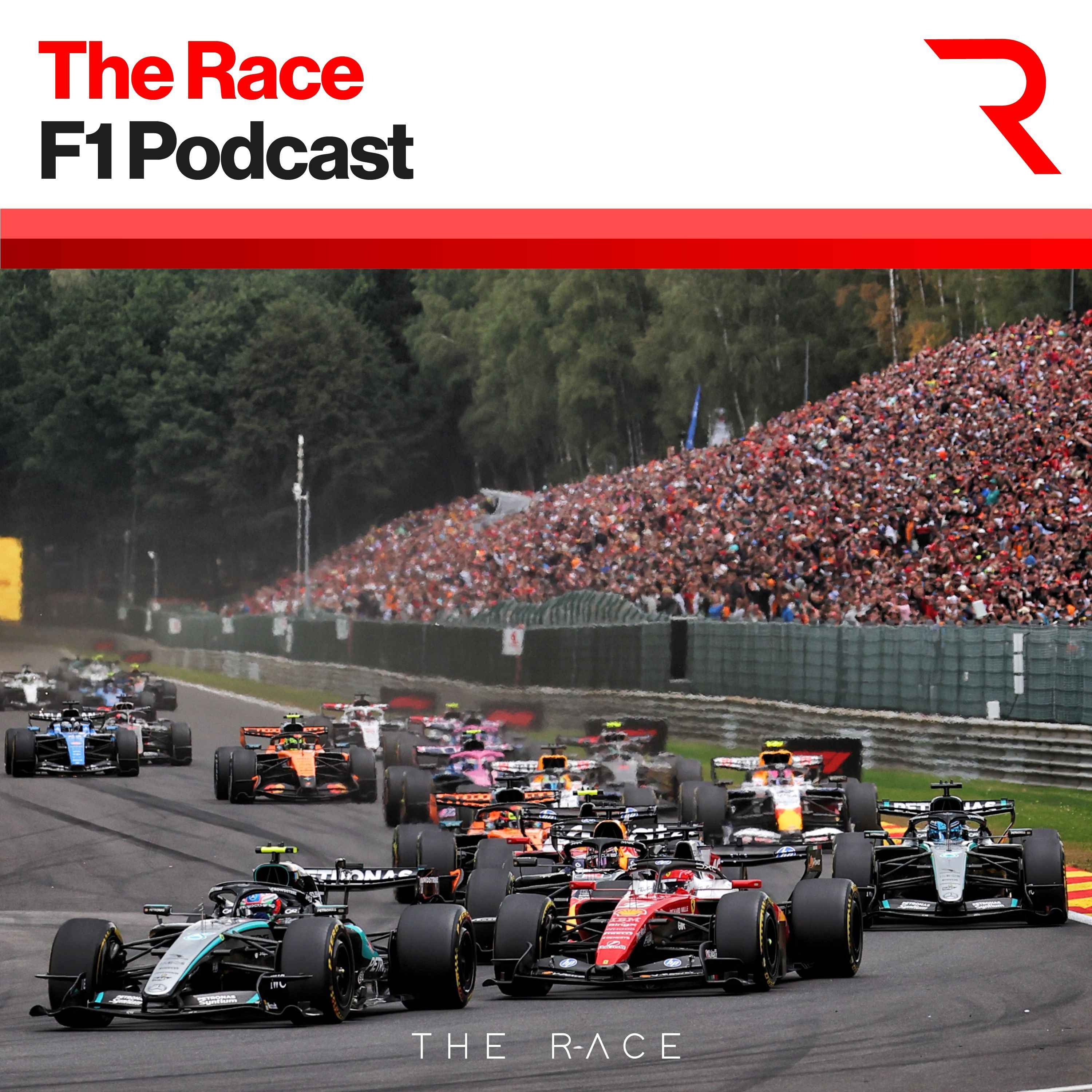
Belgian GP: Antonelli heaps more misery on struggling Russell
About this episode
Spa’s Belgian GP gets dissected through the lens of race control and energy management: “strategically, it was complicated by that virtual safety car,” which shaped Antonelli’s pass and helped him “catch and pass Charles Leclerc.” Passing was hard because “you needed a proper pace delta,” while Russell’s title hopes took a hit after “ending up in the gravel after a clash with Lewis Hamilton.” The hosts also dig into why Russell’s pace is inconsistent—“There's another aspect which is this weird battery deployment”—and debate whether the rules create too much driver-to-car disconnect.
Edd Straw is joined by Ben Anderson and Val Khorounzhiy to dissect the Belgian Grand Prix at Spa-Francorchamps. Kimi Antonelli took his win tally for the season to six with his win at Spa, while team-mate George Russell had another weekend to forget. So how big a hit have the Briton's title chances taken?
Edd, Val and Ben also look at two controversial stewards' decisions involving Ferrari, with Lewis Hamilton earning a penalty but Charles Leclerc avoiding the same fate. Did the stewards get it right?
Get bonus F1 podcasts, extra content and ad-free listening, sign-up to The Race Members' Club on Patreon today.
Hosted on Acast. See acast.com/privacy for more information.
Spa
"The race is on and Kimmy Antonelli won again at Spa in a race complicated by the timing of the VSC, meaning he had to catch and pass Charles Leclerc."
Spa is a famous Formula 1 race track in Belgium. It has lots of twists and elevation changes, and conditions can change quickly, so races there can get complicated fast.
Spa refers to Circuit de Spa-Francorchamps in Belgium, one of F1’s most famous tracks. It’s known for long straights, big elevation changes, and weather variability, which can make races and strategy—like under VSC—especially dramatic.
VSC
"The race is on and Kimmy Antonelli won again at Spa in a race complicated by the timing of the VSC, meaning he had to catch and pass Charles Leclerc."
VSC (Virtual Safety Car) is how F1 slows everyone down without bringing out the real safety car. The race uses computer-controlled targets so drivers can’t just keep racing at full speed, and that can affect strategy and who gets stuck behind whom.
VSC stands for Virtual Safety Car, a race control procedure used in Formula 1 to slow cars down without deploying the physical safety car. It’s enforced via lap-time targets, which can bunch the field up and change pit-stop timing and overtaking opportunities.
curb strike
"It was the race, I suppose, that we didn't quite get at Silverstone because of that curb strike and the damage that his car took after that."
A curb strike means the car hits the raised edge of the track. That can shake the car around and sometimes damage the tires or suspension, hurting performance for the rest of the race.
A curb strike is when a car hits the track curb (the raised edge at the side of the racing surface), which can upset suspension geometry and damage parts like tires, wheels, or underbody components. In F1, even a brief curb impact can have lasting effects on handling and reliability.
energy starved nature of the track
"And yeah, so it just felt inevitable, I think, that he was he was going to catch and pass, even though it was kind of slow to happen, I think because of the energy starved nature of the track."
It means the track makes it hard to use and manage your car’s power efficiently. Drivers have to be careful with how they spend energy so they don’t run low before the end of a stint.
This describes a circuit where the car’s energy usage is unusually constrained—often due to heavy braking zones, low-speed corners, or limited opportunities to harvest/regen energy. In F1, that can force drivers to manage power and deployment carefully to avoid running out of usable energy at the wrong time.
offset
"And as some drivers mentioned, the difficulty of getting an offset with a car that you're racing, you needed a proper pace delta to really make any kind of pass."
“Offset” here is about the timing gap between two cars. If you’re not at the right gap, it’s much harder to pass cleanly when you’re both on track.
In racing, an “offset” is the time/position gap created when one car is ahead or behind another—especially around pit stops. Getting the right offset matters because it determines whether you can attack after a stop or whether you get stuck behind traffic.
pace Delta
"And as some drivers mentioned, the difficulty of getting an offset with a car that you're racing, you needed a proper pace delta to really make any kind of pass."
“Pace delta” just means how much faster one car is than the other. If the speed difference is too small, passing becomes really difficult.
A “pace delta” is the difference in lap speed (or overall performance) between two cars. If your pace delta isn’t large enough, you can’t close the gap and pass before the other driver can defend or before strategy/pit timing changes the situation.
Leclerc
"And ultimately, even though Leclerc looked quite good in the lead for a while, the Mercedes just had that crushing pace advantage, especially in Antonelli's hands."
Leclerc is a top Formula 1 driver who races for Ferrari. Here, the hosts are saying he was doing well while leading, but the race situation changed later.
Charles Leclerc is a Ferrari driver, and the segment notes he looked strong while leading before strategy and race control events shifted the outcome. In F1 coverage, his name is often used as shorthand for Ferrari’s on-track pace and race management in that moment.
Antonelli
"the Mercedes just had that crushing pace advantage, especially in Antonelli's hands. Yeah. And of course, strategically, it was complicated by that virtual safety car."
Antonelli is an F1 driver, and the hosts are saying Mercedes looked especially strong when he was driving. They also describe how race-control slowdowns forced him to pit at specific times.
Andrea Antonelli is an F1 driver referenced here in connection with Mercedes’ pace advantage and how he had to respond to VSC timing. The segment frames his driving as particularly effective once the race conditions and strategy windows opened up.
virtual safety car
"Yeah. And of course, strategically, it was complicated by that virtual safety car. Verstappen had pitted, Antonelli had to then pit in response."
A virtual safety car is like a “slow-down rule” for the whole field, without a real safety car on track. It changes strategy because pitting during that slowdown can cost you less time than pitting under normal racing speed.
The virtual safety car (VSC) is an F1 race control procedure that slows cars down without deploying the physical safety car. It’s used to manage hazards while keeping cars moving, and it can dramatically affect strategy because pit stops under VSC can be less costly in track position.
Verstappen
"strategically, it was complicated by that virtual safety car. Verstappen had pitted, Antonelli had to then pit in response."
Verstappen is a leading F1 driver for Red Bull. The point here is that his pit stop happened before the virtual safety car situation, and it affected what other drivers had to do next.
Max Verstappen is a Red Bull Racing driver. The discussion ties his pit stop timing to the deployment of the virtual safety car, showing how one driver’s strategy can force others to react immediately.

Mercedes
"whether, I mean, that gap that Antonelli had been establishing over Stappen was representative of what his Mercedes can actually do this weekend."
Mercedes is one of the F1 teams. When they talk about “his Mercedes,” they mean the performance of that team’s car on the track during the race.
Mercedes is the Formula 1 constructor (team) that runs cars powered by Mercedes engines and uses Mercedes-branded technical partnerships. In F1, when someone says “what his Mercedes can do,” they mean the car’s pace and race strategy potential for that specific weekend.
C2 hards
"I mean, they're both on the C2 hards at that moment. The C2 hard isn't supposed to have meaningfully worn at all this weekend."
“C2 hards” means a specific type of racing tire used in F1. The “hard” version usually lasts longer, but it may not grip as strongly as softer tires.
In Formula 1, “C2” refers to a specific tire compound from Pirelli’s range, with “hard” indicating the harder, longer-lasting option. These compounds are chosen for strategy because they affect grip and how quickly the tire wears over a stint.
undercut
"it felt like Verstappen was having a go at the undercut at the point that he made the pit stop. Well, Ante had to respond."
An “undercut” is when a driver pits earlier than another car to use fresher tires. That usually lets them go faster and shrink the gap before the other car stops.
An “undercut” is a pit-stop strategy where a driver pits earlier than a rival to get onto fresh tires and build a faster lap. If timed well, the undercut can reduce the time gap before the rival makes their own stop.
pit entry
"And Ante, he was quite aggressive on the pit entry too. So it felt like there was enough pressure there that they had to execute everything right."
“Pit entry” is how a driver gets into the pit lane. Doing it aggressively or precisely can cost or save time, and it also has to be safe and controlled.
“Pit entry” is the approach to the pit lane where the driver has to hit the correct braking and turn-in point to enter safely and efficiently. In F1, how you manage pit entry affects both time loss and whether you can execute the stop cleanly.
track limits violation
"And I think you're right, there wasn't a crushing pace advantage of like three-quarters of a second or anything. ... Yeah, he still has a track limits violation in him."
A “track limits violation” means the driver went outside the allowed part of the track. That can lead to penalties, because F1 rules require you to stay within the circuit boundaries.
A “track limits violation” happens when a car crosses the boundaries of the circuit as defined by the FIA (typically by going beyond curbs or painted lines). It can trigger penalties or at least force the driver to back off, because repeated offenses can lead to sanctions.
Toto Wolff
"This is what Toto Wolff was talking about post-race. [425.2s] We both visited Mercedes in the Paddock afterwards."
Toto Wolff is the top leader at Mercedes in Formula 1. He helps run the team and is often quoted about how the drivers performed and what the team learned after a race.
Toto Wolff is the team principal of Mercedes-AMG Formula 1. In F1, the team principal is a key decision-maker who sets strategy, oversees performance, and communicates with drivers and engineers after races.
Q1
"but he really struggled, couldn't go out of Q1. [437.7s] I think in both sessions, Sprint and Grand Prix,"
Q1 is the first part of F1 qualifying. If you don’t qualify in Q1, you’re knocked out early and you’ll start the race further back.
Q1 is the first segment of Formula 1 qualifying. Drivers who fail to set a fast enough time in Q1 are eliminated and do not advance to Q2, which can severely limit their starting position for the race.
sprint
"I think in both sessions, Sprint and Grand Prix, [440.6s] but certainly it was one of his worst weekends."
A Sprint is a shorter race during some F1 weekends. It helps decide where drivers start for the main Grand Prix, so it can be a big deal for your weekend.
In F1, a Sprint is a shorter race held on a weekend that affects grid positions for the main Grand Prix. It’s typically run after qualifying (or after a qualifying format), and performance in the Sprint can strongly influence race-day strategy.
Fred Rousseau
"it's basically the thing that Fred Rousseau is always saying Ferrari needs to do come what may. [469.3s] Antonelli kind of embodies it."
Fred Rousseau is someone high up in Ferrari’s technical side. The hosts are using his quote to describe a mindset Ferrari wants—staying steady and focused even when things go wrong.
Fred Rousseau is a Ferrari engineer/executive associated with the team’s technical direction. The quote frames his philosophy as something Ferrari “needs to do come what may,” emphasizing consistency and composure across good and bad weekends.
simulators
"family friend, you see his eyes light up this stuff that he's doing outside of F1 with simulators and driver development and GT racing."
A simulator is like a high-end racing video game setup that feels like driving a real car. Teams use it to help drivers learn tracks and improve their driving without spending as much time and money on real cars.
In motorsport, simulators are computer-based driving setups used to practice, refine technique, and help engineers understand car behavior. They can be used for driver development by letting teams test setups and learn tracks without the cost of running on-track sessions.
GT racing
"family friend, you see his eyes light up this stuff that he's doing outside of F1 with simulators and driver development and GT racing."
GT racing is competition for sports cars that are based on real, road-going models. It’s another way drivers build skills by racing cars that are different from Formula 1.
GT racing refers to Grand Touring car competition, typically featuring production-based sports cars (or close derivatives) rather than open-wheel F1 cars. It’s a major ladder and development path for drivers, emphasizing endurance-style racecraft and car control.
British F4
"And that kid's, you know, fantastic record in karting, currently leading British F4, if I'm not mistaken, and McLaren, Verstappen, that should be, I mean, that name's going to come up, I imagine, in the coming years."
British F4 is a stepping-stone racing series for young drivers in the UK. It’s where drivers prove themselves in small race cars before moving up toward bigger championships like F2 and eventually F1.
British F4 is a junior single-seater racing series in the UK that sits early in the driver development ladder. It’s designed to help young drivers move from karting into cars, and strong results there often attract attention from higher-level teams.
Nurburgring
"This is obviously Nurburgring feeding into that too in the 24 hours."
Nürburgring is a very famous race track in Germany. It’s known for being tough and technical, so people use it as a comparison when talking about how hard a track is.
The Nürburgring is a famous motorsport venue in Germany, best known for the Nordschleife (“North Loop”) and its long, demanding lap layout. In F1 coverage, it’s often referenced as a benchmark for how difficult a circuit can be.
24 hours
"This is obviously Nurburgring feeding into that too in the 24 hours."
“24 hours” means a race that lasts an entire day. Instead of just sprinting for a short time, teams focus on staying fast and reliable for many hours.
“24 hours” refers to endurance racing formats where cars run continuously for a full day, typically with driver changes and pit stops. It’s a different discipline from F1’s shorter race distance, emphasizing consistency and reliability.
front row
"And that was the key to it because he got on the front row when really that car belonged on probably row three."
The “front row” means starting right at the front of the grid. That usually makes it easier to avoid getting stuck in traffic and to get a good result.
The “front row” is the first two grid positions on the starting grid, giving the best chance to control the opening laps. Starting near the front usually reduces traffic risk and helps convert pace into a strong finish.
track position
"And obviously, the track position, as we saw with the clerk when he got ahead of Antonelli, that was really important in terms of being able to grind out maybe a better result than otherwise would have been available."
“Track position” just means where you are on the circuit compared to other cars. In F1, being ahead often makes it much easier to control the race and avoid getting overtaken.
“Track position” is where a car sits relative to others on the circuit, especially at key moments like the start, pit stops, and restarts. In F1, better track position can be worth more than raw speed because it determines who can pass cleanly.
George Russell
"But we've got to talk about George Russell. Val, in the gravel on the first lap of the race, no worry wanted to be."
George Russell is an F1 driver. They’re about to talk about what went wrong for him early in the race and how it impacted his chances.
George Russell is a Formula 1 driver, and the segment is pivoting to discuss his race situation. The mention sets up an explanation of what happened to him early on and why it affected his result.
gravel
"That's how Russell felt when he was in the gravel. ... ended up in a crappy position at Lacombe at the start of the race and ended up in a gravel."
Gravel is loose material off the racing line. If a driver goes into it, the car loses grip and speed fast, and it can be hard to get back onto the track safely.
In F1, gravel is loose track material used in runoff areas. If a car goes off-line and hits gravel, it can quickly slow the car, damage components, or force the driver to recover back onto the racing surface.
Q3s
"particularly wrong in the key moment of this weekend in the Q3 part of it, because obviously for me, the Q3 defeat of half a second is more important going forward"
F1 qualifying is split into timed parts called Q1, Q2, and Q3. Q3 is the last and most important part, where the quickest laps decide the best starting positions for the race.
In Formula 1 qualifying, Q3 is the final segment where the fastest drivers set their last and best laps. The grid positions are determined by lap times set in these qualifying sessions, so losing time in Q3 can cost valuable starting spots.
practice sessions
"There's something that means his performance is just not as robust, that it goes beyond individual races or qualifying sessions. F1, 20, 26, every time you put on one of the Godforsaken practice sessions"
Practice sessions in F1 are the on-track sessions before qualifying and the race where teams test setup changes and gather performance data. Drivers also use them to learn how the car behaves on that specific track and tire conditions.
power unit
"I don't think it's the power unit. What's going on? Let's look into it. Then they decide, yeah, is the power unit."
In F1, the power unit is the whole engine-and-hybrid system that makes the car go. It includes more than just the engine—there’s also energy storage and recovery that changes how the car accelerates.
In Formula 1, the power unit is the car’s complete hybrid engine system: the internal-combustion engine plus the energy-recovery and battery components. It’s not just “the engine,” because the hybrid parts and control software strongly affect acceleration, efficiency, and how the car behaves on track.
machine learning
"It's machine learning and that's learning on the job. And there are certain inputs that affect that that they do know about. Then there are others that they can't measure properly."
Machine learning is basically using computers to learn from data. Instead of being programmed with every rule, it figures out patterns from examples—like how the car behaves—so it can predict what might happen next.
Machine learning is a data-driven approach where software learns patterns from inputs to make predictions or decisions. In an F1 context, it can be used to model complex behaviors (like how the hybrid power unit responds) when teams can’t fully measure everything in real time.
driving style
"It seems to be about the way it interacts with Russell's particular driving style. It's his job to get his head around that."
Driving style is how a driver drives—how they accelerate, brake, and steer. Two drivers can get different results from the same car because the car’s behavior depends on how the driver inputs the controls.
Driving style refers to how a driver applies throttle, brakes, and steering inputs—especially how they manage traction and weight transfer. In F1, the same car can behave differently for different drivers because power delivery and traction control interact with how each driver “asks” for grip.
tire grip
"We identified three things that are not consistent lap to lap or session to session. Wind, track grip or tire grip on that interaction."
“Tire grip” is how well the tires can stick to the road. If grip changes, the car can feel different lap to lap, even if the driver is trying to drive the same way.
“Tire grip” is how much traction the tires can generate between the rubber and the track surface. In F1, small changes in grip can strongly affect lap times and how predictable the car feels from one lap to the next.
driver inputs
"And then what the driver inputs because they can vary lap to lap run to run session to session. We identified three things that are not consistent lap to lap or session to session."
“Driver inputs” are what the driver does with the controls, like steering, braking, and accelerating. Even tiny differences can change how the tires work and how the car behaves on the next lap.
“Driver inputs” are the commands the driver gives the car—primarily steering, throttle, and braking. Because these vary slightly from lap to lap, they can change tire loading and traction, making the car’s behavior less consistent.
driving techniques
"One of which, of course, is the driving techniques. So then it comes down to, well, what is Russell doing behind the wheel"
It means the specific way a driver handles the car—when they brake, how they steer, and when they apply throttle. Small differences in technique can make the car grip better and go faster.
In racing, “driving techniques” refers to the specific methods a driver uses to control the car—like braking points, throttle application, steering inputs, and how they manage weight transfer. Different techniques can change tire temperatures, traction, and how quickly the car rotates into a corner.
NGUK
"carrying that speed through the corners, being efficient in the deployment and in the harvesting in particular and keeping the speed up and not having that little bit of infill from the NGUK."
NGUK is tied to the car’s power/energy system. The point here is that even a small loss in what that system contributes can cost you speed.
“NGUK” is a reference to an F1 energy-recovery/engine component supplier and/or system name used in the power unit context. The speaker implies that a small shortfall in the NGUK-related contribution affects how much speed is maintained through the lap.
algorithm
"There's all of these things, how much you confuse the algorithm. There was a certain difference between Antonelli and Russell in terms of how much"
An “algorithm” is basically the car’s computer logic. It uses data from sensors to decide how to control things, and different driving styles can make it behave differently.
Here, “algorithm” likely refers to the car’s control software that uses sensor data to manage performance—such as traction, torque delivery, and energy/engine management. When the driver’s inputs differ, the system’s learning and adaptation can respond differently, affecting lap consistency.
self-learning stuff
"And this is all in terms of that self-learning stuff. So there's things they can improve that."
It sounds like the car’s computer is learning from what’s happening on track. Instead of using the same settings all the time, it can adapt based on data.
“Self-learning stuff” refers to adaptive control systems that adjust their behavior over time based on observed performance and driver inputs. In F1 terms, this can mean the car learning how to deliver power and manage traction more effectively for the current conditions.
slides
"into these corners that Antonelli is so good at carrying the speed in without getting any of the slides or the time losses is a different equation to what went before"
“Slides” means the tires aren’t gripping as they should and the car starts to skid. Skidding usually costs time because the car can’t follow the ideal line as cleanly.
In racing, “slides” refers to the car losing grip and the tires skidding laterally or longitudinally. Avoiding unnecessary slides helps keep the car stable and preserves speed, especially when carrying momentum through corners.
braking zones
"Now it seems an element of how the front of the car responds when it's pitched into these corners that Antonelli is so good at carrying the speed in without getting any of the slides or the time losses is a different equation to what went before because so many braking zones now also are not ones where you attack."
A “braking zone” is the part of the track where you slow down before a corner. Where that zone is (and how hard you brake) affects how well the car turns in.
“Braking zones” are the specific track areas where drivers apply the brakes to slow the car for a corner. In F1, changes in rules, tires, or car behavior can shift where you can attack, because braking also sets up the car’s rotation and weight transfer into the turn.
pitch the front of the car
"You don't go in full chat as late as you can, hard braking, pitch the front of the car in, load that up, help you get the car into the corner and rotate, which is what all the drivers have learned since time immemorial"
It means the car’s front end dips when you brake. That shift in weight can help the front tires grip and help the car turn into the corner.
“Pitch the front of the car” describes the car’s nose dipping under braking and then loading the front tires. In corner entry, that weight transfer can help the driver rotate the car and get it turned in efficiently.
rotate
"load that up, help you get the car into the corner and rotate, which is what all the drivers have learned since time immemorial, pretty much in their careers."
“Rotate” means the car turns in more sharply so it lines up with the corner. Doing it at the right time helps the tires grip instead of sliding.
“Rotate” is the driving action of turning the car’s direction so it pivots into the corner. Drivers aim to rotate at the right moment so the tires are loaded properly and the car can follow the intended line without excessive slip.
coasting into a corner
"Now you've got these weird situations where you're coasting into a corner,"
It means you ease off the gas and let the car roll before the corner. That can change how the car feels and how the tires are loaded when you turn in.
“Coasting into a corner” means reducing throttle and letting the car roll rather than maintaining active power. In modern F1, this can change engine/energy deployment behavior and how the car’s balance settles before turn-in.
regenerate the battery
"using the gear shift sometimes to turn the car and [1436.1s] regenerate the battery, all these kind of weird interactions that that means the front of the [1440.8s] car is just not behaving in the same way"
This means the car “recharges” while you slow down. When you brake, the system turns the car’s motion into electricity instead of wasting it as heat.
In hybrid or electric-assisted race cars, “regenerate the battery” refers to recovering energy during braking. Instead of wasting speed as heat, the car uses the motor/generator to slow the car and send electrical energy back to the battery.
understeer
"generally speaking, [1446.3s] with this new input. So the drivers are able to manage that and the understeer basically [1451.2s] that it generates seems to be a massive factor in terms of the driving aspect"
Understeer is when you turn the steering wheel but the car doesn’t rotate enough. The front tires slip first, so the car tends to go wide toward the outside of the corner.
Understeer is when the front tires lose grip before the rear, so the car turns less than the driver intends. In F1, changes in braking/energy-recovery behavior can alter how weight shifts and traction are managed, making understeer more or less pronounced.
hardwire your brain over time
"They just don't have that kind of baggage that you have to kind of unpick because these drivers [1469.9s] and Russell's mentioned this, you hardwire your brain over time to do things unconsciously in the [1474.7s] car."
This describes how repeated driving inputs become automatic through muscle memory and learned control. In racing, when a car’s behavior changes (for example due to new energy-recovery or braking interactions), drivers may need to “unlearn” those automatic habits to adapt quickly.
effing battery
"Once he was in the gravel, just going on about the effing battery all effing weekend."
F1 cars use a hybrid system with a battery that stores energy. If the battery isn’t working right, the driver can lose some of the extra power that helps with acceleration.
In an F1 hybrid car, the battery stores electrical energy recovered from braking and other energy flows. If the battery is causing issues (or is limited), the car can lose access to electric boost and/or have reduced overall hybrid power delivery.
limitation of deployment
"They all had a limitation of deployment, but it was more extreme for Russell and Antonelli on that run till they come."
Deployment is how the driver gets to use the car’s stored hybrid energy. If there’s a limitation, the car won’t allow as much of that extra power as usual.
“Deployment” refers to how and when the driver can use the car’s stored energy (especially the electric boost portion). A “limitation of deployment” means the team is restricting how much hybrid power can be used, often due to battery state, component limits, or reliability concerns.
mid-corner speed
"in the slow corners especially, if you try to carry a little bit too much mid-corner speed and try and gain time there, it doesn't pay you back."
Mid-corner speed is the speed you’re holding while you’re actually in the turn. If you go too fast in the middle, the car can start to slide and you lose time because you can’t accelerate cleanly out.
Mid-corner speed is how fast the car is traveling during the middle of a turn, not just at entry or exit. The discussion suggests that carrying too much mid-corner speed in slow corners can increase sliding and make the car harder to control, ultimately costing time.
MGUK
"then whether, as Ed alluded to, the MGUK and the battery has to fill in for that power loss below a certain threshold."
MGUK is the hybrid motor in an F1 car that harvests energy when you slow down and can also add electric power when you accelerate. If it’s not supplying enough, the car can feel weaker until the system catches up.
MGUK stands for Motor Generator Unit – Kinetic. It’s the hybrid motor in F1 that recovers energy from braking (kinetic energy) and can also provide electric torque to help with acceleration. The transcript links MGUK to battery filling for power loss below a threshold.
throttle
"What you're doing then with the throttle in the"
Throttle just means how much you press the gas pedal. In an F1 hybrid car, that input also affects how the car uses its stored energy to keep power coming.
In racing, “throttle” refers to the driver’s accelerator input, which directly controls engine power and (in hybrid cars) how the car requests energy from the battery system. The transcript connects throttle behavior to how the car manages power when revs drop too low.
qualifying
"He's maybe carried too much speed into turn one [1719.2s] in qualifying compared to Antony. He's maybe a little bit scruffier with the throttle after"
Qualifying is when drivers try to set their fastest lap to decide where they start the race. Even small driving differences can matter a lot because the grid position is based on those laps.
Qualifying is the session where teams set the fastest lap to determine the starting order for the race. In F1, small differences in driving inputs during qualifying can translate into meaningful grid-position and race-performance advantages.
unpick it
"because these tiny [1744.7s] driving inputs that none of the teams really can say for sure going in, that will make the [1752.2s] difference. They have to pour over the data later to try and unpick it."
They’re trying to figure out what really caused the time difference. F1 teams look at data after the session to decide whether it was the driver, the car setup/strategy, or track conditions.
“Unpick it” refers to separating which factors caused a performance difference—driver inputs versus car/energy strategy versus track conditions. In F1, teams use telemetry and post-session analysis to attribute time gaps to specific causes.
tire grit
"but then there's [1786.1s] all these other things about the tire grit, the rolling resistance, the wind."
Tire grit is the sticky layer of rubber and debris that builds up on the track. It changes how much grip the tires get, so the car can feel faster or slower depending on track conditions.
“Tire grit” is the layer of rubber particles and debris on the track surface that affects grip. More or less grit changes traction and how the tires generate grip, which can alter lap times and the effectiveness of energy deployment.
rolling resistance
"all these other things about the tire grit, the rolling resistance, the wind. If you've got a head wind, and it's stronger"
Rolling resistance is the “drag” from the tires flexing as they roll. If it’s higher, the car loses more energy and can be harder to keep fast.
Rolling resistance is the energy lost as tires deform and roll along the road surface. In F1, it can vary with tire condition and track surface, affecting how much speed the car can maintain and how much energy is needed to do so.
headwind
"If you've got a head wind, and it's stronger than the previous run or your rival's run, that extends your straight by [1796.5s] however many meters."
A headwind is wind coming at the car. It makes the car work harder to go fast, so it can slow you down and change lap times.
A “head wind” is wind blowing toward the car, increasing aerodynamic drag. In F1, stronger headwinds can reduce straight-line speed and change lap timing, which complicates comparisons between runs.
penalty
"Let's talk about the penalty that Lewis Hamilton got for that collision with Russell. Now we've got a question from Christopher Partridge who said how on earth can Hamilton be given a penalty for what even Russell said was a racing incident when the clerk got away."
A penalty is the race officials’ punishment for breaking the rules or causing an incident. It can change where a driver finishes or how they’re allowed to race next.
In Formula 1, a penalty is an official punishment applied after an incident—often for things like causing a collision or breaking race regulations. It can affect track position immediately (e.g., time penalties) or later via grid/drive-through-style consequences depending on how stewards classify the event.
racing incident
"…for what even Russell said was a racing incident when the clerk got away. Scott free from his incident with Piastri."
A “racing incident” means the officials think the crash happened during normal wheel-to-wheel fighting, not because someone clearly broke the rules on purpose. If it’s judged that way, the driver might not get punished.
A “racing incident” is a steward classification meaning the collision was considered part of normal racing rather than deliberate rule-breaking. When an incident is labeled this way, it often leads to no penalty (or a lighter one), because both drivers are judged to have been competing within the rules.
FIA policy
"…when exactly the stick it to Hamilton was in effect as an FIA policy. I'm really curious. I mean, you could say 2021. That's fair enough."
The FIA is the organization that runs Formula 1 rules. “FIA policy” here means how they generally decide what counts as a penalty and how strictly they enforce it.
The FIA (Fédération Internationale de l’Automobile) is the governing body for F1, and “FIA policy” here refers to how the FIA and stewards tend to interpret and apply rules in certain situations. The host is questioning whether there was a consistent approach—like being harsher on one driver—when deciding penalties.
oversteer snap
"…or it's an understeer into an oversteer snap because he's lost downforce because of the cars around him."
Oversteer is when the rear of the car loses grip and wants to swing out. A “snap” means it happens suddenly, so the car can spin or rotate very quickly.
An “oversteer snap” is a sudden, dramatic loss of traction at the rear, causing the car to rotate more than intended (often quickly and unpredictably). In F1 discussions, it’s frequently linked to sudden changes in grip or aerodynamic downforce, such as turbulence from other cars.
downforce
"…or it's an understeer into an oversteer snap because he's lost downforce because of the cars around him."
Downforce is the “grip from the air” that presses the car onto the road. If it drops, the tires can lose traction and the car can suddenly feel unstable in a corner.
Downforce is the aerodynamic force that pushes the car toward the track, improving grip for braking, cornering, and stability. In the transcript, the host suggests a loss of downforce could contribute to a snap oversteer/understeer transition after an incident or disturbance from other cars.
double stack pit stop
"They didn't do it because they had double stack pit stop and he had to serve the penalty."
A double stack pit stop is when teams try to pit two cars in a tight sequence so they lose less time. It’s faster when it works, but it’s also easier for mistakes to happen if the timing or instructions get confused.
A double stack pit stop is when two cars are serviced in quick succession (or effectively back-to-back) with overlapping pit lane timing, often involving coordinated front-wing or tire work. In F1, it’s used to minimize time lost under race control conditions, but it increases coordination risk.
front wing
"They had tried to make the front wing change, but in the confusion of the situation, the whole ordering and the double stack and etc."
The front wing is the main aerodynamic “flap” at the front of an F1 car. It helps press the car onto the track (downforce), so if it’s missing or changed, the car can feel slower or less stable.
The front wing is the aerodynamic element at the front of an F1 car that generates downforce and helps control airflow to the rest of the car. Changing it can significantly affect grip and balance, which is why teams investigate wing-related incidents.
green light
"It's the person responsible for giving the green light for the car to set off. He gave the green light early and that caused the unsafe pit stop"
The green light is the team’s signal that the car is allowed to leave the pit. If the car is released too early, it can become unsafe and the team can be penalized.
In F1 pit lane operations, the “green light” is the signal from the pit wall that it’s safe for the car to be released. Releasing the car before the pit crew and equipment are clear can trigger an unsafe release and lead to penalties.
unsafe pit stop
"He gave the green light early and that caused the unsafe pit stop, which then translated into a 30,000 euro penalty"
An unsafe pit stop means the car was released in a way that wasn’t safe for the pit crew or equipment. Race officials can penalize the team because it breaks pit lane safety rules.
An unsafe pit stop is a pit lane release or service event deemed dangerous—typically because the car is released while crew members or equipment are still in the way. Stewards can impose penalties and investigate whether the team followed correct procedures.
procedural mistake
"It was a procedural mistake not borne out of any sort of competitive negligence or"
A procedural mistake is basically “doing something the wrong way according to the rules.” In F1, officials care whether it was just a process error or something that affected racing in a more intentional way.
A procedural mistake is an error in following the required rules and process (for example, pit release timing or who is responsible for authorizing actions). In F1, stewards distinguish procedural errors from “competitive negligence” when deciding whether a penalty is sporting or purely financial.
Hamilton
"Yeah, and Hamilton had nothing to do with that. Yes, he was driving, but you go when you get told to go."
Lewis Hamilton is a top Formula 1 driver and multiple-time world champion. Here, they’re arguing about whether he was actually at fault for something that happened during the race.
Lewis Hamilton is a seven-time Formula 1 World Champion and one of the sport’s most prominent drivers. In this segment, the hosts debate whether Hamilton had any responsibility for a situation that led to sporting penalties.
sporting penalties
"It's okay to give sporting penalties to drivers for that kind of pit stop thing if the team is... Oh, yeah, they make a game."
Sporting penalties are penalties applied under the race’s sporting rules (not just technical rule violations). In F1, they can include things like time penalties or grid penalties, and they’re meant to punish actions that affect fair competition.
greenlit
"So, yeah, ultimately you see green and you go, should we talk about the Leclerc thing?"
“Green lit” means they were given the go-ahead to do something. The point here is whether the driver followed instructions rather than acting on their own.
“Green lit” means the driver/team received permission to proceed—typically via race control signals or team instructions. In F1 discussions, it often matters for whether a driver is responsible for an action that triggers a penalty.
moving under braking
"Yeah, and Hamilton had nothing to do with that. ... We had a question from Jenga who said, why is Charlotte Leclerc repeatedly allowed to get away with the late moving under braking?"
It means a driver waits until the last moment to move over while slowing down for a turn. That can be risky because the other driver has very little time to react.
In Formula 1, “late moving under braking” refers to a driver changing position very late while slowing for a corner. Because braking is when speeds are highest and reaction time is shortest, late position changes can make the maneuver dangerous for the other car.
cooldown room
"because they had just seen the replay in the cooldown room."
The cooldown room is a place where drivers/teams look at replays after the race. They do it to figure out what happened in an incident.
The “cooldown room” is where teams and drivers review footage after the race, typically to understand incidents and clarify what happened. In this segment, they reference watching the replay before discussing the maneuver.
Stewards Dog
"Now, the Stewards Dog never mentioned any movement from Piastri. We couldn't see any."
This likely means the race officials (the stewards). They’re saying the officials didn’t even note the movement that someone thought happened.
“Stewards Dog” is almost certainly a transcription error for “stewards” (the officials who review incidents and decide on penalties). The point is that the stewards’ report didn’t mention the alleged movement by the other car.
racing line
"And for some reason, the Stewards have decided that at that point, Leclerc was entitled to take up the racing line through the corner because in their words, Piastri wasn't far enough along the side"
The racing line is the best path through a corner that helps a car go faster. Here, the stewards are saying one driver was allowed to use that best path at that moment.
The racing line is the fastest or most efficient path around a corner, balancing entry speed, turning radius, and exit acceleration. In stewarding decisions, being “entitled to take up the racing line” means the driver is allowed to occupy that optimal trajectory rather than being forced off it by an opponent.
overtaking move
"Leclerc was entitled to take up the racing line through the corner because in their words, Piastri wasn't far enough along the side and he had no hope of completing the overtaking move."
An overtaking move is the attempt to pass another car. The discussion is about whether the pass was far enough along that the other driver should have to give space.
An overtaking move is the specific maneuver where one car attempts to pass another, typically by drawing alongside and then completing the pass before the corner/exit. The stewards’ rationale here is that Piastri wasn’t sufficiently alongside to be considered committed to a legitimate overtake, affecting who had right-of-way.
crowding
"They said it's not crowding, specifically the story verdict. But it is. It is. It's like the Kobayashi thing, wasn't it the same corner where him and Hamilton had an incident?"
“Crowding” means one car is pushing another into less room than they need. The speaker thinks the stewards got it wrong and that the driver really did squeeze the other car.
In F1 incident language, “crowding” refers to a driver forcing another car into less space than they would otherwise have, often by moving across their path during an overtake or corner entry. The speaker argues the stewards said it wasn’t crowding, but that the maneuver effectively squeezed the other car, creating unsafe conditions.
Kobayashi
"It's like the Kobayashi thing, wasn't it the same corner where him and Hamilton had an incident? 2011, I would say. Yeah, where Hamilton just came across, didn't know Kobayashi was there and just sent him flying into the barriers."
Kobayashi is a former F1 driver. The host is bringing up an old crash example to argue that the rules/decisions in this case are being applied inconsistently.
Kamui Kobayashi is a former Formula 1 driver. The speaker references a past incident involving Kobayashi and Lewis Hamilton at the same corner, using it as an example of how one driver’s move can send another into barriers.
starting on the hards
"maybe even have had the pace to win if they hadn't had, had the 10 place grid penalty and therefore started on the hards and then run long and had to sort of pay the price with it, with the pit stop."
In F1, tires come in different “grip vs. lifespan” levels. “Hards” are the tougher tires that usually last longer, but they don’t grip as well as the softer ones—so teams often plan to run them for longer before switching.
“Hards” refers to the hardest compound of dry-weather Formula 1 tires. Harder tires generally last longer but provide less grip than softer compounds, so starting on hards often pairs with a longer first stint and later pit stop timing.
run long
"maybe even have had the pace to win if they hadn't had, had the 10 place grid penalty and therefore started on the hards and then run long and had to sort of pay the price with it, with the pit stop."
“Run long” is strategy shorthand for extending a tire stint beyond the usual window. In practice, it means keeping the current tire compound on the car for more laps before pitting, often to manage track position or to align with a planned pit-stop sequence.
McLaren
"But he did. This was a good, this was a pretty good weekend for McLaren. ... they're much happier. Obviously, they had the new engine as well, more reliable, can be around a bit harder."
McLaren is one of the F1 teams. In this segment, they’re doing better on this track, and the hosts connect that to how well they’ve prepared their car and engine for the weekend.
McLaren is the Formula 1 team being evaluated for its weekend performance and track-dependent results. The discussion links McLaren’s improvement to better preparation for the power unit and more reliable engine behavior.
track configuration dependent
"But equally, as Norris said, if they went back to Silverstone now, it doesn't mean it would change. They'd be rubbish at Silverstone. It's a track configuration dependent thing."
It means the car doesn’t perform the same everywhere because each track is laid out differently. Some tracks suit the car’s strengths more than others.
“Track configuration dependent” means a car’s performance changes based on the specific layout and characteristics of the circuit. In F1, that includes things like corner types, speed ranges, and how the car’s balance and traction behave in each section.
Silverstone
"But equally, as Norris said, if they went back to Silverstone now, it doesn't mean it would change. They'd be rubbish at Silverstone."
Silverstone is a famous F1 track in the UK. The hosts are saying McLaren might be good on one track but not necessarily on Silverstone because the driving demands are different.
Silverstone is a specific Formula 1 circuit in the UK, and the hosts use it as a comparison point for how McLaren’s performance varies by track. They argue that the car’s strengths on this weekend don’t automatically translate to Silverstone’s particular mix of corner speeds.
corner speeds
"There's a certain profile of corner speeds where it's not quite as high speed as Silverstone. ... They obviously struggle with the very low speed, like Monaco, the high speed, like Silver's,"
Corner speeds are just how fast the car goes through turns. Different cars feel better at different speeds, so this helps explain why performance changes from track to track.
“Corner speeds” refers to how fast the car is through different turns, which strongly affects tire temperatures, aerodynamic load, and traction. The hosts describe a “profile” of corner speeds where McLaren is happier, implying the car’s setup matches that speed window better.
new V6
"Obviously, they had the new engine as well, more reliable, can be around a bit harder. That's the new V6 that Mercedes had because they were out of face."
A “V6” is an engine with six cylinders arranged in a V shape. Here, the hosts are talking about a new version of that engine that’s behaving more reliably.
In modern F1, the “V6” refers to the turbocharged 90-degree V6 engine architecture used by the sport’s power units. The hosts say McLaren had a “new engine” and describe it as more reliable, implying the V6 package is performing better over the weekend.
simulation models
"They've got better new simulation models or tools to prepare themselves to operate the power unit."
Simulation models are computer programs that predict how the car will behave. Teams use them to plan setups and strategies before and during a race weekend.
“Simulation models” are computer-based representations of how the car and its power unit will behave under different conditions. The hosts credit improved simulation tools for helping McLaren prepare and operate the power unit more effectively.
cooperating completely
"I think a general rule is that Mercedes are cooperating completely with McLaren, but they're not necessarily telling them if there's a question they have to ask,"
This is about how teams work together behind the scenes. They have to cooperate in certain ways, but they still protect their competitive interests and won’t necessarily share everything first.
“Cooperating completely” here describes the practical relationship between F1 teams/engine suppliers: they may work together within the rules and contractual obligations. The hosts contrast that cooperation with limits on what questions or information get shared proactively.
legally obliged
"They're giving McLaren the service that McLaren's contracted to and everything, and they're legally obliged to, but they are competitors."
It means Mercedes has a legal/contract requirement to provide certain help. Even though they’re rivals, they still must do what the rules and contract require.
“Legally obliged” refers to the formal obligations engine suppliers have to provide certain support or services to customer teams under F1 regulations and contracts. The hosts frame it as why Mercedes provides contracted service even while remaining competitors.
V6
"It was the battery, so the V6, so they both took it, and that would have been fine, [2724.5s] but yeah, it was the energy store that was the problem."
F1 cars use a V6 engine plus extra hybrid energy systems. The V6 is the main engine, and problems with the battery part can affect how the car is allowed to run and what penalties it gets.
In modern F1, the engine is a turbocharged V6 hybrid power unit. The V6 combustion engine works alongside an energy-recovery system, so issues with the hybrid side (like the battery) can force component changes and penalties.
energy store
"It was the battery, so the V6, so they both took it, and that would have been fine, [2724.5s] but yeah, it was the energy store that was the problem."
The energy store is basically the F1 car’s battery. It holds extra energy so the car can use it later for more power, and if it’s not working right, the car can’t perform normally.
The energy store is the battery system that stores electrical energy recovered during braking and other processes. If the energy store is faulty or underperforming, the driver can’t use the hybrid power as intended, which can trigger rule penalties and race strategy problems.
mediums
"maybe in hindsight they could have utilised the VSC period and given Norris [2789.5s] the longest stint to do on the mediums, because they were holding up much better in the second"
“Mediums” are another tire option in F1—between the soft and the hard. They’re usually chosen when you want a good mix of grip and how long the tire lasts.
“Mediums” are the medium-compound slick tires in F1. They’re generally a balance between grip and longevity, so teams often choose them for stints when they need competitive pace without sacrificing too much tire life.
stint
"maybe in hindsight they could have utilised the VSC period and given Norris [2789.5s] the longest stint to do on the mediums, because they were holding up much better in the second"
A stint is how long you run on one set of tires. Teams plan stints carefully because tires wear out and performance changes over time.
A stint is the period a driver spends on a particular set of tires before switching to a new set. Strategy in F1 often revolves around how long each stint can be made to last and how tire performance changes as fuel load and track conditions evolve.
tyre performance
"Probably in the fuel loads go down and the tyre performance is different to how you [2800.2s] predict, and he could have had a better result."
Tyre performance is how well the tires grip the track and how that grip changes over time. Teams try to predict it, but real races can make tires behave differently than expected.
Tyre performance is how well the tires provide grip and how efficiently they maintain that grip as they heat up and wear. In F1 strategy, teams predict performance drop-off, but incidents or changing conditions (like VSC) can make real-world behavior differ from the plan.
fuel loads
"Probably in the fuel loads go down and the tyre performance is different to how you [2800.2s] predict, and he could have had a better result."
Fuel load just means how full the tank is. As the race goes on and fuel is used up, the car gets lighter, and that can change how the tires behave and wear.
Fuel load is how much fuel the car carries at a given point in the race. As fuel burns off, the car becomes lighter, which affects tire temperatures, grip, and how quickly tires degrade—so teams adjust expectations for tire performance over the race.
two to three tenths of a second per lap
"Stella reckoned he was [2816.5s] down two to three tenths of a second per lap in terms of damage from that, and it wasn't so much"
This is a speed-loss measurement. If a car is down by a couple tenths of a second each lap, it adds up quickly and can cost positions by the end of the race.
In F1, “tenths of a second per lap” is a common way to quantify how much slower a car is due to damage or setup issues. Two to three tenths per lap is a large deficit over a race distance, often forcing strategy changes or making overtaking harder.
tyres
"an overall uplift on performance on this track because of its profile, certain technical things that happened, and just the way the tyres interacted with the car mainly."
Tyres are what actually grip the track. In F1, how the tyres work—how much grip they give and how quickly they wear—can make a big difference to lap times and race strategy. The host is saying the track suited the way the tyres worked with the car.
In F1, tyres are the primary contact patch and strongly determine grip, wear, and how the car behaves through corners. The host attributes the performance uplift on this track mainly to how the tyres interacted with the car’s setup and driving. That kind of tyre behavior can swing race outcomes even when the car’s raw pace is similar.
Gabriel Bortoletto
"Looking behind the big four strong weekend for Gabriel Bortoletto, he won the Class B in eighth place. He had a little bit of luck with the VSC, which got him ahead of the racing bulls."
Gabriel Bortoletto is the driver the hosts are talking about in this part of the race. They say he did well enough to win his class and stayed in control when the race conditions changed. The key point is that he kept his position and drove well under pressure.
Gabriel Bortoletto is the driver discussed here as winning Class B and benefiting from race timing. The host highlights that he made it to Q3, managed track position during the VSC, and held off a rival who couldn’t close the gap. This segment frames his race as a strong performance for his team’s package.
Class B
"he won the Class B in eighth place."
Class B is a sub-category inside the race where drivers are ranked against others in the same group. You can finish overall in a certain position but still win your class. The host is saying Bortoletto won that sub-race.
Class B refers to a race classification grouping within the event (commonly used in F1 support categories or multi-class formats). Drivers compete for position within their class rather than only overall finishing order. Here, Gabriel Bortoletto is said to have won Class B in eighth place.
Arvid Lindblad
"is that Lindblad was behind him and couldn't close that gap... We should talk about racing bulls. Arvid Lindblad finished ninth, Liam Lawson was down in 12th."
Arvid Lindblad is one of the drivers in this battle. The hosts say he couldn’t catch Bortoletto when the race situation tightened up. They also mention he finished ninth and had an upgrade that affected how the car ran.
Arvid Lindblad is identified as the driver who was behind Bortoletto but couldn’t close the gap when it mattered. Later, the host says Lindblad finished ninth and had a cooling upgrade available. The segment uses him to illustrate how pit timing and traffic can decide outcomes even with similar pace.
Audi
"made it to Q3, and suddenly that Audi is leading Class B? ... I think Audi has a lot to be proud of in terms of the package they've delivered."
Audi is the car manufacturer being discussed here. The hosts are saying Audi’s car worked well on this track and that the team can be proud of how the car performed. It’s basically a “good results for Audi” moment.
Audi is the manufacturer whose package the host is praising in this segment. They say Audi’s performance improved on this track due to tyre interaction and specific technical factors, and that the team’s results in Class B reflect the work put into the car. The discussion frames Audi as benefiting from the circuit’s characteristics.
power deficit
"because they have a power deficit, gives them a lot of hope for tracks like Hungry coming up, where that shouldn't be such a factor."
A power deficit means the car doesn’t have as much “go” as the others—less acceleration and top speed. Some tracks are more forgiving because they’re more about braking and cornering than straight-line speed. The host is saying those tracks could suit the weaker car.
A power deficit means the car has less engine output than its rivals, which can show up most in acceleration and top speed. The host says this deficit is less damaging on some tracks than others, because certain circuits reduce the importance of straight-line power. That’s why they’re optimistic about upcoming tracks where power matters less.
Request an Explanation
Heard something you'd like explained? We'll add it to this episode.
Sign in to request explanations for terms you heard.
Want to learn more?
Browse our glossary for plain-English explanations of automotive terms, jargon, and concepts.
Help improve this episode
See something that's not quite right? Our annotations are AI-generated and can sometimes miss the mark. Click the flag icon on any annotation to suggest a correction.