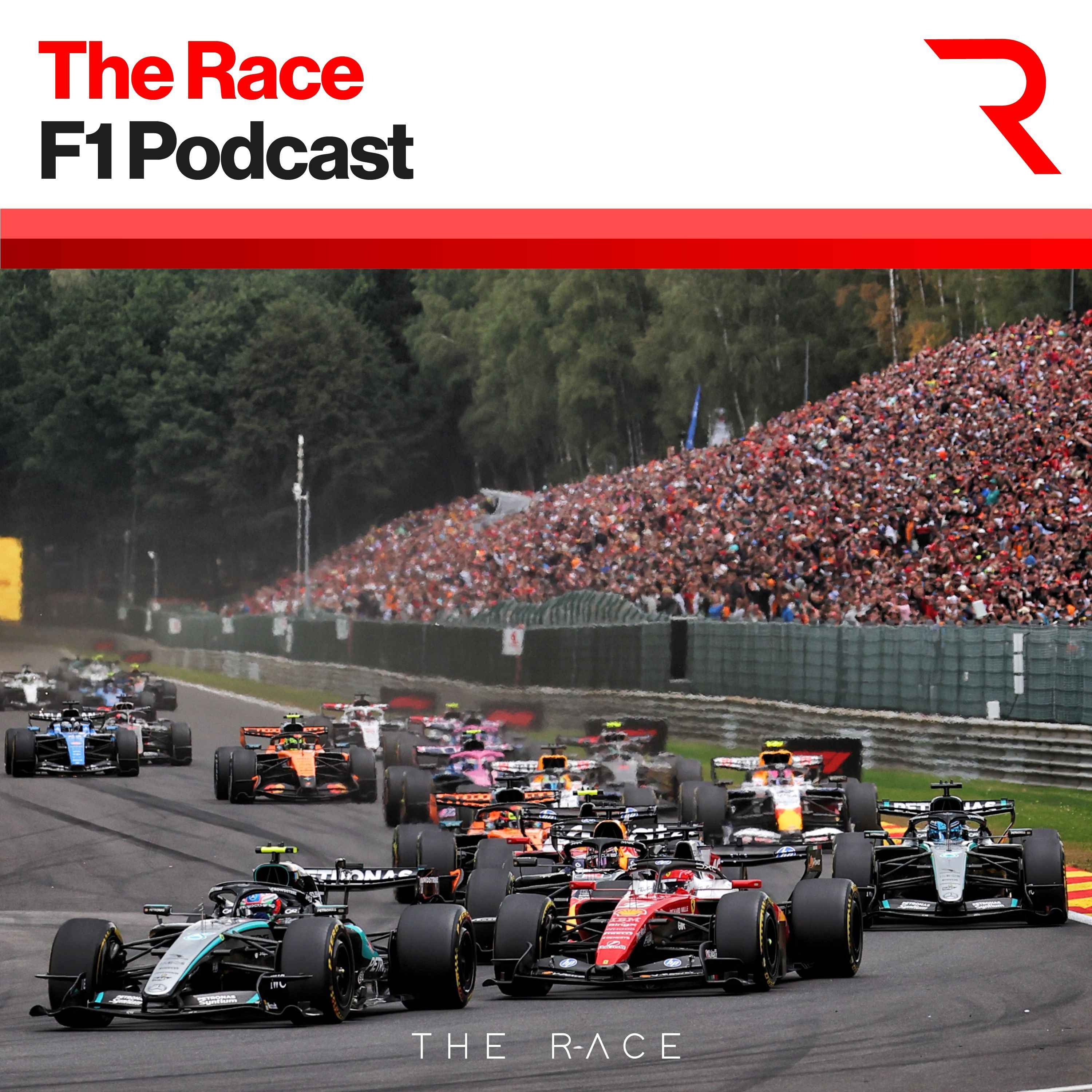
Spa is a famous Formula 1 race track in Belgium. It has lots of twists and elevation changes, and conditions can change quickly, so races there can get complicated fast.
VSC (Virtual Safety Car) is how F1 slows everyone down without bringing out the real safety car. The race uses computer-controlled targets so drivers can’t just keep racing at full speed, and that can affect strategy and who gets stuck behind whom.
A curb strike means the car hits the raised edge of the track. That can shake the car around and sometimes damage the tires or suspension, hurting performance for the rest of the race.
Term
energy starved nature of the track
It means the track makes it hard to use and manage your car’s power efficiently. Drivers have to be careful with how they spend energy so they don’t run low before the end of a stint.
Leclerc is a top Formula 1 driver who races for Ferrari. Here, the hosts are saying he was doing well while leading, but the race situation changed later.
Antonelli is an F1 driver, and the hosts are saying Mercedes looked especially strong when he was driving. They also describe how race-control slowdowns forced him to pit at specific times.
A virtual safety car is like a “slow-down rule” for the whole field, without a real safety car on track. It changes strategy because pitting during that slowdown can cost you less time than pitting under normal racing speed.
Verstappen is a leading F1 driver for Red Bull. The point here is that his pit stop happened before the virtual safety car situation, and it affected what other drivers had to do next.
Car
Mercedes
Mercedes is one of the F1 teams. When they talk about “his Mercedes,” they mean the performance of that team’s car on the track during the race.
An “undercut” is when a driver pits earlier than another car to use fresher tires. That usually lets them go faster and shrink the gap before the other car stops.
“Pit entry” is how a driver gets into the pit lane. Doing it aggressively or precisely can cost or save time, and it also has to be safe and controlled.
A “track limits violation” means the driver went outside the allowed part of the track. That can lead to penalties, because F1 rules require you to stay within the circuit boundaries.
Toto Wolff is the top leader at Mercedes in Formula 1. He helps run the team and is often quoted about how the drivers performed and what the team learned after a race.
Term
Q1
Q1 is the first part of F1 qualifying. If you don’t qualify in Q1, you’re knocked out early and you’ll start the race further back.
A Sprint is a shorter race during some F1 weekends. It helps decide where drivers start for the main Grand Prix, so it can be a big deal for your weekend.
Fred Rousseau is someone high up in Ferrari’s technical side. The hosts are using his quote to describe a mindset Ferrari wants—staying steady and focused even when things go wrong.
A simulator is like a high-end racing video game setup that feels like driving a real car. Teams use it to help drivers learn tracks and improve their driving without spending as much time and money on real cars.
GT racing is competition for sports cars that are based on real, road-going models. It’s another way drivers build skills by racing cars that are different from Formula 1.
British F4 is a stepping-stone racing series for young drivers in the UK. It’s where drivers prove themselves in small race cars before moving up toward bigger championships like F2 and eventually F1.
Nürburgring is a very famous race track in Germany. It’s known for being tough and technical, so people use it as a comparison when talking about how hard a track is.
The “front row” means starting right at the front of the grid. That usually makes it easier to avoid getting stuck in traffic and to get a good result.
“Track position” just means where you are on the circuit compared to other cars. In F1, being ahead often makes it much easier to control the race and avoid getting overtaken.
Gravel is loose material off the racing line. If a driver goes into it, the car loses grip and speed fast, and it can be hard to get back onto the track safely.
F1 qualifying is split into timed parts called Q1, Q2, and Q3. Q3 is the last and most important part, where the quickest laps decide the best starting positions for the race.
Practice sessions in F1 are the on-track sessions before qualifying and the race where teams test setup changes and gather performance data. Drivers also use them to learn how the car behaves on that specific track and tire conditions.
In F1, the power unit is the whole engine-and-hybrid system that makes the car go. It includes more than just the engine—there’s also energy storage and recovery that changes how the car accelerates.
Machine learning is basically using computers to learn from data. Instead of being programmed with every rule, it figures out patterns from examples—like how the car behaves—so it can predict what might happen next.
Driving style is how a driver drives—how they accelerate, brake, and steer. Two drivers can get different results from the same car because the car’s behavior depends on how the driver inputs the controls.
“Tire grip” is how well the tires can stick to the road. If grip changes, the car can feel different lap to lap, even if the driver is trying to drive the same way.
“Driver inputs” are what the driver does with the controls, like steering, braking, and accelerating. Even tiny differences can change how the tires work and how the car behaves on the next lap.
Term
driving techniques
It means the specific way a driver handles the car—when they brake, how they steer, and when they apply throttle. Small differences in technique can make the car grip better and go faster.
Term
NGUK
NGUK is tied to the car’s power/energy system. The point here is that even a small loss in what that system contributes can cost you speed.
An “algorithm” is basically the car’s computer logic. It uses data from sensors to decide how to control things, and different driving styles can make it behave differently.
Term
self-learning stuff
It sounds like the car’s computer is learning from what’s happening on track. Instead of using the same settings all the time, it can adapt based on data.
“Slides” means the tires aren’t gripping as they should and the car starts to skid. Skidding usually costs time because the car can’t follow the ideal line as cleanly.
A “braking zone” is the part of the track where you slow down before a corner. Where that zone is (and how hard you brake) affects how well the car turns in.
Term
pitch the front of the car
It means the car’s front end dips when you brake. That shift in weight can help the front tires grip and help the car turn into the corner.
Understeer is when you turn the steering wheel but the car doesn’t rotate enough. The front tires slip first, so the car tends to go wide toward the outside of the corner.
Concept
hardwire your brain over time
This describes how repeated driving inputs become automatic through muscle memory and learned control. In racing, when a car’s behavior changes (for example due to new energy-recovery or braking interactions), drivers may need to “unlearn” those automatic habits to adapt quickly.
F1 cars use a hybrid system with a battery that stores energy. If the battery isn’t working right, the driver can lose some of the extra power that helps with acceleration.
Deployment is how the driver gets to use the car’s stored hybrid energy. If there’s a limitation, the car won’t allow as much of that extra power as usual.
Mid-corner speed is the speed you’re holding while you’re actually in the turn. If you go too fast in the middle, the car can start to slide and you lose time because you can’t accelerate cleanly out.
MGUK is the hybrid motor in an F1 car that harvests energy when you slow down and can also add electric power when you accelerate. If it’s not supplying enough, the car can feel weaker until the system catches up.
Throttle just means how much you press the gas pedal. In an F1 hybrid car, that input also affects how the car uses its stored energy to keep power coming.
Qualifying is when drivers try to set their fastest lap to decide where they start the race. Even small driving differences can matter a lot because the grid position is based on those laps.
Concept
unpick it
They’re trying to figure out what really caused the time difference. F1 teams look at data after the session to decide whether it was the driver, the car setup/strategy, or track conditions.
Tire grit is the sticky layer of rubber and debris that builds up on the track. It changes how much grip the tires get, so the car can feel faster or slower depending on track conditions.
A penalty is the race officials’ punishment for breaking the rules or causing an incident. It can change where a driver finishes or how they’re allowed to race next.
A “racing incident” means the officials think the crash happened during normal wheel-to-wheel fighting, not because someone clearly broke the rules on purpose. If it’s judged that way, the driver might not get punished.
The FIA is the organization that runs Formula 1 rules. “FIA policy” here means how they generally decide what counts as a penalty and how strictly they enforce it.
Oversteer is when the rear of the car loses grip and wants to swing out. A “snap” means it happens suddenly, so the car can spin or rotate very quickly.
Downforce is the “grip from the air” that presses the car onto the road. If it drops, the tires can lose traction and the car can suddenly feel unstable in a corner.
A double stack pit stop is when teams try to pit two cars in a tight sequence so they lose less time. It’s faster when it works, but it’s also easier for mistakes to happen if the timing or instructions get confused.
The front wing is the main aerodynamic “flap” at the front of an F1 car. It helps press the car onto the track (downforce), so if it’s missing or changed, the car can feel slower or less stable.
The green light is the team’s signal that the car is allowed to leave the pit. If the car is released too early, it can become unsafe and the team can be penalized.
An unsafe pit stop means the car was released in a way that wasn’t safe for the pit crew or equipment. Race officials can penalize the team because it breaks pit lane safety rules.
A procedural mistake is basically “doing something the wrong way according to the rules.” In F1, officials care whether it was just a process error or something that affected racing in a more intentional way.
Lewis Hamilton is a top Formula 1 driver and multiple-time world champion. Here, they’re arguing about whether he was actually at fault for something that happened during the race.
Sporting penalties are penalties applied under the race’s sporting rules (not just technical rule violations). In F1, they can include things like time penalties or grid penalties, and they’re meant to punish actions that affect fair competition.
“Green lit” means they were given the go-ahead to do something. The point here is whether the driver followed instructions rather than acting on their own.
It means a driver waits until the last moment to move over while slowing down for a turn. That can be risky because the other driver has very little time to react.
The racing line is the best path through a corner that helps a car go faster. Here, the stewards are saying one driver was allowed to use that best path at that moment.
An overtaking move is the attempt to pass another car. The discussion is about whether the pass was far enough along that the other driver should have to give space.
“Crowding” means one car is pushing another into less room than they need. The speaker thinks the stewards got it wrong and that the driver really did squeeze the other car.
Kobayashi is a former F1 driver. The host is bringing up an old crash example to argue that the rules/decisions in this case are being applied inconsistently.
Term
starting on the hards
In F1, tires come in different “grip vs. lifespan” levels. “Hards” are the tougher tires that usually last longer, but they don’t grip as well as the softer ones—so teams often plan to run them for longer before switching.
“Run long” is strategy shorthand for extending a tire stint beyond the usual window. In practice, it means keeping the current tire compound on the car for more laps before pitting, often to manage track position or to align with a planned pit-stop sequence.
McLaren is one of the F1 teams. In this segment, they’re doing better on this track, and the hosts connect that to how well they’ve prepared their car and engine for the weekend.
It means the car doesn’t perform the same everywhere because each track is laid out differently. Some tracks suit the car’s strengths more than others.
Silverstone is a famous F1 track in the UK. The hosts are saying McLaren might be good on one track but not necessarily on Silverstone because the driving demands are different.
Corner speeds are just how fast the car goes through turns. Different cars feel better at different speeds, so this helps explain why performance changes from track to track.
A “V6” is an engine with six cylinders arranged in a V shape. Here, the hosts are talking about a new version of that engine that’s behaving more reliably.
Simulation models are computer programs that predict how the car will behave. Teams use them to plan setups and strategies before and during a race weekend.
Concept
cooperating completely
This is about how teams work together behind the scenes. They have to cooperate in certain ways, but they still protect their competitive interests and won’t necessarily share everything first.
It means Mercedes has a legal/contract requirement to provide certain help. Even though they’re rivals, they still must do what the rules and contract require.
F1 cars use a V6 engine plus extra hybrid energy systems. The V6 is the main engine, and problems with the battery part can affect how the car is allowed to run and what penalties it gets.
The energy store is basically the F1 car’s battery. It holds extra energy so the car can use it later for more power, and if it’s not working right, the car can’t perform normally.
“Mediums” are another tire option in F1—between the soft and the hard. They’re usually chosen when you want a good mix of grip and how long the tire lasts.
Tyre performance is how well the tires grip the track and how that grip changes over time. Teams try to predict it, but real races can make tires behave differently than expected.
Fuel load just means how full the tank is. As the race goes on and fuel is used up, the car gets lighter, and that can change how the tires behave and wear.
Term
two to three tenths of a second per lap
This is a speed-loss measurement. If a car is down by a couple tenths of a second each lap, it adds up quickly and can cost positions by the end of the race.
Tyres are what actually grip the track. In F1, how the tyres work—how much grip they give and how quickly they wear—can make a big difference to lap times and race strategy. The host is saying the track suited the way the tyres worked with the car.
Gabriel Bortoletto is the driver the hosts are talking about in this part of the race. They say he did well enough to win his class and stayed in control when the race conditions changed. The key point is that he kept his position and drove well under pressure.
Class B is a sub-category inside the race where drivers are ranked against others in the same group. You can finish overall in a certain position but still win your class. The host is saying Bortoletto won that sub-race.
Arvid Lindblad is one of the drivers in this battle. The hosts say he couldn’t catch Bortoletto when the race situation tightened up. They also mention he finished ninth and had an upgrade that affected how the car ran.
Audi is the car manufacturer being discussed here. The hosts are saying Audi’s car worked well on this track and that the team can be proud of how the car performed. It’s basically a “good results for Audi” moment.
A power deficit means the car doesn’t have as much “go” as the others—less acceleration and top speed. Some tracks are more forgiving because they’re more about braking and cornering than straight-line speed. The host is saying those tracks could suit the weaker car.
LIVE
I started Ornot in 2013 and we make bike apparel.
The best part of Shopify for me is our ability to run the business as essentially non-technical
people.
We're able to admin everything on the back end, front end, and sell things online easily.
If Shopify were a bike accessory, I think it would actually be the bicycle.
It's the thing that you do the thing on.
We run the business on Shopify.
Start your free trial on Shopify.com.
The Athletic.
The race is on and Kimmy Antonelli won again at Spa in a race complicated by the timing
of the VSC, meaning he had to catch and pass Charles Leclerc.
But with George Russell having another tough weekend and ending up in the gravel after
a clash with Lewis Hamilton, how big a hit have his title chances taken?
I'm Ed Straw and with me in Belgium are Ben Anderson and Val Herungi.
Well, Ben, big day for Kimmy Antonelli.
Back to winning race after a few races of not winning, not especially to any fault of his
50 point championship lead over his teammate, Hamilton's there in between them.
He was the dominant Mercedes driver, had the complexity of catching, passing Leclerc
and just another high class weekend from Antonelli.
Yeah, the race was not as straightforward as it could have been.
But as you mentioned in the intro, that was just a consequence of the virtual safety car.
Antonelli did everything he needed to do up to that point.
It voted Leclerc ahead, but he just relentlessly hunted him down.
It was the race, I suppose, that we didn't quite get at Silverstone because of that
curb strike and the damage that his car took after that.
This was a clean race, not so many aggressive curbs either.
And yeah, so it just felt inevitable, I think, that he was he was going to catch and pass,
even though it was kind of slow to happen, I think because of the energy
starved nature of the track.
And as some drivers mentioned, the difficulty of getting an offset
with a car that you're racing, you needed a proper pace delta
to really make any kind of pass.
And ultimately, even though Leclerc looked quite good in the lead for a while,
the Mercedes just had that crushing pace advantage, especially in Antonelli's hands.
Yeah. And of course, strategically, it was complicated by that virtual safety car.
Verstappen had pitted, Antonelli had to then pit in response.
And that was so on lap 17 Verstappen stopped 18.
Antonelli stopped. Then there was that VSC on that 20.
There was a small window where it could have been a problem for Mercedes.
And there was a VSC.
In fact, there were two VSCs.
One briefly happened on 18.
But Antonelli, by the time he came into the pit line, the VSC had gone
and the VSC came back for some more tidying up.
Well, Marshall on the track or something?
Yeah, picking something up.
I think the Marshall was the debris on the track.
I think the Marshall was dealing with the sweep up the Marshall.
Yeah, it was dealing with the debris.
And then Leclerc could take that stop and just had a Norris was there.
He was running long on the heart.
He wasn't really a factor for the win.
We talk about whether he could have been a factor for the win later.
But it meant Leclerc had to go through Norris and then Antonelli had to go
through Norris and they had the battle.
But it was, I don't know about you, Val, but it took Leclerc,
it took an Antonelli rather a while to catch Leclerc.
But it always felt, it always felt in-handed and it always felt inexorable progress.
Yeah, well, in that first stint, I think a lot of us were wondering before any
of the virtual safety car interruptions whether, I mean, that gap that Antonelli
had been establishing over Stappen was representative of what his Mercedes can
actually do this weekend.
And I think all of us felt that probably not, probably they can go quicker if
they need to.
And the second stint, they needed to go quicker.
I mean, I don't know if they went, like if they turned anything up relative to
the first stint, but certainly it never looked in a massive amount of doubt.
I mean, if anything, early laps, you look at how he's gaining and you look and
you think, well, is this actually enough?
But it quickly turned out that, yes, yes, it is enough that, you know,
gradually he didn't need to get the whole chunk of lap time at once.
He actually had older tires as a result, didn't he?
Ultimately, because.
Slightly, yeah.
So that from covering the Verstappen undercut.
I should say older.
I mean, they're both on the C2 hards at that moment.
The C2 hard isn't supposed to have meaningfully worn at all this weekend.
No, they're certainly, certainly.
But yeah, in any case, more than enough than the Mercedes to cover off whatever
minor advantage Licati Cerrari would have had in that circumstance.
No, it never looked much in doubt.
I do wonder, having already said Mercedes had a crushing pace advantage,
it was definitely there in qualifying.
But in the steady state of the race, I do think it shows up less.
It felt to me in this race particularly, like not only the Ferrari in the clerks' hands,
but also Verstappen's Red Bull in the first stint were close enough to make Mercedes think
that it felt like Verstappen was having a go at the undercut at the point that he made the pit stop.
Well, Ante had to respond.
And Ante, he was quite aggressive on the pit entry too.
So it felt like there was enough pressure there that they had to execute everything right.
So the advantage was there, but maybe diminished slightly.
What really stood out?
And I think you're right, there wasn't a crushing pace advantage of like
three-quarters of a second or anything.
Through the race, no.
No, but there was a bit and there was enough.
But what really impressed me, and we're seeing this more and more from him now,
is just how under control everything is for Antonelli.
Yeah, he still has a track limits violation in him.
He had a couple of lives.
They did warn him late in the race.
I remember seeing the first of those coming up on the race screen and thinking,
oh yeah, there's the first of them.
So there's a few little rough edges like that, but he feels so in control.
And this is a thing you see from those drivers who become those gold standard drivers, isn't it?
When they have a chance, it always comes.
And some of those drivers who are capable of doing it on their day,
there are times when they just get stuck or they don't reel them in.
But Antonelli feels like, because he's had that run of wins,
he doesn't feel like he ever forces the issue unnecessarily.
He was happy to work his way up.
He'd been warned that Leclerc had been being a little bit lairy,
crowding people coming in.
Yeah, Lecombe.
Lecombe, yep.
And that meant that he was thinking about how do I not only make the pass,
but disappear.
And actually, he did that pretty well,
but he didn't disappear quite as well as Merck had hoped he would be able to.
But that was more just because of the deployment stuff rather than Antonelli himself.
But I just thought he was really, really in control.
Yes, it's the quickest car.
So he had the machinery to do it.
But he wasn't, I often think about it, you can get grabby and get impatient.
But he's like, no, I've got this.
I'm just going to chip away, make the pass, not rush.
Bang.
And it looks easy, but it's really impressive.
This is what Toto Wolff was talking about post-race.
We both visited Mercedes in the Paddock afterwards.
And he was asked a question about Antonelli and the transformation one year on.
Because Spa last year, obviously different regulations,
but he really struggled, couldn't go out of Q1.
I think in both sessions, Sprint and Grand Prix,
but certainly it was one of his worst weekends.
Don't look at me.
Looking at Ed.
He's not looking at me.
I could barely remember what happened in this year's Belgium Grand Prix.
And Toto Wolff was saying that the transformation in Antonelli had surprised them.
That obviously he's very young, but he's maturing incredibly quickly.
And he was saying that Antonelli just has this evenness to him now.
So that whether he gets a good result,
it's basically the thing that Fred Rousseau is always saying Ferrari needs to do come what may.
Antonelli kind of embodies it.
I have a really successful weekend.
He doesn't get emotional, doesn't get too high,
has a low weekend or a thing that goes wrong.
He's just in the debrief, no emotions, focused on the problem.
What went wrong?
How do we solve it?
Move on.
So he's like the engineer's dream, I guess, and the team boss's dream as well.
I mean, he gets heated in the car, certainly, I think,
in terms of some of his radio messages.
They all do, don't they?
Yeah, absolutely.
For me, it's about whether it's kind of appropriate to have that.
I mean, ideally you don't want it, but he's not doing it.
There's usually a reason for that now.
Yeah, sure.
And for me, it's just it was, you know, you don't want to armchair psychology too much,
but I think it was very informative just how at ease he has looked ever since what happened
in the last round.
Because I mean, his championship lead through basically nothing he has particularly done
had turned from 60 points or whatever to 25.
And that's cause for spiraling.
And he just he doesn't care.
And I think, I mean, part of it is going to be his character.
But a second part is there must be some part of him,
whether rightly or not that is telling him right now, I got this.
It's fine.
Like I have all these guys and I have George Russell.
I got this.
This is mine.
It's that thing of knowing how to win.
And it's a bit of a cliche.
But I think some drivers have that and they're able to just bring it home.
Yep.
And other drivers who might have just as much pace on any given day, but they don't necessarily
have that.
And that's so important.
Look, there will be days when Antonelli is challenged more.
This is not going to be the hardest win of his career by any stretch of the imagination.
But you've got to bank these and not find ways to trip yourself up or make mistakes
or make life harder for you.
It would be very easy to lose that track position to the VSC and be a little bit woe
with me in the back of my head.
But he just gets on and measures it.
And I think probably that learning curve for him, he's moved along a little bit more
quickly because you did have that run of races.
And there were some rough edges.
And there still are rough edges.
But just having that...
They're looking less and less rough by the race, aren't they?
I think that success for Ronnie had has allowed him to kind of almost learn and internalize
and just put all of this sort of into the subconscious processing and just deal with
stuff.
Well, doesn't mean he might not get into a close battle near the run-in and crack under
pressure and really struggle.
It doesn't mean that.
But it's a really nice trend.
Yeah.
And we should say in this, obviously, Verstappen was pretty quick.
Great tow from Isaac Hedger in qualifying.
Put it on the front row very briefly at the Grand Prix.
He wasn't going to stay there at a bit of a battle.
Very, very briefly.
Had that battle with the clerk.
Well, second, he lost out to the VSC as well.
But it was a pretty good weekend from Red Bull all things considered.
Yeah, they weren't threatening to win.
But in the mix, thereabouts.
And Verstappen was sort of relatively chilled out Verstappen.
Yeah, he was.
There are a few choice words, comments about the rules.
Yes, Snipes is a good way of putting it.
You know, when he said something, someone might shoot me outside the door of the press
conference room when he was talking about the cars having F3 levels of power.
I think that was on Saturday, wasn't it?
Today, I think when you asked him a question, Val, about whether he or any of the drivers
have suffered some of these weird algorithmic deployment issues, he said, well, this is F1
2026.
Sometimes it's a jungle.
So he was in a kind of slightly bantery mood.
He looks relaxed generally, actually.
It seems like he's kind of accepted his lot somewhat.
Like, he knows he doesn't like F1 2026, particularly on these amazing classic high-speed tracks
that basically are the worst for this formula.
And obviously, Spa definitely fits into that classification.
He doesn't want to stay at home.
Yeah, he doesn't want to stay at home and do no driving.
Obviously, this is a home race for him, big army of Verstappen fans watching him.
Here, I think, Pleased that he put on a good show, made it onto the podium for them.
But he's just trying to think, compartmentalize this aspect that he really doesn't like and
just try to focus on the job because you either do that or you have to get out.
And I guess he's just decided on balance.
You know what?
I still want to be here and I still want to be racing even if I don't like the cars.
Doesn't hurt the bank balance, I imagine.
Not that he's never acknowledged that as being part of his thinking, but it's got to be.
If you want to continue to fund the other parts that he maybe enjoys even more into age 50,
60, whatever, then every season he does and there's a current formula, it's awesome.
But it's noticeable that he's more animated by those external activities.
So it's very clear to me on Thursday, obviously, all the drivers speak to us.
Fair enough, he doesn't want to answer questions about McLaren and his management
talking to them or whatnot.
And he doesn't want to shut it down, but he doesn't want to indulge the speculation
or bother talking about it.
And obviously Verstappen's developed this aura now where he will just flat out refuse to talk
about stuff that he's not bothered with on a given weekend.
But as soon as he's asked about the McLaren driver that is coming into his development stable,
family friend, you see his eyes light up this stuff that he's doing outside of F1 with
simulators and driver development and GT racing.
You can see there's a real passion there.
It's like he's the natural heir to Helmut Marco in some ways.
I think he gets a genuine kick out of this kind of nurturing or scouting for talent.
Yeah, and I think we know our enthusiast is about motorsport and racing and he will generally
be content as long as he sees progress being made at Red Bull.
I'm sure he'll have weekends where he's a little bit more irritated, but that's Verstappen.
What Ben said is, I mean, very particularly relevant in terms of, I mean, it's probably
maybe a different motivation to Helmut Marco, I'm not sure, but both in Verstappen's past
interest of turning sim racers with no budget to race into pro racing drivers because he believes
they're talented enough and don't have the opportunity to, you know, this McLaren kid
that you mentioned, Dries van Langendon, his rhetoric about it is like, I want to ensure he
gets to F1 because I've seen that the talent is there to get him through.
So basically the wording that he's kind of been using is, I don't want anything to be able to
derail him.
So I'm going to put my weight behind him also.
And that kid's, you know, fantastic record in karting, currently leading British F4,
if I'm not mistaken, and McLaren, Verstappen, that should
be, I mean, that name's going to come up, I imagine, in the coming years.
And I think that gives him then maybe a way to enjoy the F1 a bit more because he knows
he's got other stuff around.
This is obviously Nurburgring feeding into that too in the 24 hours.
It's all part of kind of creating that, I guess, satisfaction elsewhere that means he can come
here and do the job to the best of his ability without just getting down on his lap.
And I think you saw a pretty strong Verstappen performance all weekend with him.
He had a lot of help.
Obviously, Red Bull were effectively kind of one car ring most of this weekend with Hajar taking
penalties and whatnot, and then being used as a tow for the Max Verstappen caravan as Ed,
you put it yesterday in our In Car Insights podcast.
And that was the key to it because he got on the front row when really that car belonged on
probably row three.
And obviously, the track position, as we saw with the clerk when he got ahead of Antonelli,
that was really important in terms of being able to grind out maybe a better result than
otherwise would have been available.
Yeah. And we should mention Hajar came through to sixth place.
Obviously, it was a bit of a clever strategy to do that, but it's pretty good weekend,
I think.
One of his better ones, I think.
From Hajar.
Yeah, yeah.
So he could be.
Mekies was very happy.
Yeah, yeah.
He can be very, very consent with that.
But we've got to talk about George Russell.
Val, in the gravel on the first lap of the race, no worry wanted to be.
Nobody will be shocked to learn.
50 points behind Antonelli.
Now, struggles in qualifying, which he said were not down to his driving.
And the team accepted there was some problem.
And then they slightly refrained what they'd worked out overnight and how much was his driving,
how much was deployment.
What do you make it of all?
What actually was the story of Russell's weekend?
My head hurts, dude, on that one.
Because coming in on Thursday, I put some question to him that I don't remember,
but basically the gist of it is when he said that he understands
where the lap time has been going relative to Antonelli, because this is,
I mean, this weekend has been particularly pronounced.
And I know you guys and I over your shoulders, we've looked at a bunch of data
of George Russell laps versus Kimmy Antonelli laps.
The Mona Lisa recreation.
Yeah, yeah, yeah.
So he mentioned the Mona Lisa recreation on Thursday that, you know, like,
you see the Mona Lisa, which in that case is.
Did you see it?
No.
In that data?
No, nothing like that.
I would have to have a pretty low opinion of the Mona Lisa to compare any of that stuff
that I've seen to the Mona Lisa.
It's just a bunch of squiggly lines, which I guess the Mona Lisa you could also
describe as a bunch of, we're getting ahead of ourselves.
You're not thinking of munch as the scream, are you?
Well, that is more certainly.
That's how Russell felt when he was in the gravel.
Well, that's also the face Ben has made all weekend when talking about these,
when talking about the quirks of these regulations.
I have to say, I did not see on the data when he asked anything that he did,
particularly wrong in the key moment of this weekend in the Q3 part of it,
because obviously for me, the Q3 defeat of half a second is more important going forward
than the fact that he ended up in a crappy position at Lacombe at the start of the race
and ended up in a gravel.
Of course, that's a lot of points gone and this is a game of points,
but when there's still however many rounds to go, it's a game of projecting pace.
But it's also, you can't ignore the fact that Russell,
not Antonelli, has been in this situation over and again,
for one reason or another.
There's something that means his performance is just not as robust,
that it goes beyond individual races or qualifying sessions.
F1, 20, 26, every time you put on one of the Godforsaken practice sessions
and bore yourself to tears watching them,
but you see that the lap time comes to Antonelli every time whenever he wants it.
I mean, or he makes a mistake on the lap, but he's never slow,
but the lap time really struggles to come for George Russell.
He has to really grind and work hard to arrive at the same level at lap time as Antonelli.
I think there's probably three broad aspects to this.
One is just the grabbiness.
You mentioned that Antonelli doesn't have the grabbiness in him yet.
Obviously he's leading the championship and that helps.
Russell, I feel, is a little bit in a grabby mindset at the moment
because the season has kind of generally slipped away from him.
And that moment with Hamilton on that one,
where Russell's put himself on the outside of Lecombe
and Hamilton's had this moment.
Yeah, Hamilton was penalised, maybe harshly for that.
That is putting yourself in a position where you can be taken out.
And the way Russell kind of put his head to his hands,
I felt like that was a,
oh, my deployments let me down coming out of the first corner.
I've lost ground.
He's trying to make some ground up a bit too soon in the race
because he's thinking, oh, I've got to get this track position back.
And that can get you into a spot of bother that you don't really need to be in.
It actually reminded me slightly.
Remember here in 2009 when Button ended up off
and there was a collision with Grosjean?
And Grosjean kind of got blamed for it.
And actually there was, Button was a big part of that.
And he qualified poorly.
And by his only later admission,
he was really feeling the pressure at that point.
So you're right.
I think there is that in Russell.
And obviously he lost some momentum and ground for a reason,
but that doesn't mean that you grab or put yourself in a risky position to reclaim ground.
Exactly.
So I think that's one aspect to it, psychological.
There's another aspect which is this weird battery deployment.
Has it harvested what we expected it to?
Has it deployed when and what we expected it to?
Is it me?
Is it not me?
Is it me?
Is it not me?
Is it the AI?
I'm not sure.
Am I real?
Am I not real?
This whole existential crisis of the world now.
We all feel it.
This obviously dominated post-qualifying,
where Russell himself had been saying, well, they told me it was the brakes.
Then we decided it was my driving.
I've been trying to adjust my driving.
Now they tell me it's not my driving.
I don't think it's the power unit.
What's going on?
Let's look into it.
Then they decide, yeah, is the power unit.
Then it seems to be an aspect of the power unit that nobody understands
and doesn't predict properly.
It's machine learning and that's learning on the job.
And there are certain inputs that affect that that they do know about.
Then there are others that they can't measure properly.
That is causing, obviously, Russell grief,
because he's been kind of gas lit a bit by Mercedes in recent rounds,
where Toto has been dismissing the engine straight line speed deficit as a thing.
And then suddenly gone this weekend.
Oh, no, that is a thing.
And we need to look at it.
But it doesn't account for the full difference.
Well, it's important to note, after qualifying,
they backed Russell and say, yeah, there's something there can't be explained.
And then today, Toto Wolf said, well, the Russell thing was 50% George, 50% power unit.
So all of this we're saying here, Antonelli is unquestionably the quicker Mercedes driver,
regardless of all this stuff.
And this is all about unraveling some of the reasons for it and what Russell's struggling with.
But yeah, there is a power unit deployment problem.
It seems to be about the way it interacts with Russell's particular driving style.
It's his job to get his head around that.
There's other drivers who are having similar things.
Piastri versus Norris.
Norris was strong this weekend.
Piastri struggled a tiny bit more and seemed to be running into some of the same things.
So it's important to separate those two things.
It's not one thing or the other.
But they can't.
I did think Mercedes tried to sort of say, you know what,
publicly on Saturday and privately, they were saying the same.
Well, we've definitely got something.
We're going to dig into it.
And then they get the final result of it's a bit of both.
They can't really separate it.
This seems to be the thing.
Andrea Stella talked very eloquently about this both evenings, Saturday and Sunday.
And he was saying, well, there are difficulties modeling what you expect is going to happen
with these power units and their complexity.
And there are certain characteristics you know coming in that you can model,
like where the compressions are in the track, how that will interact with the power unit.
They're consistent lap to lap.
We identified three things that are not consistent lap to lap or session to session.
Wind, track grip or tire grip on that interaction.
And then what the driver inputs because they can vary lap to lap run to run session to session.
And they do vary exactly.
So these are the things that we're looking at.
One of which, of course, is the driving techniques.
So then it comes down to, well, what is Russell doing behind the wheel
that Antonelli is not doing and vice versa is making that difference.
Antonelli is really, really good and has been throughout the season
carrying that speed through the corners, being efficient in the deployment and in the harvesting
in particular and keeping the speed up and not having that little bit of infill from the NGUK.
There's all of these things, how much you confuse the algorithm.
There was a certain difference between Antonelli and Russell in terms of how much
pack they were using on different parts of the lap.
And this is all in terms of that self-learning stuff.
So there's things they can improve that.
Teto Wolff did say it's a good job.
We noticed it here because it would still be there in Budapest if we hadn't noticed it,
but it would be a smaller effect.
So there's something real there.
But even if you could wish that away, Russell still has some pace to find.
Yeah, it does. And also because the cars are very particular and the tires and the wheels sizes
have changed. So now it seems an element of how the front of the car responds when it's pitched
into these corners that Antonelli is so good at carrying the speed in without getting any of
the slides or the time losses is a different equation to what went before because so many
braking zones now also are not ones where you attack.
You don't go in full chat as late as you can, hard braking, pitch the front of the car in,
load that up, help you get the car into the corner and rotate, which is what all the drivers have
learned since time immemorial, pretty much in their careers.
Now you've got these weird situations where you're coasting into a corner,
using the brakes but not in the same way, using the gear shift sometimes to turn the car and
regenerate the battery, all these kind of weird interactions that that means the front of the
car is just not behaving in the same way and can't cope with these, generally speaking,
with this new input. So the drivers are able to manage that and the understeer basically
that it generates seems to be a massive factor in terms of the driving aspect and maybe it's
just the case that Antonelli being that bit younger, that bit newer to Formula One,
I think it's probably similar with Arvid Linnblad at Racing Balls.
They just don't have that kind of baggage that you have to kind of unpick because these drivers
and Russell's mentioned this, you hardwire your brain over time to do things unconsciously in the
car. I'm sure the clerks have the same thing, especially the stuff that's giving you the edge
over very, very impressive teammates and suddenly you've got to unravel all of that,
find a way to drive completely new and for the unpre-programmed drivers to return to the kind
of AI machine learning rhetoric, that must be a hell of a lot easier and Linnblad for me has been
the one driver who seems totally bereft of that kind of baggage and preconception. He's just enjoying
the ride because he doesn't know any different. Yeah, and I think coming over from my main gig
being the MotoGP editor. Oh, is that what you do? Yeah, well, I mean, on the side there's a lot of
other stuff. You hear that in MotoGP all the time and I think you actually hear that in F1 all the
time. It's at a certain point, team bosses and riders and drivers become acutely aware of that
build-up of knowledge being an active detriment because you can't stop your brain from automating
or instinctually doing certain things, instinctually capitalizing. And it doesn't feel a lot of this
the current F1 is antithetical to what you, Ben Anderson, consider F1 should be to what a lot
of people consider F1 should be, but that part is actually a pretty conventional motorsport part
where it's a major change and the oldies, quote-unquote, are struggling to wire their brain
and the blank slate guys, boom. And it is a thing that if you're having to change things within
something that's more conventional, it's a different thing and that's when the experience
can be very, very helpful. But yeah, it is a big challenge. Obviously Russell's not in a great
place. I ran down during the race to hear what he had to say and he's sort of face-like thunder.
Well, he was swearing uncontrollably on the radio, wasn't he? Once he was in the gravel,
just going on about the effing battery all effing weekend. Which is understandable because there
was the Mercedes power unit problem. They all had a limitation of deployment, but it was more
extreme for Russell and Antonelli on that run till they come. Well, I'm picking up a lot of
on social media and et cetera, like a real lack of sympathy for Russell and the feeling that
he's just not taking responsibility, not taking accountability for how he's not managed to gel
with this. People think he's getting found out, don't they? It's never quite that simple. It may
be Antonelli's better than him, but Russell talked race weekend after
about needing to adapt his style, trying to learn. And he's done it and the team are really
positive about how much he's changed it. So, yeah, he's not doing as well as Antonelli. He may
never do again as well as Antonelli, but the gaps are distorting the picture though, aren't they?
I think it's really oversimplifying it just to sort of suggest he was some kind of fraud.
He's a very, very good Grand Prix driver. Antonelli might be a great one and Russell's
falling short, but that's still very small details and differences.
In short, have you seen anything? You both have looked at so much data. Have you seen
anything on the data this weekend in particular that would justify Russell getting smoked
because he got smoked all weekend? Not by like eight tenths of a second. In terms of the realms
of driving, there's a little bit of a trend sometimes across circuits actually, where
in the slow corners especially, if you try to carry a little bit too much
mid-corner speed and try and gain time there, it doesn't pay you back. That must be to do with how
the car turns, how much sliding you get, whether you can control it, then whether your revs drop
too low, then whether, as Ed alluded to, the MGUK and the battery has to fill in for that
power loss below a certain threshold. What you're doing then with the throttle in the
medium and high speed, whether you're able to come down to 60% throttle but not less,
so you don't then move on to the battery and drain it unnecessarily. There's little moments
where you go, oh yeah, he's not quite done that. He's maybe carried too much speed into turn one
in qualifying compared to Antony. He's maybe a little bit scruffier with the throttle after
Lacombe where you've got the left-right sweep, but then he's a little bit quicker through the
left-hander before Pouon. He's in a bit slower into Pouon, slightly tighter in the first part of
Fania, not as good at Stavolo. In a normal Formula One, you would even that stuff out really and
kind of go, well yeah, one's a bit quicker here, one's a bit quicker there. There's going to be
half a tenth, tenth and a half between them at the end, maybe, but because these tiny
driving inputs that none of the teams really can say for sure going in, that will make the
difference. They have to pour over the data later to try and unpick it. You suddenly can think, well,
I've done a pretty good job driving. Piazzari and Norris even closer to the point where Stella was
saying Piazzari and Norris were basically identical up to Stavolo. Which they have always picked.
You can see tiny differences again in the data in terms of the driving. And then suddenly it's a
two to three tenth difference because of the deployment. And nobody can say for sure then
that it's the driving aspect that's created that deficit. It's created some of it, but then there's
all these other things about the tire grit, the rolling resistance, the wind. If you've got a head
wind, and it's stronger than the previous run or your rival's run, that extends your straight by
however many meters. So that then will confuse the algorithm and change the deployment. So
there are definitely aspects the drivers have influence over. And Russell is not influencing
as well as Antonelli. But the scale of the difference between them, even if you accept Antonelli is
better, is not half a second, three quarters of a second, 1.2 seconds in driving. It's just
a ridiculous quantification. Yeah, it's the nature of the beast at the moment. But
what's very clear is Russell is a long way behind in the championship 50 points. You can make that
up. But that's an unarguable quantification. Exactly. Yeah, but it's he'll be feeling that he
really will be feeling that because that's a lot to make up and you can do it. But he need he will
need to get on a proper tear. And I wouldn't rule out it happening. But obviously, with every race
weekend when Antonelli's on top and even when Antonelli maybe he's been behind, then he picks up
pace and races he did in in Barcelona. So some some hard work to rush to do. But I don't I don't
think he's I don't think he's cooked yet by any stretch of the imagination. But he ovens on.
But Antonelli will be feeling pretty happy with the way things are going.
Hey, hold up. This is your minute, your day to play to make to move to move through to explore.
It's your body to rest to nourish to grow. It's your mind, you know, it's your place, your life to
love to dream to change. It's your world to understand the New York Times. Find out more at
nytimes.com slash your world.
Let's talk about the penalty that Lewis Hamilton got for that collision with Russell. Now we've
got a question from Christopher Partridge who said how on earth can Hamilton be given a penalty
for what even Russell said was a racing incident when the clerk got away. Scott free from his
incident with Piastri. Have you ever gone back to that old stick it to Hamilton approach that
they had a few years ago? Let's not worry about the Piastri Leclerc thing. But that Hamilton
penalty. Do we do we think that was that was justified? No, although I would like to know
when exactly the stick it to Hamilton was in effect as an FIA policy. I'm really curious.
I mean, you could say 2021. That's fair enough.
I just don't think I don't think it's that this this to me is far under my old friend. If you've
got endless rule racing rules and that kind of thing, you apply them. I look at it very simply.
Yeah, Hamilton had a little moment. But he was he wasn't if Hamilton had been the aggressor and
had that moment. Then fair enough. Then I think you might have said, yeah, it's a bad thing. But
Russell had put himself in harm's way. You run a race for me that's racing incident every day
it looked like a little aero stole somewhere as a snap. Yeah, or it's an understeer into an
oversteer snap because he's lost downforce because of the cars around him. Do you know if you go
around the outside of someone like that? Russell did you will have an effect on them. So all of
these things. This is what album was saying at Silveston, actually, that the Williams is particularly
sensitive to this. And if it suddenly gets crowded by cars, he loses grip has to basically be more
cautious in battle as a result. So you could argue should Hamilton be more cautious, but
but more cautious when well in terms of knowing that aspect of when the cars are alongside you
upsets the the air stream and the downforce. But I would say that doesn't apply because
that was a rocket ship run to the con with cars at all sorts of different stages of deployment
and power. They all just coalesce in the not breaking zone breaking zone and then end up
where they are. And I don't really see what else Hamilton's supposed to do. Where he's supposed
to put his car, he can't just disappear. So to me, again, because like, as you said, Eddie, he's
not the aggressor. He's the one being overtaken. He's the one being overtaken. He can't go anyway,
can't do anything differently. And it's a first slap thing as well where they're supposed to show
more lenience. I just think they've called it wrong. And it's very harsh penalty. Yeah, because
I don't think it's an it's I don't think it's an aggression mistake. I like I'm okay with F1
penalizing mistakes, even when they're not malicious. I'm fine with that. I just don't think
that it's reasonable to apply that standard to what is a mistake. But that was created in a
situation where it was not reasonable to expect him to nail that corner to the best of his ability
because of the mechanics of what happened because he was the one being overtaken. Because if you
watch the onboard, it is a bit surprising when the car comes across. It's not like this is how
he's calculated. So effectively, the punishment is for not having foreseen Russell's move well
enough. And he's minding his own business. He's not even defending. None of this means that Russell
should be penalized. Russell perfectly legitimate to make the move. But you build into a move like
that and an element of risk, how much risk is there and doing that? There is some risk.
That will happen. Now, if Hamilton tries to do last, the late breakers and clutters into him
makes a hole in his side, different story, different thing. But for me that just racing
incident. The fact that Russell said it as well. If you're the driver who gets wiped out and your
championship challenge goes further down the toilet, you're absolutely furious and you're not
prepared to call out the driver who took you out and say that they should have been penalized.
Then that tells you everything, I think. Russell was furious, but he was furious with
that deployment problem that put him in that position. So, yeah, obviously Hamilton finished
fourth in the race, but that penalty didn't hurt him as much as it might have done because he had
the VSC. It's a double stack, but of course... He had a bit of damage, though, didn't he,
as a result of the collision? I think so. You've put me under. Why did you turn to me
immediately? Because I'm doing the usual thing, because we all do different teams and things
after the race we focus on. I looked up Hamilton's coach and he said that he lost some downforce,
doesn't know how many points. He was asking for more wing. They didn't do it because they had
double stack pit stop and he had to serve the penalty. Then he complained, well, if I'd had
the wing I wanted, then I could have maybe made a bit more progress and maybe snatched third.
I think he was really quick. I wondered actually if the damage had helped the drag situation
and made him a bit quicker in a straight line, so maybe one counts without the other.
You mentioned that they couldn't do it, but they did try to do it. That was the whole
situation with the Hamilton pit stop investigation is because they had tried to make the front wing
change, but in the confusion of the situation, the whole ordering and the double stack and etc.
Don't touch the car for five seconds. One of the key people in the process was not aware that
the front wing thing was going to happen and it's the person responsible for giving the green light
for the car to set off. He gave the green light early and that caused the unsafe pit stop, which
then translated into a 30,000 euro penalty or something for the team, which by the way,
if the FIA was so insistent to destroy Lewis Hamilton, could have easily been a sporting
penalty, but they ruled that it is not a sporting penalty because it put Ferrari at no sporting
advantage. It was a procedural mistake not borne out of any sort of competitive negligence or
anything like that, but just the situation that happened, which I think is fair enough.
Yeah, and Hamilton had nothing to do with that. Yes, he was driving, but you go when you get
told to go. He was green lit. I disagree that that's a factor that Hamilton
had nothing to do with it. It's okay to give sporting penalties to drivers for that kind of pit
stop thing if the team is... Oh, yeah, they make a game. What I mean is it's not because there was
obviously that question about whether they're targeting Hamilton, but he had no part of it in
that regard. I mean, yeah, if you're going to a sporting penalty, you get it because it's a team
and driver. Yes, yeah. So, yeah, ultimately you see green and you go, should we talk about the
Leclerc thing? We had a question from Jenga who said, why is Charlotte Leclerc repeatedly allowed
to get away with the late moving under braking? This has happened on quite a few occasions,
given the dangerous aspects. Why aren't the FIA doing anything about it? Seemingly. Now,
this was the move on Piastri Interlake on, which there was no action on. So, can you explain that,
Val? Well, I'll try to. But again, I should say, I don't think the FIA officers have a list of
pictures and under Leclerc. It says, let him move under braking because that's part of our
business model. That's what earns us buku bucks. But yeah, I don't, that said, I don't necessarily
get it. I didn't particularly understand the explanation and from what, from the demeanor
of Charlotte Leclerc in the press conference room before it started, while they were
waiting for winner Kimi Antonellicum and he was talking to Max Verstappen about it
because they had just seen the replay in the cooldown room. And I believe Leclerc was under
the impression that he got away with it because Piastri had moved towards him. I believe that's
what he was telling Max. I mean, they're not mic'ed up at that point. So I'm just kind of
lip reading a little bit. But that's, that seemed to be the gist of it. Now,
the Stewards Dog never mentioned any movement from Piastri. We couldn't see any.
There was a little bit before he got to that point, but that was just, Leclerc wouldn't
have even been aware of it. At the point in which Piastri is partly alongside the Ferrari,
the McLaren is absolutely arrow straight and the Ferrari very much isn't.
Piastri's tire is firmly on the white line. You can trace the straight
nature of it. And for some reason, the Stewards have decided that at that point,
Leclerc was entitled to take up the racing line through the corner because in their words,
Piastri wasn't far enough along the side and he had no hope of completing the overtaking move.
I don't know which, I mean... They've treated it like the straight is the outside of the corner.
It seems like they've applied a rule that should apply further round to Leclerc,
kind of where Russell was with Hamilton to the Piastri Leclerc instead. And to me,
they do not apply the same. Like there's a natural momentum that would be taking Leclerc
to the left, right, whatever, to the side of the track there. And that's demonstrably not true.
I would say this is one of those things why it's ridiculous. Motor racing doesn't work
if you can do that. It's crowding. It's crowding. You can have wheels like you can
chuck cars over barriers doing that. They said it's not crowding, specifically the
story verdict. But it is. It is. It's like the Kobayashi thing, wasn't it the same
corner where him and Hamilton had an incident? 2011, I would say. Yeah, where Hamilton just
came across, didn't know Kobayashi was there and just sent him flying into the barriers.
You can't, as a general rule, if you're on a straight and someone is doing something to you
when you are driving straight on a straight, it requires you to move out the way. They are in
the wrong in every case, because otherwise it doesn't, otherwise racing doesn't work.
You know, yeah, if you're, if you're heading into a bit of track that's narrowing and there's not
space, you know, you've got to think about it and do something. But I just don't see how racing
works if you allow that. Too bad cause. Yeah, I think that that second one is really
the worst. I suspect there'll be some conversations about that in driver's
briefings, because yeah, that that causes serious, serious problems. I was interested
by the aspect that Shard does this all the time, because I hadn't really picked up on that. But
when it was being discussed live, both of you said, oh yeah, he's got a bit of a tendency to do
that. Well, he's got it in him, but he gets away with it. So I don't blame him. Yeah, that's,
that's fine, isn't it? And there's always this thing of trying to move just to open up a little bit
into the corner or squeeze people. And if you don't clamp down on it, if you don't say, no,
you can't do that, then, then that's a problem. But basically, it's got to leave the cars with.
Yeah, it basically said, it basically said that Piastri almost deserved to be hit because he was
never going to complete the overshadowing. Well, how do you know he was never going to?
There was nothing wrong with him being there. It wasn't like Russell where there was a high
risk because normally, if you're there on the straight, on the outside, there's a point where
you might seed, but he wasn't at that point. It was completely different to the Russell.
Also, there's, there's just value in positioning your car into a corner so that if it's legal,
that it compromises the other driver's line, like you do want to force them to go more inside and
more tight into the corner, just in terms of the momentum that they're going to carry. Is that
illegal now? Do you deserve to be hit then? Can you be elbowed out of the way? I mean, it's,
it's bad. It's, but like, unless it makes, it's so bad, it makes me think I've missed something.
It makes me think that I've missed some crucial, obvious smoking gun piece of evidence.
They're just wrong.
I would say, I would suggest to anyone, have a look, there's a story on the website about it,
that quotes the Stuart's decision. Have a look at that on the race website and just,
just read it and see what they're saying about it because it's really odd.
She talked about McLaren properly now, Ben. Piastri was fifth, Norris was seventh.
Norris had really good pace. He even said after the race, I, I was waiting for him, he said,
maybe even have had the pace to win if they hadn't had, had the 10 place grid
penalty and therefore started on the hards and then run long and had to sort of pay the price
with it, with the pit stop. But basically, if he'd had a normal race, he may have had the
pace. And you know, Mercedes noted that the Norris pace, the McLaren pace was pretty good.
Yeah. So I don't know, Andrew Estella had to say about that, if he addressed it at all.
But he did. This was a good, this was a pretty good weekend for McLaren.
But equally, as Norris said, if they went back to Silverstone now, it doesn't mean it would
change. They'd be rubbish at Silverstone. It's a track configuration dependent thing.
Yeah. There's a certain profile of corner speeds where it's not quite as high speed as Silverstone.
They obviously struggle with the very low speed, like Monaco, the high speed, like Silver's,
like super high speed. I know that's a bit of a misnomer in this area of Formula One,
but let's go with it. But here in the sector two profile of corners, which are between those two
extremes, they're much happier. Obviously, they had the new engine as well, more reliable, can be
around a bit harder. That's the new V6 that Mercedes had because they were out of face.
Yeah. And they're starting to get more of the tools in terms of, this is something that's been a
bit vague, actually, in the explanation, but Stella has referred to it. They've got better
new simulation models or tools to prepare themselves to operate the power unit.
So obviously, there's been some technology they've had to build up, maybe with some
questions being asked of Mercedes, which weren't maybe forthcoming as things you need to do early
in the season. I think a general rule is that Mercedes are cooperating completely with McLaren,
but they're not necessarily telling them if there's a question they have to ask,
they need to know the answer. We'll answer if you ask us, but we won't tell you what to ask.
Exactly. And I do not blame them at all for that. They're giving McLaren the service that
McLaren's contracted to and everything, and they're legally obliged to, but they are competitors.
This is F1, that's fine. So I think they're getting there on that score, and that's just
helping them start the weekend on a stronger foot, knowing what the power unit's going to do up to
a point when there's still other elements that are obviously baffling everybody. And Norris
had one of those really clean weekends where everything just seemed to work for him. Obviously,
he didn't have any of the weird deployment stuff that Piastri had, so that helped him.
Had he not had the grid penalty, which obviously is a function of taking the engine,
because of the battery problem as early as the season.
It was the battery, so the V6, so they both took it, and that would have been fine,
but yeah, it was the energy store that was the problem.
Yeah, and he needed to take one, but obviously having lost ones early in the season. So he
had to take the grid penalty, they decided to take it here. Had he started where he should have
started without a penalty, Stella reckoned it should have been P2 that was possible,
because Verstappen he felt was an interloper in the front, because he got towed to the front row
of the grid by his teammate, and in reality the Red Bull pace was more like fifth or sixth.
So yes, he thinks Norris would have had a really strong race, doesn't see how he would have beaten
Antonelli. So it would have been P2 between Antonelli and Leclerc, where there wasn't much time,
they were very close at the end of the race. Yeah, that was VSC distorted as well.
So if we don't count that then... But then also you have the element of, if you extrapolate strategy,
I mean, you can't say that he would have started on the hard.
Then he could have benefited from the VSC, but there was also a feeling
from Stella that maybe in hindsight they could have utilised the VSC period and given Norris
the longest stint to do on the mediums, because they were holding up much better in the second
half of the race than they did in the first half of the race, because as ever, the trust they did.
Probably in the fuel loads go down and the tyre performance is different to how you
predict, and he could have had a better result. So yeah, you were in this unfortunate situation
where the stronger McLaren overall just had too much ground to make up. And Piastri,
who I had a pretty decent race, that incident with the Clert cost him. Stella reckoned he was
down two to three tenths of a second per lap in terms of damage from that, and it wasn't so much
that the damage was just costing the car performance. It was they had to take more out of the tyres
as a result of that to keep up with the league group, and then he would pay the price in terms
of degradation later. So imperfect races for both McLarens for different reasons, but an overall
uplift on performance on this track because of its profile, certain technical things that happened,
and just the way the tyres interacted with the car mainly. Looking behind the big four strong
weekend for Gabriel Bortoletto, he won the Class B in eighth place. He had a little bit of luck with
the VSC, which got him ahead of the racing bulls. I'll load up a bit of luck, I mean it is the
deciding moment of the race. But what really slightly surprised me, and I was tracking this,
is that Lindblad was behind him and couldn't close that gap. And I thought he might have the
chance to, it just showed, Alan Manish was saying this at Audi, after it just shows that if we're
there, we can hold it. And actually, he said that the pace that Bortoletto had in the race was
basically the same as Hülkenberg. But Hülkenberg, because he was the second one in the double stack,
a very well executed double stack, but he ended up in that little morass. And he was complaining
about the power and battling size. But Bortoletto just there with a tiny bit of space, Bortoletto
driving well as well, made it to Q3, and suddenly that Audi is leading Class B?
Yeah, I was being glib, just for the sake of being glib.
But it gave him a trap position. Bortoletto was running behind both racing bulls, so yeah.
But he's been really good, and I think Audi has a lot to be proud of in terms of the package they've
delivered. And it's kind of nice that it's finally being...
We could track for them as well. Yeah.
They were saying that, you know, to do that well here, where they just expect it to be behind,
because they have a power deficit, gives them a lot of hope for tracks like Hungry coming up,
where that shouldn't be such a factor. Yeah, where one car will probably start again, or so will I
have to. We should talk about racing bulls. Arvid Lindblad finished ninth, Liam Lawson was
down in 12th. He was having some deployment problems. Lawson and Lindblad, who had the full
upgrade, there was a cooling upgrade that only Lindblad had. They'd basically decided whoever
was quickest in qualifying of the two, quicker I should say, to be technically correct,
would get that cooling upgrade, and it was Lindblad. Yeah.
So he had that element. There was another bit of upgrade, which was the rear wing and front brake
ducts, which Lawson also had. So had some of it. And then he's starting to say that, oh,
the total upgrade made the difference. Yeah, there was a pace difference between the two racing bulls.
But Lindblad was driving really well as well. He said this was up there with
ones like Montreal, where he was really quick. He's been good this season.
Barcelona, and really fell on him. He wasn't quite as strong as Lawson in a few races, but
his good work has been really, really good, and that's positive for rookie. But they did have a
little dust up, which was, I don't think, seen on the TV. We only saw it not long ago when Doug
went out on F1 TV. And we did that because there was a stewards message about it being noted.
So that was the only reason. Exactly. So we dug it out, and basically Lindblad comes out of the
pits, squeezes Lawson towards the grass a bit on the run to Rory Rouge. Okay. Then they're side by
side through Rory Rouge, and there's a bit of track limits. And then they have a battle at
Lake Carmes as well. And Lawson squeezed off. Now, they were really silent on the radio.
I think they learned from Austria, because we did that piece that was basically running through
regular arguments for the team orders thing. You think we shut them up?
Who knows? Who knows? It's not impossible. It was very Mercedes in Canada type battle,
I thought, where they're like, absolutely pushing the very limit of what you could possibly do with
a teammate without actually running into each other. And certainly, I'm sure if you're Alan
Permain on the pit, what are you thinking? Oh, this is unnecessary. But I think from a team
perspective, you wouldn't really want them doing it. It'd been better for their chances if they
hadn't. I understand why they were doing it. And probably Lindblad was being quite aggressive,
I would say. Yeah. But he was desperate to keep the track position off the pit stop, wasn't he?
But they're also both young drivers still trying to make their name.
Sergio Perez, Esteban Ocon at Force India. There is an element of one wants to be in a
resistible force. The other wants to be in a movable object. I mean, this is ultimately a
team that, by its very nature, encourages the two teammates to hate each other. I mean, I think
that's a fundamental. Well, they're fighting for their lives, aren't they? Like Lawson's career
is on the line this season. He has to beat Lindblad. And Lindblad's coming in thinking,
I can make a splash here and go to Red Bull. Yeah. But as so many have done before,
in recent years, often through one good season. And they're both drivers who have quite a bit
of edge to them. And that edge has got a little bit too much of edge at times. And they have to
be belligerent, you might say. I've said belligerent about Lawson. Lindblad's definitely got that
in him as well. We've seen that a number of times. He was out of line in Austria as well.
He was being aggressive there. So use that, but don't overdo it. Choose your moments, I think.
So, but Lindblad was the one that I will imagine will have got a little bit more of them.
It's spicy to watch without slagging each other off, which they haven't got to yet. It is quite
entertaining. It's coming. Right. Alpine, Val, Franco Colopinto got 10th place ahead of Pierre
Gasly overtook both Lawson and Gasly in one move, I believe, on the Camel Strait that a lot of
people have likened to some other move from a fun history that I think you guys from the
Bring Back V10s cohort are better equipped to talk about. Yeah. There's a whole Bring Back
V10s episode of that where we speak to Mickah Hacken about that. And he talks about it in
great detail, which I really like because he gets really granular about curb use.
I was the track damp and was there a smoky back marker in the way?
Yes, to both. Lawson being the smoky back marker with his deployment issues or whatever.
But yeah, I think before that in the race, they also had a position change because
Colopinto gets ahead at the start, then I guess Gasly gets him at some point.
I think Gasly got him on Camel Strait from memory. Well, that's the place to get, isn't it? Yeah.
Then they cycle out of the pit stops and I think... Did anyone overtake anywhere else?
He must have been that other than the Camel Strait. That's a good question. It's a very good
question. Gasly laments a slowish pit stop that gets him into the racing bull's morass that then
Lindblad breaks away from, Hülkenberg joins at some point, Colopinto catches up also and
Colopinto makes that move. Colopinto is able to ultimately make it count for his race.
Gasly also did get ahead of Lawson eventually, but was only 11th, so slightly, slightly sour
about it. Generally, Alpine still not fantastic in qualifying trim. Gasly hates finishing behind
Colopinto, doesn't he? Well, wouldn't you? I mean, everybody should hate finishing behind their team.
But every time, I mean, like every time, almost regardless of the circumstances, it's like...
It feels to me like he feels by rights he should always be ahead of Franco.
It should feel that way. And there's no disrespect to Colopinto, but if you've got...
Colopinto will feel the same way as well. Yeah, absolutely. But in terms of seniority,
I mean, every time Gasly beats Colopinto, it's normal by seniority.
Yeah, the same way that Gasly does. Yeah, that's true.
So it's an all right weekend for them, but they are...
Better in race trim. There's a few of these trends where a car that is just a bit off
in qualifying is much more competitive in the race. Again, it feels like the performance across the
grid normalizes a little bit more. And you can use circumstances to get ahead and stay ahead,
whereas in qualifying, the gaps are slightly more stretched.
Well, the Merck engine and the Merck deployment also help, obviously, at a track like this to
hold your own in the fight. Again, didn't help Gasly so much clearly, but did help
Colopinto. And I don't know, maybe... You said McLaren has new tools. I don't know, maybe Mercedes
has revealed some shortcut of key binding to all of its customers.
It's how you program the computer. Alt-Q unlocks the next gear. Yeah, I don't know.
Well, we're going to be back with some more questions in a moment, but just a quick request.
If you'd like to help us out, because it does help us, remember to like or subscribe
to this podcast or even share it with a F1 fan who may enjoy it, because that really does help
the podcast. It helps us get out there. So if you can, give us a like on whatever platform you use,
many, many platforms to get podcasts on. Well, as promised, we're going to finish off with some
questions from the Race Members Club. Hit the link in the episode description. I head to Patreon
and search for the Race Members Club to find out more thriving community, load of bonus content,
Incar Insights podcast on race weekends and much more. Plus, question-asking privileges.
And that's exactly what Shrinkinator has taken advantage of. Ben, I know there are a lot of
excuses coming from the Russell camp, but as a whole, is the F1 paddock starting to recognize
that Kimmy just appears to be a fundamentally better driver?
Yeah, this is an interesting question because I do sense, not necessarily in the realms of the
decision makers here, but in the kind of wider sense of the F1 paddock and people who work within
it, that yeah, they're looking at maybe not with the level of information that some people in F1
do have at the Antenity Russell dynamic and thinking, well, this is just what happens. You know,
driver you think is pretty good, suddenly finds a generational talent comes in and takes a team
off of them. It happens to Daniel Ricciardo at Red Bull with Max Verstappen, arguably it happened
to Lewis Hamilton with George Russell at Mercedes. It's just the kind of moment you get found out.
But I don't think that is the reality of the situation as we discussed earlier. I think
Russell is behind Antenity. There's that kernel of truth to it that
Antenity being a much younger, much less experienced driver, in theory Russell should
have him covered given what we've said about how consistently good Russell has been in F1 and
many times it's been said that if he has the right car, the right circumstances, he can fight for
the title or win the title. That should be this year and Antenity is upstaging him and there's no
doubt there's an element of truth in the driving that Antenity has locked into this formula better
than Russell has. But as I've said before, I don't think the gap we're seeing that's creating
this impression, this distorted impression amongst the sort of wider envelope of the F1 community
is indicative of the reality between Antenity and Russell. It's much, much closer between them than
it looks. And a later question I'll take from Alex Whitlock. Where has all the George Russell has
a worse car than Kimmy Antenity talk come from? Do you buy into it? And Andrew Thomas asked if
Mercedes are quiet firing Russell with car issues. So he wants to leave to make a good phrase.
I mean, the worst car talk, talk that none of that's in the paddock. That's not
what people are seeing or saying. I think there's always a, there seems to be a perspective outside
that anytime there's any performance differences the team doing. This team's trying really hard
to win races. They're frustrated. Mercedes are frustrated that the car's so quick and they're
racking up 12 after 12 after one. That's what they are working 24-7 to do.
Well, Tota Wolf called it a championship-winning chassis and power unit, didn't he? Quite presumptuously,
I thought, after the race. And I don't think there's any car difference. I mean, occasionally,
with any sets of teammates, there's sometimes parts differences. Sometimes you don't have
exactly the same car. Sometimes you're out of phase on power units. So there's swings and
roundabouts, but those are purely just things that happen and they will give or take even out
over a season. So there's nothing by design. There's no sabotage going on.
I've not heard anyone even whisper it critically in the paddock. I've seen no evidence. It's just
a battle. Someone's going to win that battle. Any pair of teammates, someone wins, someone loses
and currently rustles on the trajectory to lose, but it doesn't mean he's going to lose necessarily.
They're still mileage to go in this battle. And I think Mercedes are doing everything they can
genuinely to give him the chance to do it. All right. Question for you now, Val, from Alexander
Law. Did Spa expose an even more complex weakness of the current regulations in that there is way
too much disconnect between the driver input and the car response, specifically on engine and
energy deployment? It's as if the FIA and FOM did not look at either WEC or Formula E to get some
guidance on how to build engines slash PU rules that are both great for all parties involved in
the sport. Well, I mean, we can talk about the disconnect in terms of the algorithm machine
learning stuff that I think became a talking point this weekend, much more than any other weekend.
And a disconnect between what you feel on the inside as a driver and a part of the competitive
equation and what you see on the outside. That's not new though. We've heard that through the
season. That's been enraging me doing driver rankings and the more energy starved the track,
the more it enrages me because it's so frustrating. Yeah. I mean, we have a task
on our hands and it's mostly your task, but I will contribute in terms of which of the qualifying
gaps from this would chuck for the season, for the season calculations and which of them we keep
in as representative to add to the overall formula, etc. So that's going to be fun. But
it is also, you know, WEC slower, Formula E is a lot slower. Those are ultimately different
championships operating at a different level. Formula E races on much smaller tracks. You
could make the argument that if you wanted to make this Formula One work, don't come to Spa,
don't go to Zezuka, Silverstone, probably don't go to Monza. Basically any
proper cathedral of speed, pure brilliant legendary Formula One track, chuck it in the bin,
Vegas actually as one of the new ones probably won't work because it's basically a drag strip
on the street. So it's kind of like they've got an archaic calendar of mix of old and new
and then a formula that is just not built for those tracks. There's not enough energy to go
around fundamentally. That's the key thing. Except at Monaco. This disconnect drivers never
really know how, I mean, there is an extent that there's things you know you can do and
drivers are tuned into it and there is a certain amount of control, but they're still,
you do the same thing and you get different outcomes in your two tenths slower on a straight
and you don't know why. You said to me that this is the era of Formula One where the drivers had
the least impact on the overall performance. They're less important to the overall competitive
equation than they've ever been and I completely agree with that. I find it infuriating.
Yeah, 100%. Ultimately, a driver doesn't have enough influence to make a slow car fast. You
can't do that, but in terms of the performance between two people in identical cars and those
tenths and those swings, yeah, it's not reliably and consistently within their control and some of
the things that are in their control would be down to just ludicrous. You can't feel a few percent
of throttle position. It's just not possible. It's happening up and down the grid too because
Val, you asked everyone, the top three if they'd had something happen to them like Russell's had
and it's just everywhere. So we can't even isolate. This is a Russell thing. People are
using this weekend as a further evidence that Russell's washed and Anthony's cooked him and
all of this. But the thing that Russell's had and has had not just for this weekend but last weekend
or two weeks ago at Silverstone, I should say, is something happening all over the place and
will be happening at times where we won't have spotted it. So it's so prevalent that it completely
messes with your perspective of who's doing a good job and who isn't.
The next question for you, Ben. Runch Dingus asks, do you think there needs to be a more manual
approach to the battery deployment and less AI? As currently on the energy staff tracks,
teams are struggling to find where the gaps between drivers are developing and Stephen
James Ward asked a similar question about if it's time to give full control back to the drivers
or at the very least a human engineer. Yeah, I actually broadly agree with that. Andrei Steader
talked on Saturday after qualifying about how the system is not closed loop by which he means
you can't go into the weekend going, we know if we put these inputs into the power unit,
it will perform in this way and then it will repeat itself identically lap after lap after
lap after lap, providing something doesn't break. It's this machine learning AI element that is
learning on the job, adjusting what it does based on what happens out on track that is absolutely
confusing the hell out of every single person in Formula One, including the people who make the power
units. So that is the element. I think even if you don't like what we're left with in terms of
the energy starvation and the equation that doesn't work, it's not going to fix Formula One 2026,
but it would make it more consistent. You'd know that everybody was driving within the
limitations of their equipment, the same thing lap after lap, and it would stop this kind of
infuriating, I've done everything I can, as Steader said of Piastri versus Norris on Saturday
night, nothing wrong with Oscars driving, nothing really detectable that can explain the gap. And
then suddenly, I mean, there obviously are bits, tiny bits, you wouldn't get this disproportionate
connection between what the driver does and then what the output is. I mean, I should say it is
important because I feel that sometimes you're a little guilty of this, Ben, is when you bring up
this machine learning part of it, it is like that's a magical element that comes in into the equation,
there is everything else is totally under control and understandable, or is for me,
this magical element is still, it is just coding, there are people for whom this just coding
will be as understandable as the engineering part of it.
Yes, although there are certain constraints placed in by the rules and some of the output rules that
you have to work through. Things like that thing where if you go 97% throttle, you delay the
deployment, that's not coding, that's down to the things in the regulations. I take your point,
but there are also some things that they have to code within those boundaries.
I do think that potentially there is a solution could be, I don't know, this might be very stupid,
like to limit the capacity, like the available RAM or whatever, basically, to place an artificial
limitation as we limit a lot of things, we don't let these cars go as fast as they humanly could,
obviously, because bad things would happen if we did, but I guess to also think electronically
into place some sort of electronic limitation on the electronics of how much they can think,
how much they can do in an any given moment. This is the classic rain in AI argument though,
isn't it? It's like don't let it run them up. Actually, you need to kind of put it in a play
pen, and I think that's the thing that frustrates me, it's like, yeah, they're trying to push
the limits with things. Yes, also, they're trying to solve an impossible energy equation,
e-cow as much as they possibly can, so that this fantastic long circuit, which doesn't
suit the cars, can suit them slightly better than in reality it does, but they just can't get a grip
of it. Everything about this formula is too complicated, and nothing represents that more
than what's happened this weekend. The problem is, I think you can make an argument for changing
the way those things have been done, but you needed to make that decision at source. Remember
when they did the radio ban about 10 years ago? It wasn't a terrible idea in itself. It was a
terrible idea to throw it in when they'd already developed from scratch the power units to require
those constants. You need to think, right, when are we doing the power units? Then you put it in,
and then you work accordingly. So, I mean, if you tried to do these, say it's only on push button
deployment, it would be absolute chaos and nonsense, but again, it's things you need to be ahead of.
In fact, there's another question I'll take from Richard Materi, who says,
if AI learning is controlling any element of deployment, how is this in line with the rule
that the driver should be in control? I mean, there is a thing that drive the car alone and
unaided, which is a... Say it again! Alone and unaided! It is a catch-all rule that is there
to stop things you don't want to happen, and it does sort of contravene it, but it's baked into
the rags. This is all stipulated. The teams don't have to do it this way, but the engine's kind
of a separate thing as well, isn't it? The teams don't do it by choice, but yeah, there are things.
You're not literally controlling the firing order of the cylinders. You're not asking Claude to drive
the car for you, either. Yet! Maybe George Russell should. This program is not sponsored by Claude.
Perhaps Kimmy Ansonnelli's other AI agents are available. Perhaps Kimmy Ansonnelli has paid for
subscription. George Russell's using the free model. By the time he gets to under Friday practice,
he's run out of his freedom. He's got to wait. Maybe his son's to do that. But yeah, I mean,
it's not in line, but it's the thing they decided. That's the Martin Honda which one have they got,
which is the most mad, terrible one. No, they're just googling.
And now, sort of related, but moving a bit further afield. We've had this one before,
but I think it's worth continuing to hit this topic. Alex97 says, my question is basically,
what was actually going on during that race? I'd absolutely no idea of who had overtake,
who had any battery power, who was deploying, where they were deploying, etc.
Zero graphics to even give us an idea. Yeah, they must change that. They have to, ultimately,
because otherwise so much of the watching experience of the race is going like, okay,
an overtake has happened. The yo-yoing is part of it. Does the guy have enough energy to attack?
And you sit there for like 25 seconds? Guess not. But that's not an entertaining way
of looking at it. You want to give the viewer as much information as possible as to the strategic
game at play rather than just leaving it this black box that then opens itself once. You want
to know when the battle has been decisively won. And I feel like you just don't get that
very often this year in F1. Well, not at all, because they don't show it. I mean, we've been
talking about how broadly it would help our understanding of which drivers are doing a
good job, whether it's in qualifying or the race. If we could see the state of charge,
they talk about the state of charge all the time. It's crucial. But I do think specifically this
race, because it was so normalized, and everybody said actually when it comes to the steady state
running, there won't be big differences. Everyone's going to dump their pack from turn one through
to Eau Rouge, then clip to Lecombe, charge all the way through sector two, and then dump everything
again. They've got for the last run from Stavelo through Blanchement, where it runs out before
Blanchement, to the chicane. I think that made it actually not yo-yo-y. It was very formulaic,
and it just came down to getting into the one-second zone, having the boost mode so you've
got the extra bit of energy compared to the car in front. And then if you've got enough pace
dealt to overall, being able to slingshot past on Lecombe, I think all the passes that were
successful that I saw, certainly, were basically straight line blasts. A bit like old DRS actually,
on Kemmelstrae at the end, apart from the weird one at the start, where Antonelli's deployment
out of turn one didn't work, and Verstappen just went past him before Eau Rouge, and then he got him back.
Two quick things on that. One, the battery state of charge is necessary, not so you can see in any
given moment who is deploying and who's not. That's pretty obvious. It's the whole totality,
the round of it, and understanding it. And the second thing is, talking about growth in America,
American sports market expects this information. If you are not putting this out because you're
scared of doing it, if it's that, I don't know for sure what it's that, but they seem reluctant,
they were doing it early in the season. You are not playing to the market. You claim as your growth.
That is not a good idea. I think that questions need to be asked about that. Why are you not
doing this? Look at that market and what they expect. And I think that doesn't just mean it's
only the American market. It'll benefit anyone. But just on all levels, it frustrates me enormously.
You need to actually display it and what's going on in the right way so people can understand it.
I can see the steam coming out of Ed's ears. Absolutely.
Right, Ben, a question from Craig89. Are the Racing Bulls drivers destined to have a major
on track incident soon? They are always running close together and we're very close to it today.
It's also the Austria incident and the fact both drivers are fighting for their futures and
Clive Barker asks how much longer can Lawson and Lindblad remain teammates? It feels like there's
the most needle of all teammates and it's bound to boil over soon. Well, they're going to last one
season as teammates, I think it's going to be this season. And then there's going to be some kind
of decision about who gets promoted and probably... Isn't that a pretty good lineup?
Yeah, it's a great lineup. But I feel like they'll want to use one of the seats for
Solov. I said that right, Val, we were talking about him watching F2 this weekend.
Lindblad, the way the directory he's on suggests he's going to definitely be in for a second season.
So Lawson's in a really tricky spot where there's going to be pressure from underneath. He's kind
of relying on Solov's F2 season to fall apart or the team to suddenly become unconvinced by
something he's doing or some kind of turnaround whereby he starts dominating Lindblad, not maybe
by a crushing amount of lap time but just pummeling him week after week in terms of results. So no
wonder there's needle. We talked about it earlier. They are definitely on a collision course.
Yeah, just make sure that if you're going to have that collision, it's not a ludicrous
and unnecessary. Yeah, that's the thing. And that's the scenario that they've been put into.
Ideally, the team will want them to work together when appropriate. But yeah, you create your
conditions and you get your outcome. Right, question from number 37 that I'll take. Did
Esteban Ocon have lasting damage from the first lap contact? I feel he had a surprisingly solid
race with no big race pace gap to Berman. He didn't have damage, but he did a puncher just as Berman
did from that collision. They had Berman actually got stuck in fourth gear,
temporarily done some oscillation. So he was a bit frustrated by that. And that's what he said led
to that. And team said they don't really want their drivers hitting each other. So I could be
worried. Berman said, I need to see the incident again. So I don't know if that was just racing
drivers speak to maybe I did. I did something wrong and I don't want to quite own up to it yet.
But Ocon does have car problems and he's consistently talked about this lack of rear
downforce. They were deployment issues. The team had confirmed there was something, but
they also suggested Kamatsu, the team principle, suggest on Saturday that that doesn't explain
all the deficit. We were looking at the data as well. There's definitely a bit you can see in
the straight, but it's like two tenths of the six or eight. The rest of it is a lot more pronounced.
You can see there's differences in driving and confidence on the throttle and whatnot.
But he is not complaining about deployment. He is complaining about straight line speed.
Yeah, basically, like what the inconsistently and componentry that he consistently believes
is affecting him consistently more than Berman, I said, consistently.
I did explicitly ask him about that, said, well, the team says there are some parts inconsistencies,
but by basically asking me if it's evenly distributed, he's like, no, no, I'm getting way,
way, way more. And he's been pretty consistent. So I don't know if his race was fine in the
circumstances, but yeah, just the house isn't especially quick.
They're both frustrated by that at the moment, aren't they? It's like they've slipped back.
They're sort of not making the progress. They got better balance from the new front wing,
but not really any more downforce or performance. So I think they're just both in that kind of,
we're slipping back into the kind of William zone and we're a bit unhappy about it.
That's a scary zone to be in the William zone.
Really is.
Question for you, Val, from SmoothPoperator. Was Ezek Hajiar's three-stop strategy brilliant,
lucky or both? Victor Freire asks if it was brilliant or luck and Motorsport Mike asks
why more drivers didn't do the Hajiar strategy? Well, nobody else was in quite his position.
Yeah, I think it's a red herring. Well, I mean, in that it was fine execution of the
situational strategy, but I don't think it was that important or that unusual at the end of the
day. So he is a driver who is stuck terribly out of position on the grid due to the componentry
penalty that he picked up, which was initially back at the grid and then turned into 30 places.
That's an old school 10 years ago penalty. The Endless McLaren Honda penalties that were like
60 places, 90 places. He started the race from Luxembourg.
Really, I really hate that joke. It was funny the first time and now everybody's hitting it
every single time with a longer penalty. You come up with a second joke.
I'd like to say that I did not say that as part of the joke. I said it for the same position as
you. I'm not, I would never undercut you like that. It would never ever happen. But yeah,
I don't think the strategy had a ton to do with it, with the outcome of his race. I mean, so it
made it more straightforward. So to explain what happened, he, you know, the opening lap
stuff happens, it becomes a safety car, doesn't it? He pits under safety car lap one, he pits
under safety car lap two. So he puts on a different compound and immediately discards it. So that in
theory from that moment on, he can go to the end on the hard tire, because the hard tire here,
the C2, was specifically designed to basically do the full race at minimum deg with minimal worry
about any sort of, you know, puncture or catastrophic failure or anything like that.
Like it's a compound that is designed to do the full of spa in this particular place.
Especially the speed they're going through the corners.
Especially that. Yeah, that is, that is also a factor in that. And then he caught the virtual
safety car timing. He swapped the hard for the hard that he discarded at the start of the race,
if I'm not mistaken. Yeah, you only have two hearts. So he had to put the used one back on,
but he'd only used it briefly. So scuffed it in. Yeah. So that's not, that's not a part of your
pre race strategy, obviously, at that point. That's just, you know, it's opportunism using the
virtual safety car, well done, completely right. But I don't think it was some sort of like,
incredible trend setting genius. And only he had the car in the track position to make that work
when you're a fast car starting at the back, you go along on the hard compound to give yourself
laps and clean air to put a buffer to avoid the the morass and not being the same pit cycle as all
the crappier cars in front. And as we discussed earlier, Landon Norris was just slightly unfortunate
with the timing of the ESC. So his sole pit stop was paid, whereas all of three, all three of
Hajar's pit stops were varying degrees of free. So that's, that's it. And he was, he was fast.
He, well, I think he was fast. The team said he was fast. He said he was fast. And he got back
to where he should have got back to in that car. I'm slightly, I'm, look, and I say this as somebody
who has generally been very impressed with Hajar season think he's basically doing as well as you
could reasonably expect somebody in that second Red Bull car historically, even though this is a new
formula, considering, and maybe Verstappen's usual advantage is blunted somewhat. But
you do always feel that drivers get overvalued for making the progress in the car that is
capable of making that progress, like look how far he's climbed, et cetera, blah, blah, blah.
Now, well, we'll have to look at, I think we'll have to look at his pace closer and clean air
relative to Verstappen to be sure. Because earlier this season, throughout this season,
it has been that race space has blown out the gap a little bit, but qualifying, he's actually done
quite well. Yeah. And of course, he towed Verstappen. So he didn't do Q3 properly. It was 0.234
seconds was the difference in Q2, which when you're up against Verstappen, it's not where Hajar
wants to be, but that's, but he's qualifying is not the same struggle. He didn't feel like he massively
was trying. If I heard his radio correctly at the time, I'm not even sure they were like full
push to make Q3. And obviously they did then and they use the tow strategy, but it wasn't like.
Yeah. He just needed to get in, which he was guaranteed to do, given the pace advanced to the
top four teams over the rest. Right, Ben. A question from Ben, appropriately enough.
Oh, I was asking a question of myself. You might be. See what you've
served up for yourself. Valtteri Bottas finished one minute behind Esteban Ocon, but Fernando Alonso
finished a further minute behind Bottas. 70 seconds, in fact. I know there's an Aston Martin
update coming, but how can anyone imagine them getting anywhere soon?
Yeah, I mean, that's absolutely a fair point. The one crumb of comfort you can hold on to,
if you're an Aston Martin, Honda and Alonso fan, is that not all tracks will be as energy
started this one. I think they pay an extra penalty for the Honda engine's lack of performance
place like this. So the upgraded car in Hungary could be better because not only will it be
lighter and feature some new parts, not all of it because it's coming in two phases,
the Honda engine penalty will be less. Of course. Much less than it is here. They've
made progress in understanding how to do deployment. Alonso said for the last three races,
they've got normal, consistent deployment, which is something everyone else has had for
much longer time, but they're at least still on top of executing the weekend. Like,
their qualifying was fine. Their race was fairly normal. And he was complaining about a vibration,
but he finished the race. But yeah, in terms of pure pace, there'll be certain tracks,
non-power sensitive tracks or less power sensitive tracks where there's a chance
the lighter car will really pay them back because also, even though they're kind of internally,
they won't confirm this, but estimating a couple of seconds game from the total upgrade,
including the Honda engine for Zandvoort, you could argue that maybe the weight that they've
taken out of the car will make a bigger difference. Now, Williams have talked about this, you know,
going from overweight to on the limit makes a bigger difference than maybe you even simulate
or calculate. That's the thing they'll be really clinging to. But if you just took this weekend
and said, right, they think they've got two seconds of performance in total coming,
and you extrapolated that to this weekend, they'd still be on the back of the Cadillacs.
They wouldn't be making any kind of serious progress on this kind of track. So that shows you
that even in a best case scenario, there is a massive load of work and a long road ahead for
that team. Connected to that, William Beese says, if the beast back Aston Martin does not show any
encouraging signs in Hungary, could Fernando Alonso even not return after the summer break?
There's no indication that could be the case. You never know with Fernando Alonso, but I don't
think... Mid-season. I don't think he wouldn't see how the season. I mean, he says the thing that
will dictate whether he continues next year is the regulations and what it's like to race in
Formula One. I do think he needs to see Aston Martin showing progress. I think Alonso wants to avoid
the hungry weekend being touted as this is the key weekend, and then it becomes Zanvore as well,
because that's when other elements of the upgrade come in. So I think largely that's Alonso just
trying to sort of dampen it down a bit, but I'd be surprised if he... To a point, I think he's also
grappling with it. There's a certain existential element here where it's like he's finally reaching
that point where it's like, I'm about to turn 45. He hasn't got that long left. He can't do...
In F1. In F1. Not in life. In F1. He's at a crossroads of life. What other things could
fill the gap? Probably not enough. He still wants to compete. He says he enjoys racing,
even if he doesn't enjoy the Formula, but he really doesn't enjoy the Formula. He's driving
some of his old cars from his museum to try and make himself feel better about the fact that
the rules he doesn't like and the competitive situation is rubbish. So I think they're kind
of all connected. He's probably going to go into the summer break thinking like,
what do I really want to do at this stage in my life? And it's all part of that tapestry.
Yeah. And the more signs of progress he sees from Aston Martin, the more that nudges it's
staying. And obviously it's not about what the car can do this season, but it's the progress this
season showing they actually know what they're doing. Right, Val, the final question from Callum.
What are your thoughts about Colton Herter's F2 season so far? Is he struggling a poor reflection
of IndyCar or a strong reflection of F2 or neither? How did he do this weekend?
Well, he did pick up... He was anonymous, Val. Come on. He did pick up a chunk of points in the
feature race. At the end he was eighth, I think, but there was some... A chunk of points.
Well, eight is four. How many did they pay for? Yeah, eight is four, isn't it? That's a chunk.
Is that a chunk four? That's exactly that. A handful. I think that's a dictionary definition of a
chunk. Some points. Yeah, some points. But yeah, he was... I mean, I think that eighth might have
been fortuitous through how the strategy played out in the race because there were a lot of
interruptions. I have to go back and have a look. Maybe I'm doing him a disservice. There was no
point at which he said, wow, Colton Herter's impressing me this weekend. Absolutely. And
there has not... Honestly, there has not been that point this season apart from maybe there was one
weekend, and I think others were paying closer attention than I was. I have some numbers here.
I did the qualifying gaps for the season. He is on average 19th off of Paul. That's not position.
That's the average gap. 12th on the median gap, which... So to show that there's no huge outlier
blowing it out, that's just what it's been. It's around 9 tenths and a bit to Paul, which is in
in a spec series isn't great. It just seems to be a mismatch with the Pirelli tires compared
to the general style of driving and car and the Firestones that he used to have an Indy car.
I do not think it is an indictment on Indy car. It's too different. Seeing it like that, it's a
very serious fundamental change for him. It's a very... We expected that this might go bad. I
think everybody had the feeling at the back of their minds when it was announced that he's doing
the full F2 season. That it's entirely possible that this series is so specific that it's going
to look pretty bad. It felt like a kind of two season thing really. It did. It has to, doesn't it?
Because he's breaking the mold by going the wrong way. Yeah. Effectively. It's not like XF1 guys go
into Indy car and just walk it consistently. Including XF1 guys who we recognize as good
drivers, like good solid drivers who have been in F1 for a long time and merit, etc. etc.
So it is a question of specialization and before he had gone to the Indy car ladder,
he was decent on the European scene. He didn't look like somebody who couldn't make it to F1.
He did a British F4 season alongside Lando Norris at what I believe was a pretty similar
experience level and honestly was not that far off as a teammate. I think he might have been
fourth in the standings when Norris won and the gap wasn't huge. Lando rated him, I think.
Yeah. I think he's got a lot of ability, which has, it has come through an Indy car generally.
Just not quite consistently enough. There's team that he was not with the team that was the most
consistent. He's not with, he's not with Ganasio. But I think it's fair to say he probably didn't
fully consistently realize his ability in Indy car. But the high points were magnificent.
I had a reputation for being error prone, but potentially dominant on certain weekends and
certain bands of tracks, etc. It's, look, it's, it's been, it's been tough. I don't really know
how they're going to process this mentally. It feels like almost the easiest solution and the only
solution is just to just kind of ignore it and just try to take the cues from the, if he's also
bad in like FB ones or TPCs or whatever, etc. If that doesn't work, then obviously don't put him
in the car. Well, you could be a bit sucky in F2 and, and smash it out of the park in the TPCs
and the F1 tests, right? I mean, it's kind of not saying he's on the bare and anti-nady level,
but there is very much that story of, well, they were not that impressive in F2,
but were very impressive in the F1 cars. Cadillac certainly are not fixated on his F2 performance.
It's about learning the tracks and getting a feel for the European calendar, especially,
isn't it? And there's, there's still that possibility. There's a lot of support for him,
particularly on the US side of that scene. They like an American driver and it's not impossible.
They'll throw him in next year. They've got both drivers under contract, but there is some
room to manoeuvre within that. So what I would say is don't look at him struggling in F2 and
think that means there's no chance of him ever getting promoted into Cadillac. There's more
at play here. And they might just think, well, you know, we've had a nice start. We're chipping
away. They're not going to be winning the world championship next year. Are they? So they might
think, do you know what? Let's just go for it. At the moment, they're not doing that, but it's,
it's possible. There's a, I mean, obviously the super license points question has been
endemic, I guess, to her, this career for, for a long time now. And he, if he does enough F1s,
in my understanding, from the numbers that I looked at, if he does enough F1s this season,
which might be, might be five or six, I think that would safeguard him anyway,
from whatever the outcome of his F2 season is, that would get him over the line to make him
eligible for the F1 seat, which then, then it's up to Cadillac and whatever contractual agreements
they have with which, whichever of the two drivers they want to move on from, or maybe
give him that many, and that suggests they're not beholden to his F2 season.
If that, if that happens, that's going to happen. Presumably you would have that happen at the
very, very, very end of the season when you've already made the decision when that's, that's
already, already happening. But I mean, you are right to raise it. I do also think F2 is hard,
despite the fact that, you know, we obviously have our huge issues with it. And part of the,
the reason we have issues with it is also part of what makes it hard. This is that it's so particular
in certain ways. But I do think that maybe the general level of the preparedness of a driver
that comes in of the sort of the, the tunnel that they've been through to end up there in terms of
the, the molding of the driver is maybe the most focused and sharp it's ever been in a way.
It's, it's, it's hard for me. It feels also like the existing F2 experience, specifically F2
experience, it used to be that existing GP2 experience was the end all be all in GP2.
But now it does not feel like that at all. We're getting rookie champions all the time,
but all of those rookie champions aren't somebody you grabbed from Super Formula or IndyCar.
They are guys who have followed the ladder and who have, you know, done F3 and already got their
first brush of Pirelli tires and their particularities in F3. And that Colton Hurte does not have that.
But I also, I don't want to be boring, like 18th, 19th on average, 19th, 20th on average in,
in qualifying gap when a fellow rookie Rafa Kamara is a clear first by a huge margin and
other rookies are very high up like in the aforementioned Nikola Tolov. I mean, it's not good.
Yeah. And the ideal thing for him to do is try and get a big uptick in performances, because
if he can do that, then he'll be unignorable, I guess. You can see this year, I'm happy to see
this year as a free hit. The trouble is he is 26, which does mean times a bit against him, but
equally. What were his teammates doing? Not much more. His teammate is, the problem is his teammate
is not a phenomenal benchmark in that sense, because his teammate is Ritomo Miyata, the former,
well not former, the super formula champion of some time that who is now in his third year of F2,
I think. So he should be more on top of it, but he's also kind of a guy who you feel you have to
wonder he's come over to, like he's come over to later, he's too specialized or anything like that.
It would probably be better for the purity of the experiment if his teammate was a Rafa Kamara,
a Niko Tsollov, or even one of the guys who don't have that big name or big reputation,
but are guys who are proven at the F2 level is to have, I mean, Josh Dirksen or etc, etc,
that kind of thing. Well, he's going to be back in the car in the not too distant future in the
FB1, so we'll get the chance to see her back in the Cadillac. Well, thanks very much, Ben and Val.
We've only got a few days until, well, I'll be heading to Budapest and John Noble will be back
out there as well and Josh Sutil, so there's a bit of rotation, but I'll be powering.
Ditching us, Val. Yeah, ditching us. We failed the audition. I'm upgrading, that's the way I'm
looking at it. Finishing the first half. Oh, that's cold. Upgrade sometimes don't work.
He's not going to back to back, so he won't know. Good luck, Aston Martin.
Yeah, well, let's see. I'm expecting big things. I'm expecting many, many seconds improvement
in times and certainly a high level of podcasting, so everyone will be able to hear that in a week's
time. So stay with us for everything you need to know from the world of Formula One.
The Athletic
About this episode
Spa’s Belgian GP gets dissected through the lens of race control and energy management: “strategically, it was complicated by that virtual safety car,” which shaped Antonelli’s pass and helped him “catch and pass Charles Leclerc.” Passing was hard because “you needed a proper pace delta,” while Russell’s title hopes took a hit after “ending up in the gravel after a clash with Lewis Hamilton.” The hosts also dig into why Russell’s pace is inconsistent—“There's another aspect which is this weird battery deployment”—and debate whether the rules create too much driver-to-car disconnect.
Edd Straw is joined by Ben Anderson and Val Khorounzhiy to dissect the Belgian Grand Prix at Spa-Francorchamps. Kimi Antonelli took his win tally for the season to six with his win at Spa, while team-mate George Russell had another weekend to forget. So how big a hit have the Briton's title chances taken?
Edd, Val and Ben also look at two controversial stewards' decisions involving Ferrari, with Lewis Hamilton earning a penalty but Charles Leclerc avoiding the same fate. Did the stewards get it right?
Get bonus F1 podcasts, extra content and ad-free listening, sign-up to The Race Members' Club on Patreon today.