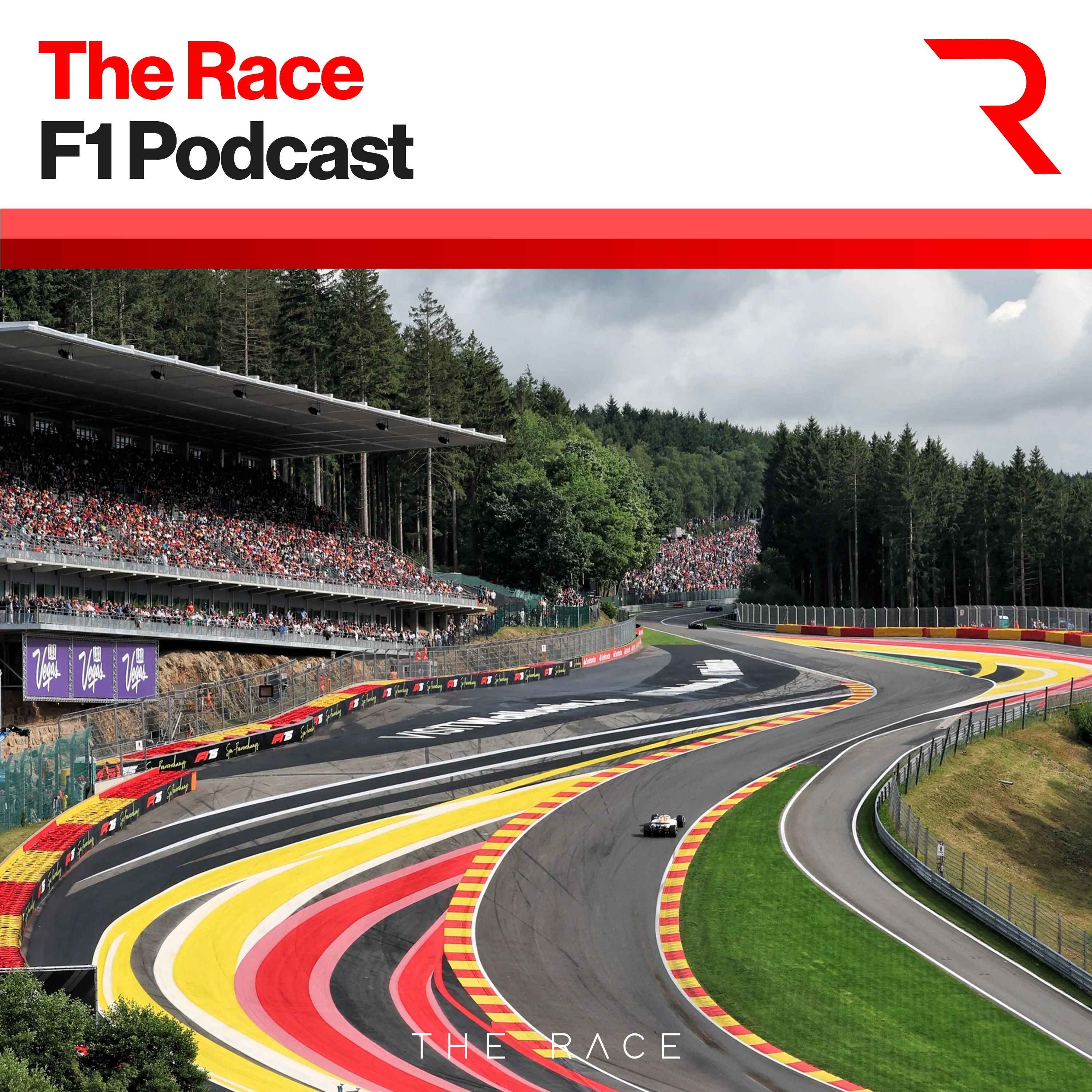
Why F1 is braced for more yo-yo racing in Belgium
About this episode
F1 heads to Spa with plenty of reasons to expect more “yo-yo” racing: hybrid energy limits, sector-by-sector harvesting, and the way battery deployment can’t be constant. The hosts tie it to Belgium’s track character and unpredictable weather—if it rains, torque delivery and visibility could make things chaotic without necessarily triggering red flags. They also debate how to explain hybrid “charge” on TV, and how different teams/drivers may cope, from low-drag efficiency to low-grip front-end feel.
Energy concerns are once again dominating discussion as F1 heads to the power-hungry Spa-Francorchamps circuit for the Belgian Grand Prix, so should we expect another weekend of yo-yo racing and drivers complaining?
On the latest episode of The Race F1 Podcast, Edd Straw is joined by Mark Hughes and Nelson Valkenburg, of Viaplay Netherlands, to explain the set-up and deployment headaches facing the teams this weekend and to debate whether Ferrari will be the team to take the fight to Mercedes once more.
With weather forecasts for Spa looking mixed, the prospect of a first proper wet race under this regulation set is also discussed, plus we examine where the true momentum in the Antonelli versus Russell title race lies, and whether there might be a shift in Belgium.
Get bonus F1 podcasts, extra content and ad-free listening, sign-up to The Race Members' Club on Patreon today.
Hosted on Acast. See acast.com/privacy for more information.
Spa Circuit
"The race is on and energy concerns are bound as F1 heads to the iconic Spa Circuit, so should we expect another weekend of yo-yo racing..."
Spa is a famous Formula 1 race track in Belgium. It’s known for big ups and downs and tricky corners that make the drive feel very intense.
Spa Circuit refers to the Belgian Formula 1 track at Circuit de Spa-Francorchamps. It’s famous for its dramatic elevation changes and high-speed corners, which make it feel like a “roller coaster” compared with many other F1 venues.
yo-yo racing
"should we expect another weekend of yo-yo racing and drivers complaining and can Ferrari again take the fight to Mercedes..."
“Yo-yo racing” means the cars keep speeding up and slowing down in a pattern. In F1, that can happen when drivers have to manage limited energy and can’t always use full power.
“Yo-yo racing” is a fan-friendly way to describe stop-start performance swings during a race, often caused by energy management. In F1, drivers may alternate between pushing hard and backing off to stay within power/energy limits, which can make the racing feel like it’s constantly surging and dipping.
power units
"one of the great iconic driving challenges. Drivers have already warned that with the current power units, it could be a little bit neutered. What are you expecting? Should we be"
A power unit is the car’s engine system in F1, including the hybrid parts. Because of the rules on how energy is stored and used, it can affect how aggressively drivers can drive.
In F1, “power units” are the hybrid engine systems that combine a combustion engine with energy recovery and deployment components. When the hosts say the current power units could make racing “neutered,” they’re pointing to how the hybrid/energy rules can limit how freely drivers can use full power.
electrical energy
"this is going to be a real sort of extreme test of how you manage the electrical energy over the lap."
F1 cars use a hybrid system that stores energy and can release it as extra power. The race is about using that extra power at the right moments so you don’t run out later.
In modern F1, some of the car’s energy comes from an electrical system (the ERS). The key challenge is managing how much electrical power you can deploy over the lap without running out at the wrong time.
megajoules
"it's six megajoules, isn't it, that we've got for the race? Or is it seven? ... it's seven megajoule harvest limit for a qualifying lap and 8.5 limit for a race lap."
Megajoules are a way to measure how much energy you have available. In F1, the rules put a cap on how much energy you can collect and use, so strategy matters a lot.
Megajoules (MJ) are a unit of energy. F1’s hybrid rules limit how many megajoules you can harvest and use, so teams must plan energy usage lap-by-lap and even sector-by-sector.
harvest limit
"You've got, it's seven megajoule harvest limit for a qualifying lap and 8.5 limit for a race lap. ... that's how much you can harvest."
A harvest limit is the maximum amount of energy the car is allowed to recover (typically via regenerative braking) over a specific run. Once you hit that cap, you can’t keep harvesting more energy, so teams time their braking and deployment carefully.
ICEs
"you're going to be through sector two with not very much power in terms of you're going to be pretty much on the ICE entirely through the twists and turns of sector two"
ICE is the normal engine that burns fuel. The discussion here is about when the car will rely mostly on that engine instead of the hybrid’s extra electric boost.
ICE means internal combustion engine. The point being made is that in some parts of the lap the car may be running mostly on the ICE rather than using the extra electrical power, which changes how teams pace the energy.
tactical lifting
"you're probably going to see a little bit of yoyoing sector one versus sector three and with a little bit of tactical lifting off and trying to regain that little extra bit more energy through sector two."
Tactical lifting is when the driver briefly eases off the gas on purpose. In hybrid F1, it can help manage the stored energy so you can use it more effectively later.
Tactical lifting means easing off the throttle on purpose to manage energy flow—often to avoid wasting battery charge or to set up better harvesting later. In hybrid F1, it’s a deliberate strategy tool rather than just “driving less aggressively.”
yoyoing sector one versus sector three
"you're probably going to see a little bit of yoyoing sector one versus sector three and with a little bit of tactical lifting off"
They expect the car’s pace to rise and fall between different parts of the track. Teams may use extra power in one sector, then back off and recover energy for the next.
This describes a lap strategy where power usage and energy deployment differ sharply between sectors. The idea is to “spend” energy in one area and then “save” or recover it in another, leading to a yo-yo pattern in pace.
bus stop
"the run from Blanchemont to the bus stop will expose a lot of teams and drivers ... if you don't do it well towards the bus stop."
The bus stop is a well-known chicane at Spa. It’s a spot where drivers have to slow down and turn carefully, so energy strategy can make a big difference to speed and passing.
The bus stop is a famous chicane area at Spa-Francorchamps. It’s a key braking/turning zone where hybrid energy management and timing can strongly influence lap pace and overtaking.
Blanchemont
"the run from Blanchemont to the bus stop will expose a lot of teams and drivers if they've got their strategies for harvesting right."
Blanchemont is a specific part of the Spa track. The hosts mention it because what teams do with energy and power there can affect who can pass and who struggles.
Blanchemont is a named section of the Circuit de Spa-Francorchamps. It’s referenced here because the run toward the bus stop is where energy strategy and overtaking opportunities can be exposed.
Stavolo
"the run from Stavolo up to the bus stop is slightly shorter than that, but still very long."
Stavolo is a named area on the Spa track. It’s mentioned because the distance from there to the bus stop determines how long teams have to manage power and energy.
Stavolo is another named section of Spa-Francorchamps. The segment is used as a reference point for how long the high-speed run is before the bus stop, which affects how teams plan energy usage.
battery energy
"have the, there's not the allowable battery energy to, battery energy to deploy on all the straights. So sort of the middle sector is pretty much your non deployment zone almost."
F1 cars use a hybrid system that stores electricity. You can’t use all of that electricity at once, so the team has to choose the best moments to spend it.
In modern F1, the car has a limited amount of electrical energy available from its hybrid system. That energy can’t be deployed everywhere, so teams must decide when to spend it for maximum advantage.
non deployment zone
"So sort of the middle sector is pretty much your non deployment zone almost. You can use a bit in a few places if you want to, but because of this unusual track characteristic,"
A non deployment zone is a part of the track where the team holds back the car’s extra electric boost. They save it for later because the battery energy is limited.
A non deployment zone is a track section where the team chooses not to use (deploy) the hybrid’s stored energy. It’s essentially a conservation area, used because the car can’t spend battery energy on every straight.
state of charge
"Now we have the opportunity to speak about it when we choose. But if you see a graphic going from 100 to 30 percent to 3 percent to 7 percent to 80 percent to 90 percent, it's just if it goes like this within a few seconds and this is what it is, it just doesn't help the storyline either."
This is basically how full the battery is in the race car. If it’s high, the driver can use more electric boost; if it’s low, they have to save it for later.
In F1’s hybrid era, a car’s “state of charge” refers to how full the battery is at a given moment. It matters because drivers can deploy energy to gain speed, but they must manage remaining charge to stay competitive over the stint.
sprint race
"Antonelli was chasing down Hamilton in the sprint race at Silverstone, having those two states of charges, not having everyone all the time, would have told quite an interesting story"
A sprint race is a shorter F1 race format held on some weekends, used to set the grid for the main Grand Prix. Because it’s shorter, teams often deploy hybrid energy differently, which can make “charge” and overtaking dynamics more dramatic.

Jeep Commander
"... in theory, Antonelli's got this much more as the commander hangers, let's see if that plays out like that. Y..."
The Jeep Commander is a larger SUV made for carrying people and cargo. It’s designed for everyday driving, like commuting and family trips. An SUV like this typically has more room than a smaller car.
The Jeep Commander is a mid-size SUV from Jeep, built for families and everyday driving with a focus on practicality and space. It’s the kind of vehicle that may come up in a podcast when discussing real-world road relevance—how large SUVs fit into daily life beyond racing talk. The name “Commander” also stands out because it’s commonly used in other contexts, so it’s worth clarifying the vehicle being referenced.
deployment strategies
"I think we all lack an understanding sometimes of deployment strategies from one car to another, especially, for instance, we've been diving into the differences between Mercedes and McLaren, and it takes time to go through the data."
This means how the driver chooses when to use the car’s stored electric energy. It’s a plan for using boost at the right times, and it can be hard to explain in real time.
Deployment strategies are the planned ways a driver uses stored hybrid energy (battery charge) across a stint—when to boost, when to conserve, and how to respond to an opponent. In live coverage, these strategies are hard to explain because they can change moment-to-moment.
McLaren
"I think we all lack an understanding sometimes of deployment strategies from one car to another, especially, for instance, we've been diving into the differences between Mercedes and McLaren, and it takes time to go through the data."
McLaren is another F1 team. Here, they’re part of a comparison about how teams use boost and manage the battery during a race.
McLaren is the other F1 team mentioned alongside Mercedes, in the context of comparing how each team’s car uses hybrid energy. The key idea is that “deployment” and charge management can differ between teams, affecting on-track battles.
drag levels
"they have completely different drag levels, and they've got different gear ratios and final drive ratios."
Drag is the “air resistance” that makes the car slow down. If two cars have different drag, they’ll reach different speeds and feel different at high speed.
In racing, drag is the aerodynamic resistance that slows the car down. Different setups or regulations can change the car’s drag level, which then affects top speed and how efficiently the car can use its power.
gear ratios
"they have completely different drag levels, and they've got different gear ratios and final drive ratios."
Gear ratios are how the transmission “gears” the engine to the wheels. Different ratios change how the car accelerates and how it behaves at speed.
Gear ratios determine how engine RPM relates to wheel speed in each gear. Changing them alters acceleration, how quickly the car reaches top speed, and how well the car stays in the engine’s efficient power band.
final drive ratio
"they have completely different drag levels, and they've got different gear ratios and final drive ratios."
Final drive ratio is the last gearing step that sets the car’s overall “speed vs RPM” feel. It changes how hard the car pulls and how fast it can go.
Final drive ratio is the overall gearing between the gearbox and the driven wheels (often via the differential). It shifts the whole car’s speed-vs-RPM relationship, affecting acceleration and top speed across all gears.
deploying
"even though the engine's the same, they're not going to be harvesting and deploying in the same way."
Deploying is when the car uses the stored energy to add power. Teams decide the timing so it helps the car when it matters most.
In hybrid racing, “deploying” is when the stored energy is released to provide extra power. It’s a strategy choice—when and how much to use—because it affects lap time and how long the advantage lasts.
FOM
"It's also a situation where FOM finds it difficult to own this, because they're already sort of waving the white flag a little bit together with the FAA"
FOM is the group that helps run Formula 1 day-to-day and handles a lot of the business and operations. When they’re mentioned, it’s about how the sport is managed under the rules.
FOM (Formula One Management) is the organization that runs the commercial and operational side of Formula 1. In discussions like this, it’s referenced in terms of how the sport is managed and presented under the current rules.
Mohammed Ben Sulayem
"and the FAA is trying to push with the Mohammed Ben Suleyem a whole different direction for the future."
Mohammed Ben Sulayem is an important official in Formula 1’s governing structure. In this segment, he’s mentioned as pushing for a different future direction.
Mohammed Ben Sulayem is a key Formula 1 official associated with the FIA, the sport’s governing body for rules and regulations. The discussion implies he’s pushing for a different direction than the current approach.
white flag
"because they're already sort of waving the white flag a little bit together with the FAA"
Here, “white flag” is a figure of speech meaning someone is backing off or conceding. It’s about negotiations, not the actual race signals.
“White flag” is used here as a metaphor for backing down or conceding in a negotiation. It’s not a racing flag meaning; it’s describing a shift in stance between parties.
Monza
"Silverstone, Spa, Monza to a certain effect, also, Zandvoort will be the ones where they will have to swallow that pill a little bit."
Monza is known for being very fast and usually running low downforce. That affects grip and how the car can use power through corners.
Monza is an Italian circuit famous for high-speed running and typically low downforce. That matters because downforce and grip levels influence how often drivers can stay in the optimal power/traction window.
Zandvoort
"Silverstone, Spa, Monza to a certain effect, also, Zandvoort will be the ones where they will have to swallow that pill a little bit."
Zandvoort is an F1 track in the Netherlands. It’s a corner-heavy circuit, so changes to power delivery and grip can show up more clearly there.
Zandvoort is a Dutch circuit used on the F1 calendar, known for its tight corners and traction demands. The segment groups it with other tracks where the rule changes may be more noticeable.
middle sector
"I think it is a shame that a big chunk of that middle sector, you're going to be way down on power."
Tracks are split into timed sections called sectors. The “middle sector” is just the middle part of the lap where the speaker thinks the car will be slower or more limited.
A “sector” is a timed section of the lap used to analyze performance. The “middle sector” refers to the middle portion of the circuit, where the speaker expects drivers to be more constrained by the power/energy rules.
down on power
"I think it is a shame that a big chunk of that middle sector, you're going to be way down on power."
“Down on power” means the car isn’t giving as much acceleration as it normally would. That can make it harder to exit corners quickly and consistently.
“Down on power” means the car is producing less usable acceleration force than expected, often due to energy deployment limits or hybrid constraints. In F1, that can change how drivers manage traction and braking/acceleration zones.
grip limit
"You don't want to have corners where you're sat within the grip limit."
The grip limit is the point where the tires can’t hold the road anymore. If you’re near that limit, the car can start to slide or feel unpredictable.
The grip limit is the maximum traction available before the tires lose their ability to follow the car’s intended path. If a driver is “within the grip limit” for too long, small changes in power or aero can cause instability and slower lap times.
low downforce
"That's that's been the trend at Spa to go more towards the low downforce."
Downforce is what helps the tires grip the road. A “low downforce” setup gives less grip in corners but usually makes the car faster on the straights.
Downforce is the aerodynamic force that presses the car onto the track for grip. “Low downforce” setups trade cornering grip for lower aerodynamic drag, often improving straight-line speed—especially relevant at circuits like Spa.
downforce level
"So I think you need to have a higher downforce level or be at the upper range of what's realistic for this for there to be any problem with, say, a corner"
Downforce level is how much the car is “pushing down” onto the track. More downforce usually means better cornering grip, but it can slow the car down on top speed.
Downforce level is how much aerodynamic pressing force the car generates. Higher downforce generally improves cornering grip but increases drag, while lower downforce does the opposite—affecting how the car can exploit power in each sector.
Baku
"Spa, [749.7s] probably second only to Monzo in terms of being a problem, although Baku is not ideal as well [755.0s] simulation suggests that you can do the majority of the harvesting you need to do on a qualifying lap"
Baku is a Formula 1 street circuit in Azerbaijan. It has long straight sections, so the car’s speed and energy use matter a lot there.
Baku refers to the Baku City Circuit in Azerbaijan, which features long straights and heavy braking into tight corners. In this discussion, it’s contrasted with Spa for how energy harvesting and braking/drag management play out on track.
harvesting
"a bit of super clipping or you might want to lift, etc. to to harvest. So yeah, Spa, [745.1s] probably second only to Monzo in terms of being a problem, although Baku is not ideal as well [755.0s] simulation suggests that you can do the majority of the harvesting you need to do on a qualifying lap"
Harvesting is when the car recovers energy while slowing down. Instead of wasting that energy, the system stores it so the driver can use it later for extra acceleration.
In F1, harvesting is the process of recovering electrical energy from the power unit, typically during braking. That recovered energy is stored and later used to provide extra acceleration within the limits set by the regulations.
energy management
"So yeah, Mark, this is just what we're dealing with now, isn't it? [784.7s] And this is where the key performance differentiators are. The energy management is going to be critical to performance because there is [788.5s] just so much lap time in it."
Energy management is about controlling when the car saves energy and when it uses that saved energy to go faster. In F1, you can’t just use everything all the time—you have to plan it lap by lap.
Energy management in F1 is how teams decide when to harvest energy (recover it under braking) and when to deploy it (for acceleration) within the rules. Because the power unit has limited usable energy, managing it well can be more important than raw speed in any single moment.
battery capacity
"Yeah, absolutely. And like you say, there's hard limits in the [850.3s] regulations in terms of battery capacity and MGUK power that you just can't get around no matter [855.8s] what the technology."
Battery capacity is how much energy the car’s hybrid battery can hold. Since it’s limited by the rules, teams have to decide when to charge it and when to spend that energy to go faster.
Battery capacity is the maximum amount of electrical energy the F1 hybrid system can store at any time. Because the battery is capped by regulations, teams must manage harvesting and deployment so they don’t run out of usable energy at critical moments.
MGUK power
"Yeah, absolutely. And like you say, there's hard limits in the [850.3s] regulations in terms of battery capacity and MGUK power that you just can't get around no matter [855.8s] what the technology."
MGUK power is the hybrid part of the F1 power unit that can store energy and then help drive the car. The rules limit how much extra power it can give you, so teams plan around that limit.
MGUK power refers to the Motor Generator unit—Kinetic, the hybrid system component that generates electricity from the car’s motion (especially during braking) and can also provide power back to the drivetrain. F1 regulations cap how much MGUK power can be deployed, which directly affects race strategy.
active aero
"all be without active aero, but that's not the case. There's five zones. There's one on the start finish, the short run to the source, one on the blast from the source to O'Rouge,"
Active aero means the car’s wings and aerodynamic parts can adjust during the race. That lets the team tune how much grip and resistance the car has as conditions change.
Active aero refers to aerodynamic devices on an F1 car that can change position or behavior while driving to manage downforce and drag. In practice, it helps the car stay stable and fast across different speeds and track conditions.
energy limits
"They're expecting it to be maybe 34 seconds slower in qualifying, because you do sacrifice lap time when you lower that energy limit, the megajoule limit harvest on a qualifying lap, which was going to be eight"
The energy limit is a rule that restricts how much extra energy the car can use. Lowering it means the car has less boost available when trying to set a quick qualifying time.
The energy limit is the regulatory cap on how much usable energy the car can recover and deploy over a defined stint or session. In this context, reducing it for qualifying means less extra power available for fast laps.
megajoule limit
"because you do sacrifice lap time when you lower that energy limit, the megajoule limit harvest on a qualifying lap, which was going to be eight megajoules, and it's dropped to seven."
The megajoule limit is a rule that caps how much “stored energy” the car can use. If the limit is lower, the car can’t boost as much, which can slow lap times.
The megajoule limit is the cap on how much energy can be harvested and used from the car’s energy-recovery system during a specific period (here, qualifying). It’s measured in megajoules (MJ), and lowering the limit reduces how much extra power the driver can deploy.
Suzuka
"It's still Spa. So it's not a disaster, but I think again, Nelson, it does just show it just takes the edge off the great circuit, doesn't it? Yeah. And this is why it hurts more at a place like Suzuka or Spa than it would at a place like Baku, where the drivers have less of an emotional connection with certain corners."
Suzuka is a major Formula 1 track in Japan. The layout is very distinctive, so drivers often have a strong personal connection to how certain corners feel.
Suzuka is the Suzuka Circuit in Japan, another iconic F1 venue. It’s especially known for its high-speed flow and distinctive corner layout, which can create strong driver “feel” for specific sections.
Kimi Antonelli
"And also you can use it to your advantage. Look at what Kimi Antonelli is doing. He is embracing it and using it to his advantage."
Kimi Antonelli is an F1 driver. The speaker is saying he’s handling the new rules that change when the car can use extra power, and turning that into an advantage.
Kimi Antonelli is an F1 driver who is being referenced here as adapting well to the new “yo-yo” style of racing caused by energy deployment limits. The host’s point is that he’s embracing the constraints rather than fighting them.
V8
"Also from a commentary standpoint, if we're just sitting there thinking, ah, give me a V8, it would have been so much better. Your Sunday is going to be miserable."
A V8 is a type of engine with eight cylinders arranged in a V shape. The comment is basically about missing the classic V8 sound and character.
A V8 is an engine configuration with eight cylinders arranged in a “V” shape. The host is lamenting that the current F1 power unit era doesn’t deliver the same sound/feel as a traditional V8, even if the racing can still be exciting.
qualifying lap
"You want to have something where passing is possible, [1021.8s] but it's not too extreme. And you want to know that drivers are at the limit [1025.0s] every part of a qualifying lap."
A qualifying lap is the fast lap drivers do to decide where they start the race. They usually drive as hard as possible because starting position matters a lot.
A qualifying lap is the single fast circuit run used to set the starting grid for the race. Drivers typically push the car to its limits because track position is hugely valuable in F1.
grip level
"So there is a chance we'll [1119.3s] get that wet race, fear of chaos, thanks to the characteristics, these power units, concerns [1124.4s] about the grip level of the tires."
“Grip level” means how well the tires can hold the road. When grip is low—like in rain—cars slide more and racing gets more unpredictable.
The “grip level” is how much traction the tires can generate against the track surface. In wet or mixed conditions, grip drops and becomes harder to predict, which increases the chance of chaos and strategy swings.
rain chaos race
"concerns [1124.4s] about the grip level of the tires. Are you quite excited about the prospect of a rain chaos race [1129.1s] if there is one?"
A “rain chaos race” is an F1 race where the rain makes everything harder—cars lose traction and drivers make more mistakes. The race can turn into a scramble with lots of strategy changes.
A “rain chaos race” refers to a Grand Prix where wet conditions cause major unpredictability—reduced traction, visibility issues, and rapidly changing grip. That often leads to more mistakes, safety cars, and strategy volatility.
Miami
"It's like the weather gods [1152.6s] are playing with this this year. It was similar in Miami, wasn't it? Those riding later on."
Miami is the F1 race held in Miami on a street-style track. Rain can make street circuits tricky because the surface can get slippery fast.
Miami refers to the Formula 1 event held in Miami, which uses a street-circuit layout. Street circuits can react quickly to rain because the surface and drainage differ from purpose-built tracks.
power delivery
"I want to see what these power units, what this power delivery, the drivability of these cars,"
“Power delivery” means how the car’s power comes on—whether it feels smooth or sudden. On a wet track, sudden power can make the tires slip and make the car harder to control.
“Power delivery” describes how the car releases engine and hybrid power to the wheels over time—how quickly it ramps up and how smoothly it transitions. In wet conditions, poor or abrupt power delivery can overwhelm tire grip and trigger wheelspin or loss of control.
drivability
"the drivability of these cars, what it's like in the wet."
“Drivability” is how easy the car feels to drive—especially how it responds when you press the throttle. In rain, drivability can get worse if the car is too twitchy or unpredictable.
“Drivability” is how easy and predictable the car is to drive in real conditions—throttle response, balance, and how controllable it feels. In the wet, drivability often depends on how the powertrain and traction work together when grip is reduced.
tire testing program
"There's an ongoing tire test program to try and improve the wets for next year."
A “tire test program” is when teams and tire makers try new tire setups to see how well they work. In this case, they’re working on tires for wet weather so cars can grip better in rain.
A “tire test program” is an organized development effort to evaluate and improve tire performance—here, specifically wet-weather tires. The goal is to increase grip and predictability when the track is wet, which can reduce the risk of cars sliding off.
wets
"There's an ongoing tire test program to try and improve the wets for next year."
“Wets” means the special tires made for rainy conditions. They have tread that helps the tire cut through water so the car can stay controllable.
“Wets” is shorthand for wet-weather tires, which use tread patterns and rubber compounds designed to channel water and maintain grip. In rain, the right “wets” help reduce aquaplaning and improve control.
torque delivery
"I think the torque delivery is going to be pretty brutal. And it's not like you're going to end up in a gravel trap, but it's by the chances are you"
“Torque delivery” is how strongly and how quickly the car’s twisting force hits the wheels. If it comes on too hard on a wet track, the tires can lose grip and the car can become difficult to control.
“Torque delivery” refers to how the car produces and applies twisting force to the wheels. The speaker expects it to be “brutal,” meaning the torque may arrive aggressively enough to break traction in the wet, making the car harder to keep pointed in the right direction.
gravel trap
"And it's not like you're going to end up in a gravel trap, but it's by the chances are you"
A “gravel trap” is a safety area next to the track made of gravel. If a driver goes off the road, the gravel helps slow the car down.
A “gravel trap” is a run-off area filled with gravel designed to slow a car after it leaves the track. In wet racing discussions, it’s mentioned as a likely consequence of losing control when traction and power delivery don’t match the conditions.
power curve
"It should be a little bit smoother in terms of the power curve, etc."
The “power curve” describes how the car’s power builds as you rev the engine or ask for throttle. A smoother curve means the car responds more gradually, which helps on slippery roads.
The “power curve” is the relationship between engine/hybrid output and engine speed or throttle demand—how power ramps up across the rev range. Smoother power curves can make throttle application more predictable in the wet, reducing sudden traction loss.
visibility
"Because that's always the thing. Actually, when it gets really wet, the problem is fundamentally visibility"
In very heavy rain, “visibility” means how well drivers can see the track. When visibility drops, it’s harder to judge braking points and where the car is going.
In heavy rain, “visibility” becomes a primary limiting factor because spray and standing water reduce what drivers can see. Even if tires are good enough to run, poor visibility can force drivers to slow down and can increase the chance of mistakes.
suction underneath the car
"But should be a little less difficult given the nature of these cars, less floor-dependent. So the suction underneath the car is different, slightly narrower tires."
Cars can use their shape to push down onto the road. Here they’re talking about the underbody creating a kind of “pull” that increases grip, which matters a lot when the track is wet.
This refers to aerodynamic downforce generated by the car’s underbody, often called ground effect. The airflow under the floor creates low pressure that “pulls” the car toward the track, improving grip—especially important in wet conditions where traction is reduced.
narrower tires
"So the suction underneath the car is different, slightly narrower tires. So I have hopes."
Tire width affects how the tire touches the road and how it handles water. In rain, that can change how much grip the car has and how safely it can stay on the track.
Narrower tires change how the contact patch works—how much rubber touches the track and how it channels water. In wet racing, tire width and tread behavior can strongly affect grip and the likelihood of aquaplaning.
red flags
"So we get a semi wet weather race where we have chaos, but no red flags that that's just the ideal."
A red flag is when officials stop the race right away because something on track is too dangerous. In bad weather, teams often want to avoid red flags so the race can keep going.
In Formula 1, red flags mean the race is stopped immediately due to a serious hazard on track (like a crash, debris, or unsafe conditions). Avoiding red flags is often the “ideal” in rain because it keeps racing continuous rather than pausing for long periods.
wet running
"I must admit, it would be nice to get on and have some proper wet running or ideally a wet race because it will stop the hypotheticals, the what-if questions that are being thrown around."
Wet running just means driving on track while it’s wet. Doing that in practice helps teams learn what the car will do in rain instead of guessing.
Wet running means teams and drivers getting meaningful track time in rainy conditions during practice or sessions. It helps them validate setup choices and tire behavior, reducing uncertainty compared with only “what-if” scenarios.
Ferrari
"Now heading to Silverstone, we didn't expect Ferrari to be a factor and they were... I think yeah, I think Ferrari can go into Spa..."
Ferrari is a top Formula 1 team. Here, the host is saying Ferrari’s car may be well-suited to Spa because it’s efficient in the way it uses energy and its aerodynamics.
Ferrari is one of F1’s historic teams, and the host is discussing its hybrid energy efficiency and aerodynamic characteristics. In this segment, Ferrari is framed as potentially benefiting at Spa due to its low-drag, aero-efficient car and upgrade path.
Mercedes
"should this on paper be one way Mercedes runs away?... although the Mercedes still has better deployment than the Ferrari power unit."
Mercedes is another leading Formula 1 team. The host says Mercedes usually looks like the favorite because it uses its car’s energy well, but that advantage might not be as big in every situation.
Mercedes is the other major F1 team discussed as the baseline favorite, with the host claiming it has better energy deployment than Ferrari. The segment also suggests Mercedes’ advantage may shrink depending on how the race unfolds and how thinly the field spreads.
deployment patterns
"I think in terms of the deployment patterns that we're seeing and who has the best use of the battery and most efficient use of that package,"
“Deployment patterns” means when the team decides to use the car’s extra energy. On different tracks, the best timing is different.
“Deployment patterns” are how a team chooses when and how aggressively to use its available energy (especially hybrid energy from the battery) during a race. Because tracks differ, the optimal timing and intensity changes from circuit to circuit.
track layout
"as each race unfolds, we're getting a little bit more of the jigsaw with the different track layouts."
“Track layouts” just means the exact course shape of the circuit. Different layouts change where you brake and accelerate, which affects how the car’s energy strategy works.
“Track layouts” refers to the specific configuration of a circuit—its corner types, straights, and overall flow. In F1, layout strongly affects how often you brake, how much energy you can recover, and where you can deploy power efficiently.
low drag
"And I think that will probably help Ferrari and also the fact that the Ferrari's got low drag, it is very aero efficient."
“Low drag” means the car is designed to push through the air with less resistance. Less resistance can help it go faster and use energy more efficiently.
“Low drag” means the car is shaped and set up to reduce aerodynamic resistance as it moves through the air. Lower drag helps top speed and efficiency, which can be especially valuable on circuits where you spend more time at higher speeds.
aero efficient
"it is very aero efficient. It seems to be aero efficient."
“Aero efficient” means the car’s shape gives it grip without slowing it down too much. It’s a balance between sticking to the road and going fast on straights.
“Aero efficient” describes an aerodynamic package that produces the needed downforce with less penalty in drag. In F1, being aero efficient can improve lap times by balancing grip (downforce) with straight-line speed (drag).
constructors' championship
"slipping towards that fourth in constructors, fourth best team, which is problematic"
This is the F1 championship for teams. Both drivers score points in races, and the team’s combined total decides the team ranking.
The Constructors’ Championship is the season-long points competition for Formula 1 teams. Each race awards points to both cars, and the team’s total determines the championship order.
drag disadvantages
"on a circuit like this, it drag disadvantages is going to be exaggerated."
Drag is the air resistance that makes the car slower. If a car has more drag than rivals, it usually struggles more on fast sections and straights.
“Drag” is aerodynamic resistance that slows the car down. If a car has “drag disadvantages,” it tends to lose time on straights and can be harder to defend against, especially on circuits where top speed and airflow matter.
short overall gearing
"you really don't want to have short overall gearing, which McLaren has. So yeah, I think those two things in particular make it probably not a very good McLaren track."
Gearing is the way the transmission ratios are set. “Short gearing” helps you accelerate faster, but it can make it harder to reach and hold very high speeds.
“Overall gearing” is how the gearbox ratios are set to trade off acceleration versus top speed. “Short overall gearing” means lower gear ratios that favor quicker acceleration but can limit top speed, which can be a disadvantage on tracks where high speed matters.
DNF
"We have the DNF in Barcelona for Antonelli when he clearly passed Russell on pace and race pace for Antonelli is his secret weapon."
DNF means the driver didn’t finish the race. If that happens, they usually don’t get points for that race because they’re not classified as finishing.
DNF stands for “Did Not Finish.” In F1, a DNF means a driver retired from the race due to mechanical issues or an accident, so they score no finish-position points.
race pace
"when he clearly passed Russell on pace and race pace for Antonelli is his secret weapon."
Race pace means how quickly the car can go during the actual race, while tires wear and conditions change. It’s different from one-lap speed in qualifying.
“Race pace” is how fast a car can run over a race stint under real conditions (fuel load, tire wear, traffic), not just in qualifying. It’s often the key indicator of how competitive a driver will be over the full distance.
tire advantage
"at the Red Bull Ring, the final part of the race, Antonelli was the clear superior, but that was also tire advantage induced."
It means one car’s tires are working better than the other’s. If your tires are fresher or last longer, you can usually go faster for longer.
“Tire advantage” refers to having better tire condition than the rival—often due to strategy, timing of pit stops, or how quickly the tires degrade. In F1, that can translate into stronger lap times, especially late in a stint.
Red Bull Ring
"And even if he qualifies magically, whatever happened with the yellow flag that lap at the Red Bull Ring from Russell was magic."
The Red Bull Ring is an F1 race track in Austria. It has sections that stress tires and grip, so small changes in conditions can make a big difference to lap times.
The Red Bull Ring is an F1 circuit in Spielberg, Austria, known for its mix of fast corners and heavy braking zones. It’s also a track where tire behavior and grip changes can quickly swing race pace and qualifying performance.
yellow flag
"And even if he qualifies magically, whatever happened with the yellow flag that lap at the Red Bull Ring from Russell was magic."
A yellow flag means there’s danger on the track ahead. Drivers have to slow down and they can’t race normally through that area, which can change how fast they can go on a lap.
A yellow flag in Formula 1 warns drivers of a hazard on track (like debris or a stopped car) ahead. Drivers must reduce speed and avoid overtaking, and the rules around it can strongly affect lap times and qualifying strategy.
Q3 performances
"But fundamentally, if you're hanging in there on performance, and sort of having to get everything out of it and produce these magic Q3 performances, you're just not as comfortable at that level."
Q3 is the last part of F1 qualifying where the top drivers fight for the best starting spots. “Q3 performances” means how strong they are when it really matters most.
Q3 is the final segment of F1 qualifying where the fastest cars set their last and best times to determine the top grid positions. “Q3 performances” refers to how well a driver and car execute in that decisive session.
low grip surfaces
"So I think there is a sort of formula to be unlocked. There's something somewhere that is not translating for George on low grip surfaces."
Low grip surfaces are parts of the track where the tires don’t grip as well. When grip is low, it’s easier to lose traction, so the car can feel less predictable.
Low grip surfaces are track conditions where the tires generate less traction than usual, often due to factors like surface texture, weather, or tire temperature. On low-grip tracks, small setup or driving differences can cause bigger performance swings.
front axle
"He's referenced how difficult he finds reading the front axle of the car on these big tire pressures, these high tire pressures on these smaller front tires."
The front axle is basically the front part of the car that controls how the front wheels behave. If the driver can’t feel what the front tires are doing, it’s harder to place the car accurately in corners.
The front axle is the front end of the car that connects the front wheels and their suspension/braking/steering behavior. In F1, how well the driver can “read” the front axle affects confidence with turn-in and how the car responds under load.
tire pressures
"He's referenced how difficult he finds reading the front axle of the car on these big tire pressures, these high tire pressures on these smaller front tires."
Tire pressures are how much air is inside the tires. Changing them changes how the tire touches the road and how it grips, so it can change the car’s handling.
Tire pressures are the air pressure inside the tires, which strongly affects the tire’s contact patch shape and how the tire heats up. In F1, pressure changes can alter grip balance and steering feel, especially on tracks with varying grip.
Silverstone
"“...the fact that he fought so hard for a single point at Silverstone…”"
Silverstone is a major Formula 1 track in the UK. The hosts are pointing to Antonelli doing well there—fighting hard even for just one point.
Silverstone is the famous Formula 1 circuit in the UK, known for fast corners and high-speed stability demands. The hosts mention a hard fight for a single point there as a moment where Antonelli helped himself through race events.
Kimi converts
"“I spoke to a few mechanics and people within the team afterwards. They're all Kimi converts now.”"
The phrase means people in the team have started to adopt a “Kimi-like” mindset. Here, it’s basically about staying calm and pushing on instead of complaining when the car isn’t perfect.
“Kimi converts” is a nickname for team members who have adopted Kimi-style attitudes—staying focused and not complaining when things go wrong. In this context, it’s about how the Mercedes team’s culture is shifting toward Antonelli’s relentless approach.
George
"“And that makes that position that George has within the team a little bit more difficult. Because you hear on the onboard radio…”"
“George” is George Russell, another Mercedes driver. The hosts are comparing how he’s doing inside the team versus how Antonelli is driving and handling setbacks.
“George” refers to George Russell, discussed here in relation to his position within the Mercedes team. The hosts contrast Russell’s situation—especially if he isn’t automatically faster—with Antonelli’s refusal to give up for even small points.
Toto
"“Because you hear on the onboard radio, you hear Toto sniping at George within qualifying sessions and just drive, don't moan so much.”"
“Toto” is Toto Wolff, the Mercedes team boss. The hosts are saying you can hear him being sharp with Russell during qualifying—telling him to focus and not complain.
“Toto” refers to Toto Wolff, Mercedes’ team principal. The transcript describes him “sniping” at George Russell during qualifying, implying a more direct, performance-focused communication style.
25 points
"“...He says, Well, my lead's been cut to 25 points. And that does have an effect because it just cuts into that cushion.”"
“25 points” refers to the driver’s championship lead margin being reduced, which changes how aggressively a driver can approach the remaining races. The hosts say this affects the psychological “cushion” Antonelli has in his mind.
low grip tracks
"with it, tackling the low grip tracks, there's still that question of, even if George Russell [2193.1s] gets back to 100%, is his 100% going to be quite as quick as Antonelli's 100%."
Some race tracks have less traction, meaning the tires can’t “grab” the road as well. When that happens, drivers have to be smoother with braking and throttle, and the car can feel harder to control.
“Low grip tracks” are circuits where the tires generate less traction because of factors like rain, cold temperatures, or abrasive/dirty surfaces. That forces drivers to brake and accelerate more gently and often changes the best racing lines and car setup.
100%
"even if George Russell [2193.1s] gets back to 100%, is his 100% going to be quite as quick as Antonelli's 100%."
“100%” here means the driver is at their best—fully recovered and fully performing. They’re debating whether Russell’s best will be as fast as Antonelli’s best.
In racing talk, “100%” is shorthand for a driver being fully back to their peak performance—physically, mentally, and in terms of confidence and car feel. The hosts use it to compare whether Russell’s peak pace would match Antonelli’s.
Danny Riccardo
"This is a mirror image of what happened with Verstappen and Danny Riccardo. [2267.7s] Is this very similar and dynamic with someone paid his dues, waiting for the opportunity,"
This is referring to Daniel Ricciardo, another F1 driver. The point is a comparison: one driver has to wait and then deal with a younger teammate who suddenly becomes very hard to beat.
“Danny Riccardo” appears to be a mis-transcription of Daniel Ricciardo, another well-known Formula 1 driver. The hosts reference him in a comparison to Verstappen, suggesting a similar pattern of a driver waiting for opportunity while a younger rival rapidly improves.
golden window
"having this golden window, this one year window. [2325.8s] the golden window, this one year window."
A “golden window” in F1 is an informal way to describe a limited period where a driver has the best realistic chance to win the championship—often because of timing, team competitiveness, or rivals’ relative performance. Here, it’s used to frame a one-year opportunity for a driver who may be “exceptionally good” but not the absolute best over the long run.
Russell
"And I think that's what we'll know by the end of the year is this a one year shot for Russell, or can he raise his game to be a consistent Antonelli beta."
Russell is a Formula 1 race driver. They’re talking about whether he can keep getting better fast enough to fight at the very front.
George Russell is a Formula 1 driver. In this segment, the hosts discuss whether he can improve quickly enough to challenge for top results and contend for the championship.
Verstappen
"There's certain things he's doing that eclipse what Verstappen could do at a similar level of experience. There's other things Verstappen was stronger at, but that's what we're talking about now, isn't it?"
Verstappen is one of the best-known drivers in Formula 1. They’re talking about how he’s reacting to another driver coming up and pushing him to stay at his best.
Max Verstappen is a top Formula 1 driver and multiple-time World Champion. Here, the hosts discuss how his performance and motivation are affected by a fast-rising rival.
Hamilton
"And for us to put him into that category of Hamilton and Verstappen also does George and Lando a disservice, but it does feel like we're looking at something else"
Hamilton is a legendary F1 driver. They’re comparing the current situation to the kind of career level that puts someone in the “greatest of all time” conversation.
Lewis Hamilton is a highly decorated Formula 1 driver and a multiple-time World Champion. The hosts use him as a reference point for what “all-time greatest” driver development looks like.
Lando
"And for us to put him into that category of Hamilton and Verstappen also does George and Lando a disservice, but it does feel like we're looking at something else"
Lando Norris is an F1 driver. They’re just using him as part of the comparison when talking about who’s being helped or hurt by the narrative around Verstappen and Russell.
Lando Norris is a Formula 1 driver. The hosts mention him in the context of how driver comparisons can shift attention and expectations across the grid.
Belgian Grand Prix
"Well, thanks very much, Nelson and Mark, for your insight. We're going to head now to Spa, so stay with us for everything you need to know from the Belgian Grand Prix."
The Belgian Grand Prix is the Formula 1 race in Belgium. They’re telling you to stay tuned for what you need to know about that weekend’s race.
The Belgian Grand Prix is a Formula 1 race held at Spa-Francorchamps. In this segment, it’s referenced as the event the listeners should stick with for coverage.
Request an Explanation
Heard something you'd like explained? We'll add it to this episode.
Sign in to request explanations for terms you heard.
Want to learn more?
Browse our glossary for plain-English explanations of automotive terms, jargon, and concepts.
Help improve this episode
See something that's not quite right? Our annotations are AI-generated and can sometimes miss the mark. Click the flag icon on any annotation to suggest a correction.