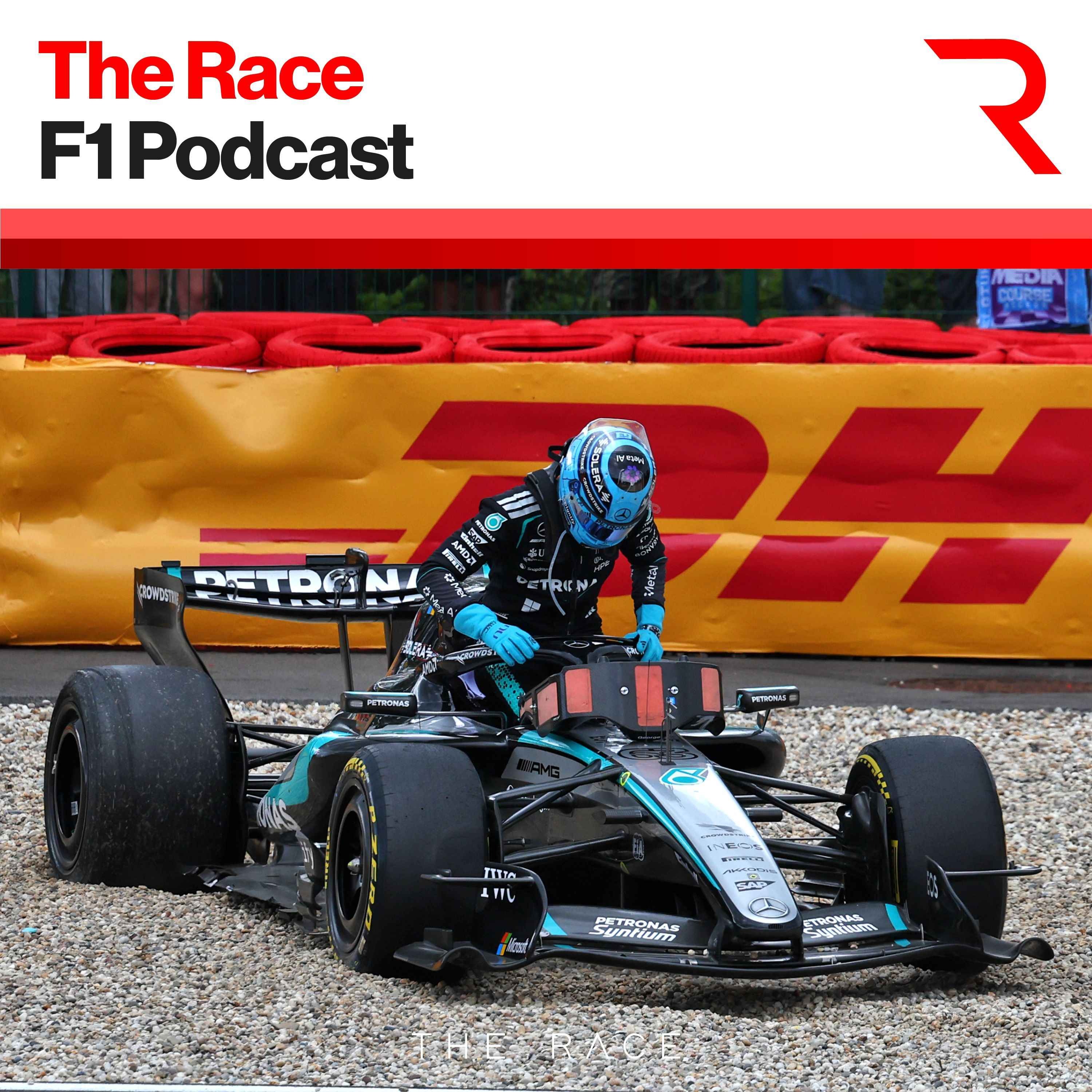
Driver Rankings: How did we rank Russell after his nightmare weekend?
About this episode
After Belgium, the hosts run through how they ranked drivers and why George Russell ended up last following a nightmare weekend. They weigh Kimmy Antonelli’s win and the wider ranking shake-up, then dig into Mercedes’ “deployment” problems, power-unit management, and energy starvation that make car-vs-driver separation harder. With qualifying and race control factors (including VSC) muddying the picture, they argue rankings can’t ignore regulations and inconsistent machine behavior.
We're back with another driver rankings podcast following the Belgian Grand Prix, where there were contrasting fortunes for the two Mercedes once more. But where did our own Edd Straw rank George Russell after early contact with Lewis Hamilton forced him out of the race? And who has claimed this week's top spot in the rankings? Ben Anderson quizzes Edd on how he ranked the drivers in Spa, backed up as ever by questions from The Race Members' Club.
Get bonus F1 podcasts, extra content and ad-free listening, sign-up to The Race Members' Club on Patreon today.
Hosted on Acast. See acast.com/privacy for more information.
driver performance
"Just in terms of the signal of driver performance, I mean, it's been bad all throughout this season. Yeah. That's just what F1 is, sadly, and I'm afraid we're going to have to talk about it a lot."
“Driver performance” in F1 is the overall measure of how well a driver is doing, combining results like qualifying position, race pace, and consistency. The hosts are using it as the basis for their ranking discussion, even though car issues can blur how much is the driver’s fault.
qualifying
"They feel you're punishing him for those Mercedes deployment issues that affected him in qualifying, particularly, but also at the start of the race."
Qualifying is the timed session before the race that decides where each driver starts. If something goes wrong in qualifying, it can make the race harder right from the beginning.
Qualifying in Formula 1 is the session where drivers set their fastest laps to determine the starting grid for the race. If a car has a problem during qualifying, it can directly hurt track position and strategy for the race.
Com
"They say the crash with Lewis Hamilton at the Com was not his fault."
“Com” is shorthand for the Monaco track. The hosts are saying Russell’s crash with Lewis Hamilton there wasn’t his fault.
“Com” here refers to the Circuit de Monaco (often shortened in F1 coverage), where the hosts say Russell had a crash involving Lewis Hamilton. Monaco is known for tight street-circuit barriers, so incidents can be especially consequential.
Q3s
"If Red Bull doesn't sacrifice, he sat cad jar to help Tomax Verstappen in Q3, even with [212.7s] those deployment issues, AI algorithmic deployment issues that Mercedes were battling and not [217.5s] really understanding."
Q3 is the last part of F1 qualifying. The cars that make it into Q3 fight for the best starting spots on the grid.
Q3 is the final segment of Formula 1 qualifying. Only the fastest cars from earlier qualifying rounds reach Q3, and the results there largely determine the top grid positions.
Red Bull
"They reckon he qualifies third. [207.3s] If Red Bull doesn't sacrifice, he sat cad jar to help Tomax Verstappen in Q3, even with [212.7s] those deployment issues, AI algorithmic deployment issues that Mercedes were battling and not"
Red Bull is another F1 team mentioned here. The idea is that their choices could have affected how well someone performed in qualifying.
Red Bull is referenced as the team that might have “sacrifice[d]” something affecting qualifying outcomes. In F1 discussions, this typically relates to strategic choices or setup/track-position decisions that can influence who gets the best performance in qualifying.
deployment issues
"If Red Bull doesn't sacrifice, he sat cad jar to help Tomax Verstappen in Q3, even with [212.7s] those deployment issues, AI algorithmic deployment issues that Mercedes were battling and not [217.5s] really understanding."
This sounds like a problem with the car’s “power boost” system not working the way it should at the key moment. If it doesn’t deploy properly, the driver can’t use the extra speed when they need it.
In Formula 1, a “deployment issue” here refers to problems with how a car’s energy/boost system is released or managed during a specific session segment (like Q3). If the deployment doesn’t happen correctly, the driver may not get the expected performance when it matters most.
Mercedes
"If Red Bull doesn't sacrifice, he sat cad jar to help Tomax Verstappen in Q3, even with [212.7s] those deployment issues, AI algorithmic deployment issues that Mercedes were battling and not [217.5s] really understanding."
Mercedes is the F1 team involved in the problem being discussed. That usually means the issue is related to how their car’s systems are working, not just what the driver did.
Mercedes is the F1 constructor/team referenced here as the party “battling” the deployment issues. In F1, each team’s technical department is responsible for the car’s systems, so Mercedes being named points to a car/technical root cause rather than only driver error.
opening lap
"Yeah, the deployment issue, which, incidentally, on that opening lap, all the Mercedes cars [245.7s] had it."
The opening lap is the very first lap after the race starts. Drivers are packed together and things can go wrong quickly, so early problems can ruin your race.
The “opening lap” is the first lap of a race start, when cars are accelerating from the grid and positions are highly fluid. Incidents and risky moves early can strongly affect track position and strategy for the rest of the race.
elements of that
"And so Russell is still struggling with elements of that. Now, I don't like the fact that the power units and getting the most out of them in the deployment is necessary..."
“Elements of that” just means the specific parts of the problem that are affecting how well the car is working. Here, it’s referring to the power-unit and how it’s being used.
The phrase “elements of that” is used as a catch-all for the specific technical and operational issues affecting Russell’s performance. In this context, it points back to the power-unit/energy-management problems discussed immediately afterward.
power unit
"Now, I don't like the fact that the power units and getting the most out of them in the deployment is necessary, but it's it's central to performance... ...You are driving the power unit."
In F1, the “power unit” is the whole engine-and-hybrid system that makes the car go. It’s not just the engine—there are also parts that store and reuse energy, and the driver has to manage it to get the most speed.
In Formula 1, the “power unit” is the car’s complete hybrid engine system: the internal-combustion engine plus the turbocharger and energy-recovery components. Drivers and teams manage how it’s deployed and how much performance they can extract moment-to-moment.
regulations package
"If we say Russell holds no responsibility for that, then the whole notion of ranking drivers becomes impossible and that has been diminished by the whole regulations package."
A “regulations package” is the bundle of rule changes for Formula 1. It can affect how the cars are built and how they behave, so results may depend less on driver skill alone.
In Formula 1, a “regulations package” is the set of rule changes that governs how teams design and operate their cars for a season. When the hosts say the regulations package diminished the idea of driver responsibility, they’re pointing to how much the rules can shift performance and outcomes away from pure driving skill.
50-50 splitter
"Like I say, that 50-50 splitter power unit to driver was how Mercedes broke it down in terms of Russell's lack of pace."
A “50-50 splitter” refers to a power-splitting strategy that divides energy or torque between the driver’s inputs and the car’s hybrid/energy management system. The hosts connect it to how Mercedes “broke it down” in terms of Russell’s lack of pace, implying that the balance of who/what controls the power delivery can affect lap time.
fidelity
"Because even the teams are struggling to understand exactly how much of that driving input, the fidelity of it impacts the deployment and it varies between car different type of power unit driver."
Here, “fidelity” means how faithfully the car turns what the driver does into what actually happens on track. If the match isn’t accurate, the car may not respond the way the driver expects.
In this context, “fidelity” means how accurately the car’s systems (or data/control models) reflect the driver’s inputs and translate them into real on-track behavior. The hosts say the fidelity of the driving input affects how the car deploys power, and that it varies by power unit type.
deployment element
"A follow up question related to this deployment element about also Oscar Piastri from Gavin Cameron, who listened to our In Car Insights podcast after qualifying, wants to know about how these machine learning deployment issues..."
A “deployment element” is a specific feature or setting that gets turned on and used while you’re driving. If that feature doesn’t behave well, it can make the car harder to drive fast.
A “deployment element” is the specific part of the car’s systems (often software/controls) that gets activated or applied during driving. Here, it’s discussed as part of how machine-learning or control strategies are rolled out, and how that can influence driver performance and therefore rankings.
Oscar Piastri
"A follow up question related to this deployment element about also Oscar Piastri from Gavin Cameron, who listened to our In Car Insights podcast after qualifying, wants to know about how these machine learning deployment issues..."
Oscar Piastri is a Formula 1 driver. In this segment, they’re talking about whether qualifying struggles should be blamed on the driver or on the car’s systems.
Oscar Piastri is an F1 driver whose qualifying performance is being discussed in the context of how software/control issues and driver technique can affect results. The hosts question whether it’s fair to blame drivers if the car’s systems (including machine-learning deployment) contribute to the problem.
Charles Leclerc
"OK, let's move on to Charles Leclerc, who was ninth in your rankings this weekend. The members want to know if you think in hindsight you ranked him a bit too low."
Charles Leclerc is an F1 driver. In this episode, the hosts argue about where he should rank after a weekend, based on his speed in qualifying and the race, and a controversial moment.
Charles Leclerc is a Formula 1 driver whose results are being discussed in the episode’s ranking debate. The hosts reference his qualifying and race performance, plus a specific incident that affected how high he should have been placed.
race
"They feel he did all he could in qualifying and the race. And one said it's baffling to count the piastry incident against him, considering it was judged by the stewards to be a legal move."
The race is the main competition on Sunday (or the main day) where drivers try to finish first. In this discussion, they’re saying Leclerc did well enough in the race to deserve a higher ranking.
In Formula 1, the race is the main event where drivers compete over a set distance/time, earning points based on finishing position. The hosts are using his race performance as part of why they think he should have been ranked higher.
stewards
"And one said it's baffling to count the piastry incident against him, considering it was judged by the stewards to be a legal move. Shout out to Adpo, Gavin Cameron, Kimmy Reichenelli and Elyon Farrell for questions on this topic."
Stewards are the rule-enforcers in F1. If something happens during a race, they review it and decide whether it broke the rules or was allowed.
Stewards are the officials in Formula 1 who review incidents and apply the rules. When the hosts say the move was “judged by the stewards,” they mean the officials decided it was legal under the regulations.
legal move
"And one said it's baffling to count the piastry incident against him, considering it was judged by the stewards to be a legal move. Shout out to Adpo, Gavin Cameron, Kimmy Reichenelli and Elyon Farrell for questions on this topic."
A “legal move” is an action on track that the rules allow. Here, the point is that the stewards decided the incident wasn’t a rules violation, so it shouldn’t be treated as a mistake.
A “legal move” means an on-track action that complies with F1’s sporting and driving regulations. In this context, the hosts argue that an incident shouldn’t hurt Leclerc’s ranking because the stewards ruled the move was allowed.
outqualified
"I think his pace was was pretty good. He did get out qualified by Gasly by six hundreds of a second, something like that."
“Out-qualified” means one driver was faster than the other in qualifying. That usually puts them ahead on the starting grid for the race.
“Out-qualified” means one driver set a faster lap time in qualifying than another, earning the better starting position for the race. In F1, qualifying pace is a strong indicator of raw speed and car balance.
Colopinto
"But the thing that stood out about Colopinto is he won that really tight four car battle. There was a four car battle for P 10. So it's basically that's the all or nothing battle."
Colopinto is the driver they’re talking about. They’re saying he did well because he fought smartly in traffic and came out on top in a close race situation.
Colopinto is the driver being discussed, and the hosts are ranking him based on how well he performed in a difficult points-fight. The segment highlights his racecraft: winning a tight battle and managing to stay clear after passing.
four car battle
"But the thing that stood out about Colopinto is he won that really tight four car battle. There was a four car battle for P 10."
A “four car battle” means four cars are fighting closely for position. When it’s that tight, it can make or break whether you finish in the points.
A “four car battle” is a multi-car fight for track position where several cars are close enough to swap places repeatedly. In F1, these battles often decide who scores points, because one mistake can drop you out of the points range.
deployment power
"Obviously at the past, the double pass he made in chemistry was because he had more deployment power, but that will have been a strategic thing as well."
In F1, drivers don’t just have one fixed engine output—they manage energy and power. “Deployment power” is about how much extra acceleration they can use when they need to attack or defend.
“Deployment power” refers to how much usable energy/power the driver can deploy at the right moment—typically tied to F1’s hybrid energy systems and power management rules. It affects how effectively a driver can accelerate for overtakes and defend after passing.
Verstappen
"between Antonelli and Verstappen for number one? ... Verstappen didn't have the quickest car"
Verstappen is Max Verstappen, one of the top drivers in Formula 1. They’re comparing his result and performance to Antonelli to decide who should be ranked higher.
Verstappen refers to Max Verstappen, the Red Bull driver. Here, the hosts are evaluating whether he deserved the top ranking versus Antonelli, based on factors like car pace and finishing position.
Antonelli
"was this the toughest decision of the year you had to make between Antonelli and Verstappen for number one? ... Jack Rudd thought top spot should have gone to Antonelli"
Antonelli is an F1 driver. In this segment, they’re talking about how he should rank compared with Verstappen after the race results.
Antonelli refers to the F1 driver Andrea Antonelli, discussed here in the context of a season ranking debate. The hosts are comparing his qualifying/race outcome versus Verstappen for the top spot.
tie break
"And in a tie break situation, given this feeling that it was quite a close call, Jack Rudd thought top spot should have gone to Antonelli"
A tie-break is what you do when two people are basically equal. Instead of picking randomly, you use extra rules to decide who ranks higher.
A tie-break is an extra decision step used when two drivers (or options) are judged too close to call. In rankings, it means applying additional criteria to decide who gets the higher spot.
Blanchiamont
"You know, they got pretty close at Blanchiamont."
Blanchimont is a famous corner at Spa in Belgium. Because it’s fast and important, it can strongly influence who gets ahead during a race.
Blanchimont is a high-speed corner at the Circuit de Spa-Francorchamps in Belgium. It’s known for being a key overtaking and momentum point, so small differences in speed and traction there can affect who ends up ahead.
VSC
"He only dropped behind him because of the VSC."
VSC is like a digital safety-car period. Race control tells drivers to slow down using signals, and that can change who’s in front on the track.
VSC stands for Virtual Safety Car, a race control mode that slows cars down without deploying a physical safety car. It’s enforced via electronic signals, and it can shuffle track position—especially if someone is ahead or behind at the wrong moment.
Russell
"The Williams in 2019, let's say, with Russell and Kubitsa, [1835.9s] they were in their own little class C. [1838.2s] But you could get a pretty good idea of where the ceiling of that car is."
Russell is an F1 driver (George Russell). The point here is that his results are hard to judge because the car wasn’t always consistent and sometimes couldn’t deliver the expected performance.
“Russell” refers to George Russell, an F1 driver. The hosts are discussing how difficult it is to rank him because the car’s performance and energy deployment issues can mask a driver’s actual potential.
Kubitsa
"The Williams in 2019, let's say, with Russell and Kubitsa, [1835.9s] they were in their own little class C. [1838.2s] But you could get a pretty good idea of where the ceiling of that car is."
Kubica is an F1 driver who drove for Williams around that time. The hosts are using both drivers as examples of how the car’s limitations affected what they could achieve.
“Kubitsa” is likely a misspelling of Robert Kubica, who drove for Williams around the 2019 period. The hosts mention him alongside Russell to describe how the team’s car performance defined what results were realistically possible.
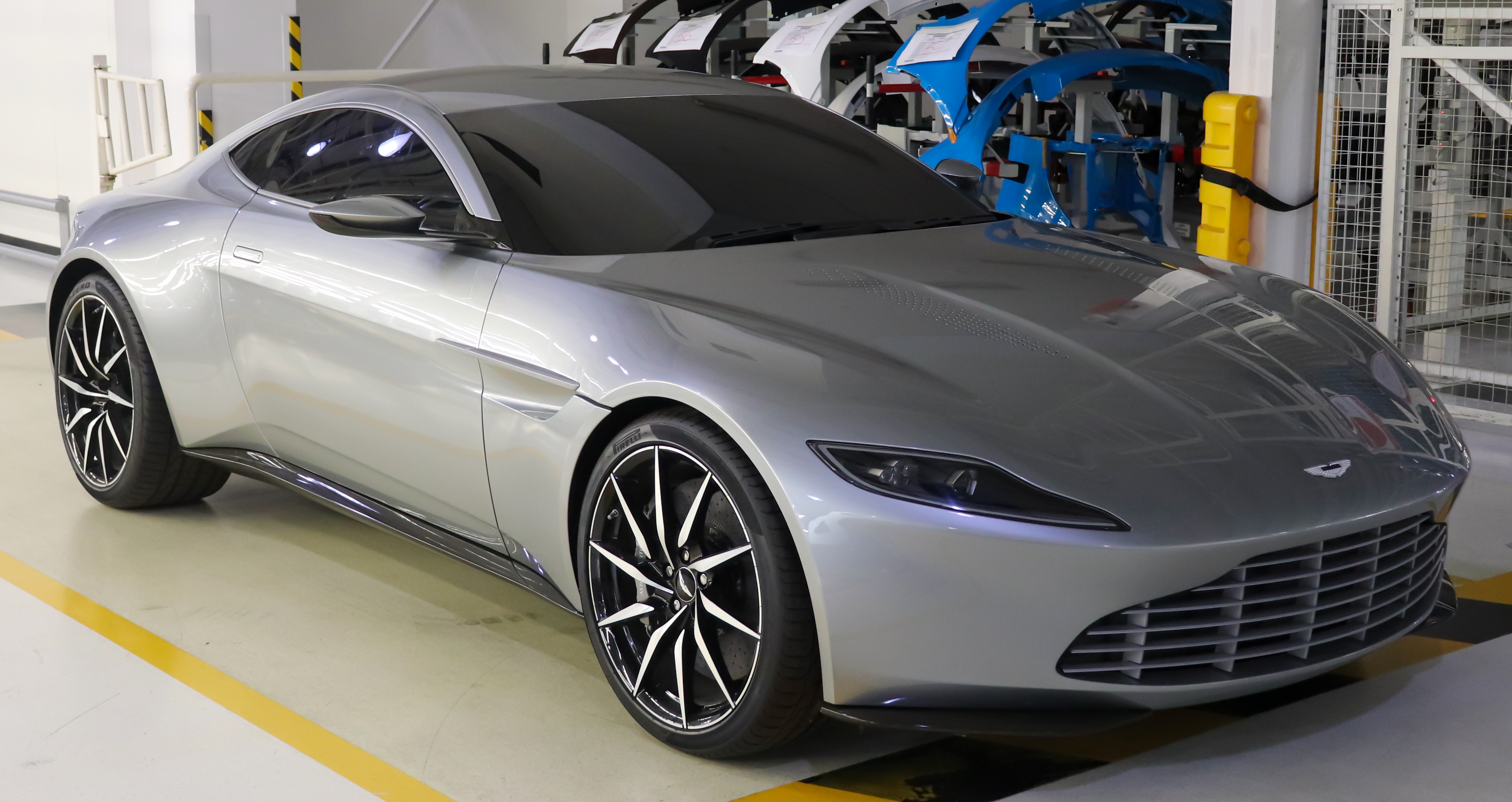
Aston Martin
"And yeah, we know the Aston Martin is not quick. [1844.2s] And you know sort of ballpark where it is, but it's that inconsistency [1847.3s] in the car that makes it quite hard. [1849.2s] You know, Alonzo and Stroll could be driving phenomenal seasons,"
Aston Martin is the F1 team the car belongs to. The hosts say the Aston Martin wasn’t very fast and was inconsistent, so it’s hard to tell whether a driver is doing everything they can or if the car just isn’t capable.
Aston Martin is an F1 constructor/team, and the hosts are arguing that its car was not quick and suffered from performance inconsistency. They also connect that inconsistency to issues around the team’s power unit and deployment-related problems, making it hard to judge driver potential fairly.
Stroll
"You know, Alonzo and Stroll could be driving phenomenal seasons, [1852.0s] but they're just fundamentally limited by the machinery they've got. [1856.4s] So the Aston Martin is basically impossible and Aston"
Stroll is an F1 driver (Lance Stroll). The idea is that even if he’s driving well, a limited or inconsistent car can hold back the results.
“Stroll” refers to Lance Stroll, an F1 driver. The hosts use him as an example of how driver performance can be constrained by the car’s machinery and inconsistency.
Alonzo
"You know, Alonzo and Stroll could be driving phenomenal seasons, [1852.0s] but they're just fundamentally limited by the machinery they've got. [1856.4s] So the Aston Martin is basically impossible and Aston"
“Alonzo” appears to refer to Fernando Alonso, an F1 driver. The hosts argue that even if Alonso is capable of strong seasons, the car’s fundamental limitations can prevent the results from matching the driver’s talent.
Perez
"I ranked Perez low, low, but basically said he didn't really have much opportunity [1897.0s] this weekend and it didn't really reflect on him so much."
Perez is Sergio Pérez. The hosts are explaining that his low ranking was partly because the weekend didn’t give him much chance to show what he could do.
“Perez” refers to Sergio Pérez, an F1 driver. The hosts say they ranked him low because he had limited opportunity during the weekend, implying that circumstances—not just driver skill—affected the outcome.
deployment problems
"But you had deployment problems, didn't he? But again, you don't know whether they're just endemic ones, whether he was doing something to get the deployment wrong."
“Deployment problems” refers to issues with how a driver’s car systems are used during a stint—most commonly relating to deploying power or energy in the right way at the right time. In F1 context, it’s about whether the car is delivering what the driver expects when they try to use it.
Bottas
"And then I guess you have to kind of rank Bottas against him because they're kind of in again a class of one almost."
Bottas is a Formula 1 race driver. Here, the hosts are comparing his results to another driver’s (Perez) to judge how good or bad a weekend really was.
Valtteri Bottas is a Formula 1 driver who has competed for multiple teams, often as a teammate to a lead driver. In this segment, the hosts compare Bottas’s performance to Perez’s to decide how to rank Russell after a difficult weekend.
changed some bits on the car
"Perez was struggling, but they changed some bits on the car into the race, including a number of bits that weren't sort of so known about publicly."
This means the team adjusted parts or settings on the car during the race weekend. The goal is to make the car work better, especially if it wasn’t performing as expected.
“Changed some bits on the car” refers to mid-race or between-session updates to the car’s setup—like adjustments to components or configuration—to improve performance. The hosts mention these changes happened “into the race,” implying the team altered the car during the weekend to address performance issues.
F1 scoring system
"So that gives you a points position based on the F1 scoring system. [2051.4s] So for the top 10 for each race, Ben, do you want to give a quick rundown"
In F1, drivers earn points depending on where they finish in each race. The “F1 scoring system” is just the official rules for how many points you get for 1st, 2nd, 3rd, and so on.
The F1 scoring system is the points method Formula 1 uses to award championship points based on finishing position in each race. The host is saying the “drivers rankings championship” is effectively a points table derived from those race results.
Belgian Grand Prix
"Who's jumped a second from fifth on account of effectively winning [2073.4s] the Belgian Grand Prix in your driver rankings. [2075.9s] Lando Norris has gone up from fourth to third."
The Belgian Grand Prix is one of the Formula 1 races. The hosts are using the outcome of that race to explain why certain drivers moved up or down in their rankings.
The Belgian Grand Prix is a Formula 1 race whose results affect the real-world championship points. In this segment, the hosts say someone effectively “won” it in their driver rankings, which is why the ranking positions changed.
Lando Norris
"Lando Norris has gone up from fourth to third. [2078.9s] Lewis Hamilton and George Russell are the big losers."
Lando Norris is a Formula 1 driver. Here, the hosts say he climbed the rankings, moving up to third after the Belgian Grand Prix.
Lando Norris is described as moving up in the podcast’s driver rankings, going from fourth to third. The hosts attribute the shift to performance in the Belgian Grand Prix.
Lewis Hamilton
"Lewis Hamilton and George Russell are the big losers. [2081.4s] Obviously they had bad rankings. [2082.8s] Hamilton was 19th in your rankings"
Lewis Hamilton is a Formula 1 driver. In this segment, the hosts say his ranking dropped a lot—he’s described as being 19th in their system and slipping to fourth overall.
Lewis Hamilton is called out as one of the biggest losers in the hosts’ driver rankings. They say he was 19th in their rankings and that he slipped to fourth overall, ahead of Russell.
Bortoletto
"Bortoletto is the other big mover. [2095.6s] He's jumped to seventh from eleventh on account of a very strong weekend"
Bortoletto is a driver mentioned as having a big jump in the hosts’ rankings. They credit a strong weekend and say he might be a top contender because of his points haul.
Bortoletto is described as making the biggest move in the ranking, jumping from 11th to seventh. The hosts attribute the jump to a strong weekend and suggest he could be a “number one contender” based on points potential.
Isak Haja
"Isak Haja, who we talked about before on this podcast, [2111.1s] is having performed better than his points tally in this rankings championship. [2115.1s] He's jumped to 19th after scoring six points in Belgium."
Isak Haja is a driver the hosts say is doing better than his points suggest. They mention he scored six points in Belgium and moved up to 19th, so they think he can gain momentum.
Isak Haja is discussed as outperforming his points tally in the podcast’s rankings championship. The hosts say he jumped to 19th after scoring six points in Belgium, implying he’s building momentum.
points tally
"Isak Haja, who we talked about before on this podcast, [2111.1s] is having performed better than his points tally in this rankings championship."
“Points tally” just means how many points a driver has in the standings. The hosts are saying Isak Haja’s ranking looks better than his total points so far.
“Points tally” is the total number of championship points a driver has accumulated. In this segment, the hosts contrast Isak Haja’s ranking performance with his points tally, suggesting his ranking is better than his raw points would indicate.
midfield pack
"Yeah, it's interesting. [2123.3s] It's a championship landscape, isn't it? [2124.5s] Very tight in that midfield pack."
“Midfield pack” means the group of drivers who are all fairly close in speed and results. The hosts are saying it’s a tight fight there, so rankings can change a lot based on one race.
“Midfield pack” refers to the group of Formula 1 drivers who are clustered together in performance and points, typically running behind the top teams but ahead of the backmarkers. The hosts say the midfield is very tight, meaning small differences can reshuffle positions quickly.
Request an Explanation
Heard something you'd like explained? We'll add it to this episode.
Sign in to request explanations for terms you heard.
Want to learn more?
Browse our glossary for plain-English explanations of automotive terms, jargon, and concepts.
Help improve this episode
See something that's not quite right? Our annotations are AI-generated and can sometimes miss the mark. Click the flag icon on any annotation to suggest a correction.