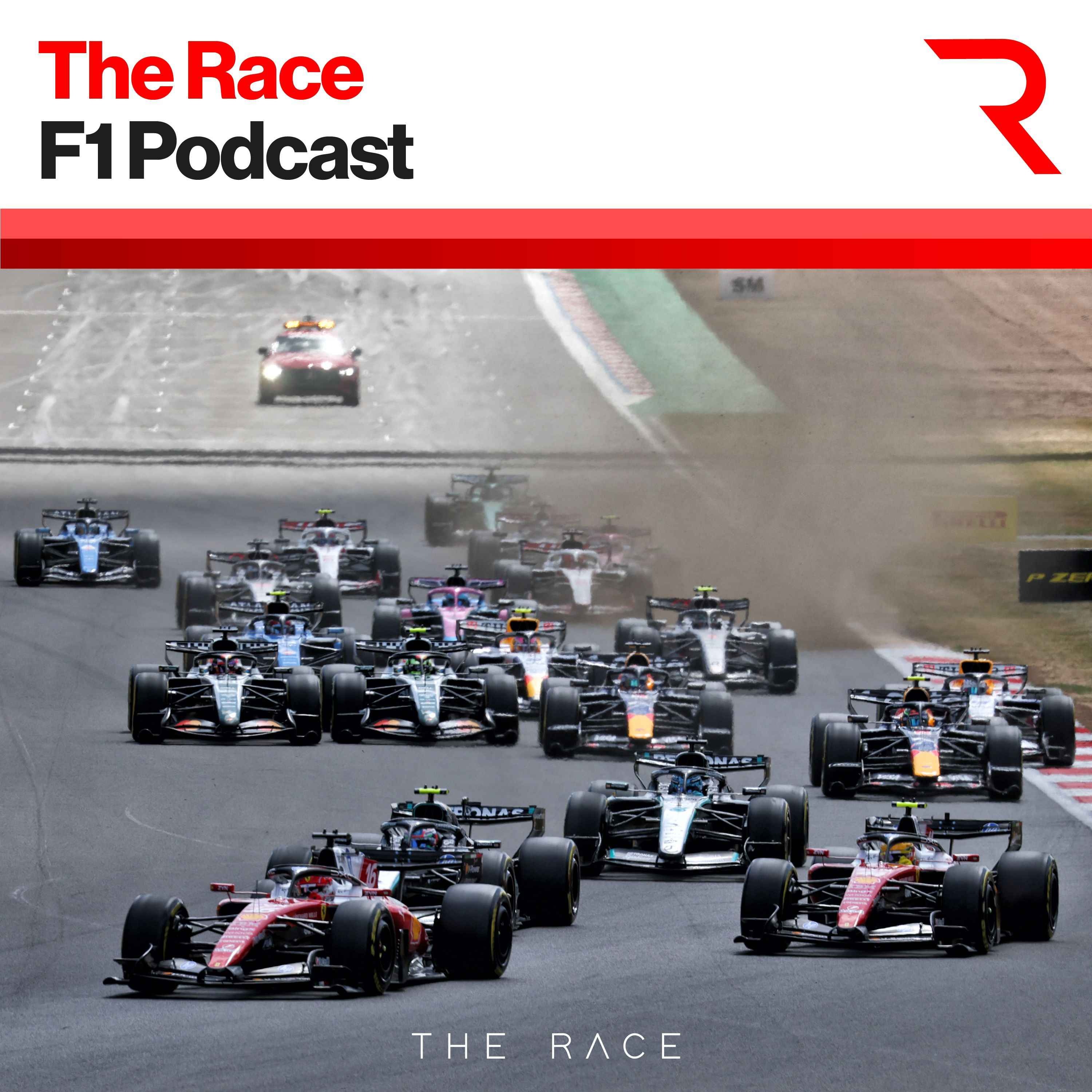
This is Formula 1’s main race in the UK. In this part of the podcast, they’re talking about what happened at the end of that race and why it was confusing.
“Un-lap themselves” means a slower group of cars gets a chance to catch up so they’re no longer one lap behind. It can affect who’s close enough to fight for position when racing resumes.
“Lap cars” are cars that aren’t on the same lap as the leader. The podcast says there’s a rule that can let them catch back up (“un-lap”) during certain race situations, which changes the restart order.
Sporting regulations are the official rules for how the race is run—like when restarts happen and how safety-car situations are managed. They don’t change the car; they control the race process.
The safety car is a special car that comes out to slow everyone down when something unsafe is happening on the track. It controls the restart so the race can finish under fair, orderly conditions.
A lapped car is a car that’s fallen behind the leaders by at least one full lap. During restarts, there are specific rules about when those cars can pass so the race stays fair.
A “one-lap shoot out” is a fan-friendly way to describe a restart or finish where the race is effectively decided over a single lap. It’s not a formal F1 term, but it captures the idea that the outcome could have been settled quickly if the timing of the restart had allowed it.
“Yellow” means there’s a warning on track—usually for an accident or danger ahead. Drivers have to be careful and follow the rules until the situation is cleared.
In F1, “clearing” means making sure a car is moved out of the way so it doesn’t block the track. For a restart, officials want the track to be safe and unobstructed before racing resumes.
The restart sequence is the official step-by-step process for getting the race going again. It’s designed to make sure everyone restarts safely and at the right time.
A red flag means the race is stopped for safety. After the problem is handled, the race can restart using a specific restart procedure instead of continuing normally.
A standing start restart means the cars are stopped before they go again. When the restart happens, they accelerate from a dead stop, which can change how hard it is to get traction and get going quickly.
A gravel trap is a safety zone next to the track made of loose stones. If a car crashes or goes off, the gravel helps slow it down, but it can be hard and slow to get the car back out.
They’re talking about a restart where drivers only race for a couple of laps to finish the event. It can be exciting, but it may not reflect how a normal race would play out.
They’re saying the wrong information was shown because of a computer/software mistake. Since a lot of race operations are automated, that kind of error can cause real confusion during the race.
Automated systems are computer-driven processes that handle parts of race operations. They can make things faster and easier, but if something goes wrong, it can still cause problems.
They’re talking about a finish where, after the race is interrupted, there’s only one lap left to race for positions. It’s meant to make the ending more exciting and decisive.
A red flag is when race officials stop the race right away because it’s not safe to continue. After that, they decide what happens next—like whether and how the race can restart.
The rulebook is the official set of rules that tells teams and officials how the race should be handled. The point being made is whether officials followed the rules exactly or interpreted them more loosely.
The race director is the top official who runs the race behind the scenes. They decide things like when the safety car should come out and how the race should restart.
A green-flag finish means the race ends while cars are racing normally, not slowed down behind the safety car. People like it because the result comes from actual racing, not a controlled pace.
The hosts focus on what Leclerc learned during the Friday evening debrief and how it influenced the weekend’s setup and strategy. The implication is that early data helped him “click” into a winning direction.
A “sprint weekend” is when F1 has an extra, shorter race before the main Grand Prix. It helps teams learn more quickly and adjust the car for the big race.
Fred Visser is a senior Ferrari team leader. Here, he’s explaining that Leclerc’s improvement wasn’t just luck—it was tied to how the car felt and how confident Leclerc was in it.
Lewis Hamilton is one of F1’s most successful drivers. Here he’s talking about how small setup changes can change how the car behaves, and he’s connecting that to what Leclerc was doing.
“Balance” is how the car behaves as a whole—whether the front and rear feel coordinated. If the balance is right, the driver can push harder with confidence.
In F1, “wing” refers to aerodynamic surfaces that generate downforce. Adding wing increases downforce (and usually grip), while removing wing reduces it—both can strongly affect balance, turn-in, and how the car feels under load.
“Diff settings” are changes to how power is shared between the wheels. That affects how the car grips and turns—so it can make the car feel more oversteery or more stable.
“Oversteery” means the car’s back end feels like it wants to swing out more than you expect. Drivers often try to adjust the setup so the car turns predictably instead of getting too loose.
A “comfortable window” is the sweet spot where the car feels stable and easy to drive fast. If the setup puts the car there, the driver can attack the track more consistently.
Sliding means the tires aren’t gripping as they should, so the car doesn’t follow the exact line. Too much sliding makes the car slower because you’re not using traction effectively.
Wheel spin is when the tires start slipping and spinning faster than the car is moving. It’s usually a sign the tires don’t have enough grip, which can make the car slower and heat the tires up.
“Harvesting” here means the car recovers energy instead of wasting it, especially when slowing down. That recovered energy can then be used later to help the car accelerate faster.
It’s about using the car’s limited energy at the right time—especially on straight sections where acceleration matters most. If you waste energy earlier, you can’t use as much later, so you go slower.
Term
quick lap time
Lap time is how long it takes to do one full lap around the track. In racing, even small improvements can add up to noticeably faster laps.
Term
margins can be very, very small
“Margins” here means the differences between cars are tiny. When it’s that close, one small problem can make you lose time fast.
In F1, the “power unit” is the car’s main engine package. It includes the engine and the hybrid energy system that helps the car accelerate and recover energy.
Term
Aduo upgrade
An “upgrade” here means the team brought a new set of parts to improve speed. The point the hosts are making is that it looked promising in qualifying but didn’t fully work in the race.
“Engine runs hot” means the engine and its cooling system are operating at higher-than-ideal temperatures. In F1, that can reduce performance and reliability because heat affects efficiency, power delivery, and how hard the car has to work to stay within temperature limits.
A “small turbo” is the turbocharger on the engine. It helps the engine make more power, and its behavior can change depending on conditions like heat and altitude.
“High altitude” means the track is at a higher elevation. The air is thinner there, which can affect how the engine performs and how hard it has to work.
“Opened the cooling up” means they adjusted the car so it can cool the engine better. It’s like giving the engine more help staying at a safe temperature.
“Aero” is short for aerodynamics. It’s how the car’s shape and wings push the air around to make the car stick to the track and go fast. If the aero isn’t as good, the car can feel less planted and slower.
Teams can send a radio message telling the driver to cool things down. That usually means the engine or turbo is getting too hot, so the driver has to drive in a way that reduces heat.
In F1, some power is limited and has to be used strategically. “Deployment” means when the driver chooses to use that extra power and when to save it for later in the race.
“One-shot qualifying” means you basically get one real chance to set your best lap time. So the car setup and tire/energy use are focused on being as fast as possible right then.
F1 cars have limited extra energy they can use for performance. “0% energy” means the driver used up that allowance by the end of the lap, which is okay in qualifying but not the same as managing energy for a whole race.
Qualifying and the race are different games. Qualifying is about being as fast as possible for one lap, while the race is about staying fast for longer without overheating the car, ruining the tires, or running out of usable energy.
A jump start means the car got moving too early, before the race start signal. In racing, that’s against the rules and can cost you position or lead to a penalty.
The championship lead is who’s ahead in the season points race. The hosts are saying this result helped Hamilton get closer to the top of the standings.
Kimmy Antonelli is a race driver mentioned in this episode. They say he won the sprint race, started from the front (pole), and then had a problem with his front-left area that hurt his result, leaving him 16th.
A sprint race victory refers to winning a shorter, separate race format used in some F1 weekends. It typically awards points and sets the grid for the main Grand Prix, so winning the sprint can strongly influence race strategy and starting position.
Pole position means starting the race from the very front. It’s usually earned by being fastest in qualifying, and it helps because you’re ahead of everyone else at the start.
Term
front left wheel guard
The front left wheel guard is a piece of car bodywork near the front tire. If it breaks, it can mess up how the car handles and can also cause the driver to lose time or retire.
Track limits are the rules about staying within the painted/marked boundary of the track. If you cut corners too much, officials can penalize you because it can help you go faster.
A five-second penalty means the race officials add five seconds to a driver’s time because of a rules break. It’s usually for things like going outside the track boundaries (track limits).
“Mediums” are one of the tire types in F1. They’re designed to be a compromise—good grip, but not as long-lasting as the hardest tires.
Term
maximum offset
“Maximum offset” is about timing pit stops so you come out at the best possible moment compared to the cars around you. Teams do it to try to gain track position when the race situation changes.
Term
wheel shield problem
A “wheel shield” is a piece of car bodywork near the wheel. If it has a problem, it can hurt how the car performs because it changes airflow (and sometimes cooling).
Term
momentum of the championship
This phrase means the team is building confidence and form over multiple races. In F1, that can show up as better strategy and fewer mistakes as the season goes on.
It means the car doesn’t feel as fast when going in a straight line. That can happen if the car doesn’t have enough speed or acceleration at full throttle, often because of how the car is set up or how much air resistance it has.
“Single lap supremacy” refers to being clearly fastest over one qualifying-style lap or one decisive stint segment. In F1 discussions, it highlights a car’s peak performance even if race pace or consistency isn’t as dominant.
A protest is when a team formally challenges what happened in a race. Here, they were considering challenging something, but they decided not to.
Concept
appeal for a review
An appeal for a review means asking race officials to look again at a decision. The hosts are basically saying there may have been talk of that, but it didn’t end up changing anything.
Brand
Total Wolf
This sounds like a transcription error for Toto Wolff, who runs the Mercedes F1 team. The hosts are saying he was looking at things after the race in the usual way teams do.
Term
right review
This is the formal process where a team asks officials to look again at a decision from the race. They usually need strong new proof before anything can be changed.
Stroll is another driver they’re talking about. The hosts say he got penalties, and they connect it to trouble when downshifting (changing to a lower gear).
Downshifting is when you change to a lower gear. "Downshift problems" means the car didn’t shift down the way it should, which can affect how the car drives and may trigger penalties or confusion.
Russell is the driver being tracked in the championship points. The hosts say he’s now 25 points behind Antonelli and that he commented after the race about whether the bad luck has balanced out.
The “final official classification” means the official final race results. Before that’s published, penalties can still be added, which can change who finishes where.
A “one lap penalty” means the driver is punished as if they lost an entire lap. That can move them down the finishing order when the race result is finalized.
Red Bull is the Formula 1 team mentioned here. The hosts are talking about what happened late in the race and whether it was caused by the driver or the car.
Term
late race crash
A “late race crash” is a crash that happens near the end of the race. Because it’s so late, it can strongly affect the final outcome and sometimes brings out the Safety Car.
Verstappen is the driver being discussed. The hosts say he was upset after the race, suggesting something went wrong again—possibly with the car rather than just his driving.
The Belgian Grand Prix is the next Formula 1 race they’re talking about. They’re worried about the rear wing because race circuits punish aero problems quickly.
Gear ratios are how the gearbox is set up to match engine speed to road speed. If they’re “short,” the car may feel quick but won’t reach its full speed on long straights.
“Homologation spec” means the officially approved setup under the F1 rules. The host is saying the overall allowed design is the same, but Mercedes has improved how reliably it works.
Person
Taito Wolff
The host attributes a quote to “Taito Wolff” about the Mercedes update. This is a Mercedes leadership figure commenting on how the changes affect the car.
Term
reliability tweaks
F1 teams often make small fixes to help the car keep working properly. The goal is to avoid breakdowns and keep the car performing well from start to finish.
A fresher engine is one that hasn’t been used as much before. In racing, that usually means it’s less worn out, so it can make stronger performance for longer.
End-of-life degradation means the engine gets less effective as it wears out. As parts age, the engine can lose power or feel less smooth, which slows the car down.
Term
0.05 seconds
In F1, even super-small differences like 0.05 seconds matter a lot. Teams chase tiny improvements everywhere because those fractions can decide who finishes ahead.
Here “mileage” means how much running time or usage they got with the relevant setup. The point is that one team didn’t have the same opportunity as the others, so they couldn’t extract the same benefit.
Term
racing balls camera
They’re talking about a particular TV camera angle used in the broadcast. The point is that, because of where the cameras were positioned, it was hard to clearly see what happened.
LIVE
The Athletic
The race is on and Charles Leclerc hit back after his poor run of form with victory in
the British Grand Prix.
But where did his and Ferrari's unexpected turn of pace come from, and was there any
hope of a win without Anton Nellie hitting trouble while rapidly closing in on the lead?
I'm Ed Straw, and joining me from Silverstone are Josh Sutil and John Noble.
Well a massively eventful race with a controversial finish, it's safe to say.
Josh and unsurprisingly a barrage of questions from the race members club, so we thought
we'd start off with this.
I'm going to merge it all into basically one starting question, but to name check some
of those who threw in questions, Pamela Rudolph, Liam H, Fredrik Schurgen, Njenga, Paul Collins,
Craig Calladine, Richard Thurbin, Philip K Morris, Alex 97, Cam Gigi, Kieran Sharkey,
Edward Graf, Ethan, Jason SPD and Chiv 2103.
Among others, all asked about the end of the race, why it finished under the safety car,
especially considering that message about the race restarting that then seemed to be
rescinded.
It's the worst possible way for a Formula One Grand Prix to end, nobody on earth wants
to see a race end under safety car, and that's exactly what we get.
It seems like it was down to a software error, according to the FAA, that was the official
line.
So it was very, very confusing because we got that message, safety car in this lap on
that 51 of 52, before that was swiftly called off, and we got that weird sort of safety
car deployed message released when obviously the safety car was already out.
So it's a really, really weird one, but it is partly to do with quite an important regulation.
So we know that the lap cars were allowed to un-lap themselves, and that happened, and
they were rejoining the queue.
And then by the regulations, the start is then supposed to happen on the very next lap.
I don't know if anyone has that regulation to hand.
Yeah, it's article B5135B for sporting regulations that basically says once the message, so it's
when the message, once the message lapped cars may now overtake has been sent to all
competitors, the safety car will return to the pits at the end of the following lap.
So basically gives you that timeframe of when the starts supposed to happen.
So it's not immediately, it's the end of the following lap.
And of course, this was the same regulation that was poured over an awful lot after Abu
Dhabi 21.
Yeah, it's a shame, isn't it?
Because it came literally as LeClaire was crossing the start finish line to begin at
51 of 52.
So, yeah, it was a shame, wasn't it?
I mean, it's what nobody wants to see.
It's just the question is, was it avoidable?
Because I think that's the feeling from fans.
It feels like we were robbed of a really great one-lap shoot out there.
I mean, there were scenarios up and down the field and so many exciting things to watch
that we never got to see play out.
Yeah, it's frustrating because people like to see a finish, but the rules do have to be
adhered to.
So in terms of the way it played out, that was correct.
The only question mark, or this, I guess, says two question marks, one is whether it
was possible to have cleared the, cleared the yellow and then given that command, maybe
about, I think about five seconds earlier, if they given that lap, cars can go past.
I think that would have been enough to swing it.
So it was on the lap before because it was really close to the end of the lap.
So maybe it could have been, but I mean, that's, that's hypercritical.
It takes an amount of time.
And I don't think they were particularly slow when it came to clearing for Stappen or anything.
Yeah, from my understanding, I think there was a very brief window on that critical
lap where they were just clearing Max's car and they were within seconds of feeling that
maybe we can get this rolling without the car 100% out of the way.
But that would have, you were kind of them preempting circumstances where if there was
a problem then being in the car, you'd have started the restart sequence without anything
kind of defined and definite.
And then the risk is something then goes wrong.
You've started the procedure to restart the race and then you end up in a worse situation
because if there's an incident that involves a car that hadn't been cleared, we would be
talking about something very different now.
So unfortunately, there are times you've got to follow the rules.
These are the regulations as they are written rules should be followed.
They can't just be broken as you see fit.
And unfortunately, we ended up with a safety car finish in hindsight.
Should they have red flagged it?
If they knew it couldn't finish under the safety car, potentially I'd have been up for a one lap
shootout with a standing start red flag restart would have been just as fantastic.
But it didn't happen.
Yeah, the regulations were properly followed.
It's just a case of do they need to change for the future in scenarios like that?
Should we have just started without a lap in the cars and should the regulation be changed
so that that can happen?
Because in that scenario where it is so time pressured, maybe there should be a scenario
where you can do that and you don't need to get the lap cars out of the way.
Because yeah, that's just the way the rules are written at the moment.
But maybe it's something to look at.
Yeah.
And the thing is there's always something one set of circumstances happens and everyone says,
oh, it should be this.
And then you have a change of rules because there were times when there were
complaints about lap cars being in the way.
Oh, get them out of the way stupid to keep them there.
And then you get, oh, you shouldn't get them out of the way and all of these things.
So there has to be something always review it.
And there are the other the other option is that you could have different rules in place.
But those rules are in place.
You can't change them on the fly.
You absolutely cannot and should not do that.
And remember, this was a safety thing.
You don't want to play fast and loose when there's marshals in the circuit moving cars.
The only other thing I did notice is there was a point they recovered the car very quickly.
But there was a point when it's kind of just behind the wall, but maybe not quite where
it holds for a bit on the little mobile crane thing.
So I don't know if there was a little bit of a delay getting it kind of all the way back
for whatever reason, because the view you had was looking kind of away from it.
So there may have been a very slight delay there.
But, you know, these things are not easy.
I mean, only a very small number of you who are listening will have ever had to clear a racing car
from a gravel trap and it's not the work of a moment.
So those things have to be that they just happen.
Crashes will happen later on.
Yeah, there's no perfect solution because even like with the red flag thing where, you know,
you could red flag it and have a race for two laps.
So we had that in Baku 21, wasn't it?
Where we had that like two lap shootout after the red flag.
And even that's maybe not a perfect solution because when you kind of jumble up the order,
I mean, imagine how much the different race starts to see in this year would play into that.
And you almost a question of is that too artificial?
So yeah, it is a tricky.
I think it's pros and cons to all the different solutions that they could have.
Yeah. And obviously, a lot of this hassle would have been avoided if there wasn't the message
about the restart that safety car was going to be in this lap.
And the FI has said that the safety car in this lap message was displayed erroneously due to software error.
So they need to look at whatever error was made with the software.
Therefore, that's the thing that's caused a lot of complication.
Yeah, a lot of those software, the night errors, a lot of automated systems.
So a lot of things happen these days, they're automated to make things easier rather
than people manually type things down.
This is one of the messages that they get ready.
The messages that are ready to bump into a live TV screen that don't make it.
Some that do.
We see this sometimes with track limits or issues that have kind of recalled.
This automatic systems have done things.
It's not there was no point where someone manually said the safety car is coming in
or had typed it and sent it.
It was an automated system that shouldn't have uploaded on to the live feed, but it did.
So that safety was never coming in.
It was a message that was wrong, not the not the way the race control handled it.
And entirely speculating here, but because it was so marginal at the end of the lap,
I think Piazza was the lead lapped car and he actually started unlapping himself
just before the end of the lap, at which point the safety car and the leader was on the next lap.
So I wonder if it came from that.
It's just if you have something really marginal, that's completely speculative.
But just through how marginal it is.
But yeah, they need to avoid those messages happening at a few of the questions.
There's one from Dan W for you, John.
You're all still upset about Abu Dhabi.
So do you want the one lap race at the end or don't you?
I do want the one lap race.
I would absolutely have loved to have had a one lap race today.
I have a safety car restart for one lap.
I think it would have been amazing.
I would be up for races if there's a safety car period with a set number of laps to go.
It's automatically red flagged to guarantee at least one lap of racing.
I think that would be positive.
And Abu Dhabi still, Abu Dhabi is an opposite scenario because the rules weren't followed.
The lap cars were released.
The race didn't restart at the end of the following lap.
It started the next lap.
So this is about following laps.
So following rules, sorry.
Sometimes you follow rules.
It doesn't play out the way you want it.
Sometimes you don't follow rules and it doesn't play out the way you want it.
This is just a scenario that the procedures were followed.
But you can't argue with that.
Whereas I think Abu Dhabi still leaves a bit of taste for a lot of people
because there were decisions made that they didn't actually follow the letter of the rulebook.
We're based on interpretation and any and all and freedoms within the regulations
for the race director to decide when the safety car comes out,
which weren't really the intention of this very article that's come up today.
Yeah. And Abu Dhabi, I maintain, happened first and foremost because of this desperation
to have a green flag finish.
And yes, they should have that if possible.
But the rules are there for a reason you do work to the rules.
So that's absolutely fine.
And a question from Simon Ems, who says, had the race been red flagged,
especially if Charlotte Clarke hadn't won,
there would have been shatter about how it should have ended under the safety car.
If one of the FI damned if they do and damned if they don't,
is that a problematic thing about modern sports?
Well, I think it kind of is, isn't it?
You know, you do have to have a set of rules.
And sometimes the way things play out might not be the ideal,
but you could only have a functioning sport if you have a set of rules
of how things have to be done.
And yeah, I can imagine a scenario where let's say you did have a one lap from a standing start.
You could have had George Russell jumps into the lead and everyone says,
ah, he didn't deserve to win that race or something bizarre happens.
And he had our jumps to the front.
Everyone says, ah, that's, you know, it's there.
There will always be some complaint.
And I think it's important for everyone to remember,
even though there are things that can be improved,
particularly that erroneous message,
sometimes things just happen on a timeline that's really annoying.
And this was a matter of something in the region,
like one and a half seconds,
I think probably the clerk was into that lap when the message was given.
So just to make it really clear cut five seconds earlier and you get the restart.
That's just what happens with the cutoff.
So and don't, don't forget 21.
That Baku late restart,
Lewis Hamilton lost more points there that ultimately cost him a championship
than what happened in Abu Dhabi.
And that was just because it was a very short restart,
made a mistake at turn one, went down the skate road,
lost a bunch of points that would have made the difference in the end.
So this is the randomness of short restarts.
If you have a one lap or two lap race,
but this is the joy of life sport, unpredictable things happen.
Yeah, it can happen.
And the important thing is it does adhere to what the regs are,
improve them if you can, execute things better, certainly,
but fundamentally that was how it had to happen.
All right, let's move on to the actual race now, Josh.
Charlotte Clerk had been having this really tough time prior to Silverstone.
He struggled quite a bit in the sprint component of the weekend as well.
He was about 0.327 off Hamilton there.
It all just seemed to be struggling.
And then suddenly outqualifies Hamilton and he wins.
And at a track where Ferrari were not expecting to be very good.
So how did all of this happen, particularly Leclerc's turnaround?
It's been 20 months since he won an F1 race, if you can believe that.
It feels like an awful long time.
I'm sure it does for Leclerc as well.
It only feels like a few hours.
Well, yeah, but it's a lifetime in Formula One, isn't it?
20 months and I'm sure there's a great relief for Leclerc.
Well, you mentioned that Friday.
I mean, something happened in that Friday evening debrief
or as Leclerc was pouring over the data there.
He found something.
We're not exactly completely sure what he exactly found,
because at the end of the day, why would he reveal that?
And give either Lewis or anyone else a clue as that performance.
But yeah, he found something and just really seemed to click from there.
It clearly was a benefit to having a bit of a sprint weekend
because you can kind of back-to-back stuff.
You know, you get to change stuff ahead of the actual Grand Prix
and that's what Leclerc did and follow through that change.
I mean, he put it that basically he had two approaches over the last few weekends
and for this weekend, he could either follow what Hamilton was doing
and try and drive the car in a very similar way to what Lewis has been doing
and try and get the results that Hamilton's been able to get,
or he could trust his own style,
his more aggressive by his own admission driving style,
and try and bring the Ferrari more towards his style.
And that's the route that he's gone down this weekend.
It's the route that's worked for him here in spectacular fashion,
really, really strong in the race today.
A clear step ahead of Hamilton in race conditions.
And yeah, it all appears to be that choice made on Friday.
He wants to validate it for future rounds still,
but it's a great vindication and I heard from Ferrari team boss Fred Visser.
And yeah, he thought that it was all a confidence thing.
And basically whatever Leclerc found during this weekend has just clicked
and that just has a massive snowball effect into what we saw today.
Yeah, and it doesn't necessarily take much.
I remember after the race in Austria, Leclerc was really miserable
and basically saying he was terrible.
And yes, he was slower, but he wasn't Eons slower, should we say.
So just a few little changes plus the confidence that confers
can make a huge difference.
Actually, the most revealing thing in the press conference,
Lewis Hamilton talked about having said that Charles Leclerc went up a bit on balance.
He said he added a bit more wing.
Whereas I felt Leclerc was a bit oversteery with the diff settings that we had.
And so I took out wing.
So that's sort of pointing a little bit of what Leclerc's been doing.
And it's all just about tuning it to what works for him as well.
But it certainly worked for him.
And it's unusual that it kind of happened over nice, I think.
That was the really, really striking thing.
I think there's also kind of a reality we're finding with these cars that
there's like exponential gains that can come from very small improvements.
And I think with deployment so important and critical to lap time,
that if you can get the car into a comfortable window where it's well balanced,
you're happy to drive it.
It's not sliding.
You're not having a wheel spin.
Suddenly, you're harvesting more.
You're not using as much energy to get up to speed.
You have more energy down the straights,
which all translates into quick lap time.
And the margins can be very, very small.
So you have one bit of wheel spin that overheats your tires,
and then suddenly you've lost energy on the straight.
You're slower.
Your tires have got hotter.
You're sliding more again after that.
If more energy is lost and you see these spirals,
and I think this is one of the elements that we've seen with cars
is just got the car in a comfortable place and push.
Suddenly everything clicks.
So these cars sometimes can be all or nothing.
And Ferrari as well.
The form here was absolutely formidable, wasn't it?
Which is remarkable.
Now, I thought they were still a little bit slower in the race,
but they were way closer than we expected.
And Ferrari indeed expected.
They were talking about six seconds off.
So it's interesting what it's told us about.
Six tenths.
Six tenths, did I say six seconds?
Yeah, that would have been very depressing for them
if they'd come in and expected to be six seconds off.
It would have been a good story, though.
That's the sweet spot for I like cars that are six seconds or more off.
They're my kind of F1 cars.
But yeah, they expected to be slower and they're a good race.
And everyone else expected them to, because they were good reasons.
But it did, John, show us that some of what we saw in Austria, rather,
was slightly misleading.
And there were certain other things that were making improvements
that had been made be more hidden, weren't they?
Yeah, I think it's highlighted how compromised
they were with the power unit in Austria.
There's been so much hype around the Aduo upgrade,
which was Freud played down before the weekend.
Then they've been quick and qualifying,
but it hadn't come together in the race.
But I think they were...
We know their engine runs hot.
We know they've got a small turbo.
So if you're running in a hot race at high altitude,
you are going to be stressed like anything.
They've opened the cooling up in Austria,
which suggested they were in difficulties.
So the aero wasn't as good.
So the turbo was running hot.
We remember that cooling message to Lewis Hamilton.
And I think everything fell there.
Whereas here, much cooler,
Aduo seems to have let them just stretch their legs a little bit.
I think Mercedes was still better on deployment overall.
And on a single lap pace, soft to tires, one-shot qualifying,
only needing to finish the lap with 0% energy
rather than maintaining it and getting into a rhythm
means very different demands qualifying to race.
But I think we're in a stronger place here than they anticipated it.
Stronger place than Mercedes anticipated.
But I think Mercedes still had the edge
and I still have no doubts if the race had played out normally,
it was, you know, Kimmy was going to win.
And Lewis Hamilton ended up third in the Grand Prix.
It was one of those weekends that started
Superby on Friday with Sprint Pole.
He led the first part of the sprint,
but always was going to slip behind Antonelli,
I think with a little pace advantage that Antonelli had.
But second in the sprint was good,
but then got out qualified by Leclerc,
then had the third place in the Grand Prix,
which should have been second,
but he also had the jump start in the Josh.
So he seemed a little bit disappointed
and felt that things had got away from him a little bit.
But ultimately, he's also come out of this race
closer to the championship lead.
He's 32 points behind Antonelli now.
So while it's a bit of a mixed bag for Hamilton,
still a relatively positive weekend,
but doubtlessly be looking and thinking,
yeah, this was one I could have won.
Yeah, for sure.
I mean, look, he'd always would have known
that Leclerc is going to come back at some point.
You know, Leclerc had a few off weekends,
but Hamilton would have known
Leclerc is going to come back to the four at some point,
and it happened to be this weekend.
So yeah, I don't think Hamilton needs to be too worried.
I think he can be annoyed not to have been second,
but I'm not sure that the win was ever really on the cards.
Leclerc seemed to have the pace edge in the race at least.
So yeah, I think overall,
Hamilton can still be pleased with this.
I mean, if this is a bad weekend for Hamilton,
then it's really not that bad.
So yeah, I think he can shrug this one off and move on
and try and tackle the new and improved Leclerc.
We'll be back in a moment to talk about the man
who nearly won the race.
To make, to move, to move through, to explore.
It's your morning to share, your weekend to shape,
to cook, to soak, to listen, to wait.
It's your body to rest, to nourish, to grow.
It's your mind, you know?
It's your place, your country, your life,
to love, to rise, to dream, to change.
It's your world as much as anyone's.
It's your world to understand.
The New York Times.
Find out more at nytimes.com slash your world.
All right, John, let's talk about Kimmy Antonelli now,
sprint race victory, pole position.
It was looking great in the race,
even though he wasn't leading.
He was closing in on the clerk,
then that front left wheel guard broke
and there seemed to be other problems.
Ended up 16th in the final classification
after that five-second penalty for track limits.
Any doubt he'd have won?
No. I think, as you showed on Saturday in the sprint,
that the Mercedes is more consistent over the race,
better time management, energy.
It could just stay there by the time.
Find the right way to make an easy pass.
In that phase of the race after, Leclerc had pitted,
wasn't really making up any ground.
So Kimmy's pace on the mediums was as strong as Leclerc's on the hards.
So the gap was fairly stationary.
So you must say, there's no point in pitting.
Let's just keep going.
Because if the safety car had come out at any point,
then it would have stayed in the lead.
And then she went for the absolute maximum offset,
which would have given them advantage,
which would have hunted down Leclerc and come through.
I mean, you can argue Woody had done it before that safety car came out.
But that's a very much an if-if-if moment,
if he hadn't had the wheel shield problem.
But pace-wise, I think it was his.
But this is the perfect evidence of the momentum of the championship.
Sometimes it's out of your control that a couple of races ago,
nothing was stopping Kimmy Antonelli.
He was just rolling on.
Then you've had Barcelona.
You've had Austria.
You've had here.
And suddenly those gaps are looking unassailable maybe a couple of weeks ago.
Definitely aren't now.
You'd still be worried if you're George Russell,
even though he's come away with a really good result and more points.
And it feels like I'm repeating myself again,
because that's what we said on previous weekends.
Because most worrying of all, I mean,
Ed, would you say that the gap between the two Mercedes drivers
hasn't really been this big since, I guess, Monaco,
I'd probably say, like this was the most decisive pace advantage
maybe Antonelli has had since then.
So not sure it was a great weekend for Russell,
even though he gained those points.
He'll feel probably that he's had a bit of the good luck now
after having a bit of the bad luck earlier in the season.
But overall, he just seemed to be struggling,
wasn't he, was complaining of a straight line deficit.
Yeah, it feels a little bit like Spain in a way,
whereby he's made a gain because Antonelli's hit trouble.
But actually, he's not entirely delighted.
At least in Spain, he had that single lap supremacy over Antonelli.
And Antonelli was a bit quicker in the race.
But yeah, here it's been frustrating for us.
I think there's some evidence of a slight deficit,
but it doesn't explain it all.
Antonelli was the quicker Mercedes driver.
That's just a simple fact here.
And that's been happening far too often for George Russell, ultimately.
But ultimately, we are continuing to see potentially Antonelli
just emerging as the Grand Prix driver.
We expect, well, he already has become the Grand Prix driver.
To an extent, we expect he will become.
The only reason he hasn't is that there's the expectation
he can kind of be the Stappen level.
And he's making those big strides.
It's just it's going to take a little bit longer
to round those rough edges off.
And obviously, the track limits stuff feel a bit sympathy for him.
There was some rumbling about a protest.
Wasn't there an appeal for a review rather about that?
But I presume nothing's come of that.
Yeah, they've decided not to go for it, basically.
It was because the Total Wolf sort of said
that they were maybe looking at it in his post-race media session.
But that was more just kind of their reviewing stuff
as they do after every race.
And they basically decided that it wasn't going to be worth it.
Because obviously, you have to do a right review.
You need sort of new and significant evidence.
And the stewards document had already said
that they knew Antonelli had this car problem.
They'd understood that.
But Antonelli still left the track without justifiable reasons.
So I think Mercedes just felt like there wasn't a case to argue there.
So try to accept the loss of two points,
which could prove crucial later in the year.
Yeah, it does happen.
I think Stroll also got one of those penalties as well,
maybe more than one.
But he had downshift problems that caused,
I think I heard on the radio, at least one of those
was caused by a weird downshift.
So it's just one of those things, I think,
that sometimes happens.
But yeah, Russell now 25 points behind Antonelli.
And that's a good numerical outcome for him.
And Russell did say after the race,
that I think he's asked something along the lines of,
oh, do you feel all the bad luckers evened up?
He said, well, I don't know if completely,
but I think he said something like 10 to 25 points
feels like the right sort of gap.
So he'll at least feel like he's sort of back into it
and or back within striking range.
Because I always think if you're basically one race wins worth
in that range, then it's not level,
but it's pretty close within that swing.
So he can be fairly happy about that.
And I should just correct myself actually,
I said Antonelli was 16th,
but he appears to have moved up to 15th.
The final official classification's not out,
but Sainte seems to have a one lap penalty
for a safety car infringement that's just dropped in.
So that makes no difference for Antonelli,
but I guess 15th is marginally better than 16th,
even though it's a whole bunch of nothing
when it comes to points.
Let's talk about Red Bull now, Josh,
for stepping up that late race crash.
Pretty unusual to see him doing that.
I say that, but we did have that in qualifying last week as well.
Clearly not happy with the car.
Was that driver error failure somewhere in between?
Another failure which left the Verstappen
quite angry actually after the race.
It was really irritated by these issues.
Thought they were super dangerous.
I think any driver who kind of has their car
throw them off into the wall at such high speed,
whether it be in Austria or here,
is never going to be very happy with that.
It's pretty much number one on the list of things
drivers don't want to have to not be able to trust the car.
So yeah, he was very irritated,
felt like these issues shouldn't be happening.
It's perhaps a bit more understandable
when it's stuff like the engine being Red Bull's first engine,
but it feels like these are the kind of basics
that this team should be getting right
and isn't at the moment.
So yeah, he was definitely very annoyed,
sort of settled, take a few times, a few days to reset.
Because yeah, I'd be worried if for Red Bull,
if Verstappen turned up in the same mood at Spa,
because yeah, like I say, he was really irritated.
Think, John, you heard from his boss, didn't you?
So what did he have to say?
Yeah, so the issue here was that the wing hadn't fully reset.
Obviously, I've got this whatever we call it,
the upside down wing, the Macarena wing, flip-flop wing.
I don't know what they've got.
It's got a universal phrase that we know what we're talking about.
But it basically rotates around.
It hadn't reset properly, which means not enough downforce,
which pitched him off because you've
got a massive aero imbalance.
In Austria, it was about the airfoil hadn't reattached properly.
So the wing was in the right position,
just the airfoil hadn't reattached as he turned in,
and that's what pitched him off there.
But it's the same problem that I think these wings
that Red Bull and Ferrari are using
just have a sort of longer process to reset.
And there's a different mechanism
where they rotate around to come back
to the corner mode position.
Like I said, we will do whatever it takes to be 100% certain
it will be safe for the Belgian Grand Prix,
which is the next race and is a circuit.
You don't really want any rear wing problems at.
I did ask him, does that mean you would consider going back
to the concept you start the season with?
Because this Macarena wing only appeared from the Miami Grand Prix.
It's been worked on since last year, but only appeared there.
He said, we will do whatever it takes.
So basically, I think it's an open book at the moment.
They will analyze it in the factory.
They've only just got the car back to the garage post-race.
There'll be some analysis going on be work this week.
And I wouldn't be surprised if they do some back-to-back tests
maybe in Belgium, just to see how things are going.
Because I think as you mentioned,
if you're a racing driver and you need to find the last thousands,
you need to be absolutely 100% confident
that your car is doing what you're expected to do.
You can't go into corners going,
I wonder if my wings reset properly or give it some caution
or just lose.
Let's just cost ourselves a tenth of a second every corner
just while we make sure it doesn't happen in Formula One.
So they definitely need to fix it.
And Isaac Hadja had a fifth place, which is a nice result on paper,
but it was still last of the big teams who had clear races.
Because obviously, Piastro had troubles.
We'll talk about that later.
And obviously, Antonelli dropped back in for Stappen, crashed.
But see that qualified for Stappen,
even though Stappen was troubled.
He can take something from that,
although the sprint was a bit disappointing.
We had our terrible start and ended up finishing.
Ninth couldn't quite get past Liam Lawson.
But let's talk about McLaren now, John.
Relatively flat weekend.
Norris is fourth in the sprint.
And third, Norris is fourth in the Grand Prix.
And third in the sprint.
Decent results for the car.
But there was an interesting story.
You ran on the race earlier in the weekend
about another chapter in the trivials
of being a customer team rather than a works team from McLaren.
So what's going on there?
Yeah, I think this weekend,
I think one of the more uncompetitive weekends
in terms of pace to the front.
Obviously, the results weren't too bad
if you just looked at them in the pure light of day.
And they've had worse races this year.
China, for example, they didn't even start.
So results was not bad, pace-wise it was.
But I think it's a combination of lots of factors
that have come together.
Some inside their own hands,
they're out of sync of upgrades,
which Andrea Stella thinks is number one.
It seems that people bring it up right now,
you get three tenths of a second.
So that explains some of their seventh tenth deficit.
They've got a straight-on speed problem,
which is a combination of a very draggy car.
They haven't got a Macarena wing.
They're trying to get one as soon as possible,
but they haven't got it yet.
But gear ratios, we know they're short,
so they're not as strong on the straights.
Deployment, they're not as optimized as Mercedes.
It was windy here and that Macarena doesn't seem
to like unstable conditions.
And then you've got the Mercedes factor,
and there's just a tiny element of,
they didn't have access to the new,
we call it new spec Mercedes.
It's the same spec,
so it's the same homologation spec as before,
but Mercedes has made some reliability improvements.
Taito Wolff said in Austria,
it gives a bit more spiciness.
For what I understand,
it's probably worth 0.05 seconds in terms of,
just the way you can run it a bit more aggressively,
confidently, because you've got these reliability tweaks.
It's a fresher engine,
so it doesn't have an end-of-life degradation.
So it doesn't sound like a lot,
but F1's all about these 0.05 seconds in all fronts.
So you add in upgrade step,
which Macarena's bringing around hungry time,
there should be something.
Better deployment, fresher engine,
trap that's a bit better suited
to the car's strengths and weaknesses,
and you can see that gap coming down a lot.
But yeah, I think there's just a sense of frustration
at the pow-y, and especially when they found the Alpine,
and Williams had access to it this weekend,
and they didn't, so it's still mileage.
And then I think they were just slightly,
I mean, I'm dressed, I'd say they were surprised,
but probably a bit annoyed
when they discovered this Mercedes qualifying trick as well,
so it showed the works team were working on
some fantastic genius ideas,
just to push the envelope,
but it made clear that not all the information Mercedes has
gets passed on to its customer teams.
Oscar Piastri had a tricky race.
Not many people will have actually seen what happened.
They'll have seen the front wing damage he had,
but I'm not sure it turned out,
but he basically got squeezed between the racing balls
on the first lap.
It was actually really hard to see,
because I was jumping around the on-balls to try and see it,
and Piastri was on the rearward facing on-board,
which is always annoying,
unless you happen to want to see something behind.
And because of the way they were aligned,
you couldn't see his car on the racing balls camera,
so you could jump onto a Bortoletto
and sort of see what happened.
And it looked a little, it's really hard to tell,
but he was on the middle,
Lindblad was on the right, Lawson was on the left.
Lawson sort of seemed to come a bit over to the right.
I'm not sure if that caused the contact.
It's really hard to tell,
but there was some contact,
and that's what Undid Piastri and he ended up finishing 11th.
So that fills in the gaps,
if you were wondering what was happening there.
But speaking of racing balls, Josh,
12 and what we like to call class B,
second consecutive race, they've done that.
No team orders, or rather,
second consecutive Grand Prix, I should say, as well,
because they did it in the sprint race as well.
So third consecutive race,
good old sprint race technicalities,
they're getting in the way.
No team orders can obviously this time at least,
but Liam Lawson was six, Arvid Lindblad was seventh,
just a point behind Alpine now in that battle for fifth.
So confirmation this car's the class of the midfield now.
I'd say so right now.
I mean, although both drivers weren't quite happy,
I mean, Arvid Lindblad wasn't pleased
to be having some deployment issues on the first lap.
He felt that cost him.
I mean, drivers are always like that.
You're never going to want to finish behind your teammate.
So even though it's a great first home race for Lindblad,
I got the sense that he felt like he maybe could have beat Lawson
if he didn't lose that track position at the start.
And he was very gutted that he didn't get to do, I guess.
What would have been his first late race sort of safety car restart,
at least as short as that in F1.
But yeah, it seems like racing balls
are now the class of the midfield right now
because Alpine just seemed to have got a little bit lost.
Racing balls are a point now behind them in the championship.
So see if that carries on.
And to spiral, there's no reason for it not to
because I think they've done a really nice job developing that car.
Not always seen that in the past of that team,
but this year they seem to have put bits on the car
and despite the fairly small size of the team
made actually really solid, consistent progress with that car.
And they've got two drivers who at the moment are making good use of it.
Let's talk about Audi now, John.
You said you were surprised about how these poor Steve points last week,
but Gabriel Bortoletto ended up eight this time.
It was actually quite a similar race in terms of where he ended up to Austria.
But with three of the big guns hitting trouble,
that saved him a disappointment of 11th and added up to P8.
Yeah, I think it's a sign of general progress that the week has been derailed by,
either did not start or starts that did not work
because they just dropped to the back of the field.
So they started ticking all those boxes.
I said to him in the pen this evening,
I said, does it feel like a lifetime since Melbourne
where they scored two points?
That was it.
They said it feels like two lifetimes just feel so long ago.
But I think it's just the case of them chipping away.
We know the car itself, the chassis itself is quite strong.
Mattia Bonotto has always talked about it being potentially top four, top five chassis.
So in the corners, it's great.
We know the power unit isn't fantastic,
but they're working improving it, trying to get rid of the drivability.
It's too peaky, which doesn't help with deployment.
So there are certain characteristics.
They've got that power unit that aren't really ideal for this rule set.
Now they've understood them,
but it's a new team, new organization pushing on, just chipping away.
But I think they will be very happy to have got some points.
Because I think, I said recently,
it's just unbelievable when you look at the points
where Aston Martin are before this weekend
and where Audi are before this weekend
to think those two teams were just one point apart.
And of course, Nick Alkenberg retired with a hydraulic problem during the race.
Alpine ended up with the final two points positions with Colopinto out of Gasly.
They swapped positions thanks to, I think,
Colopinto got the VSC pit stop, didn't they?
And that allowed them to jump out.
Actually, their race pace was very, very similar.
They did have to think a little bit of a rub on the first lap at Brooklands
with each other, but some hard fought points for them.
And good for Colopinto in particular,
to have the boost of a few more points.
And then your whole Scopiastry ended up 11th with Oli Berman,
12th once Sainz had that penalty.
As always, we're going to finish off with some rapid fire questions
from the Race Members Club.
If you're interested in joining the Race Members Club,
getting question-asking privileges and all the other bonus content
that you get from us, click the link in the episode description
or head to Patreon and search for the race.
The first question for you, John, comes from Motorsport Mike.
Could Charlotte Clerk be in this title fight or is he too far back?
Now, I think it's quite open, actually,
because we've seen a fragile Mercedes that is suffering reliability.
We've seen the PU problems, battery problems, obviously an issue today.
So they're not perfect.
The pace looks stronger than it was in Austria,
but we understand the compromise is now.
So I think we're still in a development race.
We still need to see where these cars shake up.
We've got a low downforce, low drag spark coming up,
which we know isn't for our as strong point,
but maybe they'll ditch that exhaust wing, for example.
Maybe they'll bring out some low drag profiles,
because it's not been done yet.
Here is a place where a previous generation of cars
without straight-line mode, you would be running monster-style wings.
We don't see it now because of straight mode.
But Andrea Stella mentioned tonight
that you maybe sometimes will push the boundaries a little bit in spark.
So I think this championship is wide open.
We've seen we've answered any that points can swing very, very quickly.
Nothing's done yet.
Next question from Thorough in Gunnison that I'll take.
Why does it feel like I'm George Russell's only fan,
even during his own home weekend at Silverstone?
It feels like his only real crime
is just trying a little bit too hard to be liked.
This one's a really hard question to answer,
because obviously the impression we get of the drivers
is very different than the wider world does,
just through the opportunities we get with it.
So it's really hard to tell, because he can be quite vocal, Russell can't he?
So maybe people feel he's a bit lecturing, if you like,
and he likes to, I mean, he's GPDA director, isn't he?
So that's part of his job as well.
So it's really hard to tell.
Maybe he doesn't have the most instantly
social media affable character,
but I've always found him good to deal with and honest and the like.
So it probably those of you listening
are actually better placed to judge that than I am.
I don't know if either of you have a particular feel on this,
but I also always think that drivers,
when they're still sort of building up their career,
tend to be like less than they maybe should do,
because people don't have so much time to get to understand what they're about.
I think there's no better driver if you've got a technical question
to try to understand something, some complexity,
some aspect of driving or racing or what the cars are doing
or how cars are behaving.
There's no more one better, more friendly,
willing to assist and help and talk you through it
if you don't understand things than George.
I think he's absolutely fantastic.
I can understand why some people don't like him,
but I can understand why some people do like him and do follow him,
but he's a very fast racing driver.
I find him a pleasure to work with and has helped me out no end of times.
I remember a conversation in Bahrain that we walked across the paddock
from the Mercedes hospitality unit to the pits,
which was literally only 25 seconds.
And at that time he explained to me the entire politics,
controversy, background, an issue about race starts,
and the entire political picture in those 25 seconds,
which I think for a driver just to sum it all up in perfect bite size sense
so I can understand it was fantastic.
I think he's an unfortunate position because if you look at people
are looking for a home driver to support this weekend,
you've got London Horace who is really good at marketing and social media
and branding and is really switched on with that.
So he's a very popular driver.
At the other end of the scale, you've got Hamilton with all the experience and history.
So you've got like really strong competition there in terms of a British driver for the home crowd.
So it's just difficult to stand out really in that market.
He's up against some very tough competition,
but I feel like he's one of those drivers who'll probably get more respect as the years go on.
And certainly with his good public speaking,
I could see him in that kind of role in the future,
maybe an FIA president of the 2040s and he'll find to get his juice then.
Interesting prediction, Josh.
But it will finally get some respect, maybe.
Yeah, he always seems to be, from what I've seen, good with fans
and people who run into him and gives his time for things.
I mean, others may have had different experiences,
but it's always difficult because there's so many caricatures of the senior drivers.
And I have to say with multiple drivers,
the version I see talked about on say social media
is so different to what I've seen.
I almost don't know where it comes from.
And I understand why that happens, that sort of part of it.
But ultimately, for whatever reason,
maybe he isn't quite as engaging with people for one reason or another,
but give it five years and he might have won a world championship and things will change.
So yeah, I think everybody listening probably has better place to judge.
I'd be interested to see the comments in particular from the race members club on that.
Josh, a question from Aaron.
How poor would Ferrari's strategy look if it wasn't for Antonelli's mechanical issues
and the Verstappen induced safety car?
I'm not sure about this one.
I felt like the Ferrari strategy wasn't too,
but I don't understand what they were trying to do today.
It's always going to be difficult to beat a car with better pace like Antonelli's Mercedes.
They obviously risked being undercut as well if they didn't pit
because that Antonelli's Mercedes had so much pace.
So I got what they were doing.
I didn't feel like this was a massive misstep.
And we're only a couple of races ago from Barcelona,
where that Ferrari's strategy was really top notch and working really well.
So I totally get that they got a bit of a reputation for bad strategies,
but I wouldn't file that one under that column for me.
John, question for you from Pixel Rip.
Is the Red Bull ICE the not so secret source behind racing balls midfield dominance?
Not entirely. I think the Red Bull power unit is still lacking.
I think the ICE is on a par with Mercedes.
You can debate whether it's 2% ahead of Mercedes.
I've seen some figures across the first races,
and it's not ahead everywhere, but some places it is ahead.
But these power units are quite complex and involve a lot of things,
which doesn't necessarily be strong in all tracks.
And I think here it was difficult, which is why Red Bull slipped back a bit.
But I also think the racing bull's chassis is very strong.
It's very consistent.
They seem to seem to be emerging a bit like they're like class B's Mercedes,
in the fact that they seem to be quick everywhere,
that we see at the front that Mercedes is a consistent,
that no matter what track it is, they're fast.
And then behind them, it's rotating between the Clare and Ferrari and Red Bull,
depending on upgrades, track characteristics, other elements.
And now it seems racing bull's is leading that kind of the Mercedes class B,
in terms of being consistent.
And then others are chipping away at them, depending on how the season's going.
Development has started off quite strong.
Alpine's had its little bit of run, maybe Audi will get up there.
But I think at the moment, it's just chipping consistently.
Two good drivers, decent chassis, decent power unit.
Everything is working together with a very strong team, very engineering focused,
just just gelling, basically.
And as we said before, these F126 regulations,
no better way of when everything's gelling together, the performance flies.
Next question from Chris Parrott.
Nigel Mantzel gets a hard time for his outlandish claims about how much the British crowd
was worth to him in terms of lap time.
But home field advantage is a thing in sports,
and the drivers do seem to find something extra for their home crowds.
So what is it that they are finding?
Is it measurable in terms of lap time?
Yeah, it's certainly not measurable, because you don't change the laws of physics.
But there can be an effect, and it will vary, I think, from person to person.
I think when Mantzel made those claims, I mean, maybe the numbers are a bit exaggerated,
but I do think genuinely Nigel Mantzel felt he was pushed on.
We know Lewis Hamilton does feel, carry quite heavily, actually,
the obligation to be at his best at Silverstone,
because everybody's, well, certainly there's a long time where everyone's paid to see him.
There's probably 16,000 people in the London Oris stand who would claim that they were there.
So London Oris, obviously, there's a few other home drivers who are sharing the attention.
But it does have an impact.
Now, the home field thing, I think there could be a more powerful effect, historically,
when you'd have less experience of the tracks, less data, less simulator time, etc.
So sometimes when you go to your home track, you'd have raced on it, growing up in racing,
and you might know a few of the tricks a little bit better, that can sometimes be real.
But it's not like today, in some sports, there are specific conditional things,
and there are things you can sometimes do in certain sports that play to the strengths of
your team in particular, etc, etc, etc.
But it can also have a negative effect, because if you carry that weight of expectation too much,
you think, oh, I've got to deliver, because all these people are here to see me.
It can actually make you just sort of tighten up a bit.
So it can have an effect.
But I think for the most part, it's relatively neutral, because you could look at Lewis Hamilton's
success at Silverstone, one there so many times.
But equally, he's very often been in a car that can challenge for wins there.
And it's a track where he goes well.
And it just so happens that is the homegrown pre-track.
So is it because that track suits him and he's just particularly good at it?
Is it because he feels the obligation to do well there?
There's all sorts of reasons you can't untangle.
But one thing that's the case is it doesn't change how quickly the car can hypothetically,
or theoretically even actually, because you could, I guess,
if you knew enough parameters, work out what the peak possible lap time was.
It doesn't change those numbers or the laws of physics.
But different drivers react in different ways.
So there is something real.
I just always find the way Mantle puts it with these outlandish claims
about how much it's worth, always quite funny.
But equally, I think he says it out of sincerity and through a genuine love of the fans,
which many of the home drivers at all the races around the world do have.
Right, a question for you, Josh, from Daniel Baudette.
The return to more energy and battery-dominated racing this week
really highlighted the fact that we still don't have any info on battery usage during races.
And if anything, it seems to have gone backwards,
as I noticed several on-boards without the recharge deploy graphics.
Where are we at with including more battery info in the broadcast?
And we had a similar question from EM.
Yeah, Daniel and EM make great points.
I think that is exactly what we're lacking.
It's a shame because somebody can blast past on the way to cops
and then just get blown back on the way back to stow.
It kind of makes it more artificial and hard to read the race than it needs to be,
even if we had those battery graphics.
But I think it's just a very hard thing for the broadcast to have in real time and to do it effectively.
So yeah, I don't really have a proper answer as why we don't have them.
But yeah, I share your frustration, but we don't have them because it makes the races,
I think, maybe less enjoyable than they would be if we could properly see
who is deploying when and how much battery.
We'd probably know then more what is a real overtaker guess
and what is just someone using all that battery,
whether or never they're going to get repast a few corners later.
Yeah, I think it's pretty inexcusable, really.
Or at a time when Formula One is constantly talking about expansion in the United States,
which has been at the vanguard of sports broadcasting.
American sports fans are used to a lot of data stuff appearing on the screens.
I just think it's just baffling that there's no desire to make this there,
so it can be better understood.
I can only assume it's the usual thing,
just not being genuinely confident in the product.
I think it's a real shame.
All right, question from Kieran Sharky-John.
Random question about the LEGO race.
Why does FI President Mohammed Ben-Salem have to get involved
and how is the driver's relationship with him?
It has seemed to have gotten better.
And what has been the reaction since they've removed term limits?
Oh, term limits.
I thought it's a term limit.
I thought, is that why they all decided to cut across the gravel
and ended up stuck in there?
Yeah, it was interesting.
I mean, I think Ben-Salem does like being friends with the drivers.
He's obviously hanging around in the pit lane,
in the paddock afterwards.
So I think it was interesting.
I mean, the LEGO race was a bit of fun, really.
I know there were big stories over it,
and would Lewis take part or did not take part?
I thought in the end, the LEGO race,
I think it's a bit like one of those nights that randomly happened,
and you go out with some friends to a restaurant,
and it's absolutely brilliant,
and it's the best night you've ever had.
And then a year later, you try and recreate it,
and it's not quite as good again.
And I think Miami, when they had that big LEGO race,
was absolutely fantastic,
because it was just random chaos, cars breaking apart,
drivers loving it.
Just that it all worked.
And I think they tried to recreate it in a different way,
and it didn't quite grab as much as it was, unfortunately.
Some of it was quite funny,
but it didn't have that bite, I think, of Miami,
and just this, what are we seeing for the first time?
Because it was almost overhyped.
So yeah, I think Ben-Salem just tried to join in the fun today.
I'm not sure who won.
I didn't see enough of the LEGO race towards the end.
I'm not sure who won it today.
I think Fernando Alonso.
I think he won it.
That will be coming up in the...
I'm sure he will make reference to that over the next few races
while he waits for his Aston Martin
about how he's the best LEGO driver in the world.
In terms of turn limits, I think Ben-Salem talked today
that, and he's a repeated thing,
that the turn limit change needs to be voted by the clubs.
There are 255 clubs that make up all these systems in the FIA.
They voted for it.
They approved it.
And if they're in favour of it, then why not?
Yeah, that's how the system works.
Unfortunately, I must say, just as a general philosophy,
I think turn limits are quite a good idea.
But again, I'm not an FIA member club.
So I don't have any say in the matter.
All right, question from Mark Hewitt.
How hard is it to make form predictions this year
as the prediction from the race was for I would struggle at Silverstone?
And here we are. They've won the race.
Yes, that was our expectation,
but it's for I's expectation and everyone else's as well.
And I think it's brilliant.
You want it to be hard to make predictions, don't you?
Predictions, I always say, they're your model.
And it's good to have a model of expectations
because that's your understanding of things.
You effectively race weekend as an experiment.
So you compare the results against your expectations.
What's changed?
What does that tell?
What does that teach us?
What more could we put on our knowledge bucket from it?
So I think it's brilliant.
And it's because it shows how volatile things are
to come back to that question about the championship.
It is still volatile.
Things are still swinging around
and things can still happen to surprise us all,
which I think is absolutely brilliant, isn't it?
So yeah, predictions are a tricky business,
but they do serve a purpose.
It's more about being that marker for expectation
that you can then use to try and understand
a little bit more down the line.
Right, Josh, your question from Anthony Rulimo.
It seems that Max Verstappen is often complaining
about the downshifts on the radio.
Why might that be?
Are others doing it as well?
Or is the TV broadcast just picking his complaints up more often?
He certainly complains about it more than all, I would say.
Yes, and it's also quite entertaining whenever he does it.
And his radio messages are probably in the top 5%
most entertaining of all the drivers.
And I think that's why he is picked on a little bit
from that perspective.
But I'm sure Alonso would say the same thing as well,
because his messages are also entertaining
and we often hear those.
Yeah, I mean, he wasn't the only one complaining
about downshifts.
He was one of many drivers complaining of that.
So I think it's fair enough for the broadcast
to broadcast them.
Yeah, he wasn't happy with it afterwards either.
And yeah, just honest Max really being open
about what he was experiencing.
And he always says it how it is.
It was the same throughout the whole weekend.
He had complaints of the car and said them over the radio.
So yeah, I think it's fair game all around, really.
Fair for the broadcast to pick them up
and fair for Max to say them.
Yeah, and it's certainly for a driver of his ilk
with the way he drives, the sort of unstable rear of the way.
Look at all that sharp turn and you want that downshift
to be exactly where you want it
because that can create instabilities
that can cause you problems, compromise your rotation,
all of those sorts of things as well.
So yeah, he's sensitive to that for a reason.
And he's technically sensitive because he's a driver
with astounding feel and attention to detail.
Right question from Dave Smith for you, John.
Is that the end for Max Verstappen's future
and F1 Beyond this season?
It looked very much like the last straw territory today.
No, I don't think so.
I think there is an annoyance
about what's happened, disappointment,
because after Austria, things look very good.
This weekend's been more difficult.
He doesn't want to end races qualifying
in the gravel trap in the wall.
But he is someone who can reset.
He would have talked through the team.
I'm sure he's told the team exactly what he thinks.
We know the contract exit clause is coming up August.
We know he's got till October to decide what to do.
But as we've talked about recently,
there are no other top-line options for next season.
It's all about manoeuvring for 28.
And I think in the end, he will be at Red Bull next season,
whether it's a renegotiated contract with different terms,
whether it's in a slightly bigger paycheck coming in
or other freedoms, whatever.
But I don't have any doubt that he'll be racing in Formula One next year.
Next question from Adal Gaming.
Do teams get a better setup for Grand Prix
in a sprint race weekend,
considering they effectively get a practice run at qualifying in a race
or three FP sessions better to get the setup right?
Generally, as a rule of thumb,
probably you're going to be better off with the sprint race
because it's the ultimate long run.
But there are sometimes advantages from the free practice sessions.
Obviously, you've still got a factor in all the track evolution,
that kind of thing.
But by and large, you will probably be better off with that sprint race format.
But at the same time, it's difficult to be absolute on it
because the sprint race format also changes your approach to FP1 as well.
So you'd actually go in with a very different thought process
and approach.
You know that FP1, you need to have a starting setup that is going to work.
You're also likely to go into the weekend without too many upgrades.
Sometimes people do deploy upgrades for sprint weekends or big upgrades,
but it's not ideal.
So there's all sorts of factors in there.
But I think teams would also always prefer the three free practice sessions
because that's the time where you can do the deeper work, shall we say.
So maybe actually you net learn more about the car through that.
But you might end up with a slightly better particular race setup
by the time you get to the Grand Prix if you have a sprint weekend.
Right, Josh, the final question.
We've gone with a big one to finish off from both Steve D and Daniel.
They're asking if track limits should be counted
or track limits violations should be counted.
If an actual advantage has been gained or not.
Obviously, this is Antonelli referencing his track limits violations.
I feel sorry for Antonelli.
I mean, I'd have to review exactly the times he went off
and how much he gained, if anything,
because even if you have a mechanical problem,
it is important not just to straight line every second.
I think we've seen it at Monaco, even when people have damage,
they just go straight over the Neville chicane
and gain a bit of advantage there.
So, yeah, I think there just needs to be a bit of a common sense approach really.
If you have a car that is ailing and you go off the track
and you get track limits violations
because you have the small matter of your car won't turn,
then I think some common sense should be used there
and those should be scrubbed off.
So unless I review the footage and I find that Antonelli has been incredibly
lary and has been using exit roads and stuff,
I think that penalty was incredibly harsh
and he should have been ninth.
Yeah, well, it's difficult, though, because you just know
that if you have a situation where you get to argue that,
you get times when it turns into where's the line, doesn't it?
I think the Antonelli one was pretty clear cut
under what you say there, but then drivers and teams
will start arguing, et cetera,
and you want a hard and fast rule.
To be honest, I'd much rather have some form of natural track limit
if you can find a natural track limits that can't be an advantage
and that is safe, that would be the ideal.
That's what I really want to see being worked towards
because that solves so many of these questions.
I do think track limits, just as a concept,
is a bit of a blight on motorsport today,
but I understand why it happens
because we have these good runoff areas
because the safety's improved, et cetera, et cetera.
It does create this problem.
If you have to have a white line delineating the track,
rather than a little bit of grass
that if you touch is likely in most circumstances
to cause you problems.
So yeah, this is a symptom of modern motorsport,
a kind of necessary evil of safety.
And I can understand why you have a hard and fast rule.
This is the problem.
You have a hard and fast rule.
Everyone will say, well, you shouldn't have a hard and fast rule
because then you get situations like this.
Then if you don't have that, people say,
well, we need consistency.
We need to know what's acceptable.
And you just go backwards and forwards
and backwards and forwards.
So sometimes, I guess, if you're Kimmy Antonelli,
you just have to accept that you're a bit unlucky
because he certainly wasn't gaining advantages from that.
Right, thanks to everybody who sent in questions.
Thanks to Josh and to John.
We've got a two week break now
before the spa hungry double header,
but we'll keep on talking here on the RaceF1 podcast.
So stay with us for everything you need to know
from the world of Formula One.
The Athletic
About this episode
Charles Leclerc rebounds to win a chaotic British GP, but the bigger talking point is the controversial finish under the safety car. The panel dissects how a software/communications glitch reportedly displayed an “SC in this lap” message, then got rescinded, leaving lap cars to un-lap and the restart to occur only after the following lap—per the rulebook. Fans wanted a one-lap shootout; the hosts argue procedures were followed, yet debate whether regulations should adapt for time-critical late-race scenarios, comparing it to Abu Dhabi 2021.
Charles Leclerc hit back after his poor run of form with victory in the British Grand Prix. But where did his and Ferrari’s unexpected turn of pace come from, was there any hope a win without Antonelli hitting trouble while rapidly closing in on the lead, and was he fortunate to avoid a last-gasp challenge after the late safety car?
Edd Straw is joined by Jon Noble and Josh Suttill to answer all of those questions, plus they debate the other big talking points from a busy Silverstone weekend, including more anger for Max Verstappen and mixed feelings for the home drivers.
Get bonus F1 podcasts, extra content and ad-free listening, sign-up to The Race Members' Club on Patreon today.