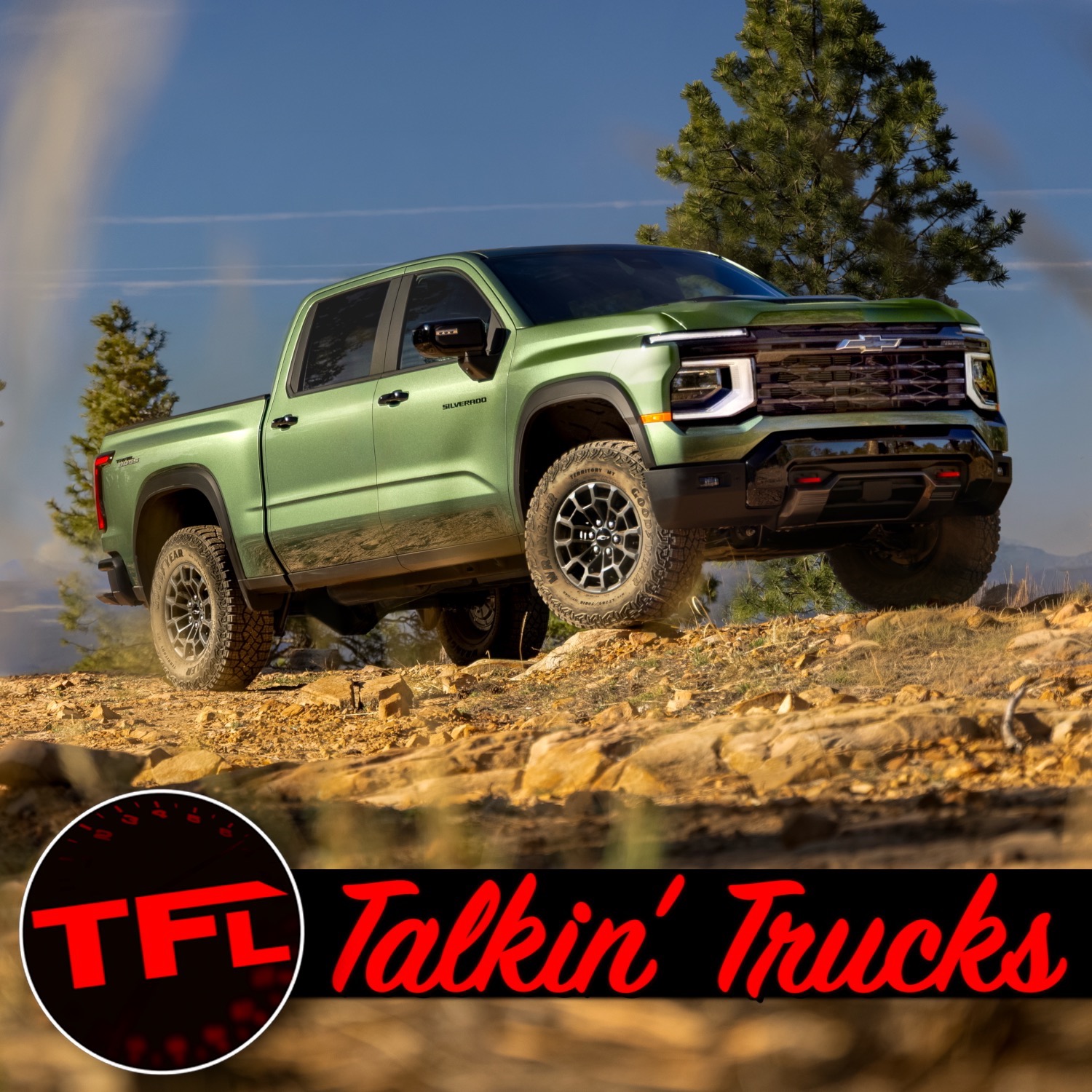
The Chevrolet Silverado 1500 is a large pickup truck made for hauling things and everyday use. The podcast is talking about the new 2027 model because they want to see what’s changed and how it will drive. It’s a major truck model people watch closely.
Dodge Ram is the name used for Ram pickup trucks. The podcast mentions it because Ram is competing closely with other truck brands for buyers. It’s part of the same big, competitive truck market.
Maximum payload is the most weight the truck is rated to carry in the back. If you load more than that, you can overload the truck and create safety and durability problems.
Maximum towing figures are the most weight the truck is rated to tow with a trailer. It’s important because towing too much can overheat the truck or overwhelm the brakes.
“T1 generation” is the truck’s underlying design platform. Think of it like the truck’s main “foundation,” which influences how the truck is built and what kinds of updates are possible.
A heavy duty truck is the more rugged, work-focused kind of pickup meant for heavier hauling. The idea here is that if you’re towing or carrying more than a half-ton is really set up for, you should move to an HD truck.
“Half-ton” is a way people categorize pickup trucks by how much they’re built to handle. The point here is that modern half-ton trucks are getting so capable that they’re starting to feel like heavier trucks used to.
The Ford Maverick is a smaller pickup truck. The host is saying that as bigger trucks get more towing and payload, Ford (and others) still need a smaller option for people who don’t need the heavy-duty numbers.
Suspension is what helps the truck ride smoothly and stay stable over bumps. If the truck is expected to carry or tow more, the suspension often has to be adjusted, which can make the ride feel firmer.
An “HD truck” is a heavy-duty pickup designed for tougher jobs like heavier towing and hauling. The point here is that most people don’t want that kind of truck as their everyday driver unless they’re using it for work.
Sheet metal is the stamped metal body panels of the truck—like the hood, doors, fenders, and outer panels. The host says GM updated the sheet metal so the styling looks different, even if it’s not a completely new design.
The High Country is the nicer, more upscale version of the Chevrolet Silverado 1500. Here, they’re saying the front lighting design looks the same as the work truck, but other parts like the grille and bumper are different.
A headlight signature is the recognizable shape/pattern of a vehicle’s headlights and related lighting elements. Automakers use it as a design “fingerprint,” and the hosts say the Silverado’s work-truck front end shares the same headlight signature as the High Country.
LED running lights are the daytime lights on the front of the truck. They help the truck stand out and be easier to see in daylight, even if the truck has simpler wheels.
“Steelies” are basic steel wheels. They’re not automatically worse—often they’re tough and practical—but they can look out of place on a truck that otherwise has premium styling cues.
The F-150 is a large pickup truck. In the podcast, they’re talking about the look of the front lights and grille area. It’s basically describing how the truck’s front-end styling is set up.
That phrase means the daytime running lights have a particular shape or pattern. It’s basically the truck’s “face” lighting design that helps it stand out.
Beadlock-capable wheels are made so the tire can stay firmly attached to the rim even when you lower tire pressure. That helps off-road traction when you “air down.”
A locking differential helps both wheels on an axle turn together instead of letting one spin. With locking diffs in the front and rear, the truck can keep moving even if one wheel is slipping.
AEV is an off-road parts company that makes truck upgrades. In this segment, they’re talking about AEV helping create off-road packages with added protection and wheels.
Quad exhaust tips means you can see four exhaust openings at the back of the truck. It’s mostly a visual “performance” look, and sometimes it goes along with a more aggressive exhaust system.
Term
dual outlets that look like HDMI
They’re pointing out some rear ports that look like HDMI connectors. In a truck, these are usually for powering or connecting accessories for passengers or the cargo area.
“Trail Boss” is a trim level/package name used on Chevrolet trucks, aimed at off-road capability and appearance. It commonly includes upgrades like more aggressive tires, towing hardware, and styling cues intended to make the truck look and function more rugged.
Tow hooks are the strong points on the truck where you can attach a strap or rope to pull or recover the vehicle. The red color is just how they’re styled.
The Toyota RAV4 is a compact SUV that many people buy. The podcast says that when the newer RAV4 arrived, Toyota didn’t change everything in a big way. It sounds like the update was more of a gradual improvement.
The Honda CR-V is a small-to-midsize SUV that many people choose for daily driving. In the podcast, it’s mentioned because it’s been doing well and is a top seller in its category. They’re not focusing on it heavily, but it’s still an important benchmark.
“Lowered” or “slammed” means the truck sits closer to the ground. It’s more of a street style choice and can make off-roading harder because you lose clearance.
A “high-power street truck” is a pickup built to be fast and exciting on regular roads. Here they’re saying GM isn’t making a truck that’s focused on that kind of street performance.
The podcast mentions a Ford “Lobo” as a comparison point. The context suggests they’re talking about a Ford model name in the same category as other trucks. The exact vehicle details aren’t clear from the snippet alone.
The GMC Sierra 1500 is GMC’s full-size pickup sibling to the Chevrolet Silverado 1500. Here, the hosts say they haven’t seen official images of the new Sierra 1500 yet, and they’re hoping GMC might bring more exciting “Sierra space” content than what they’re seeing from Chevrolet.
Powertrain is the parts that create motion in the truck. It usually includes the engine and the gearbox, plus the drivetrain parts that send power to the wheels.
Here, “5.7” means the engine is about 5.7 liters in size. Bigger displacement generally means the engine can move more air/fuel per cycle, which can affect power and torque.
“Small block Chevy V8” is a name for a Chevrolet V8 engine family. It matters here because the hosts are talking about which new engine sizes Chevy is putting into the truck.
The Grand Sport Corvette is a sportier version of the Chevrolet Corvette. It’s brought up here because it recently got a new bigger engine, and that made the hosts double-check other engine rumors.
“350 cubic inch” is another way to describe engine size, just using cubic inches instead of liters. It’s the same engine displacement, expressed in the units Americans traditionally use.
Torque is the engine’s pulling power—how strongly it can twist the drivetrain to move the truck. Higher torque usually helps with towing and getting going with a heavy load.
Horsepower is a measure of how strong the engine is overall. Engines can make horsepower by producing torque, especially when the engine is spinning faster.
They’re saying the engineering approach can be related, but the “job” each vehicle needs is different. A Corvette is tuned to feel powerful at higher RPM, while a truck is tuned to pull and work under load.
“High engine speed” means the engine is operating at higher RPM. That can be useful for making power, but for heavy towing you often want the engine to stay in a range where it can produce strong torque without constantly spinning very fast.
This means the engine has four cylinders and a turbocharger. The turbo helps the engine make more power even though it’s smaller than a bigger V6 or V8.
TurboMax is the name Chevy uses for a turbocharged engine. In this case, it’s the 2.7-liter turbo 4-cylinder that’s expected to be the base engine in the new truck.
In this context, “changing the transmission” means updating how the engine’s power is geared and delivered to the wheels. For trucks, transmission changes can affect how quickly the engine reaches its power band, towing behavior, and overall drivability.
A “10-speed” transmission has 10 gear steps. That usually helps the truck find the best engine speed for the situation—like towing—so it feels stronger and works less hard.
An “8-speed” transmission is a gearbox with 8 different gear ratios. It helps the engine stay in the right RPM range, which can make towing and acceleration smoother.
Engine displacement is the total volume of all cylinders, often measured in liters. A smaller displacement engine typically makes less torque at low RPM, so extra transmission gearing can help keep it in the range where it pulls best—especially during towing.
Term
six twos
“Six twos” is a nickname for a specific GM automatic transmission family. The speaker is saying some people blame that transmission for past issues, and hopes GM has fixed them.
“2.7” means the engine is about 2.7 liters in size. The speaker is arguing that even though it’s smaller, its power numbers plus the 10-speed should make it work well for most people.
It’s a diesel engine that uses a turbo to help it make more power. The turbo helps the engine breathe better, so it can pull harder and often feel stronger.
Work truck configurations are trim/option packages aimed at utility use—typically prioritizing durability, towing/carrying capability, and practical features over luxury. When a diesel like Duramax is offered in these configurations, it broadens who can spec a diesel in the half-ton lineup.
A hybrid uses both a gas engine and an electric motor. The electric part can help save fuel, and the hosts are noting that GM isn’t offering a hybrid here (at least based on the info they got).
A trailer is something you tow behind the truck, like a boat or equipment. Towing makes the truck work harder, so the engine’s ability to pull matters.
A “straight six” just means the engine has six cylinders in a single line. That layout can make the engine run smoothly and produce strong pulling power at lower speeds.
“Denver 100” is a testing route the hosts use to compare how trucks do in real driving. They’re using it to show that fuel economy advantages depend on fuel prices.
In this context, “efficiency” means how much fuel the truck uses for a given amount of work—especially highway driving and towing. The hosts argue that when diesel fuel is very expensive, the fuel-economy advantage of an efficient diesel can shrink, reducing the practical benefit versus alternatives like hybrids.
The Toyota Tundra is a large pickup truck. The podcast mentions it because it offers a hybrid version, which can help with fuel economy. They’re bringing it up in the context of efficiency options.
The Ford F-150 PowerBoost hybrid is a hybrid version of the F-150 pickup. They’re saying it can be very efficient in real testing, including when towing.
That number (7.2 kilowatts) tells you how strong the truck’s built-in power output is. Bigger number usually means it can run more stuff at the same time.
These are the built-in plug outlets on the truck, and 400 watts is how much power they can supply. It helps you figure out what you can safely run from them.
The Challenger is a performance car designed to be fast and exciting to drive. The podcast talks about very strong engine versions and performance trims. It’s basically mentioning the Challenger’s high-power options.
Leaf springs are a type of suspension made from stacked metal strips. They’re often used on the rear of trucks because they can handle hauling and towing, but they may not ride as smoothly as newer suspension designs.
A V8 is an engine with eight cylinders arranged in a V shape. More cylinders usually means smoother power and strong pulling power. The hosts say these new Silverado V8s are related to the Corvette’s engine.
“LT” is a name Chevy uses for a certain version of a truck—basically a specific package of features and price. If it’s removed, that means you can’t buy that exact “middle” version anymore. Here, they’re saying Chevy dropped the LT option.
“LTZ” is a higher equipment version of a Chevy truck compared to lower trims. The hosts say Chevy removed the LTZ option too, meaning fewer trim choices. That can make the lineup easier to shop, but it also changes how features are packaged.
The Toyota Land Cruiser is a tough SUV designed for off-road driving. The podcast talks about the Land Cruiser’s trim, meaning the specific version and equipment level. Different trims can change what features you get.
Four-wheel-drive selection is how you choose the truck’s drive mode for different traction conditions. It’s what switches between using two wheels or four wheels—and sometimes a low-range mode for tougher terrain.
A trailer brake controller is what lets your truck control the brakes on a trailer. It helps the trailer slow down smoothly instead of pushing or pulling when you brake.
These are different 4WD settings. Two high is for everyday driving, four high is for slippery roads, and four low is for slow, tough off-road work. “Auto” usually means the truck decides when it needs extra traction.
Magnetic wireless chargers have magnets that help keep your phone lined up on the charging spot. That makes it more likely to charge reliably without fiddling with placement.
Qi is the common wireless-charging standard used by many phones. It means you can charge your phone without plugging in a cable, as long as your phone supports Qi.
The GMC Canyon Crew Cab is a mid-size pickup truck with four doors for easier rear-seat access. The podcast is talking about a feature shown on the screen, including an icon you can see while driving. It’s about how the truck’s display works.
Cost-cutting here means the truck is designed to use fewer physical buttons. If the function is handled through the screen instead, the manufacturer can save money on parts and assembly.
Instead of a real button or knob, the truck uses the screen to control things. You tap an on-screen control, and the truck acts like you flipped a switch.
These are the buttons used to control the power windows. The host is saying some manufacturers tried combining or reducing the switches, and people complained and wanted the traditional layout back.
Volkswagen is the car brand being talked about. The host says they changed the window button layout, and customers didn’t like it—so the design direction was challenged.
The headlight switch is what you use to turn your headlights on and off. The host is warning that if it’s built into the infotainment or driver screen, a screen problem could also affect your headlights.
This is a Chevrolet mid-size truck called the Colorado, in the Trail Boss trim. The host says their 2023 model had a problem where the dashboard gauges shut off, so they couldn’t see speed or engine revs.
The gauge cluster is the dashboard screen(s) that show things like your speed and engine RPM. If it glitches and turns off, you can’t easily tell how fast you’re going or how hard the engine is working.
A passenger screen is a display mounted in the front of the cabin for the front passenger. It’s meant to let the passenger watch or control things without using the driver’s screen.
So all that is coming in the next bison iteration.
That's going to be their halo kind of, right?
But that's a little bit more...
You and I have talked about this.
It's a little bit more of a rock roller and not an all-out desert basher.
Yeah.
Once again, because of...
It's not a wide-body truck, but that's okay.
It's funny because Chevy GM does race a lot in the Mint 400.
And the best of the desert series.
Yeah.
And those multi-matic DSSV shocks really show their usefulness when you're doing a faster
off-road run.
So there is some credibility there, but I agree.
Because this truck is narrower and has a front locker, that helps it in a lot of situations
like what we have here in the Rocky Mountains, where you've got some narrow trails with trees
and rock crawling, where a big wide-body truck might actually be a little bit...
Not be able to fit in those trails.
Out of its element.
On those trails.
Yeah.
And you could also have better turning radius in some aspects of it.
So they're keeping the multi-matic DSSV shocks.
They're not adjustable though.
And that's another point where GM is quite a bit different.
Because if you look at the TRXs and their RHOs and the Raptors, those trucks have mode
buttons that control the valving of the shocks as well.
GM just continues on their path.
They're pretty set on this, that they adjusted the tuning of the shocks, but they're not
adjustable.
Yeah.
As far as from a driver perspective, right?
They retuned them for this new generation, and they included...
They talked about a better jounce capability, where the maximum hit comes in into the suspension.
So again, theoretically, you could do some high-speed running, and the truck is not going
to be configured poorly for that.
It's just not going to be as purpose-built.
For the desert, high-speed running.
Producer Cole is a big desert racer as well.
Some people don't know this.
He's actually wearing his Mint 400 shirt right now.
Yeah.
So that's what I'm saying.
And also Cole and I did Vegas Torino and the Colorado ZR2.
And actually, it was a very resilient suspension.
I mean, going 300 miles, that's what we did with Cole.
With this type of suspension, you would think the shocks would overheat.
It will start to fail after that hard-of-use case.
But these suspensions are still very tough, and also they made a point, they have to be
good on-road as well.
You can't build a shock that works really great off-road, yet on-road, it's not so good.
Even best-case scenario, if you go off-road all the time, you might have to drive still
20, 30 miles to go do a five or 10-mile-long trail off-road.
So no matter what majority of your driving, even in a truck that sees a lot of time on
dirt, is still going to be on pavement.
So to that point, yeah, it does have to drive really well on the street.
I don't think those things are at odds, though, because I really believe that the reason a
lot of people buy a Raptor or a TRX or any off-road truck is because they ride smooth.
Yeah, and they're maybe a little softer.
Yeah, if you're not pulling heavy trailers all the time and you want a bed just to throw
maybe some landscaping stuff into whatever you need to move around, throw a motorcycle
in the back of it, then a truck like this would actually be better.
And also, I think that that wide-body design of a Raptor or a TRX, it also kind of looks
a little cooler, even if you never touch dirt.
A lot of people, I mean, people accuse some of those owners of never touching dirt in
some of those trucks.
I mean, I don't know every owner, of course, but it just looks pretty impressive when you
have kind of those wide fenders.
And GM is still not quite in that game.
No.
They're not in that game, but they're upping their tire size, they're re-tuning their suspension
systems, they're racing their trucks, learning from those races, bringing that back into
the production vehicles, and still partnering with AEV.
Exactly.
Which is cool.
Yeah, so there's going to be plenty of capability with these vehicles.
Also, there's a lot of what we've come to know and expect just kind of enhanced to that
next level.
There are some tech features on this truck that we still need to explore and that we're
maybe a little skeptical of.
But overall, I think it's a good-looking truck.
Yeah.
Is it all new?
Well, we talked about them touching the suspension.
They didn't talk about modifying the frame a heck of a lot, so maybe the frames are mostly
the same, which we're good to begin with, so that's okay.
But obviously, the styling has changed.
Some of the other elements have changed.
So it's mostly new, I would say, maybe not a whole new generation coming out of nowhere,
but really an improvement on what they had.
And it's something that we're very excited to get to test.
So when we're actually able to get hands-on with this truck, I'm assuming there's probably
going to be another podcast that's going to be a deep dive, but hands-on.
In-person, yes.
Yes, hands-on.
And also, later this year, well, this is a rumor that Toyota is going to bring a hammer
to this party.
True.
With a TRD hammer.
Another flagship off-road truck.
Yes.
So this space is going to get really busy because the TRX is coming back this summer.
This is coming this year.
Toyota is coming back with a hammer, not coming back, but coming.
We might have to stick them all together and go to Moab.
Yes.
Ford, of course, still has all the Raptors.
Even though they may not be super updated, but I think they're still competitive.
I can.
So this is going to be pretty crazy.
Yeah.
It's going to be a good couple of years.
Nice.
Thanks for joining us on this episode, special episode of TFL Talking Trucks, and we'll see
you next week, as always.
About this episode
Chevy’s newly revealed 2027 Silverado 1500 takes center stage as TFL Talkin’ Trucks weighs whether it can beat Ford and Ram in the full-size fight. The hosts dig into what’s truly “all-new” (cab/bed sizes stay, and payload/towing aren’t pushed higher), then shift to off-road trims like ZR2 and Trail Boss—35s, beadlock-capable wheels, locking diffs, and green hero color. Powertrain talk turns to TurboMax 2.7, rumored V8s tied to Corvette, a 10-speed swap, and diesel/hybrid comparisons.
( https://www.alltfl.com/ ) Check out our new spot to find ALL our content, from news to videos and our podcasts! In this episode of TFL Talkin' Trucks, Andre and Kase break down the massive news shaking up the truck world: the official reveal of the 2027 Chevy Silverado 1500. Moving past the rumors and internet speculation, the guys dive into real clips, official images, and confirmed data sent directly from General Motors to see if the defending sales champion can hold its crown against Ford, Ram, and Toyota.
While the exterior gets a sharp, evolutionary sheet metal update, the absolute biggest talking points are hiding under the hood. Chevrolet is introducing a heavily overhauled powertrain lineup for 2027, completely replacing their long-standing engine options with a mix of high-tech engineering and classic displacement nods that actually share DNA with the legendary Corvette. Andre and Kase break down what these massive mechanical shifts mean for daily driving and heavy-duty towing, look at a huge transmission upgrade across the board, and weigh the pros and cons of the return of their absolute favorite class-exclusive fuel sipper. From the updated luxury of the High Country to the rugged 35-inch tires on the off-road ZR2 and green Trail Boss, the guys debate whether this mystery-shrouded power lineup is enough to stay on top, or if missing a hybrid option gives Ford the ultimate upper hand.
( http://www.patreon.com/tflcar ) Visit our Patreon page to support the TFL team!