LIVE
This is the Aftermarket Radio Network.
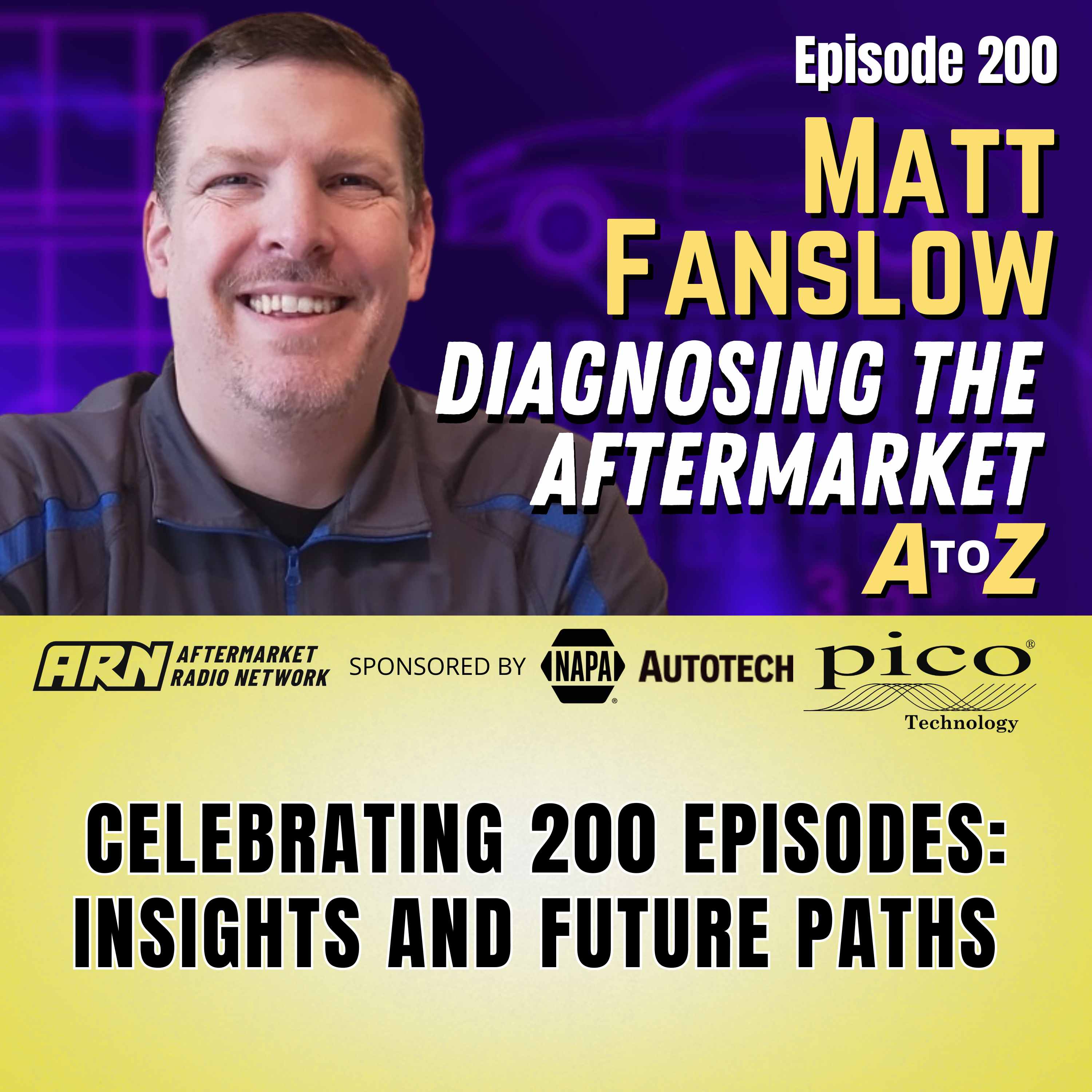
Welcome everyone to yet another episode of Diagnosing the Aftermarket ADZ.
I'm Matt Fonsland, 200 Cigarettes, that's like a year's supply.
That and more after a word from our sponsors, NAP AudioTech Training and Pico Technology.
Do you have a general service tech that you want to grow into your business, but you're
lacking the path to get them there?
Let NAP AudioTech's apprentice program pave the way.
Go to NAPaudioTech.com for more details.
Tired of guesswork and your auto diagnostics?
Need to pinpoint faults quickly and accurately?
PicoScope will turn your PC into a powerful diagnostic tool.
See live waveforms from sensors, injectors, and ignition systems.
See the problem?
Solve it faster.
PicoAuto.com, that's P-I-C-O-Auto.com, busted me.
It's a really weak people attempt at a movie quote that correlates to 200, because in fact,
this will be the 200th episode of Diagnosing the Aftermarket ADZ.
That's kind of insane.
It just doesn't seem like that long ago that I started doing this stupid time.
Don't get me going on time.
Man, doesn't matter how seemingly how much you try to appreciate it, it's still just evaporates.
Time just seems to evaporate.
But kind of going with that theme of 200, I thought I'd just kind of rattle off some
of the emails that have been coming in and even just stuff like comments or messages
from friends as this milestone has manifested itself.
And of course, I mean, the first question is obvious, right?
It's going to be what everybody asks, but yet how do you not ask it?
And then how do you not answer it?
And I guess there's a few of them, right?
There's variations, there's layers, if you will, you know, can you believe it's
been 200?
No, I can't hardly believe it.
So that's an episode a week for 200 weeks.
That's mind blowing, just mind blowing.
Of course, who is your favorite guest?
Actually, I'm accepting bribes for that.
So yeah, I'm avoiding that question like the plague.
Unless you send me money.
Just kidding.
Kind of.
I'm kidding.
Also, what have you learned or what do you feel you've gained or what's
become very evident over the course of 200 episodes?
And, you know, these are similar questions that we had for
Carm as he started hitting his hundreds of milestones, you know, 100th episode,
200, 300, you know, and again, how do you not ask it?
How do you not answer it?
I don't know.
I suppose the most obvious thing is what I think anybody doing anything
like that, be it a podcast like this or content generation in that content
doesn't have to be like this platform, but also just classes.
You know, if you're classroom presenters or again, content generators coming
up with classes, coming up with training material and all that as you
present it in the hundreds of times, you're going to gain insights from that.
And the biggest insight is there's just so much variation.
That's what I find.
And that just, you know, Matt's interests and my varying interests and
varying ways of attributing it to different things or relating it,
analogizing sometimes maybe poorly at all.
But this is a really, really wide
swath, if you will, just really wide swath of a profession.
There's so much to it.
And I don't even mean just the repair end of things.
It kind of blows my mind.
It makes me think back to an episode I talked about presenting to
usually high school students, sometimes younger elementary or middle
school for career day type things that I like to do a timeline.
Or do you want to start the timeline?
The knee jerk is when the car is built, maybe when the car is sold.
But there's a lot of time before that.
And then there's a lot of time after that, the car is built, it's sold,
is repaired under warranty, has accessories added to it.
So many things, so many different things, right?
All the way to the very end.
Well, that's all part of our profession and just the variety of it all.
And then, of course, in our world of repair, service, maintenance,
how varied that is in very variable
philosophies and variable angles, how we're going to do that, why we do that,
variable, why is and W H, why, why is.
Don't get me wrong, there's a lot of variable, why is WISC is too.
But it just blows my mind.
And I don't mean that in a bad way sometimes.
But in general, not a bad thing.
It's just amazing.
It's amazing to be a part of it.
And then other questions.
And I'll do like one more pertaining to the 200th episode
and then maybe just branch off into some of the other emails.
Because like I really like the feedback we've been getting
and the questions and the ideas and please keep them coming.
You can email me at Matt Fonzel podcast at gmail.com.
Really don't hesitate to reach out.
I try to answer everything in the email or at least hint that
I will bring it up on a podcast episode, address it.
But usually I try to address everything in the email
and reply back and then, yeah, have it come on the show.
And then, of course, if you want to be a guest,
please don't hesitate to reach out with that.
But yeah, I guess what is the, you know, looking back over all of it?
What is the biggest jaw dropper?
What's the one that made you really just sit back in your chair?
Oh, my gosh.
It's probably not what you expect.
I don't know.
It was an episode of Margaret Light talking about depression
and how it manifests or how it shows up in men.
And a lot of times it's an anger and that just blew my mind.
I can think back through my career
and those that struggle, if you will,
displayed kind of the more rage, you know, the flying wrenches,
the yelling and the swearing and whatever that however that might be
and thinking they just had self control type issues or,
I don't know, I guess just quick to anger.
And it turned out they very well could have been depressed
and not even knowing it because who tells us that?
That was a big moment.
That one really comes to mind.
That's the one I would have to go with.
Napa Autotech training sessions are being conducted day and night
in the town near you.
This training caters to every level within your organization,
be it a mechanical assistant, a mechanical specialist,
a technology specialist or a driver safety calibration specialist.
Imagine a one stop shop training partner in Napa Autotech
that will lead your team to a path to greatness.
Autotech's entry level, build a tech classes,
convert the untapped potential of your new hires
into money making mechanical specialists.
Autotech's higher level tech update classes
introduce specialists to the world of ever changing technologies
which prevents your shop from getting technologically stagnant.
Remember, if you're not moving forward, you're falling behind
and turning to the front of the store.
The Autotech service advisor class is an awesome way
to hone your client advocate skillset,
ultimately benefiting the customer
through an improved vehicle repair experience.
But it doesn't stop there.
Imagine an electric vehicle class that takes your specialist
well past the mundane, yet necessary safety topics.
Well, it's here.
Autotech's EV ready training is a week long curriculum
that takes participants through a hands on experience
involving hybrids and electric vehicles.
The session kicks off with the use of PPE and proper tooling
while touching on required OSHA regulations.
Then the students dive into the lab vehicles
to gain knowledge of the common high voltage components
on EV and hybrid vehicles and their function.
Attendees will be taken on a path exposing them
to different electric vehicle manufacturers
to compare component form and location.
Additionally, information about level one
and level two charging systems will be included,
along with a quick look at DC to DC charging.
The operation and maintenance of subsystems are explored,
including the different modes of Tesla operations
and so much more.
So what are you waiting for?
Commit to taking your business to the next level
with Napa Autotech training.
Is your shop ready for the electric vehicle revolution?
Don't get left behind.
The PicoScope EV kit is your all in one solution.
Diagnose any electric or hybrid vehicle
from high voltage batteries to complex communication systems.
With guided tests and pinpoint accuracy,
you'll tackle more jobs and boost your bottom line.
This isn't just a tool. It's your future.
Be the expert in EV repair.
Visit PicoAuto.com to future proof your shop today.
That's PicoAuto.com
looking to get into like opening up modules
and trying to repair them.
And what advice do I have in getting into that world?
And there's probably going to be more training coming out.
Going to be more available.
There's not a lot off the cuff.
I can think of two, I guess we'll go with three now
that I think about it.
One, the first one I know of doing it.
And I have to preface that.
I'm thinking automotive repair specifically
because these types of classes were and are available to locksmiths.
So that wasn't one of the three I was thinking of,
but that could be a resource is going into the more of the locksmith world
to gain some of that training.
And I don't know that they really do the module repair,
but they are going to be going into the modules
and part of the repair work is going to involve soldering,
desoldering, reflowing, using tools and equipment like that,
like soldering irons and desoldering stations
and desoldering guns and hot air, stuff like that.
The locksmith world had that for quite a while.
The ones I am aware of in our world would be
Mike Christofferson's classes.
He often is putting up stuff.
I think he calls it a promicon.
Those will show up on social media.
They show up on dyag.net.
So www.diag.net.
You know, put up ads for that for he's going to be hosting an event.
The next one that comes to mind is Kevin Sutter with.
And I think those will be under the banner of World Pack.
I have been to both of these and excellent, excellent classes
that really go into the basics of getting into the module,
you know, using a soldering iron, hot air station,
desoldering, the importance of flux like we could keep going on and on about that.
And then thirdly, and I kind of knew
not new to doing the work, but new to holding classes
as Keith Perkins with L one training.
One of those three would be my advice.
And then if it's really something you're going to get into,
I would look into getting like the starter kits,
the starter training kits, if you will,
they're educational, they're circuit boards.
They'll have I hate to abuse the word circuit board,
but they will have boards with just soldering traces.
OK, it'll just look like a long trace of varying widths.
But you practice laying the solder onto this
and then desoldering it, removing it, you know, using like a solder wick,
something like that.
And then they'll have resistors that you can solder on and desolder
and various components, I guess, MC or E-Proms and then MCUs.
Some of them will be projects, you can buy project kits
that will then it might do something.
It might be a little horn or a light or something, maybe, you know,
whatever, there's varying things that you can buy to do different things.
You know, if I want to sound super vague, but that's what it is.
You want to press on some sort of a sensor
and the harder you push the louder the horn goes, fine, or speaker,
whatever you want to call it, alarm, you could have a motion detector alarm
set it up in your, you know, room.
And if somebody walks into your room or opens the door or triggers it,
it makes a sound, different light display.
I think there's so many things available.
And yet those are going to be some of the very basic skills
you're going to have to use with soldering irons, desoldering,
either irons or tools, solder, wick, flux, stuff like that.
And I guess just don't skimp.
We're professionals.
I'd like the reference or the term, the advice, and I also don't like it.
Buy once, cry once.
Sometimes that implies that some of these tools we're buying are expensive.
And yet we would have the same argument or debate or discussion
with a client who's hesitant to spend money with us.
And we preach value, our warranty, our education, our training,
our experience, special tools, whatever it is.
That's why we're worth this amount of money, sir or ma'am.
And then it comes time to pony up to buy
any number of pieces of equipment and all of a sudden.
That advice doesn't seem to play anymore.
Then we skimp end up in the long run, I think spending more money.
And the instances of this are, I mean, it isn't limited to soldering irons.
It's scan tools, scopes, meters, hoists,
wrenches, you name it, sockets, impacts.
Cheap, go cheap, go cheap.
Then finally buy not always the most expensive, but there's a reason
we didn't buy it and it ended up being really good.
Right. So buy once, cry once.
But maybe you don't have to cry.
I get it if you as an individual, you as the tech
are taking your expendable income to invest in this new endeavor.
I get it. You have to have a conversation.
That's just the way it is.
And you have to be realistic about the ROI.
So far for me, the ROI has been horrific.
So take that for what it's worth.
Sometimes it sounds cool, but savvy businessmen.
It's not lucrative by any means or hasn't been over time.
And that time has been years.
And I am going to say 12 years of doing it at varying levels.
Like, I think I'm getting better.
I don't think I'm anywhere near the top tiers.
You know, the Pedro Delatoris, the Tommy Alivas, I'm not there.
Kevin Sodor, Mike Christofferson's, I'm not there.
But it's better and more capable, more experience.
And I will say it's been a growing segment.
Knowing what I know now, what I still get into it.
I don't know, man, I could have taken that money
and spent it on some other stuff.
That's a tough call.
Ask me in another 12 years, honestly.
But yeah, the reality is go get the training.
Learn what you're going to be getting into.
Figure out what the car lines are
that you're going to be servicing.
Like, what's the most reasonable vehicle or car line that you will see?
And then to what level are you going to try to do this at?
What tools will you be then required to purchase
to do what you want to be able to do and try your hand at it?
My perspective is what I've seen when modules have been touched already.
Soldering skills are horrific or poor.
I'm going to go poor choices or I guess I mean poor technique
that that maybe the soldering job itself was done well.
But the cleanup was terrible.
And therefore the cleanup, you know, leftover flux
started to corrode the rest of the while any part of the board that it was touching.
So that's what I see.
Really, really poor soldering, solder work, really, really poor techniques,
follow up techniques, if you will, or they don't finish the job properly.
That's what I've seen the most of.
So a good place to start is to get good at soldering.
It isn't easy.
It was so easy, everybody do it, right?
That's a big one.
All right. And another question.
Computers, what do you get for programming?
And I think I've talked about this a lot, but it keeps coming up.
My knee jerk is who's nearby or what's nearby?
What's your skill level?
I guess like, what are you going to be doing?
If you're really looking at buying a laptop
and you want it to be partitioned and you want it to be
maybe practically set up, ready to go.
Then proximity is probably out the window.
You're looking to purchase this from somebody
that just gets it all set up for you and will provide support and all that.
You could do it yourself.
You could. And how much time will you invest and effort?
And then when things go awry, you're on your own.
And I'm not saying that's good, better, nothing.
It's just the way it is.
How much of that do you want it to be on you?
And how much do you value the phone number or email to call
or email somebody for tech support and getting it and, you know,
presumably getting you up and going rather quickly?
If that's what you're after, it's really hard
not to send you to auto rescue tools and computers.
Isaac has been doing this for a while.
He's going to take care of you and get you what you need to, you know,
get you set up, ready to go, hit the ground running.
That is a really good option.
The other option I know I know I've talked about probably ad nauseam
is that I buy lots of laptops.
I pay like two fifty three hundred bucks for refurbished
currently in Lenovo's.
It's not like I wouldn't get a Dell.
It's not like I wouldn't get a gateway.
I don't know. I don't know why I don't much care for HPs.
But if you like them, computers are computers.
I tend to lean more towards Intel type processors,
personal preference, probably a bad one. I don't know.
That's what I do. I have a lot of laptops and I keep them carline specific.
I don't really have too many that have more than one carline on them,
unless I absolutely know that they're going to play nice.
And then I've learned the hard way that they play nice until they don't
play nice and then they have their own laptop anyways.
So that's what I've been doing.
I buy them all with Windows 10.
I'm probably going to be going to 11 now.
I haven't heard too much about big time conflicts just yet.
Having said that, now I'm going to get hammered with emails
telling me all about the conflicts, but I haven't heard about any of them.
And like I said, everything I have is right now is 10.
That's my advice is you kind of have to make a decision.
Do you want one or two laptops that handle almost everything?
Or do you want stacks and no, I don't have stacks.
I work in a shop, it's brick and mortar.
I have tool boxes set up with drawers that are dedicated.
You know, I got the GM drawer, the forward drawer, blah, blah.
It's got this one.
The interface in there, the laptop, the charger, ready to go.
I suppose if I was really cool, I'd have everything wired up
so that it dehumidified.
I wouldn't have toolbox to probably have cabinets or,
you know, set up with dehumidifiers and
chargers all set up that the laptops are plugged in charging all the time,
ready to go, which isn't necessarily great for the batteries,
but at least on the ones that don't kind of regulate, if you will.
Yeah, I just have them in toolbox drawers.
So that's what I do.
I don't know if that's right or wrong.
I like that if the forward laptop
tanks that I'm not out everything else
and I usually have a couple laying around
ready that I can quick install or a quick depends on what
which tool we're talking about about quick.
But there's a potential to install
the software and get up and running, if you know, you know, right?
So yeah, that's where I will call it.
I really do enjoy the emails.
I know I didn't get a chance to rattle through a whole bunch of them
this time around, but keep sending them.
Keep sending whatever questions they can be technical.
They can be personal.
They can be anything and everything you want to talk about or hear talked about.
And then again, if you want to be on, just shoot me an email
and maybe an idea or two of what you want to talk about.
And then we'll converse and get you on the show.
I would also like to take a second to mention the other shows
on the aftermarket radio network of which this podcast is a part of.
Of course, you have kind of the
know, it's Godfather, I mean, I know he likes the word Godfather
due to the heritage, but I don't know if that's technically accurate.
Almost like father would be more accurate, but at least
really one of the first, if not the first to do it.
Karm Capriotto has his remarkable results, radio podcast that's been on.
And there's so much material that covers so many topics that it's worth
perusing. And honestly, you can go to the website.
You can go on to the aftermarket radio network dot com.
And you can search each one for topics that you prefer.
And then, you know what, scroll through and look at some of the topics
that you wouldn't initially think you'd prefer or be remotely interested in
because you might find out you're very interested in it.
Another really good one that I don't think enough of us could listen to
is Business by the Numbers by Hunt Demarest.
There's such good information.
He's CPA only works with repair shops.
Yes, that sounds like that would be only for owners and managers.
There's a lot of content and information in there that we as
mechanical and technical specialists should be aware of and should know.
And there's some that are just aimed at us.
You have the weekly blitz with Chris Cotton.
You have the auto repair marketing podcast with Brian and Kim Walker.
And then bring it up the rear.
You know, what can I say?
Not only is he the FNG, but, you know, also it's like training wheels.
Craig O'Neill with Speak Up.
It's about communication.
I don't know about you.
I get tired of hearing about communication.
Just kidding.
It is a really, really good podcast.
Don't tell him I said that, though.
It's head just swells right up.
One of these weeks, you're going to see I'm on that podcast.
But luckily, luckily, he brought a ringer in his brother, Sean,
who is the real deal.
I mean, Sean was on there and he has the real deal.
But Craig is also the real deal.
It's just rocking fantastic.
That's what I will say.
And with that, I would like to thank you very much for listening.
Thank you for 200 episodes.
It's humbling.
I think that's the best word is humbling.
And I really, really appreciate the listening and supporting
and so many different things.
Yeah, the feedback, all of it.
Thank you so much.
And I would really, really like to thank our sponsors,
NAP Autotech Training and Pico Technology
for really helping make this all possible.
Really, they do like most vendors do at trade shows, right?
I don't know if they get enough credit.
They really don't.
And then the Aftermarket Radio Network for letting me do this,
even Tracy, so, you know, a bit of a shout out for her.
She does a lot of work on this podcast.
Somebody's got it, right?
All right, thank you so much again.
And until next time, take care.
You've been listening to Matt Fonslow,
diagnosing the Aftermarket A to Z on the Aftermarket Radio Network.
Follow Matt on your favorite listening app.
He's very interested in what you have to say.
Let him know what you'd like him to cover and come on the show.
Matt is all for advancing the Aftermarket.
Find Matt Fonslow on social media and connect
or on AftermarketRadioNetwork.com.
0:00
26:57