NHRA is the big organization that runs drag races in the U.S. Teams compete at events, race head-to-head, and their results help determine their season standing.
Redline Oil is a company that makes engine and other vehicle fluids meant for performance driving. The speaker is basically saying they trust it because it works well when the car is pushed hard.
A diesel particulate filter is a part that catches the smoky soot from a diesel exhaust. Over time it needs to clean itself out (regenerate) so the engine can keep running and meeting emissions rules.
A diesel oxidation catalyst is an exhaust treatment that helps clean up diesel fumes. It works by using a catalyst to help convert some of the harmful stuff in the exhaust into less harmful emissions.
DPFXfit is a company that sells replacement exhaust emissions parts for diesel trucks. They’re advertising filters and catalysts that are meant to install like the original equipment parts.
An “OEM replacement” part is made to work like the original factory part. The goal is that it fits correctly and functions the same way in the emissions system.
Pro Mod is a drag racing class where the cars are heavily modified for speed. The hosts are pointing out how many of these cars are expected to show up.
A hood scoop is a raised opening on the hood that helps direct air where it’s needed. In racing, changing hood scoop rules can change how teams cool the engine and how they shape airflow for speed.
RPM is how fast the engine spins. In drag racing rules, setting an RPM limit changes how hard teams can rev the engine, which affects how they tune and race the car.
Pro Stock is a type of drag racing where cars are built to race as fast as possible, but they still have to follow a rulebook. In this segment, they’re saying the rules are changing in a big way, so teams can adjust things more than before.
In drag racing, some classes are meant to stay closer to what you’d find on regular cars. They’re saying Pro Stock is moving away from that “keep it similar” approach, so teams can change more things.
Larisse Motorsports Insurance is a company that helps racers insure their gear. Regular insurance often doesn’t cover racing, so specialty coverage can fill those gaps.
Total Seal is a performance-focused brand known for piston rings, which are critical for sealing combustion pressure and controlling oil consumption. The segment ties Total Seal to an episode about “ring seal,” indicating they’re discussing how ring design and fitment affect engine performance in racing.
Roush Yates is a well-known racing engine and team organization referenced here via a guest’s background. In drag racing, engine builders and teams like this are often central to performance because they develop and maintain the powerplant and calibration strategies.
Ring seal refers to how well piston rings seal the combustion chamber to maintain cylinder pressure and prevent blow-by. In racing engines, improved ring seal can support better power, efficiency, and consistency by reducing leakage and controlling oil use.
FTI Performance Transmissions builds racing transmissions. In drag racing, the transmission helps the car launch correctly and shift at the right time to keep the engine making power.
A torque converter is part of an automatic setup that helps the car get moving from a stop. It can help the engine stay in the right RPM so the car accelerates harder.
Redline Synthetic Oil is mentioned as a sponsor providing engine oil. In high-stress racing conditions, oil choice affects lubrication, heat management, and engine wear, especially when engines see sustained high RPM.
The Gator Nationals is a drag racing event in Florida. Winning it two years in a row is a big deal because drag racing is tough and unpredictable.
Topic
HRA TV
This sounds like a TV broadcast they were watching while the race was happening. The exact channel name is unclear, but the point is they followed the racing coverage from home.
Gainesville Raceway is the drag strip where this event happens. Some racers just seem to do well there because the track works with their setup and driving style.
In NHRA-style seasons, early results matter because points earned after the first race set the baseline for everyone. Getting a strong finish early can create a points advantage that teams try to maintain through later events.
“Semis” refers to the semifinal round in drag racing elimination brackets. Advancing that far typically means the team has won multiple head-to-head races, which also improves their season points and momentum.
“Tuning” in drag racing means calibrating the car’s setup—such as engine management, fuel/air delivery, and chassis settings—to match track conditions and maximize performance. Tuning two cars suggests the team is managing similar goals while adjusting for differences between the vehicles.
Concept
body difference
A “body difference” implies the two cars have different exterior bodies or aerodynamic packages, which can affect airflow, weight distribution, and how the car behaves at speed. Even with similar powertrains, teams often need different setups to account for those differences.
Concept
fun and car racing
They’re basically saying they stopped treating racing like a hobby and started treating it like a real job. That usually means more practice, better parts, and a team focused on winning.
Concept
full time
“Full time” here implies the team operates like a professional operation rather than a part-time hobby. For drag racing, that typically translates to more frequent track testing, faster turnaround on repairs, and better preparation for each event.
Concept
competitive team
A competitive team is one that can keep the car performing well every time it runs. It’s not just speed—it’s also making sure the car stays consistent and doesn’t break.
John Force Racing is a famous drag-racing team. If you’re in one of their cars, you’re typically dealing with a very experienced crew and a car that’s been dialed in for races.
They’re talking about getting ready for an event in Charlotte, North Carolina. It sets the scene for what kind of racing and pressure they’re heading into.
Drag racing is racing where cars line up and race straight down a track to see who accelerates the fastest. It’s not just about horsepower—launching and getting traction are huge.
In drag racing, a “funny car” is a special type of race car. It looks like a regular car from the outside, but it’s built to go extremely fast in a straight line for a short race.
“Bronco” usually means the Ford Bronco SUV. Here, it sounds like it’s tied to the speaker’s business or background, not necessarily the race car they’re driving.
Funny car racing refers to a specific class in drag racing where purpose-built cars run high power with a short wheelbase and distinctive bodywork. The “evolution” they mention is about how teams grow—building their own support system, sponsors, and crew to move up the ladder.
Sponsors are businesses that help pay for a racing team. They usually get their name or branding associated with the team, and the team gets money or parts to keep racing.
Beepro Auto is a company the racing team is working with for the event. Racing teams often team up with partners to help pay for the season and support the car so they can show up ready to run.
Topic
Epping
Epping is mentioned as the first primary sponsor race for the new company partnership. In NHRA context, this refers to an upcoming event location/date where sponsors can activate and reach the drag-racing audience. The hosts use it to set expectations for guests and brand exposure.
Stellantis is the big parent company behind several car brands. The hosts say Beepro was started with that kind of support, meaning it likely has more resources than a typical small aftermarket startup. That can affect how quickly the company grows and how widely its parts get sold.
Mopar is referenced as a benchmark brand within the Stellantis ecosystem. The hosts explain that Beepro is trying to differentiate itself from Mopar, even though both are supported by the same parent backing and engineering resources. This highlights how aftermarket brands can share technical roots but compete on branding and product positioning.
They’re also running a Mustang-shaped funny car. In drag racing, the outside body can change, but the team tries to keep the car setup the same so they can compare how the body affects tuning.
A funny car uses a special race body that’s made to look like a car you’d recognize. Teams can swap body styles, and they’re basically asking whether the shape changes how the car behaves and needs tuning.
In drag racing, the “hot pit” area is the busy area where teams work right around the time cars are getting ready to race. It’s where you’ll see last-minute checks and prep between runs.
Flying H is the name of a racing-related business/track that the guest Scott is associated with. The hosts mention it as part of the support system behind the team.
They’re talking about Scott as someone who’s been helping and sponsoring the team. In racing, that kind of support can help pay for upgrades and getting ready to compete.
They’re talking about Logan Industries as a company that sells utility beds for pickup trucks. If you’re working on cars or hauling gear, a utility bed can make your truck more useful.
The Dacia Logan is a low-cost car meant to get you from place to place without expensive features. It’s built to be practical and straightforward. In the podcast, it’s referenced more for the name than for truck-like capability.
A “self funded team” means the race team pays for most of its own operating costs rather than relying on a major factory or large corporate backing. That makes sponsorship money especially important because it directly improves the team’s ability to compete.
B Pro is mentioned as one of the sponsors supporting the team. Sponsorships like this are common in grassroots drag racing, where outside funding can cover parts, travel, and track time.
They’re talking about the race track itself—how it used to be and how it is now. The surface (like gravel vs. proper racing pavement) affects grip, so it changes how the car launches and how consistent the runs feel.
Concept
fastest mile per hour and quickest CT
They’re bragging about record numbers from race runs. One is about how fast the car gets (mile-per-hour speed), and the other is about how quickly it can complete the run (a time-based record).
Holding a “Missouri state record” means the driver’s performance is the best recorded in that state for a specific category (here, fastest mile-per-hour and quickest CT). State records matter because they’re often tracked by sanctioning bodies and can be used to qualify or build credibility in the racing community.
Concept
doctor cars
“Doctor cars” here means getting the car dialed in so it runs better. It’s like doing the right tweaks and repairs so the car can perform at its best on that track.
Concept
laid down some really good leaks
They’re saying they made some really strong runs that night. The crowd reacted because the results were impressive.
South Georgia Motorsports Park is another race track they’re planning to visit soon. They’re excited because smaller venues can feel more packed and energetic.
When they say “world champion,” they mean the rider has won at the top level in their racing category. It usually takes a lot of consistent results, not just one good run.
A gasket is like a heat-resistant seal that stops leaks between engine parts. In racing, engines get very hot and put a lot of pressure on those seals, so the gasket has to handle it reliably.
Friction inside an engine wastes energy and turns it into heat. More heat usually means parts wear faster, and the engine can lose power as things degrade.
MacLeod is a company they teamed up with for parts that help move power from the engine to the drive wheels. In drag racing, those parts have to survive huge stress during launches and hard acceleration.
Driveline components are the parts that carry power from the engine to the drive wheels. In drag racing, they take a beating during launches, so stronger or better-matched parts can help the car perform more reliably.
A “competitive edge” means having an advantage over other competitors. In racing, even small improvements can help you go faster or be more consistent when it matters.
Drag Race Bracket Bonanza is a fan game where you pick winners in drag racing brackets. You fill out your picks after qualifying at events, and it’s meant to be fun and interactive.
Q1 means the first qualifying runs of the event. They’re saying the first qualifying session here will feel like the first qualifying session at Gainesville.
“No testing” means they didn’t get extra practice runs before the race. That can make it harder to dial in the car, especially for launch and traction.
They’re talking about posting test results from their practice runs. Sharing those numbers helps the team figure out what’s working and what to adjust.
In drag racing, “60-foot times” measure how fast the car gets down the track’s first 60 feet. A better 60-foot time usually means the car launched well and hooked up to the track.
Term
CT's lip
“CT’s lip” likely refers to a specific aerodynamic or body component on the car—often a lip/edge on the front fascia or splitter area. In drag racing, small aero and clearance details can affect airflow, stability, and how the car behaves under load.
When racers say “103s or fours,” they mean the run time is around 10.3 or 10.4 seconds. Faster times usually mean the car/bike is making more effective power and/or launching better.
The “stretch run” is the last part of the drag strip where the car is really pushing toward the finish. The hosts are saying that part is especially important.
Topic
super street racing
“Super street racing” here seems like a more casual, street-inspired racing scene. The point is that it’s busy and you can’t watch every detail at the same time.
“Nitro ranks” means the drag racing classes where the cars run nitromethane fuel. Those cars are tuned for that fuel, and how well they launch and stay consistent matters a lot.
They’re saying you should pay attention to the races happening in Arizona. Different tracks can make cars behave differently, so it’s worth watching.
Term
340
“340” is a quick way racers talk about a big performance number—like how fast the car is going or how quickly it runs. When one person hits it and others follow, it suggests the setup or conditions are repeatable.
A test session is practice where teams try different setups to see what makes the car faster. The hosts are saying that after a test in Gainesville, more cars were able to hit the same big performance number.
“Tuning strategies” means how a race team adjusts the car so it runs its best for that track and conditions. If someone suddenly goes faster, other teams may change their settings to try to copy what’s working.
A “nitro car” is a drag-racing car that runs on nitromethane fuel. Because it burns differently than regular fuel, the engine needs special setup to make power and stay consistent.
Nitro classes are drag-racing categories that run on nitromethane fuel. These cars are famous for huge acceleration and the loud, dramatic way they launch and pull.
Reaction time is how fast the driver reacts when the race starts. If you’re quicker off the line, you can get a head start and often win even if both cars are fast.
The speaker is describing how reaction times in nitro drag racing have improved over time, moving from “average” to consistently faster numbers. In competitive racing, once one team proves a new benchmark, others chase it with better staging, tuning, and driver consistency.
A “number two qualifier” means the driver earned the second-best qualifying position based on their best runs. In eliminations, that seeding affects matchups and can influence strategy—like choosing a safer launch to advance.
“Grouping” means the results are consistent from run to run. If your launches are grouped closely together, you’re more likely to know what the car will do in the next round.
“Going red” in drag racing means the driver fouled at the start by reacting too slowly or too early relative to the timing system. A red-light typically results in an automatic loss for that run, so it’s a major momentum swing in eliminations.
In drag racing, “incrementals” are checkpoints along the track. They show how the car is doing early on (like off the line) and later as it builds speed.
Qualifying runs are the practice-style timed races that decide where you start in the bracket. Doing well in qualifying can help you get better matchups later.
Concept
double low
In drag racing, the “tree” controls the start. “Double low” means someone is reacting so fast that it’s flirting with a false start. The speaker is saying there’s not much you can do to beat that, so you focus on your own safe, consistent launch.
Term
trip zero gauge is 005
Drag races measure how quickly you launch after the lights. “005” means a reaction time of about five-thousandths of a second, which is basically lightning-fast. The speaker is comparing how close to the limit they were before.
Term
004 times in a row
This is still about how fast the car leaves the starting line. “004” means an even faster reaction time than “005,” and doing it multiple times in a row is very unlikely. The speaker expects the other driver’s starts to eventually be less perfect.
On the drag strip, you have to launch legally when the tree tells you to. “Green” means you didn’t jump the start. The speaker is saying they need a clean, legal launch before worrying about the rest of the run.
A “pass” is the full drag-race run from launch through the finish line. “Making a good pass” usually implies not just speed, but proper launch, traction, and consistent performance downtrack. The speaker ties it to reaction time and exploiting the opponent’s likely drop in start consistency.
Concept
comfort zone on the bike
“Comfort zone on the bike” refers to the rider’s preferred setup and launch behavior that they can repeat reliably. In motorcycle drag racing, small changes in throttle, clutch/launch technique, and traction can dramatically affect reaction time and elapsed time. The speaker is describing a strategy of staying within what they know works rather than chasing maximum risk.
Concept
first strike
In drag racing, “first strike” usually refers to getting the jump off the line—reacting quickly and/or launching first in the tree-to-tree timing sense. It’s a momentum advantage because even small reaction-time differences can decide close races.
A “red light” in drag racing happens when the car starts after the light has already turned red. Even if you go fast, you can still lose because the start was too late. Drivers work on timing their launch so they don’t get caught by the light.
LIVE
Redline Oil, formulated to win, proven by me.
Redline Oil, formulated to win.
Formulated to win.
Formulated to win.
Formulated to win.
Proven by me.
Formulated to win.
Formulated to win.
Formulated to win.
Formulated to win.
Formulated to win.
Formulated to win.
Formulated to win.
Formulated to win.
Formulated to win.
Formulated to win.
Formulated to win.
Formulated to win.
Formulated to win.
Formulated to win.
Formulated to win.
Formulated to win.
Formulated to win.
Formulated to win.
Formulated to win.
Formulated to win.
Formulated to win.
Looking to replace your OEM diesel particulate filter or diesel oxidation catalyst?
Look no further than DPFXfit, a complete line of aftermarket diesel particulate filters and
diesel oxidation catalysts designed as an exact fit OEM replacement with all makes
coverage for light, medium and heavy duty trucks.
With thousands of units in stock we ship the same or next day and be sure to check
out our comprehensive reverse OEM lookup tool, always new, never remanufactured.
For more information, be sure to visit dpfxfit.com. That's dpfxfit.com.
This is WFO Radio.
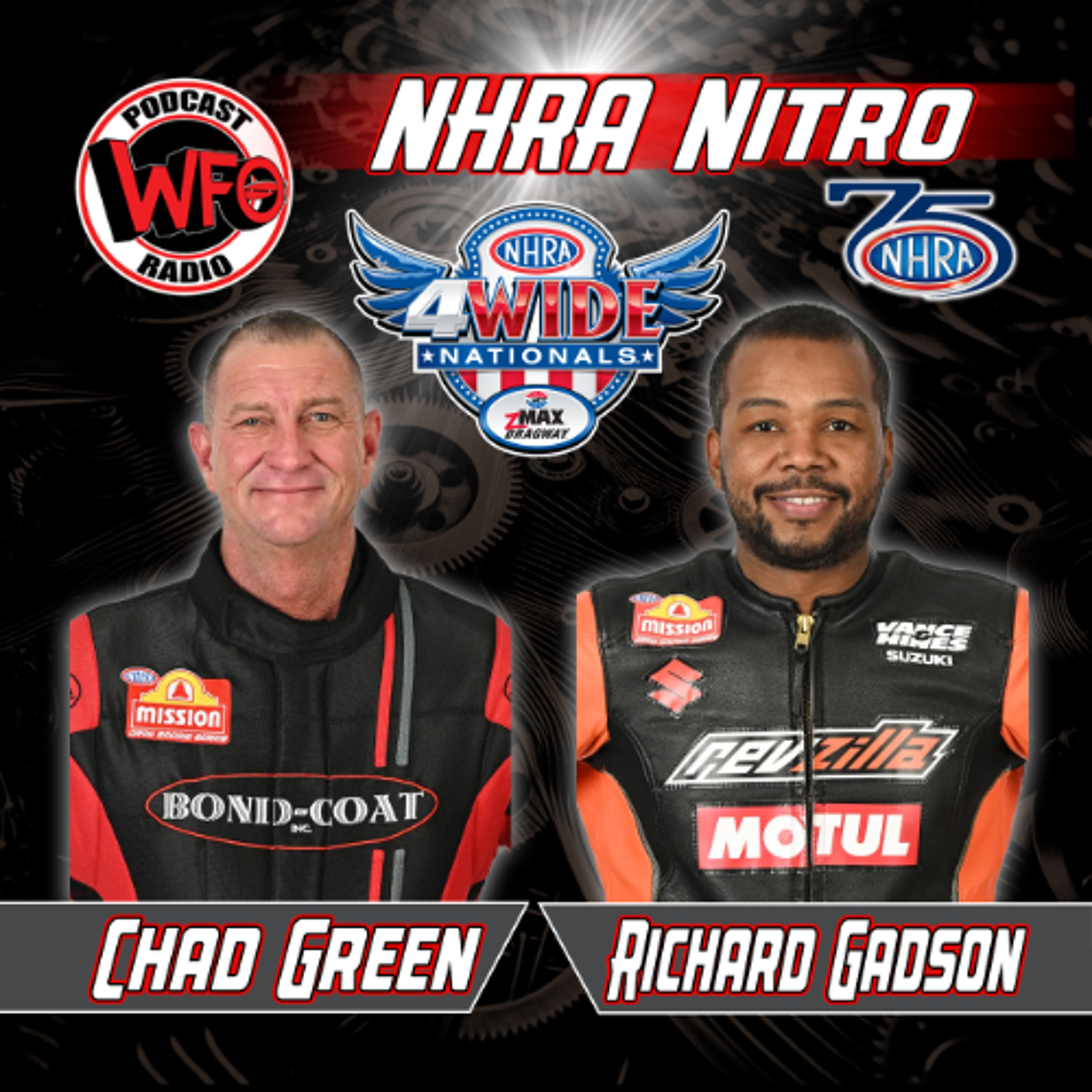
Everybody WFO Radio NHRA Nitro is back. I'm Joe Costello and we are getting ready for ZMAX
Dragway. That is right. NHRA headed to Charlotte, North Carolina. Super excited. This is a big
deal because we're only going there once a season now, starting this year. And I think
you're already maybe seeing it in the entry lists. We're talking about 21 pro
stockers, 23 pro mod cars, got 19 top fuel dragsters. So going to be very exciting to
get up there to ZMAX Dragway, the Bellagio of Dragstrips and get it on. So if you're
a fan of drag racing, if you're a fan of racing, if you're a fan of like people
talking sports, we ask you, share this show. Give us a share right now, you know,
like, subscribe, all that stuff to you, podcast listeners, audio only. Appreciate
everybody. We got Chad Green going to be on the show. Chad won the Golden Gator two
years in a row. Won the Gator Nationals. We did not catch up with Chad right after
that win. So when the tour comes back East, of course, we catch up with Chad.
Same is true for Richard Gadson. That's right. The champ is here. Vance and
Heinz, champion of the world, Richard Gadson, won the Golden Gator, won the
Gator Nationals, pro stock motorcycle back on track for the first time since then.
We're going to speak with Richard on this show, and I'm going to give you my
thoughts on the new rules in pro stock. We heard about hood scoops last
week. This week, 11,000 RPM for the Dodges and the Fords. Chevy stays at
10.5. What does that mean? It is a fundamental change to pro stock. Pro
stock is no longer a non parody category. It's like, you know, the rules
makers can make changes like they do in pro stock motorcycle. What do we
think? Talk to Alan Presensky a little bit earlier today. Got a text from him.
I'll read you the text and we'll see what he says as he will be first car out
before we get to Chad. Just want to shout out to the people who make it
possible for me to go WFO. You already heard from Redline and Jesse
converters. But how about the folks at Larisse Motorsports Insurance? If
you're interested in ensuring your racing equipment is very important.
Go to our YouTube channel. You can watch the interview with Holden Larisse or
just go to their website. LarisseMotorsportsInsurance.com. Insurance
for your racing equipment without all of the exemptions and exclusions.
And oh, it was where you're not covered. Sorry, Larisse Motorsports
Insurance. Total seal piston rings got a brand new episode of Hidden
Horsepower with Sandy Wilkins. Guy worked at Roush Yates. Last time
we were at Zmax. He won top sportsmen. Go watch that episode.
You'll learn a whole lot about ring seal. Thanks to the folks at Total
Seal. Shout out to the fine folks at FTI Performance Transmissions
and Torque Converters. Still doing their tax day special. Of course,
Redline Synthetic Oil, our friends at HussiePerformance.net,
Frank Holley's Foggett, Marvin Rodak and Bernie's Speed Shop.
I'll tell you a little bit more about them a little bit later.
But right now let's bring on the guest of honor. Got the job done
back to back. It's hard to win the Gator Nationals or any race
back to back years. And yet you did it. Congratulations, Chad.
How are you? I'm doing great, Joe. Thank you so much.
That was yes. It was really great. And we missed having you out there.
I understand that you've been to that race for many, many years.
And that was the first time you missed it in many, many years.
And we missed having you there, but we're glad to have you back now.
And yes, it was really great to win it for two years in a row.
Wow. So thank you for mentioning that.
I appreciate it.
And it was tough right then in that time.
It was for forty five consecutive Gator Nationals that I had been to
forty of them with forty with my dad.
He has since passed.
But this one was like my mom got sick and she took a like, oh, my gosh,
we're going to lose her.
And so everything went out the window.
But I watched on an HRA TV and you guys kept me sane
in those moments, watching you guys go on and go back to back.
What is it about Gainesville Raceway and Dean and Joe and you that you
first race of the season? That's a big one to win.
Yeah, that was a huge one for us to win.
And yeah, I don't know what it is about Gainesville Raceway,
but I really like that track.
I mean, we seem to really perform well there.
And it was weird, even on race day, you know, as we started going through the rounds,
I mean, everything just seemed to click just like it did the year before.
So it was a really incredible experience for us.
And I'm so grateful, so grateful for my guys.
And it's so important to get a good start at the first of the season,
especially the first race, because, you know, before the first race,
everyone's the same. Everyone's zero points after the first race.
That kind of sets the points going forward for the rest of the year.
So it's a huge advantage to, you know, at least try and get into the semis,
get into the top four so you can start the year out on a good pace.
And we was able to do that and we're going to
are playing as trying to capitalize on that.
I want to talk to you about a bunch of different things.
But you mentioned your guys, Dean and Joe, and you and I have had these
conversations over the over the years, like these are two really sharp guys.
And you got them and now they're tuning two cars
with a body difference basically between the two of them.
But you've got the brain trust and the people in place.
And this sport is really all about people.
Oh, I really do.
And I feel so fortunate to have the guys that I have.
And, you know, just the way it's all come, you know, together for us
has been really great over the years.
And now I mean, people are starting to see how good these guys are,
how smart they are and the best is yet to come.
I will talk a little bit about that.
You and you and Dean in promod, you had a tumble in Gainesville.
I remember that's when I first met Chad, like in that moment.
It's like, oh, Chad Green, all right, you've come so long.
It's almost as if and I want you to kind of elaborate on this
that you decided it's either all in or all out with this funny car stuff.
Like, all right, this is how we got to do it.
And so, you know, you're in it, hunters in it, hunters.
You got you got Tom doing PR.
You have dived all the way in to car team.
Blake and Hunter split in the deal.
Tell me about that decision that if you're going to do something like this,
it has to be a full on all out effort.
Well, I mean, that's pretty much I like to do anything that I'm involved in.
You know, I don't really want to get in.
I don't I don't do half ass very well.
So, yeah, the plan once I decided to eventually go
fun and car racing, which I was lucky enough to get that opportunity.
You know, that was that was the plan is, you know, we want to do this
full time and we want to be competitive.
We want to be a professional competitive team.
And that's our goal.
That's what we've worked for all these years.
So that final round, when when you're going to go up against Alexis out there
in Gainesville and I couldn't help but think of a few conversations that
you and I have had and she and I have had.
That's a fun rivalry there.
You two, you and Alexis, you've been on the stage together.
You've traded barbs together.
Your two drivers that are maybe maybe a little under the radar
that want the world to know, man, I'm ready to rip that other guy's
throat out and it's kind of cool to see the two of you in that final.
So tell me about the final just because that was a huge win.
Yeah, it was actually great to get to race Alexis in the final.
You know, it's unfortunate that there, you know, we can only be one winner
because I really like her and she's got a great year, this great opportunity
this year, you know, with John Force racing.
And, you know, anytime you go up against any driver in a John
Force racing car, you've got your hands full and we knew we had our hands full
that day. But also, you know, when we got by the time we got to the final,
the way our car and the way everything had been running that day.
I was I was actually feeling pretty confident in the final and I was ready
to get it done, you know, and but going back to Alexis, it was really great.
She is a good friend of mine and I really like her and she's, you know,
a great contribution to the sport of fun and car racing.
And yeah, it was just a really cool day.
I don't know. I can't say enough about it.
Well, not enough like like that.
You're not afraid to trade barbs with Alexis.
I don't know what it is about the mutual respect or, you know,
maybe everybody knows where they stand with one another very confidently.
So she doesn't mind talking about whooping you and vice versa.
And so that makes that's the fun that I think everybody wants to see.
It was certainly a fun final.
It was a fun final.
And yeah, I don't think I mind trading bars with anybody out there.
And that's and I think that's something that I really want,
like in this week leading into Charlotte, I want more people to know you, Chad.
I want more people to know that like you're not boisterous,
but you'll say consequential words when the time is right.
Does that make sense?
Like if you had to describe your own character, what would you say?
Well, you know, I'm definitely not boisterous.
I'm not trying to go and get anybody's face or do anything like that.
But, you know, I would say quiet confidence would be more of the approach
we try and take.
I like that. I like that.
And the sport of drag racing, but as a funny car racer,
that's a crazy thing to do in general.
So it does take a quiet confidence and an open confidence.
But you're out there to whip everybody.
And so we talk about the character of our drivers, right?
Like, OK, we know Austin Prok.
We know who he's marketing to.
But I think you've got a built in.
Group of people that could very easily become Chad Green fans
if they knew you a little bit better, the working man, right?
I am I like you talk a little bit about your business,
about how you got to this point, because if you go to work every day
and you strap on some boots, you're the guy who did that
and then innovated something.
And it's enabling you and your family to be drag racers now.
Oh, definitely.
I mean, I can't say enough about my business,
my people back home here, Bronco and my business.
You know, I've just got a great group of people here.
And if it wasn't for them and my business here,
we wouldn't be drag racing.
So, yeah, it took a lot of, you know, a lot of people just,
you know, see see where we are now and see us drag racing.
But, you know, it was really a lot of years of struggle
and hard work just to get to where I could even go racing at any level.
So, yeah, it's been a long road to get here.
And we're just happy to be here and feel so blessed
and trying to make the most of it.
But at the same time, you know, we take this very seriously.
This is a professional business for us.
And we, yes, we're here to win.
And definitely we want to be at the top and we aspire to be at the top.
And that's our goals.
I love that. I love hearing that.
And as you kind of go down this journey of funny car racing,
it seems to me and you tell me if I'm right or I'm wrong here,
but you're figuring out what you need to do.
Like, OK, because you're kind of we're connected to Tim
for a little while, like, no, man, I need to have my own deal.
I need to have my own guys.
I need to find my own sponsors.
And you got some folks coming out this weekend
that is kind of a big integration with you.
Tell me about the guys at Beepro Auto
and what will be happening with them this weekend in Charlotte.
So, yeah, yeah.
It's been a total evolution, Joe.
I mean, since I've started funny car racing
and I can't say enough about Tim and what he did to help me
help get me started in the sport.
I could have never done it without him.
But yeah, obviously we realize, you know, if we want to really
grow and go to where we want to be, you know, we have to evolve
and we have to change and move.
And and that's kind of what's happened.
And this whole deal.
Yeah, let me just talk about our new new partners, Beepro Auto.
I could have been more happy.
And it's actually not this weekend.
I mean, they've come on as associate
and their their first primary sponsor race is going to be Epping.
So we're really looking forward to Epping and having them out.
We're going to have a bunch of guests out.
But great, great new company.
It's a pretty new company.
They've they started this company about two and a half years ago.
And, you know, it's got it was started in its own by Stalantis.
So it's they've got big backing.
And, you know, they've gone into the, you know, the aftermarket parts market, basically.
And, you know, they wanted to differentiate differentiate themselves
from Mopar a little bit, even though they've got the same backing,
the same engineers that are producing these parts.
But they produce parts for actually all makes a model.
So it's a it's a new venture.
A lot of people haven't heard of Beepro and I'm so excited.
They chose a spot, you know, to partnership with us.
And I really I really think, you know, over the next years,
it'll be something that will grow into something a lot more.
And, you know, with our platforms that we have, you know,
we hope to really help them get their name out there and just grow them.
And I think they're really going to enjoy their experience in the HRA.
And it's a super good fit with us.
Coming up at Epping, New Hampshire, I had that wrong.
But I'm excited, regardless.
And Beepro Auto guys can check out BeeproAutoParts.com
to find out a little bit more Beepro guys.
I'm saying it because you're repping with Chad Green here.
And I really appreciate it.
Speaking of which, you got a Dodge and you got a Mustang,
two different funny car bodies under the camp.
And I wonder what that's like.
I was joking with your PR guy, Tom Blatler, who has been in the biz for ages.
And I was like, I saw a picture and a picture and it took a second to sink in that.
Well, no, you guys are running the two different bodies.
What's that like? I know you're in the Mustang.
But Hunter and Blake are in the Dodge.
And is there any communicable difference?
Like, have you guys noticed anything that that is unique to one and not the other?
A tuning challenge? Anything?
That's really hard to say.
I guess it's really hard to say if you could notice any difference
between one body or the next body.
I mean, we set our cars up the same.
We take them the same.
Everything is the same. So that's really hard to say.
You know, we love, you know, having our deal that we've got with Dodge
going right now on Hunter and Blake's car.
And, you know, we've got we've got my own deal over here going with Ford.
And they've been great.
So it's a really unique circumstances, you know, for one team to get to work
with two different manufacturers, but it's been all good.
And I can't I don't have anything to batter.
I've got all good to say about both of them.
That is wild.
So Blake's going to run 10 hunters going to run 10, as I understand it.
Blake got a lot of attention on the chasing speed show last year
during the winter break.
I'm still talking about it because I thought it was so great to watch
all of that stuff, see things that I had never seen before.
The world got a little taste of Blake Alexander right there.
Yeah, I guess they did.
Yeah, I don't know what to say about that.
But yeah, they for sure got a little little bit of taste of Blake.
You know, he's definitely not always that wound up.
But yeah, they get they get a good taste of it there.
And of course, Hunter, the other 10 races,
your your son following in your footsteps.
And you know, I think I think the world of him, he's done a great job.
How much does he push you?
Like, who's who's pushing who is he?
Are you pulling your son into the world of drag racing that you love
because it's cool, which is what my dad did with me.
Like come to the track, son, look at this amazing world.
Or is he now pushing you kind of like the way
Aaron Stanfield pushes his dad, Greg Stanfield.
Now come back to pro stock, dad.
I want to whoop you on the track, that kind of stuff.
How would you how would you tell that story?
Well, first off, I just want to say I'm, you know,
just so proud of my son, Hunter and everything he's accomplished
and everything he does and everything he does for CGM
and the racing team behind the scenes.
People really don't realize how involved he is
and the whole organization, everything that happens and goes on here.
Even before he was racing, he was involved.
And even now that he's on the other car,
getting a chance to race, he's still highly involved.
And it's just so cool to see
it's racing is nothing that I ever pushed upon either one of my kids.
You know, I truly feel if you if you're a racer
and you're going to race, you have to have a passion for it.
And it's it's not something that anyone else can bestow on you.
It's it's got to come from within.
And and for many years, Hunter really didn't have that passion or that care.
And just from him coming to the racetrack with me being involved
with the race, the race teams, it developed, it developed on its own.
And it's and it's it's been a really cool process to see
and witness and now to get to have him here racing next to me,
you know, lining up next to me in a natural, funny car in an HRA.
I mean, you can't you can't just wish for anything better than that.
I mean, it's just that it's the ultimate thing.
And I look forward to one of these days when, you know,
when I get to the point where I can't race anymore, he'll be there to carry it on.
Now, I love the passion, passion for drag racing.
It's such a crazy thing to go through all this effort.
I know you got cool cars and there's a lot of fun things you could be doing.
You know, like whatever it is you wanted to do, you could be doing it.
You chose to go out to the hot pit area and drag race because of a reason.
And that's and that's whatever it is.
So the reason we all show up there every week.
Talk a little bit about Scott from Flying H and Logan Industries.
He has been a partner for you guys over the past couple of seasons.
I understand he is back.
You know, you're bringing on some sponsors.
You're doing some self funding, too.
It's got to be nice to have people that fill in those gaps.
It's very nice.
And Scott Higgs, Logan Industries.
He also owns a Flying H race track.
He came on with us, you know, last year at the beginning last year.
And I just can't say enough about Scott, everything he's done
and not only as a partner, but as a friend.
And I know over the last couple of years,
a lot of people in the drag race of the world has got to know Scott.
And he's helped a lot of people out and he's just a great guy.
And yeah, if you if you definitely need any any type of utility
bed for your pickup for your work, you know, the Logan Industries,
that's the place to go to get it there.
They produce some touch not top notch stuff.
So definitely check them out if you're in the market for any of that
type of stuff and just going back to, you know,
these sponsors like Scott, B Pro.
As you said, I am, you know, a big percentage self funded team.
So whenever we get these these sponsors that can come on board
and infuse us with a decent amount of money like Scott has done
and like the pros doing going forward.
That money goes 100 percent to go to our race team
to try and make us better, faster, more competitive.
So it's a really great thing.
Anytime we can get any any infusion like that from any partnership
is going to 100 percent go to try and make us better.
That's great. And I, you know, I'm sure Scott's watching this
at some point, either live or in the future.
Like, I don't know.
I haven't given up hope that we are seeing you race at that track
at some day of national event level.
Like I'm hoping I'm hoping that that still happens.
Like I love that market.
And I've seen that track when it was just gravel.
And you've raced there.
You've run your car on it.
What was it like? Fine H.
Well, that was a really cool experience to just to be able to go in.
And I could actually say I hold the record, the Missouri state record
for the fastest mile per hour and quickest CT.
So that was really cool.
And to be the first tracks, I mean, the first cars
to doctor cars to be able to run down that track.
And we actually went out there and laid down some really good
leaks that night.
The fans went crazy.
They'd never seen nothing like it.
So there's actually been, you know, I don't know how much I could say,
but there's been some some good stuff that's happened here recently
with the track and with Scott.
He has, you know, legal procedures going on.
And and there's been some good outcomes to that.
So I think there's very good possibility we can see an HRA there in the future.
I would hope I would.
I would hope that that area that markets, you know,
Kansas, Missouri, there's so many racers there right in the middle of D5.
It would be great.
And yeah, I know there's some other, you know, things and issues and people.
I hopefully, you know, that will all get sorted out.
And those of us who just are fans of drag racing can go there
and buy a hot dog and watch some cars go down the racetrack.
Chad, I'm excited to see you this weekend.
Good luck, Zmax Dragway.
We're going to have a great time out there.
Seventy fifth season of the NHRA will be going to South
Georgia Motorsports Park the following week.
Kind of a small event, NHRA, small form factor.
But I'm excited about that as well.
Looking forward to seeing you out there.
I wish you good luck.
Hey, thanks for having me on, Joe.
Really, it's great to always come on your show.
And yeah, I'm looking forward to this weekend.
Zmax always look forward to going to that track.
I love it.
And any new track, I'm all I'm all about it.
So I can't wait to get out to Georgia.
And I love these small venues because you can really pack the house
and it just really helps with the atmosphere.
And yeah, it's going to be great.
It's going to be great.
It's going to be great. Good luck, Chad.
Go get another one, another diamond wallet for Chad.
Thank you. There he goes.
Chad Green with us here on WFO radio.
A lot of information right there.
Guys, if you're like, you know, it's always the same people.
You got to dial in on Chad Green because he's just like one
of those genuine type people, right?
Like where you see what it is and that's what you get.
And that's that's it.
Hardworking guy had success in business, loves cars, loves drag racing
and spending the money to prove it.
So when he's got a bunch of good people working on his team as well.
Another very genuine person is also our postdoc motorcycle world champion.
And he will be joining us moments from now, talking about Richard Gadsden,
one of the Golden Gator, kind of a, you know, a little bit of a shot
to, you know, the naysayers.
There's 10 naysayers out there, I'm sure, maybe 50 at most.
But they are on the social media and they're saying shots and whatever.
Doesn't matter. World champion, baby.
World champion Richard Gadsden going to be joining us seconds from now.
If you're a fan of the pro stock bikes or not, we ask you to share the show
because they're going to be back in action moments from now.
It won't be long.
So we're headed to Zmax Dragway.
Before we get to the break, I want to tell you about hussyperformance.net.
If you're in the racing game, if you need parts and pieces
and you're looking for gaskets, as everyone does.
David Allen and the team, they're located in Pennsylvania.
All the parts are made, sourced right here in the United States of America.
They didn't have to reshore their manufacturing because it never left.
And they have great customer service that can usually turn around your gaskets,
whether copper that they're known for or composite,
which they have started a couple of years back, really great stuff.
All sourced right here in the United States.
They can turn them around usually in a day, sometimes quicker.
Give them a call 412-716-4872.
Tell David you heard about it on WFO radio, alcohol guys,
pro mod guys, nitro guys.
Try out hussyperformance.net.
When we return, Richard Gadson can talk about one of that Golden Gator
and going for wide at Zmax Dragway.
The number one source of friction in your engine is not what you think.
Piston rings rubbing against the cylinder walls generate more friction
than any other part of the engine.
More friction and temperature means more wear and less horsepower.
Fortunately, the team at Total Seal knows how to reduce friction
and wear through innovative piston ring design.
If it takes a piston, Total Seal could build a better ring.
For more than a decade, FTI has strived to become the leader
in the aftermarket performance, transmission and converter industry.
We've joined forces with MacLeod
on driveline components under the leadership of top fuel funny car
pilot Paul Lee and now have a larger distribution network,
more resources and more power.
Come see us in the pits and ask how you can join the FTI family.
It's not cheating. It is the competitive edge.
Drag racing fans, check out Drag Race Bracket Bonanza.
It's the free family friendly fantasy bracket game.
Now, after your final qualifying at every national event,
you can fill out your bracket for all the pro classes.
It's free, easy to click on your picks.
If you need some help, just hit the randomizer buttons
to fill in the blanks.
It's for fun, stay engaged and pick your winners today.
Drag Race Bracket Bonanza.
Guys, WFO as a Drag Race Bracket Bonanza League.
I encourage you to join us.
Go to Drag Race Bracket Bonanza dot com.
Search for the WFO League.
The passcode is WFO radio, real easy, all caps and join us.
Let's see what you got.
Someone was trying to explain to me, this is the general theory.
The WFO League is in the top percentile
of the whole Drag Race Bracket Bonanza League.
Now, I don't really know what they're talking about,
but I think they're trying to say that the WFO listeners
are the most knowledgeable, right?
And I'm not going to fight against that.
But Elon would know better and he'll be on tomorrow,
12 noon, Eastern time, life's a drag.
They're Matt Hagan interview, great stuff last week
if you didn't check it out.
Be ready for those guys.
But right now, he is the world champ.
Vance and Heinz got the job done
and then drove home the point at the Gator Nationals.
Mr. Richard Gadson, what's up, Richard?
How are you?
What's up, Joe? How are you doing, man?
I'm pretty good, happy to see your face
and happy to be here talking to you, man.
I'm excited to see my friends in Pro Stock Motorcycle
for the first time in 2026.
This is the East Coast opener for me
and it's hitting me very differently.
It's hitting me like, oh, you know, like you guys
and Matt Nanji and just everybody that I haven't seen yet
in 2026, so I'm super excited.
You're coming in as the champ.
You're coming in as the only race winner
in the 75th season.
You got to be amped.
Yeah, I'm pretty pumped, man.
You know, started off the season pretty good.
You know, the Gator Nationals is one of those races, right?
It's one of those big ones.
It's like the U.S. Nationals, the Gator Nationals,
and you got a couple of Pomona World Finals,
but the Gators is one of those races.
So to add a win at the Gators and get the gold in,
what do they call it?
The Golden Gator or whatever?
The Golden Gator.
Yeah, the Golden Gator was pretty sweet, man.
And then to go to Charlotte,
which is a track that's always been pretty good to me,
I think I've gotten the three times I've raced there
a third, two runner-ups and a win.
So it's always been good to me.
Hopefully that continues.
I'm excited because it's been way too long in between races.
This Q1 is gonna feel like Gainesville Q1 to me.
It's been six or seven weeks
and I haven't rode the bike or really done anything.
So this is gonna feel like the first race of the year
almost is like kind of like a second off season,
but can't wait to get there and can't wait to get racing.
No testing, nothing.
Just kind of find it hard to believe
that Andrew and Eddie are just gonna sit idle
even with starting the season with a win.
Yeah, now I wouldn't say we sit idle so much,
but we have not ran since Gainesville.
It's not something we have so much going on here at the shop,
advanced science, motor sports,
with product developments, our road race team.
Everybody's spread so thin that if it's not a need,
we probably don't do it a whole lap right this second,
but we'd all like to and maybe sometimes soon
depends on how Charlotte goes.
Well, there you go, there you go.
And you know that Matt and Angie
have been posting some of their testing results.
That got me excited.
Angie is not afraid to kind of get out there
and say, hey, look at the CT's lip,
look at our 60 foot times.
We're getting to where we need to be.
That's pretty exciting.
The ride.
I commented on there, left a little note on there.
You know, that's something that was an argument
and the main thing I wanted Angie to see was,
you guys said this couldn't be done.
Oh, Abuel can't do this and they're doing it.
And I always knew it could be done
back when I was with Mark Ingersen.
Me and Parker had his bike 60 foot and really good
and they are now as well,
but I knew that it was possible back then.
And I've seen a rat torno go some 103s or fours.
And you know, I knew that it could be done.
So it's nice to see those guys, you know, that crew.
I shouldn't say those guys
because he's got some girls on his team.
It's nice to see that team figuring it out.
You know, I think that they should be pretty darn fast
with if they do have the 60 foot figured out like that.
But you know, we'll be there to fight
the best way we can and try to send them home
regardless.
Yeah, I don't want to get ahead of the, you know
the whole trash talk stuff, right?
Because everybody at this point in the year,
we haven't raced enough.
We haven't raced enough.
Like you're right.
This break between the Gator Nationals and Charlotte
is if you're a fan of the bikes, it's long.
But we do it so that we can have you guys
down the stretch run, which is I think more important.
Yep, I understand completely.
I think it's a, it's warranted right now.
It just sucks, you know, as a racer you want to race.
You know, and you it sucks, but it's also cool in a sense
because for a few races, we get to become fans.
I watch NHRA TV, I watched the pros
and as a competitor when you're at the races,
you don't watch anything.
Like I don't know who won the classes
until we go up on the stage and it's like, oh, you won too.
You know, it's like you're so invested
in what you got going on.
It's kind of hard to kind of hard to focus
on everything else that's going on.
So, you know, you get to become a fan for a little
while and just watch our sport
and how great it is right now.
So I've been enjoying, with all the shuffling
that happened in the off season,
I've been enjoying being glued to the natural classes
and watching what all is the result
of everything that's happened.
And, you know, that part I'd say is pretty cool
about the break.
I love you saying that.
I do have, I want to talk about the final round
at Gainesville, but I want you to build on that
just because I am curious.
Doing my little super street racing
every once in a while, I felt that experience.
Like, oh, that guy's doing good.
Like, for the fans, you cannot pay attention
to everything that is happening.
And me as an announcer, it's my job to pay attention
to everything that's happening.
So, talking to racers like, oh, you didn't know
that that person know me.
They don't know anything.
What has interested you in the Nitro ranks
so far this season?
You got to watch Arizona.
You got to watch Pomona.
You're a spectator.
I'm using this as like market research.
What has piqued your interests?
Your world champ, it matters.
I want to know.
Yeah, so what's piqued my interest is obviously the obvious.
How quickly Maddie hit the ground running.
She went the first two races, I believe, semifinals.
I thought that was really cool.
But one thing that's piqued my interest
is Brittany was going 340 last year.
She was pretty much the only car doing that
or she was the only car doing that.
And then you have a test session in Gainesville.
And now all of a sudden, multiple people,
like 340, it went from a thing to almost,
I mean, it's still a thing,
but it's like what happened?
Like how to do people?
Is that like the nature of our sport?
Do people just rise to the occasion?
It's like, OK, this person did it,
so it's got to be possible.
So you start rethinking tuning strategies
or is there something you can hear in our car?
So you're like, oh, I know what she's doing.
I don't tune Nitro cars or I'm not into pits,
but that was one thing that was curious to me
is the big speeds.
I'm a Sean Langdon fan.
He's my favorite top fuel driver.
I got quite a few of them, but Sean's like my guy
for whatever reason.
And so I've been rooting for Sean big time,
rooting for Maddie also.
But what's really cool is, is for me right now,
paying attention to the Nitro classes
are the reaction times.
And that's the same thing like the 340 mile an hour run.
It's like Justin Ashley came out and Austin Proc came out
and they started going, I'd say 60 or better,
whatever reaction time used to be average versus what is now.
And then I've been watching the last couple races
and I can't remember who was first round in Pomona.
They went 030 something.
And I'm like, is it like, I don't know what it is.
I think that's the nature of competitiveness
is like, if one person does it and shows as possible,
it's not a fluke.
We got to figure out a way to do it as well.
Obviously looking forward to Austin,
I think that I'm not trying to be cliche
and be like everybody else and like,
oh, it's coming, it's coming, it's coming,
but it's coming.
You know what I mean?
I'm pretty sure those boys would be,
those boys would be more so in the mix than they have been.
They definitely made progress,
but Chad Green having the success he has,
he's always been kind of like that guy that like,
on any weekend he could be,
but now he's like, it's more,
you're looking for Chad Green in the class.
I'm just having fun watching all of it.
I'm sure I forgot four or five things that excite me,
but those are the ones that stick out to me the most
is just watching how people rise to the occasion
when they need to.
I love hearing you do that.
I'm glad you're good on the bike
because you could probably do my job pretty easily.
All of those things I'm excited about as well.
The Justin Ashley 25, 25, 25
in a top field dragster reaction time,
he backed up in the final round to a 36
or something like that.
Like I don't know if there's ever been
four better reaction times in top fuel,
but on the bikes, you guys are used to that.
And I'm looking at your reaction times,
going into the final round at Gainesville.
You're 28 against Gino.
I'm feeling like you probably want to be a little safe
in that round one as a number two qualifier.
Second round, you're going up against Chase Van Zand.
He's 006, fired a shot, but you're 21.
So you got a nice grouping in the semi-finals.
Clayton goes red, you're 009.
I wonder, did Clayton going red have anything to do
with you being a little tight there?
And then in the final round,
don't, you know, we're not going to talk about that
yet because you're going up against John Hall,
who had maybe the best day ever.
He's 001 in the semis.
He's 002 in the second round
and he's 005 in the first round.
Like he was 00 every round.
So set up the final as you're looking at John Hall going,
man, what are you doing over there?
Yeah. So first, I don't think Clayton's deal made me
really, you got to kind of have a bigger gap
for me to react off of him.
I just know what he's capable of
on the tree I've been watching.
I'm a guy that watches everybody.
I go home at night.
I go to, not at home.
I go to the room and I watch,
they're a qualifier watching HRA TV.
I listen to the commentators.
I literally pause it when it comes up to the incrementals.
I read our, I take a picture of the run sheets.
I know where everybody's at
and what they're doing, right?
So I pay attention to Chase.
I mean, I'm not Chase, I pay attention to Chase.
Pay attention to Clayton
and I knew that he would be on it
and I know what bike he's on, right?
And I know he's right next door.
So, you know, I can't take, I can't take him lightly.
But going into finals with John Hall,
that was a tricky deal.
And John, and he went 005 and qualifying too,
one of the qualifying runs.
But the way I looked at it was,
was if he's going to be double low,
there's nothing I can do better.
Like it's not like, I mean, yeah,
you saw in Vegas where I was triple,
trip zero gauge is 005.
But if somebody's 005,
you really can't like bank to be better.
I'm not going to try to treat him.
My mindset then becomes,
if he's going to play with fire that close,
and if he nails it,
man, I'm going to shake his hand up in the race track
and say, you had a historic day.
You can't be mad at history, right?
But the odds are of him going 004 times in a row
are slim to none.
My light needs to be green.
I need to make a good pass
and capitalize on if he isn't double low.
You know, that was kind of my mindset.
I wanted to operate in a safe zone.
I kind of have a comfort zone on the bike.
I wanted to operate in a safe zone.
And if he squeezed in there and he ran me,
then that's pro stock motorcycle drag racing.
So yeah, that was a crazy.
I was watching John and kind of like, you know,
I'm sitting there when we were ready for the finals.
I'm like, I'm not sure if I'd rather be racing
Matt right now, or maybe even Gage than John right now.
He went to 74 against Gage,
beat him when Gage was double low, whatever.
And that was too late.
I'm like, I almost would rather Matt or Gage
right this minute than John.
But you know, shout out to John Hall.
He's a good friend of mine, man.
And he had an awesome day, you know,
but I'll take the first strike.
Yeah, I like John as well.
He's not cluttered by a bunch.
He's like, how'd you do that, John?
I don't know.
I just go up there.
I want to touch on that.
I want to touch on that.
I said to him, he says, man, did you change that?
He's like, you guys give me way too much credit.
I just see the light and go.
There's no methods or change in this or doing that.
He says, I just see the light and I go.
And whatever prints out on ticket print and I believe him,
he's that simple minded of a person.
And I think that that helps him.
And in fact, he doesn't overcomplicate anything.
He's not really, this isn't a science project to him.
It's just when I see the tree, I go.
And if it's good, it's good.
You know, so that's a good guy, man.
He means it as a compliment, guys.
Gadson calls Hall simple minded.
Now we mean it in a positive way.
Like he's not fluttered with thoughts of different things.
I think Karen Stofer had a four round triple Z or a double
O light race where she won.
I'm not exactly sure on that.
Someone will definitely let me know at some point,
but I think Karen did that once.
The person having that day,
those got to think about it also.
And I think that might be what got John in the final
because nobody wants to red light.
Nobody wants to red light and this guy
to scare you after a while.
When I go double low and I don't mean to be double low,
it scares me more than anything.
If I'm going after it and I know that I was being aggressive
and I go double low, it's pat on the back.
If I go double low and I'm like, I didn't,
that wasn't really my mindset.
I just was relaxed and I went double low.
That scares you more than anything.
So the hard part is to go up there next round
and not be red because these motorcycles,
people don't understand about our classes.
It's almost like in a sense,
maybe like full tree racing with no delay box, right?
Or maybe even want to delay box.
These bikes are fast enough through the beams
to where you can red light from seeing yellow.
I saw yellow, I popped the clutch and I was red.
It happened to me in Sonoma against Mac, double low one red.
They move so fast and it depends on how the tire
hits the racetrack, bites the racetrack,
but they move so fast out of the beams, they go forward.
And so it's easy to red light.
So it is a scary thing,
but shout out to him for keeping it together
and going 040 against me in the finals I needed it.
And that's one of the things to pay attention to
in our class guys.
If you see guys go red, it's not cause they choked.
You know, 030 red, you choked.
But if you see somebody double low red,
they were just being aggressive
and ended up on the wrong side of it.
Yeah, you gotta, like I always heard the term
let it hang a little bit.
Like you can't just go when you see the light.
That would be wonderful.
You gotta like let it hang there a little bit.
People weighing in, Lonnie says,
I like the way you think Richard.
Walt Walker, Walt is a national event winner,
Wally winner in Superstock.
Richard is a great student of the game.
A man after my own heart says Walt,
Walt very helpful to me whenever I go racing.
What's up, Mr. Richard says Nitro.
Maddie, let's see.
Richard, I got a question.
Will we see a 210 pro stock motorcycle this year?
I don't think so.
No, not at all.
I don't, I don't think we, I think pro stock motorcycle.
Yeah, no, we're so far from that.
You know, in these classes,
when you get to a point of being so fast,
a little bit faster is really, really, really hard.
I mean, like, if you think about it,
Matt's mile an hour record of 205 has been standing
since, I don't know, 2019 or something crazy like that.
And the rules change so much to bring parity.
And sometimes to bring parity, you're bringing people back.
It's not like you're bringing the back
of the field up always.
So the class gets faster, faster, faster, faster.
Sometimes the way it falls is that
the class is slowing down.
And I think we're in that phase right now.
We're 660 pounds back when you saw Gage going
low 660s and mid 660s all the time.
They were 635, I think.
So that was 25 pounds ago.
You know, and a lot of other things have changed since then.
We've got RPM limiters now, so that matters.
So, you know, you got to really kind of get your,
you kind of got to get your enjoyment
out of the competitiveness of everybody
bunching together and how good the racing is,
more so than the big numbers.
But 210, I don't see that.
And I don't see that for a long foreseeable future.
The tailwind won't even do that for us.
Pro Stock Motorcycle is about the good, close racing.
All right, everybody, I need you to share the show right now
because I want to talk to Richard about something
that I think is very significant and important
and positive and something that he has been involved with
which is their third year with the initiative
Big Brothers, Big Sisters.
You're diving back into that,
but this time you're doing it as a world champion
and you're bringing with you all the associated spotlight
and everything that comes with being credibility
with being a world champion.
Press release went out a couple of days ago.
Tell me a little bit about what you guys are doing here
in 2026 to improve this program,
to grow the program and help these young people.
Yeah, so I'm happy to have Big Brother,
Big Sisters of America back this year.
Shout out to Elon and Abby Werner
for they do all of the legwork for me.
I'm just like a passenger on this deal at this point
which really, really, really makes it easy for me,
but happy to have them back.
It was a really big success.
Abby texted me earlier and said that she reached out
to the Chicago chapter about the tickets
and they said that those kids coming to NHRA last year
was one of the most talked about
or I don't vote it, events of the year.
They send the kids to multiple different things.
They get tickets to ball games, all kind of stuff
and our race, NHRA drag racing was one of the top ones
and that is really anticipated
and they thought that the sign up for the tickets
would go really fast this year.
So that was really cool to see in here.
And this deal here, my message changes a little bit
because it's like you watch a kid that grew up
in the neighborhood that wanted to play basketball, right?
And he makes it to the NBA.
So you're talking to the kids about,
obviously it's still the same thing, live in the dream.
But when you talk to them about winning the championship
about like the highest trophy you could have
in whatever your sport is or whatever your passion is,
the highest trophy I got that trophy,
I got the golden nugget.
So it's talking to them a little bit different.
It's expanding on not just chasing the dream
but once you get there,
having the fortitude and the toughness
and the energy to pursue to be the best.
I haven't quite figured out exactly
all that I'm gonna say to them,
but usually when I get there,
I just talk to them like,
I just meet them where they are.
I just talk to them like kids.
I talk to them about racing
and they're so fascinated by,
they've never seen vehicles like this.
And to expand on this year,
which was really, really, really cool to me.
And I've been super adamant about talking about it
is this has moved to something
that's not just only about me.
We got Daniel Wilkerson actually reached out to me
and said, can I help with this?
And he did at a couple of races last year.
We got Gianna Everisto on board this year
and Jasmine Salinas
and maybe even I think another nitro driver, I'm not sure.
But so now these kids don't just come
to the pro-stike motorcycle pits and meet me.
They get to meet women who do what we do.
They get to see a nitro car is a funny car,
top fuel car, and up close in person.
There's adults and people in the bleachers
that never got to come behind the rope.
So just to be able to give them that experience
and make them feel special, welcomed for a day
at the races is pretty cool.
So I'm looking forward to seeing the kids in Charlotte.
Yeah, that's a great thing.
And these kids are having this situation,
like it's not their fault, right?
And the world may seem challenging.
And then all of a sudden it's like,
no man, here's something really cool
to focus on for one day
or the whole big brother program is about consistency
consistently being there.
You benefited and you're using the platform,
how whatever it is, you're doing a good job with it.
I appreciate it.
All right, here's a question from someone out there.
I think it's kind of interesting.
NHRA events going to new tracks, looking forward.
I off the top of my head,
don't know which ones the bikes are gonna be at.
Maybe all of these, maybe not.
Okay, Georgia, Maryland,
which I know is like a home track for you,
Rockingham or Michigan.
So which excites you the most asks Blake?
The word most, I'm glad you put that in there
because I would have said all of those.
But Maryland, Andrew was talking about it this morning
and he's like, has anybody made more passes
than down Maryland International Raceway than you?
And I would challenge almost anybody.
I don't care what class they race in NHRA,
unless it's some sportsman guy that's from Maryland.
But even him, I'd probably rival him.
I literally, it was three hours from my home,
but it was the closest national event we had
for the majority of my career
and track rentals, test sessions,
where that's where I went.
So Maryland does, you know,
cause ACCO went away some years ago
and then I had moved away from ACCO,
I lived in Virginia for a good while.
So Maryland International Raceway
would be the answer to that.
I'm really excited about going there.
I'm gonna be at home.
Last year, before my first win in Bristol,
Brock Davidson texts me and he says,
you Maryland International Raceway,
your right lane night session,
he was basically setting the stage
for something that he knows mentally uncomfortable at.
Like I'm not at NHRA,
it's not 20,000 people in the stands or however many people,
this isn't, I'm on ride for Vance and Hines,
like kind of zoom in and he was like,
just use that mindset when you go up there.
And that was something that worked.
So just to, I said all that to say,
that's how comfortable I am
at Maryland International Raceway.
I know the lanes, I know the racetrack,
I know that conditions, I'm ready for Maryland.
That's the one I'm most excited about.
I'm excited to just put my flight
flying into Reagan National.
I used to live in Arlington and work in DC
for about a two year stint
when I was at NASCAR Radio and Xamarin.
I love that part of the country.
It's great being so close to the Capitol,
the Potomac Nationals,
we're like about two hours south of the Capitol,
but it's gonna be great.
Let me ask you this
and I'm not putting pressure on you,
I just kind of wanna know,
you feel like you'll have like Gads and fans
buying tickets to come see the local kid,
run NHRA as world champion,
that's kind of a great story
if you are the hometown hero
and then the big show comes to the hometown
and the kid who made good at that track
is now the world champ.
To me, that's worth dropping some coin
and buying a ticket to see it.
What do you think we're gonna see?
Well, first, I don't wanna take the hometown thing
because it is actually Kelly Clonson's hometown,
that is her, she lives four miles down the street.
Yeah, like Kelly, that is literally her backyard,
she's gonna be able to hear us from her house.
So, but something like that for me,
but I don't think that it'll be,
it'll be some people there to see me,
but it'll be people there to see the bikes.
That is a humongous motorcycle drag racing capital,
maybe like how Concord or North Carolina is,
the Charlotte Concord area is for NASCAR
or how Indy is for Nitro cars.
That is the motorcycle drag racing,
not pro stock motorcycle,
but motorcycle drag racing Mecca.
So that's where a lot of the guys are,
that is a big following there.
So if they don't have another race
from some other sanctioning body that weekend,
I expect it to be a lot of motorcycle fans.
I was trying to think of a way to kind of,
either get them all in one place
and take like a group picture
or have them all yell from the stands at one point.
I don't know, I gotta figure something out
and make a post because I want NHRA to know that,
because we're all used to when the bikes come up,
you know, you start seeing people,
really it kind of starts with pro stock car,
but I want NHRA and people and the fans to see
that the bikes have got a big following in that area
because I would love to keep racing
that Marilyn and I should race with.
Well, maybe if you make like the too fast
to tasty challenge on the Saturday,
we do that big intro,
we could maybe use some of that time
to try to connect with the folks out there.
And I agree, like those kind of things,
hopefully everyone in that area will realize
it would be a big thing to come out
and just kind of celebrate pro stock motorcycle in that area.
I'm excited, Richard.
Is there anything else we need to talk about
that we didn't talk about?
I got people like Pitts Podcast saying,
this is exactly how a champion should be.
Super proud of Richard says that Pitts,
well, you're a deep thinker,
you're a good communicator,
you're passionate about the sport.
I don't know, I don't want to judge anybody else
other than yourself.
You're doing a great job, everybody likes you, Richard.
Is there anything else?
Yeah, I want to talk a little bit about
what the top end deal was.
I think you were going to allude to that at one point
and I didn't talk about it,
but you know, because I don't want to,
I'm not here to make any enemies either.
But what happened at the top end of the racetrack
after my final round win was,
in some regards, I kind of regret it
after what all happened afterwards,
but I wanted people to understand,
like when you said there's maybe 10,
maybe 50 naysayers,
you kind of made me think in that moment
because you're right,
I maybe shouldn't have reacted to the 10 or the 50
because I had thousands of people
who supported me in the championship.
I think at that moment,
I think it's important for people to know
that we human beings and the emotions,
you know, by no means was this a bad thing,
but it was a weird championship.
You know, instead of you getting just
100% of congratulations,
you kind of get a little bit of,
man, but if y'all were to race,
man, Gage is going to do this
or Matt was going to do that.
Or, you know, you kind of get that what if thing.
So it kind of tainted it or tarnished it
just a little bit for me.
By no means am I victim or was this bad,
but it was really something that I carried all winter
that was just like a weird deal.
And then, you know, so because of all the what ifs,
if you would have raced,
Gainesville was the first race.
That doesn't mean that I would have won Pomona.
It's not the same thing,
but you always envision turning off the end
of the racetrack and celebrating your championship
right down there and never got a chance to.
So Gainesville kind of was that
turning off the end of the racetrack
celebration for me internally.
So that was what you saw from me.
I'm not a bad guy.
I am a grudge racer at heart.
So we do talk a little bit of smack that is in me,
but you know, I just wanted anybody who knows
or anybody who may have like,
I don't know why Richard was like that
or whatever it can be.
I just wanted everybody to know
it was just a long three months worth of emotions,
mixed emotions on my end as well
that just came out in the interview.
So I'm still a good guy, guys.
You know, you guys are gonna get the raw,
you guys are gonna get the raw us
at the top end of the racetrack.
If we're mad, you're gonna get mad.
If we happy, you're gonna get happy.
If we're cocky, whatever we are,
you're gonna get that, at least from me for sure.
So I just wanted to kind of explain
as my first public appearance,
I guess we'll say, since that situation.
So that's pretty much it.
How about that?
I appreciate that.
You know, in that we're all fighting
against negativity at all times.
And how much oxygen do you give the person
who chooses to be negative rather than positive?
Like whatever happened there in the final at the finals,
like we all wanted to see the race, man.
And most importantly,
like that would have been a great moment to see
and we didn't get to see it
but it's not our decision on nature,
the weatherman, whoever you wanna blame.
We didn't get to race and that's that.
It's in the book.
The book is closed.
Someone's messing with you, Richard.
They got a problem with all of us
because why bother to do that, right?
And so when I saw that,
because I'm watching, I'm there with my mother
and I'm watching and I thought like it's good,
this guy's willing to fire back.
That's good.
Yeah, definitely.
It's bad because man,
there's so few of those people,
they don't deserve the energy.
Yeah, I agree.
Both are true.
Both are true and I think you handled it well
and maybe made people say,
oh, he's talking about.
Let's get a little more invested in this pro stock motorcycle.
I hope that that's the outcome
but thank you for laying it out there on WFO.
Yes, sir.
Thank you, man.
And you're 100% right.
I continue to learn from these things
and be better but yeah,
that was pretty much the sum of it.
And I think most people understood
but like you're right,
how much energy you give to certain things
and there's a really small percentage
at a lot of support.
So anyways, we going to Charlotte,
water under the bridge,
we going to Charlotte
and I'm gonna try to keep my foot on the gas,
keep this momentum going
and I got some heavy competition.
The MSR team and Gage is geared up
and this is gonna be a roller coaster year, I think.
I just gotta,
I gotta withstand the assault
that I know is coming from those guys,
from the people behind me.
I know it's coming.
I just gotta,
I gotta withstand it and fire it back.
It's gonna be great.
It's gonna be great.
You, Gage, Matt and Angie,
John Hall, Chase,
there's so many good racers, Clayton,
there's so many good racers out there.
Flying Ryan's got his team kind of
moving in the right direction.
Everybody just pick a favorite
and sit down and watch and enjoy.
All right, Richard, we'll see you out there
in a couple of days.
Thank you, buddy.
See you there.
Later, Richard Gadsen, world champion
with us here on WFO Radio.
I thought that was a little bonus right there,
a little extra,
where he addresses the negativity.
And you know, I have the problem too,
all the time.
I make a decision
to not acknowledge the negativity
and then I ruin it by acknowledging the negativity.
Like, you put a fire out by extinguishing the oxygen.
There's only,
and this is a theory that I have,
there's only like 50 people
that are actively posting on all of these pages
in a negative way,
about all the different stuff.
It's probably,
probably less.
But in our drag racing world,
they command a lot of attention
because we all love the sport so much.
We're all having such a good time.
It's like, what's with these people?
Why?
And next thing you know, you're fighting them out.
You're battling back and forth.
You're talking about it.
It would be great.
I wish that I could just freeze it out.
Freeze it out.
Instead, I think the answer is to make a list.
Like, you know, you see someone posting
a whole bunch of different stuff over and over again.
Like, man, who are these people?
Why are they taking it so negative?
And why are they hanging out in radio?
When I used to do talk radio all the time,
it was like, just turn it off, man.
You don't like it so much.
Just turn it off.
There's a whole bunch of other channels on there.
You can go find one, go find something you like.
But they never do.
They always hang out
and they always continue to be a part of this thing.
It's like, what is that about?
You secretly love it.
You're just gaining attention for yourself
by being the negative person.
On the craps table,
there's the pass line where everybody's like betting
and they wanted to win.
And then there's the don't pass line.
It's like, I want y'all to lose.
And there's always one guy there
betting the don't pass line
who's going to get a little joy
out of seeing the entire table lose.
That person exists.
Do we want them to buy tickets?
I guess we do.
I guess we do.
All right, when we come back,
I want to talk about this 11,000 RPM thing
in pro stock is very important.
But first, I want to talk to you a little bit
about Larisse Motorsports Insurance.
This is a big deal for all you racers out there.
Lucas Oil Series racers, sportsmen racers,
bracket racers, LarisseMotorsportsInsurance.com
had holding on a couple of weeks ago.
It was an illuminating conversation.
That is in our sponsor spotlight section
of our YouTube channel.
If you have any questions, he answers a bunch of them.
But for me, I can tell you that
and I'm proud that I have a race car.
My dad started it going decades ago
and I was able to maintain it and get it to this point.
And I cannot afford to replace it.
I can't.
I have to have insurance.
Taking it out on the highways, on the roads.
So people driving around in Miami,
like someone drives into the back of my trailer
and there's a problem, can I replace that?
No, I have to have insurance.
And that's why I went straight
to Larisse Motorsports Insurance.
And the thing that's great is they don't have
all these exemptions that so many
of the other companies have.
Is it parked in the right place?
What's in it?
Is it on the lift?
All of these details written into your policy.
So if you've got a policy
from one of these other companies, just go read it.
See if there's exemptions, exclusions.
Oh, it wasn't parked where we agreed.
How many times have racers brought their truck
and trailer to someone else's house?
A friendly place, right?
Like I did with Dave and Sue Morris last year.
Left my car there for like four weeks.
And meteorite flies out of the sky
and lands on top of it.
They're like, well, it wasn't parked where we agreed.
And so sorry, you don't have insurance.
Like that's not insurance, man.
So call the folks at Larisse Motorsports Insurance.
Tell them all about it
and they will get straightened out.
Also want to mention my man, Marvin Rodak,
rodaxcoffeeandgrills.com.
This one's a lot easier, no research.
Just call 817-924-6821,
the best coffee in the world, literally,
from around the world.
Couple of high-end restaurants
in Fort Worth serving Rodax coffee exclusively.
That's kind of cool, very exciting.
And I can't wait to see Marvin at the Stampede Speed.
That is gonna be great.
Rodaxcoffeeandgrills.com, 817-924-6821.
One final note, our Patreon giveaways
are gaining some steam.
We'll be doing one in Charlotte.
Sue Morris, maybe her mom,
is gonna draw the winner this week.
You go in, you listen to the specialized content
and I give a time code and then you get in on it
and maybe you win something cool.
Like from around here.
That's what I'm doing.
I'm making prize packs and whatnot.
But it's really all about supporting WFL radio
and becoming part of our secret society that is going on.
Where we share all kinds of information
about drag racing, what's up with WFO.
If you wanna just support the show
in the most basic of ways, merch is on sale.
Whether you get a Project Pontiac t-shirt
or a WFO sweatshirt or a classic
Miami Hollywood Speedway shirt,
whatever you do, we appreciate it.
And we appreciate you.
We'll be back, talk a little pro stock
for a few minutes here on WFL.
Foggett is a high performance fogging oil design,
especially for internal combustion engines.
Foggett can be used by everyone.
If you have a lawn mower, a jet ski, a motorcycle,
a tractor, a high performance car, a classic car,
racing vehicles, if it has a cylinder wall,
it needs Foggett.
Gary Stinnett, four-time Supercomp World Champion,
innovates Foggett.
Guys, if you were looking to support WFL radio,
go to Summit Racing Equipment, buy yourself a can of Foggett.
Gary Stinnett worked for Warren Johnson for a little bit
back in the day before starting his own
World Champion Engine Shop and innovating Foggett.
I'm a big fan of pro stock and most of the people
that I talk to deeply at the track
come from that school, pro stock.
When I go back in the day,
when I would go to my local bracket track,
people would not ask me about nitro cars.
All my bracket racer friends would all ask me about pro stock.
And there's a thing with sportsman racers,
Lucas oil racers and pro stock.
Pro stock holds this place in the lore of NHRA drag racing
and many people, maybe not everybody,
but many, many people deeply care about pro stock.
So a rules change was announced earlier this week
allowing the Dodges and the Fords
to rev their engines to 11,000 RPM,
whereas the Chevrolets must stay at 10,500 RPM,
a rule that has been in place for several years.
That rule was put in place to limit costs.
For those that don't know,
and I'm paraphrasing some of the things that I've learned,
by no means am I a pro stock engine builder.
I've had some exposure doing the Hidden Horsepower podcast
and speaking with guys like Gary and Greg Anderson
and Jason Lyne.
And I ask a lot of questions as best as I can
because I'm interested in it.
But pro stock, like Jason Lyne will tell you,
he loves it to be wide open competition.
And if that means going to the moon to get unobtainium
that you can spin your engine to 12,500 RPM,
that's it.
That's one of the competition.
You maybe have a connection in Eastern Europe
that they can provide a certain type of metal
that no one else can get
and you can make connecting rods out of it
and you can rev your engine higher.
That's pro stock.
That was pro stock up until several years ago
when they instituted the 10,500 rev limiter.
Now, why would they do that?
Well, it did bring down the cost.
I've talked to Matt Hartford about it.
Hartford says they get more runs
out of their valve springs
and that cost has come down a little bit
and the R and D side of it maybe has come down a little bit
in terms of metallurgy
and these unobtainium type metals
because you're only spinning to 11,000 or 10,500 anyway.
So, it's a race now to get to the 10,500 rev limiter
which is why we don't see speed records anymore.
So maybe an unintended consequence.
I don't know, but another unintended consequence
if you talk to anybody who is a Dodge campaigner,
they say that the Dodge Hemi engine
that Alan Johnson had such success
with winning the world championship in 2012
was designed to rev higher
and that 10,500 is just below the natural power band
and that 11,000 and men above is where it wants to be.
And so, NHRA working with several of the teams
and some not, not everybody's in favor of this
have elected to try to open the door
for the people with the Dodges
and let them run to 11,000.
I've thought about this certainly
and maybe it's gonna be a good thing.
Maybe it's not gonna be a good thing
because there is a downside
and I wanna know what you think.
This weekend, Brandon Miller and Alan Przenski
are gonna be staging up Dodges
with Dodge genuine Dodge power.
I texted Alan right at the start.
He's gonna be first on the track on Friday
and he says, you know, I asked him Alan,
like, is this gonna help?
He says, not sure, gonna find out.
It'll be the first car out on Friday.
I think it will happen.
Take some time to change some pieces and parts in there
to get the full effect,
but I'm pretty confident it should be worth something
right out of the gate.
So we'll see.
I've had people tell me
that the Dodge is actually better than the Chevy.
And that the problem with the Dodge is that,
you know, the economics of scale,
everybody is using the Chevy.
The Chevy has been going for decades, the DRCE
and everybody's using it.
And so everyone's really figured it out
and the information is out there
and it's mostly involved.
But the Dodge, very few people were using it.
And so you don't have as much cross-pollination
of information, of testing.
There's very few of them out there.
But I was told by someone of, I would call,
significance that the Dodge is better.
That person was Warren Johnson.
So now we're gonna let the Dodge
is spend to 11,000 RPMs
and you don't have to be a genius
to imagine what's possible
if the Dodges are out there.
First of all, Richard Freeman was on the show
a couple of weeks ago.
His new driver, Tony Stewart,
has driven a pro stock car and has enjoyed it.
But he's a Dodge guy.
He's got a Dodge sponsorship.
He can't get in one of those elite Camaros.
If you ever wanted to drive,
I mean, I'm sure Dodge probably wouldn't like it.
It'd be nice to have a Dodge out there
that was competitive.
So all of these are the positive side.
Let's do the negative side.
Are we back to weight breaks?
I mean, are we back to the pre 500 cubic inch era
where a lot of complaining is really what it is?
A lot of complaining.
It's a, is it now a parody class?
I got a phone call from someone who I trust what they say.
It's like, now we're a parody class.
NHRA is just making adjustments.
Why not just hang weight?
Let's hang some weight.
Let's go like SCCA, like Greg Anderson.
Sorry, 50 more pounds, he just won.
Are we to that?
We're not to that exactly,
but Pro Stock is now a class
where the NHRA tech department is making decisions
based on manufacturer and success.
So like if 11,000 isn't enough for the Dodges,
will it go up to 11, five?
What if the Fords need 12?
Are we just giving that to them
until they eventually become competitive?
And when they do, do we give the Chevy summer?
Do we pull them back?
And that opens a can of worms.
That's all.
Maybe it's a good thing.
We've got 21 Pro Stock cars entered at Z-Max.
And the quadres are not racing this year.
So there's three more cars that are potentially there.
Could be 24.
That's a good field of Pro Stockers.
I'm excited to see what happens with Alan Przinski.
There's more to it than just the engine.
There's a lot that goes into Pro Stock.
Many different layers and levels, you know,
for Alan to just come out and now like I have instant success.
It feels a little far fetched.
We will see.
We will see.
All right, let's get to your comments in the comment section.
Let's see, Nighthawk Motorsports, a shorter gear, like a 514
instead of a 488 acts like a longer lever,
multiplying the engine's torque more aggressively.
Thank you very much.
Think of an engine as a giant air pump.
The faster you spin it, the more air and fuel you can process
in a minute says Nighthawk Motorsports.
Thank you, Nighthawk. I agree with that.
Need to see Dodge and Ford back in Pro Stock.
Here's my other question.
And this is not a criticism in any way.
I'm just thinking out loud here.
You know, if you can't throw some things out the wall,
then are we really interested in bettering the class?
There is no Camaro that I can go by.
I can't go buy a Camaro.
We'll start there like, man, Greg Anderson, that guy just bought this ticket
and he won the race and that car was awesome.
Is a Camaro called a Camaro?
I want to buy a Camaro.
I can't buy it. There's no Camaro.
Not from I can buy a used Camaro.
There's a lot I can go by.
I used 1989 Pontiac Trans Am, too.
There's no Camaro.
Alan Przensky and Brandon Miller are going to be running Dodge Darts.
And let's say they go to the final round against each other
and I see those cars in the final.
I'm like, man, look at that. That's awesome.
I want to go get one of those.
Yeah, that's not available.
That's not available.
So what car would a Dodge even run in ProStock?
And what car is Chevy going to run in ProStock long term?
Then supposedly there's a four door Camaro coming back.
I hope that's not true.
Like I hope it's not true.
I don't want a four door Camaro.
No, against it.
Bad idea.
And maybe those are just artist renderings
or maybe it's real.
But I'd rather know Camaro than a four door commuter Camaro.
Stay true to the brand, man.
Camaro is not a four door car.
Sorry.
And just like the Mustang people with the Maki, you know,
electric four door SUV Mustang Maki and some people have bought it.
Sure. But I do think it kind of betrays the whole name plate.
So we do need a car to run in ProStock.
We do need a Chevy car to run in ProStock.
It should be a Camaro.
It should be a two door Camaro Dodge.
They've got their charger.
It's big.
I'd love to see a ProStock version, but I don't know.
So this rule, like which bodies are we talking about?
And I wonder and I also know for fact that people know
like the people that are making this happen, you know,
the rules makers and the management and the executives
and the race teams and people who are involved and people
in the manufacturers, they don't have a five month plan.
They've got a five year plan.
They already know the answers to these questions.
You just got to see what they come up with.
ProStock car season should be very interesting.
Yeah, it should be.
He also said recommends you all by WFO merch.
What South Florida track do you think will be reopened
or built any idea?
NHRA did have an announcement earlier this week
about partnering with the RPM group.
I found that story to be very interesting and I will reiterate
my like solemn belief, like I believe this to my core
that South Florida will support an NHRA national event
better than any other market, better than any other market.
You have more potential drag racing fans here in South Florida
than you do anywhere else in the country, more densely packed.
You'd have to prove me wrong.
We've got the islands.
We've got Puerto Rico.
We've got a room where the Gateway to South America,
like anybody south of Miami
that would love drag racing of any kind.
They would come to an event here in South Florida
and I don't know how to do it.
But I think that we got to figure out how to do it.
So I was excited to see that the RPM group is trying to make moves.
And, you know, here's Eddie.
Afternoon, Joe, see this weekend.
Is your health OK, Eddie?
Is your health OK, Eddie?
Movita.
Or, you know, I see you having a big get well soon, Eddie.
Bash at Movita.
More importantly, Eddie.
Back in the day when it was under the other name
Garifolos, me and Jason Logan won a trivia contest
and we received a gift certificate to be redeemed at Garifolos,
which no longer exists now as Movita.
Is it still good?
Can we redeem that?
That's my question to you, Eddie.
Please let me know.
Not like I'm using the show for my own stuff.
It was like we did we did well in trivia.
We won a prize and then the next year,
you know, it was under construction.
So I wonder, can I use that, Eddie?
Can I use it?
Let's see.
Why short fields and alcohol or funny cars?
Only seven entries.
I don't know.
Alcohol funny car is a sad situation because looking at ProMod,
you got 23 of them.
You got 21 ProStockers.
You got 16 ProStock motorcycles.
Nineteen top fuel dragsters.
How great is that with Jasmine Salinas and Spencer Massey?
Part of that crew.
You got 14 top alcohol dragsters, seven top alcohol funny cars.
Three modified production cars in Comp Eliminator.
I am very excited about that, the modified production,
like pre eighties, bodies, clutch car, stock block.
That's awesome.
There's three of them.
There should eventually be more and something that I think
is should be noted and I'm excited about.
I want to see it in play is Outlaw Street, the right
trailers Outlaw Street category.
And you're going to have Scott Taylor and Sean
Ellington and Ryan Martin.
But maybe I should call them by cut by the car names, right?
Little Goldie and Fireball Camaro and Murder Nova.
And Golden Child and Page Coughlin is going to be out there
and the speed Cheeto and the overdose to the wife's money.
And the what is this?
Canyon Racing.
This is the first race of Outlaw Street brought to you
by the folks that write trailers.
Michael Scott at PRI gets together with these guys.
And I'm very intrigued to see how it works.
And for those that don't know, the way I understand it.
These guys wanted to continue to race and to continue
to put on a show.
And they got together with the NHRA and entered into
like a symbiotic relationship, like we'll provide you guys
a place to race and you guys alert all these people
who have been watching the TV shows and following you on social
to come see you at the race and everybody wins.
And so I'm super excited for Outlaw Street
and what they're going to be doing.
And honestly, I'm like thinking of how I'm going to handle it.
I got to talk with Lones and Galvin because it is this.
Like, I don't know if they've ever had.
I've been there.
Boosted GT was on the mic, but it's they haven't had
announcers, they haven't been announced.
It's a different kind of thing.
So it's it's actually a very exciting moment in drag racing
that the Outlaw Street guys, right?
Trailers Outlaw Street coming to an NHRA national event
to continue their grudge style battles with these cars
that are steel roof and quarters.
They are real cars.
Like, that's the thing about Murder Nova that everybody loves so much.
It is what it is.
It is a real car.
It's not a stretched carbon fiber body.
It is what it is.
And so that's exciting, too.
So I'm I'm I'm interested to see how those guys.
Handle themselves out there.
I don't know.
You know, they're used to autograph sessions and PRI.
And I've seen a lot of like good fan interaction in those fan events.
But at the races, when they were doing a shoot on on TV,
I've been to No Prep Kings races.
I've been there.
Going to be interesting.
I think that's a reason to go all by itself.
Let's see. Joe, my birthday is this Friday.
Can I get you to do a shout on an NHRA TV?
Lonnie, you know, probably not.
There's zero chance that I'll remember this, Lonnie.
Like, I'm there.
Like, I don't know, man.
You're going to hit me up again.
We'll see. I wonder if the RPM change would bring the quadres out.
The scoop change may bring the quadres out.
Richard said that in the interview.
Two door Cadillac.
Way to go, C5 Pete.
Yeah, maybe the problem is a caddy.
We know where they're spending their money right now.
Right. It's like we want manufacturer involvement.
But Ford and General Motors, we know where a lot of their marketing
budget is going.
We know that.
And if you don't know, it's a Formula One.
Twenty one entries without the quadres to bring back these other brands
is a lot of R&D.
Some of the teams have a budget.
I had mentioned earlier.
Let's say we're all religious about pro stock, those of us who are.
And we really love this class and we want to continue it.
Well, what is it?
What what is it that makes pro stock, pro stock?
To me, and I'm not saying I'm right.
To me, one clutch and shift.
Clutch and shift to naturally aspirated.
Three, you know, everything out there is a car like that you know.
But the stock side of it.
It's pro stick, you know.
Clutch cars naturally aspirated.
High RPMs on the starting line, swapping feet, shifting gears.
Drivers winning races with reaction times.
Finding horsepower.
That's what pro stock is, at least to me.
There's been a lot of discussion about the engines that are in the factory
stock showdown cars, you know, production engines.
Do we want that?
Parity, you know, Dale Aldo from Mopar wanted that.
Years ago, the new engines in the current cars.
I don't know.
But now.
They've made a decision like, you know, Caesar crossing the Rubicon here.
They have it's a don't take it lightly.
It's a big decision to give certain manufacturers something
that other manufacturers aren't getting.
But you can always go back.
Great ignition show yesterday caught the show late.
We'll be rewatching always an excellent show.
Thanks. Thank you very much.
Please share and repost and retweet.
Remember, tomorrow life's a drag.
I've got to find out how to race in Outlaw Street.
Yeah, me too.
Oh, well, aren't you, Mr. Fancy C5 Pete?
I'll be in Barcelona for the Formula One race.
OK. Get me something.
That's pretty cool.
I won't even be in Miami for the Formula One race,
because I'm going to be in a much cooler place than Miami for Formula One.
Who cares?
South Georgia, baby, first race ever.
SGMP and I'm not kidding.
Yeah, you might have noticed F1, in my opinion, is honestly boring.
Why is F1 still claiming to be the fastest motor sport on the planet?
OK, so first of all, I don't think F1 is.
I think that's IndyCar that is claiming to be the fastest motor sports
on the planet, but I don't know.
I'm not really watching their marketing.
F1 people love F1.
F1 is the most popular motor sport on planet Earth.
And there's a lot to learn from why people like it.
First of all, it's like the most elite.
It's very expensive.
It's the velvet rope.
You know, you put a velvet rope out in front of an empty door
and people are going to line up and wait to get inside.
Right. It's all of that.
It's international.
It's it's got a lot of fun.
It's day drinking.
Formula One is day drinking.
You see Ferraris. It's exotics.
It's elite cars.
The athletes are getting paid 50 million dollars.
It's everything, you know, it's it is superficial in many ways.
It's definitely not grease under your fingernails.
There are things to learn from F1.
If nothing else.
People have voted with their dollars that they like that.
You might not like it, but a lot of people do.
And I think there's some things to be learned like this guy
love the F1 tech.
Even right now with all the electric stuff,
which I'm not the biggest fan of.
It's very, very video gamey and they're going to change the rules
and next race is here in Miami.
But there's a lot of talk about going back to an naturally aspirated V8.
There's a lot of discussion about that,
that this has run its course with the electric stuff.
The tide of electric everything has is receding.
I think everybody knows that by now.
It's receding.
And so NHRA as a power sport.
Joe, if I'm at the restaurant, I'll work on it for you.
That is not a firm commitment there, Eddie.
If and I'll work on it or two very vagaries,
there's very vagaries.
I'm going to need more than that, Eddie, my wonderful friend.
My wonderful friend.
All right, guys, I want to remind you,
PowerTube TV, you can watch WFO radio on PowerTube TV.
You've got Roku or Apple TV or however you watch,
you can watch the show on PowerTube TV.
Big thanks to Chad Green and big thanks to Richard Gadsen.
Gator Nationals winners get doubling back.
We try real hard to catch up with everybody.
Remember, WFO gear is available.
You can get yourself a T-shirt.
We've got some really great stuff in the archive.
Matt Hagan with the Life to Drag Guys last week.
If you didn't see Matt Hagan, which a lot of you did
on our YouTube clips and our TikTok,
yeah, I posted some of the TikTok, finally.
There's a lot of drag racing people on TikTok.
That's crazy.
I figured they were not into that, but I'm wrong,
as I'm often wrong.
But also Richard Freeman,
a lot of information in the Richard Freeman interview.
The week before Brian Hughes
and the week before Chris Cunningham.
We've got a really hot start to the 2026 season.
I'm excited to get out there to Charlotte
and hopefully you are too.
This is my East Coast opener.
And just big thanks to Marvin Rodak and Foggett.
Big thanks to Frank Holley's Drag Racing School.
Dragster Adventure, guys, you can drive a Dragster,
Frank Atlanta Holley.
Of course, FTI performance,
Larisse Motorsports Insurance, Jesse Converters,
Matt Latino, no more Mr. Nice Guy.
Matt Latino puts out, no more Mr. Nice Guy.
And clearly the president of the United States
saw Matt Latino say, no more Mr. Nice Guy
on the hood of his race car and said,
you know what, I'm gonna adopt that.
That's a good saying.
Clearly I'm kidding.
But they are both coming up with the same term
within two weeks of each other.
So there's that.
All right, guys, appreciate all of you.
Thank you so much.
I'm not working yet, so let's work on it.
See you in the lanes at Charlotte.
Absolutely.
All right, guys, appreciate everybody.
Thank you so much.
Remember, life's a drag, 12 noon Eastern.
Never miss one.
If you just subscribe and click the bell, WFO, guys.
About this episode
Chad Green and Richard Gadson headline a WFO Radio build-up to NHRA’s Charlotte return, with talk spanning Funny Car and Pro Stock Motorcycle. Green celebrates back-to-back Golden Gator/Gator Nationals success, the “all-in” approach to his team, and new partners like Beepro Auto plus sponsor-driven self-funding. Gadson, the reigning champ, breaks down Gainesville momentum, reaction-time trends, and the emotional aftermath of the final—plus his Big Brothers Big Sisters work. The show also debates Pro Stock’s new RPM parity shift (Dodge/Ford to 11,000 vs Chevy 10,500) and what it could mean for competitiveness.
#NHRA #dragracing #motorsport
Chad Green and World Champion Richard Gadson go WFO before NHRA Drag Racing in Charlotte, NC. The Amalie Oil Gatornationals winners in Funny Car and Pro Stock Motorcycle join Joe Castello for a conversation prior to NHRA's return to Charlotte. Green will discuss his team's expansion and goals for the year. World Champion, Richard Gadson from Vance and Hines will preview NHRA at zMAX Dragway and look ahead to the Pro Stock Motorcycle battles of 2026.
🚨 Don’t miss out! Subscribe to WFO Radio for weekly NHRA updates, driver interviews, and exclusive motorsport content. Hit the bell 🔔 for notifications!
MERCH: https://www.teepublic.com/stores/wfo-radio?ref_id=24678
PATREON: https://www.patreon.com/WFORadio
APPLE: https://podcasts.apple.com/us/podcast/wfo-radio-podcast/id449870843?ls=1
SPOTIFY: https://open.spotify.com/show/0oo5mn0E3VmfhRCTHyLQIS