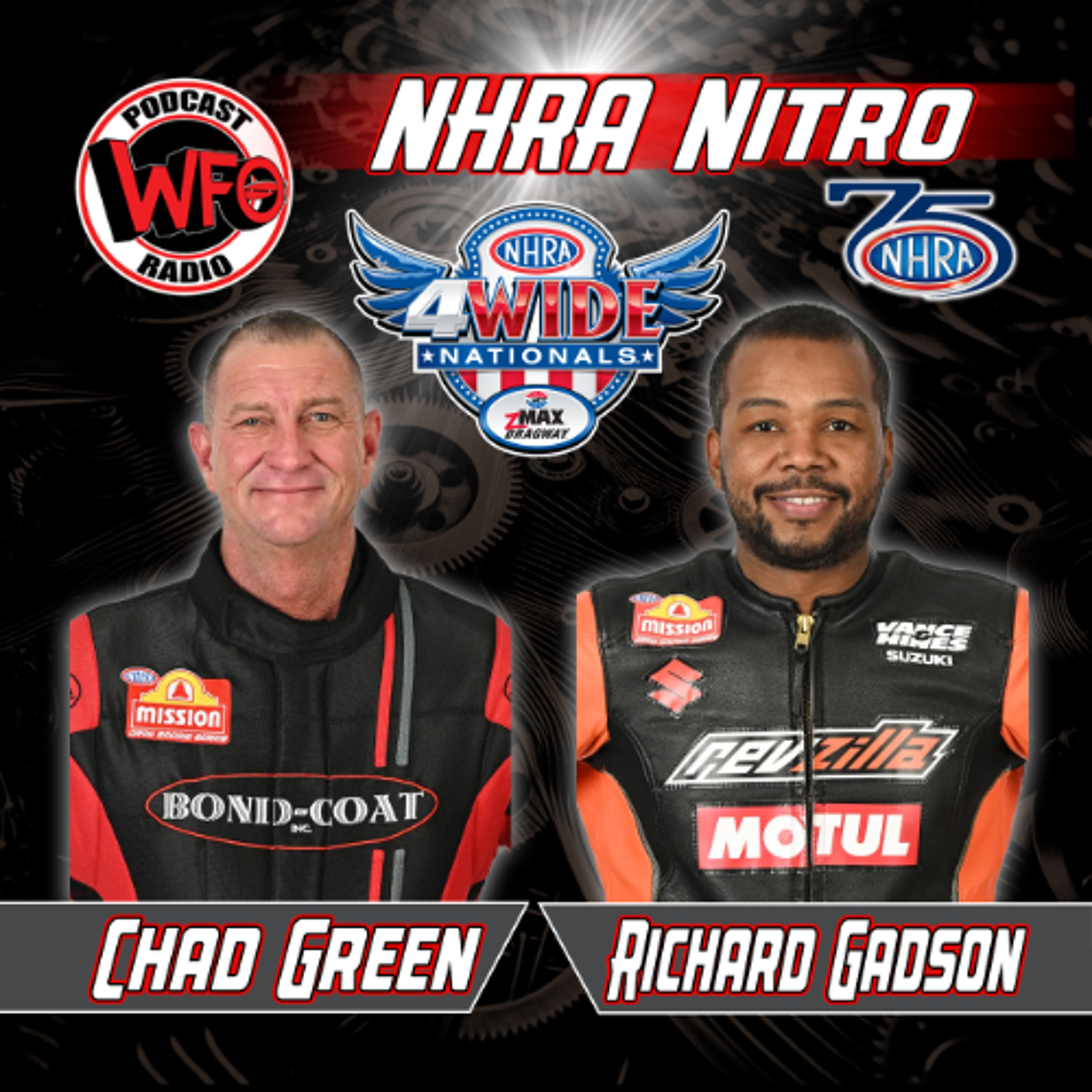
Chad Green and Richard Gadson go WFO before NHRA in Charlotte, NC
About this episode
Chad Green and Richard Gadson headline a WFO Radio build-up to NHRA’s Charlotte return, with talk spanning Funny Car and Pro Stock Motorcycle. Green celebrates back-to-back Golden Gator/Gator Nationals success, the “all-in” approach to his team, and new partners like Beepro Auto plus sponsor-driven self-funding. Gadson, the reigning champ, breaks down Gainesville momentum, reaction-time trends, and the emotional aftermath of the final—plus his Big Brothers Big Sisters work. The show also debates Pro Stock’s new RPM parity shift (Dodge/Ford to 11,000 vs Chevy 10,500) and what it could mean for competitiveness.
NHRA
"Chad Green and Richard Gadson go WFO before NHRA in Charlotte, NC [328.0s] And it was weird, even on race day, you know, as we started going through the rounds,"
NHRA is the big organization that runs drag races in the U.S. Teams compete at events, race head-to-head, and their results help determine their season standing.
NHRA (National Hot Rod Association) is the major U.S. drag racing sanctioning body. It organizes events where teams race in elimination rounds based on elapsed time and speed, and points accumulate across the season.
Redline Oil
"Redline Oil, formulated to win, proven by me. Redline Oil, formulated to win. Formulated to win."
Redline Oil is a company that makes engine and other vehicle fluids meant for performance driving. The speaker is basically saying they trust it because it works well when the car is pushed hard.
Redline Oil is a performance-focused lubricant brand that markets its products as optimized for high-stress driving and racing use. In the context of this NHRA/drag-racing episode, the host is emphasizing that the oil is designed to maintain performance under heat and load.
diesel oxidation catalyst
"Looking to replace your OEM diesel particulate filter or diesel oxidation catalyst? Look no further than DPFXfit, a complete line of aftermarket diesel particulate filters and diesel oxidation catalysts designed as an exact fit OEM replacement..."
A diesel oxidation catalyst is an exhaust treatment that helps clean up diesel fumes. It works by using a catalyst to help convert some of the harmful stuff in the exhaust into less harmful emissions.
A diesel oxidation catalyst (DOC) helps reduce harmful exhaust components by using a catalyst to promote chemical reactions in the exhaust stream. It’s often used alongside a DPF to improve overall emissions performance.
diesel particulate filter
"Looking to replace your OEM diesel particulate filter or diesel oxidation catalyst? Look no further than DPFXfit, a complete line of aftermarket diesel particulate filters and diesel oxidation catalysts designed as an exact fit OEM replacement..."
A diesel particulate filter is a part that catches the smoky soot from a diesel exhaust. Over time it needs to clean itself out (regenerate) so the engine can keep running and meeting emissions rules.
A diesel particulate filter (DPF) traps soot (particulate matter) from a diesel engine’s exhaust. It periodically burns off the collected soot through a regeneration process to keep emissions under control.
DPFXfit
"Look no further than DPFXfit, a complete line of aftermarket diesel particulate filters and diesel oxidation catalysts designed as an exact fit OEM replacement..."
DPFXfit is a company that sells replacement exhaust emissions parts for diesel trucks. They’re advertising filters and catalysts that are meant to install like the original equipment parts.
DPFXfit is an aftermarket supplier offering diesel particulate filters and diesel oxidation catalysts intended to fit like OEM parts. The ad emphasizes an “exact fit” replacement approach and a reverse lookup tool to match the correct unit.
OEM replacement
"...diesel oxidation catalysts designed as an exact fit OEM replacement with all makes coverage..."
An “OEM replacement” part is made to work like the original factory part. The goal is that it fits correctly and functions the same way in the emissions system.
“OEM replacement” means the aftermarket part is designed to match the original equipment manufacturer’s fitment and function. In practice, that usually implies similar mounting points, inlet/outlet sizing, and emissions-system compatibility.
ZMAX Dragway
"...we are getting ready for ZMAX Dragway. That is right. NHRA headed to Charlotte, North Carolina..."
ZMAX Dragway is the drag strip in the Charlotte area where NHRA races happen. The hosts are excited because it’s a big event for fans.
ZMAX Dragway is the Charlotte-area NHRA venue where the episode says they’re headed. It’s a key location for drag-racing events, and the hosts treat this as a major annual stop.
top fuel dragsters
"...23 pro mod cars, got 19 top fuel dragsters. So going to be very exciting..."
Top Fuel dragsters are the fastest, nitro-fueled dragsters in NHRA. They’re famous for huge power and dramatic runs down the strip.
Top Fuel Dragsters are NHRA’s nitro-fueled dragsters in the highest-profile class. They’re known for extreme acceleration and are powered by nitromethane, which is why the episode emphasizes “NHRA Nitro.”
pro mod
"...21 pro stockers, 23 pro mod cars, got 19 top fuel dragsters. So going to be very exciting..."
Pro Mod is a drag racing class where the cars are heavily modified for speed. The hosts are pointing out how many of these cars are expected to show up.
Pro Mod is a drag racing class known for altered, highly modified vehicles designed for maximum performance. The hosts mention the expected number of Pro Mod entries as part of the excitement for the Charlotte stop.
hood scoops
"We heard about hood scoops last week. This week, 11,000 RPM for the Dodges and the Fords."
A hood scoop is a raised opening on the hood that helps direct air where it’s needed. In racing, changing hood scoop rules can change how teams cool the engine and how they shape airflow for speed.
Hood scoops are aerodynamic and cooling features mounted on the hood that can help manage airflow to the engine bay. In Pro Stock, rule changes around hood scoops can affect how teams package intake and cooling, which can influence performance and how the car meets the regulations.
11,000 RPM
"This week, 11,000 RPM for the Dodges and the Fords. Chevy stays at 10.5."
RPM is how fast the engine spins. In drag racing rules, setting an RPM limit changes how hard teams can rev the engine, which affects how they tune and race the car.
RPM limits are a key Pro Stock rule because they directly constrain engine speed and therefore power potential and shift/launch strategy. Here, the hosts say Dodges and Fords are getting an 11,000 RPM allowance, while Chevy remains at 10.5, highlighting a manufacturer-by-manufacturer rule change.
pro stock
"Chevy stays at 10.5. What does that mean? It is a fundamental change to pro stock. Pro stock is no longer a non parody category."
Pro Stock is a type of drag racing where cars are built to race as fast as possible, but they still have to follow a rulebook. In this segment, they’re saying the rules are changing in a big way, so teams can adjust things more than before.
Pro Stock is a drag racing class where teams build purpose-built cars to compete under strict rulebooks. The discussion here is about how the rules are changing—especially engine RPM limits by manufacturer—so the class is becoming more flexible and more like other pro categories where teams can develop within the regulations.
non parody category
"Pro stock is no longer a non parody category. It's like, you know, the rules makers can make changes like they do in pro stock motorcycle."
In drag racing, some classes are meant to stay closer to what you’d find on regular cars. They’re saying Pro Stock is moving away from that “keep it similar” approach, so teams can change more things.
“Non-parody” in drag racing refers to a category where cars are expected to be closer to their production-based roots and not wildly different in design. The hosts are saying Pro Stock is moving away from that idea, meaning manufacturers/teams will be allowed to make more meaningful changes to how the cars are built and tuned.
Larisse Motorsports Insurance
"But how about the folks at Larisse Motorsports Insurance? If you're interested in ensuring your racing equipment is very important."
Larisse Motorsports Insurance is a company that helps racers insure their gear. Regular insurance often doesn’t cover racing, so specialty coverage can fill those gaps.
Larisse Motorsports Insurance is a sponsor mentioned as providing coverage for racing equipment. For racers, specialty insurance can matter because standard policies often exclude track use or racing-related losses.
Total Seal piston rings
"Total seal piston rings got a brand new episode of Hidden Horsepower with Sandy Wilkins. Guy worked at Roush Yates. Last time we were at Zmax. He won top sportsmen."
Total Seal is a performance-focused brand known for piston rings, which are critical for sealing combustion pressure and controlling oil consumption. The segment ties Total Seal to an episode about “ring seal,” indicating they’re discussing how ring design and fitment affect engine performance in racing.
Roush Yates
"Total seal piston rings got a brand new episode of Hidden Horsepower with Sandy Wilkins. Guy worked at Roush Yates."
Roush Yates is a well-known racing engine and team organization referenced here via a guest’s background. In drag racing, engine builders and teams like this are often central to performance because they develop and maintain the powerplant and calibration strategies.
ring seal
"Go watch that episode. You'll learn a whole lot about ring seal. Thanks to the folks at Total Seal."
Ring seal refers to how well piston rings seal the combustion chamber to maintain cylinder pressure and prevent blow-by. In racing engines, improved ring seal can support better power, efficiency, and consistency by reducing leakage and controlling oil use.
FTI Performance Transmissions
"Shout out to the fine folks at FTI Performance Transmissions and Torque Converters. Still doing their tax day special."
FTI Performance Transmissions builds racing transmissions. In drag racing, the transmission helps the car launch correctly and shift at the right time to keep the engine making power.
FTI Performance Transmissions is a sponsor associated with racing transmissions. In drag racing, transmission setup (including gearing and shift behavior) is a major part of getting the car to launch and stay in the power band.
Torque Converters
"Shout out to the fine folks at FTI Performance Transmissions and Torque Converters. Still doing their tax day special."
A torque converter is part of an automatic setup that helps the car get moving from a stop. It can help the engine stay in the right RPM so the car accelerates harder.
Torque converters are fluid couplings used in automatic-style drivetrains to multiply torque at launch and allow the engine to stay in its effective RPM range. The sponsor mention suggests converter selection and tuning are important for the racing setup being discussed.
Redline Synthetic Oil
"Of course, Redline Synthetic Oil, our friends at HussiePerformance.net, Frank Holley's Foggett, Marvin Rodak and Bernie's Speed Shop."
Redline Synthetic Oil is mentioned as a sponsor providing engine oil. In high-stress racing conditions, oil choice affects lubrication, heat management, and engine wear, especially when engines see sustained high RPM.
Gator Nationals
"back to back. It's hard to win the Gator Nationals or any race back to back years. And yet you did it. Congratulations, Chad."
The Gator Nationals is a drag racing event in Florida. Winning it two years in a row is a big deal because drag racing is tough and unpredictable.
The Gator Nationals are a well-known NHRA drag racing event held in Gainesville, Florida. Winning back-to-back years is especially difficult because the competition is deep and conditions can change from race to race.
HRA TV
"But I watched on an HRA TV and you guys kept me sane in those moments, watching you guys go on and go back to back."
This sounds like a TV broadcast they were watching while the race was happening. The exact channel name is unclear, but the point is they followed the racing coverage from home.
“HRA TV” appears to be a transcription error for a drag-racing broadcast channel (likely NHRA-related coverage). The key idea is that the guest watched the races on TV while dealing with family stress.
Gainesville Raceway
"What is it about Gainesville Raceway and Dean and Joe and you that you first race of the season? That's a big one to win... but I really like that track."
Gainesville Raceway is the drag strip where this event happens. Some racers just seem to do well there because the track works with their setup and driving style.
Gainesville Raceway is the track where the Gator Nationals are run, and it’s known for being a favorite venue for many NHRA competitors. Track characteristics like traction and consistency can strongly influence how well a team performs.
points going forward for the rest of the year
"[353.1s] everyone's the same. Everyone's zero points after the first race. [357.0s] That kind of sets the points going forward for the rest of the year."
In NHRA-style seasons, early results matter because points earned after the first race set the baseline for everyone. Getting a strong finish early can create a points advantage that teams try to maintain through later events.
get into the semis
"[360.1s] So it's a huge advantage to, you know, at least try and get into the semis, [364.9s] get into the top four so you can start the year out on a good pace."
“Semis” refers to the semifinal round in drag racing elimination brackets. Advancing that far typically means the team has won multiple head-to-head races, which also improves their season points and momentum.
tuning two cars
"[385.2s] And you got them and now they're tuning two cars [388.7s] with a body difference basically between the two of them."
“Tuning” in drag racing means calibrating the car’s setup—such as engine management, fuel/air delivery, and chassis settings—to match track conditions and maximize performance. Tuning two cars suggests the team is managing similar goals while adjusting for differences between the vehicles.
body difference
"[385.2s] And you got them and now they're tuning two cars [388.7s] with a body difference basically between the two of them."
A “body difference” implies the two cars have different exterior bodies or aerodynamic packages, which can affect airflow, weight distribution, and how the car behaves at speed. Even with similar powertrains, teams often need different setups to account for those differences.
fun and car racing
"So, yeah, the plan once I decided to eventually go fun and car racing, which I was lucky enough to get that opportunity."
They’re basically saying they stopped treating racing like a hobby and started treating it like a real job. That usually means more practice, better parts, and a team focused on winning.
The speaker frames a shift from casual involvement to full-time commitment to racing. In motorsports, that usually means investing in a dedicated team, testing, parts, and logistics so the car can be competitive consistently.
full time
"we want to do this full time and we want to be competitive."
“Full time” here implies the team operates like a professional operation rather than a part-time hobby. For drag racing, that typically translates to more frequent track testing, faster turnaround on repairs, and better preparation for each event.
competitive team
"we want to be a professional competitive team. And that's our goal."
A competitive team is one that can keep the car performing well every time it runs. It’s not just speed—it’s also making sure the car stays consistent and doesn’t break.
A “competitive team” in drag racing is one that can consistently qualify well and make it through elimination rounds. That requires coordinated tuning, strong crew execution, and parts reliability so the car performs the same way run after run.
final round
"So that final round, when when you're going to go up against Alexis out there"
The final round is the last stage of the event. The cars that are still in it race to decide who wins, so everything has to work perfectly.
“Final round” refers to the last elimination stage of a drag racing event, where the remaining cars race for the win. Performance and reliability matter most here because there’s no room for mistakes.
John Force racing car
"...she's got a great year, this great opportunity this year, you know, with John Force racing. And, you know, anytime you go up against any driver in a John Force racing car, you've got your hands full..."
John Force Racing is a famous drag-racing team. If you’re in one of their cars, you’re typically dealing with a very experienced crew and a car that’s been dialed in for races.
John Force Racing is one of the most prominent teams in NHRA drag racing, known for high-powered, purpose-built funny cars and a deep history of success. When a driver says they’re racing in a John Force Racing car, it usually implies a top-tier team with proven setup, data, and race-day execution.
Charlotte
"like in this week leading into Charlotte, I want more people to know you, Chad."
They’re talking about getting ready for an event in Charlotte, North Carolina. It sets the scene for what kind of racing and pressure they’re heading into.
Charlotte, North Carolina is a major hub for motorsports and is commonly associated with NHRA events. In this segment, “leading into Charlotte” signals the timing and competitive context for the discussion.
drag racing
"And the sport of drag racing, but as a funny car racer, that's a crazy thing to do in general. So it does take a quiet confidence and an open confidence. But you're out there to whip everybody."
Drag racing is racing where cars line up and race straight down a track to see who accelerates the fastest. It’s not just about horsepower—launching and getting traction are huge.
Drag racing is a motorsport focused on straight-line acceleration over a short distance, typically with cars staged and launched from a standstill. Strategy and preparation matter as much as raw power because traction, reaction time, and consistency determine who wins.
funny car racer
"And the sport of drag racing, but as a funny car racer, that's a crazy thing to do in general."
In drag racing, a “funny car” is a special type of race car. It looks like a regular car from the outside, but it’s built to go extremely fast in a straight line for a short race.
“Funny car” is a drag racing class where cars run short, intense acceleration passes while using a lightweight body that resembles a production car. The key idea is that the body is more “show” while the underlying chassis and powertrain are purpose-built for drag racing performance.
Ford Bronco
"[696.7s] I mean, I can't say enough about my business, [699.2s] my people back home here, Bronco and my business."
“Bronco” usually means the Ford Bronco SUV. Here, it sounds like it’s tied to the speaker’s business or background, not necessarily the race car they’re driving.
“Bronco” is most commonly used to refer to the Ford Bronco, a popular SUV. In this segment, it’s mentioned alongside the speaker’s business, suggesting it’s part of their personal brand or company name rather than a specific drag-racing vehicle setup.
funny car racing
"“as you kind of go down this journey of funny car racing, it seems to me… but you're figuring out what you need to do.” … “And this whole deal… our new new partners, Beepro Auto.”"
Funny car racing refers to a specific class in drag racing where purpose-built cars run high power with a short wheelbase and distinctive bodywork. The “evolution” they mention is about how teams grow—building their own support system, sponsors, and crew to move up the ladder.
sponsors
"“I need to have my own guys. I need to find my own sponsors.” … “Tell me about the guys at Beepro Auto…”"
Sponsors are businesses that help pay for a racing team. They usually get their name or branding associated with the team, and the team gets money or parts to keep racing.
Sponsors are companies that provide financial support or products/services in exchange for marketing exposure and association with the team. In drag racing, sponsorship is often essential for covering costs like travel, crew needs, and ongoing car development.
Beepro Auto
"“Tell me about the guys at Beepro Auto and what will be happening with them this weekend in Charlotte.” … “Yeah, let me just talk about our new new partners, Beepro Auto.”"
Beepro Auto is a company the racing team is working with for the event. Racing teams often team up with partners to help pay for the season and support the car so they can show up ready to run.
Beepro Auto is mentioned as a new partner supporting the team for an upcoming funny car event in Charlotte. In motorsports, partner involvement often means resources like sponsorship dollars, parts support, or services that help the team prepare and compete.
Epping
"I mean, they've come on as associate and their their first primary sponsor race is going to be Epping. So we're really looking forward to Epping and having them out."
Epping is mentioned as the first primary sponsor race for the new company partnership. In NHRA context, this refers to an upcoming event location/date where sponsors can activate and reach the drag-racing audience. The hosts use it to set expectations for guests and brand exposure.
Stalantis
"And, you know, it's got it was started in its own by Stalantis. So it's they've got big backing."
Stellantis is the big parent company behind several car brands. The hosts say Beepro was started with that kind of support, meaning it likely has more resources than a typical small aftermarket startup. That can affect how quickly the company grows and how widely its parts get sold.
The transcript appears to refer to Stellantis (misspelled as “Stalantis”), the parent company behind multiple automotive brands. The hosts say Beepro was started within this corporate structure and has “big backing,” which implies strong resources for product development and aftermarket distribution. This matters because aftermarket brands often leverage shared engineering and supply chains.
Mopar
"They wanted to differentiate differentiate themselves from Mopar a little bit, even though they've got the same backing, the same engineers that are producing these parts."
Mopar is referenced as a benchmark brand within the Stellantis ecosystem. The hosts explain that Beepro is trying to differentiate itself from Mopar, even though both are supported by the same parent backing and engineering resources. This highlights how aftermarket brands can share technical roots but compete on branding and product positioning.
Ford Mustang
"Speaking of which, you got a Dodge and you got a Mustang, two different funny car bodies under the camp... I know you're in the Mustang."
They’re also running a Mustang-shaped funny car. In drag racing, the outside body can change, but the team tries to keep the car setup the same so they can compare how the body affects tuning.
The Mustang mentioned here refers to a Ford Mustang funny car body in drag racing. The key idea is that the team can run different body styles while keeping the underlying setup consistent, then evaluate whether the body shape changes tuning or performance.
funny car bodies
"Speaking of which, you got a Dodge and you got a Mustang, two different funny car bodies under the camp... we set our cars up the same. We take them the same. Everything is the same."
A funny car uses a special race body that’s made to look like a car you’d recognize. Teams can swap body styles, and they’re basically asking whether the shape changes how the car behaves and needs tuning.
“Funny car bodies” refers to the interchangeable outer body shells used on NHRA funny cars. Teams may run different body shapes (like Mustang vs Dodge) while trying to keep the car setup the same, because the body can affect aerodynamics and how the car responds during a run.
hot pit area
"You chose to go out to the hot pit area and drag race because of a reason. And that's and that's whatever it is. So the reason we all show up there every week."
In drag racing, the “hot pit” area is the busy area where teams work right around the time cars are getting ready to race. It’s where you’ll see last-minute checks and prep between runs.
The “hot pit” area is where teams and crew work close to the action during a drag racing event. It’s typically a more active, time-sensitive zone compared with general spectator areas, because cars are staged, prepped, and serviced between runs.
Flying H
"Talk a little bit about Scott from Flying H and Logan Industries. He has been a partner for you guys over the past couple of seasons... Scott Higgs, Logan Industries. He also owns a Flying H race track."
Flying H is the name of a racing-related business/track that the guest Scott is associated with. The hosts mention it as part of the support system behind the team.
Flying H is referenced as a race-track owner/partner connected to Scott Higgs. In this context, it’s part of the team’s sponsorship and support network leading into drag racing.
Scott
"[1221.2s] And he's helped a lot of people out and he's just a great guy. ... [1260.6s] and infuse us with a decent amount of money like Scott has done [1264.4s] and like the pros doing going forward."
They’re talking about Scott as someone who’s been helping and sponsoring the team. In racing, that kind of support can help pay for upgrades and getting ready to compete.
“Scott” is referenced as a person who has helped the team and as a sponsor providing funding. In drag racing, individual sponsors can be crucial for covering the costs of making the car faster and more competitive.
Logan Industries
"...if you if you definitely need any any type of utility [1230.8s] bed for your pickup for your work, you know, the Logan Industries, [1234.7s] that's the place to go to get it there."
They’re talking about Logan Industries as a company that sells utility beds for pickup trucks. If you’re working on cars or hauling gear, a utility bed can make your truck more useful.
The hosts mention Logan Industries as a source for utility beds for pickup trucks. In a drag-racing context, these kinds of truck accessories matter because teams often need reliable transport and equipment hauling.
Dacia Logan
"... bed for your pickup for your work, you know, the Logan Industries, that's the place to go to get it ther..."
The Dacia Logan is a low-cost car meant to get you from place to place without expensive features. It’s built to be practical and straightforward. In the podcast, it’s referenced more for the name than for truck-like capability.
The Dacia Logan is a practical, budget-oriented compact sedan that’s often chosen for affordability and basic transportation needs. It’s frequently associated with “value” because it’s designed to be simple to own and maintain compared with more expensive cars. In the podcast context, it’s referenced as part of a “Logan Industries” wordplay around getting a “pickup for your work.”
self funded team
"...these sponsors like Scott, B Pro. [1250.8s] As you said, I am, you know, a big percentage self funded team. [1256.6s] So whenever we get these these sponsors that can come on board"
A “self funded team” means the race team pays for most of its own operating costs rather than relying on a major factory or large corporate backing. That makes sponsorship money especially important because it directly improves the team’s ability to compete.
B Pro
"...going back to, you know, [1247.2s] these sponsors like Scott, B Pro. [1250.8s] As you said, I am, you know, a big percentage self funded team."
B Pro is mentioned as one of the sponsors supporting the team. Sponsorships like this are common in grassroots drag racing, where outside funding can cover parts, travel, and track time.
track
"And I've seen that track when it was just gravel. And you've raced there. You've run your car on it. What was it like? Fine H."
They’re talking about the race track itself—how it used to be and how it is now. The surface (like gravel vs. proper racing pavement) affects grip, so it changes how the car launches and how consistent the runs feel.
The hosts are describing a specific drag strip’s evolution and what it was like to race there in different conditions (e.g., when it was gravel). Track surface and preparation can dramatically change traction, consistency, and how repeatable a car’s runs are.
fastest mile per hour and quickest CT
"Well, that was a really cool experience to just to be able to go in. And I could actually say I hold the record, the Missouri state record for the fastest mile per hour and quickest CT."
They’re bragging about record numbers from race runs. One is about how fast the car gets (mile-per-hour speed), and the other is about how quickly it can complete the run (a time-based record).
They’re talking about two performance metrics: top speed measured over a mile per hour and a “quickest CT” time. In drag-racing culture, these kinds of records usually come from timing runs that measure how quickly the car completes a set distance and how fast it reaches peak speed.
Missouri state record
"And I could actually say I hold the record, the Missouri state record for the fastest mile per hour and quickest CT. So that was really cool."
Holding a “Missouri state record” means the driver’s performance is the best recorded in that state for a specific category (here, fastest mile-per-hour and quickest CT). State records matter because they’re often tracked by sanctioning bodies and can be used to qualify or build credibility in the racing community.
doctor cars
"So that was really cool. And to be the first tracks, I mean, the first cars to doctor cars to be able to run down that track."
“Doctor cars” here means getting the car dialed in so it runs better. It’s like doing the right tweaks and repairs so the car can perform at its best on that track.
“Doctor cars” is drag-racing slang for making cars perform better by tuning, setup changes, or mechanical work to improve results. The phrase suggests they were among the early teams to refine cars specifically for that track’s conditions.
laid down some really good leaks
"And we actually went out there and laid down some really good leaks that night. The fans went crazy. They'd never seen nothing like it."
They’re saying they made some really strong runs that night. The crowd reacted because the results were impressive.
In drag racing, “leaks” is likely a mishearing of “leaves” or “leads,” but the context (“fans went crazy,” “good stuff happened,” “run down that track”) indicates they’re describing strong performance during runs. The key idea is that they made impressive passes that drew attention.
South Georgia Motorsports Park
"Seventy fifth season of the NHRA will be going to South Georgia Motorsports Park the following week. Kind of a small event, NHRA, small form factor."
South Georgia Motorsports Park is another race track they’re planning to visit soon. They’re excited because smaller venues can feel more packed and energetic.
South Georgia Motorsports Park is a racing facility in the NHRA schedule mentioned by the hosts as the following week. The discussion frames it as a smaller event that still creates a strong atmosphere.
world champion
"World champion Richard Gadsden going to be joining us seconds from now... World champion, baby."
When they say “world champion,” they mean the rider has won at the top level in their racing category. It usually takes a lot of consistent results, not just one good run.
“World champion” is used here as a shorthand for the highest level of achievement in the relevant racing discipline. In motorsports, that title usually implies consistent performance across a season and/or major events, not just one standout race.
gaskets
"If you're in the racing game, if you need parts and pieces [1500.8s] and you're looking for gaskets, as everyone does... All sourced right here in the United States of America."
A gasket is like a heat-resistant seal that stops leaks between engine parts. In racing, engines get very hot and put a lot of pressure on those seals, so the gasket has to handle it reliably.
In racing and high-heat engines, gaskets seal critical joints so combustion gases, oil, and coolant don’t leak. The right gasket material and thickness can help maintain consistent sealing under boost, nitro, or extreme cylinder pressures.
engine friction
"The number one source of friction in your engine is not what you think. [1553.9s] Piston rings rubbing against the cylinder walls generate more friction [1556.8s] than any other part of the engine. [1558.6s] More friction and temperature means more wear and less horsepower."
Friction inside an engine wastes energy and turns it into heat. More heat usually means parts wear faster, and the engine can lose power as things degrade.
The segment argues that friction losses can be dominated by piston ring-to-cylinder contact rather than other perceived sources. Higher friction raises operating temperature, which increases wear and can reduce power output over time.
MacLeod
"We've joined forces with MacLeod on driveline components under the leadership of top fuel funny car pilot Paul Lee and now have a larger distribution network..."
MacLeod is a company they teamed up with for parts that help move power from the engine to the drive wheels. In drag racing, those parts have to survive huge stress during launches and hard acceleration.
MacLeod is mentioned as a partner working on driveline components. In drag racing, driveline components are critical because they transfer engine power to the wheels reliably under extreme loads.
driveline components
"We've joined forces with MacLeod on driveline components under the leadership of top fuel funny car pilot Paul Lee..."
Driveline components are the parts that carry power from the engine to the drive wheels. In drag racing, they take a beating during launches, so stronger or better-matched parts can help the car perform more reliably.
Driveline components are the parts that transmit power from the engine to the wheels—typically including the transmission, driveshaft, differential, and related hardware. In drag racing, these components are heavily stressed by hard launches and high torque, so upgrades can improve durability and consistency.
competitive edge
"It's not cheating. It is the competitive edge. Drag racing fans, check out Drag Race Bracket Bonanza."
A “competitive edge” means having an advantage over other competitors. In racing, even small improvements can help you go faster or be more consistent when it matters.
“Competitive edge” is the idea that small advantages—like better parts, better setup, or smarter strategy—can meaningfully improve results in racing. In motorsports, the margin is often tiny, so teams look for any advantage that improves consistency and performance.
Drag Race Bracket Bonanza
"Drag racing fans, check out Drag Race Bracket Bonanza. It's the free family friendly fantasy bracket game. Now, after your final qualifying at every national event, you can fill out your bracket for all the pro classes."
Drag Race Bracket Bonanza is a fan game where you pick winners in drag racing brackets. You fill out your picks after qualifying at events, and it’s meant to be fun and interactive.
Drag Race Bracket Bonanza is described as a bracket-picking game for drag racing fans. The hosts frame it as a way to stay engaged by selecting winners after qualifying at each national event.
U.S. Nationals
"It's like the U.S. Nationals, the Gator Nationals, and you got a couple of Pomona World Finals..."
The U.S. Nationals is one of the biggest and most prestigious NHRA drag races. People talk about it like the “main event” of the season.
The U.S. Nationals is NHRA’s flagship drag racing event, traditionally held at Lucas Oil Raceway at Indianapolis. It’s often treated as the sport’s most prestigious race, similar to how major motorsports fans view Indy 500/Le Mans in their categories.
Pomona World Finals
"...and you got a couple of Pomona World Finals, but the Gators is one of those races."
Pomona World Finals is the NHRA’s big end-of-season event in California. It’s when the season’s winners are basically decided.
Pomona World Finals refers to the NHRA season-ending championship events held at Auto Club Raceway in Pomona, California. It’s where champions are decided, so it’s a high-stakes part of the year for teams and drivers.
Gainesville Q1
"This Q1 is gonna feel like Gainesville Q1 to me. It's been six or seven weeks..."
Q1 means the first qualifying runs of the event. They’re saying the first qualifying session here will feel like the first qualifying session at Gainesville.
“Q1” is shorthand for the first qualifying session in NHRA event format. The speaker compares the upcoming first qualifying at this race to Gainesville’s Q1, implying similar nerves/energy and similar early-season conditions.
No testing
"No testing, nothing. Just kind of find it hard to believe that Andrew and Eddie are just gonna sit idle..."
“No testing” means they didn’t get extra practice runs before the race. That can make it harder to dial in the car, especially for launch and traction.
“No testing” means the team isn’t doing track runs or setup sessions before the event. In drag racing, skipping testing can increase uncertainty because launch/traction and tune changes are often refined through practice passes.
Testing results posted by Matt and Angie
"And you know that Matt and Angie have been posting some of their testing results. That got me excited..."
They’re talking about posting test results from their practice runs. Sharing those numbers helps the team figure out what’s working and what to adjust.
The hosts reference Matt and Angie posting testing results, which suggests a data-driven approach to race prep. Sharing metrics like launch performance helps the team iterate faster between events.
60 foot times
"Angie is not afraid to kind of get out there and say, hey, look at the CT's lip, look at our 60 foot times. We're getting to where we need to be."
In drag racing, “60-foot times” measure how fast the car gets down the track’s first 60 feet. A better 60-foot time usually means the car launched well and hooked up to the track.
“60-foot times” refers to how quickly a drag car accelerates over the first 60 feet from the start line. It’s one of the most important early-run metrics because it reflects launch quality, traction, and drivetrain setup.
CT's lip
"Angie is not afraid to kind of get out there and say, hey, look at the CT's lip, look at our 60 foot times."
“CT’s lip” likely refers to a specific aerodynamic or body component on the car—often a lip/edge on the front fascia or splitter area. In drag racing, small aero and clearance details can affect airflow, stability, and how the car behaves under load.
103s or fours
"And I've seen a rat torno go some 103s or fours. 1866.0s And you know, I knew that it could be done."
When racers say “103s or fours,” they mean the run time is around 10.3 or 10.4 seconds. Faster times usually mean the car/bike is making more effective power and/or launching better.
“103s or fours” is shorthand for elapsed times in the 10.3-second or 10.4-second range, which are common ways drag racers talk about performance. It refers to how long it takes to cover the quarter-mile (or the event’s measured distance), and it’s used to gauge how competitive a setup is.
stretch run
"we can have you guys down the stretch run, which is I think more important."
The “stretch run” is the last part of the drag strip where the car is really pushing toward the finish. The hosts are saying that part is especially important.
In drag racing, the “stretch run” is the final portion of the track where cars are still accelerating hard and drivers are trying to maximize performance to the finish line. The hosts are saying they value having the audience/crew present for that critical end-of-run phase.
super street racing
"[1967.0s] just because I am curious. [1968.8s] Doing my little super street racing [1970.2s] every once in a while, I felt that experience."
“Super street racing” here seems like a more casual, street-inspired racing scene. The point is that it’s busy and you can’t watch every detail at the same time.
“Super street racing” sounds like a reference to street-style racing events or a bracketed format that’s more accessible than top-tier pro drag racing. The key idea is that the announcer is describing how hard it is to track everything happening at once during racing.
Nitro ranks
"[1988.0s] What has interested you in the Nitro ranks [1992.3s] so far this season? [1993.8s] You got to watch Arizona."
“Nitro ranks” means the drag racing classes where the cars run nitromethane fuel. Those cars are tuned for that fuel, and how well they launch and stay consistent matters a lot.
“Nitro ranks” refers to the NHRA/drag racing classes where cars run nitromethane fuel. These cars typically use specialized engines and fuel systems, and the racing strategy is heavily influenced by traction and tuning rather than just horsepower.
Arizona
"[1992.3s] so far this season? [1993.8s] You got to watch Arizona. [1994.9s] You got to watch Pomona."
They’re saying you should pay attention to the races happening in Arizona. Different tracks can make cars behave differently, so it’s worth watching.
Arizona is referenced as a place to watch during the season, implying an NHRA event stop. In NHRA coverage, each venue has its own track conditions that can affect traction and tuning.
340
"is Brittany was going 340 last year. She was pretty much the only car doing that... And then you have a test session in Gainesville. And now all of a sudden, multiple people, like 340..."
“340” is a quick way racers talk about a big performance number—like how fast the car is going or how quickly it runs. When one person hits it and others follow, it suggests the setup or conditions are repeatable.
“340” is a shorthand performance benchmark in drag racing, usually referring to a top speed or elapsed-time class target that teams and fans track. The hosts are describing how one racer’s success at that number (Brittany going 340) made it feel achievable, and then multiple cars started reaching it after a test session.
test session in Gainesville
"And then you have a test session in Gainesville. And now all of a sudden, multiple people, like 340..."
A test session is practice where teams try different setups to see what makes the car faster. The hosts are saying that after a test in Gainesville, more cars were able to hit the same big performance number.
A “test session” is when teams run controlled practice to evaluate changes in tuning, parts, and track conditions before (or alongside) competition. The segment suggests that after a Gainesville test, the performance benchmark (“340”) became more common, implying the test helped teams learn what worked.
tuning strategies
"So you start rethinking tuning strategies or is there something you can hear in our car?"
“Tuning strategies” means how a race team adjusts the car so it runs its best for that track and conditions. If someone suddenly goes faster, other teams may change their settings to try to copy what’s working.
In drag racing, “tuning strategies” refers to the setup choices that affect how a car performs under nitro or other race fuels—things like fuel delivery, timing, and traction-related adjustments. When more racers hit a new benchmark (like 340), teams often revisit their baseline tune to see what changed in the combination of parts and calibration.
Nitro cars
"I don't tune Nitro cars or I'm not into pits,"
A “nitro car” is a drag-racing car that runs on nitromethane fuel. Because it burns differently than regular fuel, the engine needs special setup to make power and stay consistent.
“Nitro cars” are drag racers that use nitromethane fuel, which changes how the engine makes power compared with gasoline. Nitro engines typically require specialized tuning and fuel/air management, and small setup differences can have big effects on speed and consistency.
Nitro classes
"But what's really cool is, is for me right now, paying attention to the Nitro classes are the reaction times."
Nitro classes are drag-racing categories that run on nitromethane fuel. These cars are famous for huge acceleration and the loud, dramatic way they launch and pull.
“Nitro classes” refers to NHRA categories that use nitromethane fuel, most notably Top Fuel and Funny Car. Nitro cars are known for extreme acceleration and distinctive sound/behavior because nitromethane allows much more fuel energy to be burned per cycle than gasoline.
reaction times
"But what's really cool is, is for me right now, paying attention to the Nitro classes are the reaction times. And that's the same thing like the 340 mile an hour run."
Reaction time is how fast the driver reacts when the race starts. If you’re quicker off the line, you can get a head start and often win even if both cars are fast.
In NHRA drag racing, reaction time is how quickly the driver launches after the starting signal. Faster reaction times can make a big difference even when top speed and elapsed time are close, because they affect the car’s position throughout the run.
reaction time used to be average versus what is now
"It's like Justin Ashley came out and Austin Proc came out and they started going, I'd say 60 or better, whatever reaction time used to be average versus what is now."
The speaker is describing how reaction times in nitro drag racing have improved over time, moving from “average” to consistently faster numbers. In competitive racing, once one team proves a new benchmark, others chase it with better staging, tuning, and driver consistency.
Justin Ashley
"The Justin Ashley 25, 25, 25 in a top field dragster reaction time, he backed up in the final round to a 36 or something like that."
Justin Ashley is a famous drag racer. The hosts are mentioning him because his results—like quick launches—are a sign of how competitive the team is.
Justin Ashley is a well-known NHRA drag racer, associated with top-level dragster competition. When the hosts cite his reaction-time numbers, they’re highlighting performance from a proven front-runner.
backed up
"The Justin Ashley 25, 25, 25 in a top field dragster reaction time, he backed up in the final round to a 36 or something like that."
“Backed up” means they did it again—like proving the good run wasn’t just luck. In racing, doing well more than once is a big deal.
In drag racing talk, “backed up” means the driver repeated a strong performance in a later round, confirming the earlier result wasn’t a fluke. Consistency across rounds is especially important in eliminations where conditions and track grip can change.
number two qualifier
"I'm feeling like you probably want to be a little safe in that round one as a number two qualifier. Second round, you're going up against Chase Van Zand."
A “number two qualifier” means the driver earned the second-best qualifying position based on their best runs. In eliminations, that seeding affects matchups and can influence strategy—like choosing a safer launch to advance.
grouping
"He's 006, fired a shot, but you're 21. So you got a nice grouping in the semi-finals. Clayton goes red, you're 009."
“Grouping” means the results are consistent from run to run. If your launches are grouped closely together, you’re more likely to know what the car will do in the next round.
In drag racing, “grouping” refers to how consistent a driver’s reaction times and/or elapsed times are across multiple runs. Tight grouping suggests repeatable launch and tune-up, which helps drivers predict performance round to round.
going red
"Clayton goes red, you're 009. I wonder, did Clayton going red have anything to do with you being a little tight there?"
“Going red” in drag racing means the driver fouled at the start by reacting too slowly or too early relative to the timing system. A red-light typically results in an automatic loss for that run, so it’s a major momentum swing in eliminations.
the tree
"I just know what he's capable of on the tree I've been watching. I'm a guy that watches everybody."
The “tree” is the set of lights at the start of the drag strip. Your reaction time is how quickly you launch after the lights signal go.
The “tree” is the starting light system in drag racing that signals when the race begins. Reaction time is measured from the tree, so knowing what someone is capable of “on the tree” means they’re good at timing their launch.
incrementals
"I literally pause it when it comes up to the incrementals. I read our, I take a picture of the run sheets."
In drag racing, “incrementals” are checkpoints along the track. They show how the car is doing early on (like off the line) and later as it builds speed.
In drag racing, “incrementals” are time or speed markers recorded at set distances (like 60 ft, 330 ft, 660 ft, etc.). They help you judge whether a car is reacting well, launching cleanly, and accelerating consistently down the track.
run sheets
"I read our, I take a picture of the run sheets. I know where everybody's at and what they're doing, right?"
A run sheet is basically the event’s schedule and results page. It tells you who’s racing, when they’re racing, and what happened in each run.
A run sheet is the official document listing each racer’s pairing and performance details for a session (qualifying, eliminations, etc.). Fans and crew use it to track who runs when, lane assignments, and results.
qualifying runs
"John, and he went 005 and qualifying too, one of the qualifying runs."
Qualifying runs are the practice-style timed races that decide where you start in the bracket. Doing well in qualifying can help you get better matchups later.
Qualifying runs are the timed passes racers make to earn their starting position for eliminations (the “finals”). Strong qualifying often means better lane choice and matchups, and it also reveals whether the car is consistent.
double low
"But the way I looked at it was, was if he's going to be double low, there's nothing I can do better. Like it's not like, I mean, yeah, you saw in Vegas where I was triple, trip zero gauge is 005."
In drag racing, the “tree” controls the start. “Double low” means someone is reacting so fast that it’s flirting with a false start. The speaker is saying there’s not much you can do to beat that, so you focus on your own safe, consistent launch.
In drag racing, “double low” is shorthand for a driver being extremely close to the tree’s reaction-time threshold (often meaning two consecutive very low/near-foul reactions). The idea is that once someone is that close, there’s limited room for you to “outdo” them with reaction time. It’s a mindset about managing risk around the start line.
trip zero gauge is 005
"Like it's not like, I mean, yeah, you saw in Vegas where I was triple, trip zero gauge is 005. But if somebody's 005, you really can't like bank to be better."
Drag races measure how quickly you launch after the lights. “005” means a reaction time of about five-thousandths of a second, which is basically lightning-fast. The speaker is comparing how close to the limit they were before.
“Trip zero gauge” and “005” refer to reaction-time readings on the drag-race starting system. A “.005” reaction time is extremely fast and typically sits right at the edge of what’s considered legal, depending on the rules and how the timing is measured. The speaker is using it as a benchmark for how aggressive (or risky) their own starts were.
004 times in a row
"But the odds are of him going 004 times in a row are slim to none. My light needs to be green. I need to make a good pass and capitalize on if he isn't double low."
This is still about how fast the car leaves the starting line. “004” means an even faster reaction time than “005,” and doing it multiple times in a row is very unlikely. The speaker expects the other driver’s starts to eventually be less perfect.
“004” is another reaction-time reference—about four-thousandths of a second. Doing that “in a row” implies repeated starts at an extremely aggressive level, which is statistically unlikely. The speaker is arguing that the other driver can’t keep hitting that kind of reaction time repeatedly, so they plan to capitalize on consistency.
My light needs to be green
"My light needs to be green. I need to make a good pass and capitalize on if he isn't double low. You know, that was kind of my mindset."
On the drag strip, you have to launch legally when the tree tells you to. “Green” means you didn’t jump the start. The speaker is saying they need a clean, legal launch before worrying about the rest of the run.
“Light needs to be green” means the car must react legally to the starting tree—no false start/too-fast reaction. In drag racing, being “green” is crucial because an illegal start can cost the run even if the car is fast. The speaker is emphasizing that reaction-time legality is part of race strategy, not just raw speed.
make a good pass
"My light needs to be green. I need to make a good pass and capitalize on if he isn't double low. You know, that was kind of my mindset."
A “pass” is the full drag-race run from launch through the finish line. “Making a good pass” usually implies not just speed, but proper launch, traction, and consistent performance downtrack. The speaker ties it to reaction time and exploiting the opponent’s likely drop in start consistency.
comfort zone on the bike
"I wanted to operate in a safe zone. I kind of have a comfort zone on the bike. I wanted to operate in a safe zone. And if he squeezed in there and he ran me,"
“Comfort zone on the bike” refers to the rider’s preferred setup and launch behavior that they can repeat reliably. In motorcycle drag racing, small changes in throttle, clutch/launch technique, and traction can dramatically affect reaction time and elapsed time. The speaker is describing a strategy of staying within what they know works rather than chasing maximum risk.
first strike
"but I'll take the first strike. Yeah, I like John as well."
In drag racing, “first strike” usually refers to getting the jump off the line—reacting quickly and/or launching first in the tree-to-tree timing sense. It’s a momentum advantage because even small reaction-time differences can decide close races.
red light
"And I think that might be what got John in the final because nobody wants to red light. Nobody wants to red light and this guy to scare you after a while."
A “red light” in drag racing happens when the car starts after the light has already turned red. Even if you go fast, you can still lose because the start was too late. Drivers work on timing their launch so they don’t get caught by the light.
In drag racing, a “red light” means the driver reacted too slowly and illuminated the starting light before the car left the line. It results in an immediate loss (a foul) regardless of how fast the car runs afterward. Reaction time and staging technique are what determine whether you avoid the red light.
full tree racing
"It's almost like in a sense, maybe like full tree racing with no delay box, right? Or maybe even want to delay box."
Full tree racing means the starting lights show the full sequence, not just one signal. You have to time your launch carefully based on the lights to avoid a red light.
“Full tree” refers to using the complete drag-racing starting light sequence (including the amber/yellow stages) rather than a simplified or delayed format. The timing challenge is that you must react precisely to the full set of lights to avoid red-lighting.
delay box
"...maybe like full tree racing with no delay box, right? Or maybe even want to delay box. These bikes are fast enough through the beams..."
A delay box is a gadget racers use to “tune” the launch timing. It can add a controlled delay so the bike/car reacts at the right moment and doesn’t go too early or too late.
A delay box is an aftermarket electronic device used in drag racing to control when the engine/transmission responds after the start signal. It can help manage reaction time and launch timing, especially when the driver is trying to avoid red-lighting.
beams
"These bikes are fast enough through the beams to where you can red light... but they move so fast out of the beams, they go forward."
“Beams” refers to the optical/electronic timing beams at the drag strip that detect when a vehicle passes the start line. The vehicle’s timing relative to these beams determines reaction time and whether a red light occurred.
clutch
"I saw yellow, I popped the clutch and I was red."
Popping the clutch means you quickly release the clutch to get the bike moving hard. If you do it at the wrong time, you can launch late and get a red light.
“Popped the clutch” describes a launch technique where the rider quickly engages the clutch to transfer torque to the drivetrain. In drag racing, clutch timing is critical because it affects how quickly the bike accelerates and whether you cross the beams on time.
0.40
"...and going 040 against me in the finals I needed it."
“040” is a super-fast reaction time number. It means the rider got moving almost immediately after the start signal.
“040” is shorthand for a very quick reaction time (often written as 0.040 seconds) in drag racing. It indicates how fast the rider responded after the start signal, which is crucial for winning rounds without red-lighting.
let it hang a little bit
"Yeah, you gotta, like I always heard the term let it hang a little bit. Like you can't just go when you see the light."
It’s advice on when to launch. Instead of reacting instantly, you wait a tiny bit so you don’t leave too late and get a red light.
“Let it hang a little bit” describes a launch technique: waiting slightly after the pre-stage/amber timing so you don’t react too late and trigger a red light. The hosts emphasize that you can’t just go instantly when you see the light—you need to time the reaction to the tree.
Superstock
"Walt Walker, Walt is a national event winner, Wally winner in Superstock."
Superstock is a specific category in drag racing with rules about how much you can change the car. Winning in Superstock means you did well against other cars in that same ruleset.
Superstock is a drag racing class (typically for production-based vehicles) with rules that limit modifications. The mention “Wally winner in Superstock” indicates the person’s competitive success within that specific class.
mile an hour record of 205
"Matt's mile an hour record of 205 has been standing since, I don't know, 2019 or something crazy like that. And the rules change so much to bring parity."
The hosts reference a top speed record (205 mph) to illustrate how close the field is and how hard it is to gain more performance. In drag racing, once records are near, incremental improvements are increasingly difficult due to rule constraints and diminishing returns.
parity
"And the rules change so much to bring parity. And sometimes to bring parity, you're bringing people back. It's not like you're bringing the back of the field up always."
“Parity” means the rules try to make cars or bikes perform more similarly. That way, one team can’t run away with it just because they’re ahead in speed or power.
In racing, “parity” refers to rule changes intended to equalize performance across competitors. The hosts discuss how adjustments can sometimes slow the class or shift who has the advantage rather than simply making everyone faster.
660 pounds
"We're 660 pounds back when you saw Gage going low 660s and mid 660s all the time. 2580.9s They were 635, I think. So that was 25 pounds ago."
The discussion of “660 pounds” and “635” refers to minimum weight rules (or weight targets) used to balance performance in a drag racing class. Changing weight requirements can alter acceleration and traction, which is why the hosts connect it to how the class is trending in speed.
RPM limiters
"You know, and a lot of other things have changed since then. We've got RPM limiters now, so that matters. So, you know, you got to really kind of get your..."
An RPM limiter is an electronic control that prevents the engine from exceeding a set revolutions-per-minute threshold. In drag racing, adding or changing RPM limiters can significantly affect power delivery, shift strategy, and overall elapsed time.
close racing
"[2608.4s] Pro Stock Motorcycle is about the good, close racing. [2610.8s] All right, everybody, I need you to share the show right now"
Close racing means the competitors are evenly matched. When that happens, small things like getting off the line cleanly can decide who wins.
“Close racing” refers to competitors running similar performance so races are decided by small differences in reaction time, traction, and tuning. In drag racing, that often means tighter setup and more consistent launches and runs.
pro-stike motorcycle pits
"But so now these kids don't just come [2782.5s] to the pro-stike motorcycle pits and meet me. [2784.7s] They get to meet women who do what we do."
The pits are where the racing teams hang out and work on the cars between runs. The hosts are saying the kids get to see the behind-the-scenes side of racing.
The “pits” are the team working areas near the track where crews service vehicles between runs. In this context, the hosts are describing how the program brings kids into a behind-the-scenes area associated with racing.
top fuel car
"They get to see a nitro car is a funny car, [2791.8s] top fuel car, and up close in person. [2794.8s] There's adults and people in the bleachers"
A top fuel car is one of the fastest kinds of drag-racing cars. It’s built specifically for straight-line racing and runs on nitro fuel to make huge power for short races.
A “top fuel car” is the highest-performance class in NHRA drag racing, known for massive power and blistering acceleration. These cars are purpose-built dragsters that run on nitromethane (“nitro”) fuel, and they’re engineered to survive repeated full-throttle passes.
Georgia, Maryland
"Okay, Georgia, Maryland, which I know is like a home track for you,"
They’re naming states where NHRA races might be held. If it’s close to where you live, you usually get more chances to practice and feel comfortable.
The hosts list Georgia and Maryland as examples of locations likely to be on the NHRA schedule. Mentioning multiple states highlights how racers’ “home track” familiarity can shift depending on where the series goes.
Rockingham or Michigan
"Georgia, Maryland, which I know is like a home track for you, Rockingham or Michigan."
They’re talking about which drag strips might host NHRA races. Different tracks can feel different to drive, so racers get excited about the ones they’ll be at.
Rockingham and Michigan are referenced as possible future NHRA venues, showing how the schedule affects which regions get attention. Different tracks can change race-day variables like traction and how cars respond to the starting line.
passes
"has anybody made more passes than down Maryland International Raceway than you?"
A “pass” is one full drag race run from start to finish. More passes at the same track usually means the racer knows how the track behaves.
In drag racing, a “pass” is one complete run down the track—typically from staging through the finish line. The number of passes at a specific venue matters because it reflects real experience with that track’s conditions, prep, and timing.
Maryland International Raceway
"So Maryland International Raceway would be the answer to that. I'm really excited about going there… That's the one I'm most excited about."
Maryland International Raceway is the track the racer is talking about. They’re saying they know it well—where the lanes behave differently and what the track conditions are like—so they feel ready.
Maryland International Raceway is a drag racing venue the speaker is excited to return to. The discussion emphasizes familiarity with the track, lanes, and conditions—key factors in drag racing where traction and consistency can change run-to-run.
right lane night session
"Brock Davidson texts me and he says, “you Maryland International Raceway, your right lane night session,” he was basically setting the stage for something that he knows mentally uncomfortable at."
Drag races run in two lanes, and they don’t always feel the same. Doing it at night can also change how grippy the track is, so racers may adjust their setup and strategy.
In drag racing, the track is split into lanes (typically left and right), and each lane can behave differently due to rubber buildup, surface condition, and wind. A “night session” also changes track temperature and traction, which can affect how the car hooks up and how consistent the passes are.
Vance and Hines
"Like I'm not at NHRA, it's not 20,000 people in the stands or however many people, this isn't, I'm on ride for Vance and Hines…"
Vance & Hines is a performance brand that sponsors racing teams. When a driver says they’re “on” for a sponsor, it usually means the team is backed by that company and the stakes can feel higher.
Vance & Hines is a well-known performance parts brand, especially in motorcycles, and it also has a presence in motorsports sponsorship. In drag racing context, mentioning a “ride for Vance and Hines” signals the team’s sponsor backing and the pressure/expectations that come with it.
Potomac Nationals
"It's great being so close to the Capitol, the Potomac Nationals, we're like about two hours south of the Capitol..."
The Potomac Nationals is a drag racing event near Washington, D.C. The hosts mention it to explain how close this racing scene is to the Capitol area.
The Potomac Nationals is an NHRA drag racing event held in the Washington, D.C. area region. It’s referenced here as a local race that’s close to the Capitol, setting the stage for the hometown-hero storyline.
hometown hero story
"...if you are the hometown hero and then the big show comes to the hometown and the kid who made good at that track is now the world champ..."
A “hometown hero” story in motorsports is when a local driver rises through the ranks and then returns to compete at a major event, often drawing extra attention from fans. The appeal is that the hometown connection makes the championship run feel more personal and meaningful.
sanctioning body
"So if they don't have another race from some other sanctioning body that weekend, I expect it to be a lot of motorcycle fans."
A sanctioning body is the group that “officially runs” a racing series. If another organization has a race the same weekend, it can pull people away from this one.
A sanctioning body is the organization that officially approves and governs a racing series or event. Different sanctioning bodies can schedule races on the same weekend, which affects how many racers and fans attend any one event.
too fast to tasty challenge
"Well, maybe if you make like the too fast to tasty challenge on the Saturday, we do that big intro,"
“Too Fast to Tasty Challenge” appears to be a named event happening during the NHRA weekend. It likely includes extra activities beyond the main races.
“Too Fast to Tasty Challenge” sounds like a specific event or segment on the Saturday schedule tied to the NHRA weekend. In drag racing culture, these kinds of challenges often include fan-facing activities, introductions, or special competitions around the main racing.
keep my foot on the gas
"and I'm gonna try to keep my foot on the gas, keep this momentum going"
It means you don’t lift off the accelerator during the run. In drag racing, staying down on the gas helps the car keep speeding up instead of slowing down.
In drag racing, “keeping your foot on the gas” means staying at or near full throttle through the run to maintain acceleration and traction. It’s a reminder that momentum and power delivery matter as much as the launch.
roller coaster year
"and this is gonna be a roller coaster year, I think."
They mean the season won’t be smooth—it’ll have good races and bad races. Racing outcomes can change because conditions and car setup can vary.
“Roller coaster year” is a metaphor for a season with ups and downs—performance swings, tough competition, and changing results round to round. In racing, this often reflects variables like tuning changes, track conditions, and reliability.
Lucas Oil Series racers
"Lucas Oil Series racers, sportsmen racers, bracket racers, LarisseMotorsportsInsurance.com had holding on a couple of weeks ago."
Lucas Oil runs a racing series. When they say “Lucas Oil Series racers,” they mean competitors who race in that organized set of events.
The Lucas Oil Series refers to a racing series promoted under the Lucas Oil brand, with competitors across multiple drag racing categories. Mentioning it signals the episode’s audience includes racers outside the top professional classes.
Motorsports insurance policy exemptions
"And the thing that's great is they don't have [3563.0s] all these exemptions that so many [3564.5s] of the other companies have."
Insurance policies sometimes have exceptions—rules about when they won’t pay. The host is saying some companies have more of those exceptions than others. So you should read the policy carefully before you assume you’re covered.
The segment contrasts “exemptions” in motorsports insurance policies—specific situations where coverage may not apply. The host claims Larisse Motorsports Insurance has fewer exemptions than other companies. For owners, reading the policy details is crucial because exclusions can determine whether a claim is paid after an accident.
Coverage details tied to where the car is and what's happening
"Is it parked in the right place? [3567.6s] What's in it? [3568.5s] Is it on the lift? [3569.3s] All of these details written into your policy."
The host describes how the policy can specify conditions like whether the car is parked in the right place, what’s in the car, and whether it’s on a lift. This is a reminder that some insurance coverage is conditional, and violating those conditions can affect claims. It’s especially relevant for race cars that may be stored, serviced, or transported differently than a normal street car.
exemptions, exclusions
"[3574.4s] See if there's exemptions, exclusions. [3576.3s] Oh, it wasn't parked where we agreed."
Insurance policies don’t cover everything. “Exclusions” are situations the policy won’t pay for, and “exemptions” are exceptions where coverage might not apply.
“Exemptions” and “exclusions” refer to the parts of an insurance policy that limit when coverage applies. In motorsports, this can matter a lot—like where a vehicle was parked, how it was stored, or whether the incident falls under a covered scenario.
race truck and trailer logistics
"How many times have racers brought their truck [3582.4s] and trailer to someone else's house? [3584.5s] A friendly place, right?"
Racers often tow their car with a truck and trailer to events. Where you park and store it can affect whether insurance will cover problems.
The hosts discuss racers bringing a truck and trailer to someone else’s property, which is a common part of event travel. This matters because insurance and liability can hinge on where the vehicle/trailer is stored and under what conditions.
pre-event storage/parking agreement
"Like I did with Dave and Sue Morris last year. [3588.0s] Left my car there for like four weeks. [3590.7s] And meteorite flies out of the sky [3593.1s] and lands on top of it. [3594.0s] They're like, well, it wasn't parked where we agreed."
They’re arguing about whether the vehicle was parked in the right spot. For insurance, details like that can decide whether they pay or deny the claim.
The segment centers on a dispute about whether the vehicle was parked “where we agreed,” which implies a storage/parking arrangement. For insurance and claims, the exact location and conditions can determine whether coverage is denied.
internal combustion engines
"Foggett is a high performance fogging oil design, especially for internal combustion engines. Foggett can be used by everyone."
An internal combustion engine makes power by burning fuel inside the engine. The show is saying Foggett helps protect the inside parts of that type of engine.
Internal combustion engines burn fuel inside the engine to create power, and they have metal cylinder walls that can corrode if exposed to moisture. The segment ties Foggett’s purpose to protecting those cylinder surfaces.
fogging oil
"Foggett is a high performance fogging oil design, especially for internal combustion engines. Foggett can be used by everyone."
Fogging oil is used to protect an engine while it’s stored. It leaves a thin coating inside so metal parts don’t rust.
Fogging oil is used to coat internal engine surfaces—like cylinder walls—with a protective film. That film helps reduce corrosion and moisture-related damage during storage, especially in engines that sit between events or seasons.
Foggett
"Foggett is a high performance fogging oil design, especially for internal combustion engines. Foggett can be used by everyone."
Foggett is a protective oil you spray or apply to help protect an engine when it’s not being used. It helps prevent rust and corrosion on important internal surfaces.
Foggett is a high-performance fogging oil designed to protect internal combustion engines, especially cylinder walls. It’s used for storage and maintenance so surfaces don’t corrode and wear while the engine sits.
Summit Racing Equipment
"Guys, if you were looking to support WFL radio, go to Summit Racing Equipment, buy yourself a can of Foggett."
Summit Racing Equipment is a store that sells performance and racing car parts. They’re being used as the recommended place to buy the product mentioned in the show.
Summit Racing Equipment is a major U.S. retailer focused on motorsports parts and accessories. In the segment, they’re mentioned as the place to buy Foggett fogging oil to support WFL radio.
Warren Johnson
"Gary Stinnett worked for Warren Johnson for a little bit back in the day before starting his own World Champion Engine Shop and innovating Foggett."
Warren Johnson is referenced as a major figure in drag racing—specifically connected here to Gary Stinnett’s early career. The mention is used to establish experience and credibility in engine development.
Dodge
"So a rules change was announced earlier this week allowing the Dodges and the Fords to rev their engines to 11,000 RPM, whereas the Chevrolets must stay at 10,500 RPM,"
Dodge is one of the car brands mentioned in the Pro Stock rule update. The key point is that Dodge teams get a higher engine-rev allowance than some other brands.
Dodge is referenced here as one of the manufacturers benefiting from the Pro Stock rule change that allows higher engine RPM. In NHRA Pro Stock, manufacturer-specific rules can influence how teams approach engine building and tuning.
Chevrolet
"whereas the Chevrolets must stay at 10,500 RPM, a rule that has been in place for several years."
Chevrolet is the brand mentioned as having a lower allowed engine-rev limit in Pro Stock. Teams have to set up their engines to perform well within that lower ceiling.
Chevrolet is referenced as the manufacturer with a lower Pro Stock engine RPM limit in this rules change. That difference can force Chevrolet teams to optimize around a lower maximum speed, which can change component selection and calibration.
Cost-limiting rules
"That rule was put in place to limit costs. For those that don't know,"
The hosts say the RPM rule is meant to keep costs down. If the rules didn’t cap performance, teams might spend more and more money chasing the next advantage.
The segment explains that the RPM rule exists to limit costs. In motorsports, performance caps can reduce the need for ever-more expensive parts and development, helping keep teams on a more level financial footing.
Hidden Horsepower podcast
"I've had some exposure doing the Hidden Horsepower podcast and speaking with guys like Gary and Greg Anderson and Jason Lyne."
The speaker references another podcast called “Hidden Horsepower.” They’re saying they learned some of their Pro Stock engine knowledge from that show and from talking with people in the field.
“Hidden Horsepower” is mentioned as a podcast where the speaker gained exposure to Pro Stock engine-building knowledge. It’s a relevant context clue for why the host feels qualified to discuss engine details.
Gary and Greg Anderson
"I've had some exposure doing the Hidden Horsepower podcast and speaking with guys like Gary and Greg Anderson and Jason Lyne."
The host mentions Gary and Greg Anderson as people they’ve talked to about Pro Stock engines. It’s basically saying, “I learned this from experienced people,” not just from reading online.
Gary and Greg Anderson are referenced as people the speaker has spoken with while learning about Pro Stock engines. In this context, they function as authority figures tied to the Pro Stock engine-building ecosystem.
Jason Lyne
"But pro stock, like Jason Lyne will tell you, he loves it to be wide open competition."
Jason Lyne is mentioned as a Pro Stock figure the host quotes. The point is that he likes the class because it’s all about pushing performance as far as the rules allow.
Jason Lyne is cited as someone who explains why he loves Pro Stock’s “wide open” competition. The mention is used to frame Pro Stock as a class where teams pursue maximum performance within the rules.
Unobtainium / special materials for extreme RPM
"And if that means going to the moon to get unobtainium that you can spin your engine to 12,500 RPM, that's it."
“Unobtainium” here is a joke for super-special materials that are hard to get. The point is that if racers are allowed to spin engines faster, teams may need rare materials to keep the engine from failing.
The hosts use “unobtainium” as a humorous way to describe rare, hard-to-source materials used to survive extreme engine speeds. The underlying idea is that wide-open competition pushes teams to chase advanced materials and engineering solutions to safely reach very high RPM.
10,500 rev limiter
"That was pro stock up until several years ago [3845.4s] when they instituted the 10,500 rev limiter. [3847.8s] Now, why would they do that?"
A rev limiter is like a safety cutoff that stops the engine from spinning past a certain RPM. If the rules cap Pro Stock at about 10,500 RPM, teams have to build engines that make power within that limit instead of chasing higher RPM. That can also change costs and performance outcomes.
A rev limiter is an engine control feature that prevents the engine from spinning above a set RPM. In NHRA Pro Stock, instituting a 10,500 rev limiter changes how teams design the engine because the car can’t safely use higher RPM power. The hosts discuss how it affects costs (valve springs, development) and even the sport’s ability to set speed records.
valve springs
"Hartford says they get more runs [3852.0s] out of their valve springs [3854.3s] and that cost has come down a little bit"
Valve springs are parts that help the engine’s valves return to the right position as the engine spins fast. When an engine revs higher, the springs work harder and can wear out sooner. If the rules limit RPM, teams often get more runs before replacing them.
Valve springs control how the engine’s valves open and close at high RPM by keeping them from floating or losing contact. In Pro Stock, higher RPM increases stress on valve springs, so limiting RPM to 10,500 can reduce spring wear and improve how many race runs teams can get. The hosts tie this directly to lower operating costs.
metallurgy
"and the R and D side of it maybe has come down a little bit [3861.2s] in terms of metallurgy [3862.5s] and these unobtainium type metals"
Metallurgy is the science of how metals are made and engineered for strength, heat resistance, and fatigue life. The hosts suggest that with the RPM cap, teams don’t need as extreme “unobtainium” materials to survive at very high engine speeds. That can reduce R&D complexity and cost.
unobtainium type metals
"in terms of metallurgy [3862.5s] and these unobtainium type metals [3864.5s] because you're only spinning to 11,000 or 10,500 anyway."
“Unobtainium” is a joke term for super-special materials that are hard to get. Race teams sometimes use these to make parts survive extreme conditions. The discussion suggests the RPM limit makes those extreme materials less necessary.
“Unobtainium” is a tongue-in-cheek term for extremely rare or hard-to-source high-performance materials. In racing, teams may use specialized alloys to survive extreme RPM, heat, and stress. The hosts imply that the 10,500 RPM cap reduces the need for those ultra-advanced materials.
Dodge Hemi engine
"if you talk to anybody who is a Dodge campaigner, [3881.9s] they say that the Dodge Hemi engine [3885.6s] that Alan Johnson had such success [3889.0s] with winning the world championship in 2012"
A “Hemi” is a type of high-performance engine design used by Dodge. It’s known for making strong power, especially in racing. The hosts are saying the specific Dodge Hemi Alan Johnson had success with was built to spin higher RPM, and the 10,500 limit may prevent it from getting into its best power range.
The Dodge Hemi refers to Dodge’s hemispherical combustion-chamber V8 engine family, commonly associated with high-performance drag racing. In the segment, the hosts connect the 10,500 RPM limit to how the Dodge Hemi Alan Johnson used in 2012 was designed to rev higher. The implication is that the rule cap may reduce how effectively the engine can operate in its intended RPM range.
natural power band
"was designed to rev higher [3894.1s] and that 10,500 is just below the natural power band"
The natural power band is the RPM range where an engine feels “in its sweet spot.” If the engine is designed to make best power above a certain RPM, but rules cap it lower, the car can’t reach its best performance. The hosts say the 10,500 limit may be just under that sweet spot.
A natural power band is the RPM range where an engine makes its strongest, most efficient power. The hosts argue that the Dodge Hemi Alan Johnson used in 2012 was designed to rev higher, and that the 10,500 RPM limit sits just below where the engine would naturally make peak power. That can explain why the rule change affects performance and records.
staging up
"This weekend, Brandon Miller and Alan Przenski are gonna be staging up Dodges with Dodge genuine Dodge power."
Staging is how drag racers line up at the start so the race timing can begin correctly. “Staging up” just means getting the cars ready to make their first runs.
In drag racing, “staging” is the process of positioning the car at the start line so the timing system can register when the driver is ready. “Staging up Dodges” implies these teams are preparing their Dodge cars for official runs on the track.
Dodge Power
"are gonna be staging up Dodges with Dodge genuine Dodge power. I texted Alan right at the start."
The Dodge Power Wagon is a pickup truck designed for tough jobs and off-road driving. It’s meant to handle heavy work like towing and rough terrain. People bring it up when they want to talk about rugged truck capability.
The Dodge Power Wagon is a heavy-duty pickup truck built for off-road work and towing, with a reputation for durability and capability. It’s the kind of vehicle that shows up when people talk about “real truck” use—work, traction, and ruggedness. In the podcast, it’s mentioned in the context of staging up Dodges and “power,” which fits the model’s identity.
change some pieces and parts
"Take some time to change some pieces and parts in there to get the full effect, but I'm pretty confident it should be worth something right out of the gate."
They’re saying the teams will adjust the car with some upgrades or changes to parts. The goal is to make sure the car performs the way they expect during the runs.
The transcript suggests the teams will modify components to achieve the intended performance outcome (“get the full effect”). In drag racing, small changes to engine and supporting systems can significantly affect how the car performs at a specific target like the discussed 11,000 threshold.
economics of scale
"And that the problem with the Dodge is that, you know, the economics of scale, everybody is using the Chevy."
They mean that if lots of people race the same kind of car, more testing gets done. Over time, that shared experience makes the car easier to make fast.
“Economics of scale” here is used in a racing context: the more a platform is used, the more testing and development happens. That creates faster learning (“information is out there”) and more refined setups.
weight breaks
"Are we back to weight breaks? I mean, are we back to the pre 500 cubic inch era where a lot of complaining is really what it is?"
Weight breaks are when the rules let some cars run with extra or less minimum weight. That’s done to keep races fair, but fans sometimes complain when the rules change too much.
“Weight breaks” are rule adjustments in drag racing where cars are allowed to run different minimum weights based on performance or competitiveness. The goal is to level the field, but it can also become controversial if teams feel the changes are too frequent or too punitive.
pre 500 cubic inch era
"Are we back to weight breaks? I mean, are we back to the pre 500 cubic inch era where a lot of complaining is really what it is?"
They’re talking about an earlier time in drag racing when the engine size rules were different—specifically around 500 cubic inches. When the allowed engine size changes, the whole way teams build and tune cars changes too.
“Pre 500 cubic inch era” refers to an earlier NHRA Pro Stock displacement rule period when engines were allowed up to 500 cubic inches. Changing displacement limits affects power potential, tuning strategies, and how teams chase performance within the rulebook.
hang weight
"NHRA is just making adjustments. Why not just hang weight? Let's hang some weight."
“Hang weight” means adding extra weight to the car. In racing, that’s used to slow down the fastest cars so the competition stays closer.
“Hang weight” is slang for adding ballast to a race car to increase its minimum weight under NHRA rules. It’s often used as a response to perceived performance imbalance—if one group is too fast, the rules may require extra weight to slow them down.
SCCA
"Let's go like SCCA, like Greg Anderson. Sorry, 50 more pounds, he just won."
SCCA is a big U.S. racing organization that runs many types of motorsport. They’re being used here as an example of how other racing series handle competitiveness with rules.
SCCA is the Sports Car Club of America, known for road racing and autocross, and it also uses rule-based balancing approaches in some series. Here, it’s referenced as an example of how adjustments (like adding weight) can be handled in other motorsports.
performance balancing / can of worms
"[4115.2s] And that opens a can of worms. [4116.7s] That's all. [4117.6s] Maybe it's a good thing."
The host describes a “can of worms” when rules/allowances are adjusted to keep manufacturers competitive. This reflects the challenge of performance balancing: changes that help one group can create new competitive gaps or unintended consequences elsewhere.
Alan Przinski
"[4133.6s] I'm excited to see what happens with Alan Przinski. [4138.2s] There's more to it than just the engine. [4142.1s] There's a lot that goes into Pro Stock."
They’re talking about Alan Przinski, a Pro Stock racer. The host’s point is that racing success usually takes more than just one big advantage.
Alan Przinski is mentioned as a Pro Stock competitor the host is excited to watch. The segment frames his situation as more complex than “instant success,” implying there are many technical and competitive factors in Pro Stock.
514
"Let's see, Nighthawk Motorsports, a shorter gear, like a 514 instead of a 488 acts like a longer lever..."
Those numbers are rear-gear ratios. A bigger number (like 5.14) generally makes the car launch harder, while a smaller number (like 4.88) tends to favor higher speed.
The “514” and “488” numbers refer to rear-gear ratios used in drag racing. A higher numerical ratio (like 5.14 vs 4.88) is typically a shorter gear that increases torque multiplication, which can improve acceleration but may reduce top speed.
Nighthawk Motorsports
"Let's see, Nighthawk Motorsports, a shorter gear, like a 514 instead of a 488 acts like a longer lever... multiplying the engine's torque more aggressively. ... in a minute says Nighthawk Motorsports."
Nighthawk Motorsports is a racing team/shop that works on NHRA cars. They’re talking about how changing the gear ratio can make the car feel more “punchy” by putting the engine’s power to the wheels more aggressively.
Nighthawk Motorsports is an NHRA-focused racing shop that contributes technical insights for Pro Stock-style setups. In this segment, they’re discussing how gearing changes (a “shorter gear”) affect how aggressively the engine’s torque is applied to the drivetrain.
shorter gear
"Let's see, Nighthawk Motorsports, a shorter gear, like a 514 instead of a 488 acts like a longer lever, multiplying the engine's torque more aggressively."
A “shorter gear” means a gear ratio that increases multiplication between the engine and the wheels. In drag racing, that can help the car apply torque more aggressively, improving acceleration and how quickly the engine reaches its effective power band.
engine as a giant air pump
"Think of an engine as a giant air pump. The faster you spin it, the more air and fuel you can process in a minute says Nighthawk Motorsports."
The “engine as a giant air pump” idea describes how an engine’s power depends heavily on airflow. Spinning faster increases the engine’s ability to move more air (and fuel) per minute, which can raise potential power output if the engine can breathe and fuel correctly.
bettering the class
"You know, if you can't throw some things out the wall, then are we really interested in bettering the class? There is no Camaro that I can go by."
They’re debating whether the racing class can get better if teams can’t bring in new cars. The conversation is basically about what makes a racing category feel exciting and competitive.
This segment is about whether Pro Stock (NHRA) can improve as a class if manufacturers/teams can’t introduce new or different cars. It’s a discussion of how rulemaking and participation affect the competitiveness and relevance of the category.
Pontiac Trans
"There's a lot I can go by. I used 1989 Pontiac Trans Am, too. There's no Camaro."
The Pontiac Trans Sport is a minivan, which means it’s designed to carry people and everyday cargo. It’s not a sports car; it’s more about practicality. The podcast mentions it as part of what someone has owned or considered.
The Pontiac Trans Sport is a minivan that was produced by Pontiac, aimed at family hauling and everyday usability rather than sports-car performance. It’s mentioned in the podcast as part of a personal vehicle history (“I used 1989 Pontiac Trans Am, too”), and the speaker also notes the absence of a Camaro in their lineup. That makes it relevant as a contrast to the performance-car theme.
1989 Pontiac Trans Am
"I used 1989 Pontiac Trans Am, too. There's no Camaro."
A 1989 Pontiac Trans Am is a specific older muscle car from the late 1980s. When someone brings it up in a drag-racing context, they’re talking about that kind of car being used or wanted for racing.
The 1989 Pontiac Trans Am is a late-1980s muscle car that’s often associated with the classic Pontiac styling and V8 performance era. In drag racing conversations, it’s commonly referenced as a period-correct platform people want to see or build around.
Dodge Dart
"Alan Przensky and Brandon Miller are going to be running Dodge Darts. And let's say they go to the final round against each other"
A Dodge Dart is a Dodge car model. In this segment, they’re saying racers plan to compete using Dodge Dart bodies in their class.
The Dodge Dart is a compact/midsize model that can be used as a homologation-style body platform in certain drag racing classes. When the hosts say Alan Przensky and Brandon Miller are running Dodge Darts, they’re talking about the specific make/model showing up in competition.
Camaro
"Then supposedly there's a four door Camaro coming back. I hope that's not true. Like I hope it's not true. I don't want a four door Camaro."
The Camaro is a Chevrolet performance car. The hosts are arguing that a “four-door Camaro” would not match what people expect from the Camaro name.
The Chevrolet Camaro is a long-running American performance coupe, and it’s a key nameplate in drag racing culture. The hosts are debating whether a “four door Camaro” rumor would be appropriate, emphasizing that the Camaro brand identity is tied to a two-door sports-car format.
Dodge Charger
"They've got their charger. It's big."
The Dodge Charger is another manufacturer body style that can be relevant to Pro Stock rules and eligibility. The speaker contrasts it with the Camaro idea, implying the class may be considering multiple body shapes.
RPM group
"NHRA did have an announcement earlier this week about partnering with the RPM group."
They mention the “RPM group” as a partner in an NHRA announcement. That implies NHRA is working with another organization to help with racing-related plans.
The RPM group is referenced as a partner in an NHRA announcement, suggesting involvement in business or operational efforts around drag racing. Without more context in the segment, it’s best understood as an organization NHRA is teaming up with.
short fields
"Why short fields and alcohol or funny cars? Only seven entries."
“Short fields” means there aren’t many cars entered in that class. That can change how the race is organized and how many rounds people get to run.
“Short fields” in drag racing refers to having fewer cars entered in a given class, which can affect how qualifying and eliminations are run. With fewer entries, the event may have different round structures and fewer matchups for that category.
alcohol funny car
"Alcohol funny car is a sad situation because looking at ProMod..."
An “alcohol funny car” is a funny car that runs on alcohol fuel. The speaker is basically saying there aren’t as many of these cars showing up as there used to be.
“Alcohol funny car” is shorthand for the alcohol-fueled funny car category in NHRA, where cars run on alcohol-based fuel and use the funny car body/chassis format. The speaker is lamenting low participation compared with other classes.
Top alcohol dragsters
"You got 14 top alcohol dragsters, seven top alcohol funny cars."
Top Alcohol is a drag racing class that uses alcohol fuel instead of gasoline. The “dragsters” are the long, front-engine-style cars competing in that category.
Top Alcohol is an NHRA class that uses alcohol-based fuel and dedicated drag racing cars (dragsters and funny cars). “Top alcohol dragsters” refers specifically to the dragster-bodied entries running in that alcohol-fueled category.
Comp Eliminator
"Three modified production cars in Comp Eliminator."
Comp Eliminator is an NHRA bracket-style eliminator category where cars compete based on performance handicaps rather than only raw class horsepower. “Three modified production cars in Comp Eliminator” indicates the field included production-based vehicles that were modified to meet that category’s rules.
modified production
"[4485.9s] I am very excited about that, the modified production, [4489.6s] like pre eighties, bodies, clutch car, stock block. [4495.5s] That's awesome."
“Modified production” means the car starts as a normal production model, but it’s upgraded for racing. The idea is to keep the car recognizable while making it much faster.
“Modified production” generally means a car based on a production model, but heavily altered for performance and/or racing rules. In this context, the hosts are describing a style of build (pre-’80s bodies, clutch cars, stock blocks) that stays rooted in recognizable factory platforms.
stock block
"[4489.6s] like pre eighties, bodies, clutch car, stock block. [4495.5s] That's awesome. [4496.8s] There's three of them."
“Stock block” means the main engine foundation is the original factory engine block. Builders may still add performance parts, but they’re not replacing the whole engine base.
“Stock block” means the engine’s core casting (the block) is kept from the original production engine, rather than using a fully aftermarket racing block. It’s a common way to describe a build that’s constrained by rules or by a desire to keep the foundation closer to factory.
Outlaw Street category
"[4503.8s] I want to see it in play is Outlaw Street, the right [4506.8s] trailers Outlaw Street category. [4509.6s] And you're going to have Scott Taylor and Sean [4512.6s] Ellington and Ryan Martin."
“Outlaw Street” is a special drag-racing class for cars that are built to be wilder than normal street cars. It’s meant to keep the racing entertaining while still fitting into the NHRA event structure.
The “Outlaw Street” category is a heads-up style class concept where cars are built to be more aggressive than typical street-legal rules, but still focused on street/drag-show vibes. In this segment, the hosts frame it as a dedicated category within the NHRA ecosystem with its own set of teams and cars.
Chevrolet Nova
"[4516.6s] Little Goldie and Fireball Camaro and Murder Nova. [4520.4s] And Golden Child and Page Coughlin is going to be out there [4524.4s] and the speed Cheeto and the overdose to the wife's money."
“Murder Nova” is a Nova race car with a nickname. The hosts are listing it as one of the cars they expect to see in the Outlaw Street racing group.
“Murder Nova” is a nickname for a Chevrolet Nova that’s part of the Outlaw Street lineup. The hosts are using these car names to identify the teams and builds, implying these are standout street/drag-show cars.
symbiotic relationship
"[4554.9s] And they got together with the NHRA and entered into [4559.7s] like a symbiotic relationship, like we'll provide you guys"
They’re describing a partnership where both groups help each other. NHRA gets more racing action and fans, and the racers get a place to compete and keep the show going.
A “symbiotic relationship” here describes how NHRA and the Outlaw Street organizers cooperate so both sides benefit—teams get a sanctioned platform and NHRA gets entertainment value and participation. The hosts imply the partnership is structured so the series can “provide you guys” a show while continuing to race.
grudge style battles
"...to continue their grudge style battles with these cars"
Grudge racing is basically racing for pride—one-on-one, winner takes the bragging rights. It’s less about a season points system and more about proving who’s faster.
“Grudge style battles” are head-to-head matchups where the focus is on rivalry and bragging rights rather than points or bracket strategy. In drag racing, this often means cars are set up specifically to win that one race and settle the score.
steel roof and quarters
"...with these cars that are steel roof and quarters. They are real cars."
This means the car is using real metal body parts (not lightweight fake-looking panels). It’s a way of saying the car is more “real” and less like a made-for-show shell.
“Steel roof and quarters” describes the use of real metal body panels (roof and rear quarter panels) instead of lightweight composite or fiberglass/carbon-fiber replacements. That matters because it signals the cars are closer to production-style construction, even if they’re heavily modified for racing.
stretched carbon fiber body
"It's not a stretched carbon fiber body. It is what it is."
This means the car’s body is made from lightweight composite material and the shape is stretched. The host is basically saying some people prefer cars that look and feel more like actual production vehicles.
A “stretched carbon fiber body” implies a car body that’s extended and made from carbon fiber/composites rather than using standard metal panels. In drag racing culture, this can be controversial because some fans prefer cars that retain more “real car” proportions and construction.
No Prep Kings
"I've been to No Prep Kings races. I've been there. Going to be interesting."
No Prep Kings is a drag racing series where the track isn’t smoothed out like a normal drag strip. Because the surface is rougher, it’s harder to hook up and the cars need different setup choices.
No Prep Kings is a drag racing series focused on “no prep” tracks, where the surface is left rougher and less prepped than traditional drag strips. That changes traction and makes tire management and car setup especially important.
RPM change
"We'll see. I wonder if the RPM change would bring the quadres out. The scoop change may bring the quadres out."
RPM is how fast the engine is spinning. Changing the RPM can change how the car accelerates, especially when you’re launching or shifting gears.
“RPM change” refers to changing engine speed (revolutions per minute), which can affect how a car responds—especially during launch or shifts. In drag racing, small RPM targets can change traction, torque delivery, and whether the car stays in the power band.
quadres
"I wonder if the RPM change would bring the quadres out. The scoop change may bring the quadres out."
“Quadres” sounds like a nickname or slang for a group, but the segment doesn’t explain what it means. It might be referring to certain cars or fans showing up.
“Quadres” is ambiguous in the transcript and could be slang for a group of cars/people or a specific class/crew. Because there’s no clear definition in the provided segment, it’s hard to map it to a specific automotive term with confidence.
scoop change
"The scoop change may bring the quadres out. Richard said that in the interview."
A scoop is an intake/air piece on the hood or body that helps feed air to the engine. If you change the scoop, you can change how much air the engine gets.
A “scoop” in this context likely means an intake scoop or hood scoop that affects airflow to the engine. Changing it can alter intake air volume and pressure, which can influence performance on a drag car.
Chevrolet C5
"Two door Cadillac. Way to go, C5 Pete. Yeah, maybe the problem is a caddy."
The Chevrolet Corvette is a sports car made for performance. It’s usually a two-seat car with a focus on fast driving. People talk about it because it’s a famous model in the performance-car world.
The Chevrolet Corvette is a performance sports car built by Chevrolet, typically recognized for its two-seat layout and strong engine options. It’s often discussed as a serious “driver’s car,” and specific generations can become part of enthusiast conversations. In the podcast context, it’s being referenced alongside other cars as a punchline or comparison point.
General Motors
"But Ford and General Motors, we know where a lot of their marketing"
General Motors is the parent company behind brands like Chevrolet, GMC, and others. They’re mentioning it in terms of how automakers market themselves around racing.
General Motors is referenced alongside Ford regarding manufacturer involvement and where their marketing spend goes. In racing culture, that can influence which brands show up with teams, parts, or promotional activations.
R&D (research and development)
"Twenty one entries without the quadres to bring back these other brands... is a lot of R&D. Some of the teams have a budget."
R&D means teams spend time and money figuring out how to make the car faster. They test ideas, learn from results, and improve the next version. More R&D usually means more chances to find performance gains.
R&D (research and development) is the work teams do to design, test, and improve technology—like engines, transmissions, and tuning strategies—so they can gain performance within the rules. In motorsports, higher budgets generally translate into more testing time, better data, and faster iteration. The segment uses R&D to explain why maintaining participation and competitiveness can be expensive.
naturally aspirated
"To me... one clutch and shift. Clutch and shift to naturally aspirated... Clutch cars naturally aspirated."
Naturally aspirated engines make air flow using the engine’s own suction, not a turbo or supercharger. That usually means you make power by revving higher and tuning the engine carefully. In drag racing, it affects how the car launches and how the power is delivered.
Naturally aspirated means the engine makes power without forced induction like a turbocharger or supercharger. In drag racing, naturally aspirated setups often rely on high engine speeds, aggressive cam/valvetrain choices, and careful fuel/air tuning to maximize horsepower. The hosts connect this directly to how Pro Stock cars are built and launched.
stock showdown cars
"There's been a lot of discussion about the engines that are in the factory stock showdown cars, you know, production engines. Do we want that?"
“Stock showdown cars” is about whether drag racing should use more production-style engines from the factory. The hosts are debating what kind of engine rules should be allowed. It affects how teams build cars and how “close to stock” the racing feels.
“Stock showdown cars” refers to a discussion about using production-based engines or rulesets in drag racing—specifically, factory-stock or production engines rather than fully unrestricted race engines. The hosts mention debate over which engines should be allowed, tying it to the broader question of what makes the class what it is. This is a rules-and-identity topic rather than a single technical component.
Wrangler Rubicon
"...de a decision like, you know, Caesar crossing the Rubicon here. They have it's a don't take it lightly."
The Wrangler is an SUV made for off-road driving. It’s built to handle rough trails better than many regular SUVs. The podcast is treating it like a big decision because it’s meant for that kind of use.
The Jeep Wrangler is a rugged off-road SUV known for its ability to handle trails and rough terrain. It’s often discussed in terms of commitment—owning one typically means you’re choosing off-road capability over a more road-focused SUV. In the podcast, it’s framed like a serious decision (“Caesar crossing the Rubicon”), emphasizing that it’s not a casual choice.
Caesar crossing the Rubicon
"They've made a decision like, you know, Caesar crossing the Rubicon here. They have it's a don't take it lightly."
It’s an expression meaning “once you do this, you can’t easily undo it.” Here, it’s used to emphasize that a big racing decision shouldn’t be taken lightly.
This is a metaphor for making an irreversible, high-stakes decision. In the context of racing rules, it suggests the governing body or series made a choice that could significantly change competitive balance.
Formula One
"I'll be in Barcelona for the Formula One race. OK. Get me something. That's pretty cool."
Formula One is the big international race series with open-wheel cars. The hosts are just talking about being at F1 events instead of other places.
Formula One (F1) is the top level of open-wheel road racing, with teams and manufacturers competing under strict technical and sporting regulations. The hosts mention it to compare scheduling and “cooler place” travel around major events.
SGMP
"South Georgia, baby, first race ever. SGMP and I'm not kidding."
SGMP is the abbreviation for South Georgia Motorsports Park, a drag racing venue. Since the hosts are talking about “first race ever” and “SGMP,” it’s likely a track-specific milestone for their NHRA/drag-racing weekend.
IndyCar
"I think that's IndyCar that is claiming to be the fastest motor sports on the planet, but I don't know... F1 people love F1."
IndyCar is a big open-wheel racing series in the U.S. The host is comparing it to F1 and arguing IndyCar might deserve the “fastest” label instead.
IndyCar is a major American open-wheel racing series that competes for attention and prestige alongside F1. Here, the host suggests IndyCar is the motorsport that should be considered “fastest,” highlighting how different series market themselves.
Ferraris
"You see Ferraris. It's exotics... It's elite cars."
Ferrari is a famous Italian car brand known for high-performance sports cars. In this context, the host is saying F1 attracts attention because it’s tied to glamorous, expensive cars.
Ferrari is an Italian performance and luxury car brand strongly associated with motorsport culture. The host uses “Ferraris” as shorthand for the exotic, high-status imagery that surrounds F1.
F1 tech
"And I think there's some things to be learned like this guy [4960.8s] love the F1 tech. [4963.4s] Even right now with all the electric stuff,"
“F1 tech” means the engineering and technology used in Formula 1 racing. People who love it usually like how advanced and rule-driven the cars are. In this conversation, it’s being brought up to set up a comparison with today’s electrified direction in racing.
“F1 tech” refers to Formula 1 technology and how its engineering ideas influence other motorsports. The hosts are using it as an example of what someone “loves,” then contrasting it with the current direction of electrification and rule changes. This is worth explaining because F1’s tech often includes hybrid systems, energy recovery, and strict rule-driven innovation.
electric stuff
"Even right now with all the electric stuff, [4966.0s] which I'm not the biggest fan of. [4967.7s] It's very, very video gamey and they're going to change the rules"
They’re talking about the growing use of electric power in racing. Electric systems can change how cars make power and how teams plan for energy use. The point they’re making is that the hype/trend might be cooling off and rules could change again.
The hosts are talking about the shift toward electric powertrains and how that affects racing rules and fan perception. “Electric stuff” here refers to battery-electric or other electrified systems that change how teams design power and manage energy. They’re framing it as a trend that may be slowing (“receding”) and influencing what rules bodies choose next.
next race is here in Miami
"they're going to change the rules [4970.8s] and next race is here in Miami. [4972.7s] But there's a lot of talk about going back to an naturally aspirated V8."
This is a race-location reference: the hosts say the next race is in Miami, tying the discussion about rule changes to an upcoming event. For listeners, it helps contextualize why they’re talking about what’s coming next in the sport. It’s not a technical term, but it’s a structural marker for the episode’s racing timeline.
PowerTube TV
"you can watch the show on PowerTube TV. Big thanks to Chad Green and big thanks to Richard Gadsen."
They’re saying you can watch the podcast on a service called PowerTube TV. It’s basically the video home for the show.
PowerTube TV is mentioned as the place viewers can watch the show. For listeners, this is a platform reference rather than a technical automotive term, but it’s still a notable “where to watch” item.
Life to Drag Guys
"Matt Hagan with the Life to Drag Guys last week. If you didn't see Matt Hagan, which a lot of you did"
“Life to Drag Guys” appears to be the name of a show or interview series connected to drag racing. The hosts are using it to point listeners to their archive content featuring Matt Hagan.
2026 season
"We've got a really hot start to the 2026 season. I'm excited to get out there to Charlotte"
They’re talking about how the 2026 drag racing season is starting off strong. Early wins and good runs can build confidence for what comes next.
The hosts call out a “hot start to the 2026 season,” which frames the episode around early-season performance and momentum. In drag racing, early results often set expectations for the rest of the year.
Holley
"Frank Atlanta Holley. Of course, FTI performance,"
Holley is a company that makes performance engine parts, especially carburetors and fuel-related components. In drag racing, the fuel system is a big deal because it helps the engine make power reliably.
Holley is a major American performance parts manufacturer best known for carburetors and fuel-system components used on drag and street builds. When a podcast mentions Holley in a drag context, it often points to engine fuel delivery hardware that affects throttle response and tuning.
Request an Explanation
Heard something you'd like explained? We'll add it to this episode.
Sign in to request explanations for terms you heard.
Want to learn more?
Browse our glossary for plain-English explanations of automotive terms, jargon, and concepts.
Help improve this episode
See something that's not quite right? Our annotations are AI-generated and can sometimes miss the mark. Click the flag icon on any annotation to suggest a correction.